The Sands of Kurobe (黒部の太陽, Kei Kumai, 1968)

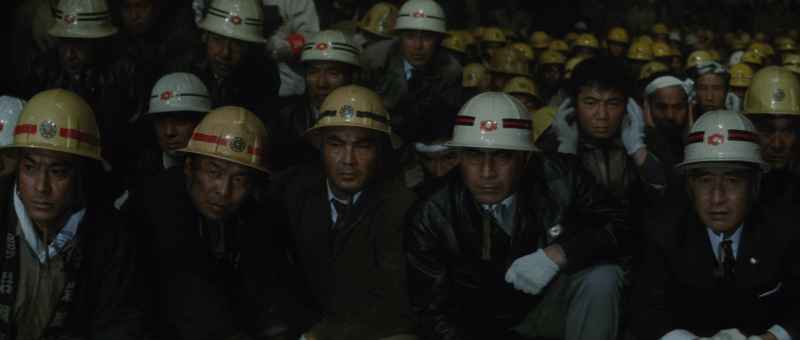
Kei Kumai’s three-hour epic of human engineering The Sands of Kurobe (黒部の太陽, Kurobe no Taiyo) opens with a titlecard to the effect that the film testifies to the courage of the Japanese people who brought the nation back to life after the war. Partly produced by Kansai Electric Power along with the production agencies of stars Toshiro Mifune and Yujiro Ishihara, the film is therefore somewhat conflicted, part bombastic celebration of Japanese engineering skill and ambivalent critique of the wilful decision to place success above all else including the welfare and safety of ordinary workers.

This critique is most evident to the flashbacks to the construction of Kuro 3 in 1938 which as many point out was conducted by the military under brutal and primitive conditions. The construction of the new Kurobe hydroelectric dam, by contrast, is a much more modern, enlightened affair in which workers have proper equipment and are not simply hacking at rocks with pickaxes wearing only a vest. But then as the conflicted Takeshi (Yujiro Ishihara) points out, it’s all effectively the same. Just because no one is pointing a gun at their heads, it doesn’t mean the men actually building the dam aren’t being exploited rather simply pressured by a vague notion of national good that they should be ready to lay down their lives. Could it be that “prosperity” is worse thing to die for than “patriotism”, especially when it appears as if your employer cares little for your physical wealth and economic wellbeing simply pledging that they will support the families of men killed during the dam’s construction. 

That there will be deaths seems inevitable. The man placed in charge of building a tunnel through the mountain, Kitagawa (Toshiro Mifune), is haunted by the vision of a man falling from a cliff that he witnessed when they first hiked to the dam site. He originally described the project as “crazy” and wanted to resign but was convinced to stay on. Kitagawa is himself fond of insisting on safety first where others are minded to cut corners, but also troubled by domestic issues in the film’s sometimes insensitive use of his daughter’s terminal leukaemia as a mirror for the dam project in considering what is and isn’t possible through human endeavour. The suggestion is that Kitagawa wants to believe the miracle of the dam is possible because needs to keep believing in a scientific miracle that can save his daughter, though obviously even if it is ultimately possible to build this dam that’s designed to fuel the post-war rocket to economic prosperity there are limits and unfortunately decades later we have still not found a cure for cancer though treatment may be more effective. 

Takeshi meanwhile has a similar battle with his hard-nosed father whose devotion to the dam project he describes almost like an addiction, suggesting that he values nothing outside of tunnelling and is willing to sacrifice everything in its name including the lives of himself and others. A flashback to to 1938 reveals that he asked his own teenage son to place dynamite and inadvertently caused his death though lax safety procedures which is the understandable reason why his wife eventually left him taking Takeshi with her. But the strange thing is for all his original opposition, Takeshi too is later captivated by the immensity of the challenge if also wary that the workers are falling victim to the same sickness as his father and are still being exploited by those like him who expect them to offer up their lives while paying them a pittance and complaining when the project does not proceed along their schedule. 

The almost nationalistic, bombastic quality of the film seems at odds with some of Kumai’s previous work save the discussion of the building of the 1938 tunnel though this largely serves as a contrast to imply that this time is different because they’re doing it for love of country rather the forced patriotism of the militarist past. Kitagawa justifies himself that if they don’t build the dam, economic prosperity will stall, companies will go bust, and people will lose their jobs but it seems somewhat hollow in the knowledge many men are certain to die while building this dam. Kumai undercuts the bombast with a series of scenes shot like a disaster movie in which supports collapse and the tunnel floods, or men are hit by falling rocks, eventually closing on an ironic Soviet-style statue dedicated to the labour of the workers that seems to question the immense loss of life along with the destruction of the natural beauty of Mount Kurobe but cannot in the end fully reconcile himself, torn between a celebration of human endeavour and its equally human costs. 


Original trailer (no subtitles)
Here Because of You (君たちがいて僕がいた, Ryuichi Takamori, 1964)

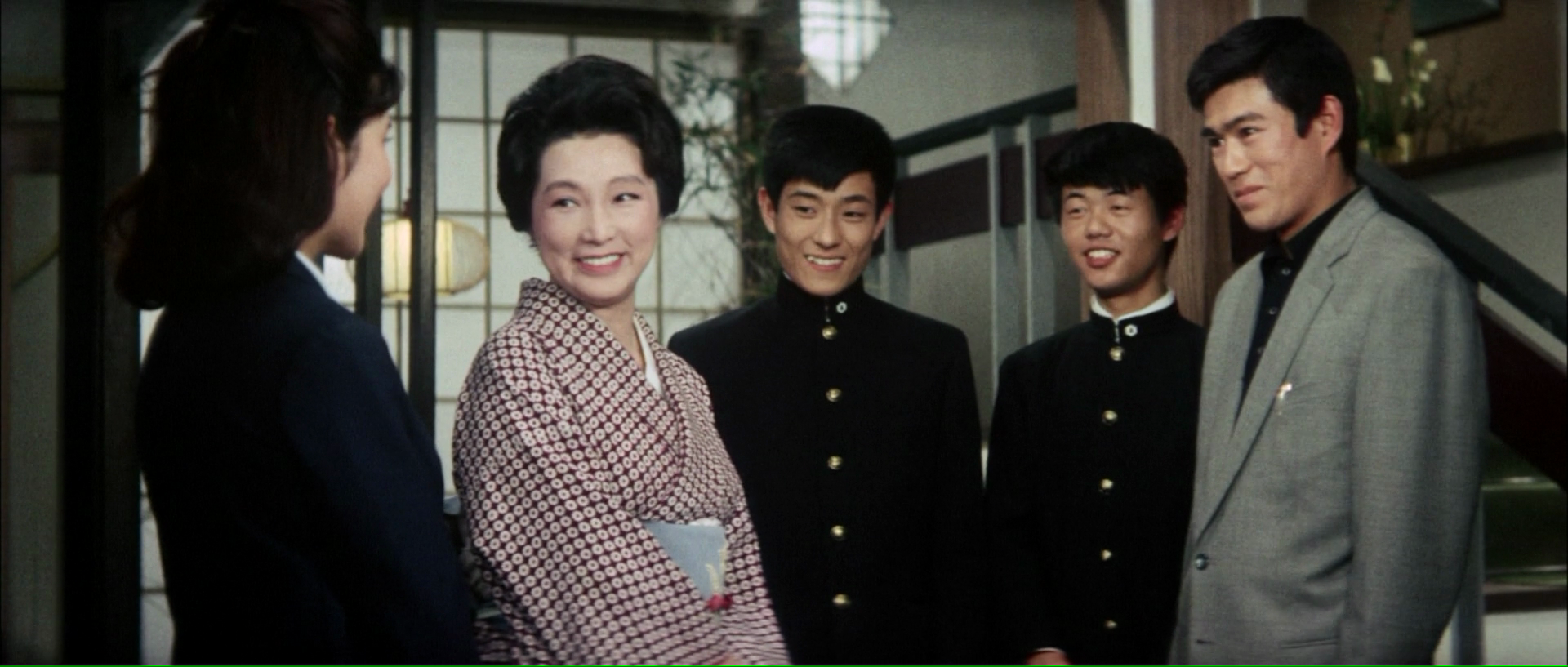
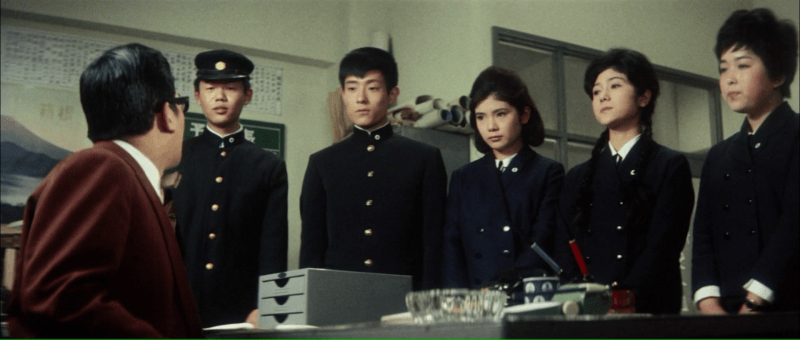
“The strength of our modern generation is that we never let anything get us down, and we’ll go after what we want without a moment’s hesitation.” The heroine of Ryuichi Takamori’s cheerful teen comedy Here Because of You (君たちがいて僕がいた, Kimitachi ga Ite Boku ga Ita) encapsulates a sense of post-war youth while trying to convince a sullen friend to join her in standing up to injustice when their teacher is smeared in the press, but he for his own reasons remains indignant and defeatist certain that nothing they do will make any difference. 

Essentially a vehicle for Toei teen stars Chiyoko Honma and Kazuo Funaki, the film is like many similarly themed youth movies of the time a progressive appeal to a new generation intent on rebelling against the social conservatism of their parents along with the injustice and inequality that accompanied it. The villain of the piece is the father of one of the students, Akira (Masaaki Sakai), who has become wealthy and is intent on throwing his weight around. Tanaka (Ken Sudo) wants his son to go to the best university in Japan and does not take kindly to the advice of his teacher, Mr. Yamabuki (Sonny Chiba), that Akira is just not up to it academically and putting so much pressure on him to achieve something which is almost certainly beyond him will only make the boy suffer. 

Akira is one of those kids with his head in the clouds who isn’t particularly good at anything. School is in general a torture for him and he himself knows that Tokyo University is not a possibility though he’s prepared to do his best if only his father would lower his expectations and let him apply to a college that is more within his capabilities. Both Tanaka and Mr. Yamabuki are however partially at fault when Akira is injured during a PE lesson that he was supposed to be excused from, Tanaka having told him not to participate in sports but to spend the lesson doing extra study instead. Mr. Yamabuki had thought that Akira had just not been applying himself, but a combination of a lack of physical agility due to being kept off PE and being encouraged to push himself further than he should lead to him falling from some climbing bars and spraining his ankle.

As might be expected, Tanaka is not happy and even asks for a second opinion on his son’s minor leg injury while deepening his grudge against Yamabuki. Tanaka also has a minor grudge against fellow student Hiroshi (Kazuo Funaki) who threw a bucket of frogs at him (to which he is allergic) for reasons Hiroshi doesn’t fully understand after hearing him kick off about Akira’s college prospects. It’s Hiroshi who fulfils the role of rebellious youth in the angry impulsivity that he often cannot explain. He’s been saying he doesn’t want to go to college but it’s because his older sister was forced to leave education during in middle school because of the family’s poverty and has become a geisha in order to pay for his tuition. Yamabuki and Hiroshi’s sister Yukiko (Junko Miyazono) develop a fondness for each other while discussing Hiroshi’s education, and it’s this suggestion of there being some impropriety in a schoolteacher dating a geisha that Tanaka takes to papers in effort to get Yamabuki fired. 

Meanwhile, Hiroshi’s cheerful classmate Chieko (Chiyoko Honma) has also developed a crush of Yamabuki. Claiming that she intends to marry him, she goes so far as to turn up at his house and insist on doing his laundry but he quite reasonably tells her that as an adult man his wife would have to be an adult woman. Surprisingly, she gets over it quite quickly and realises that Hiroshi is a much better match for her instead, but nevertheless springs into action when Yamabuki is unfairly smeared in the press. Even she is originally scandalised by the suggestion that her long widowed mother (Mieko Takamine) may have feelings for a local doctor (Shuji Sano), but soon comes round to the idea that there’s nothing wrong with it if she has just as there’s no problem with a teacher dating a geisha. She claims she would be more offended if each of them were forced to deny their feelings for each other because of social propriety and is intensely annoyed by the network of local corruption she uncovers in investigating the origins of the false news report which also suggests Yamabuki may have been inappropriately carrying on with a student, presumably herself. 

As chairman of the parent teacher association, Tanaka tries to railroad the headmaster into firing Yamabuki by holding a kangaroo court at which Yamabuki is prevented from speaking in his own defence all while his character is assassinated. But the kids, who previously witnessed a drunken Tanaka harassing Yukiko, aren’t having any of it and abandon their lessons to surround the meeting vowing that they’ll go on hunger strike if they aren’t listened to which won’t look very good in the national papers. What they bring about is a kind of democratic revolution in which the corrupt authority of Tanaka is deposed in favour of the more evenhanded chairpersonship of Chieko’s grandmother who turns out to be the oldest person in the room at 63. The children will not be ordered around or told what to think and will stand up to injustice where they find it, which is very bad news for those like Tanaka who are used to getting their way because of their privilege and social status. It’s all very wholesome and innocent, perfectly in keeping with the zeitgeist while remaining cheerful and upbeat even with Hiroshi’s continued brooding until Chieko finally manages to win him over. A charming teen musical adventure with a handful of songs performed by its idol stars, the film’s infectious energy is difficult to beat.


Song of the Flower Basket (花籠の歌, Heinosuke Gosho, 1937)

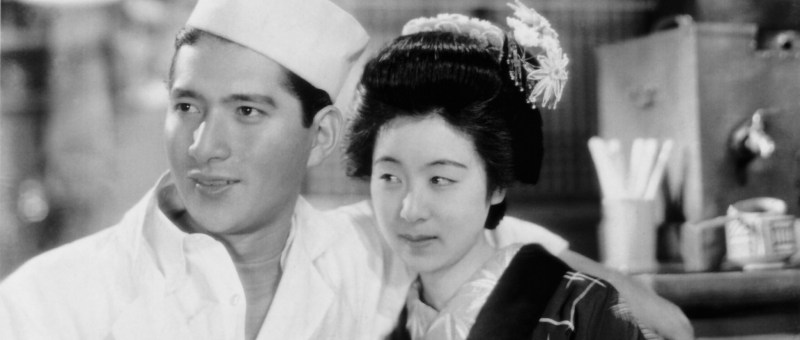
The daughter of a tonkatsu shop finds herself with an overabundance of suitors in Heinosuke Gosho’s generally cheerful yet occasionally dark melodrama Song of the Flower Basket (花籠の歌, Hanakago no Uta). Adapted from a novel by Fumitaka Iwasaki and scripted by Kogo Noda, the film finds its heroine caught at a moment of social change as she battles her snooty aunt for the right to decide her romantic future while her impoverished student boyfriend does something much the same in defying his family’s attempts to micromanage his life dreaming of the bright lights of Ginza. 

Yoko (Kinuyo Tanaka) is the “kanban musume” of her father Keizo’s (Reikichi Kawamura) pork cutlet restaurant, attracting customers with her charm and beauty while the Chinese chef her father brought back with him from Shanghai, Lee (Shin Tokudaiji), is the culinary star. Lee is secretly in love with Yoko whom he continues to refer to largely as “the young lady” and has long been writing an ode in her honour. Yoko meanwhile is in love with a penniless student, Ono (Shuji Sano), who at the beginning of the film has just returned home after visiting his family whom he has alienated by declaring that he doesn’t want to work in an office in the country while refusing an offer to marry into another family as an adopted son-in-law. The reason for this is less his pride than his desire to stay in Tokyo amid the bright lights of Ginza, sighing as he looks out into the neon-lit night gazing at adverts for Club Hamigaki toothpaste and Meiji Chocolate. The second reason may also be that he’s fallen for Yoko but given his precarious financial situation and lack of prospects does not quite dare to imagine a future with her. 

He must however be serious as we later learn he’s given up going to hostess bars with his friends, a bar girl greeting him in the restaurant evidently not having seen him in ages asking where he’s been much to Yoko’s embarrassment. The encounter places a seed of doubt in her mind in a minor role reversal as she begins to resent Ono’s past irrationally annoyed by the idea he has dated other women. Meanwhile, at the memorial event marking 11 years since her mother passed away while working as a steward on a boat in Singapore, Yoko’s snooty aunt tries to set her up with an arranged marriage to an Osakan doctor who may or may not marry depending on the “negotiations” but has also been promised his own clinic by his wealthy parents if the marriage is confirmed. Okamoto (Toshiaki Konoe) has visited the restaurant to get a better look at Yoko making him the third suitor to encircle her even though the chief concern of the family is that Yoko is almost 24 and therefore ageing out of top tier matches.  

To his credit, Yoko’s father is fully in her corner trying to stand up to the domineering aunt who is definitely overreaching in trying to micromanage the romantic lives of her nieces in the absence of her sister. He determines to find out if Yoko has her eye on someone already to get the aunt off their backs, but the situation develops in an unexpected direction when Lee mistakenly assumes that she likes him back. Too shy to say himself, he advises Keizo to ask frequent customer and best friend of Ono, Hotta (Chishu Ryu), who is on track to become a Buddhist priest and take over the family temple, only Hotta obviously tells him, correctly, that Yoko is in love with Ono having completely forgotten that Lee had once confessed his feelings to him. 

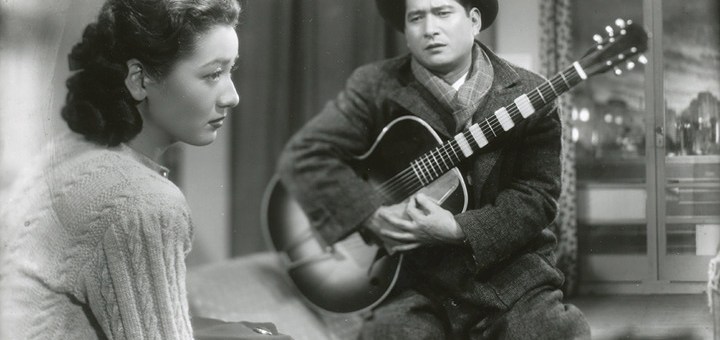
The film does its best to present a more positive vision an internationalist Japan even in 1937 despite the Aunt’s obvious disapproval of the family’s wandering past and is largely sympathetic of the lovelorn Lee yet implies that a romance between he and Yoko is so unthinkable that no one really considered the possibility that he may be in love with her himself even though it is incredibly obvious given his ongoing attempts to write a love song while he’s even torn out a picture of Yoko which appeared in a magazine and hung it on his wall. Yoko is oblivious to his feelings, believing that he is in love with their waitress, Oteru (Yaeko Izumo), who is indeed in love with him, and perhaps doesn’t appreciate the effect moving Ono in as a trainee chef will have on him both professionally and emotionally. The message that is emerges accidentally or otherwise is that Lee’s place at the cafe is insecure despite his skill being a large part of its success as he falls into a deep depression and eventually decides it’s too painful for him to stay. 

The revelations surrounding Lee further destabilise Yoko’s confidence in her choice of Ono whom she constantly doubts even suspecting he may have committed a violent crime when carted off by the police after newspaper reports stating the bar hostess he introduced her to earlier has been murdered in her apartment. Perhaps it’s normal enough to be uncertain if you’ve made the right choice in the early days of a marriage, but believing your spouse capable of murder is a significant stumbling block as is her final admission that she doesn’t really trust him and isn’t ready to accept his past with other women in a further reversal of their roles given he has now married into her family and taken her name. Nevertheless, the crisis seems to be repaired by her father’s simple act of ordering a round of beers making clear that he plans to celebrate and obviously still has confidence in Ono while preparing to adapt their restaurant to their new circumstances by branching out into sukiyaki. Expressing some of the anxieties of the 1930s from the precarious economy and uncertainty of the future to changing social mores as young people reject the traditional to craft their own romantic futures, Song of the Flower Basket nevertheless ends on a note of melancholy in the wandering Lee’s ode to loneliness and heartbreak under the neon lights of Ginza.


A Tale of Sorrow and Sadness (悲愁物語, Seijun Suzuki, 1977)

Famously, Seijun Suzuki was let go by Nikkatsu in 1968 after studio bosses became fed up with his apparently “nonsensical” filmmaking. Exiled from the film world, Suzuki made do with TV work before making his comeback with, rather surprisingly, a media satire based on a manga by Ashita no Joe’s Ikki Kajiwara. A Tale of Sorrow and Sadness (悲愁物語, Hishu Monogatari) is at once a dissection of the fluctuating class and social systems of a nation entering an era of high prosperity and a condemnation of the consumerist corruptions of a society increasingly ruled by celebrity.

It is in the corporate that the corruption begins. With mild overtones of cold war paranoia, Nichei Fabrics is alarmed that a rival firm has brought on a top Russian gymnast as a brand ambassador and is convinced they need to find someone who can steal her thunder. Fashion co-ordinator Tadokoro (Masumi Okada) comes to the conclusion that they need a homegrown star and decides to make one by grooming a promising lady golfer to become both a champion and a minor celebrity after achieving an underdog victory in a prestigious tournament. 

One might ask weather society at large is likely to take much interest in who wins the Japanese Women’s Golf Tournament, but then everyone loves an underdog victory and Tadokoro seems to think he can make them care through carefully managed media manipulation. Golf is also, of course, thought of as an upperclass pursuit beloved by a new class of salaryman despite its origins, as sportswriter Miyake (Yoshio Harada) describes them, as a pastime invented by farmers to stave off boredom. Reiko (Yoko Shiraki), Miyake’s girlfriend whom he is in a way agreeing to sell to Tadokoro, is ostensibly a working class woman raising her orphaned little brother who discovered a natural talent for golf while working as a caddy for veteran male golfer, Takagi (Shuji Sano), now her mentor. She is not, however, a natural media star, something not helped by the brand’s decision to photograph her wearing wedge shoes and eventually a bikini on the green to showcase their leisurewear which she otherwise would not necessarily be wearing during a regular golfing tournament. 

The colour green ironically becomes a kind of harbinger of doom, caught in the reflection of psychotic stalker housewife Kayo (Kyoko Enami) and later that of Reiko herself while she is otherwise offered sickly green cocktails or projected against predominantly green backgrounds. The house that Nichiei build for her comes with a tiny putting green that more resembles the catwalk it eventually becomes in the crazed bacchanal organised by Kayo in which she orders the other neighbourhood housewives to strip a near catatonic Reiko of the few clothes she is still permitted to wear. The early photo shoot marked the beginning of a gradual erasure of her identity and its replacement by Reiko the star, to Tadokoro, and Reiko the champion golfer to Miyake. 

Much of Reiko’s golfing technique seems to centre on a kind of cosmic ordering, insisting that she is one with the ball which will land exactly where she envisages it while ignoring her competitor’s attempts to make conversation with her warning that a golfer’s career is long and it’s a bad idea to offend ones seniors. A moment with her stylist is chilling its similarity as she’s told to believe herself happy so that she can smile for the cameras with the otherwise vacant look of a manufactured celebrity. She repeats these mantras to herself constantly even as her own personality is overwritten in part by Nichei fabrics and in part by Kayo who jumps in front of her car while Miyake is driving and thereafter blackmails her into almost total servitude. 

The other housewives had objected to Reiko’s presence in describing her as “low-class” and suggesting that she must be some man’s mistress because it seems unlikely to them that a pro golfer could earn the kind of money to buy a house in their neighbourhood. Their opinion of her is confirmed in their complaints about her noisy garage door, though in truth Reiko doesn’t own the house it almost owns her given that it is provided for her by Nichiei so she can get to the studio to film the daytime show they’ve created for her which mainly seems to be about fashion rather than golf which she now has almost no time to practice despite Tadokoro’s plan for her to participate in a high profile contest against a top American golfer. A classic curtain twitcher, Kayo is taken with the idea of having a celerity living next door and, already ostracised by the other housewives for being a little odd, worms her way into her life eventually deriving a quasi-sexual thrill in being able to manipulate a famous face. “I’m the only one who knows her hair’s not real!” she squeals watching Reiko on TV with her new wig after hacking her hair off as a means of punishment for hitting her with the car. 

Kayo might be, in another way, the true victim of this system. Her life is obviously materially comfortable, but she’s trapped in the role of the conventional housewife while largely ignored by her salaryman husband and, as they have no children, left on her own all day with nothing to do. When she tells Reiko that she’s lonely and just wants a friend, it goes someway to explaining her otherwise bizarre behaviour as it also does for Reiko who later chuckles when Kayo randomly asks her to sleep with her husband as a favour replying that’s it’s fine “because we’re friends”. Reiko’s body, often caught by Suzuki naked in classical poses, is misused by just about everyone from Kayo to Nichei to Miyake, leaving her little more than a grinning mannequin completely hollowed out and devoid of all individuality. 

In some ways, Kayo’s decision to invite the neighbourhood women into Reiko’s home, letting them try on her clothes, drink her booze, and generally jump all over her nice new life, could be seen as an attack on everything she represents by these otherwise conservative women who resent her class transgression and independent success. Yet it’s also a very personal act of self-destruction in erasing this image of herself through that of Reiko which she has equally created. It’s another kind of self-destruction that ends the film and may be another kind of bid for freedom, an attempt to free Reiko from psychological disintegration at the hands of the consumerist society until it all quite literally goes up in smoke. A tale of sorrow and sadness indeed, Reiko is eventually consumed by the consumerist society, a little ball hit into its hole and unable to climb out, while the flames rise all around her.  


A Tale of Sorrow and Sadness Japan Society New York on Feb. 11 as part of the Seijun Suzuki Centennial.

Original trailer (no subtitles)
A Hen in the Wind (風の中の牝鶏, Yasujiro Ozu, 1948)

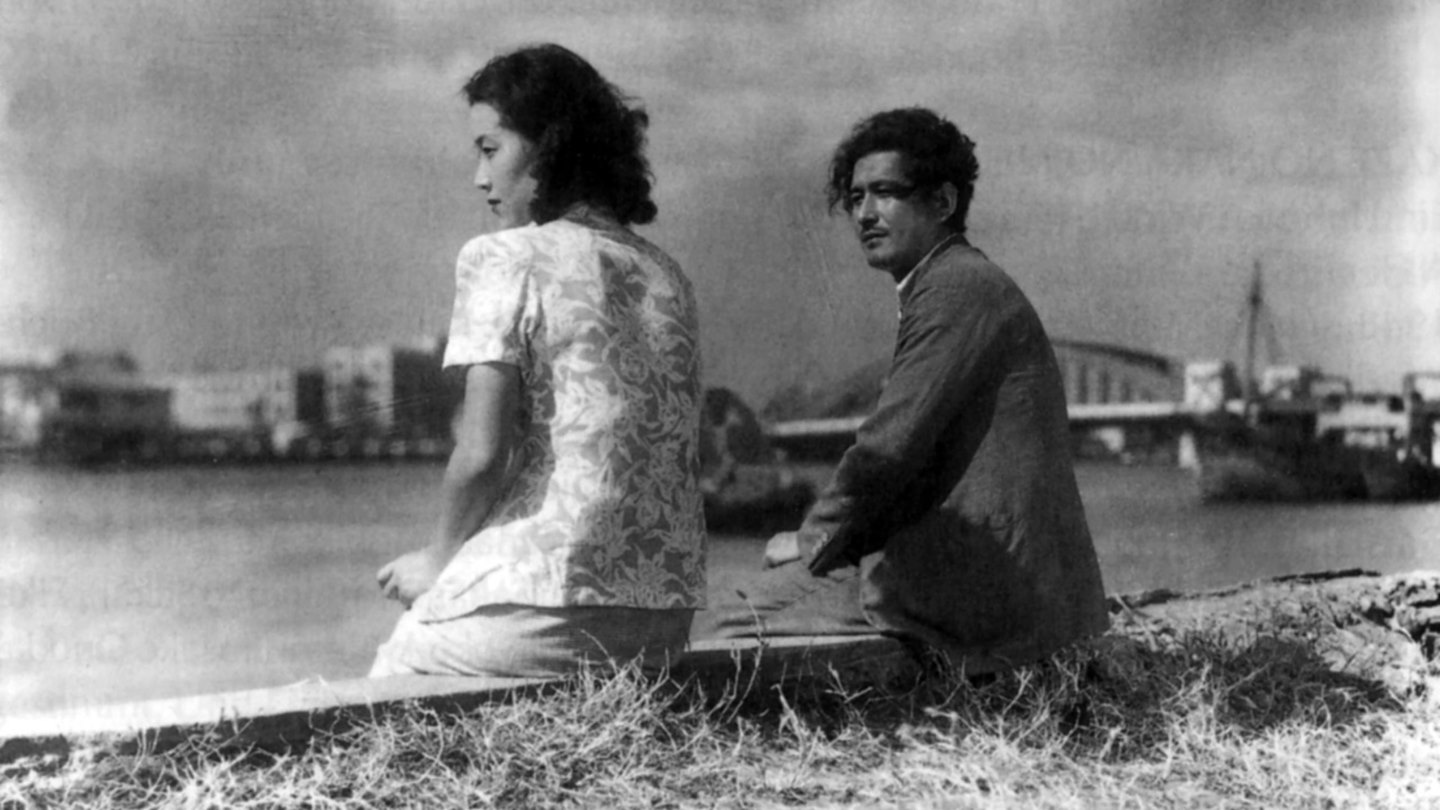
Sometimes melancholy as he might have been, the cinema of Yasujiro Ozu leans toward the wholesome. His families may experience crises, but they are good people who have generally learned how to be cheerful in the face of adversity. 1948’s A Hen in the Wind (風の中の牝鶏, Kaze no naka no Mendori), however, is unusually dark though perhaps not inappropriately so as it tries to make sense of a painful moment in time by re-envisaging it in terms of a marriage. 

Set very much in the immediacy of the contemporary era, the film opens ominously with an intimidating policeman taking a local census which introduces us to Tokiko (Kinuyo Tanaka) who lodges in the upstairs of a small, run-down building along with her young son Hiroshi while her husband Shuichi (Shuji Sano) has not yet returned from the war. Times are tough for everyone, and Tokiko is finding it increasingly difficult to make ends meet with her seamstressing job as prices rise everywhere. She’s down to her last kimonos which she asks an old friend, Akiko (Chieko Murata), to help her sell. Akiko turns to broker/madam Orie (Reiko Mizukami) who feigns exasperation to advise that a pretty woman like Tokiko, still comparatively young at 28, could make more money in her line of work. Akiko is offended on her friend’s behalf and the two laugh it off together, but when Hiroshi suddenly develops colitis and needs to be admitted to hospital Tokiko is left with no choice but throw herself on the mercy of Orie. 

Akiko scolds her friend, hurt that she didn’t come to her first and disappointed that she has chosen to degrade herself. Tokiko is sorry too, worried that if she had asked Akiko for the money she’d have found a way to get it even if she had none to spare and Tokiko would rather carry the burden herself. She wonders if she made the right choice. There was still furniture she might have been able to sell, but she wanted to keep it so that her husband would have a home to come home to. What else could a mother with a sick child do? This way at least she got the money quickly and Hiroshi recovered. It was a one time thing already in the past and no one needs to know. The friends agree to put it behind them as just another minor humiliation of life in the immediate post-war period. 

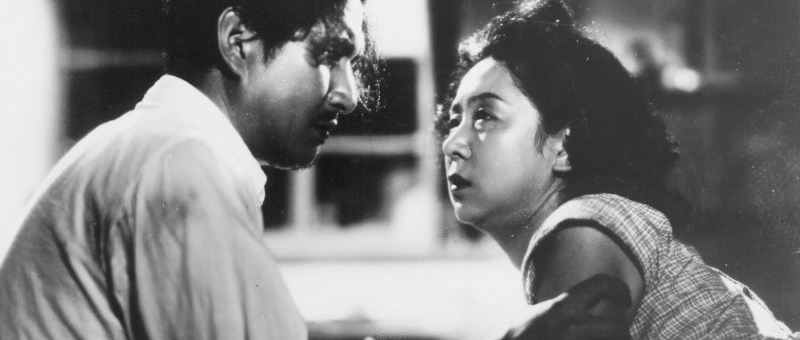
And then less than a month later Shuichi returns. The joyful reunion is disrupted when he idly asks about Hiroshi’s health and then becomes fixated on how Tokiko managed to pay the hospital bills. She doesn’t want to lie and would rather there be no secrets between them so she tells him the truth. Shuichi does not take it well. He tries to readjust to their married life but finds himself consumed with rage and unable to sleep. Intellectually, he knows his wife had no choice given the situation she was in and in one sense does not blame her but in the other he cannot accept it. 

Tokiko’s transgression undermines his fragile sense of masculinity in every possible way. He feels partly responisble. He wasn’t there to protect her because he was away at the war. If he’d returned a month earlier, she wouldn’t have needed to make such a sacrifice. Unlike many late returning soldiers, Shuichi walks straight back into his old job, easing the family’s financial hardship even as its harmony is strained by his ongoing resentment. Shuichi cannot help making this all about him. His wounded pride, his broken future, his romantic disappointment. He becomes obsessed with the idea of his wife defiled, insisting on tracking down the brothel where Orie brought her to ask if it really was just the one time while exploring the business for himself.

While schoolchildren sing cheerful folksongs in the playground behind, Shuichi talks to a 21-year-old who has only contempt for customers like him who ask too many hypocritical questions. She explains the she didn’t choose this sort of work, it’s the only way she can support her family, once again, ironically, because of a male failure in this case her father being unable to provide for them while her mother has passed away. Shuichi didn’t come for the full service, and so he eventually leaves, discarding money as he goes partly out of pity and partly in atonement. He runs into the girl again later and even shares her lunch during which he talks to her in a more fatherly fashion, encouraging her that she is not ruined and still has the right to strive for a brighter future. To further prove his point, he commits to finding her an “honest” job, asking with his friend at the company who is sympathetic and also wants to help. Only, his friend can’t understand. If Shuichi can sympathise so much with this young girl why can’t he forgive his wife who, to his mind, has done nothing wrong? 

Tokiko is perhaps a symbol of the pure Japan debased by the male violence that is militarism. Shuichi has come home from the war but carrying trauma of his own which he projects onto the loyal self-sacrificing wife who waited patiently for his return. Yet Tokiko blames herself, she begs him to beat her, hate her, only not to leave and not to be unhappy. Shuichi only comes round after accidentally pushing her down the stairs in a rare moment of shocking domestic violence totally unexpected in an Ozu movie (even if not quite unique). Suddenly overcome with post-war humanism, Shuichi forgives his wife essentially giving her the same speech he’d given to the girl only with greater emphasis. Life is long and their path is hard. They need to “be more accepting and love one another”, “conquer hardship through laughter and trust”, so that they might have a “true marriage”. Tokiko’s redemption, and perhaps that of her nation, is dependent on the former soldier Shuichi’s forgiveness, and of her acceptance of it, rather than a recognition of her blamelessness. In any case, a line has been drawn. The future starts now and it’s going to be a better one built on compassion and mutual forgiveness rather than selfishness and resentment.


A Hen in the Wind screens at BFI Southbank on 10th/14th September as part of Kinuyo Tanaka: A Life in Film

What Did the Lady Forget? (淑女は何を忘れたか, Yasujiro Ozu, 1937)

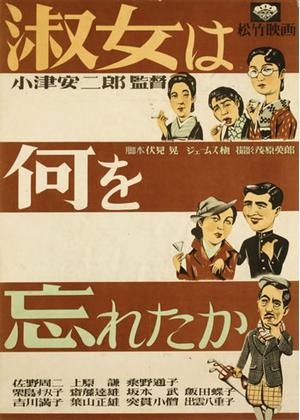
Japan was in a precarious position in 1937. Ozu’s What Did the Lady Forget? (淑女は何を忘れたか, Shukujo wa Nani wo Wasureta ka) was released in March of that year but by July the Second Sino-Japanese War would be in full swing and on the home front increasing censorship would render this kind of inconsequential comedy a much less easy sell. True enough, the film includes no “patriotic” content though it does eventually reinforce a set of patriarchal values in the remasculinisation of a henpecked husband while quietly sniggering at a new bourgeois social class.

The drama unfolds in the home of a medical professor, Komiya (Tatsuo Saito), and his austere wife Tokiko (Sumiko Kurishima). The couple have no children and mostly lead separate lives. Tokiko spends her days with two close friends, widowed single-mother Mitsuko (Mitsuko Yoshikawa), and wealthy older woman Chiyoko (Choko Iida) who is married to her husband’s friend, Sugiyama (Takeshi Sakamoto). The three women gossip about the usual things from fancy department store kimonos to new ways to laugh so you don’t get wrinkles along with the bizarrely difficult maths problems Mitsuko’s son has been studying in preparation for middle-school that none of them can answer. To help with the embarrassingly taxing homework, Tokiko offers to find a tutor, press-ganging her husband’s best student, Okada (Shuji Sano), into spending time with Mitsuko’s son Fujio (Masao Hayama) though it turns out that he too, a college graduate, is unable to solve these middle-school level problems. 

The real drama occurs when the couple’s neice, Setsuko (Michiko Kuwano), whom Tokiko had described as “proper” and “wholesome” rocks up from Osaka having become the epitome of a modern girl. Setsuko’s arrival further strains the Komiyas’ already fraying relationship as her surprising habits which include driving, smoking, drinking, and hanging out with geisha, continue to exasperate her aunt whose main objection to all of those things is that they aren’t appropriate because Setsuko is not yet married. To get away from his nagging wife who forces him to go golfing as usual when he doesn’t really want to, Komiya stashes his clubs with Okada and goes to a bar in Ginza where he meets Sugiyama who has also been forced outside by his wife. Sugiyama really does go golfing, promising to mail a previously written postcard to Tokiko on Komiya’s behalf, while he is eventually joined by Setsuko who has tracked him down to the bar despite being told to stay home and mind the house (the Komiyas have two live-in maids so the instruction seems unnecessary at best).  

As a “modern gal” Setsuko has some strangely old fashioned ideas even as she behaves like a 1930s ladette, striding around like man while drinking, smoking, and generally being almost as intimidating as Tokiko just in a more likeable fashion. Setsuko finds Komiya’s deferral to his wife embarrassing, encouraging him to be more masculine and stand up for himself even advising that he use violence to reassert his position as the man of the house. He seems uncomfortable with the idea but eventually does just that after a climactic argument once his lying about the golf and Setsuko’s nighttime adventures have been exposed. Caught in a moment of frustration, he slaps Tokiko across the face, leaving her to retreat in shock apparently “beaten”. The thing is, however, Tokiko likes it. She sees his slapping her as a sign of his love, as if she’s been needling him all this time in hope of a reaction while frustrated that perhaps he doesn’t care for her. Once he hits her, the marriage is rebalanced and repaired with traditional gender dynamics restored. She becomes more cheerful and deferent to his male authority, he acknowledges that he enabled her “arrogance” with his weakness as a man.  

Setsuko however, continues to shout at her uncle, disappointed that he apologised for his reaction and accusing him of giving away the victory he’d just won. He tells her that he’s simply using reverse psychology because wives like to believe they’re in charge and in the main it’s best to let them. Setsuko seems satisfied, but jokes with her new love interest Okada that he better not use reverse psychology on her. Or, he can, but she’ll just use reverse reverse psychology to get the upper hand, which perhaps undercuts the central message in praise of traditional gender roles. Nevertheless, What Did the Lady Forget? is full of Lubitschy late-30s charms from an unexpected sighting of real life star Ken Uehara at the Kabuki to Setsuko’s movie magazines featuring Marlene Dietrich and repeated references to Frederich March and William Powell proving that Ginza is open even in 1937, while the Komiya household descends into an oddly peaceful harmony of delayed marital bliss. 


Currently streaming in the UK via BFI Player as part of Japan 2020. Also available to stream in the US via Criterion Channel.

An Inn at Osaka (大阪の宿, Heinosuke Gosho, 1954)

inn at osaka cap 2Heinosuke Gosho may be most closely associated with the Chekhovian interplay between laughter and tears, but what are you to do when life is so unutterably miserable that levity seems almost offensive? By 1954, many might have assumed that society was on the way to recovery, that the promises of the new democracy so proudly affirmed in the post-war constitution would be available to all paving the way for a freer and fairer society. Of course, that wasn’t quite the case and many found themselves trapped on the periphery of the burgeoning economic miracle in which unemployment was high and the bitterness of the times had led many to believe that human decency was a luxury they couldn’t afford.

Made a year after his renowned masterpiece Where Chimneys are Seen, An Inn at Osaka (大阪の宿, Osaka no Yado) is a much less cheerful affair in which suicide and degradation linger permanently on the horizon. The hero, Mita (Shuji Sano), has been exiled from Tokyo, demoted to the Osaka office after slapping his boss in argument over immoral business practices. Much reduced in circumstances, he has been unable to find a lodging house that suits his budget, the local barman lamenting that these days most of the hotels in the area have been co-opted by sex workers. Just at that moment, a dishevelled old man pops up and says he knows of a good place where the rent is reasonable and the innkeeper kind. As you might expect, it turns out that he works there. The innkeeper is his sister and though she is not particularly nice, the place is warm and friendly with three kindly maids – Orika (Mitsuko Mito) who is constantly pressed for money by her no-good husband, Otsugi (Hiroko Kawasaki) who is forced to live apart from her son, and “modern girl” Oyone (Sachiko Hidari) who is much younger and having a fling with the inn’s other longterm resident, Noro (Jun Tatara), a sleazy gentleman who likes to throw his weight around because he co-signed the loan on the hotel.

In one sense, the city of Osaka itself is being painted as a “fall” from sophisticated Tokyo, an earthier place where people do what they have to to survive. This Mita learns to his cost when drunken geisha Uwabami (Nobuko Otowa) picks up his “luxury English-made blanket” and peels off a thread which she burns to expose its smell. Wilier than the innocent Mita she tells him he’s been had, lamenting that it’s “Osaka’s shame” that they wilfully trick people from Tokyo. Mita is irritated, slightly hurt and embarrassed to have been deceived, but affirms that it hasn’t damaged his views on Osaka because in the present society everyone is being cheated by someone somewhere. In any case, he allows himself to be bamboozled by the innkeeper’s brother (Kamatari Fujiwara) into tracking down the teenage girl who sold it to him, Omitsu (Kyoko Anzai), who seems upset, explaining that she bought the blanket in good faith and has been tricked herself. During their visit, Mita notices that they’re in the middle of some sort of shamanistic ritual over the sickbed of her ailing father and feels pity for her but stops short of cancelling the debt there and then.

Not cancelling the debt even though he can see Omitsu never meant to trick him and cannot afford to pay him back, is part of his rather sanctimonious rebellion against the immoralities of the post-war society. He feels wronged and thinks that getting the money back for the blanket will somehow put things right, but like many of his attempts to help those in need it eventually backfires. Mita is a good man, compassionate and honest, but he’s also disappointingly conservative in ways he hasn’t quite realised. Uwabami, who has fallen in love with him, later chides Mita that he is like a star looking down on everything from above. He doesn’t quite understand what she means, failing to grasp that what she’s telling him is that though she can see that he cares, he has a tendency to view himself as somehow “better” than the world around him and lives in silent judgement of those he believes to be fundamentally different from himself.

After a brief argument, Uwabami confesses that she feels trapped and miserable in her impossible geisha existence, just trying to make enough money to survive when too old to ply her trade. She can’t quit because she’s responsible for her whole family – her younger brother has just been laid off from his railway job and his children will go hungry without her money. She provokes Mita a little, chastising him for not caring about her on a human level only for Mita to counter that he likes her but they live in “different worlds”. Disappointed, she laments that she thought they were the same, realising that Mita’s conception of the world is defined by ideas of middle-class respectability and that he views her as occupying a lower order, forever walled off from “decent” people like himself. Though he treats her warmly and regards her as a friend, there can never be anything more between them than that.

Omitsu later shows him something similar. Having scraped together some of the money to pay him back, she arrives at the inn only for Mita to try to refuse it. Otsugi offers her some sewing work for Noro who later takes advantage of her, gossiping with the maids that she was a “bargain”. To make matters worse, Omitsu gets caught on the way out and is berated by the innkeeper for bringing the hotel into disrepute. Mita starts to feel guilty. This is, after all, largely his fault – he pushed her about the blanket out of pettiness and brought her to the inn where she has debased herself to get back the money he took from her. He tries to return it but it’s already too late. “Why do you always insist on being good?” she asks him, partly offended that he won’t take her money because he now thinks it’s tainted by immorality. “I just want to trust in people” he tells her, beginning to realise that his well-meaning gesture is both patronising and futile because if he’d really cared about helping Omitsu, he could have done it before.

Mita is good person, but like everyone else he’s flawed and human. He genuinely wants to help, for the world to be better than it is, but in his goodness allows himself to be self-involved and insensitive. The reason he didn’t get fired from his job even for so great a transgression as slapping the boss, is that his grandfather founded the company. In an effort to break with the past, he decides to sell his grandfather’s expensive French pocket watch, but retains the chain as if unable to definitively sever the connection to his privilege. To prove that he’s done it for symbolic and not financial reasons, he spends the money taking Otsugi and Orika on a day trip to Osaka castle after Orika declines his offer of money of which she is in desperate need.

“Money’s everything, what happened to humanity?” Mita asks himself, still not quite aware of his position within the system. Mita refuses to conform to the demands of the post-war era as exemplified by his boorish boss who sneeringly asks if he’s a “socialist” while dismissing him as an “intellectual” and doing illicit backroom deals to get ahead, but he does so largely passively and with little more than resentment. At his farewell dinner, he reflects that had he not come to Osaka he might have quit his job but now he’s determined to stay and try to make things better. There might be something a little sanctimonious in his new found fire born of living among the poor now he’s on his way back to Tokyo, but he has perhaps awakened to his failings and is resolving to do better.

Meanwhile, the innkeeper finds the strength to break with the odious Noro, but unlike Mita decides to throw herself into the abyss of modernity by turning the hotel in a rent by the hour kind of place complete with Western beds and tacky decor. She too feels there are two kinds of people, refusing Otsugi time off to see her son, barking that “a dog doesn’t forget what it owes its master”, while Otsugi remains powerless, aware she’s entirely out of options as a young widow in the cruel post-war economy. Orika too gives up on changing her life after finding herself unable to separate from her no-good, drunken, violent, husband, while Oyone alone seems excited by the new job possibilities at the inn, and Omitsu, despite having coldly exclaimed that she’d do whatever it takes to survive, throws herself into “honest” work, unable to attend Mita’s leaving do because now her life is one of ceaseless industry which provides her no opportunity for rest. “None of us can say we’re really happy”, Mita laments, “let’s have the dignity to laugh in the face of unhappiness”. Everybody’s tired, everybody’s disappointed and afraid, but they haven’t lost their humanity and when there’s really nothing else, all you can do is laugh. 


Short clip (no subtitles)

Spring Dreams (春の夢, Keisuke Kinoshita, 1960)

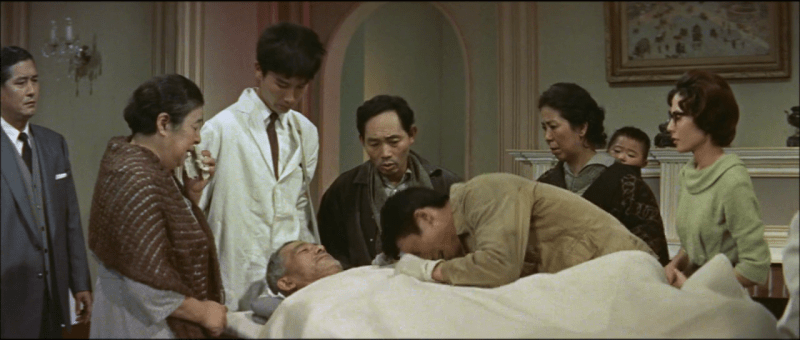
vlcsnap-2019-01-10-00h23m29s867Let them eat sweet potato? The heartless bourgeoisie at the centre of Keisuke Kinoshita’s absurdist satire Spring Dreams (春の夢, Haru no yume) have found themselves accidentally engulfed by the revolution which seems to be attacking them on every front including from inside their palatial, Western-style mansion. Things are about to change in the Okudaira world, but then again maybe not all that much.

The Okudairas are the owners of a large scale pharmaceuticals firm. Widowed patriarch Shobei (Eitaro Ozawa) is the CEO, but he’s at the constant mercy of his mother-in-law (Chieko Higashiyama) who acts as the guardian of the family business’ legacy. Meanwhile, he has three problematic children – oldest daughter Tamiko (Yatsuko Tanami) who has become a promiscuous playgirl with a taste for “mothering” college students, Chizuko (Mariko Okada) who is the only “normal” one in the house and has fallen in love with an impoverished painter, and Mamoru (Yusuke Kawazu) who is a kind of melancholy Hamlet waxing on his existential angst while eating everything in sight.

Into this already strained household comes the unexpected figure of sweet potato salesman, Atsumi (Chishu Ryu). With the house empty for a change, romantically conflicted maid Umeko (Yukiyo Toake) calls one of her boyfriends down at the fish shop to get the potato guy to come round. Kimiko (Meiko Nakamura), the other maid, goes out to pick some up but ends up flirting with a delivery boy so sends Atsumi inside where Umeko ropes him into helping shift some furniture which is how he ends up having a minor stroke in the Okudaira’s living room. Luckily for Atsumi, the person who finds him is Shobei’s compassionate spinster secretary, Kazuko (Yoshiko Kuga), who has some sad experience in this area as her father passed away after a stroke when she was a teenager, they say because someone moved him too early. A visit from the family doctor (Shuji Sano) backs up her advice and Atsumi will be staying put in the living room for the foreseeable future.

Of course, this doesn’t go down well with most of the Okudairas. Shobei wants him gone but what can you do? Atsumi stays because on balance it would be awkward if he ended up dying and staining the Okudaira name. Sadly, greed and indifference are not unique to the bourgeoisie as we discover when a parade of “well wishers” from Atsumi’s tenement house begin showing up to see how he is. Aside from the kindly, filial Eiichi (Shinji Tanaka) who has taken time off work to look after the old man, everyone else thinks Atsumi’s time has come. They know his tragic history, that he’s all alone now since both his sons were killed in the war and the rest of his family lost in the bombing. They want to get in with him to be remembered in the will, or even get their hands on his wallet for something like an advance. Poor old Atsumi is just an object fit for exploiting – a symbol of the Okudaira’s largesse, and of a potential windfall when the inevitable happens.

Meanwhile, the winds of change are blowing. Shobei is tied up with a labour dispute at the factory, obsessed with the idea of crushing the unions while the workers’ rousing chorus of the Internationale echoes ever more loudly in the distance. Grandma advises “just fire them all”, but things aren’t as easy as they were back in Meiji. Grandma thinks Shobei is a bit useless, especially since her daughter died and he’s been allowed to get off easy. She needs to find a successor seeing as Mamoru’s too weird to take over which means one of the girls needs to get married. Tamiko’s ruled herself out thanks to her eccentric love life, which leaves only Chizuko who wants to marry a painter and has no real interest in saving the family business. Chizuko is determined to oppose the idea of an arranged marriage, she’s a post-war girl after all, but grandma is firm. When she was a girl they made her give up on her first love, who happened also to be named “Atsumi”, to marry an Okudaira and so Chizuko is merely being unreasonable.

Nevertheless the presence of Atsumi begins to soften grandma’s heart with memories of her youth and the cruelty with which her youthful dreams were stripped away. Love blossoms in the cold Okudaira mansion, genuine bonds between people are recognised while the opportunist are rejected, and the young regain their freedom from the old who now recognise how destructive the old order could be. Will the house of the Okudaira’s fall? Probably not. Revolutions don’t take hold over night, but greed at least is on its way out paving the way for a better, kinder future for all.


Titles and opening (no subtitles)

Here’s to the Young Lady (お嬢さん乾杯!, Keisuke Kinoshita, 1949)

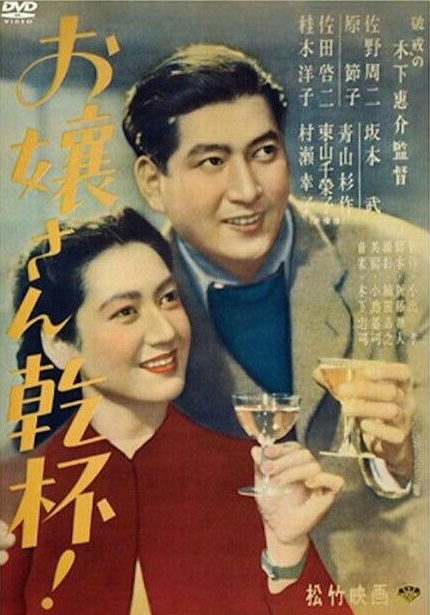
Here's to the young lady DVD coverLove across the class divide is a perpetual inspiration for melodrama, but what if the problem is less restrictive social codes and more emotional inertia and frustrated desire? Many things were changing in the Japan of 1949, racked by post-war privation and burdened with a scrappy desire to remake itself better and kinder than before. Keisuke Kinoshita, the foremost purveyor of post-war humanism, looks back to the 1930s for his 1949 cheerfully superficial romantic comedy Here’s to the Young Lady (お嬢さん乾杯!, Ojosan Kampai!). A tale of changing social codes and youth trying to find the courage to break free, Kinoshita’s easy romance is as breezy as they come but also hard won and a definitive step towards the freer, fairer world he so often envisages.

Keizo Ishizu (Shuji Sano), a 34-year-old self-made man and successful garage owner, is still single and seemingly pestered by his well meaning friends who keep finding matches for him that he doesn’t really want. Reluctantly, he acquiesces to the demands of his good friend Mr. Sato (Takeshi Sakamoto) who is desperate to introduce him to a pretty young woman from a wealthy family and agrees to meet Yasuko (Setsuko Hara) – a demure 26-year-old apparently keen to get married. Ishizu is instantly smitten, dumbstruck by her beauty and elegance. He begins to think all this marriage talk isn’t so silly after all, but then he is only a country bumpkin made good in the scrappy post-war economy. Yasuko is old money. How could he ever be permitted to enter her world and would she ever truly fit in his? Ishizu falls hard but his dreams of romance are eventually crushed when he discovers that the Ikedas, once a noble family, have hit upon hard times following half the family’s repatriation from Manchuria and the unwise business relations of Yasuko’s father which have landed him in jail as a co-conspirator in large scale fraud.

Despite his misgivings, Ishizu is talked into “dating” Yasuko for a few months during which he plans to find out if she could fall in love with him for real or if the marriage is likely to be an eternally one-sided affair which will make them both miserable. Ishizu resents being thought of as the cash cow, the classless nouveau riche upstart roped in to breathe new life into the fading aristocracy, but can’t let go of the hope that Yasuko might fall for his down to death charms even if not all of her family are very happy with this particular means of survival.

Yasuko’s grandparents are at great pains to emphasise (repeatedly) the immense gap in social class between Ishizu and their cultured, refined ingenue of a granddaughter who enjoys such elegant hobbies skiiing, tennis, and the ballet. Ishizu is into boxing and drinking at his favourite bar. He has no idea what the tune is that Yasuko plays on the piano that he bought for her and somewhat gauchely had delivered direct in front of the mildly scandalised family who can’t help feeling belittled by his generosity, but he finds it charming all the same even if his lack of refinement also stings with embarrassment. Nevertheless, the youngsters end up finding their own way – she takes him to the ballet where he is bored and then somehow moved, and he her to the boxing where she is frightened and then thrilled. They grow closer, but also not as Ishizu becomes increasingly frustrated (if in his characteristically good natured way) by Yasuko’s continuing aloofness.   

Perhaps unusually, it is Yasuko who struggles to move on from the idealised pre-war past in which she lived the romanticised life of a wealthy noblewoman who had not a care in the world and no need to worry about anything. The war has destroyed the nobility but this no Cherry Orchard-style lament for a declining world of elegance and rise of the unrefined in its place but a plea for rational thinking and a desire to move forward into a more egalitarian future. Yasuko’s grandparents cannot accompany her on this journey even if her parents and siblings are minded to be pragmatic, but it’s she herself who will need to make the decision to abandon her rigid ideas of what it is to be a fine lady and learn to embrace her own desires if she is to find happiness (as her father urges her to do) in the rapidly changing post-war world.

Then again, Ishizu is not entirely free of petty prejudice and the mild conservatism of the upwardly mobile as he shows in his intense hostility towards his best friend’s (Keiji Sada) tempestuous relationship with a club dancer (Naruko Sato). Nevertheless, after a good old fashioned case of fisticuffs and a proper consideration of all the obstacles he faces in winning the heart of Yasuko, Ishizu eventually reconsiders and urges his friend to chase happiness wherever it may lie. He vacillates and doubts himself, finds it impossible to approach the icy lady of the manor because of a feeling of social inferiority and finally decides to give up on an unrealistic idea of romance to spare them both pain, but then the obstacles were not all his to overcome and if there is a choice to be made it is Yasuko’s to make. A joyous throwback to the screwball ‘30s, Here’s to the Young Lady, banishes the darkness of the postwar world to the margins while its melancholy youngsters use romantic heartbreaks as a springboard to free themselves from the restrictive social codes of the past in order to choose happiness over misery and despair.


Titles and opening scene (no subtitles)

Thus Another Day (今日もまたかくてありなん, Keisuke Kinoshita, 1959)

Thus Another Day vertical bannerThe cinema of the immediate post-war era, contrary to expectation, is generally hopeful and filled with the spirit of industry. Keisuke Kinoshita might be thought of as the primary proponent of post-war humanism in his fierce defence of the power of human goodness, but looking below the surface he’s also among the most critical of what the modern Japan was becoming, worried about a gradual loss of values in an increasingly consumerist society which refuses to deal with its wartime trauma in favour of burying itself in intense forward motion.

The housewife at the centre of Thus Another Day (今日もまたかくてありなん, Kyo mo mata Kakute ari nan), Yasuko (Yoshiko Kuga), is a perfect example of this internal conflict. She and her husband Shoichi (Teiji Takahashi) have built a modest house way out of the city in the still underdeveloped suburbs for which they are still burdened by an oppressive mortgage. Shoichi has a regular job as an entry level salaryman but his pay is extremely low and Yasuko is forced to scrimp and save just to get by. The central conflict occurs one summer when Shoichi’s boss declares he’s looking to rent a summer house in the quiet area where the family live. Shoichi thinks it would be a great idea to rent out their house to his boss earning both money and favour. Yasuko can go stay with her family who live in a pleasant resort town while he will stay with a friend in a city apartment. Yasuko does not really like the idea, but ends up going along with it.

Shoichi is trying to live the salaryman dream, but it isn’t really going anywhere. Yasuko is home alone all day with the couple’s small son, Kazuo, who is too young to understand why the family lives the way it does and continuously asks probing questions which upset and embarrass his mother. Watching her painstakingly washing clothes by hand, Kazuo wants to know why they don’t have an electric washing machine like some of his friends’ mothers do. Yasuko tells him they’re saving money to get one, at which point he pipes up that he personally would rather have a TV set. Like his father, he is rather self-centred but being only four can perhaps be forgiven. Nevertheless, Yasuko is constantly embarrassed by the family’s relative poverty. When another neighbour spots her out shopping and decides to accompany her, she is visibly distressed that the stall she takes her to is a little more expensive than the one she had in mind. Wanting to save face, she buys expensive fish but is mindful of there being less money for the rest of the week.

Meanwhile, Shoichi is obsessed with “getting ahead” by ingratiating himself with his bosses – hence why he decided to let out his own house over the summer. The house is, after all, Yasuko’s domain and she perhaps feels family atmosphere isn’t something you should be selling. She resents that the family will be split up over the summer even if it gives her an opportunity to visit her mother and sister out in the country. Even when Shochi arrives to visit, he makes them trot out to a neighbouring town to visit his boss’ wife also on holiday in the area, and stays there all day playing mahjong while Yasuko and Kazuo are bored out of their minds sitting idly by. The second time he doesn’t even bother to invite them.

The small resort town itself is something of a haven from the demands of the city but there is trouble and strife even here. Shortly after her arrival Yasuko meets a strange, rather sad middle-aged man who is a stay at home dad to his beloved little girl, Yoko. Takemura (Nakamura Kanzaburo XVIII) came of age in the militarist era, attending a military university to become one of the elite. The world changed on him and he remains unable to reconcile himself to the demands of the post-war society. Experiencing extreme survivor’s guilt, Takemura is filled with regret and resentment towards the ruined dreams of his misguided youth in which he abandoned a woman he loved to marry a wealthy man’s daughter who he has also let down by refusing his military pension, forcing her into the world of work and eventually onto the fringes of the sex trade as a hard drinking bar girl.

As if to underscore the looming danger, a thuggish gang of yakuza have also decided to spend the summer in the resort, holing up at the inn where Takemura’s wife is working. The young guys terrorise the youngsters of the town, disrupting the well established social hierarchy with acts of violence and intimidation. The punks cause particular consternation to Takemura who remembers all the men their age who went to war and never came back only for the successive generation to live like this. Having lost everything which made his life worth living, Takemura decides to take a stand against modern disorder, hoping to die in battle the way he feels he ought to have done all those years ago.

Thus Another Day is among the darkest of Kinoshita’s post-war dramas, suggesting that there really is no hope and that past innocence really has been lost for good. The values of Takemura’s youth, however, would not perhaps line up particularly well with those most often advanced in Kinoshita’s cinema, as kind and melancholy as he seems to be. Yasuko goes back to her crushing world of unfulfillable aspirations with her obsequious husband and demanding son with only gentle wind chimes to remind her of happier days while she tries to reaccommodate herself to the soullessness of post-war consumerism .


Original trailer (no subtitles)