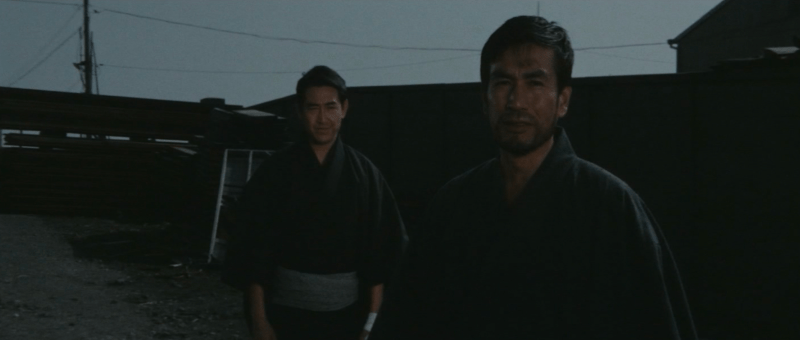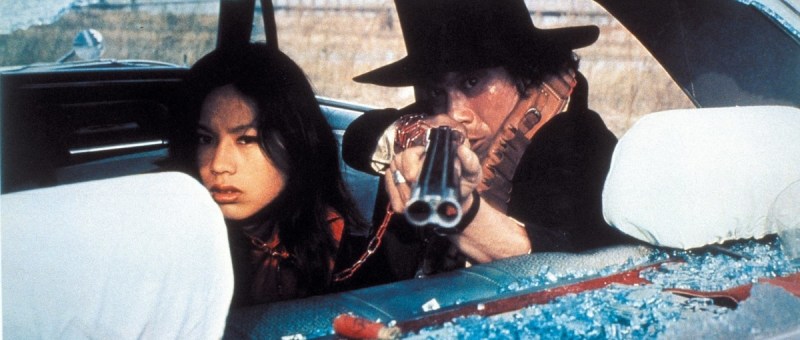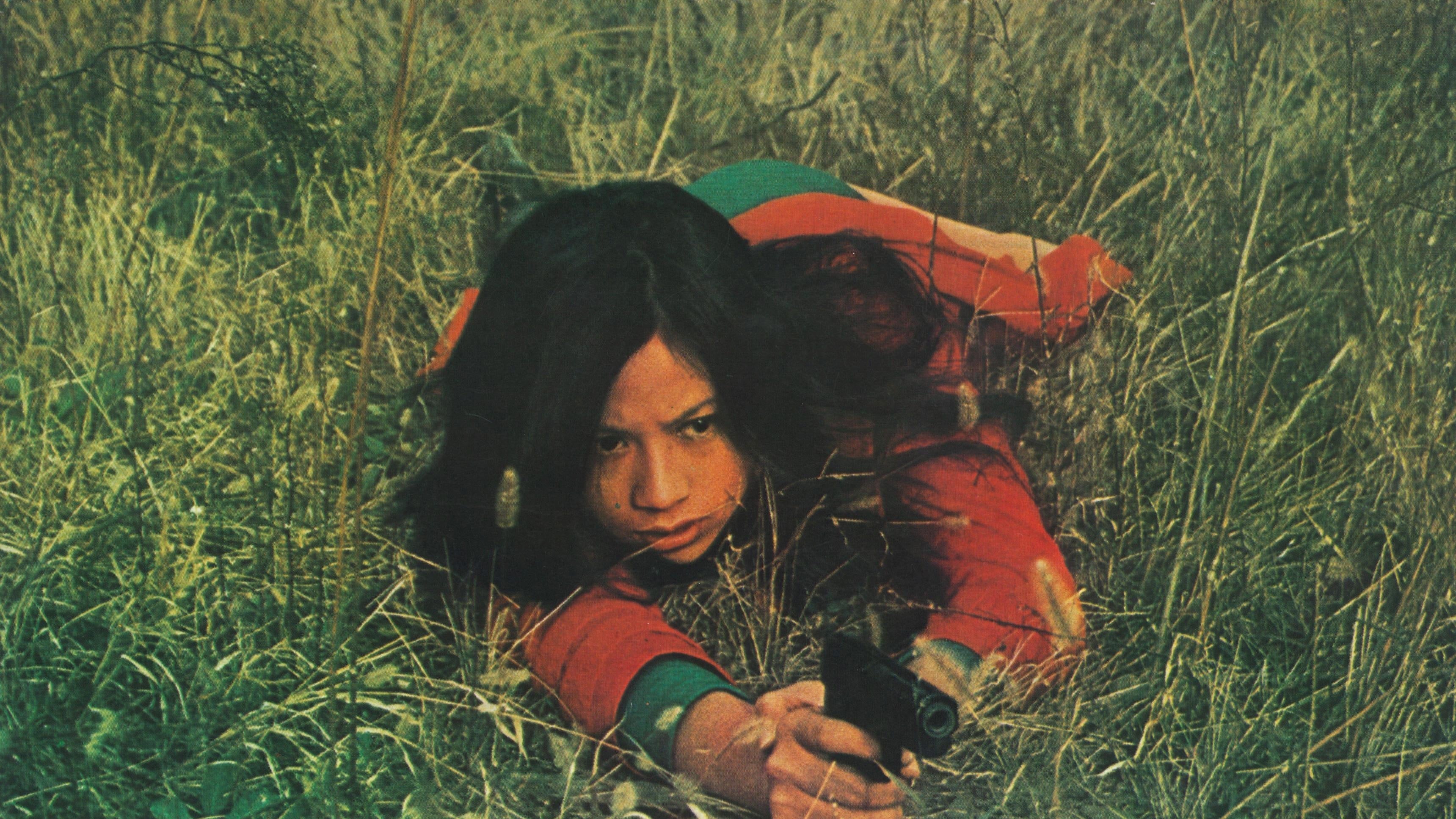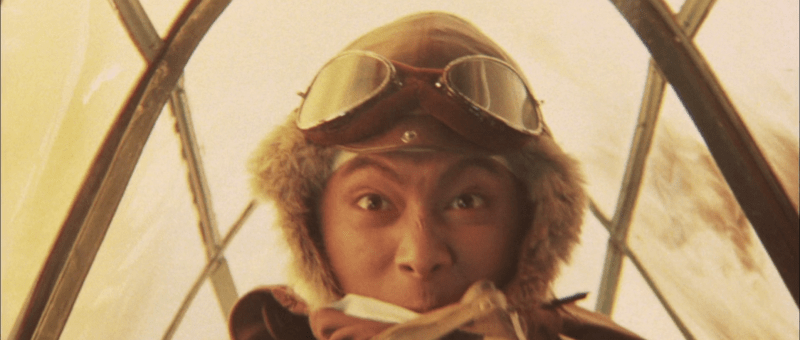
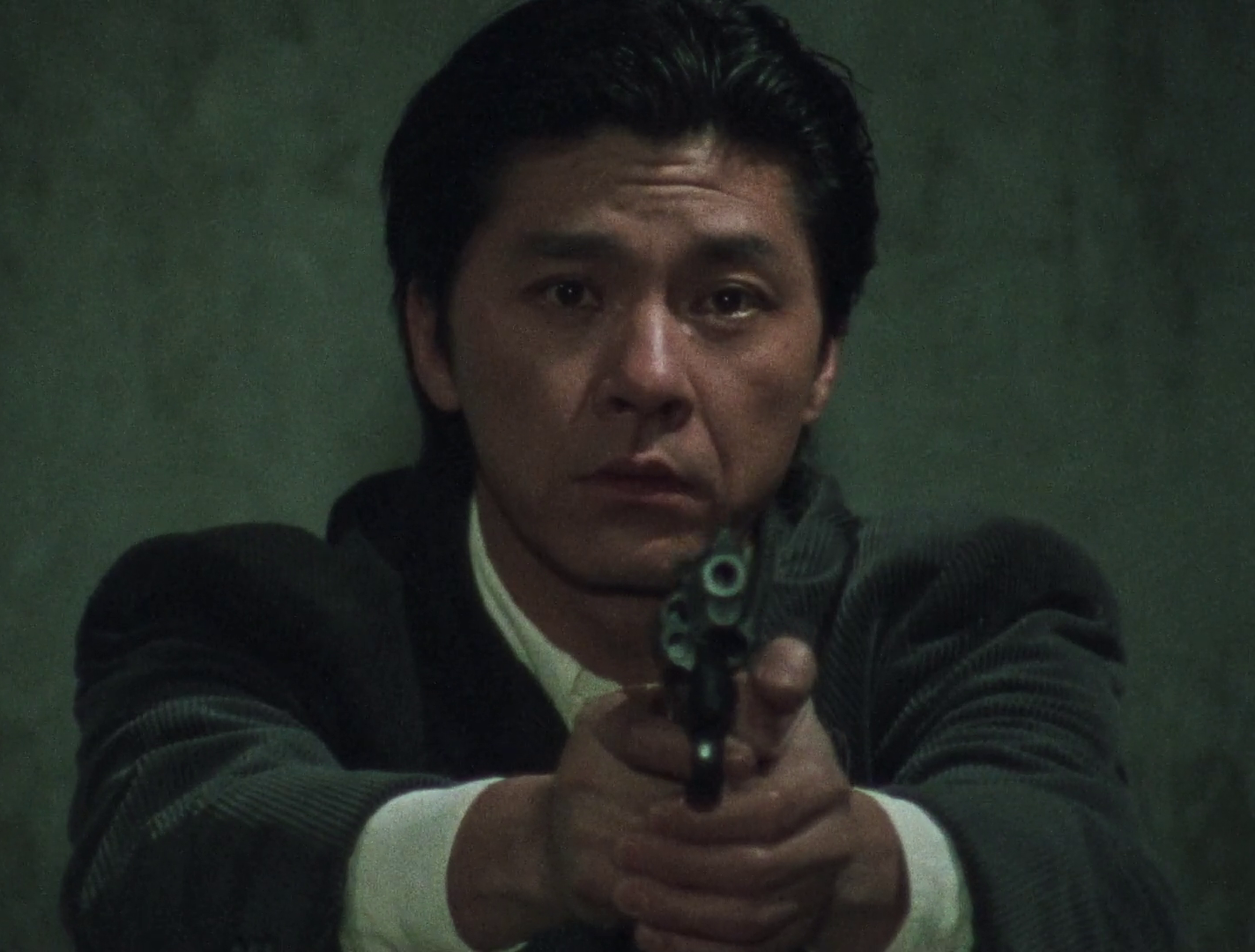
The Hitman: Blood Smells Like Roses (ザ・ヒットマン 血はバラの匂い, Teruo Ishii, 1991)

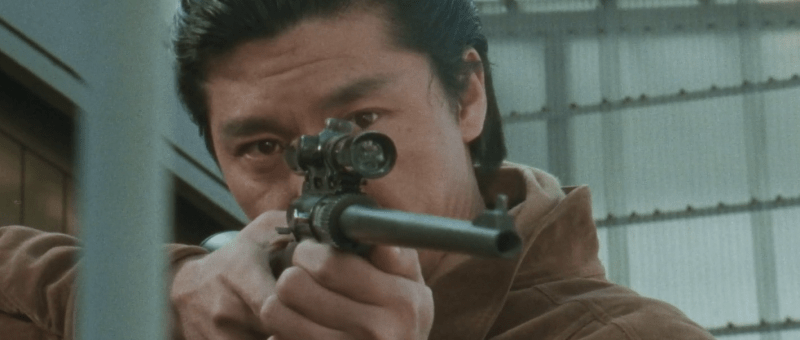
After his fiancée is killed during a yakuza shootout in a restaurant, a former spy in training plots revenge in Teruo Ishii’s Hitman: Blood Smells Like Roses (ザ・ヒットマン 血はバラの匂い, The Hitman: Chi wa Bara no Nioi). Ishii has been in retirement for 12 years before making the film but steps right into the zeitgeist with his bubble-era nightclub opening in which a yakuza goon pretends to be the son of a stockbroker to seduce a young woman he intends to press into prostitution, while looking back to classic noir and the borderless action past.

The young woman is rescued, though not soon enough to escape harm, by the titular hitman, Takanashi (Hideki Saijo), though he does not intervene to save her, only to take out the trio of yakuza who were one side of the gun battle in which his fiancée Reiko (Mikiko Ozawa) was killed. Reiko’s innocence is emphasised by her position as a teacher at a Christian school which is directly contrasted with the sleazy world of contemporary Shinjuku in which Takanashi becomes involved with a series of women. The Asia Town that he strays into is another international space with its samba bars and Filipina hostesses, while Takanashi is later sent to track a boat coming in from the Philippines which is thought to be smuggling guns. 

That’s a tip off he receives from Nakatsuka (Kiyoshi Nakajo), an old mentor from the defence academy who now works for the Cabinet Intelligence and Research Office, the nation’s primary intelligence authority. Nakatsuka is also seen meeting with the police chief who tells him that the yakuza have been complaining that police are encouraging the gang war rather than trying to stop it. So much the better, Nakatsuka says, let them massacre each other then take them all out right before the election to manipulate public opinion. If the election goes their way, the police chief will have additional budget to hire more policemen. Thus Takanashi also becomes a kind of pawn in cynical political machinations conducted by Nakatsuka and CIRO who are helping him both out of friendship and sympathy and because it is useful for him to make use of Takanashi and his desire for revenge. Only veteran policeman Uchino (Tetsuro Tanba) smells a rat, but even he later lets Takanashi go after making a moral judgement that justice has been served and Takanashi hasn’t really done anything wrong.

And so Takanashi tries to avenge Reiko by setting the gangs against each other in a recreation of the original gang war. He’s first frustrated and then aided by Shinjuku party girl Rumi (Natsumi Nanase) who steals his briefcase and gives it to the yakuza, and also be her friend Hisako (Yuki Semba) whom he meets after ducking into a soapland to escape the police. Hisako’s apartment is well furnished with even the modern convenience of an exercise bike, while Rumi’s feels empty, like a hideout with its bare floors and sparse decor. The walls are decorated with posters for Casablanca and Bonnie and Clyde that bring home and older noir past that Takanashi is echoing in his quest to avenge Reiko’s death at the hands of a crime-ridden society. We’re told that he gave up his place at the defence academy and became a truck driver when his parents objected to their marriage, but now fulfils his destiny in tackling the yakuza threat head on.

Meanwhile, as a kind of counter to Rumi, Hisako, and Yasuda’s girlfriend, Kumasa’s woman Beniko (Kimiko Yo) who is very much involved in policy decisions and actively fights back in defence of Kumasa who is otherwise a bit useless. The film is sleazy from its opening rape sequence to the soapland escapade and inexplicable closing credits which consist of a number of raunchy gravure shots backed by a power ballad that otherwise have little to do with the rest of the film, but is perhaps less cynical that it appears or at least seems to edge away from nihilism towards something that appreciates that a more emotional, poetic kind of justice is possible and valid. Takanashi is allowed to complete his quest, though it incurs additional casualties, and then leave the scene having achieved a kind of closure and brought the cycle to an end leaving the rest to Nakatsuka and Uchino who now seems to have crossed over to Nakatsuka’s side if perhaps lamenting that he may be working far too hard to a achieve a justice that now seems surprisingly easy to enact.

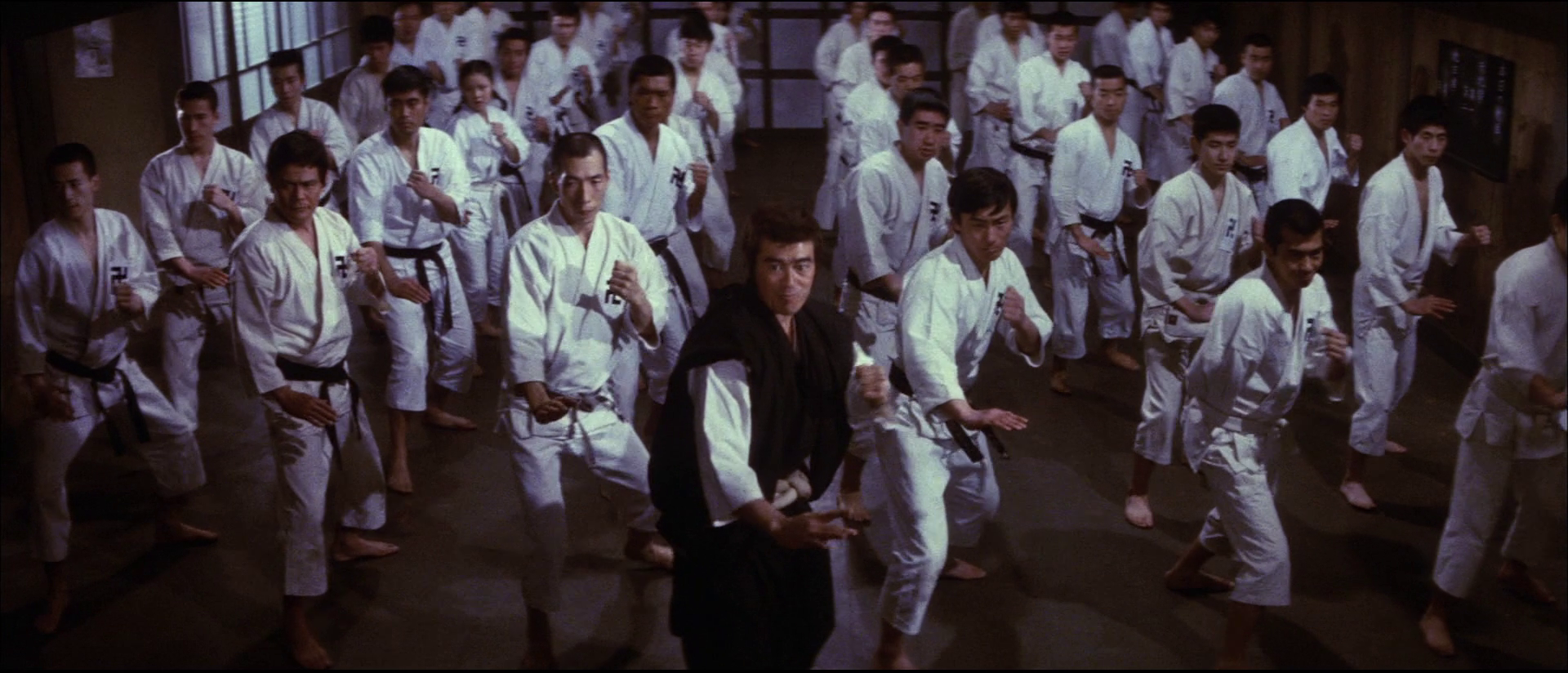
The Killing Machine (少林寺拳法, Norifumi Suzuki, 1975)

“As long as somebody like you is around, there’s hope for Japan,” an oddly sympathetic prison warden says to the last patriot standing in post-war Osaka. The title of Norifumi Suzuki’s Sonny Chiba vehicle The Killing Machine (少林寺拳法, Shorinji Kempo) maybe somewhat inappropriate or at least potentially misleading as the film is deliberately constructed as a martial arts parable emphasising the spiritual philosophy of self-improvement and compassion that is inextricable from its practice.

To that extent, the hero, Soh Doushin (Shinichi Chiba), is trying to fight his way out of the miasmas of the immediate post-war era. As may be apparent, Soh has taken a Chinese name, though Soh was apparently his along and belonged to a former samurai family whose nobility has been crushed by militarism. As the film opens, however, he’s a Japanese secret service operative in Manchuria blindsided by the news of Japan’s surrender. Soh is it seems a nationalist and a patriot, but a fairly revisionist one who stands up to the abuses of the Japanese army. He later says that he protested the way that the local Chinese population were often treated and he does indeed raise a fist toward an officer who wants to sell a young Japanese woman to a Chinese soldier in return for a guarantee of their safe passage to a boat heading out of the country. The young woman’s mother protests that she is an innocent virgin, a fact that has some later relevance. Soh refuses to let the officers take her, though evidently separated from her later.

When he meets the young woman again in the bomb-damaged backstreets of Occupation Osaka, she is dressed in Western clothing as opposed to the smart kimono she wore in Manchuria and is about to become a “pan pan” or streetwalking sex worker catering to American servicemen. Of course, Soh can’t let this happen either, but as she later tells him, she was raped by Russian soldiers during the retreat and now feels herself to be despoiled. She never wears kimono again and becomes a kind of symbol for a despoiled nation that Soh is reluctantly forced to accept he cannot save in part because his philosophy, which is still uncomfortably rooted in the philosophy of militarism, only valued strength when it should have valued love. The kind of love that Kiku (Yutaka Nakajima) had for her brother that made her willing to sacrifice herself for his wellbeing. 

Even so, Soh is doing his best to issue a course correction by caring for a small group of war orphans and helping them support themselves by running a rice soup stall so they won’t end up becoming dependent on the yakuza or the black market. It’s the yakuza and their increasingly corporatising nature that become Soh’s chief enemies, though standing right behind them are the Occupation Forces. They are, of course, just the biggest gang, as we can see when one of the kids steals a few tins from the gangster’s crate which is marked with text making it clear it came from the mess hall at the American base. The backstreets are full of sleazy soldiers and pan pans or otherwise the starving and dejected, sometimes violent demobbed soldiers filled with despair. It’s these men that Soh wants to buck up, telling them to rediscover their fighting spirit and giving them the opportunity to do so through learning Shaolin martial arts.

Of course there are those who don’t want to learn Chinese kung fu in the midst of their defeat, but what Soh is advocating is something that has a greater spiritual application even than karate can also have. It’s a kind of humanitarian riposte to the futility of the post-war society that might sometimes fail to recognise the depths of the impossibility faced by many in insisting they can be faced by discipline and moral fortitude but at the same time is not really judgemental except toward those who have deliberately abandoned their humanity, such as the trio of goons who rape a school for amusement (the girl is later seen among the students at Soh’s school along with the children from Osaka). The girl’s father reports it to the police, but the police and the gangsters are in cahoots, so nothing gets done. Soh cuts the guy’s bits off so he won’t be doing that again. Strength without justice is violence, he realises. But justice without strength is inability. Strength and love like body and mind should never be separated. The closing shots show an entire mountain covered in white-clad figures practising Shaolin kung fu and joining the humanitarian revolution rather than the cruel and selfish one represented by the gangsters with their red-light districts and black markets. It may be a simplistic solution, but it is in its way satisfying and at least a rejection both of the militarist past and the capitalistic future.


*Norifumi Suzuki’s name is actually “Noribumi” but he has become known as “Norifumi” to English-speaking audiences.

Dissolution Rites (解散式, Kinji Fukasaku, 1967)

“We’re all legitimate businessmen now” as a former yakuza explains to a recently released foot soldier stepping out into a very different Japan in Kinji Fukasaku’s Dissolution Rites (解散式, Kaisan Shiki, AKA Ceremony of Disbanding). The funereal opening scenes feature the first in a series of dissolution rites as a man dressed in black reads from a scroll and explains that all the local yakuza clans will be disbanding because despite “working day and night for the benefit of the world and humanity in the spirit of democracy” times have changed and they find themselves unnecessary.

There at the beginning of that change, Sawaki (Koji Tsuruta) served eight years in prison for the murder of a rival gang boss to ensure his gang got hold of a local landfill site where they later built an oil complex. While he was inside, his boss died and his clan disbanded leaving him with nowhere to go but thankfully looked out for by an old friend, Shimamura, who has since become a construction magnate. On his arrival at Shimamura’s office, however, he’s ambushed in a suspected case of mistaken identity while the man driving him is killed. 

Shimamura (Fumio Watanabe) tells him he’s gone straight, but it soon becomes clear that even as yakuza forsake the streets for more organised crime they still behave like thugs using the same old tactics to get what they want. Shimamura is in cahoots with a corrupt local politician, Kawashima (Asao Uchida), and is determined to get access to another stretch of bombed out wasteland owned by an egalitarian doctor, Omachi, who refuses to sell because he’s set up a community there of marginalised people, including Sawaki’s former girlfriend Mie (Misako Watanabe), who work on his chicken farm. Meanwhile, Shimamura is targeted by rival “legitimate businessman”, Sakurada (Hosei Komatsu), who pulls a few dirty tricks of his own in an effort to cut Shimamura out of the picture.

Once again Tsuruta plays a man who is out of step with his times, partly because he’s been in prison but also in his fierce commitment to a now outdated code of gangsterdom. “The chivalry that we were taught was just a way for bosses to use their soldiers” Shimumura insists, “you’ll look foolish if you don’t get rid of it”, disingenuously casting his transformation into a legitimate businessman as a way of freeing himself from yakuza oppression. Sawaki turns down his offer to join the business because it seems a bit dodgy while intensely disappointed to discover another former colleague, Kubo (Kyosuke Machida), running a trafficking ring masquerading as a management studio for cabaret singers and strippers by tricking women with the offer of good jobs then getting the hooked on drugs and shipping to them to Okinawa to do sex work near the US bases.  

On his return, Sawaki is also stalked by the man whose arm he severed in killing the rival boss who turn out to be, like him, an old school gangster which is why he insists on his revenge only to find an unexpected kindred spirit as the two men find themselves each adrift in a world in which no one really cares about humanity and honour. Sakai (Tetsuro Tanba) chooses to walk a different path, conducting his disbandment ceremony in protest of yakuza corruption. Like many Tsuruta heroes, Sawaki also has the possibility of walking away and living a conventional family life as a husband and father having been forgiven by Mei but inevitably is pulled in a darker direction by the necessities of his code. The oil complex he helped to create is only a symbol of the duplicities of the post-war society allowing men like Shimamura to get rich while literally choking the life out of those like Mei whom they now want to kick out of her home to add insult to injury. 

There’s no one more tragic than a yakuza Sawaki admits, knowing there is no longer any place for him in an amoral gangster society while unable to simply leave it and enjoy a quiet life with the woman he loves. An indictment both of corporatised yakuza and the equally duplicitous practices of “legitimate” businesses and corrupt authorities, the film ends in another righteous assault filmed handheld with Fukasaku’s characteristically canted angles amid the chaos and confusion of a rapidly changing society. 

Zero Woman: Red Handcuffs (0課の女 赤い手錠, Yukio Noda, 1974)

“Your sense of duty is too strong! The world isn’t a pretty place,” barks an irate policeman, scolding a female officer with a tendency to take things, in his view at least, too far. Yukio Noda’s kidnap drama Zero Woman: Red Handcuffs (0課の女 赤い手錠, Zeroka no onna: Akai Tejo) is on the extreme end of pinky violence and soaked in the political concerns of the 1970s along with all their concurrent paranoia but nevertheless positions its fearless avenger as a lone arbiter of justice in an incredibly unjust world. 

We know this from the start as we see Zero (Miki Sugimoto) almost date raped by an apparent serial killer who has his own torture suitcase and apparently killed her friend. Knowing that he is a diplomat and therefore has diplomatic immunity, she simply shoots him in the balls in the film’s extraordinary opening sequence. But even though it could be argued what she did was self-defence, Zero is kicked off the force and thrown into a woman’s prison for an indefinite period of detention to keep the lid on any possible scandal. Zero is only reprieved when the daughter of a politician is kidnapped by thugs and, wanting to keep things quiet, they need someone to rescue her and also wipe out all of the kidnappers to ensure no one ever finds out.

Kyoko (Hiromi Kishi), the politician’s daughter, claims that her father will do “anything” to ingratiate himself with the prime minister and has in fact already arranged her marriage to his son. Kyoko, however, already has a boyfriend who, inconveniently, is quite obviously a student protestor given his yellow construction hat and other paraphernalia. The pair are accosted while sitting in a car near an old American base, and as Kyoko is gang raped, firstly by the gang leader Nakahara (Eiji Go) who is wearing a hoodie with the words US Navy printed on the back, US planes fly over her as if she were being raped by America in an obvious metaphor for the legacy of the occupation. 

Indeed, the flashbacks later experienced by Nakahara are of his mother whom he describes as a sex worker who worked at the base suggesting a very literal allusion to the corrupting influence of American servicemen. The gang operate out of a bar called “Manhattan” which is surrounded by other similar bars with Western names in a neon-lit area, while they constantly run across various signs written in English in fact peeing directly on a no peeing sign outside a largely disused residential area on the edge of the base where they later take hostage some kind of amateur dramatics / English-language class currently in the middle of a production of Romeo and Juliet. 

Yet the big bad turns out to be essentially homegrown in the form of the corrupt lackey policeman Osaka, and the politician Nagumo (Tetsuro Tanba), who is more concerned with his political capital than his daughter’s safety keen that the police keep everything out of the papers otherwise the wedding will be called off and he’ll have a problem with the prime minister. Seeing a very pale Kyoko, her clothes torn, barely conscious having been drugged by the gang, he says he no longer cares to think of her as his daughter and perhaps it would be better if she simply passed away in an “accident”, instructing Osaka to care of loose ends like Zero too. 

It’s very clear that women’s lives have little currency in this very patriarchal world, something Zero seems to know all too well even if at the beginning of the film she was content to work for the oppressive organisation of the police force though she later tears up her warrant card in disgust. The fact that division zero, operating like a secret police force on the behalf of an authoritarian government, exists at all is a clear indication that this is already a police state though one subverted by Zero who uses her red handcuffs to deliver ironic justice to all those who deserve it. Then again, unlike other pinky violence films there’s precious little solidarity that arises between herself and Kyoko whom she later describes as nothing more her mission objective seemingly caring little for her as a fellow human being. Noda cuts back between the Diet building and police HQ as if actively critiquing the latent authoritarianism of the early 70s society but even if Nagumo gets a kind of comeuppance it’s abundantly clear that nothing really will change and Zero stands alone wilfully freeing herself of the handcuffs of a controlling society. 


Zero (零戦燃ゆ, Toshio Masuda, 1984)

The Zero Fighter has taken on a kind of mythic existence in a romanticised vision of warfare, yet as Toshio Masuda’s Zero (零戦燃ゆ零戦燃ゆ, Zerosen moyu) implies its time in the spotlight was in fact comparatively short. Soon eclipsed by sleeker planes flown by foreign pilots, the Zero’s glory faded until these once unbeatable fighters were relegated to suicide missions. On one level, the film uses the Zero as a metaphor for national hubris, a plane that ironically flew too close to the sun, but on another can never overcome the simple fact that this marvel of engineering was also a tool of war and destruction. 

The film is loosely framed around two members of Japan’s Imperial Navy, Hamada (Daijiro Tsutsumi) and Mizushima (Kunio Mizushima), who as cadets consider deserting to escape the brutality of Navy discipline. Having left the base they’re accosted by an inspirational captain who talks them out of leaving by showing them a prototype model of the Zero and convincing them they only need to stick it out for a few more years in order to get the opportunity to fly one. Mizushima, the film’s narrator, doesn’t qualify as a pilot and is related to the ground crew while Hamada does indeed get to pilot a Zero fighter and becomes one of the top pilots in the service. 

The viewpoint is is then split between the view from the ground and that from the clouds. Mizushima makes occasionally surprising statements such as candidly telling love interest Shizuko (Yû Hayami) that they are unlikely to win the war, while becoming ever more concerned for Hamada at one point telling him there’s a problem with his plane in the hope that he won’t take off that day. Hamada meanwhile is completely taken over by the spirit of the Zero and even when given a chance to escape the war after being badly injured, chooses to return because he does not know what else to do. When he visits home after leaving hospital, no one is there. His mother eventually arrives and explains that the family has become scattered with his siblings seconded to the war effort in various places throughout the country. 

Hamada’s dedication and personal sacrifice are in some senses held up as the embodiment of the Zero. The reason for its success is revealed to lie in the decision to remove the armouring for the cockpit leaving the pilot’s life unprotected, something which the American engineers describe as unthinkable. In an early meeting, a superior officer complains that they’re losing too many pilots and need to reinstall some of the armouring, but finds little support. Not only this is a cold and inhuman decision, but it’s poor economic sense given that skilled pilots are incredibly valuable and in short supply. After all, you can’t just make more. If you start from scratch you’ll need to wait 20 years and then teach them fly, but it’s a lesson the Navy never learns that is only exacerbated with the expansion of the kamikaze squads which squander both men and pilots for comparatively little gain. 

These “philosophical differences” are embodied in the nature of the Zero which is configured to be nimble and outmanoeuvre the enemy but is quickly eclipsed not least when foreign powers figure out the way to beat it lies in numbers in which they have the advantage. There is something of a post-Meiji spirit in the feeling that Japan is lagging behind Western powers and desperately needs to develop its own military tech in order to defend itself. On hearing rumours of the Zero fighter, MacArthur scoffs and says that Japan can’t even build cars so he doesn’t believe they could design a plane that could fly such large distances while others suggest that they will still need the element of surprise if they ever go to war with America because its technology is still superior. 

Walking a fine line, the film tries to avoid glorifying “war”, but it cannot always help indulging in nationalist fantasy such as in its statement that thanks to the Zero “the Japanese flag covered a vast area of the Pacific” in the wake of Pearl Harbour. These may be fantastically well designed machines that were incredibly good at what they were created to do, only what they were created to do was kill and destroy. The plane’s fortunes and Japan’s are intrinsically linked, the sense of superiority in the air lasts only a short time before Western technological advances over take it and the war continues to go badly. The film dramatises the tragedy of war through the friendship between the two men which eventually causes Mizushima to sacrifice his love for Shizuko by convincing her marry Hamada hoping that his priorities would change and he’d decide to take a position as an instructor rather than heading back to the front. 

For her part, it seems that Shizuko was also in love with Mizushima, but also caught in a moment of confusion between love and patriotism that encourages her to think she should do as Mizushima says and embrace this man who has dedicated his life to his country. In the end, it buys them each loss and misery, but also a moment of transcendent hope even if it was based on a falsehood in the pleasant memory that Mizushima gives Hamada of the life he is giving up by rejecting it to return to the front. For Mizushima, Hamada and the Zero may become one and the same. At the end of the war he can’t bear to see the remaining Zero’s sold for scrap and asked to be “gifted” one as the Captain who’d first shown one to him said he would be, so that he can give it a proper a “funeral”, or perhaps send it to Hamada in the afterlife after he is killed mere days before the surrender. Masuda cannot help romanticising the wartime conflict with his dashing pilots and their thrilling dogfights, often depicting it more as a kind of game than an ugly struggle of death and destruction, but does lend a note of poignancy to his tale of lives thwarted by the folly of war.


Trailer (no subtitles)

The Tattooed Hitman (山口組外伝 九州進攻作戦, Kosaku Yamashita, 1974)

The close brotherhood between two men is disrupted by changing times in a more contemporary gangster drama from Kosaku Yamashita, Tattooed Hitman (山口組外伝 九州進攻作戦, Yamaguchi-gumi gaiden: Kyushu shinko-sakusen). As many are fond of saying, times have changed and the yakuza must try to change with them or else meet a melancholy end. But as the hero admits, change is something he has no intention of doing even as his old school gangsterism leaves him increasingly at odds with the corporatising ways of the contemporary yakuza. 

The change in the times is obvious from the film’s opening sequence set in 1957 in which an attempt is made on the life of petty boss Ishino (Tatsuo Umemiya) by a gunman who shouts “die, for the good of the world” before firing a pistol and running away. Ishino has been targeted in a dispute over construction rights connected with the regeneration of hot springs resort, Beppu. The hit seems to have been ordered by rival gang, Sakaguchi (Eizo Kitamura), the leader of which is also a prominent local politician who is content to abuse his power for his own financial gain. So confident is he in his safety, that Sakaguchi even gets the police involved rather than deal with it himself. 

Ginji (Bunta Sugawara) has been Ishino’s sworn brother since their teenage delinquent days and determines to get revenge by raiding the Sakaguchi offices and killing one of their high ranking officers. Seeing as he’s already wanted by the police for a previous murder, Ishino sends Ginji to Osaka to lay low while working for an associate, Daito, mainly as a debt collector. It’s this act of separation which introduces a rift between the two men. While Ginji waits patiently to be recalled, Ishino climbs the ranks of corporatised gangsterism by learning to play by the new rules. 

To fill the void, Ginji takes on a new “brother” or perhaps surrogate son in the wayward Ken (Tsunehiko Watase) whom he first meets cheating at pachinko at a parlour where his pregnant wife Fusako (Mayumi Nagisa) is working. It’s Ken who first drags him into a brewing turf war as Korean gang Soryu threaten to disrupt the local equilibrium not least by selling drugs of which Ginji does not approve. Ginji “saves” Ken from joining Soryu by essentially making him his one of his guys though he doesn’t really have much of a position in Daito’s gang, offering him a sense of grown-up responsibility by handing him a pistol with the only the instruction to make sure he shoots with two hands. Unfortunately, Ken will follow his advice but otherwise ends up almost causing an incident with another gang by shooting a man who disrespected him in the street. Ginji marches straight down there to sort things out, but on arrival discovers an arrangement has already been made with his boss which further strains his sense of pride and confidence in his position as a yakuza.

Ginji feels something similar on being invited to a party to celebrate Ishino’s promotion only to be seated with the lowly footsoldiers and ignored by Ishino all night. Ishino rejects him still further in agreeing to plan to send him back to Kyushu out of the way hoping that his old school hotheadedness can finally be tempered. Others meanwhile voice concern that Ginji may have forged a relationship with rival Kobe gangs during the 18 months he abruptly disappeared from Osaka and has only come back to cause trouble. Ginji perhaps knows that he has no more future in the contemporary society, others remarking that seems like someone who is in a sense already dead for having accepted that he will die and most likely in Hakata, the town he had wanted to conquer with Ishino who had crushed his dreams in his newfound pragmatism by calmly explaining that they would never have the power to take it. 

Koji Takada’s screenplay positions Ginji’s gradual decline as an allegory for the yakuza himself while citing the new legislation that this particular series of incidents made necessary creating the new offence of assembly with dangerous weapons as a decisive moment in weakening the yakuza as an institution. Ginji remains a man displaced by his times unable to move forward into a new society in the way that Ishino has but stuck in a permanently post-war mentality despite the constant reminders that “times have changed”. Yamashita adopts the trappings of the jisturoku drama with frequent references to real life events and narrative voiceover but otherwise maintains his classicist formalism while ending on a note of ambivalence that tells us a certain kind of justice may have been served but the cycle of violence may not yet be completed.


Original trailer (no subtitles)

Female Slave Ship (女奴隷船, Yoshiki Onoda, 1960)

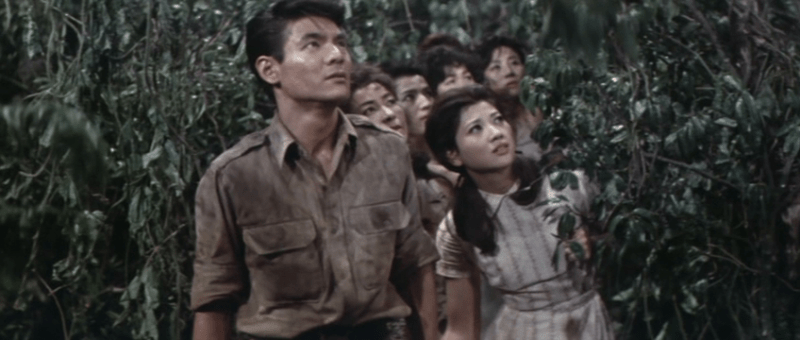
Playing out much more like a classic serial than war movie, Yoshiki Onoda’s Female Slave Ship (女奴隷船Onna dorei-sen) takes a curiously flippant approach to the conflict along with a moral perhaps a little at odds with similar films of the time. Adapted from a novel by Jun Funazaki, the film begins as spy thriller but ends up drifting into pirate territory as a Japanese solider with an incredibly important mission is shot down on his way to Tokyo, rescued by a freighter carrying women en route to being sex trafficked in Shanghai, and then captured by pirates who want to sell him to a Chinese spy working for the Americans. 

It’s right at the end of the war and Japan is losing quite badly they think because of advancements made in radar by the Allied forces. They’ve been passed blueprints for a better radar system by a German contact and so Lt. Sugawa (Bunta Sugawara), stationed in Malaya, has been charged with bringing them back to Tokyo disguised as a photo of a pretty young woman they’re going to say is his sister. Perhaps the most surprising thing about the film is that Sugawa abandons his mission quite quickly and instead devotes himself to rescuing the women, vowing not to return to Tokyo without them despite the fact that this vital information he’s carrying could supposedly turn the tide of the war.

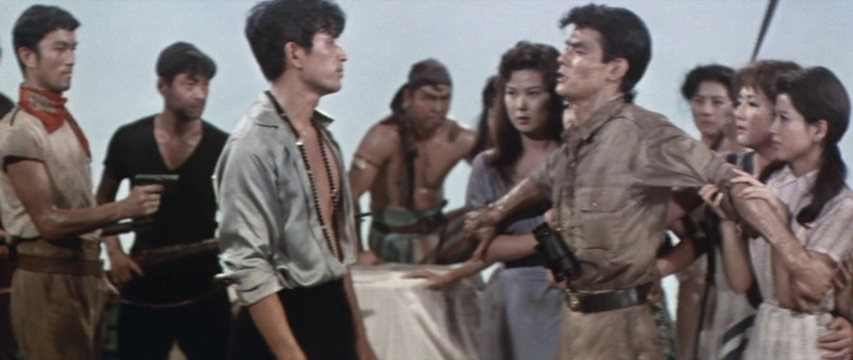
Even so, this manly chivalry defines his code of heroism. He is constantly trying to escape and defiantly stands up both to the captain of the tugboat, who is not actually in charge, but also to the pirate captain (Tetsuro Tanba) who doesn’t really seem to be doing much of anything. Among the crew of pirates is a Japanese man who later confirms that he’s a deserter but alternately switches sides, first offering to team up with Sugawa because he’s fed up with the discrimination he faces from the other pirates, and then betraying him before doing the same thing again but claiming that he feels bad about deserting and wants to do something for Japan now that his Japaneseness has been truly awoken.

It was indeed other Japanese people who were operating the slave ship, chief of them being the Queen (Yoko Mihara) who rules the boat with an iron hand but then uses her sex appeal to curry favour with the pirate captain while simultaneously developing feelings for Sugawa who is equally drawn to a meek young woman, Rumi (Utako Mitsuya), who was tricked onto the boat on the promise of a nursing job in Manchuria. Most of the other women, few of whom are actually given any characterisation, are established sex workers and resolved to their fates but all feel bad for and protective of Rumi. Though she’s the one Sugawa is closest to, it’s quite refreshing that the women are otherwise treated as equals rather than looked down on because of their occupation with Sugawa insistent on rescuing them all before they can be sold in Shanghai. 

As is usual for these kinds of films, the chief villain is Chin (Shuji Kawabe), a Chinese man apparently with ties to the Americans who has somehow found out about the radar plans, even knowing that they’re presented on a photo of a woman, and wants to capture Sugawa to get his hands on them. The bounty causes a rift between the pirate captain and Chin with the pirate captain wanting in on the deal and Chin not really willing to share, though there is a clear implication that these mercenary pirates are on the wrong the side in working with the Chinese and Americans while the slave ship was more on the level of not being okay but definitely not as bad. 

In any case, it comes down to a battle of masculinity between the monkey-loving pirate captain and his trusty whip, and Sugawa’s good old-fashioned chivalry. Surprisingly chaste given its racy title, even the pirates are more of the drunken and lascivious type than violent and rapacious, the film has a rather odd sensibility landing somewhere between jungle adventure and wartime escapade in which an earnest young man bravely carries the weight of the nation on his shoulders while doing his best to address a more immediate threat and rescue 12 captive women from the evils of Japan’s imperialist expansion. 


Original trailer (no subtitiles)

The Geisha (陽暉楼, Hideo Gosha, 1983)

The coming of the railroad spells doom for one of the most prestigious geisha houses in Japan in Hideo Gosha’s adaptation of the Tomiko Miyao novel, The Geisha (陽暉楼, Yokiro). Miyao’s novels had often provided the inspiration for Gosha’s films and she had herself been the daughter of a “flesh broker” in pre-war Kochi though later escaping to another town to be a substitute teacher. Though the English title may focus more on plight of the the individual geisha at its centre, the Japanese hints more at the destructive cycle of the Yokiro itself in the persistent legacy of exploitation.

Then again as he later points out, if you’re looking for a villain in this story then the responsibility lies largely with Daikatsu (Ken Ogata) himself. In a prologue set in 1913, Daikatsu has eloped with geisha Otsuru but the pair are discovered by gangsters sent after them by the Yokiro. Daikatsu kills all of their assailants and assures Otsuru that they are finally “free” but it appears to be too late. Holding their baby daughter in one arm, Otsuru collapses into his other and presumably dies either then or shortly after while Daikatsu is later sent to prison for 10 years. 20 years later in 1933, the daughter, Fusako (Kimiko Ikegami), has become the number one geisha at the Yokiro under the name Momowaka though her career flounders because she is regarded as too emotionally distant to keep a patron. 

Daikatsu is also himself in Kochi at this point and working as a procurer brokering the sale of young women to the Yokiro and other geisha houses and brothels. When a school teacher comes to him to sell his wife, he taps her teeth to check for malnutrition much as one would examine a horse before running a hand underneath her kimono to check everything is at is should be before offering a valuation. Her husband only looks at him anxiously enquiring if a body such as hers which has as he later reveals born three children will fetch a good price. Daikatsu lets them go so the woman, Masae, can spend a final night with her family explaining that he cannot force someone to work if they do not want to do so and is well aware they will likely take his money and never be seen again which is what almost what happens. As it turns out the husband is killed in a fight and the woman ends up becoming a geisha anyway, only in the pay of prominent Osaka yakuza led by Inaso. 

Inaso (Mikio Narita) and buddies want in on the construction of the railroad that will shortly be coming to Kochi, but need to take over the town first which means getting around the mistress of the Yokiro, Osode (Mitsuko Baisho), who is apparently running every game town. The entire local economy is underpinned by female exploitation and facilitated by a woman, a former geisha, seizing the only power that is available to her. Isano later uses Masae as a kind of spy, getting her to initiate a relationship with Osode’s weak willed husband in an attempt to humiliate her which largely backfires as Osode boldly reclaims her man through a violent brawl in a hot spring though it does not appear that she is especially fond of him so much as he serves a particular purpose.

The brawl emphases the way in which women are pitted against each other by the nature of a patriarchal society along with the ways in which they are forced to mediate their power through men. Fusako also gets into an intense physical fight with Tamako (Atsuko Asano), a surrogate daughter of Daikatsu’s and emblem of a coming modernity, who insists on becoming a sex worker at the area’s most prominent brothel. In a strange moment of confrontation, both the geishas of the Yokiro dressed in their traditional regalia, and the sex workers of Tamamizu, arrive at a modern club where the heir to a banking empire courted by the Yokiro, Saganoi, dances the Charleston he learned while studying abroad in America. The geisha who dances with him struggles to pick up the moves, Saganoi lamenting that the dance is just not suited to a woman wearing a heavy kimono, elaborate wig, and clumsy geta. Tamako immediately gets up from her table and kicks off her shoes, gathering the hem of her own kimono to free her legs for the high level kicks of the modern dance. 

Fusako reclaims her authority by interrupting the dance immediately before its conclusion and insisting on retrieving their guest. Tamako appears to resent Fusako, perhaps frustrated in her relationship with Daisuke who does not appear to have had much contact with the daughter he sold at 12 years old. They too end up in an elaborate brawl in which Tamako rips off Fusako’s wig and splits her lip, symbolically freeing her to transcend the constraints of her “geisha” persona. Meeting Saganoi at Western-style bar, she boldly dances on the counter and sleeps with him of her own volition. But in doing so she conceives a child and leaves herself in a difficult position. She has betrayed her patron, and though she could simply have kept the fact from him and allowed him to think the baby was his, Fusako does not want to bring her child up in lies while simultaneously hanging on to a naive dream that Saganoi will one day return to her despite being made aware he has left for Europe. 

“All men are enemies of women,” she writhes in childbirth while swearing that no one will take her child from her, but she is still an indentured woman and her daughter is by rights the property of Osode. Her illness, presumably consumption, began long before her pregnancy and seems to an echo of the suffering she has been forced to endure as a geisha. As her health weakens, so the Yokiro declines. First it is ravaged by a literal storm, but also under threat from the Osaka gangsters desperate to take over Kochi to gain access to the lucrative construction contracts extending in its direction. Even so, as Daikatsu admits much of the fault lies with him. He chose to elope with Otsuru and was unable to protect either her or their daughter whom he allowed meet the same fate by entering the geisha world. He continued to earn his money by selling women into what is essentially slavery, and cannot escape his part in their continued exploitation while his entanglement with gangsters later disrupts the more settled life Tamako has begun to build for herself. 

“Wait all you want, the train’s not coming,” Tamako is later told, as if signalling that there really is no way out of this destructive and disappointing existence. Truly epic in scope, Gosha’s pre-war drama draws together patriarchal exploitation and societal corruption to critique a burgeoning modernity, but ends exactly as it started among the vibrant cherry blossoms only this time undercutting the melancholy of the oft repeated song with a more cheerful scene hinting at least symbolically at a long-awaited reunion. 


Original trailer (English subtitles)

Twilight Saloon (たそがれ酒場, Tomu Uchida, 1955)

A generational divide echoes around a beer hall filled with a defeated sense of bonhomie until finally finding a point of rest in Tomu Uchida’s elliptical single set drama, Twilight Saloon (たそがれ酒場, Tasogare Sakaba). The melancholy title captures the feeling of finality which seems to overhang the bar but equally the shift that is taking place as the old must decide whether they will allow the young to be free or forever trap them with the legacy of their own mistakes. 

The tensions are obvious as a once feared military colonel nicknamed “Demon” Onitsuka (Eijiro Tono) strides into the bar cutting a slim, anxious figure evidently a shadow of his former self. Puffing out his chest, he lives on memories of past glory claiming that though he may now be a lowly estate agent, he will rise again should the occasion call and will never lose his soldier’s spirit. Kibe (Daisuke Kato), a regular at the bar, is excited to run into him, his former commanding officer, and evidently still holds Onitsuka in some esteem but the pair of them seem ridiculous, even a little pitiable, as relics of the wartime generation unable to move into the post-war era. Onitsuka has a minor apoplexy when the table of students across from them begin singing a communist song explaining it as evidence of the absence of morality in the contemporary society. Somewhat embarrassingly, he and Kibe begin singing along to what they thought was a classic military ballad sung by someone outside only to abruptly realise that it is the communists once again. Strapped for cash, Onitsuka makes an abrupt exit leaving a confused Kibe to chase after him yelling “put it on my tab.” 

“Put it on my tab” might as well be the life philosophy of regular patron Umeda (Isamu Kosugi) who unlike Onitsuka and Kibe is wracked with guilt over his wartime experiences and has dedicated the remainder of his life to making amends by paying it forward. Once a famous painter, he feels he sullied his art by wilfully depicting warfare in a manner that sought to glorify it and may have led others astray ultimately costing them their lives. Umeda feels he no longer has a right to practice his art and has made a sacrifice of it in atonement, his earnestness leant a poignant quality by the fact that he is played by Isamu Kosugi who had himself starred in a propaganda film co-produced by Nazi Germany. 

Yet he’s far from the only one who’s abandoned or compromised his art because of what he sees as a moral failing. All knowing, Umeda recounts the history of accompanist Eto (Hiroshi Ono) who he claims once lives under a different name and returned from abroad to found a revolutionary opera company only to be betrayed by his protégé who left to set up his own revolutionary company taking Eto’s wife with him. Eto later stabbed her in jealously and like Umeda has lived the rest of his life in quiet contemplation slumming it in this backstreet bar while training up a new protégé, Kenichi (Takuya Miyahara), said to be the son of a former bandmate. Eto is a vision of defeat, Umeda remarking that his time has most likely come, walking around in a Russian tunic unable to let go of the past. Emi (Keiko Tsushima) is much the same. Once a promising ballet dancer she feels she’s lost the right to dance after becoming a stripper apparently because of a bad man who later breaks into the bar and slashes her arm with a knife echoing Eto’s dark crime of passion. 

This might in part be why she is so keen to ensure that Eto will not prevent Ken from taking advantage of a valuable opportunity because of his own jealousy and resentment. The offer comes from Nakaoji, the leader of a national opera group and the man who once betrayed Eto though as the snippy “intellectuals” at another table point out he may once have been a “revolutionary” but is now an old man and has in effect become the establishment. The dilemma brings things full circle, the generational divide which once existed between master and pupil has now been eclipsed by a turn of the wheel. Eto cannot help but recognise Nakaoji, the cause of all his suffering, but Nakaoji does not acknowledge him and after all he has another name. 

Umeda pleads with him to allow Kenichi to go, not to ruin his life in the same way his was ruined by holding on to his pettiness and resentment as the man who took all from him returns to take his surrogate son too. His call is to those of his generation who bear the responsibility for wartime folly that they should accept that the world now belongs to the young and it is their duty to nurture them while setting them free to pursue their own destiny. The young customers in the bar are universally cheerful, still drunk on the exuberance of youth while those a little older are mostly defeated and melancholy, meditating on their own failed revolutions unable to move forward or let go of the past. 

Yet the youngsters who work there aren’t quite so happy, barmaid Yuki (Hitomi Nozoe) caught between the posturing of current and former gangster boyfriends while simultaneously discovering that her mother has been taken ill. She lost her father in the war and her home to the bombing and claims she has nothing other than the love of Masumi (Ken Utsui), a young tough who wants her to abandon her mother and schoolgirl sister to go with him to Osaka. Umeda adds 3000 yen to his tab, Yuki’s monthly salary, when the manager vacillates over granting her request for an advance to pay for her mother’s medical care seeing as they no longer even have rice at home. Later he runs into an old journalist friend who simply gives him the same amount of money from his wallet as if it were mere pocket change. The fact that Yuki doesn’t go with Masumi is not because she is afraid to or constrained by the burden of her family but an active choice to embrace her responsibility to others over her personal desire much as Umeda has already been doing. 

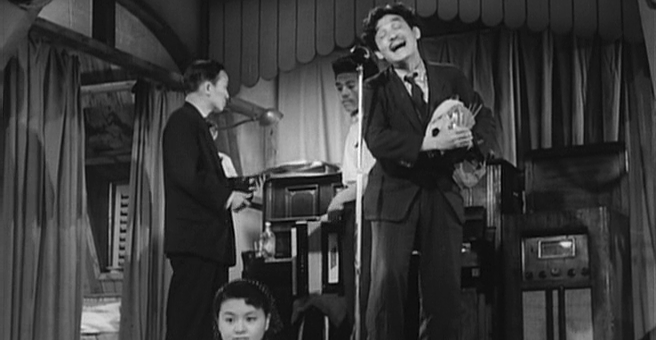
This maybe a twilight place, peopled by the hopeless and downtrodden, but there’s life here in all of its confusing randomness. A young man at one point runs in and jumps over the balcony to the stairs eventually chased by an older one, an incident otherwise unexplained just like the minor argument between a woman clutching a cat and the man who may be a patron of sorts who also brush through the bar. Uchida gives the snobbish left-wing intellectuals quite a kicking in their pithy discussions about existentialism and mocking of the students for trying to actually do something rather than just talk about it even if it’s singing in the street. Shot as if the action were unfolding in real time, the camera floats around the saloon as if it were itself a ghost lighting on the small moments of action that contribute to the incongruously warm atmosphere before ending up more or less where it started with a man singing on stage to an empty room. Even so, it does it with equal measures of hope and melancholy as age quite literally retreats and surrenders the space those who may still fill it.


Original trailer (no subtitles)

Bohachi Bushido: Code of the Forgotten Eight (ポルノ時代劇 忘八武士道, Teruo Ishii, 1973)

A nihilistic ronin falls into the hellish trap of the Yoshiwara in Teruo Ishii’s dazzlingly psychedelic period drama, Bohachi Bushido (ポルノ時代劇 忘八武士道, Porno Jidaigeki: Bohachi Bushido). Adapted from a manga short by Kazuo Koike, the film once again tackles Edo era corruption as a brothel owner with a special connection to the shogun attempts to wipe out the competition presented by an enterprising merchant class only to find himself hoist by his own petard.

Ishii signals his intentions early on with the artfully staged opening scequence in which wandering ronin Shino (Tetsuro Tanba) is attacked on a bridge at dusk. As he turns to slash at an opponent, the blood splatter morphs into the film’s title while the clang of swords gives off little blue sparks that turn into the listings for the cast and crew. By the time the title sequence has concluded, night has descended on the bridge and Shino finds himself engulfed in darkness. “To die is hell, but to live is also hell” he exclaims as he jumps into the water below, hoping to be free of his empty life of killing. 

Unfortunately, he is rescued and brought to the Yoshiwara where they try to persuade him to join the Bohachi clan so called because to do so you must abandon all eight human virtues. The Bohachi’s main line of work is the sexual torture of women until they become docile dolls for their brothel. Shino describes them as “revolting” but then adds “just like me” and agrees to join anyway only to earn their mistrust when he refuses to play along with their games, buying but not sleeping with a woman brought in over a debt. Though Shirakubi, the guy who recruited him, tries to kick Shino out and calls the police on him for good measure, the big boss, Shirobe (Tatsuo Endo), decides he’ll take him in for use as an attack dog taking down anyone who interferes with business be they lords or officials. 

The irony is that the nihilistic Shiro enthusiastically takes to his work because he dislikes the debauchery of the Edo-era society even while working for the “legitimate” brothel owner who is at least “licensed” to exploit women for financial gain. What Shirobe resents is the rise of quasi-brothels in the various teahouses that are obviously selling more than just tea but continue to undercut his business by selling women even cheaper than he does. He also feels betrayed by the various samurai lords who choose to visit the teahouses over his own establishment and therefore seeks to have them frightened into submission by ordering Shino to kill any man found with one of the tea house sex workers. Later he even declares a kind of sex worker amnesty promising to pay five ryo for any of the teahouse women brought to him, no matter by who, and then joking that he’s actually killing two birds with one stone by getting his hands on a high quantity of new stock for a very low price. 

Shino refuses to sleep with the women and is most offended when his male assistant is killed in an attack by the rival brothel owners yet the team of warrior women sent to protect him did nothing to help because their orders were only to protect Shino and Shirobe’s orders must be followed to the letter on the pain of death. He seems to know he’s living on borrowed time and Shirobe probably intends to finish him off once he’s finished his mission of removing all opposition and restoring Shirobe’s power to manipulate the shogun but barely does anything to resist until faced with the rather ironic punishment of being given opium and then forced to participate in a never-ending orgy intended to result in his death in an extraordinary psychedelic sequence from Ishii . 

Of course, what they didn’t reckon on was Shino’s ironic desire to live or at least not to be beaten in which he actively begins stabbing himself to overcome withdrawal symptoms and carry on fighting even when they try to ram him with a giant spear cart. Ears are cut off, flying across the screen followed by arms and then heads. Ishii lends a poetic sheen to the closing moments as Shino is caught in a hero pose alone in the snow but still standing, if barely, and freed at least from one kind of hell if not from many others.