That Guy and I (あいつと私, Ko Nakahira, 1961)

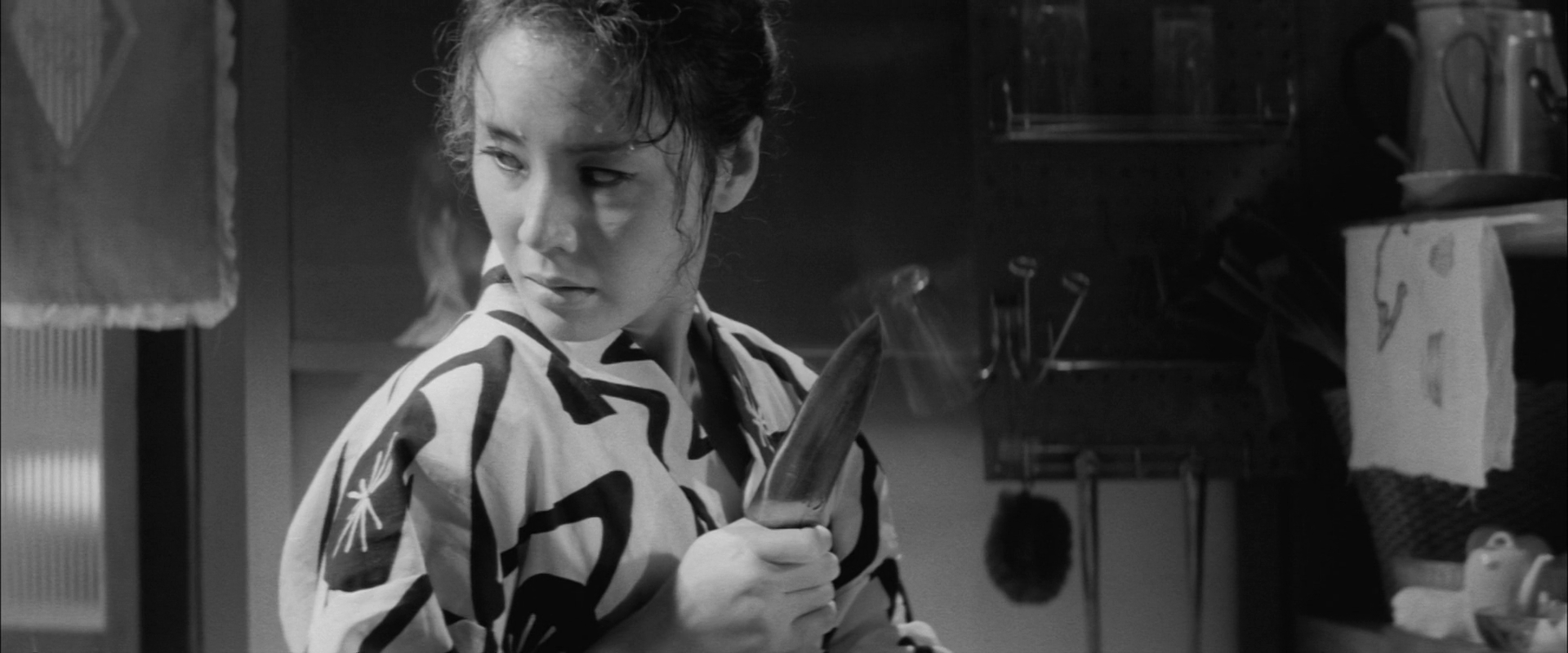
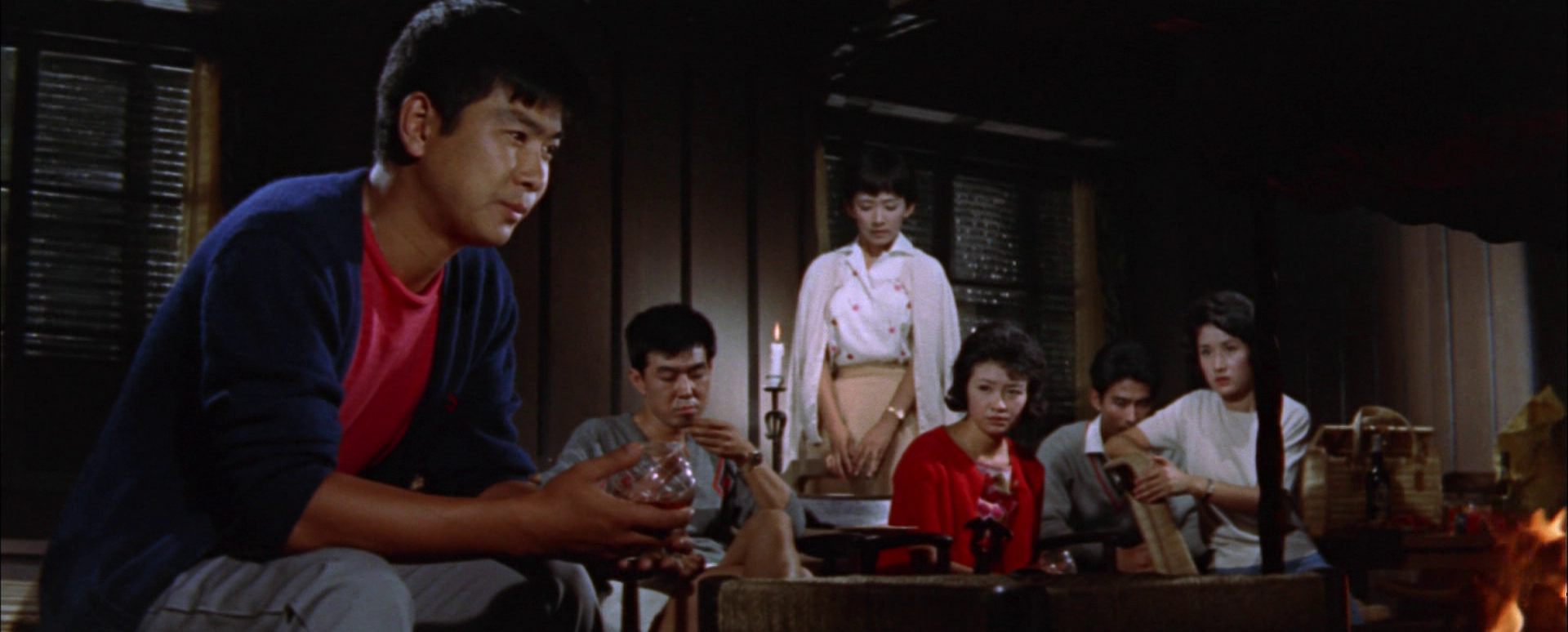
Likely intended as a slightly silly student rom-com, Ko Nakahira’s That Guy and I (あいつと私, Aitsu to Watashi) captures a sense of the changing gender roles and sexual mores of the early 1960s, if through a very male and at times even middle-aged lens. Adapted from a serialised novel by Yojiro Ishizaka and set amid the ANPO protests of 1960, the film is narrated by its heroine, a very ordinary young woman from a typical, moderately wealthy middle-class family, as she struggles with her attraction to a fabulously wealthy young man who pretends to be a boor but is actually a nice guy and unexpected feminist.

One of a new generation of women attending university with a prospect of independence, Keiko’s (Izumi Ashikawa) horizons seem to be broadening. She’s not exactly conservative and openly jokes about sex and dating with her friends, but is quite settled with her life, not particularly wanting anything more than she already has. Her psychology tutor highlights the problem of social inequality in their school that she had already raised in her opening voiceover in remarking that the rich kids all have cars and can drive themselves to school, while others are having to work to support themselves while they study. When he asks how much pocket money they all get, some are outraged and keen to stress they don’t get any help at all, but Keiko reveals that her parents actually give her a healthy allowance. It’s just that she has no real urge to spend it, so it’s been mounting up quietly in a desk drawer in her childhood bedroom while she still lives at home close to the university.

Saburo (Yujiro Ishihara), by contrast, boasts that he gets more than some people’s monthly wage as an allowance from his mother and blows it on drink, gambling, strip clubs and sex workers. It’s this last point that scandalises the female students who are all shocked and disapproving, even going so far as to ask the teacher to throw Saburo out because they don’t feel comfortable sharing a space with a man like that. The teacher also says he’s disappointed and wishes Saburo hadn’t added the last bit, only for Saburo to call him a hypocrite because sex work was legal in his day and he simply doesn’t believe that he’s never paid for sex. Most of the other boys join in on Saburo’s side, insisting that no man sees any problem with visiting sex workers which they regard as a natural right because the male sex drive is driven by “uncontrollable forces”.

But then there’s something unexpected that occurs among the female students in that some of them are obviously attracted by this very rough form of masculinity. “I’d rather have a wild beast than a meek sheep,” one intones, but nevertheless goes to join the group of girls confronting Saburo at the pool in the hope of gaining an apology for the offence he caused them. They’ve since found out that he probably made it up anyway, which is ironic because he claimed he’d only spoken the truth when they asked him to leave, but that’s somehow even worse because it means he said it deliberately to upset them. The upshot of it all is that Saburo ends up in the pool and is then forced to borrow some of the girls’ clothes while his dry off, signalling his awkward positioning between traditional masculinity and femininity in that he’s otherwise surprisingly sympathetic of women and makes sure to look out for them but in a way that encourages their independence and is never patronising. 

That might, in one way, be because of his unusual upbringing which is far more modern and bohemian than Keiko’s and in the beginning, at least, quite confusing for her. Saburo’s mother Motoko (Yukiko Todoroki) is a famous entrepreneur with a beauty shop empire. She writes her name in Western order and uses katakana for her first name which makes look foreign and therefore exciting and sophisticated even though it obviously isn’t. It was Saburo’s mild-mannered father who gave up his career in insurance to raise him, while his mother apparently blows off steam through numerous affairs. His father occasionally gets upset about this and the pair go through a charade of him leaving her while she professes her love for him, which seems to have a sexual dimension in itself. Perhaps this has given Saburo an alternative view of romantic relationships, though we also later discover that he was subject to what we’d now see as a form of sexual abuse as a teenager when his mother got a young but still adult woman, Michiko (Misako Watanabe), to essentially give him practical lessons in sex and satisfy his teenage urges, only he thought it was an organic romantic relationship and feels more than anything else emotionally betrayed. 

But then again, the film has a very of its time and defiantly male view of rape which is dealt with in a fairly flippant manner. Keiko rings her mother to tell her she’s realised that the reason she didn’t like the idea of her being at the ANPO protests was because she feared she’d be raped, which is at any rate an odd conversation to be having. Her mother asks her what her virginity has to do with ANPO, which is a fair question, but also implies that it’s not so much the physical and psychological harm of sexual assault that bothers her mother but the shame of premarital sex. One of the girls who goes to the protest, Ayako (Shigako Shimegi), is actually raped by the two boys she went with who deliberately plied her with alcohol and took her to a hotel knowing that she trusted them, but her roommate, who had a crush on one of the boys, immediately turns against her. Sadako (Kazuko Yoshiyuki), the most political of the students, calls her a slut who parades herself in front of men and says Ayako must have led them on. Only Keiko takes her side, walking her to the bath and waiting outside for her while admitting that she has conflicted thoughts about Saburo. She throws things at him to shoo him away, feeling that his presence as a man is inappropriate and not wanting him to see Ayako in this moment of vulnerability, but also she admits to herself because she’d be jealous and doesn’t want him to see a naked woman that isn’t her.

Something similar happens when she finds out about Saburo’s past and is jealous and resentful of Michiko, irrationally angry with Saburo, and on another level protective of him knowing that happened when he was a teenager was wrong. After she runs out into the rain and the pair argue about it, Saburo forces a kiss on her which, again, Keiko seems like in a show of robust manliness. Saburo is though also protective and sympathetic towards Ayako, insisting that that the way for her to move past her rape is to ensure she becomes financially independent and successful so that she can see it as just something unpleasant that happened to her rather than something that ruined her life or makes her unworthy of another man’s love. He even helps her to do that by getting her a job at his mother’s company. 

Saburo’s mother Motoko, meanwhile, gives Keiko some frank advice in disclosing the secrets of her life and Saburo’s birth. Even when Saburo suddenly announces their engagement without actually asking her, Keiko does not merely swoon but reflects that she’s got to have a proper think before actually agreeing which she is still free to do or not. Nevertheless, the film seems to have hit on a contradiction in redefining masculinity as both tough and soft. Keiko is despite herself attracted to Saburo’s forcefulness, but also his chivalrous nature and awkward kindness, his fair-mindedness and care, and recognition of women as actual human beings with interior lives and a right to independence. Nakahira may be a little less surreal than usual, but leans heavily into absurdity, on the one hand acknowledging the somewhat superficial quality of these privileged students’ lives in having them confront a band of angry rural workers and half-heartedly take part in the ANPO demonstrations without much thought to what they’re for or what they mean, but, in the end, characterises them as merely ordinary, slightly lost amid the rapid changes of the post-war society but otherwise cheerful and looking ahead to a bright future stretching out in front of them.


Trailer (no subtitles)
Jungle Block (地図のない町, Ko Nakahira, 1960)

The contradictions of the post-war era are thrown into stark relief in the forced redevelopment of slum area on the edge of an increasingly prosperous city in Ko Nakahira’s intense noir, Jungle Block (地図のない町, Chizu no nai Machi). The slightly unfortunate English title may hark back to that chosen for a US screening of Nakahira’s landmark film Crazed Fruit, Juvenile Jungle, or just echo the titles of classic Hollywood noir movies such as Asphalt Jungle and Blackboard Jungle, but otherwise has little to do with the content of the film. The Japanese title, meanwhile, means something like “a town not marked on the map” and hints at the invisibility of those who live in this slum, a self-built post-war shantytown inhabited by those largely left behind by the nation’s rising prosperity. 

Then again, Shinsuke (Ryoji Hayama) seems to have fallen behind on his own account. We’re later told that he resigned from his position at the hospital because of some kind of medical mistake for which he blames himself and has since taken to drink and gambling while working at the poor clinic run by his former mentor Kasama. The most immediate effect of his, perhaps unnecessary, decision to resign was that it prevented the marriage of his younger sister, Sakiko (Kazuko Yoshiyuki), as he was then financially dependent on her. Having delayed the wedding for two years waiting for Shinsuke to pull himself together, Sakiko and her fiancé are set upon by local gangsters working for yakuza turned politician and legitimate businessman Azusa (Osamu Takizawa). Sakiko attempts to take her own life and the relationship does not survive this crisis thanks to her fiancé’s wounded masculinity in having been unable to save her or stand up to the goons afterwards. 

As repeated flashbacks reveal, Azusa is the root of the disease spreading across the city. It’s he that’s intent on clearing the slum, as he says just doing what the government has asked him to do, planning to build luxury apartments on its site along with supermarkets and entertainment facilities. Perhaps it’s not an entirely bad thing to clear a slum, the living conditions are in themselves a health hazard, but Azusa has drastically cut the amount of compensation on offer preventing the residents from securing new places to live and essentially rendering them homeless which defeats the humanitarian justification for forcing them out when most of them don’t want to go. 

Kayoko (Yoko Minamida), an old flame of Shinsuke’s who’s since become a sex worker to pay off her father’s debts to loan sharks and ends up as Azusa’s mistress, has a cat that she confesses to mistreating which makes her feel better only to feel terrible afterwards. The film seems to align the cat with the people of the slums who are bullied by men like Azusa who have untold influence buying off police and politicians while he himself later holds public office. The cat eventually fights back by scratching Kayoko who acknowledges it’s her own fault for her treatment of it, while it’s clear that the anger of the slum dwellers will eventually boil over and they too will strike back against the corruptions of this post-war era which otherwise sees fit to leave them behind. 

Meanwhile, Shinsuke plots a revenge he may not have the courage to take explaining to Kasama (Jukichi Uno), otherwise the voice of moral reason, that it’s the city that sick and the only way to save it is an operation to remove the Azusa-shaped tumour that’s currently killing it. It’s not for mere convenience that his weapon of choice is a scalpel. Kasama, however, tells him that he’s got the wrong idea and it’s their responsibility as doctors to take the long-term view and patiently run their clinic to produce results in the far off future. But Kasama’s eventual decision would seem to walk that back, suggesting that perhaps a radical solution really is necessary to save the patient from the ravages of amoral capitalism. 

Then again, like Kayoko’s father Yoshichi (Jun Hamamura) who is branded a “cripple” and “only half a man” by Azusa, Shinsuke begins to realise that perhaps you can’t create lasting change on your own and taking out Azusa won’t solve the problem as someone else will simply rise to take his place. There is a pervasive sense of hopelessness, Shinsuke caught and frantic amid the dim backstreets of this rundown town desperate for revenge when the police are in league with Azusa and no one really cares about the residents of the slum who are beginning to lose the will to resist. Nevertheless, eventually rediscovering himself Shinsuke opts to follow Kasama’s path insisting that will join the ranks of “good, honest, people” who, like the cat, will eventually scratch back until then resisting by “doing the right thing” even in the face of violence and intimidation while staunching the flow of corruption and cruelty from the seeping wounds of the post-war society.


DVD release trailer (no subtitles)

The Wolves (狼, Kaneto Shindo, 1955)

Post-war desperation drives a collection of otherwise honest men and women towards a criminal act that for all its politeness they are ill-equipped to live with in Kaneto Shindo’s biting social drama The Wolves (狼, Okami). “Wolves” is what the criminals are branded, but the title hints more at the wolfish society which threatens to swallow them whole. After all, it’s eat or be eaten in this dog eat dog world, at least according to a cynical insurance salesman hellbent on exploiting those without means. 

Each of the five “criminals” is an employee at Toyo Insurance where they’re immediately pitted against each other, reminded that in order to qualify for a full-time position they need to meet their quotas for six months. The orientation meeting is cultilke in its intensity, the boss insisting that only in insurance can you become a self-made man while recounting his own epiphany as to the worthiness of his profession. They are told that the only two things they need are “faith and honesty”, and then “faith and pursuasion”, while encouraged to think of their work as an act of “worship”, “for the salvation of everyone”. 

Yet they’re also told to exploit their friends and family by pressuring them into taking out life insurance policies in order to help them meet their quotas. As one man points out, friends and relatives of the poor are likely to be poor themselves, but these are exactly the kind of people they’re expected to target. They’re told there’s no point going after the weathly because they’re already insured, but there’s something doubly insidious in trying to coax desperate people who can’t quite afford to feed themselves into paying out money they don’t have on the promise of protecting their families from ruin. One man even asks if the policy covers suicide and is told it does if you pay in for a year, sighing that he doesn’t want to wait that long.

“Suicide or robbery, choose one,” one of the salespeople reflects after failing to make their quota once again. They each have reasons to be desperate, all of them already excluded from the mainstream society and uncertain how they will find work if the job falls through. Akiko (Nobuko Otowa) is a war widow with a young son who is being bullied at school because of his cleft palate for which he needs an expensive operation. She’s already tried working as a bar hostess but is quiet by nature and found little success with it. Fujibayashi (Sanae Takasugi) is widowed too with two children and five months behind rent for a dingy flat in a bomb damaged slum where the landlord is about to turn off her electric. Harajima (Jun Hamamura) used to work in a bank but was fired for joining a union and is trapped in a toxic marriage to woman looking for material comfort he can’t offer. Mikawa (Taiji Tonoyama) too is resented by his wife, a former dancer, having lost his factory job to a workplace injury while the ageing Yoshikawa (Ichiro Sugai) was once a famous screenwriter but as he explains people in the film industry turn cold when you’re not hot stuff any more. 

Their unlikely descent into crime has its own kind of inevitability in the crushing impossibility of their lives. They may rationalise that what they’re doing is no different from the insurance company that exploits the vulnerable for its own gain, thinking that if they can just get a little ahead they’d be alright while feeling as if robbery and suicide are the only choices left to them and at the end of the day they want to survive. Perhaps you could call them “wolves” for that, but they’re the kind of wolves that give the guards from the cash van they robbed their train fare home after bowing profusely in apology. The real wolves are those like Toyo who think nothing of devouring the weakness of others, promising the poor the future they can’t afford while draining what little they have left out of them. As the film opens, Akiko looks down at a bug writhing in the dirt attacked by ants from all sides and perhaps recognises herself in that image as the sun beats down oppressively on both of them. Breaking into expressionistic storms and unsubtly driving past a US airbase to make clear the source of the decline, Shindo paints a bleak picture of the post-war world as a land of venal wolves which makes criminals of us all. 


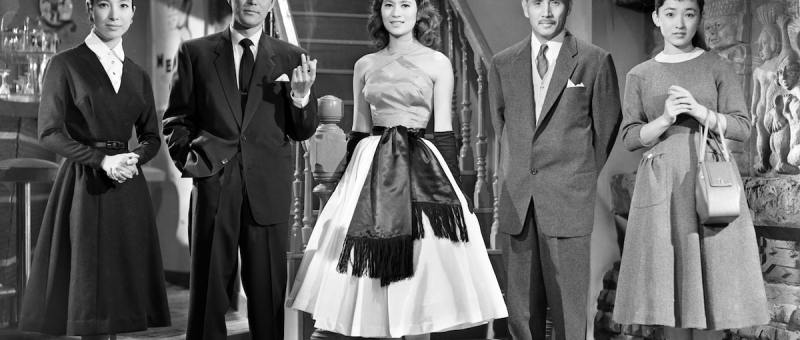
Hungry Soul / Hungry Soul, Part II (飢える魂 / 続・飢える魂, Yuzo Kawashima, 1956)

When you think of the family drama, you think of a young woman getting married and that her marriage is an unambiguously good and righteous thing despite the pain it may bring to her parents who will obviously miss her yet must comfort themselves that they’ve done everything right. In melodrama, however, we get quite a different picture of the “modern” marriage in which it is not quite so unambiguously good or righteous but a patriarchal trap enabled by a kind of gaslighting which tells women that suffering is the natural condition of life and that they should wear their unhappiness as a badge of honour.  

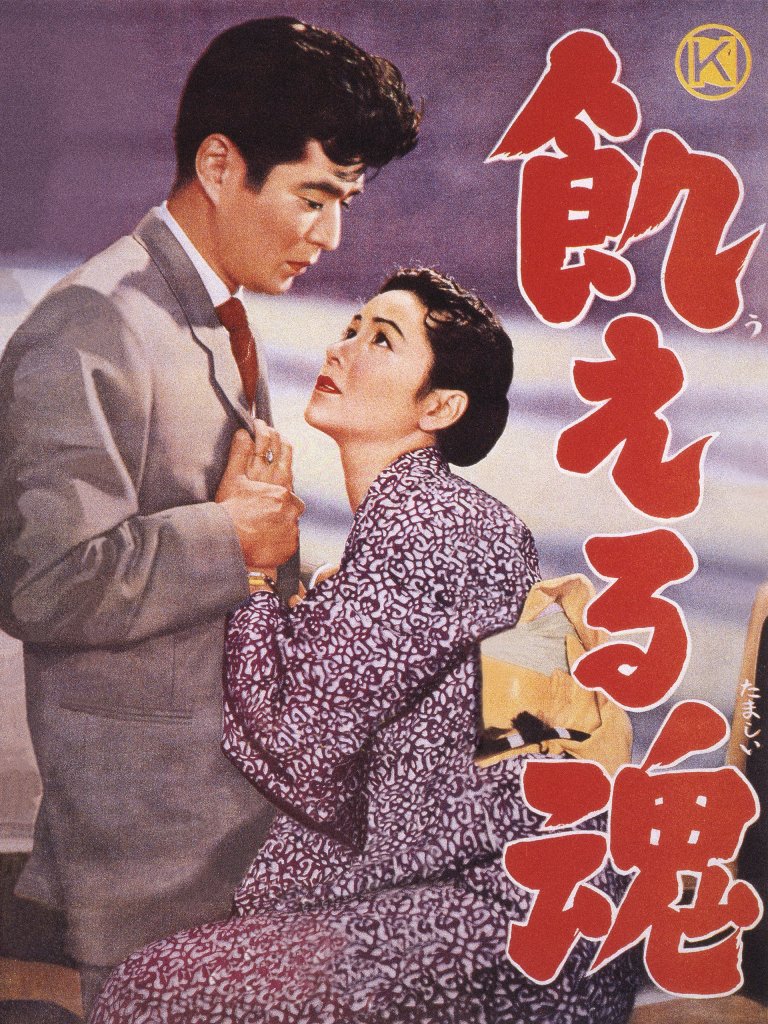
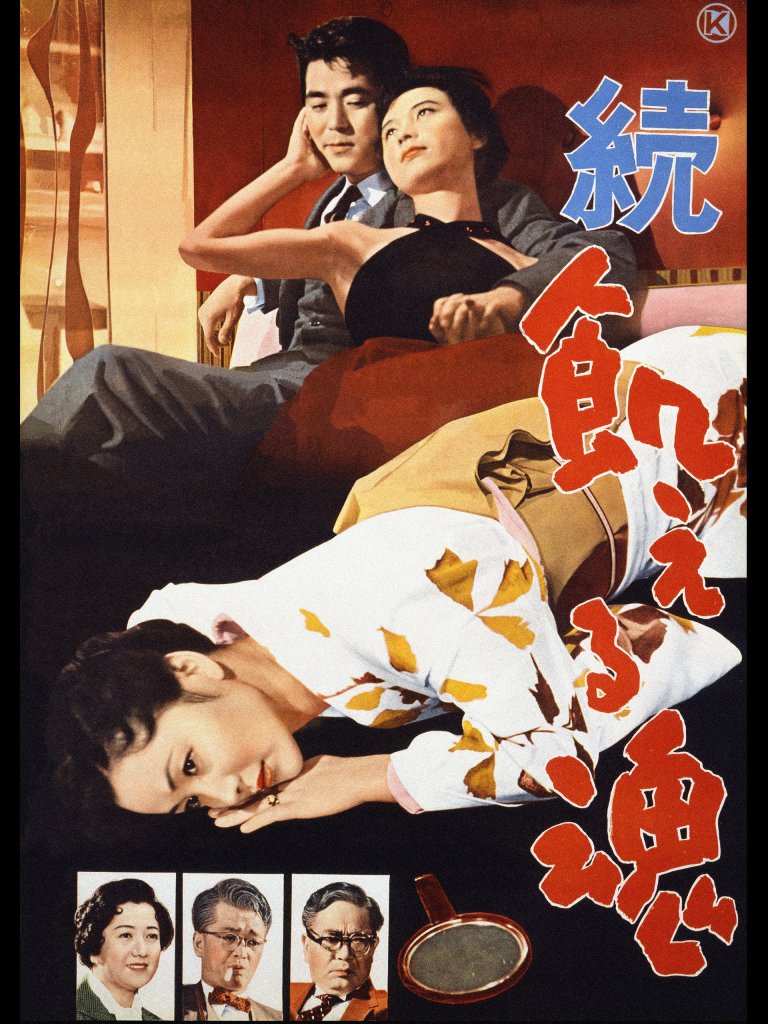
Nowhere does this seem truer than in the films of Yuzo Kawashima who in general takes quite a dim view of romance as a path to freedom and finds his heroines struggling to escape outdated social codes to seize their own freedom. Hungry Soul (飢える魂, Ueru Tamashii) finds one still comparatively young woman and another middle-aged discovering that they want more out of life than their society thinks a woman is supposed to have but continuing to wrestle with themselves over whether or not they have the right to pursue their personal happiness in a rigidly conservative society. 

Reiko (Yoko Minamida), a woman in her early 30s, married Shiba (Isamu Kosugi), 23 years her senior, 10 years previously apparently out of a mix of youthful naivety and post-war desperation. Shiba has supported her financially and apparently enabled her brother’s career, but it’s clear that he thinks of her as little more than a glorified housemaid, treating her with utter contempt even in public. He makes her carry her own bags at the station rather than wait for a porter and forces her to accompany him on business trips where he shows her off to colleagues and then retires her to the hotel with nothing to do all day. Tyrannised, Reiko has been been raised to be obedient and does her best to be a good wife, but Shiba repeatedly reminds her that he bought her while openly talking about his relationships with other women even at one point bringing a geisha home with him while Reiko cringes in the front seat next to the driver. 

Perhaps what she’s learning is that obedience is not an unambiguously good quality, but still she struggles to let go of the necessity of measuring up to the standards of social propriety. When Shiba unwittingly introduces her to handsome politician Tachibana (Tatsuya Mihashi), her accidental attraction to him awakens her to all the ways her married life is a hell of disappointment. Shiba reminds her that he keeps her in comfort, little understanding that she may hunger for something more than the material, while Reiko realises that she may starve to death for lack of love but has been conditioned to think that a woman’s emotional needs are not only unimportant but entirely taboo. 

Mayumi (Yukiko Todoroki), meanwhile, has known love but feels obliged to live on the memory of her late husband and fulfil herself only though caring for her two teenage children. To do that, paradoxically, she has seized her independence as a working woman with a job in real estate, later hoping to manage a ryokan traditional style hotel, only for her children to resent her perceived rejection of motherhood in favour of individual fulfilment. “School is for people who have two parents” her son tells her, threatening to move out into a dorm, while her daughter at one point considers suicide simply because she suspects her mother may be sleeping with her late father’s best friend. 

In Reiko’s case, her desire for liberation is kickstarted by a hunger for love, though as we later realise Tachibana is also perhaps looking to break with the past and with conventional male behaviour in that he has been a womanising playboy involved in relationships with women from the red light district which to him were always casual while they, like Reiko and Mayumi, longed for more. Mayumi’s relationship with Shimozuma (Shiro Osaka), by contrast, is complicated by the fact he is married to a woman with a long-term illness, though what he craves (besides Mayumi herself for whom he seems to have been carrying a torch for many years) is a conventional family home, jokingly chiding Mayumi that her interest in business may be making her less “womanly”.  

Both women try, and fail, to break free of patriarchal control to claim their own agency, discovering that romance is not the best way to find freedom. Despite her love for and possibly misplaced faith in Tachibana, Reiko is both too brutalised by her abusive husband and constrained by the taboo of being a woman ending a marriage for another man to definitively escape Shiba’s control. Mayumi, meanwhile, is shamed by the reflection of herself in her children’s eyes and motivated to reassume her maternity but does so also as a way of rejecting easy romantic fulfilment in the hope of discovering more of herself as a middle-aged woman embracing all the freedom that might offer while her children, though grateful to have her return to them, are also chastened and guilty in having realised that their mother is a woman too and ultimately they just want her to be happy. As often in Kawashima, no one quite gets what they wanted, but they do at least find a kind of resolution. Their souls may still be hungry, but their appetites have returned and there is the promise of future fulfilment if still tempered by the restrictions of a cruelly repressive society.


Hungry Soul opening (no subtitles)

Hungry Soul, Part II opening (no subtitles)

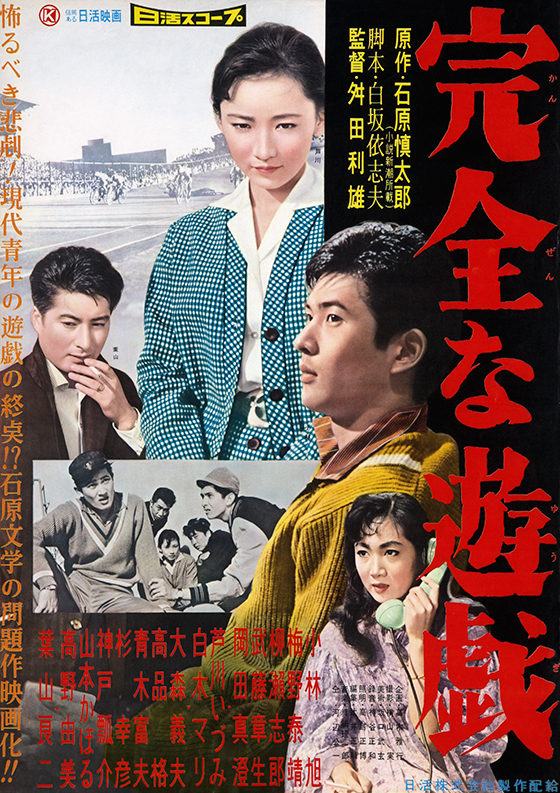
The Perfect Game (完全な遊戯, Toshio Masuda, 1958)

In the mid-1950s, Nikkatsu had courted controversy with a series of films depicting the amoral excesses of the immediate post-war generation. The “Sun Tribe” movies embedded themselves in a world of new bright young things who were largely independently wealthy and thoroughly bored by the ease of their lives. Nikkatsu was forced to halt production on the Sun Tribe films after only three (Toho and Daiei added one each of their own), but they did precipitate a wholesale shift towards youth movies which became the studio’s signature theme. 

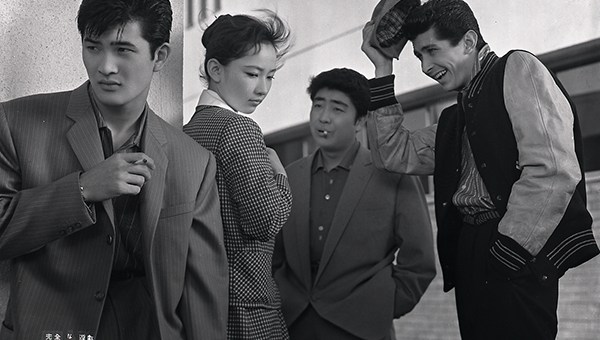
Best remembered for his contributions to Nikkatsu’s action noir, Toshio Masuda’s The Perfect Game (完全な遊戯, Kanzenna Yugi, AKA The Tragedy of Today) arrived two years after the Sun Tribe craze but neatly picked up the baton dropped by Kon Ichikawa’s Punishment Room in its tale of nihilistic college boy amorality. As the film opens, our four heroes are playing mahjong and lamenting their lack of funds. They are all, it goes without saying, middle class boys largely supported by their parents who, as far as we know, are high ranking salarymen. They are not hungry, or worrying about how to pay rent or tuition, they are just bored and want extra money to go out having fun before they they are forced into the corporate straightjacket with the regular salaryman jobs many of them already have in the bag thanks to the tremendous power of nepotism. 

As the the opening text implied, they viewed their money making exploits as a game, proving how clever they think they are in getting one over on the universe, but all too quickly it spirals out of control. Toda (Yasukiyo Umeno), the ring leader, has come up with an ingenious money making scheme. It turns out that there’s an illegal betting office some distance away from the bicycle racing stadium that keeps taking bets until someone rings from the track and tells them who won, which means there’s about a five minute delay between the winner being declared and bets being called. The boys figure that if they can somehow beat the lag they can win big. To make it work, they ask their “friend” Kazu (Masumi Okada), who they seem to regard as a bit dim, to join them as well as recruiting an old codger to call the race before the boards go up. Surprisingly it works out, but unfortunately the yakuza-backed bookmaker, Matsui (Ryoji Hayama), wasn’t banking on such a big win and doesn’t have the funds to pay out in one go. 

Toda in particular is pissed off. The wind taken out of his sails, he’s not sure what to do which is when So (Akira Kobayashi), the pretty boy of the group, suggests an ironic punishment. Matsui had joked that he’d put up his adorable kid sister Kyoko (Izumi Ashikawa) as collateral if he couldn’t pay out, so why don’t the boys take him at his word and kidnap her. Rewinding a little, these snotty college boys are about to become kidnappers, adding a little blackmail on the side. This isn’t a fun game anymore, someone is going to get hurt whatever happens even if they can’t know the extent to which their plan to earn a few bucks to blow on jazz bars and pool rooms is going to incur collateral damage. 

Unlike the boys, Kyoko is a working class girl. She wants to keep her head down and work hard, not quite approving of her brother’s involvement with the yakuza and wishing he’d find an honest job but also acknowledging that he had few options and it’s his job at the bookies that’s been keeping them all this time. Their father died in the war, and their mother (Yumi Takano) is very ill, bedridden with heart trouble. Kyoko is no innocent, she brushes off So’s attempts to court her by revealing that dozens of creepy guys try the same thing every day, and most of them don’t stop at passing notes. For whatever reason she ends up warming to him, making him take her to a theme park while her mother worries at home, while he also begins to feel conflicted about the plan in falling for her for real. 

So’s mistake is the childish belief that they’re still playing a game and everything will be alright in the end. He foolishly trusts that his friend’s are men of honour and that Matsui will come up with the money and redeem his sister in no time at all. But money’s not easy to come by even if you’re a yakuza, and the boys might not want it anyway if it comes with additional complications. Visiting with Kyoko’s sickly mother, he perhaps begins to see the gap between his comfortable existence and theirs of constant struggle. He’d been so proud to tell Kyoko that he had an interview lined up at a big company because of family connections, but when he arrives there he feels irrelevant. The interview board only ask him questions about his dad, as if he didn’t really exist. Finally they ask him to talk about what he did at uni, what his “passions” are, if he did anything of note in the past few years, perhaps even fall in love? They’ve unwittingly touched a nerve, but So is in any case forced to reflect on the meaninglessness not only of his adolescence, but of his future. This interview has been a farce, but they’re giving him the job anyway because he’s his father’s son. What more is there to say?

The other boys are also worried about their job prospects, concerned that someone might talk and they’ll be forever tarnished by “youthful exuberance”, refusing to take any personal responsibility for the consequences of their “perfect game”. Unlike So they still want to live in that inherently unfair world which exists for upperclass men to do as they please. Toda and So weren’t quite like their friends. They felt conflicted. Toda embarrassed to be borrowing money from his girlfriend but rejecting the others’ belief that you don’t have to pay women back, only to angrily bark at her that there’s “no way a woman can understand” the intensely masculine debate he’s just had with So about responsibility, which he accepted by deflecting in pushing So’s complicity back on him in an attempt to share his guilt. Unlike the Sun Tribe films, youth takes responsibility for itself and its friends, but can find no way to atone for its moral abnegation. 


Original trailer (no subtitles)

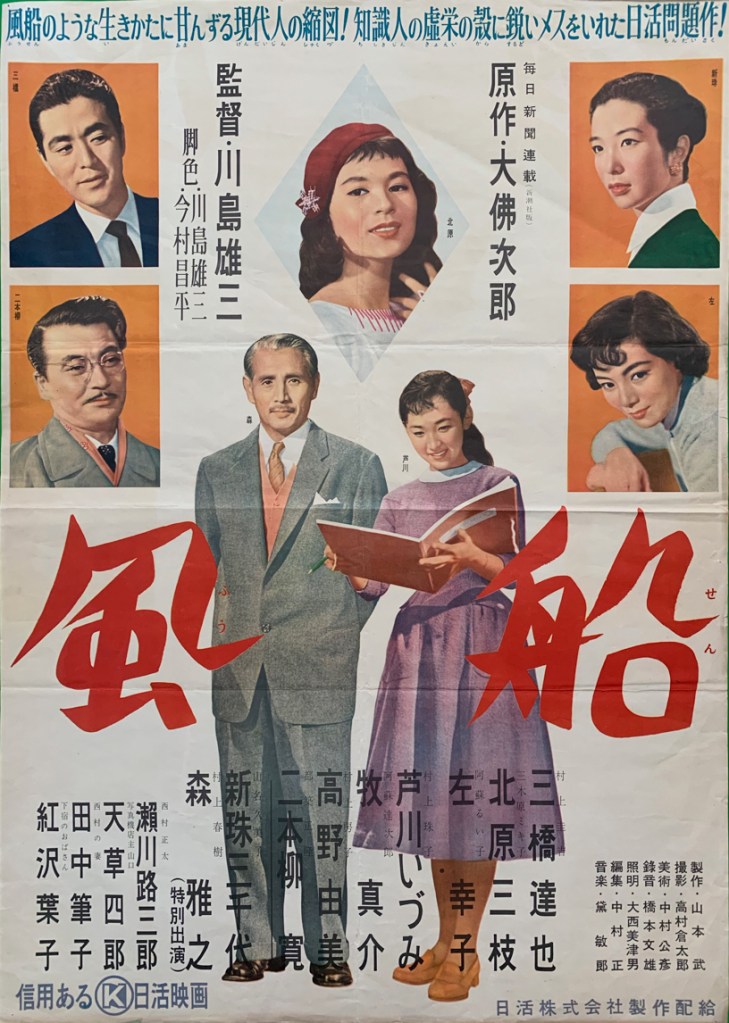
The Balloon (風船, Yuzo Kawashima, 1956)

The uncertainties of the post-war world are often conveyed through the familiar “cloud” metaphor, but in characteristic fashion Yuzo Kawashima opts for something earthier in the manmade “Balloon” (風船, Fusen). Less representative of its troubled humanists than the amoral villain Tsuzuki (Hiroshi Nihonyanagi) who likes to know which way the wind is blowing so he can go that way too, these balloons are up in the air because they’re afraid to land fearing the inevitable pop if they pick the wrong spot.

Our hero, former painter Murakami (Masayuki Mori), has become the head of a successful camera firm. His son, Keikichi (Tatsuya Mihashi), works with him, while his 20-year-old daughter Tamako (Izumi Ashikawa) is a reluctant student still living in the family home. Out of step with his times, he’s known as a decent and compassionate boss, offering his staff a significant wage increase in excess of that recommended by the union just because he thinks it’s the right thing to do. Unfortunately, Keikichi is much more like his conservative mother and does not quite share his father’s egalitarian principles. He’s currently engaged in a “relationship” with widowed bar hostess Kumiko (Michiyo Aratama) but treats her extremely badly, throwing money on the side table as he leaves her apartment to make it clear that he views himself as a customer and not as a lover. When Murakami re-encounters a family friend, Tsuzuki, at his father’s funeral it sets off a chain of events that will change his life completely. Now a shady nightclub entrepreneur, Tsuzuki is dead set on making his singer, Mikiko (Mie Kitahara), a star and thinks a good way to help make that happen might be to get her married to someone with money, like, for instance, Keikichi. 

Raised in Shanghai, singing in French, and forever wearing berets, Mikiko may indeed be the face of avaricious post-war youth, apparently having floated along with Tsuzuki halfway across the world in search of a place in the sun. Urged on by her manager, she goes to war against Kumiko who, in contrast to the “bar girl” image, is earnest and naive. Working as a hostess places her on the fringes of the sex trade, but does not necessarily imply that she makes a living by sleeping with her customers, and she certainly seems less than grateful to receive money from Keikichi whom she believes to be her boyfriend. Mikiko willingly weaponises her sex appeal and seemingly endures no consequences for doing so, while Kumiko is roundly rejected as a “fallen woman” and deemed an unsuitable match by Keikichi’s snooty mother. 

Tamako, by contrast, actively reaches out to Kumiko and attempts to make her a member of the family, never for a second considering that she might not be welcome because she can see that Kumiko is a “nice” person. Much more like her kindly father, she finds herself uncomfortable at home and mostly holes up in the attic painting. After suffering childhood polio, she’s been left with muscle weakness in her left arm and is treated like a child by her mother and brother who openly tell people that the illness has also made her “simple”. Despite all that, however, she sees only the best in people and desperately wants those around her to be happy. 

The difference in her own family is brought home to her when her father takes her with him on a business trip to the much quieter, more traditional Kyoto where he has reunited with a pair of youngsters whose late parents once rented him a room when he was temporarily displaced by post-war confusion. Like Kumiko, Rui (Sachiko Hidari) is a kind person in difficult circumstances. She too is working in a bar and has done some work as a photo model, even glamour shots to earn money to pay her brother’s university fees. Rui doesn’t want to go on doing that in the future, but doesn’t feel too bad about it either because she only exposed the outside of herself, and really who cares about that. 

Beginning to regret some of his life choices, Murakami wonders if he mightn’t be better to move back into the attic room in Kyoto and pray at the temple everyday like before instead of trying to make money he feels has slowly corrupted his family. Confronted with Keikichi’s near sociopathic self-involvement over his relationships with Kumiko and Mikiko, he comes to the conclusion that all he can do is cut him loose and hope he learns some humility through being forced to stand on his own two feet. Given a talking to by his father Keikichi doubles down with his misogynistic world view, insisting that “all women are whores” and all relationships are essentially transactions while claiming that he, himself, as well as men in general, is the real victim because he’s being forced to carry the can for the way the world works. Murakami isn’t having any of it, calmly asking him if he’d say the same thing to his mother, which he sheepishly admits he couldn’t. 

Mikiko likens Tsuzuki to one off his metaphorical balloons, pointing out that he was an imperialist in Shanghai and now seems to have it in for the bourgeoisie, but for all his cynicism he seems to have a kind of admiration for a woman like Kumiko who carried on loving one man no matter how poorly he treated her. If only he had a woman like that, he might have found a place to land and his life would have been very different, he muses. Murakami, meanwhile, has rejected the modern city, certain that his son is the way he is because his life has been too easy and access to wealth has given him a superiority complex that’s put him out of touch with ordinary people. Disappointed with his own family, he decides to make a new one with the two cheerful youngsters in Kyoto, hoping that he will at least be able to save his daughter from the ravages of a rapidly declining society which seems primed to swallow the sensitive whole.


Currently available to stream on Mubi in the US.