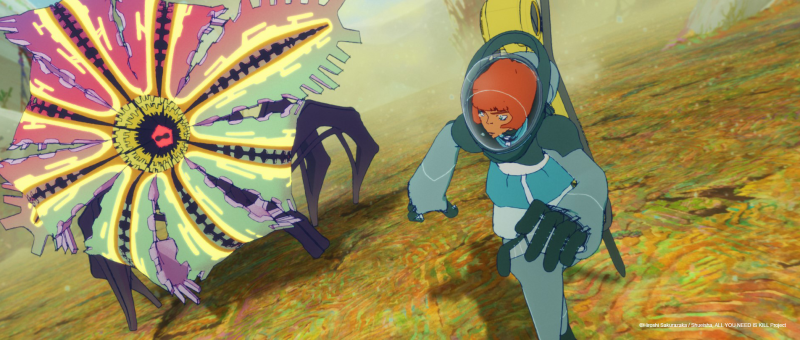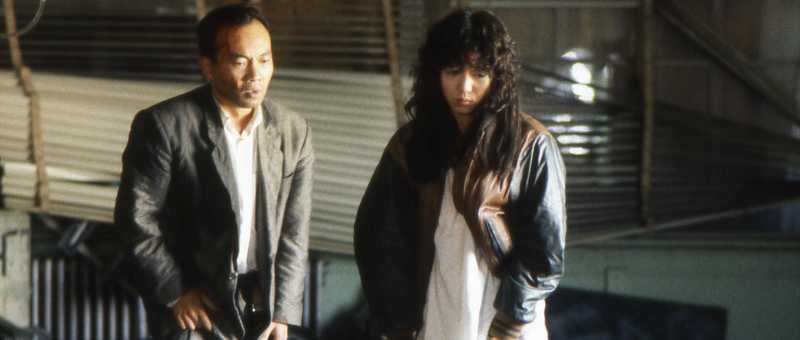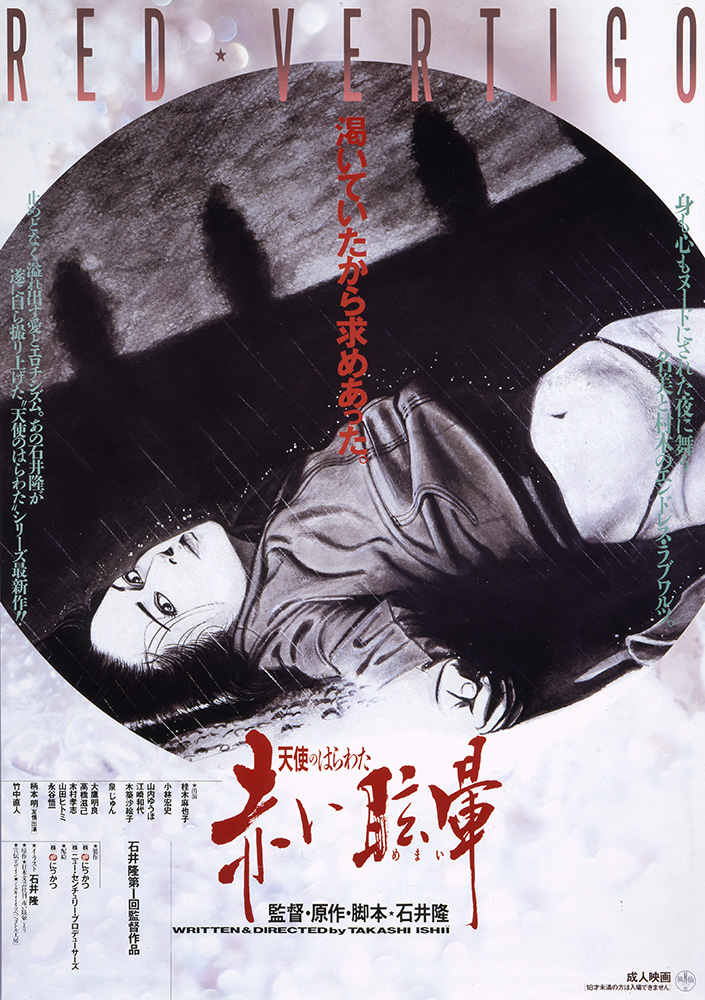
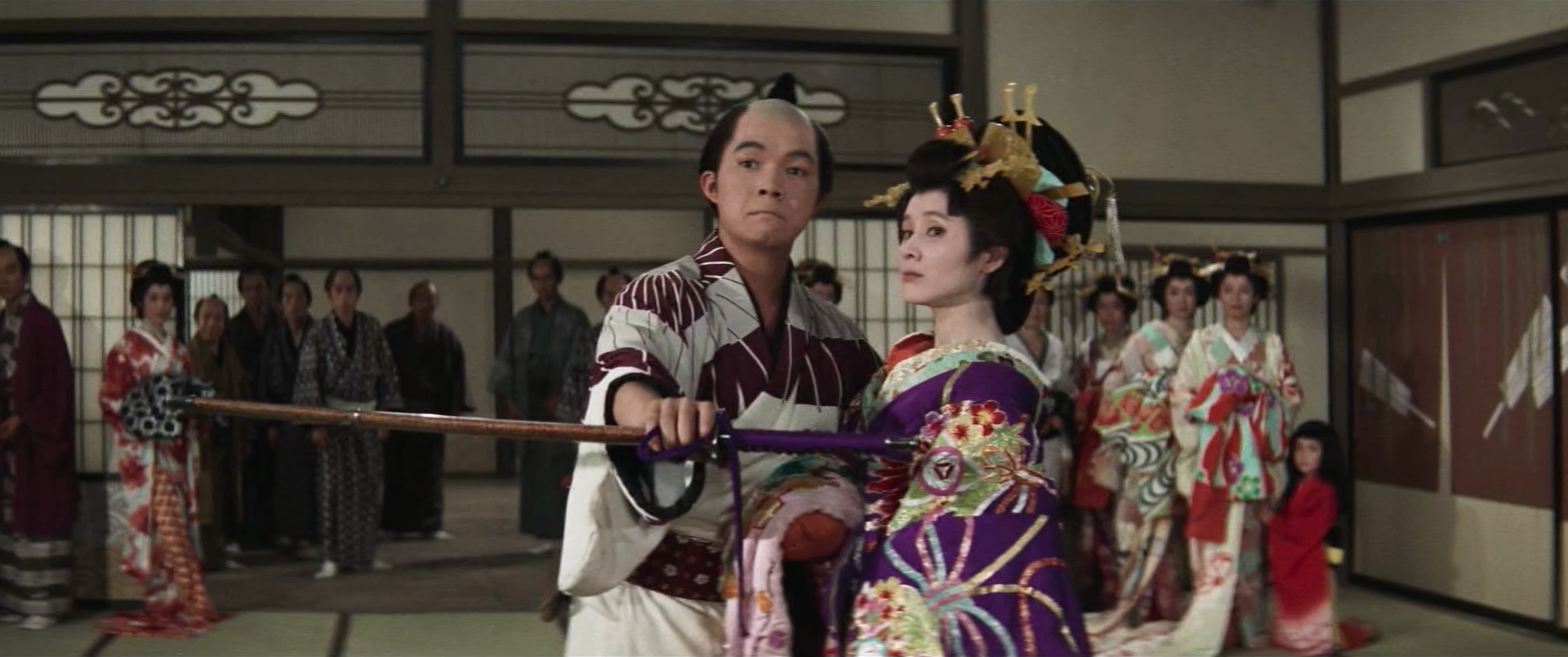
Shinobi no Mono 3: Resurrection (新・忍びの者, Kazuo Mori, 1963)

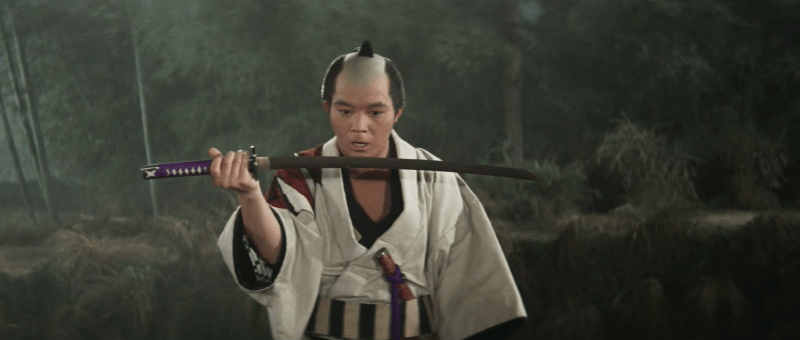
At the end of the second film in the Shinobi no Mono series, Goemon (Raizo Ichikawa) was led away to be boiled alive in oil after failing to assassinate Hideyoshi Toyotomi. Obviously, Goemon did not actually die, but exchanged places with a condemned prisoner thanks to the machinations of Hanzo Hattori (Saburo Date) which is a clear diversion from the accepted historical narrative to which the film otherwise remains more or less faithful. However, in this instalment more than all the others, Goemon is very much a shadow figure, pale and gaunt, who appears much less frequently on screen and mainly relies on stoking the fires of an already simmering succession conflict in the Toyotomi camp.

At this point, Hideyoshi has already made himself de facto leader of a unified Japan having been made the “kampaku”, advisor to the emperor, only to cede that position in favour of his adopted heir, Hidetsugu (Junichiro Narita) taking the title of “Taiko.” Hideyoshi has been childless for many years which is why he adopted his nephew, but the birth of his son by blood has dangerously unbalanced the palace order with Hidetsugu increasingly certain he’s become surplus to requirements. Meanwhile, in an effort to secure his position Hideyoshi has also embarked on an ambitious plan to conquer Korea as a means of getting to Ming China and circumventing the tributary requirements necessary for trading with it. 

This plan necessarily means that they need more money with Hideyoshi calling an end to all building and renovation projects including that of a Buddhist temple playing into the series’ themes about hubris in the face of Buddha though by this point Goemon too has lost faith in Buddhism in the clear absence of karmic retribution. As Ieyasu (Masao Mishima) points out, this works out well for him as it will stir discord among local lords who will be forced to squeeze their already exploited subjects even more earning nothing more than their resentment which will then blow back on oblivious Hideyoshi.  

Thus Goemon’s role mostly involves sneaking in and telling various people that others are plotting against them and they’d be better to get ahead of it. A secondary theme throughout the series has been a sense of powerlessness which is perhaps inevitable in a historical narrative in which we already know all of the outcomes. Ieyasu scoffs at Goemon, remarking that he thinks he’s walking his own path but is really being manipulated into walking that which Ieyasu has set down for him, though Goemon effectively rejects this stating at the conclusion that as Ieyasu believed he was using him he was also using Ieyasu to achieve his revenge on Hideyoshi for the death of his wife and son. In the historical narrative, Hideyoshi dies of a sudden illness as he does here with Goemon lamenting that his revenge is frustrated by the fact that Hideyoshi is now old and frail though he achieves it through symbolically cutting off his bloodline but explaining to him that Hideyoshi will not become the heir to anything because Ieyasu will be taking the role he has so patiently waited for. Hideyoshi has in any case perhaps disqualified himself as the father of a nation by wilfully sacrificing his adopted son, Hidetsugu, who was ordered to commit suicide to avoid any challenge to Hideyori after becoming desperate and debauched in the knowledge that his days were likely numbered anyway.

In any case, Goemon perhaps declares himself free in asking why he should care who’s in charge after Hanzo once again tries to recruit him to work for a now triumphant Ieyasu whose long years of simply waiting for everyone else to die have paid off. This is what passes for a happy ending in that he has thrown off the corrupt authority of the feudal era and discovered a way to live outside of it as a “free” man though as others point out the system hasn’t changed. Poor peasants continue to be exploited by lords who are greedy but also themselves oppressed by an equally ruler playing petty games of personal power. Fittingly, ninja tricks mainly revolve around smoke bombs and the covert use of noxious fumes to weaken the opposition as they creep in to spread their poison. Never shedding the series’ nihilistic tone, the film ends on a moment of ambivalent positivity albeit one of exile as Goemon declines the invitation to the fold instead wandering off for a life of hidden freedom in the shadows of a still corrupt society. 

Shinobi no Mono 2: Vengeance (続・忍びの者, Satsuo Yamamoto, 1963)

Though Goemon might have thought himself free of his ninja past at the conclusion of the first film, he was unfortunately mistaken. Shinobi no Mono 2: Vengeance (続・忍びの者, Zoku Shinobi no Mono) sees him trying to live quietly with Maki and their son in a cabin in the woods, but Nobunaga is more powerful than ever. He’s wiped out the Iga ninja and is currently hunting down stragglers. Try as he might, what Goemon discovers the impossibility of living outside of the chaos of the feudal era. 

After he’s caught and suffers a family tragedy, Goemon and Maki (Shiho Fujimura) move to her home village in Saiga which is the last refuge of the Ikko rebels who oppose Nobunaga. This time around, the film, based on the novel by Tomoyoshi Murayama, even more depicts the ninja as backstage actors silently shuffling history into place. Thus Goemon takes advantage of a rift between the steady Mitsuhide (So Yamamura) and loose cannon Nobunaga (Tomisabur0 Wakayama) in an attempt to push him into rebellion. But what he may discover is that even with one tyrant gone, another will soon rise in its place. Hideyoshi (Eijiro Tono) seems to be forever lurking in the background, while Ieyasu makes a few experiences explaining that he intends to wait it out, allowing his rivals to destroy each other so he can swoop down and snatch the throne at minimal cost. 

But he too has his ninja such as the legendary Hanzo Hattori (Saburo Date) who arrives to complicate the intrigue and tempt Goemon away from his attempts to live a normal life. Interestingly enough, one of the factors leading to Nobunaga’s downfall is his disregard for Buddhism in frequently burning temples associated with ninja along with everyone inside them. Burning with a desire for vengeance, Goemon describes Nobunaga as inhuman, a demon, though he also embodies the vagaries of the feudal era in which no one is really free. Nobunaga has built a large castle estate for himself while ordinary people continue to suffer under onerous demands from local lords. Hideyoshi has also done something similar in an attempt to bolster his status and prepare for his own inevitable bid for national hegemony. 

The implication is that though the constant warfare of the Sengoku era is of course bad for farmers in particular, the political machinations which revolve around the egos of three men are far removed from the lives of ordinary people. Even so, the code of the ninja continues to be severe as we’re reminded that love and human happiness are not permitted to them. A female ninja spy working for Hanzo is despatched to Nobunaga’s castle to seduce his retainer Ranmaru but is cautioned that she must not allow her heart to be stirred. Predictably this seems to be a promise she couldn’t keep, eventually dying alongside him during an all out attack on the castle. 

Goemon discovers something much the same in encountering further losses and personal tragedies, but takes on a somewhat crazed persona in his continuing pursuit of Nobunaga, grinning wildly amid the fires of his burning castle while taunting Nobunaga that he is the ghost of the Iga ninjas he has killed. Then again, he’s laid low by his own ninja tricks on discovering that Hideyoshi has had a special “nightingale floor” installed that lets out a song whenever someone crosses it, instantly ruining his attempt to infiltrate the castle. “The days when a few ninja could control the fate of the world are over,” Ieyasu ironically reflects though perhaps signalling the transition he embodies from the chaos of the Sengoku era to the oppress peace of the Tokugawa shogunate.

Somehow even bleaker than its predecessor, Yamamoto deepens the sense of nihilistic dread with increasing scenes of surreal violence and human cruelty from a baby been thrown on a fire to a dying commander teetering on his one leg and holding out just long enough to gesture at a sign requesting vengeance against those who have wronged him. Echoing the fate of the real Goemon, dubbed the Robin Hood of Japan for his tendency to steal from the rich to give to the poor, the conclusion is in its own way shocking but then again perhaps not for there can be no other in this incredibly duplicitous world of constant cruelty and petty violence. 


Ninja, A Band of Assassins (忍びの者, Satsuo Yamamoto, 1962)

Ninja in Japanese cinema had largely been relegated to the realms of childish fantasy prior to Satsuo Yamamoto’s Ninja, A Band of Assassins (忍びの者, Shinobi no Mono) which cast a distinctly less heroic light on the famed mercenary spies of the feudal era. Indeed, there’s something reminiscent of the cult of militarism in the repressive nature of the ninja code and the hero Goemon’s (Raizo Ichikawa) original allegiance to it despite his father’s wariness and attempt to warn him that human happiness has no place in the life of a ninja. 

As the leader of Goemon’s clan, Sandayu (Yunosuke Ito), explains the ninja are obliged to serve whichever lords require their service, but he refuses to work with Oda Nobunaga (Tomisaburo Wakayama, billed as Kenzaburo Jo) owing to his famous animosity towards them. He even goes so far as to call Nobunaga a greater threat to the ninja than demons or devils. Opening in 1573, the film takes place at a tumultuous moment as Nobunaga continues to solidify his plan to unite the whole of the land under his banner by absorbing or defeating rival clans. The pre-credits sequence finds Goemon playing dead on a battlefield surrounded by ominous crows and encountering another ninja from a rival clan, Kizaru (Ko Nishimura), who has become a more literal kind of vulture in stealing from the dead.

Stealing is against the ninja code and something of which the young and idealistic Goemon fiercely disapproves. Nevertheless, in a cruel irony he’s forced to become a burglar in an effort to raise funds for more weapons to combat Nobunaga whom he has also been ordered to assassinate in return for his life after having been caught having an affair with Sandayu’s wife, Inone (Kyoko Kishida). Goemon is inspired by the legendary figure dubbed the Japanese Robin Hood for his mission stealing money from the rich to give to the poor, but here is far from heroic. When his affair with Inone is discovered by a servant, Goemon kills him to maintain the silence. He then believes that Inone has also been killed after falling into a well and attempts to flee the scene only to be confronted by Sandayu. 

Only too late does to he begin to understand what his father tried to warn him about, that the code of the ninja is cruel and unforgiving. It cannot grant him pride or happiness despite the self-satisfied glow he feels on having been singled out by Sandayu as a protege. A ninja must be ready to sever all ties to those he loves and endure intense torture without speaking. If caught in an impossible situation he must scar his face and take his own life as one of Goemon’s acquaintances eventually does after being captured by Nobunaga. Goemon assumes he has no reason to be afraid because he is the most skilled ninja in the garrison and a single ninja can take down a fortress all on his own, but in reality he is powerless, merely a puppet manipulated by Sandayu for his own ends. After falling in love with a sex worker, Maki (Shiho Fujimura), he grows tired of his missions, gives up on burglary, and makes no move to assassinate Nobunaga but is pursued by Sandayu’s minions, the irony being that not even a ninja can escape from the confined space of ninjadom.

This world is so steeped in secrecy that nothing is as it seems and Goemon discovers the rug pulled out from under him in more ways than one before beginning to realise that Sandayu has deliberately engineered his downfall and was most likely behind his father’s murder in an attempt to get his hands on his recipe for gunpowder which is, as Nobunaga says, the future of warfare. Nevertheless, even within its commitment to realism the film contains plenty of ninja tricks from sudden appearances to superhuman leaps and expert shuriken throwing and grappling hooks.  The sense of melancholy futility implied by the presence of the crows in the opening scenes never recedes, Yamamoto frequently descending into mists as Goemon sinks into his confusion and eventual disillusionment with the tenets of ninjadom. Rival ninja clans more obsessed with their reputation and status vie for the head of Nobunga while all Goemon wants is the right to live a quiet life with Maki though that’s something that largely cannot be found amid the constant chaos of the feudal era. 

Golden Eyes (100発100中 黄金の眼, Jun Fukuda, 1968)

Three years after taking down illegal arms dealers, “Interpol” agent Andrew Hoshino (Akira Takarada) returns with another globetrotting adventure, this time concerning a missing coin worth a great deal to an amoral gold smuggler. Ironfinger had appeared in the midst of Bond-mania and boasted a script by none other than Kichachi Okamoto which was full of cartoonish fun and surreal humour as Andy made use of a series of spy gadgets to aid him in his cause. The similarly Bond-referencing sequel, Golden Eyes (100発100中 黄金の眼, Hyappatsu Hyakuchu: Ogon no Me) , attempts something much the same but perhaps without so much of Okamoto’s trademark sophisticated silliness. 

This time the action opens in Beirut where a chauffeur is being hunted by a man in a helicopter as he attempts to escape through the sand dunes. Skewered by a giant grappling hook, the driver’s body is apparently then deposited on the roof of a hotel, causing not a little embarrassment to gold smuggling kingpin Stonefeller (see what they did there?) who is already quite worried about attracting the attention of the local police. Meanwhile, Andy happens to be in Beirut on another “vacation”, having fun driving the owner of a shooting game in an arcade out of his mind before he runs into a little girl who tells him that she’s looking for an assassin to avenge the death of her father, the body deposited on the hotel roof. All she can afford to pay him is the silver dollar her dad gave her as a keepsake before he died, but it’s good enough for the kindhearted Andy who decides to get justice for the little girl no matter what. Just then, however, an attempt is made on his life by means of a bomb hidden in a bouquet given to him by pretty Japanese singer Mitsuko (Tomomi Sawa) who is in Beirut to find wealthy men to finance her love of rally car racing. 

The major antagonist is an ancient American “industrialist” with a dog called Sinbad who thinks that the gold must flow and that he’s doing a public service delivering it to Japan where its absence only highlights the “backwardness” of the Japanese state. Stonefeller is also blind but an ace sniper thanks to a directional microphone in place of a sight on his rifle. In any case, though Stonefeller is the kingpin, the true “villain” is Kurokawa (Yoshio Tsuchiya) who is responsible for the death of the little girl’s father, killed while thought to be in possession of the missing gold coin. The coin later makes villains of the two Beiruti gangsters working with Stonefeller who end up chasing after Kurokawa to try and retrieve it while Andy, mysterious “reporter” Ruby (Bibari Maeda), and earnest detective Tezuka (Makoto Sato) do their best to stop them. 

The international villainy may reflect a certain anxiety about Japan’s increasingly global role, rising economy prosperity, and relationship with the Americans, but it’s also a little guilty of exoticisation in its Middle Eastern setting with the majority of Beiruties played by Japanese actors in awkward brown face. An early, spectacular set piece sees Andy and Tezuka beset by Stonefeller’s goons swarming over the dunes dressed as mothers pushing prams which turn out to be fitted with machine guns while Andy sets up a complex stunt which sets off two abandoned weapons with a single pistol shot to take down the bad guys. 

Mitsuko, meanwhile, seems to be a symbol of out of control celebrity, an aspiring singer taking part in rally races sponsored by the Japan Economic Council dedicated to fuel efficiency. She is content to be discovered with a dead body because of all the free publicity it’s about to buy her, but more than holds her own when in a difficult situation with the amoral Kurokawa, perhaps a representative of unbridled capitalist greed. Almost blown up with flowers, encased in plaster like a giant mummy, and delivered poisoned gas by room service, Andy maintains an ambiguous cool while still making constant references to his dear French mama waiting for him at home in Paris. As expected, no one except for Tezuka has been quite honest about their intentions or identities, but it hardly seems to matter as they work together while pursuing their own angles to get their hands on the coin and stop the Stonefellers of the world messing around in their economy. 


Video Girl Ai (電影少女, Ryu Kaneda, 1991)

The thing about video is that it is essentially one-sided. Though it might be possible to achieve the effect of interactivity, the video itself is obviously not responding to the viewer but proceeding along its preordained path. Then again, in the new AI age, interactivity can also be dangerous as chatbots are programmed to say whatever the user wants to hear, even if it ends up encouraging them to do something harmful to themselves or others.

Video Girl Ai (電影少女, Denei Shojo), whose name means “love”, is definitely not artificial intelligence but a sort of video fairy that the hero discovers after encountering the “paradise” video store which is only visible to the pure of heart. The extremely odd proprietor gives Yota (Ken Ohsawa) a videotape he says will heal him following a moment of heartbreak on learning that the girl he fancied, Moemi (Hiromi Hiraguchi), actually has a crush on his best friend Takashi (Naoki Hosaka). Takashi acts cool, but is actually just as diffident as Yota and also has a crush on Moemi. He can’t say anything either, less because he feels bad for Yota than he just can’t muster up the courage.

Nevertheless, he keeps encouraging Yota even if it may be partly to assuage his own fear in not having to deal with his feelings for Moemi. Everyone seems to think Yota is a bit a of a loser and the kids at school have created a pun on his surname to make it sound like he’s called “Yota no luck with girls.” He is indeed awkward. His first date with Moemi goes incredibly badly. Not only is he late because he went to the wrong place, but is overly obsessed with his carefully constructed itinerary which he keeps checking on his electronic day planner. Unable to adapt to the moment, he irritates his date and is finally unable to say how he feels.

Queue Video Girl AI (Kaori Sakagami) who has been sent to comfort him. Thanks to a malfunctioning VHS player, Ai emerges from the TV set a little differently to how she was described on the back of the case. Though she was said to be kind and graceful, Ai is feisty and immediately starts giving Yota what for. After getting to know him a little, Ai begins to develop human feelings and fall for Yota herself, even though she’s supposed to be comforting his broken heart and supporting his romance with Moemi. At this point, she basically finds herself at the centre of a love square as she flirts with Takashi to get him to back off from Moemi so Yota’s romantic fantasy can come true.

Yota, meanwhile, is a classic nice guy but struggles with interpersonal communication and pales in comparison with his ultra-cool friend Takashi. In this case, the TV really can talk back and interact like a real person. Ai is not, however, very familiar with human customs and asks inappropriate questions in public, such as the nature of marriage and sex which she awkwardly says she wants to try out for herself later without knowing what it is. That he has to sort of train Ai opens up a dialogue and gives Yota a means of teaching himself, but despite the fact that Ai has corporeality, there is still a question mark over whether or not she is “real”. Looking at Ai’s imitation flowers, Yota says they’re still pretty even if they’re just pretend, just the like ready meals that Ai starts buying after realising her cooking’s gone to pot because of the damaged VCR. 

Nevertheless Yota struggles with himself. His love is a pure-hearted kind, so he’s firmly rooting for Moemi and Takashi rather than resentful or trying to keep her to himself despite knowing she likes someone else. He’s torn between his growing feelings for Ai and those he had for Moemi while also uncertain how long Ai can stay before her tape runs out. Ironically enough, she’s eventually told that she can’t voice her feelings or risk erasure because her role is supposed to be purely supportive. Erasure is in a way what Yota and Takashi fear. They’re too afraid to voice their feelings in case the girl rejects them. The first ever girl Yota asked out turned him down, which left him vowing never to tell another girl he liked her again. As he describes it, love is conflicting emotions, but thanks to his friendship with Ai, Yota is beginning to find the courage to face his feelings. There’s a minor irony, then, that he may be destined to forget her in the same way as the memories of an old girlfriend inevitably fade, leaving him clinging on to a forgotten ghost of love rather than risk romantic heartbreak pursuing connection in the real world.


The Garden Apartment (ガーデンアパート, Umi Ishihara, 2018)

Can one escape from the loneliness of being alive, or is melancholy longing an unavoidable companion of existence? Two very different women attempt to answer this question, perhaps unknowingly, in the debut feature from Umi Ishihara, The Garden Apartment (ガーデンアパート). Love becomes a destructive force which binds them both in different ways in its elusive yet unattainable allure, yet if escape exists perhaps it lies in acceptance of emotion’s transience rather in the permanence of a single moment of connection. 

Our heroine, Hikari, is a young woman at a crossroads. She’s been living with her boyfriend Taro for some time and has recently discovered that she is expecting their child. However, the couple are also struggling in a still stagnant economy. Taro is currently unemployed and, from Hikari’s point of view at least, not trying hard enough to find a stable job of the kind he will need to become a responsible father. Taro, however, does not seem worried because he’s long become used to relying on the financial assistance of his eccentric aunt, Kyoko. Kyoko married a wealthy man who sadly passed away at a young age, leaving her rich but sad and with no children of her own. Ashamed of himself and embarrassed by his aunt’s lifestyle, he’d not planned on introducing her to the mother of his unborn child but ends up doing so when she unexpectedly accosts them in a coffee shop. Things take a turn for the strange when Kyoko decides to invite Hikari to her home where she hosts “parties” for young women who want to have fun together in a safe space. 

Kyoko’s entire existence is founded on the idea of retreat, a way of living in an imagined past where she is in no pain. Her hedonistic household is filled with youngsters in a similar position all looking simultaneously for escape and for a place to belong. Kyoko drinks, so she says, not to forget but to remember, as a means of slowing down time. She wants to live inside love in memory of her late husband whose loss she cannot overcome and whose presence she feels to be slipping away from her. Sure that no one would ever love her, she clings to the last vestiges of a long absent love rather than submit herself to the loneliness of her later life. 

Nevertheless, the kind of parties Kyoko throws are the kind which only make you remember just how lonely you really are. Hikari, fed up with Taro’s vacillations, arrives at Kyoko’s only to abscond with her only male guest, Sekai, for an unfulfilling late night adventure. Hikari was seeking escape through love, but discovered that love was a finite thing which must eventually run its course. Nevertheless, she appears to have taken little pleasure in it and has come to the conclusion that desire only breeds pain. Love didn’t save her, it only brought her fear and a desire for solitude.  

Meanwhile, Taro tries to retrieve his love from Kyoko’s world only to discover she has chosen her own path, drifted away from him and the life he assumed they were building together. He attacks Kyoko for her lovelorn eccentricity, her jealously, and her need for affection in her treatment of him as a surrogate son (a role now seemingly ambiguously played by Sekai who seems to be just as conflicted as the increasingly petulant Taro) but has little real intention of assuming his responsibilities as an expectant father. 

Kyoko seeks escape through growing herself in nostalgia and the false friendships of disenfranchised youth while Hikari becomes intent on moving forward in an acknowledgment of life’s despair rather than intent on fighting it. Love may be a temporary illusion trailing a wake of self-destruction but there’s something to be said for knowing when it’s time to wake up. Ishihara frames her tale in the mundanity of an ordinary struggling existence alternating with the melancholy neons of Kyoko’s world of night peopled by fugitives like herself looking for an escape from life’s suffering but finding themselves imprisoned all the same. There may be no salve for sadness, but a life must run its course and, in the end, we are all alone.


Budget Hotel Family (ビジネスホテル・ファミリー, Junya Hayashi , 2021)

A actor whose promotional tour is interrupted by the coronavirus pandemic finds himself pulled into the toxic relationship between a hotelier/film festival organiser and a formerly homeless man he was trying to help in the first documentary feature from Junya Hayashi, Budget Hotel Family (ビジネスホテル・ファミリー). For one reason or another, the actor tries to help his friend evict the man who causes nothing but trouble, but discovers that there’s a weird bond between them and however much he tries to encourage their separation they somehow end up reuniting. 

While on the road promoting His Bad Blood in which he had starred, actor Yu Toyama is stranded in Aomori in northern Japan unable to return to Tokyo because of the coronavirus State of Emergency. Remembering that an acquaintance from the Abashiri Film Festival, Katayama, owns a small hotel, he asks him if he can travel there directly with the director of this film, Junya Hayashi, with whom he is making a documentary. On their arrival, however, the pair are soon introduced to Itagaki, a 74-year-old man Katayama offered a place to stay after discovering him washing clothes at the river. 

Toyama explains that Katayama is a friendly man who makes a point of taking care of filmmakers who visit the Abashiri Festival and has formed strong and enduring friendships with many of them. His family own a small, budget hotel named “Family” which Toyama is shocked to discover has become quite rundown and is currently suffering due to the coronavirus pandemic. In fact, Katayama is currently training to become a taxi driver to help make ends meet. From what he says, it seems Katayama had a history of taking in people in need and offering them a place to stay while they got back on their feet, but Itagaki has been continually taking advantage of his hospitality and Toyama attributes some of the hotel’s decline to Itagaki’s problematic presence. 

During their first meeting, Toyama seems to find Itagaki amusing and even talks about offering him some work after admiring his drawings displayed on walls around the room. But on interviewing him alone, his view begins to change. Itagaki seems entitled and manipulative, calling Katayama all sorts of names while accusing him of having been violent towards him and suggesting he may go to the police to have Katayama arrested. There is something undeniably chilling in the direction his conversation takes as he makes wild accusations that Katayama is planning to kill him but if he tries anything he’ll give as good as he gets. 

Any good will Toyama might have had towards Itagaki dissipates, but then Katayama doesn’t deny that there have been physical altercations between them in the past, while it also seems clear that Katayama has been drinking a lot and may not have a full comprehension of what has actually been going on. In any case, though he has repeatedly asked Itagaki to leave, he never does and for whatever reason Katayama seems incapable of cutting him off completely. It seems in some ways he may be lonely and identifies with Itagaki as he had with the protagonist of His Bad Blood as someone rejected by mainstream society, feeling unable to abandon him knowing no one else is going to help Itagaki and possibly for good reason in light of everything he’s put him through.

Not only has Itagaki outstayed his welcome he often goes drinking in local bars and starts tabs in Katayama’s name while he even manages to get kicked out of hospital for ignoring the curfew and starting a fight with a doctor, having the audacity to tell them and the hotel they sent him to that Katayama will pay his bills. When they eventually get him to move out, the exasperation on Toyama’s face is palpable on seeing him move into a really nice, spacious, modern two-bedroom apartment which whichever way you look at it seems well beyond his means given that he’s long been sponging off Katayama and maybe others claiming he couldn’t survive on his pension benefits. 

The fact Katayama found him at the river lends Itagaki the air of a predatory Kappa who’s already “famous for doing bad things” and is content to bleed Katayama dry while he can’t seem to pull himself free from whatever spell Itagaki has cast over him. The real question might be why, aside from the film, Toyama continues to play the role of referee between these two people who aren’t related but seem to be bound by some inexplicable force despite his warnings that they are obviously not good for each other. The jury seems to be out on whether Katayama has finally escaped but there is a poignancy in his resulting loneliness in the absence of Itagaki’s evident toxicity. 


Trailer (no subtitles)

Industrial Spy (産業スパイ, Eiichi Kudo, 1968)

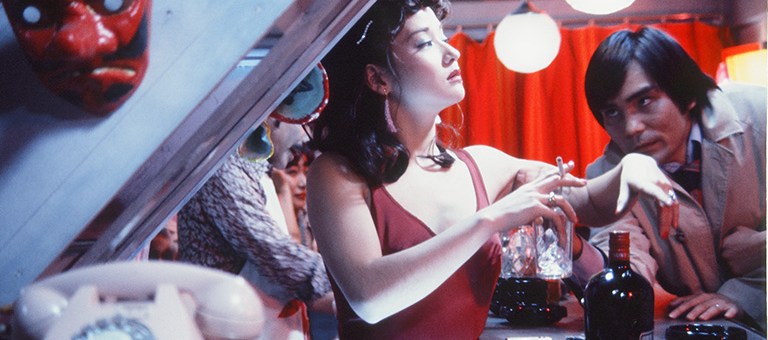
Cynical corporate spies find themselves in a battle of wits when one attempts to use the other in a psychedelic effort from Eiichi Kudo, Industrial Spy (産業スパイ, Sangyo Spy). A deliberate attempt to hop on to an ongoing trend sparked Bond mania and the success of Daiei’s “Black” series, along with the novels of Toshiyuki Kajiyama which inspired them, the film was intended as the first in a franchise vehicle for Tatsuo Umemiya whose Youth of the Night series had run out of steam. 

As such, he stars as a jaded young man working as a corporate spy stealing trade secrets on behalf of rival companies. He does not infiltrate them by gaining employment, but makes use of connections, seducing women in administrative positions, and setting honey traps for blackmailing executives sometimes even using his own girlfriend Masami (Reiko Oshida). His main justification is consumerist desire. He tells Masami that if they want nice things they have to take them. They weren’t born with a silver spoon in their mouths, so they can’t afford to act refined and expect what they want to come to them. They have to do whatever it takes or resign themselves to a life of poverty. Masami, however, is beginning to tire of this arrangement and is hurt, more than anything else, when she realises that Kogure has only bought her a new handbag, necklace, clothes and shoes to head off his guilt because he’s about to ask her to sleep with the director of a project to create an experimental engine as part of a job he’s been manipulated into by Sawada (Fumio Watanabe), the head investigator of Nisshin Industries. 

Rather childishly, Sawada convinces him to take the job basically by implying it’s too difficult for him. “There are secrets you just can’t steal,” he sighs, knowing that it’s like catnip to a man like Kogure who can’t resist a challenge even if he’s paying him less than a third of what he asked for. But Kogure has badly underestimated Sawada. When Kogure returns for his payment, he realises that Sawada sold the trade secrets back to the same company he stole them from to curry favour in the hope of worming his way in so he could take it over.  

Both men are in differing ways unsatisfied with their circumstances. Kogure resents his poverty and wants to be allowed into the increasingly consumerist society of Japan’s high prosperity era, but at the same time he isn’t especially greedy. Sawada tells him he’s doing this because money alone is no longer enough for a man to live a full life in the modern era, he must obtain a powerful position too. All Kogure wants is to sleep with the woman he loves, eat good food, and have a good time. Which is to say he only wants to be comfortable rather than wealthy but feels that that life is unattainable to him outside of his current underhanded occupation. Poignantly, after asking Masami to sleep with his mark to obtain information, he realises that he actually does love her and resolves to marry her after the job is done. But for her this was the final straw and she only did as he asked so she’d hate him enough to leave. 

Nevertheless, on learning he was tricked by Sawada, Kogure vows revenge by deliberately messing up Sawada’s plans to win a bid for a dam project on behalf of Nisshin by setting up a rival candidate and getting hold of their offer so they can make a better one. Only, Sawada always seems to be one step ahead and is even more ruthless than he is. While Kogure mourns Masami and is full of regret, pondering how he might win her back while his more straight-laced corporate lackey friend decides it’s time to shoot his shot, Sawada breaks up with his actual girlfriend to foil Kogure’s plan to photograph them together and blackmail him after he’s cynically married the disabled granddaughter of the Chuo Electric CEO who is mediating the dam bid. The older Mr Matsui (Takashi Shimura) is not completely blind to Sawada’s schemes, but blames himself for his granddaughter’s injury and believes it will be difficult for her to marry, so he’s willing to compromise himself corporately if only Sawada will ensure his granddaughter’s happiness.

Of course, that’s not really very high on Sawada’s list and only ever a means to an end. In this, he’s slightly different from Kogure who is equally heartless in some ways, humiliating a young woman who took an interest in him because she was of no use and he thought her cheap and vulgar, but clearly still has some vestige of human emotion even while realising he should probably let his friend chase Masami if he really loves her because she’s better off with him and his steady if dull corporate existence. In the end, though, neither man gets what he really wants and both ultimately lose out on both the money and the prize with Kogure vowing revenge against new enemies by whom he feels, a little unfairly, betrayed. Nevertheless, by ending with some monochrome stock footage of workers at the station, Anpo protestors being beaten by the police, and shots of US jet fighters, Kudo implies Kogure’s actions are a kind of rebellion against capitalism itself and the contemporary state of Japanese society even as he too becomes just another face in the crowd, an anonymous cog in this great shuffling machine.


Back to the Past (尋秦記, Jack Lai & Ng Yuen-Fai, 2025)

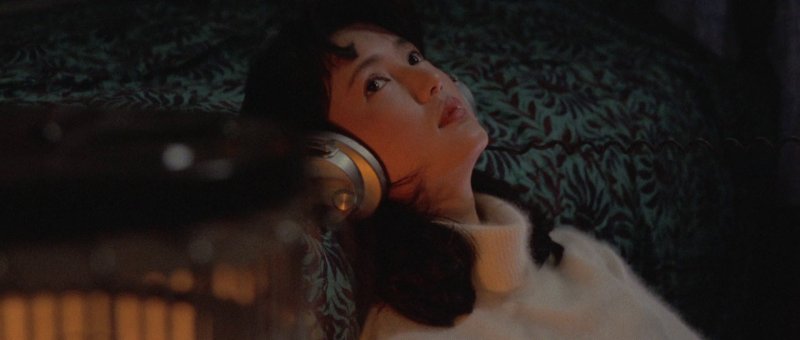
Can history be changed, and if it can, should it be? In a way, Jack Lai & Ng Yuen-Fai’s Back to the Past (尋秦記) is an attempt to change history in itself in that it’s a long-awaited sequel to a television series that concluded more than 20 years ago. A passion project from star Louis Koo, the film opens in contemporary Hong Kong where the inventor of the time machine that sent Hong Siu-lung back in time to witness the ascension of the Qin emperor is released from being “wrongfully imprisoned” for attempting to change history.

Lung (Louis Koo) seems to have told those back in the Qin Dynasty that he came from a mysterious “hometown” . He’s now estranged from his former pupil, Qin Emperor Poon (Raymond Lam), after becoming disillusioned with his despotic rule. It seems that Lung’s inability to return to the present due to a broken amulet somehow contributed to Ken (Michael Miu) getting sent to prison. Now he’s out, he’s sending himself back to the past because, for otherwise unexplained reasons, he wants to become the Qin emperor himself to prove that it is possible to change history after all. Though it is apparently still 2025 in contemporary Hong Kong, Ken and his team have access to a lot of futuristic gadgets like metal discs that can suddenly transform into motorcycles, transparent holographic communication devices, and a headset that can give you the appearance of another person.

Thus Lung is a man doubly trapped in the past in that he has no way of knowing how the society developed in the years since he left. He’s essentially fighting a war on two fronts as he’s ambushed by Ken’s team, some of whom are only there to loot “ancient antiques”, while in fear of his life from Poon who blows hot and cold over wanting to kill him as a potential traitor. The TV series had ended on a cliff hanger in which Lung’s son Bowie changed his name to “Yu”, meaning eagle, but also giving him the name of the warlord who overthrew the Qin emperor but ended up becoming a dictator himself.

The incongruity of Qin Dynasty warriors facing off against Ken’s ultramodern kit with bows and arrows is indeed fascinating, though the puzzling lack of confusion among Lung’s friends and family is possibly explained away by having seen various other odd things from Lung’s “hometown” in the past. No one is very surprised when he puts on his future clothes either, while the bun clip hair extension one of his wives made him wear gets dropped pretty quickly. Aside from the clash of eras, there’s also a commentary on the nature of family as is perhaps expected for a (Western) New Year movie. Ken is given the opportunity to trade his captured daughter for Lung’s captured wife, but refuses, insisting that he only wants the Qin emperor. When one of his men is killed, Lung tells Poon that he won’t help him any more so he’ll have to make his own way to back to the palace. His wives, however, tell him that Poon is still family even if he did turn a bit evil, and after all he risked his life to save Bowie, so it would be mean to leave him behind.

Poon is the spiritual son who has disappointed his father, Lung by turning to the dark side but Lung can never quite give up on him while as much as he bangs on about having Lung killed, Poon can’t bring himself to do it either and seems to still want Lung’s approval just not as much as absolute power. Trapped in the past, Lung has come to realise that it’s family that’s important so it doesn’t really matter where you are as long as you’re all together. A tacked on “alternate ending” sells the New Year theme with the entirety of the Qin Dynasty cast being beamed to 2025 to enjoy some nice food and a fireworks display all together as a family after which Lung returns to the past and says he’ll never come back to the future. It’s tempting to read his declaration as an expression of the nostalgia inherent in the premise, that Lung wants to go back to an earlier time when things weren’t as complicated as they are now even if he’s still living under an oppressive regime. But at the same time, history can’t necessarily be reclaimed in that way and even for him things have moved on, though of course for those in the present it is still possible to change “history” and perhaps more difficult to do so if you can’t let go of an idealised past.


Trailer (English subtitles)

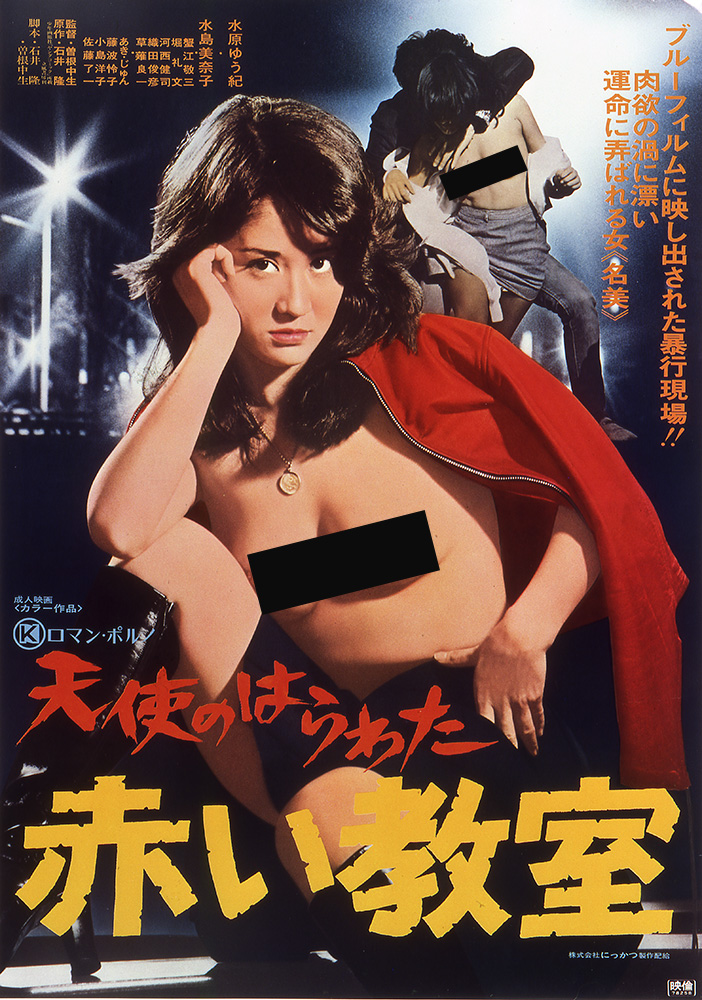
Heat Wave Island (かげろう, Kaneto Shindo, 1969)

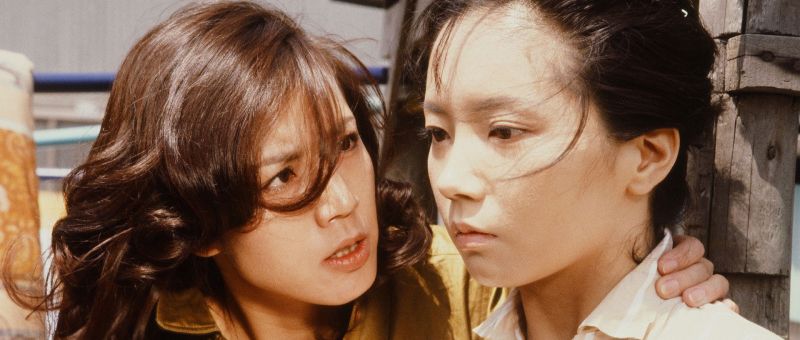
The death of a bar owner in Onomichi sparks a complex investigation into the condition of the islands surrounding the Seto Inland Sea in Kaneto Shindo’s darkly ironic crime drama, Heatwave Island (かげろう, Kagero). Produced by Kindai Eiga Kyokai, the independent production company founded by Shindo, Kozaburo Yoshimura, and the ubiquitous Taiji Tonoyama, the central thesis is that industrialisation has poisoned the waters surrounding the Japanese heartland, but also that the collection of weird islands had their share of darkness to begin with.

Indeed, having solved the crime, unusually chipper detective Oishi (Rokko Toura) states that it was the island that killed her. “Your traditions turned an island woman’s life to ruin,” he tells the very compromised village chief (Taiji Tonoyama) who refused to let a woman leave the island to seek medical treatment for her baby because of a taboo about setting sail on the night of a shipwreck. That’s not so much a supernatural fear or practical concern as much as a pact between islanders who have been killing shipwreck survivors and looting their boats. Nevertheless, the woman is eventually forced off the island when the men who killed her husband begin fighting over her body. The village chief tells her she has to go to preserve the “unity” of the island while her child, who survived but with brain damage, will be cared for by the other islanders.

Yet all the woman wants is to return to the island to live with her child after gaining the money to build a big house where everyone can see it. Some justification is given for the island’s cruelty in that it has essentially been starved out by post-war industrialisation. The fishing industry is dying, and the island terrain is only suited for growing wheat and potatoes, making farming unviable as a commercial enterprise. A man from another island says that as the salt fields were closed down factories arose in their place and leaked pollution into the surrounding seas, killing off all the fish. He is now bedridden due to industrial illness having worked on Poison Gas Island during the war. His wife now works in one of the “enemy” factories. “That’s how we survive,” he laments of the faustian pact between rural communities and large corporations. 

In any case, most of the young people have been forced into the cities in one way or another where they often lack the skills to find well-paying work and end up in crime and the nightlife industry. The late bar owner, Otoyo (Nobuko Otowa), was herself once from an island village, as was her bar girl Michiko (Toyama Masako). Both of them are dreaming of better lives while filled with a sense of futility. A young man who gave up on fishing to work in factories is injured in a workplace incident and is prevented from leaving hospital until he can pay his extortionate medical bills which the company evidently isn’t going to cover.

The irony is that Oishi is from a farming background too. Rich kids don’t become detectives, Otoyo points out. A poor man’s son commits a crime, and a poor man’s son will catch him, she adds signalling the ways in which the poor work against each other rather than their common enemies such as the exploitative corporations which have ruined the beautiful natural scenery of Japan’s islands along with their traditional communities. Then again, Oishi is a slightly compromised figure in other ways too. He probably shouldn’t be investigating this case given that he used to drink in Otoyo’s bar and seems to have a crush on her, which interferes with his ability to accept some of the less pleasant things they begin to find out about her past. He also has more than a fatherly interest in young Michiko and is unwilling to accept she could be involved with the crime having taken out a sizeable advance on her salary to care for her father who is also bedridden following a stroke.

The implication is that these murders are more like earthquakes, an inevitable result of friction between people caused by conflicting societal forces. Oishi concludes his investigation, but it only seems to result in a further fracture that severs the connection between the islands and the mainland, leaving another woman in a state of limbo waiting for someone who may or may not return. The convoluted, island-hopping mystery taking place under the blazing sun of a sticky summer has its degrees of absurdity, from the weirdness of these retreating cultures to the poignant presence of the dog, who alone seemed to want justice for Otoyo, who, whatever her other faults may have been, was always kind to him when others often weren’t.