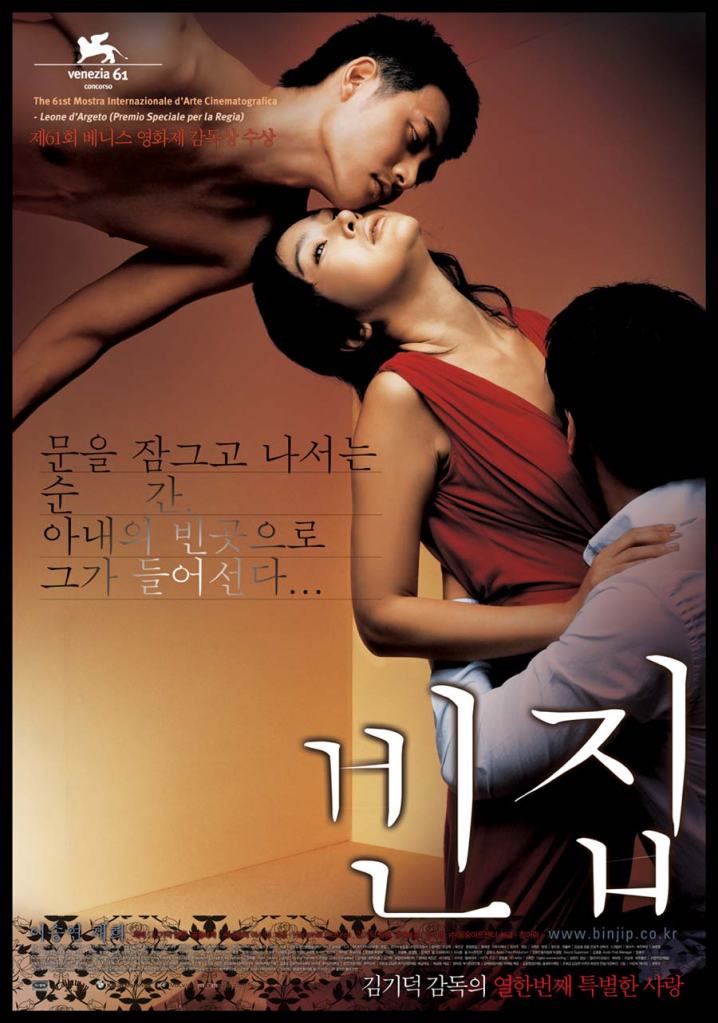
 You wouldn’t think it wise but apparently some people are so trusting that they don’t think twice about recording a new answerphone message to let potential callers know that they’ll be away for a while. On the face of things, they’re lucky that the guy who’ll be making use of this valuable information is a young drifter without a place of his own who’s willing to pay his keep by doing some household chores or fixing that random thing that’s been broken for ages but you never get round to seeing to. So what if he likes to take a selfie with your family photos before he goes, he left the place nicer than he found it and you probably won’t even know he was there.
Player 2 joins the young man (credited as Tae-suk but unnamed in the film) when he stays at an upscale mansion which turns out to be “haunted” by the still living but damaged figure of a battered wife. Tae-suk hurriedly leaves once discovered, but later thinks over his encounter with the sad seeming lady and decides to return. After an altercation with her violent husband, Sun-hwa leaves with Tae-suk and the pair sneak into various other “empty” homes together. After one particular dwelling reveals a nasty surprise the two bring themselves to the attention of the police who threaten to end their young love story before it’s hardly begun.
Like much of Kim’s work, 3-Iron (빈집, Bin-jip) is near silent and neither of the two protagonists speak one word to each other until final scene of the film. Tae-suk, in particular, seems to have an obsession with being invisible – hiding in blindspots and always making sure to tidy up after himself so well that no trace of his presence remains. Sliding into these mini universes, he seems oddly interested in their inhabitants as he gazes at their photographs and admires the decor. Despite his need to disappear, he builds connections with absent people even going so far as to take a photo with a photo of them, artificially generating some sort of kinship where there is none.
If Tae-suk is haunting the bourgeoisie, Sun-hwa is both spectre and spectee as she moves silently around her golden cage of a spacious villa like a frightened mouse locked inside the elephant house. Evidently further along the stealth game than Tae-suk has been able to progress, her discovery of him leads to a feeling of defeat. Yet, after reconsideration, he recognises a fellow lost soul and so returns to rescue her from her oppressive ogre of a husband by using his weapon of choice against him. The 3-Iron golf club is not only a symbol of the husband’s middle class pretensions, but its relative lack of wear also points to the lack of respect he reserves for his toys – even extending so far as his wife whom he also seems to regard as an “inautonomous” appendage to his image much like the golf club itself.
Kim ends the film with a caption to the effect that it’s hard to tell if the world we live in is reality or a dream. With the continued silence of the film’s protagonist, bizarre scenario of “borrowed” lives, and general surrealism, Kim creates an etherial atmosphere filled with heightened, everyday strangeness. This could be a ghost story – literally, or figuratively, as our haunted protagonists continue their visitations on the living, or a love story, or even an absurd comedy. Tae-suk and Sun-wha exchange roles, alternately comforting or rescuing one another before, perhaps, becoming one at the film’s conclusion. A strange, romantic fairytale, 3-Iron is Kim in an uncharacteristically cheerful mood though he’s careful to remind us that the world outside of this charming bubble is filled with violence, cruelty, and chaos.
3-Iron is available in the UK from Studiocanal and from Sony Pictures Classics in the US though the R3 Korean disc also includes English subtitles.
US release trailer:
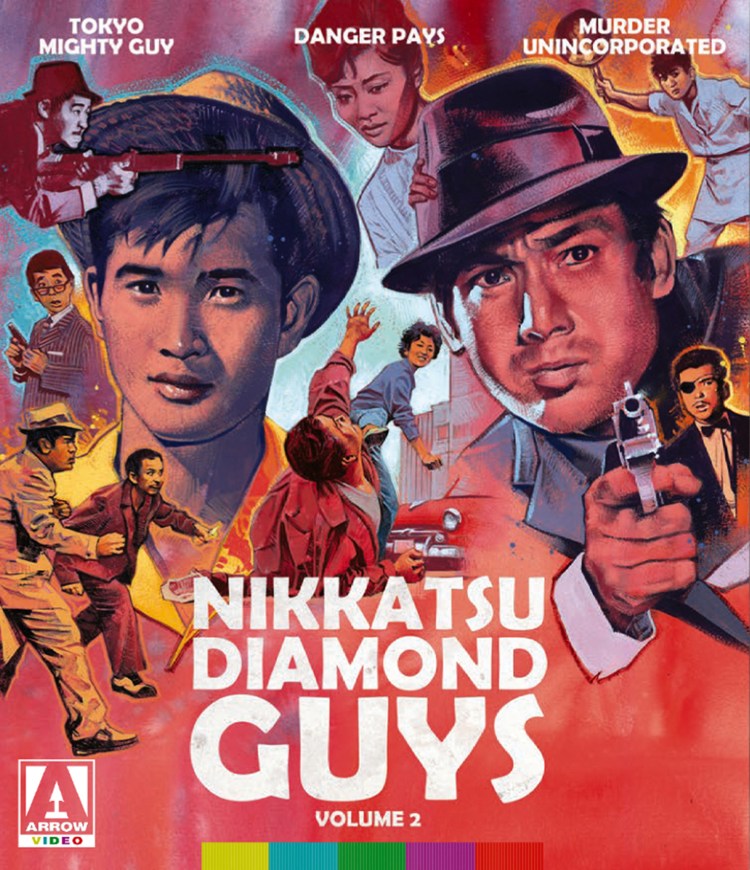
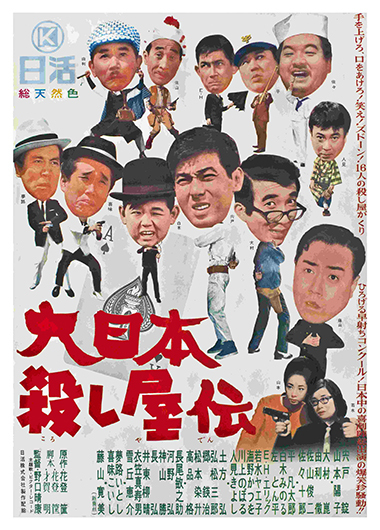 “If you don’t laugh when you see this movie, I’m going to execute you” abacus wielding hitman Komatsu warns us at the beginning of Haryasu Noguchi’s Murder Unincorporated (大日本殺し屋伝, Dai Nihon Koroshiya-den). Luckily for us, it’s unlikely he’ll be forced to perform any “calculations”, and the only risk we currently run is that of accidentally laughing ourselves to death as we witness the absurd slapstick adventures of Japan’s craziest hitman convention when the nation’s “best” (for best read “most unusual”) contract killers descend on a small town looking for “Joe of Spades” – a mysterious assassin known only by the mole on the sole of his foot.
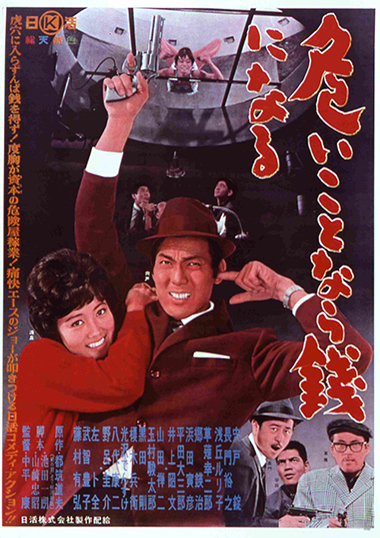 Where there’s danger, there’s money! Or, maybe just danger, who knows but whatever it is, it certainly doesn’t lack for excitement. Ko Nakahira is best known for his first feature, Crazed Fruit, the youthful romantic drama ending in speed boat murder which ushered in the Sun Tribe era. Though he later tried to make a return to more artistic efforts, it’s Nakahira’s freewheeling Nikkatsu crime movies that have continued to capture the hearts of audience members. Danger Pays (AKA Danger Paws, 危いことなら銭になる, Yabai Koto Nara Zeni ni Naru) is among the best of them with its cartoon-like, absurd crime caper world filled with bumbling crooks and ridiculous setups.
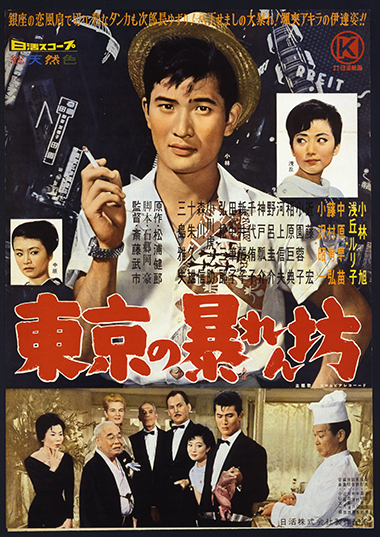 The bright and shining post-war world – it’s a grand place to be young and fancy free! Or so movies like Tokyo Mighty Guy (東京の暴れん坊, Tokyo no Abarembo) would have you believe. Casting one of Nikkatsu’s tentpole stars, Akira Kobayshi, in the lead, Buichi Saito’s Tokyo Mighty Guy is, like previous Kobayashi/Saito collaboration
 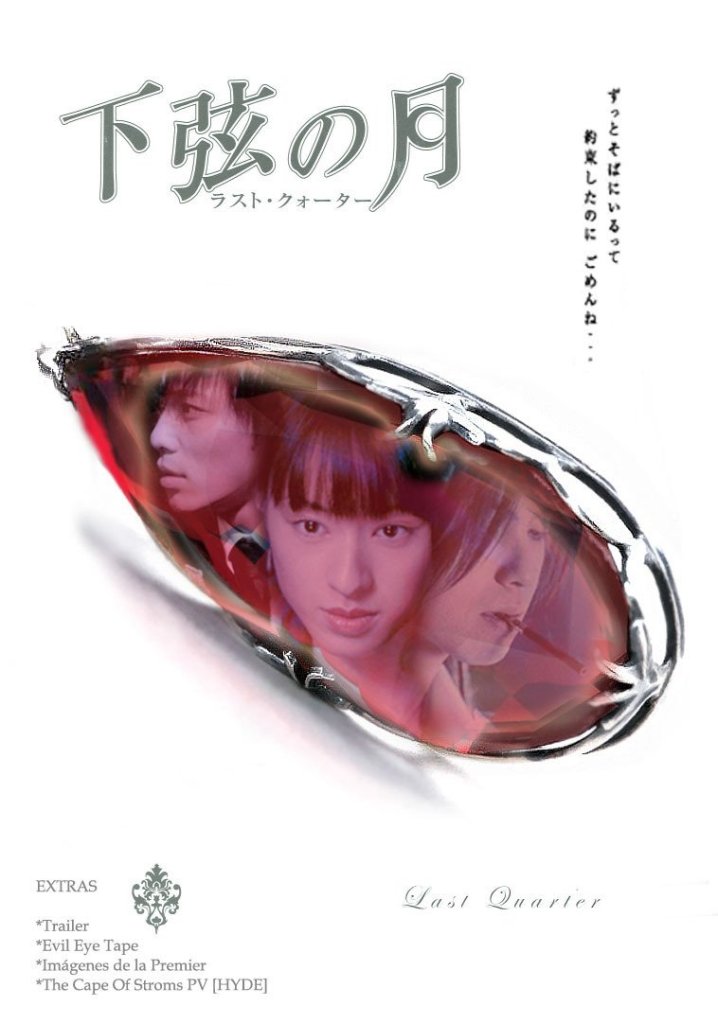 To begin on a cynical note, Last Quarter (下弦の月 ラスト・クォーター, Kagen no tsuki Last Quarter) is a film with a wide variety of marketing hooks. The first being that it’s an adaptation of a much loved short manga series by the well respected mangaka Ai Yazawa (Paradise Kiss) so it has its shoujo pedigree firmly in place. Secondly, pop star HYDE of L’Arc-en-Ciel is central to the production as he both stars in the movie as the ghostly love interest/deathly spirit and repeatedly sings his own songs throughout the film including over the end credits. Thirdly, it also stars actress Chiaki Kuriyama well known to overseas audiences thanks to Kill Bill and Battle Royale. You’d think with all these high quality ingredients first time director Ken Nikai would be able to cook up quite a feast though he does somewhat over egg the pudding.
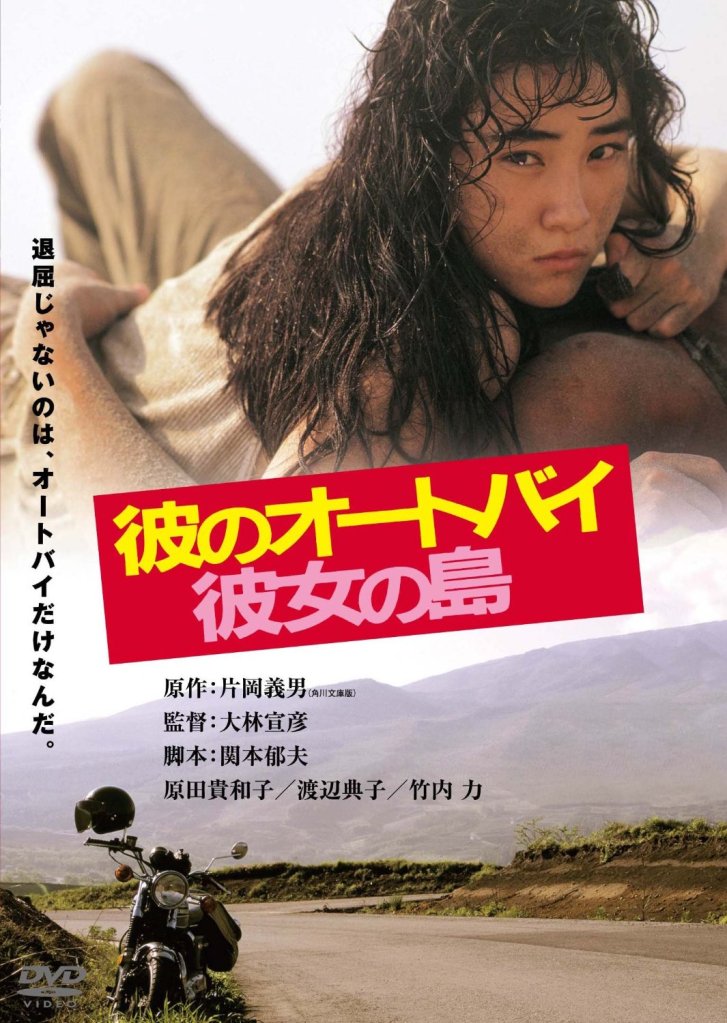 Like many directors during the 1980s, Nobuhiko Obayashi was unable to resist the lure of a Kadokawa teen movie but His Motorbike, Her Island (彼のオートバイ彼女の島, Kare no Ootobai, Kanojo no Shima) is a typically strange 1950s throwback with its tale of motorcycle loving youngsters and their ennui filled days. Switching between black and white and colour, Obayashi paints a picture of a young man trapped in an eternal summer from which he has no desire to escape.
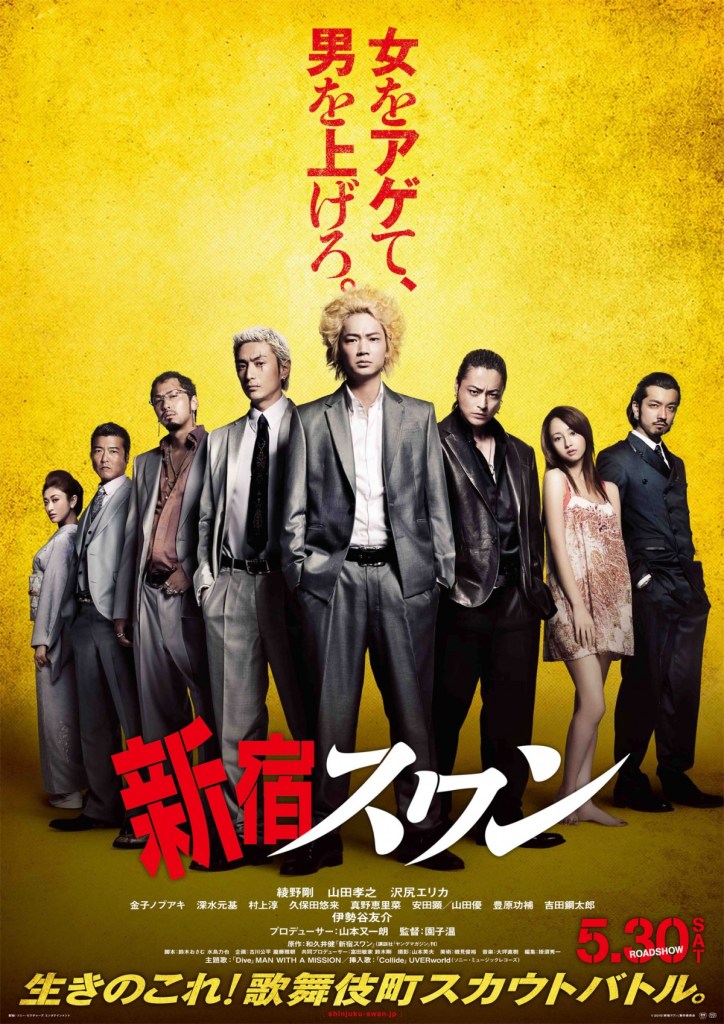 Enfant terrible of the Japanese film industry Sion Sono has always been prolific but recent times have seen him pushing the limits of the possible and giving even Takashi Miike a run for his money in the release stakes. Indeed, Takashi Miike is a handy reference point for Sono’s take on Shinjuku Swan (新宿スワン) – an adaptation of a manga which has previously been brought to the small screen and is also scripted by an independent screenwriter rather than self penned in keeping with the majority of Sono’s directing credits. Oddly, the film shares several cast members with Miike’s Crows Zero movies and even lifts a key aesthetic directly from them. In fact, there are times when Shinjuku Swan feels like an unofficial spin-off to the Crows Zero world with its macho high school era tussling relocated to the seedy underbelly of Kabukicho. Unfortunately, this is somewhat symptomatic of Sono’s failure, or lack of will, to add anything particularly original to this, it has to be said, unpleasant tale.
 Akira Kurosawa’s later career was marred by personal crises related to his inability to obtain the kind of recognition for his films he’d been used to in his heyday during the golden age of Japanese cinema. His greatest dream was to die on the set, but after suffering a nasty accident in 1995 he was no longer able to realise his ambition of directing again. However, shortly after he died, the idea was floated of filming some of the scripts Kurosawa had written but never proceed with to the production stage including The Sea is Watching (海は見ていた, Umi wa Miteita) which he wrote in 1993. Based on a couple of short stories by Shugoro Yamamoto, The Sea is Watching would have been quite an interesting entry in Kurosawa’s back catalogue as it’s a rare female led story focussing on the lives of two geisha in Edo era Japan.