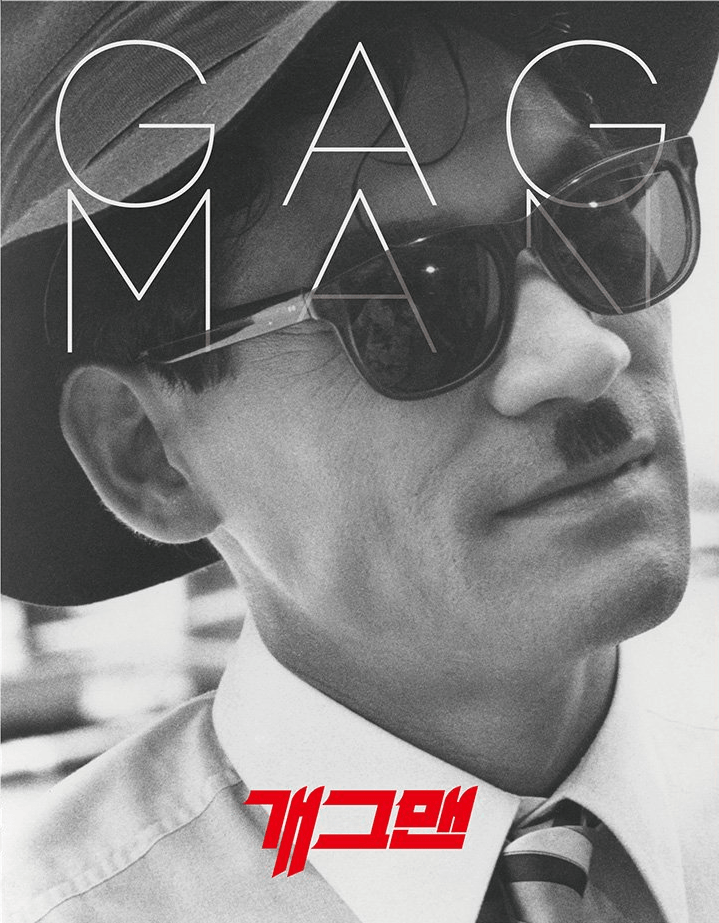
Is everything we see a waking dream or does it just appear that way? This question posed (or perhaps dreamed) by the protagonist of Lee Myung-se’s debut becomes a kind of key for unlocking much of what has gone before as Lee freewheels between fantasy and reality as his cast of movie obsessed dreamers attempt to inhabit their very own stretch of celluloid within the “real” world. Released in 1988, Gagman (개그맨) catches Korea in a moment of transition. Newly free of a lengthy dictatorship and back on the world stage after hosting the 1988 Olympics, the country was eager to promote itself as a modern liberal democracy. Hence, the arts were the first to feel the new freedom with young directors given the chance to create boundary pushing films and show just how far Korea could go. Lee was just one of these directors but Gagman is no political treatise (at least, not directly) preferring to experiment with form as a farcical exercise in meta comedy.
Cinema obsessed comedian Lee Jong-sae (Ahn Sung-ki) wants nothing more than to make the next great Korean movie which every one of the 40 million Koreans will fall in love with. Consequently he’s blagged his way onto the film set of a top director to whom he’s already sent his “prize-winning” script. Eventually thrown out, Jong-sae does not lose heart but promises the lead role in his movie to his equally film obsessed barber Moon Do-suk (Bae Chang-ho) whom he sends out on “research” missions walking into banks and asking about security. A fortuitous meeting with a feisty young woman in a cinema, Oh Sun-young (Hwang Cine), provides a another impetus for Jong-sae’s filmmaking dreams and so when he unexpectedly gets his hands on a gun after an encounter with a deserting soldier things just got real in a very unexpected way.
Lee signals his intent early on with a static camera shot focusing on the barber, Do-suk, as he waxes on about Kirk Douglas in the Vikings whilst simultaneously remarking on the fall in quality of his beloved dog meat. Do-suk feels that when it comes right down to it, Korean mutts are the best – not these scrawny poodles that cheap restaurant owners are substituting for the real thing. His comment might easily go for himself and Jong-sae, two scrappy working class Korean guys trying to make it in a walled off industry, but interestingly enough bar a mention of Sorrow Even Up in Heaven, Lee’s references are to European and American cinema rather than that of his homeland.
The most obvious of these lies in the central gag – that the gagman has a “funny” face. Ahn Sung-ki is saddled with a Charlie Chaplin moustache throughout the film (with the added bonus that it of course looks like a Hitler moustache to European/American viewers) and plays Jong-sae as someone who’s constantly doing a Chaplin impression with his strange walks and silent cinema plaintive looks. Ahn even begins layering his performance so that we get Charlie Chaplin impersonating Brando in the Godfather to recite the melancholy monologue which seems to open Jong-sae’s unfilmable script. For Jong-sae his existence is cinema, the life he lives is unreal or surreal always with an added dose of narrative in the ongoing story of his rise to greatness as the most famous Korean filmmaker of them all.
Fantasist as he is, Jong-sae has a way of pulling other people into his unrealisable dreams including the barber Do-suk and a young woman who unexpectedly starts canoodling with him in a cinema in an attempt to avoid some other creepy guys. Oh Sun-young is almost a mirror image of Jong-sae in her pragmatic realism though she too is looking at the stars and willing to engage in fantasy to get there. It is she who first suggests that the “research” they’ve been doing might have a more practical application and she is also the one to maintain a calm approach to their eventual need for escape but, even if she always has one foot in reality, Sun-young cannot escape the gravitational pull of Jong-sae’s strange dreamverse. Do-suk, by contrast, is a willing convert – just as obsessed with cinema and comics as Jong-sae, his desperation to be a part of the movies and unwavering faith in his friend lead him to give up everything in service of art even going so far as to get painful eye surgery to increase his box office potential (apparently a meta dig at a Korean celebrity who did something similar).
In keeping with the Chaplin theme Lee’s humorous universe is defined by slapstick and absurdity, his dialogue needlessly theatrical and mannered with a melodramatic seriousness. Nevertheless Lee makes the most of his canvas as the film goes on behind Jong-sae while he enters one of his reveries as in one particularly amusing scene in which he attempts to declare his love to Sun-young without noticing that she’s long wandered off and been replaced by Do-suk. Despite the cartoonish, comedic tone the atmosphere is a melancholy one reflecting the final destination of Jong-sae’s film project but also of his continuing inability to integrate the two distinct universes into one concrete whole which could be termed “reality”. In this Lee returns to that first question but this time he asks us as cinema lovers which world it is we live in, and which it is that is the more “real”.
Gagman is available on region free blu-ray courtesy of the Korean Film Archive but you can also watch the whole thing legally and for free via their YouTube channel!
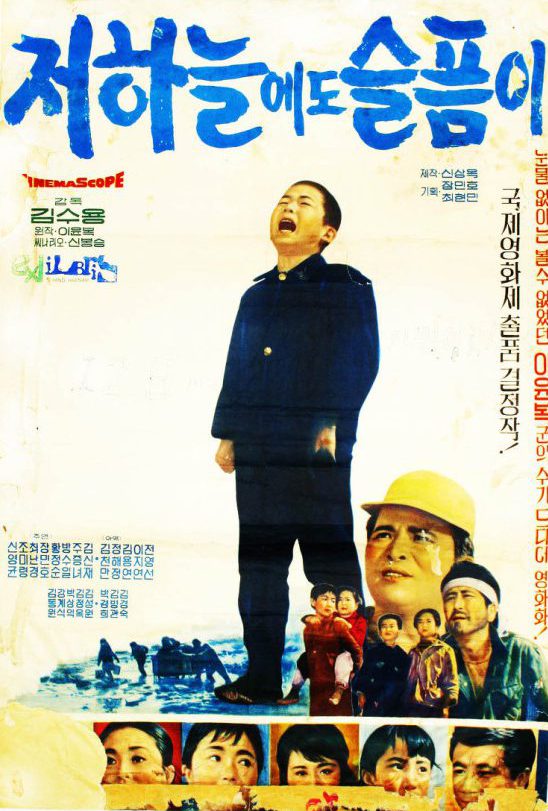 It’s a sorry enough tale to hear that many silent classics no longer exist, regarded only as disposable entertainment and only latterly collected into archives and preserved as valuable film history, but in the case of South Korea even mid and late 20th century films are unavailable thanks to the country’s turbulent political history. Though often listed among the greats of 1960s Korean cinema, Sorrow Even Up in Heaven (저 하늘에도 슬픔이, Jeo Haneuledo Seulpeumi) was presumed lost until a Mandarin subtitled print was discovered in an archive in Taiwan. Now given a full restoration by the Korean Film Archive, Kim’s tale of societal indifference to childhood poverty has finally been returned to its rightful place in cinema history but, as Kim’s own attempt to remake the film 20 years later bears out, how much has really changed?
 Post-war cinema took many forms. In Korea there was initial cause for celebration but, shortly after the end of the Japanese colonial era, Korea went back to war, with itself. While neighbouring countries and much of the world were engaged in rebuilding or reforming their societies, Korea found itself under the corrupt and authoritarian rule of Syngman Rhee who oversaw the traumatic conflict which is technically still ongoing if on an eternal hiatus. Yu Hyun-mok’s masterwork Aimless Bullet (오발탄, Obaltan) takes place eight years after the truce was signed, shortly after mass student demonstrations led to Rhee’s unseating which was followed by a short period of parliamentary democracy under Yun Posun ending with the military coup led by Park Chung-hee and a quarter century of military dictatorship. Of course, Yu could not know what would come but his vision is anything but hopeful. Aimless Bullets all, this is an entire nation left reeling with no signposts to guide the way and no possible destination to hope for. All there is here is tragedy, misery, and inevitable suffering with no possibility of respite.
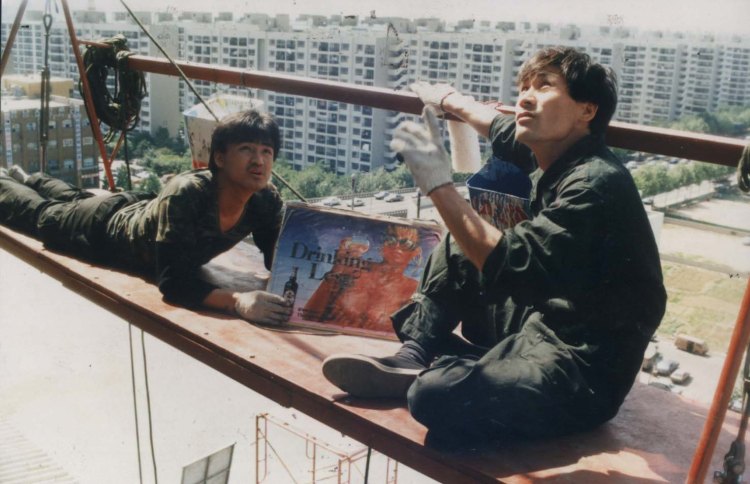 Though not a big box office hit at the time of its release, Park Kwang-su’s Chilsu and Mansu (칠수와 만수, Chil-su wa Man-su) is not only fondly remembered by its contemporary audience chiefly because of the amusing performances of its still popular leading actors, but is also credited with kicking off what would become known as Korean New Wave. Released in 1988 and set sometime in 1987, this is the new Seoul emerging into democracy after decades of military rule and looking ahead to the glory of the 1988 Seoul olympics. However, as ever, the future has not been evenly distributed and there are those who find themselves unable to climb its ladder through no fault of their own.
 Aside from the original 1960 version of The Housemaid (and this perhaps only because of its modern “remake”), mid 20th century Korean Cinema has been severely neglected overseas. Ha Kil-jong’s The March of Fools (바보들의 행진, Babodeul-ui haengjin) is almost unknown abroad but consistently tops Korean lists of the country’s best cinema and has been both enormously influential on later filmmakers and fondly remembered by audiences.
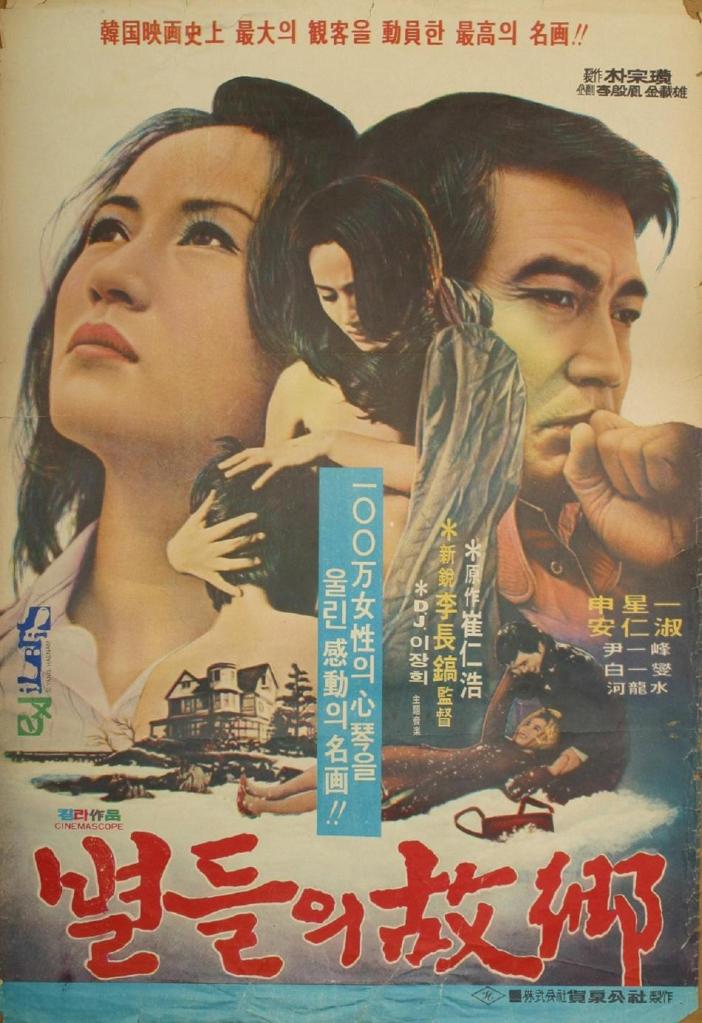 In writing the original novel which inspired Heavenly Homecoming to Stars, Choi In-ho stated that he wanted to tell the story of “a woman whom a city killed”. The novel itself was first serialised in a newspaper where it quickly became a must read and popular discussion point among readers of all ages. It’s perhaps less surprising then that this completely radical film adaptation by first time director Lee Jang-ho proved to be the big cinema hit of 1974. A new “youth culture” movement was beginning inspired by social and political developments from overseas and there was a growing appetite for films and novels which were equally revolutionary. Heavenly Homecoming to Stars managed to provide this but also, crucially, was able to appeal to older age ranges too thanks to its re-imagining of classical melodrama.
