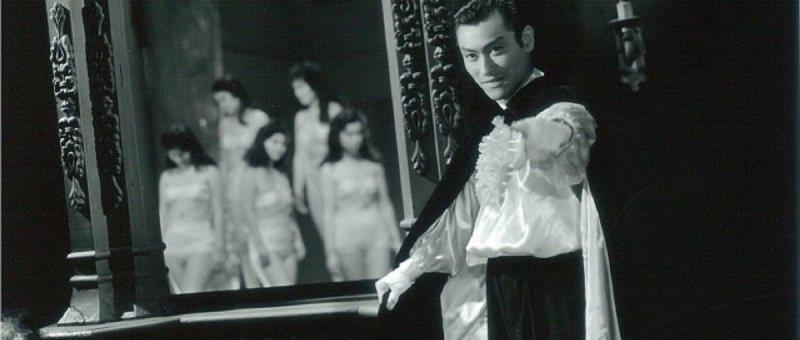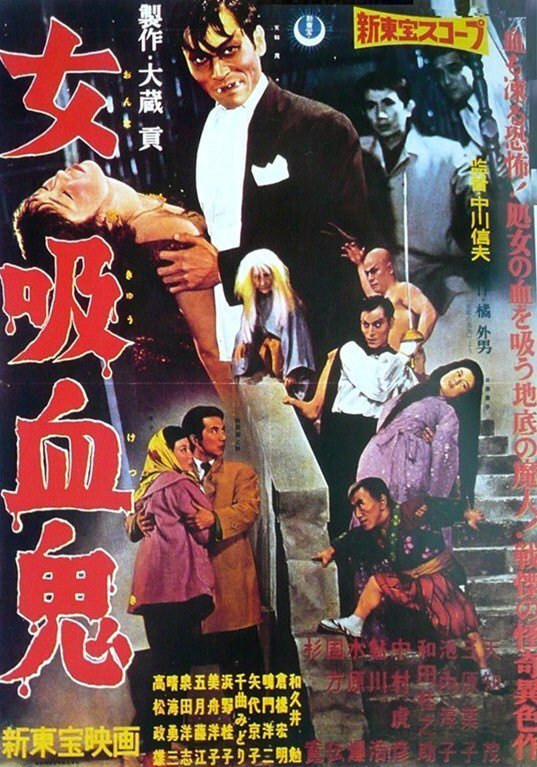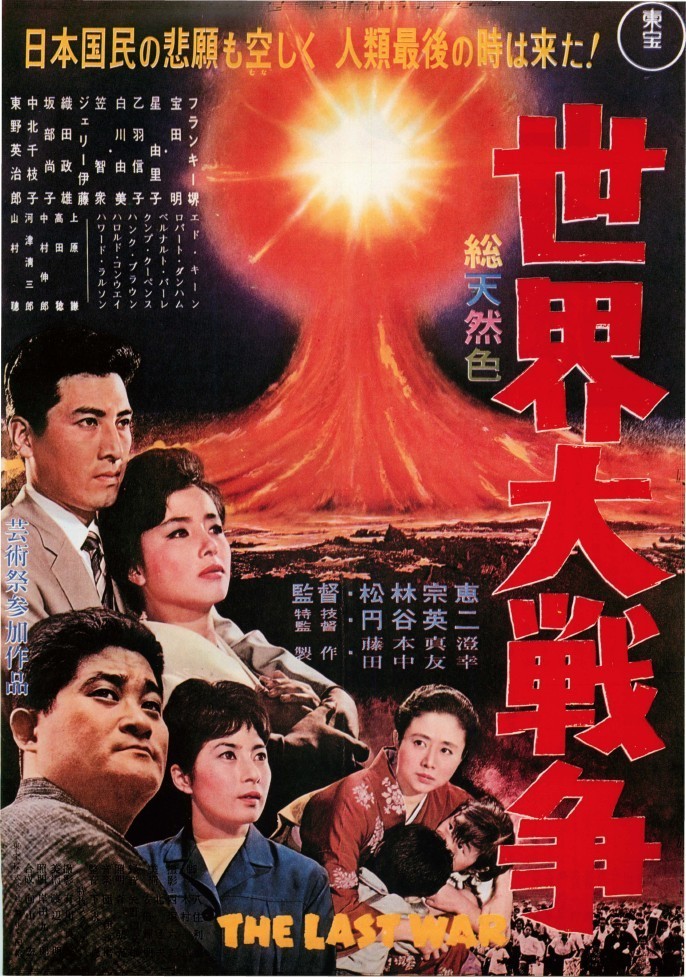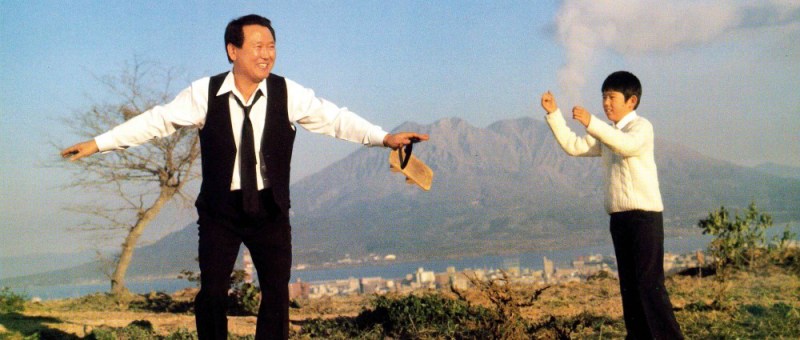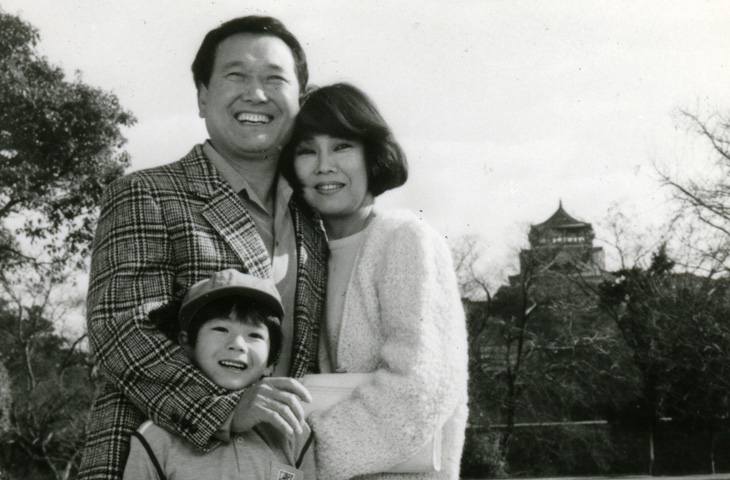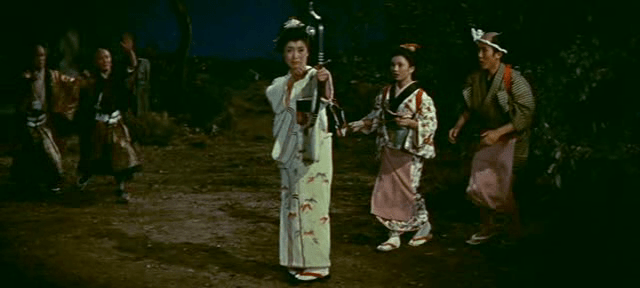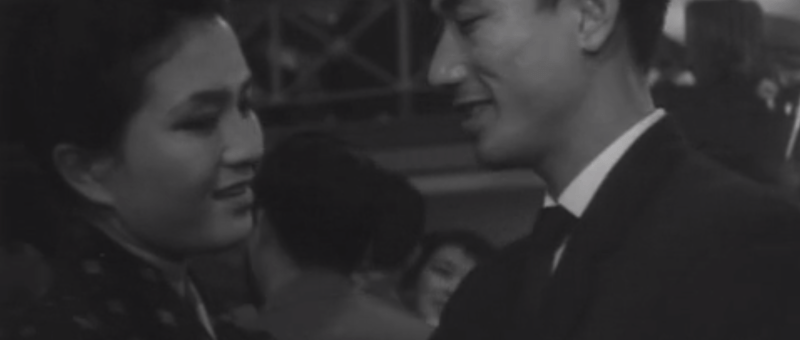
Hungry Soul / Hungry Soul, Part II (飢える魂 / 続・飢える魂, Yuzo Kawashima, 1956)

When you think of the family drama, you think of a young woman getting married and that her marriage is an unambiguously good and righteous thing despite the pain it may bring to her parents who will obviously miss her yet must comfort themselves that they’ve done everything right. In melodrama, however, we get quite a different picture of the “modern” marriage in which it is not quite so unambiguously good or righteous but a patriarchal trap enabled by a kind of gaslighting which tells women that suffering is the natural condition of life and that they should wear their unhappiness as a badge of honour.  

Nowhere does this seem truer than in the films of Yuzo Kawashima who in general takes quite a dim view of romance as a path to freedom and finds his heroines struggling to escape outdated social codes to seize their own freedom. Hungry Soul (飢える魂, Ueru Tamashii) finds one still comparatively young woman and another middle-aged discovering that they want more out of life than their society thinks a woman is supposed to have but continuing to wrestle with themselves over whether or not they have the right to pursue their personal happiness in a rigidly conservative society. 

Reiko (Yoko Minamida), a woman in her early 30s, married Shiba (Isamu Kosugi), 23 years her senior, 10 years previously apparently out of a mix of youthful naivety and post-war desperation. Shiba has supported her financially and apparently enabled her brother’s career, but it’s clear that he thinks of her as little more than a glorified housemaid, treating her with utter contempt even in public. He makes her carry her own bags at the station rather than wait for a porter and forces her to accompany him on business trips where he shows her off to colleagues and then retires her to the hotel with nothing to do all day. Tyrannised, Reiko has been been raised to be obedient and does her best to be a good wife, but Shiba repeatedly reminds her that he bought her while openly talking about his relationships with other women even at one point bringing a geisha home with him while Reiko cringes in the front seat next to the driver. 

Perhaps what she’s learning is that obedience is not an unambiguously good quality, but still she struggles to let go of the necessity of measuring up to the standards of social propriety. When Shiba unwittingly introduces her to handsome politician Tachibana (Tatsuya Mihashi), her accidental attraction to him awakens her to all the ways her married life is a hell of disappointment. Shiba reminds her that he keeps her in comfort, little understanding that she may hunger for something more than the material, while Reiko realises that she may starve to death for lack of love but has been conditioned to think that a woman’s emotional needs are not only unimportant but entirely taboo. 

Mayumi (Yukiko Todoroki), meanwhile, has known love but feels obliged to live on the memory of her late husband and fulfil herself only though caring for her two teenage children. To do that, paradoxically, she has seized her independence as a working woman with a job in real estate, later hoping to manage a ryokan traditional style hotel, only for her children to resent her perceived rejection of motherhood in favour of individual fulfilment. “School is for people who have two parents” her son tells her, threatening to move out into a dorm, while her daughter at one point considers suicide simply because she suspects her mother may be sleeping with her late father’s best friend. 

In Reiko’s case, her desire for liberation is kickstarted by a hunger for love, though as we later realise Tachibana is also perhaps looking to break with the past and with conventional male behaviour in that he has been a womanising playboy involved in relationships with women from the red light district which to him were always casual while they, like Reiko and Mayumi, longed for more. Mayumi’s relationship with Shimozuma (Shiro Osaka), by contrast, is complicated by the fact he is married to a woman with a long-term illness, though what he craves (besides Mayumi herself for whom he seems to have been carrying a torch for many years) is a conventional family home, jokingly chiding Mayumi that her interest in business may be making her less “womanly”.  

Both women try, and fail, to break free of patriarchal control to claim their own agency, discovering that romance is not the best way to find freedom. Despite her love for and possibly misplaced faith in Tachibana, Reiko is both too brutalised by her abusive husband and constrained by the taboo of being a woman ending a marriage for another man to definitively escape Shiba’s control. Mayumi, meanwhile, is shamed by the reflection of herself in her children’s eyes and motivated to reassume her maternity but does so also as a way of rejecting easy romantic fulfilment in the hope of discovering more of herself as a middle-aged woman embracing all the freedom that might offer while her children, though grateful to have her return to them, are also chastened and guilty in having realised that their mother is a woman too and ultimately they just want her to be happy. As often in Kawashima, no one quite gets what they wanted, but they do at least find a kind of resolution. Their souls may still be hungry, but their appetites have returned and there is the promise of future fulfilment if still tempered by the restrictions of a cruelly repressive society.


Hungry Soul opening (no subtitles)

Hungry Soul, Part II opening (no subtitles)

Our Town (わが町, Yuzo Kawashima, 1956)

“They tricked me and you and everyone! It’s so stupid” a stammering man tries to explain to his deluded friend, but some people just don’t want to hear the truth. Spanning 30 years of tumultuous 20th century history, Yuzo Kawashima’s Our Town (わが町, Waga Machi) charts a course of authoritarian fallacy as its puffed up hero refuses to give up on the imperialism of his youth and condemns all around him to lives of misery out of misguided faith in an outdated code of patriarchal and national pride. Too late he will perhaps begin to realise that his unforgiving rigidity has done nothing more than alienate the people that he loves, but his story is both a lament for past folly and a warning for the freer post-war future. 

Back in the 1900s, the tail end of the Meiji era, Taa (Ryutaro Tatsumi) was one of 1200 Japanese construction workers who travelled to the Philippines to help build a road intended to boost the economy of the recently independent nation. Now, around this time, Japan was also embarking on the the first of its 20th century wars fought against the Russians. While Taa was breaking his back on the Benguet road, other young men were busy painting themselves in glory as imperial soldiers contributing to the expansion of the burgeoning Japanese Empire. In his own way, and quite literally, Taa was also building the Japanese Empire and intensely resents that no one recognises his contribution as the self-styled “Taa of Benguet” who apparently kept his fellow Japanese going even when it became clear that they were just exploited workers, hung out to dry once the job was done and left to die of poverty or tropical disease. 

Taa’s life philosophy is that humans are born to work and that suffering in youth builds character. He wanted to show the world what Japanese people are made of and feels he made Japan proud building the Benguet roadway, but there are no flag waving parades for his return as there were for Hanai who went away to war, nor is there any real work. Embarrassed about his illiteracy, he didn’t even write any letters home which is one reason why he didn’t know that a casual girlfriend, Tsuru (Yoko Minamida), whom he’d perhaps long forgotten, had given birth to his child, Hatsue, who is now four. Despite his initial surprise, Taa submits himself to the role of husband and father, earning money as a rickshaw driver, but never forgets that he is “Taa of Benguet” or that the meaning of life is suffering through hard work. 

Old fashioned and patriarchal even for the times in which he lives, Taa’s attitudes continue to destroy the lives of those around him. He wasn’t there to support Tsuru and so she worked herself to death in his absence. Hatsue (Tomoko Ko) grows into a beautiful young woman and falls in love with Shintaro (Shiro Osaka) the son of a bucket maker who, though athletic, is not perhaps built for hard work in the same way as Taa had been. He tries to force his philosophies on the younger generation, pressuring Shintaro to go to the Philippines to make a man of himself, not quite understanding that much has changed in the previous 15 years, nor that Shintaro may not be able to endure the kind of hardship he regards as indicative of a productive life. 

Taa learns nothing from his mistakes, eventually pressuring his granddaughter Kimie (Yoko Minamida) in the same way he’d done his daughter, objecting to her desire to marry a man of her own choosing even though he embodies many of his oft spoken ideals including dedication to hard work. Jiro (Tatsuya Mihashi) is the son of his old rival Hanai and was himself in the war. Like Taa and the men of his generation, he too was “tricked” into working overseas for a mistaken ideal of Japanese imperialism but he’s also a man of the post-war generation and has no more illusions about things like glory or suffering.

Kimie too, as she later tells Taa, is a post-war woman. She feels no obligation towards her grandfather simply because he raised her, nor will she allow her life to be ruined in the same way her mother’s and grandmother’s were by Taa’s patriarchal authoritarianism. “You’ve got to start listening to the younger generation” Jiro tries to explain, but Taa is not someone used to listening. “Every single thing you’ve ever done has been pointless” Kimie tells him, “trapped in your own happy bubble, getting in the way of everyone else”. All Taa’s philosophy has ever caused is pain and suffering, trying to make the lives of all the men who died building a road in a foreign land mean something while ironically propping up the same ideology that robs men like him of their freedom and possibility. You could say something broke in 1905, but it also broke 40 years later, people are wiser now and they know there’s no glory in suffering. Taa sees the error of his ways, but also that there’s no place for him in the kinder post-war era where there’s no sin in working hard, but no life without freedom. 


Titles and opening (no subtitles)

Burden of Love (愛のお荷物, Yuzo Kawashima, 1955)

Two decades into the new century, Japanese society finds itself gripped by a population crisis. Supposedly “sexless”, young people constrained by a stagnant economy and a series of outdated social conventions have increasingly turned away from marriage and children to the extent that the birth rate is currently at the lowest it’s ever been. How strange it is then to revisit Yuzo Kawashima’s baby boom paranoia comedy Burden of Love (愛のお荷物, Ai no Onimotsu) in which the very same anxieties now expressed for the declining population are expressed for its reverse – that it will damage the economy, that it is the result of a moral decline, and that society as we know it is on the brink of destruction. 

All of these arguments are made by the Minister for Health, Araki (So Yamamura), as he tries to chair a committee meeting put together to find a solution to the baby boom crisis. The government policy he’s putting his name to is a birth control advocacy programme coupled with greater education to discourage couples from having so many children. Some object on the grounds that encouraging the use of birth control will inevitably lead to promiscuity and sexual abandon, which is why Araki’s government intends to limit its use only to married couples to be used for proper family planning. A feminist politician challenges him again, first citing the go forth and multiply bits from the bible to imply she objects to birth control on religious grounds only to trap Araki by reminding him that that is exactly what the government encouraged people to do during the wartime years. She thinks limiting birth control to married couples is little more than thinly veiled morality policing which will fail to help those really in need, suggesting that if this is the road they want to go down perhaps they should think about relaxing abortion laws so that those who become pregnant without the means to raise a child will have another option. Predictably, Araki is not quite in favour, but takes her point. In any case, events in his personal life are about to overtake him. 

The first crisis is that his son, Jotaro (Tatsuya Mihashi), is in a secret relationship with Araki’s secretary Saeko (Mie Kitahara), who has now become pregnant and is quite smug about it because Jotaro will finally have to sort things out with his family so they can marry. There are several reasons why he’s been dragging his feet: firstly, Saeko is a very good secretary and it’s customary for women to stop working when they marry (though as we later find out Jotaro is a progressive type who has no intention of stopping Saeko working if she wants to even after they marry and have children), secondly, his mother Ranko (Yukiko Todoroki) and younger sister Sakura (Tomoko Ko) are old fashioned and may feel marrying a secretary is beneath him, and thirdly he’s just a lackadaisical sort who doesn’t get round to things unless someone gives him a push. Sakura has an additional concern in that she’s engaged to an upperclass dandy from Kyoto (Frankie Sakai) and worries his family might object if they know that Jotaro has undergone a shotgun wedding to someone from the “servant class”. Araki’s oldest daughter, Kazuko (Emiko Azuma), is happily married to a gynaecologist (Yoshifumi Tajima) but ironically has been unable to conceive after six years of marriage. All of which is capped by the intense irony that his own wife at the age of 48 may be expecting a late baby of their own. 

The press is going to have a field day. Araki, for all his faults, is a surprisingly progressive guy, a moderate in the conservative party but one who, worryingly, doesn’t seem to believe in much of what he says as a minister of government, merely doing what it is he thinks he’s supposed to do. It’s perhaps this level of hypocrisy that Jotaro so roundly rejects, insisting he wants neither a career in the family’s pharmaceuticals company (which, it’s worth saying, also produces the birth control Araki’s policy seeks to promote), or a career in politics, and insists on being his own man. Tinkering with various bits of modern technology, he eventually gets a job in research and development of cheap TV sets, signalling his allegiance to the new all while dressing in kimono to visit kabuki clubs with Saeko. Saeko too is a modern woman – she speaks several languages and has a university degree, supporting herself independently even though she is “only” secretary albeit to a cabinet minister. Sakura, a more traditional sort, originally looks down her for being all those things, but later comes to a kind of admiration especially when she finds herself in need of advice from another modern woman. Jotaro’s mother, however, only comes around when she hires a detective who discovers Saeko might be posh after all. 

“Children have their own worlds to live in” one of Araki’s grownup kids later emphases, unwilling to rely their father for money or career advancement, they want to make their own way in the world. Jotaro, a kind man and something of a socialist, wonders if they shouldn’t be using some of this money the government has earmarked for defence on social welfare, suggesting perhaps that’s the best way to deal with the population crisis rather than pointlessly trying to police desire. Burden of Love was released in 1955, which is immediately before Japan instituted its anti-prostitution law doing away with the Akasen system that existed under the American occupation. Araki goes to visit an establishment in the red light district and declares himself horrified, but is unable to come up with a good solution when the women working there point out that they support entire families who will starve without their income. He may have a point that the pimp’s identification of himself as a social worker is disingenuous because he profits from the exploitation of women, but Araki’s later visit to a tavern staffed by geisha raises a series of questions about a continuing double standard. 

Araki exposes his own privilege when he tells Jotaro that he’d do anything for a single slice of bread before he’d ever do “that”, which is ignoring the fact that it’s very unlikely he’d ever have to consider it. Araki’s father, himself a retired politician, is also a fairly progressive sort who actively gets involved in the kids’ nefarious plans to get around their parents so they can marry the people the want when they want to marry them, while Araki remains largely preoccupied with his political position, even suggesting to his wife, despite what he said in the committee meeting, that she get an abortion to spare him the embarrassment caused by increasing the population while proposing a series of population control policies. Ranko is distraught because to her the child is the product of their love, even if to Araki it is also a “burden”, but being a traditional sort thinks first of her husband and is minded to do as he says. The younger generation think and feel differently. They want to make decisions for themselves, not just about what they do but who they love and how they live. The lesson is perhaps that this isn’t something to be overly worried about. Children are the “burden” of love, but we carry them together, and it’s a happier society that is content to figure it out rather than trying  to pointlessly police forces beyond its control. 


Original trailer (no subtitles)

For Rei (レイのために, Yukari Sakamoto, 2019)

(C)Yukari Sakamoto

Going to university is a prime opportunity to start figuring yourself out, but if you feel a little hollow inside it can often be an uphill battle. The heroine of Yukari Sakamoto’s For Rei (レイのために, Rei no Tame ni) is intensely anxious, somewhat distanced from herself in the unresolved trauma of her parents’ divorce and subsequent loss of contact with her father. University can also be a prime opportunity to reach towards independence, but that necessarily means learning to “let go of the things you don’t like” to chase the things you do while figuring out what the difference between those two things might be. 

Philosophy student Rei finds herself at odds with her classmates, some of whom actively belittle her off the wall contributions for being off the point while the TA offers only the reassurance that she found her words “poetic”, which given the environment she finds herself in might not exactly be high praise. Meanwhile, she’s in a loose relationship with fellow student Nakamura who has a part-time job as a driver he doesn’t much like. As she reveals to her mother, however what’s really bothering her is that she’d like to reconnect with her estranged birth father whom she hasn’t seen since her parents divorced when she was small. Despite her mother’s warnings that her father may only cause her pain, Rei presses ahead and writes a letter, eventually meeting up with him for dinner in a swanky Western restaurant where he orders wine and she coke. 

That comment that so riled her classmate was to do with the nature of perception and its mutual effect on the perceiver. Rei offers that she thinks being looked at is something inherently uncomfortable, that when someone looks at her she wants to look away while looking at someone else can be a cold, abstracted experience. Later, after meeting her father, she returns to the same topic with additional insight, admitting that she was always afraid of being perceived, feeling as if someone was continually watching and waiting for her to mess something up. As much as she feared the gaze, she also felt its pity and wanted to be embraced by it but as she grew she could no longer fit inside as it seemed to grow smaller and recede from her. The sense of loss and distance made her sad, but she is perhaps coming to the realisation that that feeling of disconnection is also a part of growing up as she outsteps the parental gaze to claim her own independent space. That process may necessarily be painful, but it’s her father’s hand on her shoulder that keeps her from moving fully forward as she struggles to separate herself from a half-felt presence. 

Rei’s father, apparently remarried, tries his best to reconnect with his now grown-up daughter but the encounter is unavoidably awkward, belonging both to the past and future as she realises she’s no longer a woman who needs a paternal presence just as she’s made the decision to find one. They chat awkwardly about the intervening years – her feelings of disconnection from her mother’s second family with a step-father and half-sister, and his remarriage, while eventually returning to the past. He never explains why he didn’t keep in contact (though this is sadly normal for divorced fathers in Japan) but is keen to explain that he didn’t leave because of her, only that he and her mother were very young and eventually discovered that they were incompatible, their views on money and family matters apparently entirely different. He didn’t understand her and the distance between them bothered him. 

Like Rei, he couldn’t feel himself inside the gaze and eventually absented himself from it. The reunion seems to have gone well, her father offering to take her mountain climbing, but we somehow feel that they might not meet again. What Rei learns is the power to perceive herself with pity and perhaps let go of the image of her father, a little disappointed in herself to have taken a throwaway comment to heart and remembered it all these years only to garner no reaction on recalling it. Freed from the overbearing gaze, Rei learns to centre her own perception, forgiving both herself and the past, as she steps boldly into a new adult space and sets off into a future of her own choosing.


 For Rei was screened as part of this year’s Osaka Asian Film Festival.

Original trailer (English subtitles)

Apart (散後, Lester Chan Chit-man, 2020)

“There’s gotta be a price for chasing dreams” sighs the heroine of Lester Chan Chit-man’s Apart (散後) as she mulls over lost love and the fight for Hong Kong independence. A collection of youngsters find themselves swept up in the Umbrella Movement, but some are more committed to the cause than others and divided loyalties are enough to eventually pull even those who love each other apart. 

Yin (Will Or), his cousin Toh (Chan Lit-man), Yin’s girlfriend Maryanne (Sofiee Ng Hoi-Yan), and the bashful Shi (Yoyo Fung) are all earnest university students studying hard to build professional lives for themselves. Maryanne is strongly against Mainland interference and has become a keen participant in the Umbrella Movement protests, dragging Yin and his more committed cousin along for the ride. The conflict lies in the fact that Yin comes from a fairly wealthy family. His father, Hung (Lester Chan Chit-man), is the CEO of a successful coach company and strongly pro-China. Authoritarian in the extreme, he thinks that you have to respect order and that the future lies in the Mainland. Yin’s animosity towards him may be more youthful rebellion against his hypocrisy in his many affairs and subsequent remarriage to younger woman Yin doesn’t seem to care for, than it is true political conviction. Toh’s father, meanwhile, is originally sympathetic towards the protestors and against Mainland interference (if only to needle Hung) but changes his tune when the protests start affecting his business.

“It turns out some people just want to make a living” Yin admits trying to broker peace, but finds his loyalties continually strained as he tries to balance his desire for Maryanne with his personal ambition. As the protests intensify, Yin pulls back. He objects to his friend’s increasing conviction that there can be no victory without violence and fears the outcome of a battle fought on such tense fault lines. Maryanne, however, doubles down, devoting all her energies to the movement, unforgiving of Yin when he dares to step back on the night that his grandmother dies and secretly beginning to doubt him, riddled with romantic jealousy over his growing attraction to Shi. 

In some ways Maryanne represents for him Hong Kong, while Shi represents the Mainland. Yin is a man pulled between two poles and perhaps treating neither of them with the respect they really deserve. The years wear on and the Umbrella Movement winds down. Yin pursues his technological interests in the US, perhaps hoping to escape the HK/China divide through removing himself to another continent. The crisis does not however stop. Maryanne becomes a lawmaker, trying to further her aims in the political arena but encountering fierce resistance. She is lonely and tired, but refuses to give up. Yin finds himself torn, in love with Maryanne but considering settling down with Shi who, like him, is ready for “a settled life”, while Maryanne knows she cannot rest until Hong Kong is free. He won’t come to the protests with her because he fears damaging his prospects on the Mainland, and she won’t be welcome if she accompanies him there (not that she would want to). Politics drives them apart, and as Maryanne said there’s a price for following your dreams. 

Toh, a little younger, remains committed to the ideal but also tempered by practicality, changing the future through teaching the past while his Chinese-American step-cousin, Jessica (Jocelyn Choi), eventually returns to chronicle the battle for democracy from an international perspective. In his student days, someone asks Yin why it is they who have to fight this battle and he replies that they alone can afford this naivety. They can afford to be bold, passionate, reckless, unrelenting, and unafraid of the consequences because they are young. As they grow older, some of them grow away. Yin gives in to practicalities, leans towards his father’s point of view, and eventually does what he thinks is right in looking for peace and compromise, but his actions betray Maryanne’s revolution. Maryanne looks for political solutions, but finds them slow going nevertheless continuing the fight. Nothing may change, but we’re here to show them we won’t mindlessly obey, Shi offers of the Umbrella Movement, filling the streets with the colour of resistance in tiny paper umbrellas in a vibrant yellow.


Apart was screened as part of this year’s Osaka Asian Film Festival.

Original trailer (English subtitles)

The Modern Lovers (東京の恋人, Atsuro Shimoyashiro, 2019)

Where now the dreams of youth? It may be impossible to escape a regretful middle age, wondering what might have been if only you knew then what you know now, but for the heroes of Atsuro Shimoyashiro’s The Modern Lovers (東京の恋人, Tokyo no Koibito) the pain seems all the more acute. “Today’s the day our youth ends” a brokenhearted woman laments, trying to make peace with her choices but finding that her return to the past may have done more harm than good. 

Tatsuo (Ryu Morioka) is a 31-year-old salaryman, married with a baby on the way and living in provincial Gunma. With the anxiety of impending fatherhood on his mind, he’s surprised to receive a message from his university girlfriend, Marina (Nanami Kawakami), who wants to reconnect. Telling his wife he’s going on a business trip, Tatsuo decides to spend the weekend in Tokyo, staying with another friend from uni before meeting up with Marina for a Sunday in the city reminiscing about old times. 

Like Tatsuo, his old college friend Komazawa (Tomoki Kimura) has long since given up the dream of becoming a filmmaker. A breakdown at 27 has apparently led to a diagnosis of bipolar disorder leaving him unable to hold down a job and dependent on his wife, Seiko (Maki Nishiyama), who supports both him and his step-daughter Shizuko through sex work while Komazawa has become an idle alcoholic. Despite his disappointment, Tatsuo spends the evening bonding with the local bar lady who claims to be able to see the future before leaving early in the morning to meet Marina who suggests revisiting the seaside they went to years before. 

Very much ready to step back into the more innocent past, Tatsuo has brought with him a tape of a song they used to listen to way back when and wastes no time in reassuming the poses of his 20-year-old self, sunshades and all. Marina, by contrast is self-consciously cute but mature, if perhaps sad. Tatsuo starts to tell her that he gave up his filmmaking dreams, married a good woman, and took a regular salaryman job at the family firm, but fails to complete the thought. Marina meanwhile casually remarks that she married a wealthy man but hints that she did so largely for convenience and material comfort rather than love. 

“We never get to marry the woman we love the most” Tatsuo’s strangely boys will be boys brother-in-law (Mutsuo Yoshioka) sighs, commiserating with Tatsuo’s lament for his disappointed youth and failure to make his filmmaking dreams a reality. We discover that an early success in a scriptwriting competition gave him an inflated sense of possibility, and that his desire for success was largely a desire to impress his girlfriend. Wounded male pride in his sense of artistic failure eventually convinced him he had to break things off while she silently cursed him, jokingly sentencing him to 18 years of solitude in a playful reference to a Tai Kato film. Now he realises his foolishness and is filled with regret in having settled for a conventional middle-class life as a husband and father.

Marina, meanwhile, is feeling something much the same in trying to achieve closure on the past before she becomes a mother. After breaking up with Tatsuo, she drifted through nude modelling and ended up the trophy wife of a wealthy man she doesn’t love, pegging her hopes on material comfort and hoping that love will come later. “I’m glad you’re happy now” a bar owner and former Instagram fan tries to congratulate her, but all Marina can do is smile sadly and ask her similarly troubled companion if happy is what she looks.    

“I’m not young anymore, I can’t live for a dream” Tatsuo accepts, but living on a dream is all they’re doing, recalling the time when they were “modern lovers” in Tokyo kidding themselves that they were urban sophisticates when perhaps all they did were the kinds of things unsophisticated suburbanites do like hang out at batting cages and go to barbecue restaurants. It’s too late to turn back now, but the past is a difficult trap to escape and perhaps what they long for is not so much the love cut off in its prime but a return to the possibilities of youth. Meeting again reawakens the desire for something more out of life than life may now have to give them, but this is day that youth ends, hitting the end of the road in a slow car crash of realisation that regret is the price of age.


The Modern Lovers was screened as part of this year’s Osaka Asian Film Festival.

Original trailer (no subtitles)

Retro hit Love You, Tokyo by Akira Kurosawa (not that one!) & Los Primos which recurs frequently throughout the film

The Gangs, the Oscars, and the Walking Dead (江湖無難事, Kao Pin-chuan, 2019)

You remember that film back in the ‘80s where those guys go to their boss’ house for a party only he’s dead but they want to have a good time without being murder suspects so they pretend that he’s alive, only it turns out he was going to have them killed because they found out about his massive fraud and embezzlement? The Gangs, The Oscars, and The Walking Dead (江湖無難事, Jiānghú Wú Nán Shì) is kind of like that, if lacking the mild critique of rampant consumerism. 

Our heroes are BS (Roy Chiu), a film producer, and his director/childhood best friend Wenxi (Huang Di-yang). Wenxi is a lifelong film buff who decided he had to grow up and make a zombie movie after falling in love with hopping vampires from Hong Kong. BS has been trying to make his friend’s dream come true, but the production gets derailed when the lead actor is engulfed by a sex scandal and the guys end up taking on odd jobs to make ends meet one of which involves filming the funeral of a recently deceased mob boss who later joined the boy scouts to give back to the community. The job goes just about as wrong as it’s possible to go seeing as they manage to set fire to the corpse, but somehow they manage to impress Boss Long (Lung Shao-hua) who agrees to fund their movie on the condition that part of it is shot in Japan, and his girlfriend Shanny (Yao Yi-ti) gets to play the lead. 

The second part is more of a deal breaker than the first because Wenxi’s long gestating zombie script revolves around a pure and innocent high school girl who quickly gets zombiefied during the initial outbreak but somehow retains her humanity while a heroic PE teacher/gangster falls in love with her as they fail to survive the apocalypse. Shanny is many things, but passing for a high schooler will be a stretch and in Wenxi’s eyes at least she is neither beautiful nor “pure”. To be fair, Shanny does look as if she may have suffered a lot in her life, but Wenxi’s peculiar obsession is with a mole on her face which he seems to find unsightly. In any case, it’s not a problem for very long because Shanny ends up dying during a freak accident at the launch party leaving the guys with several problems of a different order. Afraid of Boss Long, they decide to hire a top SFX artist and manipulate Shanny’s body as if she were a puppet so no one knows she’s dead. 

Sadly the film has little sympathy for Shanny who is treated more or less as a human plot device, a ridiculous figure of fun who seems to have sealed her own fate by being an “immoral” woman involved with a man like Boss Long who is, we find out, using her in more ways than one as are his not so loyal henchmen. Latent misogyny later gives over to mild homophobia as the boys figure out that Shanny got her unusual looks after getting plastic surgery to look like her favourite drag queen, so they decide to try asking him to help out, playing into an extended joke about Boss Long being fooled into canoodling with a man.

The theme, however, is brotherhood and loyalty not only between BS and Wenxi, but also Boss Long, Shanny/drag queen Hsiao Ching, and the gang. You have to die to figure out who your real brothers are, according to Boss Long, and it’s a lesson which gets put to pretty good use by just about everyone. At the end of Wenxi’s screenplay, everyone is supposed to become a zombie – the ultimate end of the world pay off for anxiety suffers, at least you won’t have to worry about getting zombified anymore, but is intended to render everyone “equal” so the world is “fair”. There is something quite ironic therefore in their unwitting zombification of Shanny, exploiting her body even after death while playing at being tough guy gangsters so they can make a film with zombies in it they are certain will win an Oscar. Aside from all that, however, the Wenxi gets his “happy” ending which eventually honours Shanny’s memory while cementing a feeling of brotherhood and acceptance placing Hsiao Ching firmly at the boss’ side as they look forward to a bright new movie making future founded on the ashes of the violent past.


The Gangs, the Oscars, and the Walking Dead was screened as part of this year’s Osaka Asian Film Festival.

Original trailer (English / Traditional Chinese subtitles)

Woman of the Photographs (写真の女, Takeshi Kushida, 2020)

(C)PYRAMID FILM

“We can only love ourselves through others’ eyes” according to an increasingly obsessed young woman desperately trying to “fix” her image of herself through retouching her photo. An inverted take on Woman of the Dunes, Woman of the Photographs (写真の女, Shashin no Onna) sees the world of a bug-obsessed photographer with a talent for “improving” on reality disturbed by the arrival of a mysterious dancer who falls from a tree in the forest into his previously ordered existence.  

Kai (Hideki Nagai), a middle-aged man dressed in an old fashioned white suit, operates a small photo studio taking official photos for things like funerals and omiai arranged marriages. As we later find out from his only regular human contact, the funeral director from across the road (Toshiaki Inomata), Kai’s mother died in childbirth and his father opened this shop to support his son. Kai has taken over but has an intense fear of women and lives alone save for his pet praying mantis with whom he regularly eats his preferred dinner of microwave pizza. 

It’s on a regular bug hunting trip that Kai is struck by the beautiful figure of Kyoko (Itsuki Otaki) tumbling out of a nearby tree and causing herself manageable if painful injuries including a nasty gash along her collarbone. Not wanting to go to a hospital, Kyoko gets Kai to take her to a pharmacy and patches herself up, later accompanying him home where he takes some photos of her to post on her Instagram, retouching them to get rid of the traces of wounds. Despite Kai’s silence, she manages to convince him to have dinner with her in a nearby restaurant and later to allow her to stay the night, after which she becomes a more permanent fixture in his life. 

A former dancer now Instagram star, Kyoko originally thinks nothing of getting Kai to clean up her photos to rid them of unsightliness, but is mildly disturbed to watch him do it. In a reverse Dorian Gray effect, Kai must scar the image to repair it, scrubbing away traces of unwanted “reality” in an act which seems to contradict the true nature of photography. “A good lie can make people happy” according to the funeral director who regularly uses Kai’s services to create suitably solemn photos of the suddenly deceased, but Kyoko isn’t so sure. Ever since she asked Kai to soften her reality, her followers have begun to desert her and she’s losing her lucrative sponsorship deals. The apologetic lady from the agency points out that she’s diverging from the “image” her fans expect from her and if she wants to keep them she’ll have to be the Kyoko they want her to be. 

Kyoko doesn’t quite like that, she’d like to be more authentic. Hisako (Toki Koinuma), meanwhile, an unexpected regular to the studio, is of the opposite opinion. In her view, retouching the photo allows her to be more herself, reflect her true essence through manipulating her image. Asking if she hasn’t got things the wrong way round, Kyoko wonders if the men she’s sending them to will be confused or disappointed that the photo and the reality don’t match but Hisako counters her that a man falling in love with her idealised self would only bring her closer to it. The self reflected in the eyes of others is the true self and only through others’ eyes can you find self love, according to Hisakao. Ironically, Kyoko has been looking for something similar through her Instagram success, but begins to resent the extent to which it is changing her, encouraging her to hide the parts of herself others might find ugly in order to gain acceptance. 

Deciding not to retouch the photos, however, has the opposite effect. Her fans love her again, bowled over by her authenticity, but at the same time perhaps she’s engaging in a strange kind of self-exploitation. Her wounds will, after all heal. Could she be tempted into a life of continued self-harm just for likes? Kyoko begins to lose her sense of self, as if she doesn’t quite exist online or off, caught between the “real” and the “ideal”.

Kai, meanwhile, remains silent but also captivated by the conflicted Kyoko. His life has been one of isolation, afraid of female touch and contented only among his insects. Yet like Kyoko he’s learning that scars can be beautiful because wounds are a sign of life. Waking up to connection and desire, he learns a different lesson from the lifecycle of the praying mantis realising that the male’s greatest pleasure lies in surrendering its body so the female can continue in life and creation. He no longer fears being devoured, but honours the true connection of mutual exchange. Inverting the conclusions of Woman of the Dunes, Kai finds himself liberated not by a sense of simplicity in life but by its complication, accepting all the richness it has to offer in joy and pain, engaging in his own strange mating dance as a man with a camera capturing his subject in all of her essential beauty. 


Woman of the Photographs was screened as part of this year’s Osaka Asian Film Festival.

Original trailer (English subtitles)

Sunshine Family (Kim Tai-sik, 2019)

Sometimes it’s easy to lose track of what’s really important while chasing illusionary success, but you’ll remember soon enough if you hit a crisis. So it is for the members of the “Sunshine Family”, the Mapalads currently living overseas in Seoul where dad works for a travel company. The Mapalads are finally preparing to move back to Manila with a house already paid for, but when dad has an accident in his car it throws all of their plans into disarray. Yet in needing to come together to combat adversity, the family is in a sense repaired as they each come to appreciate each other for who they are while remembering that they have a collective responsibility. 

That “accident” occurs one Christmas while dad Don (Nonie Buencamino) is driving home after a work/leaving party. He’s had a little bit too much to drink and is distracted by a phone call from his boss when a woman suddenly jumps out into the road and collides with his car. Don is obviously upset, hugging the oversize snowman plushie he was travelling with for comfort as he stops to check on the woman who he is certain is either dead or at least in a very bad way. Frightened of getting into trouble he drives off and leaves her, calling his dependable wife Sonya (Shamaine Buencamino) for support. 

Sonya, understandably unamused, berates her husband for never having cared enough for his family. If only he hadn’t spent so much time drinking with colleagues, playing golf, and singing karaoke, he might not have got himself into this kind of mess. Sonya hijacks a passing forklift truck and shifts the damaged vehicle into their home through a window, planning to dismember it to hide the evidence of Don’s transgression so they can all go home together as planned. 

As in most family dramas, it’s Sonya who has a plan and is determined to ensure the survival of the family. Unlike the 1992 Japanese comedy Hit-and-Run Family which apparently inspired the film, the Mapalads are strangers in a strange land though they’ve also become estranged from each other while Sonya feels increasingly unappreciated seeing as her kids are growing up and her husband is always working. As Don later points out, the crisis gives her a new sense of purpose as she formulates a series of ingenious plans to cover up Don’s crime. “Nothing is important if we’re not together” she tells him. Family means leave no man behind. 

Don, meanwhile, is forced to confront a potential failure of paternity. It is indeed he who has endangered the integrity of his family through his carelessness, but he’ll also have to admit that he’s been neglecting his responsibilities in a mistaken belief that bringing home the bacon is all that’s required of a “good father”. He hasn’t noticed that his wife is lonely and unhappy, or that his children each have secrets of their own. His waking up to all of those facts is a gradual, not always positive process, but eventually leads him to realise that it’s time for him to be a “real” father which obviously means recommitting to his family. 

In perhaps a change from the norm, that’s also true for the kids who need to rediscover a sense of solidarity and acceptance in the family unit. Oldest and now grownup daughter Shine (Sue Ramirez) has been secretly dating a Korean policeman (Shinwoo), which presents a dilemma now that the family is set on moving back home. She’s worried her conservative father might not accept her new love, but the situation is of course further complicated by the ongoing crisis and his proximity to law enforcement. Meanwhile, little Max (Marco Masa) has been caught wearing lipstick at school. Sonya doesn’t understand why that’s a problem but the school seem to think it’s not appropriate and might cause offence to other pupils. Always keen to support her kids, Sonya puts on her Wonder Woman outfit to tell Max that it’s OK to be different, and in any case his family will always love him no matter what, while also doing her best to react to her daughter’s romantic crisis in a broadly supportive manner. 

In fact, the family also end up adding an additional member in the form of the old grandpa from next-door (Han Tae-il) who has mild dementia and keeps wandering off because his daughter-in-law (Park Se-jin) isn’t very invested in looking after him. Eventually, everyone is wearing overalls and helping to dismantle the car, a symbol of the empty consumerism which has divided them. Don, meanwhile, is torn about the best way to serve his family – do the “right” thing and turn himself in, or continue covering up his crime so they can all go home to the Philippines together. In predictable fashion, the crisis resolves itself with the help of benevolent law enforcement, while even the nosy neighbour from next-door seems like she might have learned some lessons about familial bonding or at least be about to move past a crisis of her own. Thanks to their brush with crime, the Mapalads have rediscovered the meaning of family and can finally go “home” at last. 


Sunshine Family was screened as part of this year’s Osaka Asian Film Festival.

Original trailer (English subtitles)

Your Name Engraved Herein (刻在你心底的名字, Liu Kuang-hui, 2020)

Taiwan is often thought to be the most socially liberal of Asian nations and was the first to legalise same sex marriage in 2019, but a little over 30 years ago things were very different. Many thought that the lifting of martial law which had been in place for 38 years would usher in a new era of freedom only to discover that society is slow to change and despite a gradual opening up the old prejudices still remain. So it is for A-han, the hero of Liu Kuang-hui’s Your Name Engraved Herein (刻在你心底的名字, Kè Zài nǐ Xīndǐ de Míngzi) who finds himself struggling to accept his sexuality as young man coming of age in changing times. 

In 1987, as martial law is repealed, A-han (Edward Chen) is a student at a Catholic boys boarding school run along military lines. Many things are changing, but the school is much the same, as the principal Dirty Head (Ta Su) makes plain in conducting an impromptu inspection of the boys’ bunks looking for anything untoward. Nevertheless, A-Han and his friends sneak out at night to play in a band and hang out with girls. A-Han’s reticence is put down to shyness, but the reason he’s not much interested is that he’s taken a liking to a rebellious student, Birdy (Wang Shih-shien), only he’s not quite sure how to interpret his feelings or how to come to terms with them. 

This is in part because the school itself is extremely homophobic with the boys actively policing suspected homosexuality as a means of homosocial bonding. When the gang are caught sneaking out, band leader Horn (Barry Qu) targets an effeminate boy he accuses of dobbing them in, beating him up in the bathroom little knowing that A-han is hiding in a nearby stall after bringing ointment to Birdy who has also been caned. A-han emerges from the stalls after Horn hears a noise and is encouraged to join in the fun, handed a baseball bat and asked to participate in a literal act of queer bashing to prove his manhood. To his shame, A-Han prepares to comply, only to be saved by Birdy who breaks cover to rescue the other boy while casting scornful looks at Horn and the gang but most especially at the hypocritical A-Han. 

Taking his nickname from the Alan Parker film, Birdy may indeed be as “wild” as his namesake, but his rebelliousness has its limits and perhaps masks an internalised sense of shame. Nevertheless, he connects with the conflicted A-Han and the boys generate an intense friendship that of course has tension at its centre. A trip to Taipei to mourn the death of the president brings them closer, but also makes them feel ashamed as they witness a protester holding up a sign to the effect that homosexuality is not a disease and marriage is a human right being carted off by plain clothes police while the uniformed kind lurk in the shadows behind. Martial law may be over, but not everyone is free. As A-Han grows bolder, Birdy finds himself travelling in the opposite direction, dating a rebellious female student, Banban (Mimi Shao), as a kind of beard in the frustrated hope that he may “save” A-Han from his homosexuality by denying their feelings before they can fully develop. 

The central irony is that because of the changes to the educational system the high school is now required to take female pupils and the hardline Catholic, militarist teachers are paranoid about “misbehaviour”, even putting up a chainlink fence to divide the girls from the boys. Romance is forbidden even for heterosexual couples, and homosexuality unthinkable. A-Han finds himself trying to talk to his priest, Father Oliver (Fabio Grangeon), who would like to be more sympathetic but cannot offer him much by the way of advice. Later we discover that Father Oliver left his native Montreal to escape religious oppression and joined the priesthood to mask his own homosexuality, finally leaving the Church to live a more authentic life only many years later when such things were more acceptable. 30 years on A-han travels to a much changed Montreal where he sees lesbians dancing happily in bars and men kissing in the street with no one batting much of an eyelid. He reflects on all that’s changed and all the wasted time he and others like him were forced to endure hiding who they were, living in a world without love. A melancholy lament for the lost opportunities of a repressive society, Your Name Engraved Herein ends on a note of hope in which first love can blossom once again in a less restrictive world where all are free to love without shame.


Your Name Engraved Herein made its World Premiere as part of this year’s Osaka Asian Film Festival.

Original Trailers (English subtitles)