BFI London Film Festival Confirms Complete Programme for 2019

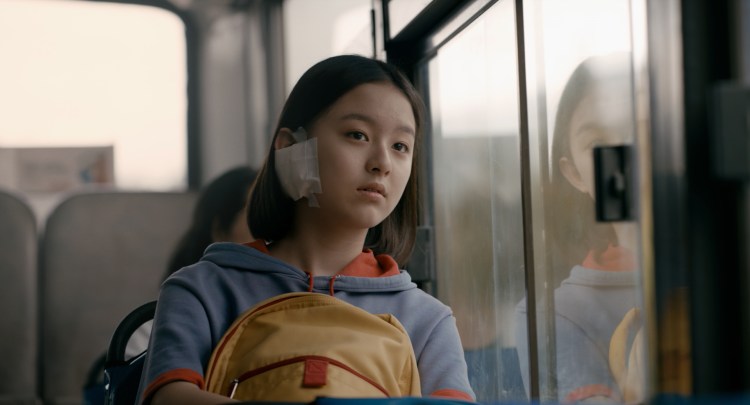
House of Hummingbird 6The BFI London Film Festival returns for 2019 with a packed programme of the best in recent international cinema. As usual the lineup includes an impressive selection of East Asian hits including Takashi Miike’s Cannes crowd pleaser First Love and sensitive Busan breakout House of Hummingbird.

Bhutan
LUNANA- A YAK IN THE CLASSROOM

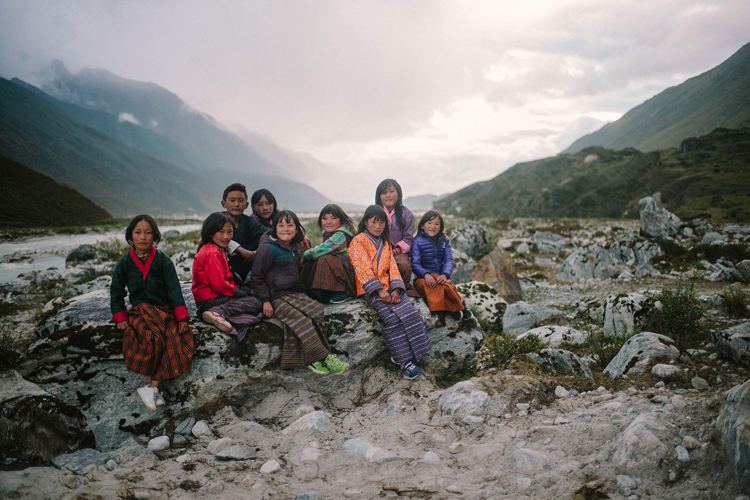
  • Lunana: A Yak in the Classroom – a frustrated teacher is dismayed to learn he’s being sent to a remote mountain outpost but is eventually won over by the kids.

China

White Snake Banner

  • So Long, My Son – Beijing Bicycle‘s Wang Xiaoshuai returns with a chronicle of the Chinese family from the ’80s reforms to the present day.
  • To Live To Sing – the leader of a struggling Sichuan Opera troupe tries to stave off eviction through impressing a local bureaucrat.
  • White Snake – beautifully animated “prequel” to the classic Lady White Snake folktale. Review.
  • Lucky Grandma – A Chinese-American grandma gambles away her life savings and ends up in the middle of a gang war after unwittingly stealing from Chinese gangsters!

Japan
Miike first love

  • 37 Seconds – a manga artist with cerebral palsy sets out to claim her independence through embracing her sexuality.
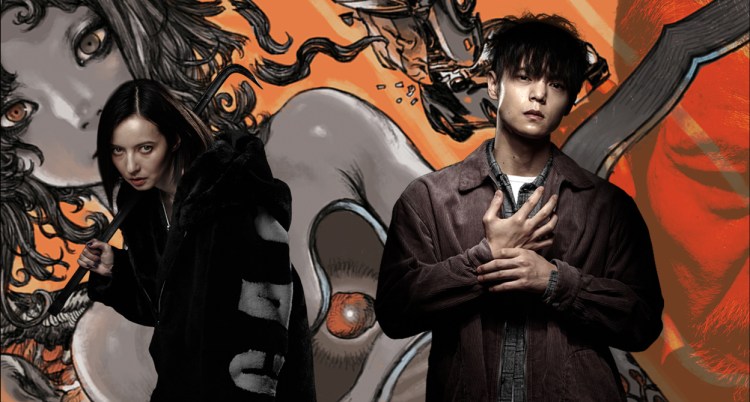
  • First Love – a boxer with a brain tumour falls for a trapped sex worker in the latest anarchic crime thriller from Takashi Miike.
  • To the Ends of the Earth – Kiyoshi Kurosawa reunites with recent muse Atsuko Maeda as a lost TV presenter goes searching for herself while filming in Uzbekistan.
  • Family Romance, LLC – Tokyo-set drama from Werner Herzog revolving around a rent-a-relative business.
  • Earthquake Bird – Alicia Vikander stars as a Tokyo-based translator in bubble-era Tokyo who finds herself at the centre of a series of murders.

Mongolia
Öndög 

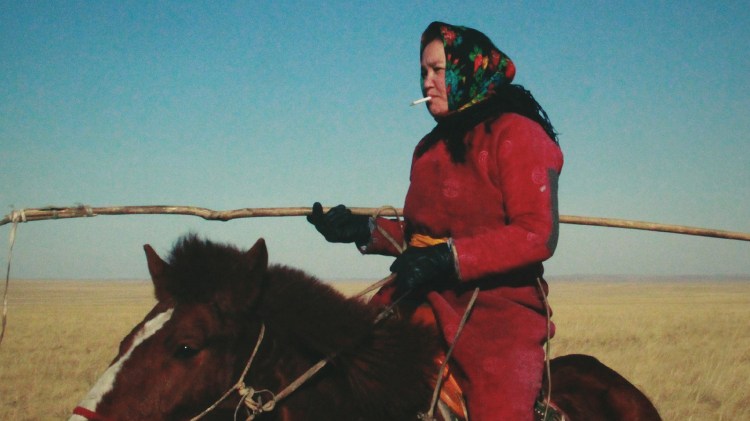
  • Öndög – a local herdswoman is brought in to take care of a wolf when the police discover a dead body.

Philippines

Overseas]

  • Overseas – Yoon Sung-a’s documentary exploring the lives of Filipina women working overseas.

Singapore
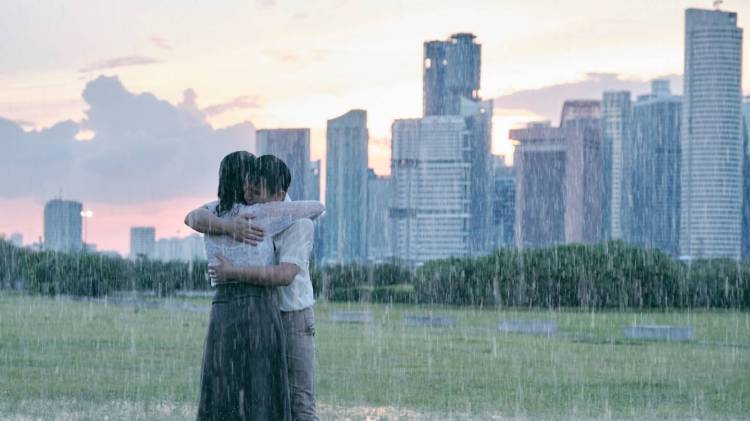
Wet season still 1

  • Wet Season – Ilo Ilo’s Anthony Chen returns with a monsoon tale in which a Mandarin language teacher is drawn to one of her students.

South Korea
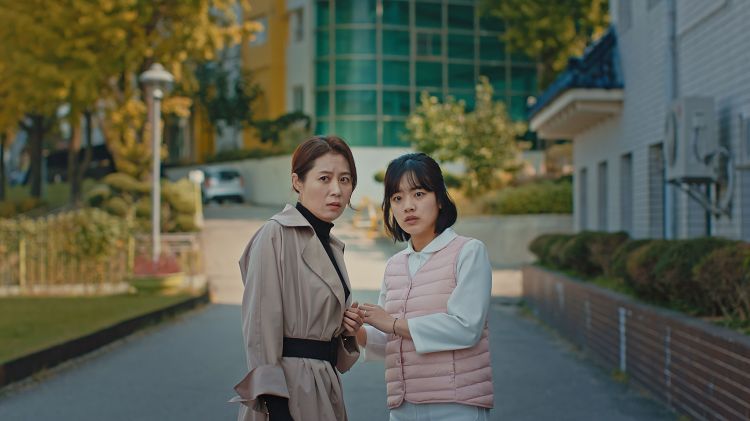
Maggie still 1

  • The Dude in Me – body swap comedy in which a jaded gangster gets a second chance to set things right when he swaps bodies with a mild-mannered teen. Review.
  • Heart – the latest from Bitch on the Beach‘s Jeong Ga-young in which she stars as a filmmaker who tracks down a married former lover for some additional advice about extra-marital affairs.
  • House of Hummingbird – a teenage girl from a problematic home finds inspiration in her enigmatic Chinese teacher in Kim Bora’s beautifully observed debut. Review.
  • The House of Us – Yoon Ga-eun’s The World of Us followup in which a young girl trying to get her parents to patch things up becomes a big sister figure to two other kids.
  • Maggie – surreal drama narrated by a catfish in which a conflicted nurse explores the interplay of truth and trust. Review.

Thailand
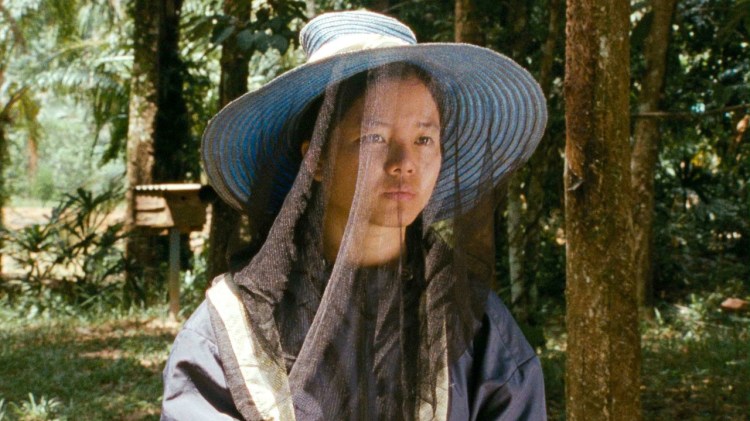
KRABI, 2562

  • The Cave (Thailand) – dramatisation of the international rescue operation of a team of young football players trapped in a Thai cave.
  • Hope Frozen – documentary following the parents of a little girl who died of a brain tumour as they try to reconcile their decision to opt for cryogenic preservation with their Buddhist beliefs.
  • Krabi, 2562 – Anocha Suwichakornpong and Ben Rivers team up for an unusual portrait of the Thai tourist town.

The BFI London Film Festival takes place at various venues across the city from 2nd – 13th October 2019. Full details for all the films as well as screening times and ticketing information are available via the official website. Priority booking opens for Patrons on 3rd September, for Champions on 4th September, and Members 5th September, with general ticket sales available from 12th September. You can also keep up to date with all the latest news via the festival’s Facebook page, Twitter account, Instagram, and YouTube channels.
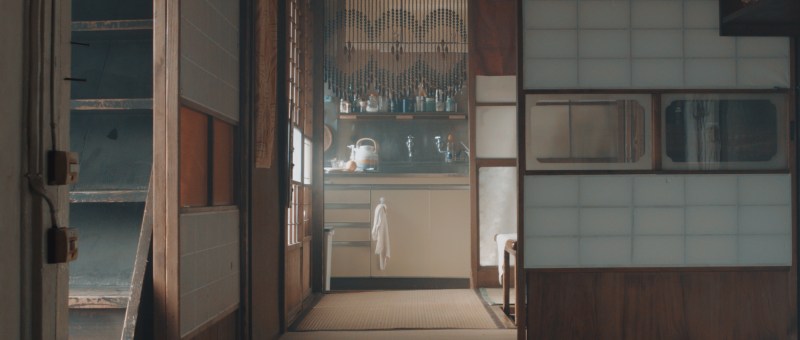
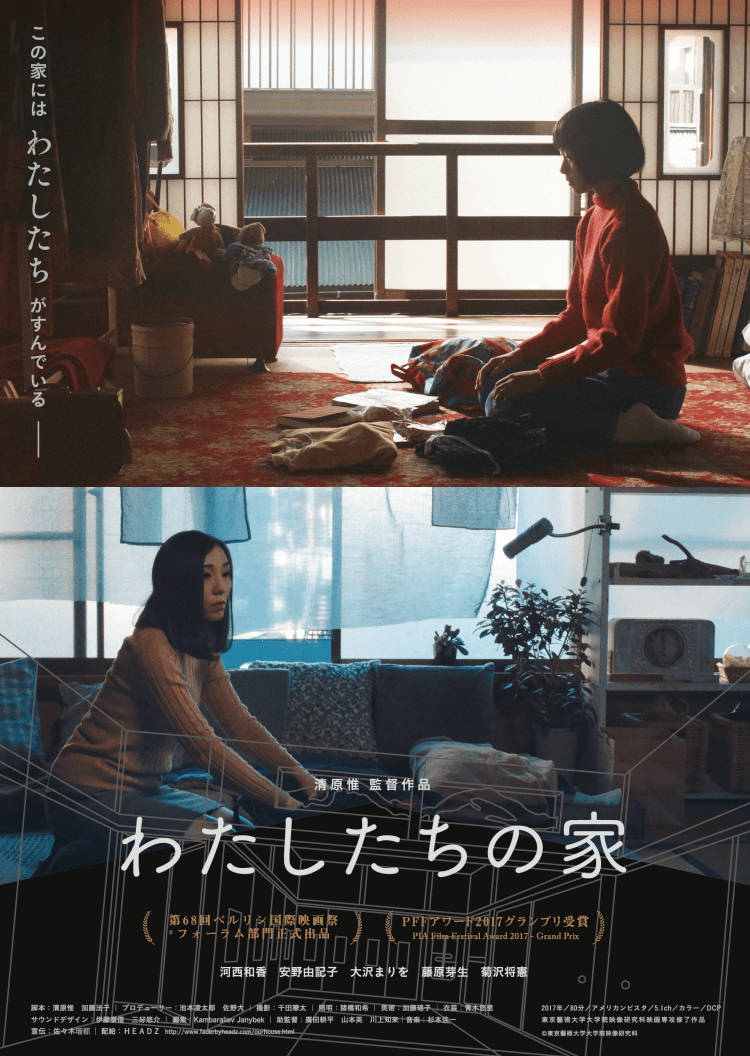
Our House (わたしたちの家, Yui Kiyohara, 2017)

our house posterIs the definition of “space” defined by absence as much as presence? Do we carve out pieces of the world to inhabit, or simply shift into an idea of place which we construct entirely around ourselves? Yui Kiyohara’s feature debut Our House (わたしたちの家, Watashitachi no Ie), completed as part of her graduation project for a masters at Tokyo University of the Arts, hints at the eeriness of a shared existential continuum as four women bridge inter-dimensional connections while living in the “same” two-storey house in Yokohama.

We begin with 14-year-old Seri (Nodoka Kawanishi) dancing cheerfully with a few of her friends presumably on a sleepover wearing incongruously old-fashioned nightgowns like the heroines of a gothic boarding school drama. The fun stops however when Seri thinks she hears a funny noise, half convinced the house is haunted. Her friends tell her it’s all in her mind, but something seems odd and she can’t seem to shake the sense of presence in the house.

Part of that might be because, though Seri’s father appears to have left long ago, she still dwells on his memory and perhaps feels the echo of him in their family home. It may seem particularly poignant to her right now because her mother, Kiriko (Yukiko Yasuno), has found a new man – Takashi (Toshio Furuya), who drives the local rubbish truck. Kiriko wants to get married again, and Seri, entering adolescence herself and playfully teasing her friend about a possible romance, cannot quite accept that her mum’s moved on.

Changing tack, a young woman wakes up on a ferry with seemingly no memory of how she got there or of her previous life aside from her name, Sana (Mariwo Osawa). Another woman on the boat, Toko (Mei Fujiwara), stops to ask if she’s alright and then offers to let her stay at her place, which happens to be an identical house to the one in which Seri and her mum live, until she remembers who she is.

Though Seri’s story has its whimsy, it remains firmly within the realms of the natural while there’s something decidedly odd about the world Toko and Sana inhabit. There is, however, a strange symmetry to their relationships. Both sets of women are keeping things from one another if for slightly different reasons. There are after all secrets which must exist between a teenage girl and her mother, so perhaps Kiriko doesn’t quite discuss her relationship with Takashi with her daughter, and Seri doesn’t talk to her mother about the kinds of things she talks to her friend about, but there are also additional communication difficulties in their shared reluctance to talk about the “ghost” of Seri’s absent father or about Seri’s various anxieties which manifest in her preoccupation with a possible haunting.

With Toko and Sana there is of course the issue of amnesia, but in this case it’s Toko who appears to be keeping secrets in her well concealed paranoia and illicit activities which see her handing over plain envelopes in dingy corridors and asking pointed questions about water pollution. Does she know more about Sana than she lets on, or is Sana perhaps a spy herself faking her amnesia to get close to Toko? In any case, Toko seems to want to keep her around, letting her know she can stay for as long as she wants, but it’s not entirely clear if that’s altogether a good thing or if Toko has more or less kidnapped a friend to keep safely at home. When she recommends drinking from the bottled water in the fridge rather than from the tap, we’re apt to wonder which source it is that might be “polluted”.

In that sense, both environments, hitherto exclusively female spaces, are eventually “polluted” by unexpected male intrusion. The spectre of Seri’s father may be ever present in the home, but it’s Takashi who places a strain on the relationship of mother and daughter, whereas Sana’s coffeeshop buddy Natsuki (Masanori Kikuzawa) sets off Toko’s alarm bells in more ways than one as he simultaneously encourages her to doubt her new friend, become jealous on an emotional level, and then anxious on a professional one as she wonders if Natsuki has befriended Sana to get into the house and look for a mysterious “something” she quickly tells him is no longer there. 

“Things embedded in the mind can never be lost” Toko reassures Sana, but also affirms that “nobody can prove who they are”, which might be true but doesn’t do much to help her identity-shorn friend. Natsuki too, claiming that Sana resembles someone he used to know, describes his old acquaintance as if she were “filled with a light that can’t be seen” perhaps alluding to the hidden depths he could only be aware existed within her but was never permitted to see. Toko says she lives the way she does so that she “won’t be defeated by gravity” but offers no reply when asked if she knows of anyone who has ever successfully defied it.

What we’re left with, is two mutually dependent realities though we’ve no way of knowing if each is located in the same temporal space or if one is past and another future. There’s a curious timelessness to Seri’s innocent world of birthday parties and walking on the beach with a friend, whereas Toko’s odd attire and slightly robotic manner of speaking hint towards a kind of retro futurism. The space, it seems, remains the same. Seri’s aunt, looking around, notices cracks in the walls but admires the house’s resilience prompting Kiriko to describe it as “still healthy”, as if it were a living entity which envelops them rather than a space they shape themselves. Yet the space is what connects them, one location existing at an intersection between two worlds. Events mirror each other, actions begin to have effect on each side though unknowingly. The curious symmetry might go someway to explaining life’s uncanniness, the sense of echoing we all feel on entering a dark and empty room, but it also provides a mechanism for harmony as items find themselves transferred to the place in which they are most needed. The space defines itself, but then perhaps it really is all “our house” – a shared universe in which we remain aware of each other but painfully unable to connect.


Available to stream via Mubi (UK) until Sept. 27.

Original trailer (English subtitles)

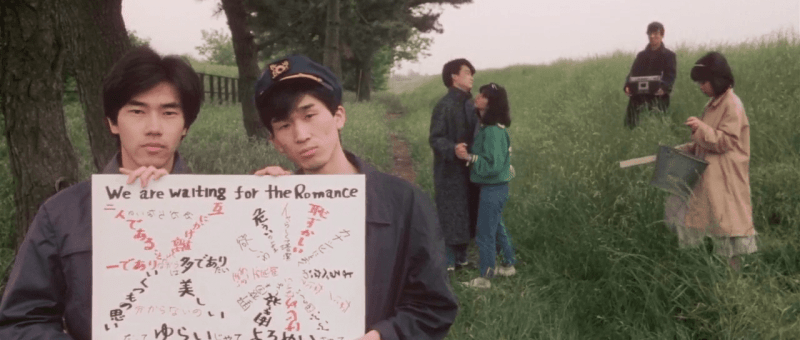
Bumpkin Soup (ドレミファ娘の血は騒ぐ, Kiyoshi Kurosawa, 1985)

Bumpkin soup posterLike many directors of his generation, Kiyoshi Kurosawa began his career in “pink film” – mainstream softcore pornography produced to a strict formula. His debut had been made for Director’s Company, an independent production house which offered creative freedom to young and aspiring filmmakers. He then tried to move into the studio system by directing for Nikkatsu’s Roman Porno, but the film was rejected for not quite living up to the demands of the genre. Bumpkin Soup (ドレミファ娘の血は騒ぐ, Do-re-mi-fa-musume no Chi wa Sawagu, AKA The Excitement of the Do-Re-Mi-Fa Girl) was then purchased from Nikkatsu and released independently as his second film, earning Kurosawa something of a reputation as a contrarian. Though the film contains its fair share of nudity and strange sexual shenanigans, it is easy to see why it did not fit the Roman Porno remit thanks to its bizarrely absurdist tone and often nonsensical French New Wave-inspired post-modernism.

The film begins with the heroine, Akiko (Yoriko Doguchi), walking into a Tokyo university campus in search of her small-town boyfriend, Yoshioka (Kenso Kato). Yoshioka is not, however, where he said he would be – he rarely turns up to lessons and has been absent from the music club he said he had joined for some time. Determined and undaunted, Akiko continues to look for him, encountering various strange people and events including a psychology professor intent on exploring the depths of shame.

After meeting sexually obsessed female student Emi (Usagi Aso), Akiko remarks that the university campus is like a permanent festival, or perhaps an amusement park. It certainly seems to be some sort of continuous orgy as seen though the eyes of simple country girl Akiko who has, after all, only come here in search of lost love. Carrying around a walkman with a tape featuring Yoshioka’s music, she devotes herself to finding her beau but eventually sniffing him out, discovers that he’s not the man she thought he was. Truth be told, Yoshioka does not seem like much of a catch. A randy college student, he has more or less forgotten all about Akiko while he pursues just about everyone else on campus instead of going to lessons.

Latterly, Akiko comes to the realisation that she thought she was looking for an adventure leading to love, but perhaps what she really wanted was love leading to an adventure. She left the country behind, travelled to the city, transgressed borders and entered the university where she was sure she would find answers but has discovered only more questions. Akiko feels herself at odds with her new environment, unable to understand the strange grammar of the university world where people seem to talk mostly about themselves. She does, however, seem strangely taken with the befuddled professor Hirayama (Juzo Itami) whose attempts to explore the nature of shame are derailed by the “shamelessness” of the modern student.

Hirayama’s big idea is that shame is all a sham. That the custom of hiding the parts of the body we have been taught to be ashamed of is a kind of deception in itself. He hopes that in the future people will live “nakedly” without feeling the need to hide anything at all, or at least that it will be impossible to tell from the outside which parts of themselves someone might be ashamed of. In order to pursue his theories, the professor is currently engaged in experiments to provoke an “extreme shame mutation” – something which his students later undertake alone but are unable to fulfil because their subject, Emi, appears to get off on the very things they considered shameful and embarrassing which, in turn, turns them all on. So in one way a very successful experiment, but in another not. In any case, Hirayama comes to the conclusion that only Akiko, with her innocent country ways, will be capable of showing him true shame which is how she eventually becomes mixed up in his “research”.

Most obviously inspired by mid-career Godard, Kurosawa adopts a post-modern, absurdist approach satirising left-wing student politics and youthful intensity while inserting random moments of song and dance along with explicit (and often odd) sexual  content that was likely still not quite enough to make it worthy of the Roman Porno name. A strange subplot pits the psychology student against a gang of mute performance artists led by a girl banging a bucket with a stick, which eventually leads to the act of nihilistic revolution which closes the film with a lullaby sung by a girl wielding a gun. What does it all mean? That shame is just a tool of social oppression, that one should make one’s own decisions without blindly following “thinkers”, that young people destroy themselves in pointless acts of revolution? Who can say, perhaps it isn’t very important but Kurosawa certainly has his fun while exploring the innocence/experience divide.


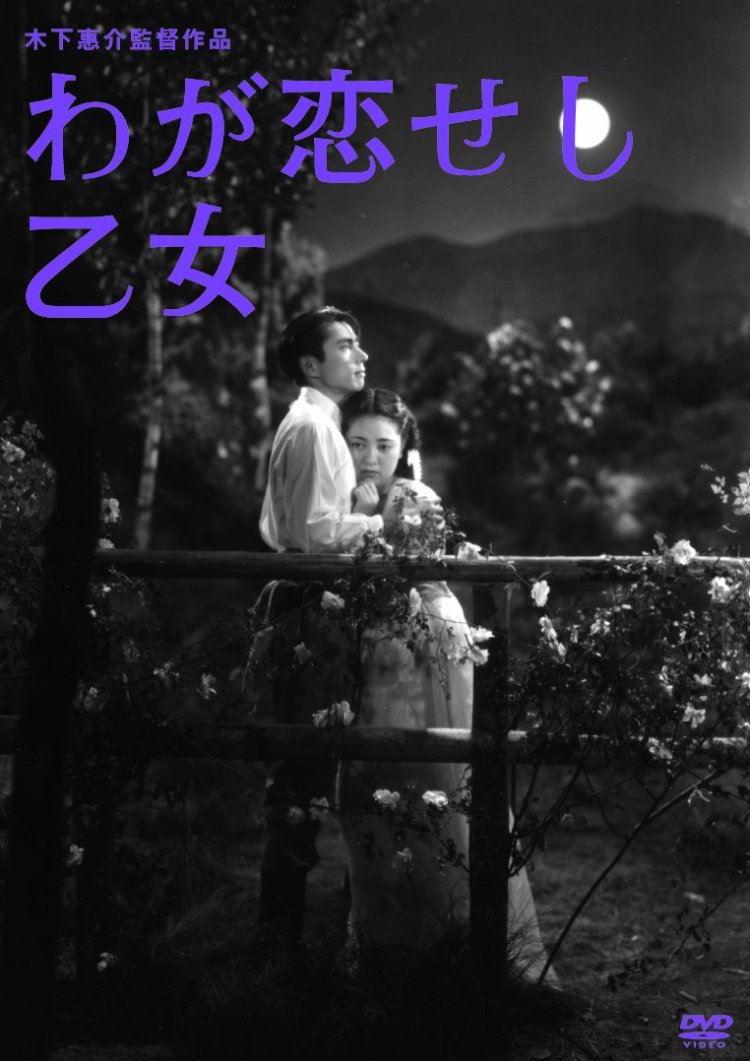
The Girl I Loved (わが恋せし乙女, Keisuke Kinoshita, 1946)

The Girl I loved DVD coverThe post-war era, as confusing and chaotic as it was, offered several choices, among them that to change to course, choose to create a better, kinder world than the one which had led to so much suffering. As always, however, the human temptation is to choose the opposite and allow anger and resentment to make everything even worse than it had been before. Occasionally censured for his sentimentality, Keisuke Kinoshita was perhaps among the more defiantly positive of the post-war humanists whose fierce love human goodness knew no bounds. In The Girl I Loved (わが恋せし乙女, Waga Koiseshi Otome) he puts his ideas to the ultimate test as a young man recently returned from the war must learn to cope with various kinds of disappointment but eventually resolves to take solace in other people’s happiness even at the cost of his own.

The tale begins some years earlier when a baby girl is abandoned in front of the Asama Ranch, her mother apparently having taken her own life by jumping from a nearby cliff. The Asamas are good people and moved by the letter they find with the baby so decide to take her in. Yoshiko (Kuniko Igawa) is raised alongside older brother Jingo (Yasumi Hara) as an adopted sister always aware of her origins but very much a full member of the family.

Flash forward to the present day and Yoshiko has become a beautiful young woman. Jingo has returned from five years of war in perfect physical health, keen to resume his idyllic farm life in the beautiful Japanese countryside. The fact is that Jingo has long been in love with Yoshiko, though the situation is understandably complicated seeing as they were raised as siblings even if there is no blood relation between them. Somehow it seems a perfectly natural idea that the pair will marry and many assume this will be the case. Jingo, however, remains somewhat reticent and afraid to voice his feelings. It seems Yoshiko has something to tell him too and so he dares to hope as they both agree to share their respective secrets after the harvest festival.

At the festival, however, Jingo gets a shock. He sees the way Yoshiko looks at another man and realises that what she wanted to tell him was probably that she had fallen in love with someone else. Shaken and confused, Jingo bites his tongue. He knows to say anything now would only create more pain and suffering for everyone while he alone will suffer if he decides to stay quiet.

Nevertheless the temptation is there. Mr. Noda (Junji Soneda), Yoshiko’s intended, is a quiet man, an intellectual who returned from the war early thanks to injury and still walks with a cane. Yoshiko has been fearful that her family may object to the marriage on the grounds of Noda’s disability – something he has also been aware of and warned her about in explaining the potential hardship she may have to endure as his wife seeing as he is also merely a poor schoolteacher. Jingo could try to refuse her permission to marry, try to force her to marry him instead, or refuse to give his blessing for her to marry anyone at all, but if he did that all he’d be doing is condemning both of them to eternal misery. It would be understandable if he began to resent Noda and most particularly his disability which brought him home from the war early and enabled him to be here to fall in love with Yoshiko while Jingo was away and dreaming of home, but then it could so easily have been the other way around.

In the end, Jingo’s love is selfless and good. What he wants is for Yoshiko to be happy and if being with Noda is what that means then Jingo will not stand in her way no matter how much it may hurt him to stand aside. After all, as Noda says, aren’t they both lucky to be alive in this beautiful place? Having suffered so much, the two men understand how precious life is and know it’s far too short for pettiness or resentment. A quiet, gentle tale The Girl I Loved is a sad story of youthful disappointment in love, but it’s also a kind of melancholy manifesto for the new post-war world built on compassion and understanding as a young man decides to take the noble path in accepting that the girl he loved loves someone else and that’s sad but it’s also happy and if you can learn to rejoice in someone else’s happiness even in the midst of your own pain then perhaps everything will be alright after all.


Titles and opening scene (no subtitles)

Bloodline (血脈 / 혈맥, Kim Soo-yong, 1963)

Bloodline posterDirector Kim Soo-yong began his career while still in the military shortly after the end of the Korean War, originally making “military films” for the Ministry of Defence’s Film Department. Since his debut in 1958, Kim had directed 19 features before the release of his “breakout” transition into mainstream cinema with Bloodline (血脈 / 혈맥, Hyeolmaek, AKA Kinship) – an early example of the “literary film” with which Kim would become heavily associated. Like much of Kim’s later work, Bloodline is a socially progressive, empathetic look at the lives of everyday people living in very difficult circumstances but trying their best to be their best all the same.

The film opens in 1946, immediately after the end of the Second World War which is also, of course, the end of the Japanese Colonial Period and the beginning of a short-lived Korean post-war democracy. A small shantytown courtyard in Seoul is home to three families – the wealthier Kim Deok-sam (Kim Seung-ho) who was once a successful mining agent in Japan and lives with his grown-up son Geobugi (Shin Seong-il), the tinker “Ggangtong” (Choi Nam-hyun) who lives with his second wife Ongmae (Hwang Jung-seun) and daughter Boksun (Um Aing-ran), and Wonpal (Shin Young-kyun) whose wife (Lee Kyoung-hee) is seriously ill while his daughter (Lee Gyeong-rim) is disabled. Wonpal, a refugee from North Korea, is also responsible for his elderly Christian mother (Song Mi-nam) and younger brother Wonchil (Choi Moo-ryong) who went to university in Japan but has come back with literary aspirations and has so far refused to get a job and help support the family.

The world of 1946 is an immensely chaotic one in which the old order has been destroyed but nothing has yet arrived to take its place. For good or ill, the American occupation has become an essential economic force – Deok-sam is forever urging Geobugi to get a job on the American military base which he believes will pay well both in terms of salary and a series of perks official or otherwise. Meanwhile, Wonchil’s old girlfriend, Oki (Kim Ji-mee), is one of many women who’ve found themselves without support in the desperate post-war economy and has become the mistress of an American serviceman. Like Won-chil she came from the North with nothing and was left with no other option than entering the sex trade as a bar girl – the same fate which awaits Boksun at the behest of her step-mother who plans to sell her to a bar to provide for the family and has been forcing her to learn bawdy folksongs in order to become a fully fledged “gisaeng”. 

Both generations are, to a particular way of thinking, intensely selfish. The old, still bound up with a series of ancient social codes, try to oppress their children in the same way they were oppressed only now they’re in charge and reluctant to cede the little power they have now they finally have it. The parents want their children to do what is best for the “family” regardless of their personal happiness. Deok-sam is determined that his son should get a job with the Americans, Ongmae is determined that Boksun become a bar girl so that she and her husband can live in comfort, while Wonpal just wants to support his wife and daughter but can’t and resents his brother for not helping more. Yet the young people want their freedom and to be a part of the world which is opening up before them. They are filial and want to look after their parents, but reject their oppressive demands especially when it comes to their romantic futures. Ggangtong disagrees with his wife’s decision to sell Boksun and has hatched a plan to marry her off to a nice barber who has asked for her hand and seems to have good prospects, but Boksun is in love with Geobugi and wants to marry him, only he is dragging his feet because he has no money and worries about his father. Geobugi wants to get a job in a nearby factory, but hasn’t had the courage to go against his father’s wishes.

Kim Soo-yong, as unjudgemental as always, places his sympathies firmly with the young as they demand their right to choose while also reserving a right to a fresh start for all – including bar girl Oki who is allowed to simply walk away from her life in the sex trade and into a happier future once the moody Wonchil has learned to accept her past and also reconciled with his brother, literally “repairing” the family home in fixing the hole in the leaky roof through which Wonpal’s wife once used to watch the stars. Meanwhile, Boksun and Geobugi also look forward to their brighter future with jobs in a progressive factory which is friendly, bright, and open. Ggangtong, who resented his wife’s feudal desire to sell their daughter but also tried to arrange her marriage, is the first to see that his era has ended, affirming that the youngsters were right to leave and that the world now belongs to them. Eventually sense is seen, the old give way and accept the desires of the young, realising that they will lose their children if they cannot learn to set them free. The world has changed, mostly for the better, and familial bonds will have to change with it but they will not necessarily have to break if each side is willing to give ground in expectation of a better tomorrow.


Bloodline is available on English subtitled DVD courtesy of the Korean Film Archive in a set which also includes a bilingual booklet featuring an essay by director Kim Soo-yong, and an article about the restoration by the Korean Film Archive’s Kim Ki-ho, as well as full cast and crew credits.

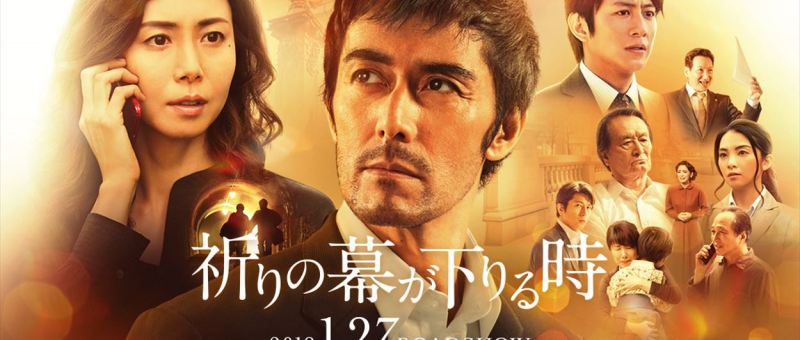
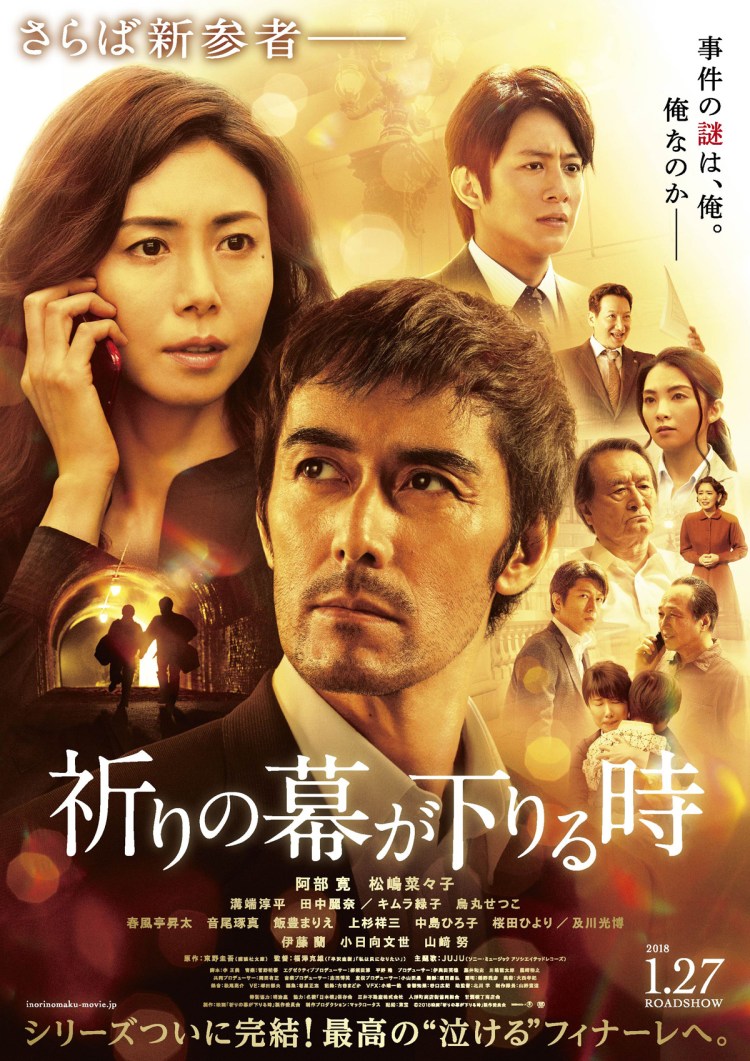
The Crimes That Bind (祈りの幕が下りる時, Katsuo Fukuzawa, 2018)

Crimes that bind posterDetective Kyoichiro Kaga has become a familiar screen presence over the last decade or so in a series of films and TV dramas starring popular actor Hiroshi Abe which might make it something of a surprise that The Crimes That Bind (祈りの幕が下りる時, Inori no Maku ga Oriru toki) is, after a fashion, a kind of origin story and touted as the culmination of the long running franchise. Another of prolific author Keigo Higashino’s key detectives, Kaga’s stalking ground has always been Nihonbashi where he has managed to make himself a friendly neighbourhood cop but, as it turns out, dedication is not the only reason he’s refused promotions and transfers to stay in what is, professionally at least, something of a backwater.

In fact, the film begins way back in 1983 when a young woman, Yuriko (Ran Ito), ran away from her husband and son to become a bar hostess in Sendai offering only the explanation that she felt herself unworthy of being a wife and mother. Some years later in 1997, she met a nice man – Watabe, but died of natural causes in 2001 at which point we discover that she is none other than the long lost mother of our master detective whom she abandoned when he was only eight years old. Being a compassionate man, Kyoichiro Kaga is not angry with his mother only sorry he did not get to see her before she passed and eager to meet the man who made her last years a little happier. Only, it appears, Watabe has also disappeared without trace. The only thing the Mama-san at the bar where Yuriko worked can remember about him is that he once said he often went to Nihonbashi. Kaga searches for the next 16 years with no leads, which is when the main case kicks into gear with the discovery of a badly decomposed body of a woman in a rundown Tokyo flat.

Of course, the two cases will turn out to be connected, giving Kaga an opportunity to investigate himself and come to terms with his difficult family circumstances including his strained relationship with his late father whose coldness he blames for driving his mother away. Parents and children will indeed develop into a theme as Kaga digs into why his mother might have done the things she did while also trying to reverse engineer his clues to figure out why he seems to be at the centre of an otherwise completely unrelated case.

Meanwhile, pieces of the puzzle seem to drop into place at random such as the fortuitous discovery of an old woman claiming to have lost her memory so that she can stay in hospital who may or may not be linked to one of the prime suspects – a top theatre director also known to Kaga thanks to a chance encounter some years earlier. In a neat twist, the theatre production she is currently trying to put on is Love Suicides at Sonezaki – a sad tale of young lovers, an adopted son of a merchant and a courtesan, who realise that they have no freedom to pursue their desires and so decide that their only solution is double suicide. The truth that Kaga uncovers leads him in much the same direction only the love at stake is familial rather than romantic and built on the strange filial interplay of the connection between a parent and a child.

It is quite literally “crimes that bind”, but Kaga’s repeated mantra that lies are the shadow of truth, illuminating as much as they conceal, does not quite fit with the incident he has been investigating which largely hinges on coincidences which place him, improbably, at the centre and tip him off to the hidden connections which will crack the case. Which is to say, the solution lies in the killer overplaying their hand (though for reasons unrelated to crime) and thereby undermining their carefully won subterfuge. Torn between solving the murder and exploring Kaga’s melancholy backstory, The Crimes That Bind finds itself falling between two stools even as its twin plot strands begin to dovetail as neatly as one assumes they eventually will, laying bare the central themes of parental sacrifice and belated filial gratitude. Playing best to those already invested in the Kaga franchise, Katsuo Fukuzawa’s adaptation may serve as a fitting conclusion (to this arc at least) but cannot quite overcome its over-reliance on confessional flashback as method of investigation or the improbable qualities of its admittedly twist filled central mystery.


International trailer (English subtitles)

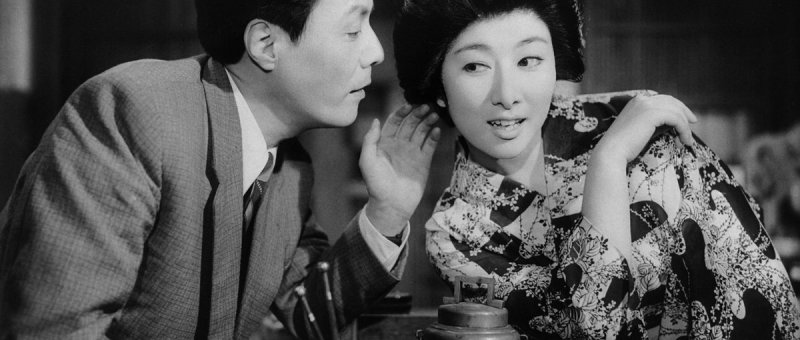
Twilight Story (濹東綺譚, Shiro Toyoda, 1960)

Director Shiro Toyoda, closely associated with high minded literary adaptations, nevertheless had a talent for melancholy comedy and for capturing the everyday reality of ordinary people. A fierce condemnation of the patriarchal society at a moment of intense masculinity, Twilight Story (濹東綺譚, Bokuto Kitan), an adaptation of the novel by Kafu Nagai, follows an ambivalent author as he covertly observes the life and love of a former geisha daring to dream of romantic salvation while fully aware of the world’s cruelty.

Set in 1936, the film opens with an author on a research trip who guides us into the world of the Tamanoi pleasure quarter which he seems to disdain but is drawn to all the same. Whilst there he runs into a nervous middle-aged man, Junpei (Hiroshi Akutagawa), who is later accosted by sex worker Oyuki (Fujiko Yamamoto) for use of his umbrella during a violent storm. A mild-mannered sort, Junpei is unused to the ways of the red light district and quickly makes his escape after being invited into Oyuki’s home. After a swift drink, however, he returns and the pair begin an awkward semi-romantic relationship.

Despite his affirmation that he is single, Junpei is in fact already married if (for the moment) unhappily. Though he knew his future wife Mitsuko (Michiyo Aratama) had given birth to an illegitimate child fathered by her employer, Junpei chose to marry her anyway because he was in love. The pair married, they say, for “genuine” reasons but the father of Mitsuko’s son continues to send maintenance money for the boy’s education and his constant presence has begun to play on Junpei’s mind especially as his teacher’s salary is dwindling in this age of militarism in which educational hours are decreasing in favour of compulsory military drills. Meanwhile, Mitsuko also seems to have got religion and spends most of her time reciting sutras with the implication that she has begun to neglect her husband, emotionally, spiritually, and most particularly physically. In order to escape his depressing home life, Junpei hangs out in the Tamanoi where men’s hearts are lighter and people talk frankly about love.

This is, of course, not quite the case, but the fantasy the pleasure quarters sell of themselves. Our jaded author is perfectly aware of that and broadly sympathetic towards the women caught in its web. Oyuki, a former geisha, has “debased” herself in order to earn extra money to send home to her family and pay the medical fees for her sickly mother. Her uncles constantly pressure her for more and she wonders if they are not merely exploiting her, using her money for their own benefit and refusing to chip in for her mother’s care. Nevertheless, she is trapped. On meeting Junpei with whom she seems to develop a genuine emotional connection, she dares to dream that one day they might marry, that she could leave this life behind and build a stable family home of her own.

Of course, it’s not to be. Like all men in the Tamanoi, Junpei is misrepresenting himself for his own ends. He is only using Oyuki as an idealised point of refuge from the unhappy marriage he shows no other signs of leaving. As the author points out, the men think they’re using women but the women are also using them though they do so without calculation. Denied power or agency of their own, the women of the Tamanoi have no other option than to manipulate that of men, though the author sympathises with them so strongly that to expose the hidden “vulgarity” seems to him an act of intense cruelty.

Junpei falls in love with the world of the Tamanoi because he thinks it’s more emotionally honest, but the truth is quite the reverse. Wandering through the narrow streets at night, the author pities the women in the windows, knowing that men come here to escape their isolation but there is no escape for these women who are forced to delude themselves that a better future is waiting in order to go on living. Meanwhile Junpei’s colleague, looking back over his shoulder towards the young men in uniform, declares that he too has lost all hope for a promising future. With militarism on the rise, hyper-masculinity has led to a further decline in the already woeful status of women with even the girls’ sympathetic pimp lamenting that the army, who have been rounding up sex workers for forced service in Manchuria, regard them as little more than products to be poked and prodded and giggled over as they are cruelly bought and sold.

Reuniting with his wife, Junpei is forced to face his emotional cowardice, that he was just playing with Oyuki’s feelings in indulging the fantasy of an idealised romantic union. Oyuki, meanwhile, faces the destruction of all her dreams when she realises her uncle has betrayed her, her mother is dead, and all her sacrifices have been for nothing. On some level she may have known Junpei had another woman, but needed to believe in the fantasy of his love for her in order to make her life bearable. Even so, she now sees no other future for herself than a return to work shorn of all her hope. Toyoda’s condemnation of the red light district is bleak and total, even as the jaded author himself becomes an ambivalent part of it, but the Tamanoi is only a symptom of longstanding social oppression exacerbated by militarist fervour as the lights go out all over town.


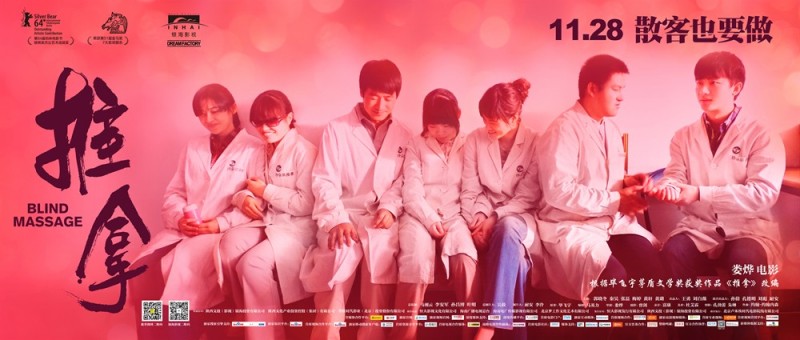
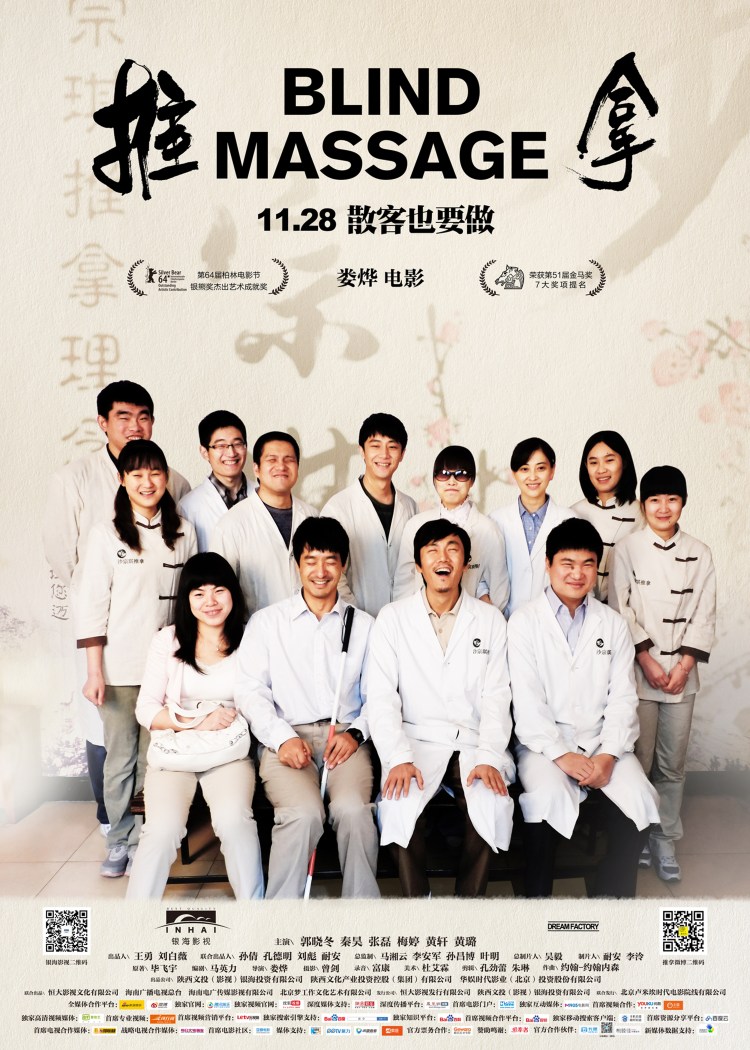
Blind Massage (推拿, Lou Ye, 2014)

Blind Massafe poster 1Lou Ye, defiantly controversial, has made those who cannot, for one reason or another, embrace their own desires the centre of his cinema. Seeking connection, his protagonists reel desperately from one traumatic event to the next but resist full commitment, no longer able to believe in the truth of their feelings in a society which has so often betrayed them. Blind Massage (推拿, T), a radical departure from the provocative politicisation that has hitherto marked his cinema, takes this one step further in setting itself inside what it sees as an entirely isolationist world – that of the blind who occupy a particular liminal space within modern Chinese society.

Lou begins with a voiceover and fractured vision of our most prominent protagonist, Xiao Ma (Huang Xuan), as he emerges from a childhood accident which killed his mother and cost him his sight. Though he is assured that his condition is only temporary and his eyes will eventually be healed, Xiao Ma later attempts suicide when he comes to understand that his doctors have been deceiving him and his sight will never return. Surviving, he learns to accept his blindness and attends a special school for those with disabilities where he learns to read braille and is trained as a masseuse – a traditional occupation for the blind in Chinese society. Once qualified he gets a job at the Sha Zongqi Massage Center which is staffed exclusively by those with visual impairments who live together on site and exist as a small and exclusive community.

The trouble begins when the two partners, Sha Fuming (Qin Hao) and Zhong Zongqi (Wang Zhihua), invite an old colleague, Dr. Wang (Guo Xiaodong), to join them. Wang brings with him his fiancée, Xiao Kong (Zhang Lei), with whom the young Xiao Ma eventually develops a fascination. Meanwhile, Fuming has also developed a fascination for another newcomer, Du Hong (Mei Ting), who, he has been told, is very “beautiful”. Du Hong, in turn, is attracted to the morose figure of Xiao Ma but perhaps understands that for one reason or another he is unable to “see” her (which might be one of the reasons she continues to pine for him).

As in his previous films, Lou centres himself in a question of haptic connection. The residents of the clinic feel themselves cut off from what they see as “mainstream society” which they believe belongs exclusively to the sighted. Mainstream society, unadaptable and perhaps unwelcoming, has seen fit to exile them to the extent that they are unable to survive outside of the specific career track it has laid down for them and without the support of their own community. Yet their occupation also depends on deep sensory perception on a level deemed inaccessible to the fully sighted and the ability to “see” the things which can’t be “seen”.

Fuming, outgoing and sociable, looks for outlets outside of his own community but is criticised by those within who worry that he is in someway attempting to deny his blindness by adhering to the conceptual world of the sighted which he is otherwise unable to comprehend on a sensory level. His “love” for Du Hong is rooted in ideas of “conventional” beauty which is, in fact, more an expression of his vanity as he longs to possess the “best” girl as Du Hong points out when she reminds him that he has no idea whether she is “beautiful” or not or even what visual “beauty” might be, and that in becoming obsessed with these incomprehensible ideas he has in fact missed all of the things which might be “beautiful” about her on another level than the visual.

Meanwhile, another resident at the clinic has become worried about Xiao Ma’s fixation on Kong and decided the best way to sort him out is to take him to a brothel (ironically, also a kind of “massage parlour”). Though originally reluctant Xiao Ma begins to develop a relationship with sex worker Mann (Huang Lu) which is forged through touch but occurs on a deeper level. A fight with one of Mann’s other clients has the ironic effect of restoring some of his vision, leaving him stumbling and confused but also excited and drunk on a kind of sensory euphoria as he tries to reconcile his differing kinds of perception to make his way home. Yet by this point in his life Xiao Ma’s entire identity and existence revolves around being a blind person – he cannot tell anyone at the clinic that his vision has begun to return for fear of losing his place in their community as well as his ability to support himself.

Eventually the community of the clinic becomes scattered as its residents begin to reassert themselves as individuals re-entering “mainstream society”. Casting visually impaired actors alongside familiar faces, Lou treats his subject with the utmost respect and demonstrates that many of the problems faced by those at the clinic are exactly the same as those faced by the protagonists of his previous films while also reflecting the various ways that society remains intolerant to those who have differing needs. Asking quite profound questions about the nature of “beauty” and “connection” when images have been absented from the frame Lou attempts to “visualise” what it might feel like to “see” without “seeing” in an exploration of defiant hidden realities which often go wilfully unseen in our own blinkered perceptions.


Original trailer (English subtitles)

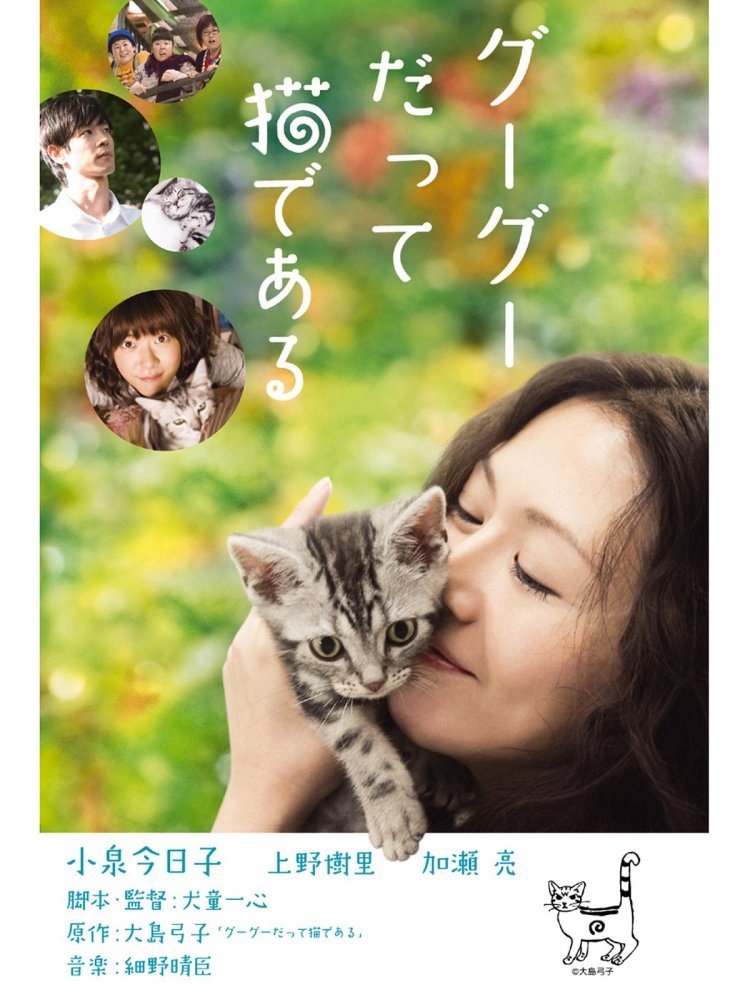
Gu Gu the Cat (グーグーだって猫である, Isshin Inudo, 2008)

Gu Gu the cat posterJapanese cinema has long been in love with the local flavour movie. It may be true that many otherwise fantastic examples of the small subgenre have a “sponsored by the tourist board” aesthetic, but then the pure “furusato” love is usually genuine enough and often proves infectious. Gu Gu the Cat (グーグーだって猫である, Gu Gu Datte Neko de Aru) is a case in point in its fierce determination to sell the benefits of trendy Tokyo suburb Kichijoji – an upscale bohemian neighbourhood well known for being home to artists and dreamers who take care to foster the kind of hometown spirit you wouldn’t normally associate with city living. The film is also, however, the story of a struggling middle-aged mangaka who is forced to deal with a long delayed existential crisis after her elderly cat passes away.

Ça Va had been living with Asako (Kyoko Koizumi) for the last 15 years but passed away while she and her team were working flat out on a special Christmas issue. Asako is of course devastated and not least because she feels guilty that perhaps she was too busy to notice that Ça Va was ill until it was too late. According to her assistant Naomi (Juri Ueno), Asako’s career had been faltering even before Ça Va passed away – the Christmas issue had been the only thing she’d produced all year leaving her team of assistants out of pocket and worried for the future. Grief-stricken as she is, Asako eventually decides to get a new cat, Gu Gu, enabling a rebirth in her professional as well as personal lives.

Based on an autobiographical story by mangaka Yumiko Oshima, Gu Gu the Cat wastes no time in reminding us that being a mangaka is a precarious business. Asako is well acclaimed as an artist and has inspired countless young women with her shojo manga (Naomi not least among them) but is still pressed into working insane hours to meet publication deadlines and is constantly badgered by her publishing company to provide new material. Her mother (Chieko Matsubara), meanwhile, just wants her to settle down and get married before it’s “too late”.

Asako’s mother’s nagging may seem like the usual kind of conservatism that is a little embarrassed by an unmarried middle-aged woman, as well as with the idea of a woman having a career and especially in manga which is a “popular” art and therefore less respectable than literature or painting. It is also, however, born of knowing her daughter and seeing that there is a part of her that hasn’t quite matured thanks to working on manga all her adult life which has left her feeling isolated and lonely in a way a cat might not be able to satisfy. This is perhaps why potential love interest Seiji (Ryo Kase) describes all her manga as “sad”, and why Asako is somewhat uncomfortable with being treated as a “famous author” rather than as a person.

Gu Gu the cat takes a back seat to most of the action (as cats are want to do) but does help engineer a meeting with Seiji who, despite being much younger than Asako, begins to reawaken in her a sense of desire if not exactly for romance then perhaps for life. Following a familiar pattern, however, Asako re-channels that desire into her manga – coming up with an idea in which a teenager suddenly grows old, neatly mirroring her sudden sense of having become “a woman of a certain age” overnight without really noticing. Having lost Ça Va, Asako attempts to come to terms with lost time in accepting that many choices have already been made and opportunities lost. In that sense there is something sad in Asako’s decision to remain alone in knowing that in the end she lost love because she was too timid to claim it, but then, the answer isn’t new romance but an acceptance of being happy in the present in the knowledge that things change and people leave but it will all be OK in the end.

Based on Oshima’s real experiences, Inudo’s film takes a turn for the melodramatic towards its conclusion which feeds back into his “live every day” message but is perhaps a little heavy for the cheerful slice of life drama surrounding it. Likewise, his strange decision to sell the joys of Kichijoji (which appear to be many) through an American Eikaiwa teacher narrating a journey through the area in the manner of a TV programme aimed at tourists is a particularly strange one which in no way benefits from its surreal plot revelation. Nevertheless, Gu Gu the Cat is a warm and affectionate tribute to this seemingly warm and quirky area which acts as a kind of coming of age story for its middle-aged heroine who, in a sense, births herself in coming to an acceptance that life goes on and the best you can do go along with it for as long as you can.


Original trailer (English/Chinese subtitles)

Camera Japan Announces Complete Programme for 2019

camera japan logo

Camera Japan, the premier Dutch showcase for Japanese film, returns for its 14th edition this September with another fantastic selection of recent indie and mainstream cinema. This year’s theme is “youth” and the programme has a special focus on films made by or about young people.

Contemporary Cinema

Fly Me to the Saitama still 2

  • 12 Suicidal Teens – 12 teens meet in an abandoned hospital to commit mass suicide but instead find themselves trying to solve the mystery behind the death of a young boy in a youthful drama from 20th Century Boys’ Yukihiko Tsutsumi.
  • Another World – three childhood friends reunite but find it difficult to escape from the shadow of the past in Junji Sakamoto’s tale of frustrated male bonding. Review.
  • Astral Abnormal Suzuki-san – indie comedy in which a young YouTuber and her family become part of a TV show.
  • Bento Harassment– A single mother fed up with her teenage daughter’s nonsense starts sending passive aggressive messages through bento in a tale inspired by a real life blog.
  • The Chaplain – the final film from the late Ren Osugi in which he plays a compassionate preacher ministering to those on death row. Review.
  • The Chrysanthemum and the Guillotine – Takahisa Zeze’s Taisho era tale of female sumo warriors and bohemian anarchists. Review.
  • Every Day a Good Day – charming tea ceremony memoir starring Haru Kuroki and the late Kirin Kiki. Review.
  • The Fable – a top hitman is given the challenge of laying low as a normal person for a year only to be sucked into yakuza drama. Heartfelt zany fun! Review.
  • Fly Me to the Saitama – the residents of Saitama have become an oppressed minority in this surreal comedy from the director of Thermae Romae. Review.
  • Hard-Core – an overly idealistic slacker and his simple-hearted buddy make friends with a damaged robot while accidentally getting mixed up in dangerous politics in Nobuhiro Yamashita’s adaptation of the cult manga. Review.
  • Jam – Sabu gets back to his roots with a tale of three guys on the run. Review.
  • Jesus – a little boy discovers he has a friend in tiny Jesus only to find himself feeling betrayed in Hiroshi Okuyama’s whimsical debut. Review.
  • Just Only Love – a lovelorn OL realises her boyfriend’s not that into her in Rikiya Imaizumi’s romantic drama.
  • The Kamagasaki Cauldron War – Osaka’s “invisible slum” is thrown into chaos when someone steals the local yakuza’s ritual bowl. Review.
  • A Life Turned Upside Down: My Dad’s an Alcoholic – a young woman struggles to take care of herself when her mother joins a cult and her dad takes to drinking.
  • Little Miss Period – surreal drama starring Fumi Nikaido in which periods are anthropomorphised as giant pink heart-shaped buddies.
  • Love at Least – sensitive drama in which a young woman with bipolar tries to face up to her feelings for her supportive (perhaps too much so) boyfriend when his manipulative ex shows up and starts interfering in her life. Review.
  • Melancholic – a Todai graduate slums it in a bathhouse only to discover the place doubles as a yakuza killing ground after hours. Review.
  • Mimicry Freaks – intense horror film in which a man wakes up on a hospital bed in the woods to be told he was executed thirty years previously.
  • My Dad is a Heel Wrestler – a nine-year-old boy exaggerates his wrestler dad’s success in this charming comedy starring real life wrestler Hiroshi Tanahashi.
  • My Father the Bride – a woman returns to her island home for the second anniversary of her mother’s death only to find her father wearing her mother’s clothes and apparently about to marry a man.
  • Okinawan Blue – three tales intertwine at an Okinawan guest house.
  • Only the Cat Knows – the disappearance of the family cat symbolises the distance in a long term marriage in a whimsical romantic drama starring legendary actors Chieko Baisho and Tatsuya Fuji with a notable cameo from Mikako Ichikawa. Review.
  • Orphan’s Blues – poetic drama in which a young woman with unexplained memory loss determines to track down a childhood friend. Review.
  • Queer Shorts – two mid-length queer films including Shun Nakagawa’s Kalanchoe in which a high school class becomes curious about their LGBT lessons, and Mika Imai’s Until Rainbow Dawn in which two deaf women fall in love.
  • Red Snow – impressionistic mystery starring Masatoshi Nagase and Arata Iura in which a journalist’s investigation of a thirty year old child disappearance begins to open old wounds. Review.
  • Rise of the Machine Girls – reboot of Noboru Iguchi’s classic splatter franchise.
  • Samurai Marathon – period drama directed by Bernard Rose in which the local lord’s idea of training his out of shape men through a marathon is misconstrued by the Shogun. Review.
  • Vision – Juliette Binoche goes rare herb hunting for Naomi Kawase.
  • We Are Little Zombies – four bereaved kids deal with their ennui in the time honoured fashion of going on an adventure and starting a punk band in Makoto Nagahisa’s anarchic drama. Review.

Classics

Stardust Brothers still 1

  • Crazed Fruit – Sun Tribe classic starring Yujiro Ishihara and his future wife Mie Kitahara alongside Masahiko Tsugawa in a tale of youth gone wild as two brothers fall for the same girl.
  • I Was Born, But… – Ozu’s classic silent movie in which two boys fear losing face to their friends over their dad’s less than impressive job. Review. Will be screened with live instrumentation from Gonçalo Almeida, Riccardo Marogna, and Phillip Ernsting.
  • Kids Return – youthful drama from Takeshi Kitano in which two lost young men muse on missed opportunities. Review.
  • The Legend of the Stardust Brothers – rediscovered cult gem from Macoto Tezka following the rise to fame of two aspiring pop stars. Review.
  • The Sun’s Burial – Nagisa Oshima classic set in the slums of Kamagasaki.
  • Tetsuo: The Iron Man – Shinya Tsukamoto’s legendary cyberpunk masterpiece.

Documentaries

Queer Japan still 1

  • Day of the Western Sunrise – partially animated documentary interviewing the surviving sailors of Lucky Dragon No. 5.
  • Kampai! Sake Sisters – documentary focussing on three women in the sake trade which has historically been a very male profession.
  • Queer Japan – a joyful exploration of LGBTQ+ life in contemporary Japan.
  • Sending Off – Ian Thomas Ash returns with his latest doc following a doctor providing hospice care to patients in their homes.
  • Tower of the Sun – Kosai Sekine’s doc focussing on the famous Taro Okamoto statue constructed for World Expo in Osaka in 1970.

Animation

Maquia still 1

  • Aragne: Sign of Vermilion – indie anime in which a young girl steps up to the plate after noticing a weird bug coming out of an old lady’s arm.
  • Chieri and Cherry – kids stop motion animation in which a girl and her stuffed toy try to save some puppies from a mean crow.
  • MAQUIA: When the Promised Flower Blooms – directorial debut from screenwriter Mari Okada in which a young immortal is exiled from her tribe and raises a human baby to maturity only to lose him to time. Review.
  • Penguin Highway – a precocious little boy determines to solve the mystery behind the random appearance of penguins in his small town. Review.

Camera Japan 2019 takes place across two weekends in Rotterdam (25th – 29th September) and Amsterdam (3rd – 6th October). Full information on all the films as well as ticketing links can be found on the official website. You can also keep up to date with all the latest news via Camera Japan’s official Facebook pageTwitter account, and Instagram channel.