 Previously, Ogigami’s heroines (and hero, when one thinks about it) have had to go great distances in order to figure out what it was they were looking for and then finally find it. In Kamome Diner, Sachie went all the way to Helsinki to open up a Japanese cafe only to find herself accidentally attracting a collective of other runaway Japanese people whilst building a community of friendly Finns in her new home. Taeko, in Megane, went on a random holiday that turned out to be much more random than she ever would have expected but she did end up learning to slow down and enjoy the simple pleasures of life which is, presumably, why she ended up on holiday in the first place. Rent-a-Cat’s (レンタネコ, Rent-a-Neko) Sayoko (Mikako Ichikawa), by contrast, stubbornly stays put. In fact, she is the pillar around which all else turns as a fixed point for her various “stray cats” each in need of temporary support.
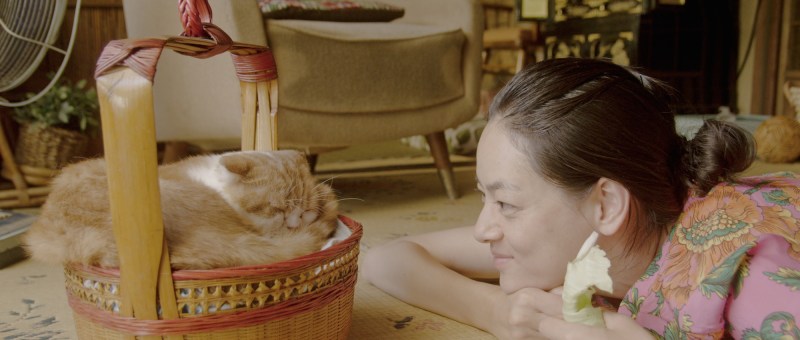
Since her grandmother died a few years ago, Sayoko’s life has been in free fall. A 30-something single woman with no “regular” employment, Sayoko lives in a spacious Japanese-style house with a small garden which is home to the various stray kitties which seem to seek her out when looking for a good place to crash. Sayoko has taken to writing out large banners declaring her immediate goals – getting married being the main one, and pasting them on the walls to encourage herself to keep going. The truth is, though Sayoko is not exactly unhappy she is unfulfilled. Since childhood she’s had the strange talent of attracting friendly cats but secretly longs to attract people too. Combining her strength and her weakness, Sayoko operates an unusual enterprise – cat rental! Walking along with a loud speaker and a trailer full of cats, she looks for lonely people who might want to borrow a fluffy friend for a while to help them out while they’re feeling low.
Of course, Sayoko’s quest to heal the hearts of others is also one to heal her own. Eccentric since childhood during which she was nicknamed “Jamiko” after a strange monster and mostly spent her time snoozing in the nurse’s office along with a kleptomaniac fellow student, Sayoko has never found her feet when it comes to building lasting relationships with people. Her voiceovers all refer back to her grandmother whom she misses deeply and seems slightly lost without. Appearing to have no real friends and spending a lot of time at home looking after her collection of needy cats, Sayoko’s main source of daily interaction comes from the horrible old woman who lives next door and turns up at random intervals to play Greek chorus in neatly reciting Sayoko’s various neuroses back to her over the garden fence.
Sayoko’s neighbour probably has a hole in her heart she fills by being deliberately insensitive to obviously sensitive people, but Sayoko offers her clients another solution in the form of a fluffy little cat who needs someone to look after it. Before lending one of her charges, Sayoko makes sure to vet the prospective cat guardian – after all, not everyone is nice and some people like to project their own suffering onto harmless little creatures. Through the house visits Sayoko gets to find out exactly what kind of hole it is that needs filling from dimples in jellies to holes in socks and even those in donuts, and being the sensitive soul she is, Sayoko usually knows what kind of help her customers need.
Structured around four different clients and bridged with Sayoko’s own neurotic journeys, Rent-a-Cat takes on a charming, fairytale quality in its repeated formulas. Each time someone asks to rent a cat they get the same speech about the inspection and then when it comes to talking money they each express surprise at the extremely good value, making sure to ask if Sayoko will be OK financially when she operates on these oddly beneficial terms. Don’t worry, she tells them – she has other income, a different one each time from stockbroking to fortune telling. The problems run from late life isolation as in a little old lady who loves making jellies for the son she never sees, to dejected fathers forced to work away from home and missing their kids grow up, and young women who feel trapped in a conservative society and would like nothing more than to jet off somewhere to follow their own path, if only they had the courage.
Social conservatism does seem to be something which particularly annoys Sayoko, if perhaps subconsciously. A strange dream sends her off to a Rent-a-Cat corporate clone where clients can rent cats of three different classes priced according to desirability. Sayoko is particularly anxious about the “Class C” cats whom the lady behind the counter disdainfully describes as “crossbreeds”. Sayoko is not having any of that and takes the woman to task for her need to “rank” things before insisting on renting a Class C cat at the Class A price to fully ram home the unpleasantness and absurdity of such a prejudiced world view.
Branded a “crazy cat lady” by the neighbourhood kids, Sayoko’s humanitarian mission of spreading love and kindness eventually does start to reel in a few humans even if they are mostly lonely souls in need of temporary support. Towards the end, when a promising reappearance provokes only disappointment, Sayoko wonders if perhaps there are holes cats cannot fill or sadnesses too great to be borne, but nevertheless she persists. A falling banner a suggests Sayoko may have already found the material to fill her own hole in helping other people fill theirs whilst surrounded by the by warm indifference of her feline brood.
You can catch Rent-a-Cat at the Japanese Embassy in London on 22nd November as the first in a series of events, Archipelago: Exploring the Landscape of Contemporary Japanese Women Filmmakers, which also includes screenings of Bare Essence of Life, Death of a Japanese Salesman, and Wild Berries from 30th November to 2nd December.
Original trailer (no subtitles)









 Poland’s
  A giant of Hong Kong cinema, Hui began her time in the director’s chair in the late ’70s following a two year stint at the London Film School. Throughout her long and varied career which has featured both commercial and more personal cinema, Hui’s work is noted for its probing social commentary and political fearlessness.
 Shining a light on a new, under appreciated film culture, Five Flavours presents a series of new films from Bhutan.
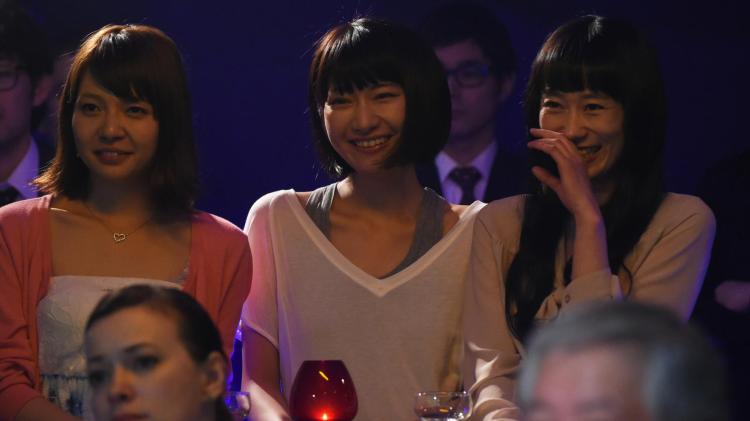 As cinema receipts dwindled in the early 1970s, Japanese studios considered the best way to stay afloat. Nikkatsu, whose output had largely skewed towards youth drama, decided to reboot itself wholesale and embark on production of levelled up “pink film” only with better production values. 40 years later, Nikkatsu’s “Roman Porno” line has been resurrected with four films directed by four of today’s most interesting directors. Five Flavours presents two of the four reboot movies paired with an original from the 1970s.