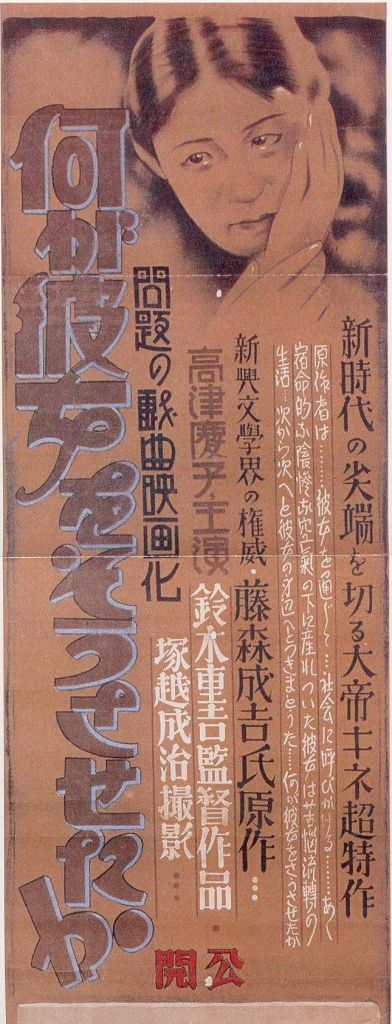
What Made Her Do It? (何が彼女をそうさせたか, Shigeyoshi Suzuki, 1930)

what-made-her-do-itLike many other areas of the world in the first half of the 20th century, Japan also found itself at a dividing line of political thought with militarism on the rise from the late 1920s. Despite the onward march of right-wing ideology, the left was not necessarily silent. Ironically, the then voiceless cinema was able to speak for those who were its greatest consumers as an accidental genre was born detailing the everyday hardships faced by those at the bottom end of the ladder. These “proletarian films” or “tendency films” (keiko eiga) were increasingly suppressed as time went on yet, in contrast to the more politically overt cinema of the independent Proletarian Film League of Japan, continued to be produced by mainstream studios. Long thought lost, Shigeyoshi Suzuki’s What Made Her Do It? (何が彼女をそうさせたか, Nani ga Kanojo wo Sousaseta ka) was a major hit on its original release with some press reports even claiming the film provoked riots when audiences were passionately moved by the heroine’s tragic descent into madness and arson after suffering countless cruelties in an unfeeling world.

Though still only a child, Sumiko (Keiko Takatsu) has been sent alone to the house of her uncle in a distant village but has run out of money for travel and food. Luckily she meets a kindly cart driver, Doi, who feeds her and takes her most of the way to her uncle’s village but he will be the last “kind” person that she encounters on her long and sad journey. As it turns out, her father had not informed his brother of Sumiko’s arrival and actually had not even had any contact with him for many years. Consequently, Sumiko’s uncle is not exactly overjoyed to see her as he already has a house full of children he struggles to feed (not to mention a healthy appetite for drink). Eventually he sells her to a circus where she is cruelly treated by fellow performers and the sadistic ringmaster.

Things are looking up when Sumiko escapes with fellow performer Shintaro (Ryuujin Unno) but the pair are divided by fate landing Sumiko in trouble with the law after she falls in with a gang of thieves. A spell in the workhouse is followed by patronising treatment as a servant for a wealthy family, and later an otherwise successful tenure as a housekeeper for a leacherous biwa player, before a tiny window of happiness opens up only to immediately cloud over again. Ending up at the “Garden of Angels” Christian reform institution for “wayward women” Sumiko tries God on for size but finds him wanting.

Long thought lost, a partial print of What Made Her Do It? turned up in Russian archives in the ‘90s (presumably following its export as a suitably socialist film) and has since been restored with additional intertitles replacing the missing portions. The opening sequence of Sumiko beginning her journey by train and the presumably spectacular finale of Christ on fire as Sumiko dances madly in the flames of the burning church are both missing but even so the drama rams home the seriousness of Sumiko’s plight as she finds only hypocrisy and selfishness at every turn.

Keiko Takatsu perfectly plays Sumiko’s essential sadness as well as her growing resilience and barely suppressed resentment towards the constant cruelty she experiences. All pleading eyes and sorrowful looks, Sumiko suffers while others exploit her for their own ends. Betrayed by her uncle who pockets the money her father enclosed for Sumiko’s care and purposefully hides from her the fact that her father is likely dead, Sumiko is left adrift in a world in which it’s impossible to survive without family. The state surfaces in her life with the supposedly progressive environment of the workhouse which feeds and houses her whilst exploiting her forced labour. The well to do household in which she is offered opportunity is little better as the cruel mistress of the house constantly exerts her authority, stresses the differences in social status, and denies her maids even small pleasures such as soy sauce on pickles in order to maintain discipline.

Finally Sumiko ends up in the house of God though what she finds there is repression and forced religiosity rather than the love and support proudly displayed in the credo. The Garden of Angels is, presumably, filled with women who have somehow disappointed modern moral codes with Christian virtues expressly emphasised and contact with the outside world forbidden. Residents are allowed to leave once they’ve proved they’ve accepted Jesus into their hearts and are resolved to live in a more “proper” manner, though Sumiko falls foul of the rules after another woman talks her into writing a letter to a friend on the outside.

When the letter is discovered, the other woman is sent to solitary as the head of the establishment informs her that her sin “will never be forgiven”, while Sumiko is forced to make a public self criticism to atone for her selfish disregard for the rules. This backfires when Sumiko’s inner rage takes hold, leading her to take a stand by decrying the hypocrisy of the religious establishment which preaches that God is love and all will be forgiven but ultimately offers nothing other than fear and hate. When the church burns down the woman in charge is the first out the door with her valuables in hand leaving the other women to discover their own salvation amongst the ashes.

Suzuki’s technique is clearly informed by foreign cinema especially that of socialist films from the Soviet Union. Using frequent dissolves and montages, Suzuki throws in impressive set pieces such as scene in which the camera pulls away from Sumiko after she receives some bad news with a door closing across it and snow falling outside. A long lost left wing populist effort, What Made Her Do It? is also a classic melodrama of female suffering as the heroine experiences just about every degradation possible whilst remaining steadfastly defiant in the face of tragedy before the final irony of her eventual position drives her into madness. What made her do it? An intensely self-interested world. Some things don’t change.


The Mamiya Brothers (間宮兄弟, Yoshimitsu Morita, 2006)

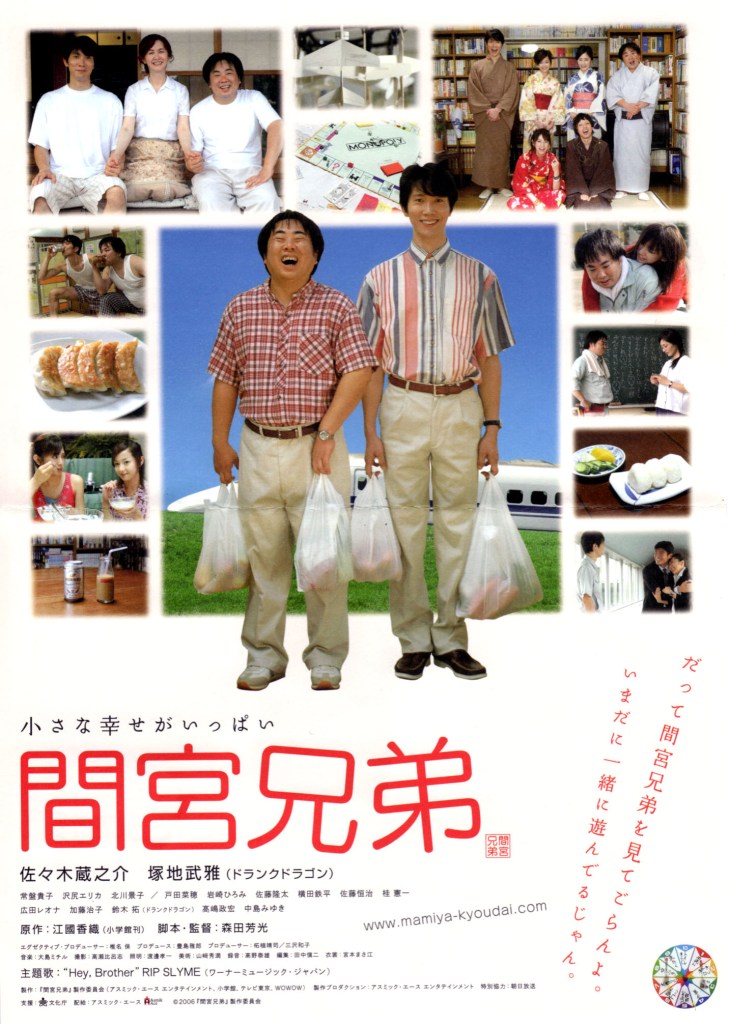
mamiya-brothersEver the populist, Yoshitmitsu Morita returns to the world of quirky comedy during the genre’s heyday in the first decade of the 21st century. Adapting a novel by Kaori Ekuni, The Mamiya Brothers (間宮兄弟, Mamiya Kyodai) centres on the unchanging world of its arrested central duo who, whilst leading perfectly successful, independent adult lives outside the home, seem incapable of leaving their boyhood bond behind in order to create new families of their own.

Older bother Akinobu (Kuranosuke Sasaki) and younger brother Tetsunobu (Muga Tsukaji) live together in a small apartment in Tokyo where they enjoy hanging out keeping track of baseball games and watching movies rented from the local store where Akinobu has a crush on the cashier, Naomi (Erika Sawajiri). They are perfectly happy but sometimes frustrated that they don’t have girlfriends so they decide to host a curry party and invite Naomi over in the hopes that she might develop an affection for Akinobu. So that she won’t feel weird about going to the house of two middle-aged guys she doesn’t really know, Tetsunobu invites a reserved teacher, Yoriko (Takako Tokiwa), from the primary school he works at as a caretaker though he “never dates coworkers” and is only really asking her as a backup for Akinobu.

Against expectation the both ladies agree to attend the curry party which actually goes pretty well though neither man is fully capable of following up on the opportunities presented to him. Outside events provide a distraction as Akinobu is swept into his adulterous boss’ divorce crisis and Tetsunobu becomes fixated on a damsel in distress who has no desire to be rescued by him. As much as the boys might want to form independent relationships for female companionship, their brotherly bond is more akin to a marriage in itself leaving both of them unwilling to abandon the status quo for a new kind of happiness.

These kinds of closely interdependent sibling relationships are more often seen between sisters, often as one or both of them has rejected offers of marriage for fear of leaving the other on the shelf. Elderly spinsters and their histories of unhappy romance are almost a genre in themselves though they often present the peaceful co-existence of the two women as a double failure and ongoing tragedy rather than a perfectly legitimate choice each may have made to reject the normal social path and rely solely on each other. The Mamiya Brothers neatly subverts this stereotype, presenting the relationship of the two men as a broadly happy one though perhaps tinged with sadness as it becomes clear that the intense bond they share is holding each of them back in a kind of never ending childhood.

Indeed, though they live alone together and have steady jobs, whilst in each other’s company the brothers regress back to childhood by spending their spare time riding bikes around the neighbourhood and playing on the beach. They are each keenly aware of how they must appear to members of the opposite sex and are always mindful not to appear “creepy”. Accordingly, they’re careful about which DVDs they check out so that Naomi doesn’t get a bad impression of them, and they’re sure to make it clear that both girls can bring other people to their parties so they won’t think there’s anything untoward going on. Throwing quick fire questions back for and constantly making references to private jokes the boys are effectively a manzai duo performing for an audience of two, perpetually suffocating inside their self made bubble.

Though they might not find love, the boys do at least make some new friends. Naomi’s sister, Yumi (Keiko Kitagawa), is exactly the kind of girl they’d usually steer clear of lest she begins to make fun of their old fashioned ways yet she actually becomes an ally and even a friend after spending time hanging out in the brothers’ odd little world. Yumi and Naomi are, in many ways, almost as closely connected as Akinobu and Tetsunobu though they both currently have boyfriends even if they find them equally disappointing.

The teacher, Yoriko, also finds herself unlucky in love as she pursues a relationship with a colleague who doesn’t seem particularly invested in her and is lackadaisical about even the smallest forms of commitment. Tetsunobu seems to have discounted her as a romantic partner under his “no coworkers” rule and is either unaware or deliberately ignoring her growing feelings for him. It may be that he invited Yoriko as a love interest for his brother precisely because he was interested himself and wanted to eliminate the problem, but he may come to regret outwardly rejecting this chance of mutual affection turning into something more solid.

When push comes to shove it might just be that the Mamiya Brothers are happiest in their own company and have no desire to move on and leave their arrested development behind. Though tinged with a degree of lingering sadness as it appears the boys do have a desire to form bonds outside of their mutually dependent bubble, they are after all quite happy and mostly fulfilled in their life together. Cute and quirky, if at times melancholic, The Mamiya Brothers is a strange tale of modern romance in a world where no one really grows up anymore. The brothers are clearly not afraid of broadening their horizons, but might prefer to continue doing so together rather than finding their own, independent, paths.


Original trailer (no subtitles)

A Scene at the Sea (あの夏、いちばん静かな海, Takeshi Kitano, 1991)

scene-at-the-seaReview of Takeshi Kitano’s A Scene at the Sea – first published by UK Anime Network.

Takeshi Kitano’s third feature, A Scene at the Sea (あの夏、いちばん静かな海, Ano natsu, Ichiban Shizukana Umi), is about as much of a departure as it is possible to make from his first two films. Not only does Kitano not star, but he eschews his focus on down and dirty, grimy crime thrillers in favour of a poetic tale about a boy who falls in love with the sea. Largely told without dialogue, A Scene at the Sea is Kitano in one of his more contemplative moods as he creates an existential fable of one man’s search to find his place.

Shigeru (Claude Maki) has a dull and unfulfilling life as a dustman, endlessly staring out over the beautifully blue seas of his harbour town as if searching the horizon for some kind of destiny. His luck changes when he finds an old broken surfboard on one of his rounds and manages to repair it. Lacking the proper equipment, Shigeru takes to the seas to indulge his new sport after stripping down to his pants and T-shirt while his girlfriend Takako (Hiroko Oshima) watches him from the sands, lovingly folding his clothes as she waits for him. Over time Shigeru’s love for surfing begins to pull him away both from Takako and from his everyday life on land as he starts skipping work to spend more time riding the waves.

Shigeru is deaf and mute and his girlfriend Takako is more or less silent too, hence the overall lack of dialogue in the film though words are not especially necessary in their relationship. Shigeru is constantly isolated from all social groups (aside from his friendship with Takako) whether it be his inability to join in with workplace banter or the rejection of the snobbish surfers who laugh at his original attempts on the board whilst also grudgingly praising his determination to brave the cold seas without even a wet suit. Though he also had a kind of ally in his partner for dust round, the only person to try and help Shigeru is the owner of a surf shop who sees potential in him and convinces Shigeru to enter a competition. However, at the competition itself there is no one to help him participate – Shigeru misses his opportunity to surf because he can’t hear them call his name. The surf shop owner berates the other surfers for not helping Shigeru, but they continue to ignore him even after he’s been semi-admitted to the group.

Shigeru perseveres despite his lack of ability and paucity of equipment to hone his skills and quickly become a competent surfer. As his obsession with the sea deepens he moves further and further away from Takako. The sea becomes his lover and the surfing a kind of congress or quest for conquest in his new romance. Takako can forgive this growing need for the ocean, but finds herself hurt when she catches Shigeru peeling another girl’s oranges (not a euphemism). Kitano employs another of his beautifully composed long shots to show us Takako wordlessly approaching the pair, who after all are only sitting together on a beach, before stopping indecisively and leaving again without being seen.

The Japanese title of the film, Ano Natsu, Ichiban Shizukana Umi, translates as “That Summer, the Quietist of Seas” which is a little ironic given that calm seas are good for sailors but the opposite of what a surfer needs. The tinge of nostalgic melancholy is clearer here and it’s more obvious that we’re dealing with the remembrance of a past summer, taken from a specific viewpoint, rather than something which is occurring in real time in the present. This may explain some of Kitano’s stranger repeated imagery such as the footballers who never play football and more lyrical, less linear approach to narrative.

Kitano may be in a maudlin mood, but he still injects some of his trademark dark humour notably in the pair of hangers on who follow Shigeru into the world of surfing but spend much of their time bickering about whose turn it is on their shared surfboard, as well as brief appearance from frequent Kitano star Susumu Terajima as a van driver who picks a fight with the police (and loses). Still, A Scene at the Sea is a melancholic vista of a boy lost among the waves, looking for a home on the water. A beautiful, if sad, summer story, Kitano’s third feature is one of his most romantic (in the wider sense) and bears testimony to his talent for crafting intensely moving cinematic poetry.


Original trailer (no subtitles)

Line Walker (使徒行者, Jazz Boon, 2016)

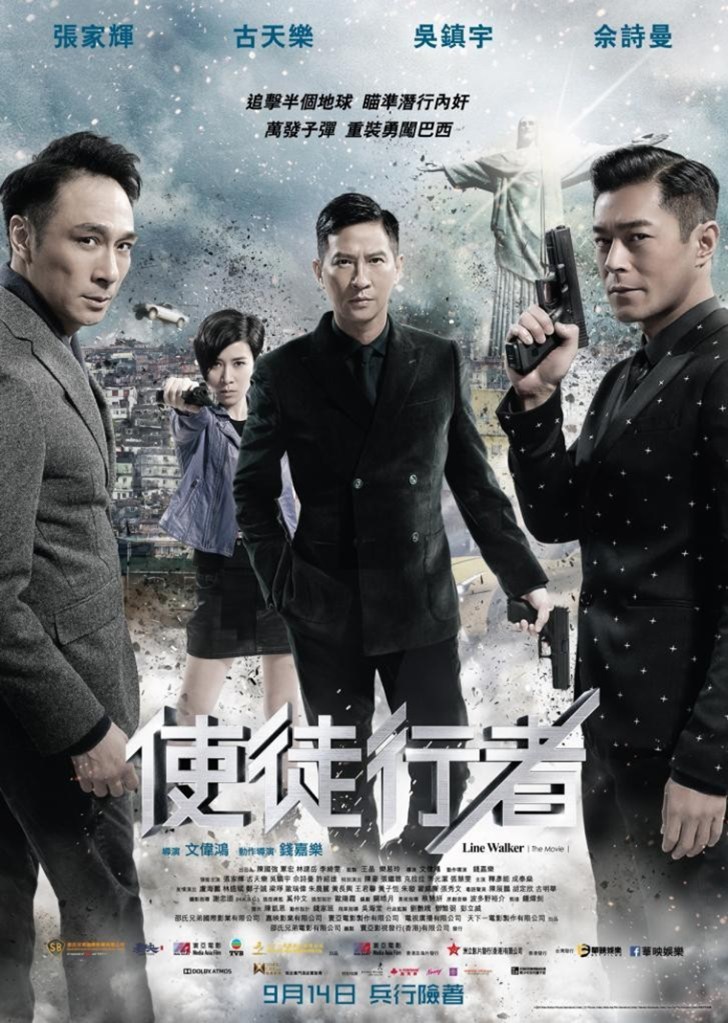
When sitcoms make the transition to the big screen, they usually do so by going on holiday. Police procedurals are no different as Line Walker (使徒行者), a cinematic outing for a wildly popular Hong Kong TV series, proves by throwing its hat into the global ring with a Brazil bound drug based gang war. Taking more than a little inspiration from the classic undercover cop drama Infernal Affairs, Line Walker joins former undercover officer Ding and her handler Q as they receive a mysterious message from a missing operative identifying himself only as “Blackjack”.

Two years ago (as detailed in the TV series), a top Hong Kong detective, Hong, managed to find just enough time before being murdered to wipe all his data relating to officers currently working deep cover. Ditzy cop Ding (Charmaine Sheh) was one such asset, and together with her boyfriend who is also her boss, Q (Francis Ng), managed to round up and bring in all the other operatives save one whose file was corrupted beyond recovery. Therefore when they receive a message written in Hong’s unique code signed “Blackjack” they are cautiously optimistic.

The trail leads them to a corporatised Triad gang currently engaged in the usual Triad business of petty gang wars over drugs, territory, and power. Shiu (Louis Koo) and Lam (Nick Cheung) are best buds and underlings in the organisation with their eyes on bigger prizes. Making a trip to Brazil to broker a drugs deal the pair get themselves into various kinds of trouble which is only compounded by the “Blackjack” issue and suspicions of a possible mole in the gang.

Ding and Q are the only returning characters from the TV series which has received significant upgrades in the big screen jump with the addition of several Hong Kong superstars including Louis Koo and Nick Cheung. Though the central narrative stands alone, there is a degree of assumed familiarity with the ongoing backstory which is at times frustrating for the uninitiated but never much of a barrier. Line Walker does, however, suffer from the common pitfalls of the TV show making the jump into the cinematic world in that it can’t shake the artificial largeness of the small screen.

After beginning with a broadly comic sequence as Ding chases down Blackjack in a Macao casino whilst making time for slapstick pratfalls along the way, the tone progressively darkens until the final, gritty action based finale. Though the banter between the bickering couple Q and Ding is never less than amusing, Ding’s cutesy airhead routine feels out of place with the general tone of the rest of the film especially as she is also supposedly part of a team of elite undercover police officers.

In attempting to up the ante, Line Walker’s scriptwriters have thrown in twists and turns at every juncture as more and more diehard criminals suddenly confess that they are, in fact, undercover police officers. No one is telling the whole truth as double crosses and betrayals dominate the action with an overt Infernal Affairs homage set in the Olympic stadium. Frankly, it all borders on the ridiculous as plot twist plies on plot twist with predictable regularity though it does at least make things exciting.

Exciting is clearly the name of the game when it comes to the action set pieces which attempt to make the most of the cinematic budget. The most high profile of these are the Brazil set sequences filled with shootouts and car chases not to mention precision timed chain reactions of exploding vehicles used as bombs. The physical fights are impressively visceral but occasionally contrived. In one notable instance two men are attacked by a lone assassin armed only with a knife but almost allow themselves to be stabbed for no reason at all. When they do fight back, they do so one on one rather simply taking down the opponent by overwhelming him with their combined strength.

Caught between comedy crime caper and gritty heroic bloodshed, Line Walker can’t make either approach work leading to an abrupt and unsatisfying, if artistically pleasing, finale. Koo and Cheung do their best as the brothers in crime duo each realising that they can’t quite go through with betraying the other, moving from easy banter in the first half to angst ridden glares in the second, but they’re in a different picture from the sunny world of Ding and Q who are still stuck in the TV screen. Though the overworked plot and variable tone create serious problems, Line Walker does at least offer impressive action with a thin layer of comedy even if it fails to hit its emotional target.


Original trailer (English subtitles)

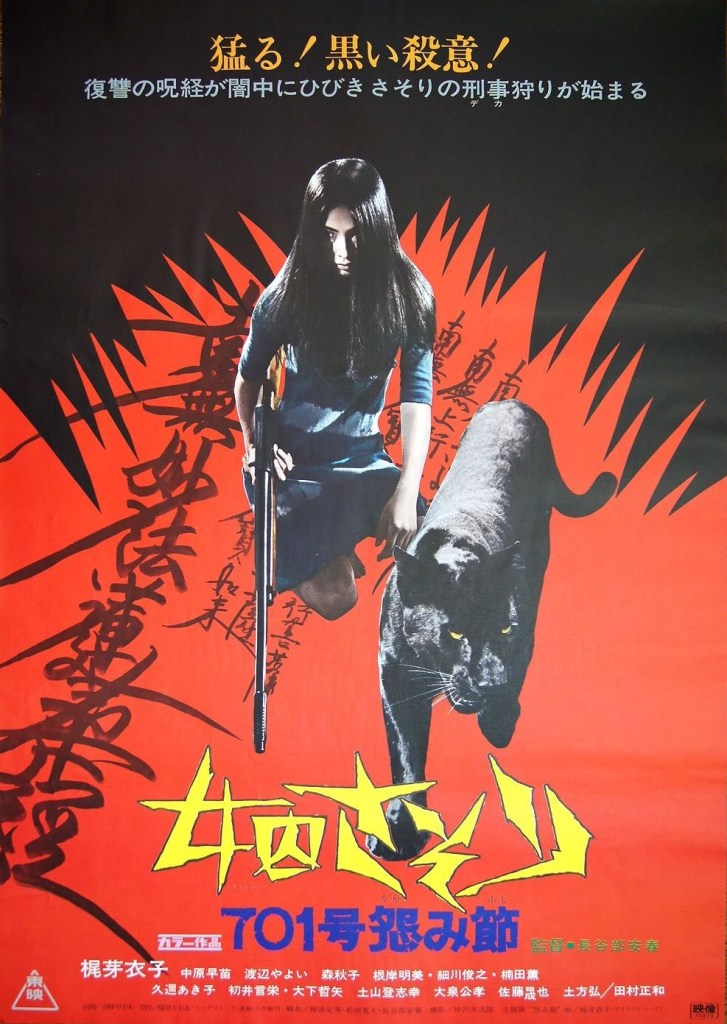
Female Prisoner Scorpion: #701’s Grudge Song (女囚さそり 701号怨み節, Yasuharu Hasebe, 1973)

The saga seemed complete with the end of Beast Stable but inevitably Matsu returns in the bonus instalment, Female Prisoner Scorpion: #701’s Grudge Song (女囚さそり 701号怨み節, Joshu Sasori – 701 Go Urami Bushi). Original director of the series Shunya Ito agreed that the ballad of Matsu was sung through, and so Yasuharu Hasebe reteams with star Meiko Kaji after their previous collaborations on Retaliation and the Stray Cat Rock series during their time at Nikkatsu. Hasebe’s style is the polar opposite of Ito’s arthouse inspired painterly majesty and heavily favours the groovy, ‘70s youth inspired aesthetic he employed in the Stray Cat Rock series. Coming as it does after Ito’s genre rocking visual tour-de-force, Grudge Song can’t help feeling a little regressive and a reminder of what a considered cash grab this fourth instalment really is but that isn’t to deny the fact that it can prove an enjoyable, genre skewing, effort when considered in isolation.

The end of Beast Song told us that Female Prisoner Scorpion served her sentence, was released and disappeared into the ether like the legendary creature she was. However, Grudge Song provides another episode to her history and begins with Matsu (Meiko Kaji) being re-arrested by police during someone else’s wedding (you have to feel sorry for the happy couple – could the police not have done this outside at least?). She fights them off in grand fashion and manages to escape though is gravely injured and not able to run very far. Luckily she is found by a damaged former protester working at a cabaret club who helps her hide out from the police. Soon the pair enter into a kind of romance but it’s not long before Matsu has some names to add to that ever increasing grudge list.

Along with the change of director comes a slight refocusing. Both the original trilogy and this fourth instalment have definite political undercurrents but Grudge Song allows these to be more overt with its constant references to the student protests of the late ‘60s and ’70s as well as to police corruption and brutality. Matsu’s ally and sometime lover, Kudo (Masakazu Tamura), had been a prominent protester picked up and repeatedly tortured by police leaving him with both physical and mental scarring. Obviously distrustful of authority but also made fearful, Kudo has been keeping his head down until he finds a kindred spirit in Matsu and decides to fight back.

The enemy here is the police – as it was to a degree in some of the other films, but Matsu’s concerns are playing second fiddle to her male saviour’s psychological traumas. This is the first film where Matsu has any kind of male help, and she’s essentially in an assisting role as Kudo attempts to defend her from the police (her injuries meaning she can’t exert the same kind of preternatural power as in the other instalments). There may be a kind of spiritual connection between Matsu and Kudo but the fact that she trusts him so quickly is strange given her behaviour throughout the series, though perhaps she has little choice given her physical condition. This is also the first time where Matsu allows an innocent woman to be killed in front of her – ironically another victim of male violence whose life is lost through no fault of her own. The other Matsu would at least find this upsetting, but this new Matsu who’s now more of an accomplice to a borderline terrorist protest cell consisting of one male member, is entirely indifferent.

Though Hasebe mimics some of Ito’s cinematography notably in the opening and his iconography of “Scorpion”, he abandons his stylistic concerns in favour of something very much more directly contemporary. In keeping with his work on the very groovy, youth orientated Stray Cat Rock movies, Hasebe turns Female Prisoner Scorpion into a standard ‘70s exploitation pic complete with gratuitous lesbianism, nudity, and random violence. Zooms, whip pans, and anarchic camera action are accompanied by jazzy electric guitar and a stoner vibe that is designed to appeal to the youth of the day but appears hopelessly dated now unlike Ito’s approach which is still of its era but manages to take on a timeless quality. As an example of ‘70s exploration cinema, Grudge Song pays its dues but as a Female Prisoner Scorpion movie, it falls far short of its predecessors.

Grudge Song marked the last outing for Kaji as the titular Scorpion, though this Matsu is not the Matsu of the rest of the series. Hasebe doesn’t seem so attached to the cult of Scorpion and more or less reboots her for a fairly straightforward genre affair which lacks the subtle intelligence of Ito’s vision. Still, taken alone Grudge Song is not without its charms though it loses the feminist edge of the rest of the series and recasts its heroine as a bit player in a game of revenge against the authorities in the name of vengeance for the death of the student movement.


Original trailer (English subtitles, NSFW)

Female Prisoner Scorpion: Beast Stable (女囚さそり けもの部屋, Shunya Ito, 1973)

beast-stableAt the end of Female Prisoner Scorpion: Jailhouse 41, Matsu – the “Scorpion” of the title, had enacted parts of her revenge but lost even more friends and allies along the way. Still filled with an intense rage, she wandered away from her imprisonment towards the dawn and a free, if uncertain, future. It’s here we find her at the beginning of Beast Stable (女囚さそり けもの部屋, Joshu Sasori – Kemono Beya) – a fugitive from justice, but a seemingly calm one. Until, that is, she is cornered.

Beginning in an extremely memorable opening sequence, the film zooms in on Matsu riding a subway train like any other young woman when she gets spotted by a couple of policemen who decide to try and take her in. Whipping out her knife from under her coat, Matsu slashes away but is almost caught when one of the policeman handcuffs her. She reacts to this situation in a typically direct way by simply hacking the policeman’s arm off and running away with it.

Hiding out in a graveyard and gnawing at her macabre bracelet in an attempt to get it off, Matsu strikes up an improbable friendship with prostitute Yuki (Yayoi Watanabe). Yuki is harbouring a dark secret in that she keeps her brain damaged brother locked up in a back room where she is forced to satisfy his sexual urges lest he attack other women.

While working as a seamstress, Matsu becomes more and more involved with the underworld and its collection of pimps and madams, each eager to profit from the weakness and misfortune of others. Eventually, after becoming too much of a problem, Matsu is locked up again – but this time inside the birdcage of a dangerous and eccentric yakuza mama-san, Katsu (Reisen Lee), with the corpse of a less fortunate victim on the other side of the bars. New names are about to appear on Matsu’s ever growing grudge list as the wrongs done to others begin to outweigh the pain of those enacted on herself.

Beast Stable differs from the first two films in the series as it mostly takes place in the “free” world until it reenters the prison environment for the final stretch. Matsu may be out of jail but she’ll never be truly free and her intense inner rage might give her away if it weren’t for her the fact her face is plastered all over the city adorning wanted posters in every conceivable location. With no particular target for her vengeful spirit, Matsu is in survival mode but her growing alliance with Yuki and the cruelty of the underground sex industry quickly awaken her old fire.

This time the big bad is another woman – a cruel madam, willing to protect her investment to the max. When she finds out one of her girls has been hiding a pregnancy, she insists on an abortion even though the baby is six months or so along. Kicking and screaming, the pregnant woman is subjected to a horrific procedure conducted by a drunken doctor which is neatly contrasted with another abortion which is carried out with a much higher level of medical care. Needless to say, Matsu cannot let this one go and makes another of her daring and mysterious escapes to enact her revenge. As she leaves, she’s become a fury of vengeance once again – her face pixelated by the surgery window, shaving her of her identity.

Though more grounded in reality than Jailhouse 41, Beast Stable is still selling the ballad of Matsu as she continues her trajectory into legendary heroine status. Always playing a long game, Matsu has the uncanny ability to escape from any holding pen save the one that burns inside her mind. Having satisfied her personal desire for revenge, Matsu moves on to the cruelties of the wider world and those that bully and misuse already vulnerable people. Her sense of greater responsibility grows as her humanity begins to return through her friendship with Yuki which eventually becomes a deep alliance between two equally trapped women.

At the end of the film we’re told that Matsu served her prison sentence and was released, but no one knows what happened to her after that. Her apotheosis is complete as she becomes the legend – a wandering heroine, meeting out justice in a cruel and indifferent world. Kaji continues to excel in her performance of the near silent Matsu, burning with rage and resentment in every scene. Beast Stable would be Ito’s final contribution to the series and acts as a suitable conclusion to the trilogy as Matsu finally becomes Scorpion in our imaginations and, strangely, our hearts.


Original trailer (English subtitles)

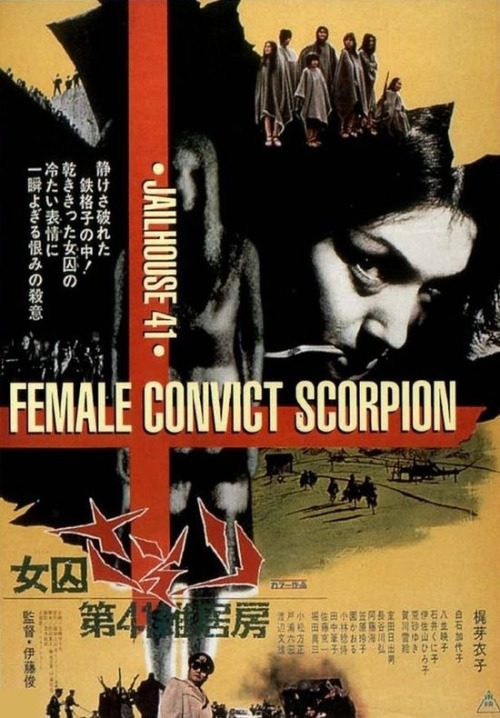
Female Prisoner Scorpion: Jailhouse 41 (女囚さそり第41雑居房, Shunya Ito, 1972)

scorpion-2Female Prisoner Scorpion: Jailhouse 41 (女囚さそり第41雑居房, Joshu Sasori – Dai 41 Zakkyobo) picks up around a year after the end of Female Prisoner #701: Scorpion and finds Matsu (Meiko Kaji) tied up in a dingy prison basement, apparently left bound and in solitary confinement for the entire interval. Once again directed by Shunya Ito, the second instalment in the Female Prisoner Scorpion series is another foray into the women in prison field but Ito resolutely refuses to give in to the exploitative genre norms, overlaying his tale of individualistic rebellion with an arthouse sensibility that has a much wider scope than its ordinary vengeance driven narrative may suggest.

Matsu may have been lying bound and gagged in a dingy underground hole for the best part of a year but today is a special day and sadistic prison warden Goda (Fumio Watanabe) is going to let her out to be shown off in front of a visiting inspector who’s paying a final visit before Goda is promoted to a top job in Tokyo. When Matsu makes a lunge for Goda, the inspector is so afraid that he wets himself, sending the other woman into a frenzy and resulting in a riot. Once again the entirety of the prison is punished, but this time Matsu is singled out for a public punishment gang rape by Goda’s goons. This kind of humiliation is too much for her fellow prisoners who instantly turn on her, but their violence provides an opportunity for escape and before long Matsu is on the run, again.

At the end of the first film, Matsu had accomplished her first round of vengeance – against the man who orchestrated her downfall and the men who secured it, but ultimately she wound up a female prisoner once again. Though Goda may have had her hidden away because of her habitual escapism, Matsu had not given up as we see from her attempts to scrape the floor away with her spoon held tight in her mouth. Barely speaking, Matsu is an unstoppable column of pure rage but an elegant one, supported by her self contained restraint.

Her anger this time is directed towards Goda himself, especially after his despicable organised punishment rape that was designed both to break her own spirit once and for all and also to damage her in the eyes of her fellow inmates who are intended to see her defeated and destroyed. The guards are a stand in for society at large, using sexual dominance and social position to keep their women in line. The visiting prison inspector makes a point of telling Matsu that “they” don’t hate her personally – they’re there for her, to help her “recover” and become a functioning member of society. Which is ironic because Goda does hate her personally as he holds her responsible for the damage to his eye sustained in the previous film. His last act before moving on is one against Mastu – an attempt by the forces of authority to crush her individual rebellion and use their victory as a coercive tool to force others to conform.

In this way, Matsu’s position as a member of a subjugated class is less important than her status as an agitator but these are women who have each suffered at the hands of men. As an extremely theatrical sequence sung in the traditional form informs us, the women who escaped with Matsu committed their crimes out of love or jealousy. Poisoned rivals, dead lovers, even children murdered to get back at their philandering father in some Medea level psychotic rage which ruins the perpetrator even more than the intended victim.

Later while the women are enjoying their brief taste of freedom, one of them is brutally raped and murdered by a troupe of feral men who boast about the wartime atrocities they committed before descending on a lone woman like a pack of rabid dogs. The others take their revenge for their friend, but also for all the women who have met a similar fate inflicted by a male dominated society which sees them as something to be controlled and then made use of, little more that cattle hemmed in and milked until dry.

As in the first film Ito makes use of expressionist techniques and strange angles to give his film a more elevated feeling that might be expected but this time he adds in a surrealist, spiritual dimension as with the old woman who sings the stories of our heroines and then dies only to bury herself in leaves and disappear into the ether, like some forgotten deity of misused women. Likewise, when one of the prisoners is raped and murdered, the men throw her body into a nearby river like an empty beer can but the waterfall behind her suddenly runs with blood as an expression of the violence which pollutes the natural world. A bus suddenly splits in two, separating our subjugated women from the violent men who mentally sentence them, given free reign simply because of their sex. Ironically enough, our last glimpse of of Matsu takes place in the reflection of Goda’s glasses and then in his false eye when she is suddenly rejoined by her compatriots for a triumphant dance of freedom on a city rooftop.

Even stronger than in the original Female Prisoner #701 Scorpion, Jailhouse 41 further advances its ideology of free individuals battling the conformist authority of the state all filtered through the prism of the patriarchy. Matsu’s vengeance is personal, she keeps her distance from the other women who do not seem inclined to band together to oppose the forces which oppress them so much as seek a wary, temporary alliance of necessity, but seeing them all reassembled in spirit at the end brings a larger dimension to Matsu’s victory which now seems much less like solving a practical problem than a deliberate strike at a wall which was solely designed to keep a certain group of people in their place. The jail is broken, all that remains is to choose to escape its restraints.


Original trailer (English subtitles, NSFW/gore)

Female Prisoner #701: Scorpion (女囚701号/さそり, Shunya Ito, 1972)

scorpion-701

Meiko Kaji had already become a familiar face in Nikkatsu’s genre output when she took on the role that would come to define her career at only 25 years of age. Toei’s Female Prisoner #701: Scorpion (女囚701号/さそり, Joshu Nana-maru-ichi Go / Sasori) would launch a series of similarly themed films and create a national pop culture icon in its central character. Based on a manga by Toru Shinohara, Female Prisoner #701 Scorpion is, at heart, a women in prison film and a cornerstone of the pinky violence genre but first time director Shunya Ito has more on his mind than salacious thrills and offers up a noticeably nuanced approach to his material filled with impressive art house flourishes.

701 is the number printed on the back of the prison uniform worn by inmate Nami Matsushima (Meiko Kaji). She makes a valiant escape attempt with a fellow prisoner, Yuki (Yayoi Watanabe), but the pair are caught and put into solitary confinement where they experience torturous treatment both at the hands of the guards and their fellow prisoners. Mostly known as Matsu but also given the nickname of “Scorpion”, Prisoner #701 is not exactly popular with the other ladies in the joint who seem to resent her escape attempts and quiet dignity, annoyed by her above it all demeanour.

Matsu has just one mission in life – vengeance, on the man who wronged her, on the society that allowed her to be wronged, and on the prison system with its sadistic guards and turncoat inmates. Once an ordinary, law abiding woman, Matsu had the misfortune to fall in love with a vice cop who convinced her to go undercover in a yakuza club to get some vital info he needs to bust it. However, Sugima (Isao Natsuyagi) turns out to be the biggest crook of them all and was merely using her to try and take out the local yakuza to get in with a bigger yakuza boss and key into a slice of the drugs trade. Matsu is brutally gang raped after her cover is blown and ends up being sent to prison after making an attempt to ice her former lover with the desire to get out and complete her mission the only thing that’s keeping her going.

Ito begins with an ironic scene in which one of the prison guards is receiving a commendation for his honourable service, Japanese flag flying proudly behind above, until the occasion is interrupted by the escaped prisoner alarm. Later Ito puts the yakuza boss in a building bearing the large banner “Beautiful Soul and Harmony of Japan” and he even adds in an expressive moment as Matsu surrenders her virginity to Sugima, staining her white sheets with a large red circle. Society is corrupt everywhere from Sugima’s bent copper to gang raping yakuza and the prison system itself.

The guards are effectively running their own little empire, cut off from mainstream law enforcement and left to their own “corrective” impulses. Ito gives us salacious shower scenes and women being marched around in the nude but he places us in the place of a voyeur, making it plain that the prison guards are sating their lust for power through humiliating their charges in sexual dominance and violence. Divide and rule is the name of the game as a top tier of prisoners are “employed” in various prison tasks earning them a different colour uniform and a status bump. These ladies are even worse than some of the male guards and are responsible for much of the cruelty inflicted on Matsu and Yuki during their time in solitary.

Inter-prisoner conflict is not the central theme of the film as Matsu continues to plan for her eventual escape and revenge on the man who has ruined her life. A slight spanner is thrown in the works when an inside woman is recruited to take Matsu out, but Matsu is painted as a the ultimate vengeful warrior. Barely speaking (the bulk of her dialogue is actually voice over for her flashback scene), Matsu waits silently, observing and plotting. Biding her time she manages to take an extremely skilful and poetic revenge against her solitary abuser despite her hands and feet being bound, and when a police mole is placed in a cell with her Matsu sees through the ruse straight away. Seducing her new cellmate, Matsu neutralises the threat with ease maintaining her trademark intense elegance all the way through.

Though the synopsis smacks of cheap and nasty exploitation Ito doesn’t see it that way and films with an art house aesthetic rather than a salacious eye. Matsu’s flashback takes a very theatrical form with a rotating set and Matsu remaining present in the corner as she narrates. Her rape scene is grotesque and nightmarish, shot through a see-through floor as her attackers grin and gurn away at her like fairytale monsters. Likewise, when Matsu traps another prisoner in her own scheme, the woman turns into a classic ghost creature, face white and staring, broken glass firmly gripped manically in front. The acting style is broad and absurd. Policeman laugh loudly and for too long, blood is an artificial kind of red, gloopy like paint, and pantomimeish grotesquery is everywhere. Ito’s backgrounds are expressionist rather than realist but always perfectly pitched.

You can tell a lot about a place from the way it treats its prisoners and when its as bad as this, you start to wonder which side of the bars you’re really on. The guards are only a representation of a consistently exploitative society, but they can at least be outsmarted. “To be deceived is a woman’s crime”, says Matsu, but it’s one she fully intends to atone for – in blood, settling not just her own score but those of all her fellow prisoners caught in the patriarchal trap of hollow promises and abused honour.


Original trailer (English subtitles)

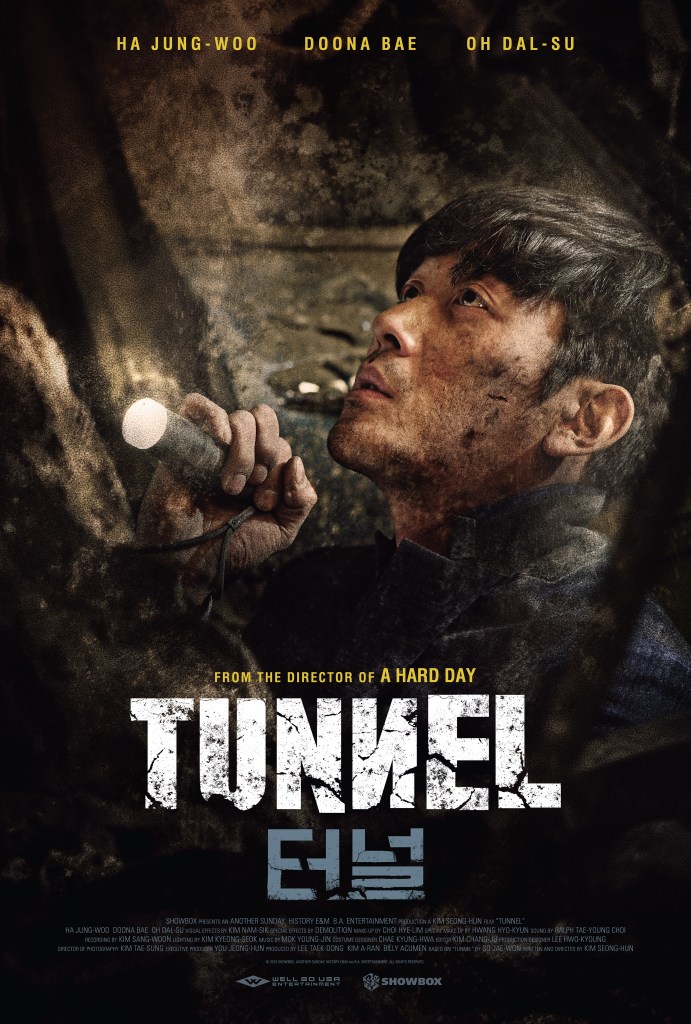
Tunnel (터널, Kim Seong-hun, 2016)

TunnelIn 1925 an avid cave explorer, Floyd Collins, became trapped in a narrow crawl space. Though he was discovered and help came with food and water, a cave in left him sealed off down there and fourteen days later he died of thirst and exposure. As tragic as this obviously is, Floyd Collins is remembered for another reason – his rescue became one of the earliest mass media crazes. The surrounding media furore also inspired the 1951 Billy Wilder classic Ace in the Hole in which a grizzled reporter attempts to manipulate the fate of a man trapped in a cave for the maximum media coverage with the consequence that his delays cost the man his life. Jung-soo, a father on his way home with a birthday cake for his young daughter is about to join the marooned underground club when a shoddily built tunnel collapses sealing him inside. Unfortunately for Jung-soo, he finds that times have not changed all that much.
Jung-soo (Ha Jung-woo) was having a good day. He’d closed an important deal and has a birthday cake in the back of his car ready for his little girl when he gets home. He also ends up with two free bottles of water for not making a fuss when a hard of hearing old timer working at the petrol station gives him a full tank rather the $30’s worth he’d asked for. It all comes crashing down, literally, when he starts hearing strange noises shortly after entering a newly completed tunnel. Driving as fast as he can, Jung-soo is still trapped under falling debris and unable to escape though otherwise uninjured. Luckily, Jung-soo’s phone still works and he’s able to get enough signal to dial the emergency services but as he’ll discover, the matter of coming to his rescue may not be as straightforward as one might hope.

Just before Jung-soo heads into the tunnel which has only been open for around a month, there’s a sign testifying to happy and safe construction. It transpires that the tunnel was completed far too quickly, corners were cut, and public safety not properly respected. Corporate corruption and margin squeezing become a constant theme as more and more faults are discovered with the tunnel’s structure right down to missing manuals and incorrect blueprints. As one sardonic construction worker puts it, who follows the rules these days anyway? In light of recent tragedies, the government can no longer be trusted to assure public safety by insuring that its infrastructure, and the third party companies which run it, are fit for purpose and operating in line with public safety standards. The fact is that the construction of the sister tunnel to this one is already underway and there have also been hundreds of other recorded safety incidents in other facilities around the country. Construction means jobs, and money, and progress – who would want to let a little thing like safety stand in the way?

If money grabbing culture and government laissez-faire are two of the greatest evils, the third leg of the tripod is mass communications who see only the story and not the human. In fact, the first people to call Jung-soo back after his emergency call are the reporters parked in their van directly outside the tunnel’s entrance. Even Jung-soo’s wife, Se-hyun (Bae Doona), only discovers her husband’s fate from a TV displaying breaking news at a supermarket. Once she drops everything to get to him, she’s quickly trotted out for endless photo-ops with government officials and rescue workers to sell the story that the entire country is behind Jung-soo in his horrendous ordeal and working hard to get him out of there. The mouth of the tunnel is now a media circus as reporters parasitically dig in, raking up whatever kind of news they can spin for good copy. When it looks like Jung-soo may be rescued, one reporter even seems upset that he hasn’t quite broken the record set by the survivors of the Sampoong Department Store collapse in 1995 (notably also directly caused by corporate greed).

Jung-soo himself accepts his situation with a stoic calmness. Sensibly rationing out his water and battery life on his cellphone, he beds in for the long haul. Before long, the TV news has even declared him a national hero for maintaining his compassionate humanity even in the face of crisis. More resourceful than most, Jung-soo is making the best of things when all he can do is wait, hoping that the authorities will finally come to his rescue. Unfortunately the authorities he’s waiting on are largely the same ones responsible for this entire mess and aside from the valiant commander of the rescue squad Dae-kyoung (Oh Dal-su) are more interested in being able to resume construction on the sister tunnel (which involves more of the blasting that may have destabilised the tunnel in first place) and deflecting the embarrassment of this high profile infrastructure project having gone so catastrophically wrong.

Kim Seong-hun keeps the tension high as Jung-soo fights for his life by simply trying to survive long enough for someone to reach him. Genuinely fraught and claustrophic, Tunnel is not without a healthy dose of black humour lightening the mood in even the bleakest of circumstances. The political subtext is refreshingly subtle yet perfectly clear as Jung-soo finds himself literally buried underneath a national scandal and branded an inconvenient truth by those whose interests lie in maintaining the illusion of compassionate government anchored by friendly corporations. Tense, thrilling, and frightening on more than one level, Tunnel is an unexpectedly thoughtful disaster movie detailing one good man’s struggles to escape from underneath the destruction caused by pervasive social ills.


US release trailer (English subtitles)

Antenna (アンテナ, Kazuyoshi Kumakiri, 2004)

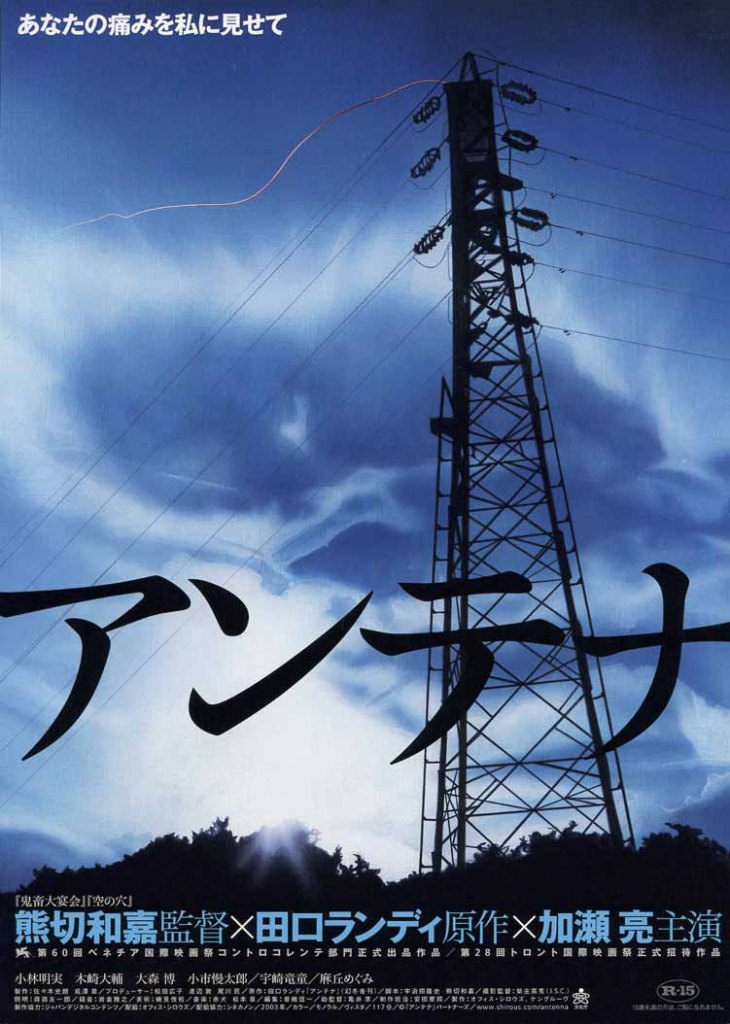
AntennaScarring, both literal and mental, is at the heart of Kazuyoshi Kumakiri’s third feature, Antenna (アンテナ). Though it’s ironic that indentation should be the focus of a film whose title refers to a sensitive protuberance, Kumakiri’s adaptation of a novel by Randy Taguchi is indeed about feeling a way through. Anchored by a standout performance from Ryo Kase, Antenna is a surreal portrait of grief and repressed guilt as a family tragedy threatens to consume all of those left behind.

Philosophy student Yuichiro (Ryo Kase) is currently working on a project which aims to reevaluate how pain is felt through attempting to identify with the pain of others. To do this he plans to investigate the S&M scene but before he can get started, a painful episode from his past is reawakened by current events. Yuichiro’s younger sister, Marie, has been missing since failing to return home from school one day when she was only eight years old. When news reports appear that another girl around the same age has been held captive in a nearby apartment complex since around the time Marie went missing hopes are sparked only to be dashed. Still no closer to discovering what happened to his younger sister, Yuichiro carries the guilt of having been unable to protect her as well as the inability to remember exactly what happened on that fateful day.

Matters come to a head when Yuichiro’s younger brother (their mother was pregnant with him at the time of the disappearance) turns up on his doorstep. Yuya (Daisuke Kizaki) repeatedly claims that Marie is about to return as he can feel her through his “antenna” (“like the horns of a snail”) and has a full scale fit aboard the train back. Things being what they are, the doctors advise Yuichiro to spend sometime at home as his distracted mother is no shape to cope with Yuya’s increasingly odd behaviour. A dutiful son, Yuichiro does what he can for what’s left of his family but his childhood home is far from a good environment for him.

Soon after Marie’s disappearance, both Yuichiro’s father and his uncle Shige who’d lived with them both died, leaving only Yuichiro’s mother and baby brother behind them. Unable to come to terms with Marie’s disappearance, Yuichiro’s mother has found religion, hosting Buddhist prayer sessions at the house and bringing in Feng Shui experts to try and heal the lingering sense of tragedy still present in the house. She has also become convinced that her second son, Yuya, is in fact the returned spirit of her daughter, raising him as a girl and dressing him in Marie’s clothes. This may explain some of Yuya’s conflicting behaviour and repeated insistence that his sister is “returning” in so much as something of her personality has become the ghost in his machine.

Once back in the house, Yuichiro’s mental state becomes ever more precarious as his memories of his sister’s disappearance begin to flicker to the surface. Overcome with repressed guilt, Yuichiro once again begins self harming by slashing his chest with a box cutter. Easing the mental pain with the physical, Yuirichiro finally begins to address some of his long buried trauma through repeated meetings with the dominatrix he was interviewing for his project. Undergoing a kind of S&M lead sex therapy, Yuichiro is slowly guided back through his memories to events he was too young to understand at the time and only now is fully able to comprehend.

Throughout his flashbacks Yuichiro is always sidelined, perched behind barriers or shut away by closed doors as the adults argue and loudly discuss things they claim are not suitable for children to hear. Crucial moments find him peaking through keyholes and seeing something he knew was not quite right but without knowing why. These incomplete and incomprehensible memories are the ones which haunt him, unresolvable but still trailing the guilt behind them of having seen yet done nothing.

Told in a slight non-linear fashion through frequent flashbacks, the film adopts a dreamlike tone and surreal imagery to make sense of the more extreme elements. The final sequence itself is either a hallucination or a dream that takes on a magical realist quality as the past is finally allowed to drift away from its lodging place, freeing up a space for light to return to the otherwise darkened house.

An intense exploration of buried trauma and childhood guilt, Antenna is a dark tale but does offer a glimmer of hope after all its hellish meandering. Kumakikri keeps things straightforward but his considered compositions have a strange kind of beauty despite the ugliness of the narrative. Embracing a number a taboo subjects coupled with strong emotion and explicit content, Antenna is not an easy watch but rewarding for those who can brave its extremes.


Original trailer (no subtitles)