Tunnel (터널, Kim Seong-hun, 2016)

TunnelIn 1925 an avid cave explorer, Floyd Collins, became trapped in a narrow crawl space. Though he was discovered and help came with food and water, a cave in left him sealed off down there and fourteen days later he died of thirst and exposure. As tragic as this obviously is, Floyd Collins is remembered for another reason – his rescue became one of the earliest mass media crazes. The surrounding media furore also inspired the 1951 Billy Wilder classic Ace in the Hole in which a grizzled reporter attempts to manipulate the fate of a man trapped in a cave for the maximum media coverage with the consequence that his delays cost the man his life. Jung-soo, a father on his way home with a birthday cake for his young daughter is about to join the marooned underground club when a shoddily built tunnel collapses sealing him inside. Unfortunately for Jung-soo, he finds that times have not changed all that much.

Jung-soo (Ha Jung-woo) was having a good day. He’d closed an important deal and has a birthday cake in the back of his car ready for his little girl when he gets home. He also ends up with two free bottles of water for not making a fuss when a hard of hearing old timer working at the petrol station gives him a full tank rather the $30’s worth he’d asked for. It all comes crashing down, literally, when he starts hearing strange noises shortly after entering a newly completed tunnel. Driving as fast as he can, Jung-soo is still trapped under falling debris and unable to escape though otherwise uninjured. Luckily, Jung-soo’s phone still works and he’s able to get enough signal to dial the emergency services but as he’ll discover, the matter of coming to his rescue may not be as straightforward as one might hope.

Just before Jung-soo heads into the tunnel which has only been open for around a month, there’s a sign testifying to happy and safe construction. It transpires that the tunnel was completed far too quickly, corners were cut, and public safety not properly respected. Corporate corruption and margin squeezing become a constant theme as more and more faults are discovered with the tunnel’s structure right down to missing manuals and incorrect blueprints. As one sardonic construction worker puts it, who follows the rules these days anyway? In light of recent tragedies, the government can no longer be trusted to assure public safety by insuring that its infrastructure, and the third party companies which run it, are fit for purpose and operating in line with public safety standards. The fact is that the construction of the sister tunnel to this one is already underway and there have also been hundreds of other recorded safety incidents in other facilities around the country. Construction means jobs, and money, and progress – who would want to let a little thing like safety stand in the way?

If money grabbing culture and government laissez-faire are two of the greatest evils, the third leg of the tripod is mass communications who see only the story and not the human. In fact, the first people to call Jung-soo back after his emergency call are the reporters parked in their van directly outside the tunnel’s entrance. Even Jung-soo’s wife, Se-hyun (Bae Doona), only discovers her husband’s fate from a TV displaying breaking news at a supermarket. Once she drops everything to get to him, she’s quickly trotted out for endless photo-ops with government officials and rescue workers to sell the story that the entire country is behind Jung-soo in his horrendous ordeal and working hard to get him out of there. The mouth of the tunnel is now a media circus as reporters parasitically dig in, raking up whatever kind of news they can spin for good copy. When it looks like Jung-soo may be rescued, one reporter even seems upset that he hasn’t quite broken the record set by the survivors of the Sampoong Department Store collapse in 1995 (notably also directly caused by corporate greed).

Jung-soo himself accepts his situation with a stoic calmness. Sensibly rationing out his water and battery life on his cellphone, he beds in for the long haul. Before long, the TV news has even declared him a national hero for maintaining his compassionate humanity even in the face of crisis. More resourceful than most, Jung-soo is making the best of things when all he can do is wait, hoping that the authorities will finally come to his rescue. Unfortunately the authorities he’s waiting on are largely the same ones responsible for this entire mess and aside from the valiant commander of the rescue squad Dae-kyoung (Oh Dal-su) are more interested in being able to resume construction on the sister tunnel (which involves more of the blasting that may have destabilised the tunnel in first place) and deflecting the embarrassment of this high profile infrastructure project having gone so catastrophically wrong.

Kim Seong-hun keeps the tension high as Jung-soo fights for his life by simply trying to survive long enough for someone to reach him. Genuinely fraught and claustrophic, Tunnel is not without a healthy dose of black humour lightening the mood in even the bleakest of circumstances. The political subtext is refreshingly subtle yet perfectly clear as Jung-soo finds himself literally buried underneath a national scandal and branded an inconvenient truth by those whose interests lie in maintaining the illusion of compassionate government anchored by friendly corporations. Tense, thrilling, and frightening on more than one level, Tunnel is an unexpectedly thoughtful disaster movie detailing one good man’s struggles to escape from underneath the destruction caused by pervasive social ills.


US release trailer (English subtitles)
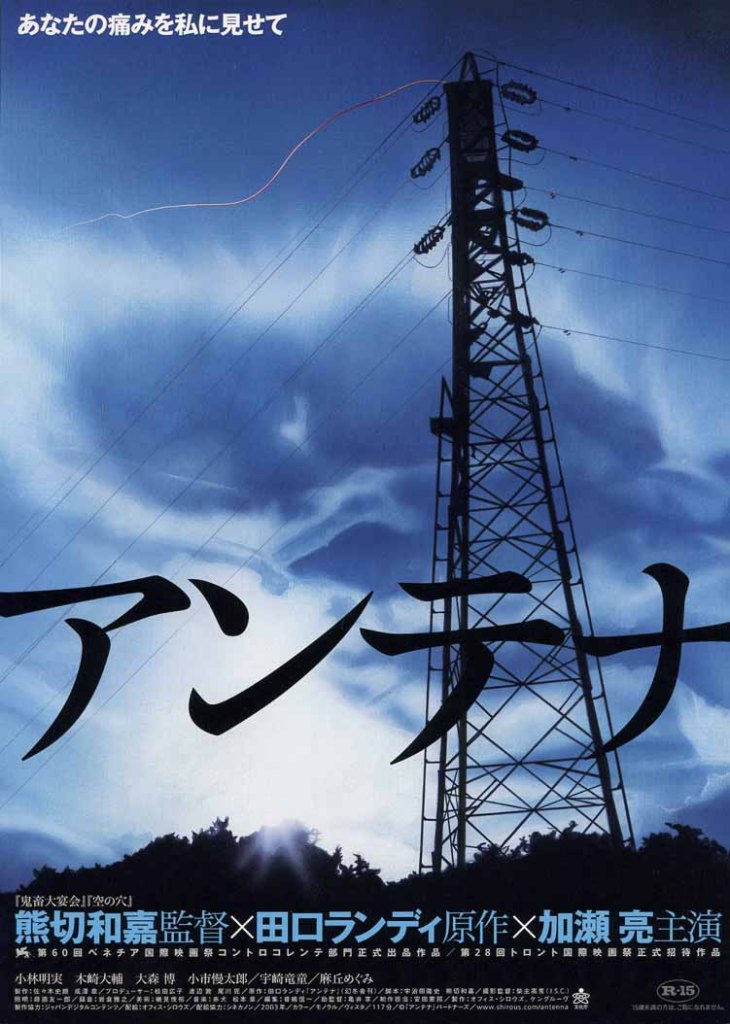
Antenna (アンテナ, Kazuyoshi Kumakiri, 2004)

AntennaScarring, both literal and mental, is at the heart of Kazuyoshi Kumakiri’s third feature, Antenna (アンテナ). Though it’s ironic that indentation should be the focus of a film whose title refers to a sensitive protuberance, Kumakiri’s adaptation of a novel by Randy Taguchi is indeed about feeling a way through. Anchored by a standout performance from Ryo Kase, Antenna is a surreal portrait of grief and repressed guilt as a family tragedy threatens to consume all of those left behind.
Philosophy student Yuichiro (Ryo Kase) is currently working on a project which aims to reevaluate how pain is felt through attempting to identify with the pain of others. To do this he plans to investigate the S&M scene but before he can get started, a painful episode from his past is reawakened by current events. Yuichiro’s younger sister, Marie, has been missing since failing to return home from school one day when she was only eight years old. When news reports appear that another girl around the same age has been held captive in a nearby apartment complex since around the time Marie went missing hopes are sparked only to be dashed. Still no closer to discovering what happened to his younger sister, Yuichiro carries the guilt of having been unable to protect her as well as the inability to remember exactly what happened on that fateful day.

Matters come to a head when Yuichiro’s younger brother (their mother was pregnant with him at the time of the disappearance) turns up on his doorstep. Yuya (Daisuke Kizaki) repeatedly claims that Marie is about to return as he can feel her through his “antenna” (“like the horns of a snail”) and has a full scale fit aboard the train back. Things being what they are, the doctors advise Yuichiro to spend sometime at home as his distracted mother is no shape to cope with Yuya’s increasingly odd behaviour. A dutiful son, Yuichiro does what he can for what’s left of his family but his childhood home is far from a good environment for him.

Soon after Marie’s disappearance, both Yuichiro’s father and his uncle Shige who’d lived with them both died, leaving only Yuichiro’s mother and baby brother behind them. Unable to come to terms with Marie’s disappearance, Yuichiro’s mother has found religion, hosting Buddhist prayer sessions at the house and bringing in Feng Shui experts to try and heal the lingering sense of tragedy still present in the house. She has also become convinced that her second son, Yuya, is in fact the returned spirit of her daughter, raising him as a girl and dressing him in Marie’s clothes. This may explain some of Yuya’s conflicting behaviour and repeated insistence that his sister is “returning” in so much as something of her personality has become the ghost in his machine.

Once back in the house, Yuichiro’s mental state becomes ever more precarious as his memories of his sister’s disappearance begin to flicker to the surface. Overcome with repressed guilt, Yuichiro once again begins self harming by slashing his chest with a box cutter. Easing the mental pain with the physical, Yuirichiro finally begins to address some of his long buried trauma through repeated meetings with the dominatrix he was interviewing for his project. Undergoing a kind of S&M lead sex therapy, Yuichiro is slowly guided back through his memories to events he was too young to understand at the time and only now is fully able to comprehend.

Throughout his flashbacks Yuichiro is always sidelined, perched behind barriers or shut away by closed doors as the adults argue and loudly discuss things they claim are not suitable for children to hear. Crucial moments find him peaking through keyholes and seeing something he knew was not quite right but without knowing why. These incomplete and incomprehensible memories are the ones which haunt him, unresolvable but still trailing the guilt behind them of having seen yet done nothing.

Told in a slight non-linear fashion through frequent flashbacks, the film adopts a dreamlike tone and surreal imagery to make sense of the more extreme elements. The final sequence itself is either a hallucination or a dream that takes on a magical realist quality as the past is finally allowed to drift away from its lodging place, freeing up a space for light to return to the otherwise darkened house.

An intense exploration of buried trauma and childhood guilt, Antenna is a dark tale but does offer a glimmer of hope after all its hellish meandering. Kumakikri keeps things straightforward but his considered compositions have a strange kind of beauty despite the ugliness of the narrative. Embracing a number a taboo subjects coupled with strong emotion and explicit content, Antenna is not an easy watch but rewarding for those who can brave its extremes.


Original trailer (no subtitles)

Carmen Comes Home (カルメン故郷に帰る, Keisuke Kinoshita, 1951)

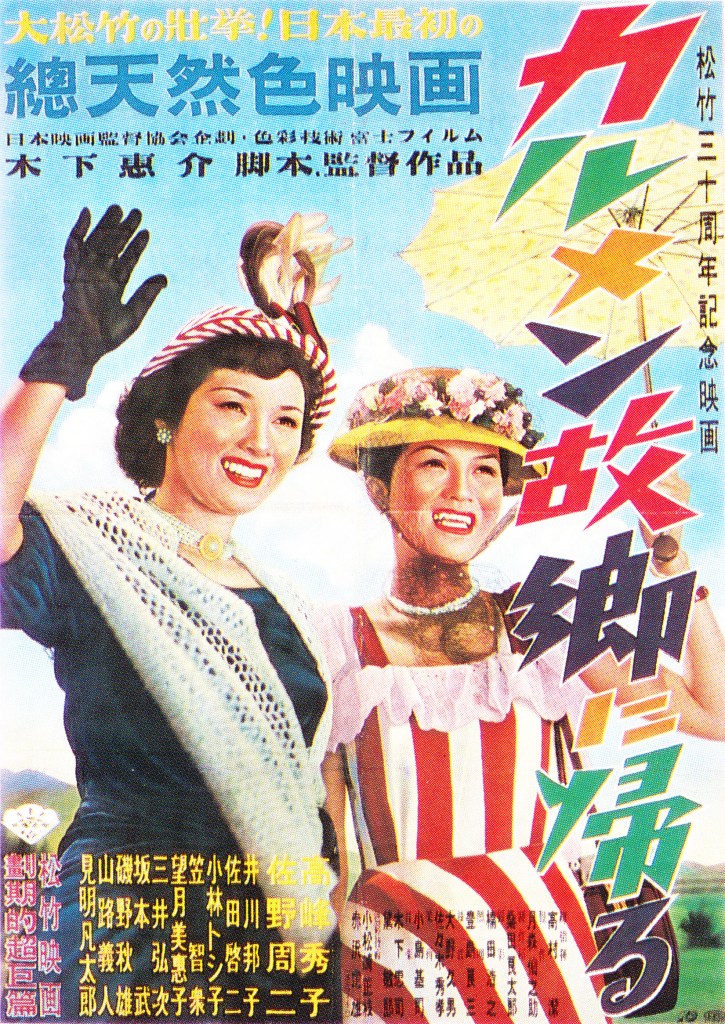
Carmen Comes HomeShochiku was doing pretty well in 1951. Accordingly they could afford to splash out a little in their 30th anniversary year in commissioning the first ever full colour film to be shot in Japan, Carmen Comes Home (カルメン故郷に帰る, Carmen Kokyou ni Kaeru). For this landmark project they chose trusted director Keisuke Kinoshita and opted to use the home grown Fujicolor which has a much more saturated look than the film stocks favoured by overseas studios or those which would become more common in Japan such as Eastman Colour or Agfa. Fujicolour also had a lot of optimum condition requirements including the necessity of shooting outdoors, and so we find ourselves visiting a picturesque mountain village along with a showgirl runaway on her first visit home hoping to show off what a success she’s made for herself in the city.
Famous Tokyo showgirl “Lily Carmen” (Hideko Takamine) was once plain old Kin from the cow farm. When the family receives a letter written in grand style and signed with Kin’s stage name explaining she’ll be coming to visit, her sister may be excited but her father has much more mixed emotions. When Carmen comes home she does so like she’s on a victory parade. Wearing her Westernised, colourful outfits fashionable in the city but like something from outer space here, Carmen becomes the show but oddly seems uncomfortable with the predictable amount of attention she’s getting around town. The presence of Carmen and her equally pretty friend, Maya (Toshiko Kobayashi), threatens to destabilise this otherwise peaceful mountain village but just what sort of chaos can two beautiful women really create over the period of a few days?

The villagers react to Carmen’s return with a series of ambivalent emotions. Of course, they’re glad to see their own girl back, especially as she’s been so successful in the city, but this Carmen is not the same as the Kin who ran away. Slightly in awe of all this visiting urban sophistication, the villagers are also scandalised by Carmen’s modern attitudes to fashion and vulgar behaviour. Striding around the village like as it were a tourist attraction and she a visiting monarch, Carmen chews gum, breaks in to song at random and dances happily in her underwear on the green mountain hillsides.

The village is smallish community but fiercely proud of their local traditions. Many of the residents are happy to think that a “great artist” of the pedigree of Lily Carmen could have been born in their little village. In fact, this tiny settlement is something of a crucible for artistic talent and the extremely pompous school headmaster has a bee in his bonnet about bringing forth the future of Japan through cultural education. However, not quite all of the residents are so liberal and many live in fear of a feudalistic money lender named Maruju (Koji Mitsui) who runs the local transportation business (such as it is) but makes most of his money out of issuing exorbitant loans to desperate local people. Recently, he’s pointlessly repossessed an organ from the home of a man who was blinded during the war.

The headmaster is very keen for Carmen to come and bring some of her city sophistication back to the village, but no one has actually asked what kind of “art” Carmen is involved in. After a lot of chat from Carmen about how seriously she takes her work, people start wondering about this cutting edge performance art that their homegirl has apparently surrendered her life to. As if it weren’t obvious from her name, Carmen is a burlesque dancer. Quite a good, high grade burlesque dancer and, in fact, an artist, but essentially a stripper who really does take it all off in the end. Ever the enterprising businessman, Maruju decides to put on a show which he advertises with a big cart bearing the slogan “wild dancing by nude beauties” plastered on the side.

Needless to say this does not go down well with pompous headmaster and his plan to create a great city of highbrow artists. Striding straight over to talk to Carmen’s father Shoichi who’s only just got up from a few days in bed after Carmen’s last embarrassing faux pas, the principal intends to talk Carmen and her friend out of their scheduled performance. Her father, however, has a surprising reaction. He had an inkling what kind of life his runaway daughter must have been living. Shoichi put much of Carmen’s lack of acumen down to being kicked in the head by a cow as a child and realised it would be hard for her to find “respectable” work. He doesn’t want to see her “indecent” show and thinks the professor shouldn’t go either, but also thinks that if she’s good at it and it makes her happy then maybe that’s OK. After all, if it was that bad they wouldn’t allow it in the city and whatever’s good enough for the city ought to be good enough for the mountains. The headmaster, momentary stunned, is now confused and wondering if stopping the performance is an infringement on Carmen’s human rights.

Kinoshita refuses to take a side, he shows the ridiculousness of both the isolated villagers and the sophisticated city dwellers to great comic effect. Hideko Takamine is something of a revelation, cast completely against type as a bubbly, airhead showgirl. As is true with a lot of early colour films, or even a lot of early talkies, Carmen Comes Home has a built in gimmick and doesn’t really worry about doing very much beyond it. As such it keeps things light and bright and breezy, emphasising its high contrast colour palate every step of the way. A gentle comedy of manners as small town comforts rival big city liberalism with the obvious trade offs involved on either side, Carmen Comes Home might lack the substance of some of Kinoshita’s other work but makes up for it with general sunniness and effortlessly timeless humour.


Original trailer(s) (no subtitles):

Call of Heroes (危城, Benny Chan, 2016)

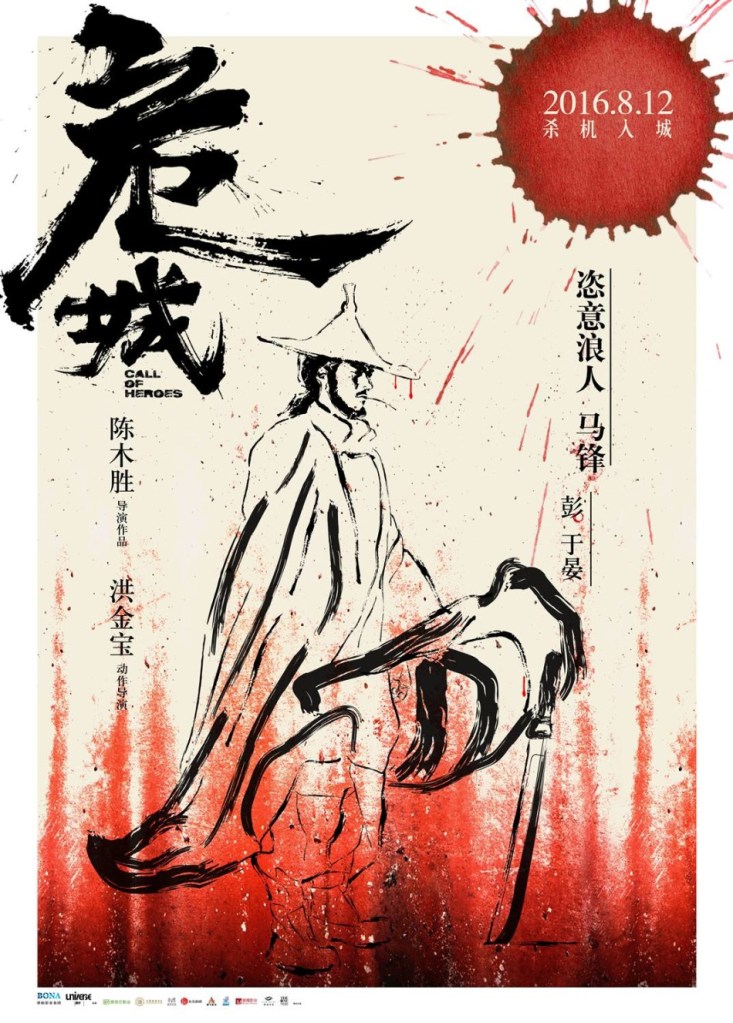
call of heroesA blast from the past in more ways than one, Benny Chan’s Call of Heroes (危城, Wēi Chéng) is a western in disguise though one filtered through Akira Kurosawa and Sergio Leone more than John Ford. Filled with Morricone-esque musical riffs and poncho wearing reluctant heroes, Chan’s bounce back to the post-revolutionary warlord era is one pregnant with contemporary echoes yet totally unafraid to add a touch of uncinematic darkness to its wisecracking world.
1914 – three years after the collapse of Chinese feudalism and warlords rule the land, each vying for power and terrain but taking little account of the displaced people in their path. The residents of Stone City find this out the hard way when notorious general Cao Ying wades into town and conducts a widespread massacre seemingly for the fun of it. Plucky school teacher Bai Ling manages to escape with some of her pupils even whilst other teachers and children are being summarily executed by Cao’s troupes.

Having left with nothing and walked miles, Bai and the children are near starvation when they stop into a noodle house to share a single bowl. Unfortunately the noodle house is about to be robbed but fortunately one of the diners is bearded wanderer Ma Feng (Eddie Peng) who isn’t up for anyone disturbing his serious food coma. Impressed with Ma’s skills, the kids and Bai make their way to Pucheng where Bai has a cousin but Cao is still on the warpath and trouble has a way of tracking good people down.

Pucheng (the name of which literally means ordinary town), is watched over by the noble sheriff Yang Kenan (Sean Lau Ching-wan) though the protective garrison has been sent to the front leaving them with only a skeleton defence. When a mysterious visitor arrives in town and proceeds to shoot dead a man, woman, and even a child, Yang arrests him but when the killer turns out to be Cao Ying’s unhinged son, a number of questions arise. Yang is committed to justice – no matter the man’s name, he ought to pay for his crimes. Yet, Cao Shaolun’s presence is sure to attract his father’s attention and so many of the townspeople feel it might be better to let Cao Shaolun go. Placate a tyrant and undermine the idea of justice by failing to enforce the law or sign your own death warrant by standing up for your principles, it’s a frontiersman’s dilemma.

The references to classic Hollywood westerns are obvious enough, particularly when the narrative takes a turn for the High Noons as Yang finds himself standing alone as the sole resistance to the oncoming militia man threat. Though the townspeople do not exactly turn on Yang in the same way they turn on Kane, they clearly choose appeasement over war. Yang’s dedication to justice is purehearted, there’s little hint of personal vanity in his decision to stand up for the rule of law but only the knowledge that folding now is the same as bowing to Cao’s tyranny.

Though introduced as a possible protagonist, Ma Feng takes a far smaller role in the action than might be expected. Clearly channeling Mifune’s Sanjuro, Peng’s wisecracking drifter and cynical, reluctant hero is almost at odds with the serious business of law vs politics over in Pucheng. His character centric subplot of conflict with a former friend who works for the other side is insufficiently developed to support the emotional weight it’s intended to carry and sometimes feels like a distraction from the main narrative though the great pot mountain based martial arts set piece is certainly one worth waiting for.

If Peng’s Ma Feng feels slightly misplaced with his cynicism and comic stunts, Louis Koo’s hammed up villain Cao Shaolun is in an entirely different film altogether. Wildly over the top, Koo plays Cao Shaolun as a permanently amused psychopath, all crazy eyes and manic laughter. A self consciously cool guy, Cao Shaolun dresses in white and murders innocents with a golden gun all the while knowing he can do as he pleases simply by the virtue of his name.

Shot with a heavily digital aesthetic, Call of Heroes’ evidently high production values are sometimes reduced to a televisual quality or otherwise let down by substandard CGI. The fight scenes themselves are filmed with an old fashioned rigour filled with innovative and exciting choreography and are refreshingly humour free. Like the best westerns, Call of Heroes contains its own parable in that the best weapon against tyranny is a strong and righteous populace but the final stretch almost undermines its noble aims by presenting what is either a revolutionary spring lead by the people for the people, or a worrying case of mob justice.

Prone to narrative dead ends in setting up major characters only to sideline or kill them off unexpectedly, Call of Heroes has a frustrated quality in not being able to decide whether it wants to be a serious call to arms for standing up for what’s right in the face of overwhelming force, or a comedic romp in which a cocky drifter sorts everything out by accident. Either way, Call of Heroes does provide a number of genuinely exciting martial arts set pieces even if floundering slightly in-between them.


Original trailer (Cantonese with Traditional Chinese/English subtitles)

The Eel (うなぎ, Shohei Imamura, 1997)

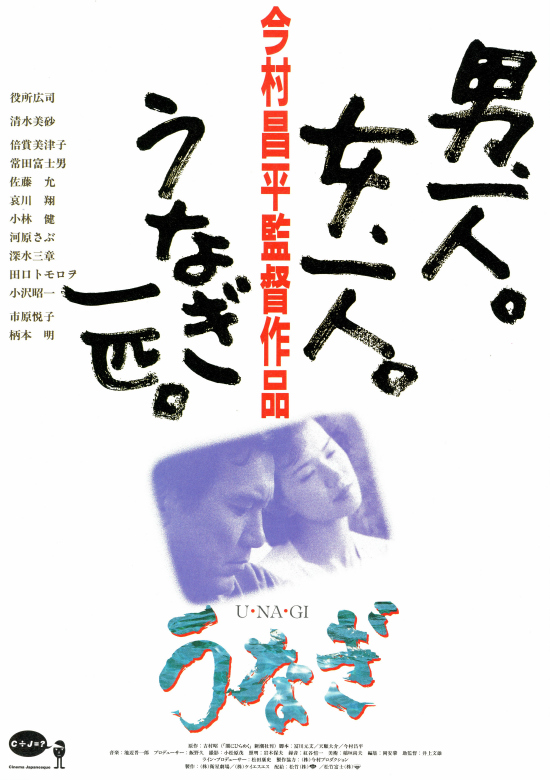
The EelDirector Shohei Imamura once stated that he liked “messy” films. Interested in the lower half of the body and in the lower half of society, Imamura continued to point his camera into the awkward creases of human nature well into his 70s when his 16th feature, The Eel (うなぎ, Unagi), earned him his second Palme d’Or. Based on a novel by Akira Yoshimura, The Eel is about as messy as they come.

Mild-mannered salary man Yamashita (Kouji Yakusho) receives a handwritten letter filled with beautiful calligraphy delivering the ugly message that his wife has been entertaining another man whilst he enjoys his weekly all night fishing trips. Confused at first, the note begins to work its way into Yamashita’s psyche and so he decides to leave his next fishing trip a little earlier than usual. Peeping through the keyhole, he finds his beloved wife enjoying energetic, passion filled sex with another man. Drawing a knife from a nearby shelf, he enters the room and attacks the pair killing the woman but letting the lover get away.

Yamashita immediately and with perfect calmness turns himself in at the local police station, still covered in his wife’s blood and carrying the murder weapon. Released on a two year probationary period after eight years in jail, there is no one to meet Yamashita when he comes out and so he remains under the guardianship of a Buddhist priest in a nearby town. Accompanied by his only friend, a pet eel, Yamashita takes possession of a local disused barbershop and sets about trying to rebuild his life.

Things change when Yamashita comes across an unconscious woman lying in the grass while he’s out looking for things to feed his eel. The strange thing is, this woman looks exactly like his wife. Eventually, Keiko (Misa Shimizu) recovers and comes to work with Yamashita in his new enterprise but as the pair grow closer the spectres of both of their troubled pasts begin to intrude.

As the small town residents of Yamashita’s new home often remark, Yamashita is a strange man. His deepest relationship is with his eel which the prison guards, who seem quite well disposed towards him, allowed him to keep in the prison pond even though pets are not generally allowed. When asked why he likes his eel so much, Yamshita replies that the eel listens to him and doesn’t tell him the things he does not wish to hear. Like Yamashita, the eel is isolated inside his tank, content to absent himself from interacting with other creatures, both protected and constrained by transparent walls.

After his release from prison, Yamashita begins to reflect on his crime which he doesn’t so much regret but has no desire to repeat. His other double arrives in the form of fellow inmate and double murderer Tamasaki (Akira Emoto) who keeps trying to convince Yamashita that he is living dishonestly by not having visited his wife’s grave or read sutras for her. Though Yamashita pays no heed to most of his advice which is more self-pity and anger than any real concern for Yamashita’s soul, some things begin to get to him, most notably that perhaps the fateful letter never existed at all and is nothing more than the manifestation of Yamashita’s jealous rage.

Though the film presents everything that happens to Yamashita as “real”, his state of mind is continually uncertain. Not only is the provenance of the letter doubted, he doubts the existence of Keiko because she looks (to him at least) like the returned ghost of the woman he killed, and even the final confrontational arguments with Tamasaki take on an unreal quality, as if Yamashita were arguing with himself rather than another man who also represents his own worst qualities – impulsivity, violence, self doubt and insecurity. The film is so deeply embedded in Yamashita’s subjective viewpoint that almost nothing can be taken at face value.

Yamashita is, in a sense, trapped in a hall of mirrors as his own faults are reflected back at him through the people that he meets. Keiko, rather than being physically murdered by a jealous lover, attempted to take her own life after being misused by a faithless (married) man. Her past troubles are, in some ways, the inverse of Yamashita’s as she finds herself at the mercy of dark forces but internalises rather than externalises her own anger. Cheerful and outgoing, she quickly turns Yamshita’s barbershop into a warm and welcoming place which the local community takes to its heart.

Yamashita, however, remains as closed off as ever though he does strike up something of a relationship with a lonely young man who wants to use his barber’s pole to try and call aliens. When Yamashita asks him what he’s going to do if the aliens actually come, the young man replies that he wants to make friends with them. Yamashita astutely remarks that the young man’s desire to meet aliens is down to a failure to connect with people from his own planet – an idea which the young man equally fairly throws back at him. Perhaps out of fear rather than atonement, Yamashita exiles himself from the world at large though gradually through continued exposure to the genial townsfolk and Keiko’s deep seated faith in him, he does begin to swim towards the surface.

Imamura adopts his usual, slightly ironic tone to lighten this otherwise heavy tale allowing the occasional comic set piece to shine through. Yakusho delivers another characteristically nuanced performance as this entirely unformed man, unsure of reality and trapped in a spiral of self doubt and confusion. His original crime of passion is at once chilling in its calmness but also messy and violent as he gives in to animalistic rage. After showing us a street lamp glowing an ominous red, Imamura steeps us in blood as his camera becomes progressively more stained making it impossible to forget the shocking betrayal of this unexpected violence.

Yamashita remarks at one point that he died that day alongside his wife. The Eel is a story of rebirth as its protagonists begin to swim towards the shore in support of each other, though like the titular marine creature there is no guarantee that they will make there alive. Yamashita is a cold blooded murderer and creature of suppressed rage yet Imamura is not interested in moral judgements as much as he is in the messier sides of human nature. A chance offering of redemption for the unredeemable, The Eel offers hope for the hopeless in a world filled with goodhearted eccentrics where all faults are forgivable once they are understood.


Original trailer (no subtitles)

Swimming Upstream (バタアシ金魚, Joji Matsuoka, 1990)

Swimming UpstreamSometimes love makes you do crazy things. Some people find themselves accomplishing previously unattainable feats powered only by the sheer force of romance. Unfortunately for the hero of Swimming Upstream (バタアシ金魚, Bataashi Kingyo), Joji’s Matsuoka’s adaptation of Minetaro Mochizuki’s manga, the task he sets for himself is a very lofty one indeed and may actually require him to abandon his love to complete it. Then again, the object of his affections shows little signs of reciprocation in any case.
Love found Kaoru (Michitaka Tsutsui) with a bucket of water. That is, he was hanging around one day when swimsuited beauty Sonoko (Saki Takaoka) soaked him by mistake but far from being annoyed, Kaoru falls in love at first sight and begins to pursue the star of the swim team even if she remains resolutely cold towards him. Kaoru immediately joins up just to be close to her even though he is actually afraid of water and does not know how to swim. Nevertheless he sets himself the task of becoming an olympic swimmer and bringing home a gold medal for his lady love. Needless to day, Sonoko is still not very interested in him.

Assisted by a strange old lady of swimming coach in sporting matters, and with an unlikely ally in Sonoko’s mother when it comes to romance, Kaoru works hard at his twin goals but makes little progress with either. His world is briefly shattered when he spots Sonoko arm in arm with the school’s star swimmer and he also faces a romantic dilemma in the form of his friend Pu whose motorbike he keeps borrowing to try and impress Sonoko despite the fact that Pu obviously has a crush on him. Nevertheless, Kaoru is undeterred until, that is, Sonoko’s actions convince him he may be doing more harm than good.

Matusoka’s film is most clearly concerned with recreating the contemporary high school summer for the presumed target audience of teenagers. Though it loosely adapts a classic sports movie romance format with Kaoru giving it his all in training, it stops short of the triumphant underdog trope as Kaoru never achieves the kind of sporting success one would expect. Though he quickly learns to swim and makes some progress, Kaoru retains a lingering fear of the water and is among the very weakest at the club. Still deluding himself with his Olympian dream, Kaoru even attempts to challenge the champion swimmer of another team (played by a very young Tadanobu Asano in his first film role) in a race for the rights to Kaoru. Needless to say, nothing goes his way.

If duelling over the “rights” to a girl seems like an old fashioned idea, Swimming Upstream is a very old fashioned film in terms of its sexual politics. The film stars popular idol Saki Takaoka as the unattainable Sonoko but is told very much from Kaoru’s point of view in which Sonoko is something to be won rather than another human being with independent will. Sonoko’s behaviour often is hard to categorise but, to borrow a term from the film’s manga roots, could easily be described as tsundere wherein she consistently rejects Kaoru’s advances before warming up to the idea just as he’s beginning to cool off. There may a fine line between persistence and and inappropriate behaviour but Kaoru’s level of devotion is the kind that straddles it. The teenage audience of 1990, however, may have seen things a little differently than that of today.

The audience of 1990 would doubtless also have been shocked by Sonoko’s rebellious lack of compliance with regular social norms. Far from the docile, cute, obedient and polite aura of the traditionally perfect girl next door in which idol movies specialise, Sonoko throws angry looks at everyone and talks back to her mother with extremely harsh words (though her mother wisely refuses to be shocked by them). In fact Sonoko is universally awful to everyone to the extent that it later seems that even one of her closest friends does not actually like her very much, but the worse she gets the more Kaoru refuses to be dissuaded.

Matsuoka mostly chooses to keep things simple with a light hearted, summery atmosphere primed to appeal to his audience of youngsters. Though intended as an innocent romance, contemporary audiences may read more darkness into the relentless war between the icy Sonoko and determined Kaoru but the adolescent intensity of young love does at least ring true. Caught between the quirkiness of its general tone and the heaviness of its themes, Swimming Upstream flounders in making its central connection work, rendering its overworked metaphor of a finale less than successful but does offer strong performances from both of its central stars.


Clip (no subtitles)

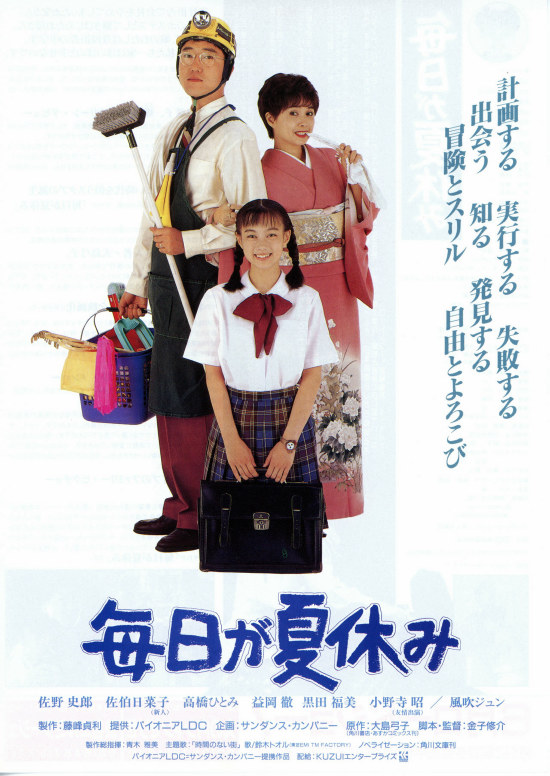
Summer Holiday Everyday (毎日が夏休み, Shusuke Kaneko, 1994)

Summer Holiday EverydaySummer Holiday Everyday – It’s certainly an upbeat way to describe unemployment but then everything is improbably upbeat and cheerful in the always sunny world of Shusuke Kaneko’s adaptation of Yumiko Oshima’s shoujo manga. Published in the mid-bubble era of 1988, Oshima’s world is one in which anything is possible but by the time of the live action movie release in 1994 perhaps this was not so much the case. Nevertheless, Kaneko’s film retains the happy-go-lucky tone and offers note of celebration for the unconventional as a path to success and individual happiness.
Told from the point of view of 14 year old Sugina (Hinako Saeki) who offers us a voiceover guide to her everyday life, Summer Holiday Everyday (毎日が夏休み, Mainichi ga Natsuyasumi) follows the adventures of the slightly unusual Rinkaiji family. Sugina’s mother is divorced from her father and has remarried a successful salary man, himself a divorcee, ten years ago. The family lives in fairly peaceful domesticity and Sugina’s mother, Yoshiko (Jun Fubuki), even remarks how glad she is that her daughter gets on so well with her step-father, Nariyuki (Shiro Sano), though Sugina claims this is largely because she can’t remember actually speaking to him very much over the last ten years.

The pair are about become closer though it risks tearing their perfectly normal family apart. Sugina has been skipping school due to bullying and spends her days in the local park where, unbeknownst to her, her step-father has also been wasting his days after quitting a job he could no longer stand. After getting over the embarrassment of this accidental encounter, Sugina and Nariyuki confess everything to each other and Nariyuki makes a bold decision. Sugina can quit school (seeing as her grades were terrible anyway) and come work with him in his new enterprise – the Rinakaiji Heart Service, helping the community 24/7 with assistance in those difficult to handle odd jobs everyone needs doing.

Quitting a lucrative and secure job for the risk associated with staring a new business is a difficult decision in any society but is more or less unthinkable in Japan. Yoshiko is beyond stunned by her husband’s decision, not to mention the fact that her daughter has been deceiving her by skipping school and faking her report cards to make it look like her grades were much better than they are. Immediately worrying about what the neighbours will think, Yoshiko finds it hard to deal with the embarrassment of her husband and teenage daughter going door-to-door and doing menial work in the community, especially when she overhears the snickers of gossipy housewives in the local supermarket. For Yoshiko, whose sense of self worth was bound up with having a successful husband employed at a top tier company, Nariyuki’s sudden lurch towards individual freedom has destabilised her entire existence. Her world ceases to make sense.

Yoshiko’s sense of displacement is deepened when the fledgling company’s second job offer comes from Nariyuki’s ex-wife. Beniko (Hitomi Takahashi) left Nariyuki for another man because she failed to appreciate Nariyuki’s gentle charms and he was too mild mannered to fight for his wife even if he loved her deeply. What’s more, Nariyuki’s unconventional approach to life has earned him a spot in the papers and brought the family back to the attention of Sugina’s father, Ejima (Akira Onodera).

Early on Nariyuki states that life’s true radiance is only visible through suffering and later says that pain and suffering are essential parts of human existence. Nariyuki, now making a stand for himself for the first time in his life, remains philosophical in the face of hardship though perhaps has more faith in Yoshiko’s ability to follow him down this untrodden path than was wise. As a son and then a husband, Nariyuki may be a methodical sort but he’s unused to the idea of caring for himself as his comical attempts at doing the housework show. After almost burning the house down several times, Nariyuki does indeed figure out an efficient way of managing the household chores and seeing to Sugina’s education whilst also allowing his wife become the family breadwinner. However, Yoshiko’s new line of work is one she finds both unpleasant and degrading and she probably hoped that Nariyuki would strenuously try to stop her doing it so it’s not quite as much of a progressive approach as might be hoped.

After countless setbacks, humorous adventures, and a major fire Nariyuki’s enterprise begins to catch on. Brought together in shared crisis, the family unit only becomes stronger and more committed to their shared destinies. In fact, the family expands as Sugina rebuilds her relationship with birth father and even gains a new aunt figure in the form of her step-father’s youthful ex-wife. When you love what you do everyday is a holiday, and Sugina’s path, unconventional as it is, is one that leads her into the sunlight guided by Nariyuki’s oddly philosophical wisdom.


Original trailer (no subtitles)

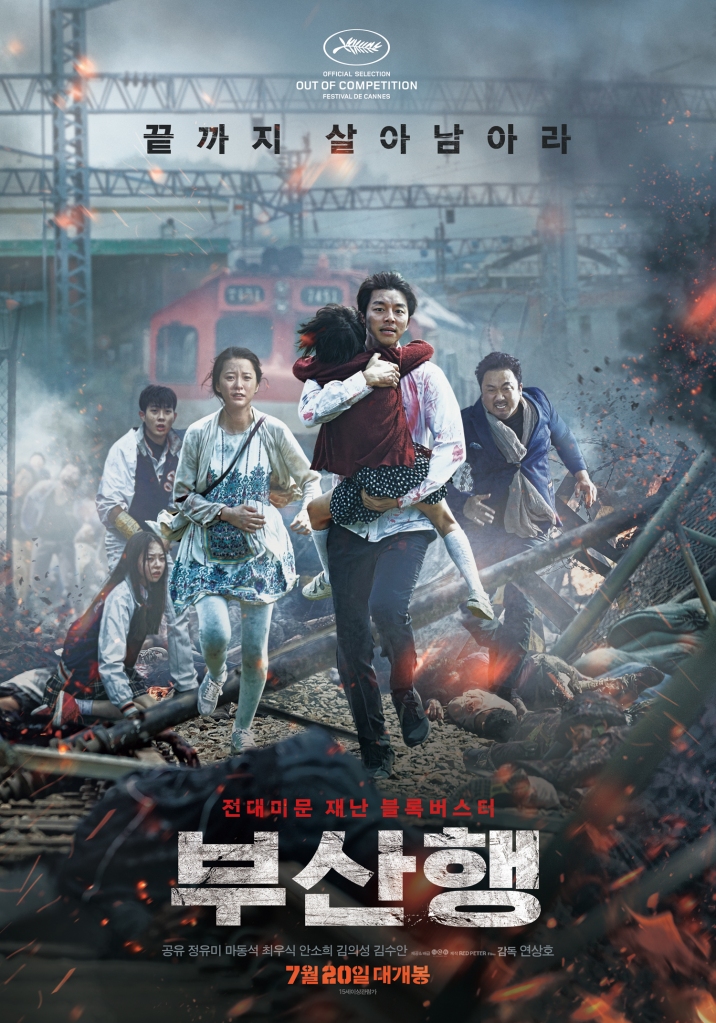
Train to Busan (부산행, Yeon Sang-ho, 2016)

Train to BusanMany people all over the world find themselves on the zombie express each day, ready for arrival at drone central, but at least their fellow passengers are of the slack jawed and sleep deprived kind, soon be revived at their chosen destination with the magic elixir known as coffee. The unfortunate passengers on an early morning train to Busan have something much more serious to deal with. The live action debut from one of the leading lights of Korean animation Yeon Sang-ho, Train to Busan (부산행, Busanhaeng) pays homage to the best of the zombie genre providing both high octane action from its fast zombie monsters and subtle political commentary as a humanity’s best and worst qualities battle it out for survival in the most extreme of situations.
Workaholic fund manager Seok-woo (Gong Yoo) is having a series of very bad days. His wife has left him and for unclear reasons, also left their young daughter, Soo-an (Kim Soo-ahn), in her father’s care though apparently wants custody in the ugly divorce battle that now seems inevitable. It’s Soo-an’s birthday but all she wants is to catch a train to Busan to see her mum and if she has to she’ll even go by herself. After his attempt at a birthday present spectacularly backfires, Seok-woo gives in and agrees to take Soo-an to her mother’s before catching the next train back after dropping her off. Unfortunately, they have picked a very bad day to take the train.

Yeon Sang-ho takes his time to build to the central train based set piece but is is careful to create an atmosphere which makes it plain that there is something very wrong with this seemingly everyday set up. After a brief dig about pig farmers losing out to government policy on foot and mouth disease and irresponsible hit and run drivers leaving deer corpses behind them for someone else to deal with, he has a parade of emergency vehicles racing past Seok-Woo and Soo-an on their trip to the station while ash rains down on their car. Seok-woo is still focussed on work though sleepy on the train so he misses Soo-an’s shocked reaction to a station guard being rugby tackled just as the train is leaving while a mass of improbable early morning revellers are trying to break through the line of staff holding them back at the platform steps.

Patient zero bounds onto the train just as the doors close though one wonders why no one is paying much attention to this obviously distressed young woman as she stumbles and writhes around in the train carriage before the virus fully takes hold. Just as we think someone is about to come to her aid, it turns out to be a case of a snooty passenger taking offence at the presence of an “odd person” on the train. The “odd person” turns out to be a homeless guy whose mutterings of “dead, all dead” take on a prophetic air rather than the ramblings of a mad man that the train guards assume them to be.

This kind of stereotypical othering and the selfish refusal to help fellow humans in need is at the very heart of the film. Seok-woo admonishes his goodhearted daughter when she repeatedly makes an effort to be a kind and decent person by giving up her seat for an old lady or wanting to stop and help others escape the zombie onslaught. However, Soo-an’s goodness wins through as she in turn chastises her father and explains that his selfishness and lack of regard for the feelings of other people is the very reason her mother left the family. Even if he begins by cruelly closing the door on the film’s most heroic character and his pregnant wife, Seok-woo gradually begins to develop a sense of social responsibility whether out of simple pragmatism or genuine fellow feeling.

Workaholic fathers with minimal connections to their offspring may be something of a genre trope but, as father-to-be Sang-hwa says, fathers often get a bad rap – making all of the sacrifices and enjoying none of the rewards. In an attempt to show solidarity with Seok-Woo, Sang-hwa assures him that his daughter will understand why he worked so hard all the time when she grows up and reiterates that true fatherhood is about self-sacrifice. This is one sense plays into the earlier themes of Seok-Woo’s self-centred viewpoint in asking if he really is working hard for his family or only wants to been as such, maintaining his own social status and upperclass lifestyle and completing it with a perfectly posed family photo. A father is supposed to protect his daughter and now Soo-an has only him to rely on, if Seok-woo is going ensure her survival he will have to decide what kind of sacrifices he’s prepared to make on her behalf.

If the film has a villain it isn’t the rabid zombie hordes who, after all, are only obeying their programming, it’s personal, corporate, and political greed. The clearest embodiment of this is in the panicked businessman who frequently tries to issue orders to the train staff and insists the train take him to his preferred destination. After trying to get the homeless man thrown off the train early on, the fascistic businessman picks up a lackey in the form of a steward and begins trying to exclude all the “suspicious” people from his general vicinity. Cruel and cowardly, the businessman’s selfish actions only cause more problems for everyone else whilst whipping up unhelpful paranoia among those who will need to work together to survive. Literally feeding even his most loyal comrades to zombies to buy himself time to escape, this egotistical CEO is the perfect metaphor for cannibalistic nature of the capitalist system which is, as Sang-hwa said, content to let the “useless” fall behind.

That’s not to forget the actual undead threat. Yeon Sang-ho’s walking dead take inspiration from his animated work and move quickly with jerky, uncanny movements more like Butoh dancers than the usual stupefied shufflers. The set pieces are expertly choreographed and well shot, maintaining the tension throughout though the increase in scale towards the final stretch is at odds with the leaner, meaner approach of the early scenes. Despite eventually giving in to melodrama in a heavily signposted script, Yeon Sang-ho’s live action debut is an impressive effort making room for his standard social concerns whilst also providing innovative zombie thrills. Yeon Sang-ho’s message is clear, when disaster strikes no one can survive alone, the only chance for salvation lies in altruistic compassion. In the end the best weapon against the darkness is a children’s song as innocence finally triumphs over fear.


UK release trailer:

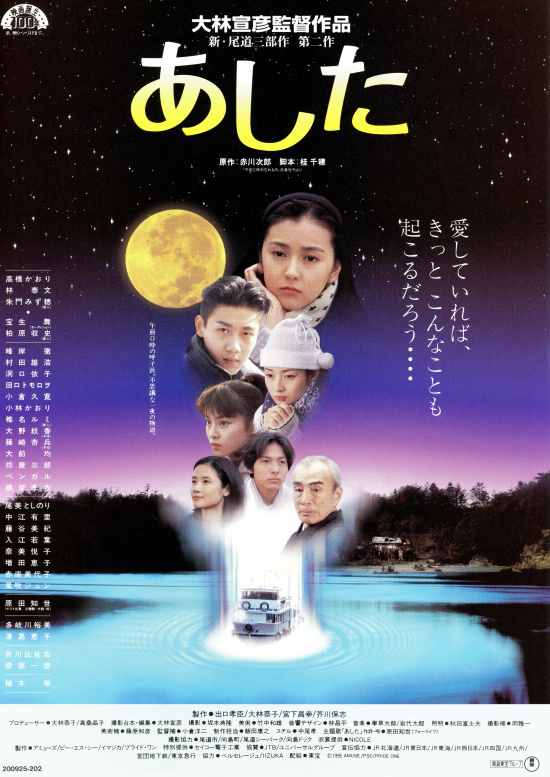
Goodbye for Tomorrow (あした, Nobuhiko Obayashi, 1995)

goodbye for tomorrowAfter completing his first “Onomichi Trilogy” in the 1980s, Obayashi returned a decade later for round two with another three films using his picturesque home town as a backdrop. Goodbye For Tomorrow (あした, Ashita) is the second of these, but unlike Chizuko’s Younger Sister or One Summer’s Day which both return to Obayashi’s concern with youth, Goodbye For Tomorrow casts its net a little wider as it explores the grief stricken inertia of a group of people from all ages and backgrounds left behind when a routine ferry journey turns into an unexpected tragedy.
Three months after nine people were drowned when a local ferry sank in the harbour, friends and relatives of the dead begin to receive messages signed by their loved ones instructing them to be at a small island at midnight. Cruel joke or not, each of the still grieving recipients makes their way to the boathouse, clutching the desperate hope that the dead will really return to them. Sure enough, on the stroke of midnight the ghostly boat rises from the ocean floor bringing a collection of lost souls with it, but its stay is a temporary one – just long enough to say goodbye.

Obayashi once again begins the film with an intertile-style message to the effect that sometimes meetings are arranged just to say goodbye. He then includes two brief “prequel” sequences to the contemporary set main narrative. The first of these takes place ten years previously in which a boy called Mitsugu throws a message wrapped around a rock into a school room where his friend Noriko is studying. We then flash forward to three months before the main action, around the time of the boat accident, where an assassination attempt is made on the life of a local gangster in a barber shop. At first the connection between these events is unclear as messages begin to arrive in innovative ways in the film’s “present”. After a while we begin to realise that the recipients of the messages are so shocked to receive them because they believe the senders to be dead.

At three months since the sinking, the grief is still raw and each of our protagonists has found themselves trapped in a kind of inertia, left alone so suddenly without the chance to say goodbye. The left behind range from a teenager whose young love story has been severed by tragedy, a middle aged man who lost a wife and daughter and now regrets spending so much time on something as trivial as work, a middle aged trophy wife and the colleague who both loved a successful businessman, two swimmers with unresolved romances, and the yakuza boss who lost his wife and grandson. For some the desire is to join their loved ones wherever it is that they’re going, others feel they need to live on with double the passion in the name of the dead but they are all brought together by a need to meet the past head on and come to terms with it so that they can emerge from a living limbo and decide which side of the divide they need to be on.

Aside from the temporary transparency of the border between the mortal world and that of the dead, the living make an intrusion in the form of the ongoing yakuza gang war. The Noriko (Kaori Takahashi) from the film’s prequel sequence also ends up at the meeting point through sheer chance, as does the Mitsugu (Yasufumi Hayashi), now a gangster and charged with the unpleasant task of offing the old man despite his longstanding debt of loyalty to him. These are the only two still living souls brought together by an unresolved message bringing the events full circle as they achieve a kind of closure (with the hope of a new beginning) on their frustrated childhood romance.

The other two hangers on, an ambitious yakuza with a toothache played by frequent Obayashi collaborator Ittoku Kishibe, and a lunatic wildcat sociopath played by the ubiquitous Tomorowo Taguchi, are more or less comic relief as they hide out in the forrest confused by the massing group of unexpected visitors who’ve completely ruined their plot to assassinate the old yakuza boss and assume control of the clan. However, they too are also forced to face the relationship problems which bought them to this point and receive unexpected support from the boss’ retuned spouse who points out that this situation is partly his own fault for failing to appreciate the skills of each of his men individually. The boss decides to make a sacrifice in favour of the younger generation but his final acts are those of forgiveness and a plea for those staying behind to forget their differences and work together.

Revisiting Obayashi’s frequent themes of loss and the need to keep living after tragedy strikes, Goodbye For Tomorrow is a melancholy character study of the effects of grief when loved ones are taken without the chance for goodbyes. Aside from the earliest sepia tinged sequence, Obayashi plays with colour less than in his other films but manages to make the improbable sight of the sunken boat rising from the bottom of the sea genuinely unsettling. The supernatural mixes with the natural in unexplained ways and Obayashi even makes room for The Little Girl Who Conquered Time’s Tomoyo Harada as a mysterious spirit of loneliness, as well as a cameo for ‘80s leading man Toshinori Omi. The Japanese title of the film simply means “tomorrow” which gives a hint as to the broadly positive sense of forward motion in the film though the importance “goodbye” is also paramount. The slight awkwardness of the English title is therefore explained – saying goodbye to yesterday is a painful act but necessary for tomorrow’s sake.


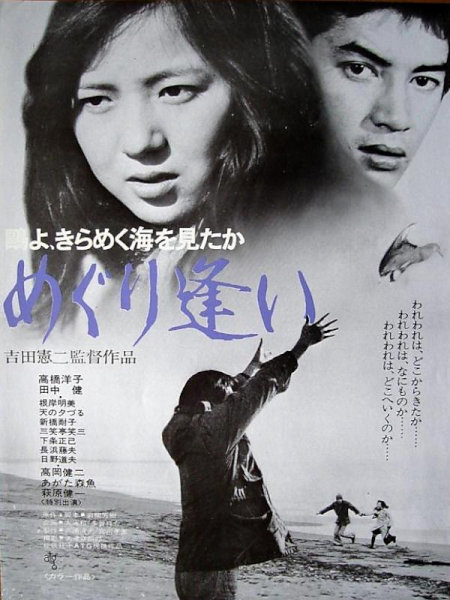
Oh Seagull, Have You Seen the Sparkling Ocean? : An Encounter (鴎よ、きらめく海を見たか めぐり逢い, Kenji Yoshida, 1975)

seagullSparkling seas sound like hopeful things, especially if you’re a majestic seagull flying far above, bathed in perpetual sunshine. But then, perhaps the water below is shining with the shards of broken hopes which float on its surface, is its beauty treacherous or in earnest? So asks the singer of the title song which recurs throughout the film as if to undercut even its brief moments of happiness. There is precious little joy to be found in the lives of the two protagonists of Oh Seagull, Have You Seen the Sparkling Ocean? : An Encounter (鴎よ、きらめく海を見たか めぐり逢い, Kamome yo, Kirameku Umi wo Mitaka: Meguriai), only pain and confusion as they try to rebuild their ruined lives in an uncaring city.

Katsuo is a drifting young man, one of the many to have escaped the mining industry after the pits began to close down but now finds only temporary manual work available to him. In Tokyo, he works as part of a window washing team, gazing into high rise office buildings which are a world away from his precarious hand to mouth existence. In one particular window he spots an office lady attempting to straighten her stockings in an otherwise empty room. Smitten he decides to pursue the woman though she is far from interested in a peeping tom of a window guy who’s coming on far too strong.

Kumi has her own problems. Like Katsuo she’s found herself in the city after escaping a life of poverty and the unwanted attentions of a relative in a fishing village. Her sights are set a little higher in the increasingly consumerist environment of ‘70s Tokyo, hence her high rise career and desire to find the right kind of husband. However, even here, she doesn’t seem able to get away from possessive men and is stalked by an ex-boyfriend who just won’t take no for an answer.

Eventually Kumi and Katsuo grow closer but on a visit to the beach come across an injured seagull which Kumi immediately tries to bury despite the fact it isn’t actually dead yet – better to die than live on in shame, says Kumi. Katsuo disagrees and decides to take it home and nurse it back to health though Kumi breaks up with him because of it. After a chance encounter the pair get back together but their fragile love story is under attack from every possible direction.

Katsuo and Kumi have each led difficult lives though they have very different ways of coping with trauma. Katuso has retreated into a fantasy world inspired by Gaugin’s famous painting Where do we come from? What are we? Where are we going?. When he first meets Kumi, all Katsuo can talk about is Resipuruko and how wonderful everything will be when he gets there. The speech exasperates Kumi who at first feels stupid for not having heard of Resipuruko, but then cheated to discover its just a made up place of the kind that children create out of fun. Nevertheless, Resipuruko continues to become a symbol in their lives, a place of hope and peace in which they would be able to live together freely and in comfort, away from the difficulties of everyday city life.

Katsuo is cheerful and optimistic. Not exactly forward looking but proceeding in the name of hope. Kumi is driven more by fear and resentment, constantly looking behind her rather than ahead. Though Katsuo’s life has not been easy, Kumi has experienced more suffering with less agency which has left her with far less capacity for making the best of things. Like Nina in Chekov’s play, she is the seagull – something beautiful, destroyed, just because it could be. Katsuo’s efforts to heal the wounded bird run in parallel to his desire to save Kumi but then, the seagull wants to be free and Kumi is forced to feel as if she never will be.

At one point Kumi says she and Katsuo are on different sides of an invisible window and it’s true that they’re opposites in many ways – he thrives on fantasy, she is destroyed by reality, but they could be perfectly happy together if it weren’t for the vagaries of fate.  Oh Seagull, Have You Seen the Sparkling Ocean? : An Encounter, is a tale of tragedy as young lives are ruined by time and circumstance, leaving them with only broken hearts to face the unfair world before them. Resipuruko exists only in a spiritual sense, but it can be called forth if you believe in it enough. Dreams are fragile things, whether realistic or fantastical, but they, like the seagull, deserve their time to fly unfettered.


Original trailer (no subtitles)