Forget Love for Now (恋も忘れて, Hiroshi Shimizu, 1937)

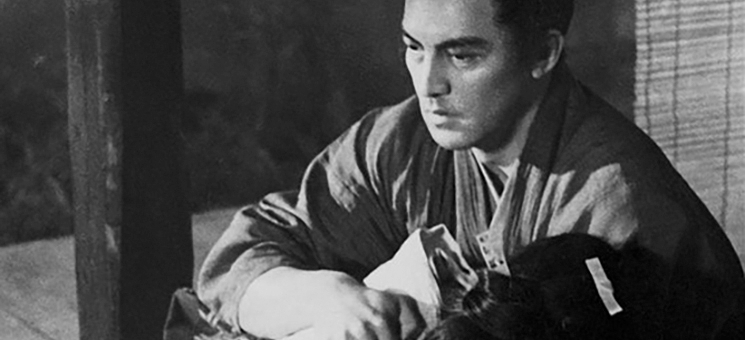
vlcsnap-2016-09-21-02h01m08s449Sad stories of single mothers forced to work in the world of low entertainment are not exactly rare in pre-war Japanese cinema yet Hiroshi Shimizu’s 1937 entry, Forget Love For Now (Koi mo Wasurete) , puts his on own characteristic spin on things by looking at the situation through the eyes of the young son, Haru (Jun Yokoyama). Frustrated by both social and economic woes, little Haru’s life is blighted by loneliness and resentment culminating in tragedy for all.

Oyuki (Michiko Kuwano) is a single mother and bar hostess in a port town. Her young son Haru loves his mum even though he’s often on his own but after he makes the mistake of inviting some of the other boys back to his mother’s apartment and they end up getting doused in her rather pungent perfume, the other kids’ mothers figure out what Oyuki does for a living. Predictably they forbid their kids from associating with Haru because his mother is “a bad woman”. After repeatedly trying to keep hanging out with the other children, Haru starts skipping school to avoid the constant exclusion entirely. When Oyuki finds out about this she is very upset and has him moved to another school but the old group of kids and the new group of kids are not entirely unconnected and so Haru is unable to escape the prejudice his old group of friends hold for him.

The film never goes into how Oyuki ended up on her own with a young child or what might have happened to Haru’s father but Oyuki’s role as a single mother is not the reason the pair are excluded from the other families. Lacking other opportunities, Oyuki is forced to into work as a bar hostess even though she clearly hates it and bears it only for her son’s sake.

Her job is to entertain men in the bar to keep the drinks flowing, always smiling and flirting to keep dull men trapped in the false hope of real connection. She gets paid very little for this as we find out early on when she tries to spearhead a kind of union movement in the bar by questioning why their work costs them so much – they have to pay for their outfits, food and drink out of their own wages when the girls working at other establishments get a share of the alcohol profits which they have helped to generate but Oyuki and her friends get only their meagre salaries. Their pleas fall on hard ears with the tough as nails mama-san who isn’t going to permit any kind of mutinies in her establishment. This is made clear later on when one employee tries to quit her job at the bar and move to Kobe in search of more lucrative employment but is beaten black and blue by the bar’s goons.

Oyuki’s single ray of hope comes in the form a sinister figure lurking in the shadows outside her apartment. Eventually becoming friends with Oyuki and her son, the man represents a possible happy ending in which he beats the depression, finds a better job and takes them both away from this world of poverty of degradation. Needless to say this is not to be – the man’s attempts to find a solution to everyone’s problems take to long and he is simply too late. Not only that, his well meaning words of advice to Haru that he should make sure to win against the bullies next time have disastrous consequences.

In essence, Forget Love For Now is “hahamono” in which Oyuki bravely sacrifices everything of herself in her son’s name, committed to the idea that he will progress through his education to university and repay all of her efforts by becoming a fine man. Society, whilst praising the idea of the self sacrificing mother, does not approve of the things she has to do in that very sacrifice she’s making and refuses to allow her success in her mission. The true tragedy is that the little boy, Haru, is aware on some level of everything his mother is doing for him and loves her so much that he is willing to sacrifice himself for her – rendering her long years of suffering entirely pointless.

In the end, Oyuki has nothing. As the title of the film tells us, not even love is permitted to her as she loses both her son and the possibility of romance as her well meaning man makes a now equally pointless sacrifice of his own. Forget Love For Now is somewhat atypical in Shimizu’s output as it ends with no hope in sight, strongly condemning this rigid society which forces women to act in a way of which it disapproves and then refuses to support them when they do. Shooting mostly on stage sets rather than the naturalistic settings featured in much of his other work, Shimizu crafts an emotionally devastating tale of maternal sacrifice cruelly frustrated by a cold and unfeeling society.


Belladonna of Sadness (哀しみのベラドンナ, Eiichi Yamamoto, 1973)

belladonnaLoosely based on Jules Michelet’s La Sorcière (Satanism and Witchcraft) which reframed the idea of the witch as a revolutionary opposition to the oppression of the feudalistic system and the intense religiosity of the Catholic church, Belladonna of Sadness (哀しみのベラドンナ, Kanashimi no Belladonna) was, shall we say, under appreciated at the time of its original release even being credited with the eventual bankruptcy of its production studio. Begun as the third in the Animerama trilogy of adult orientated animations produced by legendary manga artist Osamu Tezuka’s Mushi Productions, Belladonna of Sadness is the only one of the three with which Tezuka was not directly involved owing to having left the company to return to manga. Consequently the animation sheds his characteristic character designs for something more akin to Art Nouveau elegance mixed with countercultural psychedelia and pink film compositions. Feminist rape revenge fairytale or an exploitative exploration of the “demonic” nature of female sexuality and empowerment, Belladonna of Sadness is not an easily forgettable experience.

Beginning in true fairytale fashion with a gentle voiceover, the tale introduces us to Jean (Katsutaka Ito) and Jeanne (Aiko Nagayama), two ordinary medieval French peasants blissfully in love. Being the good, honest, Christian kids they are, they want to get married but as we’re told, this is the beginning of the story, not its end. Following tradition to the letter the pair turn up at the castle with their families to inform the Baron of their union and pay the marriage tax but the Baron takes a fancy to Jeanne and whacks up the price to a level Jean could never pay even if the entire village sold everything they had to help him, so that the Baron may exercise his droit du seigneur by claiming Jeanne’s maidenhead. After kicking everyone else out the Baron brutally rapes Jeanne before letting all of his cronies have a go too.

Finally crawling home bruised, broken, and violated Jeanne seeks comfort from her gentle husband Jean but despite his fine words, he is unable to accept what has happened and eventually retreats from her. At this point the weirdness begins as Jeanne’s intense inner rage and sadness summons forth a tiny demon friend who looks just like an overly friendly penis and also grows in size a little bit when you stroke him in just the right way. This starts Jeanne on her ultimate path towards becoming a master sorceress and eventual mistress of the devil himself. Jeanne’s fortunes rise in line with her sexual empowerment but an empowered female is not always popular with the ruling elite.

Jeanne’s empowerment and the subsequent threat it poses to the accepted political fabric is the main thrust of the narrative but it’s also important to remember that the process began with a brutal act of rape. Jeanne continues to be raped by her ever growing demon friend until achieving a kind of oneness with the Devil himself but the unwanted acts of Jeanne’s “demon”, who describes himself simply as a part of Jeanne, are mitigated because she is depicted as enjoying them (only guilt makes her say otherwise) and, after all, they form part of her sexual education. Jeanne’s power stems from the intense resentment she feels at her continued lack of agency, eventually buying her power and status enough to threaten the Baron and all he stands for.

Even if Jeanne’s power comes from the darkest of places, everything she uses it for is morally good (at least from a “modern” standpoint). When the Baron returns from a war to find Jeanne ruling the roost, he attempts to canvass some of his subjects hoping to hear tales of her cruelty or ineptitude but finds only praise. Jeanne heals the sick, helps a couple with too many children find a solution to maintain their married harmony without the risk of bearing any more, and even helps an elderly woman make contact with the depths of hell (wasn’t exactly what she had in mind, but she was thrilled to bits anyway).

The worst thing Jeanne’s power provokes is the large scale and extremely strange orgy which takes place in her hair, sees her copulating with the entire village, and even transforms genitals into bizarre creatures. This purely pleasurable exercise, even if against the prevailing moral code, has no real world consequences such as a failed harvest or ruined city brought about by the villager’s abandonment of duty for physical pleasure.

However filled with “goodness” her actions are, Jeanne herself is branded a witch and the only reason she is not burned at the stake immediately is that the Baron and his advisors fear that if Jeanne is burned whilst still bound to the devil, the demonic elements inside her will be set free and could “pollute” the other women in the village with a nasty desire to be taken seriously as people. This fear is later borne out as each of the village women emerges with Jeanne’s impassive face before time jumps on a few hundred years to the French Revolution and its vanguard of valiant women seeking social justice as evidenced by Eugène Delacroix’s 1830 painting Victory Leading the People which forms the final image of the film.

Belladonna of Sadness seems conflicted over whether this kind of empowerment is a good thing or not. Jeanne’s journey begins with violence which gives birth to rage and an eventual “succumbing” to the dark arts which facilitates her revenge. Everything about Jeanne becomes satanic and her sexuality is the weapon which she wields against male subjugation. The empowered Jeanne is independently monstrous, rather than just monstrous to the Baron and the true forces of evil, thanks to her involvement with illicit supernatural entities. Her independent spirit does indeed pollinate as the Baron feared it might, but whether these women are to be read as having been “freed” or as vengeful harpies robbing men of their rightful place whilst intent on upending the social order, might be a matter for debate.

Yamamoto opts for a mix of styles making great use of still paintings and more primitive animation to enhance the effect. Combined with the very contemporary sounding folk music, the later ventures into the realm of psychedelia lend the film a new age fable quality to present a broadly feminist rape revenge fairytale. However, this particular story offers no happy ending for its heroine even if it does retroactively add one in the form of the ongoing social change her various transgressions engender. Wildly experimental, often extremely beautiful, and necessarily explicit, Belladonna of Sadness is, as its name suggests, a melancholy tale but one just as passionately free as its tragic heroine.


Cinelicious Pics restoration trailer (English subtitles, NSFW)

Revivre (화장, Im Kwon-taek, 2015)

revivreThe 102nd film from veteran Korean film director Im Kwon-taek may appear close to the bone in its depictions death, suffering, and the long look back on a life filled with the quiet kind of love but Revivre (화장, Hwajang) is anything but afraid to ask the questions most would not want to hear as the light dwindles. The inner journey is just too hazy, as one man puts it, unknowingly commenting on the human condition, yet Im does manage bring us nicely into focus, if only for a moment.

Oh (Ahn Sung-ki), a successful salaryman working in marketing for a cosmetics company, finds himself slightly adrift as the brain tumour his wife, Jin-kyung (Kim Ho-Jung), had previously suffered from resurfaces. The treatment this time is apparently not as successful leading to prolonged hospitals stays as Jin-kyung’s condition deteriorates and she begins to require a greater level of medical care. While all of this is going on, Oh is still very much dedicated to his work but has also begun to indulge in an old man’s folly, fantasising about the pretty new girl at the office.

Much of Revivre is concerned with Oh’s inner life, the things he does not say (which are many because Oh is a quiet sort of man). Ahn Sung-ki captures this quality well in playing Oh with a kind of blankness that could be the numbing sensation of grief or an extension of his ordinarily reserved nature. This makes his impromptu verbal attack on the figure of his fixation, Choo Eun-joo (Kim Gyu-ri), all the more unexpected though his remorse over having acted in such an out of character way may actually help to generate a kind of relationship between the pair albeit more of a paternal than romantic one.

Oh’s continuing fixation on Eun-joo, the woman who becomes the accidental focus of his world even though his wife lying dies in a hospital, is intended to be a fantasy and nothing more. An early dream sequence sees Oh participating in an elaborate traditional funeral taking place in a desert in which all of the mourners are dressed in black, except, of course, for Eun-joo – the only fixed point of reference, clothed in vibrant purple and smiling back at him in contrast to the solemn faces of the other guests, each staring at the floor. In the real world time slows down for him as Eun-joo dances youthfully in a nightclub and as he leaves the party early, her’s is the lone still face, haunting him as he looks back at the other revellers still enjoying themselves heartily even outside the club.

Indeed, “looking back” with all of its various advantages and disadvantages becomes another central theme as Oh becomes a kind of Orpheus descending into his own personal hell in the hope of dragging back his departed Eurydice – an idea neatly recreated in one of the film’s few outright fantasy sequences in which Oh dreams himself into an avant-garde dance show. Like Orpheus, Oh cannot help but look back though he risks losing all in the process. What Eun-joo represents for him is perhaps not the woman herself but an image of his own youth and a desire to live again as he once lived before. The present and the past begin to overlap for him, Eun-joo becomes the future he cannot touch as well as the returning spectre of a past he cannot return to.

Oh’s daughter asks him at one point if he ever really loved her mother. His reaction to losing his wife is, it has to be said, restrained, practical. Yet this question is answered with an immediate cut to Oh helping his wife to the bathroom, performing the most intimate of tasks with unwavering devotion. As his wife fades, Oh’s fantasies become a shield against the growing fears of his own mortality as his body also begins to fail him. The melancholy sense of loss and loneliness coupled with the inevitability of the passage of time pervade as each of Oh’s points of reference slips away from him at exactly the same time.

Im opts for a non-linear approach beginning with Jin-kyung’s passing and thereafter moving freely, reflecting Oh’s fleeting memories and interior confusion as he deals with such a traumatic, life altering event. Neatly framing Oh’s dilemma within his work in which he faces a choice of sticking with the current marketing strategy or striking out in a bold new direction, Im plays with the eternal theme of transient beauty in a society which prizes bodily perfection above all else. The film’s Korean title plays on a pun involving a homonym which means both “cremation” and “makeup” perhaps harking back to the central theme that you dig a grave for yourself if you attach the wrong sort of importance to the impermanent, but is in a sense ironic as one represents a final acceptance and the other an attempt to hold off the inevitable. Poetic and intensely moving, Revivre is another characteristically multilayered effort from Im, still at his full strength even in this late career effort.


International trailer (English subtitles/captions)

700 Days of Battle: Us vs. the Police (ぼくたちと駐在さんの700日戦争, Renpei Tsukamoto, 2008)

700days-of-battleThose golden last few summers of high school have provided ample material for countless nostalgia filled Japanese comedies and 700 Days of Battle: Us vs. the Police (ぼくたちと駐在さんの700日戦争, Bokutachi to Chuzai-san no 700 Nichi Senso) is no exception. Set in a small rural town in 1979, this is an innocent story of bored teenagers letting off steam in an age before mass communications ruined everyone’s fun.

In the summer of 1979, a group of teenage high school students get their kicks pulling pranks around the neighbourhood. They finally meet their match when a new policeman, Chuzai (Kuranosuke Sasaki), arrives in town intent on actually enforcing the law. When one of the boys is fined for speeding after coming down a steep hill on his bicycle, the guys decide to make Chuzai their new enemy, virtually daring him to arrest them with their constant trolling.

However, things take a turn when the boys move their prank planning meetings to a local cafe and discover the beautiful waitress working there, Kanako (Kumiko Aso). Instantly smitten the boys step up their romance game (donning some fancy outfits in the process) and semi-forget about their mission. Unfortunately Kanako is a married woman and worse than that she’s married to Chuzai! This whole thing just got real.

Chuzai, for all his uptight authoritarianism is onto the boys and their generally innocent mischief. Finding it all very irritating rather than actually dangerous, Chuzai gradually starts playing them at their own game by attempting to prank them back such as in one notable incident where he makes them attend a public behaviour seminar but gives the entire lecture through a ventriloquist’s dummy called Taru-kun. As a slightly older man, Chuzai can see the boys are just hopelessly bored in their backwater town. Breaking with his hitherto austere persona, Chuzai drops the authoritarian line to offer some fatherly advice to the effect that these summers are precious times,  soon the boys’ high school lives will be over and they’ll most likely leave their pleasant small town for the bustling metropolis of Tokyo so they’d better make the most of these aimless days while they can.

Idyllic as it is, the nature of the boys’ mission changes in the second half as the war against Chuzai takes on a slightly more affectionate quality. At this point they decide to use their pranking powers for good to help a little girl who’s stuck in the hospital finally enjoy the summer fireworks she’s been longing for even though the doctors won’t let her out to go to the festival. With the fireworks heist hovering in the background the guys get into various romanctic difficulties while enjoying archetypal teenage summer adventures.

Infused with period detail, 700 Days of Battle: Us vs. the Police has an authentically ‘70s soundtrack with some of the biggest hits of the era running in the background. Frequent cultural references such as a brief appearance from Ultraman add to the atmosphere which has a kind of retro, nostalgic innocence behind it as these kids live in a golden era of friendship and bike riding when the sun is always shining and graduation is still a long way off.

Director Tsukamoto keeps things simple though the production values are high and visual gags are spot on. Somewhat episodic in nature, the tale is split up into various chapters by means of title cards which helps to break up the seemingly endless summer as the boys attempt to fill their otherwise empty days. Apparently this was only the beginning of the “war” against the police, occupying only 108 days of a “conflict” which would finally run to 700. Presumably the guys have finished up their high school days by that point but at least they’ve succeeded in making some amusing memories of their elaborate and sometimes fiendishly clever schemes to take revenge on the surprisingly patient Chuzai-san. Filled with innocent, witty and whimsical comedy 700 Days of Battle: Us vs. the Police offers no great leap forward even within the realm of quirky teen comedies but still manages to provide some old fashioned, wholesome summer themed fun.


Original trailer (English subtitles)

S Storm (S風暴, David Lam, 2016)

s-stormIt’s become almost a cliché to describe a sequel as “unnecessary”, but then assessing how any sequel or, indeed, any film might be deemed “necessary” (for what or whom?) proves more fraught than one might originally think. It might, then, be better to think of certain sequels as “unwise” – S Storm (S風暴), a followup to the similarly named Z Storm is just one such film. Z Storm’s critical reception was, shall we say, lukewarm and did not exactly inspire a burning desire to return to its world of corporate corruption vs different kinds of bickering policemen but, nevertheless, here we are.

Louis Koo returns as ICAC officer William Luk who has the misfortune to see one of his targets assassinated right in front of him. The trail leads him to Hong Kong’s famous Jockey Club and a trading scandal involving illegal behaviour in online football gambling. Being in the wrong place at the wrong time brings Luk into contact with depressed policeman Lau (Julian Cheung Chi-lam) whose sister just happens to work in the bar in which the mysterious hitman everyone is looking for is fond of taking a drink.

Refreshingly, S Storm’s plot is actually very straightforward – bets are being rigged and the people at the top of the tree are in on the plan. Some of them are willing to go try great lengths to stop anyone finding out and spoiling their fun. Cue gangster action and dastardly tricks as the anti-corruption guys try to clean things up. However, S Storm is very much a believer in the power of coincidence. Which is to say, Lau’s sister just happens to wind up fancying the hitman and Luk’s old boss just happens to be right at the centre of the action. Believability is not high on its list of priorities.

Added to the straightforward narrative spine, Lam throws in a number of subplots – the most interesting of them being with the mysterious hitman who visits a photography exhibition for some reason set up in a shopping mall which features scenes from global war zones. It seems our sad but noble hitman was some kind of child soldier (going by his flashback) though this is never fully explored and is rather crudely used to add some kind of spiritual quality to the hitman’s final journey.

Rather than mild rivals, ICAC and CID become awkward friends fairly quickly in the quest to investigate the mysterious deaths and corruption paper trail. Lau is a former gambler with a bad reputation hoping to make something out of himself by solving a high profile case. His relationship with his sister is somewhat strained as she recites the sad story of her upbringing which includes being gang raped by goons looking for a repayment on her brother’s gambling debts (as she improbably shouts out loud to the entire bar in which she works as a way of getting back at her policeman brother who’s asking too many questions). Luk and Lau eventually bond as their conflicting personalities complement each other well enough to create an unbeatable crime stopping team.

What the film lacks in intrigue it tries to make up for with action which it handles well though infrequently. A standout out scene features one of Luk’s female subordinates getting into a fight in a teahouse which is then followed by some fist fighting with the silent yet heroic hitman. Other standoffs are gun based but at least mildly interesting if not particularly original.

S Storm has some odd ideas about character arcs, shifting the most interesting elements to the fringes and thrusting the blandest to the front. plot elements are shoehorned in bluntly and without warning such as a forgotten tussle between Luk and a former associate over a woman which quickly becomes irrelevant. Luk is also given a rather odd character moment when he comes across the dying body of another major character and simply nods, as if identifying with their plight or sympathising believing that they’ve found peace now or some other such nonsense (given that he has never actually met this person and knows nothing of their backstory). The film’s rather abrupt ending in which justice is served but the bodies remain where they fell remains unsatisfying and testifies to the ultimate failure to make the scandal laden content as interesting as it strives to be.


Original trailer (English subtitles)

Tokyo Serendipity (恋するマドリ, Akiko Ohku, 2007)

tokyo-serendipityCities are often serendipitous places, prone to improbable coincidences no matter how large or densely populated they may be. Tokyo Serendipity (恋するマドリ, Koisuru Madori) takes this quality of its stereotypically “quirky” city to the limit as a young art student finds herself caught up in other people’s unfulfilled romance only to fall straight into the same trap herself. Its tale may be an unlikely one, but director Akiko Ohku neatly subverts genre norms whilst resolutely sticking to a mid-2000s indie movie blueprint.

Yui Aoki (Yui Aragaki) is in search of a new apartment. She had been living in an unusual old fashioned building with beautiful stained-glass windows, but her sister’s in line for a shotgun marriage and if that weren’t trouble enough the apartment is set for demolition. Living on her own for the very first time, Yui moves into a smallish modern apartment in a building filled with various eccentric residents.

One in particular catches Yui’s attention – her mysterious upstairs neighbour, Takashi (Ryuhei Matsuda). By coincidence, Yui ends up working with Takashi at his lab where she learns he’s still broken up about a girlfriend that left him flat without even a word of goodbye. Remembering she left something behind at her old place she ends up meeting the new tenant, Atsuko (Rinko Kikuchi), and striking up a friendship with her over a shared interest in homemade furnishings. The coincidences continue as Yui discovers she and Atsuko have accidentally swapped apartments! Through this odd chain of events Yui also figures out that Atsuko is Takashi’s long lost love, but is hopelessly trapped in the middle, unsure of whether she should reveal this information to either party. Of course, her developing feelings for both Atsuko and Takashi place her in a series of difficult positions.

Tokyo Serendipity was sponsored by an interior design company and so it’s no surprise that the film makes quite a lot out of its production design. The fashion choices are very much of the time and favour quirky, individual aesthetics rather than an Ikea-esque off the peg minimalism. The original apartment which is soon to by bulldozed is an artist’s dream with its hidden fireplace, old fashioned furniture, stained glass windows and well lit interior. Broadly inspirational in this regard, it’s a thrifty kind of homestyle which prizes recycled materials and repurposed furnishings as opposed to the trendy high price surroundings of other parts of the city.

Like many other films of its kind from this era, Tokyo Serendipity adopts a natural, if occasionally surreal, approach filmed with a deadpan camera. The film’s one repeated large scale gag – a group of lucha libre wrestlers who work as removal men during the day, is a good example of this as their not improbable existence somehow seems oddly funny. They drop things but only in the ring – so they say, each of them well built men treating Yui’s precious goods as daintily as children using real china at a tea party. The humour could best be described as subtle, yet does succeed in raising a smile here and there.

Smiling turns out to be the film’s main message. In fact Ohku even states that her intention in making the film was solely to leave people with a smile of their faces – something which she broadly achieves. Atsuko, a slightly lost middle aged woman, claims she became an architect as she wanted to build a house with everybody smiling – something Yui echoes as she comes to a few conclusions of her own nearing the end of the film. However, Atsuko’s desire for harmony in all things is one she’s never been able to fulfil as childhood abandonment has left her with lingering commitment issues. Simply put, she always leaves first. Interestingly enough, Yui’s burgeoning romance takes a backseat to her growing friendship with Atsuko and a half-formed acknowledgment of middle-aged regrets she’s still to young to fully understand.

Despite amassing almost all of the conventional romantic comedy/drama motifs from a last minute dash to the airport and misdirected letters to an embarrassing scene where a relative is mistaken for a lover, Ohku rejects the romantic model as her central character wisely recognises exactly where she stands in this awkward situation and makes a sensible decision motivated by the best interests of both of her friends. Straightforwardly indie in style, Ohku keeps the quirk on a low simmer but manages to make her heightened reality seem perfectly natural. An unusual coming of age film trapped inside an indie romance, Tokyo Serendipity is like one of the tiny hidden spaces the film seems to like so much, though upon opening the door some will be more impressed with what they find than others.


Original trailer (no subtitles)

Flying Colors (ビリギャル, Nobuhiro Doi, 2015)

flying-colorsBelow average student buckles down and makes it into a top university? You’ve heard this story before and Nobuhiro Doi’s Flying Colors (ビリギャル, Biri Gyaru) doesn’t offer a new spin on the idea or additional angles on educational policy but it does have heart. Heart, it argues is what you need to get ahead (if you’ll forgive the multilevel punning) as the highest barriers to academic success are the ones which are self imposed. Arguing for a more inclusive, tailor made approach to education which doesn’t instil false hope but does help young people develop self confidence alongside standardised skills, Flying Colors is the story of one popular girl’s journey from anti-intellectual teenage snobbery to the very top of the academic tree whilst healing her divided family in the process.

Little Sayaka Kudo (Kasumi Arimura) got off to a bad start in her academic life, bullied and friendless at primary school. After the teachers refuse to help, Sayaka’s doting mother, Akari (Yo Yoshida), manages to get her into a more exclusive middle school which is affiliated with both a high school and a university which means that Sayaka’s academic destiny is fairly secure. However, though she does manage to make friends at her new school, she falls in with the “popular” crowd and begins dying her hair, rolling her skirt up, and wearing an inadvisable amount of makeup. Knowing that their entrance to high school and university is assured, the girls slack off completely and are at the very bottom of the class.

However, it all comes crashing down when Sayaka is caught smoking and threatened with expulsion. Bravely refusing to give up her friends and have them suffer the same fate, Sayaka is the only one who gets suspended but still risks missing graduation and losing her secured place at university. One of the few people to really believe in her, her mother Akari, arranges for Sayaka to attend an unconventional cram school where the well meaning teacher, Tsubota (Atsushi Ito), encourages her to have a goal, and it’s a lofty one – Keio University, one of the most prestigious institutions of higher education in Japan.

Despite her dismal academic prognosis, Sayaka is not lacking in ability, just the will and belief to see it through. After being so unhappy in primary school, Sayaka values her friendships and status as one of the popular girls and maintaining that side of her life is much more important than getting good grades. Written off by her teachers, no one is prepared to give her the permission to succeed and so she assumes she’s as dim as everyone says she is.

The situation isn’t helped by her home life in which her embittered father (Tetsushi Tanaka) ignores his two daughters in favour of devoting all his attention to his son, Ryuta (Yuhei Ouchida), whom he wants to become a professional baseball player. Vicariously thrusting his own dream on his unsuspecting son, Sayaka’s father is unprepared for the moment Ryuta realises he’s been denied the right to choose for himself and rebels against him as all young men are apt to do. In fact, many of the cram school students are there because of a grudge against an unfeeling father who has had quite an adverse affect on his child’s sense of self worth.

Tsubota is the first person other than her mother to show faith in Sayaka’s abilities and is able to convince her that she might be able to achieve something if she started to apply herself. Speaking to her in terms she can understand, Tsubota hunts down different kinds of study materials to help her along the way gradually raising her scores as she builds belief in her ability to reach her goal. Tsubota is the only teacher at the school and is able to take the time to get to know each of his pupils individually so he can tailor the course to bring out the potential in each of his charges. While the kids are studying to pass exams, Tsubota is studying pop culture so that he can talk to them on their own level and find out the best ways to keep them motivated.

As much as it’s the story of a persistent underdog finally discovering a well of self belief that will sustain them on a difficult path, Flying Colors is also an indictment on the modern educational system which only caters for the group rather than the individual and is so concentrated around rote learning and standardised tests that it fails to teach young people the critical thinking skills they need to succeed in life. Flying Colors probably is not going to influence public educational policy but it does offer an amiable and inspirational story that might give hope to those struggling under its often unreasonable demands.


Original trailer (English subtitles)

What Made Her Do It? (何が彼女をそうさせたか, Shigeyoshi Suzuki, 1930)

what-made-her-do-itLike many other areas of the world in the first half of the 20th century, Japan also found itself at a dividing line of political thought with militarism on the rise from the late 1920s. Despite the onward march of right-wing ideology, the left was not necessarily silent. Ironically, the then voiceless cinema was able to speak for those who were its greatest consumers as an accidental genre was born detailing the everyday hardships faced by those at the bottom end of the ladder. These “proletarian films” or “tendency films” (keiko eiga) were increasingly suppressed as time went on yet, in contrast to the more politically overt cinema of the independent Proletarian Film League of Japan, continued to be produced by mainstream studios. Long thought lost, Shigeyoshi Suzuki’s What Made Her Do It? (何が彼女をそうさせたか, Nani ga Kanojo wo Sousaseta ka) was a major hit on its original release with some press reports even claiming the film provoked riots when audiences were passionately moved by the heroine’s tragic descent into madness and arson after suffering countless cruelties in an unfeeling world.

Though still only a child, Sumiko (Keiko Takatsu) has been sent alone to the house of her uncle in a distant village but has run out of money for travel and food. Luckily she meets a kindly cart driver, Doi, who feeds her and takes her most of the way to her uncle’s village but he will be the last “kind” person that she encounters on her long and sad journey. As it turns out, her father had not informed his brother of Sumiko’s arrival and actually had not even had any contact with him for many years. Consequently, Sumiko’s uncle is not exactly overjoyed to see her as he already has a house full of children he struggles to feed (not to mention a healthy appetite for drink). Eventually he sells her to a circus where she is cruelly treated by fellow performers and the sadistic ringmaster.

Things are looking up when Sumiko escapes with fellow performer Shintaro (Ryuujin Unno) but the pair are divided by fate landing Sumiko in trouble with the law after she falls in with a gang of thieves. A spell in the workhouse is followed by patronising treatment as a servant for a wealthy family, and later an otherwise successful tenure as a housekeeper for a leacherous biwa player, before a tiny window of happiness opens up only to immediately cloud over again. Ending up at the “Garden of Angels” Christian reform institution for “wayward women” Sumiko tries God on for size but finds him wanting.

Long thought lost, a partial print of What Made Her Do It? turned up in Russian archives in the ‘90s (presumably following its export as a suitably socialist film) and has since been restored with additional intertitles replacing the missing portions. The opening sequence of Sumiko beginning her journey by train and the presumably spectacular finale of Christ on fire as Sumiko dances madly in the flames of the burning church are both missing but even so the drama rams home the seriousness of Sumiko’s plight as she finds only hypocrisy and selfishness at every turn.

Keiko Takatsu perfectly plays Sumiko’s essential sadness as well as her growing resilience and barely suppressed resentment towards the constant cruelty she experiences. All pleading eyes and sorrowful looks, Sumiko suffers while others exploit her for their own ends. Betrayed by her uncle who pockets the money her father enclosed for Sumiko’s care and purposefully hides from her the fact that her father is likely dead, Sumiko is left adrift in a world in which it’s impossible to survive without family. The state surfaces in her life with the supposedly progressive environment of the workhouse which feeds and houses her whilst exploiting her forced labour. The well to do household in which she is offered opportunity is little better as the cruel mistress of the house constantly exerts her authority, stresses the differences in social status, and denies her maids even small pleasures such as soy sauce on pickles in order to maintain discipline.

Finally Sumiko ends up in the house of God though what she finds there is repression and forced religiosity rather than the love and support proudly displayed in the credo. The Garden of Angels is, presumably, filled with women who have somehow disappointed modern moral codes with Christian virtues expressly emphasised and contact with the outside world forbidden. Residents are allowed to leave once they’ve proved they’ve accepted Jesus into their hearts and are resolved to live in a more “proper” manner, though Sumiko falls foul of the rules after another woman talks her into writing a letter to a friend on the outside.

When the letter is discovered, the other woman is sent to solitary as the head of the establishment informs her that her sin “will never be forgiven”, while Sumiko is forced to make a public self criticism to atone for her selfish disregard for the rules. This backfires when Sumiko’s inner rage takes hold, leading her to take a stand by decrying the hypocrisy of the religious establishment which preaches that God is love and all will be forgiven but ultimately offers nothing other than fear and hate. When the church burns down the woman in charge is the first out the door with her valuables in hand leaving the other women to discover their own salvation amongst the ashes.

Suzuki’s technique is clearly informed by foreign cinema especially that of socialist films from the Soviet Union. Using frequent dissolves and montages, Suzuki throws in impressive set pieces such as scene in which the camera pulls away from Sumiko after she receives some bad news with a door closing across it and snow falling outside. A long lost left wing populist effort, What Made Her Do It? is also a classic melodrama of female suffering as the heroine experiences just about every degradation possible whilst remaining steadfastly defiant in the face of tragedy before the final irony of her eventual position drives her into madness. What made her do it? An intensely self-interested world. Some things don’t change.


The Mamiya Brothers (間宮兄弟, Yoshimitsu Morita, 2006)

mamiya-brothersEver the populist, Yoshitmitsu Morita returns to the world of quirky comedy during the genre’s heyday in the first decade of the 21st century. Adapting a novel by Kaori Ekuni, The Mamiya Brothers (間宮兄弟, Mamiya Kyodai) centres on the unchanging world of its arrested central duo who, whilst leading perfectly successful, independent adult lives outside the home, seem incapable of leaving their boyhood bond behind in order to create new families of their own.

Older bother Akinobu (Kuranosuke Sasaki) and younger brother Tetsunobu (Muga Tsukaji) live together in a small apartment in Tokyo where they enjoy hanging out keeping track of baseball games and watching movies rented from the local store where Akinobu has a crush on the cashier, Naomi (Erika Sawajiri). They are perfectly happy but sometimes frustrated that they don’t have girlfriends so they decide to host a curry party and invite Naomi over in the hopes that she might develop an affection for Akinobu. So that she won’t feel weird about going to the house of two middle-aged guys she doesn’t really know, Tetsunobu invites a reserved teacher, Yoriko (Takako Tokiwa), from the primary school he works at as a caretaker though he “never dates coworkers” and is only really asking her as a backup for Akinobu.

Against expectation the both ladies agree to attend the curry party which actually goes pretty well though neither man is fully capable of following up on the opportunities presented to him. Outside events provide a distraction as Akinobu is swept into his adulterous boss’ divorce crisis and Tetsunobu becomes fixated on a damsel in distress who has no desire to be rescued by him. As much as the boys might want to form independent relationships for female companionship, their brotherly bond is more akin to a marriage in itself leaving both of them unwilling to abandon the status quo for a new kind of happiness.

These kinds of closely interdependent sibling relationships are more often seen between sisters, often as one or both of them has rejected offers of marriage for fear of leaving the other on the shelf. Elderly spinsters and their histories of unhappy romance are almost a genre in themselves though they often present the peaceful co-existence of the two women as a double failure and ongoing tragedy rather than a perfectly legitimate choice each may have made to reject the normal social path and rely solely on each other. The Mamiya Brothers neatly subverts this stereotype, presenting the relationship of the two men as a broadly happy one though perhaps tinged with sadness as it becomes clear that the intense bond they share is holding each of them back in a kind of never ending childhood.

Indeed, though they live alone together and have steady jobs, whilst in each other’s company the brothers regress back to childhood by spending their spare time riding bikes around the neighbourhood and playing on the beach. They are each keenly aware of how they must appear to members of the opposite sex and are always mindful not to appear “creepy”. Accordingly, they’re careful about which DVDs they check out so that Naomi doesn’t get a bad impression of them, and they’re sure to make it clear that both girls can bring other people to their parties so they won’t think there’s anything untoward going on. Throwing quick fire questions back for and constantly making references to private jokes the boys are effectively a manzai duo performing for an audience of two, perpetually suffocating inside their self made bubble.

Though they might not find love, the boys do at least make some new friends. Naomi’s sister, Yumi (Keiko Kitagawa), is exactly the kind of girl they’d usually steer clear of lest she begins to make fun of their old fashioned ways yet she actually becomes an ally and even a friend after spending time hanging out in the brothers’ odd little world. Yumi and Naomi are, in many ways, almost as closely connected as Akinobu and Tetsunobu though they both currently have boyfriends even if they find them equally disappointing.

The teacher, Yoriko, also finds herself unlucky in love as she pursues a relationship with a colleague who doesn’t seem particularly invested in her and is lackadaisical about even the smallest forms of commitment. Tetsunobu seems to have discounted her as a romantic partner under his “no coworkers” rule and is either unaware or deliberately ignoring her growing feelings for him. It may be that he invited Yoriko as a love interest for his brother precisely because he was interested himself and wanted to eliminate the problem, but he may come to regret outwardly rejecting this chance of mutual affection turning into something more solid.

When push comes to shove it might just be that the Mamiya Brothers are happiest in their own company and have no desire to move on and leave their arrested development behind. Though tinged with a degree of lingering sadness as it appears the boys do have a desire to form bonds outside of their mutually dependent bubble, they are after all quite happy and mostly fulfilled in their life together. Cute and quirky, if at times melancholic, The Mamiya Brothers is a strange tale of modern romance in a world where no one really grows up anymore. The brothers are clearly not afraid of broadening their horizons, but might prefer to continue doing so together rather than finding their own, independent, paths.


Original trailer (no subtitles)

A Scene at the Sea (あの夏、いちばん静かな海, Takeshi Kitano, 1991)

scene-at-the-seaReview of Takeshi Kitano’s A Scene at the Sea – first published by UK Anime Network.


Takeshi Kitano’s third feature, A Scene at the Sea (あの夏、いちばん静かな海, Ano natsu, Ichiban Shizukana Umi), is about as much of a departure as it is possible to make from his first two films. Not only does Kitano not star, but he eschews his focus on down and dirty, grimy crime thrillers in favour of a poetic tale about a boy who falls in love with the sea. Largely told without dialogue, A Scene at the Sea is Kitano in one of his more contemplative moods as he creates an existential fable of one man’s search to find his place.

Shigeru (Claude Maki) has a dull and unfulfilling life as a dustman, endlessly staring out over the beautifully blue seas of his harbour town as if searching the horizon for some kind of destiny. His luck changes when he finds an old broken surfboard on one of his rounds and manages to repair it. Lacking the proper equipment, Shigeru takes to the seas to indulge his new sport after stripping down to his pants and T-shirt while his girlfriend Takako (Hiroko Oshima) watches him from the sands, lovingly folding his clothes as she waits for him. Over time Shigeru’s love for surfing begins to pull him away both from Takako and from his everyday life on land as he starts skipping work to spend more time riding the waves.

Shigeru is deaf and mute and his girlfriend Takako is more or less silent too, hence the overall lack of dialogue in the film though words are not especially necessary in their relationship. Shigeru is constantly isolated from all social groups (aside from his friendship with Takako) whether it be his inability to join in with workplace banter or the rejection of the snobbish surfers who laugh at his original attempts on the board whilst also grudgingly praising his determination to brave the cold seas without even a wet suit. Though he also had a kind of ally in his partner for dust round, the only person to try and help Shigeru is the owner of a surf shop who sees potential in him and convinces Shigeru to enter a competition. However, at the competition itself there is no one to help him participate – Shigeru misses his opportunity to surf because he can’t hear them call his name. The surf shop owner berates the other surfers for not helping Shigeru, but they continue to ignore him even after he’s been semi-admitted to the group.

Shigeru perseveres despite his lack of ability and paucity of equipment to hone his skills and quickly become a competent surfer. As his obsession with the sea deepens he moves further and further away from Takako. The sea becomes his lover and the surfing a kind of congress or quest for conquest in his new romance. Takako can forgive this growing need for the ocean, but finds herself hurt when she catches Shigeru peeling another girl’s oranges (not a euphemism). Kitano employs another of his beautifully composed long shots to show us Takako wordlessly approaching the pair, who after all are only sitting together on a beach, before stopping indecisively and leaving again without being seen.

The Japanese title of the film, Ano Natsu, Ichiban Shizukana Umi, translates as “That Summer, the Quietist of Seas” which is a little ironic given that calm seas are good for sailors but the opposite of what a surfer needs. The tinge of nostalgic melancholy is clearer here and it’s more obvious that we’re dealing with the remembrance of a past summer, taken from a specific viewpoint, rather than something which is occurring in real time in the present. This may explain some of Kitano’s stranger repeated imagery such as the footballers who never play football and more lyrical, less linear approach to narrative.

Kitano may be in a maudlin mood, but he still injects some of his trademark dark humour notably in the pair of hangers on who follow Shigeru into the world of surfing but spend much of their time bickering about whose turn it is on their shared surfboard, as well as brief appearance from frequent Kitano star Susumu Terajima as a van driver who picks a fight with the police (and loses). Still, A Scene at the Sea is a melancholic vista of a boy lost among the waves, looking for a home on the water. A beautiful, if sad, summer story, Kitano’s third feature is one of his most romantic (in the wider sense) and bears testimony to his talent for crafting intensely moving cinematic poetry.


Original trailer (no subtitles)