 The well known Natsume Soseki novel, Botchan, tells the story of an arrogant, middle class Tokyoite who reluctantly accepts a teaching job at a rural school where he relentlessly mocks the locals’ funny accent and looks down on his oikish pupils all the while dreaming of his loyal family nanny. Hiroshi Shimizu’s Nobuko (信子) is almost an inverted picture of Soseki’s work as its titular heroine travels from the country to a posh girls’ boarding school bringing her country bumpkin accent and no nonsense attitude with her. Like Botchan, though for very different reasons, Nobuko also finds herself at odds with the school system but remains idealistic enough to recommend a positive change in the educational environment.
Travelling from the country to take up her teaching job, Nobuko (Mieko Takamine) moves in with her geisha aunt to save money. When she gets to the school she finds out that she’s been shifted from Japanese to P.E. (not ideal, but OK) and there are also a few deductions from her pay which no one had mentioned. The stern but kindly headmistress is quick to point out Nobuko’s strong country accent which is not compatible with the elegant schooling on offer. The most important thing she says is integrity. Women have to be womanly, poised and “proper”. Nobuko, apparently, has a lot to learn.
As many teachers will attest, the early days are hard and Nobuko finds it difficult to cope with her rowdy pupils who deliberately mock her accent and are intent on winding up their new instructor. One girl in particular, Eiko (Mitsuko Miura), has it in for Nobuko and constantly trolls her with pranks and tricks as well as inciting the other girls to join in with her. As it turns out, Eiko is something of a local trouble maker but no one does anything because her father is a wealthy man who has donated a large amount of money to the school and they don’t want to upset him. This attitude lights a fire in Nobuko, to her the pupils are all the same and should be treated equally no matter who their parents are. As Nobuko’s anger and confidence in her position grow, so does Eiko’s wilfull behaviour, but perhaps there’s more to it than a simple desire to misbehave.
Released in 1940, Nobuko avoids political comment other than perhaps advocating for the importance of discipline and education. It does however subtly echo Shimizu’s constant class concerns as “country bumpkin” Nobuko has to fight for her place in the “elegant” city by dropping her distinctive accent for the standard Tokyo dialect whilst making sure she behaves in an “appropriate” fashion for the teacher of upper class girls.
This mirrors her experience at her aunt’s geisha house which she is eventually forced to move out of when the headmistress finds out what sort of place she’s been living in and insists that she find somewhere more suitable for her position. The geisha world is also particular and regimented, but the paths the two sets of female pupils have open to them are very different. Nobuko quickly makes friends with a clever apprentice geisha, Chako (Sachiko Mitani), who would have liked to carry on at school but was sold owing to her family’s poverty. Though she never wanted to be a geisha, Chako exclaims that if she’s going to have to be one then she’s going to be the world’s best, all the while knowing that her path has been chosen for her and has a very definite end point as exemplified by Nobuko’s aunt – an ageing manageress who’s getting too old to be running the house for herself.
Eiko’s problems are fairly easy to work out, it’s just a shame that no one at the school has stopped to think about her as a person rather than as the daughter of a wealthy man. Treated as a “special case” by the teachers and placed at a distance with her peers, Eiko’s constant acting up is a thinly veiled plea for attention but one which is rarely answered. Only made lonely by a place she hoped would offer her a home, Eiko begins to build a bond with Nobuko even while she’s pushing her simply because she’s the only one to push back. After Nobuko goes too far and Eiko takes a drastic decision, the truth finally comes out, leading to regrets and recriminations all round. Despite agreeing with the headmistress that perhaps she should have turned a blind eye like the other teachers, Nobuko reinforces her philosophy that the girls are all the same and deserve to be treated as such, but also adds that they are each in need of affection and the teachers need to be aware of this often neglected part of their work.
Lessons have been learned and understandings reached, the school environment seems to function more fully with a renewed commitment to caring for each of the pupils as individuals with distinct needs and personalities. Even Chako seems as if she may get a much happier ending thanks to Nobuko’s intervention. An unusual effort for the time in that only two male characters appear (one a burglar Nobuko heroically ejects assuming him to be Eiko playing a prank, and the other Eiko’s father) this entirely female led drama neatly highlights the various problems faced by women of all social classes whilst also emphasising Shimizu’s core humanist philosophies where compassion and understanding are found to be essential components of a fully functioning society.
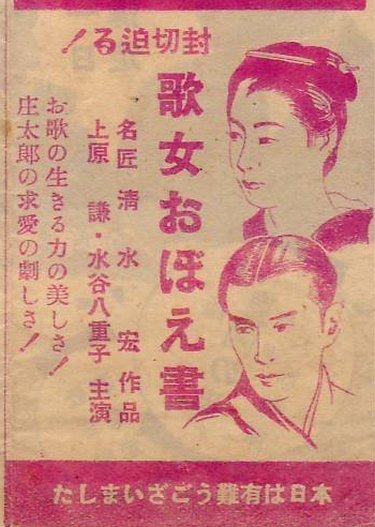 Filmed in 1941, Notes of an Itinerant Performer (歌女おぼえ書, Utajo Oboegaki ) is among the least politicised of Shimizu’s output though its odd, domestic violence fuelled, finally romantic resolution points to a hardening of his otherwise progressive social ideals. Neatly avoiding contemporary issues by setting his tale in 1901 at the mid-point of the Meiji era as Japanese society was caught in a transitionary phase, Shimizu similarly casts his heroine adrift as she decides to make a break with the hand fate dealt her and try her luck in a more “civilised” world.
 Ohara Shousuke-san (小原庄助さん) is the name of a character from a popular folk song intended to teach children how not to live their lives. The Ohara Shosuke-san of Aizu Bandaisan has lost all his fortune but no one feels very sorry for him because it’s his own fault – he spent his days in idleness, drinking, sleeping in, and bathing in the morning. The central character of Hiroshi Shimizu’s 1937 film has earned this nickname for himself because he also enjoys a drink or too and doesn’t actually do very much else, but unlike the character in the song this a goodhearted man much loved by the community because he’s a soft touch and just can’t refuse when asked for a favour. An acknowledgement of the changing times, Shimizu’s Mr. Shousuke Ohara is a tribute to the soft hearted but also an argument for action over passivity.
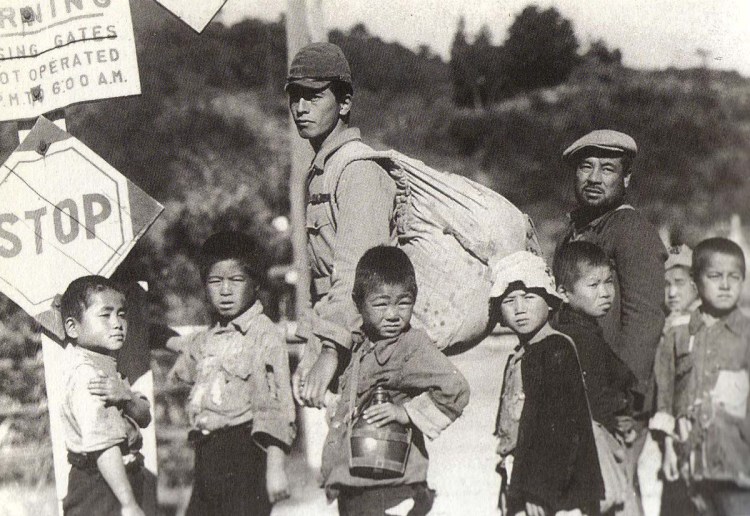 Hiroshi Shimizu is often remembered for his talent as a director of children, something which he brings to the fore with his melancholy meditation on the immediate post-war world in Children of the Beehive (蜂の巣の子供たち, Hachi no Su no Kodmotachi). This is a destroyed society, but one trying to make the best of things, surviving in any way possible. It’s fairly clear from Shimizu’s pre-war work that he did not entirely approve of the way his country was heading. Children of the Beehive seeks not to apportion blame, but merely to make plain that no one can get along alone here, in the post-war world there are only orphans and ruined cities but that itself is an opportunity to rebuild better and kinder than before.
 “The Rainbow Man” sounds like quite a cheerful fellow, doesn’t he? How could you not be excited about a visit from such a bright and colourful chap especially as he generally turns up after the rain has ended? Daiei have once again found something happy and made it sinister in this 1949 genre effort which is sometimes called Japan’s first science fiction film though there isn’t really any sci-fi content here so much as a strange murder mystery with a weird drug at its centre.
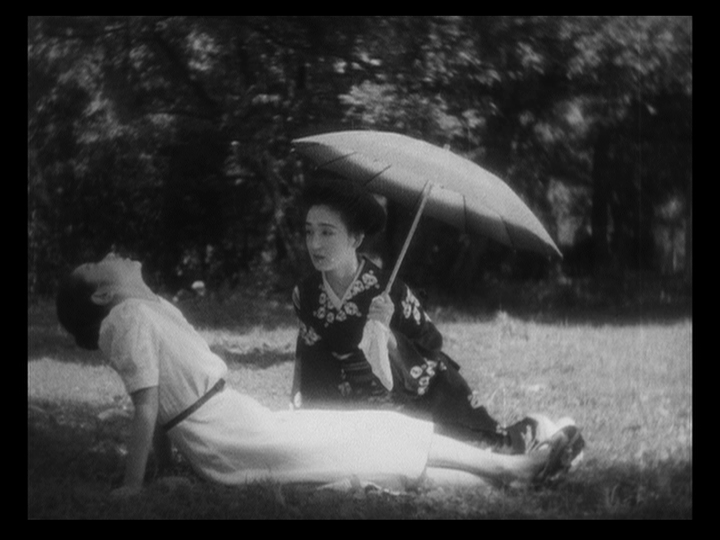 Shimizu goes on holiday! Again! Actually, when you think about it going on holiday is always inherently sad because just like everything else holidays end and you have to return to whatever it was that made you want to go on holiday in the place only with the painful reminder that a more cheerful world exists and you’re no longer in it. That rather depressing preamble out of the way, it’s time to join the temporary residents of a small hot springs resort in the picturesque countryside where a mislaid hairpin is about to kickstart a series of mini epiphanies in the diverse collection of guests.
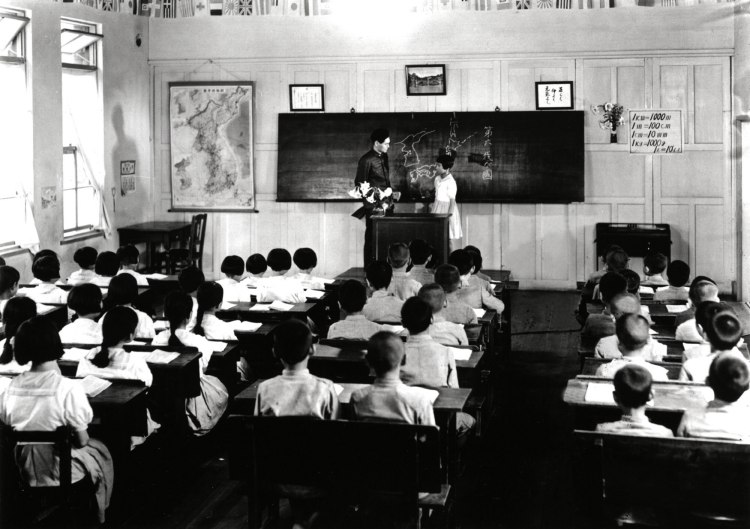 Long thought lost, Tuition (수업료, Su-eop-ryo) is an unusual example of Korean film made during the Japanese colonial period. Released in 1940, the film depicts the lives of ordinary people facing hardship during difficult economic conditions though there is no reference made to the ongoing military situation. The story itself is inspired by a prize winning effort by a real life school boy who was doubtless experiencing something similar to the trials of Yeong-dal, however, directors Choi In-gyu and Bang Han-joon made several subversive changes to the script at the filming stage in an attempt to get around the censorship regulations.
 Feelings can creep up just like that, to quote another movie. Like Wong Kar-Wai’s In the Mood for Love, Temptation (誘惑, Yuwaku) also echoes Lean’s Brief Encounter with its strains of accidental romance between unavailable people even if only one of the pair is already married. However, this time there’s much less deliberate moralising though the environment itself is a fertile breeding ground for the judgemental.

 Released in 1949, The Invisible Man Appears (透明人間現る, Toumei Ningen Arawaru) is the oldest extant Japanese science fiction film. Loosely based on the classic HG Wells story The Invisible Man but taking its cues from the various Hollywood adaptations most prominently the Claude Rains version from 1933, The Invisible Man Appears also adds a hearty dose of moral guidance when it comes to scientific research.
 Windows on Worlds