Okuni and Gohei (お國と五平, Mikio Naruse, 1952)

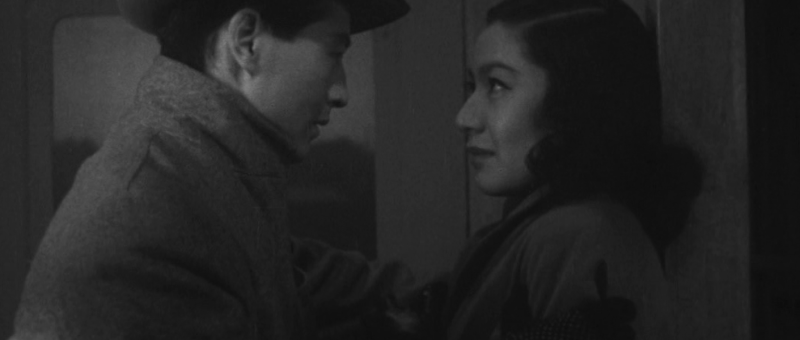
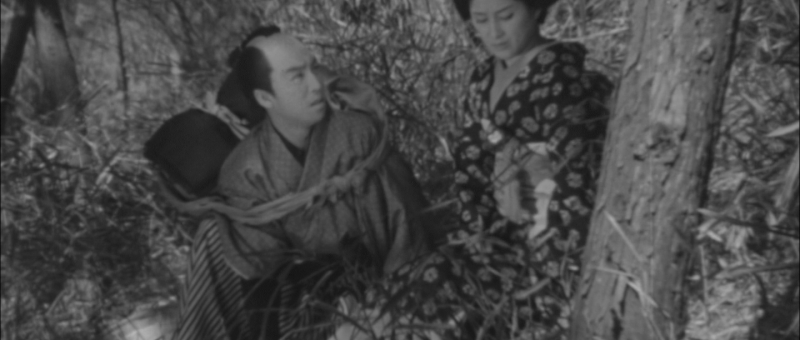
“It’s a rough and difficult road.” The heroes of Mikio Naruse’s Okuni and Gohei (お國と五平, Okuni to Gohei), adapted from a kabuki play by Junichiro Tanizaki, are two displaced between the old world and the possibility of a new one if only they were brave enough to step away from the beaten path. Unbeknownst to them, they are being followed by the man they are seeking whose shakuhachi playing haunts them wherever they go as if taunting them with its presence. 

In this iteration of the tale, Tomonojo (So Yamamura) takes on a slippery quality almost if he were some supernatural devil sent to torment Okuni (Michiyo Kogure) and Gohei (Tomoemon Otani) leading them either towards or away from their salvation or damnation. In Okuni’s flashback, which is obviously coloured with her own nostalgia and regret, he’s a sensitive young man who promised himself in marriage to Okuni. But she is forced to refuse him. Her father rejects Tomonojo because he is without standing or prospects, and instead demands she marry a wellborn man of his choosing, Iori (Jun Tazaki). Iori is then killed in the street, uttering only Tomonojo’s name before he dies. It could then be that this is Tomonojo’s revenge on a society that has rejected him and robbed him of his love, yet the Tomonojo we later meet is much different than this idealised version in Okuni’s memory. He never denies killing Iori and offers no justification for it, but corners Okuni when she’s alone to tell her to free herself by dropping her quest for revenge. He’s also subtly blackmailing her, implying he heard her having sex with her manservant Gohei the previous night and in reality wheedling away pleading for his life.

For her part, Okuni seems torn in her motivations, uncertain whether she’s looking for Tomonojo to reunite with him or kill him, or perhaps is deliberately avoiding finding him at all. She was not married to Iori for very long and he was at the very least an insensitive and emotionally distant husband who spent most of his time at his friend’s house, claiming that it was “boring” to stay home with her. She has no great emotional desire for revenge, but has been told she must accomplish it in order to return to the samurai world, having been condemned to a kind of limbo as the widow of a murdered man. Even so, she has tired of her quest and asks herself what’s to become of them if Tomonojo is already dead. She repeatedly hints to Gohei that they should give up on finding him and on returning home, instead contenting themselves with their life on the road or else find somewhere to settle together in a new world in which a lady and her retainer could live as man and wife.

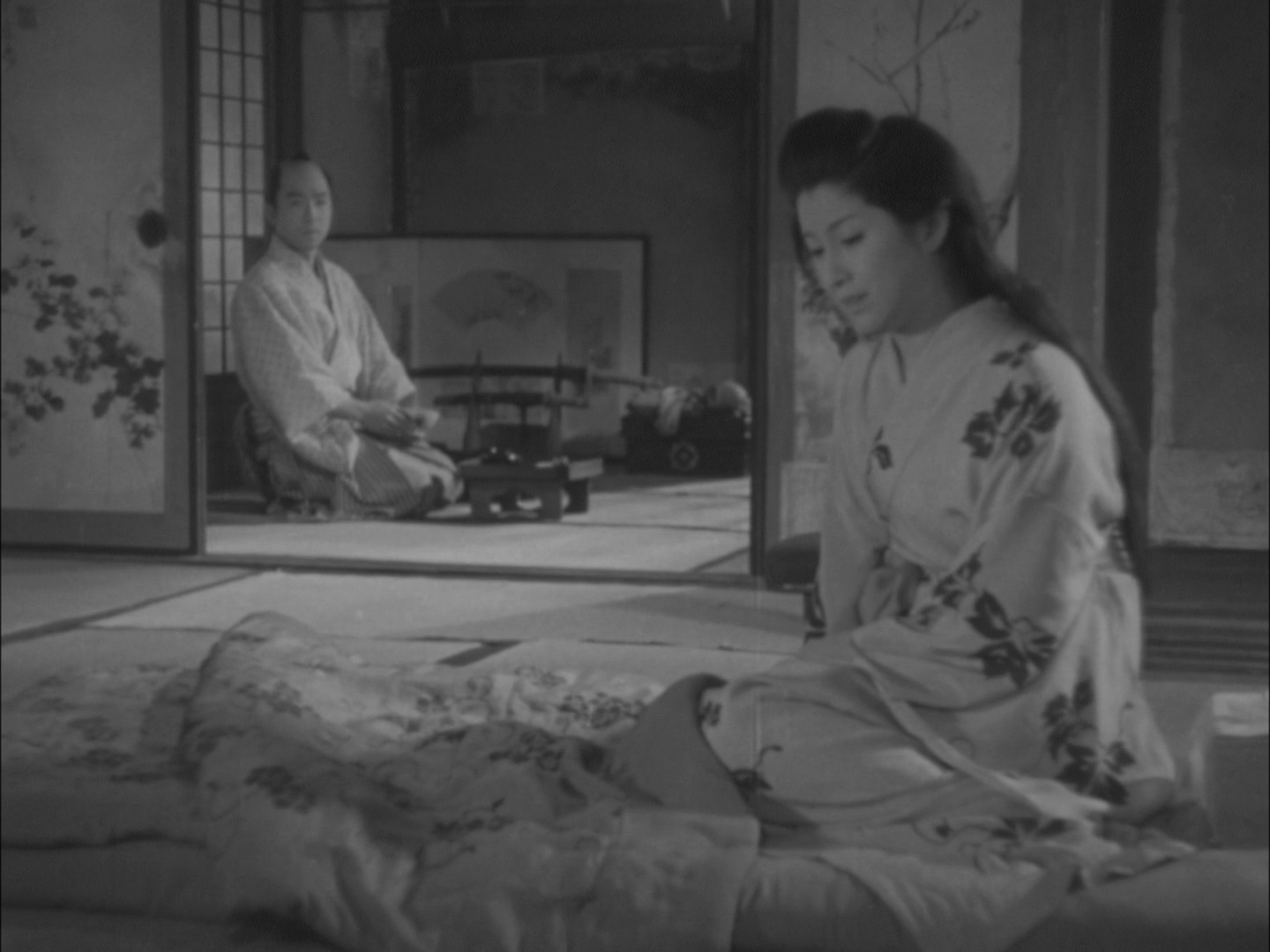
The film is both coy and somewhat transgressive in its depiction of the growing sexual tension between Okuni and Gohei from his taking hold of her injured foot and tender care for her when she falls ill, to the way they draw closer and then instinctively move apart. Passion later gets the better of them and it’s heavily implied that they sleep together, but Gohei instantly regrets it and cannot accept his class transgression. Given this development in their relationship, Okuni asks him to stop calling her “madam” but as she does so she is on one side of the fusuma and he on the other, so they remain in separate rooms divided by the ridge in the tatami. Gohei cannot let go of the old ways and is desperate to complete their quest so that his debt to Iori will be repaid and he can return in glory to be rewarded with position and the esteem of being a true samurai. Even if he tells Okuni that this quest has been his happiness in being on the road with her and knows that killing Tomonojo will end it, he does not turn back.

But the implication is that they can never escape Tomonojo who will, in fact, forever be following them. He taunts the pair with his shakuhachi and visits them in disguise. When they catch up to him, he tries again to convince them to give up their quest and live quietly together in a place free from the constraints of the samurai world, but Gohei cannot do it. Okuni first picks up her dagger and one wonders whether she about to use it on herself, but then turns on Tomonojo though it’s uncertain whether she now does so out of resentment or as revenge of herself for the way Tomonojo has again ruined her life. Just as she was a pawn of her father married off against her will to an indifferent man, she is further imprisoned by patriarchal social codes as Tomonojo needles Gohei that he had slept with her before her marriage. She has in fact already confessed to this to Gohei who transgressed by asking her what exactly Tomonojo was doing with his “shakuhachi” when they were courting, though she did so obliquely in telling him to remember his place and that he should “forget about the past.” Nevertheless she denies it now, but Gohei continues to see her as a “loose” woman with Tomonojo’s words ringing in his ears as a final revenge on the morally compromised lovers.

Their inability to let go of the quest, to do as Okuni suggests and continue on as they are along the rough and difficult path to a more egalitarian future spells their damnation. You can’t go back again. Their “home” is already lost to them. As a pedlar tells the pair along the way, they’ve already been forgotten and the village is filled with other gossip, but now they really have nowhere to go. The message may be for the coming post-occupation era that they shouldn’t try to turn back but keep moving forward into the new Japan or else risk becoming lost in a purgatorial world of confusion like Okuni and Gohei haunted by the choice to betray love for the outdated ideal of samurai honour. Haunted alternately by Tomonojo’s shakuhachi and the words of the villagers who told them they couldn’t be accepted until they fulfilled this quest, they find themselves displaced, unbalanced and uncertain amid the shifting power dynamics of class and gender, their duty and their feelings, but ultimately trapped by their cowardice in their unwillingness to cross the threshold to claim their freedom and happiness.

Lightning (稲妻, Mikio Naruse, 1952)

In many ways despite its matter of fact bleakness, Lightning (稲妻, Inazuma) is among the more optimistic of Mikio Naruse’s films ending on a note of cheerfulness and hope in which the storm has been broken and the heroine seems to have rediscovered a sense a faith in humanity. Yet the attitudes she displays are often contradictory and firmly at odds with the kind of Shitamachi spirit one might find in the films of a director such as Yoji Yamada in films like The Sunshine Girl released a decade later.

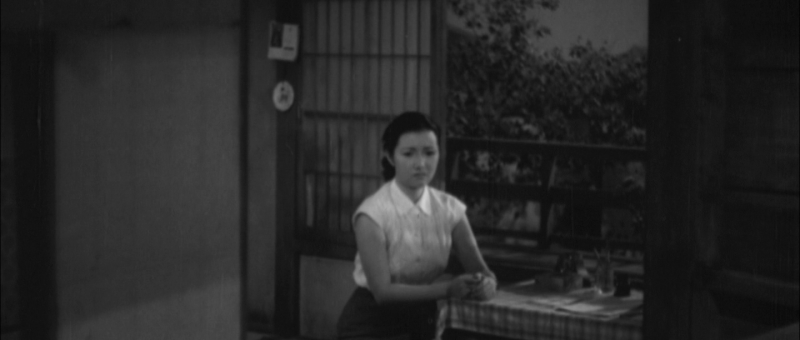
The qualities that most define Kiyoko (Hideko Takamine) are, as her mother Osei (Kumeko Urabe) suggests, an inner strength that eludes her older sister Mitsuko (Mitsuko Miura) and a forthrightness that sees her struggle to pursue the kind of life she wants rather than that she is expected to lead. Yet some might see her as snobbish and judgemental, at times attacking her mother for having married four times and given birth to four children each with different fathers. In this she sees a particular moral failing on the part of Osei, but perhaps also expresses a deeper distrust in her mother’s repeated attempts to find stability only through harnessing herself to a man. 

Echoing Takamine’s role in Hideko the Bus Conductor, Kiyoko has a job as a tour guide showing off the sites of bustling Ginza though explaining that this part of the city only really comes alive at night. The job gives her a sense of independence and self-sufficiency a woman in this era is not really permitted to have. Her oldest sister, Nui (Chieko Murata), asks if she contributes to the household but the meeker Mitsuko replies that she wanted to but they told her to save her money instead. In any case, it’s towards marriage that she’s pushed when Nui attempts to play matchmaker brokering an engagement with a 35-year-old baker, Goto (Eitaro Ozawa), who has aspirations of opening a love hotel into which Nui and her feckless husband Ryuzo (Kenzaburo Uemura) have invested. Of course, it turns out that Nui is herself having an affair with the baker who is oily in the extreme and disliked by most of the family though eventually manages to make his way into the beds of two of the sisters.

Kiyoko has little desire to marry and asks her mother if any of her four marriages made her happy, but her mother only says that happiness is not an important concept hinting the hardship she’s faced in her life and that a woman of her generation may have had to put up with a certain of degree dissatisfaction to keep a roof over her head and food on the table. While working on the bus, Kiyoko spots Mitsuko’s husband talking to another woman in the street but decides to say nothing only for him to suddenly die and the woman turn up with a baby asking for financial support. Kiyoko tells her sister that marriage is hell, but she smiles and says Kiyoko will be the exception in an expression of the various ways in which women enforce these arcane social codes against each other despite their own misery. Mitsuko too wants to escape but admits she doesn’t have Kiyoko’s courage which is how she too eventually falls into the clutches of Goto much to her sister’s disappointment. 

There is something undeniably poignant in Kiyoko’s frustrated defiance, looking longingly at the paintings and books of their lodger, a young woman from a more middle-class family working her way through university. Kiyoko says she wants to study too, but her mother shoots her down. She’s already 23, and it’s a little late to be picky about marriage let alone strike out for a more stereotypically middle-class life with a white collar job and nice house in the suburbs. It’s the suburbs though to which she eventually moves, without even bothering to tell any of her family. When the nice landlady asks if she has any she admits she has but also has nothing to do with them, which earns her a confused frown. She later says something similar to the pair of piano-playing siblings who live next-door in a kind of suburban utopia, quite clearly ashamed of her humble Shitamachi roots and family members she sees as common and immodest.

In any case, her admiration of the siblings and obvious attraction to the brother (Jun Negami) who is so much more sensitive and caring than her own (Osamu Maruyama) who appears to use the wartime bullets lodged inside him as an excuse not to move on with his life, suggest that she is still in the end looking for a conventional family only one she sees as more positive (or just posher). Perhaps it’s not so much marriage she rejects but dependency and subjugation, believing a marriage to a man like this might be one more of love and equality than the dissatisfying relationships experienced by her mother and sisters. The expressionistic bolt of lightning which appears during a difficult conversation with her mother is like the breaking of a storm, a kind of letting go in which her resentment begins to melt away and her mother agrees to retreat realising that unlike Mitsuko she can take care of herself and to that extent at least is an independent post-war woman. Ambivalent, but in its way warm and forgiving the film gives Kiyoko permission to embrace her aspiration, defy the social codes which constrain her and seek her own happiness, but also allows her to shed her cynicism in rediscovering a faith in humanity and re-embracing her admittedly imperfect mother all while leaving her behind. 


Vendetta of a Samurai (荒木又右衛門 決闘鍵屋の辻, Kazuo Mori, 1952)

During the American Occupation, period dramas were frowned upon, the occupation forces apparently fearing that they might encourage the latent feudalism in Japanese society. Released immediately before the Occupation’s end, Kazuo Mori’s Vendetta of a Samurai (荒木又右衛門 決闘鍵屋の辻, Araki Mataemon: Ketto Kagiya no Tsuji), not to be confused with the director’s similarly titled Samurai Vendetta from a few years later, is a suitably revisionist piece interrogating the legacy not only of the samurai but the samurai movie in demonstrating, quite poignantly for the contemporary audience, that the rigid and austere codes of a warrior class did nothing but create sadness which forced good men to sacrifice true friendship in service not even of an ideal but simply an agreement. 

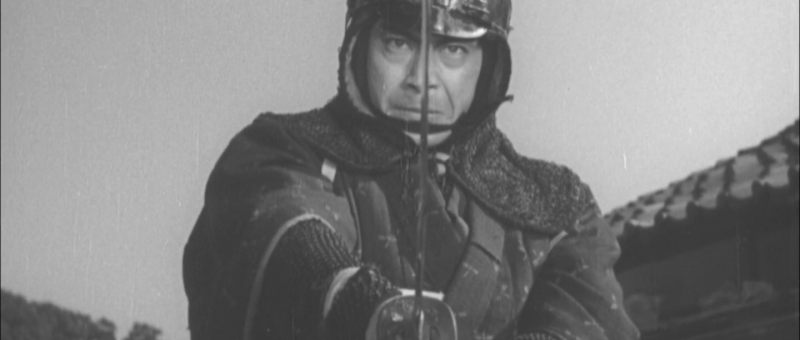
To signal his intent, Mori opens with a bombastic sequence shot in the fashion of pre-war jidaigeki, all booming speeches and clashing swords before a voiceover cuts in to tell us everything we know of the events in play is wrong. The legends surrounding the battle at Kagiya Corner tell us that Jinza (Takashi Shimura) was a bad man, and that Mataemon (Toshiro Mifune) killed 36 that day, but in reality Jinza was kind and noble and in fact the two men were good friends while Mataemon in reality struck down only two enemies which is in any case much more plausible if perhaps less exciting. As the classic chanbara scene fades, we return to the modern city of Ueno in Iga which in some respects remains unchanged further emphasising the “reality” of the brief 17th century conflict. As we learn, a man called Matagoro (Minoru Chiaki) has poked a hole through the samurai order in killing the brother of a young man called Kazuma (Akihiko Katayama), and so a lot of people have to die to eradicate the corruption of his transgression.

Boasting a script by Akira Kurosawa, the action flips between Mataemon, brother-in-law of Kazuma, and his men waiting for the arrival of Jinza and Matagoro inside a small inn, and the circumstances which brought them to this point. Mataemon is duty bound to support Kazuma who is really just a boy forced to seek revenge because they are family though there does not seem to be much heat in his desire for justice against Matagoro. Jinza, by contrast, is positioned on the opposite side solely because he is affiliated with a high ranking Hatamoto who is protecting Matagoro. Yet the two men are good friends each resigned to their fates and in full knowledge of how the samurai world works. The have no quarrel with each other, but are forced into mortal combat because of a complex network of loyalties and obligations that can only be satisfied with blood. 

“What is the meaning of this violence?” an imperious official asks, receiving no answer only a mild plea for a little more time. “Being a samurai, what a funny thing,” Mataemon laments to himself reflecting on the fact he must now kill or be killed by his friend for no real reason but simply because things are the way they are. Jinza meanwhile agrees, “Being warriors, what a misfortune,” as the pair calmly discuss the inherent hypocrisies which define their lives wherein all that really matters is one’s proximity to the shogun. That’s one reason the nervous Mago (Daisuke Kato) has joined the mission for revenge, his loyalist father a former tutor to the lord and keen to show their fealty but also hoping to advance their fortunes through a successful vendetta. 

Mago isn’t the only one who’s scared. The inn keeper is visibly shaking. He didn’t really want to be ground zero for a samurai duel today and is presumably worried not just for his safety but for the repercussions of offending his guests and damage to his property. A crowd gathering around the fighting, which includes the wealthy merchant brother-in-law of Matagoro who declared himself unafraid of a few rural bumpkin samurai, remarks on the smell of blood in the air seemingly both horrified and excited by the spectacle though even that is thin on the ground. No grand duel, Mataemon merely strikes his friend down before the battle begins, thereafter coaching the young Kazuma to overcome his fear and claim his revenge despite the bloody ugliness of the task. Yet in the end all there is is fear and futility, along with still more duty and the promise of more blood to come.  


The Wind Blows Twice (風ふたゝび, Shiro Toyoda, 1952)

Struggling with the end of her marriage, a young woman finds herself listless yet considering new possibilities in Shiro Toyoda’s The Wind Blows Twice (風ふたゝび, Kaze Futatabi). Adapted from a serialised novel by Tatsuo Nagai, the title is echoed in a remark from one of two potential suitors that youth is something that can come two or even three times so as long as you remain young at heart. They are each, however, each currently frozen and unable to move forward in the wake of their personal traumas. 

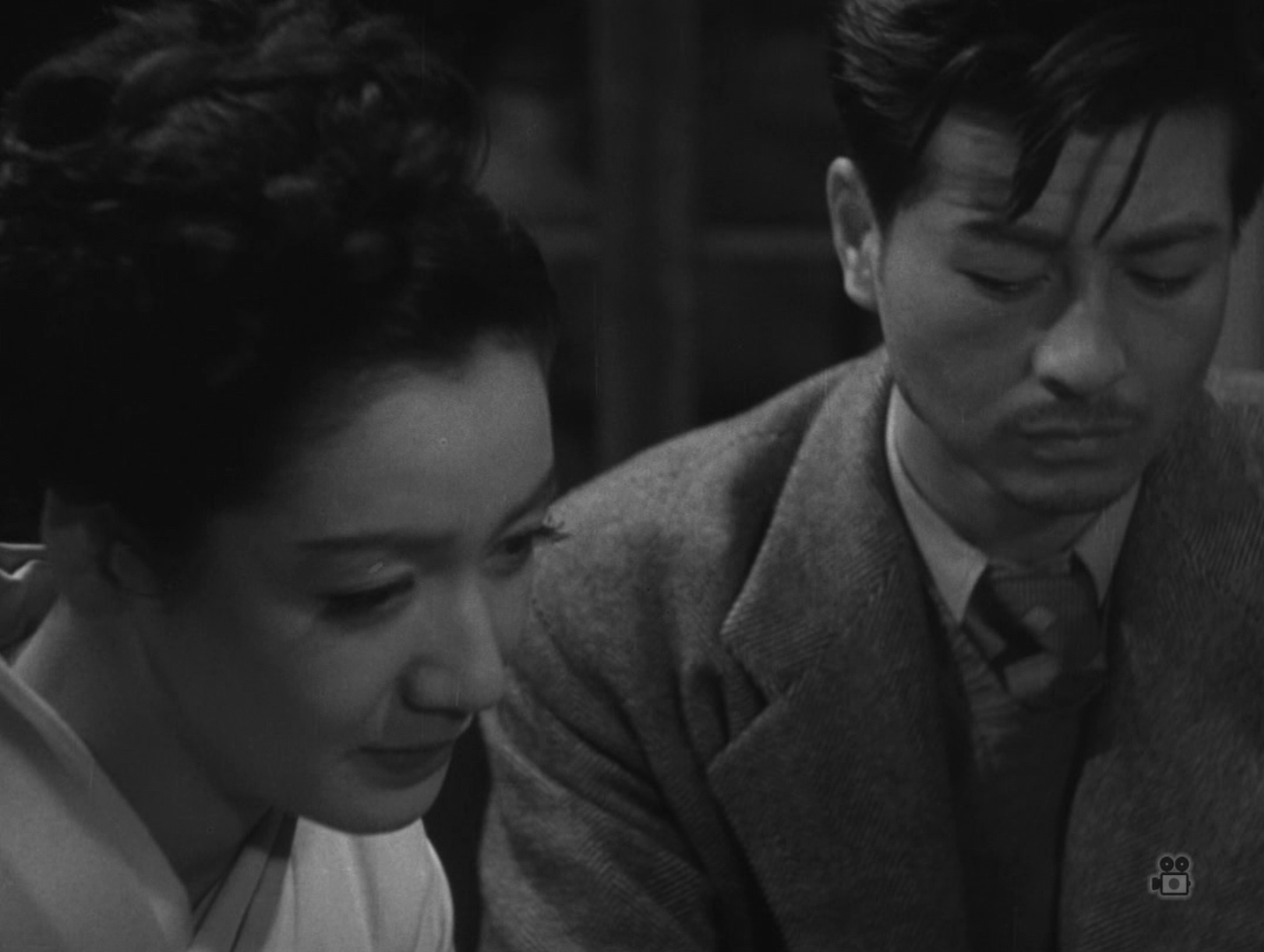
Kanae (Setsuko Hara), it seems, married for love but her husband has apparently been arrested for some kind of corruption. She has severed all ties with him and returned to the house of the uncle and aunt who raised her after her mother’s death where she helps out in their shop. Meanwhile, she learns that her semi-estranged father Seijiro (Ken Mitsuda), a university professor who lives in Sendai and hasn’t been in contact despite his daughter’s difficult circumstances, collapsed on the steps of the local station and is being cared for by a former student, Miyashita (Ryo Ikebe). She travels to look after him and becomes closer to Miyashita, who currently works as an auctioneer and has dreams of becoming a greengrocer, but is perturbed to learn that her father is a suspect in the theft of 10,000 yen from the wallet of a wealthy man, Michihara (So Yamamura), who carelessly left in the toilet and discovered the money missing when he went back to pick it up. Worried that the rumour may damage her father’s career, Kanae goes to apologise and find out what’s going on but Michihara tells her not to worry and it was his own fault anyway but his sudden magnanimity seems suspicious. In any case, Kanae later tells her friend Yoko that Michihara frightened her, also remarking to Miyashita that she felt as if she managed to slip away from him as she made her escape.

Though he later turns out to be sympathetic, Michihara appears as the villain of the piece. He thinks Kanae reminds him of his late wife and intends to ask her to marry him one the seventh anniversary memorial service is concluded. He starts using his wealth and power to gently interfere in her life, setting up a job for her on hearing that she’d been looking for employment and later approaching her father with the idea of investing in his research into the use of fluorides in the production of resin. Despite her initial dislike of him, Kanae goes along with everything and is soon sucked into Michihara’s world while otherwise wilfully oblivious of his feelings for her (which she does not share) and hoping he’ll help her convince Miyashita that he ought to return to science and help her father with his research which would obviously pave the way for them be together romantically.

The problem is that like Kanae Miyashita has become frozen inside, scarred by his wartime experiences and soured on science. Yet just as staying with him restores Kanae’s spirit and encourages her to want to look for work and find purpose in her life, her influence on him reawakens his passion for scientific research only he is less happy about it than she was. The interest that’s sparked in him ironically lies in the frozen north, travelling to Hokkaido to see an old friend and researching how to prevent potatoes from freezing in order to improve people’s quality of life. In essence it seems as if the futures they may want are too different. Now much more cheerful and energetic, Kanae genuinely enjoys her work in broadcasting and is less than keen to give it up and move to rural Hokkaido to help Miyashita study potatoes while secretly hoping she can convince him, with Michihara’s help, to become a respectable academic like her father and live a nice middle class life researching things that are more useful to industry and big business than to regular people.

Miyashita is disinclined to do so. He bounds straight off a train to see her with three day stubble from the journey, only to be disappointed witnessing in her in an elaborate kimono with her hair constrained in traditional style while Michihara is there waiting to see him to discuss a job offer from Seijiro. It’s at this point that he seems to decide his romantic desire for Kanae is most likely futile and she has chosen the rarified world of Michihara rather a rustic and homely life with a man like himself. Of course, this makes it sound as if Kanae doesn’t have much choice at all herself and to an extent she doesn’t or at least she feels backed into a corner while her aunt pressures her to remarry, unbothered to which man but excited about the proposal from Michihara because it means she will enjoy a life of uninterrupted financial comfort.

Having chosen her own suitor and seen things go drastically wrong also increases her aunt’s conviction that she shouldn’t make the same mistake again while she too is perhaps wary of remarrying. In any case. Kanae seems to want work and enjoys her job in broadcasting as much as she’s naturally drawn to Miyashita who brings out in her a greater desire to live while Michihara only seems to want her to be a shadow of his late wife suggesting that to marry a man like that may itself be a kind of death sentence. To that extent, the choice Kanae makes involves a predicable sacrifice, but still in any case it is a choice that she makes for herself to strike out for happiness and fulfilment of her own choosing rather than allow herself to be railroaded by conventionality unable to express her own desires.


Tokyo Sweetheart (東京の恋人, Yasuki Chiba, 1952)

It appears that even as early as 1952, some people were doing “very well, thank you” despite the suffering going on all around them. Then again, the heroes of Yasuki Chiba’s charming ensemble rom-com Tokyo Sweetheart (東京の恋人, Tokyo no Koibito) are relentlessly cheerful and likely wouldn’t use the word “suffering” to describe themselves, preferring instead to laugh at the foolishness of wealthy men and their petty squabbles while continuing to value what is honest and genuine above greed and insincerity.

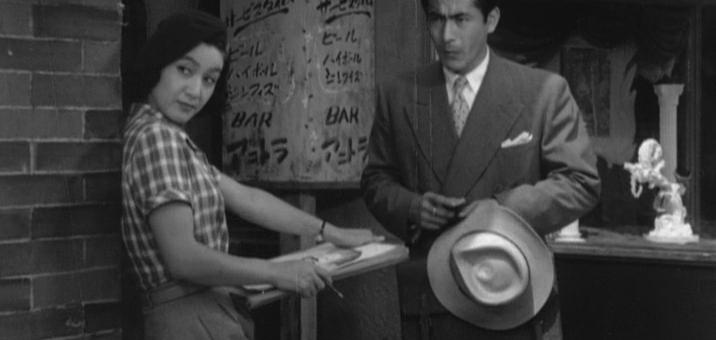
At least, there’s a minor irony in the fact that Akazawa (Hisaya Morishige) makes his living selling pachinko balls, a a source of elusive hope that’s brought ruin to millions. His mistress, Konatsu (Murasaki Fujima), exclaims that when you’re doing well a ring or two is nothing, trying to manipulate Akazawa into buying a 500,000 yen diamond from the jewellers’ downstairs. Akazawa can afford to buy it, but he doesn’t really want to because he’s cheap and greedy. Later we’re introduced to a friend of portrait artist Yuki (Setsuko Hara) who does caricatures on the street corner below the office and hangs out with the three shoeshine boys opposite. Harumi (Yoko Sugi), a sex worker, has fallen ill presumably from tuberculosis. They only need 500 yen daily for her living expenses and medicine, but the only way they can hope to come up with it is by getting a large amount of people to part with a small amount of money which they are all willing to do as an act of solidarity. 

In rather farcical turn of events, the jeweller’s has commissioned a fake ring to display in the window for security purposes while they keep the real one in the safe. Konatsu suggests a complex plan to the jewellers of getting Akazawa to buy the diamond but giving him the fake which she will then return and pocket difference. Only Akazawa has the same idea, or rather he only wants to buy the fake one because Konatsu won’t know the difference and he doesn’t think she’s worth the expense of the real one. When he ends up with both rings, Akazawa’s wife, Tsuruko (Nijiko Kiyokawa), makes him give the fake one, which is actually real, to the tea girl, Tama, who wants to sell it, even if it is fake, to help Harumi not only with her illness but to escape sex work. The boys tell her she’s being selfish and naive. If Harumi had any way of escaping sex work she would have done so years ago, there’s no real hope for her now. “A shoe can be repaired,” one of the boys sighs, “but I’m not so sure about her.”

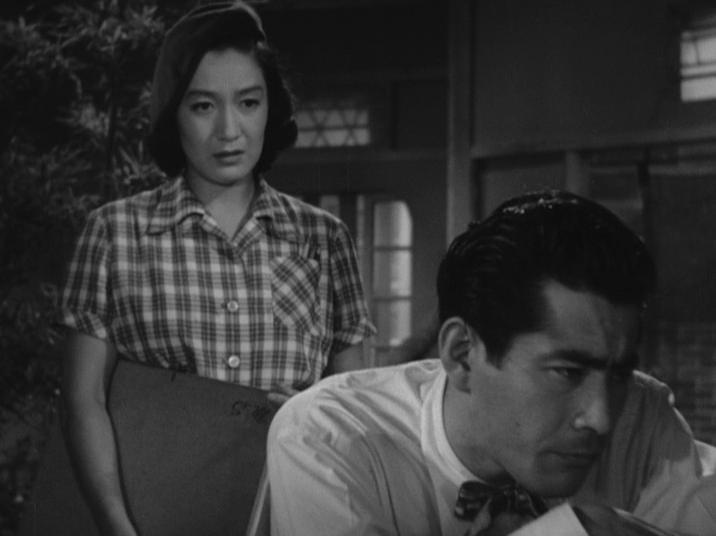
In some ways, it seems as if the genuineness of the ring is unimportant. The two are often mistaken for each other and few can tell the difference. After all, if you like it, what does its supposed authenticity matter and what does that really mean anyway? It does, however, seem to matter to Yuki who later says that she thought the film’s most genuine person, Kurokawa (Toshiro Mifune), was “gaudy and slick” when they first met because he was wearing a tacky tie pin and ring which stand out a mile to her as “fake”. Kurokawa in fact makes the replica jewellery displayed in front windows and dresses in that way as a kind lived brand though he does not necessarily approve of his own occupation. He exceeds expectations when he tracks the gang down in order to pay back some money Yuki had lent him when the conductor couldn’t give him change for his bus fare, as well as treating the shoeshine kids to ice creams and warning off the creepy yakuza type who keeps trying to bother Yuki for dates.

But the contradictions are brought to the fore when Harumi’s health declines and Yuki decides she ought to call the estranged mother to whom Harumi had written a comforting letter stating that she’d married and was living happily in Tokyo, enclosing a photo of herself and Kurokawa one of the shoeshine boys had taken on his toy camera. Yuki wants Kurokawa to pose as the husband so the mother won’t be so upset, only for him to point out that she now asks him adopt a fake persona after taking him to task for confusing people with his “fakes”. Again, this false comfort does seem to bring genuine relief to the mother even if as Kurokawa suspects she’s seen right through their ruse suggesting that authenticity of feeling is the only kind that matters.

Akazawa and his wife, meanwhile, bankrupt themselves trawling the river looking for the lost “genuine” ring sinking to all new depths of absurdity as even Tsuruko dons a diving suit and goes in to look herself. Unfortunately, all they find is a single pachinko ball. There is something quite abrupt about the sudden tonal shift from Harumi’s death bed to the gang laughing away at the foolishness of Akazawa and his wife, the boys convinced that Yuki and Kurokawa are now a couple though they never really enjoy much of a romantic resolution. Kurokawa lives a long way out of town and his home is surrounded by rubble and empty lots, signs of post-war devastation still not fully cleared away though Yuki and the boys, presumably war orphans, remain endlessly cheerful even as the extreme irony of Kurokawa’s rendition of Moon Over Ruined Castle washes over them. They do at least have each other and the strength of their community, living honest and genuine lives every day in contrast to men like Akazawa chasing pointless yet shiny trinkets and falling straight down the plughole themselves.


Children of the Great Buddha (大仏さまと子供たち, Hiroshi Shimizu, 1952)

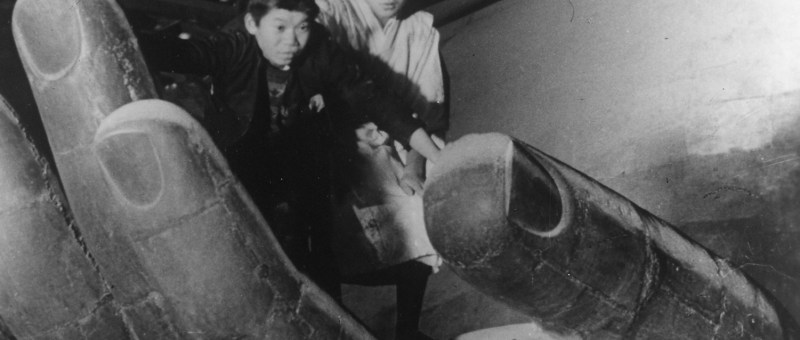
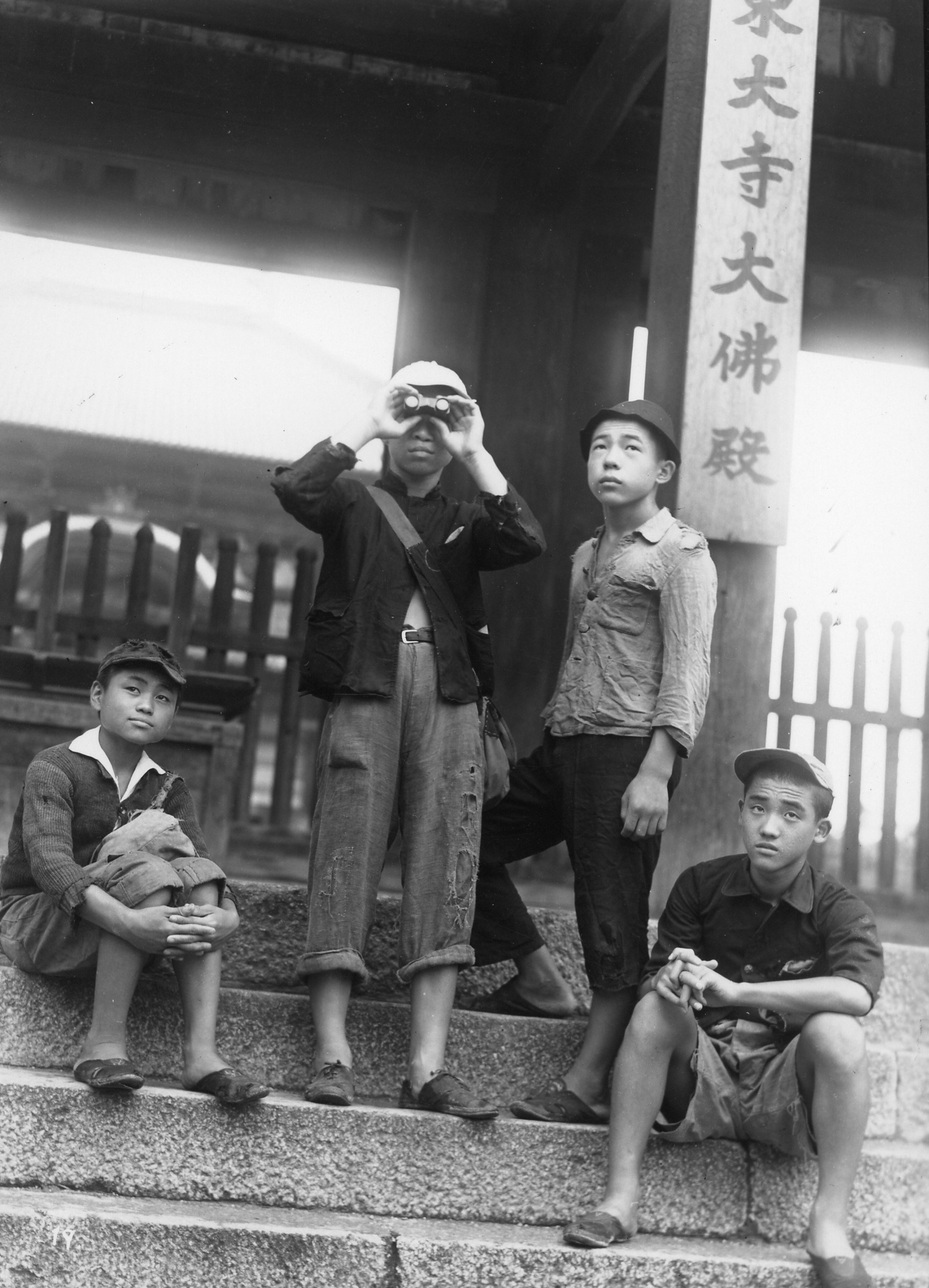
Following Children of the Beehive, and Children of the Beehive What Happened Next, Hiroshi Shimizu completes the trilogy with Children of the Great Buddha (大仏さまと子供たち, Daibutsu-sama to Kodomotachi) this time taking place n Nara and focussing on war orphans who remained alone but are trying to make new lives for themselves as tour guides around the temples of the ancient capital. The existence of tour guides in itself implies a change in circumstances in a resurgent tourist industry while it’s also true that Nara is one of the few cities to have escaped the war largely unscathed and free from the destruction seen in industrial centres such as Tokyo or Osaka or that seen in Hiroshima or Nagasaki. 

There is indeed a particular contrast between the ragged children and the guests they escort who appear generally well dressed and seem to have employed them partly out of a sense of pity. The oldest of the boys, Ko, is later gifted some better clothing but doesn’t wear it explaining that he couldn’t get customers dressed like that so he’s put the nice clothes away in a box. The film never really makes it clear where the boys sleep though they can assumed be homeless or otherwise that the temples themselves are their home. Ko has been able to save up some vouchers and sent away for a pair of binoculars putting the Nio guardian statues down as the addressee. He takes his job very seriously and is slightly put out when he discovers part of his patter is inaccurate, made up by his mentor, Ichuin, who has since been adopted by a temple as a novice monk, to better entertain the customers. 

Ichiuin tells a sculptor the boys collectively refer to as “Mr Failure” that his superiors at the temple are quite upset about this new trend in tourism, that they fear people only come to admire the statues as pieces of art rather than to worship Buddha. The fact that people now have money and time for travel signals that the age of post-war privation is coming to an end though those who arrive from outside Nara also talk of destruction and a sense of displacement. A demobbed soldier remarks that it’s only in Nara that he feels he’s come “home” hinting at a concept of Japaneseness that’s survived in the ancient capital but not elsewhere. Meanwhile, Ko is charged with escorting a Japanese-American woman travelling alone in a rented car having returned to visit her grandparents’ graves. The woman, who the boys refer to as “Miss Second Generation,” treats them warmly and includes them in her picnic which itself is quite elaborate and made with rare and expensive foodstuffs. Later her purse goes “missing,” leading Ko to assume some of the other boys have taken it. He’s right, they have. But they were too frightened to spend any of the money because there was such a lot of it expressing this new idea of America as a land of plenty in contrast to Japan at the end of the Occupation.

When Ko takes the money back to her she buys him new clothes, leading the other boys to incorrectly assume she’s going to adopt him and he’ll be leaving for a better life in America. Despite the sense of solidarity that’s arisen between the orphans, they continue to long for more conventional families or at least to be adopted as Ichiuin has been by the temple. Genji, Ko’s friend, has longing for a small statue of Buddha from a local shop only to end up heartbroken on learning it’s been sold. But the woman who buys it unexpectedly offers to adopt him, aligning Genji himself with the statue and explaining that she had a son his age but he died. Genji originally seems reluctant, saying he will stay with Ko perhaps partly out of guilt but is later persuaded though Ko declares that he will always be at the temple. Caught in a kind of limbo, he religiously listens to the missing person programmes for news of his father whose whereabouts, like many even so many years after the war, are still unknown. 

This may be one reason behind the hope that the orphans of Japan could sleep in the lap of Buddha if in a more literal sense, that they maybe embraced by a more spiritual entity in a society that otherwise appears indifferent to their fate. In any case, Shimizu spends a lot of time with the statues capturing them in a documentary style as if we ourselves were receiving this tour and becoming acquainted with the picturesque environment of the ancient capital somehow free from the corruptions of the war itself or the post-war era and in its own way accepting of these orphaned children to whom it offers a home in Buddha’s palm if not quite so literally.


Children of the Great Buddha screens at Japan Society New York on 1st June as part of Hiroshi Shimizu Part 2: The Postwar and Independent Years.

Ikiru (生きる, Akira Kurosawa, 1952)

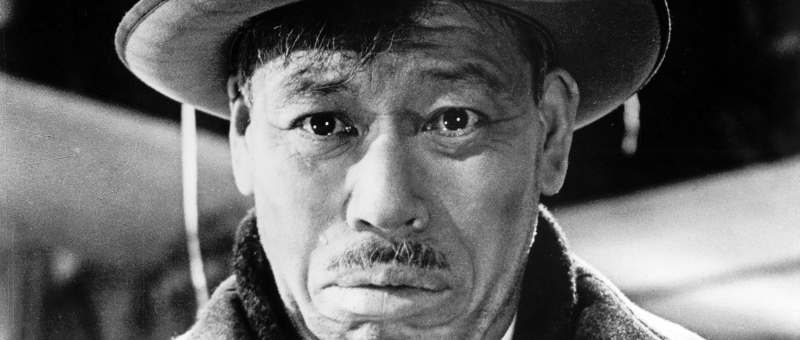
The Japanese economy may have embarked on a path towards recovery thanks to the stimulus of the Korean War, but in the early 1950s many might have thought it too soon to ask if survival in itself was enough yet this is exactly what disillusioned civil servant Kenji Watanabe finds himself asking after receiving the devastating news that he has advanced stomach cancer and year at most to live. “To live” is apt translation of Akira Kurosawa’s intensely moving existential melodrama, Ikiru (生きる), which tackles the compromises of the salaryman dream head on along with those of the contradictions of the sometimes dehumanising post-war society. 

As the opening voice over reveals to to us, Watanabe (Takashi Shimura) is man who died long ago or perhaps has never truly been alive. In some senses, he is nothing more than an embodiment of the seal he uses to stamp documents day in day out, a mere piston in an ever turning machine of relentless bureaucracy. A young woman, Miss Odagiri (Miki Odagiri), working in the Public Affairs department loudly reads out a joke someone has written about their boss, Watanabe, who has taken not a single day’s holiday in 30 years suggesting that it’s less that he fears city hall will grind to a halt without him than they’ll suddenly figure out city hall has no need of him at all. The irony is city hall does indeed grind to a halt in Watanabe’s absence as he, unthinkably, fails to turn up for work for days on end as the papers pile ever higher on his desk. “Nothing moves here without his seal” one of the workers admits, bewildered by this sudden break with protocol while salivating over its implications in the possibility that Watanabe’s chair may soon be empty. 

Yet Watanabe’s crisis is that he’s realised he’s wasted his life on a pointless bureaucratic career that’s done little more than keep a roof over his head. Even the roof is a fairly modest one and it’s clear that his grown up son Mitsuo (Nobuo Kaneko) considers him to be a stingy old miser, unable to understand why he’s never spent so much as a penny on himself and lives in a kind of self-imposed austerity. Perhaps to Watanabe this is what constitutes properness. He’s done everything he was supposed to do, got a steady job at city hall and eventually became the head of department, but now he feels foolish and lonely. Mitsuo and his wife seem to resent him and talk openly about their plans to use their inheritance, along with Watanabe’s retirement bonus, for a downpayment on a “modern” home the polar opposite of the pre-war townhouse where the family continue to live. 

Mitsuo and Kazue (Kyoko Seki) are perhaps emblems of the increasingly empty consumerism of the post-war era, emotionally disconnected from Watanabe and seeking only the flashy and new. Miss Odagiri, the young woman from work, immediately says that she’d love to live in a home like Watanabe’s rather than the crowded multiple occupancy flat she currently inhabits with her family. Cheerful and outgoing, Odagiri is on the other hand a symbol of a new generation that wants something more out of life than simple material comfort and might even be willing to trade it for a small amount of happiness. Having worked at city hall for all of 18 months, she decides that she just can’t take it anymore and is quitting to get a job in a factory making toy rabbits that she says allow her to feel as if she’s making friends with all the babies in Japan. 

To that extent, Watanabe is himself also a baby craving Odagiri’s company admitting that he envies her youth and vitality in realising he squandered his own and will never get it back. How uncomfortable it must be for her, their final meeting in a restaurant sandwiched between a loving couple and teenage girl’s birthday party as Watanabe, gaunt and shrunken, claws at the air and begs her to help him live. Yet even within the grotesquery the tone is ironic, the strains of “Happy Birthday” accompanying Watanabe down the stairs as a the high school climbs up to meet her friends signalling his (re)birth as a man with purpose and determination. Just as Odagiri had found meaning in the rabbit, Watanabe finds it deciding to get a playground built over a post-war swamp in the slums filled with raw sewage and mosquitos that left the local children ill. 

Yet children’s parks aren’t particularly profitable which is presumably why the petition to build one had been kicked all round city hall in the infernal wheel of bureaucracy in which Watanabe too is trapped. “You call this democracy?” one of the women bringing the petition asks, taking the clerk to task complaining that all they do is fob them off insisting it’s someone else’s responsibility to help while determined only to guard their own turf. “You’re not supposed to do anything at city hall” someone ironically adds, “the best way to protect your place in this world is to do nothing at all”. Watanabe did nothing at all for 30 years and it got him nowhere, his dedication to his job disrupting his relationship with his son though Watanabe is ironically one of the most emotional men and engaged fathers seen on screen in the post-war era. 

After his death, in the park he helped build for which the deputy mayor has taken credit, his colleagues put him on trial at the wake trying to work out why he did it and whether or not he even knew he was dying seeing as he told no one close him not even the son whom he felt he could no longer trust. They deny his role while both praising and condemning his passion as somehow improper, disrupting the dispassionate rhythms of the bureaucratic machine with human emotion. It was only coincidence, they say. The deputy mayor wanted an election and the yakuza wanted to turn the swamp into a red light district. “Did he think he could just build a park?” someone adds, bemused by his effrontery as a man from Public Affairs straying into the Parks Department’s territory. You have to protect your turf after all. Finally moved by Watanabe’s last ditch bid to make his life mean something, to feel alive and know he has lived, the the drunken salarymen, all but one who retreats to look at Watanabe’s photo above the altar, swear to follow his example. 

But of course the bureaucratic wheel keeps turning, another dangerous sewage problem diverted to another department continuing the literal pollution of the capitalistic post-war society. A kind of ghost story, Kurosawa lights Shimura from below, shadows cast across his gaunt face even by his “rakish” new hat while his huge eyes have a somehow haunted, grotesque quality filled with hungry desperation. Yet it’s to childhood that Watanabe eventually returns, “perfectly happy” sitting on a swing singing a song from his youth about the price age while surrounded by snow and at last painfully, absurdly alive. 


Ikiru screens at the BFI Southbank, London on 4th & 15th February 2023 as part of the Kurosawa season.

Original trailer (English subtitles)

Mother (おかあさん, Mikio Naruse, 1952)

The hahamono or mother movie is a mainstay of post-war cinema, obsessed as it is with self-sacrificing maternity. Mikio Naruse, however, is not a name you’d expect to see associating itself with the genre and his 1952 film Mother (おかあさん, Okaasan), adapted from a child’s essay, is indeed subtly subversive, transgressively questioning the institution of motherhood itself while ostensibly remaining faithful to genre norms even as it makes an accidental villain of its teenage heroine who closes the film plaintively praying for her mother’s happiness having not so long ago shut down perhaps her only real hope of achieving it. 

The Fukuhara family ran a successful laundry before the war, but these days father Ryosuke (Masao Mishima) works at a factory and is nicknamed Papa Popeye by his kids because of his finely tuned muscles born of a lifetime training the iron. Matriarch Masako (Kinuyo Tanaka) and 18-year-old daughter Toshiko (Kyoko Kagawa), our narrator, help the family finances by running street food stalls, while oldest son Susumu (Akihiko Katayama) has become ill with a lung complaint caused by poor conditions at the wool factory where he was working. In addition to youngest daughter Chako who is still in school, the family has also taken in little Tetsu (Takashi Ito) the son of Masako’s sister Noriko (Chieko Nakakita) who is now a widow recently repatriated from Manchuria. 

Like many films of the occupation period, the family at the centre of Mother is determined to rebuild, pinning all their hopes on being able to renovate their home in order to be able to reopen the laundry. The war is very much a background presence but its influence is still deeply felt not least in the ruins and devastation glimpsed around the house and the constant references to loss and widowhood which seem to plague Masako, so many women having lost sons and husbands in the conflict. The tragedy is that Masako will eventually in one sense or another lose all her children by the end of the picture, Susumu succumbing to his illness after having discharged himself from hospital out of guilt and loneliness missing his mother, Chako eventually taken in by wealthier relatives who lost their son in the war, Tetsu soon to be retrieved by his mother, and Toshiko herself clearly heading towards marriage with the cheerful and surprisingly progressive baker Shinjiro (Eiji Okada) with whom she has become close. 

Perhaps surprisingly Toshiko seems remarkably immature for her age, her voiceover taken as it is from a child’s essay has a slightly stilted quality that nevertheless makes plain her poor grasp of the adult world and most particularly the reality of her mother’s life. Masako later tells us that she started working at 14 and continued until she married at not so much older than Toshiko is now despite later stating that Toshiko is too young to marry only to find her self shocked when confronted by the sight of her in a wedding dress stifling a brief wave of despair that her daughter may soon be a wife. Originally complaining about not being able to take dressmaking classes like some of the other girls, Toshiko belatedly swears to help support the family firstly to prevent Chako going to stay with relatives and secondly because her boyfriend inadvertently gives her the impression there’s truth in a local rumour that her mother plans to remarry following her husband’s death from overwork and poverty with a friend of their father’s who’s been helping them out in the shop, “Uncle POW” Mr. Kimura (Daisuke Kato). 

Shinjiro is quick to tell her that she’s being unreasonable. In the modern world parents shouldn’t be expected to sacrifice their personal desires for their children, her mother is also a woman and has the right to pursue happiness in marrying again if she chooses. On the other hand, there is nothing particularly concrete between Masako and Mr. Kimura besides a genial domesticity, the rumour is partly local wishful thinking in knowing that remarriage is sensible economic choice and the pair seem well suited. Toshiko objects strongly to the idea out of fear, jealousy, and outdated moralising resenting her mother for betraying her father’s memory but also fearing further changes in her familial relationships in an already uncertain world. 

In this her otherwise saccharine closing monologue in which she looks on as her mother plays with Tetsu and wonders if she’s really “happy” achieves its final irony, transgressively undercutting the primacy of the self-sacrificing mother to question the ideology of motherhood itself when it requires women to sacrifice their lives and desires in service of an ideal of “family”. Nevertheless, Mother is among the most ostensibly cheerful of Narusean dramas in the gentle comedy and naturalistic depiction of a warm and loving family committed to compassion, kindness, and mutual support as pathways towards a better post-war future.  


Mother is currently available to stream in the US via Criterion Channel

The Men Who Tread on the Tiger’s Tail (虎の尾を踏む男達, Akira Kurosawa, 1952)

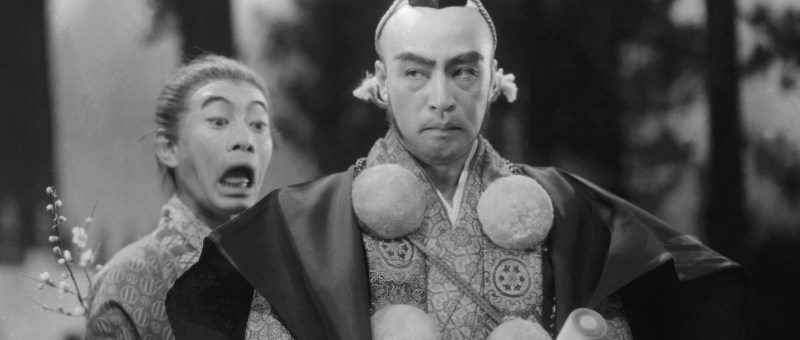
Like many directors of his age, Akira Kurosawa began his career during the war sometimes working on what were effectively propaganda films yet perhaps attempting to skirt around the least palatable implications of the task at hand. The Men Who Tread on the Tiger’s Tail (虎の尾を踏む男達, Tora no O wo Fumu Otokotachi) is an example of just that, repurposing a well known historical incident from its noh and kabuki roots and subtly undercutting it with a dose of irreverent humour unwelcome to those who liked historical tales because of their nationalistic connotations. This was not, however, the reason the film found itself out of favour so much as an ironically personal issue in which Kurosawa had apparently irritated one of the censors by pointing out his ignorance of cultural tradition leading him to conveniently leave Tiger’s Tail off the list of titles in production resulting in the American Censors rejecting it for being an unknown, illegal film which is why it languished on the shelf for seven years after filming was completed in 1945. The Americans may not have liked it much either given their aversion to period drama which they feared encouraged the kind of thinking incompatible with the democratic era, but like many of Kurosawa’s samurai dramas it has a rather ambivalent attitude to feudal loyalty both admiring of nobility and despairing of its austerity. 

Set in the late 12th century, the action takes place during a period of warfare in which warrior Yoshitsune (Iwai Hanshiro X) has returned a victory for his brother, the ruler. His brother Yoritomo, however, feels as if his victory has perhaps been too good and he is therefore a threat to him. Yoritomo accuses his brother of sedition and puts a purge in motion, leaving Yoshitsune with no option other than to flee. With six of his best retainers, he escapes dressed as an itinerant Buddhist monk and tries to make his way to neutral territory in the North. To get there, however, they need to pass through a series of checkpoints which is why they’re currently accompanied by a cheerful fool in the form of a lowly porter (Kenichi Enomoto) supposedly guiding them along a secret path through mountain forests. 

The porter is a new addition to the story added by Kurosawa for reasons of expediency and comic relief, yet his intrusion is also one which deeply angered the more nationalistic of the censors who resented the director’s irreverence towards a key historical event. Like many other of Kurosawa’s bumbling peasants, he’s both contemptuous and in awe of the world of the samurai, offering down to earth common sense takes on the politics of the day. He has already heard all about the Yoritomo/Yoshitsune drama and recounts it in the manner of a soap opera, quite reasonably asking if a quarrel between brothers could not have been sorted out with a good old-fashioned private fist fight rather than a state mandated manhunt which is also quite inconvenient for ordinary people in addition to being somewhat heartless. 

The samurai, not wanting to break cover, can only look sad and lament the cruelty of their codes, yet it’s precisely in the subversion of their ideology that they are able to escape. They have already transgressed, some with shaved heads and all already in the clothes of a monk. The porter looks at Yoshitsune, apparently a successful warrior, and remarks on his delicate physique and seeming femininity. Eventually he says too much, realises that the men are the fugitives everyone’s looking for and is suddenly afraid, forgetting for the moment that they need him to get out of the woods and knowing that samurai think nothing of killing “insignificant nobodies” like him. Nevertheless they do not kill him, but on hearing that there are lookouts on the horizon aware of Yoshitsune’s presence, they ask their lord to change places with a peasant, wearing his worn out clothes and carrying his heavy pack though the weight of it perhaps betrays him. As the porter points out, he does not have the look of a man used to trekking through the mountains and his delicate legs are already shaking under the unfamiliar strain. 

When the band is intercepted by loyal retainer Togashi (Susumu Fujita) who has been instructed to stop all priests in case Yoshitsune comes his way, Benkei (Denjiro Okochi), a real monk if also a warrior with a talent for bluff, manages to talk his way out of Togashi’s questioning, improvising an entire prospectus on the spot to convince him that they really are collecting money to repair a temple, quickly explaining that his robes are ornate because even ascetics have fashion sense. It’s not entirely clear if Togashi simply believes him, or if he too is wilfully subverting the code having recognised Yoshitsune and decided to help him escape. Might that not, in a certain sense, be the better way of serving a lord, preventing him from making a huge and painful mistake in killing his own brother out of a misplaced sense of paranoia? 

In any case, Benkei talks his way out of trouble only for a minor retainer to intervene, insisting that the porter is too pretty and bears a striking resemblance to Yoshitsune. Reacting quickly again, Benkei does the unthinkable. He strikes his lord and loudly berates him as if he really were a lazy porter failing in the duties for which he has been paid. The real porter becomes upset, placing himself in between Benkei’s staff and Yoshitsune’s body, either out of empathetic identification or horror in the betrayal of feudal loyalty. Benkei knows he must now be believed, no one would ever do what he has done because it is a complete and total negation of the samurai code. Yet in breaking it he saves his lord, which is all that really matters. Yoshitsune later forgives him, because he is a good lord after all and how could he not. But as Benkei was keen to keep pointing out, this isn’t the only checkpoint they must pass and their journey is without end, all they can do is “continue without rest”, taking this brief moment of unexpected levity provided by apology wine from Togashi and the hilarious antics from the porter before setting off once again. As for the porter, he is soon abandoned, left on one side of the samurai divide as the curtain closes on this brief strange tale. 


Currently streaming in the UK via BFI Player as part of Japan 2020. Also available to stream in the US via Criterion Channel.

The Flavour of Green Tea Over Rice (お茶漬けの味, Yasujiro Ozu, 1952)

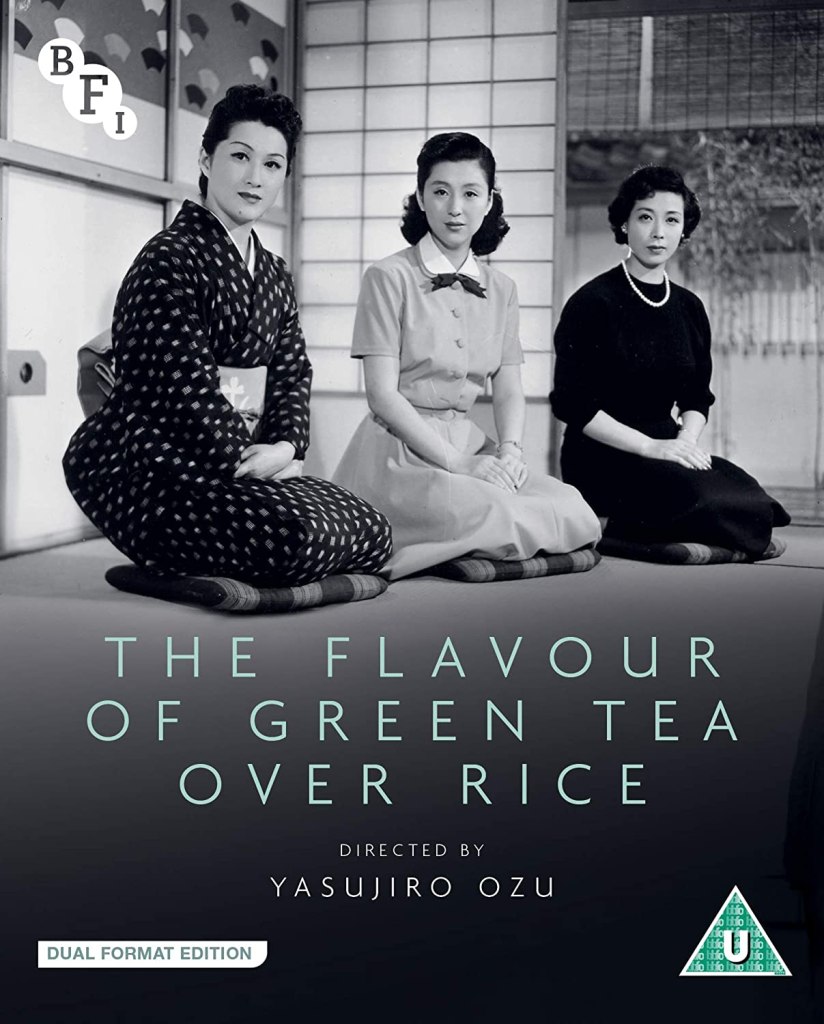
Famously, many of Yasujiro Ozu’s films end with a young woman getting married and the emotional desolation that it provokes in those left behind. Ozu, unlike some of his contemporaries, generally comes down on the side of marriage. His heroines always succumb, rarely finding independence or resignation and settling for a second choice even if their first proved unavailable. The Flavour of Green Tea Over Rice (お茶漬けの味, Ochazuke no Aji), however, takes him in a slightly different direction in asking what, if anything, is to blame when a marriage is unhappy, repurposing the arranged married debate to perhaps imply that wedded bliss is less about romance than it is about endurance and mutual understanding. 

Taeko (Michiyo Kogure), a middle-aged woman, consented to an arranged marriage to Mokichi (Shin Saburi) at the usual age but seems to feel little more than contempt for him. A friend from school, Aya (Chikage Awashima), invites her on an impromptu trip to an onsen and for reasons not entirely clear, Taeko feels she has to lie rather than simply telling Mokichi that she would like to go away with a friend for a couple of days. Aya encourages her to spin a tale that her niece, Setsuko (Keiko Tsushima), who often stays with them in the city, has been taken ill and is in need of urgent care, but the plan is foiled when she swans into their home right as rain before Aya could give her instructions. Caught on the hoof, Taeko is forced to improvise that a different friend is ill, the four women eventually heading off on a girls’ trip leaving Mokichi at home alone and apparently none the wiser. 

Perhaps surprisingly, Mokichi turns out to be a kind and considerate, if perhaps dull, kind of man. We later discover that he knew all along that Taeko was lying but thought it wasn’t worth making a fuss over. He makes a point of chatting with the maid, asking after her family and is apparently well acquainted with her circumstances. Unlike other men, he doesn’t spend his time out drinking or gambling or even overworking, coming home to read instead, but still Taeko is put out when she phones him at work to kickstart the onsen plan and discovers his desk to be empty. It turns out that he met up with the younger brother of an old friend killed in the war who had asked for his help with a recruitment exam. Non-chan (Koji Tsuruta), as everyone calls him, is a cheerful sort guy who openly admits he wears army surplus suits and likes to eat in restaurants which are “good and cheap”, all of which suits Mokichi much better than his wife’s rather more sophisticated tastes. The younger man is quick to introduce him to the pleasures of the age including bicycle racing and pachinko parlours which is where he runs into an old army buddy, Hirayama. 

While Taeko and her old friends break into a rendition of a song from their student days with Setsuko looking on in minor confusion, Mokichi sits around a small table with Hirayama and an equally out of place Non-chan recalling his glory days in Singapore and singing old army songs. They are each, in their own and infinitely parallel ways, mourning the promise of their youth. Taeko’s friends, Aya and Takako, have an equally cynical view of marriage. Takako’s husband has gone to Paris and she, it seems, couldn’t be happier with her newfound freedom, while Aya runs a small boutique and regards hers as little more than a necessary inconvenience. When the ladies take in a baseball game, Aya is surprised to spot her sports-hating husband on the bleachers apparently escorting a woman she recognises from a nearby bar, but she isn’t in any way jealous or angry merely amused and planning to use it as extra leverage to persuade him to buy her a new kimono despite the fact that we later see him asking her for money (which she snatches back as punishment). 

Despite all of that however Taeko’s tragedy maybe that somewhere deep down she wanted her marriage to work. Her open contempt for Mokichi, likening him to a big fat carp and referring to him as “Mr. Bonehead” in assuming he is stupid enough to believe all her lies, annoys the otherwise modern Setsuko who sees their unhappy union as definitive proof that arranged marriages do not work. Interrogated by her exasperated niece who was sure her aunt would support her in her resistance to her parents’ matchmaking, Taeko claims that she is happy and perhaps she is even if in her unhappiness, but Setsuko’s unexpected seizure of her agency though rudely walking out on the omiai brings her own marriage to a crisis point. Mokichi cannot quite say so but tacitly supports Setsuko’s desire to decide her own romantic future even if he disapproves of her irresponsible rudeness to her prospective suitor. “Forcing her to marry against her will would just create another couple like us” he eventually explains to Taeko in boldly saying that which should not be said. 

It would be easy to think that the problem is Taeko and Mokichi simply aren’t suited. There is an obvious class difference that seems to be a continuing problem for the snooty Taeko. It annoys her that he insists on pouring his miso soup into his rice bowl which she feels is common, like his cheap cigarettes and preference for third class rail travel. He explains that it’s not that he’s cheap, simply that these are the things he likes, that he’s familiar with, that make him feel relaxed. Their upbringings are different. Taeko feels relaxed in first class because that’s how she’s always travelled and she likes the finer things because they reassure her in her status. That might be one reason they occupy different areas of a shared home, he with a traditional futon in a tatami mat room, she in a well appointed Western-style boudoir even as she exclusively wears kimono. 

Yet the problem isn’t that they like different things so much as an essential misconnection. Without perhaps knowing, Taeko is so filled with resentment over her lack of control of her romantic destiny that she’s never warmed to her husband or felt secure in her marital home. It’s a cliche to say she doesn’t understand him, but perhaps she wanted something different to what she eventually got. A sudden crisis after the Setsuko episode sees Taeko make a temporary retreat only for Mokichi to be abruptly sent abroad. Sharing the homely comfort food of green tea poured over rice, she finally begins to understand that what she took for indifference was perhaps merely a different way of showing love. Mokichi really is a man who likes the simple things, affection without ceremony, like the flavour of green tea over rice. She knows that unlike Aya’s husband Mokichi will never betray or hurt her. He is infinitely “reliable” which might not sound romantic, but is perhaps the only solid basis for a successful marriage. 

That’s the advice she eventually offers to Setsuko, walking back on her commitment to arranged marriage, a “feudal” tradition she and all the other women had been determined to force onto her despite the fear and pain it caused them in their own youth and beyond, to remind her that marriage is for life. Find someone “reliable”. A flashy suit and a handsome face might look good now, but they might not in 20 years’ time. Setsuko has taken a liking to Non-chan who claims to be “reliable” but his taste for pachinko and bicycle races might suggest otherwise. In any case, after a heartwarming resolution that repairs the fractured marriage of Mokichi and Taeko, Ozu ends on a moment of cheeky ambivalence in which Non-chan says the wrong thing, upsetting Setsuko who retreats into a small hut. Non-chan repeatedly apologises and tries to enter, while she pushes him back out, neatly symbolising the arc of a marriage as an accidental battleground of intimacy though in this case one with a playful resolution. 


The Flavour of Green Tea Over Rice is released on blu-ray in the UK on 18th May courtesy of BFI in a set which also includes an audio commentary by Tony Rayns. The first press edition also comes with a booklet featuring an essay by Tom Milne.

Short clip (English subtitles)