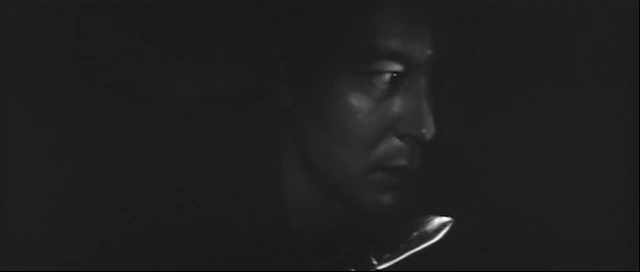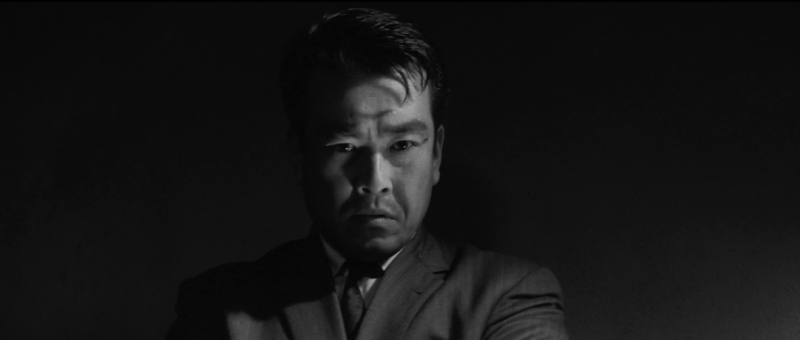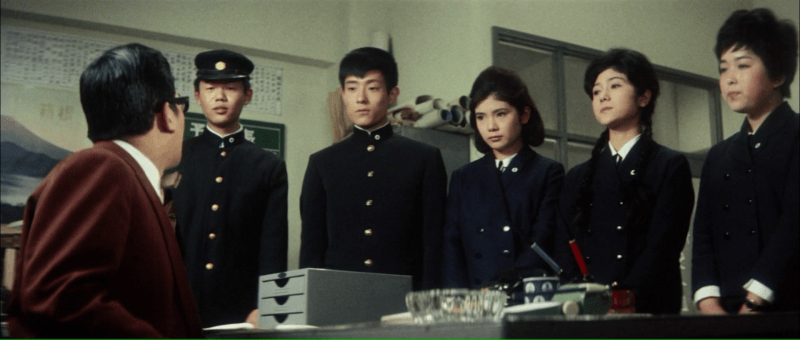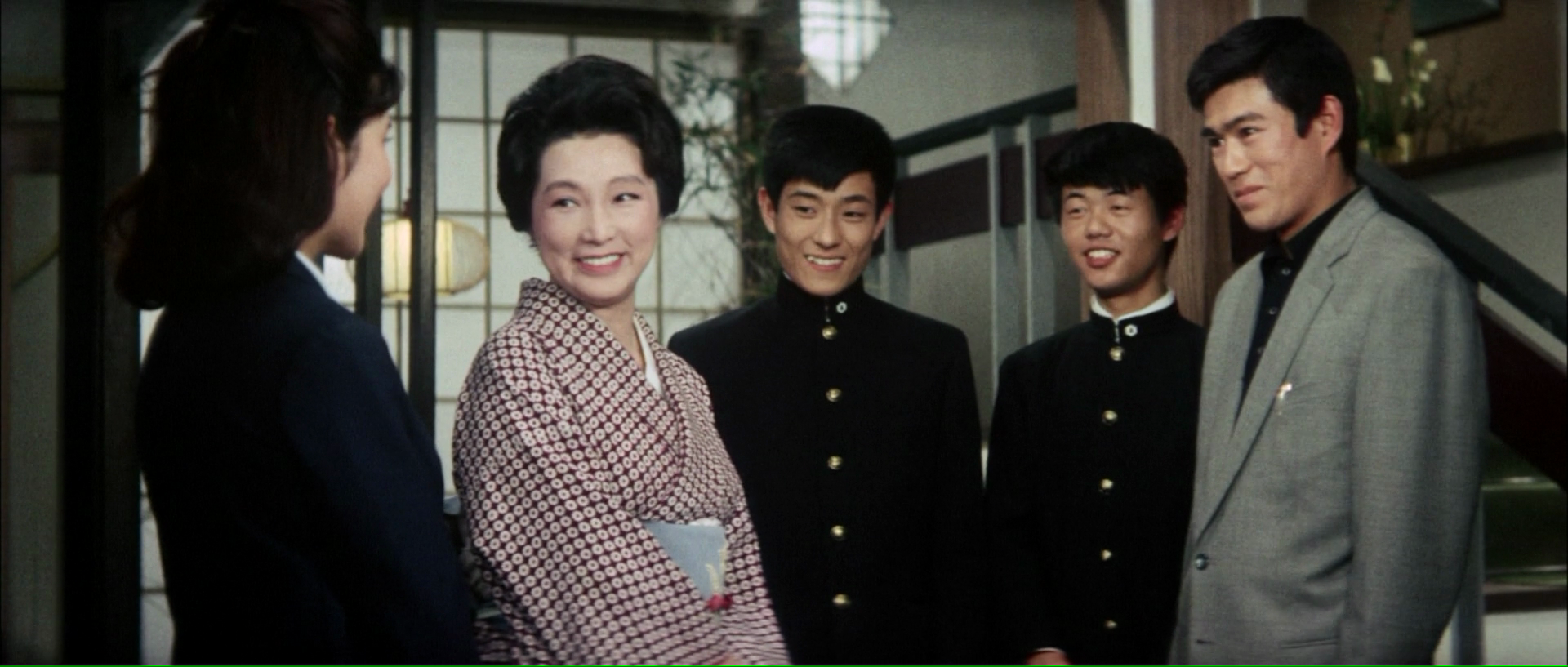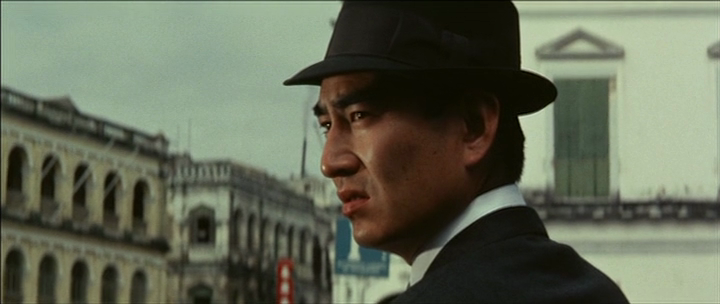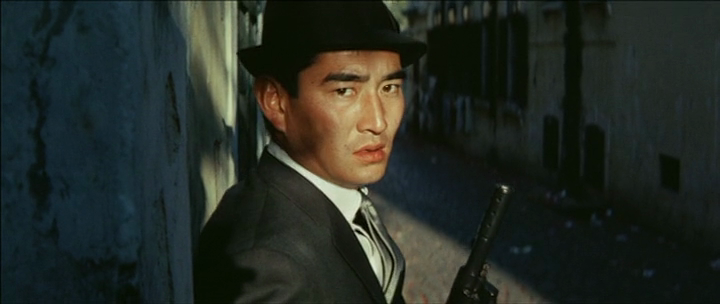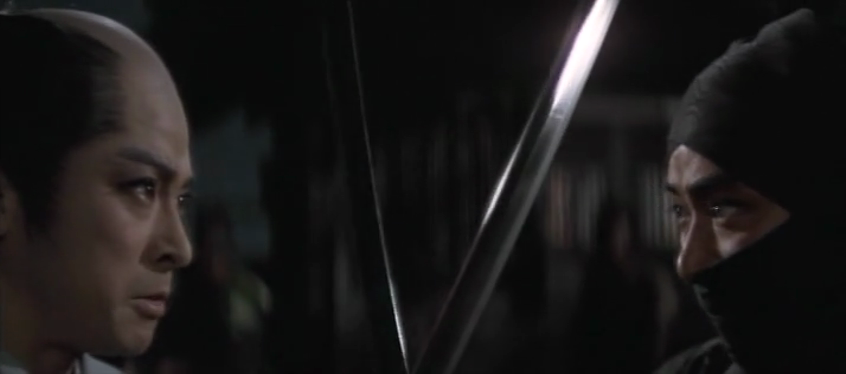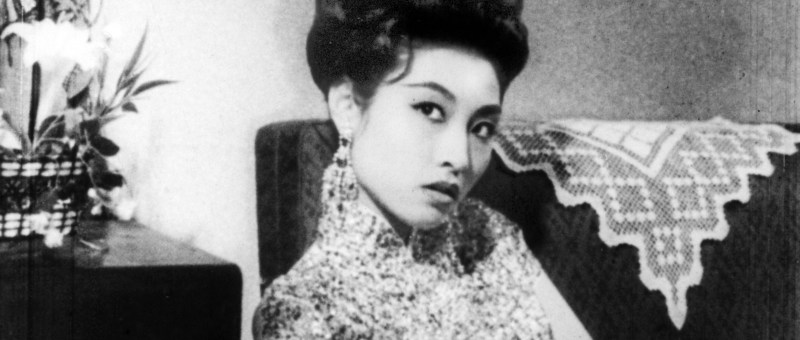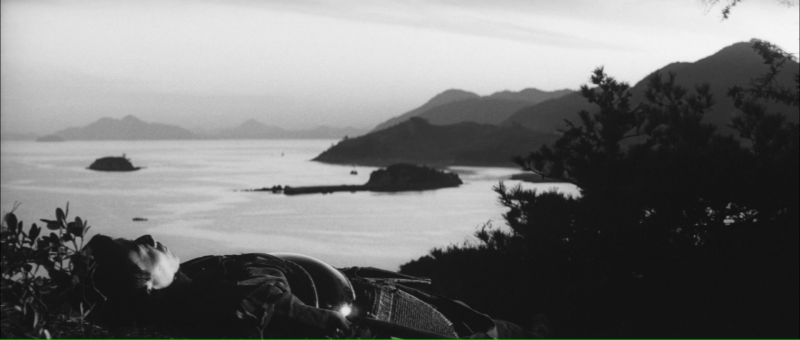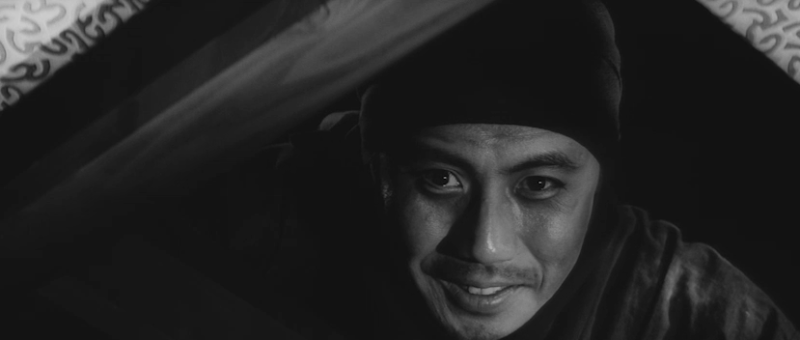
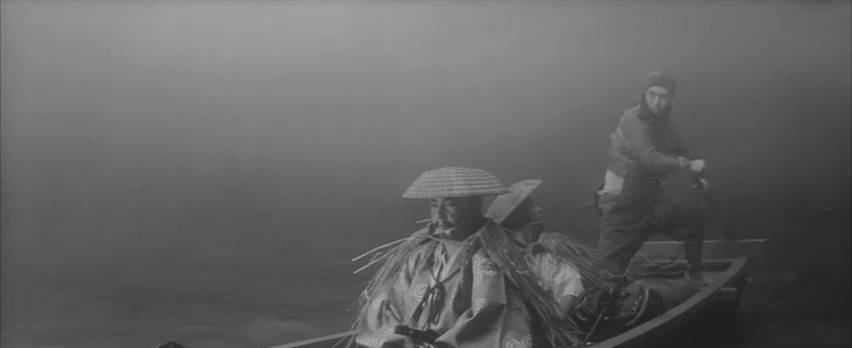
Shinobi No Mono 5: Return of Mist Saizo (忍びの者 続・霧隠才蔵, Kazuo Ikehiro, 1964)

At the end of the previous instalment, Saizo (Raizo Ichikawa) had escaped from the fall of Osaka Castle spiriting away Sanada Yukimura (Tomisaburo Wakayama) who, in contrast to what the history books say, did not die. The pair make their way towards Shimazu, where they are also not well disposed to Ieyasu (Eitaro Ozawa), but as Saizo is informed the Tokugawa clan will never die. Knocking off Nobunaga put an end to the Oda clan, getting rid of Hideyori took the Toyotomi out of the running, but killing Ieyasu will make little difference because another retainer will swiftly take his place.

As a reminder, that’s bad for Saizo because what he wanted was the chaos of the Warring States era back to restore the ninja to their previous status. Nevertheless, at the end of the previous film he claimed to have rediscovered a human heart in his devotion to Yukimura though it may of course be simply another ruse to meet an end. In any case, Ieyasu seems to be putting his ninjas to good use and is once again waiting it out apparently aware that Yukimura is alive and well in Shimazu.

Meanwhile, times are changing. Yukimura is convinced the future of warfare lies in firearms and whoever controls Tanegashima where the weapons are made will prove victorious. They think they can gain it by figuring out how they get access to high-quality iron when trading with anyone outside of Portugal is illegal and the Portuguese don’t have any. It’s access to foreign trade which is becoming a crunch issue as Ieyasu tries to solidify his power, later giving a deathbed order to ban Christianity to stop European merchants taking over the country. Saizo travels to Tanegashima to investigate and figures out that the secret is they’re trading with China, which is pretty good blackmail material, but also encounters two sisters who turn out to be the orphaned daughters of a Tokugawa ninja with vengeance on their mind.

In a surprising turn of events, it turns out that his main adversary is Hanzo Hattori (Saburo Date) but the fact he keeps outsmarting him eventually convinces Ieyasu that the ninja have outlived their usefulness. Hanzo becomes determined to kill Saizo to restore his honour, filling the palace with various ninja traps though unlike Goemon Saizo seems to be one step ahead of them. This lengthy final sequence is played in near total silence, and ironically finds Goemon just waiting, after dispatching several of Hanzo’s men, to see if his poison dart has taken effect and Ieyasu is on his way out. Only in the end Ieyasu just laughs at him. He’s 75. Saizo’s gone to too much effort when he could have just waited it out. Ieyasu has already achieved everything he wanted to. His control over Japan is secured given he’s just been appointed chancellor. He can quite literally die happy because nothing matters to him anymore. A title card informs us that when Ieyasu did in fact die, no one really cared. The Tokugawa peace continued. 

Here, once again, the Ninja too are powerless victims of fate despite their constant machinations. Yukimura tells Saizo to live and be human, advice he gives to the sisters in Tanegashima but does not take for himself staking everything on his revenge against Ieyasu which is, as he points out, pointless for Ieyasu was at death’s door anyway and his demise changed nothing. In his first of two entries in the series, Kazuo Ikehiro crafts some impressive set pieces beginning with a mist-bound underwater battle as Saizo and Yukimura make their escape by water to an epic flaming shuriken battle, though this time around the deaths are noticeably visceral. Men are drowned, stabbed, or caught on wooden spikes. Those who do not obey the ninja code are stabbed and pushed off cliffs while once again emotion is a weakness that brings about nothing more than death. Ikehiro’s frequent use of slow dissolves adds to the dreamlike feel of Saizo’s shadow existence even as the ninja themselves seem to be on the point of eclipse for what lies ahead for them in a world of peace in which there is no longer any need for stealth?
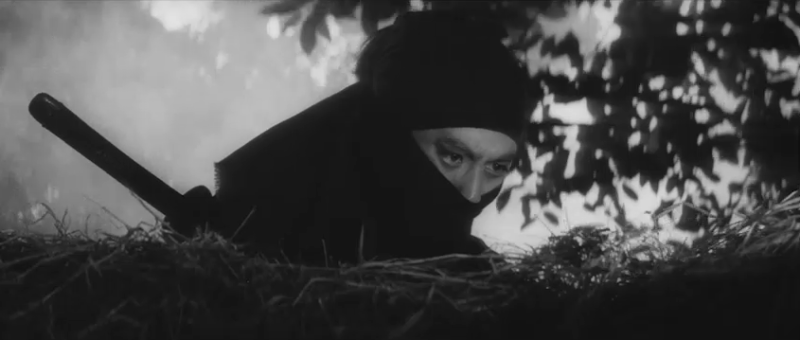

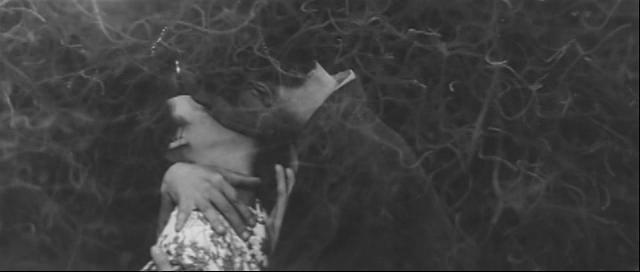
Shinobi no Mono 4: Siege (忍びの者 霧隠才蔵, Tokuzo Tanaka, 1964)

When he began what would become the Shinobi no Mono series, Satsuo Yamamoto had wanted to put a more realistic spin on the ninja movie, shifting from the fantasy-esque wuxia with which the genre had been associated since the silent days to something that was largely devoid of romanticism. In the films he directed, the ninja are powerless manipulators doomed to live unhappy lives defined by a cruel and heartless code. Though still based on the same novel, the third film began to compromise that vision in the hero’s miraculous escape from certain death, ending on a note of ambivalent positivity in which Goemon declines the offer to join Ieyasu and instead walks out into independent freedom. 

The first three films had covered all of the action in Tomoyoshi Murayama’s serialised novel, and so the following four are based on original ideas by screenwriter Hajime Takaiwa save for episode six which is scripted by Kei Hattori and Kinya Naoi. Many of the same actors appear but in different roles while the action has moved on 15 years, skipping ahead from the unseen battle of Sekigahara to the siege of Osaka and the end of the Toyotomi. Raizo Ichikawa stars as another displaced Iga ninja nominally in the service of the Toyotomi but secretly longing to bump off Ieyasu not for reasons of revenge but because there is no place for ninja in his new and peaceful society. If they’re able to unseat him, they assume the situation will revert to the civil war society with the effete Hideyori (Junichiro Narita) too ineffective to assume control over the nascent nation. 

It has to be said, this version of events has rather misogynistic overtones with frequent speeches from Sanada Yukimura (Tomisaburo Wakayama) avowing that it’s all Lady’s Yodo’s (Otome Tsukimiya) fault for giving her son bad advice that he is too naive to know not to follow. In negotiating to end the siege at Osaka castle, Yukimura had advised it was better to strike back against Ieyasu and kill him as soon as possible, but Lady Yodo vetoed it and insisted she and her son remain locked up in relative safety. His conviction is somewhat born out seeing as Ieyasu had deliberately targeted the area of the castle where they assumed she was staying in order to further frighten her.

Nevertheless, he’s astute in realising it was all essentially a ruse and part of Ieyasu’s plan to force the Toyotomi into submission. The attack on the castle was only ever intended to engineer a peace treaty which Ieasyu himself presented and forced Hideyori to sign. Then again, there’s some strange symmetry in play. When Saizo enters the castle in an attempt to assassinate Ieyasu he mangles to trick him into killing his double instead, then when Ieyasu’s ninja try to assassinate Yukimura after following Saizo having known he would pretend to be dead and dig himself out of his own grave they also kill his double much to Ieyasu’s consternation. 

It’s this similarity that Saizo hints at when he pities a retainer of Ieyasu’s explaining that Nobunaga and Hideyoshi had tried to eliminate them but they survived while Ieyasu now wants to use them for his own ends but will likely do the same when they are no longer necessary to him. Thus what they want is a kind of chaos, desperate to assassinate Ieyasu to return to the world in which the ninja are able to influence events from the shadows. Even so his conviction is apparently shaken. As in the previous series, Saizo gains a love interest, Lady Akane (Midori Isomura), who has become a sex worker as an apparent act of self-harm after being raped by Tokugawa soldiers during the fall of Osaka castle. But as we’ve been repeatedly told, a ninja’s heart lies under the blade. Born in darkness, they shall die in darkness and are not permitted to fall in love. Thus Saizo rejects her affections, but eventually declares himself corrupted by wanting to die alongside Yukimura as a loyal soldier. The in-film lore would have us believe that Yukimura did not in fact die during the final assault but was spirited away by Saizo to plot Ieyasu’s downfall in the shadows. 

Directed by Tokuzo Tanaka in his only instalment in the series, the film is shot more like a conventional jidaigeki but returns something of the fantasy aesthetic to the ninja as they somersault through the forest. Saizo’s surname effectively means “hidden in the mist”, which is partly ironic seeing as Akane also describes her rape as being overcome by a thick fog, but is also symbolic of his frequent use of smoke bombs as a disappearing trick which again undermines the sense of realism with which the series began. Yukimura is fond of declaring that the clock cannot be turned back, a sentiment echoed by Akane and emphasising the sense of melancholy fatalism that cannot be avoided in a historical drama in which the outcome is already very well known, imbuing Tanaka’s take with the sense of elegy and legend Yamamoto had so deliberately rejected. 


Whirlpool of Flesh (おんなの渦と淵と流れ, Ko Nakahira, 1964)

A intellectual professor and his wounded wife find themselves trapped in a toxic marriage after returning from Manchuria in Ko Nakahira’s fatalistic drama, Whirlpool of Flesh (おんなの渦と淵と流れ, Onna no Uzu to Fuchi to Nagare). Set in the late ‘40s, the film does indeed position Manchuria as a point of corruption while otherwise suggesting that Japan itself has been emasculated by the Occupation, but otherwise demonstrates how the couple drag each other into a cycling whirlpool of jealousy and obsession that it seems neither of them are really equipped to understand let alone escape.

Claiming to have been struck by her bright and smiling face in her omiai photo, Keikichi (Noboru Nakaya) married Sugako (Kazuko Ineno) in Manchuria without actually meeting her before the wedding. Apparently uninterested in sex, Keikichi was a virgin on their wedding night but harbours doubts Sugako may not have been. In any case, he seems put out that Sugako is not in his opinion his intellectual equal. He chances on her diary in which she details how bored she is by his constant lectures about English literature and that she feels him to be more schoolteacher than husband, but he merely scoffs that it’s not particularly well written. He begins to suspect that she’s sleeping with customers who come into the speakeasy she opens in their home during the days between the Russian invasion and repatriation and succumbs to a generalised sense of impotence hiding out in his room upstairs reading while she takes care of business below. 

In the present day, convinced that she’s having an ongoing affair with a merchant, Otani (Kazuo Kitamura), Keikichi pretends to go to a hot springs resort and then sneaks back to spy on her from an adjacent room. Though he feels no desire for her as his wife, through the eyes of these other men he rediscovers a sense of Sugako as the woman from the photograph for whom he does feel some attraction and satisfies his latent sexual desires through watching her sleep with Otani. As an escape from the war, he’d been working on a translation of Shakespeare’s Troilus and Cressida the heroine of which he seems to superimpose on Sugako in wondering if she is a faithless woman or true, angel or devil. 

Yet from Sugako’s point of view, she begs him for physical intimacy which he refuses to grant despite his jealousy over her relations with other men. Traumatised by her sexual abuse at the hands of her uncle, Sugako believes that she has a body designed to satisfy men’s desires and is drawn into meaningless, and often transactional, sexual relationships. When Keikichi later questions her, it seems she doesn’t remember any of them in detail for to her they were simply “men” and nothing more. The situation is somewhat complicated by the fact that her uncle was a scholar of Chinese literature, which in part aligns him with Keikichi, but also points back to Manchuria as a source of corruption though coming uncomfortably from the opposite direction. 

Sugako equates this corrupted sexuality with the great emptiness inside her that frequently leads to thoughts of suicide. Nakahira constantly shows us shots of Keikichi’s knife as if implying some kind of violence is inevitably going to take place, though in the end it signals nothing so much as Keikichi’s impotence. Then again, the emptiness is also linked to a sense of despair in Japan’s defeat that is manifested most obviously in the house next-door where the widowed mother may have been having an affair with Sugako’s uncle and unsubtly tries to blackmail her by threatening to expose the secret of her sexual abuse about which she had tried to tell Keikichi but he had refused to listen. The daughter has become a sex worker catering to American servicemen to support the family while her brother, Kenichi (Tamio Kawachi), allows her to sacrifice herself for him justifying himself that it’s for the greater good as he’ll eventually become a doctor and save countless other lives. He’s also masquerading as a Christian to get a scholarship to an American university through the church which is all very contradictory not to mention selfish and cynical. The sister, meanwhile, appears to have lost her mind and frequently rants and raves, blaming her mother by claiming that walking in on her with Sugako’s uncle permanently corrupted her sense of self and sexuality. Like Sugako, she exorcises her trauma through abusing her body, in her case through sex work with “nasty GIs who don’t always pay.”

Keikichi refers to this as “post-war nihilism” like the frequent strikes and workers parades that take place around him, but partially repairs his sense of masculinity after moving to Tokyo and getting a job. At work he meets another young woman who is a mirror of the young lady from next-door in that she was also repatriated from Manchuria where her father was a member of the government. With her mother dead and father unable to work, Shimura (Kaori Taniguchi) also supports her family with her secretarial job and often goes without lunch herself to make ends meet. Keikichi notices this and offers her his bento claiming to be feeling unwell, but fails to notice how his pity wounds her dignity even if he meant in kindness while acknowledging that he’s never known hunger. Unlike the mismatched Sugako, Keikichi and Shimura are an ideal match. She also wanted to study English literature and can meet him on his level discussing politics and culture though he does not seem to be aware that he is attracted to her and acts almost paternally in offering to pay her university fees to help her escape her life of poverty, echoing Sugako’s claims that he had become her “little boy” rather than her husband. 

The irony is that Sugako insists Keikichi, who does little but look down on her and alternately complain that she’s either impure or unattractive, is the only man she’s ever loved and blames his lack of sexual interest in her on the unresolved trauma of her childhood abuse. Having asked Kenichi to help her get her hands on some cyanide, she is shocked and disgusted when despite his need he rejects her money and asks for her body instead. He insists that it’s “only the friction of mucus membranes” and that she might as well sleep with him first if she’s going to die, though her refusal is in part a desire to die “pure” and finally overcome the emptiness and despair inside her. This inability to reconcile herself is also aligned with Keikichi’s vision of “post-war nihilism” and suggests that in the end this trauma can’t be healed and must necessarily lead to destruction. Meanwhile, Keikichi seems to have discovered a path towards his rebirth in his friendship with Shimura only to potentially have the rug pulled from under him. His new future too, may end up poisoned by Sugako’s unilateral decision to facilitate it. Dark and twisted in true Nakahira fashion, the film paints the post-war society itself as a deepening whirlpool from which there is no escape or at least not for those like Keikichi and Sugako forever locked in a deathly embrace and drawn ever deeper into the waves.


The Desperate (どろ犬, Takaharu Saeki, 1964)

A bruiser cop railing against the system is pulled towards the dark side in Takaharu Saeki’s icy noir, The Desperate (どろ犬, Doro Inu). Adapted from a novel by Shoji Yuki, the film is one of only two Saeki directed in an otherwise lengthy career mainly spent in television and captures an eerie sense of existential dread as its detective hero sinks to even greater depths in a quest for self preservation while kicking back against the hypocrisies of the post-war society. 

As one officer puts it, Sugai (Minoru Oki) is one of many veteran officers who can’t adjust to new codes of justice in the democratic era. In the film’s opening sequence, he’s pulled aside and warned about using excessive force on a suspect only to counter that he knows the guy’s guilty so he doesn’t see what the problem is. Sugai had been particularly motivated about this case as the victim was an 18-year-old girl raped after accepting a lift from a stranger. She was so traumatised that she could hardly speak but did remember the registration plate of the car. She’d only been working because her father lost his factory job though he appears to have begun drinking and is abusive towards his daughter for her silence, later coming to the station to drop the charges after being paid off by the suspect’s lawyer. The legal definition of rape in this era is founded not on an idea of consent but whether violence was involved and the victim can be proved to have resisted physically. The guilty party, Tomita (Hideo Murota) claims that nothing illegal transpired in his car and then walks away with a smirk when his lawyer gets him off the hook. It’s all too much for Sugai to bear, resentful that the rich and powerful are now effectively above the law thanks to legislation he feels ties his hands as a police officer. 

It’s at this point he runs into petty yakuza Yamaguchi (Ko Nishimura) whom he’s been trying to turn as an informant, unwisely mouthing off about his dissatisfaction with contemporary law enforcement only for Yamaguchi to turn the tables and effectively blackmail him having discovered that Sugai has begun a relationship with the estranged wife of an imprisoned gangster. In an act of petty revenge and desperation, Sugai leaks info on “guilty” suspects who weren’t charged to Yamaguchi who exacts financial justice by extorting them for money while threatening to expose their immorality. 

Disappointed in him, the gangster’s wife, Chiyo (Chisako Hara), exclaims that Sugai’s no different from her husband and in truth he isn’t. Part of Sugai’s resentment lies in the fact his wife left him for another man while he was on a stakeout, frightened by his violence and insisting that she hated detectives. His old-fashioned police tactics include taking suspects to the dojo where beats the living daylights out of them. Later he tells another, more earnest officer, he reminds him of himself when he was younger implying that he has become corrupted by the times and the impossibility of justice, particularly for young women whom he feels an urge to protect, in a world ruled by money and status. He may feel some pangs of guilt for a rookie who is unfairly fingered as the mole on the grounds that he and Yamaguchi were originally from the same area and had a past acquaintance, but in the end is happy enough to scapegoat him for his wrongdoing while he continues trying to dig himself out a hole but falling still further into the abyss. 

Sugai is merely trying to save his own skin, but those around him are desperate too. His opposite number, Toku (Hisashi Igawa) is desperate to clear his name, while Chiyo is desperate for what she describes as a proper marriage to a proper man while seemingly kept captive in the apartment Sugai rents for her on his meagre police salary but does not live in himself. She wants to work and has an innocent desire to buy him some better shoes that he otherwise resents in its implied challenge to his masculinity that he evidently cannot afford all this additional expense coupled with the strain of keeping his problematic relationship with a gangster’s wife secret from his employers. In the end he claims that the problem was he couldn’t escape from being a detective, pushed into desperate acts of destruction as a man now exiled from his times unable to move on from post-war chaos into a newly democratic, consumerist Japan. Saeki ends his fatalistic vision with an image of a train reeling backwards, echoing the degree to which Sugai has lost control of his life and himself no longer a detective but only a man without a moral compass whose path can only lead in one direction. 


Here Because of You (君たちがいて僕がいた, Ryuichi Takamori, 1964)

“The strength of our modern generation is that we never let anything get us down, and we’ll go after what we want without a moment’s hesitation.” The heroine of Ryuichi Takamori’s cheerful teen comedy Here Because of You (君たちがいて僕がいた, Kimitachi ga Ite Boku ga Ita) encapsulates a sense of post-war youth while trying to convince a sullen friend to join her in standing up to injustice when their teacher is smeared in the press, but he for his own reasons remains indignant and defeatist certain that nothing they do will make any difference. 

Essentially a vehicle for Toei teen stars Chiyoko Honma and Kazuo Funaki, the film is like many similarly themed youth movies of the time a progressive appeal to a new generation intent on rebelling against the social conservatism of their parents along with the injustice and inequality that accompanied it. The villain of the piece is the father of one of the students, Akira (Masaaki Sakai), who has become wealthy and is intent on throwing his weight around. Tanaka (Ken Sudo) wants his son to go to the best university in Japan and does not take kindly to the advice of his teacher, Mr. Yamabuki (Sonny Chiba), that Akira is just not up to it academically and putting so much pressure on him to achieve something which is almost certainly beyond him will only make the boy suffer. 

Akira is one of those kids with his head in the clouds who isn’t particularly good at anything. School is in general a torture for him and he himself knows that Tokyo University is not a possibility though he’s prepared to do his best if only his father would lower his expectations and let him apply to a college that is more within his capabilities. Both Tanaka and Mr. Yamabuki are however partially at fault when Akira is injured during a PE lesson that he was supposed to be excused from, Tanaka having told him not to participate in sports but to spend the lesson doing extra study instead. Mr. Yamabuki had thought that Akira had just not been applying himself, but a combination of a lack of physical agility due to being kept off PE and being encouraged to push himself further than he should lead to him falling from some climbing bars and spraining his ankle.

As might be expected, Tanaka is not happy and even asks for a second opinion on his son’s minor leg injury while deepening his grudge against Yamabuki. Tanaka also has a minor grudge against fellow student Hiroshi (Kazuo Funaki) who threw a bucket of frogs at him (to which he is allergic) for reasons Hiroshi doesn’t fully understand after hearing him kick off about Akira’s college prospects. It’s Hiroshi who fulfils the role of rebellious youth in the angry impulsivity that he often cannot explain. He’s been saying he doesn’t want to go to college but it’s because his older sister was forced to leave education during in middle school because of the family’s poverty and has become a geisha in order to pay for his tuition. Yamabuki and Hiroshi’s sister Yukiko (Junko Miyazono) develop a fondness for each other while discussing Hiroshi’s education, and it’s this suggestion of there being some impropriety in a schoolteacher dating a geisha that Tanaka takes to papers in effort to get Yamabuki fired. 

Meanwhile, Hiroshi’s cheerful classmate Chieko (Chiyoko Honma) has also developed a crush of Yamabuki. Claiming that she intends to marry him, she goes so far as to turn up at his house and insist on doing his laundry but he quite reasonably tells her that as an adult man his wife would have to be an adult woman. Surprisingly, she gets over it quite quickly and realises that Hiroshi is a much better match for her instead, but nevertheless springs into action when Yamabuki is unfairly smeared in the press. Even she is originally scandalised by the suggestion that her long widowed mother (Mieko Takamine) may have feelings for a local doctor (Shuji Sano), but soon comes round to the idea that there’s nothing wrong with it if she has just as there’s no problem with a teacher dating a geisha. She claims she would be more offended if each of them were forced to deny their feelings for each other because of social propriety and is intensely annoyed by the network of local corruption she uncovers in investigating the origins of the false news report which also suggests Yamabuki may have been inappropriately carrying on with a student, presumably herself. 

As chairman of the parent teacher association, Tanaka tries to railroad the headmaster into firing Yamabuki by holding a kangaroo court at which Yamabuki is prevented from speaking in his own defence all while his character is assassinated. But the kids, who previously witnessed a drunken Tanaka harassing Yukiko, aren’t having any of it and abandon their lessons to surround the meeting vowing that they’ll go on hunger strike if they aren’t listened to which won’t look very good in the national papers. What they bring about is a kind of democratic revolution in which the corrupt authority of Tanaka is deposed in favour of the more evenhanded chairpersonship of Chieko’s grandmother who turns out to be the oldest person in the room at 63. The children will not be ordered around or told what to think and will stand up to injustice where they find it, which is very bad news for those like Tanaka who are used to getting their way because of their privilege and social status. It’s all very wholesome and innocent, perfectly in keeping with the zeitgeist while remaining cheerful and upbeat even with Hiroshi’s continued brooding until Chieko finally manages to win him over. A charming teen musical adventure with a handful of songs performed by its idol stars, the film’s infectious energy is difficult to beat.


The Hunter’s Diary (猟人日記, Ko Nakahira, 1964)

Ko Nakahira is most closely associated with the seminal Nikkatsu Sun Tribe film Crazed Fruit which sent Yujiro Ishihara to stardom though he began his career at Shochiku in 1948 alongside Seijun Suzuki who like Nakahira would transfer to the newly re-established Nikkatsu when it resumed production in 1954. Suzuki was rather famously let go in 1968 due to creative differences with Nakahira also leaving the studio that year in similar circumstances having decamped to Shaw Brothers in Hong Kong in 1967 where he remade some of his previous hits including 1964’s Hunter’s Diary (猟人日記, Ryojin Nikki). 

Based on a mystery novel by Masako Togawa who in fact stars in her only film role as the hero’s little seen wife, Hunter’s Diary is one of a string of films in the mid-1960s critical of the functioning of the legal system in the post-war society. Nakahira opens with a lengthy sequence introducing new forensic technologies which anticipate the use of DNA as an investigative tool in the use of blood type analysis to place a suspect at a crime scene. This science will however be undercut by the sympathetic lawyer Hatanaka (Kazuo Kitamura) who reminds us that the presence of such evidence is not proof in and of itself in much the same way that DNA has since become the new smoking gun and is as susceptible to misuse as any other kind of forensic technique. 

It’s a problem for the hero, Honda (Noboru Nakaya), because his blood type is incredibly rare. In fact he was once in the paper for saving a baby by coming to the rescue with a donation just in time which as we later discover is ironic because much of his behaviour is shaped by the loss of his own child who was born with osteogenesis imperfecta and did not survive. The traumatic circumstances of the birth left his wife, Taneko, with a fear of pregnancy that eventually destroyed their marriage. The couple now live largely apart, she in her family’s country mansion painting disturbing pictures and he in the city “hunting” women for one night stands adopting the persona of a man who is foreign or part-Japanese. There is something of the fear of foreignness seen in other similarly themed films of the era in the fact that Honda’s child is born in Mexico while the couple had met and married in the US, Taneko convinced that had they returned to Japan earlier her baby may have survived while Honda claims that “intellectual” women are drawn to foreign men as he assumes his rather creepy “Monsieur Soubra” alter-ego complete with a funny accent and slightly broken Japanese. 

He positions his “hunting” as a way of dealing with the collapse of his marriage and his guilt over the death of his child overcoming his sense of impotence through transgressive sexuality though many of the women Hatanaka later interviews describe him as disappointingly vanilla and as we discover his games might have begun long before. Meanwhile the women are themselves judged for their sexuality, the discovery of a male muscle magazine in the home of a mousy spinster somewhat amusing to Honda while the unintended darkness of his sport is brought home by the film’s opening sequence in which a 19-year-old woman who became pregnant after he seduced and abandoned her takes her own life in shame and desperation only to be branded an “idiot” by her grieving sister for having slept with a man she had only just met. When a previous conquest of his is murdered in her apartment, Honda is momentarily worried but assumes it’s a grim coincidence. When her death is followed by that of a woman who could have provided him with an alibi he comes to the conclusion that someone is trying to frame him. 

Hatanaka’s conviction is that “the law is everything in court” and that Honda should not be judged on his moral character for his sleazy philandering only on the basis of the evidence presented which he believes may have been deliberately planted to incriminate him. His investigations take him to unlikely places discovering the potentially unethical practices of blood donation programs along with the illegal sale of blood and other bodily fluids such as semen while seeing the tables turned on visiting a gay bar where a male sex worker reports a weird encounter with a suspicious client, and salesman continues to frequent a Turkish bath hoping to run into a woman who seduced him but may only have been interested in his blood type. Honda soon forgets the name of the woman who took her own life, but is haunted by the visions of the women he has harmed while simultaneously rejecting the labels placed on him as a pervert or a predator and believing that his child’s death is punishment for his “abnormal sexuality” as some may brand it. 

This sense of guilt is also reflected in his worry that he is a “spreader of death”, as if though he did not kill them directly he were the carrier of a disease or else some kind of grim reaper beckoning these women towards their demise though he evidently thinks little of them outside of their status as trophies and does not stop to consider the consequences of his actions on others. Above his bed in his city hideout (officially he lives in a hotel) there is a picture of a fox hunt making plain that his satisfaction lies in the chase rather than its conclusion yet otherwise his motives are rather banal. He cannot leave his wife because he married into her prominent family and his social standing depends on his connection to them, likewise he decides against alerting the police or the building’s caretaker on discovering one of the women’s bodies because his reputation would be ruined if were to become involved in a murder and his secret life exposed. Ironically his salvation comes precisely because of this social standing when his wealthy father-in-law hires Hatanaka to handle his appeal and save him from the death penalty. 

Hatanaka had resigned from a previous position in opposition to the system, disappointed on meeting the lawyer who defended Honda at trial and realising they did not attempt to mount a defence nor investigate his case simply try to mitigate it in the hope of working it down to a custodial sentence. He instructs his naive young assistant who wonders if Honda is the sort of man they should be saving that she should approach every case on its merits as if the defendant is innocent without bringing in external moral judgements on his character. As he tells him, Honda may be legally vindicated but his moral judgement would depend on how he lives his life from then on later offering him a kind of absolution in telling him that one of his conquests, who does not want to be identified, gave birth to a son who is healthy and happy signalling that his is not an original sin and he does not bear that kind of responsibility for the death of his child. Veering towards the avant-garde Nakahira makes frequent use of superimposition and dissolves to reflect Honda’s fracturing mental state along with the persistence of his guilt while shifting into the purely documentarian in his lengthy explanation of forensic techniques and the science behind blood types but always returns to the Hitchcockian interplay of sex, death, and remorse which is true source of Honda’s trial. 


DVD remaster trailer (no subtitles)

An Outlaw (ならず者, Teruo Ishii, 1964)

Outside of Japan, “king of cult” Teruo Ishii is most closely associated with a particular brand of transgressive ero-guro exploitation films such as Horrors of Malformed Men, yet his career was much more eclectic than many might assume. Starring Ken Takakura with whom Ishii was developing a professional relationship which would eventually lead to the hugely successful Abashiri Prison series, 1964’s An Outlaw (ならず者, Narazumono) is one of a string of noir thrillers from the earlier part of Ishii’s career this one taking place mainly in Hong Kong and Macao. 

China-based Japanese hitman Nanjo (Ken Takakura) runs into trouble after he offs a man he assumed to be “the biggest thug in the underworld” but actually turns out to have been a law enforcement official working against a people trafficking ring. To make matters worse when Nanjo returns to his hotel where he was supposed to get his pay off, he discovers the body of a young woman in his bed who is later identified as the official’s daughter. Understandably annoyed, Nanjo starts trying to track down the people who hired him to figure out what’s going but is accidentally dragged into underworld intrigue after being mistaken for a drug deal middle-man owing to the yellow flower he’s wearing on his lapel. 

Like any good noir hero and especially one played by Takakura, Nanjo is basically a good guy with a strong sense of justice and an acute moral compass. He doesn’t like having been manipulated into killing someone who wasn’t in the game nor does he approve of those who make their living by exploiting women such as arch villain Mao (Toru Abe) whom he discovers to have been running a nefarious international trafficking ring getting Japanese women hooked on drugs, shipping them to Hong Kong and Macao, and working them to death before abandoning them once they’ve served their purpose. Then again, he also has a strange problem with women who like to lie in bed in the middle of the day which seems slightly puritanical for a man who kills for a living yet you’d have to admit no one could call him lazy. 

Not much of Nanjo’s past is revealed save that he was born in prison to a woman who stabbed her former partner because he left her for another woman while she was pregnant with his child, raising her son to be anything but dishonest especially with women. In any case, he appears to have been based in China and Hong Kong for some time, claiming that he came down from Xiamen for the job and speaking fairly fluent Cantonese and Mandarin though in another strange coincidence many of the people he meets turn out to be Japanese. In this there’s a slightly ironic inversion of the normal patterning of post-war crime films which sees Japan exporting crime to China the big mcguffin revolving around a tin of drugs Nanjo was given by mistake intended for the local market while the secondary target becomes Mao’s people trafficking operation bringing sex workers who’ve gotten into his bad books to Hong Kong or to be used for the pleasure of wealthy men. Despite his apparent disapproval, Nanjo reveals he was given part payment for the job in the form of a girl who he could use for his “convenience” though it seems unlikely that he did so.

On the other hand, the secondary villain, the Japanese-speaking Minran (Yoko Mihara), is painted as something of a femme fatale playing off Nanjo and her boss while trying to get her hands on the drugs to split the proceeds with her Cantonese-speaking lover who accidentally kills a young girl Nanjo had befriended in Hong Kong. The girl’s death is in part Nanjo’s responsibility in that he placed her in danger without warning or an understanding of what he was asking her to do, yet he later proves no better when he kills the landlady of the hotel who had watched as she died and then blackmailed Minran for financial gain. Aside from the girl and her Japanese friend Aki (Yoko Minamida) who is dying of consumption after being worked to death as one of Mao’s trafficked women, and a detective with whom Nanjo later forms an unexpected alliance, Nanjo is the representative of humanist morality despite his morally compromised existence reminding Mao that his mistake was in thinking that there is nothing money could not buy in rejecting his efforts to pay him off. 

Shot largely on location in Hong Kong and Macao, Ishii adds to the noirish tone with frequent voice over and a melancholy jazz score while making full use of the atmospheric environment with its deserted alleyways and cobbled streets not to mention the naturally canted angles of the Victoria Peak funicular, while there is a fair amount of lowkey sleaze more typical of his later career along with a bizarre scene in which Nanjo sucks out blood from the mouth of a woman suffering a pulmonary haemorrhage. First and foremost a fatalistic noir thriller in which the hero, unfairly damned by a corrupt society, is unable to outrun his past transgressions, An Outlaw nevertheless suggests that true nobility is to be found only in those existing outside of its borders.


Original trailer (no subtitles)

The Thief in Black (黒の盗賊, Umetsugu Inoue, 1964)

Best known as a master of the musical, Umetsugu Inoue had a long and varied filmography embracing almost every genre imaginable. He began his career at Shintoho and later joined Nikkatsu where he quickly became an in demand director often working with top star Yujiro Ishihara, but took the somewhat unusual step of going freelance in 1960 thereafter working at various studios including Shaw Brothers in Hong Kong. 1964’s The Thief in Black (黒の盗賊, Kuro no Tozoku) is not a musical but is characteristically playful even within the confines of the lighter side of Toei’s jidaigeki adventures. 

Set between the Battle of Sekigahara and the Siege of Osaka, the samurai corruption in play is essentially the burgeoning Tokugawa dictatorship, the heroes eventually uncovering Ieyasu’s secret plan for making sure his line (well, more himself in essence) remains in power for perpetuity through an insidious plot to weaken the feudal lords and ensure their loyalty to him. Meanwhile, the still developing city of Edo is beginning to turn against the Tokugawa who seem to be intent on exploiting ordinary people to enrich themselves most obviously through forcing the local workforce to renovate Edo castle rather than cleaning up the town which is apparently rampant with crime. Faced with such lack of leadership, the townspeople have come to admire a Robin Hood-like vigilante known only as the Thief in Black who alone is resisting overreaching lords. 

Part of the problem is that Ieyasu’s rule is still insecure because of the potential threat of Hideyori Toyotomi in Osaka. Consequently, they are fearful that some of the men working on the castle may be Toyotomi spies or otherwise disclose information that might benefit him if he chose to attack which is why they’ve refused the workers permission to return home to their families during the pause before beginning the second phase of works leading to further unrest. Meanwhile, corrupt local lord Tadakatsu (Ryutaro Otomo) and his sleazy priest buddy Tenkai (Minoru Chiaki) have an even darker plan in mind, preparing to simply kill the five master craftsmen in charge to ensure they present no threat. Alerted to the situation on the ground by idealistic samurai Jiro (Hashizo Okawa), their boss instructs Tadakatsu in no uncertain terms that he must treat the workers fairly in order to prevent civil unrest and/or disillusionment with the Tokugawa regime but the pair are entirely unfazed and determined to go on with their nefarious plan getting rid of Jiro if the occasion arises. 

As we later discover and in a typical jidaigeki plot device, Jiro is one of a pair of twins with his brother Kotaro (also Hashizo Okawa) abandoned because of the superstitious belief that multiple births are inauspicious. Though both men unwittingly lay claim to the name, Kotaro turns out to be the masked vigilante, his primary cause to regain the lands of the family who raised him unfairly displaced from their estates on the Musashino plains because of Tokugawa greed. Though Jiro, raised as a member of the establishment, is originally loyal to the Tokugawa who have after all brought about an era of peace, he soon begins to see that their rule is no good for the people of Edo. In his more egalitarian worldview, only by enriching the poor can they secure their rule which means less castle building and more infrastructural development along with paying people fairly for their work and absolutely not killing them afterwards. Kotaro too claims that his rebellion is for the good of the common people though unlike Jiro is much more transgressive in his ideology prepared to shake off his samurai status to become a wandering outlaw rather than content himself with the restrictive life of the heir to a samurai clan. 

Such messages are perhaps common in Toei’s brand of jidaigeki but seem unusually pronounced as the peasant workers are often given voice to lament their fate and resist their oppression more directly, pointing the finger not just at a rogue rotten lord but at the entire system built on exploiting their labour. Nevertheless, Inoue injects a hearty dose of whimsical humour to the politically charged narrative even going so far as to include a bumbling ninja claiming to be the famous Hattori Hanzo along with a comic relief magistrate and former samurai brothel owner taking his own kind of ironic revenge in getting the cowardly lords hooked on modernity with a load of faulty rifles. Obviously, Ieyasu couldn’t be stopped, but perhaps they slowed him down and reminded him of the dangers of underestimating the people. Shot with Inoue’s characteristic flare if remaining largely within the Toei house style, Thief in Black is a surprisingly direct attack on corrupt and entitled government but also a righteous romp as its idealistic heroes shuffle themselves back into their ideal positions while fighting Tokugawa oppression all the way. 


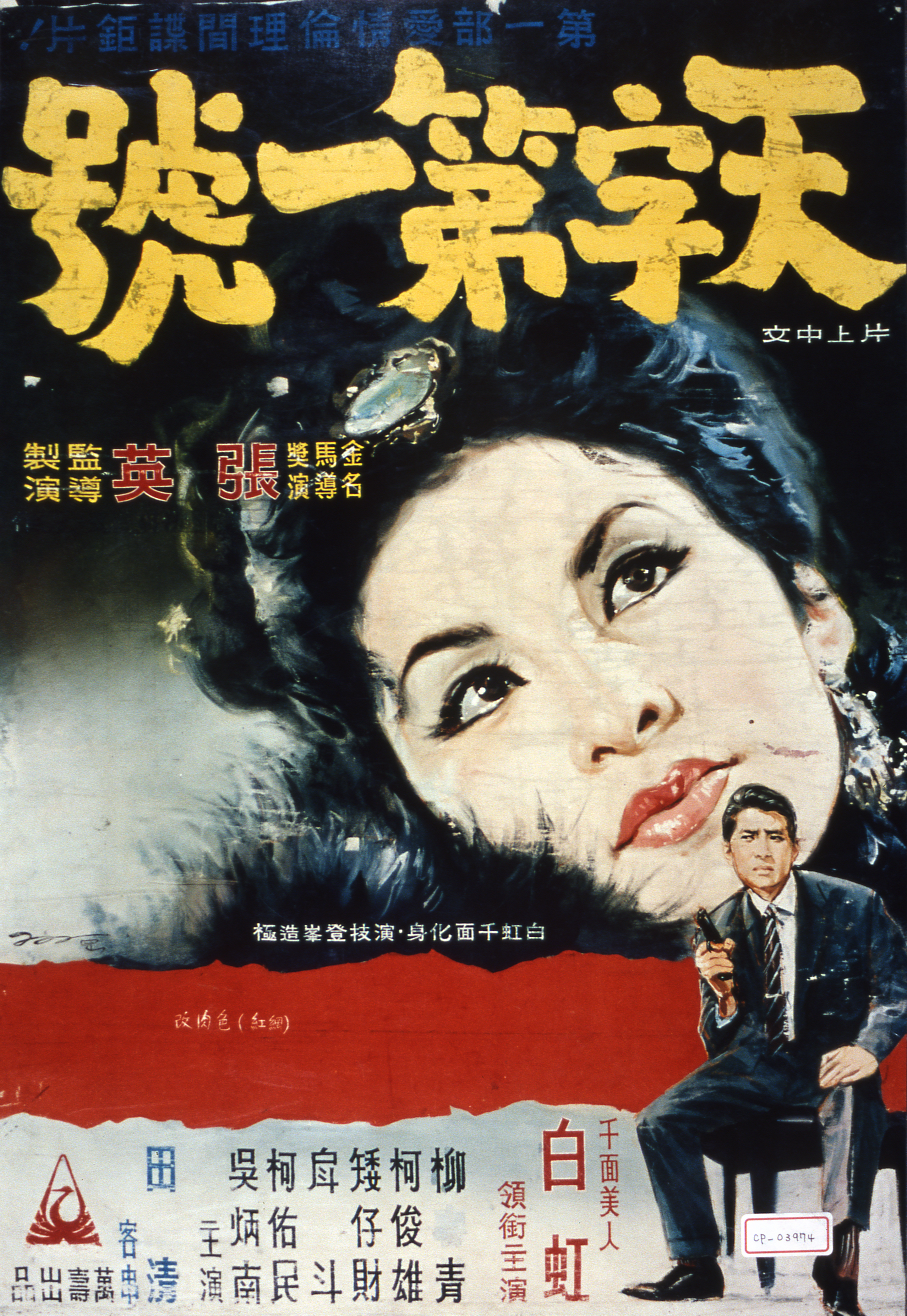
The Best Secret Agent (天字第一號, Chang Ying, 1964)

“The Japanese have destroyed our family. You must avenge me” a dying father instructs his daughter, his words somewhat ironically echoing the ideology of the ruling regime in hinting at the national trauma of exile and separation. Arriving in the wake of Bond mania, Chang Ying’s The Best Secret Agent (天字第一號) is, incongruously enough, a Taiwanese-language remake of an earlier film from 1945 set in Shanghai amid the Anti-Japanese Resistance movement, but at heart is less a tale of espionage and intrigue than a romantic melodrama in which a capable woman sacrifices romantic love for the patriotic and filial while perhaps subversively finding true freedom and independence. 

As Tsui-ying’s (Pai Hung) father (Ko Yu-Min) later explains, not wishing to be enslaved they fled from the Japanese but are forced to degrade themselves with public performances in the market square, the old man stooping to beating his daughter when the show fails to please the audience. A kindhearted man from the crowd, Ling-yun (Ko Chun-Hsiung), comes to her defence but Tsui-ying forgives her father blaming the Japanese for the misfortune which has befallen them. Soon after, Tsui-ying’s father is killed during an airstrike using his dying breath to ask for vengeance. After becoming a nightclub singer in Shanghai, Tsui-ying ends up running into Ling-yun again and the pair fall in love but she is also working as a spy and is ordered to break up with him in order to capitalise on the attraction a prominent collaborator, Chao-chun (Tien Ching), feels for her. Reluctantly she obeys, Ling-yun going abroad to study while she eventually becomes Chao-chun’s wife only to discover some years later that Chao-chun is actually Ling-yun’s uncle. 

The central melodrama revolves around the impossible love of Tsui-ying for Ling-yun, a love that she must willingly sacrifice in order to fulfil her role as a daughter both to her literal father and to her country. There is also however a degree of awkward comedy in Ling-yun’s continual discomfort that he must now refer to Tsui-ying as his aunt, their love now a further taboo in taking on a quasi-incestuous quality. Continually pained, she must keep her cover identity intact unable to explain to Ling-yun why she left him, encouraging him to think of her as a cold and heartless woman while watching him romancing his cousin, Ai-li (Liu Ching), whom she has come to genuinely care for as a maternal figure despite there being very little difference between them in age. 

What she apparently doesn’t know despite being a cunning mastermind is that almost everyone in her house is also a spy. As the famed Heaven No. 1, Tsui-Ying plays the cooly elegant wife of a diplomat cosying up to the Japanese but her activities perhaps owe more to the Basil Rathbone Sherlock Holmes movies than they do to the ever popular Bond, a late montage sequence showing her in a series of disguises from a wise old man to anonymous soldier and cheerful shoeshine boy while an early slapstick set piece sees the Resistance hide a pistol inside a roast duck in order to assassinate the Japanese advisor at dinner, the plan almost foiled by Chao-chun’s fiddling with the lazy Suzan. 

Everything is indeed the fault of the Japanese, but it’s Chao-chun, the collaborator who is the true villain even in his bumbling cluelessness, a quality also reflected in his idiot police chief Captain Wan who consistently fails to capture any Resistance members despite Chao-chun repeatedly ordering him to. In another bumbling piece of verbal humour, Captain Wan (Hu Tou) simply repeats the speech he’s just had criticising him for incompetence verbatim to his own subordinates while not doing much of anything himself. They are both, fairly obviously, outclassed by Tsui-ying playing the part of the clueless society bride lounging around in her furs and mediating in-house disputes while simultaneously plotting to bring them both down once they’ve outlived their usefulness. Though she is forced to give up what is most important to her, her love for Ling-yun, what she discovers is perhaps a transgressive sense of freedom and independence in her life as a master spy not otherwise available to an ordinary woman as she pursues her revenge for the death of her father.

Nevertheless, she is also orphaned both literally and metaphorically forced into a life of wandering. The separation of the lovers, blamed on the Japanese, is symbolic of that between the two Chinas as echoed in Tsui-ying’s melancholy love song and no doubt appealing to the prevailing ideology of the ruling regime save for the implication of fatalism as Tsui-ying and Ling-yun pursue exile in opposing directions. Even so with its fantastically compelling heroine, ironic humour, and atmosphere of intrigue tempered with melancholy romance, The Best Secret Agent more than lives up to its name as the master spy effortlessly completes her primary mission even if sacrificing her heart in the process. 


The Best Secret Agent streams in the UK 25th to 31st October as part of this year’s Taiwan Film Festival Edinburgh.

Trailer (Traditional Chinese subtitles only)

Ken (剣, Kenji Misumi, 1964)

Most closely associated with jidaigeki, Kenji Misumi’s only film to be set in the contemporary era, Ken (剣), shifts his persistent concerns into the modern day in the clash of the warrior ideal and the emotional costs of living, but also takes a sideways look at conflicted post-war masculinity as two young men vicariously lock horns in a quest for mastery over their desires. Adapting a short story by Yukio Mishima, Misumi dials back on the tragic romance of militarism painting the hero’s ultimate acceptance of nihilistic futility less as a noble sacrifice than a humanist failure of the society that failed to save him from his absolutist fallacy. 

Obsessed with strength and honour, Kokubun (Raizo Ichikawa) has convinced himself that he can capture “this spark of pure life” he saw in the sun through perfecting the art of kendo. An aloof and austere figure, he has foregone all else and dedicated himself to his skill alone. For this reason he is appointed captain of his university kendo club over his jealous rival, Kagawa (Yusuke Kawazu), who loses out because his sword is “sentimental” and there is a concern that he draws his power from “arrogance”. There is indeed something in that, and it’s Kagawa’s sense of male pride that partly sets him on a quest for vengeance and vindication in a obsessive desire to dominate Kokubun but there’s also an unspoken attraction as he later admits to a female acquaintance in remarking that he finds Kokubun’s way of life “infuriating” but despite himself also “refreshing”. 

Literal sword play, Kagawa’s obsession with Kokubun results in a vicarious seduction in which he attempts to corrupt him by enlisting the help of a female student to expose him as a fraud by rupturing his asceticism and thereby destroying his source of strength if not his sense of self. The quasi-sadomasochistic relationship between the two men is further borne out by the implication that Kokubun is in fact finding his sexual release in the intense act of repression, satisfying himself through physical exhaustion in the company of other men, Misumi’s roving camera fully capturing the homoeroticism of this intensely homosocial society. Humiliated by Kokubun who forces him into a public act of contrition through physical endurance after disappointing the club by breaking the rules smoking on the job at their part-time gig at a supermarket, Kagawa goes to the chairman to complain that Kokubun’s leadership style is far too intense, “feudalistic” as another member puts it shortly before quitting, claiming that all he wants is for his rival to wake up from his militarist dream and live in the real world though his final act of mutiny will engender consequences unforeseen in his conviction that Kokubun’s ideology is largely performative self-delusion. 

The team manager perhaps thinks something similar, reminding Kagawa that he is merely “more grown up” as if Kokubun is in a sense maintaining his childlike innocence in refusing to enter an adult world he regards as “ugly” and “corrupt”. His ideal is simplicity and he finds it in the primacy of the sword. There is in this something of an uncomfortable militarist throwback that finds a disciple in the ever loyal Mibu (Akio Hasegawa) who dutifully parrots back the quasi-facist philosophy to his quietly horrified mother and sisters who probably don’t help the situation by mocking his lack of masculinity in his inability to grow a proper beard while insisting on shaving every day anyway. Attracted by Kokubun’s dynamism and energy, he longs for strength through self denial. “We must move away from those empty desires” Kokubun instructs him while discussing the suicide of a young man who was discovered next to a selection of half eaten fruit. Rather than sympathy the man is largely mocked by his male peers, Kokubun dismissing him as “weak in mind and body” for having taken his own life apparently in fear of failure, but also stressing that suicide is a choice taken by the very strong as well as the very weak. 

In this brief exchange he opens the door to a notion of nobility in the choice to take one’s own life which leads straight back into the death cult of militarism, perhaps something that only Mibu as a fellow devotee is able to see. Yet Misumi perhaps undercuts this sense of nobility with a return to collective shame, eulogising Kokubun’s determination to preserve his “uprightness and strength” as Kagawa admits defeat in the face of Kokubun’s unbreakable purity, while placing the burden of failed responsibility on the kendo troupe not for their inability to live up to his ideal but for their lack of understanding in failing to free him of his moral absolutism. The way of the sword once again leads only to death and while there may be an uncomfortable beauty in such moral purity, in the end all there is is futility. 


Original trailer (no subtitles)