Antenna (アンテナ, Kazuyoshi Kumakiri, 2004)

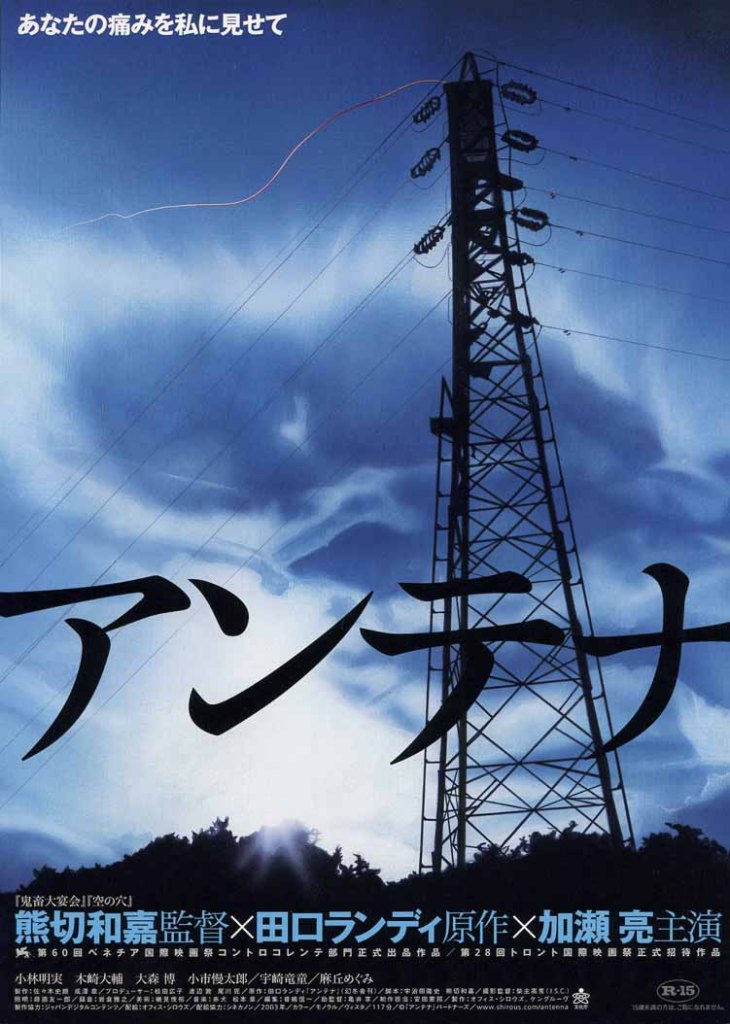
AntennaScarring, both literal and mental, is at the heart of Kazuyoshi Kumakiri’s third feature, Antenna (アンテナ). Though it’s ironic that indentation should be the focus of a film whose title refers to a sensitive protuberance, Kumakiri’s adaptation of a novel by Randy Taguchi is indeed about feeling a way through. Anchored by a standout performance from Ryo Kase, Antenna is a surreal portrait of grief and repressed guilt as a family tragedy threatens to consume all of those left behind.
Philosophy student Yuichiro (Ryo Kase) is currently working on a project which aims to reevaluate how pain is felt through attempting to identify with the pain of others. To do this he plans to investigate the S&M scene but before he can get started, a painful episode from his past is reawakened by current events. Yuichiro’s younger sister, Marie, has been missing since failing to return home from school one day when she was only eight years old. When news reports appear that another girl around the same age has been held captive in a nearby apartment complex since around the time Marie went missing hopes are sparked only to be dashed. Still no closer to discovering what happened to his younger sister, Yuichiro carries the guilt of having been unable to protect her as well as the inability to remember exactly what happened on that fateful day.

Matters come to a head when Yuichiro’s younger brother (their mother was pregnant with him at the time of the disappearance) turns up on his doorstep. Yuya (Daisuke Kizaki) repeatedly claims that Marie is about to return as he can feel her through his “antenna” (“like the horns of a snail”) and has a full scale fit aboard the train back. Things being what they are, the doctors advise Yuichiro to spend sometime at home as his distracted mother is no shape to cope with Yuya’s increasingly odd behaviour. A dutiful son, Yuichiro does what he can for what’s left of his family but his childhood home is far from a good environment for him.

Soon after Marie’s disappearance, both Yuichiro’s father and his uncle Shige who’d lived with them both died, leaving only Yuichiro’s mother and baby brother behind them. Unable to come to terms with Marie’s disappearance, Yuichiro’s mother has found religion, hosting Buddhist prayer sessions at the house and bringing in Feng Shui experts to try and heal the lingering sense of tragedy still present in the house. She has also become convinced that her second son, Yuya, is in fact the returned spirit of her daughter, raising him as a girl and dressing him in Marie’s clothes. This may explain some of Yuya’s conflicting behaviour and repeated insistence that his sister is “returning” in so much as something of her personality has become the ghost in his machine.

Once back in the house, Yuichiro’s mental state becomes ever more precarious as his memories of his sister’s disappearance begin to flicker to the surface. Overcome with repressed guilt, Yuichiro once again begins self harming by slashing his chest with a box cutter. Easing the mental pain with the physical, Yuirichiro finally begins to address some of his long buried trauma through repeated meetings with the dominatrix he was interviewing for his project. Undergoing a kind of S&M lead sex therapy, Yuichiro is slowly guided back through his memories to events he was too young to understand at the time and only now is fully able to comprehend.

Throughout his flashbacks Yuichiro is always sidelined, perched behind barriers or shut away by closed doors as the adults argue and loudly discuss things they claim are not suitable for children to hear. Crucial moments find him peaking through keyholes and seeing something he knew was not quite right but without knowing why. These incomplete and incomprehensible memories are the ones which haunt him, unresolvable but still trailing the guilt behind them of having seen yet done nothing.

Told in a slight non-linear fashion through frequent flashbacks, the film adopts a dreamlike tone and surreal imagery to make sense of the more extreme elements. The final sequence itself is either a hallucination or a dream that takes on a magical realist quality as the past is finally allowed to drift away from its lodging place, freeing up a space for light to return to the otherwise darkened house.

An intense exploration of buried trauma and childhood guilt, Antenna is a dark tale but does offer a glimmer of hope after all its hellish meandering. Kumakikri keeps things straightforward but his considered compositions have a strange kind of beauty despite the ugliness of the narrative. Embracing a number a taboo subjects coupled with strong emotion and explicit content, Antenna is not an easy watch but rewarding for those who can brave its extremes.


Original trailer (no subtitles)

Train to Busan (부산행, Yeon Sang-ho, 2016)

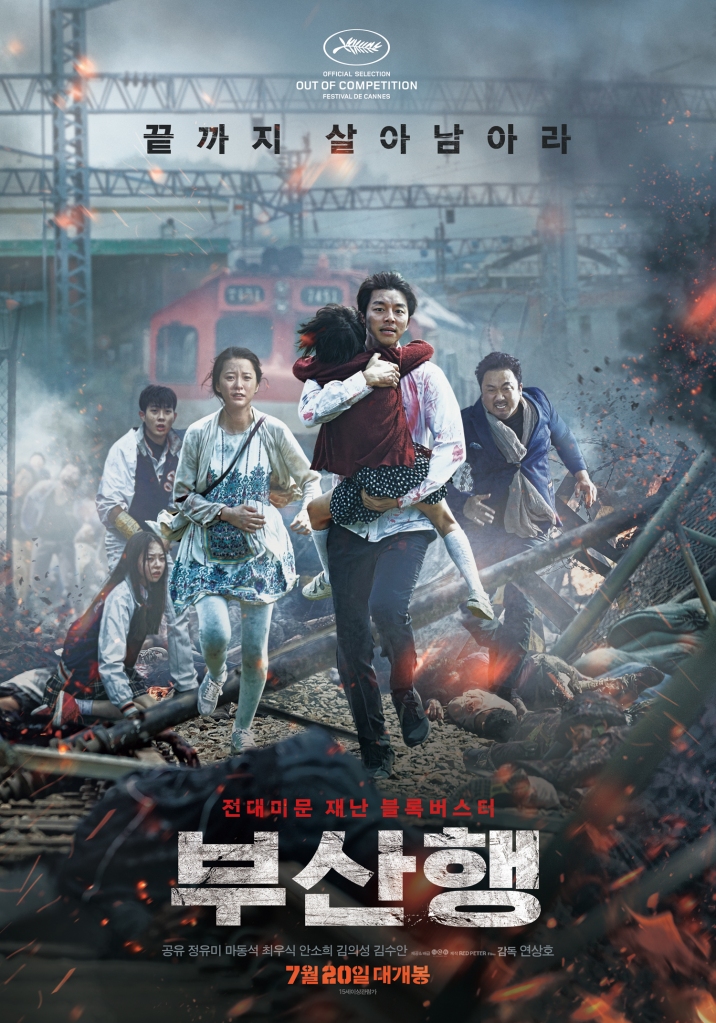
Train to BusanMany people all over the world find themselves on the zombie express each day, ready for arrival at drone central, but at least their fellow passengers are of the slack jawed and sleep deprived kind, soon be revived at their chosen destination with the magic elixir known as coffee. The unfortunate passengers on an early morning train to Busan have something much more serious to deal with. The live action debut from one of the leading lights of Korean animation Yeon Sang-ho, Train to Busan (부산행, Busanhaeng) pays homage to the best of the zombie genre providing both high octane action from its fast zombie monsters and subtle political commentary as a humanity’s best and worst qualities battle it out for survival in the most extreme of situations.
Workaholic fund manager Seok-woo (Gong Yoo) is having a series of very bad days. His wife has left him and for unclear reasons, also left their young daughter, Soo-an (Kim Soo-ahn), in her father’s care though apparently wants custody in the ugly divorce battle that now seems inevitable. It’s Soo-an’s birthday but all she wants is to catch a train to Busan to see her mum and if she has to she’ll even go by herself. After his attempt at a birthday present spectacularly backfires, Seok-woo gives in and agrees to take Soo-an to her mother’s before catching the next train back after dropping her off. Unfortunately, they have picked a very bad day to take the train.

Yeon Sang-ho takes his time to build to the central train based set piece but is is careful to create an atmosphere which makes it plain that there is something very wrong with this seemingly everyday set up. After a brief dig about pig farmers losing out to government policy on foot and mouth disease and irresponsible hit and run drivers leaving deer corpses behind them for someone else to deal with, he has a parade of emergency vehicles racing past Seok-Woo and Soo-an on their trip to the station while ash rains down on their car. Seok-woo is still focussed on work though sleepy on the train so he misses Soo-an’s shocked reaction to a station guard being rugby tackled just as the train is leaving while a mass of improbable early morning revellers are trying to break through the line of staff holding them back at the platform steps.

Patient zero bounds onto the train just as the doors close though one wonders why no one is paying much attention to this obviously distressed young woman as she stumbles and writhes around in the train carriage before the virus fully takes hold. Just as we think someone is about to come to her aid, it turns out to be a case of a snooty passenger taking offence at the presence of an “odd person” on the train. The “odd person” turns out to be a homeless guy whose mutterings of “dead, all dead” take on a prophetic air rather than the ramblings of a mad man that the train guards assume them to be.

This kind of stereotypical othering and the selfish refusal to help fellow humans in need is at the very heart of the film. Seok-woo admonishes his goodhearted daughter when she repeatedly makes an effort to be a kind and decent person by giving up her seat for an old lady or wanting to stop and help others escape the zombie onslaught. However, Soo-an’s goodness wins through as she in turn chastises her father and explains that his selfishness and lack of regard for the feelings of other people is the very reason her mother left the family. Even if he begins by cruelly closing the door on the film’s most heroic character and his pregnant wife, Seok-woo gradually begins to develop a sense of social responsibility whether out of simple pragmatism or genuine fellow feeling.

Workaholic fathers with minimal connections to their offspring may be something of a genre trope but, as father-to-be Sang-hwa says, fathers often get a bad rap – making all of the sacrifices and enjoying none of the rewards. In an attempt to show solidarity with Seok-Woo, Sang-hwa assures him that his daughter will understand why he worked so hard all the time when she grows up and reiterates that true fatherhood is about self-sacrifice. This is one sense plays into the earlier themes of Seok-Woo’s self-centred viewpoint in asking if he really is working hard for his family or only wants to been as such, maintaining his own social status and upperclass lifestyle and completing it with a perfectly posed family photo. A father is supposed to protect his daughter and now Soo-an has only him to rely on, if Seok-woo is going ensure her survival he will have to decide what kind of sacrifices he’s prepared to make on her behalf.

If the film has a villain it isn’t the rabid zombie hordes who, after all, are only obeying their programming, it’s personal, corporate, and political greed. The clearest embodiment of this is in the panicked businessman who frequently tries to issue orders to the train staff and insists the train take him to his preferred destination. After trying to get the homeless man thrown off the train early on, the fascistic businessman picks up a lackey in the form of a steward and begins trying to exclude all the “suspicious” people from his general vicinity. Cruel and cowardly, the businessman’s selfish actions only cause more problems for everyone else whilst whipping up unhelpful paranoia among those who will need to work together to survive. Literally feeding even his most loyal comrades to zombies to buy himself time to escape, this egotistical CEO is the perfect metaphor for cannibalistic nature of the capitalist system which is, as Sang-hwa said, content to let the “useless” fall behind.

That’s not to forget the actual undead threat. Yeon Sang-ho’s walking dead take inspiration from his animated work and move quickly with jerky, uncanny movements more like Butoh dancers than the usual stupefied shufflers. The set pieces are expertly choreographed and well shot, maintaining the tension throughout though the increase in scale towards the final stretch is at odds with the leaner, meaner approach of the early scenes. Despite eventually giving in to melodrama in a heavily signposted script, Yeon Sang-ho’s live action debut is an impressive effort making room for his standard social concerns whilst also providing innovative zombie thrills. Yeon Sang-ho’s message is clear, when disaster strikes no one can survive alone, the only chance for salvation lies in altruistic compassion. In the end the best weapon against the darkness is a children’s song as innocence finally triumphs over fear.


UK release trailer:

All Around Us (ぐるりのこと。, Ryosuke Hashiguchi, 2008)

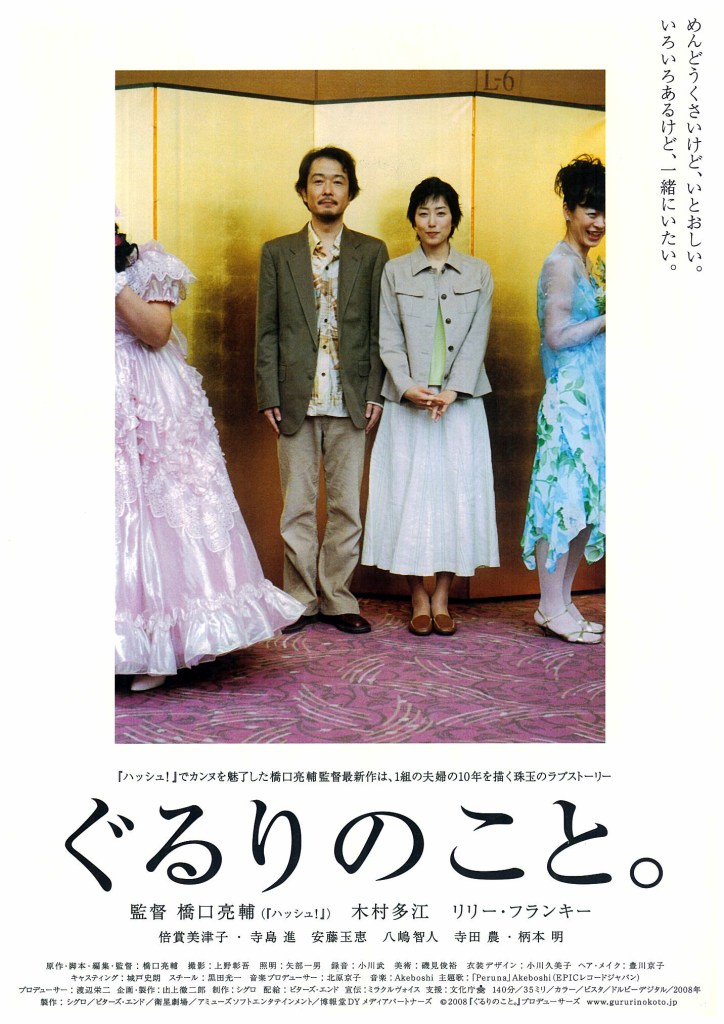
all around usRyosuke Hashiguchi returns after an eight year absence with All Around Us (ぐるりのこと。Gururi no Koto) and eschews most of his pressing themes up this by point by opting to depict a few “scenes from a marriage” in post-bubble era Japan. Set against the backdrop of an extremely turbulent decade which was plagued by natural disasters, terrorism, and shocking criminal activity Hashiguchi shows us the enduring love of one ordinary couple who, finding themselves pulled apart by tragedy, gradually grow closer through their shared grief and disappointment.

Tokyo, 1993. Kanao (Lily Franky) and Shoko (Tae Kimura) have had an “on and off” (but seemingly solid) relationship since their art school days. She works at a publishing house and he’s kind of a slacker with a job in a shoe repair booth. Shoko worries that Kanao plays around too much (but actually doesn’t seem that bothered about it) whilst continuing to attempt to micromanage their entire existence with her clearly marked calendar planning out the most intimate of actions. When Shoko discovers she’s expecting a child, the pair decide to finally get married and begin their lives as a family. Kanao also gets an opportunity on the work side when an old college friend helps him get a job as a courtroom artist for a news agency.

However, their joy is short-lived as an abrupt jump forward in time shows us a tiny shrine underneath the calendar (shorn of its red crosses) dedicated to the memory of their infant daughter. Kanao is the keep calm and carry on sort so he just tries to bluster through but Shoko is distraught and slowly descending into a mental breakdown. If that weren’t enough to contend with, Shoko’s estranged father has been tracked down and is apparently very ill dredging up even more pain an uncertainty from the long buried past.

We follow Shoko and Kanao over a period of nine years. As well as the ever present motif of the calendar, we feel the passage of time through Kanao’s work at the court house which sees him become the artistic recorder of some of the most traumatic moments of the age. Having entered into an era of economic turmoil following the end of the bubble economy, the 1990s saw not only the devastating Kobe Earthquake but also the sarin gas attack on the Tokyo underground perpetrated by a dangerous religious cult, members of which wind up in court in front of Kanao, tasked with the thankless task of bearing witness to their testimony.

Kanao evidently decided not to discuss his personal tragedy with his work colleagues or, one would assume, his boss would not have reacted so harshly when he made the reasonable request to turn down the opportunity to sit in on yet another child murder trial – either by accident or design, the trials which present themselves to Kanao (and are all real, sensationalised media events of the time) involve the horrific murders of small children with only one of the defendants voicing any kind of regret or remorse.

Meanwhile, Shoko has been trying to get on with life as best she can but finds herself sinking ever deeper into depression. Her uptight, controlling personality cannot cope with this perceived “failure” on her part or of the destruction of all her plans by a truly unforeseen tragedy. Having had her doubts before regarding Kanao’s commitment to her, she finds his lack of reaction puzzling. Mistaking Kanao’s lack of outward emotion for indifference, Shoko finds it hard to continue believing in their shared destiny and wonders if her husband ever really cared for her at all. Kanao is a laid-back soul, someone who’s learned to become used to disappointment by accepting it quickly and then trying to move on. His more grounded approach might be just the one Shoko needs in order to come to terms with what’s happened – never pushing or complaining Kanao is contented simply by her presence and is prepared to give her the space she needs whilst always being around to offer support.

Hashiguchi relies on visual cues to help navigate the shifting dynamics including the repeated use of the calendar as a symbol of Shoko and Kanao’s marital status, the now unneeded pregnancy books bundled to be thrown out, or rice discarded in the sink as a marker of a house proud woman’s slide into crippling depression. Small moments make all the difference from a mother’s bandaged wrists and a cutback to the only person who’s noticed them, to the repeated joke of all the veteran journalists suddenly falling over themselves in an attempt to escape the courtroom and be the first to file their copy. A necessarily sad story, but an oddly warm one as two people worried they may be mismatched grow into each other in the face of their shared tragedy. Anchored by the strong performances of its two leads (particularly Tae Kimura who manages some convincing on screen crying in a difficult role) All Around Us is another beautifully pitched human drama from Hashiguchi who proves himself an adept chronicler of the human condition even whilst stepping away from his trademark themes.


Original trailer (English subtitles)

Hush! (ハッシュ!, Ryosuke Hashiguchi, 2001)

hushThe family drama is a mainstay of Japanese cinema, true, but, it’s a far wider genre than might be assumed. The rays fracture out from Ozu through to The Family Game and Crazy Family which sought to ask a few questions about where the idea of “family” was headed in a society of rapidly increasing materialism. Ryosuke Hashiguchi comes at the idea from a different angle in 2001’s Hush! (ハッシュ!) as he once again takes the perspective of the gay community and asks if the “traditional family” is about to change – what could, or should, survive if the old, rigid ideas can be remade into something lasting created out of love and acceptance rather than obligation?
As the film begins, Naoya (Kazuya Takahashi) wakes up to find his one night stand already fully dressed and heading out the door, awkwardly, without even stopping to say goodbye. Eventually he hooks up with the kindly Katsuhiro (Seiichi Tanabe) and the two quickly become fairly serious but then a damaged woman, Asako (Reiko Kataoka), enters their lives hoping to use Katsuhiro as a sperm donor, forcing the men to reassess a number of important desires and beliefs, putting strain on their still fledgling relationship. If that weren’t enough drama, a girl at Katsuhiro’s place of work has also developed a crush on him and is prepared to take her unreturned love to some extremely dark places.

The first level of mini stresses Naoya and Katsuhiro have to contend with is their conflicting (if complementary) personalities and attitudes to their sexuality. Naoya is an easy going type with a job at a pet grooming salon. He’s a fully out gay man and a frequenter of city’s gay scene. Katsuhiro, by contrast, is much more mild mannered and innately kind. He works at a scientific research station and is more or less closeted – that is, he doesn’t particularly go out of his way to hide his sexuality from his work mates and family but he doesn’t volunteer the information either. This attitude seems to bother Naoya at various points but being the easy going type he’s apt to let it go most of the time.

However, when Katsuhiro reveals Asako’s offer, Naoya is actively against it. His idea of gay life suggests that relationships are generally short, he prefers the relative freedom of his life as an essentially “single” man rather a husband shackled to a family. Katsuhiro on the other hand perhaps would have liked children, or to be a father figure to someone else’s. Though Naoya has previously expressed boredom and disillusionment with his life spent in clubs and gay bars, he’s still resistant to the idea of settling down, or at least to the belief that a single relationship really can stay the course.

All three of the central characters have, in a sense, been let down by the “traditional” family. Naoya’s father left when he was small, leaving him with a single mother which is something that wasn’t so common when he was a child resulting in a fair amount of social stigma from other people in the community. These days his brassy mother knows about his sexuality and seems OK with it (aside from getting the random idea that Naoya will be wanting a pair of breasts at some point). Katsuhiro’s father was an alcoholic who died when he was just a small boy, his relationship with his brother and his family seems good but he’s afraid to reveal his sexuality to them for fear of disapproval. His brother had an arranged marriage, which doesn’t seem to have worked out so well at least from the sister-in-law’s perspective. Asako has also had a troubled life looking for affection in all the wrong places, feeling that if she had not been neglected as a child perhaps she’d have been a steadier adult. Naoya was running away from the idea of family ties, but Katsuhiro and Asako are actively seeking to repair the ones which never grew into the kind of roots one needs to anchor onself in a society entirely built around familial bonds.

After receiving some surprising medical news, Asako perversely decides that her own salvation lies in becoming a mother. She’s had enough of casual relationships and decided to go a different route so when she spots the kind look Katshiro gives a small child at a restaurant, she decides he must be the one to father her baby. Asako knew that Naoya and Katsuhiro were a couple, but that works out pretty well for her plan so she approaches him and makes her left field offer right off the bat. It will take some figuring out but this literal third way is a neat solution to a series of problems and, being completely new, is safe from the pettiness and misery often found within the traditional family unit. Contrasted with the bitterness displayed by Katsuhiro’s sister-in-law, the unusual arrangement of these three would be parents and their unborn child(ren) is one filled with love, forgiveness and mutual support rather than cold obligation or a simple fulfilment of societal expectations.

Once again Hashiguchi proves himself adept at creating a series of complex, flawed human beings who are nevertheless relatable and often endearing. Hashiguchi’s films tend to run long but he also ensures that even his supporting characters are well enough drawn to maintain interest in the many subplots from Naoya’s abrasive gay bar buddy to Katsuhiro’s unhinged stalker. An interesting sideways look at the state of the modern family, Hush! seems to advocate that just shutting up and going with the flow is not the answer but there are quieter solutions to be found if everyone is willing to listen to the silence.


Original trailer (no subtitles)

The Bow (활, Kim Ki-duk, 2005)

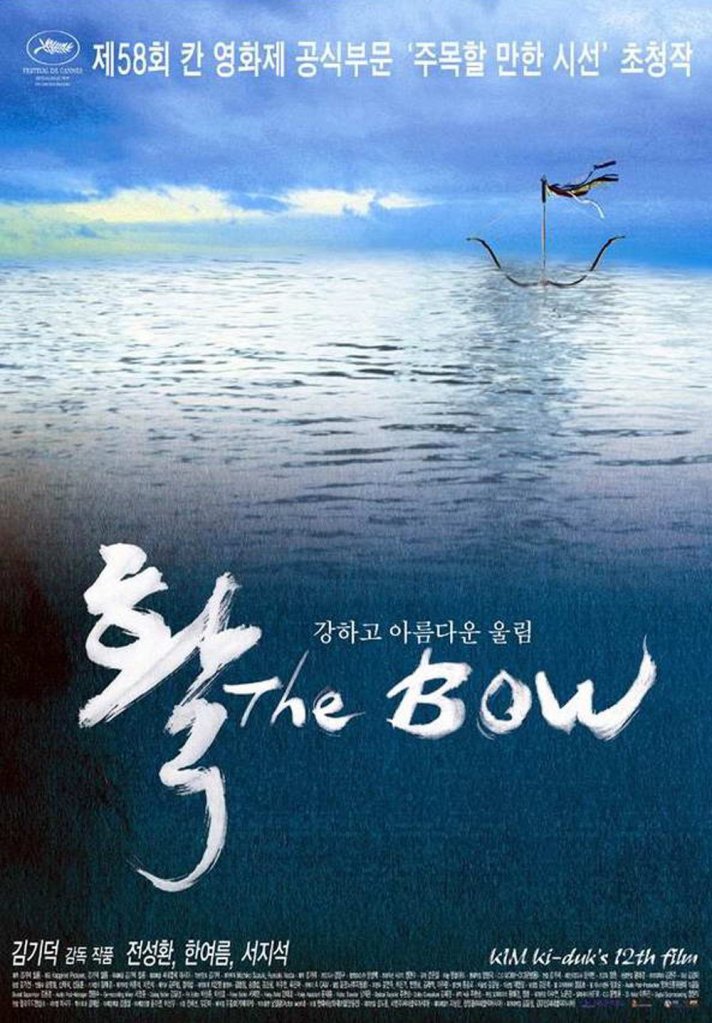
The bowKim Ki-duk is not known for his conventional approach to morality but even so his 12th feature, The Bow (활, Hwal), takes things to a whole new level of uncomfortable complexity. While nowhere near as extreme as some of Kim’s other work, The Bow takes the form of a fable as an old man and a young girl remain locked inside a mutually dependent relationship which, one way to another, is about to change forever.
The old man owns a fishing boat on which he lives with a young girl most assume to be his granddaughter. This theory is quickly disproved by the old man’s obsession with his wall calendar on which he excitedly crosses of the dates, making a note of how many there are left until the circled day on which is marked the word “wedding”. Whose wedding, one is apt to ask but the obvious answer is the correct one. The old man plans to marry the young girl on her 17th birthday. Having “found” her ten years ago, he’s been patiently raising her and now awaits his reward. It’s not clear if he has actually asked the girl, who seems to look to him as a paternal rather than romantic figure, but at any rate the relationship between them seems fairly solid at this point.

That is until one fateful day a young and handsome student boards the boat and immediately captures the girl’s attention. Having been cooped up here for ten a whole years seeing no one other than the old man and the guys who come to fish, the girl is instantly smitten – just like Miranda laying eyes on Ferdinand for the very first time. The old man is worried – is he about to lose his prize bride to a young buck? With the fateful day approaching, the girl becomes increasingly cold and rebellious towards her father/husband-to-be, though which direction she will eventually choose is anyone’s guess.

The old man is very protective of his charge, taking out his bow and arrow when the other guys on the boat try it on (and some take the chase to quite unpleasant places) but perhaps that’s more about defending his property from spoilage than it is about saving a defenceless girl from a traumatic situation. Neither the girl nor the old man speak very much, occasionally one whispers to the other who then passes the message on via another whisper to whomever it was intended for. Perhaps they genuinely have no need for talking but at any rate the girl never voices any objections to her life on the boat and the only signs of rejection given are a sullen look, rebellious courting of the customers and finally a good old fashioned slap to the face.

The bow of the title is both a weapon and a musical instrument when the string is tightened over a drum rather than across an arrow. The artist and the warrior are truly two sides of the same coin, swapping drums for arrows as the occasion calls. The old man, who is more or less cast as the protagonist of the tale meeting a final swan song, has all these qualities. A rough sea hand, he lives a life of isolation alone with the girl on a boat in the middle of the sea, the music their only form of entertainment. As well as the fishing business, the man also tells the fortunes of his customers by firing arrows at a picture of a Buddhist deity while the girl rides a swing in front. The boat itself is a world entire, with its own rules and rituals – all things are contained inside of it, violence mixed with beauty and love mixed with fear.

It’s ironic in one sense that the girl’s would be rescuer is another man with less prurient designs, but still designs all the same, on her as a woman. That she’s apparently lived on this boat for ten years with people coming and going all the time and with no great attempts to maintain a convenient excuse is shocking in itself. Whether the relationship between the old man is entirely genuine or born of a kind of Stockholm syndrome is a matter for debate, but Kim opts not to fully explore the uncomfortable elements of this unusual situation in favour of casting the old man as a kind of love fool.

Though actually featuring much more dialogue than the average Kim film, The Bow is at heart a symbolic exercise which becomes a complex and extended Buddhist metaphor. Playing out like a boat bound The Tempest, the old man becomes Prospero with a bow rather than a staff and as a prophet rather than a magician. The student, like Ferdinand, shatters their peace by bringing the outside world into their idyll with all of its pleasures and complications. The old man faces a choice, burn his books and abandon his kingdom or keep his daughter/wife-to-be fearful enough to stay with him rather than the young man who offers her, literally, the world, which she has never known. Kim descends into a surrealist frenzy as the finale approaches, culminating either in a beyond the grave consummation of true love or a spiritual rape, depending on your point of view. Whichever you choose, The Bow is both a complex and poetic exploration of human relationships but one that proves unpalatable and, ultimately, hollow.


Original English language trailer (dialogue free, English text)

Pandora’s Box (パンドラの匣, Masanori Tominaga, 2009)

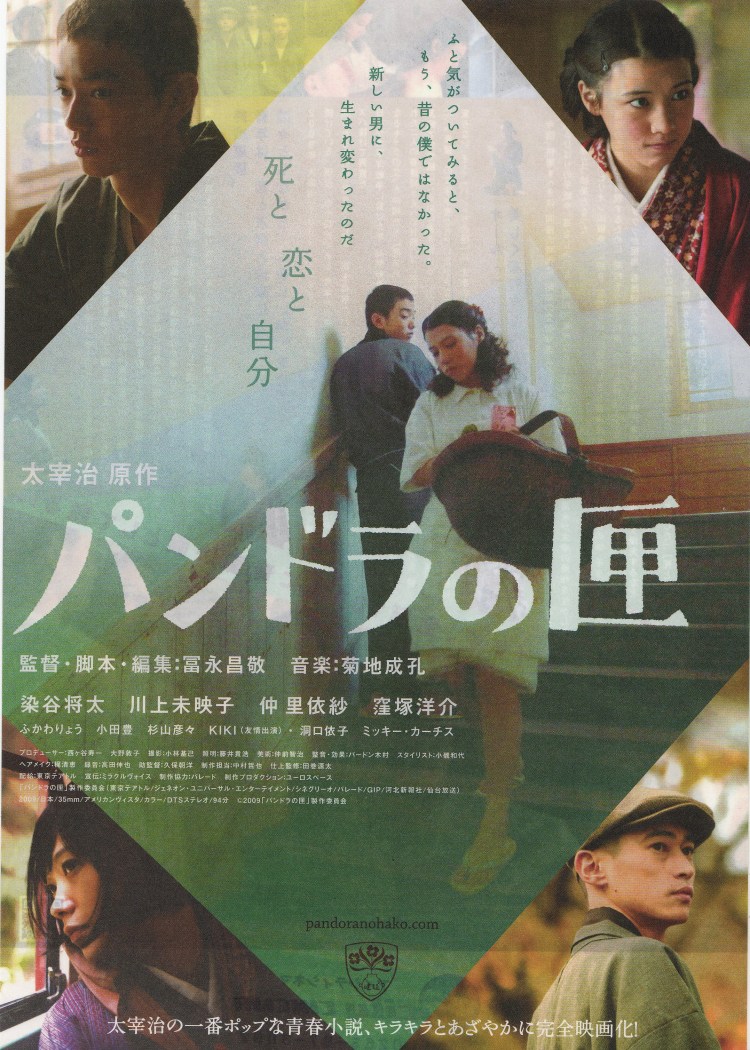
Pandora's BoxOsamu Dazai is one of the twentieth century’s literary giants. Beginning his career as a student before the war, Dazai found himself at a loss after the suicide of his idol Ryunosuke Akutagawa and descended into a spiral of hedonistic depression that was to mark the rest of his life culminating in his eventual drowning alongside his mistress Tomie in a shallow river in 1948. 2009 marked the centenary of his birth and so there were the usual tributes including a series of films inspired by his works. In this respect, Pandora’s Box (パンドラの匣, Pandora no Hako) is a slightly odd choice as it ranks among his minor, lesser known pieces but it is certainly much more upbeat than the nihilistic Fallen Angel or the fatalistic Villon’s Wife. Masanori Tominaga had made an impact with his debut film The Pavillion Salamandre and seemed to be a perfect fit for the quirkier, darkly comic Pandora’s Box but perhaps in the end it was too perfect a fit.

Inspired by events from Dazai’s own life, the story centres around a young man at the end of the second world war who has been suffering from tuberculosis for some time but kept quiet about it expecting to die soon and remove the burden on his family. However, when the war finally ends Risuke (Shota Sometani) inherits a new will to live and commits himself to a sanatorium to treat his lung condition. Whilst in the hospital he comes into contact with writers and poets as well as pretty nurses all the while proceeding with his plan to become a “new man” for this “new era”.

At once both hopeful and nihilistic, Pandora’s Box mixes gallows humour and denial in equal measure as the motley collection of inpatients waste their days away in this eccentric establishment which looks after them well enough but promises no real progress in terms of their health. Each of the patients receives a nickname when they enter the sanatorium so Risuke quickly becomes Hibari (sky lark). Tellingly, these nicknames overwrite real world personas – original names are recalled only at the time of death. Deaths do indeed occur but aside from these unhappy events, no one acknowledges the seriousness of their condition or the possibility that they may die from it, never leaving the hospital again. Physical pain and suffering is almost entirely absent though Risuke gives ample vent to his mental anguish through his letters to a fellow patient who has now been discharged back into the unseen chaos of the post-war world.

Indeed, the sanatorium might be a kind of idyll in this era of instability. Well fed and well cared for, the patients are far better off than many left adrift in the starving cities but the outside world rarely impinges on the isolated atmosphere of the sanatorium. Events change slightly when a friend of Risuke’s, Tsukushi (Yosuke Kubozuka), is discharged and a new nurse, Take (Mieko Kawakami), arrives stirring up various different emotions amongst the male patients in Risuke’s ward. Striking up a friendship with the younger nurse, Mabo (Riisa Naka), Risuke finds himself torn between two very different women.

Although its tone is necessarily one of depression and numbness, Pandora’s Box ends on an improbably upbeat note in which Risuke remarks that just like a climbing plant he may not know where he’s going, but it will certainly be a place of bright sunlight. A minor work filled with dark, ironic humour it’s perhaps unfair to expect the same kind of impact as Dazai’s more weighty efforts but Pandora’s Box is a lower budget affair which, although interesting enough in terms of direction, fails to make much of an impression outside of its obvious pedigree. The light jazzy score and deadbeat voice over add to the period feel whilst also lending an air of hopeless yet buoyant resignation to Risuke’s ongoing journey into the post-war world. This, in many ways, is what we’re here for – Risuke, unlike Dazai, has made a commitment to forge a way forward in which he plans to fight for the sun rather sink below the waves.


Original trailer (no subtitles)

Summer of Ubume (姑獲鳥の夏, Akio Jissoji, 2005)

Summer of the UbumeAkio Jissoji has one of the most diverse filmographies of any director to date. In a career that also encompasses the landmark tokusatsu franchise Ultraman and a large selection of children’s TV, Jissoji made his mark as an avant-garde director through his three Buddhist themed art films for ATG. Summer of Ubume (姑獲鳥の夏, Ubume no Natsu) is a relatively late effort and finds Jissoji adapting a supernatural mystery novel penned by Natsuhiko Kyogoku neatly marrying most of his central concerns into one complex detective story.
Freelance writer Tatsumi Sekiguchi (Masatoshi Nagase) and occult expert Kyogokudo (Shinichi Tsutsumi) become intrigued by the bizarre story of a woman who has apparently been pregnant for twenty months. If that weren’t enough weirdness, the woman’s husband also went missing a year ago and now her sister has approached the pair hoping they can investigate and figure out what’s really going on. Unbeknownst to him, Sekiguchi has a longstanding connection with several of the people involved and himself plays a role in the central mystery. Demons foreign and domestic, past trauma, infanticide and multiple personality disorder are just some of the possible solutions but as Kyogokudo is keen to remind us, there is nothing in this world that is truly strange.

The mystery conceit takes the form of a classic European style detective story complete witha drawing room based finale in which each of our potential suspects is assembled for Kyogokudo so that he can deliver his final lecture and tick them all off the list as he goes along. The tale takes place in the summer of 1952 and so the spectre of Japan’s wartime past, as well as its growing future, both have a part to play in solving this extremely complex crime. The original supernatural question concerns two otherworldly entities which have become conflated – the Chinese Kokakucho which abducts children, and the Japanese Ubume which offers its child to passersby. Needless to say, the answer to all of our questions lies firmly within our own world and is in no small part the result of relentless cruelty masked as tradition.

The opening scene includes a lengthy discussion between Kyogokudo an Sekiguchi debating the nature of reality. We only experience the world as we perceive it, seeing and unseeing at will. Everybody, to an extent, sees what they need to see, therefore, memory proves an unreliable narrator when it comes to recalling facts which may run contrary to the already prepared narrative.

Jissoji brings his trademark surrealist approach to the material which largely consists of interconnecting flashbacks often intercut with other dreamlike imagery. Filming with odd angles and unusual camera movements, Jissoji makes the the regular world a destabilising place as the strange mystery takes hold. The canted angles and direct to camera approach also add to a slight hardboiled theme which creeps in around the otherwise European detective drama though this mystery is much more about solving a series of puzzles than navigating the dangerously dark world of the noir. That said this is a very bleak tale which, for all its frog faced children weirdness, has some extremely unpleasant human behaviour at its roots.

Supernatural investigator Kyogokudo quickly dispenses with the demonic in favour of the natural but the solutions to this extremely complicated set of mysteries are anything but simple. Making space for the original novel’s author to show up as a travelling picture storyteller with some Shigeru Mizuki inspired illustrations on his easel, Summer of Ubume is not entirely devoid of whimsy but its deliberately arch tone is one which it manages to make work with its already bizarre set up. The enemy is the unburied past, or more precisely the unacknowledged past which generates its own series of ghosts and phantasms, always lurking in the background and creating havoc wherever they go. Occasionally confusing, Summer of Ubume is a fascinating supernatural mystery which takes its cues much more from European detective stories and gothic adventure than from supernatural horror or fantastical ghost story.


Natsuhiko Kyogoku’s source novel is available in an English translation by Alexander O. Smith (published by Vertical in the US).

Original trailer (no subs):

Attack on Titan: The Movie – Part 2: End of the World (進撃の巨人 ATTACK ON TITAN エンド オブ ザ ワールド, Shinji Higuchi, 2015)

166831_02Review of the second Attack on Titan live action movie first published by UK Anime Network.


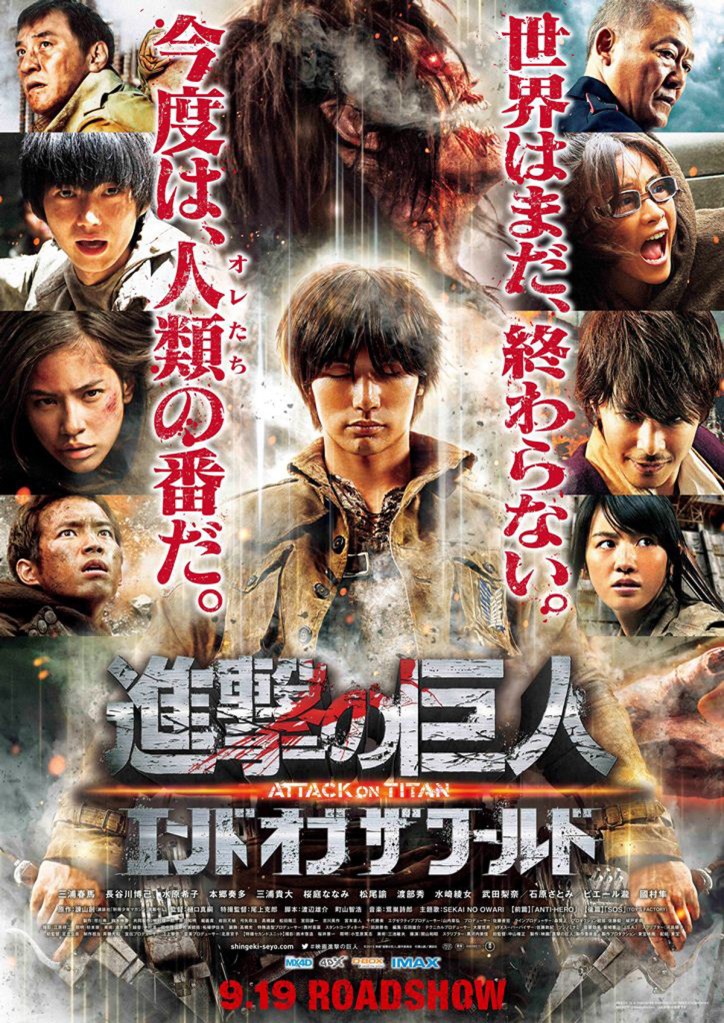
Attack on Titan: The Movie – Part 1 ended on a humdinger of a cliff hanger, so this concluding half of the two part movie is one  which carries a fair amount of expectation regardless of reactions to the first instalment. Picking up more or less straight after the end of Part 1, the situation continues to be desperate as the mission to acquire explosives to blow the wall closed is an abject failure. Thanks to Eren’s (Haruma Miura) efforts, the Titan onslaught has eased off but he now finds himself in the direct firing line of sinister dictator Kubal (Jun Kunimura). Coming up with an alternative plan to recover the dud bomb we saw in the beginning of the first film, our intrepid band of comrades decide to return to their former home paving the way for the massive Titan on Titan frenzy finale.

Whereas Attack on Titan: The Movie – Part 1 attempted to reframe itself as a monster movie, The End of the World places itself firmly within the comic book genre. Rather than a frightened populace desperately trying to protect itself from the sudden arrival of man eating giants, The End of the World introduces a series of human lead super Titans who will eventually be duking it out during the film’s finale.

Largely, The End of the World eschews the thematic concerns of the first film in favour of large scale action scenes but it does come up with a few new ideas of its own. Towards the beginning, it seems as if The End of the World is about to undercut all the unpleasant fascistic connotations of the previous film by bringing Eren into contact with the Survey Corps who are now the rebel resistance but this turns out to be a hollow offering as the squad is then painted as a renegade militia commanded by a madman.

After his original imprisonment, Eren wakes up in a minimalist, low ceilinged white room which contains a ‘50s style jukebox with a cover version of the old time hit The End of the World already playing. Despite the ban on machines “the government” has apparently stockpiled some of these “artifacts” for their own use which also includes a rather prominent remote control for an Apple TV. At this point we’re shown some archive footage which explains the birth of the Titans and the creation of the “modern” society, the implication being that the Titans are part of an elaborate governmental propaganda scheme designed to keep the unruly populace firmly in line. The Titans reappeared at a political crisis point as the government felt the loyalty of its people waning and also feared that the plan to explore outside of the walls would weaken their authority. Having already instituted authoritarian policies such as limiting access to childbirth, the government used the Titan threat to galvanise support through fear.

This sequence begins to offer an entirely different reading of the film – one which is more fully hinted at in the final post-credit sequence, but is then largely forgotten. Aside from a nasty slice of possible domestic violence and some PTSD End of the World stays away from further character driven drama, leaving Shikishima to ham things up with an increasingly camp performance whilst behaving in a very ambiguous way towards Eren which proves awkward when considering further information provided regarding Eren’s childhood. As a whole, the Attack on Titan movies have a major problem with internal consistency, piling plot holes upon plot holes yet still failing to make any of its central conceits remotely compelling.

However, The End of the World does improve on some aspects of the previous film – notably in its tighter running time and action set piece finale (lengthy exposition sequence and extremely long recap aside). Production values appear a little better, there is far less of the bad CGI which marred the first film, and there’s even some more interesting production design to be found too. The Hollywood style heroic ending with the sun shining and the score soaring might appear less clichéd when considered alongside the alternate reading offered by the post-credits sequence, but then again this may be another red herring just like the resistance group which originally appeared to offer hope but was then summarily discredited.

The two live action Attack on Titan movies come at the original franchise from vastly different angles and are often at odds with each other. Some of these inconsistencies may be explained by the post-credits sequence which is, perhaps, a hook for a putative third film but only adds an additional layer of confusion to what is already an overloaded premise. All of that aside, The End of the World does offer slightly more straightforward, comic book style trial by combat action heading into its finale even if it does lay on the exposition a little thickly. Whilst offering some mild improvements over the first film, End of the World fails to rescue the project as a whole but is likely to provide satisfaction to those left hanging after the curtain fell on part one.


English subtitled trailer:

Hanging Garden (空中庭園, Toshiaki Toyoda, 2005)

hanging gardenIf you wake up one morning and decide you don’t like the world you’re living in, can you simply remake it by imagining it differently? The world of Hanging Garden (空中庭園, Kuchu Teien), based on the novel by Mitsuyo Kakuta, is a carefully constructed simulacrum – a place that is founded on total honesty yet is sustained by the willingness of its citizens to support and propagate the lies at its foundation. This is The Family Game 2.0 or, once more with feeling.

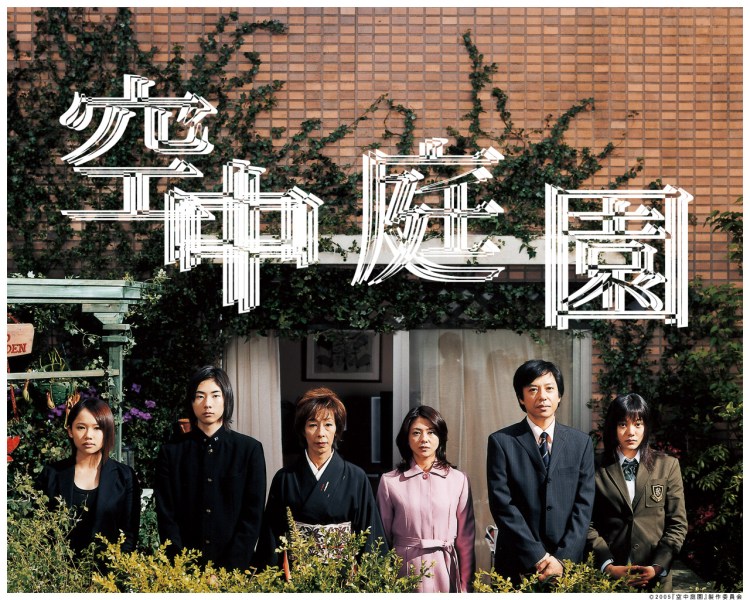
The Kobayashis have one rule – they keep no secrets and no subject is taboo. We can see they take this approach to life seriously when daughter Mana asks her mother about the circumstances of her conception and receives an honest and frank reply. However, this “pretence” of honesty is exactly that – a superficial manifestation of an idea intended to maintain control rather than foster liberty. Each of the family keeps their secrets close be it extra marital affairs, past trauma, or just dissatisfaction with the state of current society. The very idea which binds them together also keeps them forever apart, divided by the charade of unity.

Toyoda crafts his metaphors well. The hanging garden of the title belongs to the matriarch, Eriko, who has created an elegant garden space on the cramped balcony of their small flat on a housing estate. Her swinging hanging baskets give the film its odd sense of off kilter sway as the camera swirls and swoops unsteadily like a rudderless ship adrift at sea. Eriko is carefully rebuilding her world in manner more to her liking, pruning her rosebushes with intense precision both metaphorically and literally.

Eriko’s intense control freakery stems back to her childhood and strained relationship with her currently hospitalised mother, Sacchan. Sacchan is one feisty grandma who may not share Eriko’s tenet of total honesty but nevertheless is inclined to tell it like it is. The central tragedy here is of maternal misconnection, a mother and daughter who refuse to be honest with each other. An encounter with Eriko’s older brother who seems to have an equally difficult relationship with Sacchan makes this plain. However, facing a health crisis and aware of reaching the final stages of her life Sacchan is also in a reflective mood and reveals that she’s recently begun dreaming her memories – revising and improving them as she goes to the point that she’s no longer sure how much of her recollection is how she would have liked things to have been rather than how they really were.

Son Ko is also interested in imagined worlds only more of the technological kind where he’s created a virtual version of his real life on his computer. Something of a dreamer, he wonders if the designers of the tower block deliberately made all the windows face south so that they’d get more sunlight and people would feel happier but he’s quickly shot down with the prosaic explanation that it’s all to do with drying laundry. He’s the only one who tries to explain to his mother that her intense need for “honesty” is, ironically, just another way of avoiding reality but then everyone already knew that – it’s the final truth that underpins the value system which has defined each of their lives.

However, where the family at the centre of The Family Game is shown to be hollow, the Kobayashis’ willingness to go along with this crazy self determined cosmology is driven by genuine feeling. Father Takeshi may be having affairs all over the place and even lying to his boss to facilitate them, but he wouldn’t have stayed at all if it truly meant nothing to him. Eriko plays manipulative goddess, micromanaging the fate of this tiny nation state since its inception with a keen and calculating eye but it’s all in the service of creating for herself something which she’d always felt she’d been denied – unconditional familial love, something which she also seeks to pass on to her children as the ultimate revenge on her mother whom she believes to have been cold and unfeeling.

As useful a tool as honesty may be, Sacchan may have a point towards the end when she says you take your most important secrets with you to the grave. Some things lose their power once you speak them aloud, too much honesty only focuses attention on the self and is apt to make those secretive who would seek to be open. Hanging Garden is a rich and nuanced exploration of human relationships, the shifting nature of memory, and the importance of personal privacy coupled with the veneer of authenticity which makes life in a civil society possible. Take away a man’s life lie you take away his happiness – hanging gardens never take root, but they bloom all the same.


Copycat Killer (模倣犯, Yoshimitsu Morita, 2002)

copycatYoshimitsu Morita had a long standing commitment to creating “populist” mainstream cinema but, perversely, he liked to spice it with a layer of arthouse inspired style. 2002’s Copycat Killer(模倣犯, Mohouhan) finds him back in the realm of literary adaptations with a crime thriller inspired by Miyuki Miyabe’s book in which the media becomes an accessory in the crazed culprit’s elaborate bid for eternal fame through fear driven notoriety.

Following a non-linear structure, the film first introduces us to an old man who runs a tofu shop where he lives with his middle aged daughter who is in the middle of a breakdown following the end of her marriage, and his grown up granddaughter who has become the woman of the house during her mother’s illness. Though not without its difficulties his life was happy enough but after granddaughter Mariko goes out one evening and never comes home, nothing will ever be the same again.

A severed arm and a handbag are discovered in a flower bed by a teenage boy whilst walking a dog, though a mysterious distorted voice later contacts the media to inform them that the arm and the handbag do not belong to the same woman. The boy, oddly enough, is the sole survivor of his family who were all murdered some years previously. He was interviewed at the time by press reporter Yumiko whose soba shop owning brother may have a connection to the crimes. The cold blooded killer knows all of this and is engineering coincidences into a grand plan in which he will harness the power of mass media to earn himself a kind of national respect as an “expert” on the crimes which he has himself been committing.

Hitting a style somewhere between The Black House and Keiho, Morita opts for a dreamlike atmosphere filled with dissolves, soft split screens and hacker inspired graphical touches. Not only is the killer interested in appearing on TV either in voice or in person but can also manipulate mass media by hacking commercials and billboards to proclaim his own messages. As well as the early computer inspired effects, photo zooms, and contemporary methods of evidence presentation, Morita wrong foots the audience by zigzagging through the chronology of crime beginning with the central murder then switching back to the killers as they are now, then their childhoods, and cutting back to each of the other protagonists – the grandfather, teenage boy, and reporter.

Possibly inspired by the Leopold and Loeb case, the killers are a duo of psychotic young men who think they can achieve everlasting fame and personal satisfaction by committing the kind of murders which have never been committed before. The true motivator of the crimes even tells one of his victims that she ought to be grateful. That she was leading a “pointless” life and now she’s being given the opportunity to “serve” in something greater as a component in his master plan. Before, he explains, she’d just have gone on living until she died and been forgotten but now she’ll be a star – everyone will remember her name as a victim in the crime of the century and the world will mourn her death.

At another juncture, the killer also remarks that absolute faith in the family unit is the reason a relative of a suspect or victim of crime is routinely targeted by the press and a source of recrimination even though they themselves had nothing to do with it. Family issues are also a factor as rejection and abandonment by parental figures is offered as a reason for why a person may eventually become deranged. Thus, the killer’s intention to harness mass media for worldwide fame through committing heinous, terrible crimes is painted as a quest for the attention and recognition he never received from his parents. The family is both nothing and everything, but as we reach the conclusion it’s family that engenders hope as we’re presented with a potential new family committing to proving that nurture can trump nature with happy childhoods building mentally balanced adults.

The grief stricken grandfather tells the killer that his selfish actions are cowardly and pointless. That if he really wanted to cause a sensation in this cruel world, he should have become a hero and taught people how to love instead of hate – that would be the true radical action. Morita’s essential world view is once again resolutely bleak but offered with a wry and cynical sense of humour. The final messages are of acceptance and moving on no matter how hard it may be, and of trying to create something good out of even the very worst occurrences. The film’s extremely strange, oddly explosive expressionist finale takes things a step too far and the youthful, contemporary electronic score with its link to the stereotypical hacking iconography occasionally calls attention to itself but Copycat Killer still proves an entertaining, multilayered crime thriller filmed with Morita’s characteristically experimental approach and necessary dose of oddness.


Unsubtitled trailer: