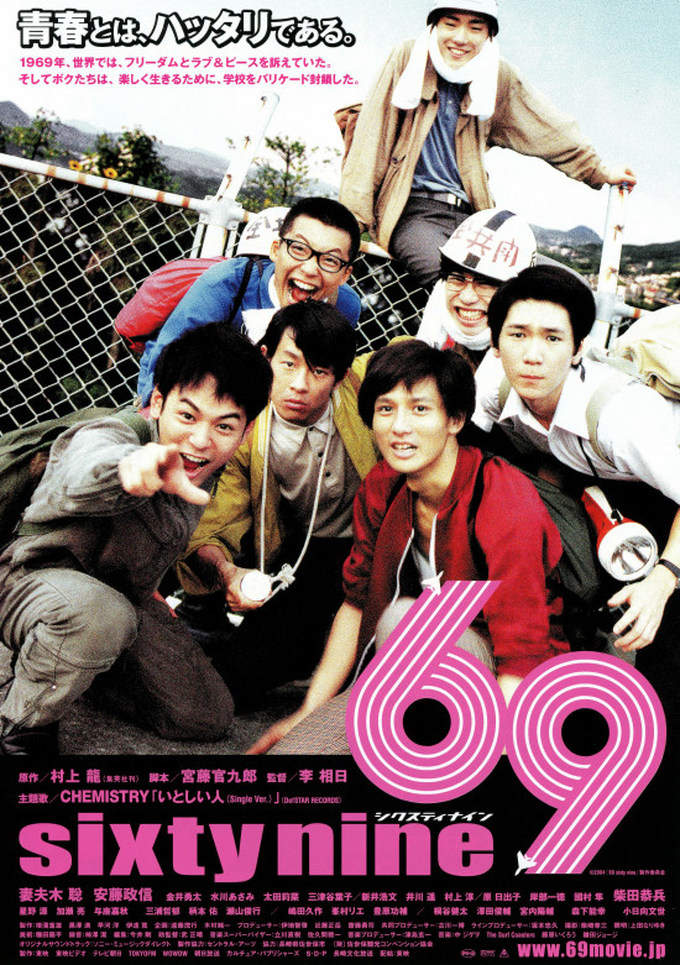
69 (Lee Sang-il, 2004)

69Ryu Murakami is often thought of as the foremost proponent of Japanese extreme literature with his bloody psychological thriller/horrifying love story Audition adapted into a movie by Takashi Miike which itself became the cornerstone of a certain kind of cinema. However, Murakami’s output is almost as diverse as Miike’s as can be seen in his 1987 semi-autobiographical novel 69. A comic coming of age tale set in small town Japan in 1969, 69 is a forgiving, if occasionally self mocking, look back at what it was to grow up on the periphery of massive social change.

The swinging sixties may have been in full swing in other parts of the world with free love, rock and roll and revolution the buzz words of the day but if you’re 17 years old and you live in a tiny town maybe these are all just examples of exciting things that don’t have an awful lot to do with you. If there’s one thing 69 really wants you know it’s that teenage boys are always teenage boys regardless of the era and so we follow the adventures of a typical 17 year old, Ken (Satoshi Tsumabuki), whose chief interest in life is, you guessed it, girls.

Ken has amassed a little posse around himself that he likes to amuse by making up improbable fantasies about taking off to Kyoto and sleeping with super models (oddly they almost believe him). He talks a big about Godard and Rimbaud, posturing as an intellectual, but all he’s trying to do is seem “cool”. He likes rock music (but maybe only because it’s “cool” to like rock music) and becomes obsessed with the idea of starting his own Woodstock in their tiny town but mostly only because girls get wild on drugs and take their tops off at festivals! When the object of his affection states she likes rebellious guys like the student protestors in Tokyo, Ken gets the idea of barricading the school and painting incomprehensible, vaguely leftist jargon all over the walls as a way of getting her attention (and a degree of kudos for himself).

69 is a teen coming of age comedy in the classic mould but it would almost be a mistake to read it as a period piece. Neither director Lee Sang-il nor any of the creative team are children of the ‘60s so they don’t have any of the nostalgic longing for an innocent period of youth such as perhaps Murakami had when writing the novel (Murakami himself was born in 1952). The “hero”, Ken, is a posturing buffoon in the way that many teenage boys are, but the fact that he’s so openly cynical and honest about his motivations makes him a little more likeable. Ken’s “political action” is merely a means of youthful rebellion intended to boost his own profile and provide some diversion at this relatively uninteresting period of his life before the serious business of getting into university begins and then the arduous yet dell path towards a successful adulthood.

His more intellectual, bookish and handsome buddy Adama (Masanobu Ando) does undergo something of a political awakening after the boys are suspended from school and he holes up at home reading all kinds of serious literature but even this seems like it might be more a kind of stir crazy madness than a general desire to enact the revolution at a tiny high school in the middle of nowhere. Ken’s artist father seems oddly proud of his son’s actions, as if they were part of a larger performance art project rather than the idiotic, lust driven antics of a teenage boy but even if the kids pay lip service to opposing the war in Vietnam which they see on the news every night, it’s clear they don’t really care as much as about opposing a war as they do about being seen to have the “cool” opinion of the day.

Lee takes the period out of the equation a little giving it much less weight than in Murakami’s source novel which is very much about growing up in the wake of a countercultural movement that is actually happening far away from you (and consequently seems much more interesting and sophisticated). Were it not for the absence of mobile phones and a slightly more innocent atmosphere these could easily have been the teenagers of 2003 when the film was made. This isn’t to criticise 69 for a lack of aesthetic but to point out that whereas Murakami’s novel was necessarily backward looking, Lee’s film has half an eye on the future.

Indeed, there’s far less music than one would expect in the soundtrack which includes a few late ‘60s rock songs but none of the folk/protest music that the characters talk about. At one point Ken talks about Simon & Garfunkel with his crush Matsui (Rina Ohta) who reveals her love for the song At the Zoo so Ken claims to have all of the folk duo’s records and agrees to lend them to her though his immediately asking to borrow money from his parents to buy a record suggests he was just pretending to be into a band his girl likes. Here the music is just something which exists to be cool or uncool rather than an active barrier between youth and age or a talisman of a school of thought.

Lee’s emphasis is firmly with the young guys and their late adolescence growth period, even if it seems as if there’s been little progress by the end of the film. There’s no real focus on their conflict with the older generation and the movie doesn’t even try to envisage the similar transformation among the girls outside of the way the boys see them which is necessarily immature. That said, the film is trying to cast a winking, wry look back at youth in all its eager to please insincerity. It’s all so knowingly silly, posturing to enact a revolution even though there’s really no need for one in this perfectly pleasant if slightly dull backwater town. They’ll look back on all this and laugh one day that they could have cared so much about about being cool because they didn’t know who they were, and we can look back with them, and laugh at ourselves too.


Ryu Murakami’s original novel is currently available in the UK from Pushkin Press translated by Ralph McCarthy and was previously published in the US in the same translation by Kodansha USA (but seems to be out of print).

Unsubtitled trailer:

and just because I love it, Simon & Garfunkel At the Zoo
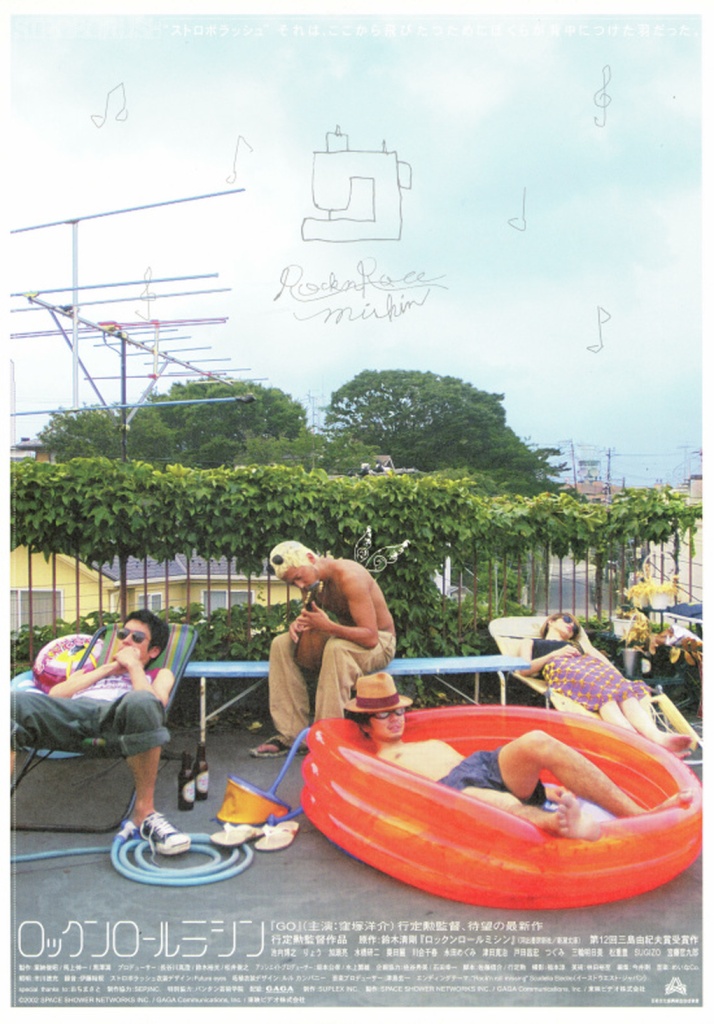
Rock’n’Roll Mishin (ロックンロールミシン, Isao Yukisada, 2002)

rock'n'roll misshinYou know how it is, you’ve left college and got yourself a pretty good job (that you don’t like very much but it pays the bills) and even a steady girlfriend too (not sure if you like her that much either) but somehow everything starts to feel vaguely dissatisfying. This is where we find Kenji (Ryo Kase) at the beginning of Isao Yukisada’s sewing bee of a movie, Rock ’n’ Roll Mishin (ロックンロールミシン). However, this is not exactly the story of a salaryman risking all and becoming a great artist so much as a man taking a brief bohemian holiday from a humdrum everyday existence.
Kenji’s life probably would have continued down a path of corporate serfdom uninterrupted if he had not run into old schoolfriend Ryoichi (Hiroyuki Ikeuchi) who, he learns, is setting up an indie fashion label with some of his friends. Ryoichi has to leave pretty quickly but he pastes a note on the outside of the restaurant window with his contact details so Kenji can find him again.

At work the next day Kenji “enjoys” some “banter” with an extremely unpleasant corporate stooge colleague who seems to be under the mistaken impression that he and Kenji are friends. After making some misogynistic comments about how Kenji is too much of a pushover and should “knock some sense” (literally) into his girlfriend, his colleague sets in on some typical salaryman careerist chat which is exactly the kind of thing Kenji is becoming disillusioned with.

Having failed to meet her at the restaurant, Kenji returns home one evening to find his girlfriend waiting outside his flat. She comes in and immediately takes off her clothes and gets into bed all without saying anything at all. When her T-shirt accidentally blows off the washing line and gets caught on some cabling below, Kenji remembers about his friend’s fashion company and decides to pay them a visit. Kenji is taken in by the sense of freedom and individual enterprise he finds in the workshop in contrast to his corporate drone office job. Eventually Kenji quits and joins the fashion gang full-time though he quickly finds that making a dream come true is surprisingly uphill work.

Unlike other films of this nature, there’s very little inspirational content to be found in Rock ’n’ Roll Mishin. The “mishin” of the title means a sewing machine and early on Ryoichi teases Kenji by telling him that his is a “rock and roll” machine because it beats out 8 stitches a second and if you really step on it it goes up to 16. Ryoichi’s teacher and mentor, Megumi (Ryo) lets Kenji in on the joke by explaining that it’s really called a “lock” machine because it holds the fabric in place for you. The other member of the team is a fashionista, Katsuo (Kenji Mizuhashi), who wants to create fashion that makes a sun of your heart so that you shine forth with an inner light. Needless to say, though the original three all have fashion skills from Ryoichi who’s the designer to Megumi who is a fashion teacher and Katsuo who studied fashion in London, nobody has any kind of business sense or a real business plan for this fledgling business.

In another film this might be where Kenji’s salaryman experience plays in, completing a missing element of the group which will enable them to triumph over adversity. However, Kenji’s experience is also fairly limited but the sensible economic advice he has to offer largely falls on deaf ears with his more creatively orientated teammates. They may understand the business on some level – at least enough to know what they can realistically expect to charge for their wares but are completely clueless about how they can go about managing their costs and maximising their profits. They also don’t really seem to know how to promote their business in anything other than a grungy, underground way which might be cool but is unlikely to take off without a serious amount of cynical marketing gimmickry which Ryoichi isn’t prepared to go for.

What Rock ’n’ Roll Mishin has to say about the youth of today isn’t very encouraging. It paints them as a group of unrealistic dreamers unwilling to put the work in to achieve anything. They might start to go for it in the beginning, but as soon as things start to look up they get scared and childishly run away rather than following through. Ryoichi is very much the tortured artist type, so fixated on maintaining his own image of artistic integrity that he’s completely unable to commercialise to work in any effective kind of way. Kenji is sucked in by the atmosphere of creative freedom but ultimately he has very little to offer and even if he is the one most affected by this new, bohemian lifestyle he’s also the best placed to recognise that you can’t live on dreams alone.

It’s tempting to read Rock ’n’ Roll Mishin as an ultra conservative, stick to the path message movie. It almost wants to say that it’s just not worth trying anything new because you’ll never see it through and you’ll be heading back to your old life with your tail between your legs quicker than you can say haute couture. However, even if the typical underdog triumphs against the odds narrative doesn’t materialise, Kenji at least comes to view his time in the fashion business in a broadly positive light. What he values is the time spent with friends, and, even if it didn’t work out quite the way they would have liked they still created something that was a success on its own terms and was ultimately appreciated by fellow travellers along the same path which, in the end, is what it’s all about.


Not exactly a trailer but this music video for one of the songs used in the film, Rock ‘n’ Roll Missing by Scudelia Electro, contains some footage from the film (lyrics in English)

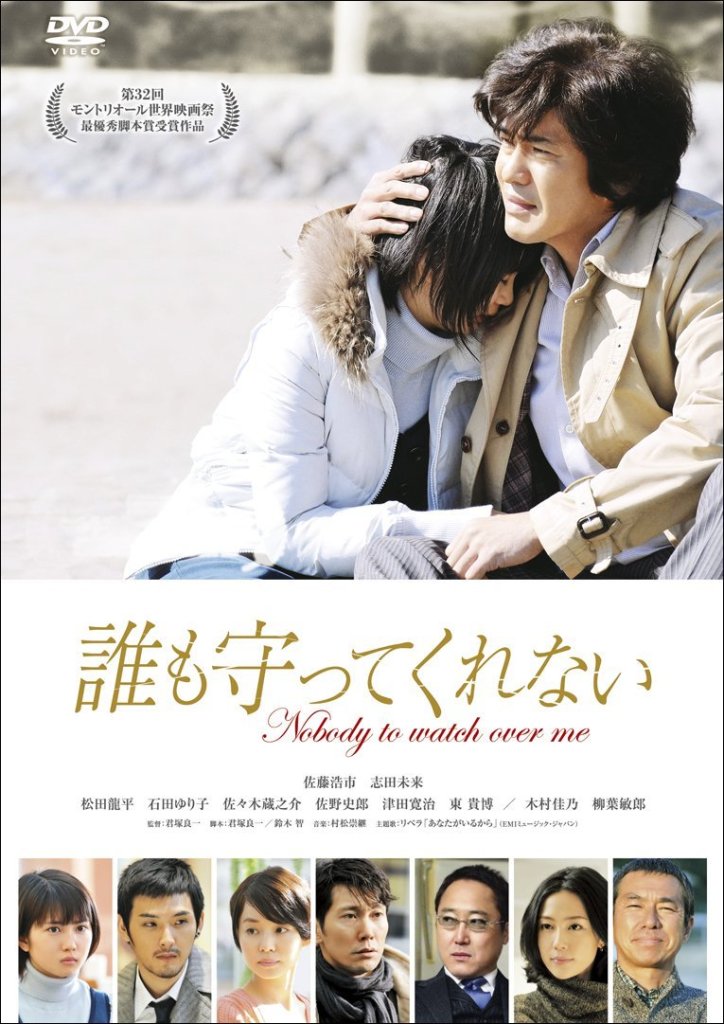
Nobody to Watch Over Me (誰も守ってくれない, Ryoichi Kimizuka, 2009)

Nobody to Watch Over MeWhen a crime has been committed, it’s important to remember that there may be secondary victims whose lives will be destroyed even if they themselves had no direct involvement in the case itself. This is even more true in the tragic case that person who is responsible is themselves a child with parents and siblings still intent on looking forward to a life that their son or daughter will now never lead. This isn’t to place them on the same level as bereaved relatives, but simply to point out the killer’s family have also lost a child who they have every right to grieve for, though their grief will also be tinged with guilt and shame.
Nobody to Watch Over Me (誰も守ってくれない, Dare mo Mamotte Kurenai) takes the example of one particular case in which an 18 year old boy has brutally stabbed two little girls in a park and then returned home as if nothing out of the ordinary had happened. After the boy is arrested, his family is caught up in a firestorm of police and press interest, barely able pause and come to terms with the surreal events that are taking place. No sooner has their son been dragged off in handcuffs than a troupe from the family court arrives with pre-printed documents which will arrange for a divorce and remarriage between the parents so that they can revert to the wife’s maiden name in an attempt to avoid the stigma of being related to a child killer. After being bamboozled into signing a number of papers with barely any explanation the family is then split up for questioning and taken to separate locations to try and throw off the press.

Grizzled detective Katsuura (Koichi Sato) is charged with looking after the murderer’s younger sister, Saori (Mirai Shida) – a 15 year old high school student. Katsuura is enduring some familial conflict of his own and was due to be taking a family holiday to try and work things out, so he’s a little distracted and put out about needing to shield this quite uncooperative teenager from the baying masses. He’s also suffering a degree of PTSD from a traumatic incident some years previously in which a case he was involved in went horribly wrong resulting in the death of a small boy. Understandably, Saori is in a state of shock, left alone with strangers to try and cope with this extremely stressful situation and unwilling to betray her brother by submitting to the police’s constant demands for information.

The police themselves aren’t always the benign and and comforting presence one might hope for on such an occasion as Katsuura’s superior has one eye on a possible promotion if he can exploit this high profile case for all its worth and is intent on pressing this innocent teenage girl as if she were some kind of war criminal. The family are treated with a degree of suspicion and contempt, as if they were directly or indirectly complicit in the violence created by their son or brother.

In actuality, there may be a grain of truth in this as the film also begins to offer some social critique of the modern family and the pressures placed on young people in the contemporary world. When questioned about their son, the mother remains more or less silent but the father angrily replies that he raised his son “strictly”. The family had high expectations and didn’t take academic failure lightly. From middle school onwards, they kept their son at home to study allowing him little outlet for anything else and, it seems, he was sometimes physically disciplined for a lack of progress.

Katsuura’s family is under threat too, perhaps placed under pressure following Katsuura’s personal disintegration over having been prevented in his attempts to save the life of the small boy some years previously or just from the constant insecurities involved being the family of a policeman whose working schedule is necessarily unpredictable. Though originally becoming fed up with Saori’s lack of cooperation, Katsuura eventually develops a protective relationship with her perhaps because she reminds him of his own teenage daughter. Given that the police are to some degree her enemy as they are the ones that have taken away her brother and separated her from her parents, it’s not surprising that she doesn’t immediately warm to Katsuura but after being betrayed by someone she believed was a true ally, she finally understands that he is firmly on her side and trying to protect her from a very real series of threats.

The modern world is shown up for all of its voyeuristic obsession with the horrifying and the taboo. The family are swarmed by press but it’s the internet that becomes the major aggressor as it publishes not only the boy’s real name, but even his parents’ address and the addresses of other people involved with the case. Self proclaimed social justice crusaders react like parasites glued to bulletin boards trading information on notorious crimes for a kind of internet fame, not caring about the facts of the case or that there are real people involved here who are already grieving. Taking the “I blame the parents” mentality to its extreme, even more distant members of the killer’s family are expected to trot out an apology for the cameras even though it’s really nothing to do with them and isn’t going to do anyone any good anyway.

Kimizuka shoots the first part of the action with a breathless intensity, mimicking hand held, on the ground news reporting to convey just how frightening and disorientating this must be for anyone unlucky enough to be caught up in a media storm. The use of choral music and occasional melodramatic touches near the end perhaps undermine the film’s emotional power which never quite coalesces in the way it seems to want to. However, Nobody to Watch Over Me is a fascinating and rich exploration of the public’s obsession with true crime stories coupled with an extreme tendency towards victim blaming and the need to hold to account those close to the perpetrator of a crime even if they had little to do with it themselves. Frightening yet hopeful in equal measure, Nobody to Watch Over Me offers scant comfort but does at least begin to ask the question.


The region 3 Hong Kong DVD release of Nobody to Watch Over Me includes English subtitles.

English subtitled teaser trailer:

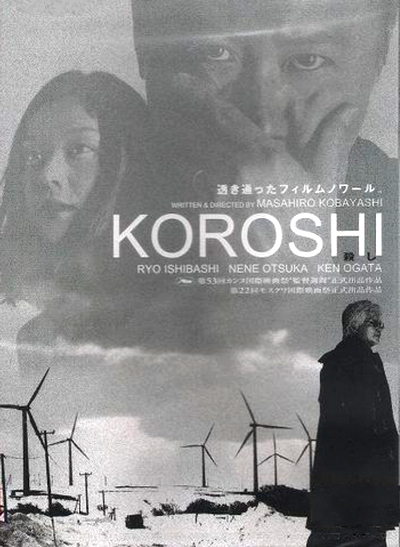
Film Noir (殺し, Masahiro Kobayashi, 2000)

Koroshi-2000Existential tales of hitmen and their observations from the shadows have hardly been absent from Japanese cinema yet Masahiro Kobayashi’s Film Noir (AKA Koroshi, 殺し) perhaps owes as much to Fargo as it does to Le Samouraï. Taking place in the frozen, snow covered expanses of Northern Japan, Kobayashi’s story is an absurdist one filled with dispossessed salarymen leading empty, meaningless lives in the wake of late middle age redundancy.
Hamazaki starts us off with a very Film Noir style voice over in which he likens being alive to be trapped on a long coach tour with strangers. You may fight and scream and argue with them right the way through, but in the end you will crave their understanding. Like many men of the era following the recent economic turbulence, he’s lost his job and, being a cowardly if kindly soul, he’s too afraid to tell his wife about it. Consequently he leaves for work everyday as normal but drives to a near by strip mall and wastes the day away playing pachinko. That is until one fateful morning when he finds the entire area deserted only for a mysterious man to climb uninvited into his car.

This unnamed man has a business proposition for Hamazaki – kill a guy, get a lot of money. As anyone would be, Hamazaki is a little shocked, confused and uncertain but eventually accepts. His first hit (like all of his subsequent hits) is on a man just like him – a middle aged loser who’s lost his job and is hiding out in the pachinko parlour hoping to figure something out before he runs out of money. Hamazaki likes his new line of work, it makes him feel like a man again and even helps him rebuild a bond with his wife (or so he thinks) but when he discovers one of his targets is someone he knows it all starts to go wrong.

Amusingly, the mysterious man gives Hamazaki a number of videos to watch as a kind of instructional guide to killing which includes a fair few from Melville including Army of Shadows and other classics of shady French cinema. This is a well worn tale and we know it isn’t going to end well for Hamazaki but we can also see from his voiceover that he’s consistently at odds with the situation as it is almost as if he’s constructing a film noir-esque reality all of his own.

Hamazaki is an unlikely fit for this kind of work – all the way through he’s berated for being “too nice”, notably in an argument with his former boss towards the end and then again by his wife who, it seems, cares more for her social standing and middle class lifestyle than she does for her kindhearted husband. The couple have a teenage daughter whom they’ve sent abroad to study in America (presumably at great expense) and only seems to contact them to ask for more money. Though she’s apparently only in high school, they seem to treat their daughter with a high level of adulthood – sending the money for her to budget with by herself (the implication is that she runs through quite a bit) and her mother even takes care to remind her of the importance of using a condom (not just the pill – America is the AIDS hub of the world, apparently) which is obviously good advice from an enlightened parent but perhaps a surprisingly frank way of talking to a teenage girl.

In many ways Hamazaki is a man without a place. Now he’s lost his job he’s become quite useless to just about everyone. As the mysterious man tells him, everyone is playing a role, in that case “killer” and “prey” but as it transpires Hamazaki was playing a role all along – that of salaryman husband and father. The couple seem happy, but in having sent their daughter overseas the Hamazakis have already broken their happy family in favour of increasing their social status. Kazuko is perhaps only playing the role of the middle class housewife and may have little use for a man who proves too soft hearted to get ahead. After Hamazaki tragically declares he wants to give up the life of a contract killer because he’s realised the importance of family, he may find that “family” had long ago abandoned him.

In this deserted, snow covered town the hearts of men are as cold as the wind that blows through the depressingly empty expanses. A man’s worth is measured by the money he makes and status he can claim, a man with no job is worth nothing at all. No love, no family, no morality – this is the archetypal film noir world filled with nothing but eternal darkness despite the bright sunshine which bounces lightly off the crisp white snow. As much about the death of the spirit as it is about the taking of life, Film Noir paints an eerily bleak picture of modern society with its rigid social codes which prize only the acquisition of money and status rather than the contents of a man’s soul.


Unsubtitled trailer:

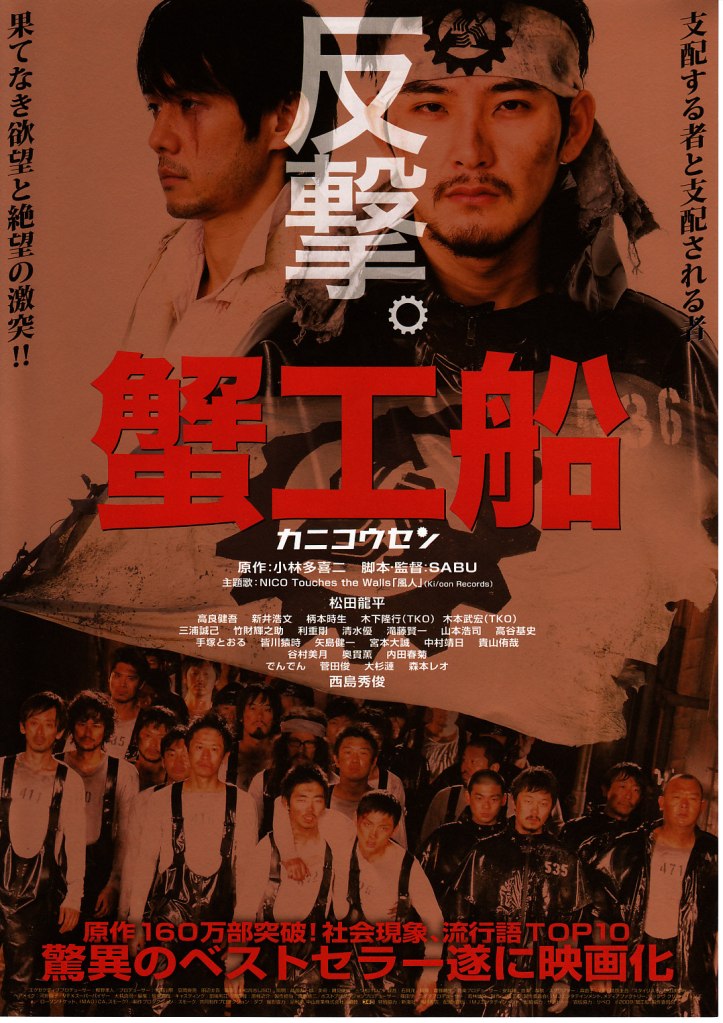
Kanikosen (蟹工船, SABU, 2009)

kanikosenBack in 2008 as the financial crisis took hold, a left leaning early Showa novel from Takiji Kobayashi, Kanikosen (蟹工船), became a surprise best seller following an advertising campaign which linked the struggles of its historical proletarian workers with the put upon working classes of the day. The book had previously been adapted for the screen in 1953 in a version directed by So Yamamura but bolstered by its unexpected resurgence, another adaptation directed by SABU arrived in 2009.
As in the book the film follows the lives of a group of men virtually imprisoned on a crab canning ship anchored near Russian seas in the 1920s. The men on the boat are of various ages and come from various different backgrounds but each is here out of necessity – nothing other than extreme poverty and lack of other options would ever persuade anyone to take on this arduous and often unpleasant line of work. Technically speaking the boat has a captain but it’s the foreman who’s in charge – dressed like a European officer in a white frock coat and riding boots and with a vicious looking scar across his left eye, Asakawa rules the waves, barking out orders and backing them up with a walking stick.

SABU films the workers’ struggles through the filter of absurdist theatre beginning with a darkly comic segment in which each of the men recount their poverty riddled circumstances and dreams for social advancement before one, Shoji, emerges and posits another idea. They will make a bid for everlasting freedom by committing mass suicide in protest to poor working conditions and consistent exploitation of their class by those above. Predictably, this fails when everyone realises they didn’t actually want to die in the first place. Later Shoji and another man are picked up by a Russian boat after being stranded at sea and after seeing how happy the Russian sailors seem to be, they return determined to enact the revolution at home.

Conveying the workers’ plight through production design, SABU opts for a packing room which is both oversized yet claustrophobic, filled with giant cogs and gears of the capitalist system in motion. The men are little more than fleshy gears themselves, just another piece of the production line to be thrown out and replaced once worn through. Gradually the workers start to realise that this system is only sustainable because of their own complicity. The foreman is, after all, only one man and the workers have made a decision to obey him – they also have the ability to decide not to. That said, the spanner in the works is that the foreman also represents the larger mechanism at play which is the imperial state itself and can call on its resources to defend himself against a potential mutiny.

Having decided to rebel and seen their revolution fail, the workers come to another realisation – that the only true path to social change is a movement for the people lead by the people as one, i.e. with no leaders and therefore no head which can be cut off to disrupt all their efforts. Hand in hand and with the bloody flag raised high do they march into battle to put an end to unfair exploitation of those without means by those that have. Ever since they’ve been on this boat, they’ve been told that they’re at war, that their services are necessary for the survival of the Imperialist state – and now so they are, engaged in the class war to end the imperialist hegemony.

In the end, SABU’s message is a little confused – he advocates collective action, but not the collective, as his revolution is born of individual choice rather than the workers linking hands behind a faceless banner. It works as a semi-effective call to arms, but more often than not undermines itself and has a tendency to pull its punches when it really counts. That said, even if it wasn’t perhaps quite what Kobayashi meant, the more general message that the revolution begins in the heart of the individual and that one has the possibility to choose to live in hell (as a slave of the state) or create a heaven for one’s self (as a free person) is one that has universal merit and appeal.


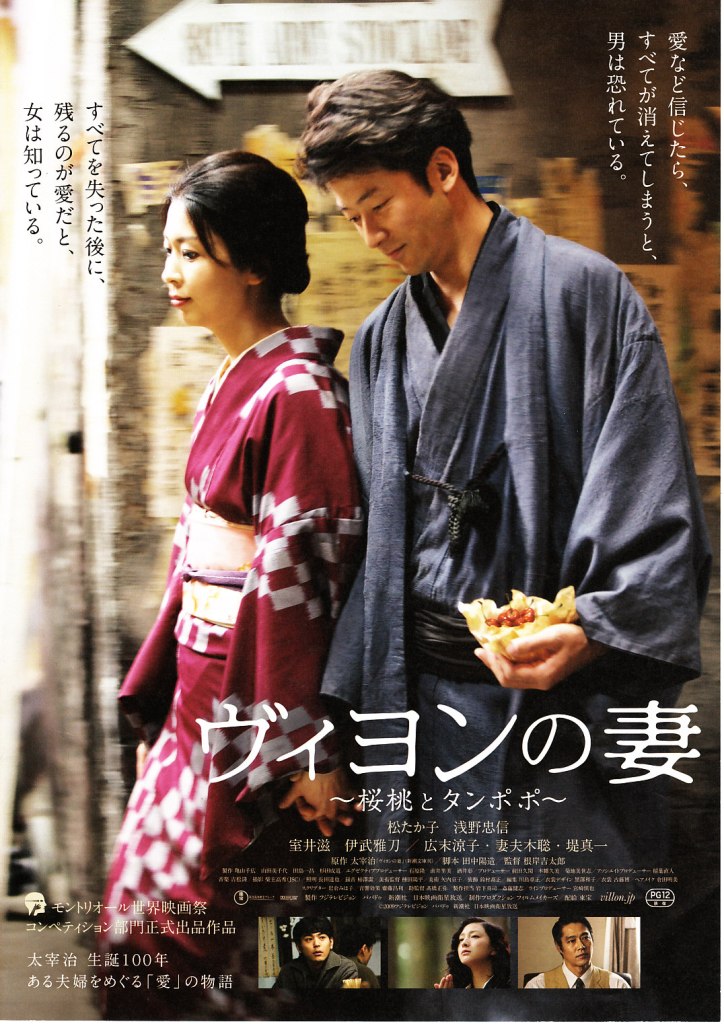
Villon’s Wife (ヴィヨンの妻 〜桜桃とタンポポ, Kichitaro Negishi, 2009)

Villon's Wife2009 marked the centenary year of Osamu Dazai, a hugely important figure in the history of Japanese literature who is known for his melancholic stories of depressed, suicidal and drunken young men in contemporary post-war Japan. Villon’s Wife (ヴィヨンの妻 〜桜桃とタンポポ, Villon no Tsuma: Oto to Tampopo) is a semi-autobiographical look at a wife’s devotion to her husband who causes her nothing but suffering thanks to his intense insecurity and seeming desire for death coupled with an inability to successfully commit suicide.

Beginning in the immediate post-war period of 1946, Sachiko (Takako Matsu) is a fairly ordinary housewife with a young son who generally waits around the house for her husband’s return. Only, she’s married to one of the most brilliant writers of the age, Joji Otani (Tadanobu Asano), whose book on the French poet François Villon is currently a best seller. Despite his obvious literary talents, Otani is a drunkard who spends most of his time (and money) in bars and with other women. When he crashes home one night only to be pursued by two bar owners who reveal that he ran off with their takings (around 5000 yen), Sachiko is not exactly surprised but still embarrassed and eventually takes matters into her own hands by volunteering to offer herself as a “hostage” by working at the bar until the debt is repaid.

“Men and women are equal now, even dogs and horses” says one customer, impressed with this sudden arrival of a beautiful woman in a low life drinking spot. To her own surprise, Sachiko actually enjoys working at the bar, it gives her purpose and proves more interesting than being stuck at home waiting to see what her drunken fool of a husband has got up to next. She’s good at it too – Sachiko is a beautiful and a fundamentally decent and kind person, in short the sort of woman that everyone falls a little bit in love with. That said, she isn’t a saint. She’s perfectly aware of the power she is able to wield over men and is unafraid to make use of it, though only when absolutely necessary.

Otani himself is a fairly pathetic figure. He may be a great artist but he’s a hollow human being. He admits the reason for all of his vices is fear – he’s a afraid to live but he’s also afraid to die. He seems to love his wife, though he’s insecure about losing her and dreads the embarrassment involved in becoming a cuckold. So afraid to face the possibility of failure, Otani satisfies himself in an underground world of drunks and easy women rather than facing his own self loathing as reflected in the faces of his unconditionally loving family.

Perhaps because Villon’s Wife is a commemorative project, the film has been given the prestige picture treatment meaning the darker sides of Dazai’s original novella have been largely excised. The chaos of the post-war city with its starving population, soldiers on the streets and generalised anxiety is all but hidden and some of the more serious travails Sachiko undergoes in devotion to her husband as well as Otani’s tuberculosis (from which Dazai also suffered in real life) have also largely been removed. What remains is the central picture of a self destructive husband and the goodly wife who’s trying to save him from himself but risks her own soul in the process.

The one spot of unseemliness of post-war life that the film lets through is in a brief scene which features a group of pan pan girls hanging around ready to try and snag some passing GIs. Sachiko buys some lipstick from them to use in attempt to convince an ex who is also a top lawyer to try and help her husband after his latest escapade lands him in jail on a possible murder charge. After visiting him, Sachiko wanders out slightly dazed to see the pan pans atop a military jeep cheerfully waving and shouting “goodbye” in English. Sachiko is confused at first but eventually shouts “goodbye” back in a way which is both excited and a little bit sad, perhaps realising she is not so different from them after all. Finally she wipes the lipstick from her face and leaves the small silver tube behind where the pan pans were sitting, hoping to bury this particular incident far in the past.

In actuality the pan pan girls are depicted in a fairly matter of fact way rather than in the negative light in which they are usually shown, just another phenomenon of occupation. At the end of the film Otani calls himself a monster whilst acknowledging that he’s a terrible father who would steal the cherries from his own son’s mouth. Sachiko replies that it’s OK to be a monster – as long as we’re alive, it’ll be alright. Oddly for someone so suicidal, this fits in quite well with Dazai’s tenet of embracing the simple gift of a dandelion. The film ends on an ambiguous note in which there seems to have been some kind of restoration but it’s far from a happy one as the couple remain locked in a perpetual battle between light and darkness albeit with the balance a little more equalised than it perhaps was before.


The R3 Hong Kong DVD release of Villon’s Wife includes English subtitles.

COSMIC RESCUE -The moonlight generations- (コスミック・レスキュー ザ・ムーンライト・ジェネレーションズ, Shinsuke Sato, 2003)

Cosmic RescueIt’s often posited that Japan rarely produces “science fiction” literature or movies and some say that’s because, well, they already live there. However, this isn’t quite true, there are just as many science fiction themed projects to be found in Japan as elsewhere you just have to look a little harder to find them. Depending on your point view, if you succeed in tracking down a copy of Cosmic Rescue -The moonlight generations- (コスミック・レスキュー ザ・ムーンライト・ジェネレーションズ), you may feel the quest was not entirely worth the effort.
Starring the younger half of the Johnny’s idol group V6 (referred to as “coming century”), Cosmic Rescue takes place in 2053 when space travel has become easy and commonplace enough to require the presence of galaxy wide emergency services. Cosmic Rescue is the AA of space travel – they float around waiting for disaster to strike whereupon they will swoop in and rescue those in peril among the stars.

However, the three crew members of the rundown rescue ship from the 89th Division of Japanese CR mostly spend their days clearing crash debris and changing batteries. The rookie of the group Sawada (Junichi Okada) longs for a spot of heroism just like in his favourite manga which inspired him to join the CR in the first place, whereas ship’s engineer Eguchi (Ken Miyake) gets on with the day to day work of maintaining the ship while the captain Nanjo (Go Morita) mopes about slumming it with this lowly crew of cleanup artists despite being a CR legend after he was involved in a heroic rescue which cost the life of his best friend. However, when Sawada receives an emergency distress call from a young woman who claims to the be sole survivor of a space crash, the gang find themselves embroiled in a corporate conspiracy.

Directed by a young Shinsuke Sato who would later go on to become one of the most successful directors of mainstream Japanese blockbusters including Gantz and Library Wars among other smash hit franchises, Cosmic Rescue is a very competently made science fiction adventure given its obvious budgetary constraints. It’s fair to say that it’s largely been created as a vehicle for its three (hugely popular) leading men and so falls back on their charisma to plug any holes in the rather generic script and lack of production values but generally acquits itself pretty well.

That said, there are no shoehorned in singing sections and even if a low budget, televisual atmosphere remains there’s still a fun sci-fi adventure underpinning it all. Sawada is the ostensible lead as he longs to prove himself as a real “hero” by saving lives in space just like his captain had done before yet Nanjo’s story becomes equally important as he battles to overcome the guilt and fear he feels after losing his friend in an earlier mission. Engineer Eguchi gets a little sidelined in a technical role but each of the three guys get fairly equal weighting as members of the maverick, underdog space crew who are going to expose this mass conspiracy and save the damsel in distress no matter what the cost.

There is a (fairly trite) message here spelt out in voice over at the end of the film that it’s easy to forget who you are when you’re used to being “tied down” by gravity but if you can’t learn to save yourself you won’t be able to save anyone else. Cosmic Rescue is what it is – it isn’t really pretending to have any kind of deeper message other than showcasing its leading actors in a fun, slightly retro space adventure. Though a fairly low budget, disposable affair aimed squarely at fans of the band, Sato adds some interesting direction plus a vaguely 1960s inspired production design which help to lift the proceedings above the bonus feature category.


The Japanese release of Cosmic Rescue includes English subtitles!

Unsubbed trailer:

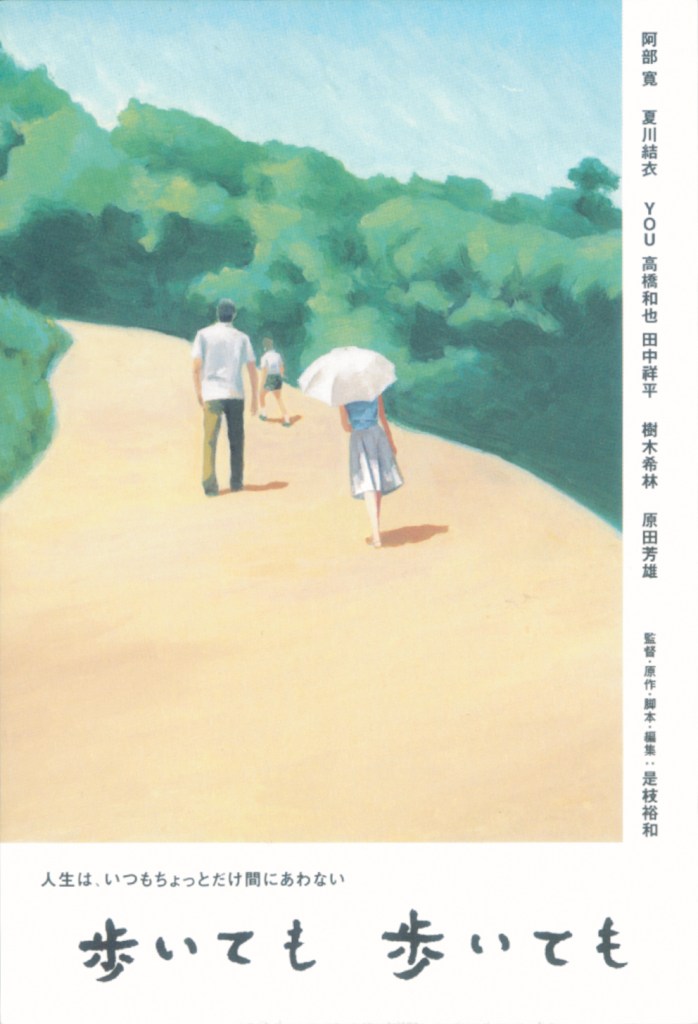
Still Walking (歩いても歩いても, Hirokazu Koreeda, 2008)

still walkingLife is full of choices, but the one thing you can’t choose is your family. Like it or not you’re stuck with them for life and even if you decide you want nothing to do with them ever again, they’ll still be hanging round in the back of your mind for evermore. Koreeda swings the camera back around the fulcrum of Japanese society for this dissection of the fault lines and earthquake zones rubbing up against this very ordinary family.
You’d be forgiven for thinking that some kind of celebration is about to take place at the beginning of Still Walking (歩いても歩いても, Aruitemo Aruitemo) yet the event that is about to bring scattered friends and family members back home is of a more somber nature. As the matriarch Toshiko (Kirin Kiki) peels vegetables with her daughter Chinami (YOU) she seems excited at the prospect of getting the family back together again yet melancholic and perhaps a little nervous.

Younger son Ryota (Hiroshi Abe) is taking the train in with his new wife and stepson. He urges Yukari (Yui Natsukawa) that they should make their excuses and leave in time for the last train but she feels obliged to stay over. It’s clear Ryota is not looking forward to a reunion with his family and also has some current worries over his working situation which are weighing on his mind and which he definitely does not want anyone in the family to find out about.

Ryota has a particularly strained relationship with his difficult doctor father, Kyohei (Yoshio Harada) who doted on his oldest son, Junpei, drowned at sea whilst saving the life of a little boy. Increasingly grumpy that he has no heir for his medical practice, Kyohei refuses to recognise Ryota as a grown man or accept his work as an art restorer as a “real” occupation. Tensions in the family are further brought out by the mild disapproval over Ryota’s choice of wife who was previously married and then widowed and has a young son by her first husband. Toshiko for one still harbours an old fashioned stigma towards second marriages and thinks Ryota could have done better than “buying second hand”. Though seemingly accepting of her new daughter-in-law and grandson, she perhaps treats them a little more like guests than fully fledged members of the family.

Set over the course of two days, Still Walking takes on a sense of Chekovian wit and melancholy as it paints a naturalistic picture of an ordinary family with all of the petty cruelties and indignation that involves. The deceased son, Junpei, has become a virtual saint, forever bathed in golden light by his grieving parents while Ryota remains very much alive yet pushed into the shadows. Feeling himself to raise only feelings of disappointment in his family, he adopts a truculent, defensive air which sees him unwilling to engage leaving the bulk of the work for his new wife who is eager to please her in-laws despite their frequent tactlessness in dealing with herself and her son.

Of course, Ryota and his father aren’t so different at all – both gruff, defensive, grumpy. Kyohei is a difficult man sinking into a miserable old age where he can no longer busy himself with the role which has given his life meaning, that of a respected small town doctor. When bubbly younger sister Chinami mentions having seen a newspaper report which referred to painting restorers as “art doctors”, neither man is very happy with being linked with the other yet there is a certain commonality between them that oddly forces them apart rather than ties them together.

Toshiko by contrast is the long suffering yet largely silent housewife whose maternal grief is the force which now defines her. Seemingly sweet and kind on the outside, there’s a tough core in the middle which gives way to some decidedly biting remarks lightly peppering the atmosphere with ancient resentments. Perhaps feeling a strange sort of kinship with the mystery guest-cum-kicking-boy-of-the-day – Yoshio, the boy who Junpei saved but has not made good on his investment as he’s turned into a slobbish and overweight 25 year old child who can’t seem to settle on one proper career, Ryota asks why his mother insists on inviting him every year knowing how painful it must be for him to come. Toshiko coldly replies that that’s exactly the reason she intends to keep making him visit, she feels wretched inside 24/7 so for one day every year she makes someone else feel dreadful too – will anyone blame her for that?

Grief and loss play a heavy part here, not only of the literal kind, but in the feeling of time wasted and the disappearing moments which can never be recaptured. Chinami’s son and daughter team up with Ryota’s stepson Atsushi to provide a melancholic mirror of the the three Yokoyama children playing in the same fields and staring at the same fleeting flowers as their forebears did years before. Time is always passing, you think there will always be another opportunity for saying something or other, forging a connection or new memory but soon enough the sand in the glass runs through. As Ryota notes, it’s always a little later than you think but you can’t see it until it’s already too late.

Dense with naturalistic detail, Still Walking is a warm if sad look at one ordinary family dealing with the aftermath of tragedy yet offers its own comments on the nature of human connection between fathers and sons, mothers and daughters, and between the living and the dead. A timely reminder of the transience of all things, Koreeda’s most straightforward take on the family drama proves a both profound and moving experience which only deepens with repeated viewing.


I rewatched this recently at an ICA members’ screening where it screened on 35mm but the print actually had an intermission built into it even though the film isn’t all that long – strange experience!

Still Walking is available on DVD and VOD in the UK from New Wave Films and was also released on blu-ray in the US as part of the Criterion Collection.

The film’s Japanese title Aruitemo Aruitemo is taken from the song made famous by Ayumi Ishida – Blue Light Yokohama which turns out to have a surprising significance within the film:


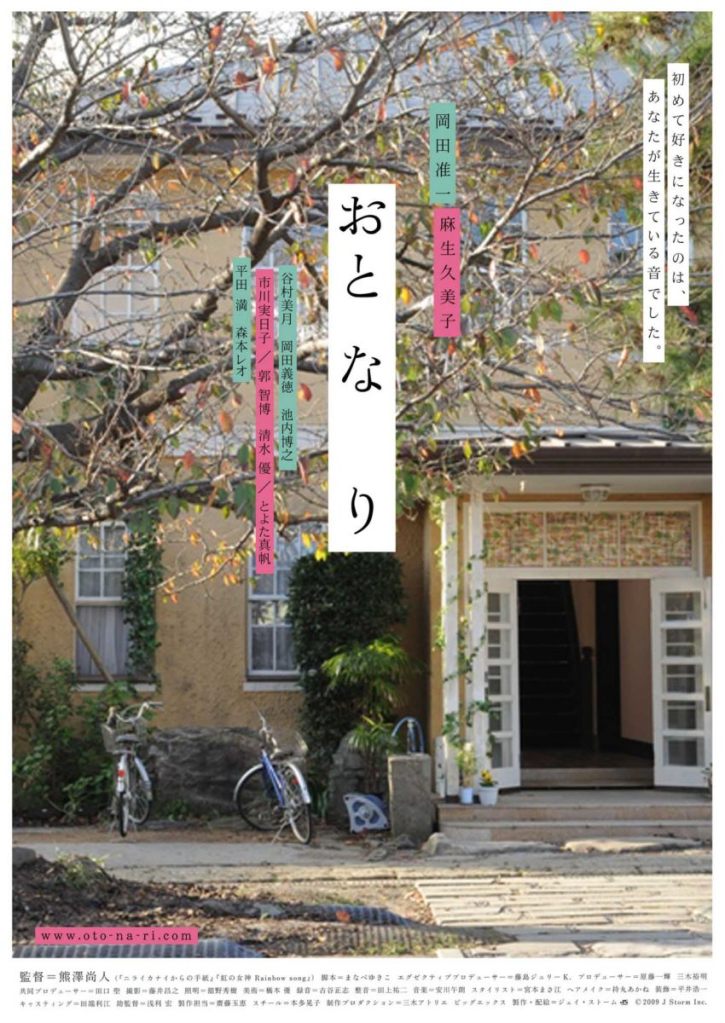
Romantic Prelude (おと・な・り, Naoto Kumazawa, 2009)

otonariSometimes when you live in the city it’s difficult to build meaningful connections with other people. You might find yourself a little lost, caught between the rat race and what it was that brought you to the city in the first place, but if you just close your eyes and listen, you can hear that you’re not alone. Romantic Prelude (おと・な・り, Oto-na-ri) is the story of two such people who build up a strange connection even though they’ve never really met.

Satoshi (Junichi Okada) and Nanao (Kumiko Aso) are next door neighbours in a small apartment block where the walls are paper thin. They’re both vaguely aware that a person of the opposite sex and around the same age lives next door, but they don’t know each other – in fact, they wouldn’t even recognise each other if they passed in the street. Still, they’re each aware of the other person through their particular soundscapes – Nanao hears Satoshi’s keys jangling on his belt as he leaves each morning and his rice cooker beeping in the evening, where as he thinks of Nanao as the humming girl and enjoys getting a free French lesson as he hears her language tapes through the wall.

Both are beginning to get frustrated with their lives in the city. Satoshi is a professional photographer doing fashion shoots but his real passion is landscape photography. He’s planning to go to Canada for a photo project but keeps getting held back as he only got into the fashion stuff because his childhood friend became a model and the two have now become entirely dependent on each other to keep working. When the friend, Shingo, finds out about Satoshi’s Canada plans, he goes missing causing his pregnant girlfriend Akane to come crashing into Satoshi’s life for a while.

Likewise Nanao is a lonely woman in her early thirties who works in a florist’s shop and plans to go to France to study flower arrangement after she’s passed the highest rank of exams. The guy at the local combini she often shops at seems to have developed a crush on her and Nanao isn’t really sure what to do with that but uses all of her time pursuing her dream of becoming a top florist.

Satoshi and Nanao are both feeling adrift, as if their lives are passing them by and it’s getting too late to not be getting anywhere. Just hearing the familiar sounds coming through the wall provides a comforting presence to not feel so alone. Though they don’t know each other, each has perhaps built up an image in their minds of the other person based on the sounds they create – keys, coffee, cooking vs French, classical music and humming an all too familiar song. Feeling the other person’s presence becomes reassuring and an absence of a familiar sound at its expected hour is unexpectedly disconcerting even if you really have no right to expect it.

Though Nanao is annoyed by the noisy and unprecedented arrival of Akane (who is not a good match for the rather uptight Satoshi) and slightly confused by her friendly greeting from the adjacent balcony, she still continues to derive comfort from the gentle presence of her neighbour. After having undergone a cruel humiliation and in something of a crisis, Nanao breaks down inside her apartment. Hearing her distress, Satoshi places his hand on the wall as if in comfort but rather than going next door to see if everything’s OK, he begins to hum and then sing the song he’s heard Nanao humming all along and eventually she too comes to sit beside the wall singing the song back to him.

As implied in the film’s English title, Romantic Prelude, music, and more particularly the symphony of sound that makes up a city, is the film’s major motif. This is further brought out by the original Japanese title which is a perfectly composed sonata of its own – Oto-na-ri. “Otonari” is Japanese for neighbour but the syllables which make up the word also have their own distinct meanings in that “oto” on its own means “sound” but put together “otona” means adult and then “nari” can also mean “to become”. Satoshi and Nanao are engaged in a blind slow dance where they’re falling in love with a stranger based on nothing other than a feeling of connection coupled with bond created by their shared soundscape.

Less a romance than an urban character study, Romantic Prelude is that rare case of a genuinely intriguing love story in which you’re really not sure which way things are going to go. This could just be another story of a tragic missed connection where Nanao heads off to France and Satoshi to Canada and they never even meet or it could give the audience the satisfying true love ending that it almost certainly wants but could have made either direction work. In the end, the important thing is seeing the pair work through their own difficulties and sort things out for themselves in the absence of each other before they finally begin to live the lives they’ve been yearning to lead.


The Japanese release of Romantic Prelude contains English subtitles.

Unsubtitled trailer:

and here’s the song they both keep singing – Kaze wo Atsumete by Happy End

Dead Run (疾走, SABU, 2005)

Dead run posterSABU might have gained a reputation for his early work which often featured scenes of characters in rapid flight from one thing or another but Dead Run both embraces and rejects this aspect of his filmmaking as it presents the idea of running and its associated freedom as an unattainable dream. Based on the novel by Kiyoshi Shigematsu, Dead Run (疾走, Shisso) is the tragic story of its innocent hero, Shuji, who sees his world crumble before him only to become the sacrifice which redeems it.

The story begins in a voice over narration offered in the second person by Shuji’s older brother, Shuichi. Shuji, it seems was a curious, if shy, little boy full of the usual childish questions and a curiosity about the way his world works. The boys live with their parents in an area they call “the shore” which is next to a settlement created through reclaimed land which the shore people refer to as “offshore” and somewhat look down on. One day, Shuji gets marooned offshore when his bicycle chain snaps and is rescued by the unlikely saviour of “Demon Ken” (Susumu Terajima) – a local petty gangster whom everyone is afraid of, and his girlfriend, Akane (Miki Nakatani), who is some kind of bar hostess. Soon after, Demon Ken is found buried in a shallow grave dead of a gunshot wound to the stomach, but somehow this improbable act of kindness has stuck in Shuji’s mind.

Moving on a few years, a creepy looking priest moves into the offshore area and opens up a church in a small hut complete with shiny silver crosses. Just like with Demon Ken, there’s a rumour about town that the priest, Father Yuichi (Etsushi Toyokawa), is a former criminal and murderer. Shuji becomes intrigued by the strange figure of the priest and a young girl his age, Eri (Hanae Kan), who likes to spend time in the church. However, more gangsters soon turn up wanting to buy up the offshore area to build an entertainment complex and even though most of the other residents have agreed to be resettled elsewhere, Father Yuichi won’t budge. Akane returns to the area as one of the higher ranking gangsters trying to force the church out and is happy to realise that Shuji, at least, has not forgotten Demon Ken. This won’t be the last time the pair meet again as circumstances conspire against the young boy to drag him ever deeper into the darkness of the shady adult world.

As a young boy, Shuji’s life is the ideal pastoral childhood full of bike rides through green fields and under cloudless blue skies, yet his once happy family dissolves and though he tries to run from his destiny he can not escape it. After his over achieving older brother Shuichi is caught cheating at school and is suspended, he begins to lose his mind becoming obsessed with the idea of the priest as a murderer and is fixated on exposing some dark secret about him. Of course, it turns out not to be exactly as he thought it was and Shuichi becomes increasingly disturbed before becoming a suspect in a series of local crimes which see him sent away to reform school. After this string of tragedies, Shuji’s parents start to fall apart too – his father disappearing and his mother mentally absent. Eventually even Eri leaves as the relocation programme finally kicks in.

Around this point our narrative voice shifts to that of Father Yuichi who becomes Shuji’s only responsible adult figure. However, Father Yuichi’s decision to take Shuji on a trip proves to be a disastrous one as it backfires massively forcing him onto the run and, coincidentally, straight into the arms of Akane. Though Akane had originally seemed an austere and difficult woman, she harbours an affection for Shuji as one of the few people to remember Demon Ken and to remember him for his kindness. Though she wants to help Shuji she ends up pulling him into a the darkness of her own world filled with violence and exploitation. Shuji runs again and eventually makes his way to Tokyo and to Eri who is just as broken as he is but there’s no salvation here either. Even when the pair attempt to travel back to their once idyllic childhood town, their problems follow them and destiny catches up with everyone, in the end.

Early on Father Yuichi and Eri are having a discussion about the difference between fate and karma and which might be more frightening. Eri says fate is better because you can’t change karma but perhaps you can change your fate. The film seems to disagree with her. You can try to run but somehow or other something will always stop you so the cold hand of fate can stretch its icy fingers around your heart. Different in both tone and style from SABU’s previous work, Dead Run is a bleak tale filled with loneliness and melancholy which, though it offers a glimmer of hope for those who are left behind, is not afraid to make a sacrificial lamb of its holy fool of a protagonist.


The Hong Kong R3 DVD release of Dead Run contains English subtitles.

Based on the book of the same name by Kiyoshi Shigematsu (as yet unavailable in English).

Unsubbed trailer: