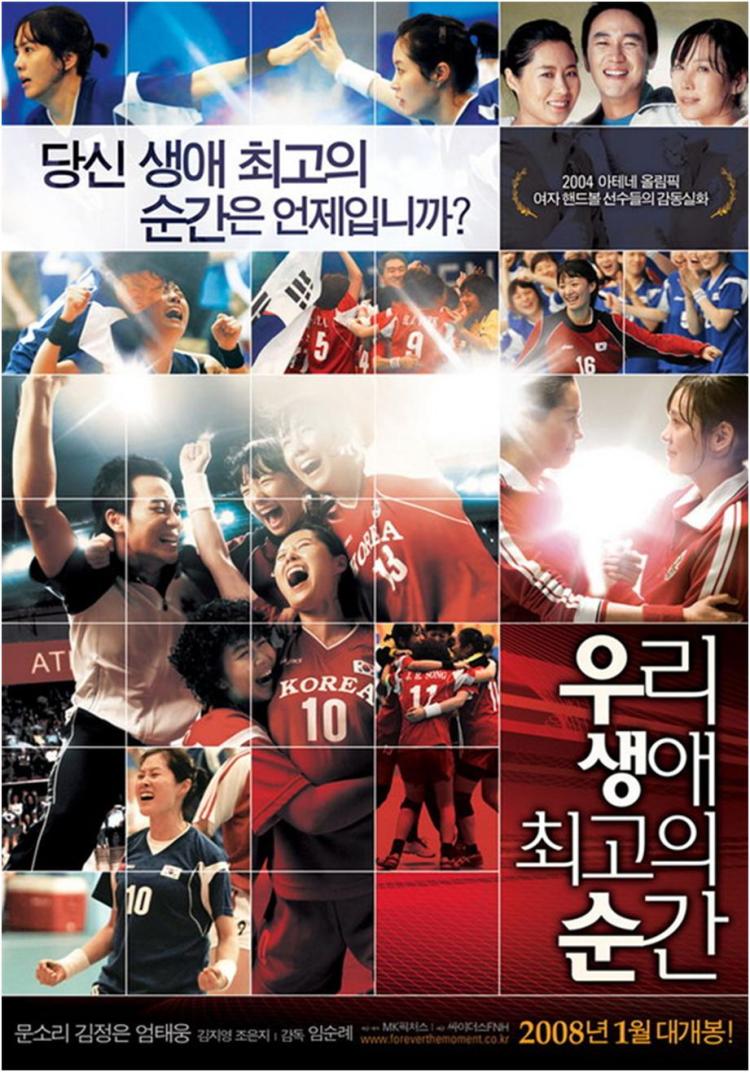
Forever the Moment (우리 생애 최고의 순간, Yim Soon-rye, 2008)

forever the moment posterSports is one of society’s acceptable obsessions. Devotion to a football team, intense knowledge of baseball stats, and idolatry of athletes is not only respected, it is often required for any kind cultural fluency in the society in which one lives. Sportsmen and women, however, can become a disposable commodity. This is after all why the pay for sports stars is so high – the career is temporary. A brief moment in the spotlight can earn a top athlete a multitude of promotional contracts and role model status to hundreds of sporty kids, but when the music stops everyone loses interest. The heroes of Yim Soon-rye’s Forever the Moment (우리 생애 최고의 순간, Woori Saengae Chwegoui Soongan) achieved their 15 seconds of fame when the Korean women’s handball team won a couple of gold medals in the ‘90s before the sport returned to relative obscurity. Despite being gold medal winners, the women are in a precarious position, left without professional team contracts and lacking the necessary qualifications and experience to find well paid work outside of the sports world.

Yim frames her story around the 2004 Olympic Games in which the Korean women’s handball team came back from a disastrous slump to reach the final only to go home with silver after a penalty shootout defeat to Denmark. Mi-sook (Moon So-ri) was part of the gold medal winning 1992 team and is now a wife and mother. Her financial circumstances, however, are strained. When the supermarket handball team she’s been playing for is disbanded, Mi-sook counts herself lucky to get a job on the shop floor. Her husband (Sung Ji-ru), formerly a top male handball player, has been conned out of all his money by an unscrupulous business partner and is currently on the run from debt collectors leaving her a virtual single parent and desperate for money.

Money is the reason she eventually decides to come back to the Korean Women’s Olympic handball team. Mi-sook’s one time rival, Hye-kyeong (Kim Jung-eun), has been parachuted in to coach the Korean Olympic hopefuls after a successful run coaching in Japan. The team is in a sorry state – filled with inexperienced youngsters, it will need serious work to even qualify for the upcoming games let alone reach the podium. Hye-kyeong decides to get some of her old medal winning team-mates back to bring some strength to the ranks even if they’re all a little past their prime. Despite her best efforts, Hye-kyeong is soon sidelined for male coach (and old flame) Ahn Pil-seung (Uhm Tae-woong) who decides to junk the “Korean method” which uses speed as a weapon against the taller European challengers, and embark on a “science-based” European training regimen.

Yim deliberately moves away from the classic sports movie formula, eschewing the training montage and including only one lengthy match at the film’s climax. Forever the Moment prefers to concentrate on the internal struggles of its scrappy, underdog team the best hopes of which are middle-aged women with children whom society often writes off. Hye-kyeong is an earnest, driven woman who’s made a successful life for herself as a sports professional after her court life has come to a natural end, but she still loses out because she got divorced – the bigwigs are nervous about the proposition of a “divorced” woman occupying a “public” position, something that would hardly come up if she were a man. Made “acting coach”, Hye-kyeong is given hardly any time at all to prove herself before the experiment of “allowing” a woman to coach women is ruled unsuccessful and a man with little experience given full budgetary backing to replace her.

Hye-kyeong’s battles with Ahn may eventually take on the expected romantic dimension but it’s the relationships between the other players which become the film’s spine. Mi-sook has always made a point of distancing herself from handball, regarding it simply as a paycheck rather than a vocation – something which seems all the more relevant thanks to her ongoing troubles with her absent husband who is rapidly sinking into a breakdown over his humiliation and inability to support his wife and child. Struggling through adversity and working hard to achieve a physical goal, the teammates discover new strengths, growing as people and as athletes in their quest to be ready for the all important Athens games.

Forever the Moment is another in the long line of Korean films which celebrate the achievements Koreans can make when they come together and work hard to achieve their goal. As in real life, the Korean Women’s Olympic Handball Team are robbed of their final victory by circumstance and accident, but coming second becomes a victory in itself because of everything it took to get there. Less a sports movie than a subversive comment on the way women are often cast aside or underestimated, Forever the Moment is a tribute to the power of hard work and team spirit which becomes its own reward even when one falls short of the goal.


Original trailer (English subtitles)

Sunny (님은 먼곳에, Lee Joon-ik, 2008)

Sunny 2008 posterLove, apparently, makes people do stupid things. So, apparently, does the absence of love. Lee Joon-ik’s Sunny (님은 먼곳에, Nimeun Meongotyi) takes another roundabout look at the recent past through the medium of music in the unlikely tale of a poor village girl married off to a resentful man whose love for another has sent him reeling off into a foreign war. While it’s nice to see this familiar story from the often neglected point of view of the unwanted wife, Lee’s tale is more one of male folly and the various ways a woman’s life is dictated by patriarchal values than it is of love and determination in the face of extreme danger.

Soon-yi (Soo Ae) sings a plaintive love song by contemporary singing star Kim Chu-ja for her fellow housewives in a small village, but her moment of reverie is broken when her domineering mother-in-law (Lee Joo-sil) arrives and orders everyone back to work. Victim of an arranged marriage, Soon-yi has been abandoned by her husband Sang-il (Uhm Tae-woong) who ran off to join the army right after the wedding. A letter he receives in the barracks tells us that he had a love in Seoul whom he was (presumably) forced to give up on in order to submit to his mother’s chosen bride (why he did this is never explained). Nevertheless, Sang-il’s mum is desperate for an heir from her only son and packs Soon-yi off for a conjugal visit every month. Sang-il, however, refuses any intimacy with his new wife, coldly rolling over as he tells Soon-yi to stop coming, wondering if she really has any idea what “love” is seeing as she’s obviously so blind to his emotional pain.

The next time Soon-yi tries to visit Sang-il she finds out he’s got himself sent to Vietnam – a source of panic to his devoted mother who blames her daughter-in-law for alienating her son so badly he’s decided to go off and get himself killed on a foreign battlefield rather than endure married life at home. Kicked out from her marital household and disowned by her birth family, Soon-yi decides to track Sang-il down in war-torn Vietnam, teaming up with a shady con-artist/musician (Jung Jin-young) as her only passage out of the country. 

The central problem is that Soon-yi does not love Sang-il. How could she, she barely knows him and their only on screen meeting is one filled with awkwardness, contempt, and resentment. Yet Soon-yi suddenly becomes bold, leaves her village, and refuses to back down until she finds Sang-il and convinces him to accept her as his wife. Given that he’s gone all the way to Vietnam in order to avoid her, it’s unclear what Soon-yi hopes to achieve in this – is her great gesture of sacrifice and perseverance supposed to make Sang-il suddenly abandon his resentment at his personal powerlessness and submit himself to inescapable (accidentally female) forces of social oppression?

Nevertheless, Soon-yi’s pureheartedness wins over all as they become unwilling allies in her quest. The innocence of the enterprise is soon stained with blood as Lee gives way to the bloody unpleasantness of the battlefield reality which our merry band of chancers are ultimately unable to escape. Eventually captured by the Viet Cong, they discover a mini society forged in underground tunnels complete with schools for the many children living in the dark. The Americans, by contrast, are cold and unyielding, cruelly executing the enemy and refusing to help Soon-yi in her quest until she makes a considerable sacrifice of her own.

Soon-yi, rechristened Sunny for her onstage persona, quickly becomes a pawn looking for a foothold in the midst of male squabbling. While Soon-yi’s determination to find Sang-il might have achieved melodramatic weight if it had been a real love story rather than a petty quest to remind an errant, weak willed man of his social obligations, it strains belief that she would really go this far just to save a man who can’t stand her (or really, cannot stomach the representation of his own moral cowardice), let alone that both the Korean and US armies would eventually allow a near silent young woman anywhere near an active battlefield just because she misses her husband. Enlivened by the energetic score of early ‘70s hits, Sunny is entertaining enough but never earns its contrived narrative nor manages to invest its heroine’s quest with any kind of weight or meaning, leaving her a passive presence in the film that bears her name.


Original trailer (no subtitles)

Kim Chu-ja’s My Love is Far Away

Children of the Dark (闇の子供たち, Junji Sakamoto, 2008)

Children of the Dark posterJunji Sakamoto’s career has been marked by a noticeable split between commercial projects and artier genre pieces but even considering his tendency towards socially conscious filmmaking, Children of the Dark (闇の子供たち, Yami no Kodomotachi) is a surprising entry into his filmography. Starring heartthrob Yosuke Eguchi as an earnest reporter determined to expose the extent of Japanese complicity in the exploitation of Thai children, Sakamoto’s film is hard hitting in the extreme, refusing to back away from the horrors that these children are forced to experience but perhaps taking things too far in putting his young actors through a series of emotionally difficult scenes. Children of the Dark was pulled from its slot in the Bangkok Film Festival for painting a less than idealised picture of the grim underbelly of Thai society but Sakamoto is also keen to point out that the problem is a global one which merely finds an unhappy home in a country many regard as a “paradise”.

Nanbu (Yosuke Eguchi), a Japanese ex-pat reporter living in Thailand, has been handed a hot tip on a difficult piece of investigate reporting relating to the illegal trafficking of human organs. His investigation brings him back into contact with a local NGO who operate a centre promoting educational and human rights whilst helping the impoverished children of the area. The NGO is currently investigating the disappearance of child they’d been trying to save, but the two investigations eventually overlap as it becomes clear that the organ trafficking and sexual exploitation of abandoned children are part of the same deeply entrenched cycle of human cruelty.

Nanbu’s key interest is in the Japanese connection to organ transplant case. A wealthy Japanese couple will apparently be bringing their son to Thailand for an illegal transplant to get around Japan’s strict medical ethics laws which prevent children becoming organ donors. Though it might be thought that the boy’s parents simply believe they will be undergoing a legitimate medical procedure only abroad, they are perfectly aware that the organ they will be receiving will have been acquired specifically for the purpose and will have been ripped from a healthy child rather than transplanted from an unfortunate accident victim.

Using the NGO’s contacts, Nanbu begins to realise how deeply the conspiracy runs. The NGO’s investigations lead them to a brothel in which extremely young boys and girls are kept in cages to be picked out like lobsters in a restaurant by the international clientele each after a different kind of sexual experience. The children are beaten if they refuse and literally “thrown out” in black bin bags should they contract illnesses such as AIDS. When one of the children is killed by a client who overdoses him on hormones, the matter is settled with financial compensation and the body disposed of. Many of these children are orphans from backgrounds of extreme poverty, neglected or abandoned by their parents into a life of sexual servitude in part caused by ongoing economic inequality which is only exacerbated by the thriving underworld enterprises of people and drug trafficking.

Nanbu is, however, only a reporter. Keiko (Aoi Miyazaki), a young and idealistic Japanese woman recently arrived in Thailand to work with the NGO, is committed to saving individual lives whereas Nanbu and the paper are committed to being passive observers exposing the truth in the hope that the whole sordid system will one day collapse. Keiko’s sometimes dangerous naivety is contrasted with Nanbu’s jaded complicity in essentially allowing a young child’s life to be sacrificed to get his story with only the justification that something might be done if the truth were known.

A final revelation, however, proves a step too far even if it encourages all to point the finger back on themselves and accept that personal complicity may run far deeper than most suspect. The tragedy is further undercut by the strange decision to end on an idyllic scene of paradise with a karaoke track playing over the top complete with lyrics pasted on the side – a tonal variation too far given the necessarily somber atmosphere of the the film as a whole. Despite the strangeness of the ending with its unexpected reversals and clumsy attempt at reflexivity, Children of the Dark is an urgent, difficult piece exposing the unspeakable cruelties hidden away in the underbelly of a foreign “paradise”.


Original trailer (no subtitles)

The Cherry Orchard: Blossoming (櫻の園 -さくらのその-, Shun Nakahara, 2008)

The Cherry Orchard- Blossoming poster In 1990, Shun Nakahara adapted Akimi Yoshida’s manga Sakura no Sono and created a perfectly observed capsule of late ‘80s teenage life at an elite girls school where the encroaching future is both terrifying and oddly exciting. Revisiting the same material 28 years later, one can’t help feeling that the times have rolled back rather than forwards. Starring a collection of appropriately aged teenage starlets The Cherry Orchard: Blossoming (櫻の園 -さくらのその- Sakura no Sono), dispenses with the arty overtones for a far more straightforward tale of melancholy schoolgirls finding release in art but, crucially, only to a point.

Less an attempt to remake the original, Blossoming acts as an odd kind of sequel in which the leading lady, Momo (Saki Fukuda), becomes fed up with her rigid life at a music conservatoire and rebelliously storms out. Already in her last year of high school, Momo is lucky enough to get a transfer to Oka Academy solely because her mother and (much) older sister are old girls. However, transfer students are rare at Oka and the other girls aren’t exactly happy to see her – they worked hard to get here but she’s just waltzed straight in without any kind of effort at all.

Gradually the situation improves. Wandering around the old school building (a European style country house) which was the setting for the first film and has now been replaced with a modern, purpose built high school complex, Momo finds the script for The Cherry Orchard and becomes fixated on the idea of putting the play on with some of the other students. However, though The Cherry Orchard used to be an annual fixture it hasn’t been performed in 11 years after being abruptly cancelled when one of the stars disgraced the school by falling pregnant.

Whereas Nakahara’s 1990 Cherry Orchard was a tightly controlled affair, penning the girls inside the school and staying with them through several crises across the two hours before their big performance, Blossoming has no such conceits and adopts a formula much more like the classic sports movie as the underdog girls fight to put the play on and then undergo physical training (complete with montages) rather than rehearsals.

Momo’s rebellion is (in a sense) a positive one as she abandons something she was beginning to find no longer worked for her to look for something else and also gains a need to see things through rather than give up when times get hard. The drama of the 1990 version is kickstarted when a student is caught smoking in a cafe with delinquents from another school, aside from being told that students are expected to go straight home, Momo feels little danger in hanging out in an underground bar where her music school friend plays in a avant-garde pop band.

Though this reflects a change in eras it also points to a slight sanitisation of the source material. Gone are the illicit boyfriends (though there is one we don’t see) and barely repressed crushes, these teens are still in the land of shojo – dreaming of romance but innocently. Teenage pregnancy becomes a recurrent theme but lost opportunities hover in the background as the girls are seen from their own perspective rather than the wistful melancholy of those looking back on their youth.

Such commentary is left to the “old girls” represented by Momo’s soon to be married sister and the girls’ teacher, each of whom is still left hanging thanks to the cancellation of the play during their high school years. Despite her impending marriage, Momo’s sister does not seem to be able to put the past behind her and may be nursing a long term unrequited crush on a high school classmate. Blossoming echoes some of the concerns of Cherry Orchard, notably in its central pairing as lanky high jumper Aoi (Anne Watanabe) worries over a perceived lack of femininity while the more refined Mayuko (Saki Terashima) silently pines for her, unable to make her feelings plain. The 1990 version presented a painful triangle of possibly unrequited loves and general romantic confusion but it did at least allow a space for overt discussion rather than the half hearted subtly of a mainstream idol film in a supposedly more progressive era.

Nevertheless, Nakahara’s second pass at teenage drama does fulfil on the plucky high school girls promise as the gang get together to put the show on right here. Much less nuanced than the earlier version, Blossoming’s teens are just as real even if somehow more naive than their ‘80s counterparts. Team building, friendship, and perseverance are the name of the day as the passing of time takes a back seat, relegated to Momo’s sad smile as she alone witnesses the painful love drama of her melancholy friend.


Original trailer (no subtitles)

The Chaser (추격자, Na Hong-jin, 2008)

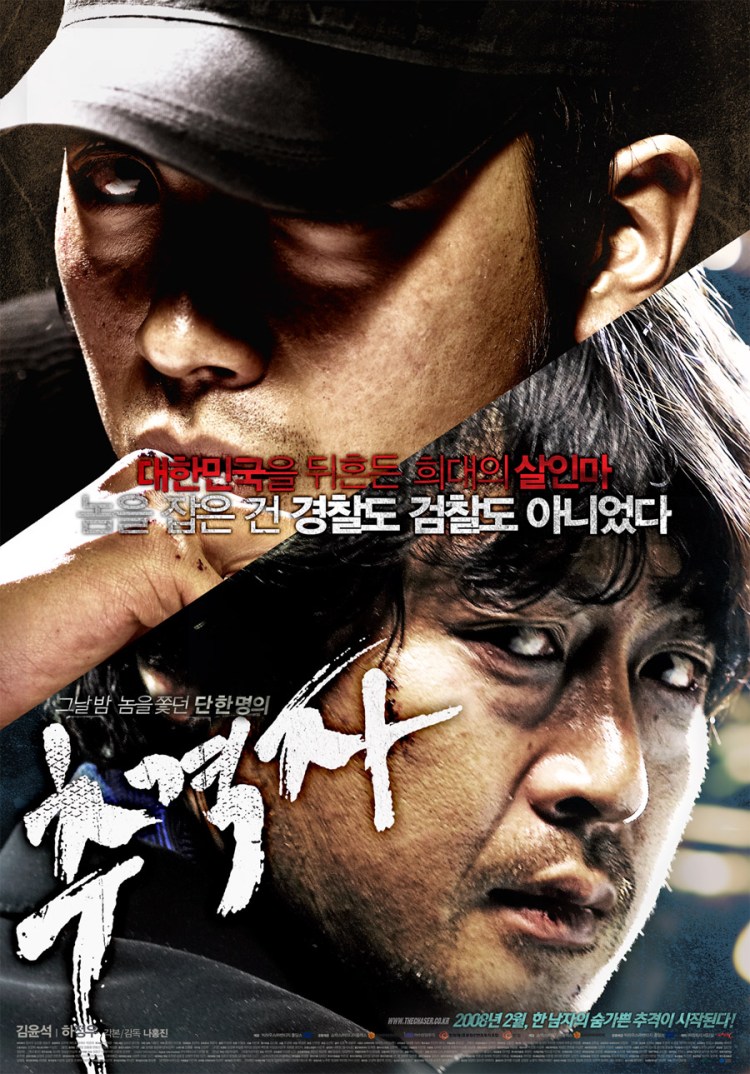
The chaser movie posterWhen it comes to law enforcement in Korea (at least in the movies), your best bet may actually be other criminals or “concerned citizens” as the police are mostly to be found napping or busy trying to cover up for a previous mistake. The Chaser (추격자, Chugyeogja) continues this grand tradition in taking inspiration from the real life serial murder crime spree of Yoo Young-chul , eventually brought to justice in 2005 after pimps came together and got suspicious enough to make contact with a friendly police officer.

Former cop turned petty pimp Joong-ho (Kim Yun-seok) has a problem. His girls keep skipping out on their debts. Or so he thinks – rousing one of his last remaining “employees”, Mi-jin (Seo Young-hee), from her sickbed (and unbeknownst to him calling her away from her seven year old daughter), Joong-ho finds a phone belonging to a missing girl and realises the last number called is the same as the one he’s about to send Mi-jin off to. Suspicious, Joong-ho rediscovers his detective skills and notices this particular number all over his books. Thinking the john is kidnapping his girls to sell them on, Joong-ho hatches a plan to track Mi-jin and have a word with this bozo but unsurprisingly nothing goes to plan. Mi-jin has fallen into the grip of a vicious serial killer, Young-min (Ha Jung-woo), but may still be alive if only Joong-ho can find her in time.

Joong-ho is not a good guy. Maybe he’s not the worst of his kind but as a former law enforcement official turned unsentimental exploiter of women, Joong-ho is an unlikely saviour. His primary motivation is, unsurprisingly, commercial as the look of concern he gives to one of his ladies encountering a dangerous client betrays, the kind of irritation a taxi driver might display on noticing a large scratch on his expensive car rather than a recognition of the pain and suffering those cuts and bruises bear witness to. He never stops to consider that something untoward has befallen the missing women and is, in one sense, relieved when he thinks they’ve been sold on rather than just skipping out on him. Throughout his quest to find Mi-jin which sees him forming an unexpected paternal bond with her young daughter, Joong-ho begins to rediscover his humanity as he’s forced to confront the similarities between himself and this deranged psycho killer.

Like his real life counterpart, Young-min, is a sexually frustrated misogynist who begins his social revenge through killing off the wealthy before moving on to the less easily missed including local prostitutes which is what ultimately proves his downfall when the various area pimps begin to connect the dots. In actuality it turns out Young-min has previously been questioned in connection with a murder but was released due to lack of evidence. Likewise, this time around the police are not very interested in capturing him and Young-min is once again returned to society due to some political concerns which result in pressure from above. As if having charmed luck with the police weren’t enough, Young-min also exploits the other cornerstone of South Korean society – the church, through which he recruits his victims, subverting their trusting religiosity with his violent perversion.

For a film which largely lives on the chase, winding through the darkened, rain drenched backstreets of downtown Seoul, Na adds in plenty of twists and turns as the case proceeds down one dingy alleyway after another. Joong-ho’s gradual reawakening as a human being rather than cold blooded human trafficker is accompanied by the gradual reveal of his counterpart’s dangerous need for validation through violence but also by the realisation of his total powerlessness in the face of such a nebulous and faceless threat. The police won’t help (perhaps if they’d investigated those parking violations a little more assiduously all of this could have been avoided), the Church is just an ironic distraction, and the politicians are busy squabbling amongst themselves. Joong-ho is an unlikely figure of salvation, but he remains the last best hope for justice so long as he can avoid becoming that which he seeks.


Original trailer (English subtitles)

https://www.youtube.com/watch?v=ai0GambXj-s

Topless (トップレス, Eiji Uchida, 2008)

toplessFollowing the surreal horror film The Greatful Dead and cynical industry exposé Lowlife Love, Eiji Uchida is not generally known for straightforward naturalism but his 2008 movie Topless (トップレス) maybe among the most refreshingly straightforward, naturalistic depictions of lesbian life in modern Japan. Inspired by the writings of Pudding Watanabe, Topless, despite the title and suggestive poster, immediately jettisons preconceptions and sets about exploring the lives of young men and women in the city, just trying to make it in an often hostile society.

Forthright Natsuko (Mina Shimizu) splits up with her high school sweetheart Tomomi (Erika Okuda) but continues to pine after her even once Tomomi reveals that she’s got herself a boyfriend and plans to try the conventional life for a while. This heavy emotional blow provokes a kind of crisis in the otherwise certain Natsuko who finds herself musing on the fate on older lesbians and expressing sympathy for those who decide it’s just easier to enter a marriage of convenience than try to live alone. For the moment, Natusko lives with her understanding flatmate, Koji (So Sakamoto), who’s been nursing a long time crush on her even if he knows she’s gay and it’s impossible. A chance meeting with a high school girl, Kana (Aya Omasa), who’s come to Tokyo to find the mother who abandoned her to run off with a lesbian lover ten years ago only deepens Natsuko’s contemplative mood as she starts to wonder about where her life will take her if she chooses not to follow the accepted path.

Topless is less about romance than it is about acceptance and identity. Natsuko maybe a member of her university’s lesbian society but she’s about as far from a flag waver as it’s possible to be and just wants to live her life without thinking too much about the big stuff. Bar one woman (a new addition and not a student) the other girls are also just hanging round to have fun, aren’t particularly interested in activism and don’t feel themselves to be part of a movement defined by their sexuality. Natsuko certainly refuses to be defined by hers though her recent falling out with Tomomi has shaken her to the core and forced her into a consideration of her own hopes and desires for the future.

Tomomi claims to still love Natsuko but also that it “can’t be helped” because they’re both women and it’s just not possible. Natsuko tries to come to terms with her friend’s decision whilst nursing a broken heart but struggles to overcome her feelings of jealously towards Tomomi’s new boyfriend. Koji, Natsuko’s roommate, can’t understand why a lesbian would marry a man but being a man himself he can’t appreciate the societal necessities which make trying to live a life outside the mainstream particularly hard for women. As Natsuko points out, women earn less and living is expensive, it’s difficult to live out and proud in a hostile society, and then there’s the fear of growing old without children or an extended family network to fallback on. Though she sympathises with all of these factors on an intellectual level and then eventually even contemplates trying out life with a man herself,  it’s not something Natsuko could ever do and a part of her can never forgive Tomomi for doing it even if she does understand why someone might.

Kana’s quest for her long lost mother gets lost between the meatier subplots but proves enlightening in the unexpected bond between the troubled schoolgirl and the shaken if confident Natsuko. Still nursing deep scars from her abandonment, Kana claims to hate lesbians but grows to like Natsuko, the only person willing to help her track down her mother in a totally unfamiliar world. Despite Koji’s protestations that Natsuko will be angry if she hears any of Kana’s anti-gay sentiments, she listens patiently to Kana’s complaints stopping only to tell her she understands why she feels that way but that she also thinks she’s wrong. Trying to help Kana understand why her mother made the decisions that she did and see that there’s nothing wrong with two women loving each other, Natsuko changes hearts and minds just by being patient and kind.

In the conventional sense Topless offers no happy endings but it does advocate first and foremost for a kind of self acceptance and finally allowing old wounds to scar over, closed but not forgotten. Normalising lesbian life with ease, Uchida proceeds with a straightforward approach which sidesteps the obvious in order to provide a more nuanced portrait of life and love among the young people of Tokyo each trying to navigate the difficult process of learning to live as an independent person constrained by social conventions. Admittedly low budget but tastefully done and anchored by a standout performance from Mina Shimizu, Topless is a refreshingly down to earth look at gay life in the big city which refuses to give in preconceptions and expectations.


Short clip from the film (English subtitles)

700 Days of Battle: Us vs. the Police (ぼくたちと駐在さんの700日戦争, Renpei Tsukamoto, 2008)

700days-of-battleThose golden last few summers of high school have provided ample material for countless nostalgia filled Japanese comedies and 700 Days of Battle: Us vs. the Police (ぼくたちと駐在さんの700日戦争, Bokutachi to Chuzai-san no 700 Nichi Senso) is no exception. Set in a small rural town in 1979, this is an innocent story of bored teenagers letting off steam in an age before mass communications ruined everyone’s fun.

In the summer of 1979, a group of teenage high school students get their kicks pulling pranks around the neighbourhood. They finally meet their match when a new policeman, Chuzai (Kuranosuke Sasaki), arrives in town intent on actually enforcing the law. When one of the boys is fined for speeding after coming down a steep hill on his bicycle, the guys decide to make Chuzai their new enemy, virtually daring him to arrest them with their constant trolling.

However, things take a turn when the boys move their prank planning meetings to a local cafe and discover the beautiful waitress working there, Kanako (Kumiko Aso). Instantly smitten the boys step up their romance game (donning some fancy outfits in the process) and semi-forget about their mission. Unfortunately Kanako is a married woman and worse than that she’s married to Chuzai! This whole thing just got real.

Chuzai, for all his uptight authoritarianism is onto the boys and their generally innocent mischief. Finding it all very irritating rather than actually dangerous, Chuzai gradually starts playing them at their own game by attempting to prank them back such as in one notable incident where he makes them attend a public behaviour seminar but gives the entire lecture through a ventriloquist’s dummy called Taru-kun. As a slightly older man, Chuzai can see the boys are just hopelessly bored in their backwater town. Breaking with his hitherto austere persona, Chuzai drops the authoritarian line to offer some fatherly advice to the effect that these summers are precious times,  soon the boys’ high school lives will be over and they’ll most likely leave their pleasant small town for the bustling metropolis of Tokyo so they’d better make the most of these aimless days while they can.

Idyllic as it is, the nature of the boys’ mission changes in the second half as the war against Chuzai takes on a slightly more affectionate quality. At this point they decide to use their pranking powers for good to help a little girl who’s stuck in the hospital finally enjoy the summer fireworks she’s been longing for even though the doctors won’t let her out to go to the festival. With the fireworks heist hovering in the background the guys get into various romanctic difficulties while enjoying archetypal teenage summer adventures.

Infused with period detail, 700 Days of Battle: Us vs. the Police has an authentically ‘70s soundtrack with some of the biggest hits of the era running in the background. Frequent cultural references such as a brief appearance from Ultraman add to the atmosphere which has a kind of retro, nostalgic innocence behind it as these kids live in a golden era of friendship and bike riding when the sun is always shining and graduation is still a long way off.

Director Tsukamoto keeps things simple though the production values are high and visual gags are spot on. Somewhat episodic in nature, the tale is split up into various chapters by means of title cards which helps to break up the seemingly endless summer as the boys attempt to fill their otherwise empty days. Apparently this was only the beginning of the “war” against the police, occupying only 108 days of a “conflict” which would finally run to 700. Presumably the guys have finished up their high school days by that point but at least they’ve succeeded in making some amusing memories of their elaborate and sometimes fiendishly clever schemes to take revenge on the surprisingly patient Chuzai-san. Filled with innocent, witty and whimsical comedy 700 Days of Battle: Us vs. the Police offers no great leap forward even within the realm of quirky teen comedies but still manages to provide some old fashioned, wholesome summer themed fun.


Original trailer (English subtitles)

All Around Us (ぐるりのこと。, Ryosuke Hashiguchi, 2008)

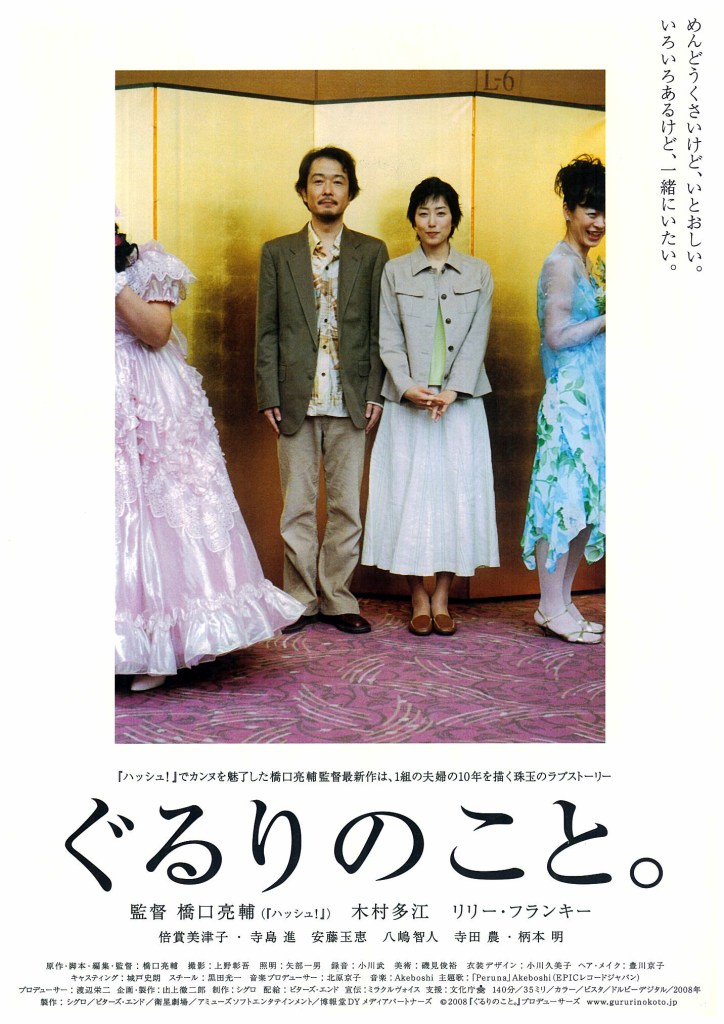
all around usRyosuke Hashiguchi returns after an eight year absence with All Around Us (ぐるりのこと。Gururi no Koto) and eschews most of his pressing themes up this by point by opting to depict a few “scenes from a marriage” in post-bubble era Japan. Set against the backdrop of an extremely turbulent decade which was plagued by natural disasters, terrorism, and shocking criminal activity Hashiguchi shows us the enduring love of one ordinary couple who, finding themselves pulled apart by tragedy, gradually grow closer through their shared grief and disappointment.

Tokyo, 1993. Kanao (Lily Franky) and Shoko (Tae Kimura) have had an “on and off” (but seemingly solid) relationship since their art school days. She works at a publishing house and he’s kind of a slacker with a job in a shoe repair booth. Shoko worries that Kanao plays around too much (but actually doesn’t seem that bothered about it) whilst continuing to attempt to micromanage their entire existence with her clearly marked calendar planning out the most intimate of actions. When Shoko discovers she’s expecting a child, the pair decide to finally get married and begin their lives as a family. Kanao also gets an opportunity on the work side when an old college friend helps him get a job as a courtroom artist for a news agency.

However, their joy is short-lived as an abrupt jump forward in time shows us a tiny shrine underneath the calendar (shorn of its red crosses) dedicated to the memory of their infant daughter. Kanao is the keep calm and carry on sort so he just tries to bluster through but Shoko is distraught and slowly descending into a mental breakdown. If that weren’t enough to contend with, Shoko’s estranged father has been tracked down and is apparently very ill dredging up even more pain an uncertainty from the long buried past.

We follow Shoko and Kanao over a period of nine years. As well as the ever present motif of the calendar, we feel the passage of time through Kanao’s work at the court house which sees him become the artistic recorder of some of the most traumatic moments of the age. Having entered into an era of economic turmoil following the end of the bubble economy, the 1990s saw not only the devastating Kobe Earthquake but also the sarin gas attack on the Tokyo underground perpetrated by a dangerous religious cult, members of which wind up in court in front of Kanao, tasked with the thankless task of bearing witness to their testimony.

Kanao evidently decided not to discuss his personal tragedy with his work colleagues or, one would assume, his boss would not have reacted so harshly when he made the reasonable request to turn down the opportunity to sit in on yet another child murder trial – either by accident or design, the trials which present themselves to Kanao (and are all real, sensationalised media events of the time) involve the horrific murders of small children with only one of the defendants voicing any kind of regret or remorse.

Meanwhile, Shoko has been trying to get on with life as best she can but finds herself sinking ever deeper into depression. Her uptight, controlling personality cannot cope with this perceived “failure” on her part or of the destruction of all her plans by a truly unforeseen tragedy. Having had her doubts before regarding Kanao’s commitment to her, she finds his lack of reaction puzzling. Mistaking Kanao’s lack of outward emotion for indifference, Shoko finds it hard to continue believing in their shared destiny and wonders if her husband ever really cared for her at all. Kanao is a laid-back soul, someone who’s learned to become used to disappointment by accepting it quickly and then trying to move on. His more grounded approach might be just the one Shoko needs in order to come to terms with what’s happened – never pushing or complaining Kanao is contented simply by her presence and is prepared to give her the space she needs whilst always being around to offer support.

Hashiguchi relies on visual cues to help navigate the shifting dynamics including the repeated use of the calendar as a symbol of Shoko and Kanao’s marital status, the now unneeded pregnancy books bundled to be thrown out, or rice discarded in the sink as a marker of a house proud woman’s slide into crippling depression. Small moments make all the difference from a mother’s bandaged wrists and a cutback to the only person who’s noticed them, to the repeated joke of all the veteran journalists suddenly falling over themselves in an attempt to escape the courtroom and be the first to file their copy. A necessarily sad story, but an oddly warm one as two people worried they may be mismatched grow into each other in the face of their shared tragedy. Anchored by the strong performances of its two leads (particularly Tae Kimura who manages some convincing on screen crying in a difficult role) All Around Us is another beautifully pitched human drama from Hashiguchi who proves himself an adept chronicler of the human condition even whilst stepping away from his trademark themes.


Original trailer (English subtitles)
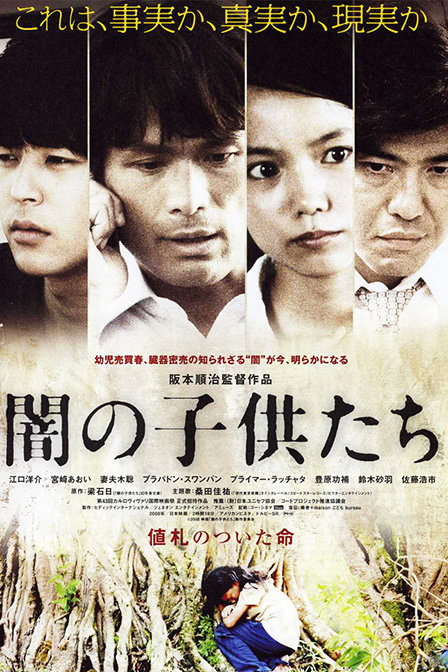
Kabei: Our Mother (母べえ, Yoji Yamada, 2008)

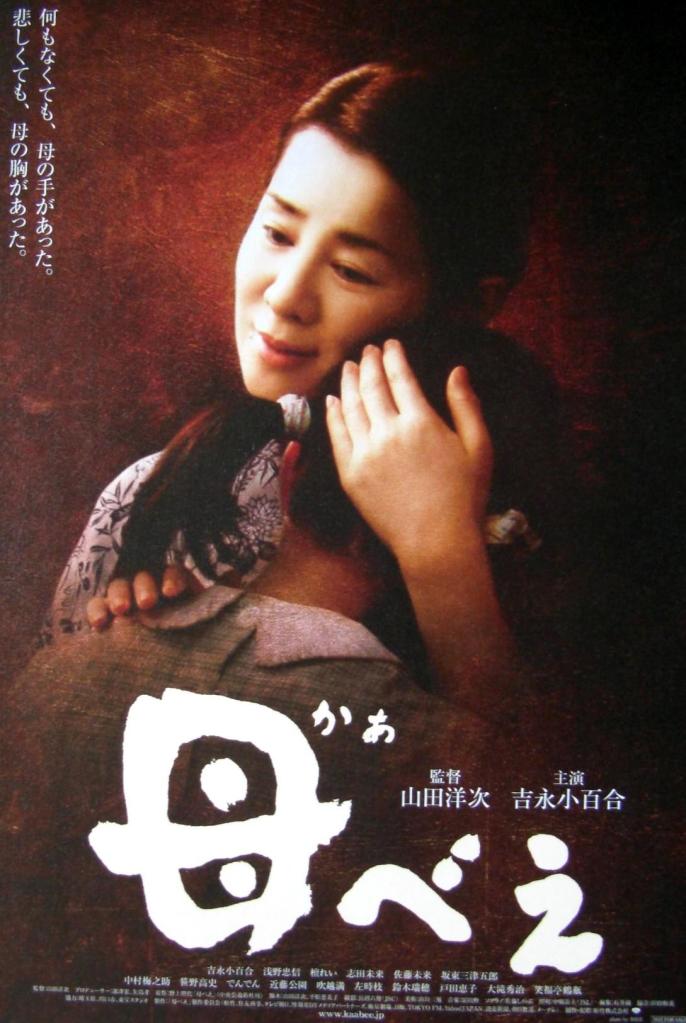
KabeiYoji Yamada’s films have an almost Pavlovian effect in that they send even the most hard hearted of viewers out for tissues even before the title screen has landed. Kabei (母べえ), based on the real life memoirs of script supervisor and frequent Kurosawa collaborator Teruyo Nogami, is a scathing indictment of war, militarism and the madness of nationalist fervour masquerading as a “hahamono”. As such it is engineered to break the hearts of the world, both in its tale of a self sacrificing mother slowly losing everything through no fault of her own but still doing her best for her daughters, and in the crushing inevitably of its ever increasing tragedy.

Summer, 1940. The Nogamis are a happy family who each refer to each other by adding the cute suffix of “bei” to their names. The father, Tobei (Bando Mitsugoro X), is a writer and an intellectual opposed to Japan’s increasing militarism and consequently has found himself in both political and financial difficulties as his writing is continually rejected by the censors. Eventually, the secret police come for him, dragging him away from his home in front of his terrified wife and daughters. After Tobei is thrown into jail for his “thought crimes”, the mother, Kabei (Sayuri Yoshinaga), is left alone with her two young girls Hatsuko and Teruyo (Hatsubei and Terubei in family parlance).

Though devastated, Kabei does not give up and continues to try and visit her husband, urging his release and defending his reputation but all to no avail. Thankfully, she does receive assistance from some of her neighbours who, at this point at least, are sympathetic to her plight and even help her get a teaching job to support herself and the children in the absence of her husband. She also finds an ally in the bumbling former student, Yamazaki (Tadanobu Asano), as well as her husband’s sister Hisako (Rei Dan), and her brother (Tsurube Shofukutei) who joins them for a brief spell but ultimately proves a little too earthy for the two young middle class daughters of a dissident professor.

The time passes and life goes on. The war intensifies as do the attitudes of Kabei’s friends and neighbours though the family continues its individual struggle, sticking to their principles but also keeping their heads down. By the war’s end, Kabei has lost almost everything but managed to survive whilst also ensuring her children are fed and healthy. A voice over from the older Teryuo calmly announces the end of the conflict to us in such a matter of fact way that it’s impossible not wonder what all of this was for? All of this suffering, death and loss and what has it led to – even more suffering, death and loss. A senseless waste of lives young and old, futures ruined and families broken.

Yet for all that, and to return to the hahamono, the Nogami girls turned out OK. Successful lives built in the precarious post-war world with careers, husbands and families. Unlike many of the children in the typical mother centric movie, Hatsuko and Teruyo are perfectly aware of the degree to which their mother suffered on their behalf and they are both humbled and grateful for it. Kabei was careful and she kept moving to protect her children in uncertain times. Seen through the eyes of a child, the wartime years are ones of mounting terror as fanatical nationalism takes hold. Bowler hatted men seem to rule everything from the shadows and former friends and neighbours are primed to denounce each other for such crimes as having the audacity to wear lipstick in such austere times. In one notable scene, the neighbourhood committee begins its meeting by bowing at the Imperial Palace, until someone remembers the paper said the Emperor was in a different palace entirely and they all have to bow the other way just in case.

Though the tale is unabashedly sentimental, Yamada mitigates much of the melodrama with his firmly domestic setting. We see the soldiers massing in the background and feel the inevitable march of history but the sense of tragedies both personal and national, overwhelming as it is, is only background to a testament to the strength of ordinary people in trying times. An intense condemnation of the folly of war and the collective madness that is nationalism, Kabei is the story of three women but it’s also the story of a nation which suffered and survived. Now more than ever, the lessons of the past and the sorrow which can only be voiced on the deathbed are the ones which must be heeded, lest more death and loss and suffering will surely follow.


Original trailer (English subtitles)
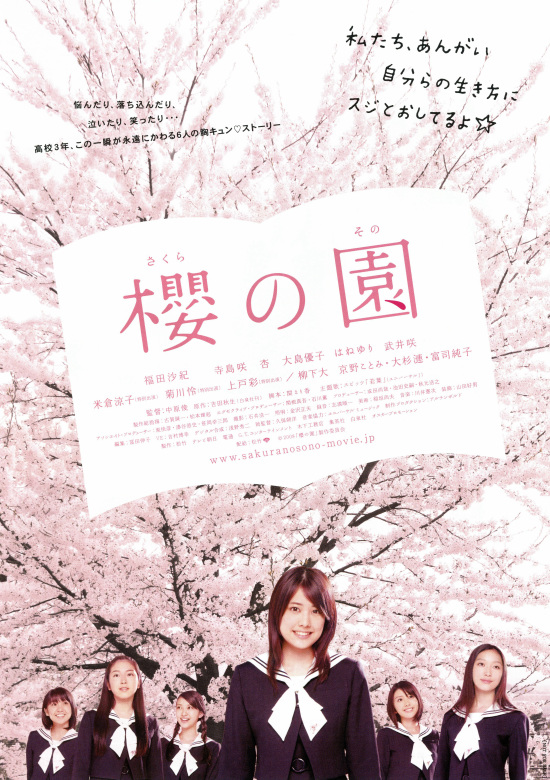
Still Walking (歩いても歩いても, Hirokazu Koreeda, 2008)

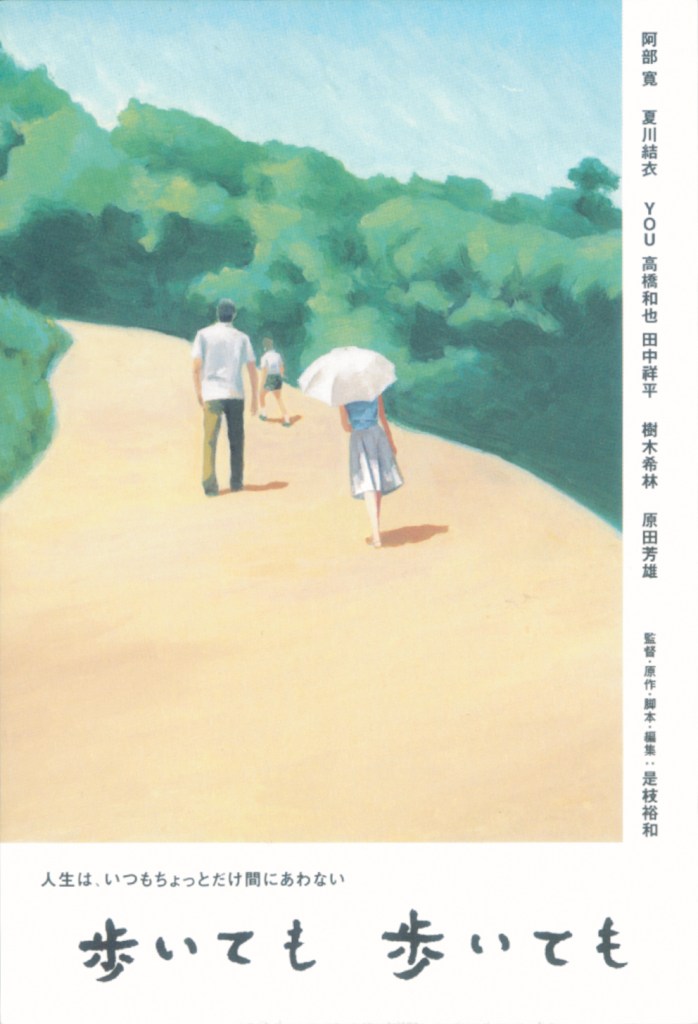
still walkingLife is full of choices, but the one thing you can’t choose is your family. Like it or not you’re stuck with them for life and even if you decide you want nothing to do with them ever again, they’ll still be hanging round in the back of your mind for evermore. Koreeda swings the camera back around the fulcrum of Japanese society for this dissection of the fault lines and earthquake zones rubbing up against this very ordinary family.

You’d be forgiven for thinking that some kind of celebration is about to take place at the beginning of Still Walking (歩いても歩いても, Aruitemo Aruitemo) yet the event that is about to bring scattered friends and family members back home is of a more somber nature. As the matriarch Toshiko (Kirin Kiki) peels vegetables with her daughter Chinami (YOU) she seems excited at the prospect of getting the family back together again yet melancholic and perhaps a little nervous.

Younger son Ryota (Hiroshi Abe) is taking the train in with his new wife and stepson. He urges Yukari (Yui Natsukawa) that they should make their excuses and leave in time for the last train but she feels obliged to stay over. It’s clear Ryota is not looking forward to a reunion with his family and also has some current worries over his working situation which are weighing on his mind and which he definitely does not want anyone in the family to find out about.

Ryota has a particularly strained relationship with his difficult doctor father, Kyohei (Yoshio Harada) who doted on his oldest son, Junpei, drowned at sea whilst saving the life of a little boy. Increasingly grumpy that he has no heir for his medical practice, Kyohei refuses to recognise Ryota as a grown man or accept his work as an art restorer as a “real” occupation. Tensions in the family are further brought out by the mild disapproval over Ryota’s choice of wife who was previously married and then widowed and has a young son by her first husband. Toshiko for one still harbours an old fashioned stigma towards second marriages and thinks Ryota could have done better than “buying second hand”. Though seemingly accepting of her new daughter-in-law and grandson, she perhaps treats them a little more like guests than fully fledged members of the family.

Set over the course of two days, Still Walking takes on a sense of Chekovian wit and melancholy as it paints a naturalistic picture of an ordinary family with all of the petty cruelties and indignation that involves. The deceased son, Junpei, has become a virtual saint, forever bathed in golden light by his grieving parents while Ryota remains very much alive yet pushed into the shadows. Feeling himself to raise only feelings of disappointment in his family, he adopts a truculent, defensive air which sees him unwilling to engage leaving the bulk of the work for his new wife who is eager to please her in-laws despite their frequent tactlessness in dealing with herself and her son.

Of course, Ryota and his father aren’t so different at all – both gruff, defensive, grumpy. Kyohei is a difficult man sinking into a miserable old age where he can no longer busy himself with the role which has given his life meaning, that of a respected small town doctor. When bubbly younger sister Chinami mentions having seen a newspaper report which referred to painting restorers as “art doctors”, neither man is very happy with being linked with the other yet there is a certain commonality between them that oddly forces them apart rather than ties them together.

Toshiko by contrast is the long suffering yet largely silent housewife whose maternal grief is the force which now defines her. Seemingly sweet and kind on the outside, there’s a tough core in the middle which gives way to some decidedly biting remarks lightly peppering the atmosphere with ancient resentments. Perhaps feeling a strange sort of kinship with the mystery guest-cum-kicking-boy-of-the-day – Yoshio, the boy who Junpei saved but has not made good on his investment as he’s turned into a slobbish and overweight 25 year old child who can’t seem to settle on one proper career, Ryota asks why his mother insists on inviting him every year knowing how painful it must be for him to come. Toshiko coldly replies that that’s exactly the reason she intends to keep making him visit, she feels wretched inside 24/7 so for one day every year she makes someone else feel dreadful too – will anyone blame her for that?

Grief and loss play a heavy part here, not only of the literal kind, but in the feeling of time wasted and the disappearing moments which can never be recaptured. Chinami’s son and daughter team up with Ryota’s stepson Atsushi to provide a melancholic mirror of the the three Yokoyama children playing in the same fields and staring at the same fleeting flowers as their forebears did years before. Time is always passing, you think there will always be another opportunity for saying something or other, forging a connection or new memory but soon enough the sand in the glass runs through. As Ryota notes, it’s always a little later than you think but you can’t see it until it’s already too late.

Dense with naturalistic detail, Still Walking is a warm if sad look at one ordinary family dealing with the aftermath of tragedy yet offers its own comments on the nature of human connection between fathers and sons, mothers and daughters, and between the living and the dead. A timely reminder of the transience of all things, Koreeda’s most straightforward take on the family drama proves a both profound and moving experience which only deepens with repeated viewing.


I rewatched this recently at an ICA members’ screening where it screened on 35mm but the print actually had an intermission built into it even though the film isn’t all that long – strange experience!

Still Walking is available on DVD and VOD in the UK from New Wave Films and was also released on blu-ray in the US as part of the Criterion Collection.

The film’s Japanese title Aruitemo Aruitemo is taken from the song made famous by Ayumi Ishida – Blue Light Yokohama which turns out to have a surprising significance within the film:

https://www.youtube.com/watch?v=MZ7RiVZvc-Y