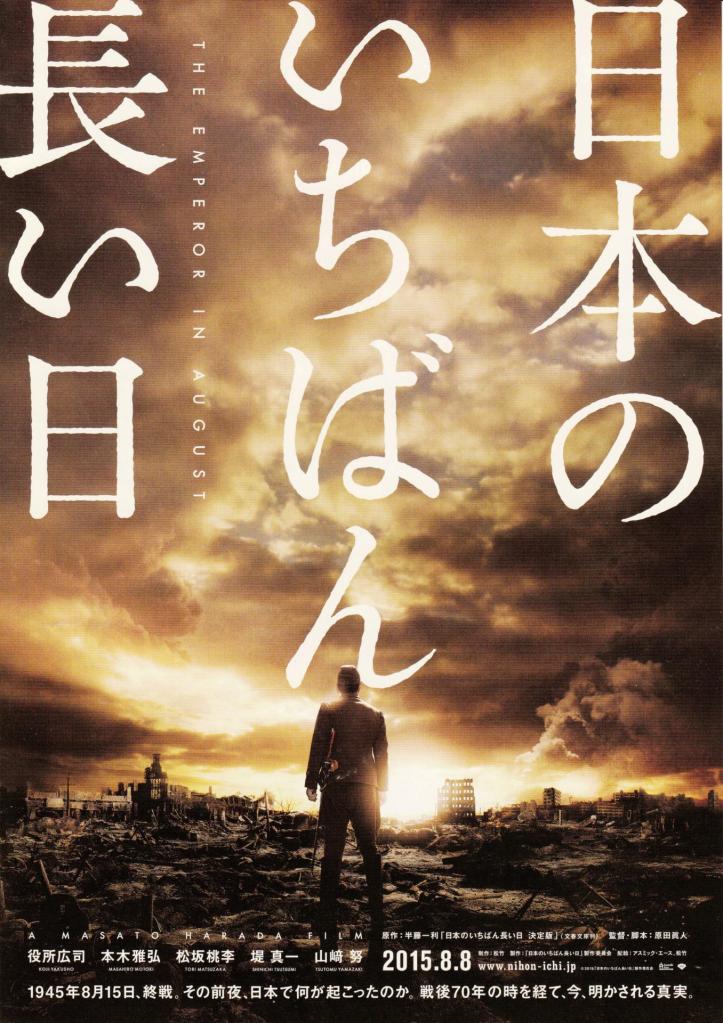
The Emperor in August (日本のいちばん長い日, Masato Harada, 2015)

bbc56b4fff657dfc4fcc0499f8be9741How exactly do you lose a war? It’s not as if you can simply telephone your opponents and say “so sorry, I’m a little busy today so perhaps we could agree not to kill each other for bit? Talk later, tata.” The Emperor in August examines the last few days in the summer of 1945 as Japan attempts to convince itself to end the conflict. Previously recounted by Kihachi Okamoto in 1967 under the title Japan’s Longest Day, The Emperor in August (日本のいちばん長い日, Nihon no Ichiban Nagai Hi) proves that stately events are not always as gracefully carried off as they may appear on the surface.

By the summer of 1945, it’s clear that the situation as deteriorated significantly and Japan can no longer cling to any kind of hope of victory in the wider scale. Tokyo has been firebombed almost out of existence leaving only the Imperial Palace untouched – even the Emperor and his wife have been reduced to eating gruel. Everyone knows it’s time for a solution, but no one is quite ready to say it. In the wake of the atomic bomb, the situation becomes ever more desperate and even if the Emperor himself advocates a surrender, he needs the approval of his advisors. The Prime Minister, Navy and other officials are in favour but the Army, represented by General Anami, is committed to fighting on to the last man. Eventually, Anami comes around to the Emperor’s point of view but some of his men prove much harder to convince…

It might seem like a strange time to make a film about grace in the face of defeat given the recent political troubles stemming back to Japan’s wartime activities, but director Masato Harada is not lamenting the course of the war or trying to advocate for any rightwing agenda so much as trying to make plain the final absurdity of recognising when the battle is over. The civilians and even the Navy might be in favour of accepting the terms of the Potsdam Declaration and ending the war as quickly as possible but a soldier is a soldier and the Army wants to go down fighting. They aren’t alone, of course, there are ordinary people who feel this way too but the writing is well and truly on the wall here.

The bulk of the film takes place within the palace, debating halls or army buildings all of which have escaped major damaged but every time we venture outside we’re shown a scene of utter desolation. A great, gaping hole where once there was a city. Anami’s wife undertakes a four hour walk to try and get in contact with a man who knew their son and can tell them how it was that he fell somewhere in Manchuria. She sees people fleeing, some thinking the enemy are about to descend any minute or that Tokyo will be the next target for an atomic bomb, and walks on through a barren, eerie landscape emerging soot covered and, finally, too late.

Closer to home, the situation among the soldiers is reaching boiling point. Originally committed to rejecting the terms of the treaty, Anami is now in favour of a surrender (with a few caveats) and is desperately working against the threat of an internal coup. Though the top brass have seen enough of warfare to know when it’s time to put down your weapons, the young hotheads have not yet learned the value of pragmatism. Seeing themselves as a second incarnation of the February 26th rebels, a cadre of young officers breaks ranks to try and stop the Emperor’s message of surrender from hitting the airwaves, hoping instead to spread the false message that the Russians have invaded and it’s all hands on deck. Needless to say, they don’t fare any better than the young officers of 1936 and if anything their bullheaded refusal to see sense becomes a microcosmic allegory for the years of militarism as a whole.

In the midst of all this chaos, the real heart of the film is Koji Yakusho’s conflicted general who feels his era passing right in front of him. Grieving for his fallen son yet also clinging to his military duty which dictates no surrender, no retreat he finally sees each of his ideals crumbling and comes to the realisation that the only way to save Japan is to abandon the military. Making a sacrifice of himself, he ensures the safe passage of his nation along a road on which he cannot travel.

The Emperor is a sympathetic figure here, gentle, soft, wanting the suffering to end for everyone but being more or less powerless to effect it despite his title. All he can do is advocate and try to convince his council that surrender is the right course of action as his country burns all around him.

Harada manages to keep the tension high even though a lot of the film comes down to a group of men discussing the proper wording for a treaty. A timely and beautifully photographed exploration of the last days of a war, The Emperor in August is another much needed reminder that decisions which will affect millions of lives are made by handfuls of men in tiny, closed up rooms that most people will never get to see.


The Japanese blu-ray/DVD release of The Emperor in August includes English subtitles.

Unsubtitled trailer:
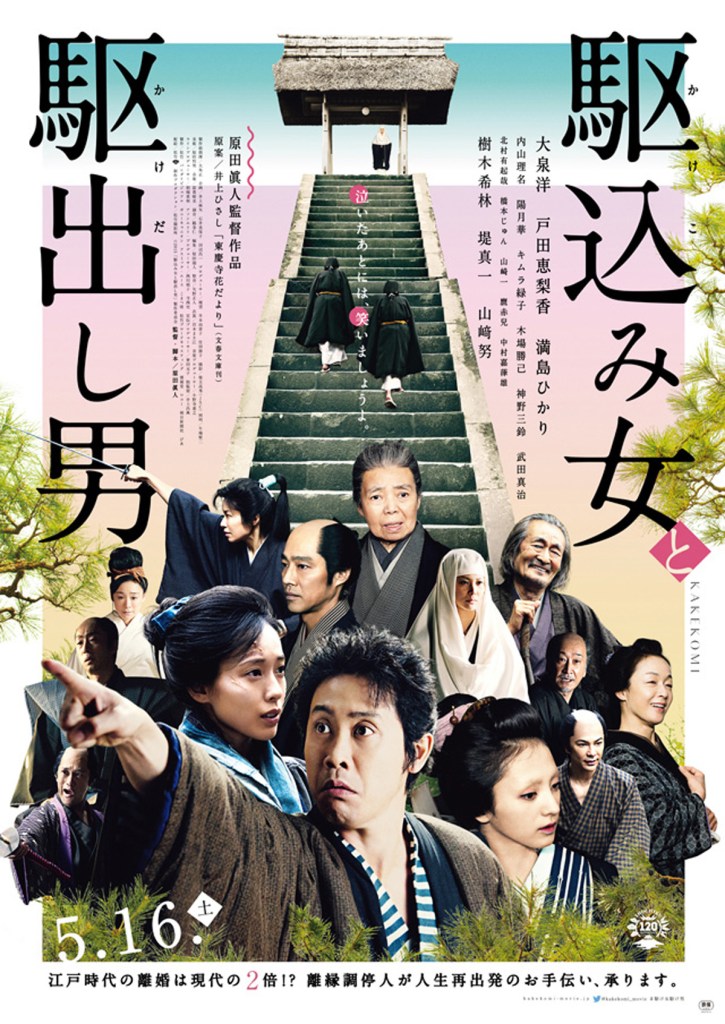
Kakekomi (駆込み女と駆出し男, Masato Harada, 2015)

166028_02The world of the classical “jidaigeki” or period film often paints an idealised portrait of Japan’s historical Edo era with its brave samurai who live for nothing outside of their lord and their code. Even when examining something as traumatic as forbidden love and double suicide, the jidaigeki generally presents them in terms of theatrical tragedy rather than naturalistic drama. Whatever the cinematic case may be, life in Edo era Japan could be harsh – especially if you’re a woman. Enjoying relatively few individual rights, a woman was legally the property of her husband or his clan and could not petition for divorce on her own behalf (though a man could simply divorce his wife with little more than words). The Tokeiji Temple exists for just this reason, as a refuge for women who need to escape a dangerous situation and have nowhere else to go.
Kakekomi (駆込み女と駆出し男, Kakekomi Onna to Kakedashi Otoko) places this important institution at its centre as it focuses on the stories of a number of women who’ve each ended up at the temple after a series of difficult circumstances. Jogo (Erika Toda) is married to a womanising drunkard who forces her to run his iron smelting business from the front lines (hence the painful looking blisters on her face) while he enjoys his life of debauchery. When the staff complains about his attitude and their subsequent fears for their jobs and Jogo raises their concerns with him he simply beats her before returning to his mistress. She then faces a decision – Tokeiji, death, or endurance. During her flight, she runs into O-Gin (Hikari Mitsushima), a mysterious wealthy woman who’s sprained her ankle after fighting off bandits in the woods. The pair bond on their quest to reach Tokeiji where they hope to find refuge from their turbulent home lives.

Before you can enter Tokeiji you’re held at one of the receiving inns where they hear your story, assess the possibility of being able to reconcile with a husband and, if deemed necessary, allowed to travel to the temple where you’ll live as a Buddhist nun for two years at which time your husband must legally sign the divorce papers. The inn adheres to strict Buddhist principles – no men are allowed near the temple (even the outside helpers wear bells so the ladies can hear them coming), you eat only temple cuisine (no meat or stimulants like garlic and onions), and have to abide by the word of the head nun. There are also three different classes of resident starting with the most expensive court lady lifestyle, then one of sewing and making repairs, and finally the lowest class which does all the day to day cooking, cleaning and other menial tasks.

The other pivot around which the film turns is the one time medical student Shinjiro (Yo Oizumi) who has literary dreams but has had to beat a quick retreat from Edo after defiantly breaking its ridiculous “no singing in the streets” law (amongst other things). At this period Edo and the surrounding area is undergoing its own mini cultural revolution as the current authorities advocate a period of austerity which sees things like literature, music and even sushi outlawed. Perceiving threats everywhere, the powers at be are also looking for a way to close down Tokeiji by any underhanded means necessary.

Shinjiro is a fast talking wise guy who can generally talk his way out of anything though he is also a keen student and a promising young doctor. As a relative of the Tokeiji inn owners, he’s seeking refuge too but also hoping to make use of their extensive archives for his writing career. As a doctor he’s immediately fascinated by the burns on Jogo’s face which he believes he can treat though in her frightened state she’s alarmed by his direct manner and refuses. After hearing his more reasoned arguments she finally submits and in turn becomes interested in his medical knowledge assisting him to gather herbs in the forest before starting her own herb garden in the temple.

Of course, the two develop a growing romantic attachment though frustrated by Jogo’s position as a married woman and the temple’s prohibition against male contact. Their romance is never played for melodrama, more as a simple and natural course of events though it’s well played by both Toda and Oizumi. At heart, Kakekomi is an ensemble drama which encompasses the often sad stories of its female cast who are each at the mercy of the cruel and rigid Edo era social system. O-Gin’s reasons for fleeing to Tokeiji turn out to be a little different from everyone else’s though she too is still suffering for love.

A humorous look at this untold story, Kakekomi proves an engaging ensemble drama anchored by the committed performances of its cast. Toda takes Jogo from a frightened and abused woman to a confident and learned scholar who is perfectly capable of taking charge of things on her own and her transformation is the true heart of the film. Apparently, director Masato Harada shot nearly four hours of footage before cutting the film down to the more manageable two and a half which may explain why it sometimes feels a little abrupt but nevertheless Kakekomi proves one of the most enjoyable mainstream Japanese movies of recent times.


The Japanese blu-ray/DVD of Kakekomi includes English subtitles.

Rakugo Monogatari (落語物語, Shinpei Hayashiya, 2011)

program_rakugoWhen it comes to the classic Japanese art forms, kabuki, noh and maybe even bunraku are not so uncommon overseas. Rakugo, however, has not been as lucky. Famously impenetrable for non-native speakers even if their language skills are otherwise top notch, rakugo is the art of traditional comic story telling in which the “rakugo-ka” recites a standard monologue with the aim of mining it for laughs in their own individual fashion. These stories date back to the Edo-era and rely heavily on classic Japanese puns, stock characters and cultural assumptions, consequently, their appeal has been on the wane in Japan for sometime. That’s not to say the art form is quite dead yet though, as real life rakugo-ka Shinpei Hayashiya’s Rakugo Monogatari attempts to prove.
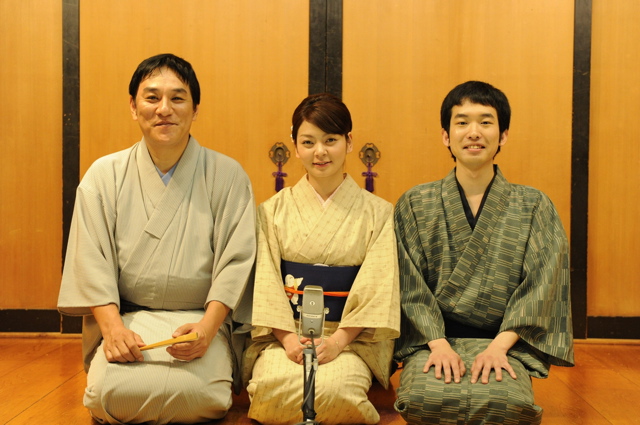
The film begins as youngster Masato catches a Rakugo act and becomes immediately smitten. Hoping to become the disciple of a top master, he parks himself outside the house of Kozaru but is too shy to actually knock on the door. Luckily, Kozaru’s wife arrives home and spots Masato waiting outside. She’s a sharp woman and immediately guesses what Masato’s after so she invites him inside to meet her husband. Kozaru is a bit of a strange man but with a fantastic sense of humour and eventually agrees to take the young hopeful on as his pupil. There will be laughter and tears along the way but Masato is well on the road to achieving his rakugo dreams.

Created by real life rakugo comedian and occasional actor Shinpei Hayashiya, Rakugo Monogatari certainly has the air of authenticity. For a film that’s about an apprentice, we don’t really see a lot of direct training scenes (though there are some) and, in fact, we don’t spend all of our time on the hopeful Masato. After he starts to make some headway, the canvas widens a little to look at the arcane institution of the rakugo association and in particular its reaction to the decision of one of its female members to pursue a career in television which is taking her away from her rakugo roots. The position of female rakugo performers is briefly touched on as, though there are at least two highly proficient female rakugo-ka active on these stages, one of the other association members proclaims that he feels “uncomfortable” with a woman reciting this material at an important event. He says this right in front of an apparently high ranking female member of the association who looks rightfully non-plussed (and in general she is not a woman to be crossed lightly) before trying to back track. The younger female rakugo-ka eventually gets to perform but then has her profile immediately undermined by a personal scandal that would probably not have much effect on a male star’s career.

Hayashiya does give in to melodrama in the third quarter though he largely even manages to work a few laughs into a tragic situation. The other thread of the film is the warm and solid relationship between Kozaru and his wife Aoi, which is filled with a sort of bickering, reciprocal humour as the two become surrogate parents to the nervous Masato. In an odd sort of way it’s Aoi who lends the heart to the film and though her role is purely supportive, she provides the firm foundations which allow her husband and his new apprentice to flourish in their own careers.

A perfect tribute to the art of rakugo, Rakugo Monogatari is an affectionate comedy celebrating all sides of its famously complicated world. Though it runs a little long and has a tendency to run off the point for a while (perhaps an intentional complication), Rakugo Monogatari nevertheless proves an enjoyable foray into the world of this declining art form and finds plenty left to enjoy while it’s there.


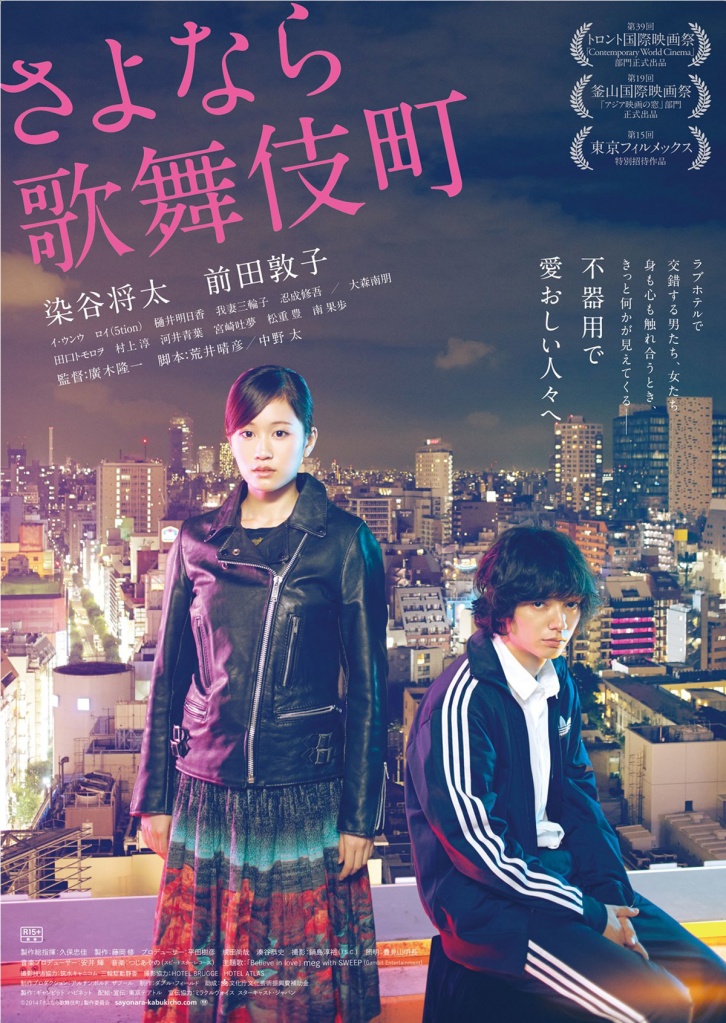
Kabukicho Love Hotel (さよなら歌舞伎町, Ryuichi Hiroki, 2014)

165709_02Kabukicho Love Hotel (さよなら歌舞伎町, Sayonara Kabukicho), to go by its more prosaic English title, is a Runyonesque portrait of Tokyo’s red light district centered around the comings and goings of the Hotel Atlas – an establishment which rents by the hour and takes care not to ask too many questions of its clientele. The real aim of the collection of intersecting stories is more easily seen in the original Japanese title, Sayonara Kabukicho, as the vast majority of our protagonists decide to use today’s chaotic events to finally get out of this dead end town once and for all.

The first couple we meet, Toru and Saya are young and apparently in love though the relationship may have all but run its course. She’s a singer-songwriter chasing her artistic dreams while he longs for a successful career in the hotel industry. He hasn’t told her that far from working at a top hotel in the city, he’s currently slumming it at the Atlas. Our next two hopefuls are a couple of (illegal) Korean migrants – she wants to open a boutique, he a restaurant. She told him she works as a hostess (which he’s not so keen on but it pays well), but she’s a high class call girl well known to the staff at the Atlas. Our third couple are a little older – Satomi works at the Atlas as a cleaner but she has a secret at home in the form of her man, Yasuo, who can’t go outside because the couple is wanted for a violent crime nearly 15 years previously. In fact, in 48hrs the statute of limitations will pass and they can finally get on with their lives but until then Satomi will continue to check the wanted posters on the way to work. That’s not to mention the tale of the teenage runaway and the hard nosed yakuza who wanted to recruit her as a call girl but had a change of heart or the porn shoot on the second floor which stars a lady with an unexpected relationship to one of the hotel’s employees…

It’s all go in Kabukicho. The punters come (ahem), go and leave barely a mark save for the odd tragedy to remind you that this is the place nobody wanted to end up. In fact, the picture Hiroki paints of Kabukicho is the oddly realistic one of someone hovering on its fringes, acknowledging the darkness of the place but refusing to meet its eyes. Everybody is, or was, dreaming of something better – Toru with his job at a five star hotel and a sparkling career in hospitality, Satomi and her romance or the Korean couple who want to make enough money to go home and start again. In short, this isn’t the place you make your life – it’s the one you fall into after you’ve hit rock bottom and promptly want to forget all about after you’ve clawed your way out.

However, while you’re there, you’re invested in the idea of it not being all that bad, really. There’s warmth and humour among the staff at the hotel who treat this pretty much the same as any other job despite its occasional messiness. In fact, the agency for the which the Korean hopeful works is run by an oddly paternalistic “pimp” (this seems far to strong a word somehow) who sits around in an apron and chats, offering comfort and fatherly advice in between dispatching various pretty young girls off to any skeevy guy who wants to rent them for an hour or two.

That’s not to say anyone is happy here though, all anyone’s focussed on is getting out and by the end the majority of them decide it’s just not worth it and the time to leave is now. Kabukicho Love Hotel may be one of Hiroki’s most mainstream efforts (despite its far less frequent than you might expect though frank sexual content) but its overlong running time and its failure to fully unify its disperate ensemble stories make it a slightly flawed one. An interestingly whimsical black comedy that takes a humorous view of Kabukicho’s darkside, Kabukicho Love Hotel is perhaps one it’s fairly easy to check out of well before the end of your stay but does offer a few of its own particular charms over the duration of your visit.


Or perhaps, you can check out any time you like, but you can never leave? We are all just prisoners here, of our own device….

La La La at Rock Bottom (AKA Misono Universe, 味園ユニバース, Nobuhiro Yamashita, 2015)

プリントNobuhiro Yamashita has made something of a career out of championing the underdog and La La La at Rock Bottom (味園ユニバース, Misono Universe) provides yet another foray into the lives of the disposed and degraded. With a lighter touch than some of his previous work, the once again musically inflected film is another testament to the power of redemption and that you can still turn your life around if you only have the courage to take the chance.

The film begins with a young man being released from prison. The guard apologises about the smell of mothballs emanating from the man’s jacket, usually the family bring clean clothes. No family has come for this inmate though – just a couple of cool seeming characters who profess their gratitude for “what you’ve done for us” but the reunion is anything but warm. A little while later the man is unceremoniously bundled into a car and taken off to a quiet place where he is beaten half to death by thugs using baseball bats. After waking up, he stumbles around and eventually chances on a summer festival with a band playing on the mainstage. Zombified, the man grabs the mic and starts singing before promptly collapsing again.

The band’s manager, a young girl, takes the man home whereupon she discovers he’s lost his memory. Giving him the ironic nickname of “Pooch” (Kasumi also has a habit of picking up stray dogs), the band and local villagers quickly “adopt” the confused stranger and let him work at their karaoke rooms and studio whilst coaching him to become their new lead singer. However, as Pooch’s memories start to return it seems that his former life may not have been as tranquil as his laid-back amnesiac persona might suggest.

Like much of Yamashita’s previous work, music plays a central role with the one thing that Pooch remembers from his former life being the lyrics to a particular song and his innate singing talent. The leading role of Pooch himself is played by real life singing star Subaru Shibutani of Kansai based idol band Kanjani Eight who proves himself more than capable of belting out these hard rock/enka tracks as well as being able to imbue Pooch’s amnesiac blankness with his own specific character. He is ably supported by the popular young actress Fumi Nikaido who turns in yet another impressively nuanced performance as the older than her years Kasumi.

The beginning of the film gives us quite an idea of the man Pooch may have been and the kind of life he’s led. As the revelations pile on and Pooch’s memories inevitably return threatening the new life and personality he’s begun to build with the band and the possibility of fulfilling a long abandoned dream of being a singer, his dark side begins to break through and we’re shown a man lost in rage and violence left with nowhere to turn. At the end of the day, “Pooch” has been given a valuable opportunity to start all over again but it requires him to make the choice to do so. Go back to being “Shigeo”, a self hating thug who’s alienated absolutely everyone in his life or choose to become Pooch and earn a second chance to be the man he always wanted to be.

Like Yamshita’s previous film, Tamako in Moratorium, with which it also shares a lot in terms of style, La La La offers no great revelations or technical bells and whistles but revels in the simple pleasure of a tale told well. Like much of his other work, the central message is that it’s never too late to begin again (even if there are bridges which have been burned beyond repair) only that it requires you to make the sometimes scary choice to take a chance on something new. That choice rests with one person but is greatly aided by the support of others and the unusual bond between the two central characters (which stops short of romance) plus the uncompromising faith which Kasumi places in Pooch are some of the greatest joys of the film.

Perhaps not a career best from this still vastly underrated director, La La La at Rock Bottom is nevertheless another beautifully constructed addition to his filmography. Offering an extreme depth of performance from each of its ensemble cast, the film is rich with detail whilst also reflecting Yamashita’s trademark cinematic naturalism. Once again a musical feast for the ears, La La La at Rock Bottom is destined to become one of the director’s best loved films even in a career which has already offered so many as yet undiscovered gems.


100 Yen Love (百円の恋, Masaharu Take, 2014)

165856_02Actress of the moment Sakura Ando steps into the ring, literally, for this tale of plucky underdog beating the odds in unexpected ways. It would be wrong to call 100 Yen Love (百円の恋, Hyaku Yen no Koi) a “boxing movie”, it’s more than half way through the film before the protagonist decides to embark on the surprising career herself and though there are the training sequences and match based set pieces they aren’t the focus of the film. Rather, the plucky underdog comes to the fore as we watch the virtual hikkikomori slacker Ichiko eventually become a force to be reckoned with both in the ring and out.
Ichiko Saito is a 32-year-old woman with no job who still lives at home in her parents’ bento store where she also refuses to help out. With unkempt hair, slobbish pyjamas and a bad attitude, she stays in all day playing video games with her nephew other than running out to the 100 yen store late at night for more cheap and nasty snacks. Her sister has recently moved home after a divorce and to put it plainly, the two do not get on. Finally the mother decides the sister is the one most in need and more or less throws Ichiko out onto the streets. She gets herself a little apartment and a job in the 100 yen store where she’s perved over by a sleazy colleague and amused by a crazy old lady who turns up each night to help herself to the leftover bento.

Ichiko also becomes enamoured with a frequent customer who they nickname “Banana Man” because he just comes in, buys a ridiculous number of bananas, and leaves without saying anything. He’s even more awkward than Ichiko though he seems to kind of like her too. Banana Man is an amateur boxer and eventually ends up staying in Ichiko’s apartment following a rather complicated chain of events. When this too goes wrong, Ichiko decides to try her hand at boxing herself, hoping to make the next set of matches before she passes the age threshold.

We aren’t really given much of a back story for Ichiko, other than that her polar opposite sister thinks she’s too much like their father who also seems to be a mildly depressed slacker only now in early old age. Her mother is at the end of her tether and her sister probably just has problems of her own but at any rate does not come across as a particularly sensitive or sympathetic person. Getting kicked out at this late stage might actually be the best thing for Ichiko though it’s undoubtedly a big adjustment with her family offering nothing more than possible financial support.

Working in the 100 yen store isn’t so bad but it doesn’t really suit Ichiko with her isolated shyness and lack of work experience. Mind you, it seems like it doesn’t suit anyone very well as her manager quits right away and her only co-worker is a lecherous criminal who literally will not stop talking or take no for an answer. Ichiko’s only real relationship is with Banana Man but even this is strange with Ichiko becoming infatuated and coming on too strong for the rather immature amateur boxer who’s just hit the end of his career. If Ichiko is going to get anywhere she’ll have to do it on her own and on her own terms, no one is going to help her or be on hand to offer any kind of life advice.

That is, until she starts boxing where she gets some coaching, if only inside the ring. The gloves give her a purpose, in getting to a real match before the age limit passes (it’s 32 and she is already 32) she finally has something concrete to work towards and strive for. She just wants to win, once, after all the awful and humiliating things that have happened to her, she just wants to hit back. Even if she falls at the final hurdle, these seemingly small elements have caused a sea change within her. No longer holed up at home, too fearful to engage with anything or anyone, Ichiko has her self respect back and can truly stand on her own two feet.

Indeed, the film might well be called sympathy for the loser – what attracts Ichiko to the sport to begin with is the mini shoulder hug at the end between the victorious and the defeated. With the idea that it’s OK to lose, there are no hard feelings between athletes and even a mutual respect for those who’ve done their best even if they didn’t quite make it, this moment of catharsis seems to give Ichiko the connection she’s been craving. However, the film’s ending is a little more ambiguous and where this rapid transformation of the “100 yen kind of girl” might take her may be harder to chart.


100 Yen Love is Japan’s submission for the 2016 Academy Awards.

Princess Jellyfish (海月姫, Taisuke Kawamura, 2014)

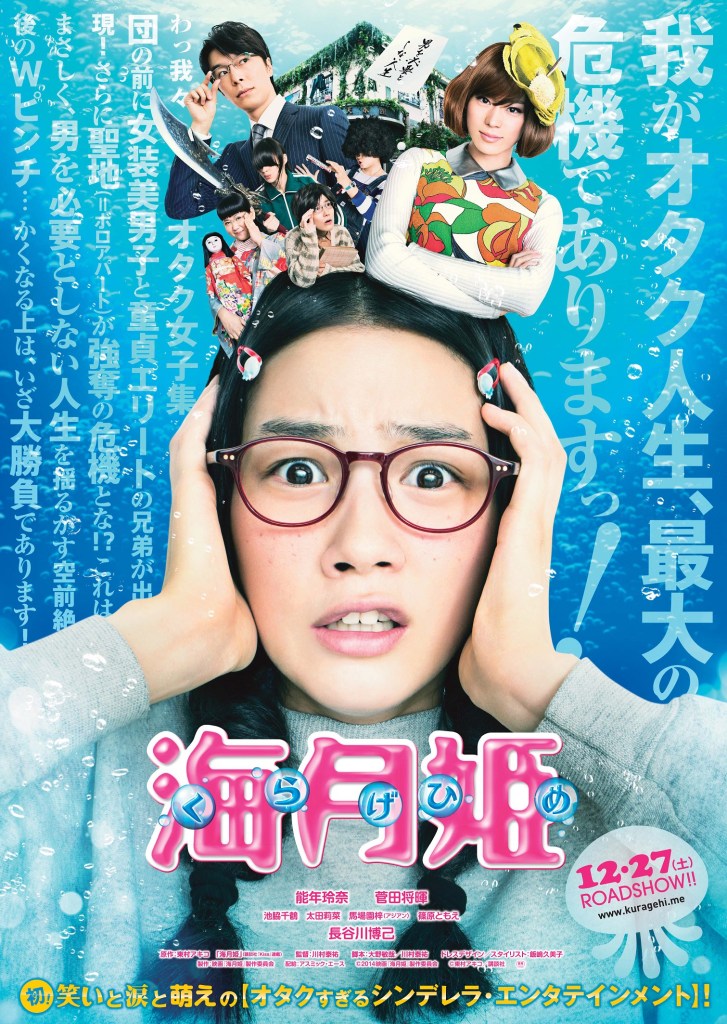
b7dec6a631e5ad87baf2ff601d6b4872Originating as an ongoing manga series by Akiko Higashimura which was also later adapted into a popular TV anime, Princess Jellyfish adopts a slightly unusual focus as it homes in on the sometimes underrepresented female otaku.

Tsukimi is an extremely awkward young woman who has an all encompassing obsession with jellyfish. Luckily for her, she’s managed to find a group of likeminded women of a similar age to room with. That is, they aren’t all as crazy about jellyfish as she is, but they all have their particular order of special interest, are fairly socially awkward with an extreme fear of “fashionable” women, and no formal form of employment. At the Amamizukan boarding house, the girls can all enjoy their otaku lives together (well, kind of separately) and, crucially there are no boys allowed!

However, one day Tsukimi finds herself at a crisis point when she notices one of the jellyfish she likes to visit at a nearby pet shop is in danger! The idiot shop boy has only gone and put a Moon Jelly in with a Spotted Jelly – does he just not know how dangerous that is?! Tsukimi will need to act fast to save her friend, but the guy behind the counter is a clueless pretty boy – absolutely the worst case scenario for Tsukimi. Despite her extreme anxiety she valiantly marches into the shop yet her confused mini lecture on jellyfish keeping only succeeds in convincing the shop boy that she’s some kind of nutcase. On being expelled from the shop, Tsukimi finds herself at the feet of an extremely glamorous looking woman who comes to her defence. What kind of strange parallel world is this? Tsukimi’s universe is about to undergo a sea change!

Though based on a manga and intended as a comedy, crucially, Princess Jellyfish casts its series of “different” heroines (and hero) in a favourable light – they are never the butt of the joke and sympathy is always placed with those who experience difficulty in their lives because they feel themselves to be different. Each of the girls is so deeply involved in their own particular obsession that they find it difficult to fit into the regular world and particularly to cope with conventional femininity. Tsukimi herself finds it particularly difficult to talk to men and the fact that no men are permitted at Amamizukan makes it clear that she is not alone in her fears.

This brings us to her new friend who is apparently a fashionable young woman – the sort who would never usually be seen dead talking to the likes of Tsukimi. However, this one not only acknowledges Tsukimi’s presence as another human of equal standing, but even lends her confidence and power as an attractive woman to Tsukimi’s predicament. There is, of course, more to this mysterious saviour than there might seem at first sight. In addition to being a fabulously well dressed lady, Kuronosuke is also a boy. This is something of a problem for Tsukimi as she only realises after letting him stay over at the strictly no boys allowed residence. The ruse also has to be maintained a little longer when Kuronosuke decides to stick around, eventually becoming known as “Kuroko”.

The situation intensifies as the girls’ secret haven comes under threat when a gang of ruthless developers want to buy up most of the town and redevelop the area. The group home is owned by one of the girl’s mothers who is also an otaku only her obsession is with top Korean actor Lee Byung-hun and she’s skipped off to Korea to be able to stalk him better. There’s no telling what she might do if it brings her closer to the object of her affections and things are looking a little desperate. Eventually a possible solution is found which plays to everyone’s strengths and offers the faintest glimmers of hope for the girls (and boy!) of Amamizukan.

Princess Jellyfish is the ultimate tale of acceptance, both in personal and societal terms. The residents of Amamizukan may be a little different, but that doesn’t mean they have nothing to offer the world and there’s no need for themselves to maintain a position of self imposed exile if the only reason is a belief in their own inferiority. This is a lesson taught to them by the exuberant rich boy and politician’s son with a traumatic past of his own, Kuronosuke. Truly unafraid to be who he is, Kuronosuke teaches the girl’s that almost any obstacle can be overcome with a combination of forthrightness and sincerity.

Though it runs a little long and gives in to some very over the top performances and melodramatic plotting, Princess Jellyfish is an enjoyably offbeat manga inspired tale. Very much not interested in demonising anyone other than those who seek to suppress individuality, it’s a cheerful celebration of the value to be found in difference offering plenty of laughter and warmth along the way. Perhaps not for those who prefer their cinematic experiences on the subtle side, Princess Jellyfish is nevertheless a fun filled film which carries its message of universal acceptance right into the closing credits.


The anime adaptation of this is actually really fun too.