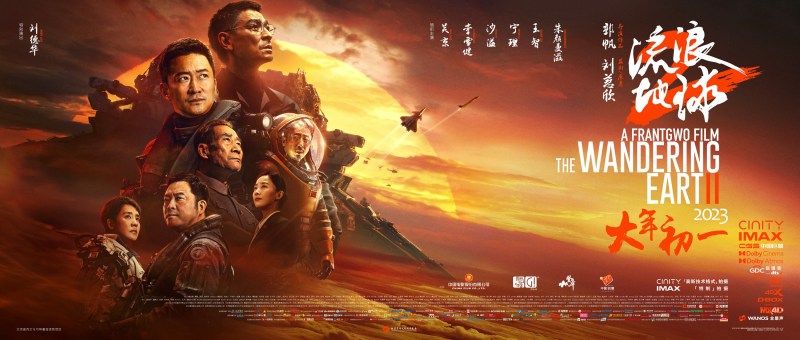
The Wandering Earth II (流浪地球2, Frant Gwo, 2023)

Back in what now seems like another world, Frant Gwo’s The Wandering Earth became a Lunar New Year box office smash and was described by some as China’s first foray into big budget sci-fi. Adapted from a novel by Liu Cixin, the film was much about fathers and sons as it was about sacrifice and solidarity in the face of oncoming apocalypse all of which are quite traditional New Year themes. Arriving four years later, The Wandering Earth II (流浪地球2, liúlàng dìqiú 2) largely drops overt references to the Spring festival bar the repeated motif of journeying home, but does once again stress the importance of international cooperation in safeguarding the future of the planet.

Then again, it seems that many feel it’s not a good use of time or resources to address a problem that will occur in a hundred years when they are long dead. A prequel to the first film, Wandering Earth II begins in the early days of the Moving Mountain Project which is the plan to push the Earth onto a different orbit to escape the sun’s eventual implosion. Given its enormous expense and the reality that much of the population will simply be left to die, the majority of the public back the rival Digital Life program in which humanity would be saved by relocating to a new virtual reality. Where this virtual reality is supposed to be stored is not exactly clear if there is no Earth for it to exist on, but it’s clear that some consider the possibilities of the digital existence preferable to allowing millions to die in the tsunamis which will engulf the Earth as it uncouples from the moon’s gravitational pull. 

Chief among them is software engineer Tu (Andy Lau Tak-wah) who is griefstricken by the loss of his wife and child in a traffic accident and has been secretly working on creating a fully fledged AI simulacrum of his daughter Yaya. He tells his more practically minded colleague Ma (Ning Li) that he doesn’t have the right to define what is “real” while eventually jeopardising the Moving Mountain Project by prioritising his desire to save Yaya over saving the Earth and eventually creating the AI system that will become Moss, a possibly dangerous entity which decides the best way to save humanity is to destroy mankind. 

The first film’s hero, Liu Peiqiang (Wu Jing), meanwhile is a rookie astronaut caught up in a terrorist incident carried out by militant opponents of the Moving Mountain project while enjoying an incongruously goofy courtship with fellow astronaut and future wife, Duoduo (Wang Zhi). This time around, he’s a dutiful son rather than conflicted father serving alongside his own dad who eventually becomes an example of intergenerational sacrifice as the old begin to make way for the young whose responsibility it now is to preserve the Earth. A nervous young aid serving the current premier later takes over the reigns and finds herself giving the same advice to a similarly nervous young man as they prepare to carry on the Wandering Earth project despite knowing that it will take thousands of years to complete. 

The ultimate message is therefore to choose hope, as Peiqiang later does striving to save the world even if it all turns out to be hopeless, rather than giving up and resigning oneself to one’s fate as many suggest doing when faced with the potential failure of their mission. As in the first film, the plan requires cooperation between nations and this time even more so as world powers must surrender their nuclear weapons to help blow up the moon. The Chinese premier looks forward to a day when governments can work on solving future problems rather than preparing for war, but then in an echo of the ongoing climate crisis some just don’t seem to see the point in dealing with something that won’t happen for a hundred years despite likely being among the first to complain no one did anything sooner when it finally affects them. Gwo adds a little whimsy in the technically pre-apocalypse setting with charming details such as Tu’s warm relationship with his dog-like robot helper and the general goofiness of Peiqiang’s attempt to court Duoduo while improving on the already polished visuals of the first film through several high impact set pieces but finally returns to its messages of hope and solidarity perhaps intended for a weary world attempting to find its own way out of a period of protracted strife.


The Wandering Earth II is in UK cinemas now courtesy of CineAsia.

International trailer (English voice over, Simplified Chinese / English subtitles)

Onlookers (Kimi Takesue, 2023)

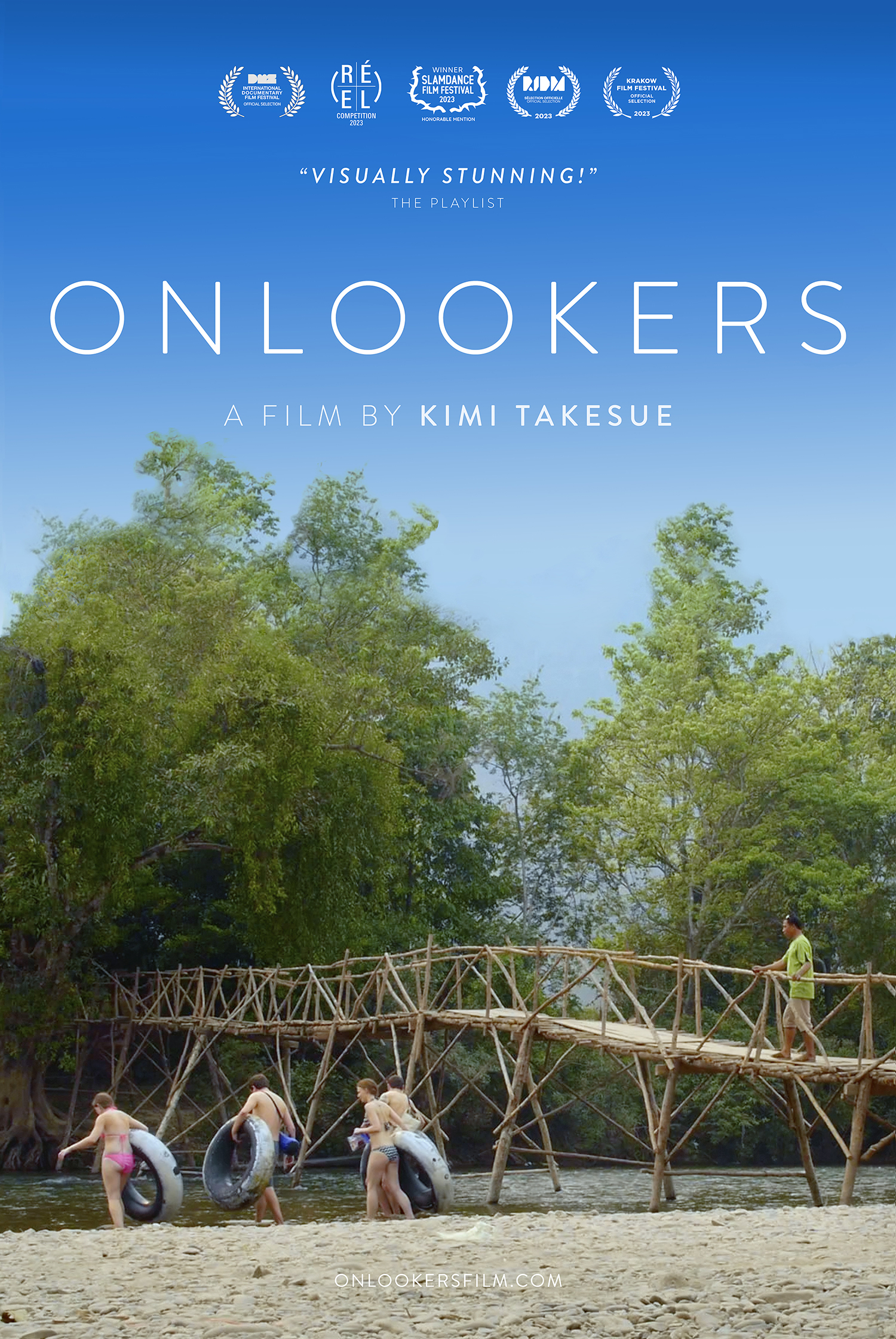
Onlookers is a strange word. It implies passivity, if also perhaps indifference, but nevertheless invites a question. Who exactly is looking at what or is the onlooker themselves also a spectacle of attention? The opening shots of Kimi Takesue’s Laotian documentary find a row of people waiting by the side of a road. A young man stares intently at his phone, as does an older woman two stools over, while an old lady’s eyes idly flicker as she watches the passing traffic. Another woman sits further away with a dog, facing an entirely different direction. 

Of course, we are also onlookers, watching the old lady as she watches if not exactly us then perhaps our ghost as manifested in the camera. In a sense the landscape is also onlooker, a passive presence often strangely forgotten by the tourists who pass through the frames throughout the rest of the film. In the early scenes, more local sightseers can be seen visiting temples and other landmarks, like others paying more attention to getting the perfect photographs rather than immersing themselves in the experience of actually being there. 

The temples seem to loom over them, onlookers too, passively observing their conduct which is not always respectful. “Don’t smoke weed here” a large sign pleads in English while large groups of tourists congregate at a swimming hole. In an elegantly composed shot of the mountains, most of the tourists are facing the wrong direction, quite literally bending over backwards to get the perfect selfie while otherwise oblivious to the beauty all around them. In a small waiting area near a shop offering tube swimming tours, the TV seems to be tuned in to ancient episodes of Friends while potential customers haggle with the driver leaving the young boy who accompanies him to wander out into the road. 

Even religious practice seems to have become a tourist attraction, gaggles of sightseers crowding round a small hut where monks ring bells, taking turns banging gongs themselves. Takesue contrasts these acts of accidental voyeurism with the local people simply trying to go about their business, a row of women again siting on the roadway though this time to offer alms to a seemingly endless parade of monks in a near eternal loop. Much of the local economy does seem to revolve around the tourist trade, the monk’s parade also attracting is share of onlookers, while a woman washes a dog in the street and others try to get on with selling their goods before Takesue abruptly switches to scenes of schoolchildren on scooters or filling plastic water bottles from the river. 

Then again, perhaps the real onlookers are the bemused cows fighting over tufts of grass as they wander onto temple grounds. The tourist trade may also be having a negative effect on the local environment, drowning out the sounds of the nature and disrupting the natural tranquility of the area while the tourists often appear indifferent to the world around them as if it were a mere playground and the people themselves little more than onlookers observing them from the outside. Occasionally Takesue cuts to scenes of nature without any people in them, bathing in the natural beauty of the landscape unsullied by human intervention as if to remind us of the various ways in which consumerism eats away at the world in which we live if also hinting at our own desire, as onlookers, to paint these scenes with a kind of pastoral innocence coupled with an otherwise uncomfortable exoticism. 

The film ends as it began, with another roadway only this time empty save for a dog who turns around to look towards the departed people before a second dog enters the frame and barks at the camera as he passes through as if to ask where everyone’s going or perhaps what they were doing here in the first place. A gentle meditation on the nature of “travel” and the disruptive qualities of “tourism”, Takesue’s elegantly lensed images seem to argue for a more active reflection on the world and our place within it rather than remaining a perpetual onlooker observing without thought or feeling.


Onlookers had its world premiere as part of Slamdance 2023.

Trailer

Lighting Up the Stars (人生大事, Liu Jiangjiang, 2022)

An immature young man recently released from prison for assaulting his girlfriend’s lover finally begins to grow up when unexpectedly saddled with looking after a grumpy little girl otherwise unwanted by her remaining family members in Liu Jiangjian’s feel good tearjerker, Lighting Up the Stars (人生大事, Rénshēng Dàshì). As much a tale of finding an accommodation with death and learning to move on as it is of the joys of forged families and unexpected connections, Liu’s drama is as the Chinese title suggests very much about the big things and what it takes to realise what they are. 

At this point in his life, San (Zhu Yilong) hasn’t been giving much thought towards the big things largely because he is consumed by resentment and a sense of inadequacy. He’s keen on getting back together with old girlfriend Xi (Janice Wu Qian) but sends her worryingly controlling voice notes and later becomes violent when she tries to break up with him before discovering that she is pregnant and plans to marry the guy he went to prison for beating up. “I can’t see you becoming a good father” she explains, regarding him as too immature to support the family she is keen to start. San is stung by the suggestion, as he is by his elderly father’s constant needling and refusal to hand the family funeral business over to him, but also has to concede she has a point. 

Nevertheless, there is a kind of tenderness to him as seen in his gentle washing of the body of an elderly woman still lying on the bed where she died while her son and his incredibly callous wife try to organise an express funeral so they can take their spoilt son to Beijing to participate in an academic competition. Meanwhile, little Xiaowen (Yang Enyou) watches while hiding in a cupboard before bursting out and demanding to know what they’ve done with her grandma. It seems that no one has taken the time to explain to Xiaowen exactly what’s happened or what’s going to happen to her now seeing as her grandmother had been raising her. Charging around like Nezha pointing her spear at everyone she meets, Xiaowen sets off to rescue grandma by chasing San’s van and eventually ending up at the funeral parlour which she then refuses to leave. Her uncle comes to fetch her but shockingly decides to leave her there with San and his two friends, asking them to look after her until they get back despite having absolutely no idea if they are suitable people to be looking after a little girl. 

These tears in the fabric of the traditional family are in some ways a result of a contemporary society. Xiaowen’s aunt point blank refuses to have her, insisting that she doesn’t want to expend resources on someone else’s child while blaming her husband for paying too much attention to his niece and not enough to their bratty son who lets them all down by humiliatingly failing the Beijing exam. Her hyperfocus is a reflection of the One Child Policy and rising consumerism as she seeks to express her status as a mother through her son’s success while simultaneously ruining their familial relationships with her constant nagging and hard-nosed practicality. Xiaowen’s henpecked uncle simply goes along with it for a quiet life, obviously very upset by his mother’s death but unable to defy his wife. San meanwhile is at odds with his father and sister who think he’s no good, will never be able to settle down and live a conventional life, and is incapable of accepting the responsibility of the family business. San may think some of this too, living with a sense of inadequacy feeling as if he doesn’t measure up to his absent elder brother, while seemingly floundering in his attempts to make something of himself. 

Through his relationship with Xiaowen he finally begins to come into his own in accepting the responsibility of fatherhood, caring for her both physically and emotionally while repairing his fracturing relationship with his own father and coming to terms with the past. He teaches Xiaowen about death and how to accept it, but also reminds her that her grandmother’s never really gone and will always be with her. Finally, San begins to think about the big things but about the small things too, planting stars in the sky as Xiaowen puts it as they prepare to get on with the business of living even in the presence of death.


Lighting Up the Stars streams for free in the US and Canada Jan. 22 to Feb. 5 as part of Asian Pop-Up Cinema’s Lunar New Year celebration.

International trailer (Simplified Chinese, English subitles)

Enma-san (えんまさん, Tomoki Suzuki, 2022)

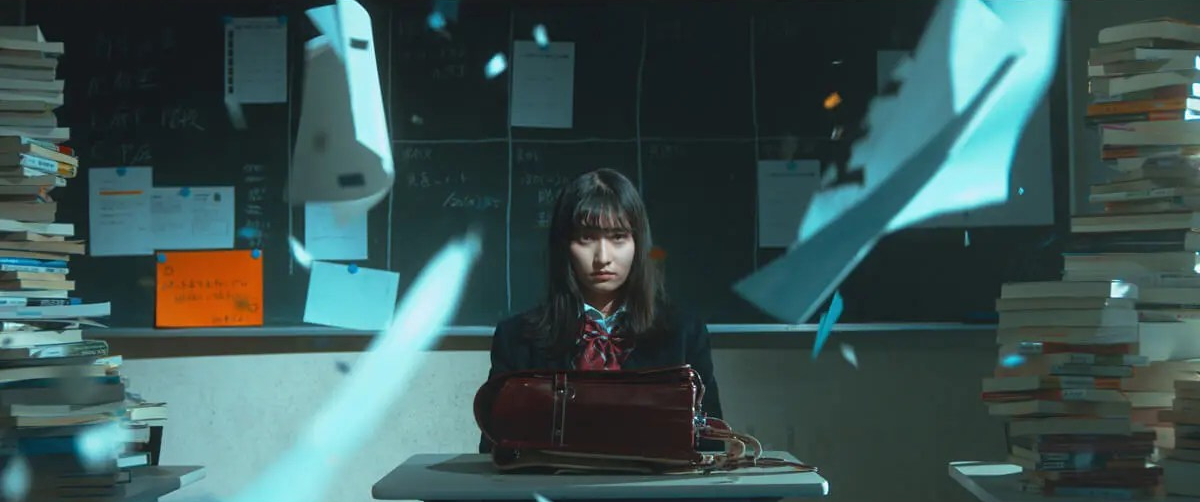
A young woman with the ability to see people’s true thoughts thanks to a magic mirror becomes consumed with hatred for the world’s duplicity but finds unexpected connection with a girl who never lies in the stylish debut feature from Tomoki Suzuki, Enma-san (えんまさん). Named for the Japanese god of hell, the film finds the emo heroine looking for an escape from a nihilistic existence in which nothing and no one can be trusted but rather than salvation finding only further despair in realising even she may not be exempt from the curse. 

17-year-old Ema lives alone with her mother and mostly keeps to herself at school. Sometimes people try to befriend her and she concedes they’re kind, but there’re also “liars” mostly trying out of pity. Since coming into possession of a mirror which looks just like that of the great god Enma, she’s been confronted by the gap between what people say and what they really think unable to put up with such moral duplicity. But then she comes across a young woman who looks perfectly normal in the usually warped vision of her mirror. It is as she says love at first sight. Realising Seira is being badly bullied by her classmates, Ema resolves to do something about it, not least because she thinks people who are honest should be rewarded and Seira doesn’t deserve to be treated so poorly. 

Indeed, with her strong sense of justice, Ema comes to take on the form of Lord Enma himself vowing to punish and eradicate liars starting with Seira’s bullies. Yet in meeting her there’s something in Seira which seems to soften her resolve. Though she had shunned the human world, Ema gradually begins to warm up to it while spending time with Seira who perhaps isn’t quite as honest as she’s made out to be but has managed to find an accommodation with an acceptable level of deception. Ema refuses to wear makeup because it’s like pretending to be someone else while becoming anxious about the idea of touching up the photos they had taken in a sticker booth at the arcade because it means they’re altering the truth of the image. Seira meanwhile corrects her pointing out that her makeup is barely noticeable, while even if the photo is inauthentic the memory it represents is not. She even convinces her to eat a slice of cake at a cafe, a place she ordinarily wouldn’t go and food she wouldn’t usually eat as it would be made by liars. 

Then again there’s a healthy amount of self-deception going on with Ema as she finds herself sinking into the persona of Lord Enma, threatening to cut out people’s tongues and eventually embarking on a dark and twisted path towards nihilistic violence disguised as justice. But then not quite everything is as she assumes it to be, later discovering Seira may not be quite as honest as she first thought and has troubles of her own with overbearing perfectionist parents whose approval she is so desperate to gain that she’s even willing to cheat. The connection between the two women, be it friendship or something more, is genuine yet they are to some degree on opposing sides while the tension inside Ema threatens to turn her into that which she most hates in the ambivalence of her emotions. 

Divided into chapters through a series of elegantly designed title cards, Suzuki’s cool colour palette bears out the loneliness and resentment of Ema’s nihilistic world view brightening only when she’s around Seira, while occasionally shifting into Ema’s mirror vision in which the world becomes blurry amid the unreality of so many liars. Yet as she’s told towards the end by a sympathetic policewoman lies are a normal part of human nature and may even be essential to a well functioning society, the tragedy being that Ema is not aware of her self-delusion until fully forced to face herself and the confusion of her feelings. Still for a few brief moments she discovered how “comfortable and pleasant” it could be trusting other people even if it turns out somewhat ironically that her trust, if not perhaps her faith, may have been mistaken. 


Enma-san screened as part of the 2022 Yubari International Fantastic Film Festival.

Original trailer (no subtitles)

Hong Kong Family (過時·過節, Eric Tsang Hing-Weng, 2022)

“It doesn’t matter how the food is cooked. Let’s just enjoy it in the presence of each other and not think too much” a regretful grandmother advises giving perhaps the best advice for how to survive an awkward family gathering in Eric Tsang Hing-Weng’s autobiographically inspired familial melodrama Hong Kong Family (過時·過節). Coloured with the shades of exile, Tsang’s melancholy exploration of a fragmenting family unit ponders the limits of communication between those who should be closest along with the lingering resentments and toxic legacies that poison otherwise loving relationships. 

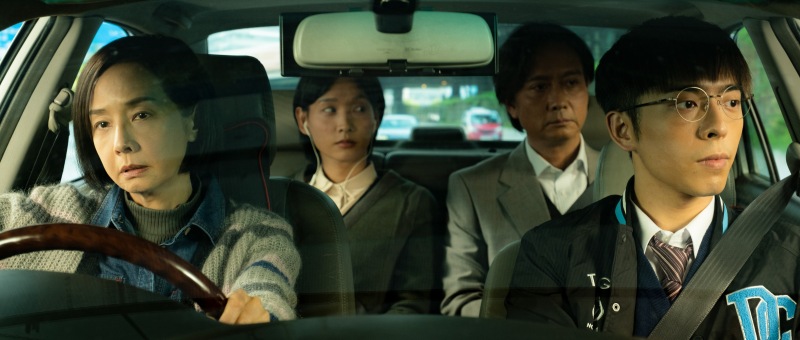
An opening sequence set eight years before the main action lays bare the tension between middle-aged housewife Ling (Teresa Mo Sun-Kwan) and her mild-mannered husband Chun (Tse Kwan-Ho) who sits silently in the back of the family car as she berates him for having recently lost his job and been unable to find another which is particularly inconvenient as they’ve just taken out a mortgage and bought a flat. 17-year-old Yeung (Edan Lui) sitting in the front passenger seat tries to keep the peace but refers to his parents as Mr & Mrs Chan, while his older sister, 20-year-old Ki (Hedwig Tam Sin-Yin), pretends not to hear escaping from reality by listening to music on her headphones. When they finally arrive at her mother’s home, a well appointed detached house out in the country, they are greeted by Ling’s brother Ming who has already fallen out with his mother (Alice Fung So-Po) in part because it seems she doesn’t like his wife who has declined to attend this Winter Solstice dinner. When his mother suspects him of stealing money, Ming angrily storms out vowing never to contact her again and provoking a similar row between Ling and Chun in which she asks for a divorce. Pushed past his limit, Chun starts hacking at a chair with a meat cleaver and eventually strikes peacemaker Yeung who then abruptly severs ties with his dad and moves out on his own. 

Yet eight years later it’s Yeung who seems to be looking for a way back to his family only he doesn’t know how to find it. He’s been working on a virtual reality “game” that would allow users to interact with AI versions of absent friends and relatives, helping them to communicate rather than offering an escape from reality though that may be in a sense what Yeung is doing in interacting with a simulacrum of his father rather than facing him directly. His parents did not divorce, but are clearly unhappy. Ling has found another simulacrum for familial life working as a housekeeper for a wealthy single father, while Chun is driving a taxi and secretly planning to start again by leaving for Mainland China and a job in a company set up by an old friend. According to grandma it seems their marriage may have been semi-arranged (by her) and years of trying have seemingly not improved their inability to communicate with each other. 

Ki, meanwhile, has been married and divorced since the fateful Winter Solstice dinner over which grandma kept trying to marry her off explaining that she married a random man to escape her family only to boomerang back two years later when it didn’t work out. She too is lying to her parents, pretending to go to work every day despite having lost her job and later drifting into an unexpected romance with a free spirited nomad from Malaysia who jolts her out of her sense of inertia in telling her to try to be true to herself. The return of Ming’s now teenage daughter Joy (Angela Yuen Lai-Lam) from exile in England offers the opportunity to repair their fragmenting bonds, but it seems some wounds run too deep to ever be fully healed. Chun is pulled towards the Mainland just as Uncle Ming had been pulled towards England, while Yeung just wants to go “home” but doesn’t know how and Ling frantically tries to preserve a sense of family just as Ki seems to have made her peace to go wherever her heart takes her.

That might be one reason that there are only women around the dinner table at another Winter Solstice, for some the first, each trying to salvage something and try to get along if only in a superficial show of togetherness while the men attempt to talk through their troubles agreeing to head towards the dinner table but in the end walking in circles. The elegantly lensed final scene may suggest that the family is in someways trapped by its history yet destined to scatter but echoes in its ambiguity offering the distant hope of a far off reconciliation but little promise of its arrival. 


Hong Kong Family is in UK cinemas now courtesy of Haven Productions.

Original trailer (Traditional Chinese / English subtitles)
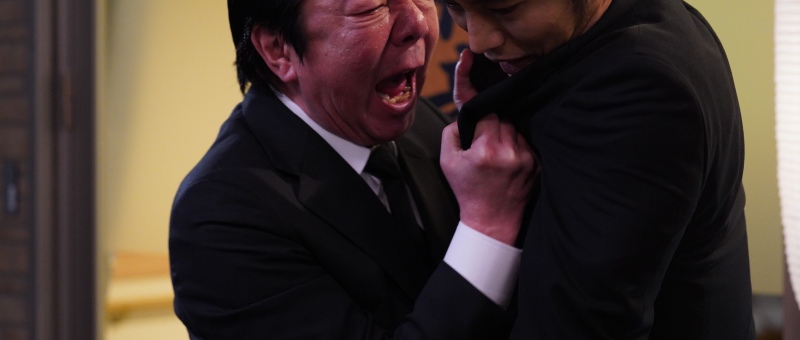
A Hundred Flowers (百花, Genki Kawamura, 2022)

An expectant father finds himself confronted with paternal anxiety and past trauma on learning that his mother has been diagnosed with Alzheimer’s in Genki Kawamura’s adaptation of his own novel, A Hundred Flowers (百花, Hyakka). A prolific film producer behind such hits as Lee Sang-il’s Rage and Tetsuya Nakashima’s Confessions, Kawamura also penned the international bestseller If Cats Disappeared from the World which was later adapted into a film starring Takeru Satoh and here makes his directorial debut with a semi-autobiographical exploration of memory and forgetting. 

Kawamura neatly signals his central concern in the opening scenes as Yuriko (Mieko Harada) seems to become unstuck in time, a withered dandelion on her kitchen table as she flits between swapping it for a new one and playing the piano eventually watching herself from an alternate temporal space. Her grown-up son Izumi (Masaki Suda) seems surprised to witness her decline on a visit home, running panicked through the streets looking for her only to find his mother sitting on the swings at the park muttering about “half fireworks”. When he approaches her she seems to mistake him for someone else, Izumi rejecting her too intimate hug and later making his exit earlier than expected, leaving the New Year food Yuriko has prepared uneaten and making an excuse about an emergency at work. 

The chase through the streets may have awakened traumatic memories in Izumi too, forcing him to remember another time as a child he came home and found his mother gone. Disappearing again, Yuriko is found at his old school, guided by a memory of a parents day at which Izumi read out sections of Osamu Dazai’s Run, Melos!, a story of a man running back to the city to save his friend before he is executed in his place. Thrown back into the past, Yuriko later berates the grown Izumi for his habit of wandering off, suggesting that he gets lost on purpose so that she’ll look for him which is perhaps what Yuriko is doing longing for her son to understand and forgive her for an act of childhood betrayal. Kawamura often places the camera directly behind Izumi’s head, following him as he chases the mother who he fears has forgotten him while he feels foolish in his inability to forget her despite the depth of his resentment. 

Ironically enough, Izumi and his heavily pregnant wife Kaori (Masami Nagasawa) both work at a music company developing a virtual idol whom they explain has been fed thousands of memories as data in order to improve her AI but ends up oddly soulless as if these fragments of moments in time are meaningless in isolation. His friend quips that maybe they should have given the AI the ability to forget, as if that would make it more “human” and relatable. Izumi is pretty sure he hasn’t forgotten anything important, but memory remakes itself every day and is in some ways selective. Though he holds his mother at arm’s length, he begins to put the past behind him in learning to forgive her and in the process regaining the happy memories of his earlier childhood that his trauma had taken from him. 

The flowers so closely associated with Yuriko who is often dressed in a bright yellow are perhaps another allusion to Dazai and his insistance on embracing the gift of a single dandelion as a kind of metaphor for the frustrated love between mother and son, while the half fireworks they later see also resemble a dandelion dispersing mimicking the continual scattering of Yuriko’s memories. Izumi remarks that it’s like her memories are being stolen while charting her decline as a depletion of her identity until there is nothing left of her at all, the various boxes in her apartment standing in for blocks of data slowly being shed. Shifting between the perspectives of mother and son who are each in some way blind to the other, Kawamura touches on the tactile quality of memory as one moment sparks another while for Yuriko time proceeds on a maddening loop of overlapping incidents that robs of her present, past, and future in equal measure. The irony may be that only in losing his mother does Izumi begin to find her again, searching for her within the halls of his own memory and rediscovering a sense of himself as a child that he had long forgotten. 


A Hundred Flowers screened as part of this year’s London East Asia Film Festival 

International trailer (English subtitles)

Intolerance (空白, Keisuke Yoshida, 2021)

At times of tragedy it may be natural to look for someone to blame, as if being able to pin all of this pain and anger on a single source would somehow help you to accept it. But in other ways tragedy is just a confluence of circumstances that are either everyone’s fault or no one’s. How far back can you really trace the blame? There would be no end it. That’s perhaps the conclusion that the protagonists of Keisuke Yoshida’s Intolerance (空白, Kuhaku) eventually come to, realising that their attempts to blame others are often born of a desire to deny their own responsibility or else to protect something else they fear losing. 

At least that’s how it is for grizzled fisherman Mitsuru (Arata Furuta), a man well liked by no one. A rude and violent bully, he terrorises all around him not least his teenage daughter Kanon (Aoi Ito) who is meek and passive with a slightly ethereal quality as if she’s learned that blending into the background is the best way to protect herself. Stopping in to a local convenience store on her way home from school, she’s accosted by resentful store manager Naoto (Tori Matsuzaka) who grabs her by the arm and accuses her of shoplifting nail polish. At some point, Kanon panics and bolts out of the store. Naoto chases her along a busy highway until she suddenly darts out into the road trying to get away from him and is hit first by a car driven by a young woman and then by a truck travelling in the opposite direction. Despite his gruff exterior, Mitsuru is quite clearly destroyed by his daughter’s death but becomes fixated on clearing her name of the shoplifting, insisting that he never saw her wear any makeup and that Naoto is to blame for her death in acting with such a heavy hand. 

Of course, it doesn’t occur to Mitsuru that Kanon may have worn makeup in secret and made sure to keep it from him knowing how he’d likely react. Likewise, perhaps she ran from the store because Naoto would have called her father and she was frightened of what he’d do if he found out she was caught pilfering, and pilfering nail polish at that. He remembers that she wanted to talk to him about something to do with school the night before she died but he didn’t listen, assuming she must have been being bullied and was forced to steal the nail polish only to hear that no one at school really even remembers her. She was a just a vague presence they can’t even quite identify. Her teacher meanwhile begins to reproach herself, realising that she failed in her duty of care repeatedly shouting at Kanon that she had “no motivation” rather than trying to help her find some or to get along in her own way, let alone figuring out what caused her to behave the way she did or if there were problems at home. Sick of Mitsuru’s belligerence the school finally set him on the new target of Naoto who was once accused of molesting a teenage girl he accused of shoplifting. 

Like Kanon, Naoto is a slightly hollow presence who also had a strained relationship with his father. As he lay dying, Naoto failed to answer his calls because he was playing pachinko and felt ashamed, afraid of another lecture from his dad about wasting his life on gambling. He struggles with his role in Kanon’s death, on the one hand guilty feeling he overreacted and inadvertently caused her to stray into harm’s way while otherwise resentful, justifying himself that it’s only natural for a storeowner to chase a shoplifter down the street. Both he and Mitsuru soon fall foul of a media culture that likes sympathetic victims and heartless villains, the media shocked by Mitsuru’s boorish behaviour but more so by Naoto’s callous indifference trimming an otherwise nuanced statement to imply that he feels his supermarket is the real victim as customers stay away or else issue complaints about their obviously heavy-handed shoplifter policy. 

“Imposing your own views on others is nothing more than torture” Naoto tells a well-meaning middle aged woman whose narcissistic cheerfulness is a neat mirror of Mitsuru’s intimidating aggression. Aggressively mothered by Kusakabe (Shinobu Terajima), Naoto carries an additional burden of guilt in realising he’s lost the store his father left to him, but she embarks on a tasteless “real victim” campaign insisting they did nothing wrong and it’s all Kanon’s fault for stealing in the first place. Kusakabe can’t bear to lose the store because it seems there’s not much else in her life. The film’s Japanese title translates as “blank” or “void” and it is indeed a void that Kusakabe is trying to fill in needing to feel needed by centring herself in her various volunteer activities such as working at a soup kitchen in addition to her crusade to save the store. 

It’s this giant abyss of grief and guilt which pulls each of them towards the edge, but in the end there’s really no way to apportion blame. The poor woman who first knocked Kanon down is completely undone by the experience though it really wasn’t her fault, repeatedly approaching Mitsuru asking for his forgiveness only to be cruelly rebuffed. It’s her mother’s (Reiko Kataoka) quiet show of dignity which stands in such stark contrast to his own white hot rage that finally forces him to realise the destructive quality of his intimidating behaviour, accepting his responsibility in his daughter’s death while understanding that in his fierce desire to control he robbed himself of the ability to know her. Really you can’t say whose fault it was, Mitsuru’s for the fear he instilled into his daughter, Naoto’s for his insecurity and misplaced zeal in hunting down a thief, the drivers’ for failing to brake, Kanon’s mother’s (Tomoko Tabata) for remarrying and having another child, the teacher’s for making Kanon feel useless, the other kids’ for rejecting her, or Kanon’s own for darting out into the road. For each of those there are a hundred other branches. There would be no end to it. But then, the strange thing is that Kanon shares her name with Buddhist deity of mercy, Mitsuru beginning to soften now willing to offer an apology where it’s due and to bear his own degree of guilt if not yet entirely able to forgive. In any case, ending in bright sunshine, Yoshida concludes with a return of the gaze between father and daughter that suggests forgiveness may indeed have arrived. 


Intolerance screened as part of this year’s Camera Japan

Original trailer (English subtitles)

Eternally Younger Than Those Idiots (君は永遠にそいつらより若い, Ryuhei Yoshino, 2021)

An insecure young woman struggles to assume her place in the world while preparing to leave the aimless security of college life for an uncertain adulthood in Ryuhei Yoshino’s empathetic social drama, Eternally Younger Than Those Idiots (君は永遠にそいつらより若い, Kimi wa Eien ni Soitsura yori Wakai). Adapted from the novel by Kikuko Tsumura, Yoshino’s film has its share of quirky humour but seems to be overshadowed by a lingering darkness in which there is only constant suffering tempered by a longing for recognition which often goes unanswered.

Horigai (Yui Sakuma) is one of the lucky ones in that she’s already locked in a job for after graduation as a children’s social worker back in her hometown. After making a speech at a uni party, however, she’s challenged by a rude fellow student who calls her out for her arrogance in thinking she has the right to interfere in people’s lives. He has perhaps touched a nerve. Though it’s a job she’s always wanted, Horigai is worried that she isn’t up to it and won’t be able to help anyone in part because she feels herself to be somehow different from those around her and lacking the skills to see what everybody else just naturally sees. 

Her sense of inadequacy is thrown into relief by a chance meeting at a party with a soulful fellow student who has just been released after getting arrested for suspected kidnapping having allowed a little boy neglected by his parents to stay in his apartment. Though she bonds with him, he soon leaves her life in unexpected fashion leaving her with an unspoken story hanging in the air. At her part-time job doing quality control at a factory she befriends another young man, Yasuda (Yo Aoi), who eventually confides in her about a very personal problem which she had originally not taken very seriously only to feel bad that she didn’t notice how much pain it was causing and had in a sense even made it a little worse by unwittingly teasing him. She didn’t see it because, in this case understandably, she did not want to look but without fully realising did perhaps make a difference a life just by listening. 

Most of all, she berates herself for picking up on her new friend Inogi’s (Nao) buried trauma as manifested in a physical wound to her body. Horigai’s uni thesis is on the link between childhood environment and visions of success, exploring whether or not there’s a difference in the way people dream based on the way they were raised. Some of the answers are, if taken at face value, a little surprising, Inogi wishing for a beautiful daughter-in-law to take care of her in her old age perhaps hinting at her desire for the security of a conventional family, but also somewhat poignant in their seeming simplicity. When Horigai relates a traumatic childhood memory Inogai is brought nearly to tears, despite having just met her, in guilt and sorrow that she wasn’t there to help, a sentiment which is later returned when Horigai learns of her trauma while also reflecting on the fact that she survived it if only by force of will and the gentle kindness of someone who was simply there. 

Simply being there is as Horigai learns a big part of it, finally stepping into herself by daring to look at the things she didn’t want see and making a difference in someone’s life who might not have survived if she had simply gone about her business. Having believed herself a “defect”, unfit for human society and unable to make lasting connections with others she gains strength through mutual acceptance that gives her the confidence to be there for those who need her still uncertain if she is really up to the job but doing her best anyway. Death seems to overshadow her, haunted as she is by missing children and the spectres of those whose suffering she could not see, but she is finally able to rise above it in overcoming some of her own childhood trauma. Almost everyone is burdened with something be it guilt, loss, or the legacy of pain and abuse but it helps to have someone to help carry the load. “The world is full of scary shit. Want to try Mario Kart?” Inogai asks, and it might be as good a suggestion as any. 


Eternally Younger Than Those Idiots screened as part of this year’s Camera Japan

Original trailer (no subtitles)

Terrorizers (青春弒戀, Ho Wi Ding, 2021)

A collection of youngsters is drawn into a dangerous web of simmering violence in Ho Wi Ding’s Taipei-set drama, Terrorizers (青春弒戀, qīngchūn shì liàn). The film may share its name with an Edward Yang classic, but it is very clearly society that is the terroriser in this instance from toxic masculinity and social conservatism to youthful isolation, video games, and pornography. The film seems to ask if it’s ever really possible to move on from the past and discovers that it may not be though some may be prepared to help carry your baggage as they travel towards the future so long as they know what’s in it. 

The youngsters are brought together by the ominous presence of Ming Liang (Austin Lin Bo-Hong), an isolated young man who barely speaks and spends all his time playing video games. It’s him we see dressed in full ninja garb attacking a young woman, Yu Fang (Moon Lee), with a katana at the train station only for her boyfriend Xiao Zhang (J.C. Lin Cheng-Hsi) to heroically throw himself in front of her to fight Ming Liang off. 

Later a dejected middle-aged woman Ming Liang befriends ironically tells him that guy who protects his girlfriend is a real man, working the wound of Ming Liang’s bruised masculinity and causing him to double down on his frequent insistence that he can protect women, though later he indeed does on separating precocious teen Kiki (Yao Ai-Ning) from the previously diffident best friend who tried to assault her. Having given up on Yu Fang he begins stalking a woman from her acting class, Monica (Annie Chen Ting-Ni), whose admittedly no good ex boyfriend he later beats up assuming it will buy him white knight credits as a protector in the shadows when in reality he’s a total creep who cloned the key to her apartment and has been hiding in her wardrobe later driven into a frenzy by the irony of watching Yu Fang and Monica, the two women he wanted, deciding they’d rather be with each other. 

Part of Ming Liang’s problem is a sense of parental abandonment, something he shares with Yu Fang whose mother abandoned her when young while her relationship with her father, who has recently remarried, has always been strained. After his parents’ divorce, Ming Liang moved in with Yu Fang’s politician father after being palmed off off by his own, the implication being that he has never really been shown parental love or given any guidance about how to live in the world save that he gleaned from the violent video games he constantly plays along with voyeuristic pornography. 

Yu Fang and Ming Liang are attempting to escape the legacy of parental failure, but Monica is left with a much more recent dilemma in her history as an early cam girl named Missy, a character created by her ex, David, who has since moved on. The more Monica tries to chase her dreams, the more her past comes out to haunt her with creepy men for some reason making a point of telling her they saw her sex tape while on some occasions actually playing it for her on their phone. Hoping to crush her spirit, David tells her that she’ll always be Missy, unable to escape the social stigma of having participated in a pornographic video, while she and Yu Fang are subject to a public shaming when a tape of them goes viral allowing the authorities to all but justify Ming Liang’s attack on Yu Fang on the grounds that she stole his girlfriend and therefore was in the wrong as if such feudalistic behaviour could ever be permissible. 

Yu Fang finds herself terrorised by the media storm of the 24hr news cycle, her new life with Xiao Zhang in jeopardy while she feels ever more isolated realising that her father cares less for her wellbeing than the optics in the light of his ongoing political campaign. Ming Liang meanwhile is forever reminding people that his father is rich and influential as if his misuse of his status is a direct rebellion against it and the parents he feels abandoned him. The fact that the news essentially reframes the slashing incident as a defence of heterosexual love, demonising same sex relationships, only emphasises the tyranny of outdated social prejudice and misogyny as Yu Fang becomes the villain and Ming Liang the victim entirely ignoring his predatory stalking of Monica and otherwise disturbing behaviour. It may not be possible to effectively move on from the past, overcome the legacy of parental abandonment and develop the ability to trust in others, but there may be less destructive ways to take the past with you if only in finding someone willing to share your burden. 


Terrorizers screened as part of this year’s New York Asian Film Festival.

Festival trailer (English subtitles)

Images: © changheFilms 2021

Hostage: Missing Celebrity (인질, Pil Gam-seong, 2021)

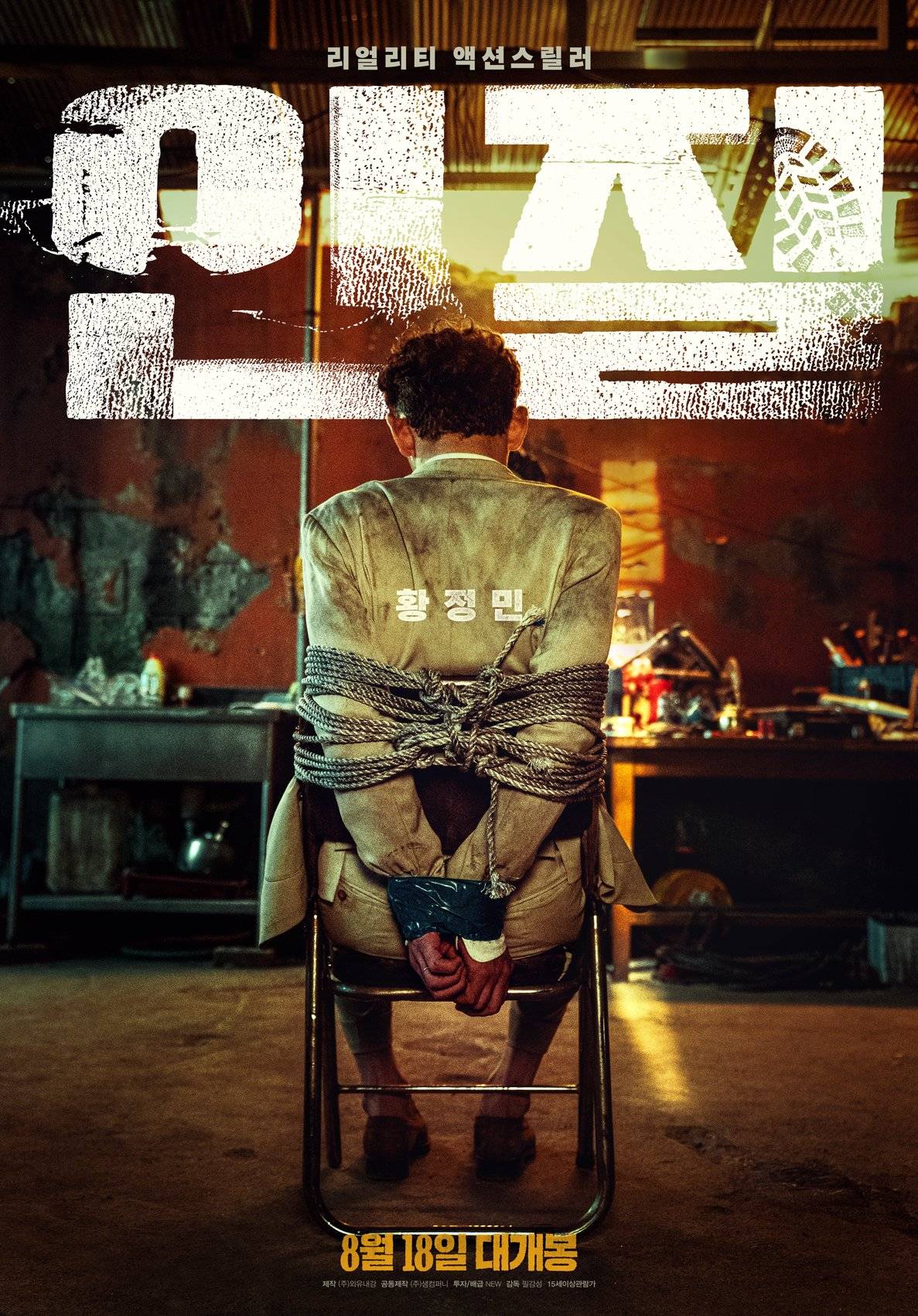
“This is real, birdbrain”. If you’re a famous actor, it might take a while to dawn on you that you’re in real trouble rather than the subject of an admittedly dark candid camera skit or variety show stunt. Real life and the movies begin to blur for top Korean actor Hwang Jung-min playing a fictionalised version of himself when he’s kidnapped by a gang of ruthless petty criminals in Pil Gam-seong’s meta take on Chinese thriller Saving Mr Wu, Hostage: Missing Celebrity (인질, Injil). 

Indeed the film opens with a montage of Hwang’s career to date including a degree of self-deprecation in which he describes himself as “just a petty actor” reminding the journalist interviewing him that film is a collaborative medium of which he is only a part. This version of himself that we see is modest and wholesome, going home early after an afterparty while his wife and son are away planning to relax alone. He seems to live a very lowkey life living in a fairly ordinary suburban house without domestic help or other signs of obvious wealth aside perhaps from an expensive car. Hwang is also on fairly friendly terms with the clerk at the local convenience store which he evidently visits frequently just like any other ordinary person rather than sending an underling to fetch him things or walking around with a massive entourage to remind people that he’s a movie star. Even while trying to escape his kidnappers he takes his shoes off before entering an old man’s home to use his landline telephone. 

Yet one can’t escape the fact that he is fantastically rich and perhaps out of touch with “real” life, his kidnappers targeting him mainly on a whim born of chance coincidence but also in resentment for everything he represents. The leader of the gang, Choi Ki-wan (Kim Jae-beom), is a crazed psychopath whose primary motivations are most likely sadistic rather than purely financial even if his targets are those with fancy cars but those of his underlings are perhaps more prosaic. When one of the gang members is captured, it emerges that he had massive debts to a casino loanshark while the most sympathetic of the kidnappers appears to have learning difficulties and later explains that he’s only doing this to pay for medical treatment to remove a prominent facial birthmark and scarring so he could live a more normal life. Because of his naivety he remains strangely loyal to Ki-wan believing that he’s looking after him while refusing any responsibility for his crimes. The gang’s only female member (Lee Ho-jung), by contrast, seems to be a North Korean refugee in a romantic relationship with Ki-wan’s less psychotic but no less cruel partner Dong-hoon (Ryu Kyung-soo) who just wants the money. 

Having literally played through scenarios just like these in his films, Hwang Jung-min the actor has perhaps gained a degree of experience that allows him to process his situation with a surprising degree of rationality quickly realising that as the kidnappers have made no attempt to hide their identities they most likely plan to kill him, and a young woman, So-yeon (Lee Yoo-mi), abducted alongside a wealthy cafe owner they killed when he couldn’t come up with the cash fast enough, after they’ve got the ransom payments. It isn’t that Hwang’s stingy, it’s that he knows there’s no point giving them the money but his only chance for survival lies in making them think he might. Even so, he gets to literally play the hero engaging in a battle of wits with the kidnappers before attempting to make a dashing escape while the on the outside the a dogged policewoman and her partner do their best to track them down despite the unhelpful interventions of their more conservative boss. 

Ki-wan might well have a point in admitting he’s overreached by going for such a high profile target. The police probably wouldn’t be investigating so heavily if the victim weren’t a famous movie star whose face is splashed across the papers. After all, they hadn’t done much for So-yeon whose sister had had to go to social media to raise awareness about her kidnapping fearing the police weren’t doing enough to help. Bearing out the underlying economic anxiety, So-yeon had only got the cafe job a few days previously after 37 failed interviews. Hwang’s response that he failed a hundred auditions before getting a break, people laughing at his acting dreams because he was a guy with curly hair and red skin who spoke with a strong southern accent, is intended to be reassuring in implying that even if it takes time you get there in the end but is also a little insensitive in the circumstances in downplaying So-yeon’s struggles in the contemporary economy having gone from elation in finally finding employment to being locked in a shed by a gang of psychos because of her boss’ personal greed which seems like quite the metaphor for the inequalities of the modern society. In any case, Pil crafts an intense kidnap thriller given an additional layer of absurdity in its meta dimensions but ends on a note of poignancy which suggests that Hwang himself is also and perhaps always will be hostage to his own image. 


Hostage: Missing Celebrity screened as part of this year’s Udine Far East Film Festival.

International trailer (English subtitles)