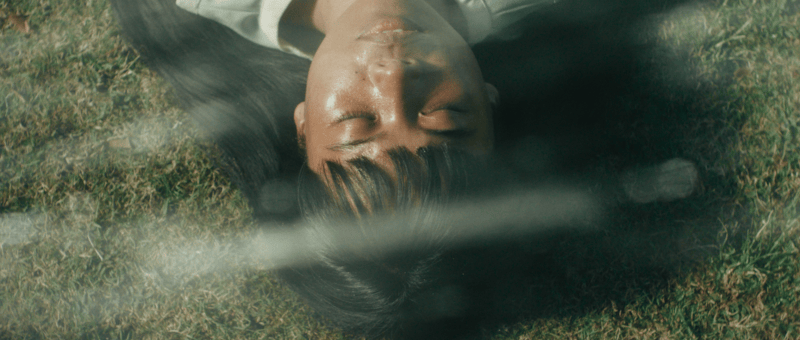

“If one of them dies, it will be replaced,” a worker reassures a wealthy client, ostensibly talking about a dried-out tree, but it’s clear his comment extends even to the largely anonymous employees of an upscale Manila golf course in Rafael Manuel’s satirical drama, Filipiñana. 17-year-old country girl Isabel (Jorrybell Agoto) has come here from her rural hometown to become a “tee girl,” which is to say her job consists of sorting golf balls and placing them in front of the wealthy men who are the course’s main clientele.
The sunlight glints ominously off the club fondled by Renato (Carlos Siguion-Reyna), a golfing supplies magnate who has brought his niece Clara (Carmen Castellanos) to the resort in the hope of convincing her to come “back” to the Philippines from the US and join his company. Manuel’s sound design captures every thwack of the club with an eerie violence that hints both at the damage this place is doing to the natural world and social fabric, and the power and privilege wielded by men like Renato against young women like Isabel. Noticing that the man she’s teeing keeps mis-hitting his balls, Isabel fears one is going to hit her and asks another girl for advice only to be told that it doesn’t hurt that much really and the golfer will probably feel guilty and tip more.
Isabel is temporarily handed the club herself when charged with returning it to the course’s mysterious manager, Dr. Palanca (Teroy Guzman) whom she first saw snoozing with one of the caddies under a mango tree. The club gives Isabel a free pass to wander through the parts of the resort where she would not ordinarily be allowed to go and also grants her access to some of its grimmest secrets. It seems that Isabel might have come here with revenge on her mind, recounting how Dr. Palanca’s trucks arrived to turf her out of her hometown, which is also his hometown though it seems like it means something different to him. But at the same time, she doesn’t quite know what to do with this power that she’s temporarily been given, give it back to those who think it’s theirs, or use it to begin dismantling this system even if it requires violence to do so.
In that sense her dilemma might not be that different from Clara’s, despite the extreme differences between them. Clara is the only female golfer that we see in a world otherwise entirely set up for men. Ina (Isabel Sicat), Clara’s caddie, asks her if all the caddies in America are female too, but is surprised to learn that in America people mostly carry their own bags. Perhaps this might suggest a rather simplistic characterisation of America as an egalitarian paradise, yet America once colonised the Philippines and these golf courses, even if now mostly catering to Chinese tourists, are a legacy of its occupation. Towards the end of the film, Manuel inserts black and white photos of plantations on the grounds of which these courses have been built.
Clara makes a point of telling Ina that her uncle is “harmless,” which is something there wouldn’t be any need to say if she actually believed it. Like Isabel, she seems uncomfortable with the course and what it represents, values implied to be born of her US upbringing, yet it’s exactly this discomfort that her uncle weaponises in suggesting she change the system from the inside. He tells her that they urgently need to diversify their customer base seeing as all their clients are older men and they urgently need people like her do it, so this country can progress. By “progress”, he likely means in his favour preserving the power and privilege of men like himself, but couched in more compassionate language such as his attempt to pass the hat round for golfers to donate to a fund to support the caddies’ families during the drought, when the best way to do that would obviously be to turn the sprinklers off at the gold course.
In the opening scenes we a minibus carrying Chinese tourists to the hotel pass through a crowd of people waiting to collect their water ration under the blistering Manila sun. It’s as if the course itself has sapped the life out of the surrounding city, rendering all too tired to want to resist having internalised the status quo as just that. The wealthy golfers relentlessly cheat at the game and are allowed to get away with it, while the smallest transgression can spell disaster for an employee. “I should aim for the left,” Clara says while looking at a hole despite her uncle and Ina’s advice that it bends right, only for Renato to reassure her that she’s “still learning” as he pulls her towards accepting this privilege despite her misgivings over the excess and exploitation on which the golf course is founded. Somewhat bleak in its implications, Manuel subverts the film’s quirky production design to create a sense of uncanniness in its essential unreality as a ruling class seeks to recreate the idyllic pastorality of a bygone age that they themselves have largely destroyed while seeking to keep it purely for themselves.
Filipiñana opens in UK cinemas 20th November courtesy of BFI Distribution.
Trailer (English subtitles)

