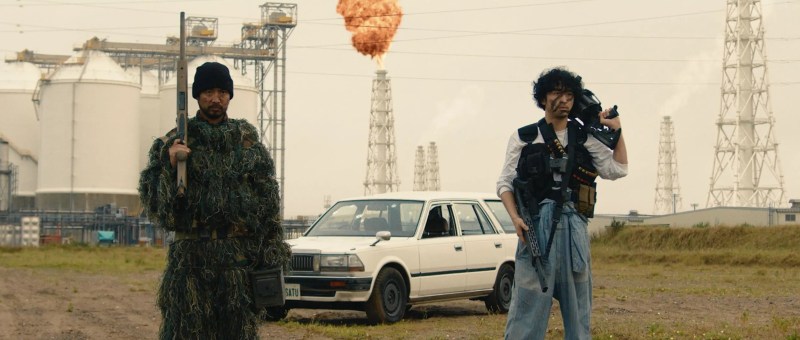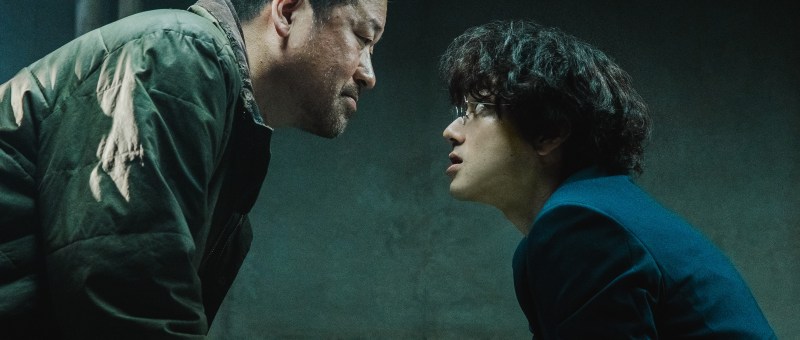
At first glance, the English-language title of Akira Nagai’s adaption of the novel by Katsuhiro Go, Suzuki = Bakudan, might seem a little strange, even aside from the incongruity of leaving “bakudan” (bomb) untranslated. But there is something to be said of the idea that there are little bombs everywhere, and each person is also powder keg waiting to explode given the right trigger. That might play in to the rather cynical view of the Hannibal Lector-like presence at the film’s centre who seems to be leading the police a merry dance with his various riddles and determination to play the part of a man whose mind has been ruined by alcohol and hopelessness.
The first thing about Suzuki (Jiro Sato), arrested for busting up a convenience store, is that he gives a name that at least sounds fake and attempts to brazen it out. Detective Todoroki (Shota Sometani) tells him that the store owner doesn’t want to press charges and will settle for compensation to fix the damage, but Suzuki says he’s broke ad offers to help the police instead. He claims to have psychic powers and knows that a bomb is about to go off, but the police assume it’s an obvious delaying tactic and take no notice, until there’s actually an explosion in the middle of the city.
The obvious conclusion that occurs to Todoroki is that Suzuki is the bomber, but at the same time he seems to think there’s something innocent about him. He is indeed as Todoroki and later Ruike say childish in his playfulness and means of expression, though there’s also a sinister edge to the way he speaks that suggests it’s all an act. He quotes poetry and and appears to ramble like a madman but while Ruike becomes convinced he’s dropping them arcane clues, others think he’s just manipulative and deliberately wasting their time. “Not every word has meaning,” one insists though it seems as if it really might for Suzuki who seems to list not being listened to by society as one of his grudge points.
The point that he makes frequent digs at the homeless despite identifying as one hints at this paradoxical sense of injustice in the contemporary society. In one of the traps he sets for the police, he sets them up with a binary choice of whether to save schoolchildren or the homeless community. The detectives don’t realise that’s what they’re doing, but still didn’t really think to much about the people who live in the park while desperate to find a potential bomb threat in a school. Later Suzuki lists off a series of people he can’t stand from the homeless to pregnant women, families, and lawyers, in fact pretty much everyone which itself seems to be more a reflection of an absurd social prejudice than his own feeling.
He might, however, have a point about social indifference and the arrogance of the police with Todoroki’s superiors rolling their eyes and refusing to take Suzuki seriously while the bombs keep going off. Everything seems to link back to a disgraced police officer, Hasebe, who took his own life by jumping in front of train and was not supported by his colleagues aside from Todoroki who only utters that he’s not insensitive to his feelings which seems like a lukewarm advocation for the police brotherhood. Suzuki seems to have resented not being accorded one of the group, and holds the police in contempt for the way they treat their own. Yabuki (Ryota Bando) is also forever trying to get his foot on the ladder as a detective, but is only exploited by those above him which is one reason he’s willing to take so many risks to catch the bomber.
Suzuki tries to guess the shape of people’s hearts, and finds those of the policemen largely warped by office politics and backstabbing. Selfishness is the sad truth of humanity, he intones. And he might be right, people only really want the bombs not to go off near them and they’re less bothered by the idea of them hurting other people than they’d like to think. After all, Hasebe’s family’s lives imploded too when they were sued by the railway company after Hasebe’s suicide, hounded by the press, and ostracised by former colleagues. Acceptance by the group, it seems, is only ever really temporary. Still, Suzuki leads the police by the nose exploiting all their weaknesses and affecting the persona of a sane madman claiming to be psychic and to have been hypnotised to erase his memory but keeping all his cards close to his chest as the cat and mouse game between him and Ruike ratchets up in tension and finally reaches its ironic conclusion.
Suzuki=Bakudan screens as part of this year’s Nippon Connection.
Trailer (English subtitles)
Images: © Katsuhiro Go/KODANSHA Ltd. All Rights Reserved © 2025 FUJI TELEVISION NETWORK, INC./Warner Bros. Japan LLC/ KODANSHA LTD. All rights reserved