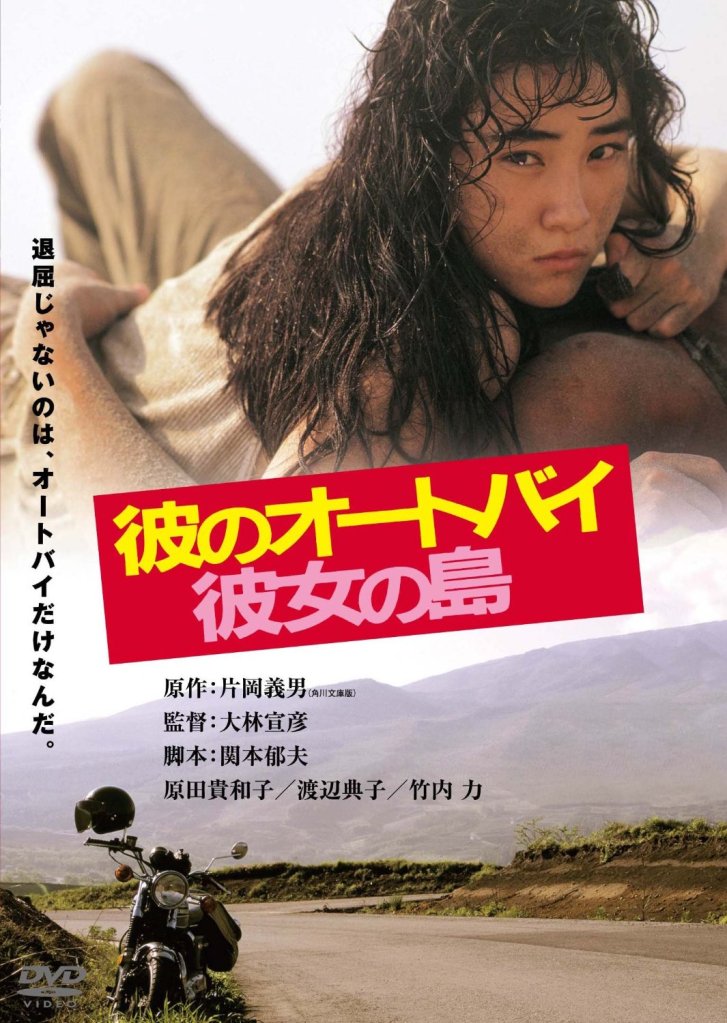
His Motorbike, Her Island (彼のオートバイ彼女の島, Nobuhiko Obayashi, 1986)

His Motorcycle Her IslandLike many directors during the 1980s, Nobuhiko Obayashi was unable to resist the lure of a Kadokawa teen movie but His Motorbike, Her Island (彼のオートバイ彼女の島, Kare no Ootobai, Kanojo no Shima) is a typically strange 1950s throwback with its tale of motorcycle loving youngsters and their ennui filled days. Switching between black and white and colour, Obayashi paints a picture of a young man trapped in an eternal summer from which he has no desire to escape.

Ko (Riki Takeuchi) tells us that he’s an unusual guy because most people dream in colour but all of his dreams are in monochrome. He’s a student and dispatch rider overly attached to his admittedly very handsome Kawasaki motorbike. After getting beaten up by his boss due to deflowering the guy’s sister and then breaking her heart, Ko skips town for the open road, just him and his bike. However, he repeatedly runs into the same mysterious girl who lives on an equally mysterious island and develops a deep seated need for her, secondary only to that for his bike. Miyo (Kiwako Harada) has also taken a liking to the Kawasaki and is intent on getting her full motorcycle license. Her growing obsession with the bike threatens to become an all consuming need driving a wedge between the two young lovers.

Obayashi begins in a black and white sequence window boxed in the centre of the screen before expanding to 4:3 when Ko has his fight with his boss and only hits 16:9 for the first colour scene which sees Ko taking off on his beloved bike. He told us that his dreams are in black and white but the film seems to disagree with him, segueing into various gradated colour schemes as Ko narrates his melancholy tale of tragic lost love. Ko is not necessarily a very reliable narrator in any case, but in each instance the on screen action is always coloured by the recollections of the older man who offers his voice over commentary.

Like many Obayashi films, the overriding feeling is one of melancholy mixed with a youthful apathy.  This is a story about modern young people, but refracted through rebellious ‘50s movies from Rebel Without a Cause to The Wild One and a hundred others inbetween. Ko is a university student (of what we don’t know) but seems to have no great ambitions. He takes things as he finds them and his only passion is the bike itself. When he first meets Miyo and she asks him where he’s going, he simply replies that he’s “looking for the wind” – a motif which recurs throughout the film.

Later on when he arrives at Miyo’s island, it takes on an opposing symbolism to his bike. Just as Miyo can’t get enough of the Kawasaki, Ko is originally attracted to the island much more than to the girl. It’s not quite a coincidence that each time he visits there it’s the Bon festival where the dead are temporarily allowed to return to the world of the living. Later he says that Miyo wasn’t just a girl but an island, and he wan’t just a boy but a bike, and together the two of them became the wind. They became one entity, inseparable one from the other. Finally the esoteric colour scheme begins to make sense, we’ve been watching a ghost story all along. This island is an unreal place, existing only inside Ko’s memory where Miyo waits for him with a full tank of gas.

Once again youth is seen as a brief yet unforgettable period filled with longing and regret. The older man is forever trapped by this one glorious summer, a place to which he can never return but neither can he escape. The nihilistic tone and voice over narration have an edge of the French New Wave but ‘50s American cinema of alienation seems closer to Obayashi’s intentions. An elliptical and strange tale of tragic love retold as a ghost story, filled with phantoms of memory and landscapes coloured by dream and emotion, His Motorbike, Her Island is another characteristically offbeat effort from Obayashi which once again embraces the aimlessness of youth and age’s regret.


Unsubtitled trailer – goes through to a video of Kiwako Harada singing the title song, in case you were in any doubt what this movie is for.

Or, here is the film’s opening (which also features the title song)

The Sea is Watching (海は見ていた, Kei Kumai, 2002)

The Sea is WatchingAkira Kurosawa’s later career was marred by personal crises related to his inability to obtain the kind of recognition for his films he’d been used to in his heyday during the golden age of Japanese cinema. His greatest dream was to die on the set, but after suffering a nasty accident in 1995 he was no longer able to realise his ambition of directing again. However, shortly after he died, the idea was floated of filming some of the scripts Kurosawa had written but never proceed with to the production stage including The Sea is Watching (海は見ていた, Umi wa Miteita) which he wrote in 1993. Based on a couple of short stories by Shugoro Yamamoto, The Sea is Watching would have been quite an interesting entry in Kurosawa’s back catalogue as it’s a rare female led story focussing on the lives of two geisha in Edo era Japan.
Throughout this tale of love bought and love lost, we mainly follow the kindly geisha Oshin (Nagiko Tono) who ends up helping a nervous young man one night when he crashes into her geisha house in an attempt to avoid being picked up by the police. It seems he’s been out drinking with friends for the first time and, after having drunk far too much, may have stabbed another customer (though he can’t quite remember). Oshin comes up with a plan by cutting off his topknot and passing him off as one of her regular customers but Funosuke (Hidetaka Yoshioka) is not a born dissembler and remains sitting bolt upright before heading home at the first light of day.

Something passes between the two in the night and Oshin unwisely begins to fall in love. Though she begs him not too, Funosuke repeatedly visits her claiming to enjoy her company. However, though the other girls at the geisha house are in favour of Oshin’s love across the class divides romance and go to great lengths to help her, Funosuke is just a feckless boy completely unaware of the way he’s been toying with people’s hearts. Later, Oshin meets another damaged man, Ryosuke (Masatoshi Nagase), and begins to fall in love again but can a put upon geisha ever believe the words of men who think they can trade money for love?

Kurosawa has sometimes had the charge of misogyny thrown at him, somewhat unfairly, as his films are often very masculine in nature. The Sea is Watching, conversely, is the story of two women, Oshin and her fellow geisha Okikuno (Misa Shimizu), who claims to have come from a wealthy samurai background. Oshin is still young, her kindness and softness have not yet been eroded by the often harsh and cruel world in which she lives. She contents herself with romantic dreams of finding a man who will rescue her from this unpleasant way of life. Okikuno, by contrast, is older, harder, more experienced in the ways of the world, and therefore more inclined to towards pragmatism. She finds her salvation in self deception about the past whereas Oshin’s fantasies are all focussed on her future. In many ways the women are mirrors of each other but they also have a tight, sisterly bond in which each seems to understand the other perfectly without the need for explanation.

Structurally, the film feels unbalanced as it focusses more heavily on Oshin in the early stages only to gradually shift through to Okikuno by the end. The thematic split between Oshin’s twin tales of love doesn’t quite help, though it does add a degree of pathos to the situation as Okikuno can see that Oshin’s happy ever after is an unlikely prospect, but still somehow wants to make it happen. Oddly, Kumai chooses not to emphasis the relationship between the two women until the very end, preferring to deal with each of their disappointments and dead end romances separately, but the film does finally come together when they are trapped alone in the geisha house following a freak flood.

In many ways, filming the unfinished work of a great director is an entirely thankless task – every fault is because you aren’t him and every success is down to the departed genius, but Kumai does what he can to both honour Kurosawa’s memory and put his own stamp on the material. There are frequent Kurosawa-esque compositions and the final, deliberately unreal scene of the geisha house underwater framed against the starry sky also has a suitably Kurosawan feeling. That said, something about The Sea is Watching never quite catches fire, its symbolism feels underworked and the final, climactic scene lacks the power it seems to want to have despite Misa Shimizu’s impressive performance. Not drowning, but waving, The Sea is Watching is an uneven experience but makes up for its tonal problems through the strong performances of its cast and powerful, expressionist imagery which allow it to successfully ride the waves of the emotional storms at its centre.


The Sea is Watching is available on DVD with English subtitles in the US and UK from Sony Pictures Entertainment.

US release trailer:

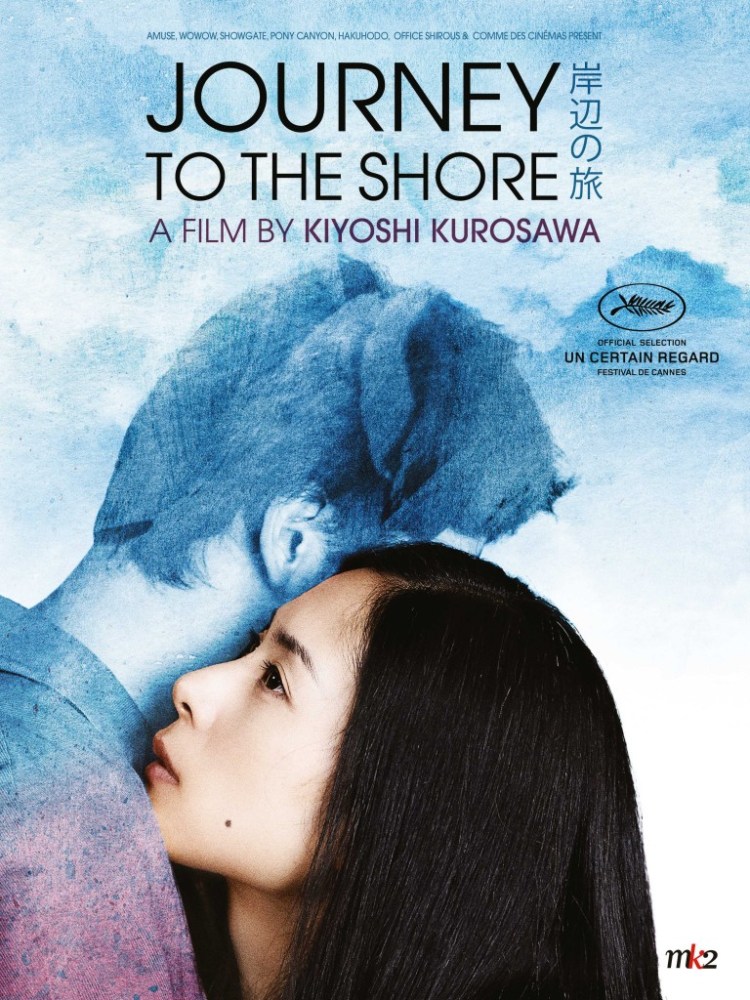
Journey to the Shore (岸辺の旅, Kiyoshi Kurosawa, 2015)

journey to the shoreTime is an ocean, but it ends at the shore. Kiyoshi Kurosawa neatly reverses Dylan’s poetic phrasing as his shoreline is less a place of endings but of beginnings or at least a representation of the idea that every beginning is born from the death of that which preceded it. Adapted from a novel by Kazumi Yumoto, Journey to the Shore (岸辺の旅, Kishibe no Tabi) takes its grief stricken, walking dead heroine on a long journey of the soul until she can finally put to rest a series of wandering ghosts and begin to live once again, albeit at her own tempo.
The film begins with three years widowed Mizuki (Eri Fukatsu) giving a piano lesson to a little girl whose mother goes on to enquire about her daughter’s progress. Wouldn’t it be better if she could learn something a little more cheerful once in a while? Reconsidering, the mother reflects that uptempo doesn’t quite suit Mizuki, and she’s right – it doesn’t. After impulse buying some flour and baking a few Japanese sweets at home, Mizuki receives an unexpected visit from her deceased husband, Yusuke (Tadanobu Asano), who drowned himself at sea.

Somehow unsurprised and pausing only to remind him to remove his shoes, Mizuki gives Yusuke some of the dumplings then retires to bed, only to wake up the next morning and wonder if she dreamt the strange events of the night before but, sure enough, Yusuke is still very much present. Promising to show her some of the beautiful places he discovered on his long odyssey home to her, Yusuke takes Mizuki on a reverse honeymoon in celebration and in mourning of all they once were to each other.

In each place they travel to, Mizuki and Yusuke help the people there deal with their own walking ghosts. Yusuke is not the only returnee as they discover with a lonely old newspaper seller who doesn’t appear to be aware that he died a long time ago. Walking dead in a realer sense than Mizuki or some of the other depressives they meet along the way who are still living but not exactly alive, Mr Shimakage is a spirit held in place by an inability to reconcile himself with the actions of his past and has brought his feelings of self loathing and regret with him into the afterlife.

Sometimes it’s the living that pin the dead, holding them close with guilt, regret, love or loneliness. If the film has a central tenet, it’s that the past has its place, and it’s not among the living. At one point Mizuki says that perhaps it’s better to leave some things unresolved. Yusuke asks her if she’s really OK with that, and she seems to reconsider but in the end that’s the way it has to be. There are no final solutions, the answers are not at the back of the book. In the end, the best you can do is try to understand and learn to be OK with everything you do and do not know about yourself and about those who are no longer here to tell their stories. Mizuki also says that she hated to practice piano as a child, but her teacher always told her to pay attention to her own rhythm. The music will always be lifeless, until you learn to hear your own song.

Kurosawa creates a beautifully ethereal world, held in a tension between the spirit realm and the everyday. Playing with lighting levels in extremely interesting ways, he allows the supernatural and natural to flow into each other, jostling and merging like waves and shore. Travelling from the grey, ordered and utilitarian city to the unruly nature of the countryside with its ancient, crashing waterfalls and beautiful, if lonely, coastlines we move from static and lifeless existence to a place of perpetual potential as we let go of one thing so that we might grasp another.

As much as Journey to the Shore is bound up with death, it necessarily speaks of life, too. During one of his strange lessons for the village folk, Yusuke delivers some meditations on science and philosophy to the effect that the world is built of nothingness but that nothingness does not lack meaning. He tells us that we are all dying, the universe was born billions of years ago and will end one day just as our species may end when the planet’s temperature exceeds that which we can endure or galaxies collide and take us down with them. For all of that, the universe is young, still growing, still expanding, and we are so lucky to have been born now when there is still so much ahead of us. This is a time of infinite beginnings. Starting again means letting go, but sooner or later you have to step off the shore of this self imposed purgatory and return to the great ocean which is life.


Journey to the Shore is availble on dual format DVD and blu-ray in the UK courtesty of Eureka Masters of Cinema.

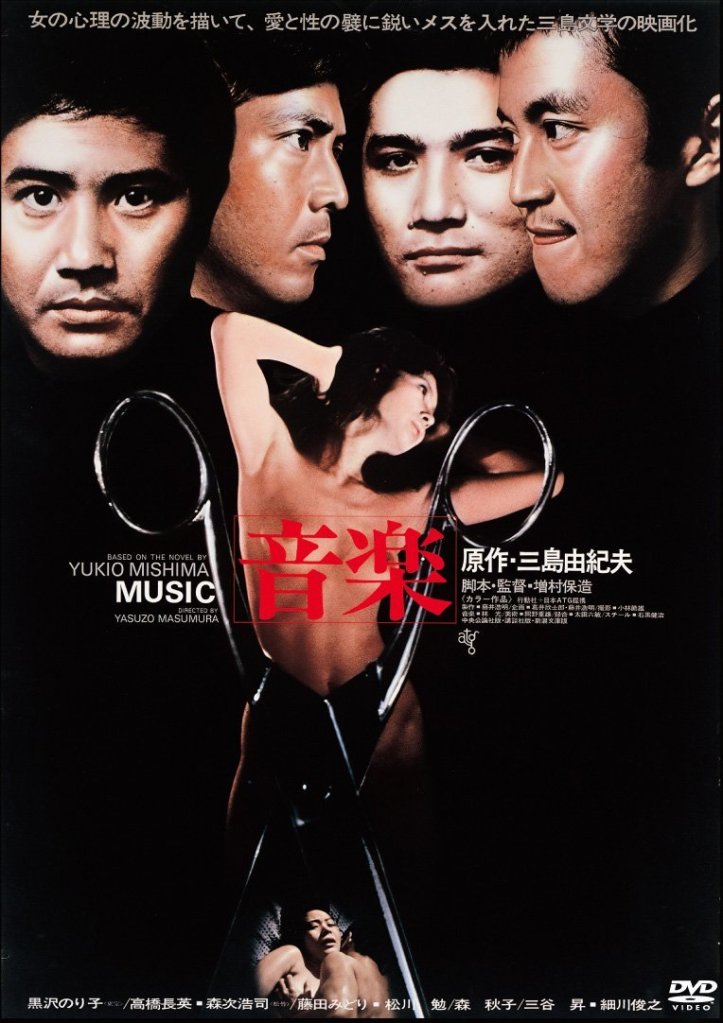
The Music (音楽, Yasuzo Masumura, 1972)

The MusicIf the under seen yet massively influential director Yasuzo Masumura had one recurrent concern throughout his career, passion, and particularly female passion, is the axis around which much of his later work turns. Masumura might have begun with the refreshingly innocent love story Kisses, but later he dived deep into the depths of depravity in Blind Beast and of manipulation in Manji before cycling back around the intense freudian character study which is The Music (音楽, Ongaku) in 1972. Based on a novel by Yukio Mishima (Mishima and Masumura – a match made in heaven), The Music is the story of one woman’s corrupted sexuality caused by a series of inappropriate sexual encounters during her childhood.
The film begins with a symbolic title sequence in which a large pair of scissors opens and closes rhythmically before being superimposed over the body of a woman – Reiko, our protagonist. She has made an appointment with a psychiatrist because, she claims, she has strange symptoms including constant nausea which led her to believe she was pregnant though medical doctors can’t find the cause of her sickness. The other thing is she can’t hear music, she can hear voices and sound effects but if music starts playing it’s like she goes deaf. Her psychiatrist isn’t quite convinced by Reiko and can tell she’s misleading him.

Sure enough he asks her to come back and she admits not hearing music was a symbolic way of explaining that she derives no pleasure from sex. Her boyfriend is a good man and she loves him, she doesn’t think the problem is with him, but she simply feels nothing when he touches her and it’s causing a rift in the relationship. This is the “music” she was talking about and which will become a recurrent motif throughout the film. Later, Reiko finds that she is able to derive a kind of satisfaction from sexual acts with men who are either dying or impotent, but should they simply get better she again loses all interest in them.

As might be expected, the reasons for Reiko’s strange behaviour lie in her childhood. Her fascination with scissors derives from a game of rock paper scissors she once played with the boy to whom she was betrothed to marry when they came of age. Reiko is the only girl in the group and when she loses the boys suddenly declare she’ll have to have her “thing” cut off – only she’s a girl and never had one in the first place. This leaves her feeling disturbed, humiliated, and in some way inherently deficient. From this point on she develops a masculine sensibility symbolised by one side of the closing scissors which becomes her own “thing”, leaving her with a desire for both cutting and being cut.

We also discover that Reiko was assaulted at a young age and that she also experienced early sexual contact with a family member as well as witnessing her aunt engage in an inappropriate relationship which greatly disturbed her. In all, it’s not surprising that Reiko is experiencing such a degree of confusion given all of the traumatic events that have followed her since her youth. Involved in an obsessive, incestuous sexual relationship Reiko is unable to move on with a “normal” life until she addresses the true cause of all her problems.

The psychiatrist is wiley guy, he can spot a lie a mile off and he has Reiko’s number pretty quickly. Amusingly, she does our job for us of trying to diagnose herself with the obvious solutions that seems to emerge from the latest story she’s told, only for the doctor to remind her it’s not so simple and untrained people shouldn’t try to analyse themselves. This is a little ironic in some respects as a trained psychologist would probably give much of Mishima’s cod Freudianism short shrift, but it works well enough in the context of the film. Reiko is about as unreliable a narrator as it’s possible to find but it does seem at last that the truth has been uncovered and Reiko set free from her improper sexual desires.

There’s a degree of campness involved in The Music with its heavy atmosphere and overtly theatrical melodrama. Masumura films with a perverse eye, animating Reiko’s recollections like dreams complete with bizarre perspectives and symbolic imagery to complete his Freudian approach to filmmaking. The Music may not be his most accomplished work, but it is nevertheless interesting and a late career return to his most pressing concerns.


Unsubtitled trailer (NSFW):

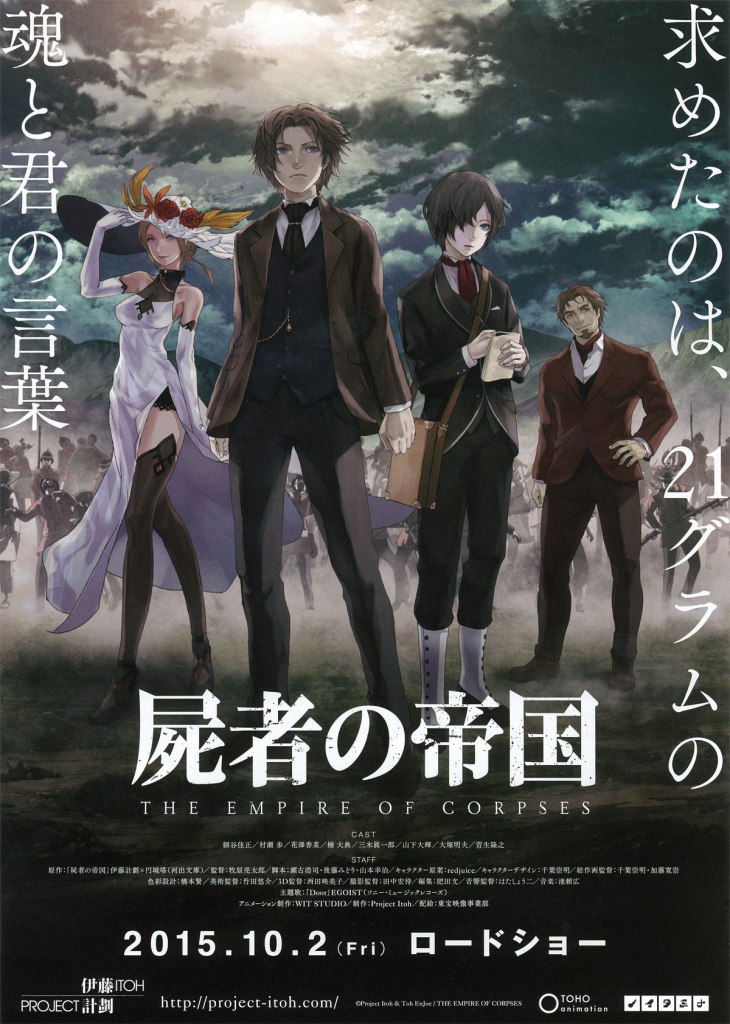
Empire of Corpses (屍者の帝国, Ryoutarou Makihara, 2015)

empire of corpses posterEmpire of Corpses (屍者の帝国, Shisha no Teikoku) is what would happen if someone’s vast library of Victorian literature was destroyed in a fire and then someone tried to put all the not too singed pages back together based on their knowledge of international pop culture. Inspired by Project Itoh’s novel of the same name and the first of three planned adaptations of his works, Empire of Corpses is a very specific kind of absurd, boys own action adventure based around the idea of empire supported by a zombified proletariat.

Beginning in London in 1878, this is steampunk paradise only steam power is quickly becoming old hat as the greatest discovery of the age turns out to be the city’s largest untapped resource – its dead. Reanimated corpses can be trained to fight wars, wait tables, or work as servants but they’re tools now – not people, they may be able to follow an order but they have no mind to act with. Corpse Engineer John Watson has unwisely reanimated his friend Friday, but is distressed not to be able to restore his friend’s soul along with his body.

Watson ends up being dispatched on a secret mission by Her Majesty’s government to reclaim the notes made by the famous Dr. Frankenstein who has succeeded in creating a sentient creature known as The One. The notes are apparently in the possession of Russian scientist Karamazov. Watson travels to India with Burnaby, a mercenary bodyguard, and Friday where he also teams up with a mysterious flame thrower wielding busty blonde, Hadaly.

Empire of Corpses touches on some interesting philosophical questions such as the nature of the soul, the border lines between death and life, and the repurposing of a body as a fleshy tool. Though it stops short of delving into what the British Empire was really based on, the idea is very much that using reanimated corpses to fight your wars remotely is an absurd solution to an unnecessary problem.

That said, these “zombies” are a well trained and docile bunch. Until of course, they aren’t. Certain forces have planned to harness the zombie hordes for their own ends to create mass panic and wholesale destruction across the world. This might be the first mission the later famous John Watson will tackle, but he’s about to realise that there’s a lot more going on here than a set of secret documents no one wants to fall into the “wrong” hands.

Empire of Corpses remained unfinished when Project Itoh unfortunately died at a relatively young age. The concept is filled with extremely interesting ideas which are only ever dealt with in a superficial sense, though one wonders if the novel he might eventually have completed would have progressed so far down the ridiculous fantasy historical epic route. Very clearly channelling ‘30s style, post-penny dreadful tales of derring do starring familiar names, Empire of Corpses steals a host of famous literary characters from across the international canon as well as a number of historical personages, though only really borrows their names or perhaps a few other minor details. After raising such interesting ideas, the film quickly reverts to riduclous B-movie genre tropes as the gang get caught up in a zombie apocalypse with flashing mystical lights and the transmigration of souls thrown in for good measure.

No, it doesn’t make any sense though it isn’t really supposed to. Patient viewers will be rewarded with a post credits sequence shining a little more light but just as much bafflement onto the characters and their possible futures, though the intention is clearly just to raise a knowing wink from the well read members of the audience. By the time it all turns into The Wizard of Oz, some will undoubtedly have followed the yellow brick road out of the cinema but it is worth sticking around to see the final coda.

What Empire of Corpses has going for it is the extremely impressive visuals. Backgrounds in particular are gorgeously drawn making for an always interesting spectacle even if other aspects of direction can seem a little uninspired. Clumsily plotted and often incoherent, Empire of Corpses has its fair share of problems even aside from the inherent absurdity of its original premise, yet it isn’t completely unsalvageable and those who come expecting a B-movie style slice of incomprehensible hokum might well find much to enjoy.


Reviewed as part of the “biennial” Anime Weekend at BFI Southbank. Empire of Corpses has also been licensed for UK distribution by All the Anime (and Funimation in the US).

Unsubtitled trailer:

Harmony (ハーモニー, Michael Arias & Takashi Nakamura, 2015)

Harmony PosterHarmony – the word itself sounds peaceful. A coalescence of sympathetic sounds, the feeling of wholeness and happiness. However, if given the choice, would you like to live in a world of peace and plenty in which your body is almost government property and your personal freedom is limited in favour of ensuring the survival of the species, or would you rather take your chances with the world as it is complete with its violence, sadness and pain if it meant you could be free to live in which ever way you see fit? Michael Arias’ adaptation of the Project Itoh novel addresses just this question in all its complexity as utopia turns out to have a heavy entrance fee.

Fifty years after a devastating nuclear war humanity has recovered itself and the elite now live in spotlessly clean, futuristic cities. A healthcare monitoring system administered through nanotechnology ensures proper adherence to health guidelines including sending alerts about unhealthy food and heart rate fluctuations making it almost impossible to cheat the system even if you wanted to. Everyone also has “augmentations” including a heads up display in the eyes which flags all the aforementioned info as well as a break down on your fellow humans which also includes their “social aptitude quotient” based on how well they treat others and how good they are at following the rules.

For some, all of this nannying is nothing other than an infringement on their personal freedom. After all, shouldn’t you have the right to eat what you want, drink, smoke, take risks, if that is your personal choice? Camus said that the only way to deal with an unfree world is to become so absolutely free that your very existence becomes an act of rebellion. Our heroine, Tuan, has opted for a similar solution as she finds herself working for enemy as a Helix Inspector allowed to life on the margins of society where the the rules are more easily breached. She flaunts the regulations and cares little for anything or anyone. Once, long ago, she cared deeply for a girl in high school who was so opposed to the constant invasions of the modern world that she chose the only way out that was available to her – suicide. The pair intended to die together but Tuan alone survived.

Tuan is then recalled to Tokyo following an incident of mass suicides only for another high school friend to kill herself in a violent and bloody way right in front of her. Tuan is about to discover that she herself is at the centre a complicated conspiracy which intends either to save or to destroy humanity depending on your point of view.

Harmony is an extremely complex dissection of the human need for self protection from threats real or imagined. Following a large scale humanitarian disaster, fear rules the day and humans must be protected from their bad decisions by gentle reinforcement but isn’t the right to slowly destroy yourself, should you choose to do so, exactly what wars are fought for? Is it worth surrendering such basic rights to live in a world without disease or hunger (for the wealthy nations, at least) or does this level of being looked after rob humanity of the thing that defines it? The “Harmony” of the title is a medical treatment designed to spread peace and love throughout the land, yet it eventually robs the patient of a self-aware soul leaving them without the individual desires and emotions which cause human conflict. What should the future look like – cold, sterile but long and peaceful or shorter but filled with all the richness of human passions?

Arias had been working on a live action adaptation of Harmony which apparently fell though and though asked to helm Genocidal Organ managed to get them to allow him to switch back to the anime version instead. Here he’s billed as a co-director along side Takashi Nakamura and it seems there was more than a little conflict involved in the process. In any case, the finished product is vastly different in approach from Arias’ original concept though sticks fairly close to Itoh’s novel.

Made on a very tight budget and in an extremely short time, Harmony makes the best of its difficult production circumstances with a complex mix of CG and hand drawn animation styles. The production design is prescient and interesting as it presents its utopic city as a serene place of muted colours and stress free round buildings. Even the monolith presented in the framing sequence looks exactly like what a traditional Japanese tombstone would look like if it was designed by Apple. However, the natural pops right out of the screen with its vibrant colours such as in an early scene where a field of sunflowers looks almost like stop motion in its highly textured 3D CGI. Though occasionally falling back on static conversations, the composition and directing style is also interesting with unsettling circular shots, frequent dissolves and montages, and even a light jazzy soundtrack which definitely lends to the Lynchian atmosphere.

Harmony is certainly a complex film and arguably succeeds much more because of its nuanced source material than the production itself, yet like the best sci-fi it does offer an in-depth philosophical discussion along side exciting acting scenes and moving character drama. Unfortunately, the film does fall into the trap of ponderous monologuing at times and is sometimes guilty of stilted, expository dialogue but largely manages to maintain goodwill even as it does so. In many ways imperfect, Harmony is an undoubtedly ambitious project and one of the better science fiction themed anime movies to emerge in recent years.


Reviewed as part of the “biennial” Anime Weekend at BFI Southbank. Harmony has also been licensed for UK distribution by All the Anime (and Funimation in the US). Project Itoh’s original Harmony novel is also available in English translation (by Alexander O. Smith) published by Haikasoru.

Unsubbed trailer:

Failan (파이란, Song Hae-sung, 2001)

FailanSometimes God’s comic timing is impeccable. You might hear it said that love transcends death, becomes an eternal force all of its own, but the “love story”, if you can call it that, of the two characters at the centre of Song Hae-sung’s Failan (파이란, Pairan), who, by the way, never actually meet, occurs entirely in the wrong order. It’s one thing to fall in love in a whirlwind only to have that love cruelly snatched away by death what feels like only moments later, but to fall in love with a woman already dead? Fate can be a cruel master.

The titular Failan (Cecilia Cheung) is a migrant from mainland China who’s travelled to Korea in search of her last remaining relatives following the death of her family. Unfortunately, they moved abroad some time ago and no one knows how to contact them. Stuck in Korea, Failan is running out of options but a “kindly” woman suggests a phoney visa marriage so she can legally stay in the country and earn her keep at the same time.

So, she ends up married to the feckless petty gangster-cum-video-store-proprietor Kang-jae (Choi Min-sik). We meet him around a year later and it’s his story we follow for the first half of the film as he gets out of jail after being arrested for selling adult videos to horny teenagers. Kang-jae quickly gets into an argument with his gangster boss, Young-sik (Son Byung-ho), but as they’re also old friends they patch things up over a drink only for the evening to go way south when Young-sik spots a rival gang member and ends up beating him to a bloody pulp whilst in a trance-like rage.

Young-sik is young and ambitious so when the crime is discovered he pleads with Kang-jae to take the rap for him, promising that he’ll buy him that fishing boat he’s always wanted so he can go back to his home town when he gets out. Kang-jae goes home to think it over and gets a knock on the door, two policemen are standing outside only they haven’t come to arrest him – the wife he’d forgotten all about has died. Kang-jae has hit a fork in the road both literal and metaphorical and takes a road trip with his best friend to finally meet his bride in a cold and lonely place.

Failan is almost a plot device in the film that bears her name, but her story is a sad and a hard one. Orphaned and alone she finds scant kindness in her adopted country but the woman who runs the laundry where she ends up working does at least develop an almost maternal feeling for her. Failan feels great gratitude to Kang-jae for agreeing to marry her so she could stay in Korea and is convinced he must be a very good, very kind person. She thinks this largely because she never meets him.

Kang-jae is rubbish at being a gangster. Young-Sik may have a point when he says he doesn’t have the heart for it. Early on, some of the youngsters try and rope him into an extortion scheme where they’re trying to get an old granny to pay back some of her loan. Apparently the granny had once been kind to Kang-jae when he was young and hungry so he doesn’t really put a lot of effort into being menacing towards her which makes him lose face with the young toughs who think of him as a joke anyway. Reading Failan’s letter, it’s the first time that anyone has ever said anything nice about him. The first woman who ever thought he was worth anything at all and she’s already lost to him before he even knew her.

Kang-jae is not a good man, he’s an underling just muddling through without thinking. He leaps from one thing to another always thrashing around landing where falls. He has a vague ambition to get the money together to buy a fishing boat and go home, but he’s not seriously pursing it. Even the group of gangsters he’s involved with are so laughably low rent that they can’t hold on to their completely worthless territory and have to put pressure on old ladies just to get by. After reading Failan’s letter and hearing that someone believed he was better than this, Kang-jae finally wakes up and starts thinking about his life with the ultimate realisation that he doesn’t have to live like this. Unfortunately, he might have just picked the wrong day to start living the rest of his life.

In many ways Failan is a typical melodrama filled with the pain of unrealised love and Fate’s ironic sense of timing. Based on a novel by the modern Japanese master of the tearjerker Jiro Asada (Poppoya), Failan seems engineered to rend hearts with its tale of true love frustrated by time and circumstance where every ounce of hope and goodness is well and truly trodden into the ground by the time the credits roll. Nevertheless, Song keeps things on the right side of schmaltzy, never racking up the misery and heartbreak beyond the threshold of plausibility. Like all the best melodramas, Failan’s sentimentality is sincere and, ultimately, moving. Another sad story of salvation arriving too late, Failan’s tale of tragic, unrealised love is an all too familiar one but effectively told it can’t fail to tear the heart.


You can currently stream Failan via Amazon Video in the US courtesy of Asian Crush, but the Korean R3 DVD and Region A blu-ray both contain English subtitles!

Unsubbed trailer:

Mr. Thank You (有りがとうさん, Hiroshi Shimizu, 1936)

Mr. Thank YouBus trips might be much less painful if only the drivers were all as kind as Mr. Thank You and the passengers as generous of spirit as the put upon rural folk travelling to the big city in Hiroshi Shimizu’s 1936 road trip (有りがとうさん, Arigatou-san). Set in depression era Japan and inspired by a story by Yasunari Kawabata, Mr. Thank You has its share of sorrows but like its cast of down to earth country folk, smiles broadly even through the bleakest of circumstances.

Mr. Thank You is everyone’s favourite bus driver. In fact, some of his passengers have even deliberately decided to “miss” the previous bus because they heard he was driving the next one. It’s not hard to see why, he’s a good a driver and a very polite, nice young man who’s been given the affectionate “Mr. Thank You” nickname because of his habit of shouting a loud thank you to everyone who moves out of the way for his bus to pass in the narrow mountain roads (the aforementioned pedestrians are also to be seen waving wildly and shouting his nickname back at him as he grins at them in the rear view mirror). He’s also prepared to stop and pick up passengers along the way as well as carrying messages between villages and filling requests for the latest records to hit Tokyo stores.

Mr. Thank You was apparently shot without a firm shooting script other than the inspiration of Kawabata’s story so the dialogue has a very immediate, contemporary feeling. There isn’t so much of a story as a journey taken with this disparate group of people all travelling from one place to another for various different reasons with the small interjections of other passersby on the roadside. The main drama occurs between a woman and her daughter who have such ashen faces they might as well be ascending the gallows, a very modern whiskey swilling travelling woman, and a grumpy guy with a handlebar moustache who seems very anxious about the bus being delayed by all these pleasantries. Along the way, Mr. Thank You offers commentary on some of the people he knows from his regular trips which amounts to a collection of sad stories decrying the state of the nation in which fathers are selling their daughters and mad men wander the streets searching for lost love.

“Young women used to laugh, but you never hear that now.” Says one passenger glancing at the sad face of a girl on a bus to the city. The mother and daughter seem reluctant to talk about their journey but it’s obvious to all that the girl is to be sold to a geisha house, never to see her home again. Mr. Thank You is sympathetic to her plight whilst silently listening to the lamentations of his customers like a sober barman. At one point he wonders out loud if he might be better off driving a hearse – acknowledging his own complicity in taking money for escorting this poor girl off to a life of rack and ruin. The flirtatious modern woman sitting behind him (most likely a prostitute herself) reminds him that women who pass these mountains rarely make a return journey, perhaps there is another way he could help her even if he can’t do the same for everyone.

Shimizu also stops a minute to consider the human costs of all this rapid progress. Taking a brief break from driving, Mr. Thank You chats to an acquaintance who has been working on the road building programme. A Korean migrant, she is among the most put upon of workers. She hoped she might have enough money to ride on Mr. Thank You’s bus just the once, but no sooner has one road been completed than she’s despatched off to build another one on another mountain so she’ll have to bid him goodbye. Mr. Thank You (seemingly quite taken with her and sorry to hear they may not meet again) offers to let her ride for free but she looks back at the masses of other people who are walking the mountain passes because they can’t afford the bus either and says it’s OK, she will stay with them, walking onward with everyone else caught in the same predicament as herself.

Filmed in 1936 Mr. Thank You has an extremely modern sensibility with a lot of naturalistic location shooting outside of the cramped environment of the bus which forms the main setting for the drama. The bus drives onward without stopping as obstacles fade from view only to reappear in the rear view mirror like ghosts, phantom images reflected on the landscape here one minute and gone the next. Time and history are marching on though one gets the impression Shimizu at least does not approve of the way his country is heading. The passengers on Mr. Thank You’s bus all have their troubles, but they’re trying to do the best they can by putting a brave face on it. They laugh, they drink, they sing but eventually they will all have to get off the bus, away from the careful protection of Mr. Thank You, and return to land of badgers and foxes where it’s every man for himself and those who cannot pay the fare will have to walk the rest of the way on their own two feet alone.


Mr. Thank You is the second of four films in Criterion’s Eclipse Series 15: Travels with Hiroshi Shimizu box set.

Scene featuring the Korean migrant worker (with English subtitles)

Japanese Girls at the Harbor (港の日本娘, Hiroshi Shimizu, 1933)

japanese girls at the harbourHiroshi Shimizu made over 160 films during his relatively short career but though many of them are hugely influential critically acclaimed movies, his name has never quite reached the levels of international renown acheived by his contemporaries Ozu, Naruse, or Mizoguchi. Early silent effort Japanese Girls at the Harbor (港の日本娘, Minato no Nihon Musume) displays his trademark interest in the lives of everyday people but also demonstrates a directing style and international interest that were each way ahead of their time.
A classic melodrama at heart, Japanese Girls at the Harbor begins with two school girls living their humdrum lives of commuting back and for to school in early 1930s Yokohama. Dora and Sunako attend a Catholic school in the “foreign quarter” of the city and are devoted best friends who swear they’ll stick together for ever. However, motorcycle riding bad boy Henry rips right through their friendship in the way that only a bad boy can. Sunako abandons Dora at the harbour to ride off with Henry (later apologising to her understanding friend) but it turns out that Henry likes hanging round with gangsters and also has something going with an older lady called Yoko.

Dora tells Sunako if she really loves Henry she’ll just have to accept him for what he is before going off to find the cheating louse herself and give him a piece of her mind. However, when Sunako catches Henry and Yoko together she loses the plot entirely and ends up running off out of the city. Time passes and Sunako returns but in shame as she’s become a prostitute living with a painter whom she doesn’t seem to care for very much at all. Can she repair the damage with the now married Dora and Henry and get herself out of the hell her existence has become, or is she forever doomed to the life of a fallen woman?

Made in 1933 just as Japan was heading into its militarist era, Japanese Girls at the Harbour has an oddly international mindset with its Western houses, names and a Christianising atmosphere. An international port, there’s plenty of the outside world to be found in Yokohama where things seem to leave much more often then they arrive. Sunako says watching the boats leave makes her feel sad, but it’s she who will go off on one of Shimizu’s trademark travels, running from a crime of passion and the ache of a breaking heart.

A true friend, Dora has not abandoned Sunako and is willing to welcome her back into her home. Henry, the first to meet Sunako (at her place of employ) is torn between the old attraction, feelings of guilt over what’s happened to her, and his responsibility to Dora as her husband. Shimizu introduces an interesting metaphorical device as Henry and Dora wind a ball of wool whilst sitting together in their Western style house but as soon as Sunako arrives it falls onto the floor and begins to unravel, eventually becoming tangled up around the feet of Henry and Sunako who dance in the living room while Dora prepares a meal. Suddenly seeing her married life unravel just like this shaggy ball of wool, Dora, though still devoted to her friend, begins to feel a little afraid that Sunako may be about to jump back on the bike with Henry, just as she did all those years ago.

Shimizu’s interest is much more with the two young women than it is with Henry who remains very much a prize not worth winning. This is Sunako’s fallen woman story – eventually she comes to feel that she’s bringing too much disruption into the lives of her old friends who were getting on so well before. Henry and Dora were her last lifeline to her old self, the only old friends she could still count on, but if she wants to save them (and herself) she will have to stay away and lose them forever. Her redemption lies in self sacrifice, in giving up something that made her profoundly happy for its own good despite the immense amount of suffering she will incur in doing so.

Shimizu was one of the earliest proponents of location shooting and he does make good use of the atmospheric Yokohama streets before heading indoors for the seedy, smoky clubs and cheap tenement housing. He also introduces a series of strange jump zooms at two moments of unusually high emotion which add a degree of panic to the scene as well as heightening the nuanced reactions of the characters in question. This, coupled with his use of dissolves which often sees characters simply evaporate from the frame like unwelcome ghosts of memory, lends to the almost noir-ish, melancholic tone with its dream-like blurring of the real and the merely recalled.

An interesting example of international cross pollination in the early 1930s before hard line militarism became entrenched, Japanese Girls at the Harbor is a pregnantly titled story of a wronged woman abandoned on the shore and left with the choice to board a boat to fairer climes or remain behind and risk destroying what she most loved. The past becomes something to be absorbed and then put to rest. Ghosts cannot travel by water, and so you must leave them behind, like girls at the harbour staring sadly at departing ships.


Japanese Girls at the Harbor is the first of four films in Criterion’s Eclipse Series 15: Travels with Hiroshi Shimizu box set.

Video clip of a climactic scene which showcases Shimuzu’s jump zoom technique (presented without musical score but does have subtitles for the really quite amazing intertitles which are a definite highlight of the film).

(Video clip courtesy of Mubi)

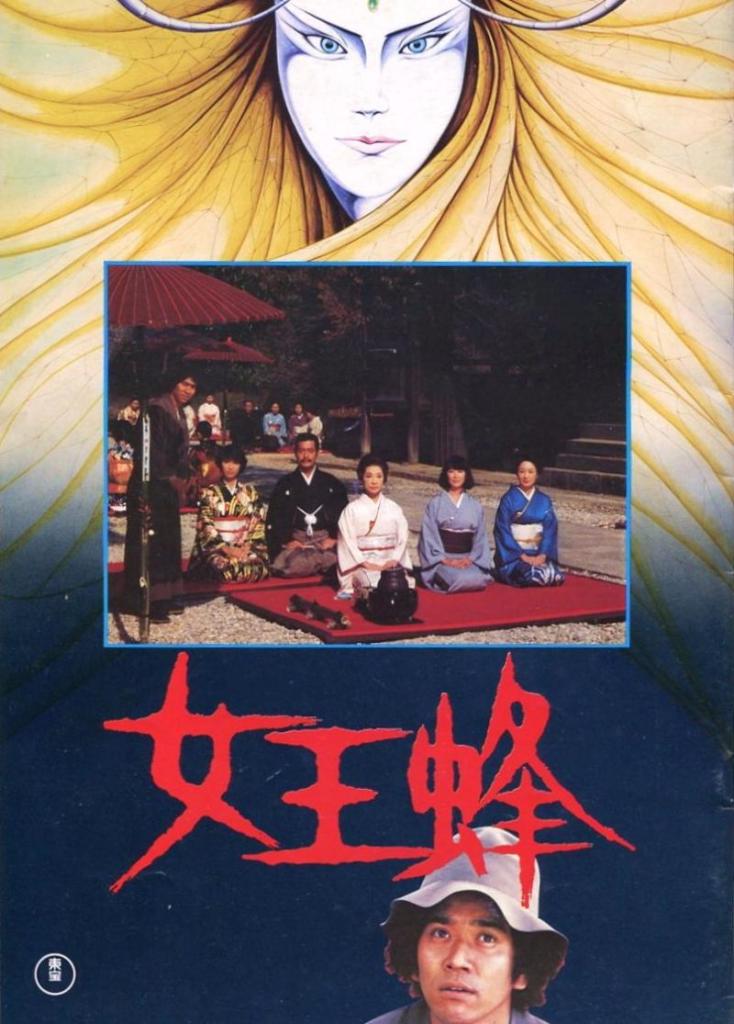
Queen Bee (女王蜂, Kon Ichikawa, 1978)

queen beeKon Ichikawa may be best remembered for his mid career work, particularly his war films The Burmese Harp and Fires on the Plain as well as his melodramas Ototo and Bonchi, but he was one of the few directors who was prepared to keep one foot in the commercial arena as well as making more personal, “artistic” efforts. For this reason he was able to go on working through the creatively dry ‘80s when other big name directors, in particular Akira Kurosawa, found themselves locked out of the cinematic arena in their native country. Ichikawa’s biggest box office success was in fact the literary adaptation of a popular mystery novel The Inugamis (which he actually remade in 1999 as his final feature film). 1978’s Queen Bee (女王蜂, Jooubachi) is one of five films that Ichikawa made based on the work of popular mystery writer Seishi Yokomizo which feature the eccentric detective Kousuke Kindaichi.

In many ways, Queen Bee is the perfect synthesis of European and Japanese mystery styles as it technically plays host to its strange detective but places him off centre, more as an onlooker to events than the protagonist. Though it follows something like a classical Agatha Christie approach, it also brings in the Japanese love of puzzles and the importance of long buried secrets bubbling to the surface and coming back to haunt everyone involved in the original incident. It’s also important to note that Ichikawa is deliberately playing up the camp comedy of the situation too as he makes his bumbling policeman a definite figure of fun as well as sending Kindaichi tumbling into a pond among other oddly comic elements for this multiple murder mystery.

The story itself begins in 1932 as two students, Hitoshi and Ginzo, leave a small town where they’ve been learning all about the local folklore. Hitoshi later returns under less than pleasant circumstances as he’s come to get his grandmother’s ring back after giving it to a local girl, Kotoe, whom he’d agreed to marry, only his mother objects so now he wants to hold off a bit. Unfortunately this is not a good idea as Kotoe is already pregnant with his child. Sometime later Hitoshi dies in mysterious circumstances and we flash forward to 1936 when the daughter, Tomoko, is three years old and Ginzo comes back to propose to Kotoe.

Now we fast forward to 1952 when Tomoko is about to turn 19. Kotoe has died, Tomoko has been adopted by Ginzo, and three folklore loving students have set their eyes on her as a bride. Unfortunately, one of these suitors also winds up getting killed with Tomoko the prime suspect and it looks like history may be about to repeat itself.

Queen Bee may be a more mainstream effort, but Ichikawa films in a noticeably anarchic fashion with extremely strange cuts and juxtapositions, not to mention the almost parodic tone of the film. He adopts a fairly perverse approach to the entire enterprise even allowing his veteran star Tatsuya Nakadai to play the 20 year old version of himself in the brief 1930s scenes which is, it has to be said, something of a mistake. As fine an actor as Nakadai is, playing a 20 year old at 50 is a stretch and one which serves as a point of alienation during the deepest historical layer of the film.

As is usual with Japanese mysteries, the plot relies on the solution of various puzzles, riddles and the mechanics of crime much more so than the human psychology and importance placed on motive that dominate Western detective tales. As well as the long buried secrets, Queen Bee brings in some commentary on the place of social class in the post-war world, the folly of misplaced love, and how the failure to act honestly and in the best interests of others by putting your own feelings aside can cause extreme repercussions not only in your own future but those of generations to come. Once again, only by exposing previously unexpressed emotions and lies both accidental and deliberate can the trauma be resolved and crises come to an end.

Queen Bee is a strange film which plays up its European detective novel atmosphere complete with the drawing room lecture that has become a hallmark of the genre but also adds in a layer of irony and an almost winking jokiness that make for an oddly amusing tone. The mystery element itself is satisfying enough to keep even the most seasoned crime fan guessing with plenty of red herrings and misinformation along the way. That said, Queen Bee is also very much of its time and perhaps fails to offer much more than an enjoyably old fashioned detective story, albeit one which is anchored by strong performances from its veteran cast.


Unsubtitled trailer: