Narratage (ナラタージュ, Isao Yukisada, 2017)

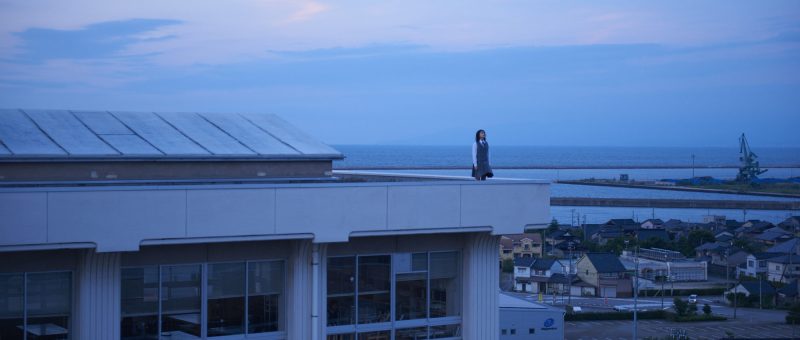
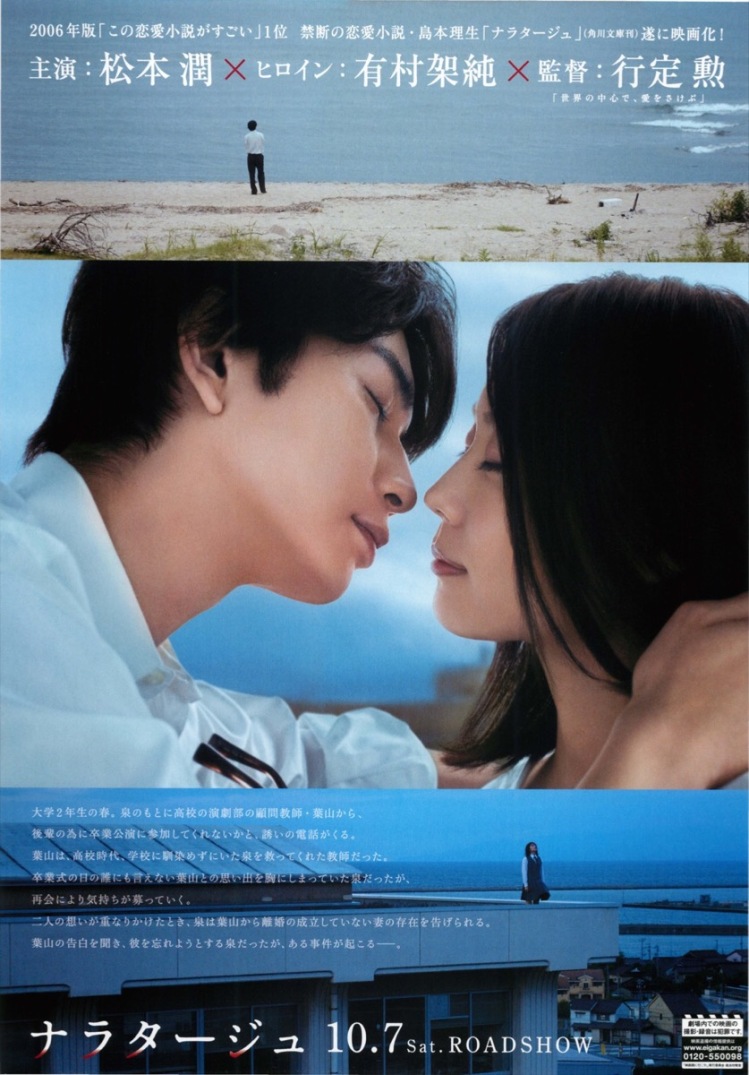
Narratge poster 1Isao Yukisada made his name with the jun-ai landmark Crying Out Love in the Centre of the World back in 2004. Adapted from a best selling novel (which had also been adapted as a TV drama around the same time), Crying Out Love was the epitome of a short lived genre in which melancholy, lovelorn and lonely middle-aged heroes looked back on the lost love of their youths. Jun-ai has never really gone away though it might not be so popular as it once was, but the focus has perhaps shifted and in an unexpected direction. Narratage (ナラタージュ), once again adapted from a best selling novel though this time one by an author still in her early 20s when the book was written (incidentally smack in the middle of the jun-ai boom), is another sad story of frustrated love though in contrast to the jun-ai norm, its tragedies revolve around loves which were tested and subsequently failed, leaving the broken hearted romantics trapped within their own tiny bubbles of nostalgia.

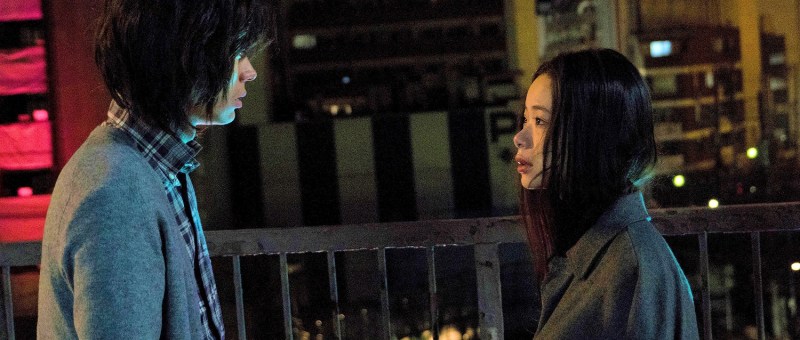
The heroine, Izumi (Kasumi Arimura), narrates her tale from three distinct periods of her young life speaking from the perspective of her still young self now living as a lonely office worker. A lonely high school misfit, she found herself drawn to a sensitive teacher, Hayama (Jun Matsumoto), who rescued her from despair through an invitation to join the drama club. Relying on him ever more, she began regularly visiting his office for guidance and the pair bonded over their shared love of cinema. On graduation Izumi decided to declare her love, but earned a sad story in return and resolved to move on with her life. Then in the second year of university, she gets an unexpected phone call, calling her back to help out with a play at the school’s culture festival.

Yukisada begins with a rather unsubtle metaphor in which the older Izumi lovingly fondles an antique pocket watch which has long since stopped ticking. 20-something Izumi apparently has very little in her life, a pang of melancholy envy passing her face as she talks to a friend on the phone at home with a new baby while she prepares for another lonely night of (unnecessary) overtime. Where the heroes of jun-ai obsess over true love lost, Izumi struggles to face the fact that the man she loved did not, could not, love her in the way that she wanted him to. There is, of course, something deeply inappropriate in the awkward relationship between Izumi and Hayama who are a teenage student and her teacher respectively – connect as they might, there are moments when a line is crossed even while Izumi is still a schoolgirl which is in no way justified by the presentation of their (non)romance as a natural consequence of their mutual suffering.

Hayama and Izumi are presented as equals but they aren’t and never could be. As if to continue the chain, university era Izumi gets a love confession of her own from old classmate Ono (Kentaro Sakaguchi) who has apparently been carrying a torch for her all this time. Ono’s love, like Izumi’s, is originally generous and altruistic – he understands her unrequited affection for Hayama and perhaps even sympathises, but once Izumi decides to try and make things work with someone who loves her it all starts to go wrong. Ono is jealous, possessive, desperate. He demands to inspect her phone, insists she erase Hayama from her mind and devote herself only to him. Izumi, sadly, goes along with all of this, even when her attempts to turn to Ono for protection when afraid and alone are petulantly refused. When the inevitable happens and she decides to try and sort things out with Hayama, Ono tries to exert an authority he doesn’t really have, ordering her to bow to him (literally), and harping on about all the hard work he personally has put into their relationship which, he feels, she doesn’t really appreciate while berating her for not really loving him enough. As it turns out, neither of Izumi’s romantic options is particularly healthy or indeed viable.

At one particularly unsubtle moment, Izumi (alone) attends a screening of Naruse’s Floating Clouds – another film about a couple who fail to move on from a failed love affair though their struggle is ultimately more about the vagaries of the post-war world than it is about impossible love. Meanwhile the school play is to be A Midsummer Night’s Dream which is also about misplaced and unrequited loves which spontaneously sort themselves out thanks to some fairy magic and a night in a confusing forest. No magic powers are going to sort out Izumi’s broken heart for her. Like the pocket watch, her heart has stopped ticking and her romantic outlook appears to be arrested at the schoolgirl level. She and Hayama maybe equally damaged people who save and damn each other in equal measure, but the central messages seem to be that difficult, complicated, and unresolved loves and the obsessive sadness they entail produce nothing more than inescapable chains of loneliness. Simplistic as it may be, Izumi at least is beginning to find the strength to set time moving once again prompted perhaps by another incoming bout of possibly requitable love lingering on the horizon.


International trailer (English subtitles)

It’s Only Talk (やわらかい生活, Ryuichi Hiroki, 2005)

It's Only Talk poster“I’m scared of wanting to die” the heroine of Ryuichi Hiroki’s It’s Only Talk (やわらかい生活, Yawarakai Seikatsu) confesses during an awkward car ride with a childhood friend, perhaps one of the only absolute truths she offers in her infinite quest to escape existential loneliness through the false connection of mass tragedy. Yuko (Shinobu Terajima) tells people that her parents died in the Kobe Earthquake, but they actually died in a house fire a few years later. She tells people that her best friend died in 9/11 (she died in New York in the early 2000s but in a car accident), and that her former lover died during the sarin gas attacks on the Tokyo Subway (this one might even be true, but who really can say). She lies, not about facts only details, in the belief that her private pain is somehow not relatable enough and if she ties herself into a wider sense of national or global tragedies then others can share in her grief and she won’t be so alone in her sadness.

Following the deaths of her parents when she was 29, Yuko was diagnosed with bipolar and has been in and out of hospitals for the past six years. Now 35, single, and unemployed, Yuko has found herself cast out from mainstream society and fulfils her (minimal) needs for human connection through meeting “perverts” on specialist message-boards. Through one of these illicit connections she meets K. (Tomorowo Taguchi) – a 50-year-old husband and father who drives her all the way out to provincial suburb Kamata to ensure the liaison (which extends only to watching a porn film together in a public cinema and a cup of tea afterwards) remains secret. Taken with the suburb’s retro charm and unassuming air of faded grandeur, she decides to move and starts life over again in the somewhat nostalgic past which brings her into contact with two men from her youth and another still battling his own.

A portrait of inescapable loneliness, Yuko’s life is both as frozen as the photographs she takes of local landmarks to post on her fledgling blog and permanently in flux as she tries to navigate the constantly shifting tides of her condition. After moving to Kamata she unexpectedly reencounters an old university friend who recalls their spirited discussions of world politics from the fall of the Berlin Wall to Tiananmen Square when they were both bright and engaged students. Like Yuko, Honma (Shunsuke Matsuoka) has wound up in Kamata as a kind of retreat from the harshness of life in Tokyo. Unwilling to embrace life in the public eye, he’s decided to concentrate on a career in local politics instead hoping to work his way into the ministry of education as a civil servant. He is also unmarried – partly as a result of debts accrued during unsuccessful electoral campaigns, and, as we later find out, erectile dysfunction. Honma reintroduces Yuko to another old friend, “Bach” (Nao Omori) who has gone the opposite way and become a venture capitalist but apparently still holds a torch for the young Yuko all these years later. Meanwhile, she’s been meeting up with a lonely yakuza, Noboru (Satoshi Tsumabuki), who also has bipolar and longs for the world of childhood safety and innocence he associates with the strange Godzilla tyre park Yuko photographed and put on her blog.

The most significant relationship in her short-lived period of connection is in fact with her childhood friend and cousin, Shoichi (Etsushi Toyokawa), who abruptly turns up at her flat unannounced. Shoichi, also depressed but perhaps in a less extreme way and hiding it much better, left his marriage because he felt pushed out when the baby was born and then ran after a younger woman who went to Tokyo but ultimately did not want him. The two share a strange sort of intimacy born of their long history which is almost fraternal but laced with minor awkwardness and ancient resentments. Though his wife berated him for his refusal to help out at home, Shoichi tenderly cares for Yuko just as she is at her most vulnerable having entered an extreme depressive episode – washing her hair, doing her laundry, and picking up her medication while trying to remain patient even when Yuko rejects his gestures of help. The giving and receiving of care provides each with a new sense of purpose and connection but their paths are perhaps set on different courses in the immediacy of the need to deal with the unresolved past.

Waking up from her depression, Yuko discovers life has delivered her yet another cruel blow, witnessing others moving on in one way or another and leaving her once again all alone marooned on the sidelines. Yet she lives on, “scared of wanting to die” but daring to remove the towel which hides an ugly scar from a previous suicide attempt to revisit a public bath which holds a memory perhaps both happy and sad. Melancholy in the extreme, It’s Only Talk is not a tragedy but an aching portrait of spiritual loneliness in a society only too happy to exclude.


Original trailer (no subtitles)

The Devil’s Island (獄門島, Kon Ichikawa, 1977)

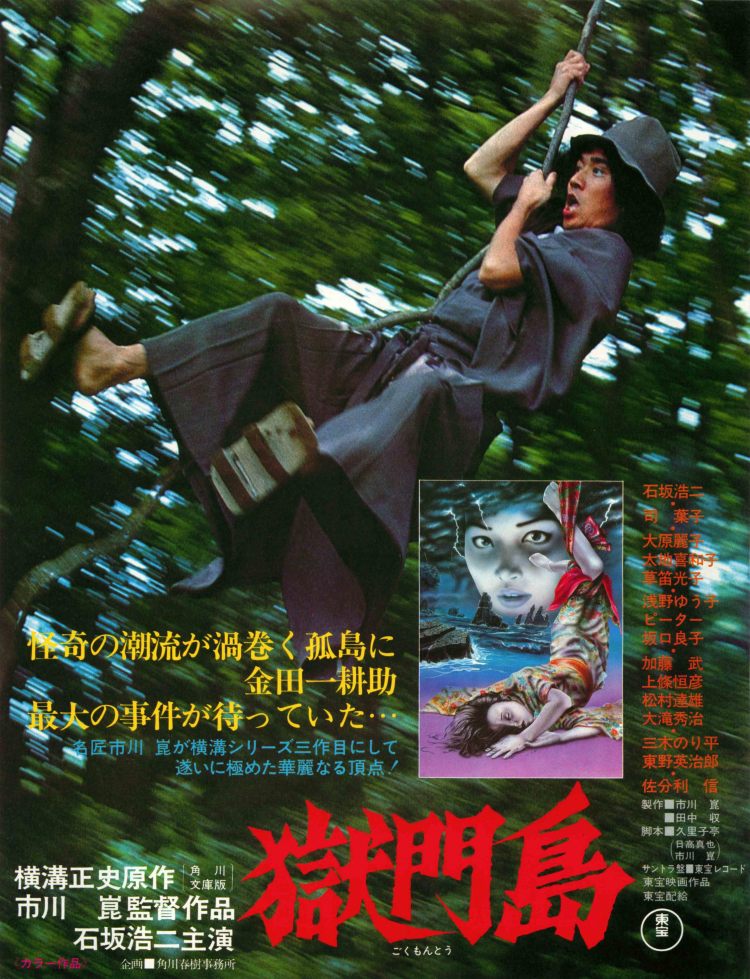
Devil's Island posterKon Ichikawa revisits the world of Kosuke Kindaichi for the third time in Devil’s Island (獄門島, Gokumon-to). Confusingly enough, Devil’s Island is adapted from the second novel in the Kidaichi series and set a few years before Ichikawa’s previous adaptation The Devil’s Ballad (the twin devils are just a coincidence). As with his other Kindaichi adaptations, Ichikawa retains the immediate post-war setting of the novel though this time the war is both fore and background as our tale is set on profane soil, a pirate island once home to Japan’s most heinous exiled criminals, which is to say it is the literal fount of every social failing which has informed the last 20 years of turbulent militarist history.

In 1946, Kindaichi (Koji Ishizaka) travels to Kasaoka to catch the ferry to the island. On the way he runs into a demobbed soldier hobbling along on crutches only to catch sight of the man quickly picking his up crutches and running across the railway tracks when he thought no one was looking. Kindaichi is in luck – before he even reaches the boat he runs into the very man he’s come to see, Reverend Ryonen (Shin Saburi), for whom he has a message. Posing as a fellow soldier, Kindaichi reveals he has a “last letter” from a man named Chimata who sadly passed away right after the cessation of hostilities having contracted malaria. Chimata, as we later find out, was the legitimate heir of the island’s most prominent family. Kindaichi chooses not to reveal his true purpose, but the truth is that Chimata suspected his death would put his three younger sisters in danger from various unscrupulous family members attempting to subvert the succession.

Your average Japanese mystery is not, as it turns out, so far from Agatha Christie as one might assume and this is very much a tale of petty class concerns, island mores, and changing social conventions. The extremely confusing island hierarchy starts with the head of household who doubles as the head of the local fishing union and then shuffles out to the branch line and brassy sister-in-law Tomoe (Kiwako Taichi) who is keen claim all the authority she is entitled to. The old patriarch, Yosamatsu (Taketoshi Naito), went quite mad at the beginning of the war and is kept in a bamboo cage in the family compound where he screams and rails, only calmed by the gentle voice of Sanae (Reiko Ohara), a poor relation raised in the main house alongside her brother Hitoshi who hasn’t yet returned from the war. Aside from Yosamatsu, the absence of the two young men means the main house is now entirely inhabited by women, looked after by veteran maid Katsuno (Yoko Tsukasa).

Then again, Japanese mysteries hinge on riddles more than they depend on motives and there are certainly plenty of those on this weird little island where they don’t like “outsiders”. Ichikawa hints at the central conceit by flashing up haiku directly on the screen along with a few original chapter headings for Kindaichi whose eccentricities might seem less noticeable in such an obviously crazy place but strangely seem all the more overt, his trademark dandruff falling like rain from his tousled hair. It has to be said that Kindaichi fails in his otherwise pure hearted aims – he doesn’t make a great deal of effort to “save” the sisters and only attempts to solve the crimes as they occur, each one informing the next. This time around he gets trouble from both irritatingly bumbling detective Todoroki (Takeshi Kato) and his assistant Bando (Kazunaga Tsuji) , and the local bobby who immediately locks Kindaichi up and declares the crimes solved on the grounds that they only started happening after Kindaichi arrived.

Meanwhile, there are rumours of an escaped “pirate” running loose, demobbed soldiers, and a host of dark local customs contrasting strongly with the idyllic scenery and the strange “pureness” of this remote island otherwise untouched by the war’s folly save for the immediate events entirely precipitated by the absence of two young men taken away to die on foreign shores. Though the various motives for the crimes are older – shame, greed, classism, a bizarre dispute between Buddhists and Shamans, none of this would have been happening if the war hadn’t stuck its nose into island business and unbalanced the complex local hierarchy. Tragically, the crimes themselves all come to nought as a late arriving piece of news renders them null and void. Just when you think you’ve won, the rug is pulled from under you and the war wins again. Ichikawa opts for a for a defiantly straightforward style but adopts a few interesting editing techniques including fast cutting to insert tiny flashbacks as our various suspects suddenly remember a few “relevant” details. This strange island, imbued with ancient evils carried from the mainland, finds itself not quite as immune from national struggles as it once thought though perhaps manages to right itself through finally admitting the truth and acknowledging the sheer lunacy that led to the sorry events in which it has recently become embroiled.


Original trailer (no subtitles)

The Devil’s Ballad (悪魔の手毬唄, Kon Ichikawa, 1977)

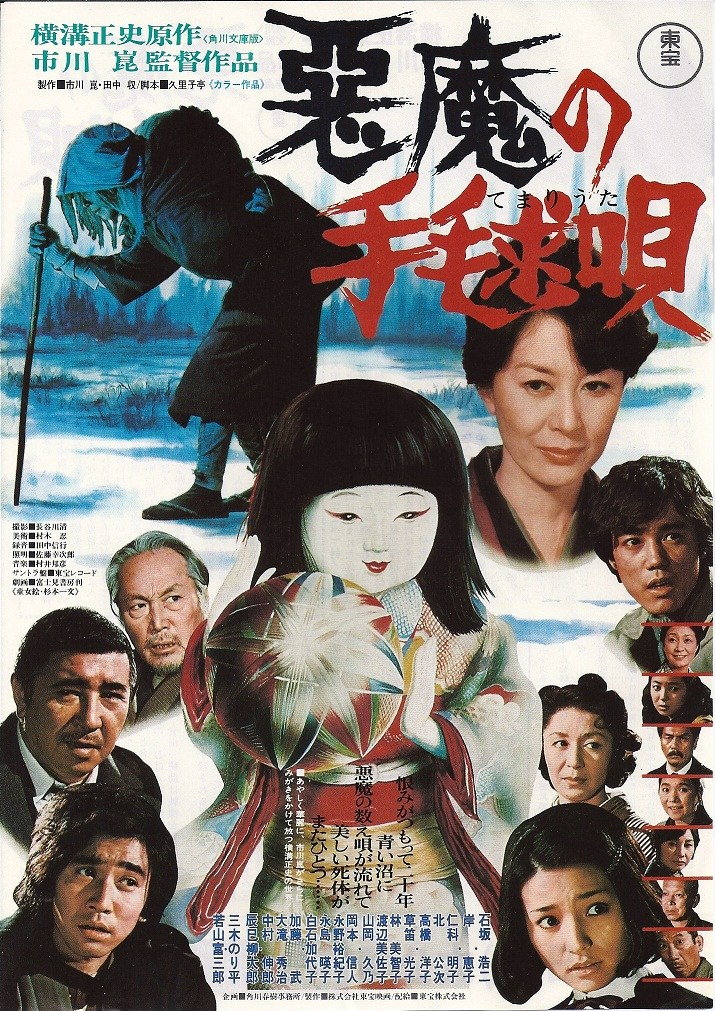
Devil's Ballad posterA year after his box office smash The Inugami Family, Kon Ichikawa returns to the world of eccentric detective Kosuke Kindaichi with The Devil’s Ballad (悪魔の手毬唄, Akuma no Temari Uta). Like many a Kindaichi mystery, Devil’s Ballad finds him called upon to delve back into the past to satisfy an ageing detective’s anxiety about an old case, only to be faced with a series of new ones as a consequence. This time, however, the mystery leans less on buried secrets than deeply held grudges, betrayals, and lingering feudal feuds as the post-war society tries and fails to free itself from ancient oppressions.

The film opens with a tryst between two adolescent lovers in the ominously named “Devil’s Skull Village” in 1950. Yasu (Yoko Takahashi), the girl, is at pains to let her boyfriend, Kanao (Koji Kita), know that she is keen to take the relationship to the next level but he is old fashioned and wants to wait until their union is formalised. The pair are interrupted by some of their friends who are in the middle of planning a celebration for a visit from a girl who moved to the city, Chie (Akiko Nishina). Meanwhile, Kindaichi (Koji Ishizaka) has arrived at the inn owned by Kanao’s mother Rika (Keiko Kishi) on invitation from a retired policeman, Isokawa (Tomisaburo Wakayama), who wants Kindaichi to look into the murder of Rika’s husband twenty years ago. Isokawa, then a young rookie, is convinced that Rika’s husband was not the victim but the murderer and the corpse actually belonged to another man entirely – Onda, a drifter who defrauded half the village with a wreath making scam.

Rika and her children – 20-year-old Kanao and his younger sister Satoko (Eiko Nagashima) who has prominent facial birthmarks and rarely leaves the house, came to the village with her husband and are therefore slightly divorced from the longstanding social rivalries. The village has two noble families – the Yuras and the Nires. Feeling the need to modernise, the Nires bet everything on vineyards and it paid off. The Yuras, by contrast, were defrauded by Onda’s wreath scam and lost their fortune and social standing. Yasu, Kanao’s girlfriend, is a daughter of the Yuras, but the Nire’s have been petitioning Rika for quite some time to have her son marry their daughter, Fumiko (Yukiko Nagano), who also has a crush on him (though this is largely irrelevant to her father’s dynastic ambitions). When the younger generation start getting bumped off in ways eerily similar to a local folk song, Kindaichi and Isokawa are on the case, wondering if these new murders have anything to do with their old one.

Despite its 1950 setting, Devil’s Ballad is unusual in resolutely making an irrelevance of the war which only receives a brief mention as an explanation for why some of the case files have been destroyed and for why marriage is such a hot button issue given the lack of men and abundance of women. Nevertheless, the crimes span a turbulent 20 years of Japanese history with the original murder taking place in the early ‘30s during a period of economic instability following the Manchurian Incident. In the socially conservative pre-war era, it seems Onda also got around and may have fathered several illegitimate children with women in the village, some of them noble, some not. These buried secrets seem primed to bubble to the surface now that the children are coming of age and marriage again becomes an issue as worried parents try to think of acceptable ways to block potentially “inappropriate” matches without sending their children off into ruinous elopements or tipping off the wrong people that their kids may not be their kids.

The crimes themselves, old fashioned as they are, are partly reactions to a changing society. We discover that the reason Rika and her husband were forced to come back to the village was that their showbiz careers were stalling – she was a vaudeville performer specialising in shamisen, and he a “benshi” (narrator of silent films) who became convinced his job was obsolete after witnessing a subtitled print of Morocco. Likewise, the two rival families cannot let go of their petty provincial privileges, and as Kanao angrily snaps back at his mother, Japan is now a democratic country and he is free to choose his own wife at a time of his own choosing with or without parental blessing. This remote village is perhaps isolated from the privations of the post-war world but it’s also stuck in the past, hung up on past transgressions and unable to move forward into the new era. However, the primary motivations for murder are as old as time – guilt, humiliation, and self preservation.

Ichikawa keeps things simple but splices in a few strange, avant-garde sequences of kokeshi dolls menacingly bouncing balls coupled with shifts to black and white, fast-paced reaction shots, and stuttering still frame sequences all while Kindaichi showers innocent passersby with his famous dandruff, the idiot police officer continues to offer ridiculous theories while his sergeant dutifully follows him around, and the local bobby perfects a line in hilarious pratfalls. Overlong at two and a half hours and falling prey to the curse of the prestige crime drama in spoiling its mystery through casting, the Devil’s Ballad may not be the best of the Kindaichi mysteries but offers enough of a satisfying twist to prove worthy of the Kindaichi name.


Original trailer (no subtitles)

Seven Years of Night (7년의 밤, Choo Chang-min, 2018)

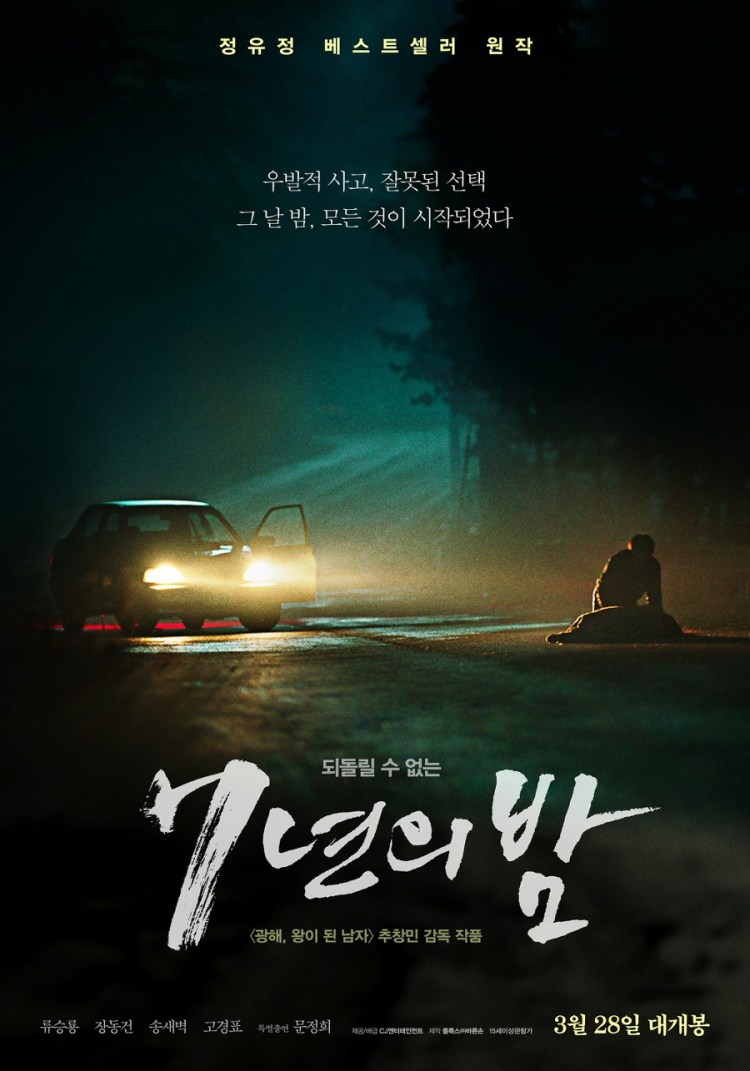
Seven Years of Night posterThe sins of the father are visited upon the son. Cycles of abuse and fatalistic retribution are a persistent theme in Korean cinema but Choo Chang-min plunges them to new depths of tragic inevitability in his adaptation of the best selling novel by Jeong You-jeong. The biblically titled Seven Years of Night (7년의 밤, 7 Nyeonui Bam) pits two visions of failed fatherhood against each other as two broken men attempt to restore order to their lives but damn their children in the process through their own refusal to engage with past trauma.

In 2004, security guard Hyun-su (Ryu Seung-ryong) buys an apartment he can’t afford in order to placate his wife who is in constant worry over their precarious financial circumstances. Hyun-su can’t really manage the interest payments on the mortgage so the family will be renting out the fancy apartment and moving to a remote house provided by his new employers at a hydroelectric dam. On the day that he was supposed to go and check over his new accommodation, Hyun-su partied hard with his former colleagues and set off drunk, getting into an altercation with another driver on the way. Lost in a thick fog and fuzzy from the drink, he hits a little girl who ran out in the middle of the road, panics and hides her body, planning to forget any of this ever really happened.

Forgetting is not, however, something anyone is permitted to do in Choo’s world of elemental retribution in which the buried past is always destined to make its way to the surface sooner or later. The lake around the dam was once home to a village which was sunk, intact, to make way for its construction. Locals fear the water with superstitious dread, believing the lake sucks the souls of men and is polluted with something darker and older than industrial corruption. Attempting to drown the inconvenient may have its appeal, but nothing stays underwater for long and the harder you try to push it down, the faster it will rise.

Unfortunately for Hyun-su, the father of the girl he has killed, known to all as Dr. Oh (Jang Dong-gun), is not a man to be messed with. Dr. Oh, apparently an upscale dentist in the city, rules over all with a tyrannical authority and, as he owns almost all the land around here, enjoys a near feudal level of deference from the villagers. Violent and controlling, Oh’s wife, who describes him as the Devil incarnate, has recently escaped and gone into hiding leaving their small daughter Se-ryung (whose name is coincidentally the same as that of the sunken village) alone to face his wrath. Doubtless, Dr. Oh was raised with an authoritarian father of his own and is unable to see beyond himself and understand that his reign of terror prevents him from achieving the very thing he craves – the love of his wife and daughter.

Desperate for revenge, needing to prove that this is all someone else’s fault to avoid admitting that his own violence drove his wife from him and his daughter into the path of another violent man, Dr. Oh vows poetic retribution by targeting the life of Hyun-su’s innocent son, Seo-won (Go Kyung-pyo). Increasingly disturbed by his crime, Hyun-su dreams of his own father – a violent drunk with PTSD from a pointless war whose death he longed for and who he swore never to become, only to be confronted with a vision of himself as a small boy in the face of his own son watching his father strike his mother in anger. Hyun-su sees. He sees what his father passed to him and what he fears he will pass to his own son. He wants to break the curse, but doesn’t know how. 

Still, Hyun-su would drown the world to save his son even if he hates him for it. Seo-won, left with a series of dubious legacies, struggles to emerge from the shadow of his father’s crimes, is disowned by his family as the son of a murderer and cast out from regular society as one polluted by murderous blood but eventually saves himself through skills learned from a second father, himself hoping to atone for a selfish decision that led only to tragedy. Deliberately disjointed and self-reflexive, Seven Years of Night is a dark tale of supernatural dread masking a horror all too real in the impossible task of exorcising the living ghost of defeated male pride.


Seven Years of Night was screened as part of the 2018 London Korean Film Festival.

International teaser trailer (English subtitles)

Asako I & II (寝ても覚めても, Ryusuke Hamaguchi, 2018)

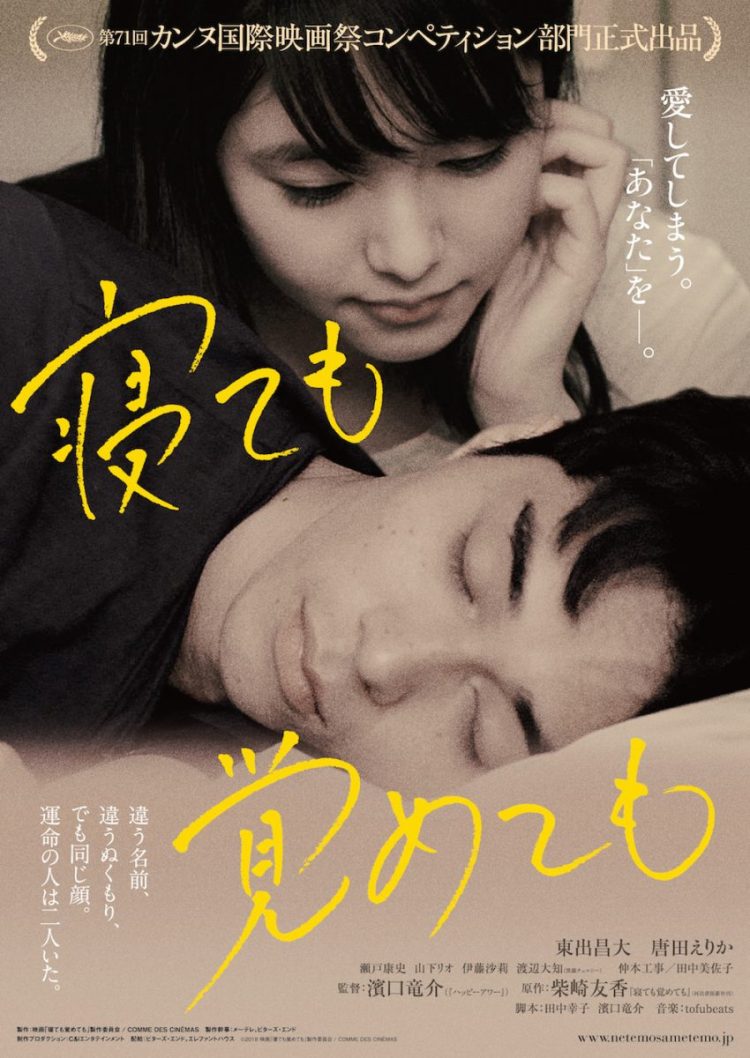
asako I & 2 posterDualities define the perpetually submerged worlds of Ryusuke Hamaguchi’s Happy Hour followup Asako I & II (寝ても覚めても, Netemo Sametemo). Waking and sleeping, fantasy and reality, past and present, presence and absence, love and sadness. Asako (Erika Karata), an ordinary young woman of the contemporary era, finds herself in a similar position to many of the heroines of contemporary Japanese literature in that she has no idea what she really wants out of life and is essentially torn between a series of idealised lives snatched from movies and magazines. Yet she is also haunted by a broken heart, arrested in a state of perpetual adolescence thanks to an early disappointment in love in which remains horribly unresolved.

As a university student in Osaka, Asako attends a photo exhibition dedicated to one of the few books put out by legendary Japanese photographer Shigeo Gocho titled “Self and Others”. Fascinated by an eerie picture of two little girls dressed identically, one slightly taller than the other, Asako’s attention is eventually caught by a striking young man. She leaves the exhibition and follows him until he eventually turns and faces her. Firecrackers some teenagers had been struggling to light suddenly explode around his feet. He strides over to her, asks for her name, and then leans in for a kiss – at least, that’s the way he later tells it to a disbelieving friend who points out that “no one meets like that”. An arty type in dungarees and shaggy hair, the young man’s name is “Baku” (Masahiro Higashide) – he uses the character for wheat (his dad was big into grains) but it’s also a homonym for explosion which a is key indication of the unpredictable excitement he comes to represent for Asako as her uni best friend Haruyo (Sairi Ito) attempts to warn her by insisting that Baku is the heartbreaking type and whatever she has with him is destined to end in tears.

Haruyo’s prediction comes to pass when Baku steps out one day to buy some shoes and never returns. A brokenhearted Asako makes her way to Tokyo and begins working a cafe but two and a bit years later, she is stunned to find “Baku” wearing a suit and working in an office. He doesn’t remember her and says his name’s Ryohei, but Asako can’t shake the association which is both attractive and repellent in equal measure. Ryohei is smitten, he felt the connection too, but Asako doesn’t quite know what to do with this unfortunate coincidence.

Events repeat themselves with only mild distortions – Asako and Ryohei attend another Gocho photo exhibition though this time with Asako’s Tokyo best friend, Maya (Rio Yamashita). Rather than a motorcycle accident, Ryohei and Asako find and comfort each other after the 2011 earthquake and eventually become a couple, move in together, and even get a cat. Asako begins to fall for Ryohei, but can’t be sure her love for him isn’t really love for Baku refracted through a different lens. Baku, a man with a wandering heart, once told her he would always return no matter how long it might take. There’s a part of Asako that’s always waiting, held back, afraid to move and unwilling to acknowledge the death of her younger self as immortalised in the image of herself with Baku.

When Haruyo runs into Asako and Ryohei unexpectedly in Tokyo, she gives us our first indication that Ryohei really does look like Baku and the association isn’t just a projection of Asako’s romantic anxieties. Haruyo’s first words to Asako are that she hasn’t changed – they’re intended as a compliment, but Asako bristles. She feels as if she’s moved forward, matured, is preparing to enter a comfortable middle age with Ryohei at her side but deep down she knows she hasn’t. She’s still the naive student pining for a lost love that never cared enough about her to resolve itself. She worries she’s been playacting and that her relationship with Ryohei isn’t “real” even if she cares about him enough to have her feeling guilty for this mild form of betrayal.

Later, offered another possibility, Asako feels as if her life with Ryohei has been like a dream, or perhaps the only waking moment of her life. When Ryohei introduces a work friend to Maya as an excuse to get close to Asako, they watch a video of her performing a scene from Chekhov’s Three Sisters – a play famously about self delusion in which the fierce belief in an impossible future becomes the only thing which makes life possible. The climactic earthquake hits just as Ryohei is preparing to watch Maya perform in Ibsen’s The Wild Duck – the play which lays bare the playwright’s key tenet, that if you take away a man’s life lie you take away his happiness. Ryohei’s friend Kushihashi (Koji Seto) might rip into Maya’s “narcissistic” acting, denigrating her for attention seeking rather than baring her soul on stage, but Asako admires her determination and absolute certainty in her chosen goal, things she herself lacks.

Talked down by the soothing tones of practiced de-escalator Ryohei, Kushihashi is prompted to confess that his outburst was mostly out of jealously, that having given up his dreams of the stage for a conventional salaryman life he resented seeing someone else embrace theirs. Asako can’t decide which “dream” she wants – a life of fireworks and unpredictability with Baku for all the heartbreak it might bring, or one of gentle happiness with the good and kind Ryohei. A series of crises prompt her into making a clear choice – seemingly her first, though it may be too late. Real love is messy, painful, and ugly, but it’s beautiful too once you learn to see through the miasma of self delusion and romantic fantasy.


Screened as part of the 2018 BFI London Film Festival.

Original trailer (no subtitles)

Love At Least (生きてるだけで、愛, Kosai Sekine, 2018)

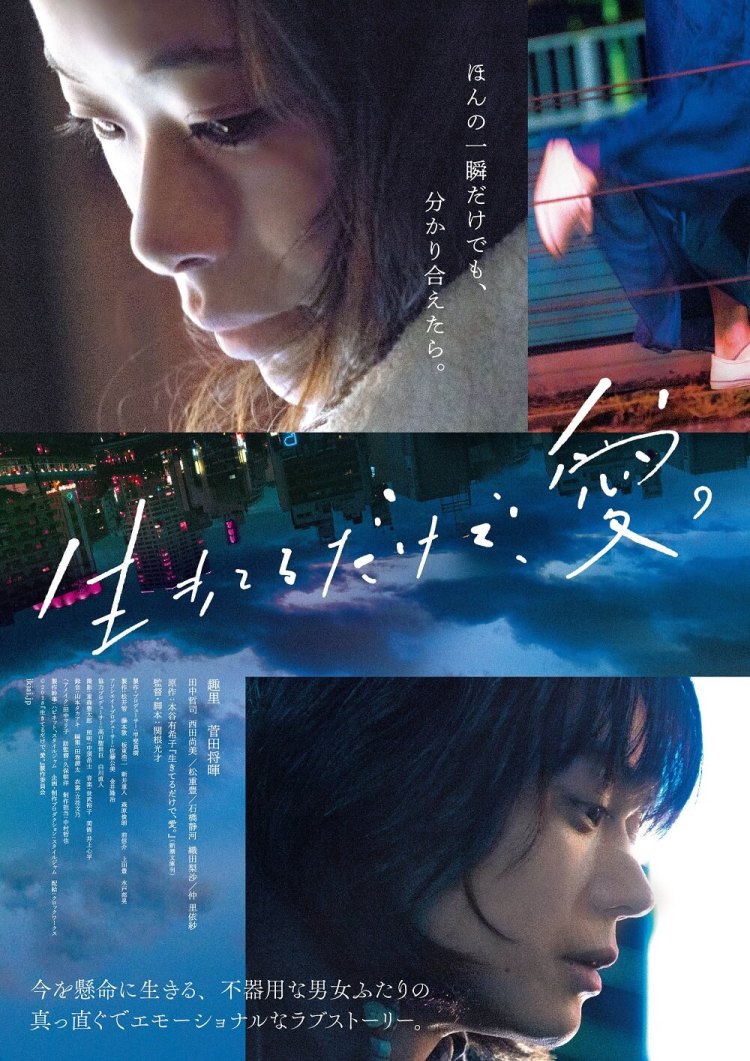
love at least posterFor some, it might be impossible grasp just how exhausting it can be merely being alive. For the heroine of Kosai Sekine’s debut feature Love At Least (生きてるだけで、愛, Ikiteru Dake de, Ai) , adapted from the novel by Yukiko Motoya (Funuke, Show Some Love You Losers!, Vengeance Can Wait), life is a draining cycle of waking and sleeping from which she fears she will never be able to free herself. An encounter with an equally atypical though perhaps more destructive young woman who orders her to leave her ordered existence so that she might step into the newly vacant space unwittingly helps her towards a moment of clarity though not the one it might at first seem.

Yasuko (Shuri) has vague memories of her mother dancing when the power went out but she herself is afraid of the dark. Looking back there’s a lot that makes sense to her about her mother’s behaviour and subsequently her own, but she hasn’t yet found a way to come to terms with her psychology. Yasuko has bipolar and is currently unemployed as she suffers with hypersomnia and hasn’t been able to hold down a job. She’s supported by her live-in boyfriend of three years, Tsunaki (Masaki Suda), who once dreamed of being a writer but now has a soul crushing job at a tabloid magazine writing salacious exposés about celebrities.

Yasuko is currently in the middle of a depressive spell and rarely leaves the house, spending most of the day asleep and exchanging texts with her somewhat unsupportive sister but her life is turned upside-down when she receives a surprise visit from a woman calling herself Ando (Riisa Naka) who drags her off to a nearby cafe and explains that she previously dated Tsunaki three years ago and now she wants him back. Viewing Yasuko as some kind of lesser human, Ando thinks she should see sense and leave Tsunaki to which Yasuko quite reasonably points out she has no income and so the request is quite unreasonable. Ando, however, is nothing if not thorough and it’s not long before she’s bamboozled both the cafe and Yasuko into taking her on as a part-time waitress.

Ando, an extremely unpleasant and manipulative woman, may be as Yasuko points out even “sicker” than she is but somehow she seems to make all around her do her bidding. Oddly enough, working at the cafe might actually be good for Yasuko – the cafe owner and his wife are kind and sympathetic people who seem to want to help and the other waitress was once a hikikomori so they might truly have some idea of what is involved in trying to help those in need. Ando, however, doesn’t quite seem to want her to succeed – she turns up at the cafe on a regular basis to feed Yasuko’s insecurities, pointedly asking her if she’s considered whether the problem might not just be that she’s “useless”, telling her that it’s pointless to try because she’ll inevitably fail, all of which seems quite counterproductive to her nefarious plan.

Then again, kindness and sympathy are not always quite as helpful as they seem. The cafe owner’s wife is nice, to be sure, but is fond of repeating the mantra that depression is caused by loneliness and that therefore making friends with the people at the cafe will make everything better. There might be something in her way of thinking, but it’s also a superficial approach to a more complicated problem and mild refusal to face some of the more serious aspects of Yasuko’s condition. When she’s started to feel as if the cafe is a safe space, told to think of herself as “family”, Yasuko lets down her guard and reveals one subject of her obsessive anxieties which just happens to be the washlet and the possibility of its sudden explosion should the water pressure go haywire. All of a sudden it’s as if the air changes, they look at her like she’s “mad” and the facade of their patronising desire to help is suddenly ripped away. Yasuko’s worst fear has been realised, they “see through” her and she feels as if there’s no hope any more.

Being seen through is perhaps something which Yasuko both fears and craves. Tsunaki, meanwhile, is suffering something similar only in a less extreme way. He also feared being seen through, but unlike Yasuko chose to isolate himself, rarely speaking and maintaining a healthy distance to the world. For this reason he’s been able to put up with his awful tabloid job, even excusing himself when an actress whose affair they’d exposed committed suicide because after all it was “nothing to do with” him despite the fact he was so obviously complicit. Increasingly conflicted, he begins to pull away from Yasuko, unwilling to overburden her with his own worries or perhaps more accurately equally afraid to expose them. Yasuko’s cruel barb that she wished Tsunaki’s “lack of character” would infect her hints at her mild frustration with his passivity, that his refusal to engage and habit of pussyfooting around her illness to avoid creating a scene are also contributing to her ongoing lethargy. The passive aggressive texts from her sister which seemed so unsupportive are perhaps less so as she is the only person willing to go toe to go with her and suddenly Yasuko’s meanness towards her outwardly patient and caring boyfriend reads more like provocation, as if she’s trying to make him respond rather than allow him to continue enabling her inertia.

Being driven apart by their parallel crises eventually brings the pair back together again, closer to an emotional centre and reaching a brief moment of understanding. As Yasuko says, the connection may have been only momentary, but within that infinitesimal space she can perhaps find a life. The dark is not so scary after all. Anchored by an extraordinary performance from Shuri, Love at Least is a beautifully composed examination of the costs of modern living in which fragmentary moments of absolute connection become the only source of salvation in a world of broken dreams and hopeless futures.


Love At Least made its World Premiere at the 2018 Raindance Film Festival.

Original trailer (no subtitles)

Smaller and Smaller Circles (Raya Martin, 2017)

Smaller and Smaller circles poster“Time and forgetfulness are the allies of abusers” – a Catholic priest reminds his students as part of a history lesson regarding the supposedly bloodless revolution that led to the end of the Marcos regime. Festival favourite Raya Martin dials things back a little in adapting the award winning novel by F.H. Batacan, Smaller and Smaller Circles. Batacan’s novel is often described as the first real Philippine crime novel – something echoed in the ridiculous views of a lazy and self serving police officer who believes there are no serial killers in the Philippines, yet the Smaller and Smaller Circles of the title lay the blame for the heinous acts its centre not at the feet of an evil madman but at those of the society which so progressively damaged his soul as to render it irreparable.

Our hero is himself a priest. Father Gus Saenz (Nonie Buencamino) is a man of faith and compassion who, despite all the failings he can see in it, still believes the Church is the best way to help those in need. He is sickened and appalled by the institution’s intransigence when it comes to bad priests and is preoccupied by one in particular – Father Ramirez, whose inappropriate conduct with children he has doggedly reported for more than a decade only for him to continually escape punishment. In addition to the priesthood, Father Gus is also a teacher of philosophy and a forensic scientist who works as an occasional consultant to the local police. It is in this capacity that he comes to discover a series of murders involving young boys whose bodies were discarded on a local rubbish dump deprived of their hearts, genitals, and faces. With the assistance of his junior priest, Father Jerome (Sid Lucero), and a reporter (Carla Humphries) who was once his student, Gus attempts to solve the mystery behind this horrific series of murders before the killer strikes again.

Martin breaks with genre norms by giving us an immediate insight into the killer’s psychology as we witness the prelude to the killings while listening to his own explanations of why they must occur. The picture he paints of his childhood quickly frames his crimes as a murder of the self as the killer indulges in a compulsion to kill the weak, targeting teenage boys and stealing from them not only the breath of life but the spirit of it too. The first of our circles is the Church – the bad priests whose abuses are sanctioned by their organisation and mitigated by the “good” they leave behind. Father Ramirez was shuffled on and now works for a children’s charity but Father Gus’ attempts to warn the charity’s director fall on deaf ears and then cost him his funding. Only when Father Ramirez’ financial improprieties are discovered is his position finally questioned.

The second ring is poverty. All of these boys were poor and many of them were not identified right away because aside from their parents (if they had them) nobody was going to miss them. The film opens with a scene of children running over a rubbish dump and as the father of the first victim explains, his son was one of many who supported their struggling families by combing over the left overs of the better off looking for anything which might still be useful. Our third ring is bureaucracy – when Fathers Gus and Jerome meet the local councillor, they are surprised to find that she is efficient and committed, keen to do whatever it takes to look after her constituents even if it means going up against the Church or the wider government. However, she knew nothing of the murders and though she is quick to grant Father Gus all the access he needs, it is partly her own efforts to provide essential services to the poor which have enabled the crimes as those who claim to want to help others are really only helping themselves and wilfully turning those same mechanisms back on the people who need them most.

As a man of faith Father Gus does his best, refusing to give up on the killer, trying to ease his burden whilst in grave physical danger. Set in the Philippines of the late 90s, Smaller and Smaller Circles is filled with those still trying to come to terms with the traumatic past but finding its unpleasantness echoing in unexpected places. As such it finds unexpected resonance in the world of 2017 in which life is once again cheap and compassion thin on the ground.


Smaller and Smaller Circles is screening as part of the seventh season of Chicago’s Asian Pop-Up Cinema on 19th September at 7pm, AMC River East 21, plus introduction and Q&A with director Raya Martin.

Original trailer (English subtitles)

Downtown Heroes (ダウンタウンヒーローズ, AKA Hope and Pain, Yoji Yamada, 1988)

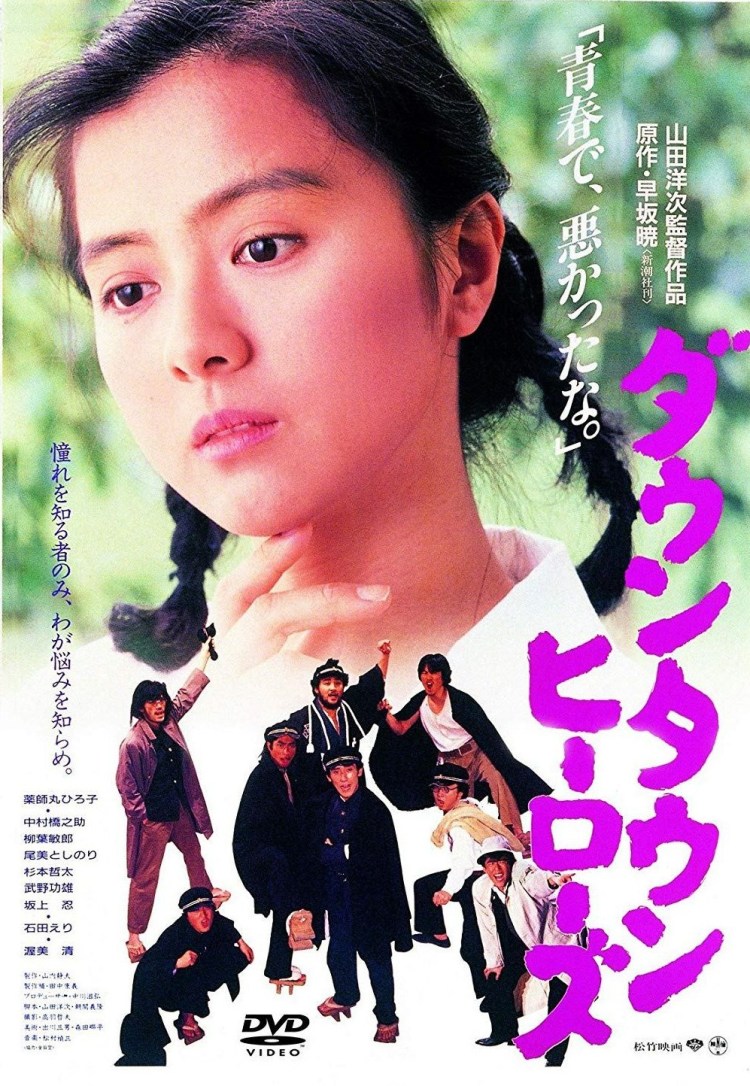
Downtown Heroes posterUnlike many of his contemporaries, Yoji Yamada was an infrequent visitor to the youth movie. Best remembered for his long running Tora-san series, Yamada’s later output is marked by an alternation of laughter and tears, running between raucous family comedies and poignant examinations of wartime loss. Set in the immediate postwar period, 1988’s Downtown Heroes (ダウンタウンヒーローズ, AKA Hope and Pain) adapts the autobiographical novel by Akira Hayasaka for a twin tale of endings and beginnings as a group of boys prepare to leave the Japan of their childhood behind and set out into the brand-new post-war future.

Our narrator for the tale is Hayasaka’s stand-in, Kosuke (Hashinosuke Nakamura), a sensitive young man from the mountains studying at the prestigious boys’ boarding school in town. The Matsuyama high school is one of the last to still be operating in Japan’s pre-war educational model. In fact, when the boys graduate the school will shut down in favour of the American 6-3-3 standard model of organising the educational system. Nevertheless, Kosuke and his friends enjoy what seems like a fantastically broad curriculum to modern eyes, much of which consists of classic German literature. Rather than their family names, the boys refer to each other with a series of nicknames inspired by their studies and have been heavily influenced by European left-wing political ideology. Accordingly, they are less than happy about the imposed American “reforms” and, paradoxically, the restrictions placed on their individual “freedom” by the “imperialist” occupation.

The central drama revolves around two episodes occurring one after another during the final year of high school. The first involves Kosuke’s friend Arles (Toshinori Omi) and a prostitute he helps to rescue from the red light district – Sakiko (Eri Ishida) was supposed to elope with a student from the school, but he didn’t show up and if the people from the brothel she was sold to find her she’ll be in big trouble. Her suitor turns out to be a fraud, but the boys are committed to saving her and hide Sakiko in their dorm, sharing their meagre rations with her before helping her escape to her home town. Meanwhile, the boys are also preparing for the very last culture festival the school will ever see at which they will present their adaptation of a classic German play. The snag is, the play needs a girl. Eventually the gang enlist the help of Fusako (Hiroko Yakushimaru) – a student at the girls’ school recently repatriated from Manchuria who also happens to be the young lady Kosuke had a meet cute with on the road and has been in love with ever since. Trouble brews when Gan (Tetta Sugimoto), the play’s director, falls in love with her too.

Told from the POV both of the old and the young Kosuke, the atmosphere is one of intense melancholy and inescapable nostalgia. Though these were times of hardship – rationing is fierce and intense, so much so that the school no longer serves meals at all on Sundays and the boys largely subsist on rice gruel, they were also times of joy and possibility. These are however youngsters in the best tradition of the sensitive young men of Japanese literature. They feel everything deeply, fully aware that they are living on the cusp of something new, which necessarily also means to be standing atop a grave. Their world is collapsing and the values they’ve been given (progressive though they seem to be) are about to be thrown out of the window. They have been taught that nothing is more important than their personal autonomy and that personal freedom is attained only through overcoming hardship, but their lives will increasingly be dictated by occupying forces and they feel themselves robbed of something without the right to reply.

Nevertheless their problems are also ordinary teenage ones of romantic crises and friendship dilemmas. Kosuke struggles with his love at first sight crush on Fusako but remains too diffident to say anything until it’s almost too late, while he also struggles to figure out what the most proper thing to do is when Gan reveals he is also in love with her. Gan, a sensitive writer, apparently burns with longing – so much so that he’s written a book long confession of love in apology for being unable to declare himself in person. Kosuke, a good friend, agrees to deliver the letter but both of them have neglected to consider Fusakao’s feelings so bound up are they in their own solipsistic dramas. Fusako was also struck by the love bug on her first meeting with Kosuke and has been patiently waiting for him to say something (as is the custom of the time). She is therefore doubly hurt and offended when he delivers a mini-tome on the theme of love from someone else before attempting to leave abruptly in a huff. Truth be told, there are few women who would enjoy being handed a thesis as a confession, but Fusako is really not in the mood to read one now.

Ending on a melancholy epilogue in which the old Kosuke looks on at field of young men playing American football before some others in running shorts brush past him and a young couple enjoy an evening walk, Yamada embraces the mild sense of deflation that has been building since the beginning. Young love faded and the dreams of youth were destined to come to nothing – not quite a tragedy, or perhaps only one of the ordinary kind, but food for the regrets of age all the same. The times were hard, and then they got better but somehow they were never so happy again. A youth drama indeed.


Original trailer (no subtitles)

Theme song “Jidai” performed by Hiroko Yakushimaru

Female Ninja Magic (くノ一忍法, Sadao Nakajima, 1964)

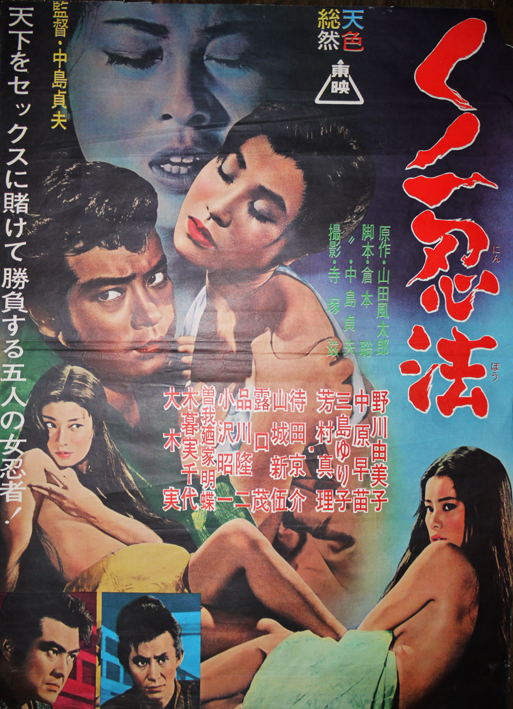
female ninja magic posterSadao Nakajima, a veteran director and respected film scholar, is most often associated with his gritty gangster epics but he made his debut with a noticeably theatrical fantasy tale of female ninjas and their idiosyncratic witchcraft. Adapted from a novel by Futaro Yamada, Female Ninja Magic (くノ一忍法, Kunoichi Ninpo) is an atypically romantic take on the ninja genre, infused with ironic humour and making the most of its embedded eroticism as a collection of wronged women attempt to change the course of history and mostly pay with their lives.

The night before the fall of Osaka castle in 1615, Sanada Yukimura (Eizo Kitamura) comes up with a cunning plan to ensure the survival of the Toyotomi clan. Following the death of Hideyoshi, his son Hideyori had inherited the title but he was sickly and had no children of his own. His wife, Princess Sen (Yumiko Nogawa), was not able to bear an heir and so Sanada has hit on an idea. He wants to send five women of Iga to Hideyori’s bed chamber in the hope that one of them will become pregnant and ensure the survival of the Toyotomi line. Princess Sen is very much in on the plan and hopes to raise the child herself. However, she is by birth a member of the Tokugawa which is where she is eventually sent following fall of Osaka. Refusing to return to her birth clan, Sen rejects her father and insists on remaining true to the memory of her (now departed) husband and his unborn child. Tokugawa Ieyasu (Meicho Soganoya), however, has learned of the Toyotomi heir and is determined to see it killed…

Nakajima opens in grand fashion with a ghostly sequence in which Sanada outlines his plan. The ninjas sit silently before magically fading from the frame and being replaced by Sasuke, Sanada’s messenger. Soon enough, both Sanada and Sasuke are cut down by a rogue assassin but rather than going straight to heaven they decide to hang around and see how well the plan works out, becoming our narrators of sorts, hovering around in the background and occasionally offering the odd ironic comment from beyond the frame.

The ghostly effects don’t stop with the two undead commentators but comprise a key part of Nakajima’s deliberately theatrical aesthetic. Like many ninja films, Female Ninja Magic is filmed almost entirely on studio sets but never pretends otherwise. Its world is unrealistic and deliberately over the top, filled with with visual motifs both from traditional Japanese and classical European art. The female ninjas dance, topless, beckoning and seducing but they do it against a stark black background moving firmly into the film’s magical space in which all things are possible.

Meanwhile, Tokugawa Ieyasu has sent five male ninjas to take care of our five female witches, making use of their own, devious, ninja magic to combat that of our heroines. The first nefarious male ninja technique involves the murder and identity theft of a trusted maid, while another tries a similar trick by “projecting” himself into the consciousness of a handmaiden he has figured out is pregnant by listening for additional heartbeats, and convincing her to commit harakiri. His villainy is eventually turned back on him as the female ninjas make use of the most important of their spells – the “Changing Rooms” technique which effectively shifts the foetus from one womb to another.

Deliciously named – Rainbow Monsoon, Dancing Snow, Robe of Wings etc, the spells run from the sublime to the ridiculous with the self explanatory Eternal Gas which sends noxious purple smoke billowing from under the skirts of an elegant princess. Each has its own erotic component, even if it doesn’t necessitate a shift into the film’s elegantly designed dreamscape, but by and large the female ninja fight with supernatural rather than earthly powers. Facing such extreme threat, the women form a tight group of mutual support in order to ensure the survival of the child which Princess Sen will raise but not birth. Though her quest originated as a fierce declaration of her loyalty to the Toyotomi, she later recants on her tribal zealotry. Shocked by her father’s cruelty and sick of a persistent suitor, she admits that she has come to loathe the world of men and prefers to think of the baby as belonging to her band of women alone. Nevertheless, male violence eventually saves her as her aggressor, ironically enough, is moved by her devotion to the new life in her arms – he is “defeated by her strength as a woman”, and turns on his own kind. Female Ninja Magic eventually achieves the revenge it sought, allowing a princess to survive in triumph while the male order quakes in its boots.