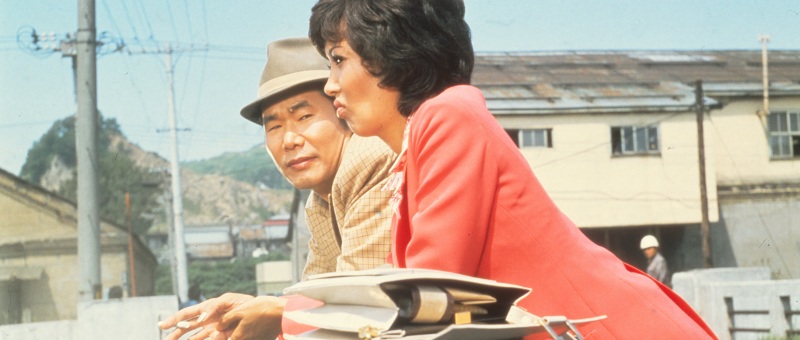
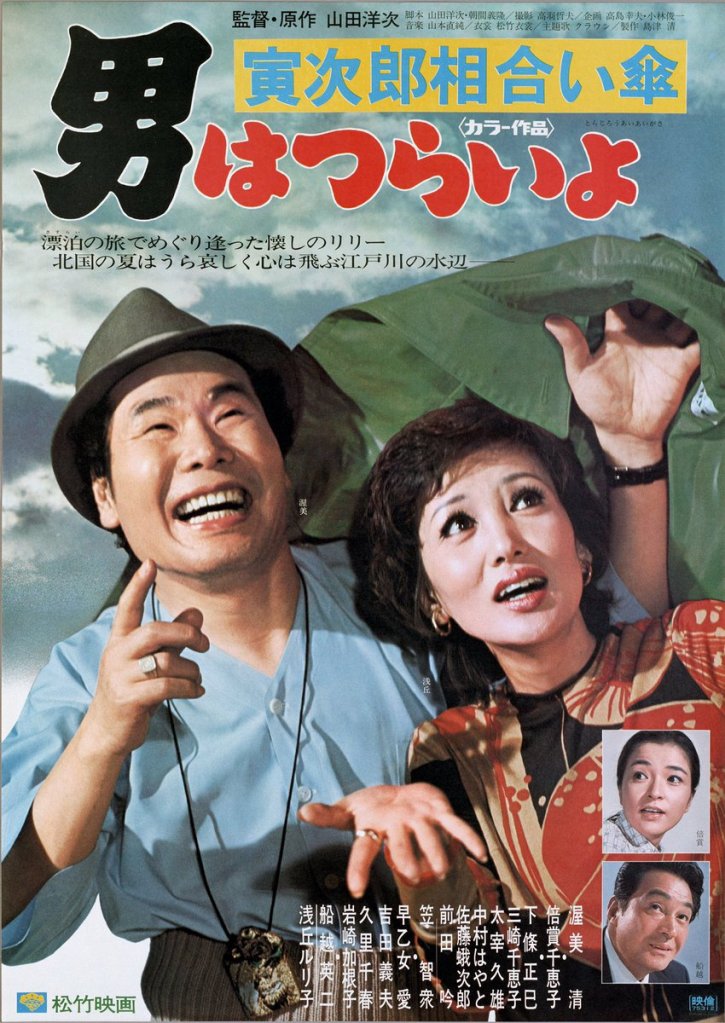
Tora-san Meets the Songstress Again (男はつらいよ 寅次郎相合い傘, Yoji Yamada, 1975)

Spanning 48 films and almost 30 years from the middle of the economic miracle to the post-Bubble depression, the Tora-san series provided a certain kind of comforting stability with its well established formula that saw the titular travelling salesman alternately hit the road and return home to his wholesome family waiting and worrying in Shibamata, always glad to see him but also anxious as to what kind of trouble he’ll be causing this time around. Among the most melancholy of the series, Tora-san #15, Tora-san Meets the Songstress Again (男はつらいよ 寅次郎相合い傘, Otoko wa Tsurai yo: Torajiro Aiaigasa, AKA Tora-san’s Rise and Fall) sees him flirt with the idea of settling down while others wrestle with the costs of the salaryman dream and the contradictions of the post-war era. 

Yamada opens, however, with an exciting dream sequence in which Tora (Kiyoshi Atsumi) re-imagines himself as a heroic pirate saving his family members, and all the residents of Shibamata, from enslavement by some kind of evil capitalist villain. He wakes up and leaves the cinema, but Shibamata is perhaps on his thoughts once again acting as it does as a kind of “port” in his life of perpetual wandering. For the moment he’s travelling with a depressed salaryman, Hyodo (Eiji Funakoshi), whom he rescued at a train station fearing he may have been about to take his own life. Meanwhile, back in Shibamata, Tora’s old friend Lily (Ruriko Asaoka) has come looking for him at the dango shop apparently now divorced, tearfully explaining to Tora’s sister Sakura (Chieko Baisho) that she wasn’t well suited to being a housewife after all and is planning to head back out on the road as an itinerant singer. 

Perhaps ironically, Tora is angry with Hyodo for causing worry to his family by disappearing without notice, eventually ringing Sakura to tell her to ring Hyodo’s wife and let her know he’s alright (why he doesn’t just ring himself is a mystery, and in any case he only has the one coin for the payphone so runs out of time to explain). What we can infer is that Hyodo has in a sense achieved the “salaryman dream” but it’s left him feeling empty and unfulfilled. Mrs. Hyodo appears to be very prim and proper, their home spacious and tastefully decorated. When Sakura calls two men from her husband’s company are with her trying to figure out where Hyodo could have gone. She explains that her husband is a timid man and earnest, it’s unlikely he’s gone off with another woman and it’s out of character for him go AWOL from work so she’s at least very relieved to learn he’s alive even if Tora ran out of time to say where they were. Hyodo isn’t really sure anyone’s missing him, and as we later discover his flight is part mid-life crisis in that he’s heading to the hometown of his first love. He assumes she also will have married and has no illusions of a romantic reunion but simply wants to make sure she’s happy (as he, presumably, is not). Discovering she’s a widow gives him pause for thought, but on seeing her he realises the futility of his situation and resolves to return home to his dull and conventional salaryman life. 

It’s a huge source of irony to Tora that anyone might envy him. Indeed, Mrs. Hyodo quite snobbishly insists on asking Sakura about Tora’s company joking that “he can’t just be a pedlar” much to Sakura’s embarrassment. But that sense of freedom and the open road appears to be something Hyodo is looking for, childishly romanticising hardship, finding sleeping on park benches and helping Tora pull salesman’s scams in the street exciting rather than worrying (he could after all always just go home). Yet he also envies Tora for having such a loving and forgiving family, explaining that his now look down on him because he’s been demoted at work, as if they only value him for what he represents an embodiment of the salaryman dream. Lily too is as much in love with Tora’s family as anything else, though the complex relationship between the pair begins to scandalise the conservative local community. Sakura frames it as a joke but puts it to Lily that it would be nice if she and Tora could marry so she’d be a part of their family. Lily unexpectedly agrees, overcome with emotion, but Tora is his old insensitive, if perhaps perceptive self, declaring that they’re too alike. Like him she’s a bird meant to wander. She’d only stay until she felt ready to fly. 

Tora-san and Lily are wandering souls cast adrift in the post-war era, unable to find firm footing while Hyodo’s existential angst suggests the salaryman dream is not the answer either. Only Sakura and the Kurumas seem to be doing well enough, living their ordinary, wholesome lives in Shibamata. “She probably has problems we don’t know about” Tora’s aunt remarks watching Queen Elizabeth II waving gracefully on the television, lamenting that it must be tiring to have to stand around so long. Everyone has problems but they carry on. In Shibamata they try to be kind and especially to big-hearted men like Tora no matter what kind of trouble they may cause.


Tora-san Meets the Songstress Again streamed as part of this year’s Japan Cuts.

Original trailer (English subtitles)
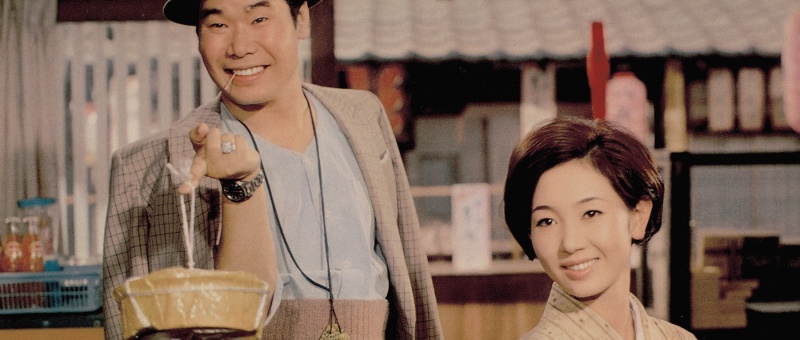
Tora-san, Our Lovable Tramp (男はつらいよ, Yoji Yamada, 1969)

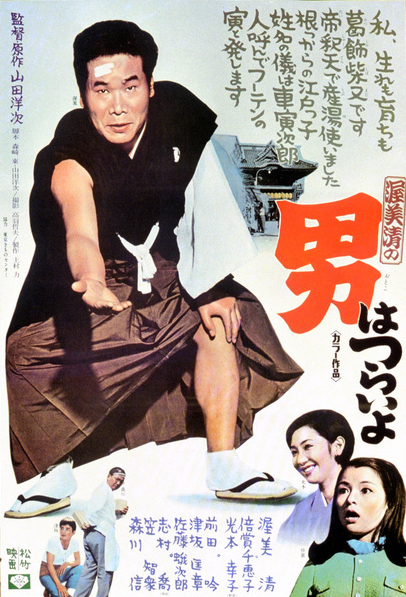
“It’s tough being a man” according to the Japanese title of the long running series affectionately known as “Tora-san” to its many fans. Tora-san began as a TV drama broadcast in 1968-9 in which the hero died of a snakebite in the very last episode much to viewers’ disappointment. Director Yoji Yamada then resurrected the loveable travelling salesman and made him the star of a reboot movie which proved so popular that it spawned a 48-film series which lasted until the death of star Kiyoshi Atsumi at the age of 68 in 1996. 

Yamada directed all but two instalments in the series each of which broadly follow a similar pattern to that introduced in the first film following the eponymous Tora as he gets himself mixed up in some kind of trouble, returns home to visit his family in Shibamata, and falls in love with a beautiful but unobtainable woman known as the “Madonna” in the series’ “mythology”, if you can call it that. At the beginning of Tora-san, Our Lovable Tramp (男はつらいよ, Otoko wa Tsurai yo), Torajiro Kuruma (Kiyoshi Atsumi) or “Tora-san”, explains that he’s been in a wistful mood thinking about his hometown while viewing the cherry blossoms and has decided to go back to Shibamata for the first time in 20 years having left swearing never to return after arguing with his father who has since passed away as has his brother. Tora-san’s only remaining family members are his younger sister Sakura (Chieko Baisho), a small child when he left but now a grown woman in her mid-20s, and an uncle (Shin Morikawa) and aunt (Chieko Misaki) who’ve been looking after her and run a small dango shop. 

Being away for 20 years necessarily means that Tora has been on the road since he was a young teenager back in 1949 when Japan was still very much in the throws of post-war chaos, in contrast to the increasingly prosperous nation it has since become. On his return to town he is relieved to discover that the local priest (Chishu Ryu), as well as his aunt, still remember and recognise him but shocks them all with an incongruous, and frankly over the top, show of politeness as he expresses gratitude and filial piety towards his uncle and aunt for having raised his sister but then immediately afterwards tries to sell them some of his tacky sales goods including some kind of electronic bracelet with supposed health benefits. Nevertheless, the family, including his sister Sakura who works as a typist at an electrical goods company, are very glad to seem him after all these years. 

Hardly in the house five minutes before peeing in the garden instead of using the bathroom like a regular person, Tora is already undercutting the image he first presented and causing trouble with the neighbours. The major drama occurs when he ends up accompanying Sakura to an omiai arranged marriage meeting set up by her boss in a fancy hotel. Sakura hadn’t been keen to go to the omiai, her uncle and aunt assume because arranged marriages are already outdated, but as we later discover she’s developed a fondness for factory worker Hiroshi (Gin Maeda) who lives in the house directly behind theirs. The uncle and aunt encourage the match because it’s an opportunity to marry up, viewing it as better than Sakura could otherwise hope for as an orphan with no dowry. Tora agrees with them, encouraging his sister not to write off tradition, but he has little understanding of the etiquette for these kinds of situations and quickly scandalises the refined, upper-class family by drinking far too much, making bawdy jokes about the composition of Chinese characters, and using vulgar language. As expected the suitors decide not to take things further, though luckily Sakura’s boss does not seem to mind or hold Tora’s behaviour against her.

On the road since he was little more than a child, perhaps it’s no wonder that Tora struggles when trying (or not) to adapt to the rules of civilised society though as he later tells us, he also had a traumatic childhood beaten by his father who resented him for being illegitimate, conceived during a drunken indiscretion with a geisha (Sakura is a half-sister born to his father’s legal wife). At one point he loses his temper completely and finds himself slapping Sakura, accidentally starting a mass brawl in their courtyard, though it’s obvious afterwards that he deeply regrets his behaviour and despite being forgiven by his ever patient sister feels as if it might be better to leave again before he makes even more trouble for his family. 

Tora is, however, perhaps good trouble in that his heart is (broadly) in the right place even if he makes a lot of mistakes. He meddles in Sakura’s love life and almost destroys her chance of romantic happiness, but it all works out in the end and he might have a point in implying that without his mistaken intervention she and Hiroshi would have just gone on in silent longing. Nevertheless, he remains a romantically naive figure, falling for the elegant daughter of the local priest (Sachiko Mitsumoto) who surprises him by expressing a fondness for low entertainment but in real terms is never going to marry a man like Tora. “Mine’s a hard world” he explains to a boatman, sadly making his way back towards the road filled with a deep sense of despair but pressing on all the same, trying his luck wherever he goes just another plucky, though no longer so young, guy, left behind by the rapid pace of the post-war economic miracle.  


Tora-san, Our Lovable Tramp streamed as part of this year’s Japan Cuts.

Original trailer (English subtitles)
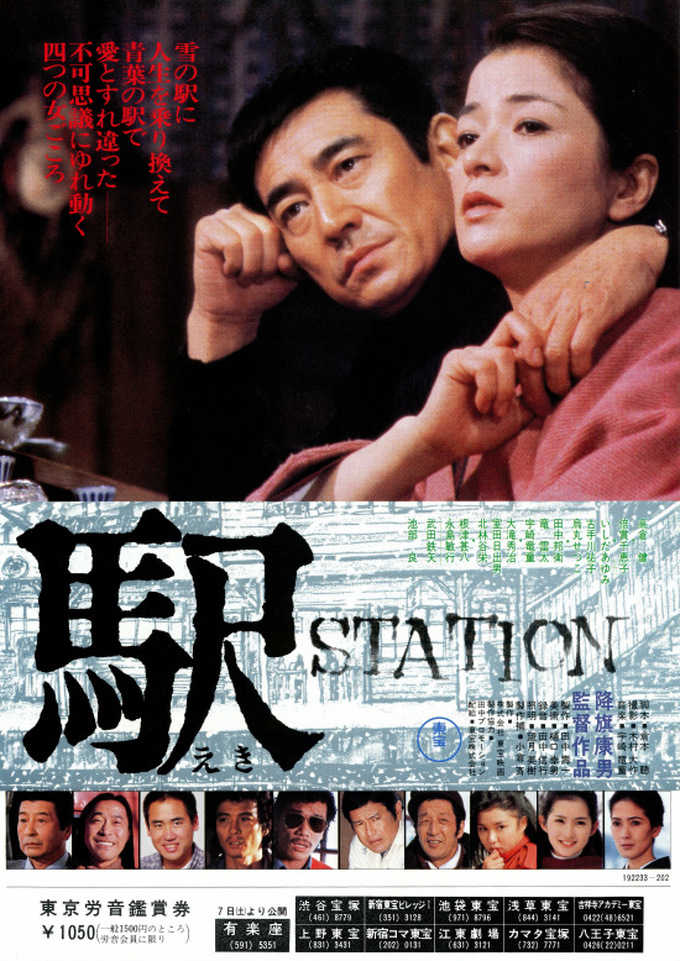
Station (駅, Yasuo Furuhata, 1981)

The thing about trains is, you can get off and wander round for a bit, but sooner or later you’ll have to go where the rails take you. You never have as much control as you think you have. The hero of Yasuo Furuhata’s Station (駅, Eki) is beginning to come to that conclusion himself, addressing the various stations of his life, the choices he made and didn’t make that have led him into a dejected middle-age, defeated, and finding finally that any illusion he may have entertained of living differently will not come to pass. 

In 1968, police detective Eiji Mikami (Ken Takakura) sends his wife (Ayumi Ishida) and son away for reasons which aren’t entirely clear. At this point in his life, he’s an aspiring marksman on Japan’s shooting team intensively training for the Mexico Olympics, which is perhaps why he felt he could no longer be a husband and a father, or at least not while also being a policeman. All that changes, however, when his friend and mentor is gunned down during a routine job, shot in the chest at point blank range by a man in a white Corolla while operating a check point to catch a killer on the run. In 1976, he goes to see his sister (Yuko Kotegawa) marry a man she might not love to escape a violent boyfriend and investigates a serial killer of women who rapes and murders girls in red skirts. In 1979, he’s haunted by the serial killing case coupled with his cool execution of hostage takers during a siege. Holing up in a small fishing village waiting for a boat home for New Year, he strikes up a relationship with a barmaid who is just as sad, lonely, and defeated as he is. 

When Mikami’s friend is shot, his wife tells the reporters that she thinks shooting at targets, which her husband had been training others to do, is a different thing than shooting at living beings. “One shouldn’t shoot at people” she tearfully insists, accidentally forcing Mikami into a double dilemma, knowing that his marksmanship skills were on one level useless in that they couldn’t save his friend while paradoxically told that they shouldn’t be used for that purpose anyway. But what really is the point in shooting holes in paper targets just to test your skill? Wandering into the hostage situation while posing as a ramen deliveryman, he cooly shoots the two bad guys without even really thinking about it, as if they were nothing more than paper. 

The Olympics overshadow his life. He gave up his wife and son for them, but no matter how hard you train, the Olympics eventually pass. Mikami is told he’s supposed to bring honour to Japan, representing not only the nation but the police force. He’s not allowed to investigate his friend’s death because they want him to concentrate on his shooting, but he is and was a policeman who wants to serve justice. While he’s waiting for the funeral, he sees a report on the news about a former Olympic marathon runner who’s taken his own life because he got injured and fell into a depression feeling as if he’d let down an entire nation. Mikami perhaps feels something the same, drained by responsibility, by the feeling of inadequacy, and by the potential for disappointment. After the Olympics he feels deflated and useless, wondering what the point of police work is while quietly rueful in suspecting the committee is about to replace him on the team after all. 

When he wanders into the only bar open on a snowy December evening, that is perhaps why he bonds so immediately with its melancholy proprietress, Kiriko (Chieko Baisho). The conversation turns dark. Kiriko tells him that a friend of hers who worked in a bar in the red light district killed herself last New Year, that it’s the most dangerous time for those who do this sort of work, not for any poetical reason but simply because it’s when their men come home. She tells him that she’s a lone woman, no virginal spinster but weighed down by the failure of old love. Swept up in the New Year spirit, Mikami starts to fall for her, but is also called back to the past by an old colleague who passes him his wife’s phone number and tells him she’s now a bar hostess in Ikebukuro. He starts to think about leaving the police and getting a local job, but fate will not allow it. Kiriko too sees her dream of love destroyed precisely by her desire to escape the pull of toxic romance. Back in 1976, Mikami had been party to a similar dilemma as the sister of his suspect kept her brother’s secret but secretly longed to escape its burden. Suzuko (Setsuko Karasuma) too lost love in trying to claim it and now works as a waitress in a small cafe in this tiny town, only latterly making an impulsive decision to try to leave and make a new future somewhere else. 

Mikami tears up the letter of resignation that declared him too tired of life to be a good policeman, once again boarding a train back to his rightful destination, knowing that a policeman’s what he is and will always be. He watched his wife wave goodbye from a station platform, saw a man betrayed on the tracks, and finally boarded the train himself, letting go of any idea he might have had about going somewhere else. Stations are after all transitory places, you can’t stay there forever. 


Original trailers (no subtitles)

Aki Yashiro’s Funauta which plays frequently throughout the film

Weathering with You (天気の子, Makoto Shinkai, 2019)

weathering with you poster 2Some might say much of life is learning to weather the storm, but when the storm is literal as well as metaphorical it’s easier said than done. Following his 2016 mega hit Your Name, Makoto Shinkai’s Weathering with You (天気の子, Tenki no Ko) opts for much of the same but grafts an additional layer of anxiety onto the lives of his precarious teen heroes who are left largely adrift, betrayed by corrupt adult society and plagued by doubt and despair in a world which, it seems, is trying to drown them in existential hopelessness.

16-year-old Hodaka (Kotaro Daigo) has run away from his parochial island home for the bright lights of Tokyo. Beyond disconnection from his parents and small-town ennui, he never gives much of a reason why he’s so determined not to go back, but tries to make a go of it in the city with all the prideful naivety of an adolescent young man. What he discovers is that, because of laws in place to protect him, he can’t support himself honestly as an independent teen, ironically placing him firmly at risk in shady Kabukicho but it turns out that you can’t even get a job as a host in a sleazy bar without proper ID. Just when he’s hit rock bottom, Hodaka is given new hope when a friendly employee at McDonalds decides to gift him a burger just because she can see that he’s hungry.

Hodaka describes the BigMac as the best meal he’s ever tasted, because he’s tasting kindness in an environment which has turned out to be far more hostile than he’d anticipated. He tries to repay that kindness when he spots the girl out in Kabukicho being manhandled by a gangster trying to coax her into a love hotel, threatening him with a gun he picked up from the rubbish bin outside a club. The girl, Hina (Nana Mori), ends up saving him again, but the rescue originally backfires because of Hodaka’s problematic adoption of the gun. He regains Hina’s sympathy by throwing it away, allowing a genuine connection to arise between them, especially when he discovers that Hina has an unusual power – she can stop the rain with the power of prayer.

It’s the height of summer, but it hasn’t stopped raining since Hodaka arrived in Tokyo. In fact, it’s just about time for Obon when the departed souls of long gone relatives are able to return. Hina apparently became linked with the sky after praying at a shrine during her mother’s illness, but if the gloominess of the heavy skies and constant rain is a reflection of her unhappiness, it’s one belied by superficial cheerfulness even though her life is just as hard as Hodaka’s. In addition to trying to support herself on the kind of money you can make as a teenage part-timer, she’s also responsible for her younger brother Nagi (Sakura Kiryu) which is why, perhaps, she was tempted by that gangster’s offer of big bucks to be made in Kabukicho.

Hodaka too looks for familial connections, moving in with a middle-aged man who saved his life during the storm that brought him to Tokyo. Like Hina, Keisuke (Shun Oguri) is also drowning in grief, in his case for a beloved wife killed in an accident, while dealing with separation from his daughter who has been taken in by her grandmother in disapproval of Keisuke’s scrappy lifestyle. It’s working for Keisuke’s occult-themed magazine that leads Hodaka to recognise Hina as a “Sunshine Girl”, but also to learn that such “weather maidens” were once common in ancient Shinto Japan and mostly met a bad end. A fortune teller makes it clear that exercising the kind of power that Hina has is likely to deplete her capacity for life, a mild irony in that it’s the inability to feel alive that these rains seem to symbolise.

Ironically enough, both teens met their destiny because they were chasing the light – Hina drawn to a rooftop shine illuminated by an improbable ray of sunshine in the rain, and Hodaka longing to find his place in the sun and resolving to live inside the light that Hina casts. Eventually, Hodaka is forced to make a decision and comes to the conclusion that he can accept Hina for all that she is, that she doesn’t need to be the “Sunshine Girl”, she can feel what she feels and the world will cope. He will weather the storm along with her.

Meanwhile, the spectre of real world climate change looms in the background. Hodaka’s decision necessarily means he has chosen to drown the world to save his love. Faced with the gradual submergence of the city of Tokyo, an old woman waxes philosophical, remembering that back in Edo most of this land was underwater so perhaps it’s just going back to the way it’s supposed to be. Hodaka is swayed but unconvinced. Still young, he is very invested in the idea that he has changed the world, for good or ill, seizing his agency as path out of his despair. But Shinkai’s messages are mixed. Hina continues to pray, but Hodaka comes to the conclusion that the world has always been messed up so perhaps all you need to do is learn to live in it and the rest will figure itself out. As much as it’s true that the problems of climate change should not rest on the young, who are blameless, it is perhaps irresponsible to advocate cautious indifference. Hodaka remains wedded to the idea that he’s made a choice and his choice has changed the world, while beginning to realise that changing the world is not his responsibility, or at least not his alone and not in that way. He has, however, found a way at least to live with all his choices, undefeated by the rain.


Original trailer (English subtitles)

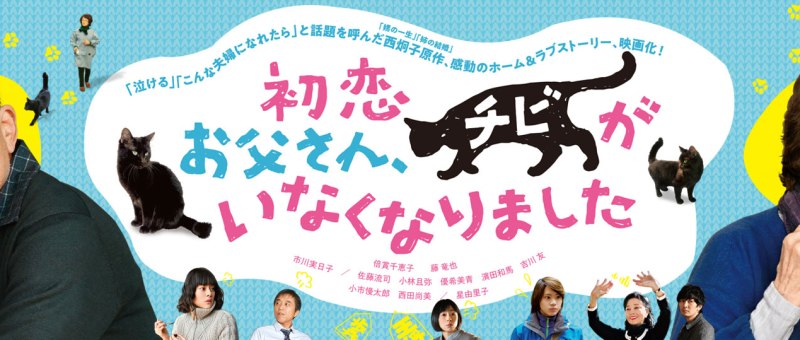
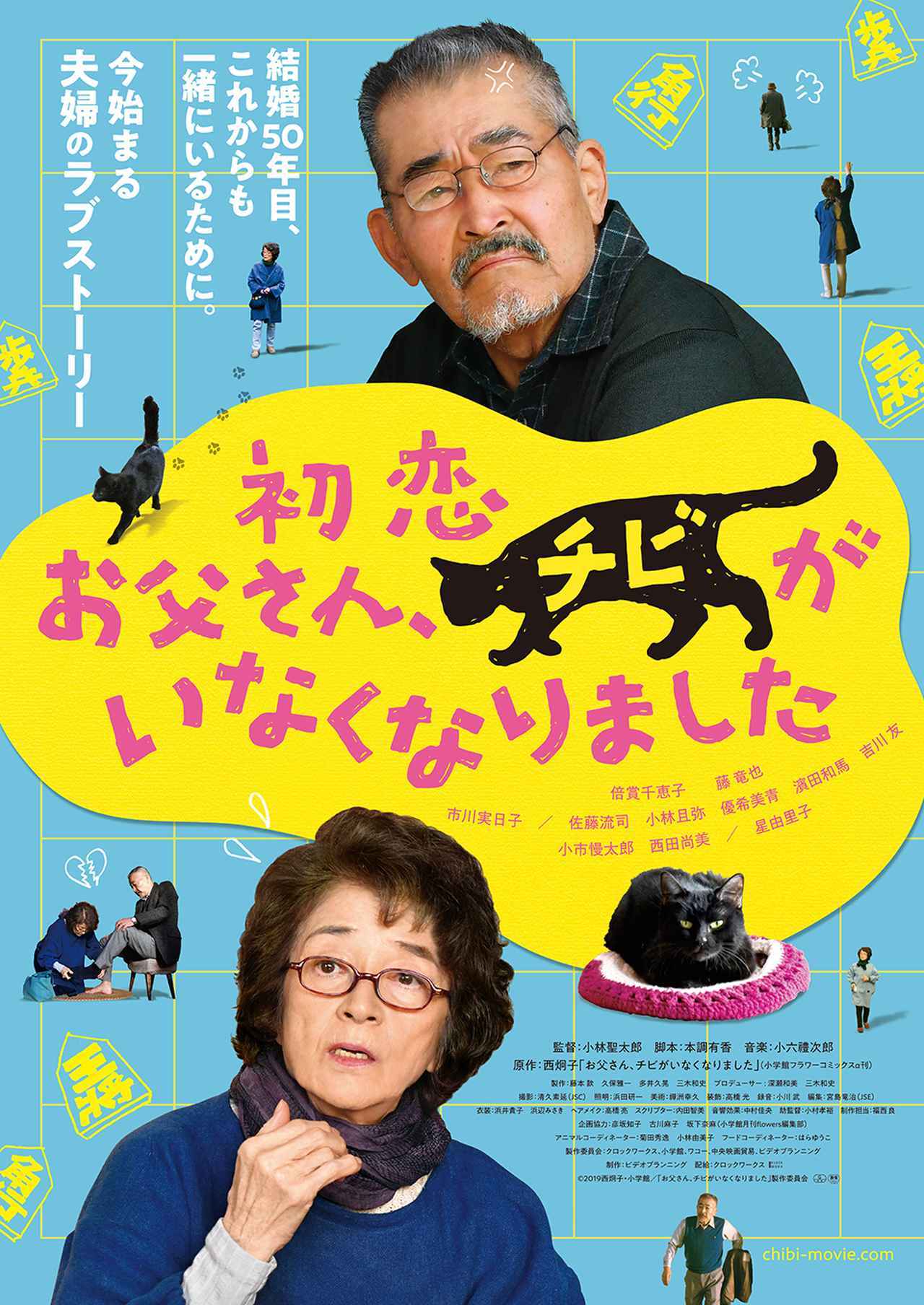
Only the Cat Knows (初恋 お父さん、チビがいなくなりました, Shotaro Kobayashi, 2019)

Only the cat knows poaterThe disappearance of a beloved cat has sparked many a crisis in Japanese cinema. In Shotaro Kobayashi’s* Only the Cat Knows (初恋 お父さん、チビがいなくなりました, Hatsukoi: Otosan, Chibi ga Inaku Narimashita), the disappearance is as metaphorical as it is literal in that this particular cat has come to symbolise the faded love of a couple married for fifty years whose relationship has begun to disintegrate if in a very ordinary way.

Chibi had been a constant companion to Yukiko (Chieko Baisho) who often feels neglected by her salaryman husband of 50 years, Masaru (Tatsuya Fuji). Now that he’s (semi-)retired, she hoped they might be able reconnect, perhaps even travel, but he is just as disinterested in domestic life as ever and mostly spends his days popping back into the office or playing shogi in a nearby club. An awkward, conservative man, Masaru aggressively ignores his wife, even irritatedly blanking her when she spots him out and about, while she dutifully waits for him at home to take his socks off for him in the hall and pick up the jacket he so casually throws to the floor for her to deal with. Chibi’s disappearance is then another blow to her already lonely world and Masaru’s extremely unsympathetic reaction to her fears eventually provokes her into wondering if she should leave him.

Masaru, it has to be said, is not an easy man and it’s easy to imagine that much of Yukiko’s married life may have been difficult or even unhappy. This is perhaps why though youngest daughter Naoko (Mikako Ichikawa) is originally panicked by her mother’s mention of divorce, all three of the couple’s grown-up children are eventually on her side and claim they can completely understand why she might feel that way. As if trying to fill a very real void in her life, Yukiko has taken to watching romantic Korean dramas dubbed into Japanese while reminiscing on her own romantic past which led her to marry Masaru all those years ago.

Nevertheless, despite her own dissatisfaction, she remains perturbed by Naoko’s disinclination to marry even at the comparatively late age of 37. Avowing that she doesn’t think a woman needs a career, Yukiko tries to push her daughter towards the socially conservative choices of home and family. Yukiko may worry that Naoko will end up all alone in her old age, but then as Naoko points out, Yukiko did everything “right” and feels alone anyway. Tellingly, Naoko was once engaged to man who jilted her right before the wedding because he was insecure about her career success which had exceeded his own and apparently needed to be master in his own home. Unfortunately, the world has not quite moved on enough and it seems many men still only want women who will take their socks off for them at the end of a busy day.

Naoko doesn’t want to get married just for the sake of it which, ironically, seems to be the same way Yukiko felt when she was young though as it turned out her courtship with Masaru was an awkward mix of arranged and not. Having fallen for him at her job on the milk counter at the station, she was slightly stunned to spot his picture in an omiai book and agreed to the meeting only for Masaru to tersely tell her he’d decided to take the first offer and didn’t even open the envelope to peek inside. In true Masaru fashion, this may turn out to be a lie of awkwardness but it’s left a note of anxiety running right through their decades long marriage which only is now bubbling the surface. Yukiko worries she “stole” Masaru from her friend on the counter who liked him first and whom she spots him secretly meeting all these years later. A lack of emotional honesty has created a widening gulf between husband and wife with Yukiko left wondering if her husband ever really loved her at all.

The search for the missing cat becomes a quest to rediscover the smouldering love of a longterm couple that a lack of communication has all but smothered. Yukiko tries everything she can to find Chibi, even hiring a pet detective, while Masaru irritatedly tells her to give up – that Chibi has most likely gone off to die and wanted to spare Yukiko the pain of watching him suffer. Masaru may be somewhat casting himself as the wandering cat, the strong and silent type who thinks he’s protecting his wife by making her miserable, but deep down he too wants to save their love even if it means he will finally have to find the wherewithal to talk about his feelings without embarrassment. A charming late life love story, Only the Cat Knows is careful not to sugarcoat the the destructive social codes of a bygone era but allows its pair of former lovers to rediscover what it was they once had while allowing them to move forward into a happier future.


Only the Cat Knows was screened as part of the 2019 Udine Far East Film Festival.

*Director Shotaro Kobayashi’s name is also romanised as Syoutarou Kobayasi

Original trailer (no subtitles)

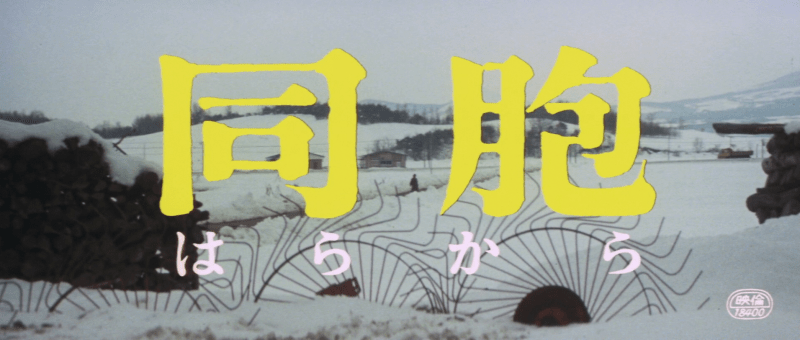
The Village (同胞, Yoji Yamada, 1975)

The Village posterBest known for the long running Tora-san series, Yoji Yamada has often been disregarded by international critics for a perceived over indulgence in sentimentality. Nevertheless, his films are often at pains to capture a Japan which is changing with a noted ambivalence towards the results of those changes. Home From the Sea had rooted itself in the difficult decision of a young couple in realising that their way of life was no longer sustainable in a rapidly modernising economy. The Village (同胞, Harakara) returns to a similar theme, once again harping on “furusato” while the conflicted younger residents of a farming village struggle with the decision to accept the life passed down to them by their parents or abandon it in favour of the bright lights of an urban future.

Narrated by Takashi (Akira Terao), a young farmer and president of the local youth club, The Village revolves around one heady spring in which the arrival of a sophisticated woman from Tokyo injects additional stimulation into the sometimes stagnant community. Takashi, in many ways a very typical resident of Matsuo and many other rapidly depopulating rural villages like it, has taken over his family dairy farm following the death of his father when he was relatively young. His brother, Hiroshi (Hisashi Igawa), took a factory job to help make ends meet and put Takashi through school but has now become embittered and resentful as the widowed father of two young girls. Trapped by circumstance he berates Takashi for his diffidence in remaining uncommitted to farm life while perhaps dreaming of something better that he is too afraid to pursue.

The arrival of Hideko Konno (Chieko Baisho) seems to give Takashi a new sense of purpose. Hideko works for an itinerant theatre company based out of Tokyo which makes a point of taking shows to remote areas which might not ordinarily get much access to the arts. The snag is that the locality will have to take the responsibility of producing the show and absorbing the shortfall should they fail to sell enough tickets to cover costs. Takashi is tempted but he’s also well aware of the risks – the investment is sizeable given the relative poverty of the rural area and the risks involved with failure extreme.

Yamada places the dilemma surrounding whether or not to produce the show at the forefront, but the questions are bigger than they might at first seem. It has to be said that farming, whatever its rewards, is an extremely hard life. As a character puts it in the emotively titled play “Furusato”, it’s disheartening when you get a bad harvest and all your work goes for nothing but it’s almost worse when the harvest is good and the value of your work drops exponentially. For Takashi and the others, the youth association is a much needed social outlet even if many of them regard it as something of a joke and rarely get around to doing very much with it. The idea of the play is attractive to them for several reasons, having something more interesting to do not the least among them, not to mention offering a valuable break in routine in what can often be an overly ordered and somewhat stagnant existence.

However, the very same reasons the play appeals to the youngsters are the ones their elders find suspicious. Having made their peace with rural life and learned to adapt to its rhythms, the older generation worry that the young ones are being swayed by outside influences and neglecting their work in favour of idle pursuits. Meanwhile, many of the youngsters have already left to try their luck in the cities, some of them returning and bringing new experiences back with them while others resolve to remain where the lights are brighter.

Setting the scene, Yamada reminds us the factories have long been encroaching on farmland and that this “ancient” way of life is becoming ever harder in a rapidly modernising economy, but through their involvement with the play and its extremely close to home themes, the members of the youth association are finally able to look at their village through new eyes, seeing not only its immense visual beauty for the first time but learning to reappreciate the value of community and friendship. Life in the city might be more glamorous but perhaps it’s no less hard and only lonely in a different way. At once a celebration of and lament for a changing rural landscape, The Village asks an accidentally profound series of questions about life and happiness but once again puts its faith in goodhearted people creating meaning from togetherness in a world that might otherwise set them apart.


Original trailer (no subtitles)

Home from the Sea (故郷, Yoji Yamada, 1972)

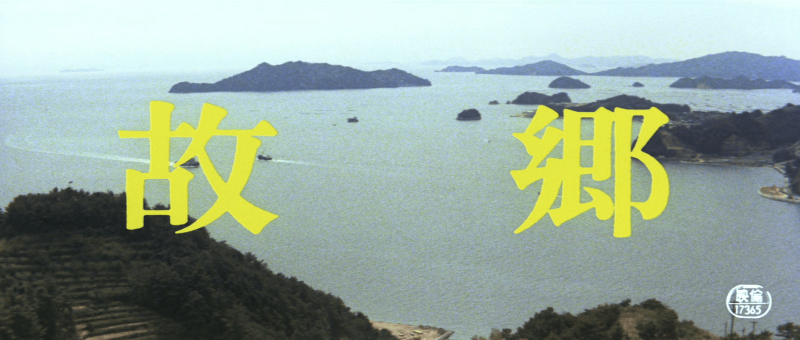
Home from the sea still 1By the early 1970s, Japan was well on its way to an economic recovery with memories of post-war privation fading and modern consumerism rapidly taking hold in the national mindset. Contemporary cinema understandably saw this as a good thing, that brighter times were coming and soon enough everyone would be enjoying a comfortable, prosperous life. The future, however, was not always evenly distributed and modernisation brought with it problems as well as solutions. Yoji Yamada’s Home from the Sea (故郷, Kokyo/Furusato*) paints a melancholy picture of a changing Japan as an earnest young couple are forced to consider leaving their beloved hometown to seek their fortunes elsewhere.

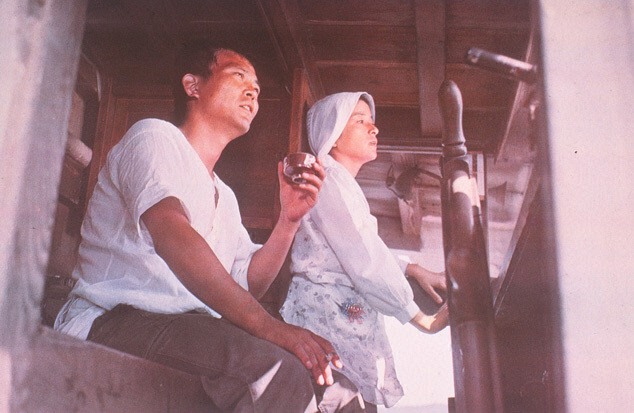
Seiichi Ishizaki (Hisashi Igawa) owns a small transport boat he uses to ferry rocks between construction sites. He is sometimes joined by his wife, Tamiko (Chieko Baisho), who serves as the boat’s engineer. The couple live with Seiichi’s elderly father (Chishu Ryu) and their two daughters on a small island in the Inland Sea. Times are hard. Fuel costs are increasing making Seiichi’s business much less profitable while his boat is old and slow. The maintenance costs alone are difficult to contemplate and the family cannot afford to invest in one of the new steel boats which are currently sucking up most of the available work. Seiichi’s younger brother who used to work on the boat with him has already given up and moved on, taking his wife and children to another town where he works in a factory. Many people seem to think Seiichi would do well to do the same, but he is stubborn. He refuses to be pushed out of his ancestral home and occupation simply because of the unfairness of his times.

A little way into the film, a friendly fishmonger, Matsushita (Kiyoshi Atsumi), who often stops by to have dinner with the family expounds on the beauty of the town. He can’t understand why anyone would want to leave somewhere as lovely as this. Unlike the Ishizakis, Matsushita wasn’t born on the island but in Korea – his parents died during the repatriation after the war and he’s been getting by on his own ever since. He’s done many different jobs and lived in many different places but has chosen to make his home here. A fishmonger’s job is probably always safe (to an extent, at least) in a small harbour town, but Seiichi’s isn’t and he needs money to feed his family. There is no other work on the island, and so there is no way to stay without making the boat pay.

The boat, however, is already 19 years old. Transport ships are only intended to last 10. The engine is faulty and the hull is in desperate need of repair but a visit to the original shipwright reveals that to do so would not be cost effective. The best thing to do would be to buy one of the shiny new steel vessels like their neighbour’s, but that’s far out of Seiichi’s reach. All along the shoreline, you can see the charred remains of boats belonging to those like Seiichi who’ve finally come to the conclusion that their era has passed.

“Can’t beat the Big” is a local mantra. In early ‘70s Japan, counterintuitively enough, size is everything. Not just the boats themselves, but the fleets and the architecture of life. You can’t survive as your own boss anymore because the little guy alone has no power when corporations and conglomerates are extending their reach even into tiny islands. Seiichi goes to have a look at the factory in Onomichi to which he’s been recommended by a friend. It’s not as bad as he thought, but it’s huge and filled with hundreds of identically dressed faceless men. The food is awful, and they’d have no friends. Nevertheless, needs must. If you can’t fight the Big you’ll have to become a part of it or it’ll swallow you whole.

Still the sadness of leaving one’s hometown behind against one’s will with one eye always looking back towards the shoreline is difficult to bear. Seiichi’s father, who had been looking after the children and was therefore extremely close to them, will be staying behind with no one left to look after him save the community itself. Progress might be a good thing, but there are costs too and small town Japan is one of them. It’s sad, but there’s nothing you can do about it. The post-war world might not require so much “gaman” anymore, but bearing the demands of modernity just might.


*According to Shochiku’s website and the narrator in the trailer, the official title is “Kokyo” which is the Sino-Japanese reading of the kanji (故郷) but it’s also often listed under the title “Furusato” – the slightly more emotive native Japanese reading.

Original trailer (no subtitles)

Shitamachi no Taiyo (下町の太陽, Yoji Yamada, 1963)

(C) Shochiku 1963

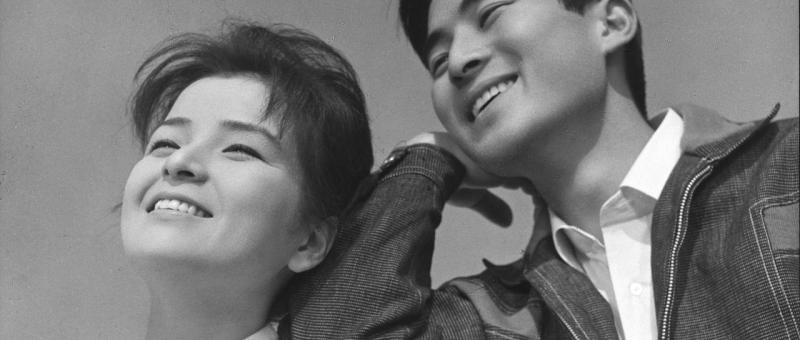
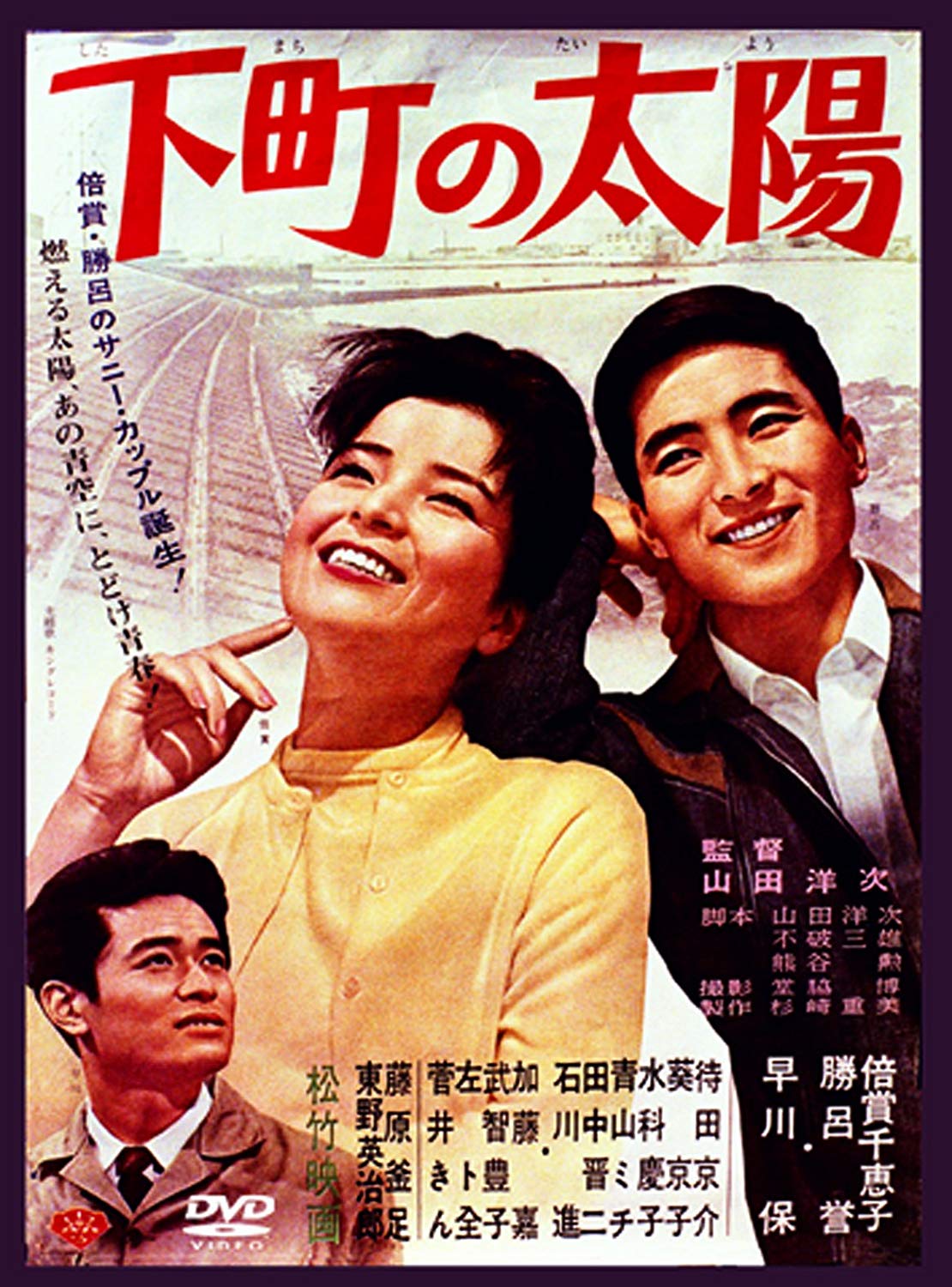
Shitamachi no Taiyou DVD coverYoji Yamada’s debut feature, The Strangers Upstairs, was very much of its time as it attempted to capture the aspirational fighting spirit of the post-war era through the struggles of a nice young couple who are trying to “get on” and escape their humble origins for the salaryman dream through achieving the goal of home ownership as quickly as possible. His second film, Shitamachi no Taiyo (下町の太陽, also known as The Sunshine Girl / Sunshine in the Old Neighbourhood), takes a slightly different look at a similar issue as a young woman from Shitamachi – a working class industrial area on the outskirts of Tokyo, agonises over her future prospects as she considers a marriage to her longterm boyfriend who has ambitions to join the salaryman revolution.

Yamada opens with shots of Shitamachi and its prominent smokestacks while the now famous song plays in an instrumental version over the credits, before abruptly shifting to visions of the upscale Ginza where Machiko (Chieko Baisho) and her boyfriend Michio (Tamotsu Hayakawa) are enjoying a demonstration of an extraordinarily expensive, state of the art radio before retreating to a cafe where they agree that sometimes its more fun to “aspire” to things than actually obtain them. After all, there’s no way they could ever afford the diamond rings they walked past on their way out of the department store unless they decided to rob the place. Both Machiko and Michio are residents of Shitamachi and work in a local soap factory. Michio, however, has his sights firmly set on the path to a middle-class life and is planning to take the exam for a promotion to head office – though he lacks qualifications, Michio is confident because he’s studying hard (though more so because his dad and his section chief served together in the war so Michio is sure a good word will be put in for him).

Despite her fondness for Michio, Machiko has her doubts about his overriding ambition to get out of Shitamachi. Since her mother died, Machiko has been the lady of the house and primary caregiver for her naughty little brother Kenji (Joji Yanagisawa) while her older brother Kunio (Toshio Suzuki) is the family brainbox and also planning to bust out only through the path of education rather than advancement. Having left education behind, Machiko is happily contributing to the family finances with her job on the packing line at the soap factory which is, all things considered, not too bad – the work may be dull and methodical but also relatively quiet and stress free, not to mention sweet smelling. Nevertheless, Machiko does not necessarily want to work on the shop floor all her life but knows her opportunities are limited.

This fact is one cruelly brought home to her by a moody Michio when descends into a major sulk on learning that he hasn’t passed the test for head office because another of his colleagues outdid him – both in terms of his study ranking and in one upping him in having a direct connection to the director. While Machiko tries her best to sympathise and put up with his moody petulance, Michio chooses to throw her sympathy back in her face by abruptly announcing that she can’t understand the pain he’s going through because careers are irrelevant to women who only use them as a stopgap until they get married. Thoroughly annoyed, Machiko leaves Michio to his wallowing before things get any worse but she can’t argue with the fact that he’s only said what most people think.

Still, Machiko isn’t even sure she wants to get married. One of her friends, Kazuko (Kyoko Aoi), recently won the jackpot – she married a nice man who did get a promotion to head office and won the housing lottery for a home on one of the shiny new “danchi” – brand new apartment complexes for upwardly mobile young couples and the very embodiment of post-war aspiration. However, when Machiko and a friend visit the new bride they find that she is not quite as happy as one might expect. Though married life is peaceful enough and she and her husband evidently get on, Kazuko is also intensely lonely. With her husband away at work all day and often out playing golf with colleagues on Sundays too (not to mention after hours drinking and miscellaneous get togethers), there’s precious little for Kazuko to do, stuck at home all day cooking and cleaning while waiting for her husband to return. Having moved to the danchi she’s also lost her community and is no longer close enough to her friends to see them very often.

Meanwhile, Machiko is also somewhat disturbed by Kazuko’s collection of expensive cosmetics which her husband has instructed her to buy because he’s “very particular” about her appearance. Kazuko makes sure her makeup is on point before her husband gets home because that’s apparently what he likes. Machiko, however, does not like this – to start with, she thinks Kazuko looks better without. Not that there’s anything wrong with wearing makeup because you want to wear it, but the idea of wearing it because someone told you to and you’re worried they’ll “get bored” with your face doesn’t strike her as a particularly healthy relationship dynamic. If this is what a love marriage is like, perhaps Machiko would rather do without.

Despite her otherwise close relationship with Michio, it quickly becomes obvious that she does not love him and if she decides to marry him it will be because it’s the “sensible” decision rather than any great romantic desire. Annoyingly enough, Michio hasn’t really even asked her, he just assumes they will marry once he gets his promotion. He also assumes that Machiko, like him, will want to shake the dust of Shitamachi off her feet for good for the bright lights of Tokyo. Machiko, however is not so sure. “Getting on” is one thing and there’s nothing wrong with “aspiration”, but that doesn’t mean you need to look down on the people who come from the same place as you – after all, the sun still shines even in Shitamachi and there’s nothing wrong in choosing to be happy here rather than always chasing an unattainable dream of conventional success.

Another possibility presents itself when Machiko meets an unrefined boy who has an ordinary job in the steelworks. Though their first meeting did not make a good impression – he creepily chased her off a train and then made a mess of trying to explain why, they later bond when she realises he has befriended her troubled little brother and the pair then end up spending a pleasant evening together which is far more romantic than any of her dull and conventional outings with Michio. Then again the choice she faces isn’t between two men but whether or not to embrace her own ability to make a definitive choice about her future. What she rejects is cold and selfish path of men like Michio who only want to get ahead and are willing to step on anyone who gets in their way to make it happen. Machiko doesn’t want fancy radios and diamond rings, she just wants to not have to worry too much about money and for someone to actually listen to what she’s saying. She doesn’t want to end up like Kazuko, all alone in a sparkling apartment with nothing to do but knit. When Michio tells her to shut up and do as he says because he’ll definitely make her happy, the choice seems clear. Hard work, community, and maybe the fiery boy who seems determined to get a yes rather than assuming he already has one. Who wouldn’t want to live here?


Original trailer (no subtitles)

https://www.youtube.com/watch?v=3GP13Tmm6TA

Famous title song performed by Chieko Baisho

Downtown Heroes (ダウンタウンヒーローズ, AKA Hope and Pain, Yoji Yamada, 1988)

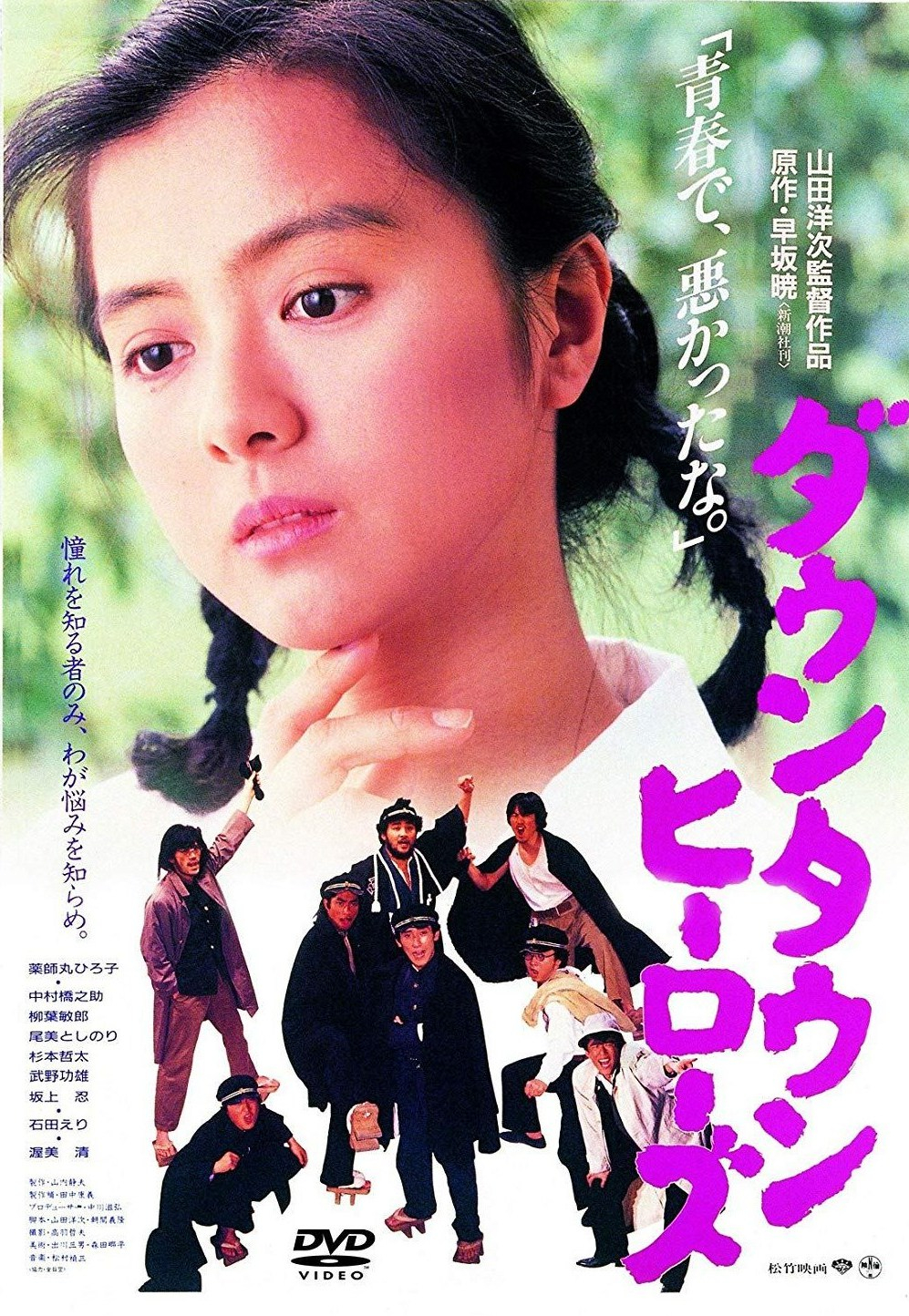
Downtown Heroes posterUnlike many of his contemporaries, Yoji Yamada was an infrequent visitor to the youth movie. Best remembered for his long running Tora-san series, Yamada’s later output is marked by an alternation of laughter and tears, running between raucous family comedies and poignant examinations of wartime loss. Set in the immediate postwar period, 1988’s Downtown Heroes (ダウンタウンヒーローズ, AKA Hope and Pain) adapts the autobiographical novel by Akira Hayasaka for a twin tale of endings and beginnings as a group of boys prepare to leave the Japan of their childhood behind and set out into the brand-new post-war future.

Our narrator for the tale is Hayasaka’s stand-in, Kosuke (Hashinosuke Nakamura), a sensitive young man from the mountains studying at the prestigious boys’ boarding school in town. The Matsuyama high school is one of the last to still be operating in Japan’s pre-war educational model. In fact, when the boys graduate the school will shut down in favour of the American 6-3-3 standard model of organising the educational system. Nevertheless, Kosuke and his friends enjoy what seems like a fantastically broad curriculum to modern eyes, much of which consists of classic German literature. Rather than their family names, the boys refer to each other with a series of nicknames inspired by their studies and have been heavily influenced by European left-wing political ideology. Accordingly, they are less than happy about the imposed American “reforms” and, paradoxically, the restrictions placed on their individual “freedom” by the “imperialist” occupation.

The central drama revolves around two episodes occurring one after another during the final year of high school. The first involves Kosuke’s friend Arles (Toshinori Omi) and a prostitute he helps to rescue from the red light district – Sakiko (Eri Ishida) was supposed to elope with a student from the school, but he didn’t show up and if the people from the brothel she was sold to find her she’ll be in big trouble. Her suitor turns out to be a fraud, but the boys are committed to saving her and hide Sakiko in their dorm, sharing their meagre rations with her before helping her escape to her home town. Meanwhile, the boys are also preparing for the very last culture festival the school will ever see at which they will present their adaptation of a classic German play. The snag is, the play needs a girl. Eventually the gang enlist the help of Fusako (Hiroko Yakushimaru) – a student at the girls’ school recently repatriated from Manchuria who also happens to be the young lady Kosuke had a meet cute with on the road and has been in love with ever since. Trouble brews when Gan (Tetta Sugimoto), the play’s director, falls in love with her too.

Told from the POV both of the old and the young Kosuke, the atmosphere is one of intense melancholy and inescapable nostalgia. Though these were times of hardship – rationing is fierce and intense, so much so that the school no longer serves meals at all on Sundays and the boys largely subsist on rice gruel, they were also times of joy and possibility. These are however youngsters in the best tradition of the sensitive young men of Japanese literature. They feel everything deeply, fully aware that they are living on the cusp of something new, which necessarily also means to be standing atop a grave. Their world is collapsing and the values they’ve been given (progressive though they seem to be) are about to be thrown out of the window. They have been taught that nothing is more important than their personal autonomy and that personal freedom is attained only through overcoming hardship, but their lives will increasingly be dictated by occupying forces and they feel themselves robbed of something without the right to reply.

Nevertheless their problems are also ordinary teenage ones of romantic crises and friendship dilemmas. Kosuke struggles with his love at first sight crush on Fusako but remains too diffident to say anything until it’s almost too late, while he also struggles to figure out what the most proper thing to do is when Gan reveals he is also in love with her. Gan, a sensitive writer, apparently burns with longing – so much so that he’s written a book long confession of love in apology for being unable to declare himself in person. Kosuke, a good friend, agrees to deliver the letter but both of them have neglected to consider Fusakao’s feelings so bound up are they in their own solipsistic dramas. Fusako was also struck by the love bug on her first meeting with Kosuke and has been patiently waiting for him to say something (as is the custom of the time). She is therefore doubly hurt and offended when he delivers a mini-tome on the theme of love from someone else before attempting to leave abruptly in a huff. Truth be told, there are few women who would enjoy being handed a thesis as a confession, but Fusako is really not in the mood to read one now.

Ending on a melancholy epilogue in which the old Kosuke looks on at field of young men playing American football before some others in running shorts brush past him and a young couple enjoy an evening walk, Yamada embraces the mild sense of deflation that has been building since the beginning. Young love faded and the dreams of youth were destined to come to nothing – not quite a tragedy, or perhaps only one of the ordinary kind, but food for the regrets of age all the same. The times were hard, and then they got better but somehow they were never so happy again. A youth drama indeed.


Original trailer (no subtitles)

Theme song “Jidai” performed by Hiroko Yakushimaru

It All Began When I Met You (すべては君に逢えたから, Katsuhide Motoki, 2013)

It All Began When I Met You posterChristmas, in Japan, is an occasion for romance. Strangely, the Christmas date movie has never quite taken off though there are a fair few examples of this oft maligned genre even if they don’t generally help to ameliorate the contempt in which it is held. Truth be told, It All Began When I Met You (すべては君に逢えたから, Subete wa Kimi ni Aeta kara) won’t help to do that either but then it isn’t really intended to so much as provide a little warmth combat the to Christmas cold whilst celebrating the centenary of Tokyo Station (a destination surely as romantic as meeting under the clock at Waterloo).

Spinning out from Tokyo Station, the film splits into six interconnected stories of love ranging from dealing with long distance romance to an orphaned little girl who has projected her need to believe in the existence of her parents onto a faith in Santa Claus. Counting down to Christmas Day, the protagonists each progress towards some kind of crisis point which will allow them to deal with their various problems whilst getting into the holiday spirit.

Couple one are a pair of youngsters, one a fashion designer, Setsuna (Fumino Kimura), and the other an engineer, Takumi (Masahiro Higashide), who are separated because of differing work commitments. She’s in Tokyo, he’s up North, but they chat on the phone all the time and seem close despite the distance between them. The truth is revealed when Takumi comes to Tokyo and is supposed to meet up with Setsuna but stays out all night drinking with a (female) colleague instead.

Meanwhile, a college student (Tsubasa Honda) is invited to a karaoke party but isn’t sure whether to go because her crush is going and she can’t pluck up the courage to confess to him. Her boss at the pastry shop (Chieko Baisho) where she works tells her to go get him rather than allow her true love to slip away as, we later find out, happened to her when her boyfriend failed to appear at Tokyo Station 49 years earlier when they had arranged to elope. One of their regular customers, a Shinkansen driver (Saburo Tokito), has just retired early and, it turns out, may not have long to live but wants to make the most of his last Christmas with his son (Ryutaro Yamasaki) who is preoccupied about a “half-coming of age” ceremony they’re having at school.

Across down, the train driver’s brother-in-law, an arrogant CEO (Hiroshi Tamaki), runs into an aspiring actress (Rin Takanashi) who is currently in rehearsals for a play she puts on every year at a local orphanage. This year might be her last, however, because she’s begun to accept that her acting career will never take off and it’s time to go home. One of the little girls at the orphanage, Akane (Emiri Kai), is particularly looking forward to the festivities because she’s invested in the unseen figure of Santa as a substitute for believing in the unseen figures of the parents she never knew.

Each of the stories is intended to capture something of the complicated business of modern city living – a long distance relationship is, perhaps, something that many will be familiar with, relating to the pain and confusion of being not quite sure where each party currently is in terms of commitment. The pace of contemporary life frustrates romance, but the station is there to connect people and bring them back together. The conclusion is perhaps a little optimistic in its sudden cementing of a romantic bond but broadly in keeping with the Christmas theme.

The CEO and the actress, by contrast, are a much more conventional rom-com couple. Serendipitously meeting each other at various upscale joints, the CEO immediately tags the actress as a gold digger after she (accidentally) catches him flashing his premium credit card. Offended she spins him a yarn about a dead boyfriend as payback but finds it backfiring when he is unexpectedly moved and tries to make it up to her. Warmer in tone, this strand sets the station up as a symbol of the interconnectedness of city life where such mini miracles are indeed possible even if the perfectly rational reason for all the coincidental meetings is later explained to us.

However, where there’s joy there’s also heartbreak. The train driver’s tale seems out of place here, but plays into other themes of coming to terms with reality and committing to enjoying the now rather than worrying about the past or future. Similarly, the little girl begins to work out her faith in Santa maybe misplaced because the letter he’s written her is in Japanese, which is weird because isn’t Santa Swedish? Learning to accept that not having parents is not due to a lack of faith and that she has good people looking after her helps Akane move past her loneliness while the baker gets a surprise visitor who helps fill in a few details about her failed romance which in turn helps her offer advice to her young assistant faced with her own typically adolescent love worries.

Miracles really do take place at Tokyo Station, which, it has to be said, is quite picturesque. Saccharin and superficial, It All Began When I Met You is nevertheless a heartwarming tribute to the strange serendipity of city life, throwing in a good amount of Christmas cheer with hope for the future and presumably a happy new year.


Original trailer (no subtitles)