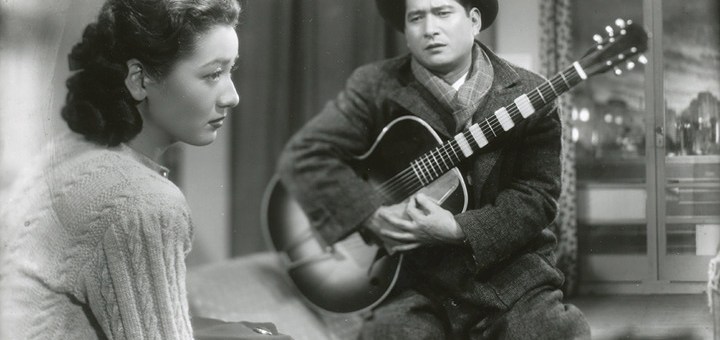
The Garden of Women (女の園, Keisuke Kinoshita, 1954)

garden of women still 1Things changed after the war, but not as much as some might have hoped. Sadly still topical, Keisuke Kinoshita’s Garden of Women (女の園, Onna no Sono) takes aim both at persistent and oppressive patriarchal social structures and at a compromised educational system which, intentionally or otherwise, systematically stifles attempts at progressive social change. A short few years before student protests would plunge education into crisis, Kinoshita’s film asks why it is that the establishment finds itself in conflict with the prevailing moods of the time and discovers that youth intends to have its brighter future even if it has to fight for it all the way.

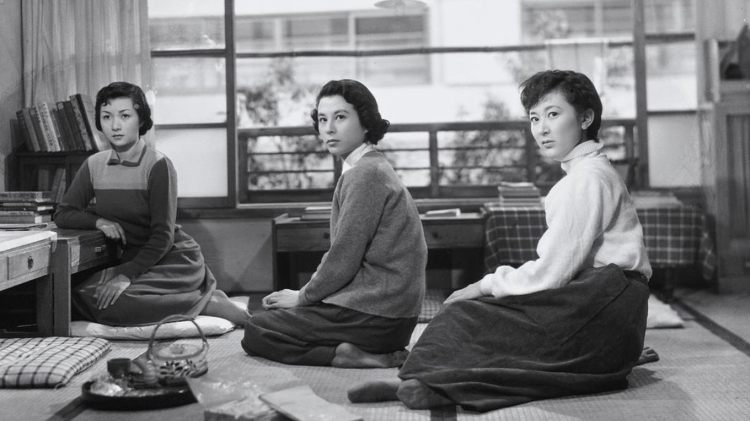
The setting is an exclusive private woman’s university in the elegant historical city of Kyoto. The ladies who attend this establishment are mostly from very wealthy families who have decided to educate their daughters at the college precisely because of its image of properness. As one student will later put it, there are two kinds of girls at the school – those who genuinely want to study in order to make an independent life for themselves and intend to look for work after graduation, and those who are merely adding to their accomplishments in order to hook a better class of husband. Everyone, however, is subject to a stringent set of rules which revolves around the formation of the ideal Japanese woman through strictly enforced “moral education” which runs to opening the girls’ private letters and informing their families of any “untoward” content, and requiring that permission be sought should the girls wish to attend “dances” or anything of that nature.

As might be expected, not all of the girls are fully compliant even if they superficially conform to the school’s rigid social code. Scolded for her “gaudy” hair ribbon on the first day of school, Tomiko (Keiko Kishi) rolls her eyes at the over the top regulations and enlists the aid of the other girls to cover for her when she stays out late with friends but her resistance is only passive and she has no real ideological objection towards the ethos of the school other than annoyance in being inconvenienced. Tomiko is therefore mildly irritated by the presence of the melancholy Yoshie (Hideko Takamine). Three years older, she’s come to college late and is struggling to keep up with classes but is, ironically enough, prevented from studying by the same school rules which insist she go to bed early.

Meanwhile, dorm mate Akiko (Yoshiko Kuga), from an extraordinarily wealthy and well connected family, is becoming increasingly opposed to the oppressive atmosphere at the school. However, as another already politically active student points out, Akiko’s background means there are absolutely no stakes for her in this fight. She has never suffered, and likely never will, because she always has been and always will be protected by her privilege. Fumie (Kazuko Yamamoto), a hardline socialist, doubts Akiko’s commitment to the cause, worrying that in the end she is only staging a minor protest against her family and will eventually drift away back to her world of ski lodges and summer houses. Despite her ardour, Akiko finds it hard to entirely dispute Fumie’s reasoning and is at constant battle with herself over her true feelings about the state of the modern world as it relates to herself individually and for women in general.

This is certainly a fiercely patriarchal society. Even though these women are in higher education, they are mostly there to perfect the feminine arts which are, in the main, domestic. They are not being prepared for the world of work or to become influential people in their own right, but merely to support husbands and sons as pillars of the rapidly declining social order that those who sent them there are desperate to preserve. For many of the girls, however, times are changing though more for some than others. Tomiko rolls her eyes and does as she pleases, within reason, and even if she eventually wants to see things change at the school it is mostly for her own benefit. She sees no sense in Akiko’s desire for reform as a stepping stone to wider social change, and perhaps even fears the kinds of changes that Akiko and Fumie are seeking.

Akiko and Fumie, and to an extent, Tomiko, seem to have a degree of agency that others do not as seen in the tragic story of Yoshie whose life has been largely ruined thanks to the selfish and heartless actions of her father. From a comparatively less wealthy family, Yoshie worked in a bank for three years during which time she met and fell in love with an earnest young man named Shimoda (Takahiro Tamura). However, her father, having become moderately successful, developed an appetite for social climbing and is determined she marry “well” to increase his own sense of superiority as a fully fledged member of the middle classes. He sees his daughter as nothing more than a tool or extension of himself and cares nothing for her thoughts or feelings. In order to resist his demands for an arranged marriage, Yoshie enrolled in school and is desperate to stay long enough for Shimoda to finish his education so they can marry.

Yoshie is trapped at every turn – she cannot rely on her family, she cannot simply leave them, she cannot yet marry, if she leaves the school she will be reliant on a man who effectively intends to sell her, but her life here is miserable and there is no one who can help her. All she receives from the educational establishment is censure and the instruction to buck up or get kicked out. She feels herself a burden to the other girls who regard her as dim and out of place thanks to their relatively minor age gap and cannot fully comprehend her sense of anxiety and frustration.

Finally standing up to the uncomfortably fascistic school board the girls band together to demand freedoms both academic and social, insisting that there can be no education without liberty, but the old ways die hard as they discover most care only for appearances, neatly shifting the blame onto others in order to support their cause. “Why must we suffer so?” Yoshie decries at a particularly low point as she laments her impossible circumstances. Why indeed. The oppressive stricture of the old regime may eventually cause its demise but it intends to fight back by doubling down and the fight for freedom will be a long one even if youth intends to stand firm.


Titles and opening scene (no subtitles)
Spring Dreams (春の夢, Keisuke Kinoshita, 1960)

vlcsnap-2019-01-10-00h23m29s867Let them eat sweet potato? The heartless bourgeoisie at the centre of Keisuke Kinoshita’s absurdist satire Spring Dreams (春の夢, Haru no yume) have found themselves accidentally engulfed by the revolution which seems to be attacking them on every front including from inside their palatial, Western-style mansion. Things are about to change in the Okudaira world, but then again maybe not all that much.

The Okudairas are the owners of a large scale pharmaceuticals firm. Widowed patriarch Shobei (Eitaro Ozawa) is the CEO, but he’s at the constant mercy of his mother-in-law (Chieko Higashiyama) who acts as the guardian of the family business’ legacy. Meanwhile, he has three problematic children – oldest daughter Tamiko (Yatsuko Tanami) who has become a promiscuous playgirl with a taste for “mothering” college students, Chizuko (Mariko Okada) who is the only “normal” one in the house and has fallen in love with an impoverished painter, and Mamoru (Yusuke Kawazu) who is a kind of melancholy Hamlet waxing on his existential angst while eating everything in sight.

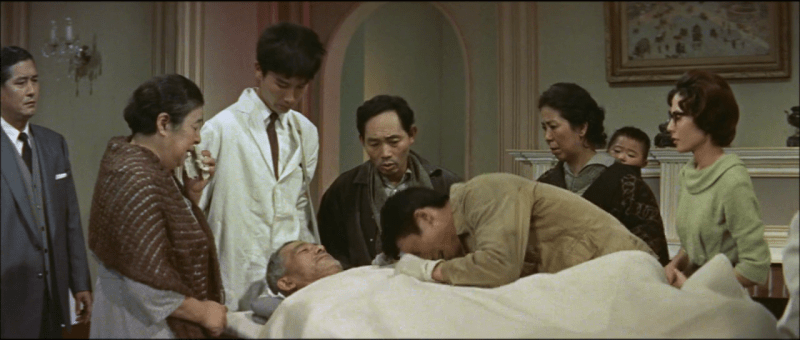
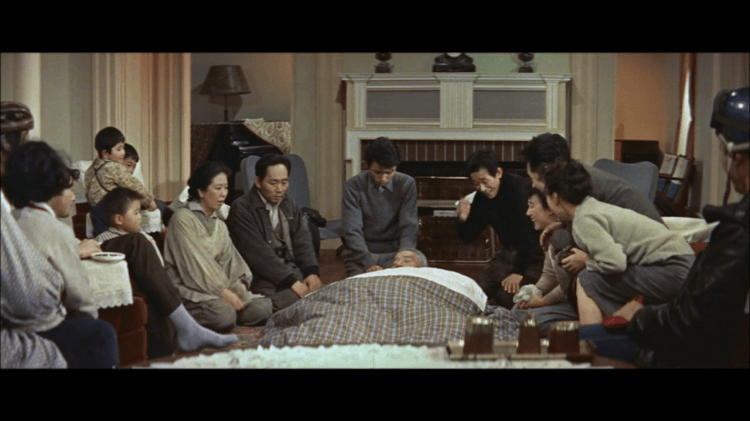
Into this already strained household comes the unexpected figure of sweet potato salesman, Atsumi (Chishu Ryu). With the house empty for a change, romantically conflicted maid Umeko (Yukiyo Toake) calls one of her boyfriends down at the fish shop to get the potato guy to come round. Kimiko (Meiko Nakamura), the other maid, goes out to pick some up but ends up flirting with a delivery boy so sends Atsumi inside where Umeko ropes him into helping shift some furniture which is how he ends up having a minor stroke in the Okudaira’s living room. Luckily for Atsumi, the person who finds him is Shobei’s compassionate spinster secretary, Kazuko (Yoshiko Kuga), who has some sad experience in this area as her father passed away after a stroke when she was a teenager, they say because someone moved him too early. A visit from the family doctor (Shuji Sano) backs up her advice and Atsumi will be staying put in the living room for the foreseeable future.

Of course, this doesn’t go down well with most of the Okudairas. Shobei wants him gone but what can you do? Atsumi stays because on balance it would be awkward if he ended up dying and staining the Okudaira name. Sadly, greed and indifference are not unique to the bourgeoisie as we discover when a parade of “well wishers” from Atsumi’s tenement house begin showing up to see how he is. Aside from the kindly, filial Eiichi (Shinji Tanaka) who has taken time off work to look after the old man, everyone else thinks Atsumi’s time has come. They know his tragic history, that he’s all alone now since both his sons were killed in the war and the rest of his family lost in the bombing. They want to get in with him to be remembered in the will, or even get their hands on his wallet for something like an advance. Poor old Atsumi is just an object fit for exploiting – a symbol of the Okudaira’s largesse, and of a potential windfall when the inevitable happens.

Meanwhile, the winds of change are blowing. Shobei is tied up with a labour dispute at the factory, obsessed with the idea of crushing the unions while the workers’ rousing chorus of the Internationale echoes ever more loudly in the distance. Grandma advises “just fire them all”, but things aren’t as easy as they were back in Meiji. Grandma thinks Shobei is a bit useless, especially since her daughter died and he’s been allowed to get off easy. She needs to find a successor seeing as Mamoru’s too weird to take over which means one of the girls needs to get married. Tamiko’s ruled herself out thanks to her eccentric love life, which leaves only Chizuko who wants to marry a painter and has no real interest in saving the family business. Chizuko is determined to oppose the idea of an arranged marriage, she’s a post-war girl after all, but grandma is firm. When she was a girl they made her give up on her first love, who happened also to be named “Atsumi”, to marry an Okudaira and so Chizuko is merely being unreasonable.

Nevertheless the presence of Atsumi begins to soften grandma’s heart with memories of her youth and the cruelty with which her youthful dreams were stripped away. Love blossoms in the cold Okudaira mansion, genuine bonds between people are recognised while the opportunist are rejected, and the young regain their freedom from the old who now recognise how destructive the old order could be. Will the house of the Okudaira’s fall? Probably not. Revolutions don’t take hold over night, but greed at least is on its way out paving the way for a better, kinder future for all.


Titles and opening (no subtitles)

Here’s to the Young Lady (お嬢さん乾杯!, Keisuke Kinoshita, 1949)

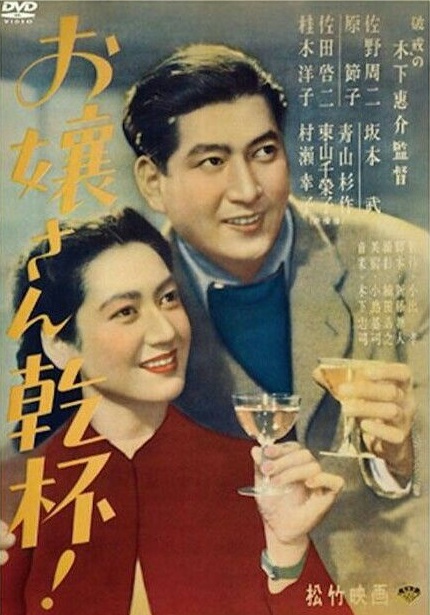
Here's to the young lady DVD coverLove across the class divide is a perpetual inspiration for melodrama, but what if the problem is less restrictive social codes and more emotional inertia and frustrated desire? Many things were changing in the Japan of 1949, racked by post-war privation and burdened with a scrappy desire to remake itself better and kinder than before. Keisuke Kinoshita, the foremost purveyor of post-war humanism, looks back to the 1930s for his 1949 cheerfully superficial romantic comedy Here’s to the Young Lady (お嬢さん乾杯!, Ojosan Kampai!). A tale of changing social codes and youth trying to find the courage to break free, Kinoshita’s easy romance is as breezy as they come but also hard won and a definitive step towards the freer, fairer world he so often envisages.

Keizo Ishizu (Shuji Sano), a 34-year-old self-made man and successful garage owner, is still single and seemingly pestered by his well meaning friends who keep finding matches for him that he doesn’t really want. Reluctantly, he acquiesces to the demands of his good friend Mr. Sato (Takeshi Sakamoto) who is desperate to introduce him to a pretty young woman from a wealthy family and agrees to meet Yasuko (Setsuko Hara) – a demure 26-year-old apparently keen to get married. Ishizu is instantly smitten, dumbstruck by her beauty and elegance. He begins to think all this marriage talk isn’t so silly after all, but then he is only a country bumpkin made good in the scrappy post-war economy. Yasuko is old money. How could he ever be permitted to enter her world and would she ever truly fit in his? Ishizu falls hard but his dreams of romance are eventually crushed when he discovers that the Ikedas, once a noble family, have hit upon hard times following half the family’s repatriation from Manchuria and the unwise business relations of Yasuko’s father which have landed him in jail as a co-conspirator in large scale fraud.

Despite his misgivings, Ishizu is talked into “dating” Yasuko for a few months during which he plans to find out if she could fall in love with him for real or if the marriage is likely to be an eternally one-sided affair which will make them both miserable. Ishizu resents being thought of as the cash cow, the classless nouveau riche upstart roped in to breathe new life into the fading aristocracy, but can’t let go of the hope that Yasuko might fall for his down to death charms even if not all of her family are very happy with this particular means of survival.

Yasuko’s grandparents are at great pains to emphasise (repeatedly) the immense gap in social class between Ishizu and their cultured, refined ingenue of a granddaughter who enjoys such elegant hobbies skiiing, tennis, and the ballet. Ishizu is into boxing and drinking at his favourite bar. He has no idea what the tune is that Yasuko plays on the piano that he bought for her and somewhat gauchely had delivered direct in front of the mildly scandalised family who can’t help feeling belittled by his generosity, but he finds it charming all the same even if his lack of refinement also stings with embarrassment. Nevertheless, the youngsters end up finding their own way – she takes him to the ballet where he is bored and then somehow moved, and he her to the boxing where she is frightened and then thrilled. They grow closer, but also not as Ishizu becomes increasingly frustrated (if in his characteristically good natured way) by Yasuko’s continuing aloofness.   

Perhaps unusually, it is Yasuko who struggles to move on from the idealised pre-war past in which she lived the romanticised life of a wealthy noblewoman who had not a care in the world and no need to worry about anything. The war has destroyed the nobility but this no Cherry Orchard-style lament for a declining world of elegance and rise of the unrefined in its place but a plea for rational thinking and a desire to move forward into a more egalitarian future. Yasuko’s grandparents cannot accompany her on this journey even if her parents and siblings are minded to be pragmatic, but it’s she herself who will need to make the decision to abandon her rigid ideas of what it is to be a fine lady and learn to embrace her own desires if she is to find happiness (as her father urges her to do) in the rapidly changing post-war world.

Then again, Ishizu is not entirely free of petty prejudice and the mild conservatism of the upwardly mobile as he shows in his intense hostility towards his best friend’s (Keiji Sada) tempestuous relationship with a club dancer (Naruko Sato). Nevertheless, after a good old fashioned case of fisticuffs and a proper consideration of all the obstacles he faces in winning the heart of Yasuko, Ishizu eventually reconsiders and urges his friend to chase happiness wherever it may lie. He vacillates and doubts himself, finds it impossible to approach the icy lady of the manor because of a feeling of social inferiority and finally decides to give up on an unrealistic idea of romance to spare them both pain, but then the obstacles were not all his to overcome and if there is a choice to be made it is Yasuko’s to make. A joyous throwback to the screwball ‘30s, Here’s to the Young Lady, banishes the darkness of the postwar world to the margins while its melancholy youngsters use romantic heartbreaks as a springboard to free themselves from the restrictive social codes of the past in order to choose happiness over misery and despair.


Titles and opening scene (no subtitles)
The Wandering Princess (流転の王妃, Kinuyo Tanaka, 1960)

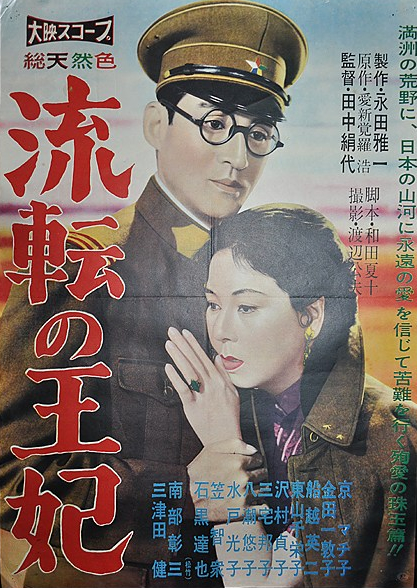
Wandering Princess posterAs in her third film, The Eternal Breasts, Kinuyo Tanaka’s fourth directorial feature, The Wandering Princess (流転の王妃, Ruten no Ouhi), finds her working with extremely recent material – in this case the memoirs of Japanese noblewoman Hiro Saga which had become a bestseller immediately after publication in 1959. Tanaka’s filmic adaptation arrived mere months later in January 1960 which was, in an ironic twist, a year before the real life tale would meet something like the conventional romantic ending familiar from classic melodrama. Nevertheless, working with Daiei’s top talent including Kon Ichikawa’s regular screenwriter (and wife) Natto Wada, Tanaka attempts to reframe the darkness of the preceding 20 years as the defeat of compassionate idealism at the hands of rigid austerity and unstoppable oppression.

Tanaka opens with a scene taking place in 1957 which in fact depicts a somewhat notorious incident already known to the contemporary audience and otherwise unexplained on-screen in which the older Ryuko (Machiko Kyo) tenderly bends over the body of lifeless schoolgirl. The camera then pulls back to find another girl in school uniform, Ryuko, twenty years earlier. A young woman with innocent dreams, Ryuko’s life encounters the usual kind of unwelcome disruption in the unexpected arrival of a marriage proposal but this is no ordinary wedding. Ryuko, as the oldest daughter of a prominent noble family, has been selected as a possible bride for the younger brother of the former Qing emperor now installed as the symbolic leader of the Japanese puppet state of Manchuria. Against the odds, Ryuko and her new husband Futetsu (Eiji Funakoshi) are well matched and endeavour to build a happy home together just as they intend to commit themselves to the creation of a new nation born from the twin legacies of the fallen Chinese empire and the resurgent Japan.

Foregrounding Ryuko’s experience, the film does its best to set “politics” aside but the inescapable truth is that each of our protagonists is a prisoner of the times in which they live. The second scene finds Ryuko in 1937 as an innocent schoolgirl gazing at the young men in uniform as they march past her. She remains out of step with them, walking idly and at her own uneven rhythm while they keep rigorous and seemingly unstoppable time. The family are understandably wary of the implications of the marriage proposal, especially as it comes with a military escort, with Ryuko’s beloved grandmother the only one brave enough to ask to see whoever’s in charge of this outrage only to be told that their fates are in the hands of the nebulous concept known as “army” which knows no individual will.

Assured by her family that the decision rests with her, Ryuko consents – not only to becoming a stranger’s wife (which would have been her fate in any case) but to being a kind of ambassador, the presentable face of imperial ambition. On her marriage she’s presented with a deep red cheongsam and continues to dress in Chinese fashion for remainder of her life in Manchuria where she learns to speak Mandarin and devotes herself to becoming as Chinese as it’s possible to be. Meanwhile, her husband Futetsu busies himself with a complementary desire to become Japanese, intensely worried that the sometimes degrading treatment he and his family receive is exclusively caused by his problematic nationality. When their daughter, Eisei, is born, the couple determine to raise her as the child of a new world, the embodiment of idealised cultural integration.

The world, however, is not so kind and the blunt force of militarism continues to present a barrier to familial harmony. Futetsu is prevented from seeing his brother by the officious forces of the military police while the lonely, paranoid “emperor” suspects that Ryuko is nothing more than a Japanese spy sent to undermine his rule. Ryuko was sent to Manchuria to be the bridge between two cultures. Her, in a sense, feminine energy which attempts to build connection through compassion and understanding is consistently contrasted with the prevailing male energy of the age which prizes only destruction and dominance. Filled with the naivety of idealism, she truly believes in the goodness of the Manchurian project and is entirely blind to the less altruistic actions of her countrymen engaged in the same endeavour.

Confronted by some children in a park while pushing the infant Eisei in a pram, Ryuko is identified as a Japanese woman by her accent while conversing in Mandarin. She assures the children that Eisei is Manchurian like them, and that seeing as she married a Manchurian she is now too despite her Japanese birth. The kids are satisfied, so much so that they warn her that some Manchurians were killed recently in this park by Japanese soldiers, adding a mild complaint that it upsets their parents when Japanese people come to their restaurant and leave without paying. Mortified, Ryuko decides to use some of her (meagre) resources to buy all of the kids and everyone else in the park some sweets from a nearby stand, fulfilling her role as a Japanese ambassador even while insisting that she is a proud citizen of the newly born state of Manchuria.

Nevertheless the Manchurian project is doomed to fail, the kind of idealism fought for by Ryuko and Futetsu crushed under the boot of militarism. Despite everything, Ryuko still wants to be the bridge if only to prevent a catastrophe of this kind happening again (while perhaps refusing to engage with some of the reasons it happened in the first place) but in Eisei’s eventual death, foreshadowed in the melancholy opening, a deeply uncomfortable implication is made that the kind of cross-cultural harmony that Ryuko dreams of may not be viable. In contrast to the salaciously reported real life events (somewhat alluded to by presence of a schoolboy’s cap next to the body) which hinted at a suicide pact or murder, Ryuko attributes Eisei’s decision to end her life to an inability to reconcile her twin heritage coupled with the heavy burden of being the last descendent of the Qing Dynasty. Despite this minor misstep of tying the fate of Eisei to the failure of the Manchurian dream and the loss of its misplaced idealism, Ryuko ends her account on a hopeful note in admiring the flowers she planted finally in bloom and looking forward to a more hopeful age governed by warmth and compassion rather than violence and austerity.


The Wandering Princess was presented by Japan Foundation London as part of a series of events marking the publication of Tanaka Kinuyo: Nation, Stardom and Female Subjectivity.

The Portrait (肖像, Keisuke Kinoshita, 1948)

vlcsnap-2018-09-06-01h35m07s763The immediate post-war period was one of fear and hardship. You might survive, but you might not like the person you’ll have to become in order to do so. The (unexpected) heroine of Keisuke Kinoshita’s The Portrait (肖像, Shozo) thought she’d made her peace with her choices, only to be confronted by a vision of her essential self as seen through the eyes of a cheerfully innocent artist. Despite the harshness of the times, there are those who’ve learned to be happy in their lot, but is their talent for happiness inspiration or irritation for those who’ve chosen a different path?

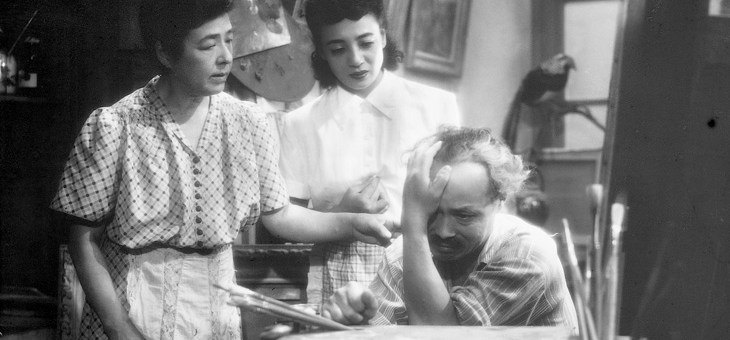
Kinoshita opens with a comic scene in which two shady real estate brokers take a look at a local property. Deciding it’s overpriced and impractical, the pair nevertheless decide to buy it together with the intention of flipping it once they convert the downstairs workspace into more practical living accommodation. There is, however, a slight hitch in that there are sitting tenants – a painter and his family who live in the room upstairs and use the rooms below as a studio. Thinking it will be easy enough to evict them, the men aren’t bothered but the the family are all so relentlessly nice that no one has yet been able to tell them to go. As a last resort, one of the men, Kaneko (Eitaro Ozawa), decides to move into the upstairs with his mistress, Midori (Kuniko Igawa), in the hope that the family will feel so awkward and in the way they will decide to vacate. Innocent and unworldly, the Nomuras all assume Midori is her lover’s daughter rather than his mistress, and start treating her like a well to do young lady. Such sudden and unexpected respect starts to weigh on Midori’s mind as she finds herself playing along, pretending to be “nice” and “respectable” while knowing that the life she’s living is anything but.

The problem is that the Nomuras are so essentially kind and welcoming that they really don’t mind sharing the house. Mr. Nomura (Ichiro Sugai), the middle-aged painter, feels guilty that he doesn’t earn more money and is too poor to move, but he’s also the sort to get over excited about having grown a giant pumpkin that he can’t resist showing to absolutely everyone. As it turns out the Nomuras are also living with a private tragedy – their eldest son Ichiro (Toru Abe) whose wife Kumiko (Kuniko Miyake) and son Koichi also live with the family has not yet returned home from the war and his whereabouts are unknown. Still, they don’t mind talking about it and are as happy as they can be, dancing away under the light of the moon – an unexpected upside to constant power outages. Meanwhile, Kaneko complains loudly as he attempts to finish his accounts in the evening gloom.

Midori half envies, half resents her new neighbours. The longer she lives with the Nomuras the guiltier she starts to feel in deceiving them. Matters begin to come to a head when Mr. Nomura asks permission to paint her portrait. He thinks Midori has a very “interesting” face, in part because he can see a sadness in her eyes that is totally absent in those of his daughter, Yoko (Yoko Katsuragi). Midori agrees and swaps her usual Western attire for the kimono her mother once gave her, but the picture Mr. Nomura paints begins to bother her. The portrait is of a pure young woman, innocent and honest, which is about as far from the way she sees herself as it’s possible to be.

As a friend of Midori’s puts it, you have to survive somehow and Midori thought she’d made her peace with the way she has decided to live but the portrait reminds her that she wasn’t always like this and now she’s not sure which version of herself she ought to despise. She wishes she could paint herself over, but feels her fate is sealed and there’s no way back. Kumiko, a little more worldly wise than her in-laws, is perfectly aware of what’s been going on upstairs but isn’t at all bothered by it. She doesn’t blame Midori for the choices that she’s made and thinks the picture is accurate in capturing her true soul, advising her that it is possible to be that woman again if that’s what she really wants.

The Portrait was scripted by none other than Akira Kurosawa whose belief in the essential goodness of humanity was perhaps not quite as strong as Kinoshita’s but the Nomuras are nevertheless typical Kinoshita heroes and it’s their unguarded warmth and kindness which begins to change the world for those around them. Even the cynical Kaneko is eventually moved by their cheerful selflessness, forced to accept their accidental moral victory rather than continue with his nefarious plan. Midori, forced into a reconsideration of herself, stands in for a generation attempting to make peace with the compromises of the past, learning that they don’t need to define the future and that it isn’t too late to strive for a more authentic life of simple happiness even if you feel you may have already sunk too far.


The Nomuras dancing in the moonlight

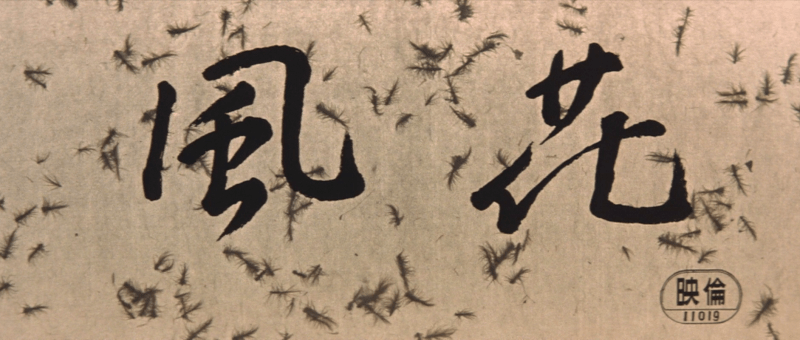
The Snow Flurry (風花, Keisuke Kinoshita, 1959)

Snow Flurry poster 2

Studies of the post-war world have often made the cities their home. Filled with the starving, the ruined, and the hopeless, the cities of post-war Japan were places of defeat but also of perseverance as a betrayed generation struggled to survive in whatever way they could. Generally speaking, the rural countryside seems to fare better, coping only with the absence of lost sons and lonely daughters as life goes on much as it always has. Nevertheless things are changing even here. Recalling the subversion of his earlier Army, Keisuke Kinoshita’s The Snow Flurry (風花, Kazahana) employs a complex non-linear structure to examine the various ways in which the past continues to inform the future, trapping post-war youth in the same way their parents were trapped not only with a legacy of wartime rigour but with the weight of the feudal world pressing down upon them as they struggle to escape the authority of the generation by whom they have been betrayed.

We begin with the conventional “happy ending”. A middle-aged woman looks on with genuine happiness as a younger one leaves in a bridal outfit before running off to look for her son, Suteo (Yusuke Kawazu), who has run off towards the river with dark thoughts clouding his mind. Stepping back a little, we are told that 19 years previously Suteo’s mother, Haruko (Keiko Kishi), attempted double suicide with his father, Hideo (Masanao Kawakane) – the son of the local lords. Hideo, fearing that he would soon be sent away to war and knowing that his noble family would never approve of the woman he loved, felt death was his only solution but while his attempt succeeded, Haruko’s did not. Surviving she gave birth to a child and was eventually taken in by Hideo’s family, the Naguras, but only to avoid the gossip in town that their heartlessness was the cause of their son’s death. Haruko and Suteo, rather than living in the main house with the other family members, occupy a small shed to the side of the property and are treated as a maid and farm hand respectively. The only member of the family to treat them kindly is the grand-daughter, Sakura (Yoshiko Kuga), who is a little older than Suteo and remains unmarried at 25 while her grandmother insists on finding a wealthy man willing to marry into the family and save it from dying out altogether.

Though the main action takes place in 1959, not much has changed in the village and the eventual arrival of modern cars belonging to Sakura’s prospective suitors proves jarring in more ways than one. The Naguras, once the feudal landlords, have been greatly reduced in status thanks to the post-war agricultural reforms which limited the amount of land which could be held by one family to that which they could reasonably farm themselves. This obviously means that their income has sharply decreased which, coupled with the patriarch’s profligacy, makes their present way of life untenable unless they can find a wealthy man to marry into the family and re-inject it with cash while they figure out how to make money by farming their own land. Sadly, this will be hard because the Naguras are terrible people with a bad reputation thanks not only to their unpleasant personalities but the lingering stigma of Hideo’s death and the continuing existence of Suteo.

Nagura (Yasushi Nagata), a hard man, rejected his son’s remains out of shame for his “cowardice” in refusing to die bravely for the emperor. When Suteo is born in 1941, he takes it upon himself to register the child’s birth name without consulting the mother, insisting that the child is neither hers nor his but belongs to the nation and will be expected to sacrifice himself in his father’s place to make up for Hideo’s failure of duty. “Suteo” itself means “abandoned boy” and is hardly a warm legacy to leave to anyone let alone your own grandchild and the only offspring of your own late son.

Despite their reduced circumstances, the Naguras continue to behave like lords and are trapped within the feudal pre-war world, obsessed with status and position while those around them have entered the brave new era of promised equalities and modern possibility. Sakura, the only “legitimate” child of the last generation, is literally kept a prisoner by her hardline grandmother (Chieko Higashiyama) who has insisted on conferring various “accomplishments” such as traditional dance and learning to play the piano intended to hook an upperclass husband. Such things hardly matter now in the post-war world and any man who valued them is unlikely to make her very happy, but the Naguras care little for happiness and only for their own “good” name. Sakura wanted, like her friends, to go Tokyo for university but of course she couldn’t – her family wouldn’t even let her spend time with the other girls because there were boys around and they viewed even that as “improper” given her “position”. It’s no wonder that Sakura already feels as if her life will be “crushed by the weight of this house” and longs to leave it, as well as her cold and oppressive family, far behind her.

Suteo’s tragedy is the same has his mother’s, he has fallen in love with someone who can never be his because of outdated notions of social class and the unbreakable authority of the older generation. Sakura loves him too, though she hardly knew it until faced with her own dilemma and realises a marriage is the only way to escape her miserable existence even if she must sacrifice her feelings to do so. Despite all this lifelong suffering, grandma declares herself satisfied in having reasserted her noble status in marrying Sakura off to another prominent family, even if it is to a second son and no one could be persuaded to take on their family name. The Nagura family ends here and she gives her permission for the estates to be sold after she’s gone. All of this sacrifice in name of honour was, apparently, entirely pointless.

Employing a bold non-linear structure in which past and present inhabit the same space, Kinoshita mythologises his ordinary villagers through the repeated use of theatrical narration in the songs which accompany Sakura’s traditional dance, commenting on the action with a melancholy passivity. Trapped by circumstance and burdened by legacy, his protagonists are backed into corners with no way out other than to accept the paths before them. The future for Suteo lies in “abandonment” as he prepares to reject his cruel history and attempts to start again by walking bravely into the post-war world free of feudal oppression.


Original trailer (no subtitles)

The Blue Sky Maiden (青空娘, Yasuzo Masumura, 1957)

blue sky maiden dvd coverYasuzo Masumura is generally remembered for dark, erotic and disturbing explorations of human behaviour but the early part of his career was marked by a more hopeful innocence and a less cynical yet still cutting humour. His debut, Kisses, was very much in the mould of the youth movie of the day but its themes were both more innocent and more controversial as a boy and girl bond after running into each other at the prison where both of their parents are serving time. Marked by darkness as it is, the worldview of Kisses is much kinder than Masumura would later allow as the pair of lovers seem to shake off their respective concerns to embrace the youthful joy and boundless freedom young love can offer.

The Blue Sky Maiden (青空娘, Aozora Musume), Masumura’s second film, does something similar but with added bite. Working for the first time with actress Ayako Wakao who would later become something of a muse, Masumura takes a typical melodrama storyline – the returned illegitimate child treated as a poor relation by her own “family”, and turns it into a genial comedy in which Wakao’s charming heroine shines brightly despite the often cruel and heartless treatment she receives. As far as the family drama goes, the genre was still in its heyday and the family unit itself fairly unquestioned yet as Masumura shows times were changing and perhaps the family is not the bedrock it initially seems to be.

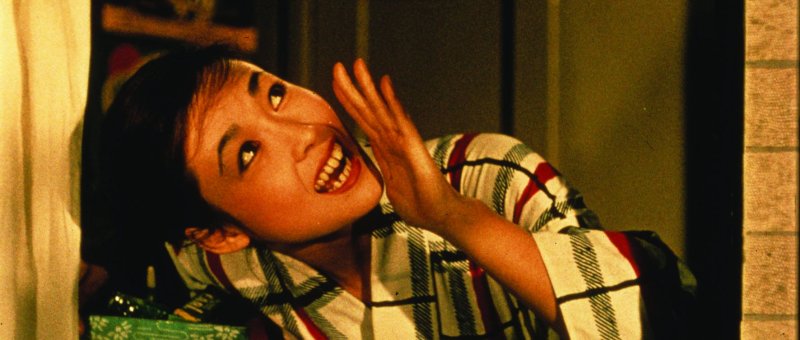
18 year old Yuko (Ayako Wakao) stands at the gates of adulthood. Taking a last photo in school uniform with her high school friends as they prepare for graduation, Yuko expresses her nervousness about being sent to Tokyo to live with the family of a father she barely knows while her friends worry about getting married or getting stuck in their tiny village all alone respectively. Tragedy strikes when the girls’ teacher arrives on a bicycle and informs them that Yuko’s grandmother has been taken ill. On her death bed, the grandmother reveals the reason Yuko is the only one of her father’s four children to be raised in the country is not a concern for her health, but that she is illegitimate. Yuko’s father, unhappy in his marriage, fell in love with his secretary (Kuniko Miyake) who later gave birth to Yuko, but he was already married with two children and so Yuko’s mother went to Manchuria leaving her to be raised in secret in the country.

Having nowhere else to go, Yuko arrives at her father’s large Western style house to be greeted coldly by her half-siblings, and treated as a maid by her still angry step-mother while her father (Kinzo Shin) is away on business. It has to be said that this model middle class family are an extremely unpleasant bunch. Step-mother Tatsuko (Sadako Sawamura) is shrewish and embittered while oldest daughter Teruko (Noriko Hodaka) spends all her time chasing wealthy boyfriends (but failing to win them because she’s just as mean as her mother). The oldest brother (Yuji Shinagawa) idles away in a hipster jazz band while the youngest boy, Hiroshi (Yukihiko Iwatare), is rude and boisterous but later bonds with his new big sister when she is the only one to really bother interacting with him.

The Ono household has always been an unhappy one. Yuko’s father married his wife after being bamboozled into it by an overbearing boss trying to offload his difficult daughter. Feeling trapped and avoiding going home he fell in love with a kind woman at work, had an affair, and wanted to marry her but wasn’t strong enough to break off not only from his unwanted family but also from his career in pursuing personal happiness. By Masumura’s logic, it’s this failure to follow one’s heart which has poisoned the Ono family ruining not only the lives of Tatsuko and the children who have no respect for their father or capacity for real human feeling (as Yuko later tells them), but also that of Yuko’s poor mother  whose life has been one of constant suffering after being unfairly jettisoned by a man who was bold enough to have an affair, but not to defy social conventions and leave an unhappy home.

Yuko herself, however, refuses to allow her life to be ruined by the failings of others. Looking up at the bright blue sky with her teacher (Kenji Sugawara), she learns to create her own stretch of heaven if only in her own mind. Though others might have fought and complained at being forced into the role of maid in what is her own family home, Yuko bears her new circumstances with stoicism and good humour. Thanks to her kindness and enthusiasm, the family maid, Yae (Chocho Miyako), is quickly on her side and if Teruko’s latest target, Hirooka (Keizo Kawasaki) starts to prefer the “new servant girl” his defection is completely understandable. Unlike later Masumura heroines, Yuko’s “revenge” is total yet constructive. She refuses to be cowed by unkindness, remains pure hearted in the face of cruelty, and resolves to find her own happiness and encourage others to do the same. With a few cutting words offered kindly, Yuko gets to the heart of the Onos, essentially reminding her father that all of this unhappiness is his own fault – he made his bed 20 years ago, now he needs to lie it and be a full-time husband and father to the family of lonely misfits he created in the absence of love.

Light and bright and colourful, The Blue Sky Maiden is among Masumura’s more cheerful films, not least because it does seem to believe that true happiness is possible. Yuko does not so much defy social convention as ignore it. She lives openly and without rancour or regret. She takes things as she finds them and people (aside from the Onos) are good to her because she is good to them. Though Masumura’s later work would become increasingly dark and melancholy, Yuko bears out many of his most central themes in her steadfast claim to her own individuality and equally steadfast commitment to enabling the happiness of others in defiance of prevailing social codes.


Diary of a Mad Old Man (瘋癲老人日記, Keigo Kimura, 1962)

e0022344_20155095Junichiro Tanizaki is giant of Japanese literature whose work has often been adapted for the screen with Manji alone receiving four different filmic treatments between 1964 and 2006. His often erotic themes tallied nicely with those of the director of the 1964 version, Yasuzo Masumura who also adapted Tanizaki’s The Tattooist under the title of Irezumi, both of which starred Masumura’s muse Ayako Wakao. Preceding both of these, Keigo Kimura’s Diary of a Mad Old Man (瘋癲老人日記, Futen Rojin Nikki) adapts a late, and at that time extremely recent, work by Tanizaki which again drew some inspiration from his own life as it explores the frustrated sexuality of an older man facing partial paralysis following a stroke. Once again employing Wakao as a genial femme fatale, Kimura’s film is a broadly comic tale of an old man’s folly, neatly undercutting its darker themes with naturalistic humour and late life melancholy.

Tanazaki’s stand in is a wealthy old man, Utsugi (So Yamamura), who has recently suffered a stroke which has paralysed his right hand and significantly reduced his quality of life. He currently operates a large household with a number of live-in staff, including a round the clock nurse, his wife, son, daughter-in-law, and grandson. The son, Joukichi (Keizo Kawasaki), is a successful executive currently having an affair with a cabaret dancer, leaving his extremely beautiful wife, Sachiko (Ayako Wakao), herself also formerly a dancer, at a loose end. Though approaching the end of his life and possibly physically incapable of acting on his desire, Utsugi is consumed with lust for Sachiko and thinks of little else but how to convince her to allow him even the smallest of intimacies. Sachiko, for her part, is not particularly interested in pursuing a romantic entanglement with her aged father-in-law but is perfectly aware of her power over him which she uses to fulfil her material desires. Meanwhile, Utsugi’s rather pathetic behaviour has not gone unnoticed by the rest of the household who view his desperation with a mix of pity, exasperation, and outrage.

Kimura’s film takes more of an objective view than the subjective quality of the title would suggest but still treats its protagonist with a degree of well intentioned sympathy for a man realising he’s reached the final stages of his life. Utsugi’s sexual desire intensifies even as his body betrays him but this very life force becomes his rebellion against the encroaching onset of decay as he clings to his virility, trying to off-set the inevitable. As such, conquest of Sachiko becomes his last dying quest for which he is willing to sacrifice anything, undergo any kind of degradation, simply to climb one rung on the ladder towards an eventual consummation of his desires.

Sachiko, instinctively disliked by her mother-in-law, is more than a match for Utsugi’s finagling. A young, confident, and beautiful woman, Sachiko has learned how to do as she pleases without needing permission from anyone for anything. In this, the pair are alike – both completely self aware yet also in full knowledge of those around them. The strange arrangement they’ve developed is a game of reciprocal gift giving which is less a war than a playful exercise in which both are perfectly aware of the rules and outcomes. Sachiko allows Utsugi certain privileges beginning with slightly patronising flirtation leading to leaving the bathroom door unlocked when she showers (behind a curtain) and permitting Utsugi to kiss and fondle her leg (even if she hoses it down, complaining it feels like being licked by a slug).

Tanizaki’s strange fetish is again in evidence as Utsugi finally deifies Sachiko in creating a print of the sole of her foot which he intends to have carved into his grave so he can live protected beneath her forever, as insects are under the foot of Buddha. This final act which takes the place of a literal consummation goes some way towards easing his desire but may also be the one which pushes him towards the grave he was seeking to avoid. Notably, Sachiko is bored and eventually exhausted by the entire enterprise even whilst Utsugi is caught in the throws of his dangerous ecstasy.

Other members of the household view the continuing interaction of Sachiko and Utsugi with bemusement, pitying and resenting the old man for his foolishness whilst half-admiring, half disapproving of Sachiko’s manipulation of his desires. Utsugi had been a stingy man despite his wealth and even now risks discord within his own family by refusing to assist his grown-up daughter who finds herself in financial difficulty and in need of familial support, yet lavishing vast sums on Sachiko for expensive trinkets even as she continues an affair with a younger man right under his nose. Still, Sachiko uses what she has and gets what she wants and Utsugi attempts to do the same only less successfully, completely self aware of his foolishness and the low probability of success yet buoyed with each tiny concession Sachiko affords him. A wry and unforgiving exploration of the link between sex and death, Diary of a Mad Old Man undercuts the less savoury elements of its source material with a broadly humorous, mocking tone gradually giving way to melancholy as the old man begins to accept his own impotence, the light around him dwindling while Sachiko’s only brightens.


Port of Flowers 花咲く港 (Keisuke Kinoshita, 1943)

film_syosai_img_01_04-thumb-730x480-1642Keisuke Kinoshita is far better known in his native Japan than outside it despite his long and prolific career in filmmaking. Equally adept at comedy and tragedy and tackling all genres from musicals to crime dramas, Kinoshita began his career in the relatively turbulent war years where every last detail was at the censor’s mercy.  Port of Flowers is his very first foray into the director’s chair and began a long association with the comedy genre. Though, yes, it has it’s obligatory moments of bare faced propaganda, the film is refreshingly light on heavy handed political statements and prefers to focus on a humorous take on small town life.

Life in a sleepy little port town is about to get significantly more exciting after the local inn has received two rare telegrams purporting to be from the same man but sent from different locations one day apart. The man in question claims to be the son of a businessman who lived in the town some years previously but has since died and the bereaved child has a hankering to see the little shipping village that the father apparently loved so much. After picking up their new guest at the station the mini delegation of inn keepers and officials are shocked to discover another disgruntled customer also claiming to be the sender of the letter. Sufficed to say neither of the two in question is what he claims to be but has come to town with the intention of fleecing some gullible country bumpkins out of grandma’s silver. The two decide to work together but eventually the goodnatured enthusiasm of the villagers (and the rising war effort) begin to make them rethink their nefarious ways!

Given the time period and strict censorship, it would be ridiculous not to expect some degree of pro-war sentiment in the film but Kinoshita has managed to more or less leave the conflict as merely a background setting. Life in this little fishing village seems fairly tranquil and the war has barely encroached on its idyllic settings. There are youngish men about, the people aren’t rich but they aren’t afraid and the only mention of turbulence seems to be a young woman who’s recently returned from Manchuria not entirely at her own volition. There are some fairly excited mentions of various victories but these are fairly minor events, almost like something happening far away to other people to whom you feel connected but not quite involved with. The most important thing is the building of the ship – not only is it a source of pride for the villagers, a way of fulfilling the dream of a respected visitor they all remember fondly but it will also be for their country. Everyone must contribute as they can because it’s for the entire community of citizens, not just the village but for everyone in the country and it’s important. Their sacrifice and hard work will matter because it will be for the greater good.

Here endeth the lesson, for the most part. What of our two bumbling crooks? It’s never really explained how they came to know so much about this poor, unsuspecting community and simultaneously hatched on the same scheme at the same time but they must have been pretty well out of options to think these poor villagers were going to be worth this much effort. They came to commit a fraud but ended up having to actually do the impossible and make their improbable scheme work solely because the villagers’ kindness was too much to bear. The addendum to the lesson being that pure hearts can shame the devil and innocence becomes infectious after a while (in the best possible way).

Very much of its time and with an air of disposability, Port of Flowers is an enjoyable, surprisingly warm film but not without its faults. Eschewing heavy handed propaganda for a subtle enforcement of traditional, communal values it reflects Kinoshita’s subsequent humanistic concerns and even manages to do so without giving in to the censor’s red pen. A nice take on an old story, Kinoshita once again proves that nothing matters so much as people and goodness will always win through in the end.