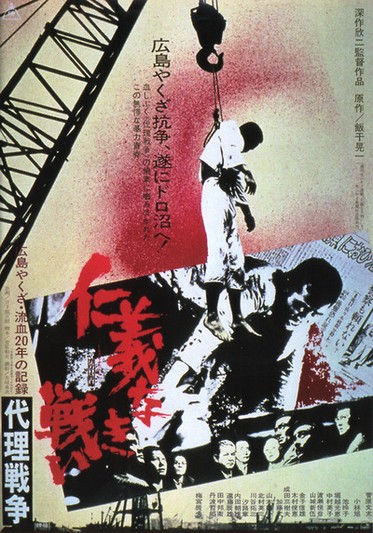
The Yakuza Papers Vol. 3: Proxy War (仁義なき戦い: 代理戦争, Kinji Fukasaku, 1973)

3-Battles-Without-Honor-and-Humanity-3-Proxy-WarThree films into The Yakuza Papers or Battles Without Honour and Humanity series, Fukasaku slackens the place slightly and brings us a little more intrigue and behind the scenes machinations rather than the wholesale carnage of the first two films. In Proxy War we move on in terms of time period and region following Shozo Hirono into the ’60s where he’s still a petty yakuza, but his fortunes have improved slightly.

It’s now 1960 – almost 15 years since Hirono came home from the war. The young people who are just coming of age grew up in the turbulent post-war era but probably don’t remember much of the conflict itself. These days the problem is the ANPO treaty and the wider world’s pre-occupation with communism. Russia and America are engaged in various “proxy wars” across the world in what would come to be known as the cold war. This tactic of indirect warfare has also taken root in the yakuza world as gangs and gang members form covert alliances, hatch secret plots to take out rivals, or otherwise try to manipulate the situation to their advantage. When the head of the Muraoka crime syndicate is assassinated in broad daylight and his underling, Uchimoto, does nothing, it kickstarts a chain of petty vendettas as each of the ambitious crime bosses vie to fill the power vacuum with the snivelling Uchimoto not least among them.

Bunta Sugawara returns to centre stage again with Hirono at the forefront of the action. One of the few yakuza guys who’s pretty happy with his lot and not seeking a higher position he’s in the perfect spot to become a very important player when it comes to supporting other people’s bids for power. Having originally backed Uchimoto he’s at something of a disadvantage following Uchimoto’s cowardly flip-flopping. However, having found himself back under the aegis of former boss Yorimoto, it does afford Hirono the possibility of finally getting revenge against him. Gangs merge several times while fracturing on the inside as the lower bosses try to get their guys in line whlst picking sides as to whom they support in the leadership battles (some with more of an eye on their own futures) but this time the action is a little more cerebral than the audacious violence of the immediate post-war period.

Changing up his style slightly, Fukasaku keeps the overall documentary approach with the news reel voice over relating the salient political and historical details plus the initial captions explaining the names and allegiances of the major players but reduces the freeze frame death announcements. The action is still frenetic with ultra naturalistic handheld camera and occasional strange angles but this time he opts for a muted colour effect in the final shoot out which increases the shocking nature of the scene. Blow for blow there’s less overt violence here though there is a fairly graphic and unpleasant rape scene which feels a little out of place though it does add to Fukasaku’s argument about the nature of aggression.

Once again the ruined the dome looms large over everything, reminding us that this isn’t just a story of gang warfare but a critique of the senselessness of a violent life. As the film says, young men are the first to die when the battles begin but their deaths are never honoured. Like Hiroshima Death Match, Proxy War also leads to the death of a youngster in pointless gang violence – another young man who ended up in the criminal underworld through lack of other options. The futility of the cycle of violence is becoming wearing – as is perhaps the point. One gang boss falls, another rises – only the names have changed. There’s no rest for an honest yakuza like Hirono when the less scrupulous are willing switch allegiance without a second thought. The only victory is staying alive as long as you can.


Proxy War is available on blu-ray in the UK as part of Arrow Video’s Battles Without Honour and Humanity: The Complete Collection box set.

The Yakuza Papers Vol. 2: Hiroshima Death Match (仁義なき戦い: 広島死闘篇, Kinji Fukasaku, 1973)

81ZkRgBFyyL._SL1378_If you thought the story was over when Hirono walked out on the funeral at the end of Battles Without Honour and Humanity think again – we’ve barely scraped the surface of the post-war Hiroshima criminal underworld chaos. The aptly named Hiroshima Death Match runs in parallel with the events of Battles Without Honour taking place in roughly the same time, 1950-1955, but features a new protagonist relegating Bunta Sugawara’s Hirono to the sidelines where he appears as a weary observer of the cruel yakuza world. This time our hero, Yamanaka, is younger – too young to have offered his life as a kamikaze in the war as he apparently wanted to, and is one of the thousands of young men who’ve found themselves alone and without futures thanks to both the after effects of World War II and the ongoing Korean War.

Hiroshima Death Match ties itself into Battles Without Honour and Humanity quite neatly when the protagonist, Shoji Yamanaka (Kinya Kitaoji), is sent to prison after taking a knife to a room full of guys who accused him of cheating in a gambling den. There he comes into contact with the first film’s hero, Hirono (Bunta Sugawara), who offers him some food whilst in solitary but then disappears for the vast bulk of the film. When he gets out, Shoji finds himself in trouble again when he can’t pay for his meal in a restaurant and offers to work off the bill. The waitress, Yasuko (Meiko Kaji), refuses and tells him to just forget about the money and leave when he’s done but Shoji is insulted by her “charity” and things kick off between him and a gang of yakuza also in the restaurant at the time. Yasuko turns out to be the widowed niece of a yakuza boss and after recovering in her care Shoji agrees to join the Muraoka gang to get revenge on the guys who beat him up.

Whereas Battles Without Honour and Humanity took as its protagonists the young men who’d returned from the war to a ruined and defeated country, Hiroshima Death Match focuses on the generation below who were too young to fight themselves but have still been marked by the after effects of the conflict. At the beginning of the film Shoji has nothing, he’s ashamed of cheating and gets upset when caught which only fuels his youthful and violent anger. He doesn’t seem to have any family to help him or honest work to go to and so, of course, he ends up a yakuza. Once again, the yakuza take the place of a traditional family offering both a place to belong and a degree of emotional and financial support – for a price.

When Shoji inevitably falls in love with Muraoka’s widowed niece, he discovers his surrogate father’s love is not quite unconditional. Yasuko has a young daughter and was married to a man who died a kamikaze war hero. Muraoka does not want her to remarry lest she shame her husband’s memory unless he keeps it in the family by marrying her off against her will to her huband’s brother. Shoji’s affair with Yasuko continues to cause a rift with Muraoka and he’s torn between a desire for a peaceful future with the woman he loves and loyalty to his gang boss to whom he owes so much. Muraoka’s own morals are shown to be far from the traditional yakuza ideals and he’s not above using Shoji’s strained loyalties to his own advantage eventually with tragic consequences.

Like Battles Without Honour and Humanity, Hiroshima Death Match is shot in the same quasi-documentary style with a weary sounding narrative voice over and frequent freeze frame captions identifying the characters along with their gangs and positions as well as their dates of demise at the appropriate time. The ruined Atomic Bomb Dome (now the Hiroshima Peace Memorial) continues to loom large over the proceedings as we’re reminded at the end that this isn’t the only blood that’s been shed here. Even more so than with Battles, Fukasaku rams home the senselessness and futility of violence. The film ends with Hirono attending another funeral (though this time in a black suit and melancholic air) where the bosses reap in consolation money and gamble at the wake. He gives his old bosses a sideways look as they laugh and joke while a young man who they all now account as some kind of legendary yakuza hero lies dead for no reason at all. What does this sort of life amount to in the end? The only reward for a life of violence is a lonely grave.


Hiroshima Death Match is available on blu-ray in the UK as part of Arrow Video’s Battles Without Honour and Humanity: The Complete Collection box set.


The Yakuza Papers Vol. 1: Battles Without Honour and Humanity (仁義なき戦い, Kinji Fukasaku, 1973)

Snapshot-2015-12-07 at 11_06_36 PM-930280086When it comes to the history of the yakuza movie, there are few titles as important or as influential both in Japan and the wider world than Kinji Fukasaku’s Battles Without Honour and Humanity (仁義なき戦い, Jingi Naki Tatakai). The first in what would become a series of similarly themed movies later known as The Yakuza Papers, Battles without Honour is a radical rebooting of the Japanese gangster movie. The English title is, infact, a literal translation of the Japanese which accounts for the slightly unnatural “and” rather than “or” where the “honour and humanity” are collected in a single Japanese word, “jingi”. Jingi is the ancient moral code by which old-style yakuza had abided and up to now the big studio gangster pictures had all depicted their yakuza as being honourable criminals. However, in Fukasaku’s reimagining of the gangster world this adherence to any kind of conventional morality was yet another casualty of Japan’s wartime defeat.
The story begins with a black and white image of a mushroom cloud with the film’s bright red title card and now famous theme playing over the top. This is Hiroshima in 1946. Things are pretty desperate, the black market is rife and there are US troops everywhere. Shozo Hirono (Bunta Sugawara) has just returned from the war (in fact he’s still in his uniform). He gets himself into trouble when he intervenes as an American soldier attempts to rape a Japanese woman in broad daylight in the middle of a crowded marketplace. He manages to cause enough of a commotion for the woman to escape but the Japanese cops just tell him not to mess with the GIs. Things don’t get much better as one of Hirono’s friends is assaulted by a yakuza. They get some rival yakuza to help them get revenge and in the commotion Hirono accidentally kills someone and is sent to prison for 12 years. In prison he meets another yakuza who wants to escape by pretending to commit harakiri and promises to get his yakuza buddies to bail Hirono out if he helps. From this point on Hirono has become embroiled in the new and dangerous world of the Hiroshima criminal underground.

Battles Without Honour and Humanity has a famously complicated plot entered around the various power shifts and machinations between different groups of yakuza immediately after the end of World War II. The film begins in 1946 and ends in 1956 though many of its cast of tough guys don’t last anywhere near as long. The picture Fukasaku paints of Japan immediately after the war is a bleak one. Even if some of these guys are happy to have survived and finally reached home, they’ve seen and done terrible things. Not only that, they’ve been defeated and now they’re surrounded by foreign troops everywhere who can pretty much do what they want when they want. They just don’t have a lot of options – if they don’t have connections to help them find work when there’s not enough to go around then it isn’t surprising if they eventually fall into to crime. Also, having spent time in the military, the yakuza brotherhood provides a similar kind of camaraderie and surrogate family that you might also find in an army corps.

It all gets ugly quite fast. Largely the yakuza are making their money profiting from the political instability, resenting the US occupation yet reaching deals with them to support their efforts in the Korean war and then selling new and untested drugs at home (with less than brilliant results). Betrayals, executions, assassinations in previously safe places like a bath house or the barbers – these are a long way from the supposedly honourable gangsters of old. One minute Hirono is offering to cut off his finger as a traditional sign of atonement (though no one knows exactly what you’re supposed to do in this situation and it all ends up seeming a little silly) and taking the rap for everyone else’s mistakes, but his friend faked harakiri to get out of jail and everyone is double crossing everyone else whichever way you look.

The whole thing is filmed in an almost documentary style with captions identifying the various characters and giving the exact time of their demise (if necessary) as well as a voice over giving background information about the historical period. The film is inspired by real life yakuza memoirs and there are parts which feel quite like a bunch of old guys sitting in a drinking establishment and recounting some of their exploits.

This new postwar world of heartless gangsters is a tough one and almost devoid of the old honour-bound nobility, however somehow Fukasaku has managed to make it all look very cool at the same time as being totally unappealing. You wouldn’t want to live this way and you definitely don’t want to get involved with any of these guys but somehow their self determined way of life becomes something to be admired. That said, there’s a sadness too – that even in the criminal underworld there used to be something noble that’s been obliterated by the intense trauma of the war. You can rebuild, you can move on from the destruction left by the war’s wake but there’s no going back to those days of “honour and humanity” – if they ever existed, they’re gone forever now.


Battles without Honour and Humanity is available in blu-ray in the UK as part of Arrow Video’s Battles Without Honour and Humanity: The Complete Collection box set.


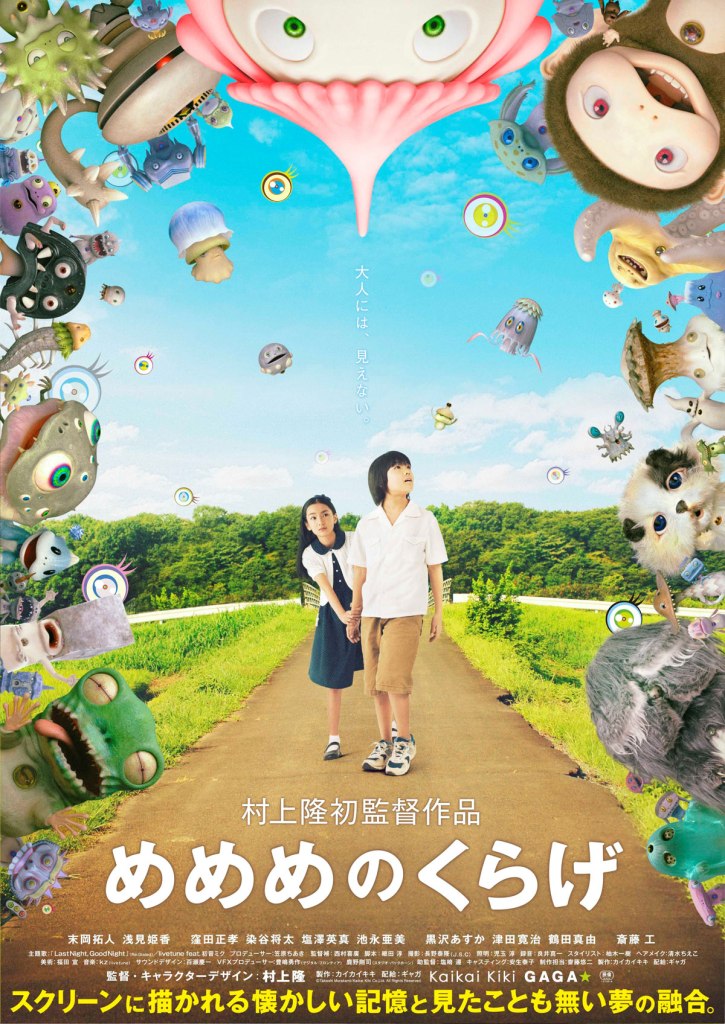
Jellyfish Eyes (めめめのくらげ, Takashi Murakami, 2013)

161244_01Jellyfish Eyes (めめめのくらげ, Mememe no Kurage) is the feature film debut of the internationally popular Japanese artist, Takashi Murakami. Well known for his cutesy character designs which are as likely to turn up in the world’s best regarded art galleries as they are on a kid’s backpack, Murakami is one of Japan’s most highly regarded art exports. Having unsuccessfully tried to raise interest in the more obvious totally CG animation, Murakami has enlisted the help of gore master Yoshihiro Nishimura for some director’s chair tips in creating a live action/CGI hybrid. Jellyfish Eyes is very definitely a kids’ movie, calling it a “family film” seems unfair when the age cut off is most likely around seven or eight years old but those who meet the (lack of) height requirement are sure to lap it up.
The story is set in post-tsunami Japan as Masashi (Takuto Sueoka) has finally moved out of the earthquake evacuation centre with his mother (Mayu Tsuruta) to live in a new town. As it will transpire, the two have moved there alone as Masashi’s father (Kanji Tsuda) has been killed in the tsunami and his mother has a brother (Takumi Saito) in the area. Not long after he moves in, the boy makes a new friend in the shape of a Jellyfish-like creature who floats in the air and loves eating the same kind of snacks as Mashashi. The creature, christened Kurage-bo (Jellyfish Boy), becomes a firm fixture in Masashi’s life and when he arrives at school Masashi realises Kurage-bo is not the only one of his kind. In this strange town all the kids have a weird little creature friend they can control by means of a smartphone app. Predictably some of the meaner boys use them to fight, but could there be a more sinister reason for the appearance of these very odd little guys? and what’s up with the bizarre religious cult that’s located right next to the creepy science lab? This is a very strange town indeed.

The film’s Japanese title, Mememe no Kurage, is a little reminiscent of the master work of the late Shigeru Mizuki, Gegege no Kitaro and like that perennially popular franchise the film focuses on the daily lives of children as they have strange adventures with supernatural creatures. The central premise is that a shady group of black clad scientific researchers (played by Masataka Kubota, Shota Sometani, Hidemasa Shiozawa, and Ami Ikenaga) claim to have found the key to surpassing natural disasters like earthquakes and it relies on the particles generated by the negative emotions of human children. Predictably it’s not long before things go from bad to worse and a giant kaiju-like creature descends on the town requiring the kids to work together to combat the marauding monster before it destroys the entire planet.

To be frank the film sounds a lot more entertaining that it turns out to be. Though undoubtedly very cute and not exactly uninteresting, it all ends up feeling, well, “superflat” only in an unintended way. The photography is generally basic though the CGI itself is of an extremely high quality and perfectly toned to match Murakami’s thematic concerns. Structurally it’s all over the place with the central ideas emphasised a little too strongly only to be thrown out of the window for the sugar rush finale of a million adorable monsters all fighting to the death for their cute as a button sad children masters. There’s quite a lot of darkness and melancholy lurking around the edges but the adorable little critters seem tailor-made for keeping the bad stuff in the background.

Like all good children’s movies the messages are the usual ones about the importance of friendship, sharing, teamwork and doing what’s right but it feels like Murakami has quite a lot of other things to say about reliance on forms of technology (and in particular what that can open the door to) and the state of post earthquake Japan that don’t quite come through. Having said that Jellyfish Eyes boasts some amazing visuals in its adorably cute cast of F.R.I.E.N.Ds and though a little messy is perfectly watchable. A festive treat for younger members of the family, Jellyfish Eyes is full of youthful idealism in the power of simple sincerity and genuine human feeling to win through against even the most terrifying of monsters but ultimately fails to offer much beyond its cutesy visuals.


Here’s a trailer – it says the creatures are invisible to adults but they aren’t (but some of them can make themselves transparent, if that makes sense).

Otakus in Love (恋の門, Suzuki Matsuo, 2004)

koi no monReview of Suzuki Matsuo’s Otaku’s in Love (恋の門, Koi no Mon) first published on UK Anime Network in February 2014.


The word “otaku” is a difficult one to pin down. In the West, it’s often come to be a badge of pride and respect, a label that many fans of what most people would perceive as a niche subculture actively identify with and eagerly apply to themselves. However, the roots of the term are much darker and in its native Japanese, “otaku” can be far from a nice thing to call another person. Of the central couple in this film perhaps only one can be thought of as a traditional “otaku” the other being more of a “tortured artist” whose eccentric behaviour makes it difficult for him to survive in the real world. Well, to be honest finding a base line for “normal behaviour” in this film is a pretty tall order, we run into bizarre anime conventions, cosplay obsessives, broken hearted ex-mangaka (manga) bar owners and a bizarre cult like office environment where the only rule is you must be “happy!” all the time. Otakus In Love is an endearingly odd film that is jam packed full of in jokes and meta references that knows its audience very well and never fails in the humour stakes as a result.

Mon is a down on his luck, in fact totally broke, manga artist. Well, he calls himself a “manga artist” but his work isn’t exactly what most people would expect. In a touch of the avant garde, Mon makes his manga out of rocks. Mon’s “manga” are, in fact, a collection of rocks painted with a single kanji character and arranged inside a custom made wooden box. Needless to say each of Mon’s works is a one off piece and his sales record is not exactly going to get him on the best seller list. He can’t seem to hold down a part time job either due to his extreme reactions to people not taking his art seriously and his strange appearance which is something like a seventies guru come glam rock god whose ragged clothes have an oddly deliberate look to them. One fateful day he has an interview for Tsugino Happy Inc which turns out to be a cult-like office environment which seems to advocate happiness through total subjugation. He lasts about an hour at this job before punching his new boss in the face for failing to appreciate his artistic qualities.

However, on the way there about to pick up a particularly fine looking rock, he meets Koino who turns out to be a colleague of his at Happy Inc. The two go out for drinks which ends up at Koino’s apartment where upon Mon wakes up the next morning to find out he’s been a victim of forced cosplay! Unwittingly dressed up as Koino’s favourite character from Soul Caliber II, he’s quickly posed by Koino for her cosplay wall and dragged into a world of doujinshi, comiket, cosplay and all things geeky. Koino is an amateur manga artist who claims to have made a small fortune selling her home made manga at conventions and is well and truly an otaku. Can two such different people really find love? There’s only one way to find out!

Otakus in Love is based on Jun Hanyunyuu’s manga Koi no Mon (also the original Japanese title of the film) and as such carries over various extremely clever meta visual references. Directed by well known actor Suzuki Matsuo (Ichi the Killer) the film is often about as close as you could get to being a live action manga as Matsuo manages to make standard manga tropes like reaction shots and surreal action scenes work in a totally believable way. In the course of the film we’re treated to full on musical sections and ridiculous comic motifs that resurface at fairly predictable moments which could all end up just being far too much, but under Matsuo’s steady hand the film comes out on the right side of crazy and is never anything less than totally zany fun.

The film isn’t afraid to wear its otaku badge on its sleeve, either. Jam packed with references from video games, anime, and manga, Otakus in Love gets its audience completely and trusts it to understand all of its allusions and homages without needing to repeatedly bash the viewer over the head with tie-ins. It also takes an affectionate side swipe at fan culture with some bizarre interactions with cosplay, conventions and ani-singers which any anime fan can probably relate to. The film also has a fair few cameos from such well known personages as Hideaki Anno, Shinya Tsukamoto and Takashi Miike to name but a few.

At a 114 minutes it does run a little long and occasionally feels like it’s going to run out of steam but for the vast majority of its running time Otakus in Love is a genuinely hilarious, truly bizarre, romantic comedy. Full of warmth and exuberance, it’s difficult to image anyone not being swept away by its surreal humour and though it’s certainly on the broader side of comedy it never feels particularly over the top (or at least not in a bad way). Otakus in Love is a romanic comedy that no self confessed otaku should miss out on seeing.


Reviewed at the Japan Foundation Touring Film Programme 2014.

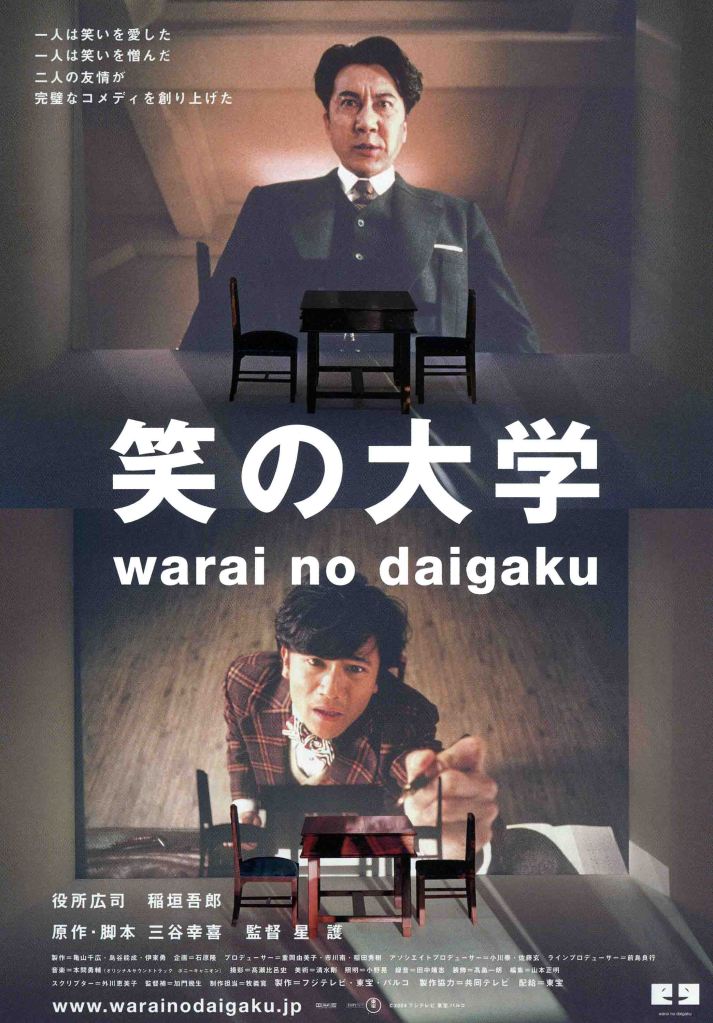
University of Laughs (笑の大学, Mamoru Hoshi, 2004)

warainodaigakuUniversity of Laughs (笑の大学, Warai no Daigaku) is certainly an apt name for a film which aims to teach the universal power of comedy. Based on a 1997 stage play by Japanese comedy master Koki Mitani and directed by Mamoru Hoshi, the film is set in 1940 at the height of Japan’s militaristic fervour. With the annexation of Manchuria only three years previously and the war in full swing, there is no room for such petty bourgeois pleasures as slapstick comedy shows. The censor’s stamp rules all and if the piece doesn’t exult the glorious nature of the empire, then what good is it?
Or so thinks recent Manchurian returnee Sakisaka (Koji Yakusho) – the newly appointed occupier of the censor’s chair. Sakisaka has been appointed because he has no sense of humour at all and very little in the way of human feeling. In fact, he even thinks this censorship business is a little pointless and it would be better to just ban everything outright. Then, one day, he encounters quite the stupidest piece of low comedy he’s ever come across in the form of the latest play by a company called “University of Laughs” written by their company director, Tsubaki (Goro Inagaki).

Tsubaki is a nervous, neurotic young man. “Don’t worry, we very rarely use torture” Sakisaka reassures him. Still, Tsubaki tries to talk him through his parodic play script called “The Tragedy of Juleo and Romiet”. However, Tsubaki’s play is no good at all! It’s full of foreigners! And there’s romance, and no one talks about how amazing Japan is, what the hell sort of play is this!? Sakisaka tells him to bring it back tomorrow with the requisite changes. However, tomorrow’s effort is only a little better. Maybe another day? Gradually over the course of a week the pair become uneasy collaborators as Sakisaka eventually rediscovers his sense of humour.

The central irony being that in trying to eliminate all subversive elements in the script, Sakisaka actually ends up in the position of editor – all of the changes he suggests only succeed in making the play funnier and more coherent. The more advice he receives from Sakisaka, the better a writer Tsubaki becomes. However, Sakisaka is the representative of everything the true artists abhors as the tool of an oppressive state which seeks to repress all independent thought. In going along with Sakisaka’s recommendations, isn’t Tsubaki becoming just another government lapdog? Is it better to compromise, go as far as you can go, and stay open or should you staunchly refuse and boycott the regime in its entirety?

For Tsubaki, comedy is a religion. He’s a comedy writer, if he can’t write comedies he may as well not exist at all and the way he sees it, this stuff is making the work better so who cares what it’s all about, really, so long as the work is good. His actors, though, feel differently and Tsubaki is paying a heavy price for his awkward quasi-friendship with the government stooge. Nevertheless, the two develop a strange bond with the previously stiff Sakisaka bucking his rigid adherence to government doublespeak in opening up to Tsubaki’s comedic education. However, their friendship may not be as deep as Tsubaki hopes when he unwisely reveals his real feelings about the regime causing Sakisaka to remind him where his loyalties lie. This is 1940 after all and the spectre of war lies all around. In the end, even if Tsubaki’s now near perfect work is passed for presentation, he may be unable to realise it in person.

Consciously old fashioned, University of Laughs has echoes of Fellini though perhaps filtered through mid period Woody Allen. The Nino Rota-esque score further enhances the association as does the idea of the fascist state as a mad circus where one is forced repeat the same actions over and over again until the ringmasters finally applaud. Warm, witty and surprisingly engaging for a film that is essentially two guys in a room for two hours, University of Laughs is another impressive effort from the pen of Mitani which offers both a cutting critique of oppressive censorship, a defence of the artist and an exultation of the universal power of laughter.

Ruined Heart: Another Love Story Between a Criminal & A Whore

Ruined Heart
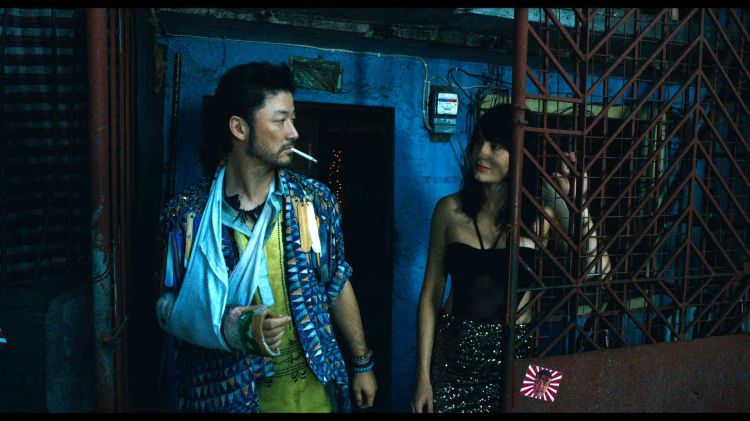
100% did not notice that sticker while I was watching the film…

Just “another love story between a criminal and a whore” –  so subtitles maverick Filipino film director Khavn his latest effort, Ruined Heart (Pusong Wasak: Isa na namang kwento ng pag-ibig sa pagitan ng kriminal at puta), though like much in the film you could read quite a lot more intro those few words than their subtext suggests. Light on conventional narrative and almost dialogue free, Ruined Heart is the deconstruction of the classic B-Movie. We have our noble, broken hearted outlaw and our damaged princess in need of rescue but what we’re denied is the sense of moral righteousness that generally pervades in a B-Movie and particularly in a film noir. The picture Kavn paints is of a hellish world where violence reigns and love will always be defeated.

There’s little point trying to tease out the plot bar the above ideas. What we are presented with at the beginning of the film is our dramatis personae – archetypes of this modern myth: The  Lover (Elena Kazan), The Criminal (Tadanobu Asano), The Friend (Andre Puertollano), The Whore (Nathalia Acevedo), and The Pianist (played by Khavn himself), each profiled against a butterfly patterned curtain neatly echoing Branded to Kill. Our hero, the Criminal, bonds with the Whore after offing one of her Johns, but their love is not to last after the Criminal decides to help The Friend rescue his Lover from the Godfather.

While all of this is going on we’re also treated to a far more surreal scene where the pianist reads out a street poem consisting of the repeated phrase “I am the poem of the world” before taking part in a bizarre ritual where he appears to resurrect the Godfather (Vim Nadera) who is now introduced for the first time. Is the pianist the god of this strangely operatic landscape, presiding over this violent world of song? For someone with such an elaborate introduction he makes relatively little impact thereafter. Is this hell, are we all dead already or merely doomed to relive these old stories over and over again to the point where names and language no longer have currency?

That said, there is something genuine to be found here in this otherwise cold landscape. The Criminal and The Whore find love against the odds though their romance is soon frustrated by the harshness of their world. They have fleeting moments of joy where they drink and dance and make music of all kinds. However, something is coming for them and however hard you try to escape there are things you cannot outrun.

Playing out more like an avant-garde opera than a conventional film, Ruined Heart offers little in the way of concrete explanations. Dripping with sometimes impenetrable symbolism the film paints an eerie, dream-like vision that often proves impossible to decode and like all the best poems, there are a hundred different ways to read it.

The score itself is an eclectic assault of catchy ’60s inflected broken heart ballads and electro pop, often repeating the same song in different arrangements (an apt stylistic choice given the nature of the film). Composed by a diverse collection of artists including French/German outfit Stereo Total who contributed to Third Window Films’ previous release pink musical Underwater Love, and Bing Austria & the Flippin’ Soul Stompers who provide the film’s catchy theme song, the musical element becomes the driving force of the film.

Shot with a youthful yet melancholy verve by Christopher Doyle, Ruined Heart is a high energy experience that proves difficult to digest, particularly on a first viewing. However, its extremely rich layers of symbolism and subversion of common archetypes lend it a mystifying and intriguing atmosphere that continues to fascinate long after the credits roll. More felt and experienced than understood, Ruined Heart may prove a difficult sell for some but comes bearing gifts for those that long to find them.


Ruined Heart is available on blu-ray in the UK now from Third Window films in a limited edition package which also includes a soundtrack CD (highly recommended for the CD alone). The blu-ray disc also includes Khavn’s short film with the same title and a similar theme (though filmed in an entirely different style and with a different cast).

First saw the film a couple of months ago and still can’t get this song out of my head.

Trailer for the film


Summer Time Machine Blues (サマータイムマシン・ブルース, Katsuyuki Motohiro, 2005)

summertimemachineblues-2There ain’t no cure for the summer time blues! Unless, of course, you have a time machine. For the boys of the sci-fi club the long, boring summer vacation is just getting started. They mess around playing baseball while the two girls from the photography club who’ve been unceremoniously ousted from their club room in favour of the boys take photos of them. Then some weird stuff starts happening and their air con remote gets broken and it’s just so hot! When the boys somehow end up with a mysterious time machine, the solution is obvious…

Full of nostalgic charm, Summer Time Machine Blues is a fitting tribute to all those endless, golden summers of adolescence. Hanging out in the university club room even though they’re on their summer break, the kids waste time in distinctly old fashioned ways – playing baseball, going to the baths, working on a photo project etc. Though the guys are nominally the “science-fiction club” they actually aren’t very interested in science fiction and kind of make fun of the sort of people who would belong to the very club that they do, actually, belong to. Perhaps they just wanted the bigger room with the air conditioner and were lucky enough to get it as their two female friends are the only two members of the photography club and mostly hang out in the dark room at the back anyway.

The film began as a stage play put together by Europa Kikaku and though it makes the cinematic jump extremely confidently also maintains its youthful absurdist tones and theatrical comedy beats. The humour itself is cheerfully bizarre, full of fast comebacks and naturalistic sounding banter between a group of young guys. Added to this there are numerous references to other popular science fiction and time travel themed franchises such as the obvious homage to the Back to the Future series which is even prominently showcased in poster form at the local rep cinema. The cinema itself (a mini plot point in the movie) is run by a total sci-fi buff and time travel story expert who dresses (from the waist up) in a Star Trek: The Next Generation Command uniform complete with Communicator Badge. He seems to have something of a beef with the only actual scientist in the film who never has much success with his discoveries and only succeeds in boring everyone around him with his needlessly complicated theories.

Directed by Katsuyuki Motohiro who may be best known for the Bayside Shakedown series, Summer Time Machine Blues, also mixes in plenty of fun stylistic devices like the anachronistic tape rewinds or the elaborate disappearing of the time machine itself. He also makes good use of split screens to compare and contrast what’s happening where and pays especial attention to make sure everything works out in the most completely satisfying way.

Indeed, one of the most satisfying things about Summer Time Machine Blues is that despite essentially becoming a parody of time travel movies, all of its complicated paradoxes are internally consistent and even though it doesn’t really have an obligation to, it all makes sense no matter how hard you poke at it trying to find the holes. Of course, there’s also the more melancholic side of time on show as the scientist points out he’s riding a time machine as well – just one that will never go backwards, only very slowly into the future. This aimless summer will end at some point, as will college and eventually the universe too, one supposes.

However, that’s no reason not to enjoy the time you have, as one character realises towards the end as he fears his romantic desires may come to nothing going on some hints from the future. An enjoyably absurd and youthful farce, Summer Time Machine Blues is lives up to its name as a transporting delight which carts the viewer back to their own days of long and boring summers filled with improbable adventures. Smart, funny and beautifully crafted, Summer Time Machine Blues is the perfect way to while away an aimless afternoon at any time of the year.


Midnight Diner (深夜食堂, Shinya Shokudo, Joji Matsuoka, 2015)

mainvisualYaro Abe’s manga Midnight Diner (深夜食堂, Shinya Shokudo) was first adapted as 10 episode TV drama back in 2009 with a second series in 2011 and a third in 2014. With a Korean adaptation in between, the series now finds itself back for second helpings in the form of a big screen adaptation.

Midnight Diner is set in a cosy little eatery which only opens between the hours of midnight and 7am. Presided over by the “Master”, a mysterious figure himself with a large unexplained scar running down one side of his face, the restaurant has only one regular dish on its menu but Master is willing to make whatever his customers want provided he has the ingredients. Regulars and newcomers mingle nightly each with their own, sometimes sad, stories while Master offers them a safe place to think things through coupled with his gentle, all knowing advice.

The big screen movie plays just like a series of connected episodes from the television drama yet manages unify its approach into something which feels consistently more cinematic. Keeping the warm, nostalgic tone the film also increases its production values whilst maintaining its trademark style. The movie opens with the same title sequence as its TV version and divides itself neatly into chapters which each carry the title of the key dish that Master will cook for this segment’s star. A little less wilfully melodramatic, Midnight Diner the movie nevertheless offers its gentle commentary on the melancholy elements of modern life and its ordinary moments of sadness.

Fans of the TV drama will be pleased to see their favourite restaurant regulars reappearing if only briefly, but the film also boosts its profile in the form of some big name stars including a manager of another restaurant in town played by Kimiko Yo who seems to have some kind of history with Master as well as a smaller role played by prolific indie star of the moment Kiyohiko Shibukawa and the return of Joe Odagiri whose character seems to have undergone quite a radical change since we last saw him.

The stories this time around feature a serial mistress and her dalliance with another, poorer, client of the diner; a young girl who pulls a dine and dash only to return, apologise and offer to work off her bill; a lovelorn widower who’s come to Tokyo to chase an aid worker who probably just isn’t interested in him; and then there’s strange mystery of a mislaid funerary urn neatly tieing everything together. Just as in the TV series, each character has a special dish that they’ve been longing for and through reconnecting with the past by means of Master’s magic cooking, they manage to unlock their futures too. As usual, Master knows what it is they need long before they do and though he’s a man of few words, always seems to know what to say. One of the charms of the series as a whole which is echoed in the film is that it’s content to let a few mysteries hang while the central tale unfolds naturally almost as if you’re just another customer sitting at the end of Master’s counter.

Shot in more or less the same style as the TV series favouring long, static takes the film still manages to feel cinematic and its slight colour filtering adds to the overall warm and nostalgic tone the series has become known for. Once again offering a series of gentle human stories, Midnight Diner might not be the most groundbreaking of films but it offers its own delicate insights into the human condition and slowly but surely captivates with its intriguing cast of unlikely dining companions.


The Crucified Lovers (近松物語, Chikamatsu Monogatari, Kenji Mizoguchi, 1954)

E8BF91E69DBEE789A9E8AA9EB2Bunraku playwright Chikamatsu Monzaemon had a bit of a thing about double suicides which feature in a number of his plays. Though these legends of lovers driven into the arms of death by a cruel and unforgiving society are common across the world, they seem to have taken a particularly romantic route in Japanese drama. Brought to the screen by the great (if sometimes conflicted) champion of women’s cinema Kenji Mizoguchi, The Crucified Lovers (近松物語, Chikamatsu Monogatari) takes its queue from  one such bunraku play and tells the sorry tale of Osan and Mohei who find themselves thrown together by a set of huge misunderstandings and subsequently falling headlong into a forbidden romance.

Set in 17th century Kyoto, the story begins with a reminder that adultery is currently illegal and that the penalty is crucifixion of both parties. A samurai woman and a man servant are being paraded through the streets for having committed the double transgression of an extra-martial affair which also crosses class borders. We set our tale at the top printing house in the city where the most promising employee, Mohei, is being pulled from his sickbed to complete a particularly important order. At the same time, mistress of the house Osan receives an unwelcome visit from her brother who is once again in pecuniary difficulty. He wants her to ask her wealthy husband, Ishun, to lend him some more money to meet the latest mortgage payment on their family home. However, Ishun is a stingy old man and outright refuses. Mohei overhears the brother’s visit and offers to help but his idea to temporarily embezzle some of the money backfires when he’s caught.

To make matters worse, Ishun now has it in for Mohei as Ishun has been after the servant girl Otama who has been refusing his advances and finally lied to him by claiming that she and Mohei are secretly engaged. After Otama reveals Ishun’s true nature to Osan, they hatch a plan to confront him by swapping rooms so that when Ishun makes his nightly visit to Otama he’ll find his wife waiting for him instead and have to backdown for awhile. This backfires too when Mohei decides to escape and stops by Otama’s room to say goodbye only for another servant to find Mohei and Osan together there. Mohei flees but a rumour starts about his friendship with Osan and it’s not long before she’s stormed out too. Accidentally running in to each other the pair find themselves on the run and eventually falling in love, but this isn’t the sort of place where two people can just move to another town and disappear. The police and Ishun’s men are hot on their tail determined to try and prevent the impending scandal…

Life was pretty harsh in feudal Japan. In some ways Osan might be thought lucky – married off at a young age to a well connected and prosperous husband. Indeed, at the beginning of the film she doesn’t seem too unhappy though is obviously nervous to talk to her husband about her brother’s predicament. Ishun is not a good man though he is perhaps sadly typical of his petty samurai merchant class. He swaggers around complaining about having to pay for everything and won’t even lend any of his vast wealth to his own sister let alone his wife’s family. Though outwardly miserly he’s no problem promising fancy kimonos and even a house to Otama if she’d only consent to becoming his mistress. Something of a double standard then when his wife is accused of having affair with a servant merely by having been found in a compromising position alone in a room with another man.

Mohei, by contrast, is the archetypal loyal retainer. When ever a problem comes up he reminds himself that one needs to be a “good servant” – a sentiment he utters to Otama when she asks for his help to fend off Ishun. He doesn’t approve of the idea of her simply giving in, but thinks she ought to grin and bear it. Similarly when some of the female members of staff are sympathising with the samurai lady about to be crucified for love, Mohei agrees that he feels sorry for her but also that she’s broken a law and what is happening is simply a natural consequence. He’s the last sort of person you would expect this sort of thing to happen to, and yet, it does.

The irony is that nothing existed between the pair other than the loose friendship and loyalty of a mistress and a member of staff before this whole thing started. Their union is quite literally unthinkable, not only a relationship between a married woman and another man, but love across the class divides. Even if Osan were free, a marriage with Mohei would be considered a disgrace. When the pair face the hopelessness of their situation and decide on suicide, Mohei confesses his love which immediately changes Osan’s mind about dying. She’s fallen in love with him too, and now she wants to live. For her now there can be no life without Mohei. Though Mohei entertains the noble idea of handing himself in to the police and sending Osan back to Ishun who would doubtless be glad to cover up the affair and avoid a bigger scandal, he later finds himself unable to give her up. The pair cannot, and will not, deny their love even if it costs their lives. In this unforgiving world of harsh social justice, the only freedom left to Osan and Mohei is to ride proudly to their agonising deaths hand in hand and with beatific smiles on their faces.

In the end, two grand houses fall because of a series of coincidental misunderstandings and lapses of protocol. Envious of his position, another petty samurai is perfectly happy to manipulate the situation to take down Ishun fully knowing that it will mean the deaths of two people. In ordinary circumstances this passionate, romantic love would never be permitted to exist (or at least among this social class). Its blossoming is an impossible miracle that threatens the very foundation of the extraordinarily regimented society of the two people at its centre. Parents betray their children to protect these archaic laws and preserve their family “honour” but what honour could their possibly be in the denial of love and society that places standing above basic compassion?

Though not perhaps Mizoguchi’s most impressive effort, The Crucified Lovers is an impassioned attack on needlessly repressive social systems and the self centred shenanigans which perpetuate them. Unashamedly melodramatic and filled with a melancholy though passionate resilience, The Crucified Lovers is a tragic tale of true love torn asunder by a cruel and unforgiving world. It would be so easy to say this would never happen today, and yet…


The Crucified Lovers is available on blu-ray in the UK as part of Eureka’s Late Mizoguchi box set.

No trailer but here is a particularly beautiful scene from the film

And an introduction from Tony Rayns