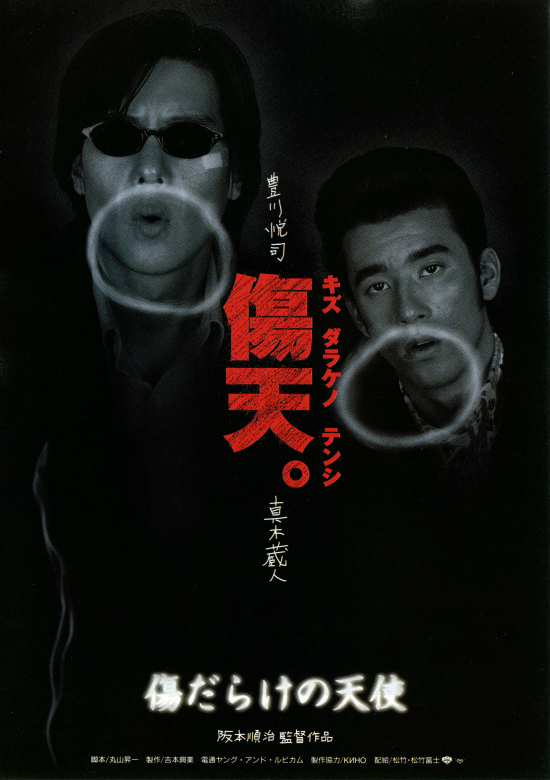
 Despite having started his career in the action field with the boxing film Dotsuitarunen and an entry in the New Battles Without Honour and Humanity series, Junji Sakamoto has increasingly moved into gentler, socially conscious films including the Thai set Children of the Dark and the Toei 60th Anniversary prestige picture A Chorus of Angels. Injured Angels (傷だらけの天使, Kizudarake no Tenshi) marries both of aspects of his career but leans towards the softer side as it finds genial private detective Mitsuru (Etsushi Toyokawa) accepting a request from a dying man to ensure the safe passage of his young son to the boy’s mother in Northern Japan.
Reluctantly taking on an assignment to question the last remaining tenant of an office block, Mitsuru discovers the man inside already mortally wounded. During their conversation, the man offers him all the money he has left to take his young son to his estranged wife, currently living in a small town in the North of Japan. Mitsuru doesn’t really want this kind of hassle but feels sorry for the man and his son and eventually decides to make sure the boy, Hotaru, gets to someone who can take of him. The pair set off on a kind of road trip eventually joined by Mitsuru’s partner Hisashi (Claude Maki) meeting friends old and new along the way.
Inspired by the 1970s TV series of the same title, Injured Angels adopts an oddly jokey tone throughout as Mitsuru has various strange adventures whilst trying to guide a small child to someone willing to take him in. At one stage, the film goes off on a long and improbable tangent in which Mitsuru runs into an old friend who is currently wearing a lucha libre mask “for work”. The pair then board the bus with the wrestlers before Mitsuru himself ends up in the ring. Though fun, the sequence has little to do with the ongoing plot other than adding to the already absurd atmosphere.
Predictably, when Mitsuru reaches the address he’s been given, Hotaru’s mother has already moved on but even when they eventually find her, the reaction is not the one you’d expect. Soon to be married again, Hotaru’s mother (Kimiko Yo) is not keen to resume custody of her son (or rather, her husband to be has no desire to raise another man’s child and even goes so far as to use physical violence on Mitsuru to show the strength of his feeling). Hotaru starts to grow attached to the two detectives who are probably giving him the most normal kind of family life that he has known for a very longtime. The guys seem to know they can’t keep him indefinitely and are intent on finding another relative but the mini family they’ve formed may be painful to break up.
While all of this is going on, Mitsuru also has a series of meetings with a woman from Tokyo, Eiko (Tomoyo Harada), who keeps bumping into him. Though an obvious attraction develops, Eiko is also fleeing her own kind of trouble and the pair seem content to leave things up to fate and possible drinks in Tokyo at an unspecified point in time, but this oddly integrated plot strand fails to have a real impact within the narrative as a whole. It does, however, add to Mitsuru’s ongoing existential dilemma as he begins to reexamine his life and relationships after bonding with Hotaru. Ultimately he opts for asking his partner, Hiasashi, to move in with him when they get back to Tokyo but at the same time Mitsuru seems to know he may be headed for another destination entirely.
This tonal strangeness is a serious weakness where would expect a more nihilistic atmosphere as Mitsuru’s journey begins to take shape but the inconsequential humour and mildly absurdist approach continues right until the anticlimactic ending. Perhaps feeling a need to recreate the feeling of the TV series, Sakamoto fails to reconcile these differing levels of seriousness into a convincing whole in allowing for the kind of light and breezy action in which everything is definitely going to be OK by next week’s episode. For what’s actually a look at neglected, abandoned children coupled with intense friendships and romantic dilemmas, the bouncy, ridiculous tone is an odd fit and robs the piece of its dramatic weight. Nevertheless, despite the structural problems, Injured Angels is often a fairly enjoyable, if odd, character drama even it ultimately fails to amount to very much as a whole.
Original trailer (no subtitles)
 As you read the words “adapted from the novel by Kanae Minato” you know that however cute and cuddly the blurb on the back may make it sound, there will be pain and suffering at its foundation. So it is with A Chorus of Angels (北のカナリアたち, Kita no Kanariatachi) which sells itself as a kind of mini-take on Twenty-Four Eyes (“Twelve Eyes” – if you will) as a middle aged former school mistress meets up with her six former charges only to discover that her own actions have cast an irrevocable shadow over the very sunlight she was determined to shine on their otherwise troubled young lives.
