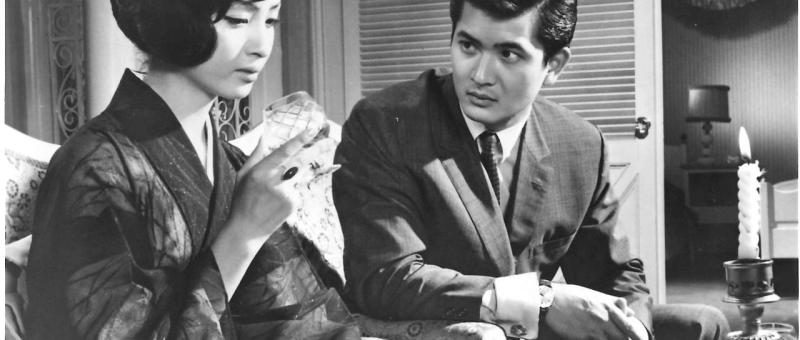
Lightning (稲妻, Mikio Naruse, 1952)

In many ways despite its matter of fact bleakness, Lightning (稲妻, Inazuma) is among the more optimistic of Mikio Naruse’s films ending on a note of cheerfulness and hope in which the storm has been broken and the heroine seems to have rediscovered a sense a faith in humanity. Yet the attitudes she displays are often contradictory and firmly at odds with the kind of Shitamachi spirit one might find in the films of a director such as Yoji Yamada in films like The Sunshine Girl released a decade later.

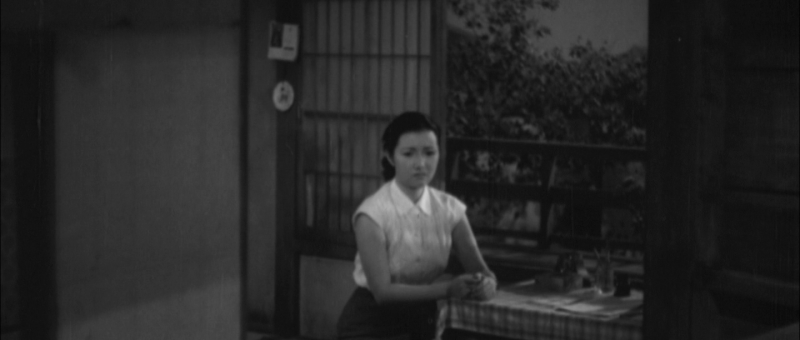
The qualities that most define Kiyoko (Hideko Takamine) are, as her mother Osei (Kumeko Urabe) suggests, an inner strength that eludes her older sister Mitsuko (Mitsuko Miura) and a forthrightness that sees her struggle to pursue the kind of life she wants rather than that she is expected to lead. Yet some might see her as snobbish and judgemental, at times attacking her mother for having married four times and given birth to four children each with different fathers. In this she sees a particular moral failing on the part of Osei, but perhaps also expresses a deeper distrust in her mother’s repeated attempts to find stability only through harnessing herself to a man. 

Echoing Takamine’s role in Hideko the Bus Conductor, Kiyoko has a job as a tour guide showing off the sites of bustling Ginza though explaining that this part of the city only really comes alive at night. The job gives her a sense of independence and self-sufficiency a woman in this era is not really permitted to have. Her oldest sister, Nui (Chieko Murata), asks if she contributes to the household but the meeker Mitsuko replies that she wanted to but they told her to save her money instead. In any case, it’s towards marriage that she’s pushed when Nui attempts to play matchmaker brokering an engagement with a 35-year-old baker, Goto (Eitaro Ozawa), who has aspirations of opening a love hotel into which Nui and her feckless husband Ryuzo (Kenzaburo Uemura) have invested. Of course, it turns out that Nui is herself having an affair with the baker who is oily in the extreme and disliked by most of the family though eventually manages to make his way into the beds of two of the sisters.

Kiyoko has little desire to marry and asks her mother if any of her four marriages made her happy, but her mother only says that happiness is not an important concept hinting the hardship she’s faced in her life and that a woman of her generation may have had to put up with a certain of degree dissatisfaction to keep a roof over her head and food on the table. While working on the bus, Kiyoko spots Mitsuko’s husband talking to another woman in the street but decides to say nothing only for him to suddenly die and the woman turn up with a baby asking for financial support. Kiyoko tells her sister that marriage is hell, but she smiles and says Kiyoko will be the exception in an expression of the various ways in which women enforce these arcane social codes against each other despite their own misery. Mitsuko too wants to escape but admits she doesn’t have Kiyoko’s courage which is how she too eventually falls into the clutches of Goto much to her sister’s disappointment. 

There is something undeniably poignant in Kiyoko’s frustrated defiance, looking longingly at the paintings and books of their lodger, a young woman from a more middle-class family working her way through university. Kiyoko says she wants to study too, but her mother shoots her down. She’s already 23, and it’s a little late to be picky about marriage let alone strike out for a more stereotypically middle-class life with a white collar job and nice house in the suburbs. It’s the suburbs though to which she eventually moves, without even bothering to tell any of her family. When the nice landlady asks if she has any she admits she has but also has nothing to do with them, which earns her a confused frown. She later says something similar to the pair of piano-playing siblings who live next-door in a kind of suburban utopia, quite clearly ashamed of her humble Shitamachi roots and family members she sees as common and immodest.

In any case, her admiration of the siblings and obvious attraction to the brother (Jun Negami) who is so much more sensitive and caring than her own (Osamu Maruyama) who appears to use the wartime bullets lodged inside him as an excuse not to move on with his life, suggest that she is still in the end looking for a conventional family only one she sees as more positive (or just posher). Perhaps it’s not so much marriage she rejects but dependency and subjugation, believing a marriage to a man like this might be one more of love and equality than the dissatisfying relationships experienced by her mother and sisters. The expressionistic bolt of lightning which appears during a difficult conversation with her mother is like the breaking of a storm, a kind of letting go in which her resentment begins to melt away and her mother agrees to retreat realising that unlike Mitsuko she can take care of herself and to that extent at least is an independent post-war woman. Ambivalent, but in its way warm and forgiving the film gives Kiyoko permission to embrace her aspiration, defy the social codes which constrain her and seek her own happiness, but also allows her to shed her cynicism in rediscovering a faith in humanity and re-embracing her admittedly imperfect mother all while leaving her behind. 

Endless Desire (果しなき欲望, Shohei Imamura, 1958)

In the noir films of the immediate post-war era, the protagonists are often haunted by an inescapable past that prevents them from moving on into the new democratic Japan. But in Shohei Imamura’s Endless Desire (果しなき欲望, Hateshinaki Yokubo) the situation is ironically reversed as a group of former soldiers who on the surface of things at least seem to have made moderately successful lives for themselves reunite to dig up buried treasure from the dying days of the war greedy for a little more glamour than the world has seen fit to show them.

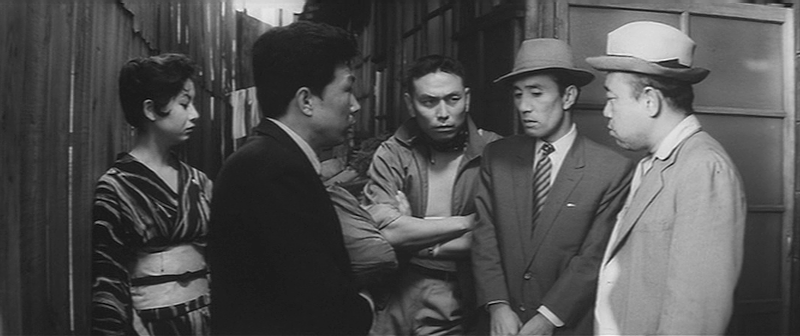
Their venal amorality is directly contrasted with the bumbling earnestness of Satoru (Hiroyuki Nagato), a young man who fears his childhood sweetheart, butcher’s daughter Ryuko (Sanae Nakahara), is going to marry another man because he is unemployed and cannot find a job in the still difficult if steadily improving post-war economy. As such, he’s incredibly excited by the opportunity to get into the real estate business, wandering around town dressed in a suit and carrying a briefcase to scout properties or otherwise doing odd jobs for the gang, which is a shame because unbeknownst to him the business is a sham set up as a front by the crooks who’ve rented a vacant shop from Satoru’s land shark dad so they can tunnel their way to the treasure which they think is buried under Ryuko’s butcher’s shop. 

The changing nature of the times is rammed home by the fact that the shopping district, which stands atop the site of the former military hospital where the gang buried a barrel full of stolen morphine at the end of the war ten years previously, is itself about to be torn down. Effectively a post-war shantytown, the area is now ripe for redevelopment with the economy beginning to bounce back thanks to the stimulus of the Korea War. The post-war era is not quite “over”, but it’s definitely on its way out which makes the gang’s determination to recover the stolen morphine all the more ironic especially as the market for hard drugs may not be as a lucrative as it once was not to mention to the logistical difficulties of turning it into cash. 

Nevertheless, the desire for it immediately sets the gang against each other. The problem is that the lieutenant, Hashimoto, who set the whole thing up has apparently died and extra person has turned up to claim some of the loot despite the gang members having been told there should only be three of them. They were not particularly close in the war and cannot exactly remember each other while Hashimoto had them all work separately without knowing who else was on board so they don’t even know which one of them is the potentially uninvited guest. Meanwhile, the presence of a woman, Shima (Misako Watanabe), who claims to be Hashimoto’s sister sets them all on edge with masculine jealously as she sometimes gleefully plays the femme fatale later even trying to seduce the innocent Satoru, convincing him she’s a victim of domestic violence in need of rescue in an attempt to quiet his concerns over what might be going on at the shop. 

The fact is that none of the gang members can really claim to be desperate, all are simply greedy and selfish silently plotting to keep all the money for themselves rather than share it. One of them is eventually crushed under the barrel, an embodiment of their insatiable desire, but with their dying breath insists it’s theirs and no one else can have any. As old man later says, this kind of greed only leads to a bad end unlike the greed he’s patiently practiced over decades which seems to be taking a little here and there where you find it such as asking Shima for some extra money for “helping” her before asking the police about a reward and turning her in anyway.

Even Satoru’s dad is “greedy”, renting the crooks a shop he new would soon be knocked down and then complaining when his tenants try to take the tatami mats and shoji doors they’d paid for themselves out of his property. Greed maybe the way of the world, at least for those who unlike the diffident Satoru do not lack for self-confidence, but endless desire has only one reward. Darkly comic and often deeply ironic, Imamura plays with a noirish sense of fatalistic retribution but finally returns to a sense of childish innocence in the bumbling courtship of Satoru and Ryuko who may be her own kind of femme fatale playing two suitors against each other while refusing to be dominated by any man but nevertheless riding off into the sunset on her bicycle with a diffident Satoru chasing along behind her.


Sympathy for the Underdog (博徒外人部隊, Kinji Fukasaku, 1971)

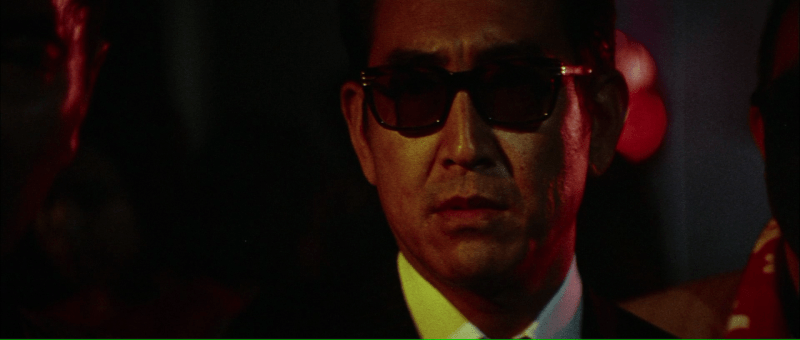
Toei’s stock in trade through the 1960s had been the ninkyo eiga, chivalrous tales of noble gangsters set before the war and implicitly in a less corrupt Japan in which jingi could still triumph over the giri/ninjo conflict if at great personal cost to the idealistic hero. By the end of the decade, however, audiences were growing tired of yakuza romanticism particularly in the wake of grittier youth dramas produced by Nikkatsu. Originally conceived as a kind of sequel to Japan Organised Crime Boss, Kinji Fukasaku’s Sympathy for the Underdog (博徒外人部隊,  Bakuto Gaijin Butai) marks a shift towards the jitsuroku or “true account” trend of the 1970s which would come to dominate the genre following the success of his Battles Without Honour and Humanity cycle two years later, employing many of the same techniques from onscreen text to shaky handheld photography but doing so within the confines of moody noir as the hero emerges from a 10-year prison sentence into a very different Japan. 

When Gunji (Koji Tsuruta) gets out, he steps into an empty, windswept street his incongruous zori sandals clashing with his smart suit and sunshades and marking him out as a relic of a bygone era. He’s met only two loyal underlings, his gang apparently now disbanded following the death of his boss who refused to take his advice as regards the big name gang from Tokyo attempting to muscle in to their Yokohama territory. Part of the missing post-war generation, Gunji has no illusions about going straight, wandering into their former HQ now a derelict building and calling the guys, who’ve since moved on to more legitimate occupations, back together. He knows he can’t take on Daitokai with his meagre forces and so settles for extracting from them some compensation money to get out of town, later teaming up with Kudo (Noboru Ando) a similarly orphaned former member of a rival Yokohama gang wiped out by Daitokai, and resolving to relocate to Okinawa where he is convinced the post-war gangster paradise is still very much in existence. 

Okinawa was only “returned” to Japanese sovereignty in 1972, having been governed by the Americans since the end of the war, and of course maintains a large American military presence up to the present day. As such to Gunji, and in a yakuza movie trope which persists right into Takeshi Kitano’s Boiling Point, it exists in a permanent post-war present in which the conditions of the occupation are still very much in play. Gunji knows that he and his guys are products of the post-war era, they cannot adapt to the “new” world of corporatising yakuza in which street brawls and petty thuggery have given way to more sophisticated kinds of organised crime, and so they retreat into an Okinawan time warp, determining to steal turf from under two rival gangs who control between them the ports and the red light district mediated by black market booze from the American military.  

Fukasaku was apparently inspired by Pontecorvo’s The Battle of Algiers, intending to make a comment on resistance to American imperialism on the mainland though it has to be said that this is extremely ironic given that Japan is itself a coloniser of the Okinawan islands where there has long been a demand for self-determination and recognition of a distinct identity which has often been subject to oppression in the face of conformist Japanese culture. Nevertheless, the film continues the persistent theme that the chaotic post-war era which has come to a close thanks to rising economic prosperity in the time Gunji was inside is inextricable from the American occupation, implying that Okinawa is in a sense the last frontier and the only viable territory for men like Gunji who, like the melancholy ronin of the Edo era, lack the skills to live in time of peace.  

Nevertheless, modernity is also on its way to Okinawa and where there’s money there are gangsters so as expected Daitokai eventually rear their heads on the island pushing Gunji towards the revenge he didn’t want to take. The Okinawa he inhabits is one of loss and nostalgia, taking up with a sex worker who reminds him of the Okinawan woman who left him when he went to prison and perhaps playing into the slightly complicated political dialogue which positions Gunji as an ironic “migrant worker” salmoning back to Okinawa as many Okinawan youngsters are forced to travel to the mainland for work while the islands themselves remain, it’s implied, mired in poverty and crime economically dependent on the American military. Indeed, the head of the dock gang brokers a deal with Daitokai predicated on the fact that there is plenty of cheap labour available at the harbour. “Good place for a long life” he ironically adds, shortly before all hell breaks loose. Shot with typical Fukasaku immediacy, Sympathy for the Underdog looks forward to jitsuroku nihilism but does so through the prism of film noir cool as its fatalistic hero submits himself to his inexorable destiny.


Original trailer (English subtitles)

Inn of the Floating Weeds (浮草の宿, Seijun Suzuki, 1957)

Another of Nikkatsu’s crime inflected pop song movies, Inn of the Floating Weeds (浮草の宿, Ukigusa no Yado) makes space for the singer of the song which gives the film its name, Hachiro Kasuga, but only in a minor role as a supportive friend. Directed by Seijun Suzuki under his birth name Seitaro (he’d change it to Seijun for Underworld Beauty the following year), the film is in some ways typical of his early work as a B-movie director at the studio but nevertheless displays flashes of his later brilliance in its unconventional composition and wistful sense of irony. 

Company man Shunji (Hideaki Nitani) gets into a fight during which Shida, a high ranking executive at Marubishi construction, is stabbed to death. Shunji is kicked into the water and left for dead, while his fiancée, Kozue (Hisano Yamaoka), pines for him at a nearby bar. Five years later Shunji resurfaces hoping to reunite with Kozue after having fled to Hong Kong and taken a job at a shipping company. At the bar, however, he discovers a woman that looks exactly like his lost love but turns out to be her younger sister, Mio (also played by Hisano Yamaoka), the bar’s madam and apparently the mistress of Murayama (Toru Abe), the current head of Marubishi. 

Shunji’s survival and subsequent reappearance is inconvenient for everyone so it’s no surprise that Murayama wants to have him bumped off, but Shunji is determined to stay and find out what’s happened to Kozue who, according to her sister, went missing in suspicious circumstances three years earlier while desperately searching for Shunji. 

Haunted by memories of lost love, Shunji finds himself drawn to the mysterious Mio who closely resembles her sister, while pulled towards a nexus of criminal activity unwittingly positioned between Murayama’s Marubishi and the avaricious interests of his American colleagues operating out of Hong Kong. Indeed, Shunji has himself it seems taken on an alternate identity as Hong Konger Kang Ho-chun, interpreter to the mysterious Mr. Green (Harold Conway). Perhaps still naive, Shunji appears to be unaware of his boss’ shadiness, warned off by good Samaritan Haruo (Hachiro Kasuga) who rescues him after he’s beaten up by Marubishi goons and allows him to rest in his apartment where he’s nursed back to health by his cheerful kid sister Yuri (Ikuko Kimuro). 

The strange goings on on the Saganmaru perhaps testify to an ambivalence with Japan’s new globalising presence which echoes through Nikkatsu’s “borderless” action dramas. Mr. Green is certainly not on the level, later revealed to be involved with drug smuggling through Marubishi and employing a large number of Chinese stewards (he operates out of Hong Kong after all) which plays into a sense of Sinophobia common across the series. The major problem, however, is Murayama whom Shunji later learns tried to assault Kozue after he left and may be connected with her disappearance. Perhaps trying to warn him off, Mio fires back at Shunji that this all his own fault, that Kozue couldn’t live with the knowledge he was a murderer and in the end he broke her heart, while he meekly protests his innocence and vows revenge on Murayama.

Meanwhile, he’s pulled back towards innocence by Haruo and his relentlessly cheerful sister who has obviously taken a liking to him. Mio, echoing the femme fatale, remains enigmatic, concealing key information about her sister, later confessing that she too has been desperate for vengeance but fears that Murayama has grown too powerful. Haruo, singing the mournful song about past regrets and lost love, observes from the sidelines trying to decide if Shunji is rotten inside or merely in danger of being swallowed by a vortex of crime and violence. 

Yet, as it so often is, the gangster world is in danger of collapse, destroying itself through internecine power struggles and petty betrayals. Murayama thinks he’s the top dog but there’s always someone agitating from below. Shunji, didn’t kill Shida, and maybe he’s close enough to finding out who did, clearing his name while figuring out what happened to Kozue, but in someways it hardly matters because the true battle is for the future, not the past. Like the singer of the song, he reflects on what a fool he’s been, resolving to put the past aside as he walks towards a less complicated future and an eventual return to a compassionate and forgiving society.


Title song by Hachiro Kasuga

Underworld Beauty (暗黒街の美女, Seijun Suzuki, 1958)

“No one can be happy without money” the villain of Seijun Suzuki’s Underworld Beauty (暗黒街の美女, Ankokugai no Bijo) claims, vainly trying to justify his actions. He may indeed have a point, but you can’t buy happiness through selfish immorality. A noirish tale of changing times, Underworld Beauty pits a noble hearted gangster on the road towards reform against his amoral bosses as he tries to ensure a better future for the sister of a friend whose life was irreparably changed through proximity to crime. 

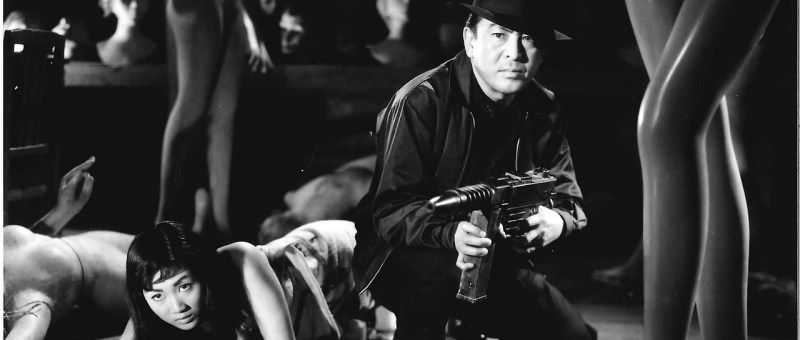
Miyamoto (Michitaro Mizushima) has just been released from three years in prison. His first stop is the sewers where he locates a loose brick he’d been using as a dead drop and retrieves a handgun and a small bag containing three diamonds stolen in the heist which got him sent away. Paying a visit to his old gang, Miyamoto makes it plain that he intends to keep the diamonds for himself so that he can sell them and give the money to Mihara (Toru Abe), the man who was crippled during the job and now lives an “honest” life running a small oden stall. To Miyamoto’s surprise, his boss, Oyane (Shinsuke Ashida), says OK and offers to set him up with a foreigner in Yokohama who is interested in buying blackmarket jewels. Unfortunately, the whole thing goes south in predictable fashion when a gang of masked heavies turns up to disrupt the deal. Mihara, who had come along with Miyamoto, swallows the diamonds and promptly falls off a nearby wall. He survives just long enough to tell the police that he “slipped” thanks to his unsteady legs, which makes his death “accidental” meaning he won’t have to undergo an autopsy. That’s both good and bad for the crooks. The cops won’t find the diamonds, but getting them back before the body is burned is going to be difficult. 

Arita (Hiroshi Kondo), a sculptor of mannequins, finds himself perfectly primed to find a solution because he’s been dating Mihara’s little sister, Akiko (Mari Shiraki), who’d been working as a nude model. Mihara had talked to Miyamoto about his sister and his fears for her in the big city. Feeling his debt even more since his friend’s death, Miyamoto decides to save Akiko from the evils of city life, but finds himself fighting an uphill battle. Meanwhile, Akiko is smitten with the intellectual yet cold Arita, who may perhaps be more interested in her for access to her brother’s body than to her own. 

The diamonds themselves become a kind of MacGuffin and symbol of amoral post-war greed. Having been away for three years, Miyamoto is the classically conflicted film noir hero, a noble yet compromised figure forced to operate in a murky moral universe that is at odds with his own sense of justice. That is perhaps why he tries so hard to “save” Akiko even if she resents his sometimes patronising paternalism that, well-meaning as it is, denies her the agency that is a mark of the age. Mihara warned his sister about hanging out with Arita, suspecting he was a no good guy likely to drag her further into the underworld which he had now escaped, but she sees him as “different” from the men around her, mistaking his coolness for sophistication rather than a possibly sociopathic superiority complex. 

Yet it’s perhaps a sense of inferiority which sends him so crazy about the diamonds. A tortured artist slumming it in a mannequin factory, he resents the way he’s chosen to “sell” his art while superficially laughing at those who buy it. There is something quite perverse in the various ways he is “using” Akiko, literally commodifying her body and turning it into a lifeless object, a simulacrum of “real” womanhood sans voice or agency, all the while planning to use her in order to get his hands on the diamonds. Figuring out Arita may have mutilated her brother’s body in order to dig them out, she wonders if he ever really loved her at all. His sudden declarations of affection and an impromptu proposal only further convince her that what he wants is money. She hides the diamonds inside the breast of a half-baked mannequin, just about where the heart ought to be. Later we spot the poor thing dismembered and abandoned, a gaping hole in its chest as it floats ominously in the sewer, discarded in just the way a woman like Akiko might be if she’d let a man like Arita get his hands on the loot. 

Kidnapped as leverage to force Miyamoto to hand the diamonds over, Akiko loses her fascination with underworld darkness in learning what the “yakuza code” really means. “What do you mean, the yakuza way?” She barks at Oyane, “it’s wrong to kill, you idiot!”. Literally steamed clean and making an ironic escape up a coal shoot, she edges towards a new dawn. “What a beautiful day!” She exclaims, declaring herself not bored in the least, freed from the false promises of the underworld and released from the diamonds’ corruption into the bright sunshine of a wide open future.


The Perfect Game (完全な遊戯, Toshio Masuda, 1958)

In the mid-1950s, Nikkatsu had courted controversy with a series of films depicting the amoral excesses of the immediate post-war generation. The “Sun Tribe” movies embedded themselves in a world of new bright young things who were largely independently wealthy and thoroughly bored by the ease of their lives. Nikkatsu was forced to halt production on the Sun Tribe films after only three (Toho and Daiei added one each of their own), but they did precipitate a wholesale shift towards youth movies which became the studio’s signature theme. 

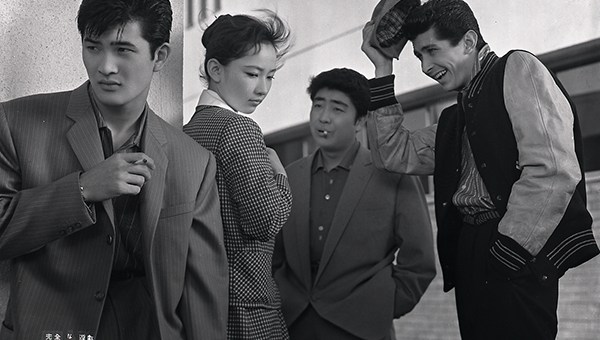
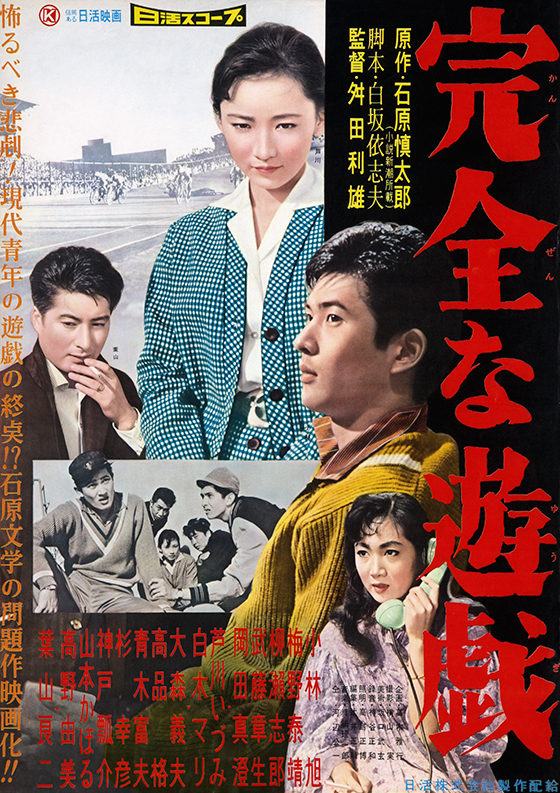
Best remembered for his contributions to Nikkatsu’s action noir, Toshio Masuda’s The Perfect Game (完全な遊戯, Kanzenna Yugi, AKA The Tragedy of Today) arrived two years after the Sun Tribe craze but neatly picked up the baton dropped by Kon Ichikawa’s Punishment Room in its tale of nihilistic college boy amorality. As the film opens, our four heroes are playing mahjong and lamenting their lack of funds. They are all, it goes without saying, middle class boys largely supported by their parents who, as far as we know, are high ranking salarymen. They are not hungry, or worrying about how to pay rent or tuition, they are just bored and want extra money to go out having fun before they they are forced into the corporate straightjacket with the regular salaryman jobs many of them already have in the bag thanks to the tremendous power of nepotism. 

As the the opening text implied, they viewed their money making exploits as a game, proving how clever they think they are in getting one over on the universe, but all too quickly it spirals out of control. Toda (Yasukiyo Umeno), the ring leader, has come up with an ingenious money making scheme. It turns out that there’s an illegal betting office some distance away from the bicycle racing stadium that keeps taking bets until someone rings from the track and tells them who won, which means there’s about a five minute delay between the winner being declared and bets being called. The boys figure that if they can somehow beat the lag they can win big. To make it work, they ask their “friend” Kazu (Masumi Okada), who they seem to regard as a bit dim, to join them as well as recruiting an old codger to call the race before the boards go up. Surprisingly it works out, but unfortunately the yakuza-backed bookmaker, Matsui (Ryoji Hayama), wasn’t banking on such a big win and doesn’t have the funds to pay out in one go. 

Toda in particular is pissed off. The wind taken out of his sails, he’s not sure what to do which is when So (Akira Kobayashi), the pretty boy of the group, suggests an ironic punishment. Matsui had joked that he’d put up his adorable kid sister Kyoko (Izumi Ashikawa) as collateral if he couldn’t pay out, so why don’t the boys take him at his word and kidnap her. Rewinding a little, these snotty college boys are about to become kidnappers, adding a little blackmail on the side. This isn’t a fun game anymore, someone is going to get hurt whatever happens even if they can’t know the extent to which their plan to earn a few bucks to blow on jazz bars and pool rooms is going to incur collateral damage. 

Unlike the boys, Kyoko is a working class girl. She wants to keep her head down and work hard, not quite approving of her brother’s involvement with the yakuza and wishing he’d find an honest job but also acknowledging that he had few options and it’s his job at the bookies that’s been keeping them all this time. Their father died in the war, and their mother (Yumi Takano) is very ill, bedridden with heart trouble. Kyoko is no innocent, she brushes off So’s attempts to court her by revealing that dozens of creepy guys try the same thing every day, and most of them don’t stop at passing notes. For whatever reason she ends up warming to him, making him take her to a theme park while her mother worries at home, while he also begins to feel conflicted about the plan in falling for her for real. 

So’s mistake is the childish belief that they’re still playing a game and everything will be alright in the end. He foolishly trusts that his friend’s are men of honour and that Matsui will come up with the money and redeem his sister in no time at all. But money’s not easy to come by even if you’re a yakuza, and the boys might not want it anyway if it comes with additional complications. Visiting with Kyoko’s sickly mother, he perhaps begins to see the gap between his comfortable existence and theirs of constant struggle. He’d been so proud to tell Kyoko that he had an interview lined up at a big company because of family connections, but when he arrives there he feels irrelevant. The interview board only ask him questions about his dad, as if he didn’t really exist. Finally they ask him to talk about what he did at uni, what his “passions” are, if he did anything of note in the past few years, perhaps even fall in love? They’ve unwittingly touched a nerve, but So is in any case forced to reflect on the meaninglessness not only of his adolescence, but of his future. This interview has been a farce, but they’re giving him the job anyway because he’s his father’s son. What more is there to say?

The other boys are also worried about their job prospects, concerned that someone might talk and they’ll be forever tarnished by “youthful exuberance”, refusing to take any personal responsibility for the consequences of their “perfect game”. Unlike So they still want to live in that inherently unfair world which exists for upperclass men to do as they please. Toda and So weren’t quite like their friends. They felt conflicted. Toda embarrassed to be borrowing money from his girlfriend but rejecting the others’ belief that you don’t have to pay women back, only to angrily bark at her that there’s “no way a woman can understand” the intensely masculine debate he’s just had with So about responsibility, which he accepted by deflecting in pushing So’s complicity back on him in an attempt to share his guilt. Unlike the Sun Tribe films, youth takes responsibility for itself and its friends, but can find no way to atone for its moral abnegation. 


Original trailer (no subtitles)

Till We Meet Again (あした来る人, Yuzo Kawashima, 1955)

(C) Nikkatsu 1955

“Men only want to treat women as pets” according to a disaffected housewife in Yuzo Kawashima’s Till We Meet Again (あした来る人, Ashita Kuru Hito). Given the well-meaning paternalism of her melancholy father, she may indeed be right. Her struggle, along with that of her husband, and of the lonely manageress of a dress shop, is in part to break free of paternalism, rejecting the “traditional” and breaking with the natural order of things to claim her own happiness. That, however, requires not only courage and conviction, but time and a willingness to endure hurtful failures. 

The hero, patriarch Kaji (So Yamamura), is a successful businessman. He’s married off his daughter, Yachiyo (Yumeji Tsukioka), to a promising young man, Kappei (Tatsuya Mihashi), but the marriage is unhappy. Kappei, a mountaineering enthusiast, rarely goes home – either out drinking with buddies in a bar with an Alpine theme, or away rock climbing in the mountains. Feeling neglected, Yachiyo resents her husband’s lack of interest and finds it increasingly difficult to get on with him, but her father proves unsympathetic, simply telling her she must put up with it and work harder at her marriage. A chance encounter on a train, however, kickstarts a change in Yachiyo’s outlook, while Kappei also finds himself drawn to a melancholy young woman who actively takes an interest in his mountain climbing career. 

Unfortunately, the young woman, Kyoko (Michiyo Aratama), is also in a strange “relationship” with Kaji who met her while she was a bar hostess in Ginza. Bonding with her for one reason or another, he funded her dress shop which has allowed her to escape the red light district, despite his oft repeated claim not to make frivolous investments. There is however, on his side at least, no “romantic” interest, his intentions are purely paternal. As Yachiyo said to her mother about Kappei, he is in a sense treating her as a kind of “pet”, to be loved and fussed over as an exercise in itself. He claims what he wants from her is his “lost youth”, presumably sacrificed for his business success, but she begins to believe herself painfully in love with him because, paradoxically, of his beneficence. Meanwhile, she meets Kappei by chance, never knowing his connection to Kaji, but bonding with him after taking in the little dog he brought home but was forced to give up by Yachiyo who claims to hate them (or, more accurately, living things). 

That ought to be as good a clue as any that Yachiyo and Kappei simply aren’t suited. Their marriage is already a failure which is making them both miserable, but they’re obliged to put on a show of being a happy couple for appearance’s sake. Yachiyo turns to her mother, Shigeno (Fukuko Sayo), for guidance, suddenly noticing that she looks much older than she’d remembered. Shigeno tells her that you age faster when you’ve nothing to do, busying herself by fussing over the cat (another living thing Yachiyo can’t abide). Yachiyo asks if she was ever happy with Kaji, but gets only the reply that she was “happy” to the extent that she knew she’d never have to worry about being hungry. Looking at her mother’s life, Yachiyo knows that she doesn’t want to end up in the same position, bored and aimless with no “dreams” to speak of. She doesn’t see why she has to stay in a loveless marriage and is convinced that only with another man could she ever truly be “herself”. 

The idea of divorce is still taboo, which is perhaps why her father insists she reconsider, aside of course from his business entanglements with Kappei. Talking it over the couple come to a mutual conclusion, that they only make each other unhappy and separating is the best decision for them both. Pretty much everyone, however, tries to talk them out of it – Kaji still wedded to the idea of marriage as an unbreakable sacrament, while new friend Sone (Rentaro Mikuni) is convinced he’s contributed to their marital discord.

Sone, a bumbling professor obsessed with his research into a rare type of fish and its possible ability to adapt to its environment, becomes friends with Yachiyo after a mix up with dinner bills on a train. She offers to introduce him to her father to see if he can help find financing, and thereafter generates a friendship which, in her mind at least, turns romantic. Sone, however, is a widower now only interested in his fish. Yachiyo falls for him because he’s a much softer, kinder presence than her husband and despite his dedication to his work, is keenly aware of the feelings of others even if he’s awkward in a charming sort of way when it comes to dealing with them. There is something, however, a little perverse in her immediate attraction to another emotionally distant man. She couldn’t stand Kappei’s obsession with the mountains, but could potentially become interested in Sone’s fish. Then again, that’s just as likely to be because Sone made a point of including her in his passion, where Kappei keeps his to himself, eventually sharing it with the more receptive Kyoko. 

Kaji, returning to the paternal, advises Kyoko that “romance is mutual deception”, or at least a kind of transaction and if she really wants to do this, she’d best be sure she’d be OK with regretting it at some point in the future. Previously, he’d told her that “marriage is pointless”, and she’d decided never to do it partly because she thought she was in love with him and he was married already. Her realisation that she’s just a kind of pet to him, a plaything he uses to feel useful while reclaiming his youth, pushes her towards an acceptance of her growing love for Kappei, an irony Kaji struggles with but eventually comes to understand. He really does want the best for her and will support her love story even though it’s also extremely inconvenient in providing an unwelcome link between the different branches of his life. Once Kyoko discovers the truth, however, her determination to fight for love begins to weaken as she reflects on an image of herself as a wicked and selfish woman betraying a man who’d been good to her, when in reality quite the reverse is true. 

Yachiyo, meanwhile, begins to understand that Sone does not necessarily return her feelings, perhaps still attached to the memory of his late wife, too preoccupied with his research, feeling awkward about her position as a married woman, or just not interested. So alarmed is he that he temporarily rushes off from his research to have a word with Kappei and is once again upset by his calm explanations that this is a decision they’ve come to mutually. It’s not because of his love for Kyoko, that only provided an excuse, but because they simply weren’t suited and made each other unhappy. Sone declares himself “sick of seeing beautiful things getting hurt”, but prepares to absent himself from the entire situation by returning to his research. Faced with the potential failure of their new romances, neither Yachiyo or Kappei reconsider their decision to divorce. Kappei retreats to his beloved mountains, while Yachiyo refuses an offer from her father to return home with him, electing to remain in Tokyo and live her own life.  

Now an old man, Kaji struggles to understand the young but somehow admires them for being what he couldn’t be. He describes them as having something pure that he did not have in his youth, but wonders if that purity hasn’t in a sense allowed them to be “damaged” in a way he never has been. Still, he thinks that’s probably a good a thing, because it allows them to become more themselves. Things might not work out right now, and it might hurt, but there’s always tomorrow. He admires the young people because they’re in the process of becoming whole and will be able to continue on their own journeys as complete people while he can only proceed down this corridor, unable to access the post-war future by actively rejecting the rigidity of the traditionalist past.


Currently available to stream on Mubi in the US.

Original trailer (no subtitles)

Our Blood Will Not Forgive (俺たちの血が許さない, Seijun Suzuki, 1964)

Our blood will not forgive posterIn Japan, “kaeru no ko wa kaeru”, or “a frog’s son is also a frog”, is an often heard idiom, sometimes disparaging but often affectionate. Can a yakuza’s son become anything other than a yakuza, or does your blood define you in ways you cannot defy? Our Blood Will Not Forgive (俺たちの血が許さない, Oretachi no Chi ga Yurusanai), an early semi-absurdist gangster drama from Seijun Suzuki’s mid-period at Nikkatsu, asks just that question as two brothers battle the legacy of their slain father whose dying wish it was that the yakuza line die with him.

After their father was assassinated at home by sword, the Asari brothers were raised by their mother, Hatsu (Chikako Hosokawa), who did her best to keep them out of the underworld. After the war, however, times were tough. Older brother Ryota (Akira Kobayashi) had to work as a delivery boy to keep the family fed, studying hard at the same time and getting in to a good university. Now grown up, he’s a smart suited night club manager. His younger brother Shinji (Hideki Takahashi), meanwhile, is a clownish goof-off with a good job at an ad agency he’s always in danger of losing (like a fair few jobs before). Today, Shinji was meant to collect his bonus, but he’s bunked off to take part in a local festival which is unfortunate, because he’s got a visitor – Tobita (Akifumi Inoue), the man who killed their father without knowing why and now regrets it. He’s managed to track Shinji down thanks to the fact he looks just like his dad and has a habit of doing stupid things that get his picture in the papers like winning eating competitions and getting lucky on the horses only to get mugged outside.

Tobita’s desire to apologise to the boys exposes their father’s sordid yakuza past and forces them to deal with the legacy of their gangster blood. Though Ryota is more sanguine and simply declares that he “hates all yakuza” before asking Tobita to leave and never come back, Shinji immediately attacks him but then becomes enamoured of the romanticism of the gangster life and considers restarting the Asari clan after getting fired when a picture of him fighting with thugs on the company away trip makes the papers with the headline “yakuza’s son”.

The central irony is that Ryota, who was his mother’s favourite and ostensibly the steady, respectable son, has secretly been a yakuza for quite some time. The club he runs is a yakuza front, which is why he tries to talk Shinji out of trying to get a job there, leading him to feel rejected enough to have too much to drink and start a bar fight, causing problems for Ryota with his boss.

“All yakuza are the same,” Ryota confesses to Shinji as they argue in a car incongruously surrounded by roaring waves, “they’re violent because they’re afraid”. Despite graduating from Tokyo University, Ryota couldn’t get an honest job because they always found out his dad was a yakuza. Out of other options, he decided he had no other choice but to become one too, that he could not escape his blood but might be able to make sure his brother could. Shinji has romantic dreams of the yakuza lifestyle (his bedroom wall’s covered in pictures of Al Capone et al), but Ryota knows what it means, which is why he hates all yakuza, including himself. He’s planning to marry his secretary girlfriend, Yasuko (Chieko Matsubara), but his emotions are so corrupted that he isn’t quite sure if he really loves her or is only making a bid for respectability as a kind of atonement to his mother. In any case, he also feels guilty, knowing that just as his father eventually made his mother miserable, no woman can be happy with a yakuza.

“Yakuza are so stupid, you’re all obsessed with dying – what’s the point?” Shinji eventually exclaims, finally thoroughly disillusioned as his brother goes out in search of an honourable ending rather than trying to escape from certain death at the hands of his vengeful boss. “It may not be easy to live, but there’s nothing honourable about dying!” he tells him, undercutting a series of cultural signifiers, but finally crawling out of the yakuza trap and vowing to live on muddling through with his mother and perky girlfriend, Mie (Yuri Hase) whose birthday party he’s currently missing. Blood does not forgive, but it does eventually release if only you can learn to see it for what it is and choose to be free of it.


Opening (no subtitles)

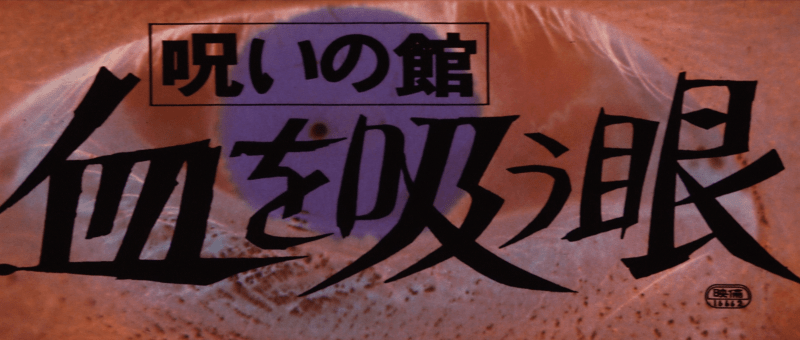
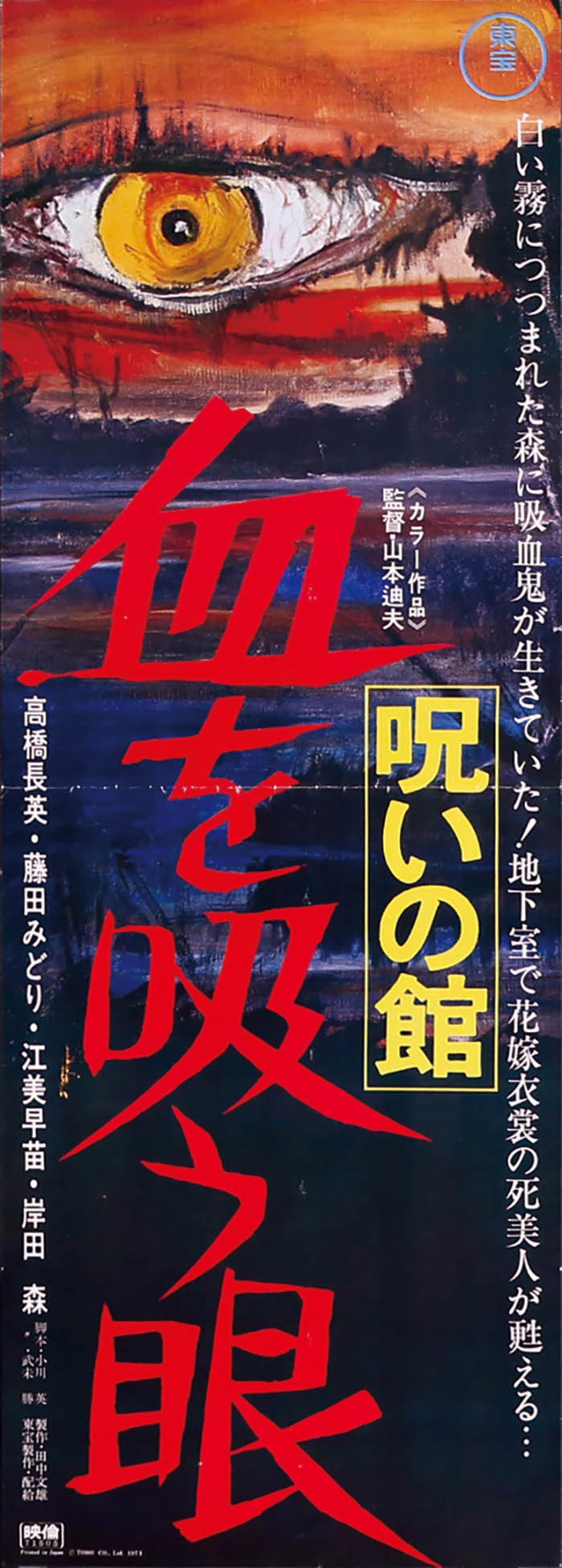
Lake of Dracula (呪いの館 血を吸う眼, Michio Yamamoto, 1971)

Lake of Dracula posterThe Vampire Doll, the first in a loose trilogy of films along vampiric themes released by Toho in the 1970s, had done its best to relocate Hammer-style horror to contemporary Japan. Adopting the best of the gothic from thundery skies to creepy mansions in the middle of nowhere, Vampire Doll successfully merged the Japanese longhaired grudge bearing ghost with the “romantic” bloodsucking tragedy of a young woman corrupted by illicit desires (though in this case for revenge). Returning to the theme a year later, Michio Yamamoto steps away from Japanese folklore altogether and positions his “foreign” Dracula as a “living” embodiment of repressed trauma, sucking the life out of his unwitting enemy until she finally learns to remember him, burning him away in the bright sunlight of his own eye.

Unlike Vampire Doll, Lake of Dracula (呪いの館 血を吸う眼, Noroi no Yakata: Chi wo Su Me) begins with a short prologue in which some children play on a rocky outcrop underneath a strangely ominous pink sky. When little Akiko’s pet dog Leo uncharacteristically runs off, she follows him and he leads her straight into the path of danger. Finding herself in a creepy mansion complete with stained glass windows and a dead body posed at a piano, the last thing that Akiko remembers is the pale face of a strange man with golden eyes and blood staining his chin.

Flashforward 20 years and Akiko (Midori Fujita) is a school teacher still living with her younger sister Natsuko (Sanae Emi) in their childhood home. She is convinced her traumatic childhood incident must have been a dream though it continues to haunt her enough to be a frequent subject in her artwork including a striking canvas she has just completed featuring a frightening golden eye looming over a tiny girl and her dog. Akiko has nice boyfriend, Takashi (Choei Takahashi), who is a doctor in the city, and all things considered a pretty nice life. Sadly it is not to last.

The trouble begins when someone randomly delivers a coffin to the local boathouse. First Akiko’s dog goes missing, then her trusted uncle figure tries to attack her before running off never to be seen again. Meanwhile, at Takashi’s hospital, a young “runaway” has been brought in in a catatonic state though no one can find much wrong with her until Takashi spots two suspicious bite marks on her neck. In case you’d forgotten about Natsuko, she has also begun behaving strangely – offering snide comments to her sister, going out alone in the middle of the night, and most alarmingly she has begun to grow pale.

Like Vampire Doll, Lake of Dracula is also an experimental vampire movie hybrid – a B-movie stalker picture in which Dracula is the creepy guy who can’t seem to take no for an answer. Yamamoto films the “naturalistic” action in standard Toho fashion but shifts into a higher register for his conception of heightened vampiric romanticism as Akiko’s “dream” erupts under a blood red sky and eventually leads her to an artfully appointed gothic cottage in which even the dead bodies are tastefully arranged.

Yet what Dracula comes to represent is the soul sucking power of the repressed past. Akiko has largely been able to move past her traumatic childhood adventure, convincing herself it was nothing more than a dream, and seems to be living a pleasant enough life even if her paintings betray her continuing anxiety. As we later find out, it is not quite so much the episode itself as the refusal to accept it which has caused Akiko so many problems – not least a buried rift with her treasured sister resulting from unfortunate sibling rivalry never fully dealt with both because of the incident and the early death of their parents. Akiko, resentful of having a new sister who had “displaced” her in her parents’ affections, sought to win back her rightful place by being the ideal child – good and obedient. Hence when no one believed her about the creepy house and strange man, she backed down, let them tell her it was only a dream to avoid being thought argumentative. Now she wonders if Natsuko harboured ill will towards her too for “stealing” back her parents’ love through her crazy story and perhaps relegating her to second place when she had become used to first.

Familial love becomes an odd kind of theme as we discover Dracula had a father of his own – a descendent of non-Japanese immigrants who had purposefully built a creepy mansion in the middle of nowhere in order to limit the possibility of his “bad blood” wreaking havoc in the world. The bad blood apparently skips a generation here and there and so Dracula, the third generation, is the first to be affected by it. His father tried to sacrifice himself to control his son, but now the demon is loose and is after Akiko who, creepily enough, seems to have caught his eye all those years ago (when she was five!) and he is determined to make her his “wife”. Vampirising someone’s sister is probably not a good way to win their heart, but Dracula, oddly, has never been very good at conventional romance.

Dracula’s “foreign” origins are perhaps an uncomfortable nod back to the xenophobic nature of the vampire myth. Despite being 3/4 Japanese and born and raised in Japan, Dracula’s late in the game exposure as not properly “Japanese” enough unfortunately reinforces the idea that “mixed” blood is somehow “impure”, even dangerous, and that even those who’ve spent their lives in Japan are not the same as those who are descended from long lines fully recorded 100% Japanese ancestors. Thus the danger becomes a “foreign object” which must be expelled to restore the integrity of the whole.

Restoring integrity is Akiko’s quest as she, along with her doctor boyfriend, attempts to solve the mystery through revisiting her traumatic childhood incident and finally learns to put it behind her. Yamamoto’s direction shifts between standard B-movie naturalism and florid avant-garde compositions but perhaps fails to capitalise on their inherent theatricality. Picking up the pace for the final set piece, Yamamoto also allows himself to go grim in taking a leaf directly out of the Hammer book by lifting the final death scene from the Christopher Lee starring Hammer Horror from 1958 in his crumbling, melting vampire, not to mention the other decomposing corpse resting in the house whose skin slides sickeningly from his body. A strange, hybrid adventure, Lake of Dracula makes an early attempt to pair the vampire chiller with serial killer thriller and does so moderately successfully even if its psychology remains firmly within the realms of the B-movie.


Lake of Dracula is the second of three films included in Arrow’s Bloodthirsty Trilogy box set which also includes extensive liner notes by Jasper Sharp detailing the history of vampires and horror cinema in Japan.

Original trailer (no subtitles)

https://www.youtube.com/watch?v=b1V2hCpxMNU

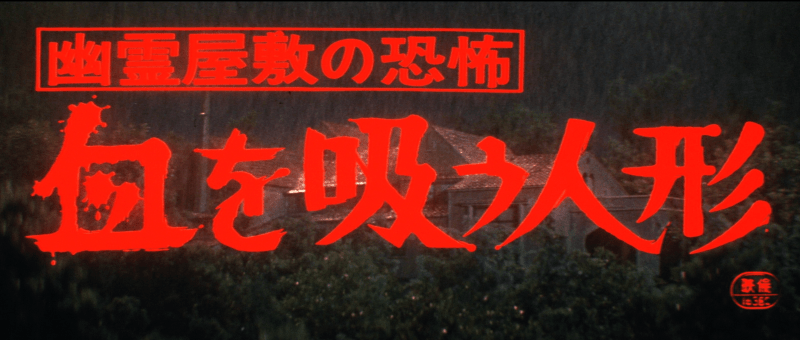
The Vampire Doll (幽霊屋敷の恐怖 血を吸う人形, Michio Yamamoto, 1970)

Vampire doll posterIn a roundabout way, Toho can almost be thought of as the most “international” of mainstream Japanese cinemas operating in the late ‘60s and ‘70s. Though their view of “the foreign” was not always positive, their forays into science fiction often made a point of the need for international co-operation to combat extraterrestrial threats and “Interpol” became a (slightly humorous) fixture in the studio’s small number of sci-fi inflected spy films. If the spy movies were an attempt to echo the increasing ‘70s cold-war paranoia coupled by post-Bond camp, Toho was also looking overseas for inspiration in its wider genre output which is presumably how they wound up adding Hammer-esque vampire horror to their tokusatsu world.

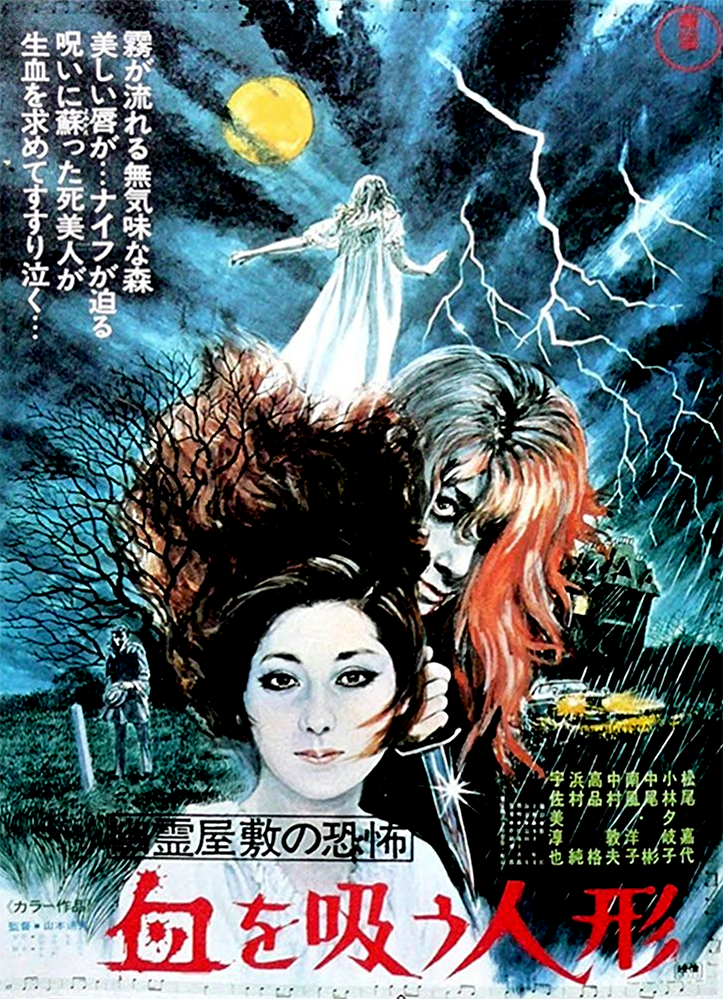
The Vampire Doll (幽霊屋敷の恐怖 血を吸う人形, Yurei Yashiki no Kyofu: Chi wo Su Ningyo) draws influence both from classic European gothic and, perhaps less predictably, Alfred Hitchcock’s Psycho to create a new hybrid horror model which effectively merges the Western “vampire” mythology with the “traditional” long haired, grudge bearing ghost. The tale begins with a young man who has recently been “abroad” for a number of months and has been looking forward to reuniting with his fiancée. When Sagawa (Atsuo Nakamura) reaches the gothic country mansion owned the family of Yuko (Yukiko Kobayashi), his longed for love, he learns that she has, unfortunately, passed away in a car crash just two weeks previously. Heartbroken he decides to stay over but is unable to sleep, not because of the grief or shock, but because of strange noises and the conviction that he has seen Yuko wandering around the house. Visiting her grave the next day, he finally meets her but she seems “different” and tearfully asks him to end her life.

Cut to the city, Sagawa’s sister Keiko (Kayo Matsuo) wakes up from a nightmare in which Yuko killed her brother and tries to cancel a date with her boyfriend to go look for him. Keiko’s boyfriend Hiroshi (Akira Nakao) eventually agrees to drive her to Yuko’s country pile to help investigate. On arrival, Yuko’s mother Shidu (Yoko Minakaze) tells them Sagawa left in heartbreak the day before, but Keiko doesn’t believe her and the couple fake car trouble to stay the night and investigate further.

Yamamoto’s film does indeed raid classic vampire movie tropes and mine them for all they’re worth. The curiously gothic architecture is explained away by Shidu’s husband having been a diplomat who developed a fondness for the European while overseas, but the presence of the hunched over, barely verbal servant Genzo (Kaku Takashina) seems a much more obvious Hammer homage. Shidu laments that the house is now “very old” and crumbling, a remnant of a pre-war world of lingering feudalism, all faded grandeur and declining influence – a fitting seat for a vampiric meditation of changing class and value systems with its kimono’d mistress and seemingly incongruous temporality.

Yet Yuko, not quite a “vampire” as we would usually think of them, is an extension of the traditional ghost story villainess rather than the sex crazed bloodsucker of European literature. Once again, the war is raised as a partial explanation of the tragedies which have befallen the family, if in a more logical fashion than the otherwise outlandish narrative would imply. Shidu carries a prominent scar across her neck – the mark of having tried to take her own life after a frustrated demobbed soldier massacred the family on learning that the woman he loved had married someone else while he was away fighting. This is apparently the origin of Yuko’s grudge (as the film clumsily explains), leaving her with a profound sense of rage against the world that killed her mother’s husband as well as intense resentment that she would die mere days before true happiness was finally in her grasp after enduring so much suffering.

Yuko may put on the billowing white nightgown of the repressed vampiress, her hair a flowing a chestnut-brown, but her blood lust is born of vengeance – she craves destruction rather than satisfaction. Toho flexes its tokusatsu muscles as lightning forks over the gothic mansion, perfectly achieving the air of oppressive supernatural unease provoked by the claustrophobic Western estate which seems to have even the local residents resolved to take the long way home to avoid it. Fusing European gothic with Japanese ghost story, Yamamoto’s first “vampire” movie is an unusual take on the material, refusing the foreign origins of the demonic for a homegrown tale of violence and tragedy consuming the life of a young woman attempting to find happiness in the rapidly changing post-war society.


The Vampire Doll is the first of three films included in Arrow’s Bloodthirsty Trilogy box set which also includes extensive liner notes by Jasper Sharp detailing the history of vampires and horror cinema in Japan.

Original trailer (no subtitles)