Aizen Katsura (愛染かつら, AKA The Tree of Love/Yearning Laurel, Hiromasa Nomura, 1938)

aizen katsura posterJapan’s political climate had become difficult by 1938 with militarism in full swing. Young men were disappearing from their villages and being shipped off to war, and growing economic strife also saw young women sold into prostitution by their families. Cinema needed to be escapist and aspirational but it also needed to reflect the values of the ruling regime. Adapted from a novel by Katsutaro Kawaguchi, Aizen Katsura (愛染かつら) is an attempt to marry both of these aims whilst staying within the realm of the traditional romantic melodrama. The values are modern and even progressive, to a point, but most importantly they imply that there is always room for hope and that happy endings are always possible.

The heroine, Katsue (Kinuyo Tanaka), has found herself in a difficult position for a woman of 1938. Married off at a young age in payment of a family debt yet rejected by her husband’s family, Katsue’s fortunes fall still further when her husband passes away suddenly leaving her alone and eight months pregnant. Her daughter, Toshi (Kazuko Kojima), is now five years old and Katsue has a good job as a nurse at a local hospital. The job allows her to support herself, her daughter, and her older sister but the problem is that the hospital has a strict policy of not employing married women. Katsue isn’t married anymore, she’s a widow, but the fact that she has a daughter she is raising alone makes her familial status a grey area. She’s been hiding her daughter’s existence from her colleagues in case it costs her the job she needs to survive, but a chance encounter in a park threatens to ruin everything.

Thankfully, Katsue’s colleagues at the hospital turn out to be nice, reasonable people who respond sympathetically on hearing Katsue’s explanation about why she’d avoided telling them the truth about her daughter (and that, crucially, she had been married and the child was conceived legitimately). Her next problem occurs when the son of the hospital’s chief doctor, Kozo (Ken Uehara), returns after graduating university and the pair strike up a friendship which eventually blossoms into romance. Kozo’s father, however, is intent on arranging his marriage to a girl from another medical family – a long held tradition and, in an odd mirror of Katsue’s situation, the marriage is a way of getting additional investment for the rapidly failing clinic. Kozo asks Katsue to run away with him to Kyoto but she still hasn’t told him about Toshi or her previous marriage out of fear of losing not only her new love but her position at the hospital if he rejects her. Just as Katsue is about to go to meet Kozo at the station, Toshi falls ill.

Despite the austerity and conservatism of the times, Aizen Katsura is a very “modern” story in which Katsue’s pragmatic solution to her difficulties is praised and even encouraged. Her life has been an unhappy one in many ways – sold into an arranged marriage at 18, forced out of her hometown after rejection by her husband’s family, and finally widowed in the city, Katsue has been let down at each and every juncture. Alone with a baby, her choices were few and her only support seems to come from her older sister who has no husband of her own (at least, not one that is present), and takes care of Toshi while Katsue has to go out and earn the money to support the family.

Society does not quite know what to do with an anomaly like Katsue who cannot rely on extended family. She needs to support herself and her child but many jobs still have a marriage bar which extends to widows with children. The only options for women who can’t find a solution as elegant as Katsue’s aren’t pleasant, the hospital is a dream come true as it both pays well and is a respectable profession, but if the management found out about Toshi, Katsue could be left out in the cold with little prospect of finding more work despite her nursing qualifications.

The times may be harsh, but the world Katsue inhabits places her on the fringes of the middle classes. Kozo, as young doctor and heir to the clinic (Japanese hospitals are often family businesses) is far above her but is, in some ways, equally constrained. Whilst recognising a duty to his father, Kozo is resolute in refusing the idea of an arranged marriage conducted for financial purposes. He determines to set his own course rather than be railroaded into something which is for his father’s benefit and not his own. Deeply hurt by Katsue’s actions but not attempting to find out why she acted as she did, Kozo enters a depressive spell, sitting around resentfully and not doing much of anything. Luckily for him, the woman his father has picked out, Michiko (Michiko Kuwano), is a thoroughly good person who, once she finds out about Katsue, becomes determined to see that true love wins rather than being shackled to a moody young man and spending the rest of her life in a one sided relationship with someone still pining for a first love.

Katsue’s dreams come true only once she begins to give up on them. Leaving the hospital and returning to her home town with no firm plans, Katsue gets herself a career through luck and talent when a song she enters in a competition is picked up by a leading record label. Music rewards her financially but also gives her a sense of confidence and a purpose which puts her on more of an even footing with Kozo even if he sits in the stalls while her colleagues fill the balcony. Her salvation is both self made and something of a deus ex machina, but the broadly happy ending is intended to give hope to a hopeless age, that miracles can happen and second chances appear once two meet each other openly with full understanding and forgiving hearts.

Mothra (モスラ, Ishiro Honda, 1961)

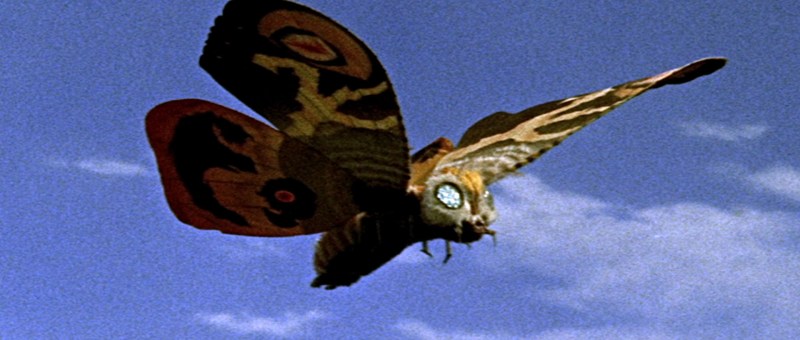
mothra-poster.jpgJapan’s kaiju movies have an interesting relationship with their monstrous protagonists. Godzilla, while causing mass devastation and terror, can hardly be blamed for its actions. Humans polluted its world with all powerful nuclear weapons, woke it up, and then responded harshly to its attempts to complain. Godzilla is only ever Godzilla, acting naturally without malevolence, merely trying to live alongside destructive forces. No creature in the Toho canon embodies this theme better than Godzilla’s sometime foe, Mothra. Released in 1961, Mothra does not abandon the genre’s anti-nuclear stance, but steps away from it slightly to examine another great 20th century taboo – colonialism and the exploitation both of nature and of native peoples. Weighty themes aside, Mothra is also among the most family friendly of the Toho tokusatsu movies in its broadly comic approach starring well known comedian Frankie Sakai.
When a naval vessel is caught up in a typhoon and wrecked, the crew is thought lost but against the odds a small number of survivors is discovered in a radiation heavy area previously thought to be uninhabited. The rescued men claim they owe their existence to a strange new species of mini-humans living deep in the forest. This is an awkward discovery because the islands had recently been used for testing nuclear weapons and have been ruled permanently uninhabitable. The government of the country which conducted the tests, Rolisica, orders an investigation and teams up with a group of Japanese scientists to verify the claims.

Of course, the original story of the survivors was already a media sensation and so intrepid “snapping turtle” reporter Zen (Frankie Sakai) and his photographer Michi (Kyoko Kagawa) are hot on the trail. Zen is something of an embarrassment to his bosses but manages to bamboozle his way into the scientific expedition by stowing away on their boat and then putting on one of their hazmat suits to blend in before anyone notices him. Linguist Chujo (Hiroshi Koizumi) gets himself into trouble but is saved by two little people of the island who communicate in an oddly choral language. Unfortunately, the Rolisicans, led by Captain Nelson (Jerry Ito), decide the helpful little creatures are useful “samples” and intend to kidnap them to experiment on. Refusing to give up despite the protestations of the Japanese contingent, Nelson only agrees to release the pair when the male islanders surround them and start banging drums in an intimidating manner.

The colonial narrative is clear as the Rolisicans never stop to consider the islanders as living creatures but only as an exploitable resource. Nelson heads back later and scoops up the two little ladies (committing colonial genocide in the process) but on his return to Japan his intentions are less scientific than financial as he immediately begins putting his new conquests on show. The island ladies (played by the twins from the popular group The Peanuts, Yumi and Emi Ito) are installed in a floating mini carriage and dropped on stage where they are forced to sing and dance for an appreciative audience in attendance to gorp.

Zen and Michi may be members of the problematic press who’ve dubbed the kidnapped islanders the “Tiny Beauties” and helped Nelson achieve his goals but they stand squarely behind the pair and, along with linguist Chujo and his little brother Shinji (Masamitsu Tayama), continue to work on a way to rescue the Tiny Beauties and send them home. The Tiny Beauties, however, aren’t particularly worried because they know “Mothra” is coming to save them, though they feel a bit sad for Japan and especially for the nice people like Zen, Michi,  Chujo, and Shinji because Mothra doesn’t know right from wrong or have much thought process at all. 100% goal orientated, Mothra’s only concern is that two of its charges are in trouble and need rescuing. It will stop at nothing to retrieve them and bring them home no matter what obstacles may be standing in the way.

The island people worship Mothra like a god though with oddly Christian imagery of crosses and bells. Like many of Toho’s other “monsters” it is neither good or bad, in a sense, but simply exists as it is. Its purpose is to defend its people, which it does to the best of its ability. It has no desire to attack or destroy, but simply to protect and defend. The villain is humanity, or more precisely Rolisica whose colonial exploits have a dark and tyrannical quality as they try to insist the islands are uninhabited despite the evidence and then set about exploiting the resources with no thought to the islanders’ wellbeing. The Japanese are broadly the good guys who very much do not approve of the Rolisicans’ actions but they are also the people buying the tickets to see the Tiny Beauties and putting them on the front pages of the newspapers. Nevertheless, things can only conclude happily when people start respecting other nations on an equal footing and accepting the validity of their rights and beliefs even if they include giant marauding moth gods.


Original trailer (no subtitles)

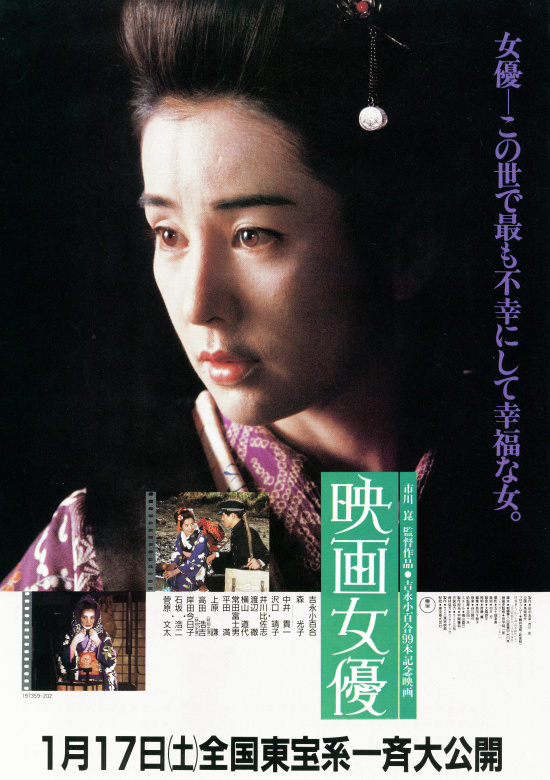
Actress (映画女優, Kon Ichikawa, 1987)

actressKon Ichikawa was born in 1915, just four years later than the subject of his 1989 film Actress (映画女優, Eiga Joyu) which uses the pre-directorial career of one of Japanese cinema’s most respected actresses, Kinuyo Tanaka, to explore the development of Japanese cinema itself. Tanaka was born in poverty in 1909 and worked as a jobbing film actress before being “discovered” by Hiroshi Shimizu and becoming one of Shochiku’s most bankable stars. The script is co-written by Kaneto Shindo who was fairly close to the action as an assistant under Kenji Mizoguchi at Shochiku in the ‘40s before being drafted into the war. A commemorative exercise marking the tenth anniversary of Tanaka’s death from a brain tumour in 1977, Ichikawa’s film never quite escapes from the biopic straightjacket and only gives a superficial picture of its star but seems content to revel in the nostalgia of a, by then, forgotten golden age.
The film begins with the young Tanaka awaiting a visit from her mentor, Hiroshi Shimizu (Toru Watanabe), whom her family are keen to thank for bringing them all to Tokyo away from their life of hardship. Although everyone is very happy for Tanaka’s success, there is shadow hanging over the party in the form of missing oldest brother Ryosuke who went on the run to avoid the draft and has not been heard of since.

Shimizu gives Tanaka (Sayuri Yoshinaga) her first roles at Shochiku where she becomes a contract player but is put out when another director, Heinosuke Gosho (Kiichi Nakai), wants to give her a leading role. Overruled by studio bosses, Shimizu becomes increasingly jealous of Tanaka’s career – a situation which is further complicated by the couple’s growing romantic entanglement which sees them living together in an unofficial marriage allowing Tanaka to continue acting. However, Shimizu continues to meddle in Tanaka’s professional life whilst also continuing his hard drinking, womanising playboy lifestyle. The couple eventually divorce but reunite from time to time on the film set.

Vowing never to marry again, the rest of Tanaka’s life is dedicated to acting and sees her working with some of the best directors of the age including Ozu (Shigemitsu Ogi) and later Mizoguchi (Bunta Sugawara). It is Tanaka’s professional and personal relationship with Mizoguchi which occupies the second half of the film. Judging by the first experience on the now lost Woman of Osaka in 1940, you wouldn’t think the two would ever wish to work together again though they eventually completed fifteen films together over the next fifteen years.

Mizoguchi’s process is completely different from any other Tanaka had worked with. Rather than meeting to rehearse and discuss the work, Mizoguchi abruptly sends her a lifetime’s supply of books about bunraku and changes the script that she has painstakingly committed to memory with on set rewrites communicated via a large blackboard he expects the actors to read from. Exasperated, Tanaka finally asks him for actual direction but he coldly states that she’s the actress and her acting is not part of his job description. Mizoguchi and Tanaka are very different people but each driven and ambitious so their frequent locking of horns produces a fiercely creative collaboration in which each was able to find worth even if it was frequently difficult.

The film ends around the time of Life of Oharu which would mark the final time the pair would work together. In terms of the film’s narrative, this unspoken development is foreshadowed by the idea that the two artists are heading in different directions but in the real world the reasons are a little less clear. Tanaka became the second woman to direct a feature film with Love Letters in 1953 which was even featured at Cannes, but for reasons unknown Mizoguchi attempted to block her access to the Director’s Guild of Japan, effectively ending both their friendship and any professional relationship. Ironically enough, Actress seems to imply that Tanaka’s desire to direct may have been inspired by Mizoguchi and his all powerful on set status prompting her to wonder how he does it, and, perhaps how she could do it too.

Ichikawa weaves the history of Japan through its cinema into the narrative to recount the changing tastes of the eras as naturalism came in and out of fashion and Japanese films began to experience international as well as domestic acclaim. Skipping huge portions of time to focus on the two directors – Shimizu and Mizoguchi, Ichikawa avoids mentioning Tanaka’s post-war visit to America which had a profound impact on her later career, not only in what she learned there but also in the extremely hostile reception she received on returning home. The main takeaway from his depiction of Tanaka is a woman ahead of her time, independent and headstrong, willing to work hard to achieve the things she wanted to achieve even if flying in the face of social convention though it makes no particular judgement on her character other than in her success as an actress.

Taking on the conceit of being a film about film, Ichikawa’s sets are theatrical, creating a deliberately artificial, half unreal world. This also extends into the scriptwriting which is extremely talky and more like a stage play than film, offering pointed, long stretches of monologuing which are already far away from the more naturalistic approach of early talking cinema. Characters have improbable, exposition filled conversations in which they each tell each other things they already know for the audience’s benefit – an effect which enhances the overall theatricality, but does draw attention to itself and eventually becomes wearing. Ichikawa’s picture of Tanaka is one of steely determination and of a woman ahead of her time, but even if Actress proves less than enlightening regarding its subject it does help to shed some light on both classic Japanese cinema and that of the late 1980s.


Original trailer (traditional Chinese subs only)

Notes of an Itinerant Performer (歌女おぼえ書, Hiroshi Shimizu, 1941)

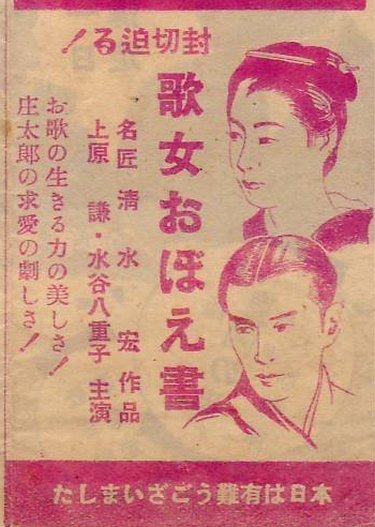
notes-on-an-itinerant-performerFilmed in 1941, Notes of an Itinerant Performer (歌女おぼえ書, Utajo Oboegaki ) is among the least politicised of Shimizu’s output though its odd, domestic violence fuelled, finally romantic resolution points to a hardening of his otherwise progressive social ideals. Neatly avoiding contemporary issues by setting his tale in 1901 at the mid-point of the Meiji era as Japanese society was caught in a transitionary phase, Shimizu similarly casts his heroine adrift as she decides to make a break with the hand fate dealt her and try her luck in a more “civilised” world.

At 25 years old, Uta (Yaeko Mizutani) jumps ships from one acting company to another having been promised better work by a roguish fellow performer. Tired of the strenuous life of travelling from village to village, putting on folk plays and street performances, Uta is thinking of quitting the business and looking for a job as a maid or something similar which is at least in the same place everyday. In a stroke of luck, she comes into contact with a kindly tea merchant who takes pity on her and suggests she come to live with him where she can teach his teenage daughter how to dance.

Uta becomes a member of the Hiramatsu household but not all of the inhabitants are as generous of spirit as Mr. Hiramatsu (Hideo Fujino) himself. The oldest son is away at college but the daughter, Nuiko (Kyoko Asagiri), has no interest in learning to dance and resents her father’s “adoption” of such a “common” woman. Youngest son Jiro (Haruhiko Tsuda) is similarly unimpressed with Uta’s presence, making her new home less than welcoming. To make matters worse, Mr. Hiramatsu abruptly dies leaving his business and household in disarray. Oldest son Shotaro (Ken Uehara) returns and feels as if he ought to abandon his studies and take over the company, but as a student he has no experience of running a business and lacks his father’s knowledge of the tea industry. Uta encourages him to return to university and finish his studies if only so that the prestige of a degree might help him later if he decides to restart the business. She also volunteers to act as a guardian for Jiro and Nuiko though Shotaro is wary seeing as they know each other so little. He then makes a surprising suggestion – that he and Uta marry, making it perfectly natural that she take care of everything at home while he’s away studying in the city.

Like many a Shimizu hero, Mr. Hiramatsu is a good hearted man but perhaps lacking in practical skills. Though he seemed to be prosperous and successful, the business was on the rocks and he dies leaving a number of debts behind him and total admin chaos for Shotaro as there is no clear successor to keep the business running in Mr. Hiramatsu’s absence. Luckily for Uta, Shotaro is also a kindhearted man like his father (in contrast to his siblings) and has no desire to suddenly throw her out when his father promised to look after her. He is, however, at a loss as of how to take care of everyone with no money coming in.

Even before Mr. Hiramatsu died, not everyone was happy about his decision to take in a travelling performer and an old friend begins to warn him about the danger of rumours. Friend of the family Kajikawa feels he has a stake in this as he intends his daughter Ayako to marry Shotaro and thinks it’s a done deal (though Mr. Hiramatsu does not seem particularly wedded to the idea). Ayako and Nuiko are also good friends and Ayako does seem like the ideal bride for Shotaro as a member of his own social class and a business connection for the family. Shotaro, however, proposes to Uta without really thinking things through. It is, in one sense, a purely practical decision but one that is likely to meet with a degree of social opposition.

Uta left her life as a travelling performer because she wanted something more conventional. Her mother died when she was six and she never knew her father. Her only happy memory of family is the time spent with her grandmother who died when she was twelve. Uta resents her lack of status as a member of a lowly order of entertainers and longs for something grander but has also internalised a deep seated sense of inferiority. Hence when Jiro and his school friends refer to her as a “monster” living in the house, she half accepts their prejudiced view of her. Nevertheless, she wants to honour the kindness that Mr. Hiramatsu offered her and also deeply respects his son, Shotaro, possibly even developing romantic feelings for him. Despite continuing to feel herself unworthy, Uta does the unthinkable by almost singlehandedly resurrecting the tea business when presented with an opportunity from a foreign company. Even after becoming a formidable business woman and winning the respect of Nuiko and affection of Jiro, Uta still feels herself out of place in the mercantile world and ultimately opts to leave in order to pave the way for the “proper” union of Ayako and Shotaro.

When Shotaro and Uta meet again she tells him that she left because she found his middle class world of “decency” too rigid and full of dull formality. Her “housewife” life was a hard one – getting up early, no smoking, no drinking. At least as a travelling performer she can sleep in and have her share of fun. This produces a quite shocking and strange scene in which Shotaro strikes Uta violently, knocking her to the floor. He repeats his earlier promise to marry her and invites her to come home as his wife, a “decent” woman, and full member of his social class whatever anyone else might have to say about it. Shotaro is apparently a man of his word but there is real feeling implied in his actions as opposed to duty or obligation. Nevertheless, this quite surprising scene of domestic violence used as a tool of coercion does not speak to Shotaro’s otherwise kindly personality and undercuts the “romantic”, if melodramatic, quality of the scene. This may be another instance of Shimizu’s aversion to romantic resolutions or romance as a solution to crisis, but one expects better from a director generally so keen to underline the hardships faced by women in his society.

Despite being filmed well into the era of the talkies and long after Shimizu himself had made the jump to sound, Notes of an Itinerant Performer makes use of frequent intertitles setting the scene or providing explanatory background material. Conversely, it also anticipates a more recent trend by allowing the discussions between the “American” (actually heavily accented European) and his interpreter to take place in English with Japanese sidetitles for parts not subsequently translated in the dialogue. In fact, this broadly positive foreign presence seems an odd inclusion for the fraught political world of 1941 (the film was released in March, just nine months before outright hostilities would commence with the USA which had been effecting a series of trade sanctions with the expansionist nation since 1938) even if the deal itself is taking place in the comparatively more open society of 1901.

In many ways about transitionary periods both in terms of society and of the self, Notes of an Itinerant Perfomer seems conflicted right up until its “Reader, I married him” inspired intertitle. Uta crosses a class border, transcending her lowly origins through selfless sacrifice, pure heartedness, and perseverance yet finally she is dragged across by violence and condescension rather than self acceptance or personal transformation. Filled with ambiguity, Notes of an Itinerant Performer reflects the uncertainties of its times and is noticeably less forgiving than Shimizu’s general outlook as its problematic finale demonstrates.


The Little Girl Who Conquered Time (時をかける少女, Nobuhiko Obayashi, 1983)

Little Girl Who Conquered TImeThe Girl Who Leapt Through Time is a perennial favourite in its native Japan. Yasutaka Tsutsui’s original novel was first published back in 1967 giving rise to a host of multimedia incarnations right up to the present day with Mamoru Hosoda’s 2006 animated film of the same name which is actually a kind of sequel to Tsutsui’s story. Arguably among the best known, or at least the best loved to a generation of fans, is Hausu director Nobuhiko Obayashi’s 1983 movie The Little Girl Who Conquered Time (時をかける少女, Toki wo Kakeru Shoujo) which is, once again, a Kadokawa teen idol flick complete with a music video end credits sequence.
As in the novel, the story centres around regular high school girl Kazuko Yoshiyama (Tomoyo Harada). She has two extremely close male friends (generally a recipe for disaster, or at least for melodrama but this is not that kind of story) – Horikawa and Fukamachi, and one Saturday while all three are charged with cleaning up the schoolroom, Kazuko ventures into the science lab where she sees a beaker on the floor emitting thick white smoke which smells strongly of lavender causing her to pass out. Everyone seems to think it’s either hunger, anaemia, or that old favourite “woman’s troubles” but from this day on Kazuko’s life begins to change. The same day repeats itself over and over again with minor differences and Kazuko also begins to experience multilayered dreams in which her friends are in some kind of peril.

Tsutsui’s original novel was a Kadokawa Shoten property (though first published 15 years previously) which made it a natural fit for the Kadokawa effect so when legendary idol master Haruki Kadokawa found an idol he was particularly taken with in Tomoyo Harada the stars aligned. Obayashi set the story in his own hometown, the pleasantly old fashioned port village of Onomichi, which adds a nicely personal feel to his take on the original story. Although The Little Girl Who Conquered Time is an adaptation of a classic novel, many of Obayashi’s regular concerns are present from the wistful tone to the transience of emotion and the importance of memory.

Kazuko is another of Obayashi’s young women at a crossroads as she finds herself wondering what to do with the rest of her life. The original timeline seems to point to a romance and possibly a life of pleasant, if dull, domesticity with one of her best friends but with this time travelling intrusion everything diverges. Though assured that she will not remember most of the strange events that have been happening to her, something of her adventures seems to have stuck in Kazuko’s mind even if she couldn’t quite say why. Much to the consternation of her mother, Kazuko’s purpose in life begins to lean to towards the scientific rather than the romantic, almost as if she’s waiting for the return of someone whom she has no recollection of having met.

Obayashi once again uses conflicting colour schemes to anchor his story. Beginning with black and white as Kazuko has her first encounter with someone she’s known all her life under the brightly shining stars, he gradually re-introduces us to the “real” world through sporadically adding colour during her bus ride home to her small town which does have a noticeably more old fashioned aesthetic when compared to Tokyo set features of the era. The effects are highly stylised and very much of their time including the celebrated time travel sequence which has Kazuko framed by a neon blue halo. The most touching sequence occurs near the end of the film in which Kazuko crosses paths with a familiar face that she doesn’t quite recognise, the camera perspective actively changes physically pulling us away from the encounter until Kazuko turns around and walks away in the opposite direction and into yet another empty corridor.

Tomoyo Harada developed into a fine actress with a long standing and successful career in both television and feature films as well as releasing a number of full length albums. As is usual with this kind of film she also sings the theme tune which has the same title as the movie though in an unusual movie Obayashi includes a music video retelling of the events of the film over the end credits featuring all of the cast helping Harada to perform the song with silly grins on their faces all the way through. Harada proves herself much more adept at convincingly carrying a feature length movie than some of her fellow idols but the same cannot be said for many of her co-stars though she is well backed up by established adult cast members including Ittoku Kishibe as Kazuko’s romantically distressed teacher.

The Little Girl Who Conquered Time is first and foremost a Kadokawa idol movie and has all the hallmarks of this short lived though extremely successful genre. Necessarily very much of its time, the film has taken on an additional layer of nostalgic charm on top of that which has been deliberated injected into it. Nevertheless, in keeping with Obayashi’s other work The Little Girl Who Conquered Time has a melancholic, wistful tone which is sentimental at times but, crucially, always sincere.


Original trailer (no subtitles)

And here’s the famous music video for the title song (which is of course sung by Tomoyo Harada herself). English Subtitles!

Where Chimneys are Seen (煙突の見える場所, Heinosuke Gosho, 1953)

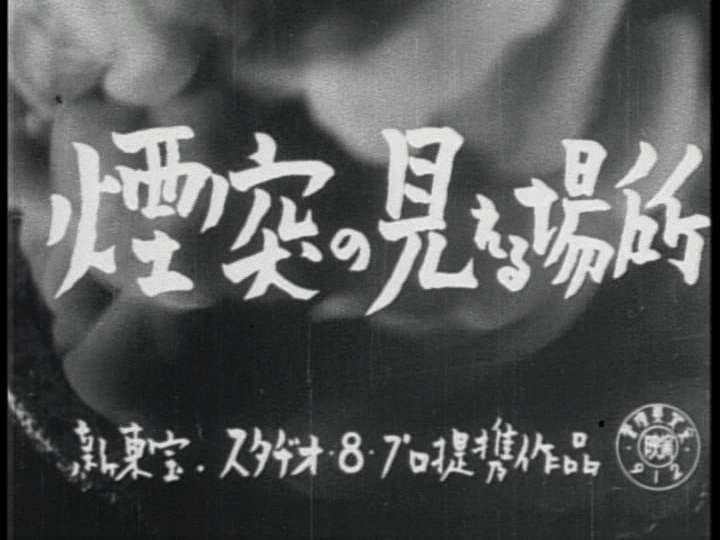
vlcsnap-2016-07-07-01h01m06s792Where Chimneys are Seen (煙突の見える場所, Entotsu no Mieru Basho) is widely regarded as on of the most important films of the immediate post-war era, yet it remains little seen outside of Japan and very little of the work of its director, Heinosuke Gosho, has ever been released in English speaking territories. Like much of Gosho’s filmography, Where Chimneys are Seen devotes itself to exploring the everyday lives of ordinary people, in this case a married couple and their two upstairs lodgers each trying to survive in precarious economic circumstances whilst also coming to terms with the traumatic recent past.

Ryukichi Ogata (Ken Uehara) is our primary narrator, introducing us to his humble circumstances and, for the moment, happy home. He’s married to a cheerful and kindly woman, Hiroko (Kinuyo Tanaka), who was widowed during the war, and the couple rent out their upstairs to a man, Kenzo (Hiroshi Akutagawa), and a woman, Senko (Hideko Takamine) , who aren’t a couple but each rent a room separately. They’re desperately poor, so much so that they have complicated measures in place to try and avoid having any children – a luxury which they can in no way contemplate. However, unbeknownst to Ryukichi, Hiroko has taken on a part-time job outside the home by working at the bicycle races. He’s upset by this because he resents feeling as if his wife has been hiding things from him, though his pride is wounded too. The worry planted in his mind by the idea of not knowing everything there is to know about his wife’s past is brought to the fore when a baby is suddenly abandoned on their doorstep with a note claiming to be from Hiroko’s first husband which states this is “her” child and she ought to look after it from now on.

The titular “magic” chimneys belong to a large scale factory and, in truth, there are four of them, but depending on where you stand they blend into each other, increasing or decreasing in number. This rundown, backwater town is a three chimney sort of place – not quite rock bottom, but almost. All anyone can think about is trying to keep their head above the water and food on the table. Upstairs lodger Senko works as a public announcer in the shopping district along with another woman who has a rather different approach to life and is in some kind of compensatory relationship with a businessman whom she’s apparently going to marry. Senko is a little upset about this, possibly envious, but at any rate is going to lose a friend at work and in a way she doesn’t entirely approve of. At one point she declares that she envies the baby in one sense – children are allowed to cry whenever they want and make as much noise as they please, but adults are expected to grin and bear it no matter how painful it might be.

Kenzo, by contrast, is a government official in that he’s a kind of bailiff trying to enforce taxation fines and threatening to seize the property of those that can’t pay. This kind of work contrasts strongly with his sense of social justice as he can see that most of the people he visits just don’t have the means to pay but do have plenty of other problems of their own, what good will it serve turning them out onto the streets? Predictably he’s developed a bit of a crush on Senko though given both of their dire financial circumstances, he’s afraid to pursue it. His need for “justice” sends him out on a quest to track down Hiroko’s former husband and find out what’s really going on though his investigation takes far longer than expected and soon begins to depress him. When eventually uncovered, the facts of the matter shock and upset, leaving Kenzo wishing that he’d never bothered in the first place.

Having gone to so much trouble to avoid having children (they have a very prominently marked calendar hanging on the wall), that Ryukichi and Hiroko should be saddled with an abandoned child is especially ironic though the baby serves as more than a physical burden, becoming a manifestation of a hitherto buried past. Both of the women in the film have suffered heavily in the war. Hiroko lost her entire family and was reduced to stealing scraps of discarded food behind the evacuation centre. After losing everything she came to resent the whole of humanity for becoming involved in this senseless war and just wanted to live alone, but came to feel a life of mere subsistence was not worth living. She got herself a new family register and started again planning not to look back. She didn’t tell Ryukichi much about her former life because she wanted to forget it, it was painful to her.

Senko had similar experiences, losing family members in extremely cruel ways leaving her with a degree of resistance to forming new bonds. The baby, perhaps a temporary visitor, perhaps not, forces them to reconsider their choices, reawakening an emotional connection that had been severed due to the war’s hardships. The past is quite literally visited upon them, but how they decide to deal with it is very much a matter for the present. In the end, this extreme stress test on the various relationships of the central characters proves effective as their bonds eventually strengthen rather than break.

Using the four chimneys as an effective, if occasionally overworked, metaphor, Gosho remains resolutely non-judgemental, reminding us that things often look very different depending on where you stand. Everybody here is struggling, but everyone is trying to survive. If the film has a central message, it’s that you have to let the past go. The “right time” may never come, so you just have to make the best of things now. Happiness is fragile, but possible, if only you can learn to accept the various compromises which necessarily accompany it.


Mr. Thank You (有りがとうさん, Hiroshi Shimizu, 1936)

Mr. Thank YouBus trips might be much less painful if only the drivers were all as kind as Mr. Thank You and the passengers as generous of spirit as the put upon rural folk travelling to the big city in Hiroshi Shimizu’s 1936 road trip (有りがとうさん, Arigatou-san). Set in depression era Japan and inspired by a story by Yasunari Kawabata, Mr. Thank You has its share of sorrows but like its cast of down to earth country folk, smiles broadly even through the bleakest of circumstances.

Mr. Thank You is everyone’s favourite bus driver. In fact, some of his passengers have even deliberately decided to “miss” the previous bus because they heard he was driving the next one. It’s not hard to see why, he’s a good a driver and a very polite, nice young man who’s been given the affectionate “Mr. Thank You” nickname because of his habit of shouting a loud thank you to everyone who moves out of the way for his bus to pass in the narrow mountain roads (the aforementioned pedestrians are also to be seen waving wildly and shouting his nickname back at him as he grins at them in the rear view mirror). He’s also prepared to stop and pick up passengers along the way as well as carrying messages between villages and filling requests for the latest records to hit Tokyo stores.

Mr. Thank You was apparently shot without a firm shooting script other than the inspiration of Kawabata’s story so the dialogue has a very immediate, contemporary feeling. There isn’t so much of a story as a journey taken with this disparate group of people all travelling from one place to another for various different reasons with the small interjections of other passersby on the roadside. The main drama occurs between a woman and her daughter who have such ashen faces they might as well be ascending the gallows, a very modern whiskey swilling travelling woman, and a grumpy guy with a handlebar moustache who seems very anxious about the bus being delayed by all these pleasantries. Along the way, Mr. Thank You offers commentary on some of the people he knows from his regular trips which amounts to a collection of sad stories decrying the state of the nation in which fathers are selling their daughters and mad men wander the streets searching for lost love.

“Young women used to laugh, but you never hear that now.” Says one passenger glancing at the sad face of a girl on a bus to the city. The mother and daughter seem reluctant to talk about their journey but it’s obvious to all that the girl is to be sold to a geisha house, never to see her home again. Mr. Thank You is sympathetic to her plight whilst silently listening to the lamentations of his customers like a sober barman. At one point he wonders out loud if he might be better off driving a hearse – acknowledging his own complicity in taking money for escorting this poor girl off to a life of rack and ruin. The flirtatious modern woman sitting behind him (most likely a prostitute herself) reminds him that women who pass these mountains rarely make a return journey, perhaps there is another way he could help her even if he can’t do the same for everyone.

Shimizu also stops a minute to consider the human costs of all this rapid progress. Taking a brief break from driving, Mr. Thank You chats to an acquaintance who has been working on the road building programme. A Korean migrant, she is among the most put upon of workers. She hoped she might have enough money to ride on Mr. Thank You’s bus just the once, but no sooner has one road been completed than she’s despatched off to build another one on another mountain so she’ll have to bid him goodbye. Mr. Thank You (seemingly quite taken with her and sorry to hear they may not meet again) offers to let her ride for free but she looks back at the masses of other people who are walking the mountain passes because they can’t afford the bus either and says it’s OK, she will stay with them, walking onward with everyone else caught in the same predicament as herself.

Filmed in 1936 Mr. Thank You has an extremely modern sensibility with a lot of naturalistic location shooting outside of the cramped environment of the bus which forms the main setting for the drama. The bus drives onward without stopping as obstacles fade from view only to reappear in the rear view mirror like ghosts, phantom images reflected on the landscape here one minute and gone the next. Time and history are marching on though one gets the impression Shimizu at least does not approve of the way his country is heading. The passengers on Mr. Thank You’s bus all have their troubles, but they’re trying to do the best they can by putting a brave face on it. They laugh, they drink, they sing but eventually they will all have to get off the bus, away from the careful protection of Mr. Thank You, and return to land of badgers and foxes where it’s every man for himself and those who cannot pay the fare will have to walk the rest of the way on their own two feet alone.


Mr. Thank You is the second of four films in Criterion’s Eclipse Series 15: Travels with Hiroshi Shimizu box set.

Scene featuring the Korean migrant worker (with English subtitles)

A Japanese Tragedy (日本の悲劇, Keisuke Kinoshita, 1953)

A Japanese Tragedy 1A Japanese tragedy, or the tragedy of Japan? In Kinoshita’s mind, there was no greater tragedy than the war itself though perhaps what came after was little better. Made only eight years after Japan’s defeat, Keisuke Kinoshita’s 1953 film A Japanese Tragedy (日本の悲劇, Nihon no Higeki) is the story of a woman who sacrificed everything it was possible to sacrifice to keep her children safe, well fed and to invest some kind of hope in a better future for them. However, when you’ve had to go to such lengths to merely to stay alive, you may find that afterwards there’s only shame and recrimination from those who ought to be most grateful.
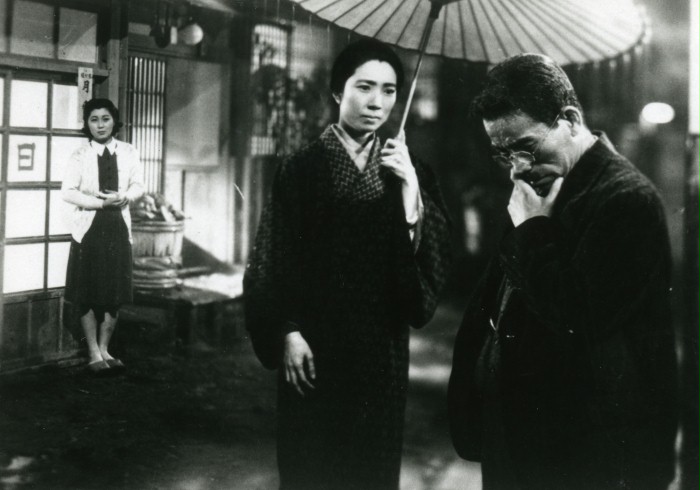
After opening with a series of genuine newsreel segments overlaid with newspaper clippings which tell of nothing other than crime, corruption and suicides, Kinoshita shifts focus to our ordinary mother, Haruko, currently working in an inn. Her son, Seiichi, has something he wants to tell her and will be staying with his sister, Utako, if she’d care to call. Neither of the children seems very excited about seeing their mother and, in fact, Seiichi’s news is that he wants to be adopted into a wealthy medical family so he can eventually take over their hospital. Utako is studying dressmaking and learning English but has also developed an attraction to her married English teacher which is threatening to develop into quite a difficult situation.

Kinoshita makes it plain that everybody suffered during the war which generally brought out the worst in people and even afterwards it was every man for himself as each tried desperately to climb out of the deepening hole that was Japan’s wartime defeat. Haruko lost her husband in the conflict, leaving her alone with two young children to feed and no one to help her. She did what she had to do whether that was a spot of black-marketeering, hoarding, or even casual prostitution but she put her children first every time. Unfortunately, she also falls for some bad self serving advice from her brother-in-law who offers to take over her husband’s land and look after the children while she earns more money out of town. Of course, he didn’t exactly keep his promises and both of the children suffered as a result.

Far from feeling grateful for their mother’s sacrifice, what the children feel is a mixture of shame and resentment. They’re embarrassed by their mother’s hardline personality and rural earthiness which no longer match their postwar upwardly mobile aspirations and force them to remember the unpleasantness of their upbringing. Seiichi is particularly disgusted by his mother’s having prostituted herself, branding her a “loose woman” and calling into question her character even before the disruptive effects of the war. Utako suffered a far greater betrayal at the hands of her relatives which has coloured her entire world view and left her with nothing but lingering resentment towards the mother who placed her in this situation.

Kinoshita intercuts the present day action with completely silent scenes of the family escaping from the military police, or memories of the various traumas each of the family members encountered in the chaotic period immediately after the end of the war. We see them travel from the warm letters sent by the children to their mother which lament the way their aunt and uncle are treating them to the outright hostility of the contemporary era. Haruko may not be the easiest of women, she’s certainly had a difficult life by any standards and it’s understandable why the relationship with her children might be strained, but in this case blood is not enough to overcome all the years of hardship and neither Seiichi nor Utako is willing to fulfil their filial obligations towards their mother.

Haruko substitutes the relationship she’s missing with her own children by offering maternal advice to the chef who works in her inn and a sad wandering guitarist who often comes by to serenade the guests. Not much older than her own son, the guitarist also has a mother in the country whom he rarely sees – Haruko gives him some money that he tearfully promises to use to send his mother a present, though he confesses at the end of the film that he drank it himself in the end. He feels guilty about it and he’s moved by Haruko’s kindness towards him but in the end he’s forgotten his own mother too and even if he isn’t treating her with the same level of disdain that Seiichi and Utako display for Haruko, he isn’t doing much better in the filial piety stakes.

An extended metaphor with a series of tightly packed layers, A Japanese Tragedy is a lament for a homeland that’s lost its way. Haruko, like the idealised mother, has given her own life in sacrifice for those of her children only to find that her children disown her for it. Everything she has ever done, good and bad, has been in their name yet they refuse even to acknowledge her suffering but rather apportion blame for their own hardships. Kinoshita litters Haruko’s story with news reports bearing out the depths to which the country has fallen – corrupt politicians, rioting, violence on the streets and mothers who commit suicide taking their children with them. At a moment near the end of the film, Haruko remains motionless on the train station steps as a crowd of passengers surges past her. Left alone, uncertain, and believing herself to have lost the only thing that has ever mattered to her, Haruko becomes a casualty of a society that is so intent on marching forward that it’s lost sight of where it’s going. An enraged state of the nation address, this bleak and tragic tale is nevertheless filled with genuine human feeling and naturalistic detail which only deepen the impact of the desperately sad ending.


Opening sequence of the film:

Reviewed at the 2016 Japan Foundation Touring Film Programme, ICA 7th February 2016.


Army 陸軍 (Keisuke Kinoshita, 1944)

Dem-3 Photo. Helene Jeanbrau © 1996 cine-tamaris.tif

With a name like “Army”, you’d expect this to be a stridently propagandistic film about brave men fighting for their countries – some of whom will likely fall but will cover their families in eternal glory through their selfless sacrifice. Those are certainly the ideas behind Kinoshita’s 1944 film, the last film he’d be permitted to make before the war’s end, however any lingering feelings of pro-militaristic ardor are completely undercut by the film’s near silent closing moments.

Like The Living Magoroku, we begin in another historical era – one just as turbulent as the contemporary action. As people flee burning houses at the dawn of the Meiji era, a father and son shelter a wounded samurai who gifts them a set of historical encyclopaedias. Despite the changing times, the father is convinced a man’s highest duty is to his country and makes a deathbed plea that his son Tomohiko become a fine soldier. Tomohiko tries his best, as an infantry Captain through the several of Japan’s international conflicts of the early 20th century he’s certainly had ample opportunity to distinguish himself. However, luck is not on Tomohiko’s side as minor injuries, illness or simply failing to be selected have kept him safely away from the front lines. Eventually invalided out, Tomohiko tries to make a go of civilian life, finally ending up trying to run a pawn shop (before realising he’s not good at that either and leaving the heavy lifting to his more capable wife). Still convinced of the wisdom of his father’s philosophy, Tomohiko pushes his wishes for military glory onto his oldest son – the equally weedy Shintaro whose slight frame and kindly nature don’t exactly point to a future Field Marshall. Japan needs soldiers though, it’s time for every man and boy to stand up to defend her!

Final scene excised, Army would look like the most obviously propagandistic film in the box set. Full of references to the importance of military virtue and physical strength over book learning, Army brings home that a man who does not fight is not a man. He is weak and womanly and is to be shamed. Even those who are in poor physical health or simply not built for brute force attacks are expected to suddenly shape up and join every other young man in sacrificing themselves nobly for the Emperor. Mothers, even, are not permitted to grieve as their sons were never theirs in the first place – they were merely taking care of them for the Emperor. Now they’ve done their duty and returned their progeny to the father of the nation, they ought to feel nothing more than relief at a job well done, or so says Tomohiko’s wife, Waka. Wouldn’t it be shaming to have a grown up son still at home, after all, or even one that was far from the front line but relatively safe? Prepare for the worst or hope for it? It’s an oddly macabre way of thinking.

However, the last scene of the film which is played almost silently, undercuts this cold willingness to sacrifice and shows it up for its own hollowness. Having originally claimed not to be going to see the brigade depart because she’s a weak and emotional woman, Waka is suddenly overcome by something. She rises and follows the other townspeople drifting towards the noise of the parade with its crowds of cheering, flag waving supporters. Desperately, anxiously, she searches for her son in amongst the multitudes of other young men in identical uniforms marching off gleefully almost certainly not to return. Having pushed through the ranks of ecstatic civilians, she finally catches a glimpse of Shintaro who smiles at her before disappearing back into the ranks of anonymous infantrymen. Waka is left bereft, alone and terrified – her only recourse is prayer.

Unsurprisingly, the army didn’t really like this bit. In fact, one high ranking official marched right down to Shochiku and accused Kinoshita of treason! Luckily, not too much came of that but Kinoshita’s next script about kamikaze pilots was rejected and he wasn’t allowed anywhere near a camera until after the end of the war. Waka’s final uncertainty, her grief at losing her son to this faceless monster undercuts the entirety of the previous 80 minute celebration of glorious military history and masculine pride. All of a sudden it’s not a joyful celebration anymore, it’s a funeral peopled with grieving wives and mothers – hardly the sort of message you want to send out when you’re trying to give the barrel a final scrape when it comes to conscripting for the army. Army is a film that’s defined by its final minutes and is surprising in the level of ambiguity it was allowed to get away with given the strict censorship conditions in place. As a propaganda film it fails, but by design. Kinoshita once again refuses to depict his characters as unfeeling robots who can suppress their natural empathy in the name of duty or honour and a mother’s love proves the most dominant (if hopeless) force of all.

Jubilation Street 歓呼の町 (Keisuke Kinoshita, 1944)

20138117_1_IMG_FIX_700x700The third entry in Criterion’s Kinoshita and World War II box set takes a decidedly darker turn than either of its predecessors. Made a little later in 1944, Jubilation Street is surprising addition, not least because for the majority of its running time it’s hard to see how it could have ever have fulfilled the propaganda requirements of the time. Its title is almost ironic, there’s nothing here but an inevitable sadness and eternal partings both between people and between eras. It’s not until the closing moments of the film that anything even remotely “inspirational” occurs, and even then it’s all a little bit tacked on and feels like a token epilogue to please the censors. With far less obvious comedy moments Jubilation Street is taking us somewhere significantly darker, but is not without Kinoshita’s characteristic sympathy.

Jubilation Street is an old-fashioned row of modest housing home to a small community of families who’ve each lived there for many years. Now they’re all being “relocated” because the government wants the land for the war effort. Some are ready to leave, others are not – either because they feel too old to start again somewhere else or simply because they don’t want to be split up from the people they’ve shared their lives with. The family who own the printer’s shop want to finish their last few orders and wait until their baby is born, the crotchety old man who runs the bath house just doesn’t want to go anywhere and Mrs. Furukawa is afraid to leave in case the husband who walked out on her and their son ten years previously finally comes home. Shingo, Mrs. Furukawa’s son, is a test pilot in the air force and wants to marry childhood sweetheart Takako, though her parents are against it given his family circumstances and dangerous work. Just in the knick of time, Mr. Furukawa makes a shocking reappearance, unbeknownst to his wife and son but will his ten years away with nary a word damage his chances of a happy reunion? With the evacuation date drawing nearer, important decisions will have to be made, and made in a hurry.

There may have been hope and happiness in this little street once, but now there’s just waiting and desperation. Towards the beginning of the film, the war still feels something far off – the relocation programme might as well be for a new dam or a modern housing development as much as being down to a war. Shingo is the only person directly involved with anything military and though his work is dangerous in one sense he gets to live at home with his mother and nothing seems very different than before. Towards the end, however, a traumatic event will drop the devastation of war right into the middle of this little community with as much force as any bomb. Doomed romance, shattered dreams, a lifetime’s work going for nothing – there’s nothing to celebrate here. Having undergone a tragedy and forced out of their homes, the community each vow they’re going to honour the sacrifices made by each doing their best for the war effort, but it comes dangerously close to being insulting. “So you’ve lost people, you might have lost your home or your business or a child but that just means you have to work even harder to make your loss mean something”. A fairly bleak message, if understandable given the circumstances, but it’s debatable that it’s one a worried populace would have wanted to receive in the normally escapist realms of the cinema.

It’s remarkably ambiguous for a film of its time. Perhaps because, again, he kept the war effort in the background, Kinoshita was able to get away with showing a less “jubilant” group of people each facing their various difficulties with an enviable degree of stoicism (coupled with their determined resolutions at the end). There’s no way you could read Jubilation Street as a “pro-war” film. Though it stops short of any kind of direct criticism, war (and even in one case the whole idea of Manchuria) has ruined each of these people’s lives, destroyed their community and cast them adrift in an uncertain world. What sort of glorious nation is this, and was it worth all this sacrifice?

Jubilation Street is not as well preserved as either Port of Flowers or The Living Magoroku, though the actual film is fine for the most part the soundtrack is very badly damaged with strong hiss and distortion throughout. However, it doesn’t detract from the experience too much and given that it’s a minor miracle it survives at all you can’t complain. Kinoshita has once again tried to put the lives of ordinary people up on screen with all the warmth, empathy and truth that was permitted to him at the time. The last days of Jubilation Street were not altogether happy ones, but as a metaphor for a place and time it’s about as close as you’d be allowed to explore.