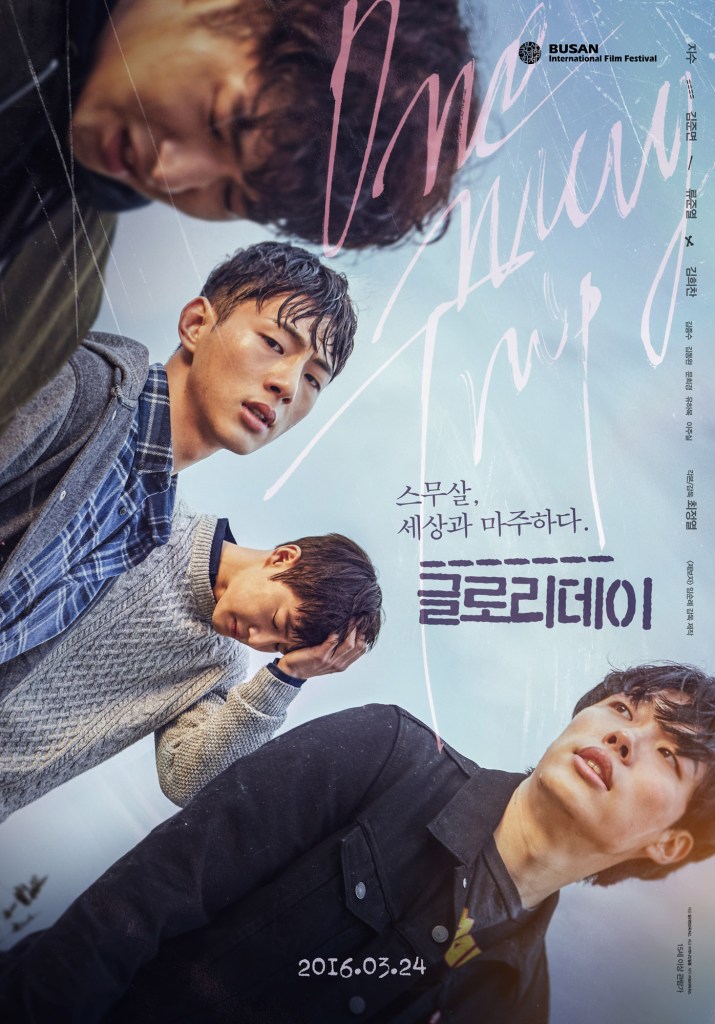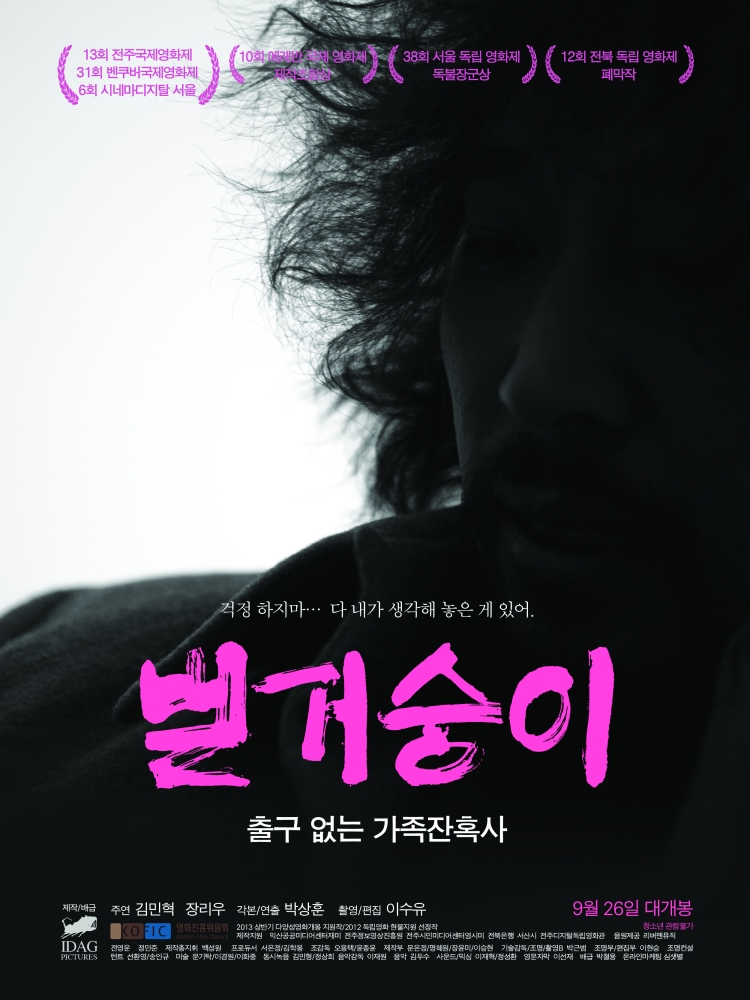
Train to Busan (부산행, Yeon Sang-ho, 2016)

Train to BusanMany people all over the world find themselves on the zombie express each day, ready for arrival at drone central, but at least their fellow passengers are of the slack jawed and sleep deprived kind, soon be revived at their chosen destination with the magic elixir known as coffee. The unfortunate passengers on an early morning train to Busan have something much more serious to deal with. The live action debut from one of the leading lights of Korean animation Yeon Sang-ho, Train to Busan (부산행, Busanhaeng) pays homage to the best of the zombie genre providing both high octane action from its fast zombie monsters and subtle political commentary as a humanity’s best and worst qualities battle it out for survival in the most extreme of situations.

Workaholic fund manager Seok-woo (Gong Yoo) is having a series of very bad days. His wife has left him and for unclear reasons, also left their young daughter, Soo-an (Kim Soo-ahn), in her father’s care though apparently wants custody in the ugly divorce battle that now seems inevitable. It’s Soo-an’s birthday but all she wants is to catch a train to Busan to see her mum and if she has to she’ll even go by herself. After his attempt at a birthday present spectacularly backfires, Seok-woo gives in and agrees to take Soo-an to her mother’s before catching the next train back after dropping her off. Unfortunately, they have picked a very bad day to take the train.

Yeon Sang-ho takes his time to build to the central train based set piece but is is careful to create an atmosphere which makes it plain that there is something very wrong with this seemingly everyday set up. After a brief dig about pig farmers losing out to government policy on foot and mouth disease and irresponsible hit and run drivers leaving deer corpses behind them for someone else to deal with, he has a parade of emergency vehicles racing past Seok-Woo and Soo-an on their trip to the station while ash rains down on their car. Seok-woo is still focussed on work though sleepy on the train so he misses Soo-an’s shocked reaction to a station guard being rugby tackled just as the train is leaving while a mass of improbable early morning revellers are trying to break through the line of staff holding them back at the platform steps.

Patient zero bounds onto the train just as the doors close though one wonders why no one is paying much attention to this obviously distressed young woman as she stumbles and writhes around in the train carriage before the virus fully takes hold. Just as we think someone is about to come to her aid, it turns out to be a case of a snooty passenger taking offence at the presence of an “odd person” on the train. The “odd person” turns out to be a homeless guy whose mutterings of “dead, all dead” take on a prophetic air rather than the ramblings of a mad man that the train guards assume them to be.

This kind of stereotypical othering and the selfish refusal to help fellow humans in need is at the very heart of the film. Seok-woo admonishes his goodhearted daughter when she repeatedly makes an effort to be a kind and decent person by giving up her seat for an old lady or wanting to stop and help others escape the zombie onslaught. However, Soo-an’s goodness wins through as she in turn chastises her father and explains that his selfishness and lack of regard for the feelings of other people is the very reason her mother left the family. Even if he begins by cruelly closing the door on the film’s most heroic character and his pregnant wife, Seok-woo gradually begins to develop a sense of social responsibility whether out of simple pragmatism or genuine fellow feeling.

Workaholic fathers with minimal connections to their offspring may be something of a genre trope but, as father-to-be Sang-hwa says, fathers often get a bad rap – making all of the sacrifices and enjoying none of the rewards. In an attempt to show solidarity with Seok-Woo, Sang-hwa assures him that his daughter will understand why he worked so hard all the time when she grows up and reiterates that true fatherhood is about self-sacrifice. This is one sense plays into the earlier themes of Seok-Woo’s self-centred viewpoint in asking if he really is working hard for his family or only wants to been as such, maintaining his own social status and upperclass lifestyle and completing it with a perfectly posed family photo. A father is supposed to protect his daughter and now Soo-an has only him to rely on, if Seok-woo is going ensure her survival he will have to decide what kind of sacrifices he’s prepared to make on her behalf.

If the film has a villain it isn’t the rabid zombie hordes who, after all, are only obeying their programming, it’s personal, corporate, and political greed. The clearest embodiment of this is in the panicked businessman who frequently tries to issue orders to the train staff and insists the train take him to his preferred destination. After trying to get the homeless man thrown off the train early on, the fascistic businessman picks up a lackey in the form of a steward and begins trying to exclude all the “suspicious” people from his general vicinity. Cruel and cowardly, the businessman’s selfish actions only cause more problems for everyone else whilst whipping up unhelpful paranoia among those who will need to work together to survive. Literally feeding even his most loyal comrades to zombies to buy himself time to escape, this egotistical CEO is the perfect metaphor for cannibalistic nature of the capitalist system which is, as Sang-hwa said, content to let the “useless” fall behind.

That’s not to forget the actual undead threat. Yeon Sang-ho’s walking dead take inspiration from his animated work and move quickly with jerky, uncanny movements more like Butoh dancers than the usual stupefied shufflers. The set pieces are expertly choreographed and well shot, maintaining the tension throughout though the increase in scale towards the final stretch is at odds with the leaner, meaner approach of the early scenes. Despite eventually giving in to melodrama in a heavily signposted script, Yeon Sang-ho’s live action debut is an impressive effort making room for his standard social concerns whilst also providing innovative zombie thrills. Yeon Sang-ho’s message is clear, when disaster strikes no one can survive alone, the only chance for salvation lies in altruistic compassion. In the end the best weapon against the darkness is a children’s song as innocence finally triumphs over fear.


UK release trailer:

The Bow (활, Kim Ki-duk, 2005)

The bowKim Ki-duk is not known for his conventional approach to morality but even so his 12th feature, The Bow (활, Hwal), takes things to a whole new level of uncomfortable complexity. While nowhere near as extreme as some of Kim’s other work, The Bow takes the form of a fable as an old man and a young girl remain locked inside a mutually dependent relationship which, one way to another, is about to change forever.

The old man owns a fishing boat on which he lives with a young girl most assume to be his granddaughter. This theory is quickly disproved by the old man’s obsession with his wall calendar on which he excitedly crosses of the dates, making a note of how many there are left until the circled day on which is marked the word “wedding”. Whose wedding, one is apt to ask but the obvious answer is the correct one. The old man plans to marry the young girl on her 17th birthday. Having “found” her ten years ago, he’s been patiently raising her and now awaits his reward. It’s not clear if he has actually asked the girl, who seems to look to him as a paternal rather than romantic figure, but at any rate the relationship between them seems fairly solid at this point.

That is until one fateful day a young and handsome student boards the boat and immediately captures the girl’s attention. Having been cooped up here for ten a whole years seeing no one other than the old man and the guys who come to fish, the girl is instantly smitten – just like Miranda laying eyes on Ferdinand for the very first time. The old man is worried – is he about to lose his prize bride to a young buck? With the fateful day approaching, the girl becomes increasingly cold and rebellious towards her father/husband-to-be, though which direction she will eventually choose is anyone’s guess.

The old man is very protective of his charge, taking out his bow and arrow when the other guys on the boat try it on (and some take the chase to quite unpleasant places) but perhaps that’s more about defending his property from spoilage than it is about saving a defenceless girl from a traumatic situation. Neither the girl nor the old man speak very much, occasionally one whispers to the other who then passes the message on via another whisper to whomever it was intended for. Perhaps they genuinely have no need for talking but at any rate the girl never voices any objections to her life on the boat and the only signs of rejection given are a sullen look, rebellious courting of the customers and finally a good old fashioned slap to the face.

The bow of the title is both a weapon and a musical instrument when the string is tightened over a drum rather than across an arrow. The artist and the warrior are truly two sides of the same coin, swapping drums for arrows as the occasion calls. The old man, who is more or less cast as the protagonist of the tale meeting a final swan song, has all these qualities. A rough sea hand, he lives a life of isolation alone with the girl on a boat in the middle of the sea, the music their only form of entertainment. As well as the fishing business, the man also tells the fortunes of his customers by firing arrows at a picture of a Buddhist deity while the girl rides a swing in front. The boat itself is a world entire, with its own rules and rituals – all things are contained inside of it, violence mixed with beauty and love mixed with fear.

It’s ironic in one sense that the girl’s would be rescuer is another man with less prurient designs, but still designs all the same, on her as a woman. That she’s apparently lived on this boat for ten years with people coming and going all the time and with no great attempts to maintain a convenient excuse is shocking in itself. Whether the relationship between the old man is entirely genuine or born of a kind of Stockholm syndrome is a matter for debate, but Kim opts not to fully explore the uncomfortable elements of this unusual situation in favour of casting the old man as a kind of love fool.

Though actually featuring much more dialogue than the average Kim film, The Bow is at heart a symbolic exercise which becomes a complex and extended Buddhist metaphor. Playing out like a boat bound The Tempest, the old man becomes Prospero with a bow rather than a staff and as a prophet rather than a magician. The student, like Ferdinand, shatters their peace by bringing the outside world into their idyll with all of its pleasures and complications. The old man faces a choice, burn his books and abandon his kingdom or keep his daughter/wife-to-be fearful enough to stay with him rather than the young man who offers her, literally, the world, which she has never known. Kim descends into a surrealist frenzy as the finale approaches, culminating either in a beyond the grave consummation of true love or a spiritual rape, depending on your point of view. Whichever you choose, The Bow is both a complex and poetic exploration of human relationships but one that proves unpalatable and, ultimately, hollow.


Original English language trailer (dialogue free, English text)

The Himalayas (히말라야, Lee Suk-hoon, 2015)

HimalayasBecause it’s there. As good a reason as any for doing anything but these were the only three words of explanation offered by George Mallory in answer to the question “Why climb Everest?”. In Powell & Pressburger’s The Red Shoes, the heroine reacts in a similarly philosophical fashion when asked “Why do you want to dance?” replying with the question “Why do you want to live?”. What makes some people prepared to dance until their feet bleed and their toes break, and sends others to the peaks of snowcapped mountains staring death in the face as they go, is something which cannot be fully explained in words but cannot be denied by those who hear its calling.

Korea’s most well known mountain climber, Um Hong-gil (Hwang Jung-min), was undoubtedly one who heard the call and The Himalayas (히말라야) is his story (more or less). Based on his real life exploits, the film charts his continuing successes as an international climber until a foot injury forces him to remain on a more usual altitude, but the real heart of the story is in his growing relationship with rookie Moo-taek (Jung Woo) who’s every bit as fearless as he is. Together the pair scale the peaks of the world’s highest mountain ranges until it’s finally time for Hong-gil to hang up his pick and keep his feet on the ground for good.

However, tragedy strikes as one of Hong-gil’s closest friends is suddenly killed after getting caught in an unexpected storm. The mountain ranges of the world are littered with the corpses of unfortunate climbers who got into difficulty and couldn’t be rescued. The bodies remain where they fell, becoming one with mountain itself in a lonely climbers graveyard, frozen and perfect for eternity. Risking your own life to retrieve the lifeless body of a friend may seem like a perverse, irrational thing to do, yet understandable. Wracked with guilt and grief, Hong-gil assembles a team and embarks on a sentimental journey to bring his friend home, and, ironically, learn to let him go.

What starts off as a sports movie with its training sequences and tough coach inspires maverick rookie routine branches off into the classic expeditionary adventure format before falling into its unexpected home genre – the melodrama. Though in one sense a kind of biopic, the realm aim is to get those tears rolling as these brave men and women risk all for glory and comradeship in pushing the limits of the human condition far past their breaking points.

Hong-gil himself is, despite his gruff exterior, a dreamer and idealist in love with the soulful purity of the mountains. His is a journey of self discovery as he tells us that there is no pretence when it comes to mountain climbing. When you’re up there alone, just you and the vast snow covered emptiness, all of your masks and defences fall away. Hong-gil climbs the mountain to explore landscape of his own mind. He also objects to the often uttered phrase “conquer” a mountain as he believes the mountain gives you permission to ascend making this way of thinking disrespectful and even likens the mountain itself to woman when bemoaning Moo-taek’s pointlessly noble romantic gesture by stating that you don’t conquer the “mountain” you console it.

For all that, the real world is ever present as we see in one particularly awkward marketing pitch in which Hong-gil is trotted out as a model to have the prospective sponsor’s logo plastered all over him in the hopes that they will fund an expedition. When someone raises the very sensible point that this could look very bad for them should one of the climbers die with their logo on their chest, the marketing guys slowly start peeling them all off – velcro solves everything, it seems.

The team also becomes a marketing tool for their nation, carrying the Korean flag around with them for any photo opportunities which might present themselves. When tragedy strikes and the remainder of the Korean expeditionary group refuse to go after their fallen friend (the right and practical decision given the weather conditions and the low probability of success), base camp puts out a message over the radio in English pleading for help. The British contingent continue with their crosswords and cups of tea, steadfastly ignoring the emotional mayday call. The Chinese at least begin reassuring each other that it’s far too dangerous to contemplate.

The Himalayas begins as a comedy but the laughs fall away once the tears start rolling. Though it may affect a poetic tone the philosophical meandering is generally at the service of the melodrama which is very much underpinned by male bonding, pride, honour, debt and responsibility. Hong-gil’s “Human Expedition” is one of grief stricken madness but a perfectly understandable one in which he both needs to atone for “abandoning” his mountaineering brother and come to terms with the fact that the death zone has claimed another sacrifice. Often impressively filmed, The Himalayas suffers from its extremely melodramatic, sentimental tone which is only exacerbated by the intrusion of its loud and syrupy score. Anchored by strong performances from its leading players including Hwang Jung-min as the tough yet sensitive Hong-gil and Jung Woo as the young firebrand Moo-taek, The Himalayas spends too long at the destination rather than on the journey and ultimately fails to make either its character drama or expeditionary environment sufficiently engaging.


Seen as part of a teaser programme for the upcoming London Korean Film Festival 2016.

US release trailer:

Daytime Drinking (낮술, Noh Young-seok, 2009)

daytime drinkingPoor old Hyuk-jin is about to have the worst “holiday” of his life in Noh Young-seok’s ultra low budget debut, Daytime Drinking (낮술, Natsul). Currently heartbroken and lovesick as his girlfriend has just broken up with him, Hyuk-jin is trying to cheer himself up with an evening out drinking with old university friends. Truth be told, they aren’t terribly sympathetic to his pain though one of them suddenly suggests they all take a trip together just like they did when they were students. Hyuk-jin plays the party pooper by saying he can’t go because he’s meant to be looking after the family dog but after some gentle ribbing he relents and says he’ll come if he can get someone to look in on the puppy for him while he’s gone. He will regret this.

Sure enough, Hyuk-jin arrives at the bus terminal in the town where his friend supposedly knows someone with a cosy inn where they do delicious barbecues only it’s freezing cold and his friends are nowhere to be seen. That’s right – his ultra flaky friends have forgotten all about it and stood him up. Already quite annoyed, Hyuk-jin argues with his “friend” but later accepts his offer to stay over at the inn on his own at his friend’s expense and wait for him to join him there in a couple of days. However, firstly, Hyuk-jin somehow ends up at the wrong inn which seems to be run by a madman where he also meets a female solo traveller who’s apparently fond of a drink. Everywhere he goes, everyone keeps offering Hyuk-jin a drink in a way which makes it very hard for him to say no, though there’s almost nothing else to do around here anyway. Pretty girls and drink are about to land Hyuk-jin in a series of embarrassing incidents that are most likely only bearable because of the residual booze cloud Hyuk-jin is currently residing under.

Following a loose road trip structure, Daytime Drinking follows Hyuk-jin on his strange and accidental odyssey where just about everything conspires against him. Hyuk-jin is not entirely blameless in his fate – he’s far too taken by pretty faces and gets himself into trouble by behaving rudely towards a not so pretty older woman as she bores him with endless prattle, completely failing to take the hint that he’s finding her constant conversation a little too much to bear. Hyuk-jin’s distress continues to grow as his friend keeps delaying his trip, and his troubles only increase until he is deprived of both his phone and his wallet (not to mention his trousers!), leaving him entirely dependent on the kindness of strangers. Unfortunately, though some strangers may seem kind they often have ulterior motives whether they just want someone else to pay for the drinks or they’ve only booked one bed and are planning to creep into the shower just as you’re lathering up…

Daytime Drinking is the first feature from Noh Young-seok in which he acts as scriptwriter, cinematographer and editor so it’s a real indie production. Made on a true shoestring budget of only $9000, production values are surprisingly high even if obviously filmed on low grade equipment. Noh sticks to straightforward composition with Hong Sang-soo style static camera and zooms though he manages to effortlessly bring out the sympathetic humour inherent in Hyuk-jin’s very disappointing mountain holiday. Hyuk-jin himself is never a figure of fun and though hapless is clearly an ordinary person with ordinary failings such as his weakness for pretty girls and booze or his polite way of being impolite in trying to evade the attentions of a boring fellow traveller when he’s already tired and fed up himself.

Noh’s world view seems quite a bleak one but is also undoubtedly very funny. When things get as bad as this perhaps there’s nothing left to do but laugh. You’d think a trip as disastrous as this one would have Hyuk-jin vowing never to leave the house again, but then there’s yet another pretty face at the train station so perhaps a holiday to get over one’s holiday is order? Don’t do it Hyuk-jin! Some people never learn….


US release trailer:

Black House (검은집, Shin Terra, 2007)

Black House (korea)Yusuke Kishi’s Black House source novel was previously adapted by Yoshimitsu Morita in its native Japan back in 1999, but eight years later the tale made its way to Korea by way of director Shin Terra who opts for a much more straightforward approach than Morita’s characteristically bizarre take. Sold as K-horror, the tone is closer to nasty thriller only giving way to classic slasher action in the final stretch. In eschewing Morita’s idiosyncratic tendency to insert himself into the material, Shin crafts a more mainstream aesthetic, but loses the various layers of social and psychological commentary that went with it.

Juno (Hwang Jung-min) is a mild mannered insurance clerk, new on the job and extremely naive. His first case involves a visit to a hospital with his boss to visit a persistent claimant whom they believe is deliberately scamming the system and possibly with the hospital’s help. In many ways, Juno is an innocent, he believed in insurance as a safety net and a power for social good so he’s shocked that anyone would deliberately manipulate the rules in this way – particularly when he discovers some people will go so far as to deliberately maim themselves just to claim on their insurance policies.

Not long after he starts working at the company, Juno gets a strange phone call from a man asking if insurance policies pay out in case of suicide. It’s possible, Juno says – he’ll need to check the policy to make sure. Suddenly worried the person he’s talking to is in a dark place, he starts trying to dissuade him from the idea of taking his own life and unwisely gives a lot of first hand advice despite the highlighted section in his employee guide cautioning him never to reveal personal information to clients. Soon enough, a client has asked for him personally to go out to their remote house and chat about a policy. When he gets there he receives a nasty surprise as the man’s young son has apparently hanged himself in the back room. Appalled, Juno waits to greet the police but becomes convinced the man has deliberately killed the boy, who was his step-son, to get the payout on his life insurance.

Juno refuses the claim but Choong-bae, the claimant, won’t give up and starts coming to the office everyday to ask for his money. Choong-bae is a scary looking guy and frightens most of the other staff with his vacant staring. He also has an insurance policy on his wife leading Juno to fear that she is next but his decision to try and alert her to her husband’s plans will prove a mistaken one, drawing him into the web of a dangerous and psychopathic serial killer.

Shin’s adaptation is most likely closer to the original novel but he is far less interested in the psychological or social implications than Morita was. There is no explanation offered for the actions of the killer though the childhood sequences with their reliance on dreams and hearsay remain intact, only with lesser impact. The question of insurance fraud and scamsters, people so desperate for money that they will literally sacrifice an arm or a leg, only exists as background and isn’t presented as a societal problem so much as just something that happens because there are some shameless people out there who would rather play the system than do an honest days work. Juno has also been given his own tragic backstory which tries to play him off as a mirror of the killer though somehow this never quite works and Juno’s own flashbacks are overplayed.

Beginning as a slow burn thriller where Juno plays the nervous, softhearted neophyte as yet uninured to the murkiness of the insurance world, Black House (검은집, Geomeun Jip) takes a huge detour during the final third which sends it into slasher territory when Juno decides to travel to the titular Black House, alone, during the middle of the night, because the police won’t listen to him and there are people in danger. When he gets there he finds a veritable house of horrors with body parts and nooses hanging from the ceiling, blood and carnage everywhere. Then it’s a straightforward fight to the death as Juno faces off against the psychopathic terror despite his nervous disposition culminating in some unexpectedly gory business with a key.

Like most slasher movies, Black House has several endings and finishes on a note of uncertainty but it never quite manages to make its sudden descent into violence work in its favour. Lacking the depth of Morita’s adaptation, Shin’s Black House may have stronger genre influences but with nothing to back them up all that remains at the end is a darker than usual serial killer tale with mild slasher tendencies. A decent enough mainstream thriller, Black House has a lot to offer despite stumbling in its final third but nevertheless lacks a distinctive element to mark it out from similarly themed genre efforts of recent times.


Unsubbed trailer:

3-Iron (빈집, Kim Ki-duk, 2004)

3-ironYou wouldn’t think it wise but apparently some people are so trusting that they don’t think twice about recording a new answerphone message to let potential callers know that they’ll be away for a while. On the face of things, they’re lucky that the guy who’ll be making use of this valuable information is a young drifter without a place of his own who’s willing to pay his keep by doing some household chores or fixing that random thing that’s been broken for ages but you never get round to seeing to. So what if he likes to take a selfie with your family photos before he goes, he left the place nicer than he found it and you probably won’t even know he was there.

Player 2 joins the young man (credited as Tae-suk but unnamed in the film) when he stays at an upscale mansion which turns out to be “haunted” by the still living but damaged figure of a battered wife. Tae-suk hurriedly leaves once discovered, but later thinks over his encounter with the sad seeming lady and decides to return. After an altercation with her violent husband, Sun-hwa leaves with Tae-suk and the pair sneak into various other “empty” homes together. After one particular dwelling reveals a nasty surprise the two bring themselves to the attention of the police who threaten to end their young love story before it’s hardly begun.

Like much of Kim’s work, 3-Iron (빈집, Bin-jip) is near silent and neither of the two protagonists speak one word to each other until final scene of the film. Tae-suk, in particular, seems to have an obsession with being invisible – hiding in blindspots and always making sure to tidy up after himself so well that no trace of his presence remains. Sliding into these mini universes, he seems oddly interested in their inhabitants as he gazes at their photographs and admires the decor. Despite his need to disappear, he builds connections with absent people even going so far as to take a photo with a photo of them, artificially generating some sort of kinship where there is none.

If Tae-suk is haunting the bourgeoisie, Sun-hwa is both spectre and spectee as she moves silently around her golden cage of a spacious villa like a frightened mouse locked inside the elephant house. Evidently further along the stealth game than Tae-suk has been able to progress, her discovery of him leads to a feeling of defeat. Yet, after reconsideration, he recognises a fellow lost soul and so returns to rescue her from her oppressive ogre of a husband by using his weapon of choice against him. The 3-Iron golf club is not only a symbol of the husband’s middle class pretensions, but its relative lack of wear also points to the lack of respect he reserves for his toys – even extending so far as his wife whom he also seems to regard as an “inautonomous” appendage to his image much like the golf club itself.

Kim ends the film with a caption to the effect that it’s hard to tell if the world we live in is reality or a dream. With the continued silence of the film’s protagonist, bizarre scenario of “borrowed” lives, and general surrealism, Kim creates an etherial atmosphere filled with heightened, everyday strangeness. This could be a ghost story – literally, or figuratively, as our haunted protagonists continue their visitations on the living, or a love story, or even an absurd comedy. Tae-suk and Sun-wha exchange roles, alternately comforting or rescuing one another before, perhaps, becoming one at the film’s conclusion. A strange, romantic fairytale, 3-Iron is Kim in an uncharacteristically cheerful mood though he’s careful to remind us that the world outside of this charming bubble is filled with violence, cruelty, and chaos.


3-Iron is available in the UK from Studiocanal and from Sony Pictures Classics in the US though the R3 Korean disc also includes English subtitles.

US release trailer:

The Priests (검은 사제들, Jang Jae-Hyun, 2015)

The Priests PosterThe era of hero priests might be well and truly behind us but at least when it comes to the exorcism movie, the warrior monk resurfaces as the valiant men of God face off against pure evil itself risking both body and soul in an attempt to free the unfortunate victim of a possession from their torment. To many, the very idea sounds as if it belongs in the medieval era – what need have we for demons now that we posses such certain, scientific knowledge? There are, however, things far more ancient than man which are far more terrifying than our ordinary villainy.

The Priests (검은 사제들, geom-eun sa-je-deul) begins with two Italian clerics in the Vatican discussing the somewhat taboo subject of exorcism and demonic possession. They have been made aware of a serious case in Korea and, as they can’t get in touch with the Korean exorcism department, head out there themselves for a little pest control of their own. However, the enemy they were facing proves too strong for them as they become involved in a multi-car pileup allowing the demon they’ve trapped inside a small dog to escape and migrate to a better humanoid host.

Now we turn to the Korean church authorities who are also worried about a young girl who appears to be displaying the symptoms of demonic possession. Their leader repeatedly tells them he will not “officially” sanction any kind of action whilst making it clear he wants them to go ahead and deal with it. No one knows much about exorcism so they reluctantly turn to the maverick preacher Father Kim who, as it also turns out, is a friend of the girl, Young-sin. Matters have reached an impasse as the demon inside Young-sin tries to make her commit suicide by jumping from her hospital room window in order to migrate to a more robust host, leaving her in a comatose state.

Anyone with any basic knowledge of exorcism in the movies knows that you need a young priest and an old priest so Kim gets a sidekick in the form of the equally unusual Deacon, Choi, who is not exactly a model student at the seminary. Choi is initially quite excited to be assisting in such an arcane ritual even if his chief job title is “pig sitter” and his new “boss” is a gruff and world weary man who he has also been asked to spy on just in case this is all down to Kim acting “inappropriately” with an underage girl rather than a visitation from an even more ancient evil. Needlessly to say, Choi quickly discovers Father Kim has been speaking nothing but the truth and he is in way over his head.

Though this is a Catholic crisis bound up with Christian cosmology and centuries old rites, this is still Korea and so Eastern concerns seep into the Western religiosity. The night Kim has chosen for his final assault coincides with the Buddhist feast of the Hungry Ghost when the dead return to visit the living and one of the criteria that made Choi a prime choice for the role of the assistant is that he was born in the year of the Tiger and therefore supposedly more spiritually sensitive. In a quest to help the girl, all avenues are being explored so shamanistic rites are also performed (though with little success) and Kim seems to have a kind of professional respect for his shamanic counterpart even if the two obviously disagree on some quite fundamental things.

Thanks to its double layer of exoticised mysticism, The Priests quickly works up a supernaturally charged atmosphere though its eyes are strictly on entertainment rather than exposing any deep seated social concerns.The possessed girl calls forth animals, speaks in tongues offering bizarre and disturbing prophesies, and eventually projectile vomits blood and snakes all over a painting of the Virgin Mary yet the film never aims for the shock factor that defined Friedkin’s The Exorcist. Though tagged as horror, The Priests is not particularly frightening (jump scares aside) but does manage to evoke a kind of ever present dread in the face of this unfaceable threat.

Despite the heavy atmosphere, Jang is careful to allow the occasional comic episode providing a welcome break from the seriousness of the war against ancient evil. Impressive action sequences including the early serial car crash and later chase sequence add to the urgency of the situation whilst also alleviating some of the ever increasing tension. Though he visits some dark places, Jang’s world view is not as bleak as Friedkin’s as we’re left with a feeling of restitution, once the original threat removed, though we obviously know that other such threats remain. The heroic ending allows us to forget this for a moment as we enjoy the right and proper victory of good over evil, neglecting that this is but one of many battles in an eternal, celestial war.


Reviewed at a Teaser Screening for the upcoming London Korean Film Festival to take place in November 2016.

US trailer with English subs:

Failan (파이란, Song Hae-sung, 2001)

FailanSometimes God’s comic timing is impeccable. You might hear it said that love transcends death, becomes an eternal force all of its own, but the “love story”, if you can call it that, of the two characters at the centre of Song Hae-sung’s Failan (파이란, Pairan), who, by the way, never actually meet, occurs entirely in the wrong order. It’s one thing to fall in love in a whirlwind only to have that love cruelly snatched away by death what feels like only moments later, but to fall in love with a woman already dead? Fate can be a cruel master.

The titular Failan (Cecilia Cheung) is a migrant from mainland China who’s travelled to Korea in search of her last remaining relatives following the death of her family. Unfortunately, they moved abroad some time ago and no one knows how to contact them. Stuck in Korea, Failan is running out of options but a “kindly” woman suggests a phoney visa marriage so she can legally stay in the country and earn her keep at the same time.

So, she ends up married to the feckless petty gangster-cum-video-store-proprietor Kang-jae (Choi Min-sik). We meet him around a year later and it’s his story we follow for the first half of the film as he gets out of jail after being arrested for selling adult videos to horny teenagers. Kang-jae quickly gets into an argument with his gangster boss, Young-sik (Son Byung-ho), but as they’re also old friends they patch things up over a drink only for the evening to go way south when Young-sik spots a rival gang member and ends up beating him to a bloody pulp whilst in a trance-like rage.

Young-sik is young and ambitious so when the crime is discovered he pleads with Kang-jae to take the rap for him, promising that he’ll buy him that fishing boat he’s always wanted so he can go back to his home town when he gets out. Kang-jae goes home to think it over and gets a knock on the door, two policemen are standing outside only they haven’t come to arrest him – the wife he’d forgotten all about has died. Kang-jae has hit a fork in the road both literal and metaphorical and takes a road trip with his best friend to finally meet his bride in a cold and lonely place.

Failan is almost a plot device in the film that bears her name, but her story is a sad and a hard one. Orphaned and alone she finds scant kindness in her adopted country but the woman who runs the laundry where she ends up working does at least develop an almost maternal feeling for her. Failan feels great gratitude to Kang-jae for agreeing to marry her so she could stay in Korea and is convinced he must be a very good, very kind person. She thinks this largely because she never meets him.

Kang-jae is rubbish at being a gangster. Young-Sik may have a point when he says he doesn’t have the heart for it. Early on, some of the youngsters try and rope him into an extortion scheme where they’re trying to get an old granny to pay back some of her loan. Apparently the granny had once been kind to Kang-jae when he was young and hungry so he doesn’t really put a lot of effort into being menacing towards her which makes him lose face with the young toughs who think of him as a joke anyway. Reading Failan’s letter, it’s the first time that anyone has ever said anything nice about him. The first woman who ever thought he was worth anything at all and she’s already lost to him before he even knew her.

Kang-jae is not a good man, he’s an underling just muddling through without thinking. He leaps from one thing to another always thrashing around landing where falls. He has a vague ambition to get the money together to buy a fishing boat and go home, but he’s not seriously pursing it. Even the group of gangsters he’s involved with are so laughably low rent that they can’t hold on to their completely worthless territory and have to put pressure on old ladies just to get by. After reading Failan’s letter and hearing that someone believed he was better than this, Kang-jae finally wakes up and starts thinking about his life with the ultimate realisation that he doesn’t have to live like this. Unfortunately, he might have just picked the wrong day to start living the rest of his life.

In many ways Failan is a typical melodrama filled with the pain of unrealised love and Fate’s ironic sense of timing. Based on a novel by the modern Japanese master of the tearjerker Jiro Asada (Poppoya), Failan seems engineered to rend hearts with its tale of true love frustrated by time and circumstance where every ounce of hope and goodness is well and truly trodden into the ground by the time the credits roll. Nevertheless, Song keeps things on the right side of schmaltzy, never racking up the misery and heartbreak beyond the threshold of plausibility. Like all the best melodramas, Failan’s sentimentality is sincere and, ultimately, moving. Another sad story of salvation arriving too late, Failan’s tale of tragic, unrealised love is an all too familiar one but effectively told it can’t fail to tear the heart.


You can currently stream Failan via Amazon Video in the US courtesy of Asian Crush, but the Korean R3 DVD and Region A blu-ray both contain English subtitles!

Unsubbed trailer:

Tuition (수업료 , Choi In-gyu & Bang Han-joon, 1940)

tuition largeLong thought lost, Tuition (수업료, Su-eop-ryo) is an unusual example of Korean film made during the Japanese colonial period. Released in 1940, the film depicts the lives of ordinary people facing hardship during difficult economic conditions though there is no reference made to the ongoing military situation. The story itself is inspired by a prize winning effort by a real life school boy who was doubtless experiencing something similar to the trials of Yeong-dal, however, directors Choi In-gyu and Bang Han-joon made several subversive changes to the script at the filming stage in an attempt to get around the censorship regulations.

Schoolboy Yeong-dal lives alone with his grandmother after his parents have left to try and make more money. The pair are struggling to get by already and the grandmother is so exhausted that she’s beginning to become too ill to continue working. Yeong-dal’s biggest preoccupation is the money for his school fees, they’re already a few months behind and besides it being embarrassing in front of his friends, he’s worried he’ll be kicked out altogether. They’ve also got the landlord breathing down their necks and the threat of eviction hanging over them too. When the worst comes to the worst, Yeong-dal sets off on a long and arduous journey walking to his aunt’s house in a distant village in the hope that she will lend him the money for his school fees.

The original script for Tuition was written entirely in Japanese as was common for the era. However, at the shooting stage, the directors put most of the dialogue back into Korean other than that which would naturally occur in Japanese. The kids are taught in Japanese at school – their Japanese tutor doesn’t even really understand Korean as can be seen when he decides to visit Yeong-dal’s home to see why he hasn’t been coming to class and struggles to converse with his grandmother. At home and in the streets everyone speaks Korean to each other, Japanese is reserved for official occasions only.

That said, the tuition the children are receiving is entirely geared to turning them into loyal Japanese citizens. They read about mainland Japanese history with an unusual amount of passion for school kids reciting from a text book, enjoying exciting stories of ancient battles somehow separated from the real political context of the time. Likewise, as Yeong-dal makes his arduous solo road trip, it’s a Japanese military song he sings to raise his spirits rather than a Korean folk tune or familiar lullaby.

Aside from the political ramifications, the reasons the film proved so popular at the time were more likely to do with the feel  good story of a small boy so committed to his studying, and to the honesty of being able to pay for it, that he’d walk miles and miles all alone solely for the promise of being able to ask a family member to borrow the money. Actually, his aunt seems to be extremely well off when he gets there and gives him a huge bag of rice as well as the tuition fees so one has to wonder why Yeong-dal and grandma haven’t upped sticks and gone to stay with her ages ago rather than endure this life of extreme hardship and near starvation. It is, however, a happy ending for little Yeong-dal who finds his perseverance and determination rewarded and not only that, his struggles have also inspired his schoolmates to start a charity collection to help other pupils who find themselves unable to pay the school fees.

Tuition isn’t particularly notable in terms of its directing style which remains relatively simple though typical of the time, but does offer an interesting window into the cinema of the late colonial period which has often been difficult to see. The film’s child’s eye view of economic hardship which is filled more with shame and worry than it is with fear, also make it an interesting addition to the world of depression era children’s cinema inviting comparisons with the films of Hiroshi Shimizu which appear to have influenced Tuition to some degree. Only recently rediscovered, Tuition is an invaluable resource for the history of Korean cinema but is also the heartwarming tale of an earnest little boy winning through despite almost insurmountable odds.


Tuition is the fifth film in the Korean Film Archives The Past Unearthed Project which is attempting to recover some of these lost and hidden films from the 1930s and 40s. Like the majority of releases from the Korean Film Archive, Tuition includes English subtitles and comes packaged in an elegant slipcase. The set also includes a beautifully designed booklet which resembles an old fashioned school excercise book and as usual also contains an English translation of the original Korean text. The DVD itself is region free!

A Midsummer’s Fantasia (한여름의 판타지아, Jang Kun-jae, 2014)

Midsummer FantasiaFollowing his “sleeper” hit, Sleepless Night, Korean indie director Jang Kun-jae gets a touch of the Hong Sang-soos in the bifurcated tale of artistic inspiration found in a foreign land with the Korean/Japanese co-production A Midsummer’s Fantasia (한여름의 판타지아, Hanyeoreumui Pantajia). Mixing naturalism with hyperreality, Jang’s exploration of cross cultural pollination is one which offers both fireworks and quiet contemplation.

Neatly split into two parts, the film begins with a black and white sequence titled First Love in which a Korean director travels to a tiny Japanese town on a location shoot accompanied only by his assistant playing the role of interpreter. A beautiful country idyll, the village is also dying as the population ages leaving the local school abandoned for over 25 years with only the elderly left behind by their children who’ve fled to the cities. After talking with some of the residents, the director is captivated by the romantic tales of a local civil servant who acted as a guide for a young Korean girl some years previously and that of a slightly older man who once worked in the big city of Osaka and took a liking to a Korean bargirl who reminded him of his first love but tragically lost touch with her after deciding to return home.

Inspired by these twin tales of frustrated cross cultural romance, part two switches to colour for a story titled The Well of Sakura in which a Korean woman pays a visit to the same small town before heading home. A local man from the tourist office helps her out by showing her around a little and is, in truth, disappointed that she will be leaving soon never to be seen again.

The first half is shot entirely in black and white with a documentary style approach filled with ugly jump cuts and direct to camera speeches from the local residents about their daily lives in the town. Wandering around the picturesque settlement and listening to the stories of its lonely older population, what the director is most taken with is the wistfulness of the place – the sense of unresolved longing, faded promise and missed opportunities the abandoned village seems to evoke.

Part two is his response, a constructed tale of unresolved romantic connection between a Japanese man and a Korean tourist who’s ventured somewhat off the beaten path both physically and spiritually in visiting this quiet backwater before returning to the various problems which seem to be proving disruptive in her everyday life in Korea. Picking up elements from part one such as the abandoned school and its mysterious photograph, it weaves an ordinary tale of love as two people begin a dialogue they may never have the opportunity to end.

However, part one is not quite as naturalistic as it first seems with its wandering ghosts and strange symbolism. Even if the bright colours of the film’s second half are intended to feel more “cinematic” and therefore less “real” than the black and white, talking heads doc meets indie movie feel of part one it’s clear that both segments are involved in a dialogue, or perhaps even a romance, with each other – a case of call and response which begins and ends with fireworks.

It’s difficult to unsee Hong Sang-soo in Jang’s dual structure and straightforward if occasionally whimsical approach, yet he’s a little less flippant than Hong’s often ironic tone and is content to let even his imagined tale of a failure to launch romance say something more meaningful if only through simple conversation. Filled with cross cultural detail, A Midsummer’s Fantasia is both about place and not as it, like the director of the first half, is keen to point us to the who and not the where – people rather than place are the name of the day. Filled with an oddly melancholy warmth, A Midsummer’s Fantasia is another excellently produced character piece from Jang which explores larger themes with a poetic economy and heart filled with “romance” in much a larger sense.


A Midsummer’s Fantasia is available on English subtitled Region 3 DVD from Korea.