Peafowl (공작새, Byun Sung-bin, 2022)

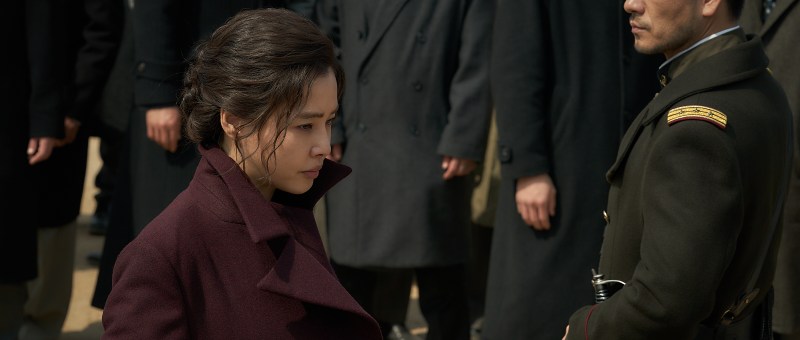
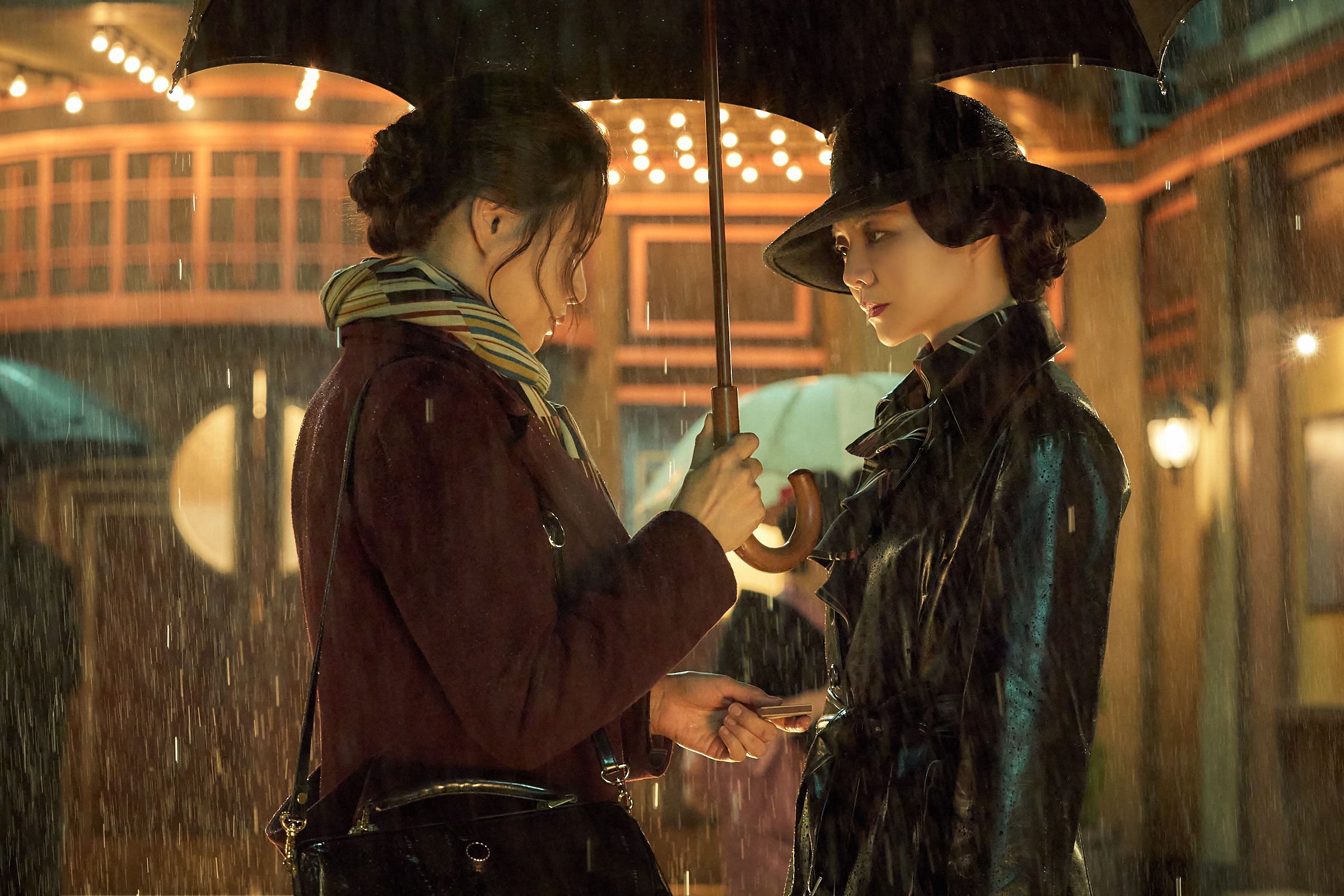
A trans woman begins to step into herself after reclaiming her traditional culture to make peace with the past in Byun Sung-bin’s poignant indie drama, Peafowl (공작새, Gongjaksae). At once situating itself in the heartland of a society struggling to adapt to the pace of change, the film suggests that only by reintegrating her Koreanness can the heroine become fully herself even as the spirit of the father who rejected her softly tells her to dance her dance.

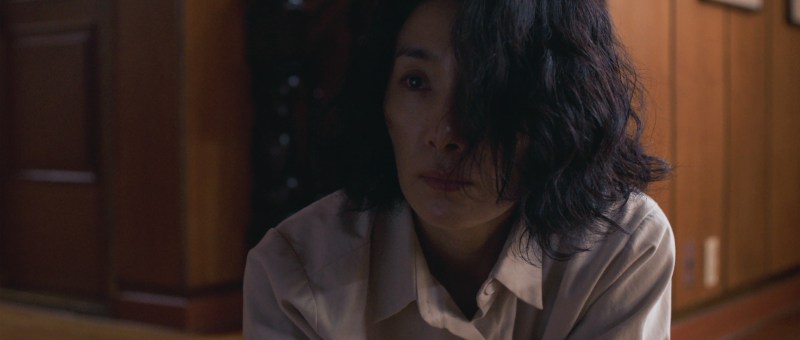
Myung (Choi Hae-jun), whose name as she later says means “not too light not too dark”, is a trans woman living in Seoul hoping to earn a large amount of money to pay for her surgery through winning a waacking dance competition. Shortly before she performs, she receives an unsettling telephone call and narrowly loses the dance off against a Taiwanese competitor while a judge explains that she lacks a colour of her own. It’s then that a childhood friend, Woo-gi (Kim Woo-kyum), contacts her to let her know that her estranged father Duk-gil (Ki Joo-bong) has passed away and asks her to come to the funeral. Myung first says she won’t go, but later does only to be berated by her overbearing, conservative uncle who ironically causes a scene by loudly exclaiming that a man shouldn’t be going around with long hair or wearing makeup. He even introduces her as Duk-gil’s son to an older relative who is otherwise much more sympathetic and even asks her with surprise why she’s wearing a male mourning outfit rather than the more appropriate one for women. 

It’s the uncle, a symbol of oppressive middle-aged patriarchal power, that is the real problem. Most other people are either broadly supportive or too polite to say anything of Myung’s changed appearance while her teenage nephew Bo-suk (Go Jae-hyun) simply accepts her and quickly refers to Myung as “sis” despite his mother’s obvious discomfort. It is however the uncle who is in charge, continuing to misgender and insult Myung especially once Woo-gi reveals that it was Duk-gil’s dying wish for Myung to lead the funerary rites at his 49th day memorial service. Myung doesn’t really want to participate but is tempted after Woo-gi suggests there’s a sizeable inheritance to be had if she agrees. 

It’s clear that Myung had good reason to resent her father, holding up her hand and revealing a large burn scar she’s since had tattooed with with a beautiful peacock feather. The feather motif is repeated throughout as a kind of symbol of Myung’s hidden beauty which she will eventually learn to reveal through the fusion of the traditional art of shamanistic ritual and her contemporary waacker dance moves, yet it’s also linked to the image of her father as a man she never understood and may never have really known whose relationship with her was shaped by the legacy of homophobic prejudice in ways she could never have imagined. The truth that she discovers reminds her that there have always been people like her even within this very “traditional” society, while the twin revelation that her cousin is gay and struggling in many of the same ways she has proves there always will be. As Woo-gi reminds her, her grandfather’s tree looks like it’s dead but is kept alive by its connections with others much like people are, pointing out that rituals accept everyone without prejudice or exception. 

Only after making peace with her conflicted aunt and showing her overbearing uncle the error of his ways can Myung begin to reclaim herself in reintegrating her traditional culture to gain the colour she was lacking and become fully herself as she performs the ritual along with a waacker dance that quite literally sets fire to the oppressive quality of tradition as mediated by men like her uncle who weaponise it to preserve their own privilege. Shot in classic 4:3, Byun neatly contrasts the vibrancy of Seoul nightlife with the oppressive dullness of life in the village, but also highlights the various similarities in the colour and noise of a shamanistic ceremony which as Myung discovers moves to a beat not dissimilar to waacker as she watches her friends dance in a club with the movements of traditional shamanism. In a way, Myung does indeed burn it all down but does so positively, finally coming to an understanding of her father and her history while reclaiming her traditional culture along with the right to do with it whatever she wishes.


Peafowl screened as part of BFI Flare 2023. It will also be screening at Genesis Cinema, London on April 20 as part of this year’s Queer East.

Trailer (English subtitles)

Please Make Me Look Pretty (니얼굴, Seo Dong-il, 2020)

“We all have different ways of looking at the world” according to a customer to Jung Eun-hye’s caricature stand at a local market explaining that she’s told all her friends to come and check her out because she wants them to see the world from Eun-hye’s perspective. A short time later, however, the same woman seems to attempt taking advantage of her in pleading for a little more change back than she’s actually owed because she’s handed over her bus fare home. The exchange in some sense characterises Eun-hye’s existence in her persistent battle to show others the world the way she sees it, responding to her customers’ pleas to make them look pretty that they are pretty already, while often experiencing discrimination on the grounds of her disability,

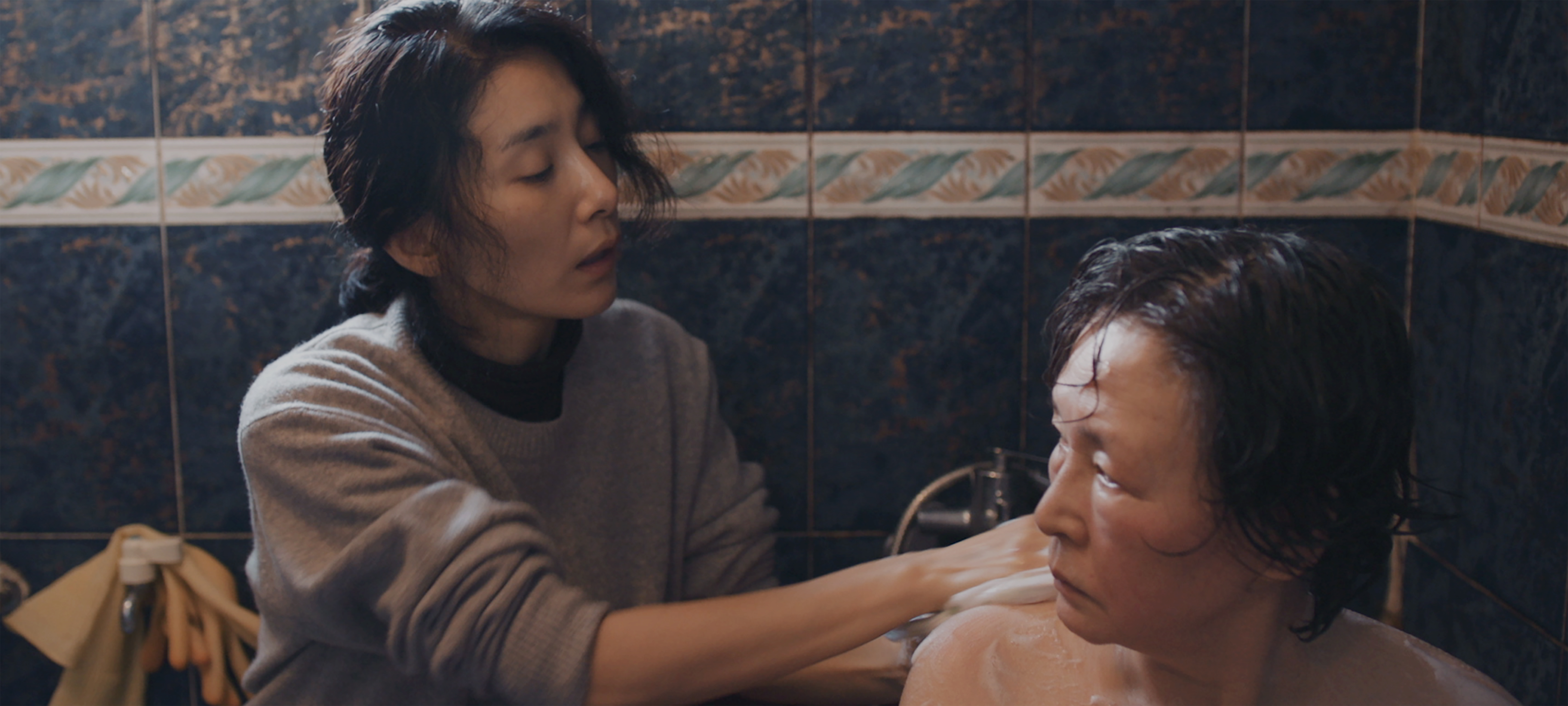
Directed by Eun-hye’s stepfather documentary filmmaker Seo Dong-il, Please Make Me Look Pretty (니얼굴, Nieolgul), follows Eun-hye over a period of three years as she develops a career as an illustrator that eventually leads to a solo exhibition and a residency at a centre promoting the work of disabled artists. Eun-hye was born with down syndrome and at 27 had been unable to secure a job, left at home all day with nothing to do but knit. Helping out at her mother’s art school she developed a desire to draw herself and adopted an unconventional style that is all her own. Her mother says that if she attempted to teach her conventional art theory, Eun-hye simply nodded and then went back to drawing instinctively. Originally with her mother’s help, she began drawing carictures at a local crafts markets and soon gained a steady stream of customers. 

Though in the beginning some may have complained and even asked for their money back, people came to love Eun-hye’s unique vision in which as she says she draws what she sees. She is clear that they are “caricatures” and not “portraits”, though looking at her compositional style they bare a strong resemblance to traditional portrait paintings from the feudal era with a comparatively large empty space at the top and the subject looking directly ahead. Her mother occasionally offers advice, telling her she should have started higher up on the paper, or that she’s made one of the people too big in comparison to the other but Eun-hye draws things the way she sees them and quickly becomes irritated with her mother hovering over her until she concedes to let Eun-hye draw in peace.

It is however quite tiring, especially in the heat of summer or in the freezing cold, and it occasionally seems like it might be too much for her but Eun-hye resolves to soldier on and eventually runs the stall all on her own even if struggling a little when it comes to figuring out the right change and dealing with confusing customers. In her spare time she writes song lyrics in a notebook that poignantly describe her loneliness and feelings of isolation as a disabled person often locked out of mainstream society, but clearly enjoys interacting with the other vendors at the market and participating in its community atmosphere. After saving money from her work, she is able to host a solo exhibition and is also invited to illustrate a book on business etiquette aimed at the disabled community as well as taking up a residency at a centre dedicated to promoting the work of disabled artists. 

What’s most evident is how happy drawing seems to make Eun-hye, giving her both an outlet and means of expressing herself while expressing her love for others in drawing caricatures which truly make their subjects feel seen as if Eun-hye has captured how pretty they are on the inside as well as out. Since the documentary was completed, she’s also gone on to become an actress playing an artist with down syndrome in the popular TV drama Our Blues and continuing to raise awareness of the lives of disabled people in a society which can often be hostile and unaccommodating. In any case, she continues to draw the world as she sees it, a place where everyone is pretty and deserving of love even if they don’t always see her the same way.


Please Make Me Look Pretty streams in the US until March 31st as part of Asian Pop-Up Cinema Season 16.

Original trailer (English subtitles)

Jiseok (지석, Kim Young-jo, 2022)

When Kim Jiseok, co-founder and head programmer of the Busan International Film Festival, passed away suddenly at Cannes in 2017 of a heart attack at the young age of 57, it sent shockwaves through the cinema industry. Kim had been a key figure in the promotion of Asian cinema which he founded the festival to showcase, but had also become mired in controversy following the decision to go ahead with a screening of a documentary about the Sewol Ferry disaster that the municipal authorities had tried to pressure the festival to cancel because it reflected badly on the government. 

Kim Young-jo’s documentary Jiseok (지석) makes no secret of suggesting that the stress of dealing with the government’s attempts to overrule the festival’s autonomy was a direct cause of his death. In a poignant clip from a 2012 interview included close the documentary’s conclusion, Jiseok is asked why BIFF has managed to survive when so many other festivals have not and answers that there has always been such a tight bond between its team members which has not so far been strained by conflict or controversy and he doubts that it ever will be. 

But this is in fact thought what happened as the organisers split into factions with differing views as to how the festival should proceed after it was targeted by the government, some feeling they should cancel all together and others wanting to go ahead. Jiseok felt himself pressed into a corner caught between opposing forces and torn between loyalty to his old friends and the desire to preserve the film festival. Industry friends also privately recall that he was personally very affected by the Sewol Ferry Disaster in which a large number of school children were killed when the ferry they were travelling on as part of a school trip capsized due to mismanagement and lax safety procedures. 

Still, Jiseok was regarded by some as a traitor for continuing to work with the festival and taking over the duties of Lee Yong-kwan who had made the decision to go ahead with the screening but was forced to resign under government pressure and later accused of embezzlement after a government audit carried out in retaliation. In subsequent years, many Korean industry figures decided to boycott the festival entirely while a question mark hung over its autonomy and artistic freedom. Most of the interviewees are able to acknowledge that Jiseok found himself in a difficult position and do not necessarily hold his decision to continue working at BIFF against him but do suggest that it was the fragmentation of these relationships, some of which went back over 30 years, that caused him additional strain and damaged his health. 

What’s most clear is that Jiseok was very well loved and is much missed not only by his wife who also appears in the documentary but by the international industry at large. Some of the biggest names in East Asian cinema such as Hirokazu Koreeda, whom Jiseok had asked to become the dean of the Asian Film Academy, and Apichatpong Weerasethakul appear on camera offering their memories of Jiseok while it’s clear that he also enjoyed warm and close relationships with filmmakers at both ends of their career. Malaysian director and actress Tan Chui Mui (Barbarian Invasion) makes a particularly poignant statement recalling the bubbling frog bath toy Jiseok had gifted her infant son who will now only know his “Korean Uncle” only from photographs and her stories of him. Other South Eastern filmmakers also pay tribute to his warm support of underrepresented national cinemas and encouragement of new cinematic voices.

Kim’s documentary may in some ways find itself caught between competing visions on the one hand keen to examine the fallout from the tightening censorship regime of the Park Geun-hye era which eventually led to the blacklisting of artists who were critical of the regime including internationally renowned names such as Park Chan-wook and Bong Joon-ho, while on the other offering a simple memorial of the man himself in an act of catharsis for those who knew him with the consequence that little else of him is revealed aside from his warmth, cheerfulness, and affability along with his passionate love of film. In any case, many of the interviewees appear close to tears as they attempt to bid Jiseok goodbye, testament to good he left behind not just in terms of cinema but as a human being.


Jiseok screened as part of this year’s Osaka Asian Film Festival.

Original trailer (English subtitles)

The Dream Songs (너와 나, Cho Hyun-chul, 2022)

Teenage friends wrestle with a sense of mortality, frustrated longing, and future anxiety in the etherial feature debut from actor Cho Hyun-chul, The Dream Songs (너와 나, Neo wa Na). Set shortly before the 2014 Sewol ferry disaster and shot in a washed out soft focus with a hazy nostalgic quality, the oneiric drama finds its conflicted heroine coming to an appreciation of the solipsistic qualities of obsessive love while preparing to cross the line between adolescence and adulthood in fearing she may not return from her upcoming trip or that the her that returns will not be same and the world will have moved on without her. 

The trip is only four days, but for Sam (Park Hye-su) it represents the end of her adolescence and the beginning of adulthood. As the film opens, she wakes up in her classroom after having a disturbing dream that something bad is going to happen to her best friend Ha-eun (Kim Si-eun) who is currently in the hospital though only for broken leg after being hit by pedal bike on a zebra crossing. So upset is she, that Sam manages to convince her teacher to let her leave early to verify that Ha-eun is OK with her own eyes and try to convince her to come on the school trip to Jeju with her, broken leg and all, so that whatever happens happens to them together. 

In the repeated dream imagery, it’s being left on her own that Sam seems to fear. She doesn’t want to be the only one who survives or the only one who dies and leaves her friend behind though as she confesses there was something that felt peaceful in her dream on looking at a corpse that might have been her own. The school trip to Jeju is one that many teenagers take in a quite literal rite of passage, but it’s also tinged with additional anxiety in the painful reminders of the 2014 Sewol Ferry disaster, directly referenced via a radio broadcast, in which many school children taking the trip from the area where the film takes place lost their lives. Sam’s impending sense of foreboding causes her to reevaluate her relationships and especially that with her best friend Ha-eun for whom she has developed romantic feelings she is unsure can be returned. Afraid to leave without saying anything but also worried she may be rejected and end up imploding the friendship too, Sam’s internalised conflict ironically blinds to her Ha-eun’s individual suffering in having recently lost her pet dog as well as her disappointment on missing out on the trip while recovering from her accident. 

Cho frequently lands on the image of clocks, often stopped, which hint at time running out while there are frequent allusions to death and drowning from the bird Sam finds on the ground by the school to the girls’ final parting seemingly taking place in front of a stranger’s funeral with mourners talking outside while people carry funeral wreaths directly past them. While the lines between dream and reality continue to blur, Sam sees images of herself in the two little girls playing together in the park and another with her grandmother who “saves” a toy dinosaur from drowning in an environment in which it is unable to survive. She and Ha-eun chase a lost dog and eventually end up on opposite sides of a fence which is the outcome Sam most feared, but are eventually reunited and able to have a more emotionally honest conversation now that Sam has come to an understanding of the self-involved qualities of her romantic obsession. 

Even so, for the first part of the film it isn’t entirely clear if Sam’s feelings are indeed romantic or if it’s more a case of intense teenage friendship that causes her to be jealous of others that might be spending time with Ha-eun while preoccupied with the identity of the mysterious “Humbaba” whom Ha-eun apparently wanted to kiss in a diary entry Sam was presumably not intended to read. Sam’s feelings are made clear in a letter she doesn’t have the courage to send while she seems to fear that time may slip away from her and Ha-eun won’t be there when she returns from her trip. Yet what she ends up awakening to is more like self love, or at least no longer fearing “Joy” will fly away from her when she’s not looking. Cho’s hazy, poetic coming-of-age drama excels in capturing the joyful quality of teenage female friendship and diffidence of first love if tinged with a note of melancholy nostalgia in the wake of a devastating loss.


The Dream Songs screened as part of BFI Flare 2023

Original trailer (English subtitles)

Broker (브로커, Hirokazu Koreeda, 2022)

Perhaps more than any other contemporary director in Japan, Hirokazu Koreeda has persistently interrogated the concept of the modern family asking what exactly the word has come to mean and how it is or should be defined. In Nobody Knows he showed us a case of parental neglect as abandoned siblings attempted to get by on their own in the absence of maternal care, while the separated brothers of I Wish struggle to define the nature of their relationships in the wake of their parents’ divorce. In Like Father, Like Son, Koreeda asks whether it’s blood relation that defines a family tie or whether it is forged more by mutual affection and shared memories, and in festival hit Shoplifters, he showed us a family who were not related by blood but had found in each other a home and a place to belong. 

Billed as a kind of companion piece, Broker (브로커) once again features a found family “brokered” by criminal activity but goes a step further, asking once again what the rights and responsibilities are when it comes parenthood and if the choice to abandon a child can ever be justified. Set in Korea where Christian morality has a greater influence, the film opens with a young woman leaving her infant child in front of a church yet abandoning him on the floor rather than placing him inside the “baby box” in the church’s wall. A policewoman staking out the church in the belief that someone is using the baby box to traffic children gently places the infant inside with what looks like maternal care but then we start to wonder, perhaps she only does so in order to see what happens when someone picks up him from the other side. 

Indeed, the policewoman will later concede that perhaps she herself was the one who most wanted the baby, Woo-Sung, to be sold so that she could catch the traffickers redhanded. We might feel a degree of revulsion towards the idea that a baby could be exchanged for money, but then perhaps we don’t stop to wonder who might buy and for what purpose. Sang-hyun (Song Kang-ho), a dry cleaner with gambling debts, and his partner Dong-soo (Gang Dong-won) who himself grew up in an orphanage, later recount selling a baby to two gay men who would otherwise be unable to adopt in the still conservative country suggesting in part that it’s a repressive society that forces people into this morally questionable underground trade in human children. It’s also societal conservatism that necessitates the existence of something like the baby box in that often very young women who bear children but cannot keep them either out of shame or simple economic impossibility have few other options than to abandon their child in the hope that someone will take it in. 

Detective Lee (Bae Doona) nevertheless brands these women as “irresponsible” and blames the baby box for tacitly encouraging their behaviour. An abandoned child himself, Dong-soo also struggles with his attitude towards the mother, So-young (Lee Ji-eun), who against all the odds does come back to reclaim her son after changing her mind. He and Sang-hyun justify their actions that they’re “saving” Woo-sung from being placed into the care system by finding him a loving home with parents who can give him a comfortable life. After taking to the road, the trio arrive at the orphanage where Dong-soo was raised which is less a home for him than a painful reminder of all he’ll never have and will never achieve as someone without a clear idea of a place to belong.

The man running the orphanage even concedes he’s not doing so well after the losing the subsidies for a few of the kids who have left, though few people adopt kids over six and the law makes it more difficult at eight which is a particular problem for football enthusiast Hae-jin (Im Seung-soo) who ends up climbing into Sang-hyun’s van and demanding they take him in. “Blood is thicker than water” the man sighs, explaining that kids are often sent back when it doesn’t work out or even end up suffering abuse despite the supposedly rigorous processes for vetting potential parents which causes some to simply buy a child on the black market instead. 

Despite the image of Dong-soo and Sang-hyun as heartless child traffickers they nevertheless take good care of Woo-sung and are up to a point careful that they should give him to someone responsible, mindful of those who might want a baby for untoward purposes or are intent on selling him on. A visual motif of tangling threads from the cotton on Sang-hyun’s sewing machine to the rope that pulls the busted back door of the van closed hints at the various ways these five dispossessed people are slowly bound together, becoming an accidental family forged through a process of mutual understanding in which Dong-soo is able to re-evaluate his feelings towards his mother through bonding with So-young and realising that in abandoning her child she may only have been trying to protect him and give him the better life that she never had. 

So-young tells Dong-soo that she sometimes has a dream in which the rain washes away her life until now, but on waking she realises it’s raining and nothing’s changed. He tells her perhaps all she needs is an umbrella that’s big enough for two, a metaphor for the protective quality of family he could perhaps have given her. Even she later concedes that had she met them earlier, none of this would have been necessary while Detective Lee’s more sympathetic partner (Baek Hyun-jin) likewise asks why they couldn’t have intervened earlier and done something to help this struggling young woman whose only problem was her aloneness before it came to this. What emerges is an unexpected compassion and the extension of an umbrella from an unexpected source in the acknowledgement that nothing’s ever quite as simple as it might seem. Koreeda leaves us with an outcome that is possibly as happy as it could be in an imperfect world, which might in itself be a little unrealistic but nevertheless in its own way hopeful in having reclaimed a notion of “family” brokered by selflessness and mutual compassion if not quite love for the orphans of an indifferent society.


Broker opens in UK & Irish cinemas on February 24th. For more information head to http://broker.film/

UK release trailer (English subtitles)

Project Wolf Hunting (늑대사냥, Kim Hong-sun, 2022)

“Remember, there’s nowhere to run” an arrogant police officer explains to collection of rapists and murderers locked aboard a cargo ship ready to be delivered to “justice” in Korea having attempted to flee to the Philippines. It is in someways ironic that these men and women, depraved as many of them may be, have been loaded onto a commercial vessel to be shipped home less like cattle than faceless and inanimate objects. Kim Hong-sun’s eerie gore fest Project Wolf Hunting (늑대사냥, Neukdaesanyang) is in many ways about the horrors of the past but also suggests that the present is little better in a world in which there is little difference between cop and thug and we are all at the mercy of looming violence. 

As one older prisoner puts it, “if this isn’t hell, I don’t know what is”. Thanks to an international extradition arrangement some of the worst Korean criminals are about to be repatriated from the Philippines only the historic event is disrupted by a suicide bombing carried out by a disgruntled victim whose smashed glasses and severed limbs are an eerie harbinger of what’s to come. After a rethink, the government decides to hire a cargo boat instead so the public won’t have access to the criminals, which is somewhat ironic, while accompanied by a crack team of veteran cops each with over 10 years of experience on the force. Already it isn’t seeming like a very well thought through plan, but as Captain Lee (Park Ho-San), who openly beats a prisoner with whom he has prior history on the dock, points out, there aren’t any cameras so he has full authority to enforce the law with no concern for the rights of inmates nor basic human morality. To cut it short, he’s little different than they are even if he isn’t, as far as we know, a multiple murderer or rapist. 

In any case, keeping a bunch of violent criminals handcuffed with only one bathroom break a day and no stimulation seems like a recipe for disaster even if it weren’t just plain inhumane. But inevitably the operation is compromised by an attempt to spring a gang boss which lets the criminals take control of the ship albeit temporarily seeing as there’s something else lurking in the bowels of this floating hellscape that is pure nightmare fuel and a not quite living embodiment of man’s inhumanity to man. Predictably, this all stems back to the abuses of the colonial era and the machinations of the equivalent of Unit 731 operating in the Philippines but has since seemingly been co-opted by a shady Korean organisation apparently also attracted to the research’s capitalistic potential in the booming anti-ageing market hoping to usher in the next stage of human evolution. 

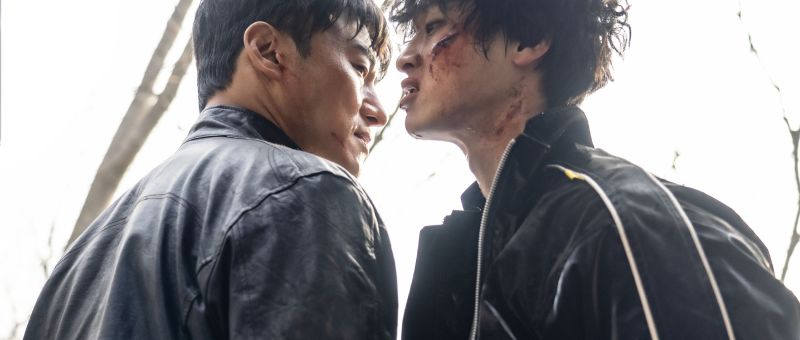
What ensues is a parade of senseless violence in which cop and killer alike are stalked by a mysterious “monster” with wolf-like senses and preternatural strength, and that’s on top of the bloody destruction wrought by the vengeful criminals in their unsuccessful attempt to escape. As Lee had said, there really is nowhere to run though as it turns out that cuts both ways. The gang boss proves unexpectedly heroic, genuinely trying to save the moll who’d been arrested alongside him, while law enforcement reveals itself hopelessly out of depth even as Lee and his female subordinate Da-yeon (Jung So-min) pivot towards protecting the prisoners they were previously intent on oppressing as they form a temporary alliance to defend themselves against the mysterious threat, ironically a product of the “kemono” (beast) project and a reminder of what happens when you decide that some people aren’t really “human” after all. 

Even so, the rampage is indiscriminate. The “monster” doesn’t care if you’re a cop or a killer, all it knows is violence smashing in the heads of the toughest gangsters and ripping hearts out of well-built bodies without a second thought. It’s got no eyes but knows how to use a gun and it still might not be the scariest thing on the boat, at least not in the end as we wonder what exactly all this is for and what might be meant by the next evolution of our species. This is indeed hell and there’s no where to run either from the unresolved past or the malignant future. 


Project Wolf Hunting is released in the US on Digital, Blu-ray, and DVD on Feb. 14 courtesy of Well Go USA.

International trailer (English subtitles)
Hostage: Missing Celebrity (인질, Pil Gam-seong, 2021)

“This is real, birdbrain”. If you’re a famous actor, it might take a while to dawn on you that you’re in real trouble rather than the subject of an admittedly dark candid camera skit or variety show stunt. Real life and the movies begin to blur for top Korean actor Hwang Jung-min playing a fictionalised version of himself when he’s kidnapped by a gang of ruthless petty criminals in Pil Gam-seong’s meta take on Chinese thriller Saving Mr Wu, Hostage: Missing Celebrity (인질, Injil). 

Indeed the film opens with a montage of Hwang’s career to date including a degree of self-deprecation in which he describes himself as “just a petty actor” reminding the journalist interviewing him that film is a collaborative medium of which he is only a part. This version of himself that we see is modest and wholesome, going home early after an afterparty while his wife and son are away planning to relax alone. He seems to live a very lowkey life living in a fairly ordinary suburban house without domestic help or other signs of obvious wealth aside perhaps from an expensive car. Hwang is also on fairly friendly terms with the clerk at the local convenience store which he evidently visits frequently just like any other ordinary person rather than sending an underling to fetch him things or walking around with a massive entourage to remind people that he’s a movie star. Even while trying to escape his kidnappers he takes his shoes off before entering an old man’s home to use his landline telephone. 

Yet one can’t escape the fact that he is fantastically rich and perhaps out of touch with “real” life, his kidnappers targeting him mainly on a whim born of chance coincidence but also in resentment for everything he represents. The leader of the gang, Choi Ki-wan (Kim Jae-beom), is a crazed psychopath whose primary motivations are most likely sadistic rather than purely financial even if his targets are those with fancy cars but those of his underlings are perhaps more prosaic. When one of the gang members is captured, it emerges that he had massive debts to a casino loanshark while the most sympathetic of the kidnappers appears to have learning difficulties and later explains that he’s only doing this to pay for medical treatment to remove a prominent facial birthmark and scarring so he could live a more normal life. Because of his naivety he remains strangely loyal to Ki-wan believing that he’s looking after him while refusing any responsibility for his crimes. The gang’s only female member (Lee Ho-jung), by contrast, seems to be a North Korean refugee in a romantic relationship with Ki-wan’s less psychotic but no less cruel partner Dong-hoon (Ryu Kyung-soo) who just wants the money. 

Having literally played through scenarios just like these in his films, Hwang Jung-min the actor has perhaps gained a degree of experience that allows him to process his situation with a surprising degree of rationality quickly realising that as the kidnappers have made no attempt to hide their identities they most likely plan to kill him, and a young woman, So-yeon (Lee Yoo-mi), abducted alongside a wealthy cafe owner they killed when he couldn’t come up with the cash fast enough, after they’ve got the ransom payments. It isn’t that Hwang’s stingy, it’s that he knows there’s no point giving them the money but his only chance for survival lies in making them think he might. Even so, he gets to literally play the hero engaging in a battle of wits with the kidnappers before attempting to make a dashing escape while the on the outside the a dogged policewoman and her partner do their best to track them down despite the unhelpful interventions of their more conservative boss. 

Ki-wan might well have a point in admitting he’s overreached by going for such a high profile target. The police probably wouldn’t be investigating so heavily if the victim weren’t a famous movie star whose face is splashed across the papers. After all, they hadn’t done much for So-yeon whose sister had had to go to social media to raise awareness about her kidnapping fearing the police weren’t doing enough to help. Bearing out the underlying economic anxiety, So-yeon had only got the cafe job a few days previously after 37 failed interviews. Hwang’s response that he failed a hundred auditions before getting a break, people laughing at his acting dreams because he was a guy with curly hair and red skin who spoke with a strong southern accent, is intended to be reassuring in implying that even if it takes time you get there in the end but is also a little insensitive in the circumstances in downplaying So-yeon’s struggles in the contemporary economy having gone from elation in finally finding employment to being locked in a shed by a gang of psychos because of her boss’ personal greed which seems like quite the metaphor for the inequalities of the modern society. In any case, Pil crafts an intense kidnap thriller given an additional layer of absurdity in its meta dimensions but ends on a note of poignancy which suggests that Hwang himself is also and perhaps always will be hostage to his own image. 


Hostage: Missing Celebrity screened as part of this year’s Udine Far East Film Festival.

International trailer (English subtitles)

Rainbow Trout (송어, Park Chong-won, 1999)

The hypocrisies of contemporary civility pass under the microscope in Park Chong-won’s creepingly intense drama, Rainbow Trout (송어, Song-o). As a collection of urbanites pile into a car and journey far into the mountains to rescue an old friend who’s dropped out and returned to the land as a fish farmer, they find themselves stepping into a world entirely contrary to their understanding but eventually expose themselves as petty, jealous, resentful and shockingly violent even in their disdain towards the “backwards” woodsmen they feel are harassing them.

The film both begins and ends with a tollbooth as the car carrying the urbanites first leaves and then returns to the “safety” of Seoul. Ominous signs pepper their journey, one of the men wondering if the pits on a mirror at a dangerous curve are bullet holes while his friend insists they’re more like pockmarks from small rocks swept up in a storm. Swept up in a storm might be one way to describe what later happens to the city dwellers, but it’s fair enough to say that they are fairly puffed up on the superiority of their urban civility over the earthy lives of the rural hunters. None of them can understand why their friend has made the choice to leave Seoul behind and live a primitive existence in a cabin in the woods. 

Chang (Hwang In-sung) even remarks that his fish sometimes commit suicide, Min (Yu In-chon) suggesting that being cooped up in a small space makes them feel anxious. The urbanites are not in a small space, they’re in the wide open countryside, but to them it is claustrophobic in its unfamiliarity. Though the trip starts off well enough as they reminisce with Chang and enjoy a night round the camp fire, the two men, bank clerk Min and his bbq restaurant owner friend Byung (Kim Se-dong), soon fall foul of a local hunter who doesn’t like where they’ve parked their car or possibly that they’ve parked it at all. Byung is forever performing his masculinity, making a show of chopping wood and lifting weights outside the cabin, but like Min otherwise unable to challenge the hunters and entering a mini vendetta of pettiness with them that is destined to end badly. Min meanwhile is preoccupied in knowing that his wife, Jun-hwa (Kang Soo-yeon), is still in love with Chang while Chang’s decision to leave the city seems in part to have been provoked by their marriage. Byung’s wife, on the other hand, ironically submits to her carnal desires after being caught stealing a rabbit from a trap by a lecherous hunter who later shows up with a gift of yet more meat which seems somehow like even more of a betrayal given that her husband runs a barbecue meat restaurant but is obviously not quite red-blooded enough for her. 

It’s the presence of Jun-hwa’s younger sister Se-hwa (Lee Eun-ju), however, that provokes further tensions in the group not least as she develops a fondness for Chang while local dog breeder Tae-joo (Kim In-kwon) develops a fascination for her. Tae-joo peeps on Se-hwa in the outhouse and creepily lurks around the cabin though he is perhaps just awkward if a little strange more than actively dangerous. Nevertheless he becomes the target for the husbands’ frustrated masculinity as they decide to exorcise some of their frustration on a mountain boy who is ill-equipped to resist them, unleashing uncivilised violence and barbarity that would bring them to the point of homicide. They assume Chang is like them, that he will side with the city, but Chang is now a mountain man and has shades of barbarity the husbands’ little suspect. As the crisis intensifies, the urbanites shift the blame and turn on each other, uncomfortably blaming Se-hwa as if it were her fault that the boy took a liking to her or that the men took it in the direction that they did. Se-hwa also finds herself a victim of male violence from an unexpected source but is again blamed for it less for her naivety than the simple fact of her existence as a young woman in this incredibly primal environment. 

The urbanites thought the hunters to be savage, but in reality were savage themselves only to convince themselves that they had done nothing wrong pleading with Chang to cover up their violence because Tae-joo is only a mountain boy while they are civilised people from the cities who could not have acted in anything other than a civilised way. They are in a sense like the rainbow trout, raised within a narrow frame and little understanding how to live outside of it, driven out of their minds by the removal of the guardrails of civility. On returning to the city they may convince themselves that the dark shadows within have disappeared but the fragility of their sophistication has already been exposed rendering them at least less honest than the huntsmen who made no pretence of their carnality. 


Rainbow Trout screened as part of this year’s London Korean Film Festival.

The Road to the Racetrack (경마장 가는 길, Jang Sun-woo, 1991)

A pompous scholar returning home after five years living abroad in France struggles to adapt himself to a changed Korea in Jang Sun-woo’s literary drama, Road to the Racetrack (경마장 가는 길, Gyeongmajang Ganeun Kil). Hoping to rekindle an affair with a fellow student with whom he lived for three and a half years, the man known only as R (Moon Sung-Keun) finds himself frustrated by the same patriarchal norms which he manipulates in an attempt to dominate and control his former lover while little realising that it is she who truly has the upper hand as he pathetically follows and entreats while begging her to sleep with him. 

J (강수연), as the woman is known, shows little desire to pick up where they left off and roundly refuses to sleep with R who can speak of little else. She tells him that things are different in Korea and hints that the cause of her reluctance is that R is still married and in fact has two children. While J had (seemingly) been content to live with R as his “wife” in France, in Korea she feels a need to be married herself and obviously cannot marry R as his wife will not divorce him. Old-fashioned in her thinking, R’s wife (Kim Bo-yeon) assumes the cause of the discord in their marriage is that she was not a virgin when they married though it seems clear that since obtaining his PhD in France, R has begun to look down on his humble family and no longer wishes to associate with his uneducated spouse. An ironic soap opera scene precedes one of their conversations in which a husband cooly tells his wife that he will do as he pleases and has no intention of granting her a divorce fully highlighting R’s hypocrisy though his own wife is depicted more or less like the one on screen eventually screaming at him and refusing his demands to end their marriage. 

Though R had told his wife that the fact she had lovers before they married is not a factor in his desire for a legal separation, discovering that J has met someone else and is thinking of marrying him sends R into a tailspin of jealously. Badgering J into sex, he is ultimately unable to perform and complains that the “shadow” of the other man is putting him off his stride. He demands that she makes a choice and encourages her to tell her new man all about their time in France whereupon he might like R abruptly dump her for being an impure woman. Meanwhile, R complains that she’s treating him “like a rapist”, which is ironic because that is exactly how he is behaving. She cries and refuses, asking him if they “really have to” and still he pushes on violently pulling at her clothes until she gives in. He can’t seem to understand why it’s “different in Korea” when they lived together for three years in France, as if a single instance of consent has eternal permanence. 

J always returns to him if for unclear reasons in the increasing toxicity of their relationship. She addresses him as “doctor”, while he repeatedly insults her and calls her stupid, mocks her middle-class background in an attempt to deflect the class difference between them, implies she’s useless without him and that all her achievements are really his own. He claims to have written her PhD thesis for her, and is irritated that she’s had some success since returning to Korea having completed her studies a year before him. He reads an essay she’s written and while he may have a point about an ambiguous turn of phrase, further insults her by claiming that the only good bits are the bits she ripped from an old essay of his, but is clearly annoyed that she’s managed to get an essay published after showing it to another man who further edited it for her. Suddenly he explodes in rage and claims he feels exploited, insisting that J pay him monetary compensation for his emotional pain. 

The relationship only begins to work again once it becomes transactional perhaps hinting at a societal change in an increasingly capitalistic society. As J is unable to pay the sum he asked for, R insists she work off the amount by becoming his personal prostitute. Though effectively constrained by his wife’s refusal to divorce him, he thinks that he controls J and is reasserting his patriarchal authority. But then he is clearly the one in thrall to J following her around and refusing to let her go while her decision to continue meeting with him seems like it may partly be born of fear and a sense of inadequacy if also a delight in wielding her power. His contribution to J’s PhD leaves her feeling underconfident and a fraud, fearing he’s right and she’s not much of a scholar just a girl with rich parents who could send her France to study. But she’s also tied to him in service to outdated patriarchal social codes that were not in play in France in which he is both husband and not. When he strikes her, she immediately apologises.

The contrast between the two cultures is clear on R’s arrival as he wonders at the thousands of neon crosses that now colour the nighttime skyline of Seoul, remarking that’s as if he’d found himself in a European war cemetery. Both he and J seem to be adrift in a new society, aimless and with no particular place to go. Hoping to rekindle their love, R tries to force J to go abroad again but she refuses and declines to give an explanation. Incredibly frank in its sexual language, the file presents an otherwise bleak view of the toxic relationship between the former lovers who inhabit a series of seedy motels and are seemingly unable to escape the destructive cycle of their love while the pompous hero can only comment on his inability to orient himself in a changing city by recording the number of steps from each direction to the racetrack as if trying to reassure himself of the geographical integrity of the landscape of his memory.


The Road to the Racetrack screened as part of this year’s London Korean Film Festival.

The Surrogate Woman (씨받이, Im Kwon-taek, 1986)

“They seem to live for honouring the dead” the bemused heroine of Im Kwon-taek’s Surrogate Woman (씨받이, Ssibaji) explains to her visiting mother of the noble society she has been unwittingly plunged into but still struggles to understand. A condemnation both of a society which continues to value sons over daughters and of the absurdity of ancestral rites along with the hierarchies of the feudal order, Kwon’s impassioned historical drama speaks directly to the contemporary era in which in many ways nothing has changed.

In any case, Ok-nyeo (Kang Soo-yeon) is fated to become a surrogate woman. As the woman who seems to be in charge in a small community ensconced in a valley which from a certain vantage point seems to resemble female genitalia explains, surrogate mothers who bear daughters are expected to raise them themselves but the children are considered undesirable for marriage and generally end up becoming surrogate mothers themselves. Ok-nyeo’s mother had not wanted such a fate for her daughter, but is in the end powerless to prevent it especially given the allure of the generous payment promised on the birth of a male child. Ok-nyeo thinks she can endure anything for the promise of a comfortable life afterwards but is simply too young and naive to understand the emotional consequences of her decision, that her child will be removed from her seconds after birth and handed to another woman to raise. 

The situation is not much better for the wife who is made to feel as if she has failed in not having conceived a child during her 12 years of marriage. Both she and the grandmother who is so insistent on ensuring the existence of a male heir now that her husband has died and their only son is childless, express anxiety about Ok-nyeo’s youth, as did the women in the village, fearing that at 17 she is not yet physically or emotionally mature enough to bear a healthy child. The man they sent to select her seems to have done so out of personal preference, explaining that of all the women he picked a virgin though this raises several practical issues given the nature of surrogacy. Even so there is something quite perverse in the fact that it is the grandmother, the wife of a noble family of Confucianist scholars, who is actively participating in this system that renders women little more than wandering wombs now that she has the only real power that she will ever experience in her life as a widow turned head of household. 

On the other hand, it’s clear that this isn’t an ideal arrangement for the man either. The husband, Sang-kyu, is reluctant. He thinks it’s morally wrong and against his Confucianist philosophy while he is also attached to his wife and has no desire to sleep with other women. Nevertheless, he becomes attached to Ok-nyeo to a degree that is regarded as inappropriate by his family members and advisors, sneaking out to sleep with her for reasons other than conceiving an heir. When Ok-nyeo becomes pregnant they send him away to a temple in an attempt to sever their emotional connection, though he immediately sleeps with her again on his return despite the fact that she is already pregnant. For this transgression, Ok-nyeo’s mother is beaten while Ok-nyeo herself had earlier been punished for seducing him though she is completely confined to a single room for the entirety of her stay at the house lest anyone find out the embarrassing secret that the family have hired a surrogate. 

While Ok-nyeo and Sang-kyu make love in the bushes, drunken men from the party he’d been attending have a dull conversation about the nature of ancestral rites which is in its own way transgressive as they ask themselves where these ancestral spirits actually are, trying to make sense of what the rituals are for and what they mean but emerging with only confusion for they are largely meaningless. They praise women for rescuing the ancestral tablets at the expense of their children and constantly incur vast expense sacrificing food for those who can no longer eat. As someone remarks, the dead dislike their world and long to stay in ours but the living hardly live at all and spend all their time in service of those who are no longer here. All of it, this vast system that traps women like Ok-nyeo along with men like Sang-kyu the Confucian scholar, stems from this desire to placate departed souls at the expense of those still breathing. 

Yet Ok-nyeo is almost like a ghost herself, an invisible presence locked up in a backroom concealed as a dirty secret. Her mother reminds her that Sang-kyu is an aristocrat and she is not, they do not really regard her as human and what she is is stabled like a horse brought for mating to be taken home once the foal is born. They snuck her in by night and will insist that she leaves in darkness mere hours after her son’s birth. Meanwhile, she will be tortured by her captors who burn her stomach and force her to drink strange potions in the name of having a son. Sang-kyu too is forced to drink deer blood to improve his manliness while Ok-nyeo is advised to stare at the moon to the point of dizziness. She perhaps falls for Sang-kyu because he is her only real human contact though it appears they never actually speak to each other, while he discovers a kind of liberation in the permission to dispense with the sublimation of his sexual desire normally demanded by his Confucianist teachings. 

But few of them acknowledge the cruelty with which Ok-nyeo and the surrogate women are treated, the pain and despair her mother had tried to warn her of. Ok-nyeo had said anything was worth the price of 10 fields, but soon cries out that she’d give them all up for her son unable to accept that the boy will never be hers for to be a surrogate woman is to be denied one’s own existence. Caught in the night, she can only stare back through the fog as the carriage departs forever separating her from her child and the man she had unwisely come to love. As the closing titles explain, returning to the funereal scenes with which the film had opened, Ok-nyeo has become a victim of a society that prizes sons over daughters as have so many women like her even centuries later in which enlightenment has brought little freedom for those oppressed by class and patriarchy.


The Surrogate Woman screened as part of this year’s London Korean Film Festival.

Trailer (no subtitles)