The Eagle and the Hawk (鷲と鷹, Umetsugu Inoue, 1957)

Strapping sailors meditate on revenge and forgiveness while trapped aboard a moribund cargo ship in Umetsugu Inoue’s otherwise charming musical youth drama, The Eagle and the Hawk (鷲と鷹, Washi to Taka). One of several films Inoue released starring muse of the moment Ishihara, the film uses the boat as a kind of metaphor for a reluctance to deal with the unfinished past as several of its crew members are actively engaged in a self-imposed limbo wilfully remaining in a transient space floating between two harbours with no plans to disembark. 

This is most obviously true for the zombified Ken (Kinshiro Matsumoto) who wanders around the boat in a depressive daze unable to get over a girlfriend who left him for another man though as it turns out the bosun too is hiding out at sea waiting for the statue of limitations to run out on the murder of his lover 30 years previously. When two new recruits show up from the sailors union despite only one having been requested, many are under the assumption that they too are running from something on land though the boat itself is a confined environment from which there is no real escape so it’s also an ideal space for confrontation. 

The thing they may be running from is the murder of the boat’s chief engineer in the film’s noirish opening sequence in which a middle-aged man in a sailor’s cap is stalked by a youngster in jeans before being knifed with a ceremonial dagger. If they were running from that particular crime, it might be ironic that they chose this particular boat but then as the murdered man’s son, First Mate Goro (Hiroyuki Nagato), discovers the dagger was part of a set and the other one’s owned by the captain who seems very alarmed by the whole affair. Meanwhile, the captain’s daughter, Akiko (Ruriko Asaoka), has secretly stowed away along with Akemi (Yumeji Tsukioka), the heartbroken former girlfriend of one of the two new guys, Senkichi (Yujiro Ishihara). 

Women are regarded as unlucky on board, and it’s not difficult to guess why with Goro offering strict instructions to the new guys not to try anything with Akiko while one of the other sailors later attempts to rape Akemi with a palpable desperation existing within the crew. There is also a degree of homoerotic tension between the two new guys, the other being Sasaki (Rentaro Mikuni) who typically walks around shirtless in a pair of tight jeans and works hard to give the impression of having a mysterious past all of which leads Senkichi to suspect he’s an undercover cop possibly there after him or one of the other crew members though unbeknownst to (almost) everyone there is another crime in motion on board. 

As usual, it’s the past that’s come calling with Senkichi on the boat ironically running towards rather than away from a confrontation while others desperately try to cover up their crimes or deflect their responsibility for the dodgy dealings of their youth. Both Senkichi and Sasaki immediately remark that the boat’s a “junker” as soon as they get on board, implying that it too is on its way out, its disrepair a sign of its captain’s lack of respect and care for ship and crew alike. Then again, it seems the crew were intent on drinking half the cargo, most of them clearly happy in their work and enjoying a pleasant sense of camaraderie even on this crummy ship and its presumably not quite above board trip to Hong Kong which might hint at why Akemi shows up in cheongsam though for stowaways both women seem to have brought extensive wardrobes which in all honesty are not particularly well suited to life at sea. 

In any case, the boat becomes an unexpected place of healing and forgiveness largely brokered by manly magnanimity as Goro, on learning the truth behind his father’s murder, accepts that the killer’s motivations are “understandable” even while cautioning them against the fallacy of revenge which he insists will only create more hate and violence. He’s also fairly okay with Senkichi romancing his girl, Akiko, who sadly tells him she sees him more like a brother and isn’t interested in marrying him even if that’s what her father also expects neatly reflecting the dynamic which arises between Akemi and the lovelorn Ken who begins to cheer up and consider leaving the boat to open a transistor radio shop only for Akemi to describe him as a little brother while continuing to chase Senkichi despite his interest in Akiko. An expressionistic storm scene provides some divine justice, but also provokes a bittersweet romantic resolution which suggests it’s time to get off the boat and the face the past but with a kind of cheerfulness for the future otherwise at odds with the rage and violence of the original crime. Of course, this being a vehicle for Yujiro Ishihara, Inoue works in a few romantic scenes with his ukulele and a mournful song about the moon and ocean but finally sends him back to dry land a little more “grounded” for having found his sea legs.

Crossroad (死の十字路, Umetsugu Inoue, 1956)

An adulterous industrialist finds himself in a sticky situation after accidentally killing his wife in Umetsugu Inoue’s bizarre noir Crossroad (死の十字路, Shi no Jujiro). Based on a story by Edogawa Rampo, the film like any good noir suggests that in the end you can’t outrun your fate and all transgressions must be paid for but also turns on cosmic irony and strange coincidence in the great “tapestry” of life in which everything really is connected.

Shogo Ise (an aged-up Rentaro Mikuni) is the director of a construction firm about to complete a hugely expensive dam project which requires the sinking of a village and quarry. Apparently unhappily married to a woman obsessed with Nichiren Buddhism believing it helped to cure her of a serious illness during the war, he more or less lives with his secretary/mistress Harumi (Michiyo Aratama) who has been receiving incredibly weird and definitely threatening letters from Shogo’s wife Tomoko (Hisano Yamaoka). Tomoko claims that she has received an order from the “Child of the Sun” insisting that she must exact vengeance for the “great sin” Harumi has committed. The letter seems to be the last straw for Shogo who has decided to leave his wife, despite her incredible wealth, and set up home with Harumi permanently. 

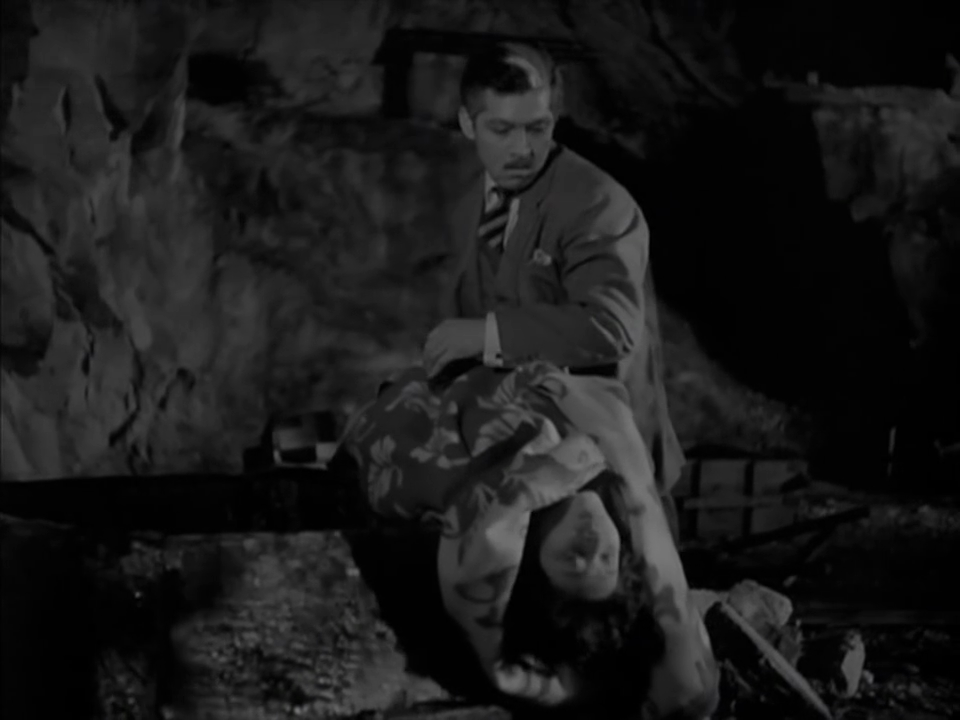
Shogo hadn’t taken the threat very seriously, but sure enough Tomoko later shows up with some kind of ceremonial dagger and barges in to attack Harumi in the bath. During the struggle, Shogo accidentally kills Tomoko while trying to wrestle the knife from her. After briefly considering turning himself in, he realises that doing so will involve them all in scandal so he decides the best thing to do is dump her body in a well at the quarry which is shortly to be sunk. However, the plan soon goes awry and not least because a random man with a head injury climes into his car after he has a fender bender on a set of crossroads and later dies there leaving Shogo no choice but dump him alongside Tomoko. 

Inoue casts the abandoned quarry in truly eerie light, filled with gothic winds as if Shogo were being chastised by the gods themselves. In a sense, he’s paying not only for his sexual transgression but for the breaking of a taboo. A homeless man who once lived in the village later relates that he stayed until the last day because he did not want to leave his ancestors’ land. Shogo is part of the post-war construction boom but there’s also an underlying implication that this industrialisation is harmful to the land itself, not least in constraining a natural flow with the imposition of a dam in addition to causing a displacement of the people who once lived in the village while literally drowning the ancestral spirits. 

Harumi too speaks of feeling as if they’re both sinking beneath the waves, chasing a happiness to which they have no entitlement though she herself seems completely blameless save for her involvement in an extra-marital affair and strangely wholesome in comparison to the film’s otherwise sordid atmosphere. Even for a noir, Inoue’s sensibility is surprisingly sleazy for the world of 1956 and more than a little suggestive. A detective that randomly shows up, Minami (Shiro Osaka), lives with his foxy assistant and the interaction between them is constantly sexually charged while Inoue frequently returns to the backstreets of a neon city and the bars that line the streets approaching the crossroads where Shogo’s fate will align. 

It could be inferred that Shogo is a man whose life was marked by the war, his marriage perhaps in haste and then regretted while his wife developed her illness and subsequent obsession with Nichiren because of its corruption. Nevertheless, he’s portrayed as a basically “good” man in a very bad situation who made some very bad choices he wasn’t in the end bad enough to carry through properly hence the amazing series of collisions that seal his fate. On the one hand, like the young couple related to the drunk man who ended up in Shogo’s car, he and Harumi are just two otherwise ordinary people who decided to chase happiness albeit through an extra-marital affair only to pay a heavy price for daring to dream of a better future. Inoue has his usual amount of fun playing with noir archetypes as men strike matches in darkened alleyways and silhouettes of mysterious men in trench coats line the walls, not to mention the gothic sense of dread in the abandoned quarry, while constantly wrong footing us only to set us on our own collision course with the vagaries of post-war morality. 


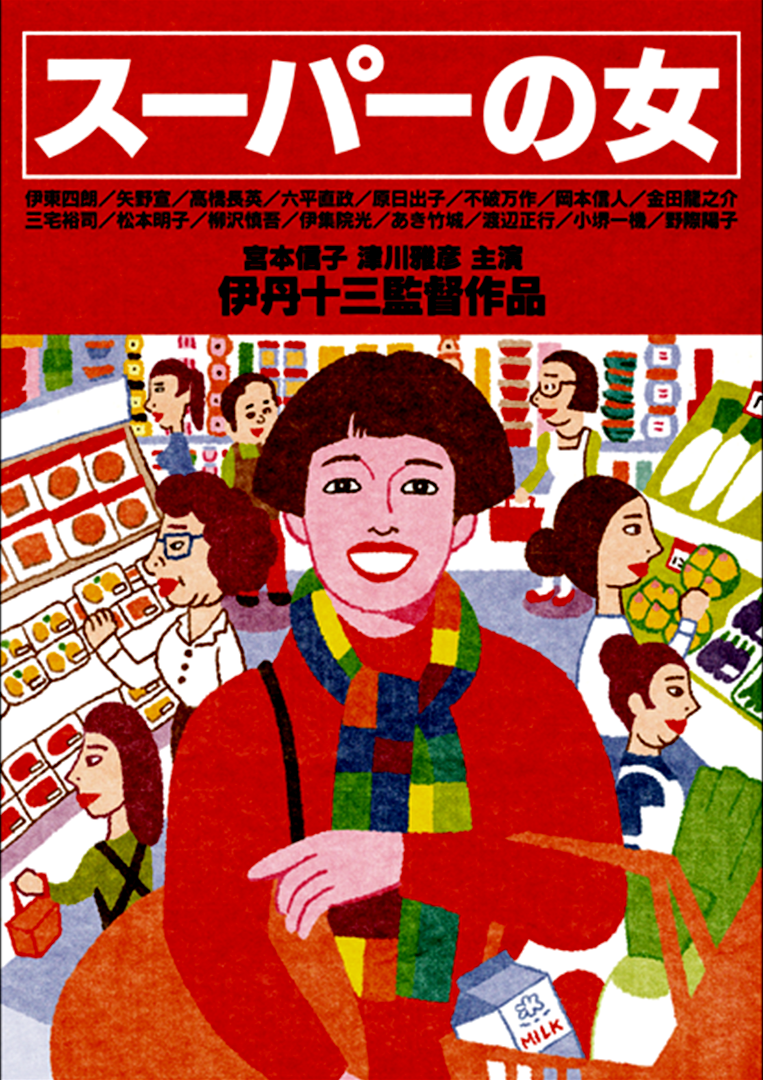
Supermarket Woman (スーパーの女, Juzo Itami, 1996)

By 1996 Japan had entered an extended period of economic stagnation which signalled the end of post-war aspiration but for many at least the false promises of the Bubble era proved hard to dispel. In what would be his penultimate film, Supermarket Woman (スーパーの女, Supa no Onna), Juzo Itami turns his attentions to the insular world of the nation’s family-held, independent supermarkets to ask a few questions about integrity in business which cut straight to the heart of what kind of society post-Bubble Japan intended to be given yet another opportunity to make itself anew. 

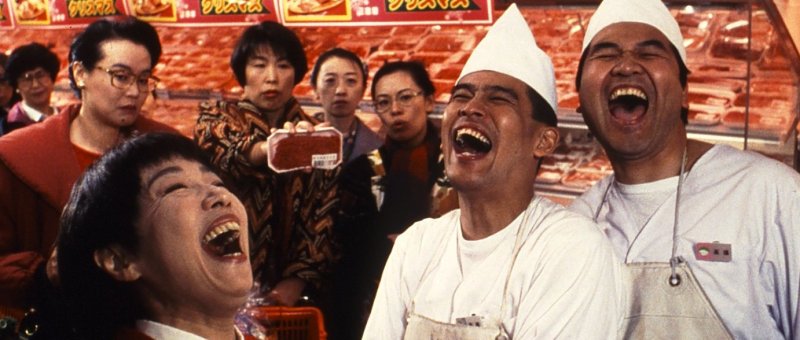
As the opening text crawl explains, this is a story not about giant supermarket chains but your friendly indie local. “Honest Mart” is a family-owned, mid-range supermarket in a declining industrial area nominally run by absentee CEO Goro (Masahiko Tsugawa) who was bequeathed the place by his father but is a melancholy drunkard delegating responsibility to his manager. The store has a huge problem in that a rival has recently re-opened under the new name “Discount Demon” and seems primed to steal all their business. On a stakeout of the new place, Goro runs into a childhood friend, Hanako (Nobuko Miyamoto), who is now a widow returning to the area. With her lifelong experience as a veteran housewife, Hanako knows a few things about supermarkets and she’s not very impressed with Discount Demon, doing a few quick calculations to realise the supposed discounts aren’t as enticing as they seem while common gimmicks like the all pervasive red glow that makes their meat look fresher than it really is only irritate her. Goro asks her for a “professional” opinion on Honest Mart without telling her who he is, only to discover she’s even less impressed with them, certain that his place is on the way out thanks to its dated decor, uninviting atmosphere, and low quality produce. 

The irony is Honest Mart is not much better than Discount Demon, both stores are subject to the same industry standards in which a certain degree of obfuscation is permissible. “In business honesty doesn’t pay” Hanako is told by the onsite butcher after she questions his tendency to mix meats to pass them off as more expensive cuts, while she later discovers that the store engages in the practice of repackaging unsold meat and fish with new expiration dates and is not very particular about its suppliers when it comes to buying in ready-made products. Brought on board to save the store, Hanako breezes in with a new mission to win the hearts and minds of her customers, and she can’t do that if she can’t have confidence in her stock. In any case, her the customer is always right policy quickly brings her into conflict with the store manager, an older more conservative man who actively resists innovation and resents having his authority undercut by an interloping woman. 

Meanwhile, we can also see that customer attitudes have changed. There’s a problem with availability of trolleys because, perhaps unusually for Japan, customers are just abandoning them willy-nilly in the carpark instead of retuning them to the trolley point like responsible shoppers. One man is even for some reason intent on stealing a large number of shopping baskets, caught by Hanako loading them into his car. Everybody wants cheap, which is understandable especially given the economic situation, and they might even be a little underhanded when it comes to getting it, but they also expect a reasonable level of quality and to be able to trust that the food they’re buying is safe to feed their families. Hanako is most alarmed that the ladies who work in the kitchen area, who are obviously wives and mothers themselves, do not shop at Honest Mart because they know what goes on at the store and they don’t trust it. 

“A housewife knows” Hanako is fond is saying. Her revolution is in essence a vindication of “the housewife”, perhaps the most maligned and dismissed figure of the mid-90s society, putting to good use all of her veteran experience both of running a home and of working a series of part-time jobs including those in supermarkets which she claims to love. Approaching the problem from the point of view of a consumer, she attempts to help Goro achieve his dream of making Honest Mart number one in Japan not through making it the most financially successful but the most loved by listening to women like her in the form of a focus group of local aunties some of whom had previously been serial complainers. 

Then again, some of her decisions are in a sense contradictory as she attempts to streamline the business along classically capitalistic lines in suggesting that the store doesn’t really need its overqualified butcher and fishmonger because the part-timers could be trained to do a “good enough” job. “Good enough” is in a sense her business philosophy, only not in the sense that somewhere like Discount Demon which falsely advertises regular steak as discount Wagyu means it, rather that her customers are after an everyday level of produce and so it’s not surprising that premium meats don’t sell. She wants to get rid of the butcher, who turns out to be on the fiddle, and the melancholy fishmonger disappointed no one wants his top quality seafood, because their “artistic temperament” is disruptive to the flow of the store and their presence is perhaps emblematic of the bloated, pretentious management style which is holding it back. 

Positioning the “housewife’s choice” as the ultimate seal of approval, Supermarket Woman advocates for a return to wholesome, small-town values, prioritising a sense of integrity as Honest Mart projects itself as a corporate force their customers can trust, perhaps anticipating a trend in dedicating itself to providing good quality fresh produce at fair prices in direct opposition to Discount Demon and its underhanded trickery. “Honest Mart keeps its word” Goro assures, pledging to honour a mistaken ad which promised eggs at prices so good it caused minor riot. In the end, it’s all about trust and integrity. If you don’t have that, you don’t have anything and the housewives of post-Bubble Japan will it seems vote with their feet. 


Currently available to stream in the US via Criterion Channel.

Original trailer (no subtitles)

Gate of Hell (地獄門, Teinosuke Kinugasa, 1953)

Which is the greater challenge to the social order, love or ambition, or are they in the end facets of the same destabilising forces? Teinosuke Kinugasa’s Gate of Hell (地獄門, Jigokumon) is, from one angle, the story of a man driven mad by “love”, reduced to the depravity of a crazed stalker betraying his samurai honour in order to affirm his status, but it also paints his need as a response to the chaos of his age along with its many repressions while the heroine is, once again, convinced that the only freedom she possesses lies in death. Yet in the midst of all that, Kinugasa ends with a triumph of nobility as the compassionate samurai restores order by rejecting the heat of raw emotion for an internalised contemplation of the greater good. 

Set in the 12th century, the film opens in revolt as two ambitious lords combine forces to attack the Sanjo Palace in what would become known as the Heiji Rebellion. The lords have attacked knowing that Taira no Kiyomori (Koreya Senda) is not in residence, having departed on a pilgrimage. Fearful for the safety of his sister and father, retainers order decoys to be sent out to distract the rebels. Kesa (Machiko Kyo), a court lady in service to the emperor’s sister, agrees to be her decoy and Morito (Kazuo Hasegawa), a minor retainer, is ordered to protect her. He manages to escort her back to his family compound where he assumes she will be safe, transgressively giving her a kiss of life, pouring water into her mouth with his own, after she has fainted during the journey. Unfortunately, Morito has miscalculated. His brother has sided with the rebels and they are not safe here. During the chaos they go their separate ways, and as soon as Kiyomori returns he puts an end to the rebellion restoring the status quo.  

Shocked at his brother’s betrayal, Morito tells him that only a coward betrays a man to whom he has sworn an oath of loyalty but he explains that he is acting not out of cowardice but self interest. He has made an individualist choice to advance his status in direct opposition to the samurai code. Morito doesn’t yet know it but he is about to do something much the same. He has fallen in love with Kesa and after meeting her again at the Gate of Hell where they are each paying their respects to the fallen, his brother among them, is determined to marry her, so much so that he asks Kiyomori directly during a public ceremony rewarding loyal retainers for their service. The other men giggle at such an inappropriate, unmanly show of emotion but the joke soon fades once another retainer anxiously points out that Kesa is already married to one of the lord’s favoured retainers. Kiyomori apologises and tries to laugh it off, but Morito doubles down, requesting that Kiyomori give him another man’s wife. 

This series of challenges to the accepted order is compounded by a necessity for politeness. Morito is mocked and derided, told that his conduct is inappropriate and embarrassing, but never definitively ordered to stop. Making mischief or hoping to defuse the situation, Kiyomori engineers a meeting between Morito and Kesa, cautioning him that the matter rests with her and should she refuse him he should take it like a man and bow out gracefully. Kesa, for her part, has only ever been polite to Morito and is extremely confused, not to mention distressed, by this unexpected turn of events. She is quite happily married to Wataru (Isao Yamagata) who is the soul of samurai honour, kind, honest, and always acting with the utmost propriety. That might be why he too treats Morito with politeness, never directly telling him to back off but refusing to engage with his inappropriate conduct. That sense of being ignored, however, merely fuels Morito’s resentment. He accuses Kesa of not leaving her husband because Wataru is of a higher rank, as if she rejects him out of snobbishness, rather than accept the fact she does not like him. 

Morito continues in destructive fashion. We see him repeatedly, break, smash, and snap things out of a sense of violent frustration with the oppressions of his age until finally forced to realise that he has “destroyed a beautiful soul” in his attempt to conquer it. “One cannot change a person’s feelings by force” Wataru advises, but is that not the aim of every rebellion, convincing others they must follow one man and not another because he is in someway stronger? The priest whose head was cut off and displayed at the Gate of Hell was killed in part because he reaped what he had sown in beheading the defeated soldiers of a previous failed revolution. Morito kills a traitor and he falls seemingly into rolling waves which transition to an unrolling scroll reminding us that rebellions ebb and flow through time and all of this is of course transient. Only Wataru, perhaps ironically, as the unambiguously good samurai is able to end the cycle, refusing his revenge in the knowledge it would do no real good. Morito is forced to live on in the knowledge of the destruction his misplaced passion has wrought, standing at his own Gate of Hell as a man now exiled from his code and renouncing the world as one unfit to live in it. 


Gate of Hell is currently streaming on BFI Player as part of the BFI’s Japan season.

Tange Sazen: The Million Ryo Pot (丹下左膳余話 百萬両の壺, Sadao Yamanaka, 1935)

million ryoSadao Yamanaka had a meteoric rise in the film industry completing 26 films between 1932 and 1938 after joining the Makino company at only 20 years old. Alongside such masters to be as Ozu, Naruse, and Mizoguchi, Yamanaka became one of the shining lights of the early Japanese cinematic world. Unfortunately, this light went out when Yamanaka was drafted into the army and sent on the Manchurian campaign where he unfortunately died in a field hospital at only 28 years old. Despite the vast respect of his peers, only three of Yamanaka’s 26 films have survived. Tange Sazen: The Million Ryo Pot (丹下左膳余話 百萬両の壺, Tange Sazen Yowa: Hyakuman Ryo no Tsubo) is the earliest of these and though a light hearted effort displays his trademark down to earth humanity.

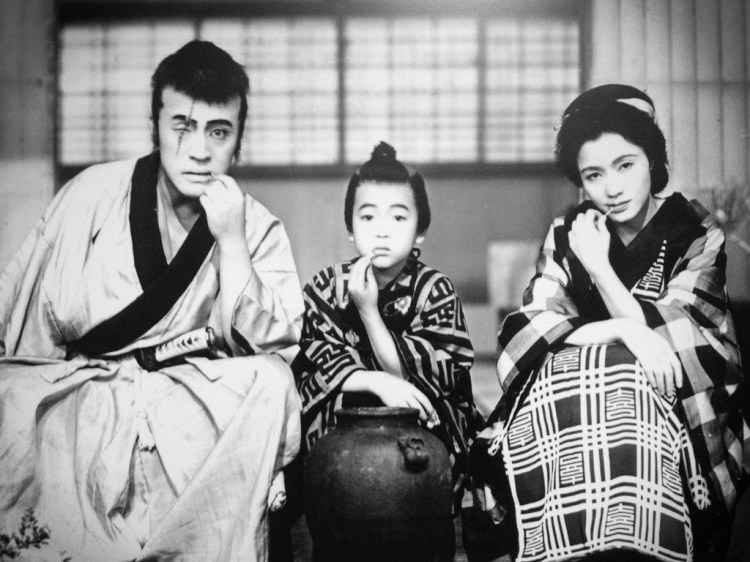
The plot turns on the titular one million ryo pot when the local feudal lord inconveniently discovers that an ugly vase with a weird monkey pattern is actually a hidden treasure map just after he’s palmed it off on his younger brother as a kind of family heirloom. The brother, Genzaburo, is both angry and insulted that his vastly wealthy brother has given him such a worthless gift rather than the money which he feels he is owed. An underling is dispatched to try and get the pot back but Genzaburo is so annoyed about it that the pot gets sold before he finds out its value. The peddlers who buy it don’t know either so they give it to a little boy to keep his pet goldfish in. Eventually the boy comes into contact with Tange Sazen who is a popular character of the time known for the scar across his eye and lack of one arm. Round and round the pot goes but where it stops, no one knows – though in the end, it’s not the pot or even the treasure that really matters.

There’s something quite amusing about the central irony that this whole mess started with a stingy rich old man accidentally cheating himself out of a vast amount of money that he really didn’t need in the first place. Genzaburo does seem more like the impoverished and subjugated kind of samurai, but still he’s not exactly starving and has a large staff to support him. His concern is more with the humiliation he feels in the way he is treated by his brother. Truth be told, Genzaburo is a feckless and clumsy man who knows he has little talent or ability and continues to sulk about it. He’s even subjugated by his wife at one point after she discovers how much time he’s been spending at the local geisha house leading to another embarrassment when he tries to sneak back in late at night and is beaten up by his own servants who assumed he was a thief.

Indeed, Genzaburo repeatedly utters that finding the pot could take ten or twenty years – like a noble quest for justice! The truth being that he loses interest in the idea of actually finding it because it would mean an end to his life of “looking for the pot” which allows him to spend all his time shooting arrows with the ladies at the bar. In essence, Genzaburo is the harmless, childish kind of second tier samurai who complains about harsh treatment and lack of status but at the same time enjoys a life of leisure, indulging his personal whims and ignoring his feudal responsibilities as well as his family home.

Tange Sazen, by contrast, is well known from various other kinds of media as a loose cannon swordsman and wandering ronin gambler but here he’s more of a gruff but goodhearted ne’er do well. He seems to be in a fairly solid but perhaps unofficial relationship with the no nonsense owner of the archery-parlour-cum-geisha-palace, Ofuji, and together (more or less, after a lot of arguing and refusing) they take in the orphaned little boy, Yasu, who, unbeknownst to all, is keeping his prized goldfish inside the very pot which everyone is looking for. In fact, Genzaburo and Tange Sazen have been sitting next to it all along but entirely failed to notice.

This is just one strand of the film’s deeply felt humour as everyone fails to see what is staring them right in the face. Yamanaka proves far ahead of his time employing comedic techniques including frequent uses of what would later become know as a “bicycle joke” in which a character swears they’ll absolutely never do something only for the film to cut to them doing exactly that. Tange Sazen and Ofuji bicker endlessly – particularly about Yasu whom they’ve both become quite attached to despite their claims to the contrary. In addition to the frequent wipes and dissolves, Yamanaka’s direction is resolutely forward looking and inventive which, coupled with a more naturalistic acting style, lend it an oddly modern air for a film completed in 1935. Humorous and heartwarming with a little social commentary thrown in, Tange Sazen: The Million Ryo Pot is a wonderfully put together ensemble comedy which still proves hugely entertaining eighty years later.


Unsubtitled clip:

https://www.youtube.com/watch?v=we7iz4-zoQE