My Sunshine (ぼくのお日さま, Hiroshi Okuyama, 2024)

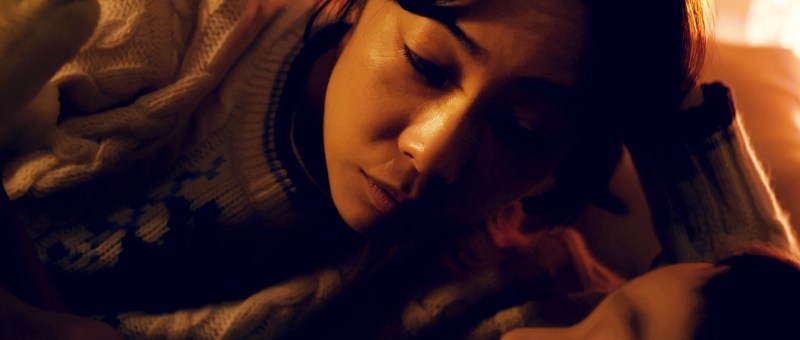
A golden light seems to pour into the life of Takuya (Keitatsu Koshiyama), a nervous young man with a stammer, as he stands transfixed by the elegant movements of a figure skater. As the world around him literally brightens, he begins to discover another side of himself, though it’s never quite clear if it’s Sakura (Kiara Takanashi), a moody teenage girl whose attitude to figure skating seems ambivalent at best, with whom he’s fallen in love or the simple act of figure skating itself. 

Drawing on autobiographical experience, Okuyama studied figure skating himself while his older sister trained to be a champion, My Sunshine (ぼくのお日さま, Boku no Ohisama) otherwise roots itself in the small-town Japan of the late ‘90s and 2000s in which being different was not exactly welcomed. But in fact, most people seem accepting of Takuya, if in a sometimes patronising way, viewing him as a boy with his head in the clouds and cutting him off when he attempts to speak rather than give him the time to finish. When the teacher is going around the class asking the children to read out a stanza of a poem each, he picks on Takuya and tells him to take his time, though the boy’s anxiety is palpable. The teacher may be caught between two options and struggling to decide which is better, not asking him to read at all to spare him from his classmates’ mocking which would also be to exclude him and reinforce a sense of inferiority in his otherness, or to ask him deliberately and try to encourage patience to teach him and the other children that there’s nothing wrong with the way he speaks. 

But in any case, Takuya is already something of an outsider in that he has no aptitude for sports and it’s never clear if he actually enjoys them or just participates because it’s what you do in this town to be man. When a recent arrival to the town and former international pro-figure skater Hiroshi (Sosuke Ikematsu) catches sight of him clumsily trying to teach himself how to dance like Sakura, it enlivens something in him that reminds him of the passion he once felt for skating. He finds himself wanting to help the boy, gifting him his old figure skating skates and teaching him for free before hitting on the idea of training him alongside Sakura as a pair.

Sakura isn’t all that keen to begin with, though at times, it seems as though she may not even like figure skating and is only doing it because her mother makes her. She tells Hiroshi that she isn’t aiming to become the best ice dancer and is a little resentful of being forced to go back to basics to meet Takuya’s skill level but goes along with it because the coach says so. What she thinks of Takuya isn’t exactly clear, though she seems to look down on him a little like the other kids who also mock him giving up ice hockey to do a “girl’s” sport. For her part she seems to have a crush on the handsome and mysterious Hiroshi that, like Takuya, she is unable to articulate. For this reason, along with an insecurity in her talent, she resents the special attention Takuya seems to be getting when it’s her mother who’s paying for the lessons and comes to the conclusion that he’s just more interested in him than her.

She may not altogether be incorrect. In his early coaching sessions with Sakura, Hiroshi doesn’t seem all that invested and is distracted by Takuya in the same way Takuya is distracted by the sunlight or the snow. In trying to help Takuya, he’s trying to help himself and for a time succeeds as the three of them generate a joyful familial relationship, culminating in a day skating on a frozen lake. But he too is unable to be honest about the fact that he came to this rural town to be with his partner who decided to take over the family business when his father passed away. Kai (Ryuya Wakaba) laughs off questions about whether he’s married yet, and the two men seem to live together quietly otherwise isolated from the community around them. When Sakura catches sight of them together, she realises something she may not really be equipped to fully understand, only further deepening her sense of resentment in an unreasonable feeling of betrayal. It isn’t really homophobia that motivates her as much jealousy when she suddenly brands Hiroshi as “‘disgusting” and accuses him of getting a kick out of making a boy do a girl’s sport, excusing her conviction that he prefers Takuya over her and potentially giving herself an out to quit skating (though it seems her mother’s not taking the hint).

But like Sakura, Hiroshi is also uncertain if this is the right place for him or if he and his partner can really live together in this small town permanently. Though he answers “of course” when Kai asks if he’s glad he came, Hiroshi pointedly gives no answer when he’s asked if he really wants to be here. Kai says that he hasn’t talked about skating like this for ages nor seemed so happy, suggesting that there may have been something missing in his life that the relationship didn’t compensate for and may not survive without. How his professional career ended is never explained, though his telling Sakura that he only got to compete internationally because of the lack of male dancers speaks to a degree of insecurity that contributes to a lack of ambition in his personal and professional lives. All three of them are, for varying reasons, unable to say what they really want or how they really feel. Though they find temporary solace in their fragile bond, it is only, as Takuya’s brother cruelly puts it, meant to last until the snow melts. Nevertheless, now dressed in a new school uniform clearly far too big for him that suggests he has some more growing to do, Takuya may have found a means of self-expression in dance that might give him the courage to speak his mind.


My Sunshine screened as part of this year’s Queer East.

Trailer (English subtitles)
Cloud (Cloud クラウド, Kiyoshi Kurosawa, 2024)

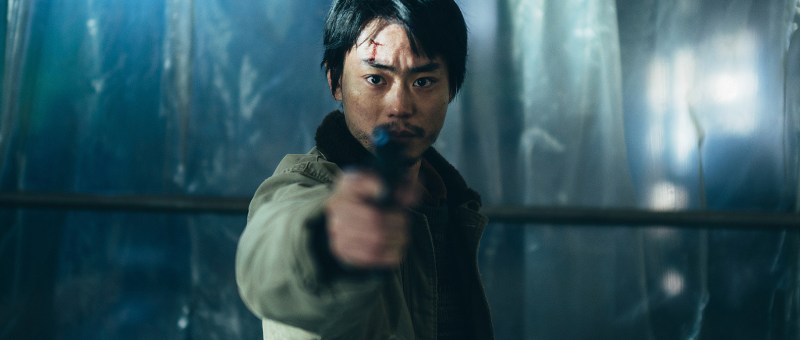
“We wanted to make easy money,” a down-on-his luck reseller admits, “is life easy now?” Factory worker Ryosuke (Masaki Suda) rebels against capitalism by subverting it through buying low and selling high while repeatedly refusing promotions at his job in a textiles factory. Though it might seem that reselling is just a way to earn an income that seems almost passive but is actually fairly labour-intensive, it’s clear that Ryosuke is a young man dissatisfied with capitalistic realities and lacking direction in his life. 

Reselling has become a kind of game to him and like a gambler who plays to lose he’s hooked on the thrill of making a killing exploiting other people’s misery. He’s at once filled with pride and smugness over his apparent triumph over his society and consumed by self-loathing. His friend and fellow reseller Muraoka (Masataka Kubota) tells him that another acquaintance has been arrested for scalping concert tickets with both of them lamenting his foolishness in getting involved with something so risky. The implication is that their friend, Goto, must have been in real desperation to lower himself to such levels and they each fear they may someday end up in the same position. Muraoka laments that that kind of selling is a young man’s game and neither of them have the time or energy to spend all day queuing to buy stuff just to sell it on cheap. They are each, it seems, beginning to feel the increasing desperation of their age that they are running out of time and have little to show for their efforts nor any prospects for the future. 

But on the other hand, neither of them want to be locked into the grind or join the oppressive but secure world of the salaryman. In many ways, Ryosuke’s factory boss Takimoto (Yoshiyoshi Arakawa) represents the “correct” path of hard and honest work, though his own paternalistic conviction in meritocracy seems outdated in a man of his age whose formative years occurred during an era of economic stagnation. He talks to Ryosuke as if he’s a young man who wants to get on but lacks confidence, telling him that he has leadership potential and is wasted on the shop floor, but his language also has an edge of the uncanny as if he were trying to recruit Ryosuke into his own worker drone revolution. In any case, even if it might be true that Ryosuke lacks confidence and ambition, that isn’t the reason he refuses promotions, which seems to be another way of rebelling against capitalism. When he eventually quits, he suggests it’s because he’s sick of being told what to do and wants more autonomy over his life and finances.

He tells his girlfriend Akiko (Kotone Furukawa) that she should quit her job too, which she’s only too happy to do because, unlike him, she actively doesn’t want to work and only wants to spend money. When she said she was thinking of giving up her apartment, Ryosuke naturally asked her to officially move in but she refused because his place is too small and she has too much stuff. Akiko has already been corrupted by the same consumerist bug that’s driving Ryosuke’s reselling business, but neither of them can really afford this lifestyle in the city. Ryosuke’s bright idea is to move to the remote countryside where he’s able to rent a huge, though ominous-looking, property for a fraction of the price with the idea of also economically supporting Akiko who will revert to traditional gender roles as a housewife in charge of the domestic space and most especially the kitchen.

But freedom cannot be found simply by retreating from urbanity and the couple soon find themselves plagued by a pervasive sense of resentment. The locals are not particularly accepting of people from Tokyo and are also needled by their success which is something they feel they’ve been unfairly denied. When Ryosuke tries to report a smashed window, even the policeman hassles him and says he’s received a tip-off that Ryosuke is breaking trading standards regulations by selling counterfeit goods as the real thing. Reselling in itself is not illegal, if definitely dubious morally and incredibly cynical. Ryosuke doesn’t seem to like to think about that and tells his new assistant, Sano (Daiken Okudaira), that he tries to sell all the items as quickly as possible so he doesn’t have to worry too much about their authenticity. If they’re wanted they’ll sell, Ryosuke justifies but he might as well be talking about himself.

“Being real or fake doesn’t matter?” Sano asks him, just as Ryosuke’s online and offline personas start to blur. He’s unaware that there are people actively hunting him for selling them substandard goods and is later pursued by real life vigilantes acting like online trolls and planning to torture him to death during a livestream. Like many of Kurosawa’s heroes, Ryosuke is completely convinced that he’s the benchmark for normal and it’s everything around him that’s strange or unfair. As the internet once again invades the “real” world, or perhaps it’s more that Ryosuke’s living his online life offline, the increasing unreality of the situation makes us wonder if any of this is “really” happening or product of Ryosuke’s fractured identity as it finally collapses under the twin corruptions of capitalism and social media. “Please keep focusing only on making money,” his new guardian angel Sano tells him, “everything will be obtainable. Whatever you want. Even things that can end the world.” Flying through ironically heavenly clouds, Ryosuke reflects that the path to hell really is paved with gold and his Mephistophelian pact with hyper-capitalism may have damned him beyond all repair.  


Cloud is in cinemas from 25th April courtesy of Blue Finch Film Releasing 

UK trailer (English subtitles)
(Ab)normal Desire (正欲, Yoshiyuki Kishi, 2023)

There’s a pun embedded in the Japanese title of Yoshiyuki Kishi’s heartfelt drama (Ab)normal Desire in that first character in the word for “sexual desire” (seiyoku, 性欲) has been replaced by one that can be read the same but has the meaning of “correct”, or “proper”. But “normal” is also relative construct that implies conformance with the majority even if that may not actually be the case. As one of the protagonists later remarks “everyone is pervy” though they themselves feel such a degree of shame and otherness that it’s largely prevented them from living any kind of life at all.

In that sense it may be hard to understand why a fetish for water would invite such severe self-loathing in that it causes no harm to others if admittedly resulting in ridicule if exposed. Then again, society can be a fierce watchdog. Department store shop assistant Natsuki (Yui Aragaki) is taken to task by her pregnant colleague who refuses to take her seriously when she says she’s not really interested in getting a boyfriend before giving her a lecture about her biological clock. Though Natsuki appears uninterested in her vacant prattling, the woman later becomes upset and harshly tells her that she was only trying to be “nice” because she felt “sorry” for her and that making people be nice to you in this way is actually a form of harassment which, whichever way you look at it, is some particularly twisted logic.

Her alienation seems to stem from the fact that she feels “abnormal” and that her fetish for water is a part of herself she must be careful to hide. Her parents watch a news report on Tokyo Rainbow Pride and marvel at the idea that there are now choices other than marriage and children but even among the young there remains confusion and shame amid an inability to reconcile the seemingly opposing concepts of “normality” and “diversity” as they struggle to define themselves. A plan to have a male dancer who usually dances in a masculine style dance in a more feminine way backfires when he points out that asking someone to dance in a way they don’t want to doesn’t really do much to advance “diversity”.

But diversity isn’t considered an ideal by all and parents of young children find themselves confused and conflicted when their kids begin to reject conventionality at an early age by asking to withdraw themselves from school and instead focus on other kinds of education that align with their interests. Challenged by his wife about why he never listens to their son’s concerns, prosecutor Hiroki (Goro Inagaki) replies that he should “just be normal” and later describes people who are “unable to live normal lives” as bugs in the system which must eradicated. A symbol of lingering authoritarianism, Hiroki is an intensely conservative man obsessed with properness who thinks it’s his job to decide which crimes everyone is guilty of rather than make any attempt to understand the world around him outside of binary terms like right and wrong or normal and abnormal. When his assistant passes him information on fetishes as a potential explanation for the case of a man who repeatedly steals taps, he simply rolls his eyes and dismisses it.

Yet he perhaps has his own fears and internalised shame as evidenced by his outrage on discovering that another man has been coming to the house to help his wife with tech setup for their son’s new outlet in livestreaming and not only that, he was able to blow up the balloons that Hiroki himself failed to inflate. It’s his rigid authoritarianism that eventually alienates his wife and son who come to see him only as an oppressive bully unable to accept anything that differs from his own definition of “normal”. Finally, he’s the one who is isolated, imprisoned by his own repression and lack of understanding or unwillingness to accept those around him.

Even so, despite its positive messages that no one should feel themselves alone or that society has no place for them the film muddies the waters by introducing fetishes that are necessarily problematic in that they cause harm to others who do not or cannot consent and could not and should not be accepted by mainstream society though oddly those that have them seem to feel less shame only fearing being caught because acting on their desires is against both moral and judicial laws. In any case, in discovering togetherness, that they are not alone, those who feel their desires to be “abnormal” can begin to ease their loneliness and find a place for themselves in an often judgemental world.


(Ab)normal Desire screened as part of this year’s Toronto Japanese Film Festival.

Original trailer (English subtitles)
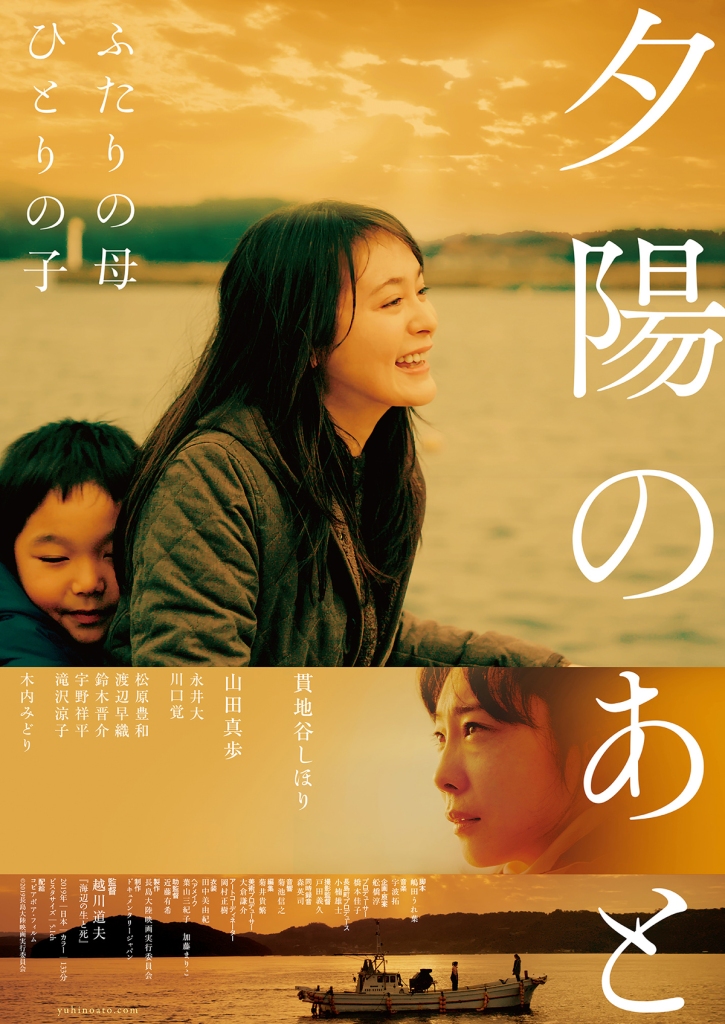
After the Sunset (夕陽のあと, Michio Koshikawa, 2019)

Two women find themselves caught up in an impossible situation in Michio Koshikawa’s sensitive maternal drama After the Sunset (夕陽のあと, Yuhi No Ato). Though both want the best for the child, they have to acknowledge that someone is going to end up desperately hurt while perhaps no one is at fault other than the insensitive and austere society which saw fit to punish a young woman already in the depths of despair rather than come to her aid. 

7-year-old Towa (Towa Matsubara) lives in a cheerful island village with his mother Satsuki (Maho Yamada), fisherman father Yuichi (Masaru Nagai), and compassionate grandma Mie (Midori Kiuchi). What he doesn’t know is that Satsuki and Yuichi are not his birth parents. Unable to have children of their own they decided to pursue adoption after years of unsuccessful fertility treatments and now that they have everything else sorted are hoping to finalise Towa’s legal status as a member of their family. What they don’t know is that Towa’s birth mother, Akane (Shihori Kanjiya), has been living on the island for the past year to be close to her son but is conflicted and at something of a loss as to what to do. Matters come to a head when they need the birth mother’s signature on the adoption forms to confirm her renunciation of parental rights and Akane’s true identity is exposed. 

The first and most obvious problem is that both women believe themselves to be the rightful mother. Satsuki has been raising Towa since he was a baby and her feelings for him are no different than if she had given birth to him herself. Akane meanwhile gave birth to Towa in difficult circumstances and was then separated from him. She has spent the past four years searching and wants nothing more than to be reunited with her son. Though she can see that he is very happy with with Satsuki and Yuichi and is grateful that he has found such a loving family in such a beautiful place, she cannot bear the thought of losing Towa while Satsuki cannot help but fear that this other woman who was able to do what she was not in giving birth has come to take her child away. 

It is of course an impossible situation with no good or right answers. Satsuki begins by resenting Akane, discovering that Towa was abandoned as an infant in an internet cafe and regarding her as having lost the right to call herself his mother but on investigating more begins to understand the kind of despair she must have been in to have taken such a drastic step. A victim of domestic violence left all alone with an infant child and no means of support, she considered suicide but rather than help her the authorities criminalised her actions and took her child away, dangling the false hope of a reunion in return for “rehabilitation” while Satsuki and Yuichi gave him a happy family home she knew nothing about. Towa has lived all his life on the island, he thinks Satsuki and Yuichi are his mother and father, how could you explain to him that he has to leave his second mother to return to the first that he never really knew?

Where one might expect there to be fear and anger, the two women eventually come to an understanding of one another as mothers who each want the best for the child even if that means they may end up hurt. As grandma puts it, the island is a welcoming place. It accepts all those who come, and does not pursue those who choose to leave but is always willing receive them when they return. Towa points out that that it takes a village, to him everyone on the island, including Akane, is his mother because they all raised him together though his father holds that the best mother of all is the sea. There is perhaps room for more than one if only in an ideological sense, no true mothers and no false only people who love their children and struggle against themselves to do what they know in their hearts is best. A gentle exploration of everyday life on a tranquil island, Michio Koshikawa’s sensitive drama finds people at their best in the extremities of emotional difficulty, finding their way through mutual compassion and understanding in an acknowledgement that there is no right answer only an acceptable best that leaves the door open for a future reconciliation.


After The Sunset is available to stream in Germany until June 14 as part of this year’s online Nippon Connection Film Festival.

Original trailer (No subtitles)

We Are Little Zombies (ウィーアーリトルゾンビーズ, Makoto Nagahisa, 2019)

Little Zombies poster“Reality’s too stupid to cry over” affirms the deadpan narrator of Makoto Nagahisa’s We Are Little Zombies (ウィーアーリトルゾンビーズ), so why does he feel so strange about feeling nothing much at all? Taking its cues from the French New Wave by way of ‘60s Japanese avant-garde, the first feature from the award winning And So We Put Goldfish in the Pool director is a riotous affair of retro video game nostalgia and deepening ennui, but it’s also a gentle meditation on finding the strength to keep moving forward despite all the pain, emptiness, and disappointment of being alive.

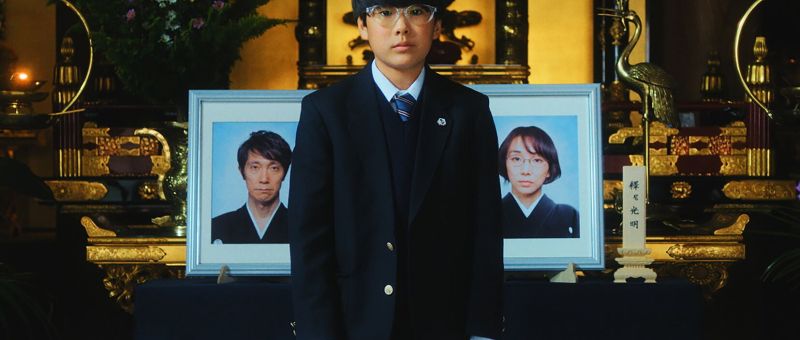
The “Little Zombies”, as we will later discover, are the latest tween viral pop sensation led by bespectacled 13-year-old Hikari (Keita Ninomiya). Recounting his own sorry tale of how his emotionally distant parents died in a freak bus accident, Hikari then teams up with three other similarly bereaved teens after meeting at the local crematorium where each of their parents is also making their final journey. Inspired by a retro RPG with the same title, the gang set off on an adventure to claim their independence by revisiting the sites of all their grief before making themselves intentionally homeless and forming an emo (no one says that anymore, apparently) grunge band to sing about their emotional numbness and general inability to feel.

Very much of the moment, but rooted in nostalgia for ages past, Little Zombies is another in a long line of Japanese movies asking serious questions about the traditional family. The reason Hikari can’t cry is, he says, because crying would be pointless. Babies cry for help, but no one is going to help him. Emotionally neglected by his parents who, when not working, were too wrapped up in their own drama to pay much attention to him, Hikari’s only connection to familial love is buried in the collection of video games they gave him in lieu of physical connection, his spectacles a kind of badge of that love earned through constant eyestrain.

The other kids, meanwhile, have similarly detached backgrounds – Takemura (Mondo Okumura) hated his useless and violent father but can’t forgive his parents for abandoning him in double suicide, Ishii (Satoshi) Mizuno) resented his careless dad but misses the stir-fries his mum cooked for him every day, and Ikuko (Sena Nakaijma) may have actually encouraged the murder of her parents by a creepy stalker while secretly pained over their rejection of her in embarrassment over her tendency to attract unwanted male attention even as child. The kids aren’t upset in the “normal” way because none of their relationships were “normal” and so their homes were never quite the points of comfort and safety one might have assumed them to be.

Orphaned and adrift, they fare little better. The adult world is as untrustworthy as ever and it’s not long before they begin to feel exploited by the powers intent on making them “stars”. Nevertheless, they continue with their deadpan routines as the “soulless” Little Zombies until their emotions, such as they are, begin inconveniently breaking through. “Despair is uncool”, but passion is impossible in a world where nothing really matters and all relationships are built on mutual transaction.

Mimicking Hikari’s retro video game, the Zombies pursue their quest towards the end level boss, passing through several stages and levelling up as they go, but face the continuing question of whether to continue with the game or not. Save and quit seems like a tempting option when there is no hope in sight, but giving in to despair would to be to let the world win. The only prize on offer is life going on “undramatically”, but in many ways that is the best reward one can hope for and who’s to say zombies don’t have feelings too? Dead but alive, the teens continue their adventure with heavy hearts but resolved in the knowledge that it’s probably OK to be numb to the world but also OK not to be. “Life is like a shit game”, but you keep playing anyway because sometimes it’s kind of fun. A visual tour de force and riot of ironic avant-garde post-modernism, We Are Little Zombies is a charmingly nostalgic throwback to the anything goes spirit of the bubble era and a strangely joyous celebration of finding small signs of hope amid the soulless chaos of modern life.


We Are Little Zombies was screened as part of the 2019 Nippon Connection Film Festival.

Original trailer (English subtitles)
Makoto Nagahisa’s short And So We Put Goldfish in the Pool

Music videos for We Are Little Zombies and Zombies But Alive

The Chrysanthemum and the Guillotine (菊とギロチン 女相撲とアナキスト, Takahisa Zeze, 2018)

Chrysanthemum and the Guillotine poster 1“I see it now, we can’t change anything” a despondent would-be-revolutionary decries in a moment of despair. Almost 100 years later, you might have to concede they have a point when the world finds itself on a tipping point once again and the same old prejudices refuse to disappear. Takahisa Zeze’s The Chrysanthemum and the Guillotine (菊とギロチン 女相撲とアナキスト, Kiku to Guillotine Onna Zumo to Anarchism) casts an unflinching eye back towards the Japan of 1923 caught in the aftermath of a devastating natural disaster which followed on from a chaotic era of rapid social change and bewildering modernisation during which a series of battles were being fought for the future direction of a nation still trying to define itself in world dominated by empires.

When the Great Kanto Earthquake struck claiming mass loss of life and extreme damage to infrastructure, the ensuing chaos gave rise to a vicious rumour that Koreans were taking advantage of the situation to foment the independence movement by poisoning wells and committing arson leading to a pogrom against anyone who failed to prove themselves Japanese enough to satisfy the mob. Meanwhile, the same forces also turned on political opponents whose influence they perceived as destructive to their own aims culminating in the murder of prominent anarchist Sanae Osugi along with his feminist wife Noe Ito and their six-year-old nephew.

We begin, however, with a different band of outsiders in the Tamaiwa itinerant female sumo wrestler troupe many of whom have taken refuge in an isolated world of female solidarity in order to escape abusive relationships. Kiku (Mai Kiryu) is one such woman who found the courage to run away from a violent husband on catching sight of the powerful female wrestlers who made her realise that she too could become strong like them. Having accepted that “weak people can’t change anything”, Kiku has vowed to become “strong” in order to claim her own agency and ensure that she can’t be pushed around ever again.

Meanwhile, an anarchist sect known as the Guillotines are fomenting a more general kind of revolution but have not been very successful and are now on the run from the authorities which is how they end up running into the female wrestlers and more or less bringing them into the struggle. Led by libertine and (as yet) unpublished poet Tetsu Nakahama (Masahiro Higashide), the Guillotines are more romantic bandits with high ideals than serious revolutionaries. They rob the rich to fund their “activism” but spend most of the money on sex and drink while plotting revenge for the murder of Osugi with various schemes which imply that at heart they aren’t so different from that which they hate.

Nevertheless, the forces of darkness are rising and history tells us that, temporally at least, they will win. The vigilante militias which carried out the massacres were largely made-up of farmer soldiers who’d served in Russia and experienced terrible hardship. Unable to bear the idea that their traumatic wartime experiences had been a senseless waste, they doubled down on militarist ideology and insisted on their nationalistic superiority. This led them to hate, to regard anything that lay outside of their code as inferior and dangerous. Though the massacres were condemned by the government and the perpetrators prosecuted for their crimes, the convictions were largely quashed a short time later which is why we see our major villains rewarded by the state and our revolutionary “heroes” imprisoned for their resistance towards state oppression and desire to create a fairer, more equal society.

Ironically enough, Nakahama’s big utopian idea is an overly idealistic vision for a future Manchuria which in hindsight proves extremely uncomfortable but is perhaps an indication of the naivety of the times. Even so, the Guillotines for all their romanticism are essentially progressive in their thinking and in full support of sexual equality, insisting on the necessity of the wrestlers to embrace their physical capabilities in order to defend themselves against an oppressive and patriarchal society fuelled by male violence. Though this in itself might be mildly problematic in implying that in order to become “equal” women must learn to be more like men, it also plays into the film’s subtle sense of irony in which the tools of militarism are being subverted in order to oppose it. The “intellectual” Guillotines find their revolutions failing, while fighting fire with fire may be the only surefire way to win even if it legitimises the problematic act of violence in the process. Then again, as another of the Guillotines puts it, the truly strong are those who have no need of killing. 

In any case, the Tamaiwa stable becomes a tiny enclave of progressive values built on female solidarity though they ultimately discover that solidarity is not quite enough and they cannot protect each other from the ravages of the times without external assistance. Even so, they attempt to hold the line, literally pushing back against the fascist incursion while insisting on their right to resist as human beings with will and agency. The prognosis seems bleak. 100 years later the same battles are still being fought and the same tensions rising in the wake of new disasters yet there are also those who will continue to resist and like the Tamaiwa wrestlers refuse to give in to those who threaten to restrict their freedom.


The Chrysanthemum and the Guillotine was screened as part of the 2019 Nippon Connection Film Festival.

Original trailer (no subtitles)

Poetry Angel (ポエトリーエンジェル, Toshimitsu Iizuka, 2017)

poetry angel posterLife is confusing. You think you know what you want, only to realise it wasn’t what you wanted at all. What you really wanted was the very thing you convinced yourself you didn’t want so that you could want something else. The characters at the centre of Toshimitsu Iizuka’s Poetry Angel (ポエトリーエンジェル) are all suffers of this particular delusion, lost and alone in a small town in rural Japan without hope or direction. That is, until they discover the strange sport of “poetry boxing”.

Our hero, Tsutomu (Amane Okayama), is a 21-year-old farm boy with dreams of becoming an author. His illusions are, however, shattered when he checks the board in the community centre and discovers he hasn’t even placed in a local history essay writing contest which appears to have been won by a child. In this delicate state, a pretty girl suddenly approaches him and begs for his help but then drags him into a seminar room where he is forced to listen to a lecture on “poetry boxing”. Almost everyone else leaves straight away but Tsutomu is intrigued – after all, semi-aggressive literary sport might be just the thing to get an aspiring author’s creative juices flowing.

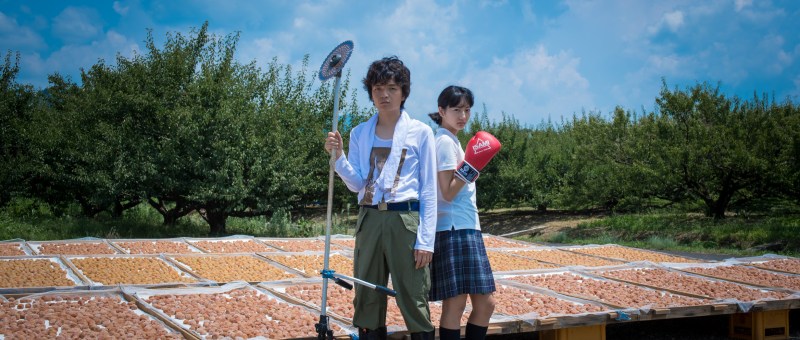
Tsutomu’s problems are the same as many a young man’s in Japanese cinema – he resents having his future dictated to him by an accident of birth. His father owns a large orchard and is a well respected producer of salt pickled plums. As the only child, Tsutomu is expected to take over but he hates “boring” country life and the repetitive business of farming, his thinly veiled jealousy all too plain when an old friend returns from Tokyo on a visit home between university graduation and a new job in the capital. Tsutomu thinks of himself as special, as an artist, but no one seems to be recognising his genius.

This might partly be because his only “poem” is an alarming performance art piece in which he laments his tendency to destroy the things he loves with his “weed whacker”. The sport of poetry boxing has no physical requirements but it has no limits either. It’s more or less like performance poetry or a less directly confrontational kind of slam, but participants are encouraged to step into the boxing ring and express themselves in whichever way they see fit. Once both participants have concluded their “poems” a panel of judges votes on the winner. Like Tsutomu, the other members of the poetry boxing team are dreaming of other things or claiming to be something they’re not. Rappers who really work in cabaret bars, lonely girls who fear they’re plain and long to be “cute”, civil servants longing to kick back at inconsiderate citizens, and old men who really do just want to write poetry and appreciate the time they have left.

Yet through the endlessly wacky tasks set by Hayashi (Akihiro Kakuta), the leader of the group, each of the participants begins to gain a deeper understanding of who they are and what they really want. Not least among them An (Rena Takeda), a gloomy young girl who spends her life scowling at people and refusing to speak. She’d been into boxing for real and first met Tsutomu when she punched him in the face because his unexpectedly sexist friend from Tokyo was harassing her in the street. Poetry, however, begins to unlock even her deepest held desires which can finally be voiced from the ironically safe space of the poetry boxing ring.

There may be nothing particularly original about Iizuka’s delayed coming of age tale, but it has genuine warmth for its confused no hopers as they look for connection through formalised language and ritual play, discovering new depths to themselves as they do so. As it turns out mostly what you want was there all along, only you didn’t want to look. Annoyingly, other people may have figured it out before you but that can’t be helped and is, after all, only to be expected. Poetry is a doorway to the soul but it’s also one that might need a good kicking to get it open. Maybe the boxing ring is a better place to start than one might think.


Original trailer (no subtitles)

Japanese Girls Never Die (アズミ・ハルコは行方不明, Daigo Matsui, 2016)

Japanese Girls Never DieJapanese Girls Never Die (アズミ・ハルコは行方不明, Azumi Haruko wa Yukuefumei) but, like old soldiers, only fade away in Daigo Matsui’s impassioned adaptation of the Mariko Yamauchi novel. Crushed by a misogynistic society, these are women who may well want to disappear if only as an alternative to finally being forced into submission to the predefined paths of womanhood – i.e. marriage and motherhood (and nothing else) that have been carved out for them. The young are, however, fighting back if in less than admirable ways. The best revenge on an oppressive society may be living well in one’s own way, but when that same society is at great pains to frustrate your goal the options are few.

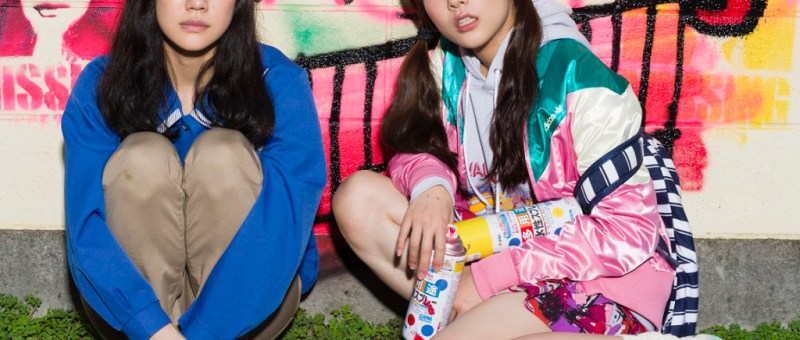
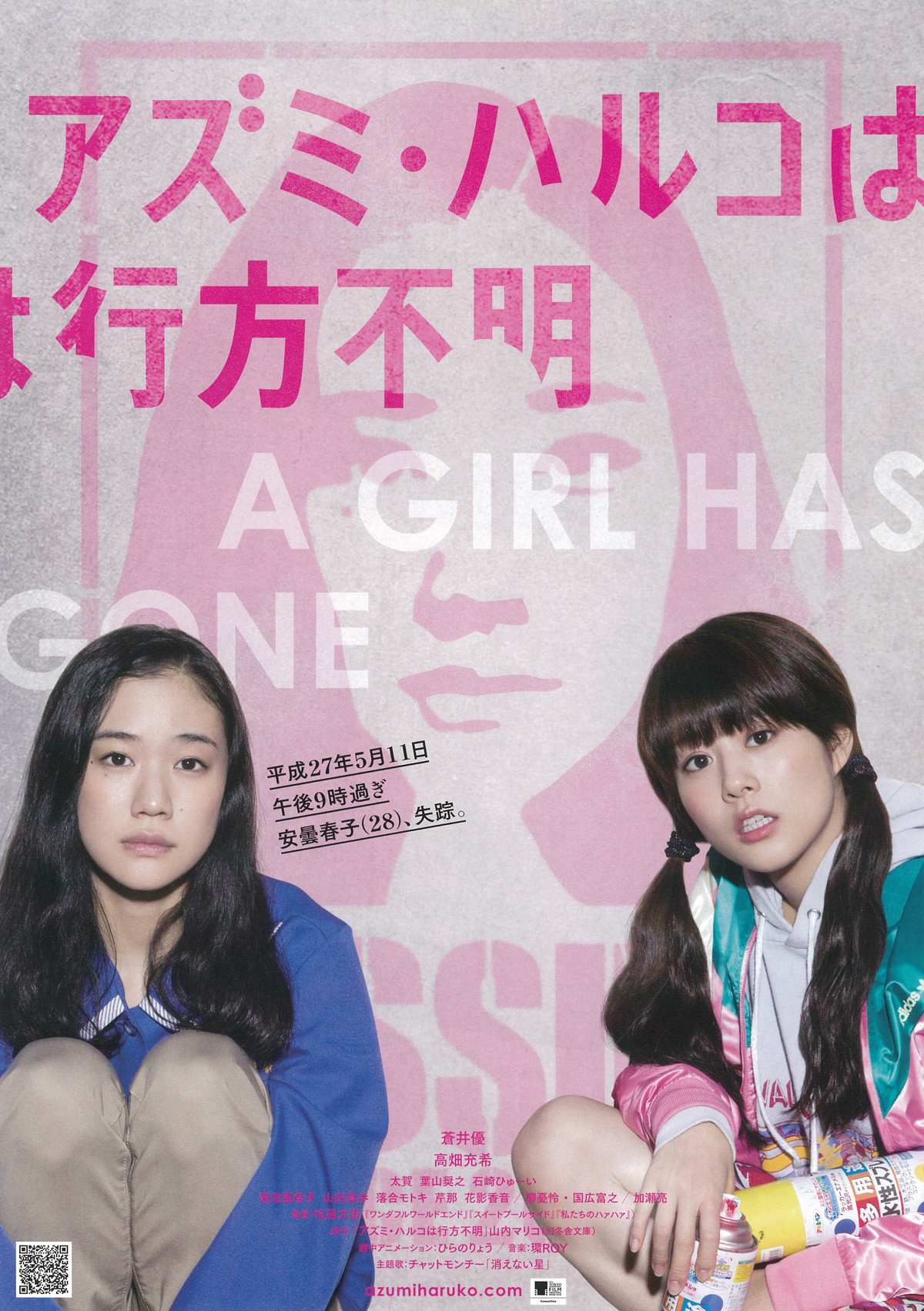
As per the title, 28-year-old admin assistant Haruko Azuma (Yu Aoi) has gone missing. Her face, stolen from her missing poster, has been co-opted by a pair of petty punk idiots trying to come-up with a viral graffiti tag to rival Obey, but there’s no art or intention behind their minor act of social transgression so much as bravado and pithy rebellion. Nevertheless, Haruko’s image, plastered throughout the city, has become a hot topic on Japan’s social networking sites where a hundred trolls wade in with their prognostications and salacious fantasies of her violent death at the hands of a sex maniac.

Meanwhile, in an ironic subversion of the normalities of city life, young men have been urged to avoid walking alone at night following a spate of attacks by a gang of rabid school girls taking revenge on the male sex. No exact motive is given for their crusade save the missing poster that precedes Haruko’s and asks for information on a disappeared school girl, but goodness knows they have enough obvious reasons to have decided on a course of vigilante justice.

Haruko’s world is one defined by entrenched sexism. At 28 she finds herself embarrassed to be a still single woman at a wedding while a chance encounter with a school friend (Huwie Ishizaki) at a supermarket leads to more awkwardness when he pointedly remarks he assumed she’d be a housewife by now, and that she looks “old”. At work, Haruko’s colleague Yoshizawa (Maho Yamada), 37 and still unwed, is the butt of hundred jokes for the two middle-aged men who, for some reason, are their bosses though they hardly seem to do any work and automatically earn seven times Yoshizawa’s salary. The bosses urge Haruko to dress in more feminine fashions, asking invasive questions about her personal life while disparaging single women like Yoshizawa who they blame for Japan’s declining birthrate and a related raise in their taxes, avowing that women over 35 are essentially pointless seeing as their eggs are already “rotten”. Yoshizawa has developed a thick skin for their constant needling, realising that it amounts to an odd combination of sexual harassment and constructive dismissal campaign. Unwilling to pay a “higher” salary to an “older” woman, they are waiting for her to quit so they can hire a young and pretty new girl who will be naive enough to accept the pittance they intend to pay her.

It might be thought that the attitudes of Haruko’s bosses are a reflection of their generation, but the two young punks, Yukio (Taiga) and Manabu (Shono Hayama), are no different. 20-year-old Aina (Mitsuki Takahata), a bar girl with ambitions to enter the beauty business, gets swept into their unpleasant orbit after getting into a “relationship” with Yukio, but Yukio thinks of her only as a plaything, even going so far as to encourage the shy Manabu to try his luck because (he claims contemptuously) Aina is the kind of girl who’ll go with anyone. Later she becomes a key part of their mini graffiti movement, but once the pair start to get a little recognition they essentially erase Aina from the story taking all the credit for themselves. Aina, poignantly looking up at the poster advertising the boys’ big moment in the same way she had gazed at Haruko’s missing poster on the police station notice board, realises she’s finally had enough of all their lies and of being made to feel invisible in a society which refuses to recognise her as anything more than an object for exploitation.

Haruko’s face is literally plastered all over town, but she remains essentially faceless, her image stolen and stripped of its identity to be repackaged as a soulless symbol for two idiotic boys who not only do not care who she is or might have been but only seek to profit from claiming to be allies in a struggle while simultaneously propping up the opposing side. The image does, however, gain its own independent power, speaking for all the oppressed and belittled women who find themselves essentially disappeared in being forced to abandon their hopes and dreams in the face of extreme social pressure. The school girls are fighting back – the next generation will (perhaps) not be so keen to remain complicit in the social codes which restrict their prospects. Then again, as the image of Haruko tells one of her lost disciples, the best revenge is living well. Choosing to absent oneself from a system of social control, going missing in a more positive sense, may be the best option of all.


Screened as part of the Japan Foundation Touring Film Programme 2018.

Screening again:

  • Dundee Contemporary Arts – 26 February 2018
  • HOME – 27 February 2018
  • Phoenix Leicester – 1 March 2018
  • Filmhouse – 3 March 2018
  • Showroom Cinema – 6 March 2018
  • Firstsite – 9 March 2018
  • Exeter Phoenix – 13 March 2018
  • Queen’s Film Theatre – 18 March 2018

Original trailer (English subtitles)
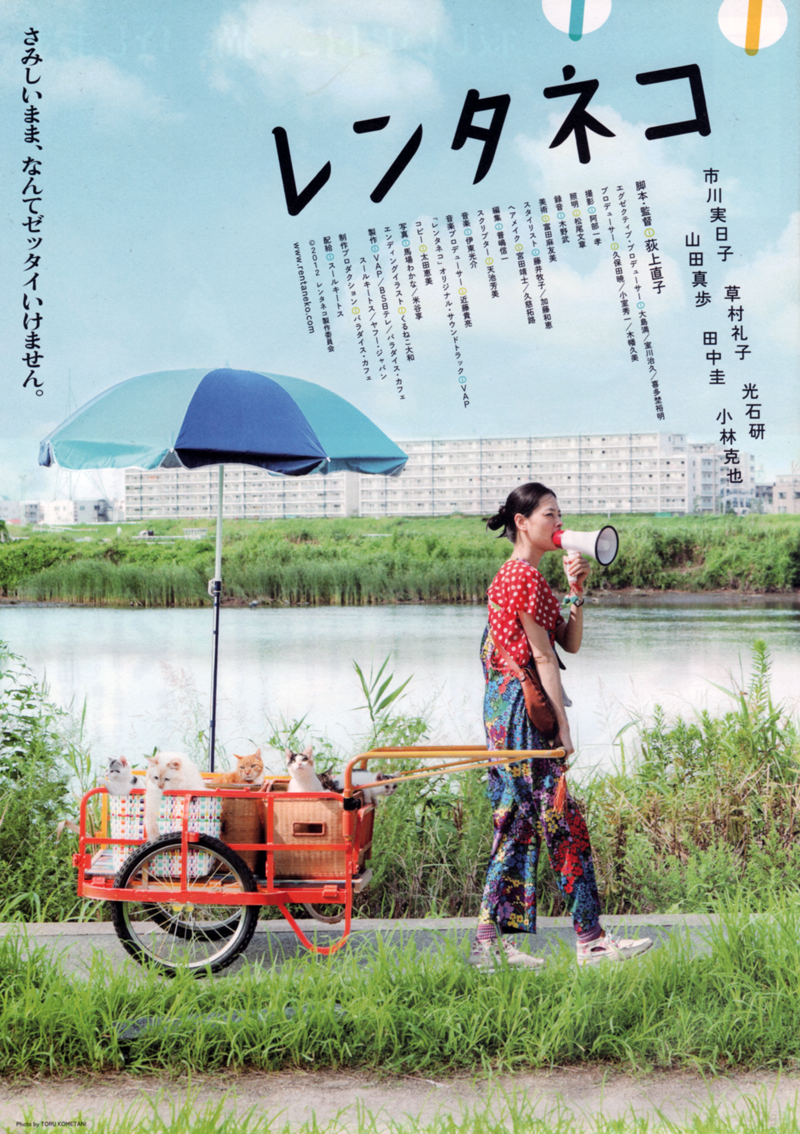
Rent-a-Cat (レンタネコ, Naoko Ogigami, 2012)

©2012レンタネコ製作委員会

rent-a-cat posterPreviously, Ogigami’s heroines (and hero, when one thinks about it) have had to go great distances in order to figure out what it was they were looking for and then finally find it. In Kamome Diner, Sachie went all the way to Helsinki to open up a Japanese cafe only to find herself accidentally attracting a collective of other runaway Japanese people whilst building a community of friendly Finns in her new home. Taeko, in Megane, went on a random holiday that turned out to be much more random than she ever would have expected but she did end up learning to slow down and enjoy the simple pleasures of life which is, presumably, why she ended up on holiday in the first place. Rent-a-Cat’s (レンタネコ, Rent-a-Neko) Sayoko (Mikako Ichikawa), by contrast, stubbornly stays put. In fact, she is the pillar around which all else turns as a fixed point for her various “stray cats” each in need of temporary support.

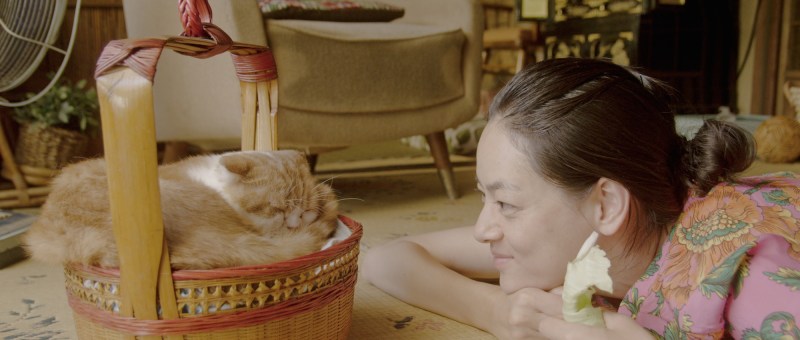
Since her grandmother died a few years ago, Sayoko’s life has been in free fall. A 30-something single woman with no “regular” employment, Sayoko lives in a spacious Japanese-style house with a small garden which is home to the various stray kitties which seem to seek her out when looking for a good place to crash. Sayoko has taken to writing out large banners declaring her immediate goals – getting married being the main one, and pasting them on the walls to encourage herself to keep going. The truth is, though Sayoko is not exactly unhappy she is unfulfilled. Since childhood she’s had the strange talent of attracting friendly cats but secretly longs to attract people too. Combining her strength and her weakness, Sayoko operates an unusual enterprise – cat rental! Walking along with a loud speaker and a trailer full of cats, she looks for lonely people who might want to borrow a fluffy friend for a while to help them out while they’re feeling low.

Of course, Sayoko’s quest to heal the hearts of others is also one to heal her own. Eccentric since childhood during which she was nicknamed “Jamiko” after a strange monster and mostly spent her time snoozing in the nurse’s office along with a kleptomaniac fellow student, Sayoko has never found her feet when it comes to building lasting relationships with people. Her voiceovers all refer back to her grandmother whom she misses deeply and seems slightly lost without. Appearing to have no real friends and spending a lot of time at home looking after her collection of needy cats, Sayoko’s main source of daily interaction comes from the horrible old woman who lives next door and turns up at random intervals to play Greek chorus in neatly reciting Sayoko’s various neuroses back to her over the garden fence.

Sayoko’s neighbour probably has a hole in her heart she fills by being deliberately insensitive to obviously sensitive people, but Sayoko offers her clients another solution in the form of a fluffy little cat who needs someone to look after it. Before lending one of her charges, Sayoko makes sure to vet the prospective cat guardian – after all, not everyone is nice and some people like to project their own suffering onto harmless little creatures. Through the house visits Sayoko gets to find out exactly what kind of hole it is that needs filling from dimples in jellies to holes in socks and even those in donuts, and being the sensitive soul she is, Sayoko usually knows what kind of help her customers need.

Structured around four different clients and bridged with Sayoko’s own neurotic journeys, Rent-a-Cat takes on a charming, fairytale quality in its repeated formulas. Each time someone asks to rent a cat they get the same speech about the inspection and then when it comes to talking money they each express surprise at the extremely good value, making sure to ask if Sayoko will be OK financially when she operates on these oddly beneficial terms. Don’t worry, she tells them – she has other income, a different one each time from stockbroking to fortune telling. The problems run from late life isolation as in a little old lady who loves making jellies for the son she never sees, to dejected fathers forced to work away from home and missing their kids grow up, and young women who feel trapped in a conservative society and would like nothing more than to jet off somewhere to follow their own path, if only they had the courage.

Social conservatism does seem to be something which particularly annoys Sayoko, if perhaps subconsciously. A strange dream sends her off to a Rent-a-Cat corporate clone where clients can rent cats of three different classes priced according to desirability. Sayoko is particularly anxious about the “Class C” cats whom the lady behind the counter disdainfully describes as “crossbreeds”. Sayoko is not having any of that and takes the woman to task for her need to “rank” things before insisting on renting a Class C cat at the Class A price to fully ram home the unpleasantness and absurdity of such a prejudiced world view.

Branded a “crazy cat lady” by the neighbourhood kids, Sayoko’s humanitarian mission of spreading love and kindness eventually does start to reel in a few humans even if they are mostly lonely souls in need of temporary support. Towards the end, when a promising reappearance provokes only disappointment, Sayoko wonders if perhaps there are holes cats cannot fill or sadnesses too great to be borne, but nevertheless she persists. A falling banner a suggests Sayoko may have already found the material to fill her own hole in helping other people fill theirs whilst surrounded by the by warm indifference of her feline brood.


You can catch Rent-a-Cat at the Japanese Embassy in London on 22nd November as the first in a series of events, Archipelago: Exploring the Landscape of Contemporary Japanese Women Filmmakers, which also includes screenings of Bare Essence of Life, Death of a Japanese Salesman, and Wild Berries from 30th November to 2nd December.

 Original trailer (no subtitles)

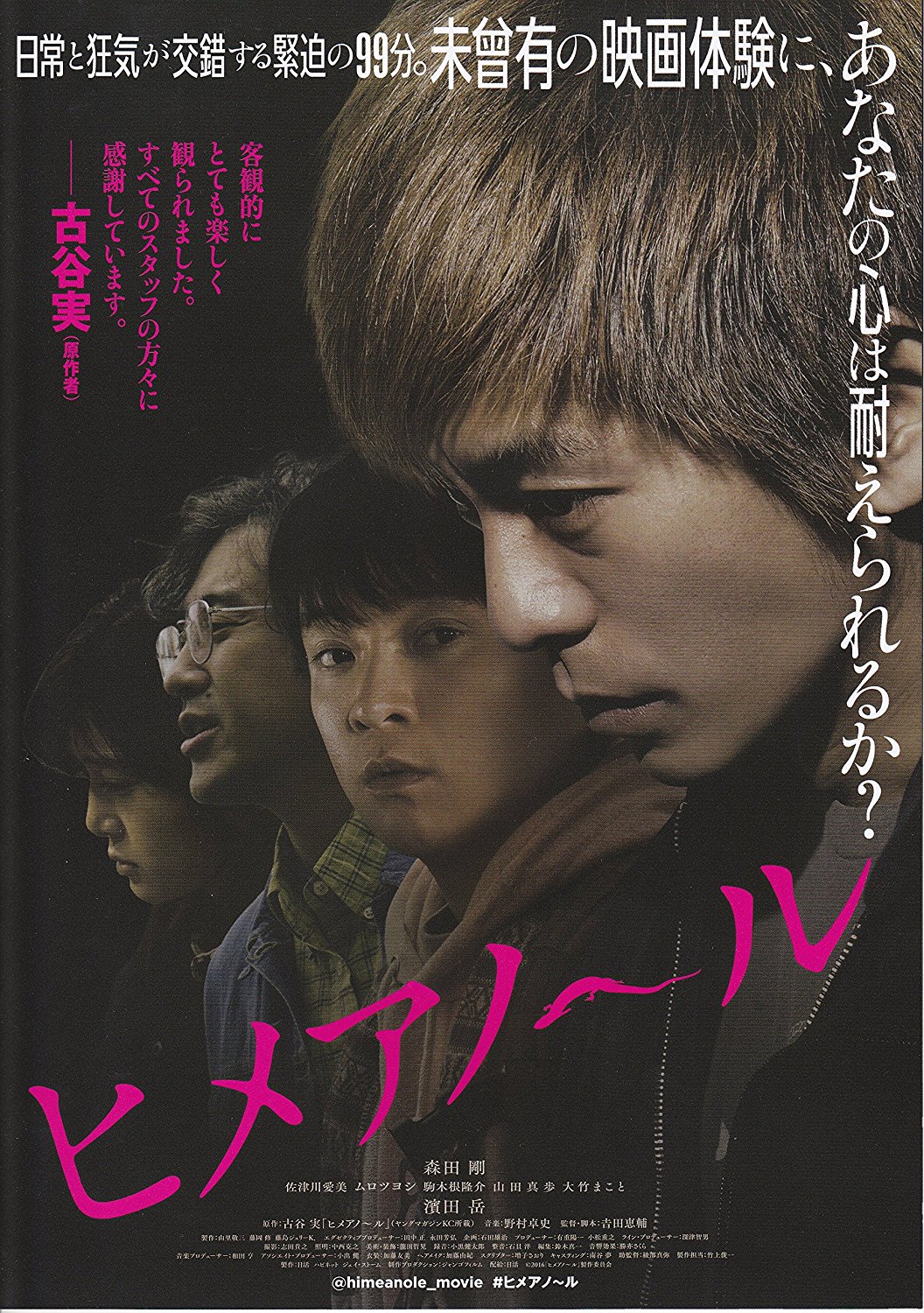
Hime-anole (ヒメアノ~ル, Keisuke Yoshida, 2016)

hime-anole posterSome people are odd, and that’s OK. Then there are the people who are odd, but definitely not OK. Hime-anole (ヒメアノ~ル) introduces us to both of these kinds of outsiders, attempting to draw a line between the merely awkward and the actively dangerous but ultimately finding that there is no line and perhaps simple acts of kindness offered at the right time could have prevented a mind snapping or a person descending into spiralling homicidal delusion. To go any further is to say too much, but Hime-anole revels in its reversals, switching rapidly between quirky romantic comedy, gritty Japanese indie, and finally grim social horror. Yet it plants its seeds early with two young men struggling to express their true emotions, trapped and lonely, leading unfulfilling lives. Their dissatisfaction is ordinary, but these same repressed emotions taken to an extreme can produce much more harmful results than two guys eating stale donuts everyday just to ask a pretty girl for the bill.

Okada (Gaku Hamada) is a young man lost. He has a dead end construction job he doesn’t like and isn’t particularly good at, but treading cement all over the finished floors at least helps him bond with his mentor, Ando (Tsuyoshi Muro), who seems to view him as a friend even if constantly referring to him as “Okamura”. Okada takes the opportunity to explain his malaise to Ando – that he feels his life slipping away from him in its emptiness, going through the motions with no real hobbies or girlfriend to give his existence meaning. Ando does not really understand this, he says dissatisfaction is natural and the driving force of all life but, on the other hand, he is not particularly dissatisfied because he lives for love!

Ando has a crush on a girl at the local cafe, Yuka (Aimi Satsukawa), who actually hasn’t noticed him because she’s pre-occupied with the blond guy who got there before Ando and sits outside everyday just staring at her. Luckily or unluckily, the guy in question, Morita (Go Morita), is an old high school acquaintance of Okada’s and so Ando asks him to find out what’s going on with this scary looking guy and his angelic lady love.

So far, so Japanese indie rom-com, but when the title card flashes up about a third of the way in, we’re in very different territory. Suddenly the colour drains from the screen and Yoshida changes his aesthetic and shooting style almost entirely. Gone is the comforting, slightly washed out colour scheme and the static, middle-distance camera of the opening. Now we are the voyeur, held helpless behind Yoshida’s erratic shaky cam, hiding behind the bins as Morita goes about his bloody business. Morita’s world is dark yet realistic, he’s shot and positioned with the arch naturalism familiar to the Japanese indie and the violence he inflicts is not movie violence, it is shocking, sickening, and visceral.

Hime-anole does not shy away from the consequences of its actions. This is, in a way, its point. At one time or another everyone concludes the increasingly surreal events they become engulfed in must be all their fault because they all have at some point acted in a way they do not quite approve of. Guilt is another of the emotions that is hard to express, especially when it’s mixed with humiliation or fear, but left unaddressed it is these corrosive agonies which develop into deep psychoses. Morita, a violent sociopath, was once (or so it would seem) an ordinary young boy who liked video games and had few friends. Perhaps if he hadn’t been the victim of humiliating, sadistic treatment, or if someone had found the courage to stand up for him, none of this might be happening.

Then again, the world is a strange place filled with people who have trouble deciding where the lines are when it comes to appropriate behaviour. Poor Yuka seems to have become something of a nutter magnet, stalked by two guys at the same time and chatted up in the street by persistent suitors who only leave her alone when they realise she’s waiting for another man. Okada is the only man who’s treated her like a regular human being for a very long time so it’s no surprise that she begins to prefer him to his awkward friend. Ando is, it has to be said, odd. Convinced Yuka is the one for him yet completely uninterested in her feelings, he vows to persevere. Yet for all his talk of chainsaws, Ando is basically harmless (to others at least) and just another lonely guy who doesn’t know how to express himself in way in which he will be understood. Morita, by contrast, is instantly creepy and has no interest in connection, he only wants to take and possess in a kind of ongoing vengeance for truly horrific events in his childhood following which something inside him became very broken.

That Hime-anole ends with a Brazil-style fantasy only adds to its strangely melancholy air as it insists on sympathy for the devil even whilst showing each of his sadistic crimes for the ugly, bloody messes they really are. Maybe the reason everybody feels they’re to blame is that in some way they are yet everyone has done things they regret or aren’t proud of, wishing they’d done things differently or managed to find the courage to do what they thought was right rather than choosing to protect themselves or keep their head down when they could have saved someone else pain. Betrayals can be small things, but they fester – like those unspoken emotions which were making our guys so unhappy in the first place. There are no innocents in Hime-anole save perhaps for the ones pushed further than they could endure, but there are those finally facing up to their own flaws and attempting to do things differently now they know better. If that’s not progress, what is?


Original trailer (no subtitles)