Samurai Wolf 2: Hell Cut (牙狼之介 地獄斬り, Hideo Gosha, 1967)

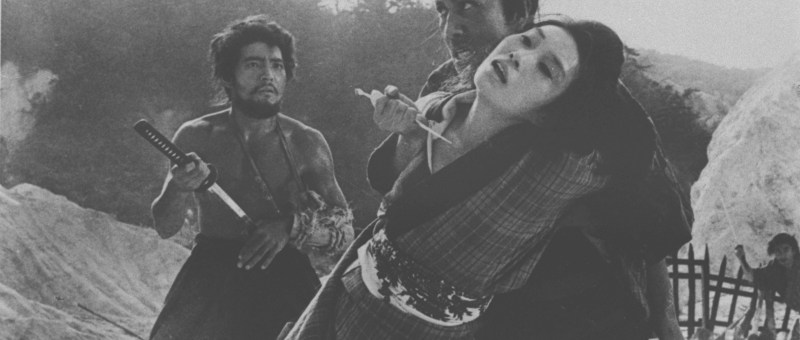
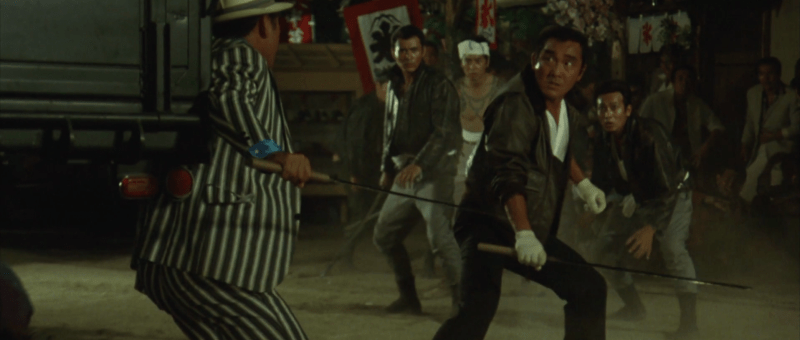
“We ronin must live without mercy” insists a fugitive on a quest for vengeance and riches only to meet his match in the justice-loving wanderer Kiba (Isao Natsuyagi) making his return for Samurai Wolf II: Hell Cut (牙狼之介 地獄斬り, Kiba Okaminosuke: Jigoku Giri). Like the second instalment in many series, Gosha’s avant-garde chambara largely follows the same formula picking up several familiar elements from the first film if giving them a new spin as Kiba once again finds himself caught up in intrigue provoked by the amoral venality of late Meiji society. 

In this case, he makes a rod for his own back by humiliating some swordsmen after catching them harassing a young woman, mocking them when they try to claim that their treatment of her is part of their “training”. Kiba saves the girl, Oteru (Rumiko Fuji), who has some kind of etherial quality and doesn’t quite seem to know what’s going on immediately throwing herself at Kiba who turns her down in gentlemanly fashion. Sometime later, he runs into a convoy of officials transporting criminals to the nearest judicial centre and stops to give the prisoners some of his own water explaining that that from the stream is polluted thanks to leaks from a nearby goldmine. In any case, Kiba is struck by the appearance of one of the men, Magobei (Ko Nishimura), who reminds him of the father who was killed by swordsmen he’d humiliated with his skill. 

Magobei is in chains for murdering the manager of the mine which previously belonged to the shogun but has now been shut down, its seam apparently exhausted. But like the toxins that poured into the river, the mine is a poison to society and in more ways than one. Magobei tells Kiba that he’s been set up. He was hired to kill the manager by a duplicitous gang leader named Jinroku (Bin Amatsu) who has found a new seam and has been operating the mine illegally taking all the gold for himself so obviously Magobei wants revenge. After seeing off an ambush, Kiba agrees to act as a bodyguard delivering both Magobei and the other prisoner, Kihachi (Out Yokoyama) who claims to be a big time bandit in trouble for robbing a samurai family, to the nearest city but secretly seems to sympathise with the injustice dealt to Magobei and the female prisoner who later joins them, Oren the Thistle (Yuko Kusunoki), who murdered a judge who killed her lover. 

Yet Kiba’s memories of his father cloud his judgment about Magobei who is definitely not a man worthy of his faith in him. “What good would pity do?’ Magobei asks, certain that compassion is a weakness and that if he were to give in to human feeling he would immediately be betrayed. The men misunderstand each other, assuming they are alike when in reality they are opposites. Kiba bets on Magobei’s humanity and loses, while Magobei assumes that Kiba will easily be won over by the riches to be found in the goldmine and help to wipe out Jinroku’s gang which is also a family of which Oteru is a member. “Life’s tough that’s how it is” he justifies, but Kiba cannot forgive him not least for his callous murder of a man who was only a frightened braggart and could not have harmed him and a woman who was otherwise blameless. Just as Sanai had in the first film, Magobei tells him that “one day you will be like me” a future that Kiba once again violently rejects. 

But then again he can never escape the world where goldmines pollute the rivers and money can buy anything, even the hearts of men. Just like his father, he’s pursued by the swordsmen he’s unwittingly insulted while discovering his desire to serve justice backfiring, eventually robbing him of the only thing he actually wanted just as it had at the end of the previous film. Even so, Kiba retains his sense of humanity and unlike so many jidaigeki (anti-)heroes refuses to give in to nihilism or despair. A little less avantgarde than the previous instalment, Gosha nevertheless conjures a world of dazzling violence in freeze-frame and silence while once again leaving Kiba the furious wolf to wander, a lonely figure in an unforgiving landscape.


Samurai Wolf 2: Hell Cut opens at New York’s Metrograph on Dec. 26 as part of Hideo Gosha x 3

Original trailer (English subtitles)
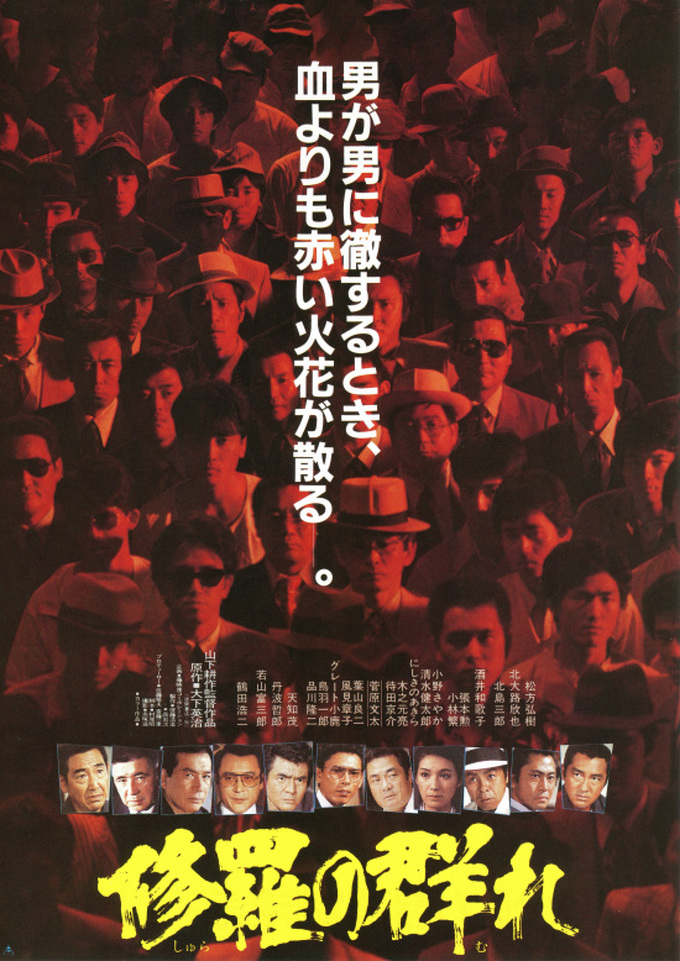
The Story of a Man Among Men (修羅の群れ, Kosaku Yamashita, 1984)

The ninkyo eiga, chivalrous tales of noble gangsters standing up for the little guy with decency and honour, had been Toei’s mainstay throughout the 1960s but a decade later the image of righteous yakuza had been well and truly imploded by the advent of the jitsuroku or “true account” movie which drew inspiration from real life tales of post-war gangsterdom using voiceover narration and onscreen text for added authenticity as it proved once and for all that there was no “honour and humanity” to be found in the gangster life only nihilism and futility. Still, the ninkyo, like many of its heroes, proved hard to kill as 1984’s Story of a Man Among Men (修羅の群れ, Shura no Mure) perhaps proves. A throwback to an earlier era with its infinitely noble hero and unexpectedly if not quite happy then defiantly positive ending, Kosaku Yamashita’s manly drama nevertheless adopts some of the trappings of the jitsuroku in its infrequent use of voiceover and emphasis on concrete historical events. 

The hero, Ryuji Inahara (Hiroki Matsukata), is like many heroes of post-war gangsterdom an orphan though his story begins in the mid-1930s as he’s recruited by a friendly yakuza at a karate dojo. As his teacher explains, Ryuji has already been offered a job with the police but given the chance to join the other side instead immediately agrees, explaining that his life’s ambition has been to gain revenge against the force that ruined his father and destroyed his family, gambling. He chooses to do this, however, not by destroying gambling dens everywhere but by becoming a gambler himself determined to be a winner which is, it seems, a textbook example of having learned the wrong lesson. Still, his noble gangster cool stands him in good stead in the yakuza world where he quickly earns the loyalty of other men, rapidly advancing up the ranks to head his own gang by the crime heyday of the mid-1950s. 

As the title implies, this is a story of a man, a very manly man, among other men. The gangster world is intensely homosocial and founded on ideas of brotherhood and loyalty. Thus, Ryuji finds a surrogate father figure in fellow gangster Yokoyama (Koji Tsuruta) who constantly gives him advice on what it is to be a proper man. “Don’t be a fool, don’t be too smart, and most of all don’t be half-hearted” he advises, later adding “you can’t be a man if you’re dirty about money”, and “taking action isn’t the only way to be a man. It takes a man to have patience.” (this last one as Ryuji hotheadedly discharges himself from hospital to get revenge on a punk who got the jump on him outside a shrine). To be a man, Ryuji intervenes when he sees some less than honourable young toughs hassling an old couple running a dango stand at the beach and the young woman from the caramel stall next-door, throwing his entire wallet on their counter to make up for the damage in what will become something of a repeated motif. His manliness earns him the eternal devotion of the young woman, Yukiko (Wakako Sakai), who eventually becomes his devoted wife against the will of her concerned mother who is nevertheless brought round on realising the love she has for him because of his intense nobility. 

Indeed, Ryuji lives in a noble world. He’s a gambler by trade but only because he hates gambling and is trying to best it. He doesn’t participate in the seedier sides of the yakuza life such as drugs or prostitution and is also in contrast to jitsuroku norms a humanist who defiantly stands up against racism and xenophobia, taking another gambler to task for using a racial slur against a Korean opponent while opting to befriend the “foreign” gangs of Atami when eventually put in charge of the lucrative area rather than divide and conquer. This is apparently a lesson he learned from his flawed but goodhearted father who hid a Korean man and his daughter from the pogroms after the 1923 earthquake because “we’re all the same human beings”. Spared the war because of an injury to his trigger finger, Ryuji kicks off against an entitled son of a gang boss for acting like a slavedriver while working at a quarry but earns only the respect of his superiors further enhancing his underworld ties because of his reputation as a standup guy willing to stand up to oppression. 

Such an intense sense of uncomplicated righteousness had perhaps been unseen since the ninkyo eiga days, and Ryuji’s rise and rise does in that sense seem improbable as his goodness only aids his success earning him the respect of over 1000 foot soldiers even as he finds himself in the awkward position of having to exile one of his most trusted associates for getting too big for his boots and disrespecting the yakuza code. His children also suffer for their connection to the gangster underworld, but are reassured that their father is a good man if with the subtle implication that he has damned them as his father did him. Shot with occasional expressionist flourishes such as crashing waves or a midnight sky, A Story of a Man among Men is not free from manly sadness and indeed ends on the sense of a baton passing from one era to another but does so with an unexpected sense of moral victory for its righteous hero who vows to bring his manly ideas with him into a new age of gangsterdom. 


Original trailer (no subtitles)

Snake Princess (新蛇姫様 お島千太郎, Tadashi Sawashima, 1965)

Hibari Misora fights Edo-era corruption once again in another jidaigeki musical adventure from Tadashi Sawashima. Snake Princess (新蛇姫様 お島千太郎, Shin Hebihimesama Oshima Sentaro) sees her doing double duty as a sake-loving stage performer in love with a reluctant revenger, and an austere princess mourning the murder of her confidant and only friend but, as in some of her other films, the resemblance is never remarked upon nor is it any kind of plot point. There isn’t even really a “snake princess”, though snakes and the supernatural do play their part and there is perhaps less space for the derring-do and swashbuckling musical numbers which typically characterise a Hibari picture. 

The film opens with stage performer Oshima (Hibari Misora) waking up from a drunken snooze on a riverbank and realising she’s been left behind by her acting troupe. Running into the mysterious Ittosai (Minoru Oki) on her way, she hurries on to the next town to catch them up while he heads in the opposite direction towards Karasuyama and the Princess Koto (also played by Hibari Misora). Meanwhile, in the town, a rowdy samurai starts a drunken fight in an inn, demanding to drink with the innkeeper’s pretty daughter Suga (Tomoko Ogawa). The innkeeper refuses, offering the excuse that his daughter is at the palace with the princess, but the samurai doesn’t take no for an answer and starts thrashing about with his sword eventually killing the innkeeper for the offence he feels has been caused to him. The innkeeper’s son Sentaro (Yoichi Hayashi), a former pupil of Ittosai, then kills the samurai in revenge and is forced on the run, taken in by the leader of Oshima’s acting troupe, Juzo (Takashi Shimura), who apparently knew his father well. 

What ensues is of course a tale of intrigue and revenge mixed with mild romantic melodrama. Oshima begins to fall for Sentaro, but is warned that he is from a prominent non-samurai family and as such is unlikely to marry a travelling actress, itinerant players then belonging to a kind of underclass which is in part one reason why it is so easy for Sentaro to hide among them. Even so he is also subjugated by the samurai who frequently object to being ordered around by “commoners”, insistent on their privilege the refusal of which is the reason Sentaro’s father had to die. 

Meanwhile,  the Princess Koto is herself oppressed within the feudal system as a female ruling a clan in the absence of her father who has placed her in charge while he remains in the city. While Oshima falls for Sentaro, the relationship between Koto and Suga is perhaps transgressively equally close, Koto describing Suga as the only one she can trust within her own court and plaintively asking her to stay by her side forever. Unfortunately however Suga is murdered by the male court conspirators attempting to wrest power from the princess on her way back with evidence of their smuggling plot after meeting Ittosai on Koto’s behalf. Misled into thinking that Koto had his sister killed, Sentaro plots revenge but on learning the truth asks her why she hasn’t dealt with the wrongdoing among her own retainers, only later realising that even as the leader of the clan she lacks the power to do so and remains in a precarious position. 

Arguably, Oshima has more freedom, fearlessly walking the roads alone, drinking and gambling with the men refusing to abide by traditional social codes though perhaps in some ways permitted to do so precisely because of her position within the entertainer underclass. A further gender reversal sees the fallen Sentaro temporarily resorting to sex work as a host at an inn drinking with a melancholy noblewoman who fully expects to bed him for her five Ryo only for Sentaro to become indignant and throw the money back in her face, much to Oshima’s approval though she later becomes jealous and irritated questioning him if he’s ever done this sort of work before as if it would actually change her feelings for him. While Sentaro is forced into but then rejects the subjugated female role, Oshima chooses the male solution of trying her luck at the gaming tables, occasionally charging into a fight wielding a nearby object such as a handy water bucket. 

The snake theme of the title links back to the supernatural appearances of Suga’s silent ghost, protecting the princess with a wall of serpents when Sentaro plans to attack under the false assumption that she was responsible for his sister’s death. Musical numbers are largely restricted to a lengthy stage performance featuring Oshima and Sentaro’s evolving act utilising several sets and elaborate design while Sawashima ups the game a little from the lower tier Toei norm with varying locations shifting from a set-bound snowscape as Oshima is carted off by local goons, to a shot-on-location set piece as the conspirators take down a spy in the rocky desert. Revenge is eventually taken not only for the murders of Sentaro’s father and sister, but for the samurai transgressions of the Edo era, restoring order by wiping out the bad apples but also allowing Sentaro to free himself from his class-bound destiny and pursue a life, and love, of his choosing regardless of contemporary social codes.


Musical sequences (no subtitles)

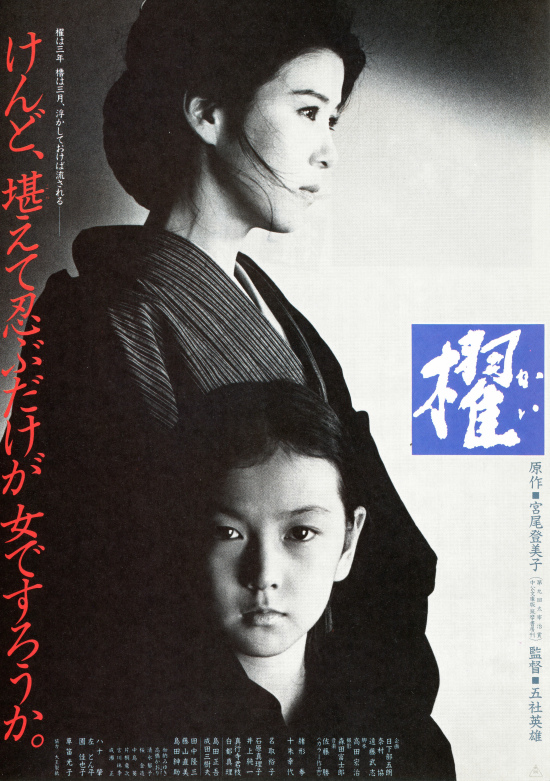
Oar (櫂, Hideo Gosha, 1985)

oar posterUntil the later part of his career, Hideo Gosha had mostly been known for his violent action films centring on self destructive men who bore their sadnesses with macho restraint. During the 1980s, however, he began to explore a new side to his filmmaking with a string of female centred dramas focussing on the suffering of women which is largely caused by men walking the “manly way” of his earlier movies. Partly a response to his regular troupe of action stars ageing, Gosha’s new focus was also inspired by his failed marriage and difficult relationship with his daughter which convinced him that women can be just as devious and calculating as men. 1985’s Oar (櫂, Kai) is adapted from the novel by Tomiko Miyao – a writer Gosha particularly liked and identified with whose books also inspired Onimasa and The Geisha. Like Onimasa, Oar also bridges around twenty years of pre-war history and centres around a once proud man discovering his era is passing, though it finds more space for his long suffering wife and the children who pay the price for his emotional volatility.

Kochi, 1914 (early Taisho), Iwago (Ken Ogata) is a kind hearted man living beyond his means. Previously a champion wrestler, he now earns his living as a kind of procurer for a nearby geisha house, chasing down poor girls and selling them into prostitution, justifying himself with the excuse that he’s “helping” the less fortunate who might starve if it were not for the existence of the red light district. He dislikes this work and finds it distasteful, but shows no signs of stopping. At home he has a wife and two sons whom he surprises one day by returning home with a little girl he “rescued” at the harbour after seeing her beaten by man who, it seemed, was trying to sell her to Chinese brokers who are notorious for child organ trafficking.

Iwago names the girl “Kiku” thanks to the chrysanthemums on her kimono and entrusts her to his irritated wife, Kiwa (Yukiyo Toake), who tries her best but Kiku is obviously traumatised by her experiences, does not speak, and takes a long time to become used to her new family circumstances. Parallel to his adoption of Kiku, Iwago is also working on a sale of a girl of a similar age who ends up staying in the house for a few days before moving to the red light district. Toyo captures Kiwa’s heart as she bears her sorry fate stoically, pausing only to remark on her guilt at eating good white rice three times a day at Iwago’s knowing that her siblings are stuck at home with nothing.

Iwago’s intentions are generally good, but his “manly” need for control and his repressed emotionality proceed to ruin his family’s life. He may say that poverty corrupts a person’s heart and his efforts are intended to help prevent the birth of more dysfunctional families, but deep down he finds it hard to reconcile his distasteful occupation with his traditional ideas of masculine chivalry. Apparently “bored” with the long suffering Kiwa he fathers a child with another woman which he then expects her to raise despite the fact that she has already left the family home after discovering the affair. Predictably her love for him and for the children brings her home, but Iwago continues to behave in a domineering, masterly fashion which is unlikely to repair his once happy household.

Kiwa is the classic long suffering wife, bearing all of Iwago’s mistreatments with stoic perseverance until his blatant adultery sends her running from marriage to refuge at the home of her brother. Despite the pain and humilation, Kiwa still loves, respects, and supports her husband, remembering him as he once was rather than the angry, frustrated brute which he has become. Despite her original hesitance, Kiwa’s maternal warmth makes a true daughter of Kiku and keeps her bonded to the eldest and more sensitive of her two sons, Ryutaro, even if the loose cannon that is Kentaro follows in his step-father’s footsteps as an unpredictable punk. Her goodheartedness later extends to Iwago’s illegitimate daughter Ayako whom she raises as her own until Iwago cruelly decides to separate them. For all of Iwago’s bluster and womanising, ironically enough Kiwa truly is the only woman for him as he realises only when she determines to leave. Smashing the relics of his “manly” past – his wrestling photos and trophies, Iwago is forced to confront the fact that his own macho posturing has cost him the only thing he ever valued.

Gosha tones down the more outlandish elements which contributed to his reputation as a “vulgar” director but still finds space for female nudity and frank sexuality as Iwago uses and misuses the various women who come to him for help or shelter. More conventional in shooting style than some of Gosha’s other work from the period and lacking any large scale or dramatic fight scenes save for one climactic ambush, Oar acts more as a summation of Gosha’s themes up until the mid-80s – men destroy themselves through their need to be men but also through destroying the women who have little choice but to stand back and watch them do it. Unless, like Kiwa, they realise they have finally had enough.


Short clip from near the beginning of the film (no subtitles)