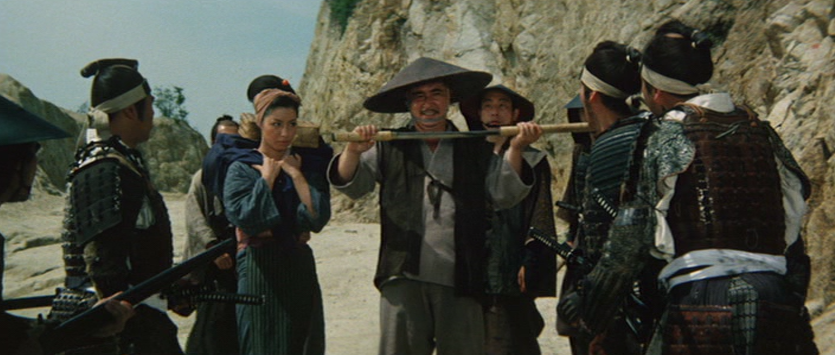
Killer’s Mission (賞金稼ぎ, Shigehiro Ozawa, 1969)

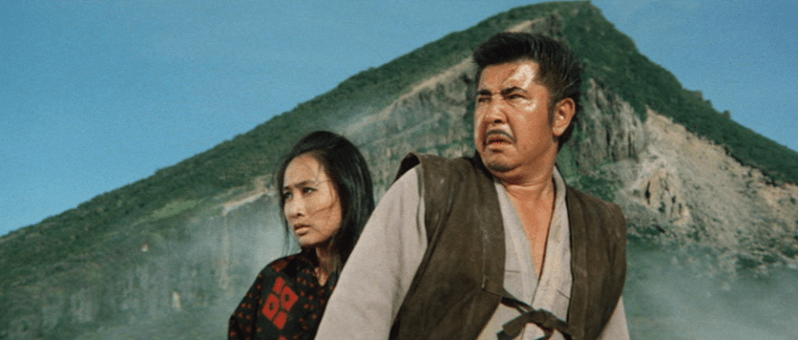
According to the title card at the beginning of Shigehiro Ozawa’s Killer’s Mission (賞金稼ぎ, Shokin Kasegi), none of the events it depicts have been recorded in history because the shogunate decided to erase them all in fear of the effect they may have on the nation’s geopolitical stability. Nevertheless, it gives some very concrete dates for its historical action, even if they may not make complete sense while foreshadowing the political turbulence of the following century. 

What it essentially attempts to do is tell a James Bond-style tale of political intrigue in a feudal Japan in which perpetual peace has begun to create its own problems. Here played in a cameo appearance from Koji Tsuruta, the Shogun Ieshige was weak in part because he was in poor health and had a speech impediment which led him to be rejected by his retainers. The problem here, however, is with Satsuma which has been on bad terms with the Tokugawa shogunate since the Battle of Sekigahara after which they took power. Satsuma will in fact be at the centre of the conspiracy to overthrow the government in the following century, but for the purposes of the film have fallen foul of a rumour that the plan to do an arms deal with some Dutch sailors who sailed South to Kyushu after being rebuffed in Edo. 

A civil war is feared and in the interests of maintaining peace, Ieshige sends his trusted spy Ichibei (Tomisaburo Wakayama) to protect Satsuma official Ijuin Ukiyo (Chiezo Kataoka) in the hope that he will be able to talk his young and naive lord out of doing the deal. Ostensibly a doctor by trade, Ichibei has a series of spy gadgets such as hidden blades and collapsible guns stored in a secret room at his surgery which he then carries in a black leather utility belt. He keeps the nature of his mission close to his chest, but often double bluffs by simply telling people he is a shogunate spy or otherwise adopting a disguise as he does in a moment of meta comedy impersonating the signature role of his brother Shintaro Katsu by posing as a Zatoichi-style blind masseur. 

As if to signal the cruelty of the feudal world, Ichibei comes across the corpses of suspected spies abandoned outside Satsuma territory while his enemies meditate on their ancient slight and consider taking the deal in the hope of avenging their defeat and overthrowing the Tokugawa. They are warned that creating unrest and sowing division may be exactly what foreign powers like the Dutch crave, but aren’t particularly bothered, preferring to take their chances with them rather than curry favour with the Shogun and possibly destabilising the entire society along with it. 

Of course, much of this is anachronistic with the Dutch sailors appearing in a distinctly 19th century fashion carrying weapons which are also too advanced for the era as are Ichibei’s folding pistols. Through his travels, he runs into a female Iga spy who too can do some nifty ninja tricks and has a gadget of her own in a comb which can shoot poison darts, though luckily it’s one of the poisons Ichibei has already developed an immunity to. Ichibei is fond of crying that you kill him he’ll simply come back to life, barrelling through the air with feats of improbable human agility and generally behaving like some kind of supernatural entity with a secondary talent for violent seduction. 

Though ironic and often darkly comic, there is an unavoidable poignancy in the inner conflict of Ijuin who knows his clan is about to do something very foolish but is torn between his duty to obey them and that to act in their best interests, eventually backed into a corner and left with no real way out of his predicament. As Ichibei points out, it’s difficult to keep the peace, especially when restless young samurai spot opportunities to cause chaos and the outside world knocks on the door of a closed community. Even so, Ozawa ends on a romantic image of a beach at sunset somehow undercutting the violence and tragedy with the restoration of an order that might itself be imperfect in its peacefulness.
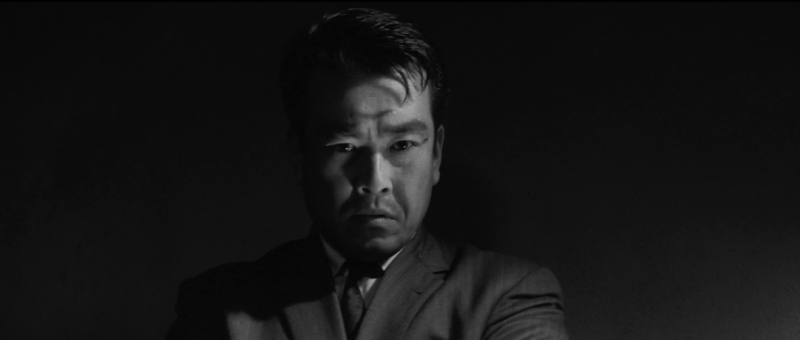

The Desperate (どろ犬, Takaharu Saeki, 1964)

A bruiser cop railing against the system is pulled towards the dark side in Takaharu Saeki’s icy noir, The Desperate (どろ犬, Doro Inu). Adapted from a novel by Shoji Yuki, the film is one of only two Saeki directed in an otherwise lengthy career mainly spent in television and captures an eerie sense of existential dread as its detective hero sinks to even greater depths in a quest for self preservation while kicking back against the hypocrisies of the post-war society. 

As one officer puts it, Sugai (Minoru Oki) is one of many veteran officers who can’t adjust to new codes of justice in the democratic era. In the film’s opening sequence, he’s pulled aside and warned about using excessive force on a suspect only to counter that he knows the guy’s guilty so he doesn’t see what the problem is. Sugai had been particularly motivated about this case as the victim was an 18-year-old girl raped after accepting a lift from a stranger. She was so traumatised that she could hardly speak but did remember the registration plate of the car. She’d only been working because her father lost his factory job though he appears to have begun drinking and is abusive towards his daughter for her silence, later coming to the station to drop the charges after being paid off by the suspect’s lawyer. The legal definition of rape in this era is founded not on an idea of consent but whether violence was involved and the victim can be proved to have resisted physically. The guilty party, Tomita (Hideo Murota) claims that nothing illegal transpired in his car and then walks away with a smirk when his lawyer gets him off the hook. It’s all too much for Sugai to bear, resentful that the rich and powerful are now effectively above the law thanks to legislation he feels ties his hands as a police officer. 

It’s at this point he runs into petty yakuza Yamaguchi (Ko Nishimura) whom he’s been trying to turn as an informant, unwisely mouthing off about his dissatisfaction with contemporary law enforcement only for Yamaguchi to turn the tables and effectively blackmail him having discovered that Sugai has begun a relationship with the estranged wife of an imprisoned gangster. In an act of petty revenge and desperation, Sugai leaks info on “guilty” suspects who weren’t charged to Yamaguchi who exacts financial justice by extorting them for money while threatening to expose their immorality. 

Disappointed in him, the gangster’s wife, Chiyo (Chisako Hara), exclaims that Sugai’s no different from her husband and in truth he isn’t. Part of Sugai’s resentment lies in the fact his wife left him for another man while he was on a stakeout, frightened by his violence and insisting that she hated detectives. His old-fashioned police tactics include taking suspects to the dojo where beats the living daylights out of them. Later he tells another, more earnest officer, he reminds him of himself when he was younger implying that he has become corrupted by the times and the impossibility of justice, particularly for young women whom he feels an urge to protect, in a world ruled by money and status. He may feel some pangs of guilt for a rookie who is unfairly fingered as the mole on the grounds that he and Yamaguchi were originally from the same area and had a past acquaintance, but in the end is happy enough to scapegoat him for his wrongdoing while he continues trying to dig himself out a hole but falling still further into the abyss. 

Sugai is merely trying to save his own skin, but those around him are desperate too. His opposite number, Toku (Hisashi Igawa) is desperate to clear his name, while Chiyo is desperate for what she describes as a proper marriage to a proper man while seemingly kept captive in the apartment Sugai rents for her on his meagre police salary but does not live in himself. She wants to work and has an innocent desire to buy him some better shoes that he otherwise resents in its implied challenge to his masculinity that he evidently cannot afford all this additional expense coupled with the strain of keeping his problematic relationship with a gangster’s wife secret from his employers. In the end he claims that the problem was he couldn’t escape from being a detective, pushed into desperate acts of destruction as a man now exiled from his times unable to move on from post-war chaos into a newly democratic, consumerist Japan. Saeki ends his fatalistic vision with an image of a train reeling backwards, echoing the degree to which Sugai has lost control of his life and himself no longer a detective but only a man without a moral compass whose path can only lead in one direction. 


The Passionate Spinster (結婚相談, Ko Nakahira, 1965)

A woman still unmarried at the comparatively late age of 30 begins to go out of her mind while on a hellish descent into vice and crime in Ko Nakahira’s darkly comic satire, The Passionate Spinster (結婚相談, Kekkon Sodan). Shimako (Izumi Ashikawa) begins to feel as if her existence has no value as a single woman who has already aged out of the arranged marriage market, pressured by her family members to settle down and with seemingly no possibility of supporting herself as an independent woman almost as if such a thing could not exist even in the more enlightened world of 1965.

Shimako’s age is her primary problem. We often see her using some kind anti-aging device on her face and reapplying her makeup but as others reveal men in search of marriage are looking for women in their early 20s as is soon confirmed to her when she decides to visit a matchmaking agency after attending the wedding of a close friend, Mikiko (Michiyo Yokoyama), at which she is made to feel like something of an embarrassment giggled at by her younger coworkers who regard her with thinly concealed pity. As a voiceover explains, far more women sign up to matchmaking agencies than men while the age range is typically late 20s. Men’s only condition is that the woman be young, while women are mainly concerned with a man’s height and educational background. Shimako is not particularly picky and simply lists that she’d prefer a man of over 170cm in height, under 35 years old, and a university graduate but despite the beauty with which she is often credited she soon discovers that being over 30 is a deal breaker for most. 

The first man she meets remarks to the matchmaker that she looks “young” for her age and then inappropriately adds that she must be virgin, but eventually decides to marry a 24-year-old woman introduced by his boss. The second, a farmer with an interest in electronics, makes her an offer but is quickly vetoed by his family who feel that there must simply be something wrong with a woman who remains unmarried at 30. The last man the matchmaker, Tonobe (Sadako Sawamura), suggests is a 50-year-old widower named Hidaka (Tatsuo Matsushita) whom Shimako only considers out of desperation but later warms to uncomfortably because he reminds her of the father she lost in the war. Hidaka tells he that once they marry he will be a “father” to her too while taking this as a firm promise Shimako ends up sleeping with him to seal the deal. 

It’s with this that she damns herself, driven into a near nervous breakdown on realising that Hidaka may have been just another married man using a dating agency for extramarital sex. Then again, she’s told this by Tonobe who as it turns out, despite her frequent claims of being “not a yakuza” and concern for her agency’s reputation fearing she will be accused of running an illicit sex ring, is actually doing exactly that. Shimako accepted money from Hidaka and in so doing could be taken for a sex worker. Reminding her that sex work is against the law, Tonobe essentially blackmails Shimako into quitting her office job to work for the agency full time as a call girl, “protected” and “observed” by her two goons one of whom the agency’s other girl, Asako (Michiko Sasamori), suggests is actually Tonobe’s husband. 

In another kind of film, Shimako’s new line of work may have proved liberating, freeing her from the patriarchal ideals surrounding marriage, but it’s true enough that she falls into in a dangerous underworld as a virtual slave of the increasingly monstrous Tonobe whose demonic laughter begins to ring in Shimako’s ears along with all the criticism she’s received from men so far regarding her age. She seeks romantic escape after bumping into office lothario Takabayashi (Masaya Takahashi) who ironically asks her to pose as his fiancée to help him get rid of a problematic bar hostess who’s latched on to him. He promises to marry her too, only it soon transpires that he has massive debts and has been embezzling money from the company which he fears will soon be discovered because of an unexpected merger. Just as Hidaka had offered to become her father, Takabayashi likens her to his mother adding that he was never breast fed. 

With somewhat incestuous overturns, the lines between to blur between the ideals of wife and motherhood as Shimako becomes in effect responsible for a failed man pledging that she will use her body to pay off the debt that Takabayashi owes so that he won’t be prosecuted while believing that he will actually marry her. But her body belongs to Tonobe who reminds her that though she doesn’t care who she marries (an odd comment considering how they met) uncompensated romance is against the rules and she must now be punished in being sent to a further level of hell in essentially being offered up to an ogre in a remote Western-style mansion. Taking on gothic overtones, Shimako unexpectedly finds a kind of fulfilment while essentially embodying maternity in fulfilling the oedipal desires of a young man apparently driven mad who immediately tells her that avatars of his mother have appeared in this place before ominously adding that he has killed all the “fake” ones. Shimako later tells his sympathetic mother that her son was the best of the men she’s met while doing this kind of work and the first she’s slept with whose feelings were pure. 

Through this expressionist sequence which takes place during a gothic, violent storm surrounded by pictures of the Madonna, Shimako undergoes the first of her rebirths in effect giving birth to herself as a woman no longer quite so concerned with the necessity of being married though the film strongly implies she soon maybe. Her maternity is later reconfirmed when she unexpectedly reunites with her former boss, possibly the only “good” man seen in the film in having embraced his own paternity while caring for a wife with a longterm illness and raising his two children. His wife having died, when Shimako meets him again it’s almost as if she were meeting her own father in the memory she described to Hidaka though he is much closer to her in age while also unlikely to have any strong feelings either way regarding either her being over 30 or the scandals surrounding everything that happened to her after quitting the company. 

The film may suggest that it’s partly Shimako who is “old-fashioned”, something she later accuses her mother of being once she discovers that Shimako has been engaging in a sexual relationship with Takabayashi on only the promise of marriage, in contrasting her with the slightly younger Sakata (Kaoru Hama) who scoffs that she wants to put off her (already confirmed) marriage because she’s only 23 and wants to have a little fun first later seen in a nightclub with a gang of rough-looking guys who nearly cart off a near comatose Shimako, but then stops short of actually critiquing the institution of marriage only suggesting that Shimako’s intense anxiety was misplaced because the right man would have come along eventually. It may expose the matchmaking agency for what is really is and in its way fight back against the archaism of the arranged marriage along with the patriarchal social system and its intrinsic ageism but leans towards the view that a woman’s value lies in maternity in positioning Shimako to become a stepmother rather than simply a wife. Nakahira shoots with a noirish intensity before descending into a gothic eeriness in the demonic laughter of the incredibly sleazy Tonobe and creepiness of the mansion even if what Shimako discovers there is perversely a kind of purity that finally allows her to reclaim an image of herself as a pure woman even in the depths of her degradation. 


The Dry Spell (渇水, Masaya Takahashi, 2023)

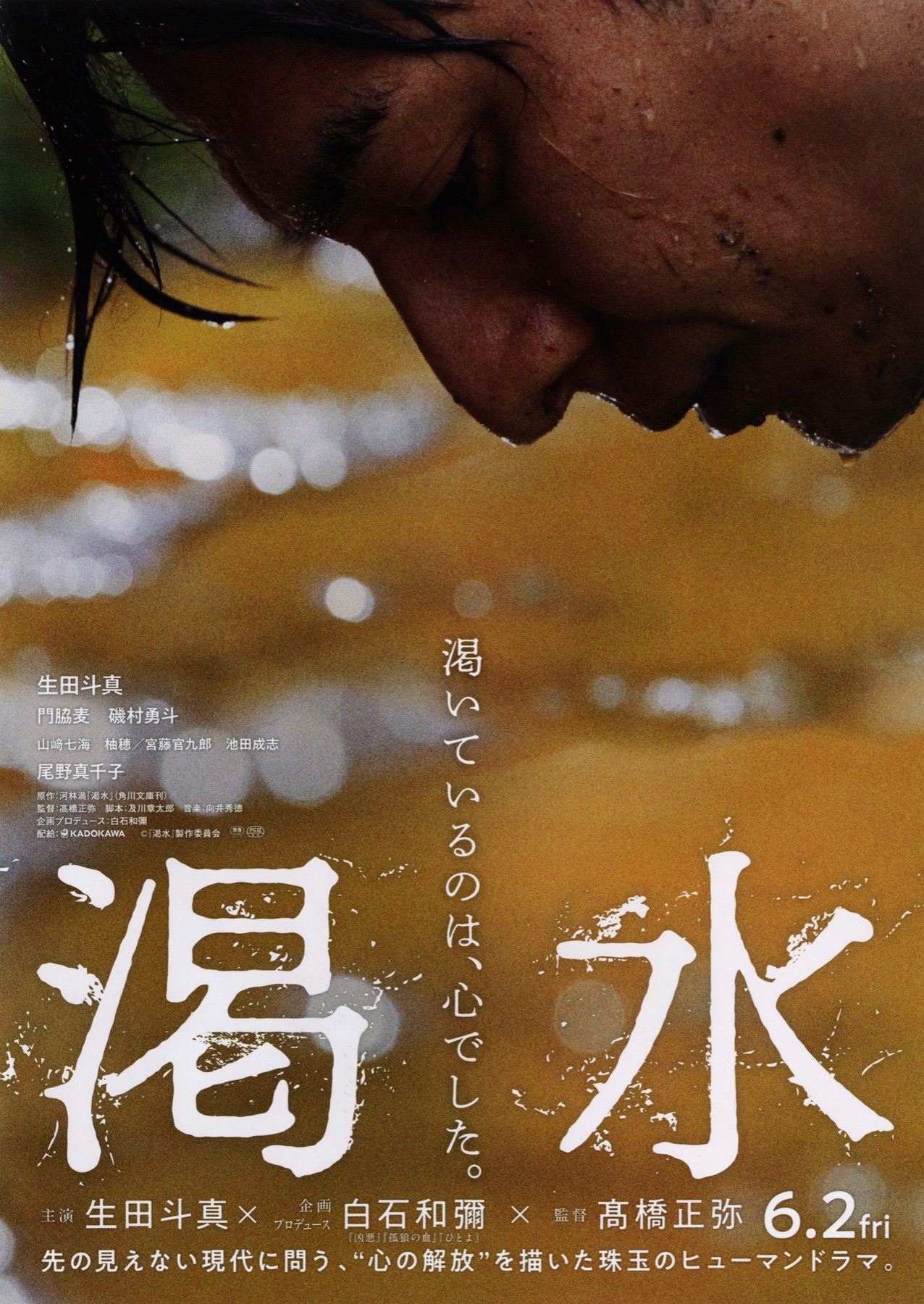
A literal drought becomes a metaphor for bureaucratic heartlessness in Masaya Takahashi’s empathetic social drama The Dry Spell (渇水, Kassui). Inspired by Mitsuru Kawabayashi’s 1990 novel, the film puts a contemporary spin on prejudice and poverty as a collection of officials from the waterboard point at airconditioners and mobile phones while asking why the residents have fallen into arrears with their water payments only to reflect that yes, water like air and sunlight should be free.

The argument that one of Iwakiri’s (Toma Ikuta) colleagues makes, is that they have a right and a duty to charge for the water supply to support the nation’s infrustructure along with their advanced purifcation system which keeps people safe. Iwakiri isn’t so sure about that, but as others later say of him he’s a man who’s made of water himself. He doesn’t like his job but he doesn’t really dislike it either and justifies himself that it’s not him turning people’s water off so much as it’s a natural consequence of them not paying their bills and all they need to do to get it turned back on is settle them. But then as another colleague who eventually refuses to continue cutting people off suggests, every time you do it you lose a little piece of your soul. 

Iwakiri may not have had much of a soul to begin with. He’s as dried up as the town in the middle of a recordbreaking drought and heatwave. Having endured a difficult childhood, he’s become alienated from his wife and son who have decamped to her hometown with no clear indication of when or if they’ll return. That may be one reason he finds himself empathsithig with a pair of sisters who have been abandoned by both parents and are living alone in a house that has already had its gas and electricity supplies cut off. Iwakiri turns off their water supply because it’s the rules, but begins to hate himself for doing it and develops a desire to go against the flow for the first time in his life.

Keiko (Nanami Yamazaki) and Kumiko (Yuzuho) are a pair of water babies who have a yearning for the sea and the father who was apparently once a sailor but seemingly disappeared a year previously while their disappointed mother does her best to support the family through sex work which is as she points out the only line of work open to a single mother with limited qualifications. Iwakiri advises her to apply for benefits but she refuses on the grounds that she doesn’t want them poking around in what she describes as a complicated family situation which makes plain her predicament. But even as Iwakiri begins to meditate on his own paternal failures, his partner Kida (Hayato Isomura) flows in the opposite direction keener to hold onto his job after he learns he’s a baby on the way and unwilling to rock the boat despite how much he may also feel that water should be free. 

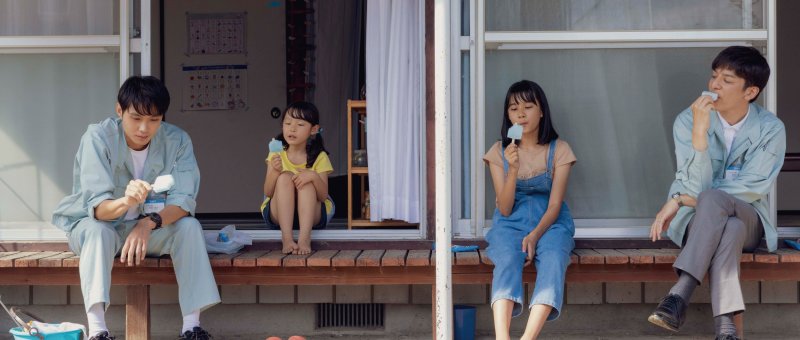
In any case, Iwakiri is trying to un-dam himself, waiting for the great big rain that Kumiko says will make everything go back to normal. Except it won’t, at least not literally  though it will in some senses open the flood gates liberating Iwakiri from his emotional repression and the girls from their illusions accepting that they are now alone but will always have each other. As he points out, they are just watermen and there’s not much they can do for the struggling people whose supplies they’ve cut off. It wouldn’t help to pay their bills for them even if they could, and in a better world water should indeed be free though it becomes much harder for them to justify their complicity with a heartless system that can arbitrarily remove access to something so essential for life. Takahashi flits between cheerful scenes of ice lollies in the sun to the cruel realities of the lives of Keiko and Kumiko who continue to long for the sea as does Iwakiri in struggling to repair his relationships with his wife and son while trying to escape the legacies of own traumatic upbringing. The film doesn’t offer any easy answers, but does perhaps suggest that the rain will bring change and the promise of a better future.


The Dry Spell screened as part of this year’s Camera Japan.

Original trailer (no subtitles)

Air Doll (空気人形, Hirokazu Koreeda, 2009)

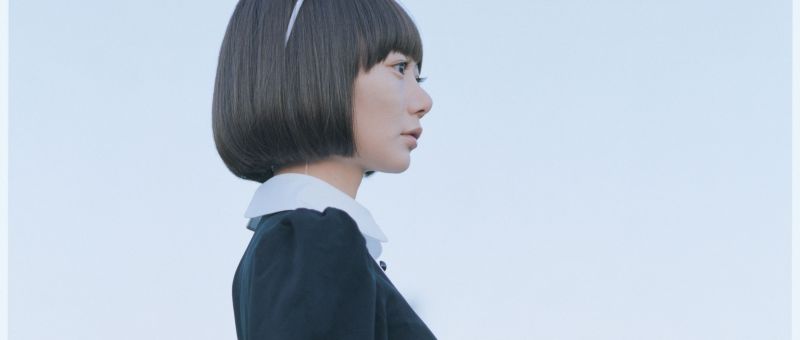
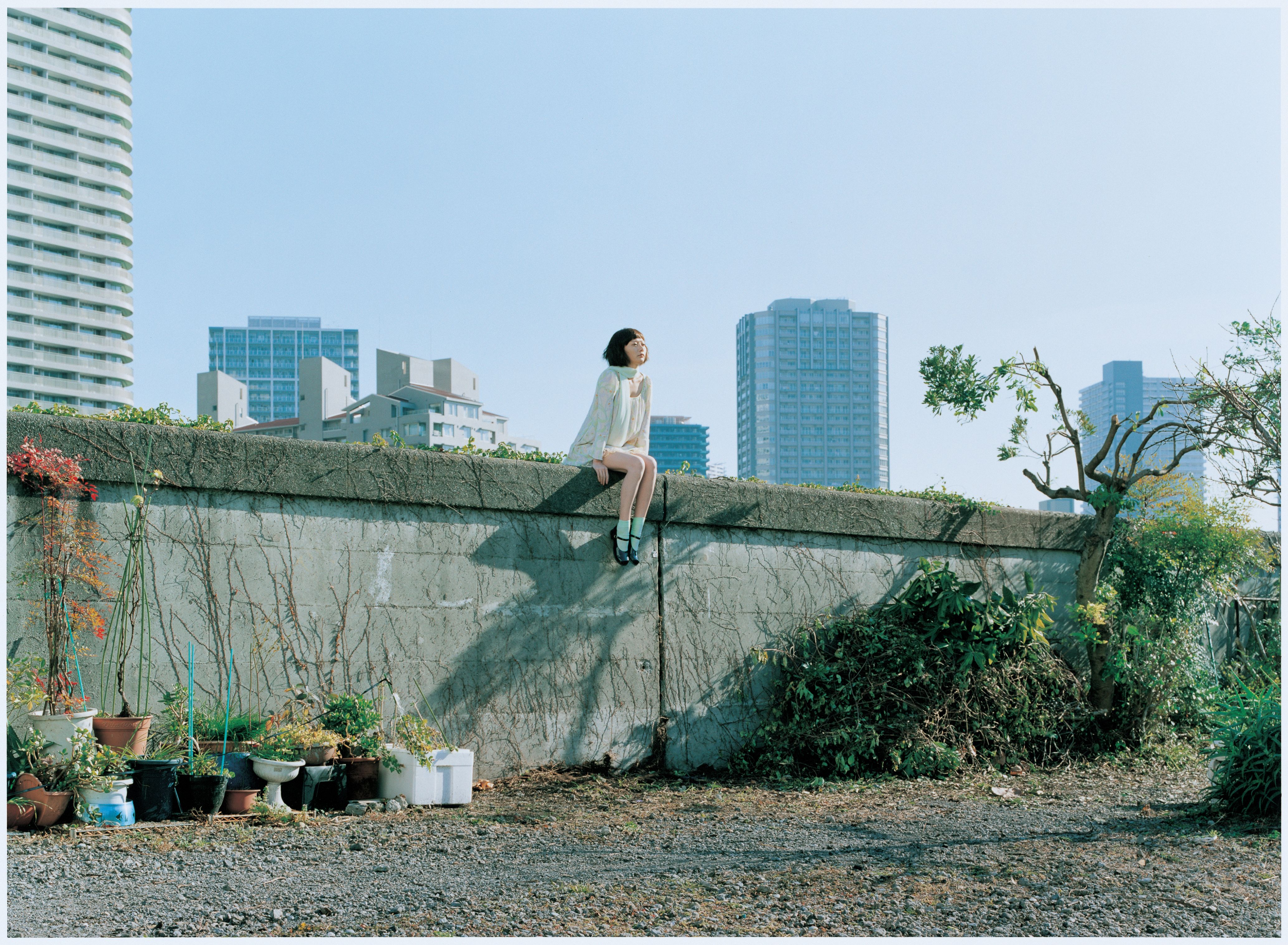
“Was everything you saw in this world sad? Was there something, anything, what was beautiful?” the heroine of Hirokazu Koreeda’s exploration of urban loneliness Air Doll (空気人形, Kuki Ningyo) is asked by her creator though he can offer her few answers for the strange mystery of her life. Like a child, she takes beauty where she finds it yet much of what she sees is indeed sad as she reflects on the disconnected lives around her, the emptiness and futility of life in the contemporary society where everything is just a substitute for something else which cannot be obtained. 

As for herself, she is quite literally empty inside, an inflatable sex doll owned by middle-aged family restaurant waiter Hideo (Itsuji Itao) who has given her the name of his ex, Nozomi (Bae Doona), which ironically means hope, wish, or desire though not generally of the sexual kind. Yet one day she suddenly wakes up and begins to explore the world rejoicing in its new sensations feeling the rain on her hands and the wind that sounds the chimes as she watches her neighbours go about their daily routine. Dressed in the French maid’s outfit picked out for her by Hideo she gets a job at a local video store and begins living a more independent life while learning how to operate in human society. She feels herself out of place but is repeatedly told that there are others like her, mistaking her literal emptiness for their spiritual despair. 

Yet that sense of emptiness and futility is evident from Nozomi’s first forays into the human world in that the first act of mundanity she witnesses is the bin men sorting rubbish for disposal. “Unfortunately they’re non-burnable” Nozomi’s creator explains when she visits him in search of answers revealing he throws out the broken dolls that are returned to him once a year, “after all, once we die we’re burnable garbage. It’s not such a big difference” he adds, though as it turns out it is quite a big difference to Nozomi in ramming home to her that she can never become human and will always be something else, an inorganic “substitute” for something perceived as the “real”. 

“Your only flaw is that your body’s so cold” Hideo ironically laments as he warms her up in the bath, something she is told repeatedly to remind her that though she has discovered a heart it does not beat and she is not “alive”. Yet an old man (Masaya Takahashi) seeking a different kind of comfort later remarks that those with cold hands often have warm hearts as he reflects on his own life as a “substitute” teacher while she looks over the pictures of the many dogs he’s had through the course of his life as substitutes for the traditional family that have only left him feeling lonelier through their inevitable absences. There is perhaps in this a slightly conservative and uncomfortable implication that the loneliness we see in everybody that we meet is partly caused by the decline of the traditional family itself partly a consequence of the shifting gender roles of the later 20th century society. When they first meet, Nozomi has been rejected by a group of local mothers for inappropriately cooing over a baby in a pushchair the old man comforting her with a tale of the mayfly which is itself empty inside existing only to give birth and then die its own life defined by futility. Nozomi can never truly be human, but more than that she can never truly be a woman because she cannot reproduce as signalled in her final exchange with a little girl in her neighbourhood who swaps her beaten up and broken doll, a substitute for her absent mother now symbolic daughter to Nozomi, in exchange for her ring, a symbol of adulthood. 

In this way Nozomi becomes herself a symbol of something that is broken, an active barrier to societal happiness in providing a way for men like Hideo to escape the responsibility of the traditional family by satisfying his sexual desire through a fantasy of intimacy with an inanimate substitute. When Nozomi throws her pump away, Hideo buys a new model and when she confronts him he asks her to go back to being a passive doll because he finds all the human stuff “annoying” and only wants a woman who can be a selfless embodiment of his desires, will never talk back, challenge him, or hurt his feelings. Meanwhile, when her boss at the store (Ryo Iwamatsu) who seems have experienced a recent familial breakdown of his own blackmails her into having sex with him in the bathroom he is conversely annoyed by her passivity while tearfully calling out his wife’s name. Even her innocent love for coworker Junichi (Arata Iura) has its darkness, not only does she suspect she’s merely a substitute for his ex, his fetishisation of her revolves around his ability to take control over life by letting out her air and then permitting her to live by blowing his own back into her. 

“I am an air doll. A substitute for sexual desire” is how she introduces herself, preoccupied with her literal emptiness yet along with a heart discovering a sense of self as she interacts with others, beginning to wear her own clothes rather than those purchased for her by Hideo. At a moment of crisis she is surrounded by all the treasures she’s collected which ironically include a number of ornaments intended for a doll’s house including a tiny simulacrum of a cake which reappears in her imaginary birthday party suggesting that the only true happiness is to be found in wishful fantasy while the “real” will only ever disappoint. Nevertheless, she uses her last breath to bring happiness to all she can, uniting the old man with a lonely old woman (Sumiko Fuji) who confesses to random crimes just to have someone to talk to. Shot with unusual fluidity by Mark Lee Ping-Bing, Koreeda captures a society in flux in which the easy convenience of disposable consumerism has begun to replace human relationships and left us all empty inside. 


Air Doll in in US cinemas and on VOD Feb. 4 courtesy of Dekanalog

Trailer (English subtitles)

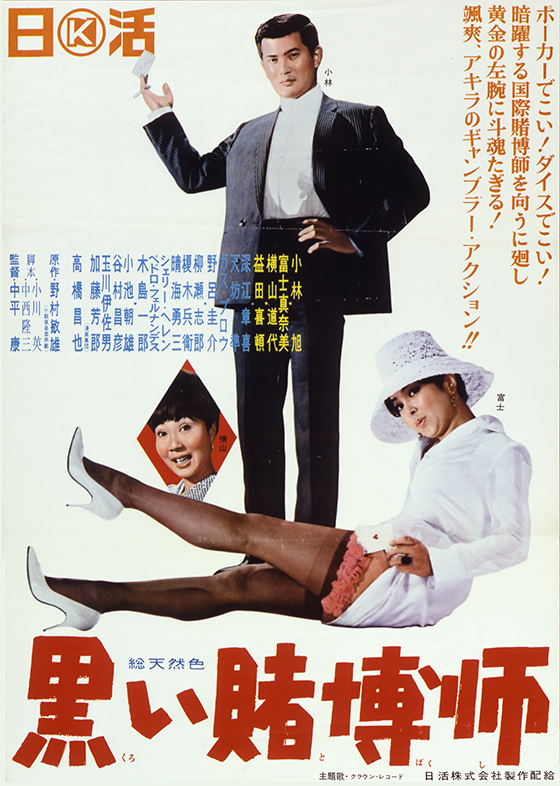
The Black Gambler (黒い賭博師, Ko Nakahira, 1965)

Black Gambler poster

Nikkatsu’s “Mighty Guy” Akira Kobayashi occupied a very particular space in the studio’s collection of leading men. Where Yujiro Ishihara was known for his roguish cheek, Tetsuya Watari for his bruiser nobility, and Joe Shishido for his detached efficiency, Kobayashi’s chief selling point was his gentlemanly charm and unflappable decency. The “Gambler” series which ran to eight films in all cast him as a James Bond-esque wandering cardsharp with a well tailored suit and keen intellect capable of defeating even the most devious of opponents. The sixth in the series, simply titled The Black Gambler (黒い賭博師, Kuroi Tobakushi), finds Koji Himuro (Akira Kobayashi) returning to Tokyo and straight into the middle of international intrigue as he gets mixed up with a global gambling syndicate hellbent on bringing its particular brand of funny business to the Japanese capital.

Himuro, renowned for his skills at the gaming table, is called to an exclusive gambling party where he entertains the French Ambassador and ruins a cheating rival in the process. Inumaru (Asao Koike), humiliated by his defeat, sends his mistress Reiko (Manami Fuji) to spy on Himuro and figure out all his secrets so they can get their revenge. However, Himuro gets himself mixed up in a bigger crisis when he comes to the rescue of a foreign woman in a park running away from a scary looking gangster. The woman, Nina, claims to be an air stewardess flown in from Hong Kong who has fallen foul of a Chinese gangster named Yang. Yang has apparently tricked her into amassing vast debts and thereafter attempted to recoup his investment in other ways. Himuro is a noble sort of guy and so decides to pay off Nina’s debt by defeating Yang in a game of cards, but Yang is a different kind of opponent than he’s hitherto faced and Himuro finds himself floundering unable to figure out Yang’s particular cheat.

Nikkatsu’s action line was famous for its “borderless” approach, making an international milieu one of its many selling points. This is not to say its vision of global Japan was altogether positive – in fact the reverse was often true. Once again, the Chinese have been designated the criminal element of choice with Yang painted as a villainous cheater complete with a horrible Fu Manchu beard and delirious cackle, sure that his unique method for ensuring victory cannot be beaten. Meanwhile, Himuro’s first engagement dropped him straight into a world of international diplomacy and it comes as no surprise to learn that Yang’s activities are merely a facet of a wider conspiracy which turns out to be run by a Jewish gambler who apparently used his ill gotten gambling gains to finance the Nazis during the second world war. Perhaps it’s wise not to even start trying to unpack that one.

Himuro’s upscale world of high stakes games played in well appointed rooms by men wearing tuxedos and drinking martinis may be a world away from the dirty backstreet shenanigans of Nikkatsu’s other gambling adventures, but there is bite in its defiant bid for frivolity. When Himuro first rocks up at the French Ambassador’s residence, his assistant doesn’t really want to let him in. He is infuriated that with a war going on in Vietnam his boss is taking time out to play silly games of chance rather than getting on the with real business of diplomacy. Vietnam is referenced again in the ironic closing freeze frame in which Himuro covers his face with a newspaper bearing the headline “America bets on bombing North Vietnam” – politics itself is now a game played by men in smart suits trying to stave off the boredom of being alive by using the lives of real men and women as gambling chips with little more feeling for them than for the tiny scraps of plastic which stand in for meaningless little bits of paper in the centre of a table covered in green felt.

Women, it seems, are a more immediate casualty of a gambler’s vice. Reiko, sent to spy on Himuro but drawn to his cardsharp’s acumen, was herself gambled away by her father who lost her to Inumaru in a bet. She holds no affection for the man who won her, but feels bound to him all the same and has vowed to become a top gambler as an odd kind of revenge. Nina too suffers at the hands of gangsters and criminals, drawn to Himuro because of his heroic nobility and unable to escape the underground world of grifters and chancers without the help of a seasoned player.

Sticking to a house style, Nakahira finds little scope to express himself in another B-movie adventure for the sophisticated gambling man. Nevertheless, there’s enough Bond-inspired silliness to keep the franchise fans happy from Himuro’s ball bearing loaded car to the gaming intrigue and intricate cheats that define it. The Black Gambler is a fairly typical example of Nikkatsu’s regular programme picture with little to distinguish it but it does what it sets out to well enough and with crowd pleasing style.


Opening scene (no subtitles)

Take Me Away! (ふりむけば愛, Nobuhiko Obayashi, 1978)

Take Me Away PosterDuring his long and extremely varied career, Nobuhiko Obayashi was a not infrequent visitor to the world of the idol movie though his most notable entries into the genre would come in the 1980s Kadokawa heyday with the much loved The Little Girl who Conquered Time (starring Tomoyo Harada) and School in the Crosshairs (starring Hiroko Yakushimaru) among many others made for that studio alone. Obayashi’s ‘80s idol movies play very much into his key themes in their preoccupation with youthful melancholy and teenage ennui but 1978’s Take Me Away (ふりむけば愛, Furimukeba Ai) takes a slight step away from the genre norms in its slightly more grownup tale of complicated love and early life disappointments.

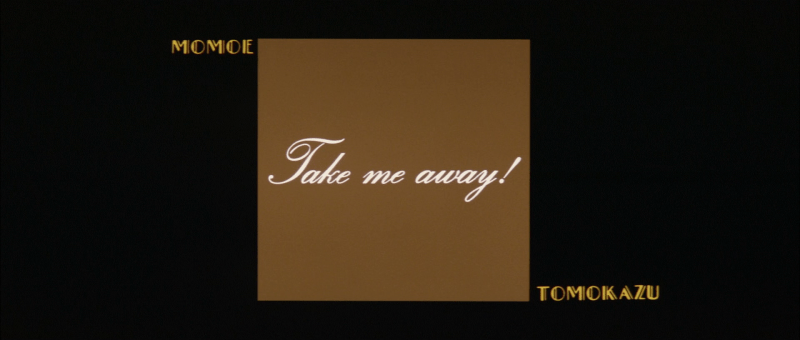
Beginning in typically strange Obayashi style, the film opens with some footage of abandoned machinery before the caption “Kyoko is on a journey” flashes up on the screen and we meet the woman herself (Momoe Yamaguchi) as she stares at San Fransisco’s Golden Gate Bridge.  Soon enough her view is obscured by a runaway kite bearing the name of Tetsu (Tomokazu Miura) – a young Japanese man currently living in the city. The pair hit it off while Tetsu tries to fix his both kite and Kyoko’s shoe which she broke trying to catch it. Tetsu promises to show her around San Fransisco and asks her to meet him at Union Square the next day at noon. Kyoko waits but Tetsu does not arrive – eventually a friend of his turns up in his place and Kyoko reluctantly spends a few hours with him during which she reveals that she’s on a suicide holiday and is about to go back to her hotel room to write the note. Finally Tetsu arrives, takes her to a hippy beatnik club where he sings her the title song of the movie, and the pair fall deeply in love.

Tetsu promises to meet Kyoko back in Tokyo to start a life together, but once again he does not turn up. Heartbroken and worried, Kyoko searches for him but the name of a bar he gave her as a point of rendezvous seems to be fake and her letters all come back undeliverable. When she gets hit by a car driven by a wealthy businessman, another, more stable, romantic possibility presents itself but will Kyoko let her true love dream go?

Take Me Away was the eighth in a series of films which starred popular Horipro idol Momoe Yamaguchi and her regular leading man Tomokazu Miura but the couple already had a long history of working with Obayashi in his career as a director of TV commercials. In fact the pairing which would eventually become a real life marriage was born thanks to Obayashi who was casting around for some stars while he made commercials with Miss Lonely apparently already on his mind. Obayashi was offered the chance to direct Yamaguchi’s cinematic debut but the dates didn’t line up and she made her first film, an adaptation of Yasunari Kawabata’s The Dancing Girl of Izu, with Katsumi Nishikawa instead.

This being the eighth Yamaguchi/Miura romantic drama the stakes needed to be raised – hence the decision to shoot for real on location in San Fransisco. Like many idol movies, the temporary shift away from the regular world the leading lady inhabits provides her an occasion to reinvent herself and the jet-setting, glamorous American holiday is certainly in keeping with the new, globally minded youth of Japan interested in transgressing borders of all kinds. When Tetsu meets Kyoko, she spins him a tale about diplomat parents that sounds like it could come out of any idol movie but in a departure from the norm it’s a part of her new holiday persona. In truth, beatnik dropout Tetsu is the posh one, a runaway son of a wealthy doctor, while Kyoko’s origins are humbler – she’s saved the money for this extremely extravagant holiday while working not as a concert pianist as she claimed, but as a piano tuner (making her choice of a Holiday Inn less strange in retrospect).

Though many idol movies centre around their teenage target audience, Kyoko and Tetsu are very noticeably grown up, already leading “adult” lives, no longer students but young people living semi-independently. This is brought home by the incongruous inclusion of a sex scene – the first in the series of films starring Yamaguchi and Miura, something which would not usually feature (at least explicitly) in the generally innocent idol movie world. Obayashi chooses to shoot this in an artistic, surreal, and impressionistic rather than naturalistic manner which shows the pair lying together naked (Yamaguchi covers herself with an arm) with a superimposition of the couple about to kiss over the top while the entire scene is bathed in golden white light. The sequence is one of the few typically Obayashi flourishes seen in the film (others include the title sequence, obvious Pan Am model shots, illustrated starry skies, and a slapstick brawl conducted to ‘20s jazz), but it perfectly captures the glory of young love so central to the early part of the film.

Of course, it doesn’t last. Holiday romances are one thing, but Tetsu proves to be a flaky sort of guy on every conceivable occasion until he’s finally dragged back into Kyoko’s orbit and vows to give up on his half-hearted ways once and for all to finally be true to his one true love. Kyoko’s second chance – a marriage proposal from the CEO who ran her over looks like the better option, that is until he shows his true colours at the film’s climax. Just as Tetsu leant meaning to Kyoko’s life in San Fransisco, so she too reawakens his fighting spirit. Tetsu describes himself as like the kite which bears his name – a free floating thing whose strings have long been severed. He needs the steady hand of Kyoko to right himself again. Unlike many of Obayashi’s wistful dramas, Take Me Away has a classically happy ending though its oddly silly, slapstick quality is very much in keeping with his sensibilities. A strange brew to be sure, but one which retains the essential innocence of the idol movie even whilst moving it beyond its traditionally adolescent remit.


Tomokazu Miura’s Furimukeba Ai

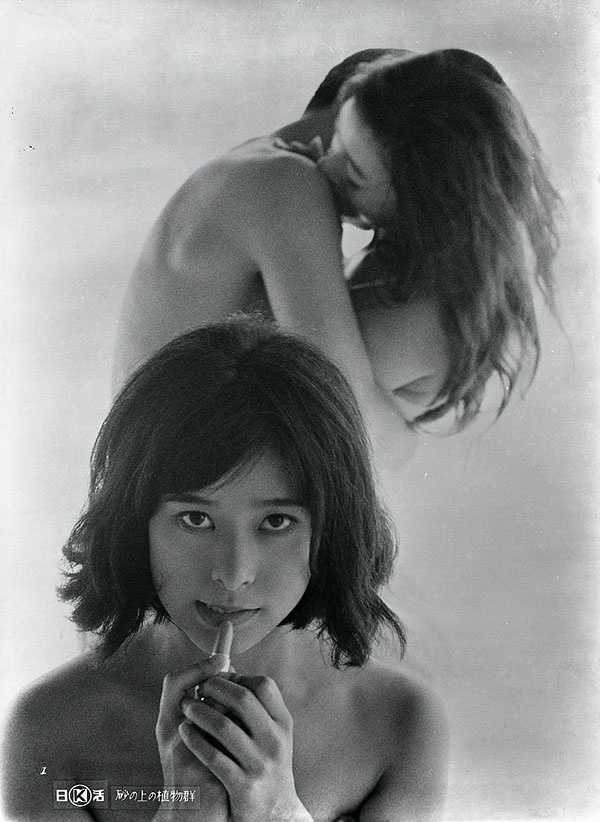
Flora on the Sand (砂の上の植物群, Ko Nakahira, 1964)

© 1964 Nikkatsu CorporationDespite being among the directors who helped to usher in what would later be called the Japanese New Wave, Ko Nakahira remains in relative obscurity with only his landmark movie of the Sun Tribe era, Crazed Fruit, widely seen abroad. Like the other directors of his generation Nakahira served his time in the studio system working on impersonal commercial projects but by 1964 which saw the release of another of his most well regarded films Only on Mondays, Nakahira had begun to give free reign to experimentation much to the studio boss’ chagrin. Flora on the Sand (砂の上の植物群, Suna no Ue no Shokubutsu-gun), adapted from the novel by Junnosuke Yoshiyuki, puts an absurd, surreal twist on the oft revisited salaryman midlife crisis as its conflicted hero muses on the legacy of his womanising father while indulging in a strange ménage à trois with two sisters, one of whom to he comes to believe he may also be related to.
After a brief prologue in which our hero, cosmetics salesman Ichiro Igi (Noboru Nakaya), imagines a scenario for a novel in which a dying husband becomes so jealous of the man that may succeed him in his wife’s life that he sets about plotting to make her the weapon of that very man’s destruction, Igi heads to his regular barber and longtime family friend where he takes the time to probe him about his late father’s womanising habits. Igi’s father died young at only 34 for years of age, three years younger than the age Igi is now. His father’s spitting image, Igi cannot help seeing him everywhere he goes and feels unable to evade his ongoing influence, almost as if he were possessed by his father’s (un)departed spirit.

The major preoccupation Igi has is that his wife (Yukiko Shimazaki) may have slept with his father before they were married while she was just a teenager. The barber tells him he’s pretty sure not, but Igi cannot let the idea go and repeatedly brings it up with his wife, creating discord in the family home. Meeting a precocious schoolgirl at the Marine Tower one evening, Igi finds himself taking her to a hotel and deflowering her even though she begins to resist him at the last minute. The girl, Akiko (Mieko Nishio), then makes a strange request of him – she wants Igi to seduce and “hurt” her older sister Kyoko (Kazuko Inano) whose sanctimonious attitude she can no longer stand. Igi does indeed visit the bar where Kyoko works as a hostess and embarks on an intense affair with her but Akiko’s pleas to “hurt” her sister are complicated by Kyoko’s masochistic tendencies and Igi’s descent into a kind of madness.

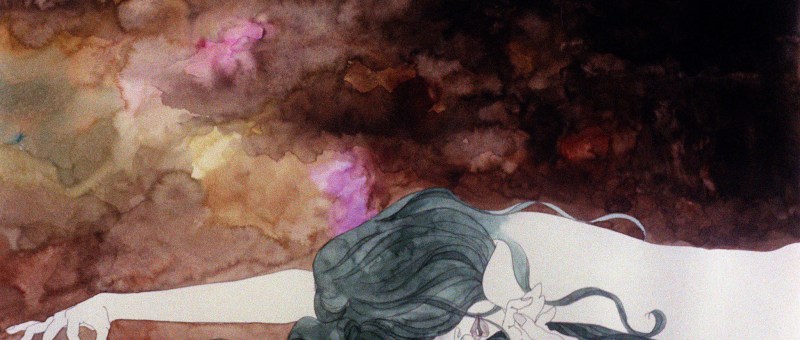
Beginning with the painting by Paul Klee which gives the film its name, Nakahira asks us to imagine what would happen if a large dash of red were suddenly to appear, disrupting the comforting harmony of Klee’s perfectly matched colours. The discomforting redness does dutifully appear as strangely shaped squares on the canvas but the symbolic value of the colour is felt throughout the black and white narrative from the dark stain of Akiko’s broken maidenhead to the affectation of her lipstick and constant references to red seas and suns.

Though Igi’s world may have seemed just as perfectly ordered as Klee’s painting from the outside, his constant preoccupations with his father become the disruptive influence which leads to all of the redness later leaking in. Haunted by his father as he is, seeing his face everywhere from train windows to the barber shop mirror, Igi’s attempt at a plot for a murder mystery takes on a strangely Oedipal quality as we begin to wonder if it’s his father rather than Igi himself who has assumed the role of the “protagonist”, leaving a time bomb for his wayward son, the inheritor of his woman, just as Igi laid out in his prologue. Bizarre reality or another symptom of Igi’s increasingly fractured mind, the plot seems likely to succeed at least in a sense as Igi declines into a dishevelled mess, prone to hallucinations and uncertain visions.

Nakahira gives us several of these as Igi panics and struggles with a key only to open a door into bright white light and nothingness or another in which he and Kyoko dine in an empty restaurant which is suddenly filled with the noisy chatter of other diners. Strange touches such as the German beerhall with a Spanish guitarist, or the odd peepshow in which Igi and his two friends take on the appearance of demons or impassive Buddhist statues thanks to the light reflected into their eyes, add to the unbalanced atmosphere as do the frequent closeups of lips and hands, and the symbolic value of seeds never meant to be planted which nevertheless flower at an unintended moment. Shooting in black and white, Nakahira begins with a colour sequence featuring the abstract artwork with occasional flashes of colour as well as voice over and occasional intertitle-style captions adding to the absurdist atmosphere.

A surreal and complex psychological exploration of sex, power, obsession, identity, and legacy Flora on the Sand finds Nakahira flexing his experimental mussels for a drama rife with ambiguity and strangeness. Sadly this brand of innovation was not entirely welcome at Nikkatsu head offices and so he found himself left out in the cold eventually ending up in Hong Kong making action movies for Shaw Brothers. Despite some later success at international festivals, Nakahira’s work remains sadly neglected but the unusual degree of sophistication and almost playful atmosphere seen in Flora on the Sand make him worthy of attention as more than just an almost was of the rising New Wave.


Screened as part of the Japan Foundation Touring Film Programme 2017.

Belladonna of Sadness (哀しみのベラドンナ, Eiichi Yamamoto, 1973)

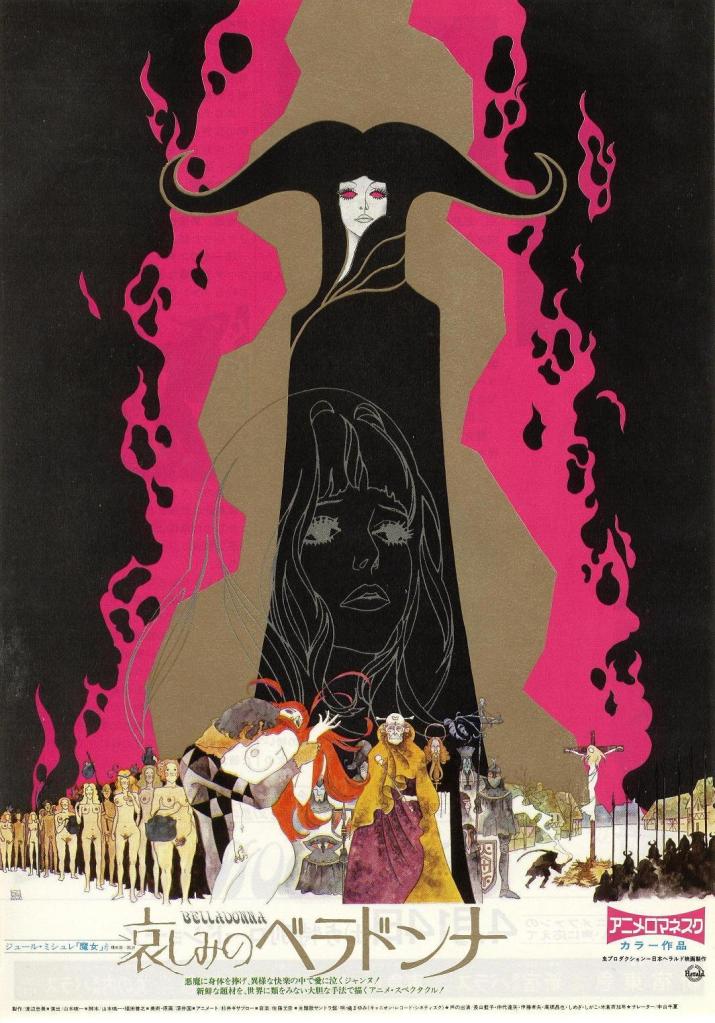
belladonnaLoosely based on Jules Michelet’s La Sorcière (Satanism and Witchcraft) which reframed the idea of the witch as a revolutionary opposition to the oppression of the feudalistic system and the intense religiosity of the Catholic church, Belladonna of Sadness (哀しみのベラドンナ, Kanashimi no Belladonna) was, shall we say, under appreciated at the time of its original release even being credited with the eventual bankruptcy of its production studio. Begun as the third in the Animerama trilogy of adult orientated animations produced by legendary manga artist Osamu Tezuka’s Mushi Productions, Belladonna of Sadness is the only one of the three with which Tezuka was not directly involved owing to having left the company to return to manga. Consequently the animation sheds his characteristic character designs for something more akin to Art Nouveau elegance mixed with countercultural psychedelia and pink film compositions. Feminist rape revenge fairytale or an exploitative exploration of the “demonic” nature of female sexuality and empowerment, Belladonna of Sadness is not an easily forgettable experience.
Beginning in true fairytale fashion with a gentle voiceover, the tale introduces us to Jean (Katsutaka Ito) and Jeanne (Aiko Nagayama), two ordinary medieval French peasants blissfully in love. Being the good, honest, Christian kids they are, they want to get married but as we’re told, this is the beginning of the story, not its end. Following tradition to the letter the pair turn up at the castle with their families to inform the Baron of their union and pay the marriage tax but the Baron takes a fancy to Jeanne and whacks up the price to a level Jean could never pay even if the entire village sold everything they had to help him, so that the Baron may exercise his droit du seigneur by claiming Jeanne’s maidenhead. After kicking everyone else out the Baron brutally rapes Jeanne before letting all of his cronies have a go too.

Finally crawling home bruised, broken, and violated Jeanne seeks comfort from her gentle husband Jean but despite his fine words, he is unable to accept what has happened and eventually retreats from her. At this point the weirdness begins as Jeanne’s intense inner rage and sadness summons forth a tiny demon friend who looks just like an overly friendly penis and also grows in size a little bit when you stroke him in just the right way. This starts Jeanne on her ultimate path towards becoming a master sorceress and eventual mistress of the devil himself. Jeanne’s fortunes rise in line with her sexual empowerment but an empowered female is not always popular with the ruling elite.

Jeanne’s empowerment and the subsequent threat it poses to the accepted political fabric is the main thrust of the narrative but it’s also important to remember that the process began with a brutal act of rape. Jeanne continues to be raped by her ever growing demon friend until achieving a kind of oneness with the Devil himself but the unwanted acts of Jeanne’s “demon”, who describes himself simply as a part of Jeanne, are mitigated because she is depicted as enjoying them (only guilt makes her say otherwise) and, after all, they form part of her sexual education. Jeanne’s power stems from the intense resentment she feels at her continued lack of agency, eventually buying her power and status enough to threaten the Baron and all he stands for.

Even if Jeanne’s power comes from the darkest of places, everything she uses it for is morally good (at least from a “modern” standpoint). When the Baron returns from a war to find Jeanne ruling the roost, he attempts to canvass some of his subjects hoping to hear tales of her cruelty or ineptitude but finds only praise. Jeanne heals the sick, helps a couple with too many children find a solution to maintain their married harmony without the risk of bearing any more, and even helps an elderly woman make contact with the depths of hell (wasn’t exactly what she had in mind, but she was thrilled to bits anyway).

The worst thing Jeanne’s power provokes is the large scale and extremely strange orgy which takes place in her hair, sees her copulating with the entire village, and even transforms genitals into bizarre creatures. This purely pleasurable exercise, even if against the prevailing moral code, has no real world consequences such as a failed harvest or ruined city brought about by the villager’s abandonment of duty for physical pleasure.

However filled with “goodness” her actions are, Jeanne herself is branded a witch and the only reason she is not burned at the stake immediately is that the Baron and his advisors fear that if Jeanne is burned whilst still bound to the devil, the demonic elements inside her will be set free and could “pollute” the other women in the village with a nasty desire to be taken seriously as people. This fear is later borne out as each of the village women emerges with Jeanne’s impassive face before time jumps on a few hundred years to the French Revolution and its vanguard of valiant women seeking social justice as evidenced by Eugène Delacroix’s 1830 painting Victory Leading the People which forms the final image of the film.

Belladonna of Sadness seems conflicted over whether this kind of empowerment is a good thing or not. Jeanne’s journey begins with violence which gives birth to rage and an eventual “succumbing” to the dark arts which facilitates her revenge. Everything about Jeanne becomes satanic and her sexuality is the weapon which she wields against male subjugation. The empowered Jeanne is independently monstrous, rather than just monstrous to the Baron and the true forces of evil, thanks to her involvement with illicit supernatural entities. Her independent spirit does indeed pollinate as the Baron feared it might, but whether these women are to be read as having been “freed” or as vengeful harpies robbing men of their rightful place whilst intent on upending the social order, might be a matter for debate.

Yamamoto opts for a mix of styles making great use of still paintings and more primitive animation to enhance the effect. Combined with the very contemporary sounding folk music, the later ventures into the realm of psychedelia lend the film a new age fable quality to present a broadly feminist rape revenge fairytale. However, this particular story offers no happy ending for its heroine even if it does retroactively add one in the form of the ongoing social change her various transgressions engender. Wildly experimental, often extremely beautiful, and necessarily explicit, Belladonna of Sadness is, as its name suggests, a melancholy tale but one just as passionately free as its tragic heroine.


Cinelicious Pics restoration trailer (English subtitles, NSFW)

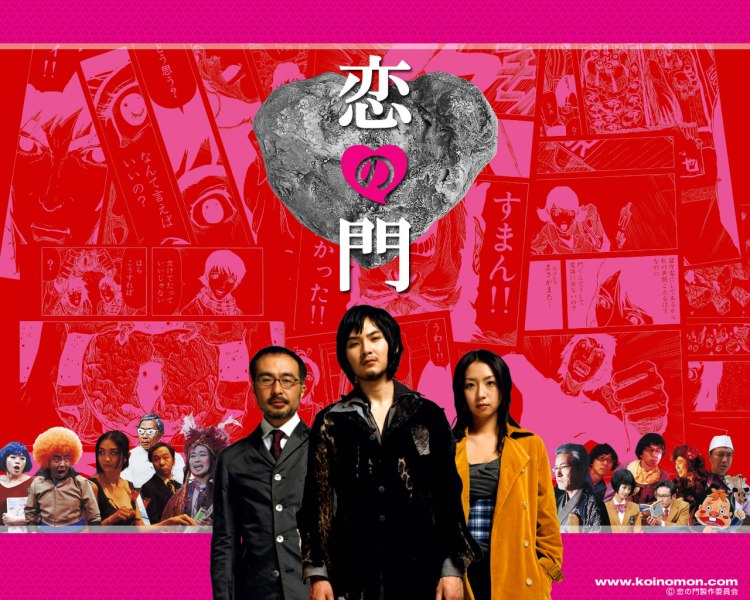
Otakus in Love (恋の門, Suzuki Matsuo, 2004)

koi no monReview of Suzuki Matsuo’s Otaku’s in Love (恋の門, Koi no Mon) first published on UK Anime Network in February 2014.


The word “otaku” is a difficult one to pin down. In the West, it’s often come to be a badge of pride and respect, a label that many fans of what most people would perceive as a niche subculture actively identify with and eagerly apply to themselves. However, the roots of the term are much darker and in its native Japanese, “otaku” can be far from a nice thing to call another person. Of the central couple in this film perhaps only one can be thought of as a traditional “otaku” the other being more of a “tortured artist” whose eccentric behaviour makes it difficult for him to survive in the real world. Well, to be honest finding a base line for “normal behaviour” in this film is a pretty tall order, we run into bizarre anime conventions, cosplay obsessives, broken hearted ex-mangaka (manga) bar owners and a bizarre cult like office environment where the only rule is you must be “happy!” all the time. Otakus In Love is an endearingly odd film that is jam packed full of in jokes and meta references that knows its audience very well and never fails in the humour stakes as a result.

Mon is a down on his luck, in fact totally broke, manga artist. Well, he calls himself a “manga artist” but his work isn’t exactly what most people would expect. In a touch of the avant garde, Mon makes his manga out of rocks. Mon’s “manga” are, in fact, a collection of rocks painted with a single kanji character and arranged inside a custom made wooden box. Needless to say each of Mon’s works is a one off piece and his sales record is not exactly going to get him on the best seller list. He can’t seem to hold down a part time job either due to his extreme reactions to people not taking his art seriously and his strange appearance which is something like a seventies guru come glam rock god whose ragged clothes have an oddly deliberate look to them. One fateful day he has an interview for Tsugino Happy Inc which turns out to be a cult-like office environment which seems to advocate happiness through total subjugation. He lasts about an hour at this job before punching his new boss in the face for failing to appreciate his artistic qualities.

However, on the way there about to pick up a particularly fine looking rock, he meets Koino who turns out to be a colleague of his at Happy Inc. The two go out for drinks which ends up at Koino’s apartment where upon Mon wakes up the next morning to find out he’s been a victim of forced cosplay! Unwittingly dressed up as Koino’s favourite character from Soul Caliber II, he’s quickly posed by Koino for her cosplay wall and dragged into a world of doujinshi, comiket, cosplay and all things geeky. Koino is an amateur manga artist who claims to have made a small fortune selling her home made manga at conventions and is well and truly an otaku. Can two such different people really find love? There’s only one way to find out!

Otakus in Love is based on Jun Hanyunyuu’s manga Koi no Mon (also the original Japanese title of the film) and as such carries over various extremely clever meta visual references. Directed by well known actor Suzuki Matsuo (Ichi the Killer) the film is often about as close as you could get to being a live action manga as Matsuo manages to make standard manga tropes like reaction shots and surreal action scenes work in a totally believable way. In the course of the film we’re treated to full on musical sections and ridiculous comic motifs that resurface at fairly predictable moments which could all end up just being far too much, but under Matsuo’s steady hand the film comes out on the right side of crazy and is never anything less than totally zany fun.

The film isn’t afraid to wear its otaku badge on its sleeve, either. Jam packed with references from video games, anime, and manga, Otakus in Love gets its audience completely and trusts it to understand all of its allusions and homages without needing to repeatedly bash the viewer over the head with tie-ins. It also takes an affectionate side swipe at fan culture with some bizarre interactions with cosplay, conventions and ani-singers which any anime fan can probably relate to. The film also has a fair few cameos from such well known personages as Hideaki Anno, Shinya Tsukamoto and Takashi Miike to name but a few.

At a 114 minutes it does run a little long and occasionally feels like it’s going to run out of steam but for the vast majority of its running time Otakus in Love is a genuinely hilarious, truly bizarre, romantic comedy. Full of warmth and exuberance, it’s difficult to image anyone not being swept away by its surreal humour and though it’s certainly on the broader side of comedy it never feels particularly over the top (or at least not in a bad way). Otakus in Love is a romanic comedy that no self confessed otaku should miss out on seeing.


Reviewed at the Japan Foundation Touring Film Programme 2014.