Kokuho (国宝, Lee Sang-il, 2025)

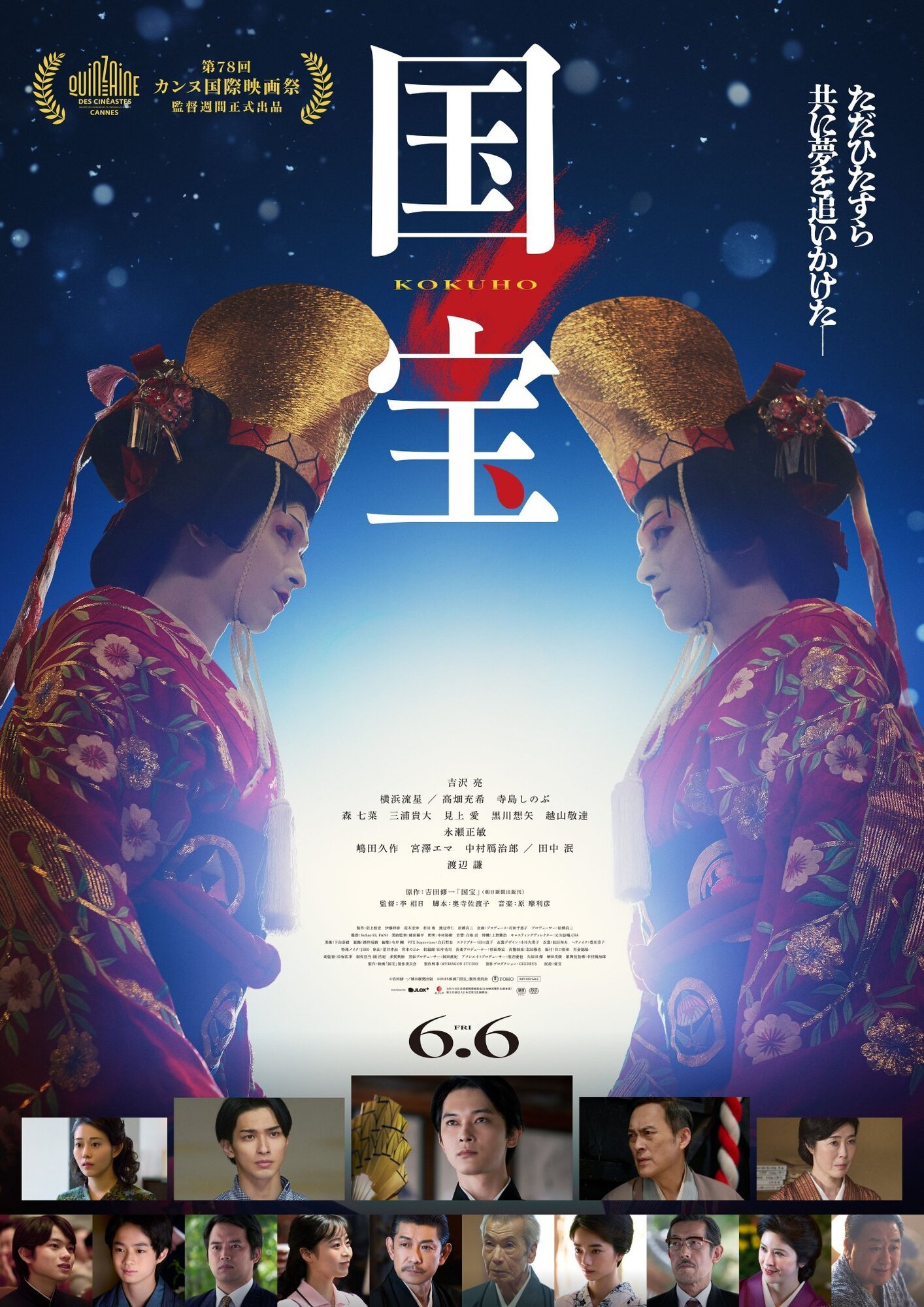
What does it mean to commit yourself so entirely to your art that you become it and effectively cease to exist? Playing the role of Ohatsu in Chikamatsu Monzaemon’s Love Suicides at Sonezaki, Kikuo (Ryo Yoshizawa) asks if Ohatsu’s lover Tokubei is really resolved to die for their love. The scene is intercut with his brother and rival Shunsuke leaving the theatre, led away by Kikuo’s girlfriend Harue (Mitsuki Takahata), just as Ohatsu leads Tokubei towards their mutual fate, as if Shunsuke were agreeing that he is not resolved to give his all to art in the way Kikuo evidently feels himself to be, at least in this moment.

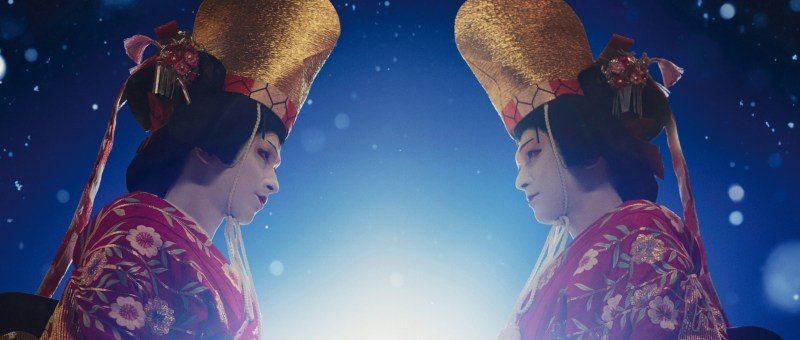
The roles between them are reversed several times before they eventually perform the play again, but each of them are, in effect, in a love suicide with the art of kabuki, though kabuki itself is destined to live on. In any case, the “kokuho” of the title is a living national treasure and one who has indeed embodied their art. We’re introduced to one early on, Mangiku (Min Tanaka), an ageless onnagata, or player of female roles, who has a quasi-spiritual quality and warns the young Kikuo that though his face maybe beautiful, it could also be a barrier to his art and, in the end, consume him. It is said of Mangiku that all he will leave behind him is his art. The words are spoken with pity, but this is really what it means to be a kokuho and the highest compliment that might be paid to an artist. Mangiku himself would likely approve, casting an eye around his spartan room and declaring himself unburdened. 

But Kikuo is only half-joking when he says he cut a deal with the devil to make him the best kabuki actor in Japan. As a woman he abandoned later scolds him, all his sacrifices were made by others. Actors are greedy, another laments, and it’s true enough that Kikuo feared little in his need for success. The irony is that he too was an heir, only to a yakuza dynasty to which he could not succeed. His was father was gunned down in front of him while preparing to draw his sword, while Kikuo’s rebound tattoo does him no favours in the end and his attempt to avenge his father’s death apparently fails. Nevertheless, he vies for the approval of his surrogate father and kabuki master Hanjiro (Ken Watanabe) who values his skills above those of his biological son Shunsuke (Ryusei Yokohama) who alternately resents having his birthright stolen from under from him and acknowledges that Kiku has an innate talent with which his bloodline can’t compete.

Nevertheless, there’s a genuine and enduring brotherhood between the two men that never quite slips into hate or acrimony even as circumstances conspire against them. They both want what the other has. In the kabuki world, bloodline is everything and Kikuo is viewed as a interloper usurping Shunsuke’s rightful position, while Shunsuke wants the raw talent he knows he lacks and no amount of training and commitment can buy. Yet it is in a way about resolve, or at least the willingness to give your life to the stage and die in the pursuit of art. Kikuo’s signature piece is the Heron Maiden, in which a heron falls in love with a young man and becomes a young woman. But her love is unrequited. She goes mad, and can only show her love for him by dancing until she dies. This is, in effect, Kikuo’s dance with kabuki, a waltz to the death as he yearns for the “scenery” he as been searching for and eventually finds the apotheosis of his art in the moment of the heron’s demise.

Like Lee Sang-il’s previous films Villain and Rage based on a novel by Shuichi Yoshida, the film is a poetic meditation on the price of the pursuit of art that revels in its sumptuous production design and the intricacies of the kabuki world. With shades of Farewell, My Concubine, it frames its central dynamic not quite one of straightforward rivalry but a brotherhood between two halves of one whole who each know that neither of them can really win, while becoming a kokuho is an endless pursuit of artistic perfection in which one must be resolved to kill the self and die on stage in a lover’s suicide with a forever elusive kabuki.


Kokuho screened as part of this year’s LEAFF.

Trailer (English subtitles)
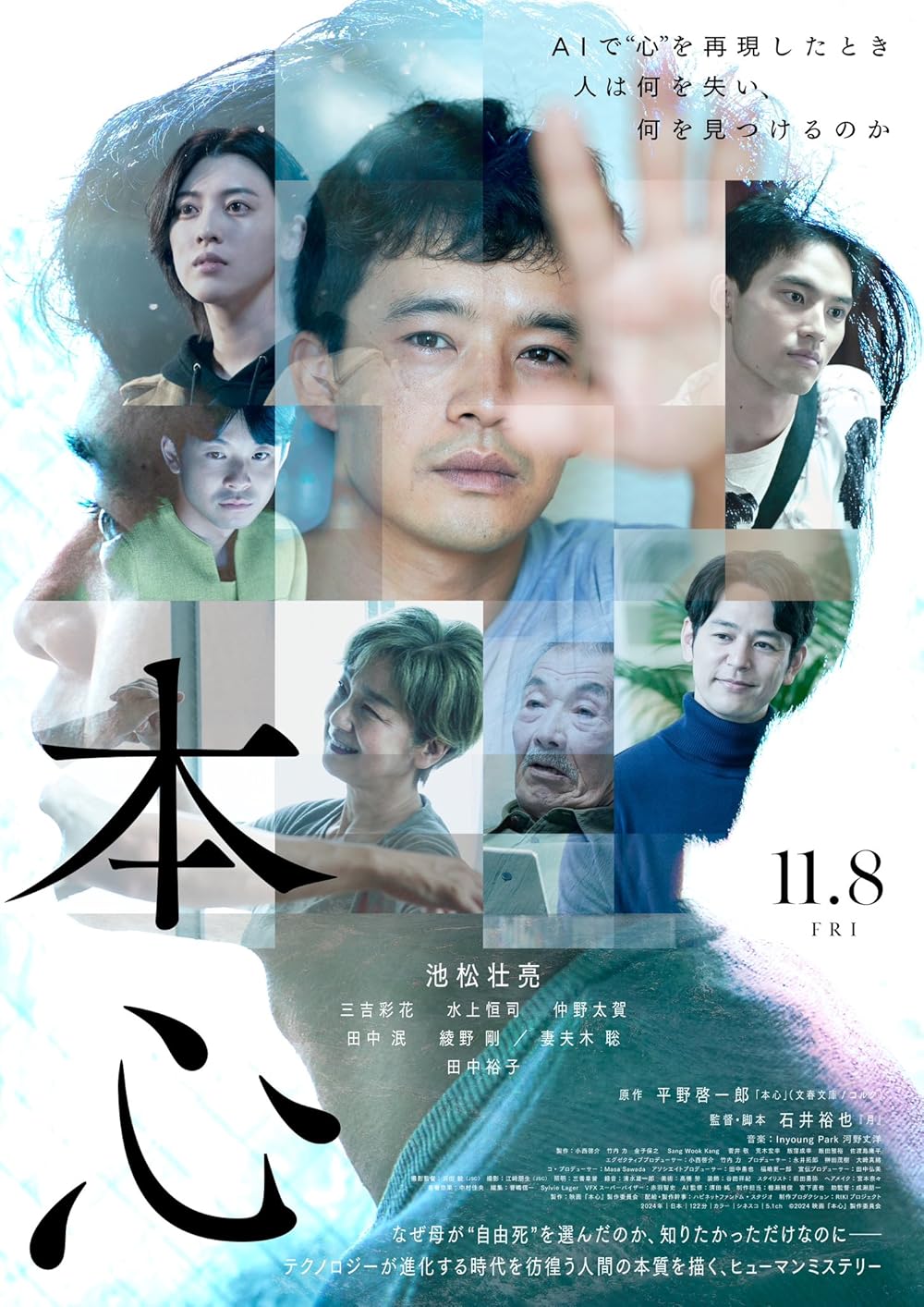
The Real You (本心, Yuya Ishii, 2024)

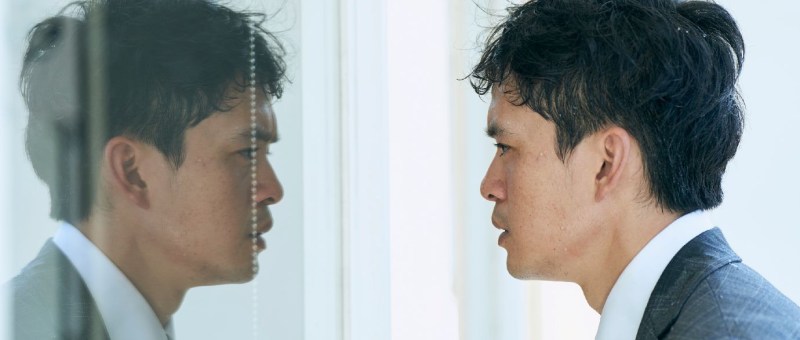
“Putting it into words makes it sound like a lie,” according to a young woman struggling to “be real” and express a truth without any of the awkwardness that interferes with emotional intimacy, but there are ways in which lies can be true and truth can be lies. Based on a novel by Keiichiro Hirano, author of A Man which also deals with similar themes, Yuya Ishii’s The Real You (本心, Honshin) probes at the nature of the human soul and asks if there really is such a thing as the “real” you or if authenticity is really possible in human interaction. 

Both Ayaka (Ayaka Miyoshi) and the avatar of his mother Akiko (Yuko Tanaka) describe Sakuya (Sosuke Ikematsu) as being too pure for this world and to an extent they’re right even if many of his present problems are directly linked to having committed a “crime” in his youth. As the film opens in the summer of 2025, Sakuya is a factory worker watching helplessly as robots take over his work. After all, they don’t care about the heat, or being able to breathe under a heavy welding mask, nor do they get tired and they can get this job done much faster than he can. In any case, he ignores an ominous phone call from his mother, who appears to be showing signs of dementia, despite her telling him that she has something thing important to say and stays out with a friend after work only to spot her by the river in a storm on his way home. When she abruptly disappears, he assumes she entered the water and jumps in to save her but is injured himself and wakes up in hospital about a year later.

Of course, we don’t really know that he wakes up at all and it’s possible that all of this is really just a dream or an attempt to make contact with his authentic self through his relationships with two women, his mother and a young woman who also disappeared abruptly back in high school. Even though it’s only been a year, the AI revolution has marched on a pace and the entire world is now run by robots and avatars. Sakuya’s factory is no more, and the only job he can get is that of “Real Avatar” in which he rents out his physical body on behalf of clients who for whatever reason are unable to complete an action in person. Many of his early customers are elderly people who have opted for “elective death” and are trying to relive a precious memory vicariously through the VR headset before they go.

“Elective death” is one of the things that most bothers Sakuya in that he’s told it’s what his mother had chosen and that he’s getting a tax break and sizeable condolence payment so he can continue living in the family home. This eerie proposition that elderly people are being encouraged to decide that “this is enough” frightens Sakuya and hints at the eugenicist aims of an AI society in which those who are judged to be “weak” or cannot “contribute” in the way expected of them are forced to end their lives as if they didn’t deserve to live. He can’t understand why his mother would have chosen to die, but moreover, why she would have done it without even telling him. He can’t decide if the important thing she wanted to say was just about the elective death or if there was some greater truth he’ll now never know because he ignored her when she tried to tell him.

That’s one reason that he decides to use all his savings plus the condolence money to have an AI Avatar of his mother made in hope discovering what she wanted to say. Later he says that he wanted to know “Akiko Ishikawa,” rather just his mother, but is put off at first when confronted by the gap between the image of the mother he remembered and the objective reality. The creator, Nozaki, suggests incorporating memories from a young woman who was apparently his mother’s only real friend to get a fuller picture, but Sakuya resists insisting that he and his mother had no secrets from each other so she had no “hidden side”. Nozaki (Satoshi Tsumabuki) merely smirks and tells him that everyone has different sides to themselves that they don’t share with others, which Sakuya ought to know because there are things he’s not exactly hiding but doesn’t really want to talk about either.

His friend, Kishitani (Koshi Mizukami), wonders if there isn’t something a little incestuous about Sakuya’s desire to build a VF of his mother rather than his first love as he’d assumed he would, and he might be right in a way. Ayaka Miyoshi, played by the actress of the same name, shares a striking resemblance with the high school girl who exited the young Sakuya’s life, Yuki, and has a similar life story, though it’s not clear if they are actually the same person or not even if the AI version of his mother tells Sakuya that they are. Yet Ayaka is his only way of verifying that what the VF Akiko says is actually “true’ rather than some random hallucination cooked up by the machine based on the incomplete information it’s been fed. Through the VF he finds out things about his mother’s past that shock him, not that he necessarily disapproves, just that they conflict so strongly with the image of his mother he’d always had. Additionally, there’s a degree of hurt that though he believed he and his mother shared everything, she kept this actually quite significant part of herself secret from him in much the same way he admits he didn’t tell Ayaka about his “crime” because he feared she might pull away from him if she did.

Ayaka also avoids talking about her past as a sex worker which has left her with PTSD and fear of being touched for much the same reason even if she suspects that Sakuya already knows and that his mother may have told him before she died. There’s an obvious parallel being drawn between them when Ayako insists that she made a clear choice to do sex work out of economic necessity and refuses to apologise for it, while Sakuya has also been selling his body as a Real Avatar. While some of his clients merely need help accomplishing things physically, others hire him for amusement. They send him on pointless errands running all over the city and then give him a bad review for smelling of sweat, or deliberately make him do degrading tasks. They also ask for things that are clearly illegal, such as another RA’s client requesting to see a man die. But Sakuya continues to wilfully degrade himself carrying out each of the tasks faithfully despite the pitying looks of those around him. When he’s unexpectedly employed by a wealthy avatar designer (Taiga Nakano) who uses a wheelchair, Sakuya again sheds his own identity and finds himself playing reverse Cyrano forced to make Ifi’s declaration of love on his behalf only to the consternation of Ayaka who isn’t sure who it’s coming from and is disappointed in both men for the obvious cruelty of the situation.

Thus this new technology becomes just another means of class-based oppression in which the wealthy use their riches to abuse those without economic means who have no choice but to submit themselves or rebel through criminality while the rich look on with amusement. Sakuya says he isn’t in love with Ayaka, but it’s unclear if he says it because he thinks she’s better off living in material comfort with Ifi, if he really means it, or he’s realised that he was more in love with the image of the girl who disappeared and the missing side of his mother than he really was with her. It seems that Sakuya is really looking for the hidden half of himself through refracted images of the way others see him, while essentially engaging in an internalised dialogue with his own thoughts and memories. He can’t really be sure of the truth behind anything the VF says, a fact brought home by the implication that the great truth he was seeking is a banal platitude and what he undoubtedly wanted to hear yet knew all along. Nevertheless, it’s not until hearing it that he can regain his real self, let go of the past, and be in a position to connect with Ayaka which is also a kind of waking up. Disquieting in its implications for a new AI-based society in which the line between the real and virtual has all but disappeared, there is nevertheless something quite poignant in Sakuya’s gradual path towards saying goodbye but also hello to a new life of greater self-awareness and independence.


The Real You screens in New York July 11 as part of this year’s Japan Cuts.

International trailer (English subtitles)

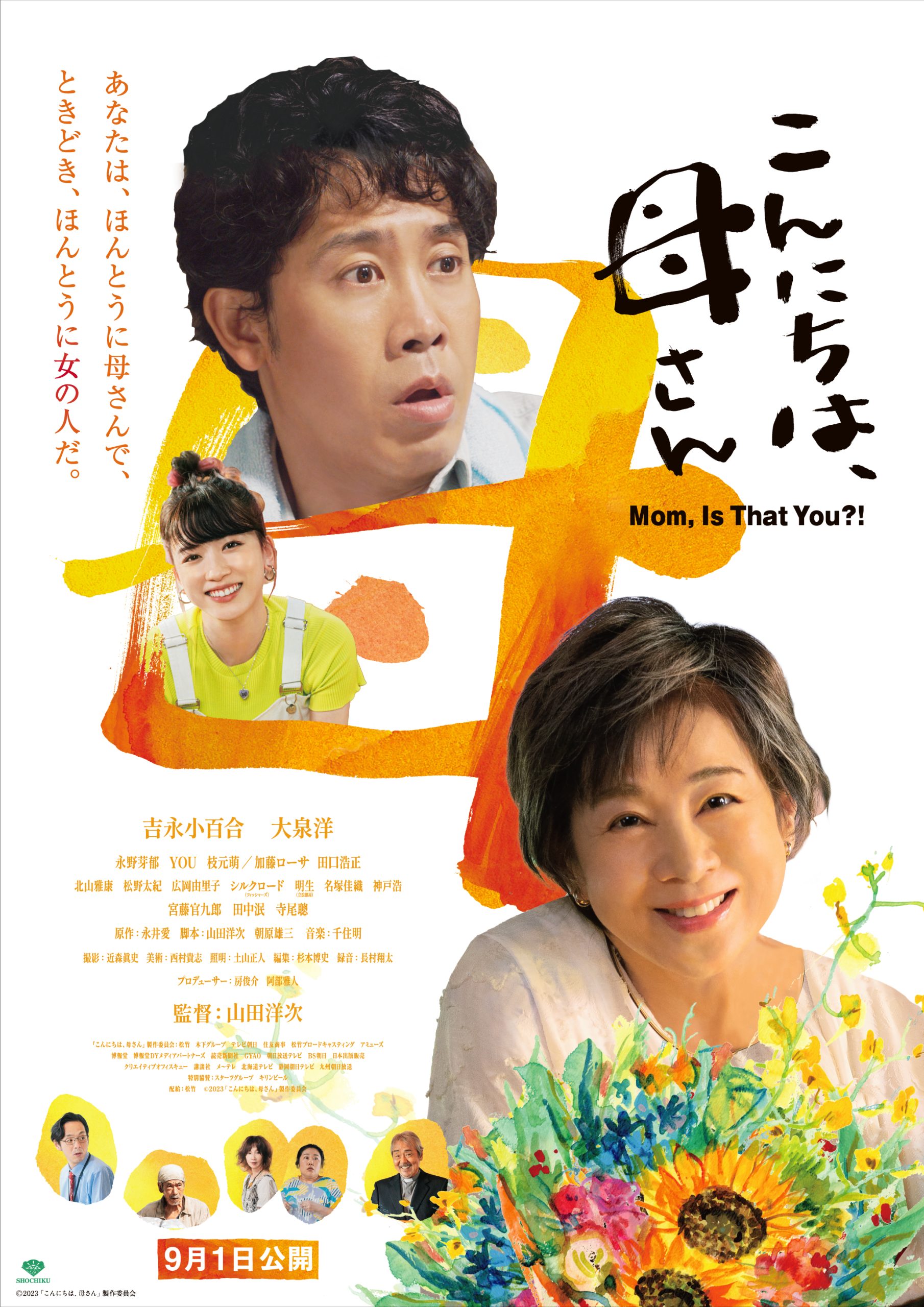
Mom, Is That You?! (こんにちは、母さん, Yoji Yamada, 2023)

“People of my generation can’t throw anything away,” an older woman admits on her hearing her daughter-in-law has just been featured in a TV series about decluttering. Inspired by Ai Nagai’s 2001 play, the latest from veteran director Yoji Yamada Mom, Is that You? (こんにちは、母さん, Konichiwa, Okasan) seems to hint at a series of circular generational divides while suggesting that the children of the Bubble-era in particular are too quick to get rid of things they don’t think they don’t need anymore.

That’s the irony of soon-to-be 50-year-old Akio’s (Yo Oizumi) salaryman job in HR. It’s his job to cut dead wood from the company and this current round of polite requests to employees of a certain level to take early retirement includes his uni friend Kibe (Kankuro Kudo) who doesn’t take kindly to what he sees as a personal betrayal. Unlike Akio who is beginning to tire of the salaryman dream, Kibe fiercely fights for his position and identity as an executive at a big company even when faced with banishment room treatment and disciplinary dismissal after an altercation with the boss.

But what Kibe doesn’t know is that Akio is already facing a series of crises. His marriage has collapsed and his university student daughter Mai (Mei Nagano) is having a crisis of her own. Fresh from her tidying success, her mother has told her that all she can do is get good grades followed by a boring salaryman job like her dad’s which doesn’t seem to be what she wants which is why she’s run off to stay with her grandmother Fukue (Sayuri Yoshinaga) who runs a traditional shop selling tabi socks near the Sumida River. Fukue has a kindly, laid-back attitude remiscent of the shitamachi spirit found in other Yamada films in contrast to the stressed out uptightness of Akio who hasn’t told her about his impending divorce nor work troubles but finds himself paying a visit home in an attempt to sort himself out only to find Fukue keeping herself busy with a local charity group and nascent relationship with a church pastor. 

Fukue’s charity work is emblematic of a waste not want not philosophy that has otherwise disappeared from the modern society as they pick up the things other people don’t want and donate them to the needy even if it sometimes seems a little simplistic or patronising. Biting into some reject crackers from the local rice cracker shop, Akio reflects that they’re something that’s made to console people and it’s work that has meaning unlike his soulless corporate job that gives him nothing other than stress and money. At the time the play was written, the fallacy of the salaryman dream was clear for all to see in the post-Bubble society but to a man like Akio getting a company job was a big deal and his success is still the talk of his mother’s friends even he starts to wonder if he still has time to start again and discover a more meaningful way of living.

Some of these ideas, and the timescales involved, make much more sense for the play’s millennial setting rather than the film’s apparent present day given the references to the firebombing of Tokyo which would require the older protagonists to be their late 80s to even remember. Akio dismisses his mother’s charity work and insists that the homeless are only those who opted out of the competitive society he too has come to doubt or else were excluded from it, while he’s resentful of her attachment to the pastor in contrast to Mai who is excited by the prospect of her grandmother’s love affair and enduring possibilities of age while Fukue is beginning to fear not death but dependency if her health should suddenly decline. 

It’s in the midst of her heartbreak that the film affords Fukue a new beginning if in coming full circle, Akio choosing to make a clean break with the unhappiness in his life and Mai embracing her youth while falling for the old world charms of her grandmother’s tabi sock shop almost exclusively catering to sumo wrestlers, who as someone points out never waste anything, and people trying ceremony for the first time at 60. Like most of Yamada’s work, the film has a gentle humanity and melancholy poignancy but also a sense of hope and continuity that run contrary to an overly corporatised society in which young and old are already losing faith.


Mom, Is That You?! screened as part of this year’s Toronto Japanese Film Festival.

Original trailer (No subitles)

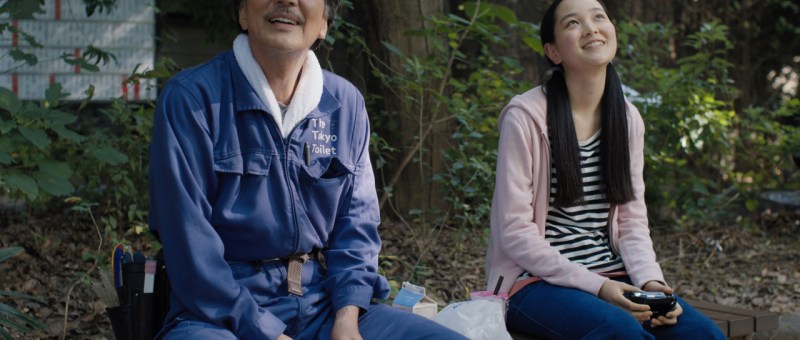
Perfect Days (Wim Wenders, 2023)

A man in late middle-aged quite obviously living in the past begins to wake up to the possibilities of change in Wim Wenders’ Tokyo-set drama, Perfect Days. Even so, Hirayama’s (Koji Yakusho) days may be pretty much the same but that doesn’t necessarily mean that his life is dull or even predictable while it’s clear that he manages to find joy in small moments of serenity even if he may also seem to be harbouring a great sadness. 

The irony is that Hirayama lives in a rundown postwar tenement that happens to be almost directly under the Tokyo Skytree which Wenders often cuts back to as if to signal the disparity between the rich and glitzy skyline of the contemporary city and the lives of those on its margins. Hirayama’s home has an almost eerie quality owing to the glowing purple light shining out of the window of his spare room where he nurtures tiny saplings back to health. The traditional-style two-floor flat has two tatami-mat rooms on the upper level, the other filled with books and cassette tapes amid an otherwise spartan interior. Before leaving for work each morning he brushes his teeth over the kitchen sink, the place has no bathroom, and meticulously takes up his belongings neatly placed in order on a shelf by the front door. 

Perhaps it’s this kind of order that Hirayama craves, clinging to the security of the usual and dedicating himself to his work with unusual rigour. A municipal toilet cleaner, he painstakingly scrubs each and every bowl and urinal, checking the nozzles on the bidet function and shining a mirror underneath to make sure everything is as clean and tidy as it could possibly be only for drunken salarymen to push past him and quite literally piss all over his hard work. Like many such workers, he attains a kind of invisibility and should anyone need to use the facilities while he’s cleaning them he’s obliged to step outside and wait before starting all over again. When he finds a little boy crying alone in a park toilet he takes him by the hand and tries to help him find his mum, only when he finds her she completely ignores Hirayama and even goes so far as to wipe the boy’s hand with a wet wipe. The boy’s little wave of thank you as they leave is the only ray of comfort and recognition. 

Yet for all that, it’s as if this the life Hirayama has chosen. He barely interacts with his chatty colleague Takashi (Tokio Emoto) who has a habit of rating everything out of ten and sees no value in his work, hardly bothering to do much cleaning at all while complaining that he has no money to romance the bar hostess he’s hoping to make his girlfriend. Takashi and Aya are fascinated by Hirayama’s collection of cassette tapes which he plays in his van, though Takashi more so for the commercial value that may be attached to them in a world in which everything old is new again and specialised stores in the trendy neighbourhood of Shimokitazawa trade exclusively in secondhand LPs and Sony Walkmans. Even so, Aya too appears to have her private sadnesses drawn to the voice of Patty Smith but pressing stop when the tape mentions suicide. The melancholy office lady in the park and an elderly homeless man who lives there too must have their own stories as unknown to Hirayama as his is to them. 

A surprise visit from a teenage niece suggests that he may have come from a relatively wealthy family with a tyrannical patriarch and that this ascetic life of his is a kind of rebellion or else or a refuge, but there’s a look of pain on his face when the landlady at his favourite bar (played by enka legend Sayuri Ishikawa) laments that she wishes everything could stay the same. Perhaps he’s tired of this very analogue life and its otherwise pleasant monotony as he further confirms for himself realising that it’s not right for things not to change as he engages in a game of shadow tag with another middle-aged man who’s evaluating his life after a terminal cancer diagnosis. In truth, the film risks straying into orientalism in its advocation of Japanese serenity in simplicity (something not helped by the final title card explaining the term komorebi) while the musical choices appear a little on the nose and the celebration of mundanity in Hirayama’s labour might otherwise seem flippant. Even so, Yakusho’s typically astute performance keeps the film on an even keel as Hirayama finds himself on a turbulent journey towards a “new world” of fulfilment and possibility. 


Perfect Days screened as part of this year’s BFI London Film Festival.

Original trailer (English subtitles)

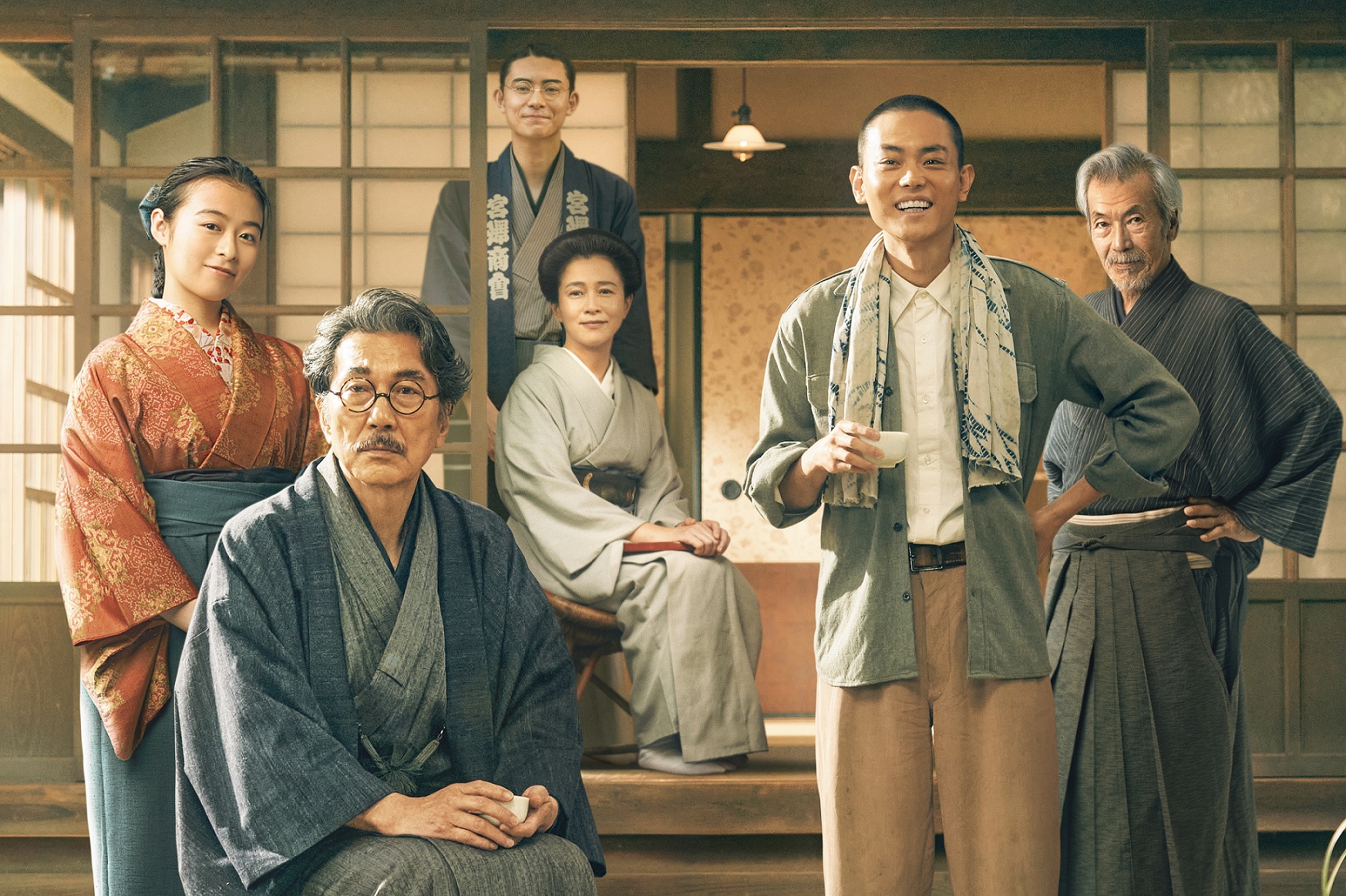
Father of the Milky Way Railroad (銀河鉄道の父, Izuru Narushima, 2023)

Generations of Japanese children have grown up with Kenji Miyazawa’s much loved classic Night on the Galactic Railroad but Miyazawa remained largely unknown in his lifetime and passed away from pneumonia at the young age of 37 in 1933 with the book that would make his name still unpublished. His story has been told before, most notably by Kazuki Omori in 1996’s Night Train to the Stars, but Izuru Narushima’s Father of the Milky Way Railroad (銀河鉄道の父, Ginga Tetsudo no Chichi), adapted from the Naoki Prize-winning novel by Yoshinobu Kadoi, takes a slightly different angle in exploring the life of his generally supportive father, Masajiro (Koji Yakusho).

As he’s fond of saying, Masajiro is a product of the modern era and a very modern father even in some ways by the standards of today. The film opens (and closes) with him on a train, this time hurrying home having received a telegram informing him that his first child has been born. So excited is he that he offends his own father by running past him on the way to see the baby without offering the proper greeting. Kisuke (Min Tanaka) is indeed more of a traditionalist raised with feudal values that are fast becoming out of date in the new society. As the head of the household, it’s he who gives the baby his name, Kenji, written with the characters for intelligence and healing which will indeed define his character if leaving him somewhat at odds with his society. 

Such a devoted father, Masajiro breaks with tradition and accepted gender roles in insisting on accompanying Kenji to hospital when he is taken ill despite his father’s admonition that caring for the sick is a role reserved for women. Kisuke also tells him his decision to have Kenji educated is wrongheaded, that literature and the arts only confuse a man and may prove more ruinous to him than drink or women. Annoyingly, Kisuke may have a point in that on his return from middle school Kenji (Masaki Suda) immediately rejects the family’s business as pawnbrokers having read too many Russian novels in which they are depicted as exploiters of the poor. He decries Masajiro’s justification that they support farmers who would otherwise be unable to access other forms of financial help such as bank loans and be forced to sell their daughters into sex work as mere sophistry. Masajiro may share some of his concerns, but remains in part wedded to some aspects of feudalism in insisting that as the oldest son Kenji has no choice other than to take over the family pawn shop.

Nevertheless, he also educates his daughter, Toshi (Nana Mori), who later begins working as a school teacher and is able to convince him to allow Kenji to further his studies only for Kenji to suddenly announce he wants to go to agricultural college to better understand their customers who are after all predominantly farmers. Having sent him away to be educated, Masajiro laments that Kenji knows “nothing of the world” after seeing him taken in by an obvious sob story from a duplicitous customer reflecting that his liberal education may have given him ideas that prevent him from living successfully in the society in which he lives. Kenji continues to resist the idea of taking over the pawnbroker’s while evidently unsuited to it before worrying his family further by becoming dangerously obsessed with radical new Buddhist sect Nichiren. 

It’s with this that Masajiro cannot really help him and begins to lose his patience as Kenji gives in nihilistic despair believing that nothing he does has any real meaning. His literary gifts are appreciated only in the wake of a tragedy that reconnects him with his childhood self while finally freeing Masajiro to embrace his son’s natural gifts as a writer rather than trying to force him to take over the family business. In truth, the film barely touches on the novel from which it takes its title if subtly hinting at it and bookending itself with the celestial train motif, but rather takes its lead from one of Miyazawa’s best known poems about his desire to become a better, more selfless, less self-defeating person that is perhaps inspired by his “modern” father’s “new” ideas of a society founded above all else on love. Perhaps it’s not so bad to know nothing of the world after all.  


Father of the Milky Way Railroad screens in New York July 29 as part of this year’s JAPAN CUTS.

Original trailer (no subtitles)

Tekkonkinkreet (鉄コン筋クリート, Michael Arias, 2006)

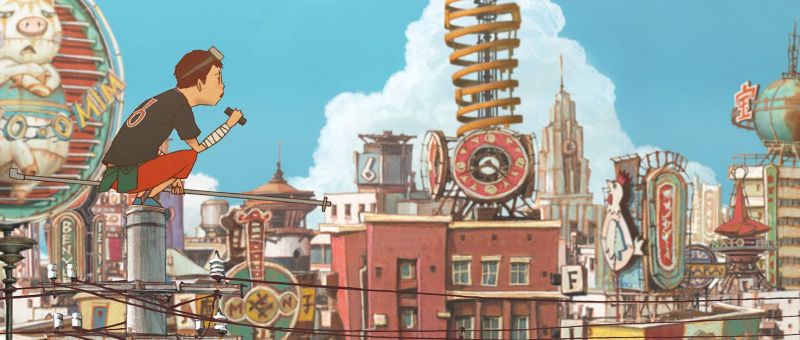
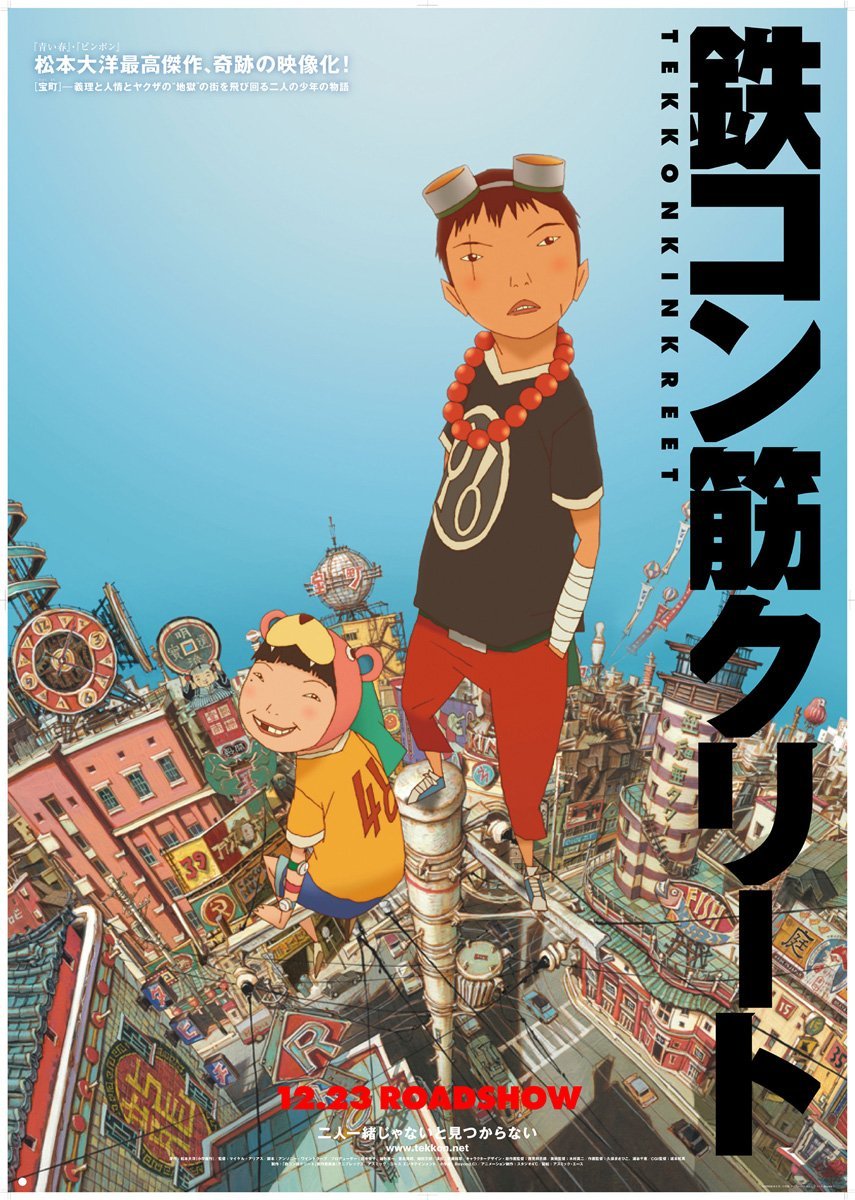
A pair of orphaned street kids attempt to defend backstreet life from the ravages of progress in Michael Arias’ adaptation of the manga by Taiyo Matsumoto, Tekkonkinkreet (鉄コン筋クリート). Though the manga was first published in the early ‘90s which is to say at the beginning of the post-Bubble era, the film looks back to a scrappy post-war Japan embodied by the moribund Treasure Town, once a lively city filled with the promise its name implies but now according to some a lawless slum ruled over by the “Cats” and contested by yakuza determined to turn it into another “Kids Kastle” theme park. 

There is something particularly ironic in the desire to turn Treasure Town, a literal playground for orphans Black (Kazunari Ninomiya) and White (Yu Aoi) collectively known as the Cats, into a walled city taking something that should be free and charging for it while displacing the street kids who live there so that those whose parents can pay can be given a temporary illusion of freedom. To Black, this is his city and he will defend it along with protecting White who has an otherworldly simplicity and makes radio calls to the universe reporting that he has preserved peace on Earth for another day. In a way he has because it becomes clear that the two boys are a two halves of one whole maintaining balance and keeping each other in check. Innocent and naive beyond his years White cannot survive alone, but without White, Black would have nothing to live for. His inner darkness would become all consuming and present a threat to all those who cross his path. 

In a piece of poignant symbolism, White attempts to grow an apple tree by planting a seed in the junk yard where they live but is disappointed that it does not seem to sprout little realising that it cannot grow where it is planted because the conditions are adverse to its development. The same might be said of he and Black who have been abandoned by their society and are cared for only by a wise old man who gives them occasional advice. Their only desire to is protect their town in a bid to avoid yet another displacement this time at the hands of corporatised yakuza who see Treasure Town only as a relic of a previous era sitting on valuable land which must be seized and monetised. Only old school gangster Rat ironically enough agrees with the Cats, confused by the desire to erase community and history riding roughshod over the feelings of all those who have ever called Treasure Town home. 

Rat’s battleground is located in the soul of his protege, Kimura (Yusuke Iseya), who first says that he doesn’t believe in anything only for Rat to tell him that he should at least believe in love. Seduced by the consumerist promises of the duplicitous Snake (Masahiro Motoki) and his giant alien minions, Kimura nevertheless comes around to Rat’s way of thinking on learning that he will soon be a father. Like Black and White, he dreams of escaping Treasure Town for a house by the sea where he could live a peaceful life with his child but is trapped by contrary codes of gangsterdom if even if eventually realising that the two things he believes in are truth and love neither of which are very important to Mr. Snake. Black meanwhile is torn between his inner darkness and his belief in White, caught between nihilistic violence and the desire to plant a seed and watch it grow even on shaky ground. 

Designed by Shinji Kimura, the backstreets of Treasure Town are a Showa-era paradise perhaps stuck in the past in the view from early Heisei but embodying a scrappy sense of possibility. It has an uncanny reality as an organic space built and lived in by human hands that is at an odds with the slick uniformity of the gangster developers who want to turn it into a children’s theme park, the very embodiment of a constructed paradise that will halt the natural growth that Rat describes in reminding Black that Treasure Town will never be what it was but will continue on with or without them. Bringing this place fully to life, Arias’ surprising, inventive direction gives full vent to the anarchy of the source material but is in the end about the heart of a place along with the bond between its two protectors keeping the peace through complementary balance.


Tekkonkinkreet screens at Japan Society New York on Sept. 16 as part of the Monthly Anime series.

Original trailer (no subtitles)

Vision (ビジョン, Naomi Kawase, 2018)

In her most recent work, Naomi Kawase has been moving further towards the mainstream, shooting in a more conventional arthouse register and mainly casting established professional actors in contrast to the amateurs who often took centre stage in her earlier career. Vision (ビジョン) however returns her to her familiar Nara Prefecture with its verdant forests and rolling mists and to more obscure realms of poetic ambiguity and new age philosophy.

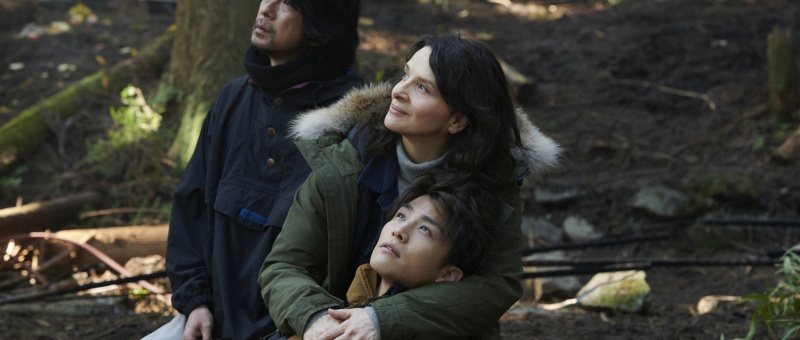
French scientist/travel writer Jeanne (Juliette Binoche) has come to Japan in search of a herb so rare it apparently only spores once a millennium but has the capability to “dispel human weakness, agony, and pain”. Tomo (Masatoshi Nagase), a mountain man she ends up lodging with along with her interpreter Hana (Minami), answers only that “happiness exists in each of our hearts”, a somewhat hollow and ironic reply given his general grumpiness and stern expression. He tells them that he’s only lived in the cabin for 20 years having moved to the country because he was “tired” and that his purpose is to save the mountain. Despite his seeming reluctance, he eventually introduces the pair to a blind shamaness who claims to be 1000 years old and was born when the last plant (or as she points out fungus) spored. 

Lost in the beauty of nature, Jeanne begins to wonder if she is really in the present, losing the certainty of the moment. We get occasional snippets of what seems to be memory bathed in a golden light and presented as flashback which might hint at the “pain” Jeanne is trying to cure through finding the “vision” herb even as she engages in a halfhearted though apparently passionate affair with the indifferent Tomo. She sees him as “starving” for something, not knowing what it is he’s longing for, though her friend describes him as “happy” as if silent like the mountain he claims to be saving though all we see him do is destroy it by carving up trees even if he does point again to the transience of things in explaining that the lumber he produces is the work of several generations who planted and grew so he could cut down, perhaps hinting back at Jeanne’s claim that when life develops too far it begins to destroy itself. 

Tomo doesn’t quite seem to buy her new age philosophies, explaining only that “you see, and hear, touch, you feel, that is everything”, rooting his sense of reality firmly within the realms of the sensual. “Sometimes because we have language we can’t understand each other” Jeanne later says, echoing him though perhaps accidentally while expounding on the human condition to a mysterious young man, Rin (Takanori Iwata), discovered injured in the forest. Aki (Mari Natsuki), the shamaness, advances that there are changes in the forest, that it has become unbalanced, and that it will soon be time for the “vision” to present itself though it seems to take a while for Jeanne to understand what form that may take. Aki dances furiously amid the trees as if bending them to her will, her ritualistic dance later echoed in the climatic final sequence that sets a fire in the mountain but causes Tomo to suddenly declare that it is after all alive. 

Jeanne finds her “vision” in an alignment of past and future, a familial, generational reunion which allows her ease her pain just as it was said vision would do. All moments are perhaps one moment. On the train Hana had described a feeling of long forgetten happiness that Jeanne’s travel essay had provoked in her as akin to “nostalgia”, instantly amusing Jeanne who is overcome by the incongruity of this young woman already romanticising a sense of nostalgia for an unlived past. Tomo had declared that it was enough simply to remember that he too was a part of this world, but is suddenly reminded that he is not alone. Literally setting fire to the past they buy themselves the possibility of being reborn, making space for new growth in the knowledge that the mountain is “alive” as indeed are they. Tomo has saved the mountain, and Jeanne has perhaps saved herself. “Isn’t it beautiful?” she exclaims embracing a new vision of a bright and shining future no longer burdened by pain or despair.


Vision streams in the US until Dec. 23 alongside Naomi Kawase’s 1997 debut Suzaku as part of Japan Society New York’s Flash Forward series.

Trailer (English subtitles)
The Pass: Last Days of the Samurai (峠 最後のサムライ, Takashi Koizumi, 2021)

“Even with 100 plans and 100 ideas, we cannot defeat the march of progress” a progressive samurai admits, well aware that he’s witnessing the end of his era while knowing that the “thrilling future” that lies ahead will have no place for him. Adapted from the novel by Ryotaro Shiba, The Pass: Last Days of the Samurai (峠 最後のサムライ, Toge: Saigo no Samurai) is inspired by the life of Kawai Tsugunosuke, known as the “Last Samurai” for his steadfast embodiment of the samurai ideal during the chaos of the Bakumatsu and subsequent Boshin War

As the opening voiceover from Tsugunosuke’s wife Osuga (Takako Matsu) explains, the Tokugawa Shogunate had ruled Japan for close to 300 years after bringing the warring states era to an end following the Battle of Sekigahara, placing the nation into a period of enforced isolation which by the 1850s was beginning to crack while resentment towards the Tokugawa continued to grow over their handling of access to foreign trade. In 1867, Tokugawa Yoshinobu (Masahiro Higashide) effectively relinquished his monopoly on power and restored ultimate authority to the emperor (the “Meiji Restoration”). Yet if he hoped his decision would both restore peace and allow the Tokugawa to maintain political influence he was quite mistaken. In the immediate wake of this political earthquake the nation became polarised between those in favour of imperial rule and those who remained loyal to the Shogunate. 

The chief retainer in Nagaoka, Tsugunosuke (Koji Yakusho) finds himself in an impossible position caught between the forces of East and West and essentially unable to pick a side because of the demands of samurai loyalty. Fearing another war would prove disastrous, he chooses neutrality certain that the present conflict cannot be resolved militarily and requires a political solution. To this effect he attempts to petition a delegation from the Western, pro-emperor, pro-modernisation army but his pleas fall on deaf ears and lead only to a rebuke that he is a coward and a traitor. Like any good leader, however, Tsugunosuke has also been preparing for the worst, buying a gatling gun from foreign dealers in order to boost his meagre man power eventually realising they have no other option than to go war 

The irony is that Tsugunosuke tacitly supports imperial rule but cannot say so because his clan is closely affiliated with the Tokugawa. He is well aware that his era has come to a close and that he will not live to see the new Japan, knowing that he is man of the old world and cannot progress into the classless society he is certain is coming. For all that he seems to be excited by the promises of revolution, encouraging the son of a friend to take advantage of the freedoms of a new era while dreaming of foreign travel and advocating for “liberty and rights” along with universal education in the hope of building of a better society. 

Yet for himself he cannot let go of samurai ideals, knowing he must fight a pointless war in which he does not believe because honour dictates it. “If it shows future generations what we samurai truly stood for then this battle will have been worthwhile” he tells a friend, fearful of a future dominated by the clans of Satsuma and Choshu. “Your samurai spirit will encourage countless others” another retainer tells him, “you are our ideal”, touched by his stoicism and grace even in defeat as he takes sole responsibility for the failure of their military campaign caused in part by the betrayal of a defecting ally. “This warriors’ way shall die with me” he cheerfully tells a servant, advising him to become a merchant and travel abroad to seize the “thrilling future” which lies ahead of him. 

A martyr to his age, Tsugunosuke is the last of the samurai stoically defending a lofty ideal in an acknowledgement that he does not belong in the new society and must sacrifice himself in order to bring it about. An homage to classic samurai cinema from former Akira Kurosawa AD Takashi Koizumi, who even throws in the odd screen wipe, featuring cameos from golden age stars Tatsuya Nakadai and Kyoko Kagawa, The Pass is about the passage from one era to the next taking as its hero a closet revolutionary and walking embodiment of the idealised samurai who chooses unity and shared vision over conflict in the creation of a better world he does not intend to live to see.


The Pass: Last Days of the Samurai screens on Aug. 21 and Sept. 1 as part of this year’s Japan Cuts.

Original trailer (English subtitles)

Svaha: The Sixth Finger (사바하, Jang Jae-hyun, 2019)

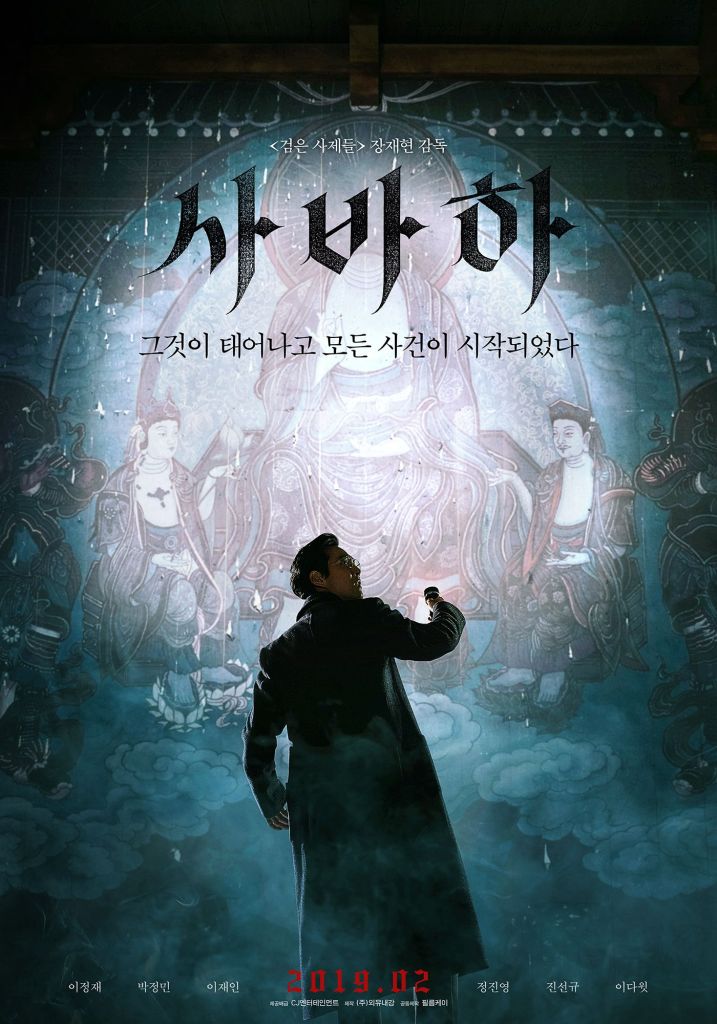
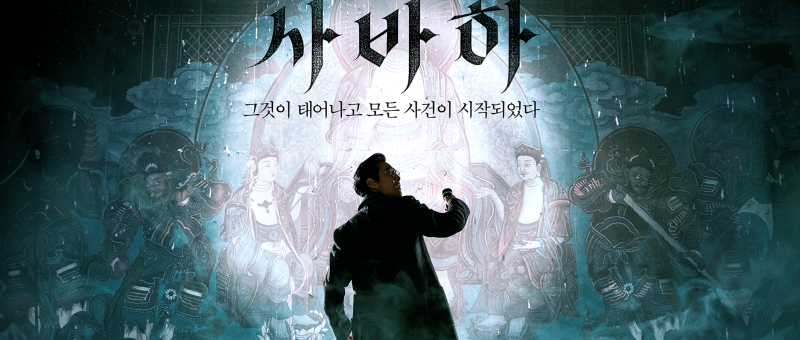
The thing about prophesies and the prophets who proclaim them, is that they only have power if people choose to believe in them. “Faith” can become a convenient cover for those who’d rather not explain themselves, a mechanism for manipulating sometimes vulnerable people looking for a greater truth or a purpose in their lives. Svaha: The Sixth Finger’s (사바하) dogged pastor is intent on investigating religious crimes and exploiting spiritual charlatans but he of course has his own agenda, that mostly being that he’s keen to get money off his clients who are in turn hoping to bolster their authority by rooting out “heresies”.

Leader of the Far Eastern Religious Research Institute, a kind of religious detective agency employing only himself, an undercover assistant, and a “deaconess” secretary, Pastor Park (Lee Jung-jae) makes his money flagging up dodgy and/or exploitative practices connected with organised religion. According to him, freedom of religion is “overly” protected, and he is alone on the frontlines of a spiritual war against unscrupulous cultists. Though some kind of protestant, he often works for/against the Catholic Church and is good friends with a Buddhist monk who gives him a tip off about a weird sect he can’t get a handle on, Deer Hill. 

Meanwhile, a young girl, Geum-hwa (Lee Jae-in), explains to us that she was born with an “evil” twin clamped to her leg. The twin wasn’t expected to survive, but is still living with Geum-hwa and her family who keep her locked up in a shed like a beast. Rightly or wrongly, Geum-hwa connects her sister with the deaths of her parents which occurred fairly soon after the children were born. Her grandfather, with whom Geum-hwa now lives, never even registered the birth of a second child out of fear and shame, never expecting her to survive this long. When a truck hits a bridge and exposes the hidden body of a murdered teenager, the police start investigating too, eventually leading them to two young men loosely connected with the shady Buddhist cult. 

“This world is one big muddy mess”, according to the cultists at Deer Hill. It’s not difficult to see why people might be looking for spiritual reassurance in such a chaotic world, but it’s exactly that need that places like Deer Hill may be seeking to exploit. Nevertheless, the only thing that Park’s undercover agent turns up is that there doesn’t appear to be anything untoward. Deer Hill doesn’t accept offerings from its members and even gives money away to the needy. Tellingly, the real nitty gritty to Park’s clients is in doctrinal deviation, they only really want to know what kind of Buddhism it is that they do and if it’s in line with broader teachings of the faith. 

A further tip off leads them to the mysterious Je-seok (Jung Dong-hwan), a legendary Buddhist priest who studied in Japan but apparently devoted himself to the Independence movement and is said to have achieved enlightenment. Je-seok’s teachings are dark in the extreme, “Pain is the fruit of faith” goes his mantra, “pain purifies your blood”. He believes that he is the “light” that will conquer the “darkness” by snuffing out “snakes”. One of his disciples, brainwashed as a vulnerable young man and encouraged to do terrible things in the name of good, begins to doubt his teachings when confronted with a possible hole in his logic and the very real human cost of his strategy. 

Not quite as cynical as he seems, Park retains his faith. It’s ironic that all this is taking place at Christmas and centres on the prophesied birth of a child that threatens someone’s sense of personal power. Unlike most, Park has always regarded Christmas as a “sad” holiday, unable to forget that Jesus’ birth was accompanied by the mass murder of innocent baby boys. He wonders where God is now and why he permits these things to happen. Park has faith that God sent Jesus into the world for the greater good, but Je-seok has convinced his followers that the same is true of him, that he has come to banish the darkness and that all their pain and suffering is fuel in a holy war. Their faith has been redirected and misused for the benefit of a false prophet, while his opposite number has been made to live a life of bestial misery solely because of superstitious prejudice. The police is a fairly irrelevant presence in this series of spiritual transgressions, but there is much less clarity to be had in “truth” than one might hope with “faith” the only solution in an increasingly uncertain world.


Svaha: The Sixth Finger is currently available to stream on Netflix in the UK (and possibly other territories).

International trailer (English subtitles)
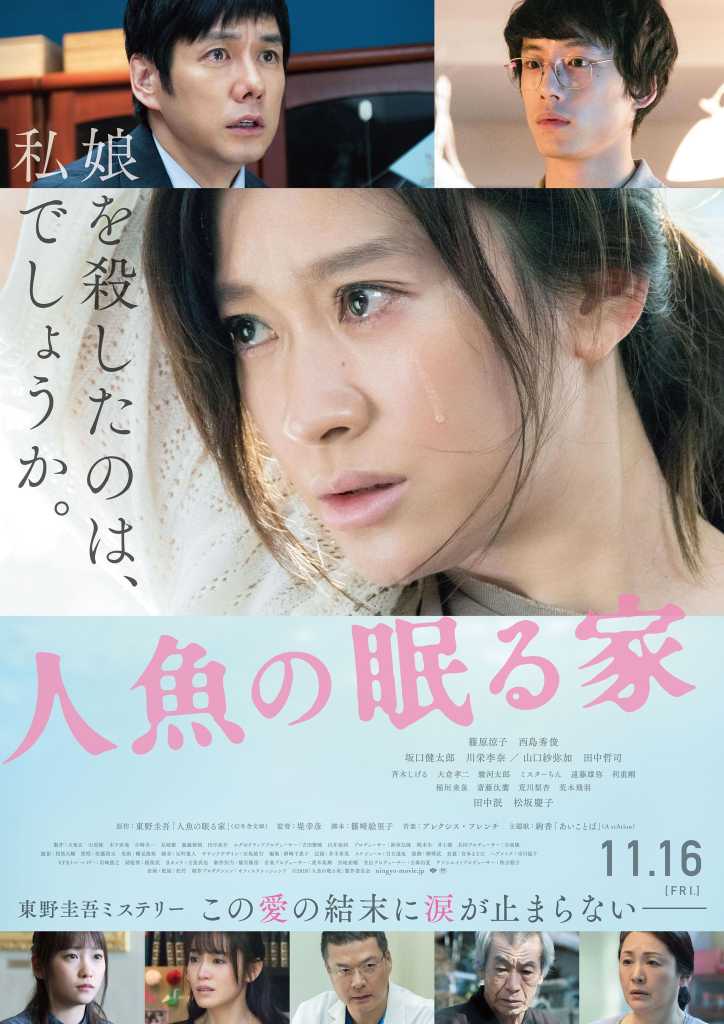
The House Where the Mermaid Sleeps (人魚の眠る家, Yukihiko Tsutsumi, 2018)

In most countries, the legal and medical definitions of death centre on activity in the brain. In Japan, however, death is only said to have occurred once the heart stops beating. The bereaved parents at the centre of The House Where the Mermaid Sleeps (人魚の眠る家, Ningyo no Nemuru Ie), adapted from the novel by Keigo Higashino, are presented with the most terrible of choices. They must accept that their daughter, Mizuho, will not recover, but are asked to decide whether she is declared brain dead now so that her organs can be used for transplantation, or wait for her heart to stop beating in a few months’ time at most. As their daughter was only six years old, they’d never discussed anything like this with her but come to the conclusion that she’d want to help other children if she could. Only when they come to say goodbye, Mizuho grasps her mother’s hand giving her possibly false hope that the doctor’s assurances that she is brain dead and will never wake up are mistaken. 

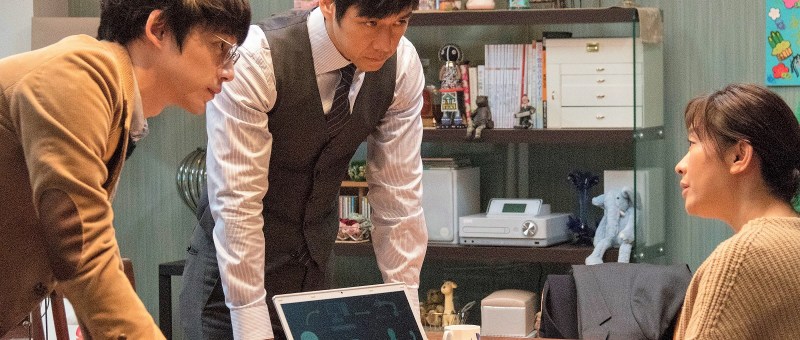
The situation is further complicated by the fact that the Harimas were in the middle of a messy divorce when they got the news that Mizuho had been involved in an accident at a swimming pool. Kazumasa (Hidetoshi Nishijima), Mizuho’s father, is the CEO of a tech firm specialising in cutting edge medical technology mostly geared towards making the lives of people with disabilities easier. He does therefore have a special interest in his daughter’s condition and is willing to explore scientific solutions where most might simply accept the doctor’s first opinion. His wife, Kaoruko, meanwhile has a deep-seated faith that her daughter is still present if asleep and will one day wake up. 

It so happens that one of Kazuma’s researchers (Kentaro Sakaguchi) specialises in a new kind of technology which hopes to restore motor function through artificial nerve signals controlled by computers and electromagnetic pulses. He hatches on the idea of using the technology to improve his daughter’s quality of life by letting her “exercise” to maintain muscle strength, but despite the excellent results it achieves in terms of her health, it takes them to a dark place. Muscle training might be one thing, but having Mizuho make meaningful gestures is another. They don’t mean to, but they’re manipulating her body as if she were a puppet, even forcing her to smile without her consent. 

Kazumasa starts to wonder if he’s gone too far. Seeing his daughter’s face move with no emotion behind it only proves to him that she is no longer alive. Meanwhile, he comes across another parent raising money to send his daughter to America for a life saving heart transplant and begins to feel guilty that perhaps his decision was selfish. The father of the other girl sympathises with him and confides that they can’t bring themselves to pray for a donor because they know it’s the same as praying for another child’s death, but Kazumasa can’t help feeling he’s partly responsible because he made the choice to artificially prolong his daughter’s life but now realises that she is little more than a living a doll. 

This is something brought home to him by Kaoruko’s increasing desire to show their daughter off. Her decision to take her to their son Ikuo’s elementary school entrance ceremony instantly causes trouble with the other parents who feign politeness but are obviously uncomfortable while the children waste no time in ostracising Ikuo because of his “creepy” sister. Kazumasa privately wonders if Kaoruko’s devotion has turned dark, if she’s somehow begun to enjoy this new closeness with her daughter to the exclusion of all else and has lost the power of rational thought. He can’t know however that perhaps she’s coming to the same conclusion as him, but it finding it much harder to accept that they might have made a mistake and all their interventions are only causing Mizuho additional suffering.

What’s best for Mizuho, however, is something that sometimes gets forgotten in the ongoing debate about the moral choices of her parents and relatives. Kazumasa’s colleagues accuse of him of misappropriation in monopolising a key researcher, hinting again at the “selfishness” of his decision to expend so much energy on treating someone whom many believe to be without hope when there are many more in need. The researcher in turn accuses Kazumasa of “jealousy” believing that he has displaced him as an “artificial” father working closely with Kaoruko in caring for their daughter. The “life” in the balance is not so much Mizuho’s but that of the traditional family which is perhaps in a sense reborn in rediscovering the blinding love that they shared for each other which will of course never fade. What they learn is to love unselfishly, that love is sometimes letting go, but also that even in endings there is a kind of continuity in the shared gift of life and the goodness left behind even after the most unbearable of losses.


Screened as part of the Japan Foundation Touring Film Programme 2020.

Original trailer (English subtitles)