New Female Prisoner Scorpion (新・女囚さそり 701号, Yutaka Kohira, 1976)

After the fourth film in the Female Prisoner Scorpion series, star Meiko Kaji decided to move on but Toei had other ideas and opted for a reboot as signalled by the addition “shin” or “new” to the otherwise identical title to the very first film. New Female Prisoner Scorpion #701 (新・女囚さそり 701号, Shin Joshu Sasori: 701-go) moves in a slightly different direction spinning a tale of a less straightforward revenge coloured by conspiracy cinema and a series of real life high-profile corruption cases including the Lockheed Scandal, itself name checked in the film. Just a few months earlier, Roman Porno actor and fervent nationalist Mitsuyasu Maeno had lost his life in a suicide attack on the home of underworld figure and right-wing fixer Yoshio Kodama who had been instrumental in “convincing” Japanese airlines to buy Lockheed planes over McDonnell Douglas.

In any case, this Nami Matsushima (Yumi Takigawa) is an ordinary young woman who becomes concerned about her sister Taeko (Bunjaku Han) when she uncharacteristically drops out of contact after behaving strangely. Taeko is a political secretary to assemblyman Miura (Ichiro Nakatani) who is currently the vice-minister for justice and at the centre of a burgeoning corruption scandal. After Nami and her fiancée Toshihiko (Yusuke Natsu) manage to meet up with Taeko, she is suddenly kidnapped from the hotel car park while the man who was with her, Sugino (Nenji Kobayashi), is gunned down. Sugino is found to be carrying his passport and two airline tickets to Paris which, along with Taeko’s strange behaviour, imply they were planning to flee the country together. Looking more closely at the wedding presents her sister had given her, Nami realises she’s left her a cassette tape with the instruction to leak its contents to the press should anything untoward happen to her. 

Nami uses the tape as leverage with Miura to try and rescue her sister but ends up learning some unpleasant truths before being framed for Taeko’s murder and sentenced to 15 years in prison. Toshihiko, who had originally been supportive, betrays her, testifying at her trial that she may have been resentful that Taeko was against their marriage only to later marry Miura’s daughter and go into politics apparently siding with the bad guys. Toshihiko may have seemed like a nice guy, but it’s also true that he tried to pressure her into premarital sex that she didn’t want by insisting that he couldn’t wait for marriage, suggesting they blow off her sister and go to a hot springs in Hakone instead. Most of the men in the film are equally spineless and duplicitous not least the guards who with the exception of one are all corrupt and/or abusing the inmates. 

Not content with sending her to prison, Miura tries to have Nami offed with the assistance of the warden who puts her in a cell with the prison’s most notorious offender. Fusae (Mitsuyo Asaka) orders her minions to beat and torture Nami, at one point gang raping her while the only way she can think of to save her life is by claiming there’s another tape so if they kill her they’ll never know where it is and run the risk of the contents leaking. 

Meanwhile, she’s approached by a group of anarchists who tell her they need a leader which seems a little contradictory but nevertheless enables a jailbreak even as Nami develops a rivalry with the feisty prisoner number 804. Though she obviously didn’t commit the murder for which she was imprisoned, Nami is no pushover and in fact burns one of her tormentors alive not to mention stabbing another in the eye with a pencil and cunningly splitting a pair of scissors to gain twin knives. Rather than the classic scorpion look, she appears almost batlike, spreading her arms in her cape as she prepares to make her final act of revenge right outside the Diet building itself as if she were making a point about cleaning up politics aside from avenging her sister’s death and her own mistreatment. Director Kohira lends her a supernatural quality in her eerie silhouette as if she’s already become something else, a force of nature transformed by her righteous anger towards a corrupt society largely ruled by venal men willing to kill and use women for their own benefit or pleasure. Even Nami is forced to admit her complicity having learned her sister may have paid for her education through allowing herself to be traded by Miura as a political bargaining chip. She is not, however, willing to let it stand, resisting a controlling a patriarchal society with all of the resources available to her.


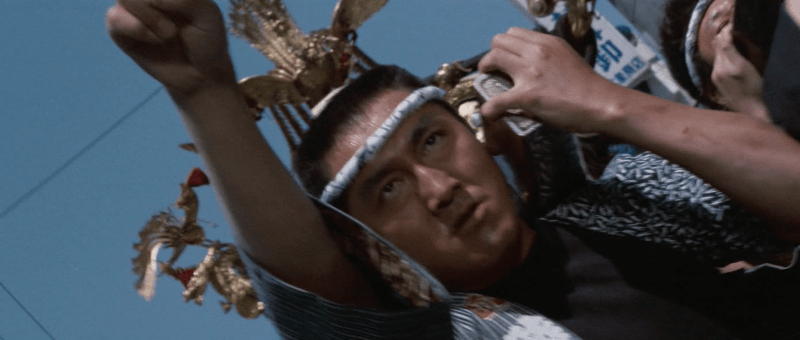
Festival Champ (お祭り野郎 魚河岸の兄弟分, Norifumi Suzuki, 1976)

Who doesn’t love a festival? The hero of Norifumi Suzuki’s Festival Champ (お祭り野郎 魚河岸の兄弟分, Omatsuri yaro: Uogashi no Kyodai-bun) loves them so much that he travels all over Japan to help out in places where young men have become thin on the ground thanks to increasing urbanisation and rural depopulation. Following the success of Suzuki’s entries in the Truck Yaro series in 1975 and 1976, the film was part of a new line of comedies and sports movies launched by Toei as well as a vehicle for Hiroki Matsukata who was trying to move on from yakuza movies.

Katsuo (Hiroki Matsukata) is however something of a goodhearted bruiser who is always getting into manly scraps and especially at the festivals he travels to which is a pretty good hook for an ongoing series. But it’s not all that great for his employer who runs a family fishmonger’s at the Uogashi fish market and complains that Katsuo’s always running off and causing trouble. The fish market itself takes on an exoticised quality in the opening sequence which features a voice over from karate queen Etsuko Shihomi, here in a purely dramatic role, who is the daughter of a well-to-do traditional Japanese restaurant and travels there daily by speedboat to pick up the best fresh fish available. Suzuki throws in some documentary-style stock footage and statistics about the market that lend a strangely corporate feel, but then homes in on its capacity as a community hub. Kiyoko says it’s her favourite place precisely because there’s nothing formal about it. Deals are done through body language and you don’t need any kind of resume to work there, everyone’s welcome. 

That may be the implied contrast between Kiyoko’s father, who owns an upscale place and cultivates genuine relationships with local fishermen and brokers, and local boy made good Kurosaki who has supposedly become the CEO of a restaurant chain, itself a symbol of the soulless corporation of ‘70s Japan. Kurosaki rocks up dressed like a yakuza, but everyone treats him as a successful businessman and in part thanks to Katsuo’s boss Zenjiro’s recommendation is eager to make deals with him but predictably he’s running a huge scam that could destroy the local economy. Zenjiro is later faced with the difficult decision of selling his family business to repay all the other fishermen and brokers that have fallen foul of him. 

It’s this societal sense of unfairness that stripper Kumi (Terumi Azuma) hints at when she says she feels “frustrated” and that her long-lost brother Eiji (Toru Emori) probably feels even more frustrated than she does after he slaps her having found out that she’s become a burlesque dancer. As she points out to him, he ran away from home and left her behind with the aunt that was cruel to them so what exactly he expected her to do is a mystery. In the end, it’s his own fault for abandoning her, so he has no leg to stand on in criticising her for the way she’s lived her life. Kumi is well accepted in the local community and walks around in very elegant attire which gives her the air of an “ojosan” or upperclass lady to much greater extent that Kiyoko has in her love of the earthy world of the fish market. The fact that she turns out to be suffering from a tragic terminal illness perhaps only reinforces this sense of unfairness, that the modern world has essentially poisoned her and she can no longer survive in it.

The only things that give her solace are Katsuo and the idea of joining in carrying a shrine festival which would seem to be ways of reconnecting with a more essential Japaneseness. Despite his rowdiness, Katsuo is as she describes him the kindest person she’s ever met and a more positive vision of a still traditional masculinity that looks to protect the community and those around him. He gets into a fight with Eiji, but after exchanging a few blows the men become firm friends, while it’s trying to hook his wimpy friend Kinichi up with a date that brings him to Kumi in the first place. Meanwhile, it seems like Ayuko (Junko Natsu) has a crush on him and despite Zenjiro’s exasperation with Katsuo, everyone expects that he will eventually marry her and take over the family business. 

And so, it’s only a violent, but also quite funny, intervention from Katsuo that can eventually overcome the disruption Kurosaki threatens. Suzuki throws in a lot of his trademark weirdness including all of Zenjiro’s other daughters having fishy names, and a local sex worker who is insatiably aroused by octopuses followed by a gag in which Katsuo is trolled with a suggestive-looking shellfish, but mostly rests on a sense of qualified wholesomeness and community all carried on Katsuo’s broad shoulders as the lone guardian of a more essential Japaneseness otherwise uncorrupted by venal post-war capitalism.


*Norifumi Suzuki’s name is actually “Noribumi” but he has become known as “Norifumi” to English-speaking audiences.

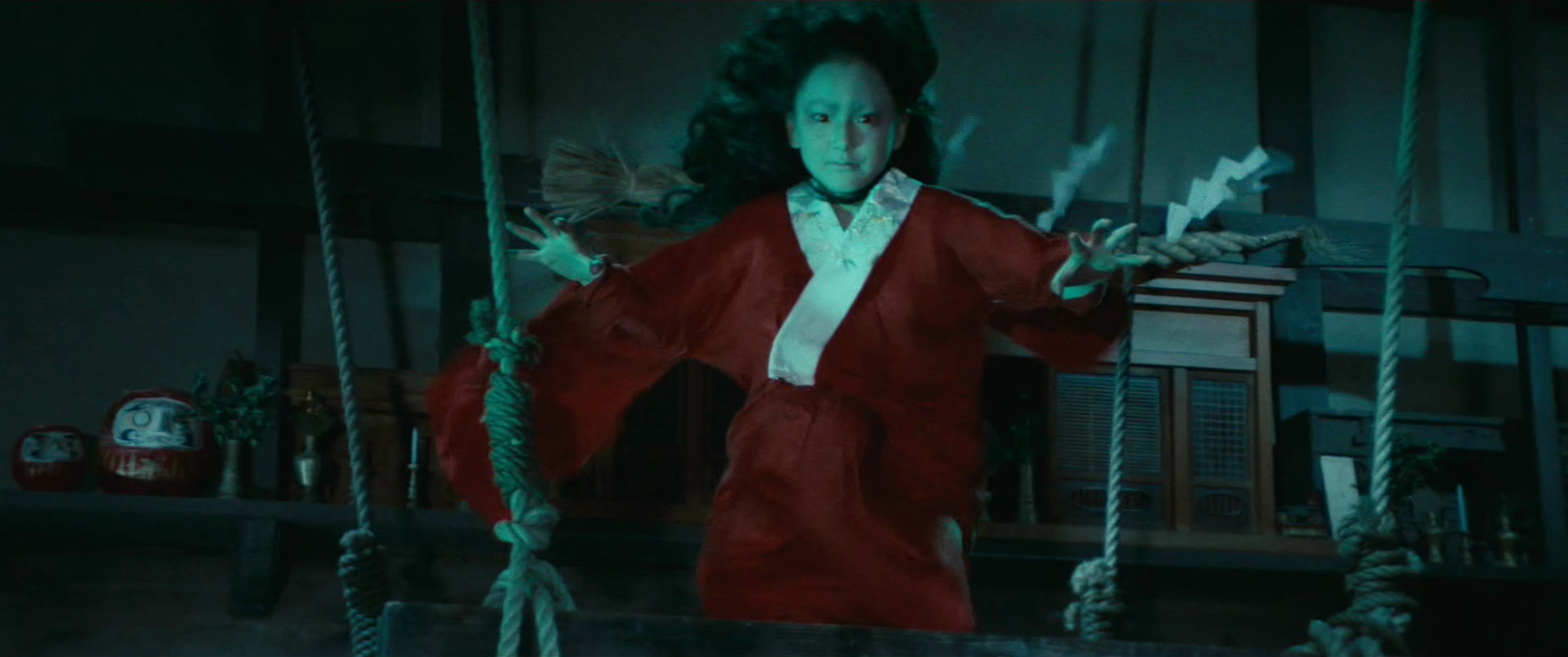
Curse of the Dog God (犬神の悪霊, Shunya Ito, 1977)

By the late 1970s, Japan was a very prosperous place and the cutting edge of modernity yet old beliefs die hard and those who run afoul of a natural order they assumed had long been forgotten will pay a heavy price for their arrogance. After a four-year hiatus following the third of the Female Prisoner Scorpion films, Shunya Ito returned with a strange slice of folk horror The Curse of the Dog God (犬神の悪霊, Inugami no Tatari) in which it is indeed the city invaders who have transgressed these ancient boundaries in their wilful indifference to the natural world.

The conflict between these two Japans is clear in the opening sequence in which three men pass through a tunnel in a truck bearing the logo of a nuclear power company and emerge into a village where a group of boys jump out from behind a row of tiny haystacks wearing masks made of leaves. The boys crowd around the van asking the strangers why they’re here and they jokingly tell them that they’ve come to look for “treasure,” which turns out to be a quest to find uranium in the local mountains. Otherwise uninterested in the village or the landscape, the men back their truck into a dilapidated roadside shrine which then collapses, and subsequently run over a little boy’s dog which had attempted to stop their car by barking fiercely at them. Rather than stop to apologise or comfort the boy who is cradling his dead dog in his arms, the men sheepishly drive off as if embarrassed. 

Of course, the shrine turns out to belong to the Dog God who is guardian deity of these mountains and now incredibly annoyed not just by the destruction of the shrine and killing of the dog, but by the men’s intention to tear the natural world apart looking for something which could prove very destructive even if they claim they want to use it responsibly to fuel the economic rocket which is Japan in the 70s. The Kenmochi family, the head of which, Kozo, is the local mayor are very receptive to the firm’s entreaties and immediately grant them access to their land while arranging a marriage which at least in part dynastic between Kozo’s daughter, Reiko (Jun Izumi), and the head of the expeditionary group Ryuji (Shinya Owada). But once they return to the city, the other two men die in mysterious circumstances, one entering a kind of trance and walking off the roof of the hotel after the couple’s formal wedding reception and the other attacked by a pack of wild German Shepherds in the middle of Tokyo. 

Reiko is quick to exclaim that it’s all the fault of the Dog God, though it’s never quite clear whether or not she is aware that her family is the subject of an ancestral curse because they themselves offended the deities by getting their hands on the land cheaply when it was used as collateral for a loan. In contrast to the Tarumis, the family of Reiko’s best friend Kaori (Emiko Yamauchi) and her little brother Isamu (Junya Kato) who is the boy whose dog they killed, the Kenmochis put on heirs and graces and as if they were the ancestral aristocracy of this area rather than having made a speedy class transition thanks to someone else’s misfortune and the vagaries of the post-war era. The Tarumis, meanwhile, live in a much more humble home and dress in a much more traditional mountain village manner. Patriarch Kosaku (Hideo Murota) point-blank refuses to sell his land and will have little truck with Ryuji or the mine once it opens, leaving the family regarded as outcasts within the village. 

But then there is a definite and literal pollution signalled by the arrival of the prospectors. At a meeting, it’s suggested that the sulphuric acid they’re using to flush out the uranium in inaccessible areas of the mine could contaminate the local groundwater which is a problem when many families are still taking their water from wells but they all laugh it off. Sometime later Ryuji is horrified to see dead fish floating in the river, while his own in-laws, the older generation of the Kenmochi family, are also killed by ingesting contaminated water. A rumour arises that the culprit is the Tarumis who have poisoned the wells out of spite, and when Ryuji tries to raise the alarm after getting a positive result for sulphuric acid in the water supply the company tell him to pin it on them instead. 

The intrusion of modernity has interrupted the careful, if woefully feudal, balance of the village with terrifying and tragic consequences. Yet Kosaku is also surprised, asking how a city man like Ryuji could really believe in something like a “curse”. The shamans they bring in to do a ritual also blame everything on the Terumis, adding the suggestion that the ill will is motivated by Kaori’s sexual jealousy over Ryuji giving rise to yet another interpretation of the curse’s origin besides the Kenmochi’s class transgression and the unintentional offence caused by the destruction of the shrine. Then again, perhaps it really is all because of the Dog God in a great confluence of coincidences that have led to this incredibly strange and unfortunate situation. In the end, even the film’s purest character, the Kenmochi’s small daughter Mako (Masami Hasegawa), is possessed by the evil spirit and made to take her revenge with a remorseful Ryuji desperately trying to repair what he himself broke in the acceptance that he should not have come here and was the catalyst for this confrontation with fate. Weird and haunting even in its bizarre obscurity the film nevertheless makes a case for the protection of the dark heart beating at the centre of the contemporary society which speaks of something older that cannot be crossed and most specially by those hellbent on a hubristic path to prosperity that has little respect for the land.


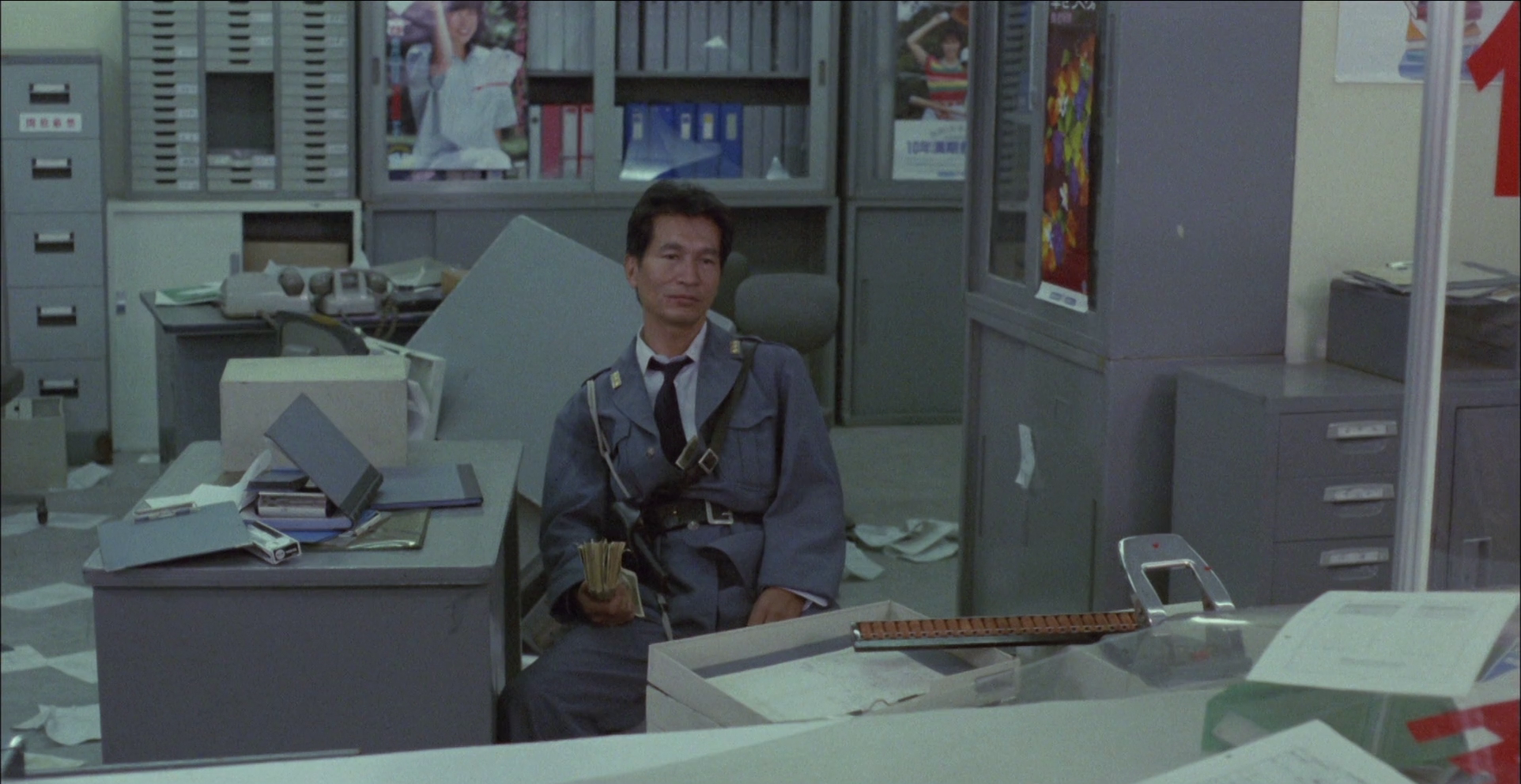
The Mosquito on the Tenth Floor (十階のモスキート, Yoichi Sai, 1983)

A beaten-down beat cop’s existential crisis progressively deepens after he throws himself into financial ruin to buy a computer in Yoichi Sai’s debut The Mosquito on the Tenth Floor (十階のモスキート, Jikkai no Mosquito). Like Pool Without Water, star Yuya Uchida conceived and co-scripted the film as a vehicle for himself and was apparently inspired by the sight of some blood, his own, on a wall where he’d squashed a mosquito though he also claimed the the 10 in the title is intended to reference the 10 commandments in addition to simply where the unnamed protagonist lives.

The fact that he lives on the 10th and top floor in a building with no lift is symbolic of his dismal circumstances. On the one hand he can rise no higher but on the other is stuck with an inconvenient living situation precisely because of his inability to rise socially. As it transpires the hero, a policeman, joined the force right out of high school with aspirations of rising to the rank of captain but has spent the entirety of his 20-year career manning a police box. He’s repeatedly failed the exam for promotion to lieutenant and realistically speaking is now simply too old to make much further progress. A man of few words, he listens as the other officers who took the exam with him outline the hierarchal structure of the police force while meditating that as a man on the wrong side of 40 his possibilities have decreased and it’s more than likely he’ll be stuck in the police box until he retires. 

His boss later says as much, sympathising with him but also pointing out that a policeman is also a public servant with a role to serve within the community. He is supposed to make people feel safe and contribute to the progress towards a crime-free society, but it’s clear that his life has spiralled out of control precisely because he cannot ally his career goals with the kind of life he wished to lead. His wife divorced him two years ago seemingly because she wanted a greater degree of material comfort and became resentful that he failed to progress in his career and could not move on from the low-salaried position of an ordinary street cop. She now makes a living selling golf club memberships, looking ahead to the oncoming Bubble-era and a society of affluent salarymen which is very much what her new boyfriend seems to be. Meanwhile, she lives in a very nice townhouse with their teenage daughter and constantly hassles the policeman for falling behind with his child support and alimony payments. He’s also racked up a healthy tab at a karaoke bar where he regularly hangs out and has a serious gambling problem with betting on boat races seemingly his only other form of social outlet.

As his daughter and others keep reminding him, the world is changing and his decision to buy a computer after unwisely taking out a payday loan is in part a symbol of his desire to progress into the modern society even if, somewhat ironically, others chastise him for spending what is then a huge amount of money on something they think of a child’s toy. Otherwise an upstanding policeman who irritatedly deflects a colleague’s joke about bribing someone to pass the exam, the policeman finds himself taking out one payday loan to pay another with loansharks constantly ringing him at the police box to remind him he’s behind on his payments. To overcome his sense of powerlessness, he begins by abusing his authority in catching a punk woman shoplifting and arresting her but then taking her back to his flat to play computer bowling and take advantage of her sexually. He later does something similar with a bar hostess, Keiko (Reiko Nakamura), who took him home when he was drunk. Though the encounter begins as rape, Keiko soon gives in and even comes back for more claiming that she’d never done it with a policeman before and it exceeded her expectations which is in many ways reflective social attitudes at the time. Emboldened, he invites danger by raping a female traffic cop, tearing her clothes as she fights back, screams, and cries though she presumably does not report him given the professional and social consequences that may adversely affect her life and career if she chose to. 

His ex-wife Toshie (Kazuko Yoshiyuki) says she’s not even sure if he’s human anymore, and his failed attempt to rape her after his boss reminds him that he advised against getting a divorce in the first place because it would negatively affect his chance of promotion may be a perverse way to prove he is though it obviously backfires. Having failed in every area of his life and with no prospect of ever getting back on track or starting again, he begins to go quietly insane typing rude words into his computer while the constant calls from loansharks take on a mosquito-like buzzing as does his own final wail of despair and powerlessness as he’s brought down by same authority he once served. His aloneness and confusion are palpable when he ventures into the city and discovers his teenage daughter Rie (Kyoko Koizumi) dancing in Harajuku staring at her intently but then walking away having invaded this space reserved for the young. “Police yourself!” one of the Rockabilly guys ironically instructs him on noticing that he’s dropped his ice cream cone, explaining that the police might shut them down if they’re discovered to be using the space irresponsibly by littering. Rie and her friends tell him to get a life, explaining that the world is changing while tapping him for cash he doesn’t have but is too embarrassed to refuse, laying bare the extent to which he and those like him have been left behind by the economic miracle, buzzing around maddeningly in mid-air with safe nowhere safe to land. 


Original trailer (no subtitles)

The Geisha (陽暉楼, Hideo Gosha, 1983)

The coming of the railroad spells doom for one of the most prestigious geisha houses in Japan in Hideo Gosha’s adaptation of the Tomiko Miyao novel, The Geisha (陽暉楼, Yokiro). Miyao’s novels had often provided the inspiration for Gosha’s films and she had herself been the daughter of a “flesh broker” in pre-war Kochi though later escaping to another town to be a substitute teacher. Though the English title may focus more on plight of the the individual geisha at its centre, the Japanese hints more at the destructive cycle of the Yokiro itself in the persistent legacy of exploitation.

Then again as he later points out, if you’re looking for a villain in this story then the responsibility lies largely with Daikatsu (Ken Ogata) himself. In a prologue set in 1913, Daikatsu has eloped with geisha Otsuru but the pair are discovered by gangsters sent after them by the Yokiro. Daikatsu kills all of their assailants and assures Otsuru that they are finally “free” but it appears to be too late. Holding their baby daughter in one arm, Otsuru collapses into his other and presumably dies either then or shortly after while Daikatsu is later sent to prison for 10 years. 20 years later in 1933, the daughter, Fusako (Kimiko Ikegami), has become the number one geisha at the Yokiro under the name Momowaka though her career flounders because she is regarded as too emotionally distant to keep a patron. 

Daikatsu is also himself in Kochi at this point and working as a procurer brokering the sale of young women to the Yokiro and other geisha houses and brothels. When a school teacher comes to him to sell his wife, he taps her teeth to check for malnutrition much as one would examine a horse before running a hand underneath her kimono to check everything is at is should be before offering a valuation. Her husband only looks at him anxiously enquiring if a body such as hers which has as he later reveals born three children will fetch a good price. Daikatsu lets them go so the woman, Masae, can spend a final night with her family explaining that he cannot force someone to work if they do not want to do so and is well aware they will likely take his money and never be seen again which is what almost what happens. As it turns out the husband is killed in a fight and the woman ends up becoming a geisha anyway, only in the pay of prominent Osaka yakuza led by Inaso. 

Inaso (Mikio Narita) and buddies want in on the construction of the railroad that will shortly be coming to Kochi, but need to take over the town first which means getting around the mistress of the Yokiro, Osode (Mitsuko Baisho), who is apparently running every game town. The entire local economy is underpinned by female exploitation and facilitated by a woman, a former geisha, seizing the only power that is available to her. Isano later uses Masae as a kind of spy, getting her to initiate a relationship with Osode’s weak willed husband in an attempt to humiliate her which largely backfires as Osode boldly reclaims her man through a violent brawl in a hot spring though it does not appear that she is especially fond of him so much as he serves a particular purpose.

The brawl emphases the way in which women are pitted against each other by the nature of a patriarchal society along with the ways in which they are forced to mediate their power through men. Fusako also gets into an intense physical fight with Tamako (Atsuko Asano), a surrogate daughter of Daikatsu’s and emblem of a coming modernity, who insists on becoming a sex worker at the area’s most prominent brothel. In a strange moment of confrontation, both the geishas of the Yokiro dressed in their traditional regalia, and the sex workers of Tamamizu, arrive at a modern club where the heir to a banking empire courted by the Yokiro, Saganoi, dances the Charleston he learned while studying abroad in America. The geisha who dances with him struggles to pick up the moves, Saganoi lamenting that the dance is just not suited to a woman wearing a heavy kimono, elaborate wig, and clumsy geta. Tamako immediately gets up from her table and kicks off her shoes, gathering the hem of her own kimono to free her legs for the high level kicks of the modern dance. 

Fusako reclaims her authority by interrupting the dance immediately before its conclusion and insisting on retrieving their guest. Tamako appears to resent Fusako, perhaps frustrated in her relationship with Daisuke who does not appear to have had much contact with the daughter he sold at 12 years old. They too end up in an elaborate brawl in which Tamako rips off Fusako’s wig and splits her lip, symbolically freeing her to transcend the constraints of her “geisha” persona. Meeting Saganoi at Western-style bar, she boldly dances on the counter and sleeps with him of her own volition. But in doing so she conceives a child and leaves herself in a difficult position. She has betrayed her patron, and though she could simply have kept the fact from him and allowed him to think the baby was his, Fusako does not want to bring her child up in lies while simultaneously hanging on to a naive dream that Saganoi will one day return to her despite being made aware he has left for Europe. 

“All men are enemies of women,” she writhes in childbirth while swearing that no one will take her child from her, but she is still an indentured woman and her daughter is by rights the property of Osode. Her illness, presumably consumption, began long before her pregnancy and seems to an echo of the suffering she has been forced to endure as a geisha. As her health weakens, so the Yokiro declines. First it is ravaged by a literal storm, but also under threat from the Osaka gangsters desperate to take over Kochi to gain access to the lucrative construction contracts extending in its direction. Even so, as Daikatsu admits much of the fault lies with him. He chose to elope with Otsuru and was unable to protect either her or their daughter whom he allowed meet the same fate by entering the geisha world. He continued to earn his money by selling women into what is essentially slavery, and cannot escape his part in their continued exploitation while his entanglement with gangsters later disrupts the more settled life Tamako has begun to build for herself. 

“Wait all you want, the train’s not coming,” Tamako is later told, as if signalling that there really is no way out of this destructive and disappointing existence. Truly epic in scope, Gosha’s pre-war drama draws together patriarchal exploitation and societal corruption to critique a burgeoning modernity, but ends exactly as it started among the vibrant cherry blossoms only this time undercutting the melancholy of the oft repeated song with a more cheerful scene hinting at least symbolically at a long-awaited reunion. 


Original trailer (English subtitles)

Yakuza Graveyard (やくざの墓場 くちなしの花, Kinji Fukasaku, 1976)

“We don’t resort to violence. We observe the law.’ The hero of Kinji Fukasaku’s Yakuza Graveyard (やくざの墓場 くちなしの花, Yakuza no Hakaba: Kuchinashi no Hana) is berated by a superior officer for excessive use of force, but his criticism is in some senses ironic because it is the police force itself which becomes a symbol of the societal violence visited on those who can find no place to belong in the contemporary society. By this time the yakuza was already in decline and in the process of transforming itself into a corporatised entity while as a police chief explains increasing desperation has led to escalating gang tensions. 

Recently transferred maverick cop Kuroiwa (Tetsuya Watari) finds himself caught between two worlds in attempting to enforce the law through methods more familiar to yakuza. Soon after he’s had his gun taken away for exercising excessive force on a suspect he’d been independently tailing in the street on whom he’d found bullets designed to be used with a remodelled toy gun, Kuroiwa is pulled aside by another senior officer, Akama (Nobuo Kaneko) who takes him to a meeting with local yakuza boss Sugi (Takuya Fujioka). It seems obvious that Akama has cultivated a relationship with the Nishida gang which may not be strictly ethical for a law enforcement officer and hopes to bring Kuroiwa on board as a potential asset. They attempt to bribe him in return for information on the Yamashiro clan, the dominant organised crime association in the area, which has been hassling Nishida in an attempt to take over their territory. But Kuroiwa ironically tells them that they should “act like yakuza” and sort out their own problems rather than relying on the police before dramatically walking out much to to the consternation of everyone else present. 

Nevertheless, he eventually comes to sympathise with them as a symbol of the little guy increasingly crushed by corporate and authoritarian forces outside of their control. He finds out from a briefing that the police’s goal is the disbandment of the Nishida gang but when he asks why they aren’t going after the Yamashiro too he’s told to mind his own business and begins to realise that the police are in cahoots with organised crime. Whether they justify themselves that managing the Yamashiro to prevent a turf war is the best way to protect the public or are simply corrupt and in the pocket of big business, Kuroiwa can’t help but balk at the blatant hypocrisy of the law enforcement authorities. 

Later Kuroiwa reveals that he became a police officer after being bullied as a child in order to exert power over his life, or perhaps becoming an oppressor in order to avoid being oppressed. He was bullied because he had been born in Manchuria and even years later remains a displaced person at least on a psychological level. It’s this sense of displacement which allows him to bond with the Nishida gang’s accountant, Keiko (Meiko Kaji), whose father was Korean. Kuroiwa agrees to accompany Keiko to visit her husband (Kenji Imai) who is serving a lengthy prison term in order to tell him that the gang want to promote someone else to a position he viewed as his by right. The husband explodes in rage and uses a word some would regard as a slur to reference Keiko’s Korean heritage while she later attempts to walk into the sea feeling that there really is no place for her in the contemporary society. 

Just as she claims that she is neither Korean nor Japanese or much of anything at all, Kuroiwa is neither cop nor thug and similarly excluded from society at large. He ends up bonding with old school Nishida footsoldier Iwata (Tatsuo Umemiya), who is also ethnically Korean, for many of the same reasons and attempts to mount a doomed rebellion against their mutual oppression, but is hamstrung by his otherness which is only deepened when he’s taken prisoner by loan shark Teramitsu (Kei Sato) and given a mysterious truth drug developed by the nazis later becoming a user of heroin. Already marginalised, forced into crime by economic necessity and social prejudice, Iwata and Keiko like Kuroiwa himself struggle to escape their displacement while pushed still further out by systemic corruption and the amoral capitalism of an era of high prosperity. Shot with jitsuroku-esque realism and characteristically canted angles, Fukasaku injects a note of futility even within the hero’s tragic victory as he quite literally sticks two fingers up to the corrupted “brotherhood” that has already betrayed him.


Yakuza Graveyard is released on blu-ray on 16th May courtesy of Radiance Films. On disc extras include an in-depth appreciation of the film and the work of screenwriter Kazuo Kasahara from Blood of Wolves director Kazuya Shiraishi, and an informative video essay from Tom Mes on the collaborations of Meiko Kaji and Kinji Fukasaku. The limited edition also comes with a 32-page booklet featuring new writing by Miko Ko plus translations of a contemporary review and writing by Kasahara.

Original trailer (no subtitles)

The Island Closest to Heaven (天国にいちばん近い島, Nobuhiko Obayashi, 1984)

On its publication in the mid-1960s, Katsura Morimura’s autobiographical travelogue The Island Closest to Heaven (天国にいちばん近い島, Tengoku ni Ichiban Chikai Shima) became something of a publishing phenomenon and is credited with creating a romanticised image of the Pacific islands in the post-war Japanese imagination. Nobuhiko Obayashi’s 1984 film adaptation in fact prominently features adverts for the UTA New Caledonia tour and acts as something like a tourist information video showcasing the idyllic island scenery and well appointed resort accommodation if also later featuring the decidedly less well appointed establishments on the other side of town where the locals live and and work. 

It is however first and foremost a vehicle for Kadokawa idol star Tomoyo Harada who had made her debut in Obayashi’s The Little Girl Who Conquered Time and was now onto her third lead having starred in Curtain Call earlier in the year which Haruki Kadokawa had directed himself. As such, the film is only loosely based on Morimura’s novel, recasting the heroine as a recently bereaved 16-year-old embarking on a coming-of-age adventure while travelling overseas looking for herself and a sense of the safety and stability she experienced before her father’s death. 

In the prologue sequence which opens the film, shot with a muted, pink-tinted colour filter, a younger Mari sits on the edge of a bridge with her father holding her from behind. As both she and her father are dressed in yukata, as are others who pass them on the bridge, we can assume that it is summer and possibly around the time of Bon festival which adds an extra degree of poignancy to their conversation in which her father quietly clearly anticipates his own death. He tells her about a distant island far to the south and close enough to Heaven for God to call on where it is always warm and sunny and the people always happy. Mari asks for the name of the place and is told it is called New Caledonia, possibly a name her father picked out of the air without thinking but becomes to her a symbol of the bond that existed between them and place she must visit now that her father is no longer physically present in her life. 

What she’s looking for is in a sense a path back to her father or at least a means a coming to terms with his absence. Her mother (Kayo Matsuo) may appear somewhat indifferent, but it’s clear that it’s a kind of pride she feels in her daughter’s first steps into adulthood knowing that she has raised a determined young woman if one with her head in the clouds like her father. Her sentiment is later echoed by an older woman (Nobuko Otowa) who has come to New Caledonia in order to make peace with the death of her husband 39 years previously when his submarine was sunk during the war, stating that all these years later her abiding memory is pride that she fell in love with someone she could be proud of. “Love is the story of your whole life” she tells Mari, who is herself just beginning to understand that life is a process of love and loss as she searches for her island and eventually finds it in the eyes of a local boy who yearns for an island far to the north where it’s always bright and sunny and the people are always happy. 

Mari’s interactions on the island are torn between two men, the young Taro (Ryoichi Takayanagi) who is fascinated by the idea of Japan where his grandfather first came from to dig nickel, and a much older man, Yuichi (Toru Minegishi), who seems to be arrested, stuck on the island and unable to move forward with his life because of a youthful broken heart. Mari reminds him of the young woman he loved and lost, trying to recapture the magic with a moment that seems to reference Jules Verne’s The Green Ray, but of course failing to do so. There is something uncomfortable in their relationship given that Mari is only 16 and this man is perhaps already in his 40s, yet her decision to leave the safety of the tour group and venture astray with him to find what she is looking for rather than what the tour guide wants to show her demonstrates her independent spirt and impending adulthood in taking an active control over her life and future. 

In this way the island is a liminal space in more ways than one, symbolically connecting the mortal world and the other while allowing Mari to transition into adulthood as symbolised by her return home now no longer wearing her glasses in having opened her eyes to a fuller reality. Nevertheless, the film does follow the line of the book which is very of its time in its presentation of the indigenous community which is bound up with the idea of a smiling island people lazing in the sun of a tropical paradise while possessing profound spiritual knowledge. Mari’s literal coming of age is symbolised by a fever she endures after being stung by a sting ray, coming to during a tribal dance and then collapsing again to awaken as if reborn into adulthood.  

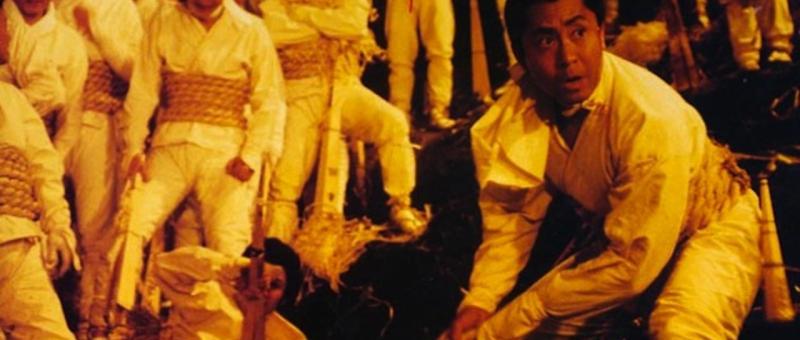
After this transition it’s implied that her relationship with Taro will have to end, that this brief summer adventure like so many in Obayashi’s films was just about making memories to carry forward in the further course of life. But then as her seemingly unburdened tour group friend had pointed out, Mari found Taro by chance twice before and so may someday find him again just as Mari’s intervention has earned Yuichi and his first love a second chance no longer so enthral to the illusionary power of the green ray but making choices informed by the realities of love that may still be “romantic” if no longer quite so naive. Shifting into a more contemplative register than other similarly themed Kadokawa idol movies, The Island Closest to Heaven is one of Obayashi’s most straightforward features save for its brief use of colour filters in the opening and closing scenes and the lengthy title sequence which draws inspiration from classic Hollywood melodrama, but engages with some of his key themes in the romantic nostalgia of love and loss as his heroine comes to a new understanding of herself while bidding goodbye to the past. 


The Island Closest to Heaven is released on blu-ray on 17th October courtesy of Third Window Films as part of the Nobuhiko Obayashi’s 80s Kadokawa Years box set alongside School in the Crosshairs, The Girl Who Leapt Through Time, and His Motorbike, Her Island.

Original trailer (English subtitles)

Theme song performed by Tomoyo Harada

Crazy Thunder Road (狂い咲きサンダーロード, Sogo Ishii, 1980)

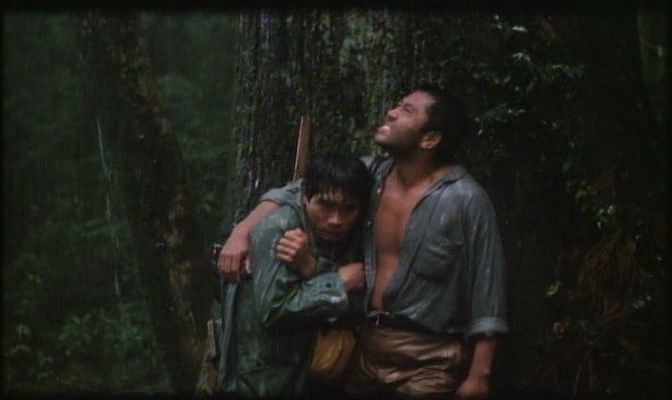
If you’re pushed out of the only group you’ve ever belonged to, where is it that you’re supposed to go? Produced as a graduation film, Sogo (now Gakuryu) Ishii’s second feature, Crazy Thunder Road (狂い咲きサンダーロード, Kuruizaki Thunder Road) captures a sense of youthful alienation in an age of prosperity in following in essence two men who choose to leave a group to which they have devoted their lives each for different reasons but both discovering that their new paths lead them nowhere but nihilistic despair. 

After a brief opening sequence foreshadowing the conclusion in which a ruined motorcycle lies abandoned amid the smoke of a volcanic explosion, the main action begins with the abdication of the previous leader of the Maboroshi biker gang, Ken (Koji Nanjo), who feels he’s aged out of the bosozoku lifestyle and hopes to settle down with his barmaid girlfriend Noriko (Michiko Kitahara). The Maboroshi gang is about to join an alliance with two other local outfits, Dokuro and Gaya, to put an end to the internecine street violence. Young hothead Jin (Tatsuo Yamada) decides he wants no part of this soft and cuddly version of the biker life and abruptly leaves with three of his friends to start his own gang, Maboroshi Kamikazes, declaring that his old outfit should now consider him an enemy.  

The problem is that system doesn’t like it if you step out of place and so the Elbou Alliance doesn’t really like it that Jin wouldn’t join, capturing and killing one of his friends to make a point. The more he tries to claim his independence, the more he is forced to realise that he is an ineffectual leader and being outside the group makes him vulnerable. His four guys are no match for the combined forces of three gangs which is one reason he later finds himself joining a new outfit, an ultra-nationalist militarist biker gang operated by former Maboroshi founder Takeshi (Nenji Kobayashi) who turns up in full infantry gear singing an imperial song, only to again become disillusioned because a life of order and austerity is the very opposite of everything he wanted which would be control and agency over his own life. 

In another way, that might what Ken wanted too but he doesn’t find it either and in the film’s hyper masculine worldview he appears weakened in his choice. An entirely passive figure, he is even seen wearing a pretty pinny while helping Noriko out at the bar otherwise usually looking blank or sullen like a man half alive who’s already given up on life. To ram the point home we discover at the film’s conclusion that Noriko eventually leaves him essentially for not being manly enough now that he’s left the biker subculture though her new squeeze is clearly a yuppie salaryman which itself points to a paradigm shift in contemporary visions of masculinity. 

Meanwhile, we’re suddenly presented with a new challenger, Shigeru (Masashi Kojima), who began as a shy foot soldier lead away by Jin but later finding a home with the nationalists, becoming Takeshi’s lover after Jin rejects the rigidity of militarism. Shigeru promises to protect both the town and Takeshi in an expression of the archetypal vision of masculinity as a protector, but love is it seems incompatible with this way of life in which strength is the only thing that matters. Ken loses Noriko because his desire to escape a life of violence renders him unmanly, while love doesn’t save Shigeru either because in the hyper masculine world in which he lives attachment is never anything other than weakness. 

Literally maimed by his failed attempt at dominance, Jin is cast out further into the post-war industrial wasteland where he encounters a teenage boy selling drugs and an old man weapons implying that the mediation of death has shifted with the generations only to be undercut with another piece of shocking and random violence that reminds us of the arbitrary meaninglessness of these petty struggles for dominance. True freedom, the film implies lies only in death, Jin the ultimate outsider a man who cannot be part of any group and must always remain outside of the pack while it remains impossible to survive alone. Set in the near future inches closer to an apocalypse, Ishii’s proto-cyberpunk aesthetic owes as much to The Warriors as it does to Mad Max painting pre-bubble provincial Japan as a post-war wasteland inhabited only by the hopeless perpetually fighting over the scraps of an increasingly prosperous but oppressively conformist society. 


Crazy Thunder Road is released on UK blu-ray on Feb. 21 courtesy of Third Window Films in an edition which includes an audio commentary by Tom Mes and video essay on jishu eiga by Jasper Sharp.

Trailer (English subtitles)

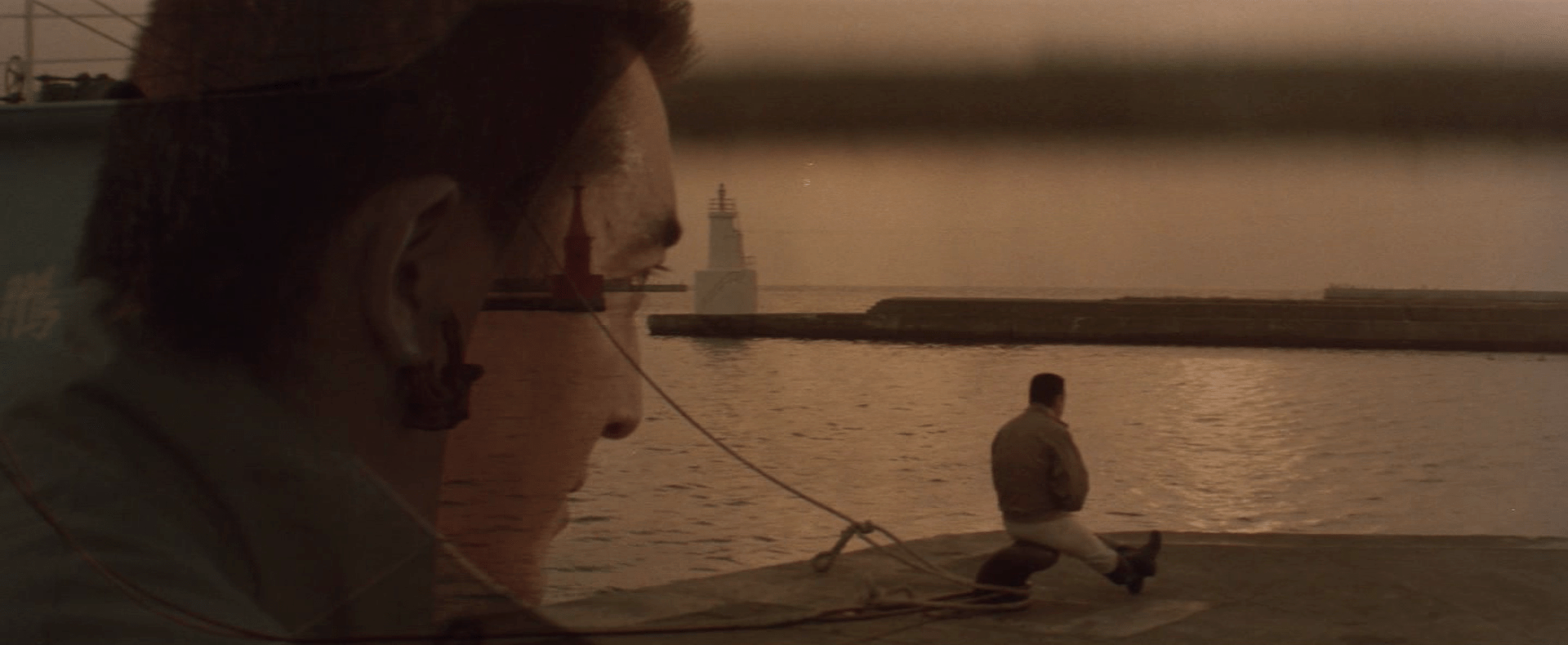
Fire Festival (火まつり, Mitsuo Yanagimachi, 1985)

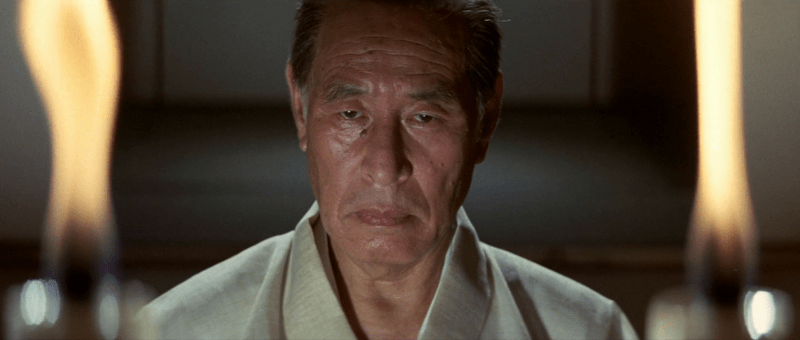
By 1985 the Japanese economy was approaching its zenith yet along with increasing economic prosperity had come social change of which small-town Japan was either casualty or sacrificial victim. “Nigishima will stay as it is” declares the last holdout of an increasingly obsolete way of life in Mitsuo Yanagimachi’s intense modernity drama, Fire Festival (火まつり, Himatsuri), a manly mountain man and animalistic force of nature by several metrics unsuited to life in the contemporary society into which he is ultimately unable to progress. 

There are many things which it seems have not changed in Nigishima for generations, one being the animosity between the cohorts of its bifurcated community, those who live by land and those who live by sea. Rural depopulation may have forced them to come closer but it has also increased their sense of mistrust while both industries continue to suffer in an economy which no longer prizes their humble rural output. Despite being catapulted into a promised modernity by the advent of the railway to great fanfare in 1959, it now seems that Nigishima cannot survive without a new road which could be paid for by the development of a marine park only mountain man Tatsuo (Kinya Kitaoji) owns the property right in the middle of the earmarked area and has hitherto refused to sell further increasing the tension between the two communities. 

Tatsuo is thought of, and thinks of himself, as a big man in the area quite literally it seems as part of the reason he enjoys this status is down to his being unusually well-endowed. He believes himself to have a special relationship with the mountain goddess, often joking to the other men about having a sexual relationship with her while sometimes describing her as his girlfriend. Several times he is mistaken for an animal, firstly by the boatman bringing his childhood sweetheart and sometime mistress Kimiko (Kiwako Taichi) back to the island who assumed he was a monkey crawling along the cliff edge thoughtlessly throwing rocks at them, while he often gambols through the forest whooping like some kind of Tarzan. Entirely unreconstructed, his worldview is patriarchal and misogynistic. All of his banter with the other men is sexual, constantly referring to his penis while greeting his friends with lewd hand gestures thrusting his fist into his pocket as if waving with an erection. The cure for offending the goddess he tells his young protege Ryota (Ryota Nakamoto) is to drop his trousers and display his manhood, Tatsuo strangely believing this would appease her for taking wood from a sacred tree or killing without permission. 

Smearing the blood of a sacrificial animal over his chest and forearms he dedicates the death to the goddess, a gesture he will repeat in the film’s violent and tragic conclusion yet there is also arrogance in his conduct as if he believes himself above natural law, protected as the goddess’ favourite even as he describes himself as “suffocated” by the women in his life from his mother and five older sisters all of whom indulge him to his wife, kids, and mistresses. He has trained his dogs to hunt wild boar without the use of guns in a method he admits even other hunters describe as “cruel” while breaking a local taboo shooting monkeys in the forest well aware of nature red in tooth and claw. As such, there is little nobility to be seen in his determination to preserve this already obsolete way of life. His virility maybe contrasted with that of the ageing land broker Yamakawa (Norihei Miki) and his failed attempts to bed sex worker Kimiko who tricks him into paying off her debts, but he at least knows the way the wind is blowing explaining to her that towns such as Nigishima survive only through things like marine parks or hotels or even nuclear power plants. Without the road, the town will die. 

Yet in 1959 they were told the railway would save them and it seems it did not. Tatsuo’s love making with Kimiko in a boat borrowed from a treacherous fisherman who later agrees to sail it transgressively into sacred waters is intercut with memories of the rail line’s opening ceremony, two teenagers who might have been them or at least of around the same age ride an elephant on the jetty while the townspeople arrange themselves into the formation of the character for “celebration” captured by the aerial photographer above. For Tatsuo as a boy, was this a rebirth of Nigishima or the beginning of its demise as the coming modernity began to eat away at its foundations? 

The fire festival is “for men”, according to Tatsuo, “to drive out evil spirits”, his manliness getting the better of him as he disrupts the proceedings to attack a man he accuses of having brought “false fire”. These are the lessons he teaches to surrogate son Ryota whose devotion to him borders on the homoerotic, Tatsuo cradling him during the climactic rain storm and he seeming to develop a fascination for Kimiko as a kind of indirect fixation. Ryota has learned Tatsuo’s chauvinism mimicking his lewd hand gestures and swaggering walk, his cruelty in sacrificing 1000 yen to trick Yamakawa into injuring his hand in a bear trap, and his arrogance ensuring that his problematic masculinity will survive into another generation presumably no more capable of halting the march of modernity than he has been. Tatsuo poisons the waters with fuel oil which as one of the greek chorus of fish wives points out does not catch fire, Tatsuo himself smouldering until an inevitable explosion. Receiving some kind of epiphany during a mystical congress with the goddess in the middle of a storm, he knows what he must do and accepts that he cannot progress into the modern society. Smoulderingly intense in its small-town animosity and primeval sensibilities, Yanagimachi’s poetic tragedy of futility and the broken promises of a badly distributed modernity may accept the the sacrifice but mourns it all the same. 


Fire Festival screens at the BFI on 20/27 December as part of BFI Japan.

Clip (English subtitles)

Choji Snack Bar (居酒屋兆治, Yasuo Furuhata, 1983)

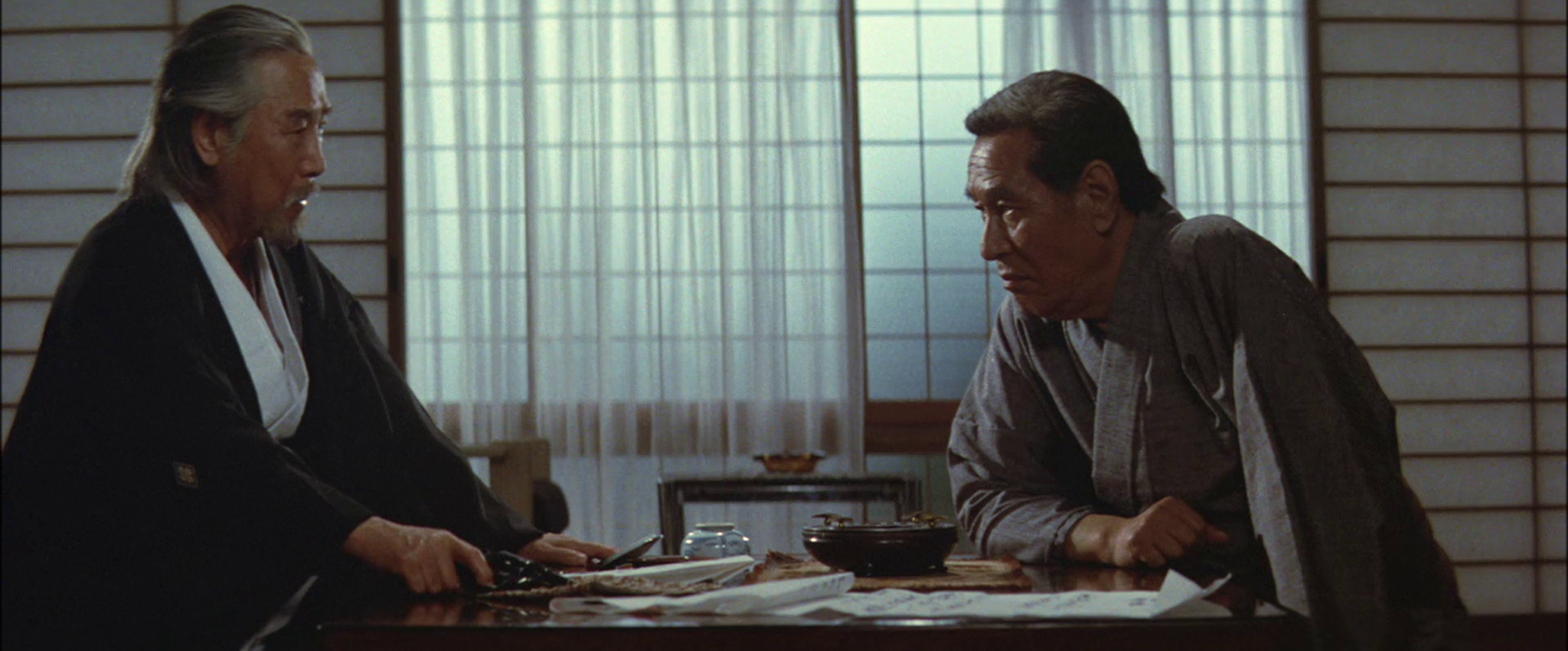
Beginning his career at Toei, Yasuo Furuhata is most closely associated with tough guy action films forging a strong and enduring relationship with the genre’s key star Ken Takakura through their work on the New Abashiri Prison series. From the late ‘70s however he began to transition further towards the realms of manly melodrama with a series of films which often starred Takakura as a man struggling to adapt to life in modern Japan such as the guilt-ridden policeman of Station or the conflicted former yakuza of Yasha. Arriving between the two and adapted from a novel by Hitomi Yamaguchi, Choji Snack Bar (居酒屋兆治, Izakaya Choji) is in someways much the same casting a typically stoic Takakura as an intensely noble man whose values are increasingly at odds with the world in which he lives while shifting away from the realms of manly action towards a more somber contemplation of the broken dreams of post-war youth. 

Eiji (Ken Takakura), known to all as “Choji”, is a happily married father of two who gave up his job in shipping to open a bar selling small eats in a Hakodate. He and his wife Shigeko (Tokiko Kato) have been planning to expand the business by opening a larger location near the docks but Eiji is dragging his feet largely it seems because the place found for him by childhood friend Kawahara (Juzo Itami) is too close to another bar run by an old man who helped him when he first started out so he’s loathe to risk infringing on his livelihood. Meanwhile, the central drama in town in the mysterious disappearance of Choji’s childhood sweetheart, Sayo (Reiko Ohara), who married a wealthy ranch owner but has long been trapped in an unhappy marriage she has several times failed to escape. Sayo’s disappearance coincided with a fire at the ranch which is suspected to have been started deliberately the assumption being that Sayo is responsible. 

The ironic disappearance of Sayo forces Choji into a reconsideration of his life choices, something his middle-aged friends also find themselves experiencing if for various different reasons. Choji was once a high school baseball star dreaming of turning pro but his hopes were dashed after an injury forced him to leave the sport thereafter working in an office at the docks but later resigning rather than accept a promotion that would mean he’d suddenly be the boss to his former friends. The bar is his way of being his own man, no one’s boss but his own, though his decision was not universally respected among his friends and in fact came as something of a shock to Shigeko who consented to an arranged marriage partly in search of the typical salaryman life. Most of the other men in town, however, struggle to keep their youthful dreams alive or to find accommodation with the way their lives are now. Inoue (Eiji Misato), for example, is obsessed with cabaret singing, spending all his time in karaoke bars often wearing elaborate costumes and makeup. Childhood friend Iwashita (Kunie Tanaka) even wonders if he’s gone “mad” after taking him to task for neglecting his family on discovering that he’s converted a docked boat into a tiny private cabaret space complete with a sound system and lighting as well as a small seating area for spectators who presumably have not yet materialised. 

This is perhaps in a way a symbol in itself of Japan’s new economic prosperity, later thrown into stark contrast by Choji’s explanation that he and Sayo broke up because of their mutual poverty he nobly pushing her to marry a wealthy man so at least one of them could be happy. Happy is however something Sayo has never been, later paying a short visit to Choji during which she blames him for his “cowardice” suggesting that he is largely responsible for the misery of her life in failing to fight for their love, giving up too easily on a distant happiness which is something he later cautions a young baseball player not to do. The police meanwhile accuse him of complicity, implying the pair knew Sayo’s husband had TB and thought he’d die soon enough after which they’d inherit his money and stay together, consequently assuming the “arson” was an attempted murder. 

The irony is that Choji is far too noble to have ever considered such a thing, something demonstrated by his continuing righteousness in refusing to take up Kawahara’s offer of cheap and lucrative new premises because it would mean betraying his former mentor, refusing to condemn his former teacher’s shock marriage to a woman 30 years his junior, and eventually taking Kawahara to task for his callous comments over the death of friend’s wife. Rival cabbie Akimoto (Masao Komatsu) was forever joking that his wife would die before him and sleazily flirting with young women, but went into debt in order to buy her an elaborate funeral altar and is completely devastated by her loss while living with his three children in a noticeably rundown apartment. As Choji puts it, Kawahara’s broken dream is in no longer being the big boss among the boys as he was in their high school days, fuelling his sense of middle-aged male frustration into embittered drunken violence. Yet everyone is always telling Choji he is being unnecessarily “good”, that he should stop thinking about doing the right thing and put himself first by accepting the offer to relocate the bar because business is business. 

Sayo too is trapped in the past unable to accommodate herself with the way her life turned out, an ironic casualty of Choji’s goodness clinging to her broken dream of youth. These now middle-aged teens of the post-war era are in a sense victims of their age, denied the sense of possibility the youth of today might enjoy but equally unable to step fully into the contemporary era of economic prosperity which some feel has become increasingly amoral and unkind. Nevertheless, as Shigeko puts it “no one can take away what a person carries in their heart”, Choji manfully retaining his nobility while literally burning the image of the past but perhaps carrying it with him as the other men carry the shards of their broken dreams some with more nobility than others.  


Original trailer (no subtitles)