Roppa’s Honeymoon (ロッパの新婚旅行, Kajiro Yamamoto, 1940)

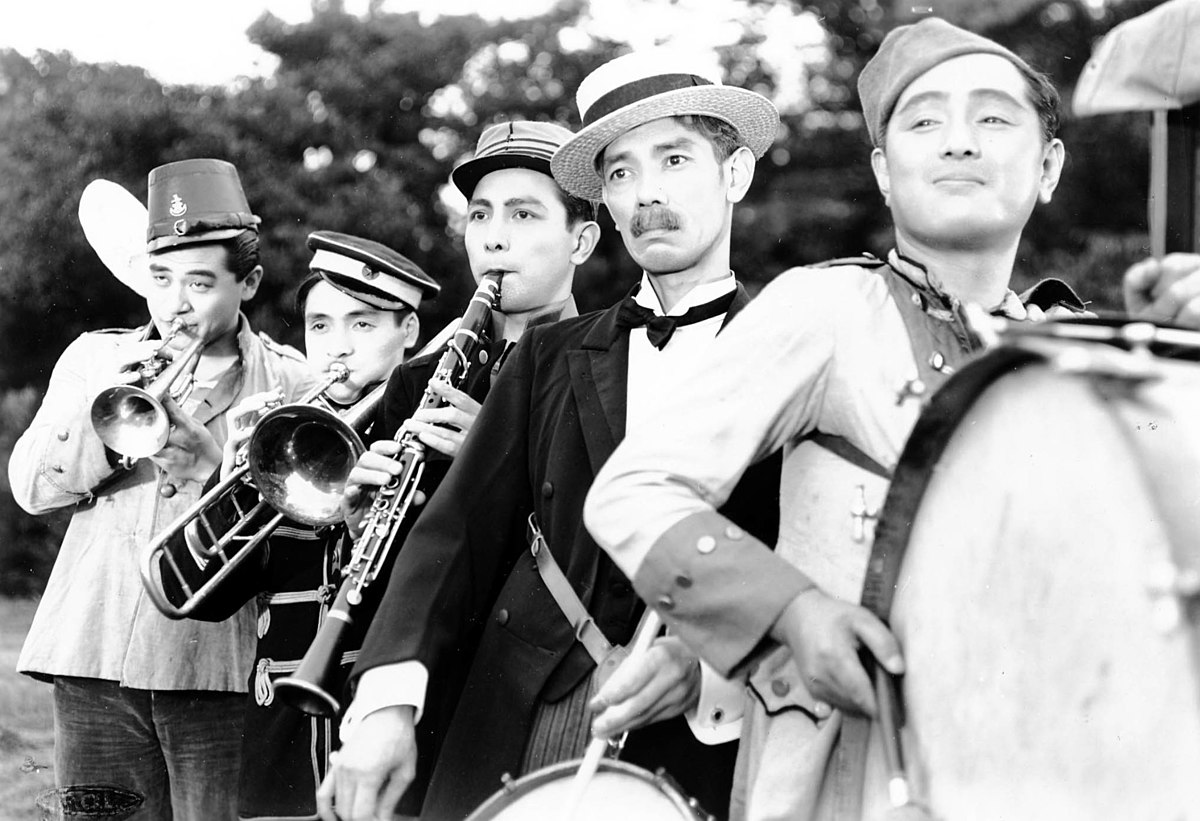
One of the most surprising things about Kajiro Yamamoto’s defiantly silly comedy Roppa’s Honeymoon (ロッパの新婚旅行) is how devoid it seems to be of political import with no overt patriotic content or references to the ongoing conflict even if the central messages of the necessity of enduring hardship are otherwise very on brand. Likewise and contrary to expectation, the film is clearly influenced by Hollywood comedies and heavily features American ragtime music presented largely without prejudice. 

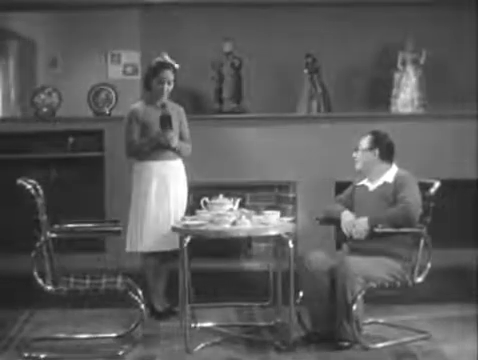
In fact it’s the confrontation of these different influences which eventually sparks a crisis between father and son. As the film opens, beer magnate Garamasa is sitting in his bath practicing his gidayu recitation with the help of a shamisen player in an adjacent room, but his idiot son Ichiro (Roppa Furukawa) keeps singing “stupid Western songs,” which is very annoying for him but apparently not enough to actually get out of his bath which is why he rings an employee and gets him to ring Ichiro to tell him to shut up. This seems in part to be a slightly subversive gag poking fun at fat cat CEOs with Garamasa weirdly berating the staff member for being lazy and suggesting that he’s probably only just got up despite it being already 7am even if Garasama himself is still in the bath. The employee has, however, been busily at work for quite some time and spends the rest of the film toadying up to Garamasa. Later on, Yamamoto includes a similar gag in which a maid is forced to run back and forth between Ichiro’s annex and Garamasa’s office to deliver messages between the two.

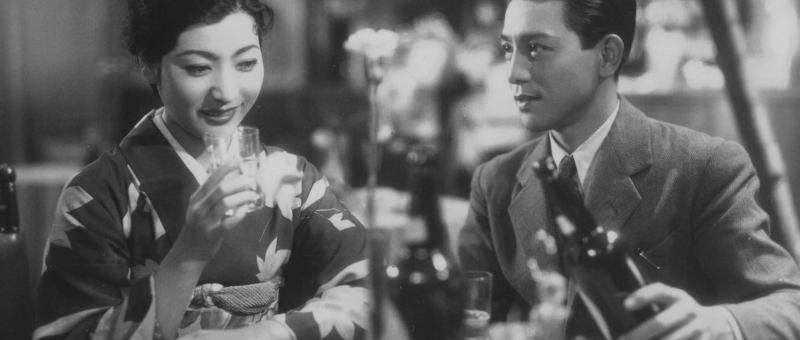
In any case, Garamasa’s grand plan to get his son to be quiet is to marry him off to someone who also likes Western music which is why he visits a pair of servants he actually kicked out of the house when they decided to get married 20 years previously but have since opened a shop selling Western records. They suggest a young woman, Eiko, known as the nightingale of Japan (real life opera singer Hamako Watanabe) who is also a member of the nobility and the daughter of one of Garamasa’s friends, yet Ichiro has been seeing a young woman, Chiyo, who works in an oden restaurant and in fact finds out he is “engaged” from the same newspaper article she does. Eventually he makes the decision to run away from home and elope only to flounder while being entirely ill-equipped to live a “normal” life in which he must attempt to support himself financially.

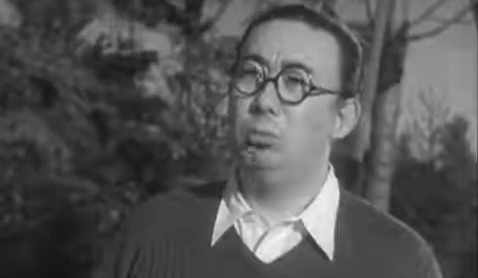
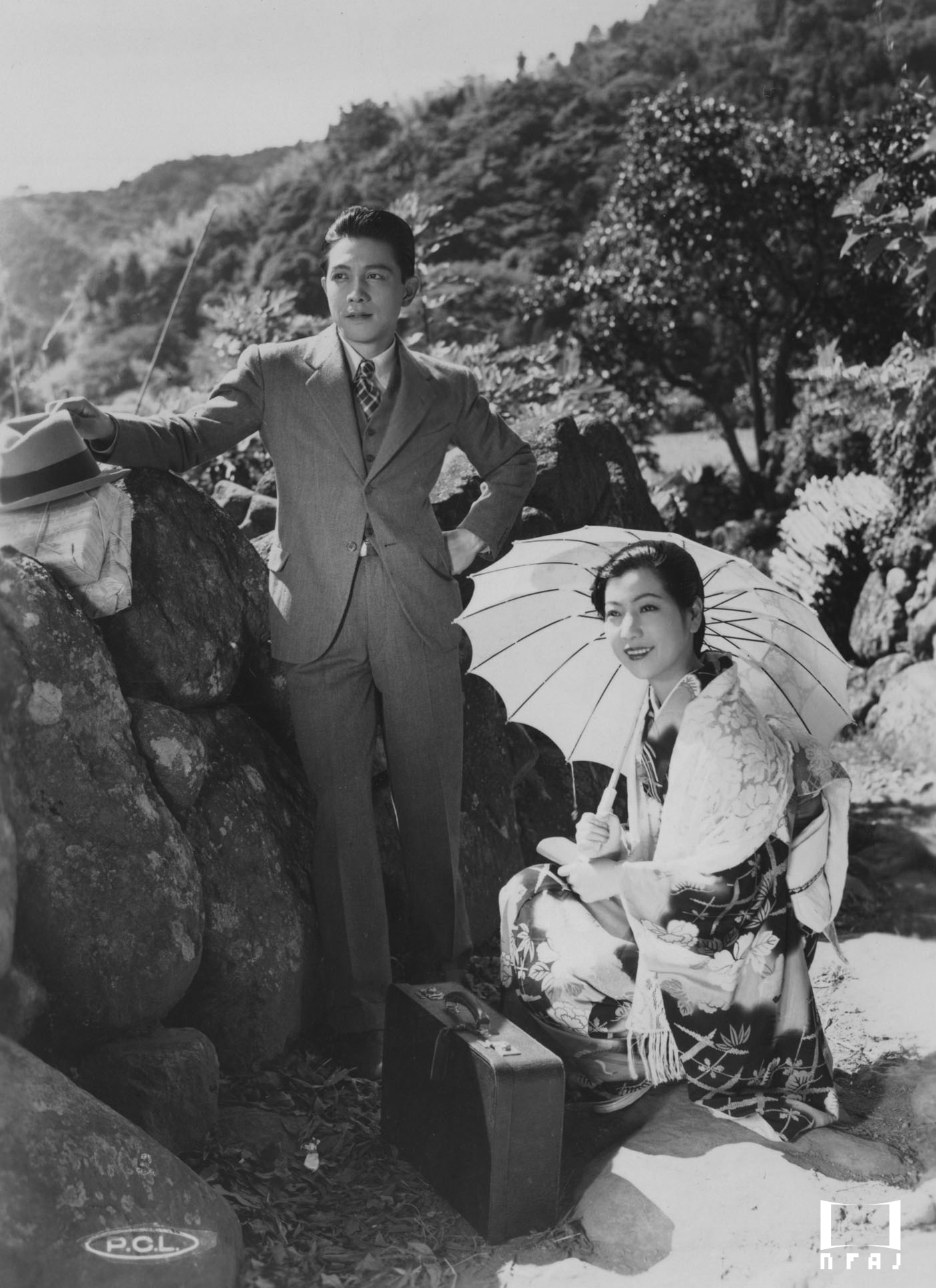
Star Roppa Furukawa was himself a member of the aristocracy and one of a small number of performers popular enough in the 1930s that their names were often inserted into the titles of the files in which they appeared even if their characters did not share it. Roppa was well known for his rather comical face, round and a little pudgy with big round glasses which seem to capture something of the zeitgeist of the interwar years. He was also an excellent singer and the film is quite notable for its use of an ironic song in which Roppa narrates his “honeymoon” in which he and Chiyo are forced to move several times, first sitting in their living room on the back of a truck before their belongings slowly decrease from truck to cart to hand. Chiyo is eventually forced to return to work at the oden restaurant while the relationship suffers because of Ichiro’s refusal to do a common man’’s job. Ironically, he is disturbed by the singing of Eiko who lives close by and on visiting to tell her to be quiet is talked into buying a pair of charity concert tickets.

Chiyo actually approves because she doesn’t like the idea of people looking down on them for not having the money to pay, but is then jealous, insisting that she’ll pay for the tickets herself while forbidding Ichiro to go. It’s this that forces him to accept a job he previously thought demeaning as the leader of a marching band singing a ragtime-themed jingle for a brand of toothpaste. All of this absurd silliness might be thought too trivial for the early 1940s in which censorship concerns usually some kind of patriotic content (aside from gidayu) but there is a message to be found in Garamasa’s eventual acceptance of their relationship in which he thanks Chiyo for introducing his son to hardship and thereby making a man of him as reminding the audience that a little bit of suffering is character building though doubtless they don’t have such wealthy parents to bail them out nor can they really look forward to better days any time soon. In any case it paints a rather rosy of picture of life in the early ‘40s, harking back to a distinctly ‘30s brand of foppish comedy with Ichiro a kind of Bertie Wooster suddenly plunged into “real” life and realising being the stupid son of a CEO obsessed with gidayu recitative wasn’t so bad after all.
Morning’s Tree-Lined Street (朝の並木路, Mikio Naruse, 1936)

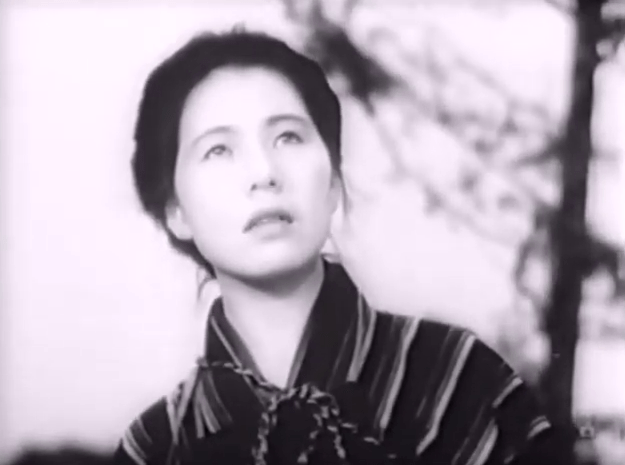
A country girl comes to the city in search of a more glamorous life but largely finds only disillusionment and disappointment in Naruse’s 1936 drama Morning’s Tree-lined Street (朝の並木路, Ashita no Namikimichi). Naruse depicts Chiyo’s (Sachiko Chiba) spiritual journey literally as she takes the bus from her rural hometown all wide-eyed wonder and then arrives in the city to be bothered by a homeless man and then walk into a less salubrious area of the city with only her friend’s address to go on. 

In her hometown, everyone thinks Hisako (Ranko Akagi) works in a big office in Marunouchi, but in reality she’s now working in a hostess bar under the name “Shigeko.” Nevertheless, despite a degree of shame in her circumstances, Hisako doesn’t reject Chiyo and isn’t angry that she’s come and found out her secret. She talks her landlady, Okada, into letting her stay but discourages her from working in the bar. The current economic depression is evident in the fact that the bar isn’t doing so well and never has many customers, yet the “help wanted’ sign keeps going up and down outside. There’s even a running gag that the cook makes a permanent version so they won’t waste so much paper, only he spells “hostess” wrong, so they have to take it down anyway. 

The help wanted sign is a harbinger of doom for Chiyo who, it seems, is being drawn towards this kind of life. As Hisako had told her, it’s impossible for a country girl to find a job when there are already so many “desperate” people in Tokyo, and at the grand old age of 22 Chiyo is worried that she’s simply too old to find employment. By the standards of the time, she may be considered on the older side not to be married, and indeed Hisako tells her she’d be better off to go home and find a husband, but Chiyo wants both more and to find a grand romance. She romanticises an idea of poverty believing that she could be happy with a man she truly loved even if they had no money. Hisako doesn’t disillusion her, but may be inwardly rolling her eyes at her naivety. She has a boyfriend already, but he’s no good. He keeps turning up and pestering her for money which might be one reason Hisako can’t escape the life of a bar girl.

It is indeed money that gets in the way everyone’s relationships. Hisako reads in the paper about a salaryman who embezzled money to spend at a hostess bar and then died in a double suicide with one of the women who worked there. The dark fantasy the bar represents echoes the wider despair in the society coloured by economic depression and broken dreams in which the fantasy version of Ogawa admits that his life was without hope or joy. Chiyo gets close to a nice young man who comes into the bar who tries but fails to find her a legit job in an office in attempt to save her from becoming a bar girl. In the end, she gives in and becomes one. Ogawa says he thinks no less of her, but begins coming to the bar more often and appears to be spending beyond his means even while Chiyo warns him not to waste his money. 

What happens next turns out to be a cinematic fantasy informed by Chiyo’s naive desires in which Ogawa agrees to marry her but has already ruined himself by embezzling public funds and later asks her to die with him while she pleads that as long as they have love poverty is nothing to fear. In many ways, the dream shatters her illusions and confronts her with the stark reality of her life in playing out a best/worst scenario in which Ogawa is so deeply in love with her that willingly walks to his destruction, which is at least preferable to the truth, which is as Hisako says that a man may seem honest and sincere but will turn out to be a coward or else he’ll cheat on you.

Unable to find employment nor rely on men, the women have only each other and the solidarity of those like Mrs Okada her running a small bar in this rundown corner of the city where dreams go to die. Chiyo takes to her new life a little more than to her liking. She turns to Hisako and asks if she looks like a bad girl, fearful that it’s already changed her and it’s no longer possible to go back to being the innocent country girl who wanted a bigger life in the city. Her conviction might be brought home to her by the fact that Ogawa is promoted and sent out of Tokyo but doesn’t ask her to come with him, only leave his address in case she ever feels like writing. But at the same time it spurs her into a flurry of false positivity, committing herself to the job search despite knowing that it’s almost certainly futile. Throwing his note into the river and letting it flow away, she both sees through the naivety of her dream of escape through romance and also resigns herself to the life of a bar girl, like Hisako with nowhere else to go and no possibility of return only the vague and far off hope of salvation through employment.


Morning’s Tree-Lined Street screens 21st June at New York’s Metrograph as part of Mikio Naruse: The World Betrays Us – Part II.

Images: Collection of National Film Archive of Japan.

Tokyo Sweetheart (東京の恋人, Yasuki Chiba, 1952)

It appears that even as early as 1952, some people were doing “very well, thank you” despite the suffering going on all around them. Then again, the heroes of Yasuki Chiba’s charming ensemble rom-com Tokyo Sweetheart (東京の恋人, Tokyo no Koibito) are relentlessly cheerful and likely wouldn’t use the word “suffering” to describe themselves, preferring instead to laugh at the foolishness of wealthy men and their petty squabbles while continuing to value what is honest and genuine above greed and insincerity.

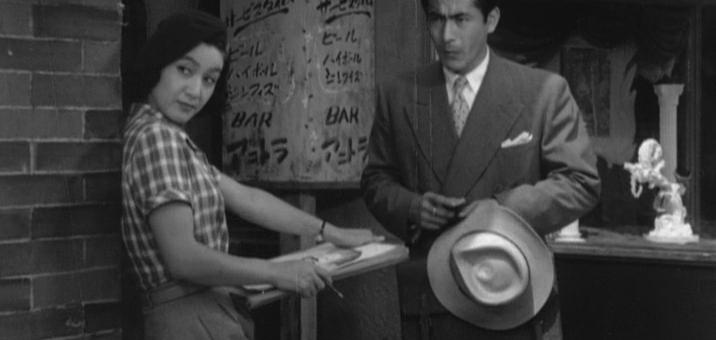
At least, there’s a minor irony in the fact that Akazawa (Hisaya Morishige) makes his living selling pachinko balls, a a source of elusive hope that’s brought ruin to millions. His mistress, Konatsu (Murasaki Fujima), exclaims that when you’re doing well a ring or two is nothing, trying to manipulate Akazawa into buying a 500,000 yen diamond from the jewellers’ downstairs. Akazawa can afford to buy it, but he doesn’t really want to because he’s cheap and greedy. Later we’re introduced to a friend of portrait artist Yuki (Setsuko Hara) who does caricatures on the street corner below the office and hangs out with the three shoeshine boys opposite. Harumi (Yoko Sugi), a sex worker, has fallen ill presumably from tuberculosis. They only need 500 yen daily for her living expenses and medicine, but the only way they can hope to come up with it is by getting a large amount of people to part with a small amount of money which they are all willing to do as an act of solidarity. 

In rather farcical turn of events, the jeweller’s has commissioned a fake ring to display in the window for security purposes while they keep the real one in the safe. Konatsu suggests a complex plan to the jewellers of getting Akazawa to buy the diamond but giving him the fake which she will then return and pocket difference. Only Akazawa has the same idea, or rather he only wants to buy the fake one because Konatsu won’t know the difference and he doesn’t think she’s worth the expense of the real one. When he ends up with both rings, Akazawa’s wife, Tsuruko (Nijiko Kiyokawa), makes him give the fake one, which is actually real, to the tea girl, Tama, who wants to sell it, even if it is fake, to help Harumi not only with her illness but to escape sex work. The boys tell her she’s being selfish and naive. If Harumi had any way of escaping sex work she would have done so years ago, there’s no real hope for her now. “A shoe can be repaired,” one of the boys sighs, “but I’m not so sure about her.”

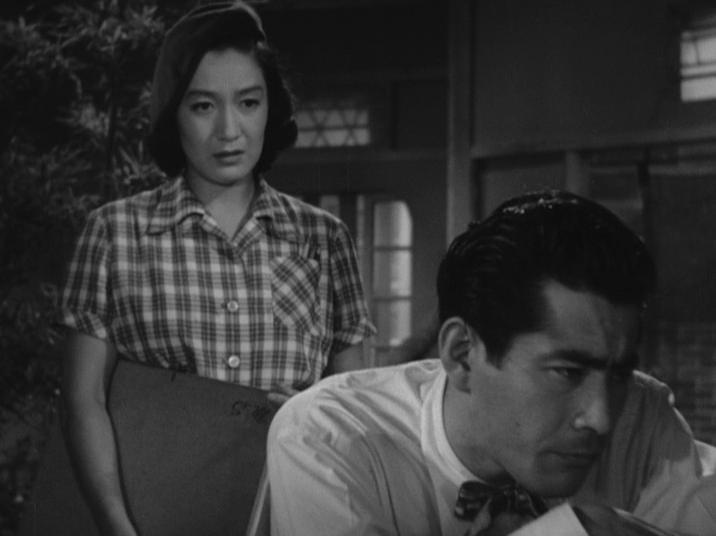
In some ways, it seems as if the genuineness of the ring is unimportant. The two are often mistaken for each other and few can tell the difference. After all, if you like it, what does its supposed authenticity matter and what does that really mean anyway? It does, however, seem to matter to Yuki who later says that she thought the film’s most genuine person, Kurokawa (Toshiro Mifune), was “gaudy and slick” when they first met because he was wearing a tacky tie pin and ring which stand out a mile to her as “fake”. Kurokawa in fact makes the replica jewellery displayed in front windows and dresses in that way as a kind lived brand though he does not necessarily approve of his own occupation. He exceeds expectations when he tracks the gang down in order to pay back some money Yuki had lent him when the conductor couldn’t give him change for his bus fare, as well as treating the shoeshine kids to ice creams and warning off the creepy yakuza type who keeps trying to bother Yuki for dates.

But the contradictions are brought to the fore when Harumi’s health declines and Yuki decides she ought to call the estranged mother to whom Harumi had written a comforting letter stating that she’d married and was living happily in Tokyo, enclosing a photo of herself and Kurokawa one of the shoeshine boys had taken on his toy camera. Yuki wants Kurokawa to pose as the husband so the mother won’t be so upset, only for him to point out that she now asks him adopt a fake persona after taking him to task for confusing people with his “fakes”. Again, this false comfort does seem to bring genuine relief to the mother even if as Kurokawa suspects she’s seen right through their ruse suggesting that authenticity of feeling is the only kind that matters.

Akazawa and his wife, meanwhile, bankrupt themselves trawling the river looking for the lost “genuine” ring sinking to all new depths of absurdity as even Tsuruko dons a diving suit and goes in to look herself. Unfortunately, all they find is a single pachinko ball. There is something quite abrupt about the sudden tonal shift from Harumi’s death bed to the gang laughing away at the foolishness of Akazawa and his wife, the boys convinced that Yuki and Kurokawa are now a couple though they never really enjoy much of a romantic resolution. Kurokawa lives a long way out of town and his home is surrounded by rubble and empty lots, signs of post-war devastation still not fully cleared away though Yuki and the boys, presumably war orphans, remain endlessly cheerful even as the extreme irony of Kurokawa’s rendition of Moon Over Ruined Castle washes over them. They do at least have each other and the strength of their community, living honest and genuine lives every day in contrast to men like Akazawa chasing pointless yet shiny trinkets and falling straight down the plughole themselves.


Nightingale (鶯, Shiro Toyoda, 1938)

Set in a quiet northern town, Shiro Toyoda’s Nightingale (鶯, Uguisu) finds the nation still struggling to emerge from the feudal past into the modern era. The film opens with a scene in the local train station, yet we’re also told that it is literally cut off from prosperity because the express train does not stop there and so it is relegated to the status of provincial backwater. Physically trying to flag the train down, the Mayor has been trying to get the town placed on the fast track but has had no luck so far.

The ticket man, who’d been more or less ignoring him, suggests they can’t put the station on the express line because the population of the town is decreasing presumably as young people migrate to the cities in search of work. One of the people waiting there is a man with two sons who tries to get the younger to pretend he’s younger than he is so he won’t have to pay for his ticket, though the ticket man refuses to give him a discount leaving the man with only the option to leave one of the boys behind while the family can no longer survive in the town. He explains that he’s been financially crippled by the medical fees to care for his now late wife and is clearly at his wits end trying to find a way to support his children.

The costs of medical treatment seem to be a direct driver of poverty and crime. Shifting to the local police station, we’re introduced to a man who’s become a serial chicken thief having begun stealing neighbour’s birds to pay for doctors to treat his sickly wife only she eventually left him for another man because he was always away conducting poultry heists so she thought he’d abandoned her due to her illness. His problem is compounded by the fact he had not formally registered their marriage intending to wait until the first child was born leaving him without a leg to stand on.

An official doctor later jokingly complains that he’s losing custom because no one in the area can afford modern medical care so they’re turning to dubious snake oil-style miracle cures proffered by a “fake priest” the police are about to arrest for fraud. Meanwhile, they’ve also arrested a middle-aged woman (Haruko Sugimura) who assists with births for violating the medical practice law. Branded a midwife she is really more of a wise woman who is well respected in the local community as someone who had had many children herself and also offers advice about folk remedies for various illnesses. She never claims to be a doctor and does not regard it as a job, merely as helping people even if she perhaps also enjoys the sense of being needed and important, and is unable to understand how that could ever be a crime. Unlike the priest, she takes no payment and uses her own resources though people sometimes give her small compensatory gifts such as parcels of rice as a thank you. When a woman goes into labour and the “official” midwife is not available, the policeman is unwilling to let her in but hearing the woman’s distress she runs to help her kicking all the policemen out of this very personal female space.

Her confusion bears out that within the general society as people struggle to adjust to a more ordered modernity and the encroachment of urbanity which is what the police themselves represent. Then again, they are presented as being more compassionate certainly than the staff of the railway and seemingly have a duty of pastoral care for the local area which is separate from their role in enforcing the law. A secondary drama that began at the train station involves a young woman who is being sold into sexual slavery by her father against her will. She is eventually rescued by an earnest school teacher who says the sale isn’t valid because she also signed a contract to become a teacher, convincing her father to change his mind with the help of the police who remonstrate with him that it’s wrong to sell your child even if the practice had been somewhat normalised which plays into a propagandistic element about the importance of moving on from “backward” rural practices still mired in the feudal era. The police also have access to a fund which can be used to get the broker out of the way in an effort to stamp out this morally indefensible situation in which parents sell their children into indentured servitude for reasons of poverty. 

They also agree to help an old lady who’s arrived in search of a child she fostered a decade previously who was taken back by her birth mother and sold to a circus. Like the chicken thief, the old woman was caught out by the modern convention of paperwork. She had been led to believe the adoption had been processed and the child placed on her own family register, but was illiterate and therefore easily deceived. The old woman also becomes a victim of the dodgy priest and the disease currently spreading because of his problematic cure-alls which people have turned to out of desperation in their poverty.

But despite the police’s apparent altruism, the arrival of a young woman selling a captive nightingale reveals the irony that she’s come there because it’s the only place anyone has any money. Unfortunately it turns out that capturing a nightingale has also been ruled illegal, even if one of the policeman was interested in buying it if only it could sing, so she’s come to the wrong place and if she doesn’t release it she’ll end up with a fine. The nightingale’s song is later replaced by that of a flute player who had been arrested for being drunk and disorderly having spent some money he was given towards the funeral of his baby on drink. 

The police are in some ways a disruptive influence, trying to bring a new urban order to this rural place which has its own laws and customs often at odds with those of the city. Their efforts tie in to a persistent message of modernising for the good of the nation which was particularly current in the late 1930s though the film is equally sympathetic towards the plight of the rural poor who are not after all being given very much support as the youngsters move to the city leaving the old behind, trapped on the slow line cut off from the benefits of modernity while otherwise expected to simply adapt to new visions of civility in a society still trying to emerge from the feudal past. 


The Nineteen-Year-Old’s Map (十九歳の地図, Mitsuo Yanagimachi, 1979)

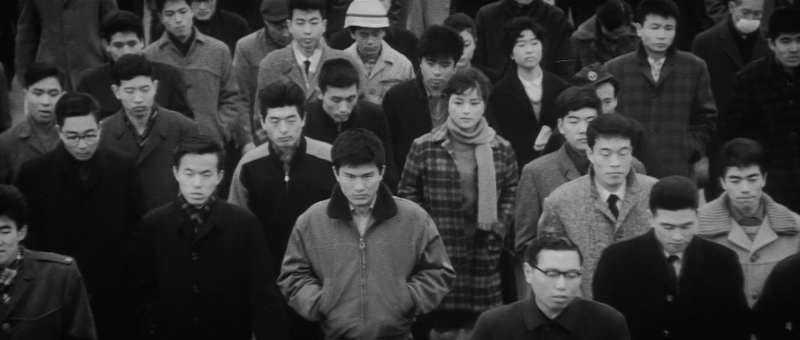
“What should I do with my life?”, the question becomes a frequent refrain in Mitsuo Yanagimachi’s dark tale of urban alienation, The Nineteen-year-old’s Map (十九歳の地図, Jukyusai no Chizu). Adapted from a novel by Kenji Nakagami which painted a bleak picture life on the margins of the economic miracle, the film’s quiet sense of unease hints at a coming explosion but also that there will never be one because in the end the hero is too filled with despair and ennui to ever follow through on the various threats he makes during a series of prank calls to people in the neighbourhood who’ve incurred his wrath.

The nineteen-year-old of the title, Yoshioka (Yuji Honma) is in theory a student taking a year out to study for university exams while earning his keep delivering papers for a newsagent where he lives in a dorm with several other paperboys all just as defeated and aimless as he is. They all, however, look down on and make fun of him for being a bit odd not least because he hangs around with a 30-year-old man who is still stuck living a like a teenager that the other guys think is creepy. Konno (Kanie Keizo) is creepy in a way, in that he’s an obvious image of what these boys might be in 10 years’ time if they do not manage to find something that will allow them to move forward, out of the slums and into a more fulfilling life. 

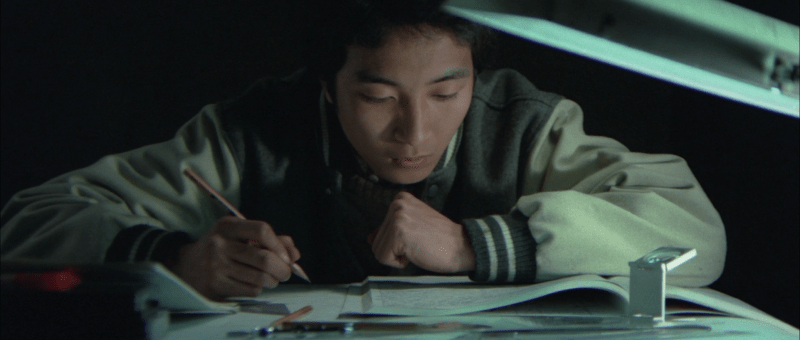
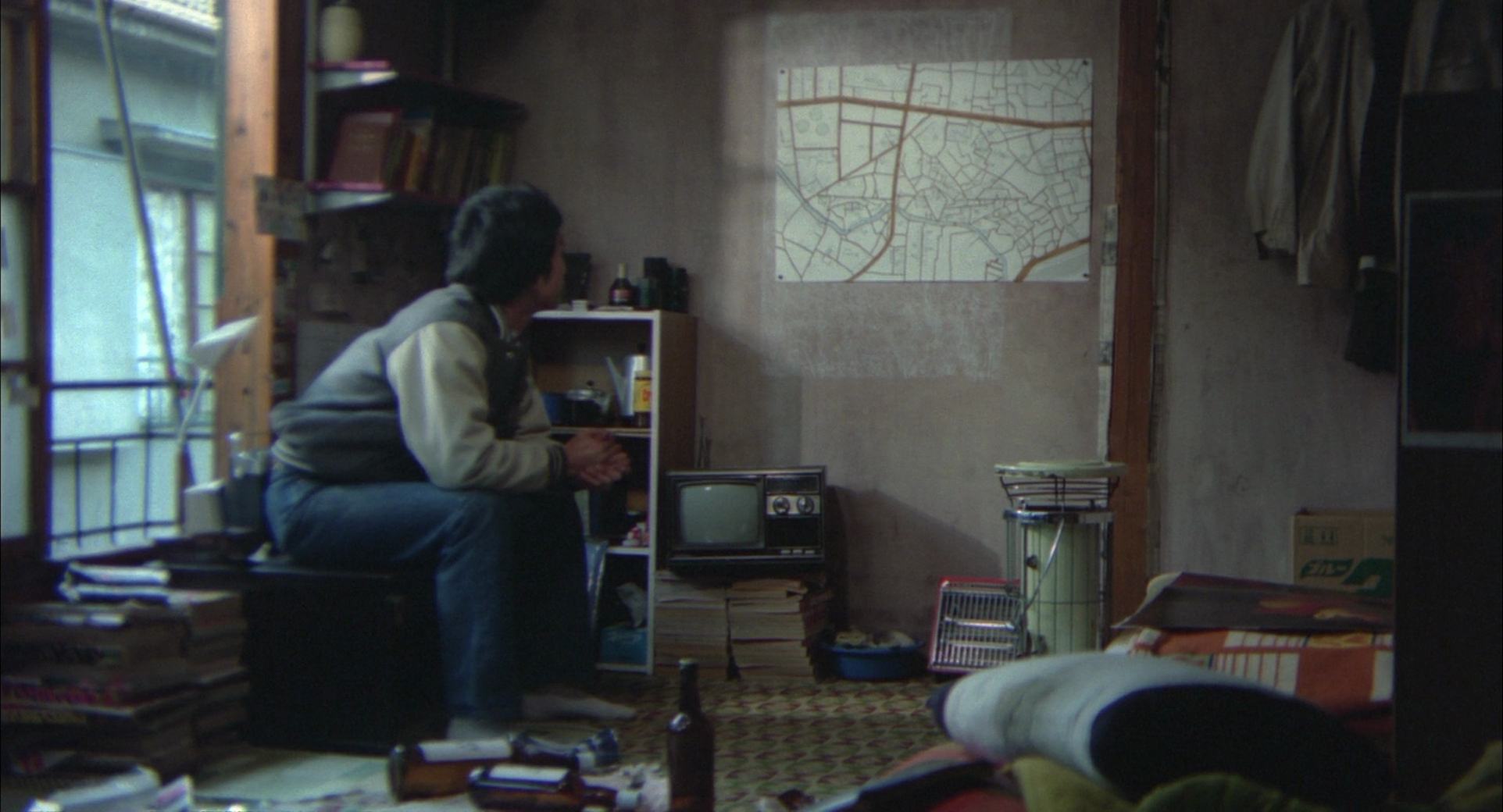
Yoshioka’s main outlet is making a map of the local area which he annotates with notes about the various people who live there, many of them on his paper round. If they do something to displease him or otherwise display something he regards as a moral failing he puts a large cross against their name, and when someone has three crosses he makes a harassing phone call threatening to burn down their house. It’s never quite clear whether his threats have any serious intent or if the threat itself is enough in allowing him to feel powerful and superior to world around him which he feels is rotten beyond repair. People often ask him where he’s from and he tells them but with slight hesitation, as if he’s not telling the entirety of the truth as perhaps confirmed by one woman’s attempt to probe his origins surprised that he doesn’t have any kind of rural accent while she’d never heard of the town he claimed to be from. 

One of the other boys at the newspaper office is an aspiring boxer, but he gets badly beaten in a fight and eventually leaves to join the Self Defence Forces. The meanest of them, Sato, has a sharp tongue but seemingly no more direction than Yoshioka finding his release through more direct forms of violence and hateful behaviour. Everyone around him is disappointed and filled with despair. Even the lady who runs the newsagent’s reflects on her unsatisfying life and the ruined hopes of her youth in which she dressed in fine kimonos and kept herself nice. Her only comfort is that she “saved a man deserted by his wife” even if she mainly treats him with contempt for his failure to repair the loose nail in the hallway she keeps catching her foot on, or fix the toilet which continually backs up and floods the bathroom. 

Yoshioka does seem to be followed around by leaky appliances while everywhere around him is dank and muddy. Konno has one ray of hope in his life in the form of a woman he calls Maria (Hideko Okiyama) who is covered in scars but still she survives. Maria is indeed a Madonna figure, a symbol of scarred purity and human suffering that Konno regards as a kind of salvation. Yet Konno’s attempt to reach her only leads to further ruin as he commits small but increasingly daring acts of crime from bag snatching to burglary to get the money to run away with her only to end up in prison still wondering what it is he should do with his life. 

Maria had told them of a dream she had in which hundreds of people emerged from her and went happily to heaven while she was left on the ground below. Some angels on a cliff tried to lift her up, but she found herself unable to reach out to them only standing immobile and looking up in jealousy. In his way, Yoshioka is much the same perhaps as Konno had said afraid to be happy and unable to envisage for himself a life outside of the slum. Konno sometimes introduces him as a student at a top university which seems to further press on his insecurity. Yoshioka rarely attends classes, spending all his time delivering papers or making his map of iniquity. He describes himself several times as a “right-winger” and at one point fantasises about taking part in a nationalist parade, but aside from his conservative takes on morality seems to have no real ideology save the fact that everyone, even the people who are actually nice to him, pisses him off. 

“Even if you’re angry at something, why should you explode the gas tanks?” a telephone operator reasonably asks after Yoshioka makes a prank call reporting a bomb threat on a train leaving Tokyo station while explaining that he also plans to blow up a set of gas cylinders to obliterate the town. The voice on the phone does not appear to take him seriously and sympathetically tries to talk him out of his strange delusion, but all Yoshioka can do is go home and cry in the utter impotence of his life. In the end, Maria is the only one who is able to feel any kind of joy. Finding a pretty dress while dumpster diving, she twirls cheerfully dancing around even with the leg which was left lame after a failed suicide attempt. This time she’s the one who tries to reach out, but Yoshioka ignores her and looks away as they head in different directions. It seems he will never really act on any of his threats, or be able to escape the futility of his life trapped on the margins of a prosperous society which he feels continues to reject him. Yanagimachi films his uneasy existence with naturalist detachment, capturing the mud and filth that cling to Yoshioka along with the strangely violent, goldfish-killing kids, the angry dads, and women who urinate in the street that occupy his round in this particular corner of the “hell” of modern Tokyo.


DVD release trailer (no subtitles)

The Lower Depths (どん底, Akira Kurosawa, 1957)

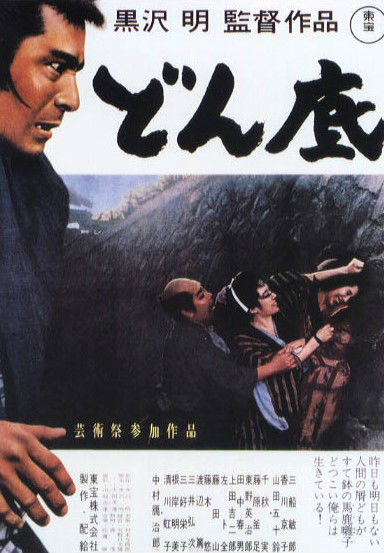
“How can you go to hell if you’re already there?” quips a stoical gangster, perhaps the only denizen of a rundown tenement block no longer looking for escape in Akira Kurosawa’s adaptation of the Gorky play The Lower Depths (どん底, Donzoko). In general, much of Kurosawa’s post-war work decries deliberate falsehood but paradoxically suggests that some degree of self-delusion is essential for surviving an otherwise hopeless world. The wandering pilgrim who arrives like some kind of emissary from the land above says as much as he offers what may turn out to be false promises of a better world to come, but as one of his charges points out he does so “out of pity for those beyond hope.”

Then again, perhaps spirituality won’t save you either. As the film opens, it’s two monks who are seen throwing leaves over a cliff describing the settlement below as “just an old rubbish dump”, which in a sense it is if that were not such a cruel thing to say. In any case, the people who live here are all those who have already fallen into desperation, exiled from mainstream society and caught between a fierce desire to claw their way back up and the despair of knowing that in all likelihood they never will. A man who claims to be a former samurai waxes on his illustrious past, while a melancholy sex worker meditates on the lost love that reduced her to current position, and a stage actor laments his failing memory his mind now fogged by years of alcohol abuse that he says have already poisoned his “bitol organs”. A tinker secretly thinks he’s better than those around him. He’s only been here six months and insists that he’s a skilled craftsman who can continue working, but blames his desperate circumstances on the sickly wife whose death he quietly awaits assuming it will free him of this burden and thereafter this place.

It doesn’t, of course. He sells his tools to pay for her funeral, and otherwise appears lost no longer a husband to a dying wife. In essence the film revolves around a confrontation between the pilgrim who offers what may well be an illusion of salvation and the thief Sutekichi (Toshiro Mifune) who challenges him but begins to believe that it really may be possible for him to leave this place and take the woman he loves, Okayo (Kyoko Kagawa), with him or else fall further and remain trapped in this mortal hellscape. The problem there is that Sutekichi had previously been having an affair with the landlord’s wife Osugi (Isuzu Yamada) who is Okayo’s sister. Though Osugi, whose hope of escape through romance is dashed, first takes against her sister, she later offers to surrender her to Sutekichi if only he will assist her by killing her greedy husband Rokubei (Ganjiro Nakamura). 

In this cold and austere place which is in effect a living hell, there is a sense that many of the residents are already dead. Rokubei’s face is the palest of them all, suggesting that he is already too far gone ever to be saved and most likely doesn’t want to be anyway for in this terrible place he is in effect the king. Osugi is the queen, but often framed behind bars now a prisoner already too corrupt to leave the tenement behind. Her uncle, Deputy Shimazo (Kichijiro Ueda), has a largely illusionary sense of power in his position in a policeman which he prosecutes selectively and mostly at the service of the landlord. In the climactic closing scenes, his policeman’s baton is stolen by the drunkard Unokichi (Yu Fujiki) who dances through the streets with it demonstrating just how little authority he actually wields finally losing his position when the landlord is deposed and his familial connections become irrelevant. He inherits the landlord’s residence, but is reduced to the husband of the sweet seller Otaki (Nijiko Kiyokawa) whose status as a working woman is perhaps higher than his. 

Yet the pilgrim seems to think there is still time to save Sutekichi who at heart wants to go straight but is also resentful admitting that in a world where swindlers prosper perhaps it is foolish not to be a swindler. The pilgrim promises all of them a “better place”. “As long as you believe you’ll find it, you surely will”, he explains telling the actor about a temple that can help him cure his alcoholism while simultaneously urging the tinker’s suffering wife to give in to her fate and go to Buddha’s embrace as soon as possible. Perhaps he sincerely believes these things to be true, but also seems to have a sense that even if they weren’t these hopeless people could not go on if they knew there was no way out. They all say they’ll leave, but discover there are only two means of escape, to die or fall still further in banishment from this already banished place. Only Okayo whose final whereabouts remain unknown may finally have been able to free herself. Staying almost exclusively with the claustrophobic confines of the drafty tenement as wind the whistles through it, Kurosawa frames the space of one of existential purgatory but perhaps suggests that in the absence of salvation a comforting falsehood is the only means of survival.


The Lower Depths screens at the BFI Southbank, London on 19th & 30th January 2023 as part of the Kurosawa season.

Five Men in a Circus (サーカス五人組, Mikio Naruse, 1935)

“Life is a journey” according to the melancholy heroine of Mikio Naruse’s Five Men in a Circus (サーカス五人組, Circus Goningumi), one of the director’s early anti-comedies in which a collection of itinerant performers find not so much hope for the future as accommodation with despair. Though the Japan of 1935 was not perhaps as straitened as the nation was to become, an all pervasive sense of hopelessness traps these travelling players in perpetual motion, burdened by the unattainability of their dreams as they find themselves continually moving forward while standing still. 

The five men of the title are an itinerant jinta brass band, though to tell the truth not a very good one. They were supposed to be on their way to play at a primary school sports day, only when they get there they’re told the event has been postponed to the following spring. After having wasted the afternoon killing time playing on the monkey bars and children’s slide, they decide to give a little concert anyway, not that anyone’s listening and there’s no real chance of getting paid. It’s in the next town, however, that they make a series of serendipitous meetings connected with a travelling circus which is currently undergoing a crisis as the entire male company has gone on strike against the boss’ tyrannical management style in a subversive dig at rising authoritarianism. 

All things considered, the circus seems to be doing pretty well for itself. It has a sizeable company with several accomplished performers and appears to be drawing good audiences. The boss (Sadao Maruyama) dresses in fancy outfits and there doesn’t seem to be much anxiety over hunger or any sign of the usual worries with which films about itinerant performers are usually concerned, all of which is in direct contrast to the jinta guys whose ragged appearance and habit of pinching yukata from the various inns on their route make plain their relative poverty. “None of us do jinta because we like it” the oldest of the players Seiroku (Ko Mihashi) points out, a woman behind in the bar him echoing that no one becomes a hostess because they like it either. None of these men had a burning desire to be in a band, they simply ended up there and now they can’t get out. Young orphan Kokichi (Heihachiro Okawa), however, dreams of going to Tokyo to study the violin carrying around a record of Western classical music to refresh his soul while worrying that his jinta life is corrupting him.  

Kokichi’s earnestness finds a fan and a mirror in Chiyoko (Masako Tsutsumi), the older daughter of the circus master who claims that she has long since given up hope of a better life even as she continues to dream her small dream of living in an ordinary house with a man she loves. Trapped by filial duty to her cruel father, Chiyoko actively encourages the escape of her younger sister Sumiko (Ryuko Umezono) who is in love with the ringmaster Kunio (Koji Kaga) though their father won’t let them marry. Kunio is also the instigator of the strike which is currently engulfing the circus, placing a strain on Sumiko’s conflicted loyalties as she struggles with her desire to leave the intinerant life behind. 

After the band is taken on as ringers to replace the striking musicians they also find themselves required to perform on stage, with varying degrees of success. Kokichi pleads to be given a chance to perform with a violin, even foregoing his pay as he’s warned the target audience is unlikely to find much to entertain them in a violin recital. His inexpert playing is roundly rejected by the baying mob who quickly begin throwing their rubbish at him until he’s forced to leave the stage in a moment of pure and crushing tragedy. Chiyoko tries to comfort him that she at least enjoyed the performance, but her words fail to cheer him more than superficially. He knows he’ll never go to Tokyo, or be anything more than a jinta player with only false hope to sustain him in the same way that Seiroku realises he’ll never never make peace with his past when he’s slyly conned by a 10-year-old girl he half suspected was the baby he abandoned out of economic desperation following the death of his wife. 

Yet it is in a sense romance that eventually eventually brokers resolution in the eventual implosion of Sumiko’s conflicted desires which cause her to “fall” from the trapeze, a moment of crisis daringly filmed through the use of double exposure superimposing Sumiko’s face over her POV of the men fighting in the ring. This narrowly averted tragedy apparently awakens something in her father who, she tells Kunio, only became cruel when their mother left, forcing him to relent and agree to be nicer to his employees while approving his daughter’s marriage. Yet romance cannot solve everything, and the only other romantic resolution we discover is in the roguish Torakichi (Hiroshi Uruki) who relents and accepts a woman he callously seduced and abandoned but who followed him because of the strength of a woman’s “passion”. Though we can see a connection has arisen between Chiyoko and Kokichi, it is not one which can be fulfilled, fate is pulling them in different directions. Forever a jinta player, he is pulled on to the next gig, the camera pulling back tragically from the bereaved Chiyoko, rooted to the spot as she watches her last hope walk away from her. “Life is a journey” she offers as a note of grim resignation, while knowing she’s going nowhere at all.


Our Marriage (私たちの結婚, Masahiro Shinoda, 1962)

Like many directors of his age, Masahiro Shinoda had to serve his apprenticeship at Shochiku contributing to the studio’s particular brand of light and cheerful melodramas though 1962’s Our Marriage (私たちの結婚, Watashitachi no Kekkon) did perhaps allow him to explore some of his persistent themes in its ultimately empathetic exploration of the romantic and existential dilemmas of two sisters who ultimately find themselves taking different paths in the complicated post-war society. Co-scripted by Zenzo Matsuyama, Our Marriage is essentially a chronicle of changing times and the crises of modernity, but it’s also surprisingly even-handed in its refusal to judge or indeed to sugarcoat the “romance” of a working class life. 

Keiko (Noriko Maki) and her younger sister Saeko (Chieko Baisho) both have jobs in the local factory with Keiko working in the accounts department which is where she first meets the brooding and self-righteous Komakura (Shinichiro Mikami) when he marches straight into the office to complain that he’s been shorted on his pay-packet to the tune of 10 yen. The ladies are non-plussed, it’s only 10 yen after all so perhaps there’s no need to be so unpleasant about it, but Komakura insists on having it looked into even after they give him the single coin in an effort to make him go away. Getting so upset about 10 yen is perhaps disproportionate, but then it is Komakura’s 10 yen and he has a point that if a mistake has been made it needs to be acknowledged and corrected especially when you’re dealing with people’s livelihoods to ensure that everyone is being paid fairly. On the other hand, marching in and shouting at people is unlikely to help the situation. 

It just so happens that Komakura is a good friend of Saeko’s who perhaps reads more into the mild embarrassment he and her sister each experience on meeting in another context to assume that they are romantically involved, immediately swinging into action to get them together. Meanwhile, another potential suitor has turned up at home in the form of Matsumoto (Isao Kimura), apparently an old friend dropping in on their parents out of courtesy. Matsumoto is very good looking and apparently now has a well paying job in the textiles trade, but despite their politeness to him the parents later have their doubts because it turns out that he was their blackmarket dealer during the dark days of the immediate post-war era. 

The Hibino family make their living as seaweed farmers and live in a small two-story home in a fishing village. Times are hard because the sea is dying. Increased industrial pollution, land reclamation, and the new airport have reduced the harvest to almost nothing and the girls’ father (Eijiro Tono) can no longer make ends meet. The union hasn’t paid him and he can’t ask about it because he’s still in debt from a previous loan, which is why Keiko’s mother (Sadako Sawamura) is always asking her for extra money to help with household expenses. Keiko intensely resents this, especially as her father’s irresponsible drinking habits continue to adversely affect the family’s finances. They haven’t really been thinking about her marriage perhaps partly because they need her salary but are now forced to because of all the sudden and unexpected interest. On top of Matsumoto and Komakura, it seems that the union leader’s widowed son is also interested which would, admittedly, be quite beneficial to the family. 

Keiko, however, is insistent that her husband must have a decent salary and that her married home must have a refrigerator and a washing machine. Quite the consumerist, Keiko has had enough of poverty and of feckless men like her authoritarian father who waste all their money on drink while relying on female labour to keep them out of trouble. When Matsumoto writes a formal letter proposing marriage, the parents decide to push the union leader’s son instead hoping to avoid embarrassment all round. Keiko immediately assumes the worst, that her father is trying to sell her to the union leader in exchange for the cancelation of his debts. She insists that she will decide her own future, leading Saeko to make a disastrous intervention revealing Keiko’s relationship with Komakura which only has the effect of enraging her father who brands her an ungrateful “whore” while shouting that a mere workman is not good enough for his daughter despite having previously stated that the union leader’s son was really “too good” and they were only in the running because it’s a second marriage. 

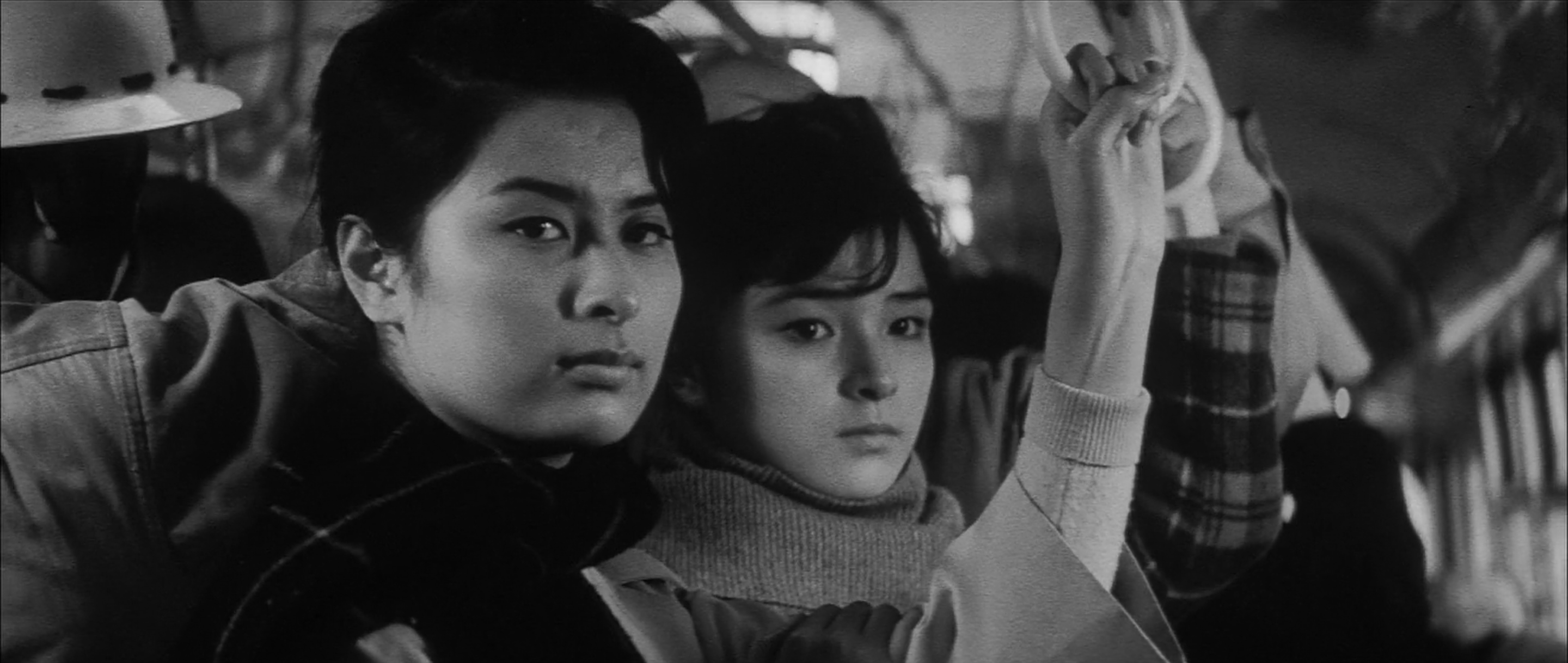
Both women still implicitly feel that marriage will define their futures, they do not have an expectation of living independently. Nevertheless, marriage itself may not be an answer. Everyone keeps talking about how happy Miyoko (Fumiko Hirayama) is with her new husband and she herself is forever extolling the joys of married life even in poverty, insisting to Saeko that “a woman’s happiness lies in marrying and having babies”. It’s a cruel irony then that we later see her arguing with her husband who is trying to force her to have an abortion against her will because they cannot afford to raise a child. Keiko has had enough of poverty, she wants to be more than comfortable, enjoying the new consumerist age. Re-encountering an old schoolfriend who has become a glamorous social butterfly she is mildly scandalised when she tells her that she obtained all her treasures through a complex network of compensated dating arrangements with foreigners, but later decides to check it out for herself when directly faced with the hopelessness of her situation. 

The fact remains, however, that no matter the initial attraction and her sister’s earnest attempts to make it work, Keiko and Komakura are fundamentally unsuited. They have entirely different ways of thinking about the world and want completely different things. Komakura is an angry young man but committed to his working class roots. He isn’t trying to get on, he’s happy with working in the factory for the rest of his life and just wants a quiet, honest existence. Keiko wants more, she thinks that people who say they’re poor but happy have merely given up on life. Revealing himself, Matsumoto says that he was struck by Keiko’s harsh words to him when she was a child, her calling him a blackmarketeer to his face apparently showing him what he was. He claims to have reformed and now fears the various ways that poverty can corrupt, something Keiko feels herself after her brief brush with the shady world of compensated dating. They are very much on the same page, both intent on seizing the benefits of the consumerist age but hoping they won’t have to stoop too low to get them. 

Saeko meanwhile is a little younger, still naive, and unlike her sister completely resistant to the corruptions of consumerism. Part of that might be because Keiko has shielded her from some of the harsh consequences of the way their family lives such as the financial burden of her father’s drinking, leaving her with a rosier view of poor but honest life which has her taking notes from Miyoko on how it’s easy to be happy even when you don’t have enough to eat. She and Komakura are in fact perfectly suited and perhaps she is already in love with him but either afraid of her feelings or unable to recognise them, pushing him towards her “prettier” sister instead. Then again, is there anything to say that Komakura will not turn into another man like her father, embittered and old, trying to drown his disappointment in sake? There’s no guarantee Keiko will be happy with Matsumoto, or perhaps with anyone, but they are at least moving forward in the same direction, as are Saeko and Komakura even as they blend back in with a hundred other cheerful youngsters making their way towards the factory. Our Marriage offers no judgment on its heroines’ choices, merely stating that people make their own paths in life pursuing their particular ideal of happiness and it happens that those paths might necessarily diverge but the people are still the same ones they always were and perhaps you don’t need to reject them for choosing differently than you might have done. Isn’t that what post-war freedom is all about after all?


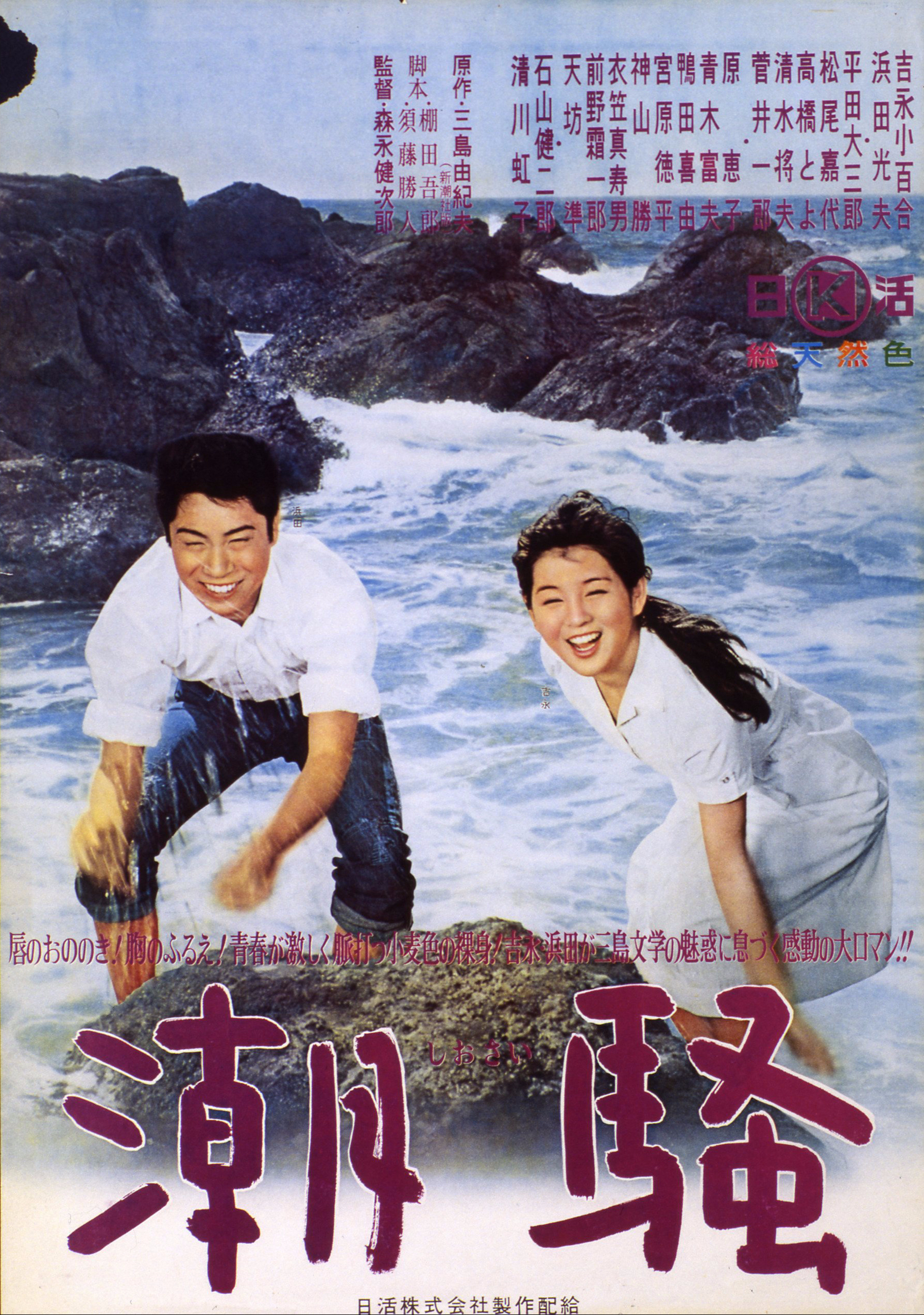
The Sound of Waves (潮騒, Kenjiro Morinaga, 1964)

Still a major marquee name well into her 70s, Sayuri Yoshinaga began her career as one of Nikkatsu’s young starlets in the early 1960s. Based on the well known novel by Yukio Mishima, The Sound of Waves (潮騒, Shiosai) finds her starring alongside regular co-star Mitsuo Hamada in another tale of love across the class divide. Usually, such forbidden love would be fodder for romantic tragedy, but Sound of the Waves is a cheerful exploration of tranquil island life where the people are simple and honest and the good will always triumph. 

Shinji (Mitsuo Hamada) is indeed good. Though still only a teenager, he’s become the man of the house following his father’s death, working hard as a fisherman to support his family and saving most of his salary to pay for his little brother’s education. The trouble starts when the beautiful Hatsue (Sayuri Yoshinaga) who had been living as a pearl diver on another island is called back to live with her father, island big man Terukichi (Kenjiro Ishiyama), after her brother dies. There have long been rumours that, as what Terukichi wants is a son to take over his business, he will soon be marrying Hatsue off and probably to the slick and handsome Yasuo (Daizaburo Hirata) who seems to be his favoured choice of son-in-law. 

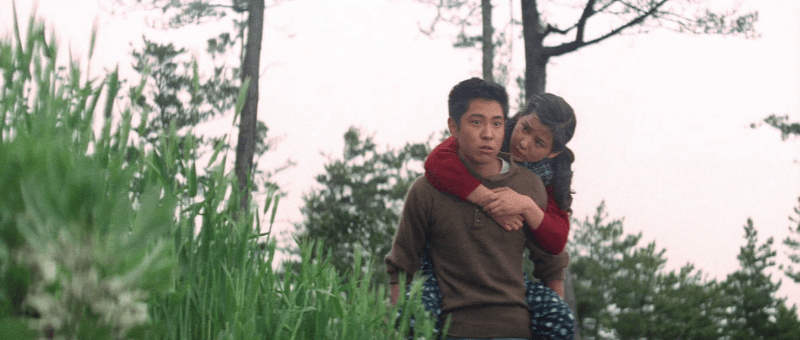
When Shinji lays eyes on Hatsue helping out with the boats it’s love at first sight, and even more so when he foolishly drops his pay packet while delivering a fish to an elderly couple and Hatsue takes the trouble of finding out where he lives and delivering it to his mother safely. Though everyone in Shinji’s household is quite taken with the beautiful, kind, and responsible newcomer, they are also aware that she is far out of Shinji’s reach. Terukichi is mean and arrogant, there’s no way he’d let his daughter marry a regular fisherman, and Shinji knows he can’t compete with an eligible young man like Yasuo. Hatsue, however, seems to like him too, especially after she gets bitten by a snake and his quick thinking, immediately sucking out the poison, probably saves her life. 

This being an innocent story of pure love, the couple have the opportunity to consummate their relationship after stripping off during a rainstorm but collectively decide to wait for marriage. That doesn’t stop the rumours starting, however, when they are spotted in the forest by Chiyoko (Kayo Matsuo), a young woman sweet on Shinji who’d gone away to study at university in Tokyo. She tells Yasuo who is immediately threatened, not only feeling unjustly betrayed, but acutely aware that the bright future he’d been so proudly boosting of as Terukichi’s future son-in-law might be in jeopardy. 

Where Shinji is kind and responsible, working hard to look after his family and always supporting the other villagers, Yasuo is, like Terukichi, arrogant and self-centred. He’s perfectly aware that he’s the island’s most eligible bachelor and makes a point of swaggering around like a little prince in waiting. Perhaps for that reason he’s also a snivelling coward and intensely insecure, angrily confronting Hatsue and even attempting to rape her while she collects water at the local spring. She manages to fend him off when he’s stung by hornets coming to her defence, and all he can do is plead with her not to tell her father so he won’t mess up his bright future any further. 

Hatsue seems not to have very much say in her future, romantic or otherwise. Having heard the rumours, Terukichi keeps her prisoner in her own home, insisting that she will marry his choice of son-in-law. The islanders, however, who seem to have grown used to ignoring Terukichi as much as it is possible to do so, are fully behind the youngsters’ romance. After all, what could be more natural than two young people falling in love? Eventually the island women launch a small petition to Terukichi to convince him to end his pettiness, but the contest, it seems, comes down to a test of manliness, Terukichi embarking on a young people today speech in complaining that his boat’s come loose in a storm but no one is man enough to retrieve it. Yasuo is found wanting once again, shrinking back from real risk while Shinji puts himself in harm’s way not only to prove himself a man and win Terukichi’s approval, but simply to serve the community. Manliness is redefined not only as strength and bravery, but kindness and patience too. Shinji’s goodness is indeed rewarded allowing him to dream of a brighter future, building a life for himself alongside a woman who loves him on their idyllic island home. 


Original trailer (no subtitles)

Travelling Actors (旅役者, Mikio Naruse, 1940)

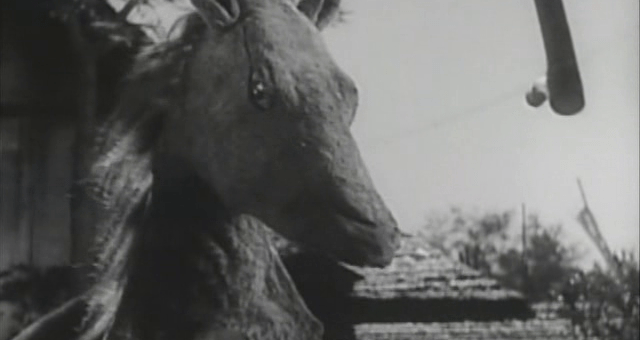
“You can’t have a horse without the ass” admits a travelling actor, inwardly preparing to meet his obsolescence. Anything’s an art if you care to practice it, but there is such a thing as taking yourself too seriously. A masterclass in tragicomedy, Naruse’s 1940 character study Travelling Actors (旅役者, Tabi Yakusha) finds two ends of a pantomime horse about to be torn apart when their act is unwittingly destroyed by a resentful punter whose drunken attempt to escape his sense of humiliation in being tricked by unscrupulous promoters leaves their horse without a head. 

Hyoroku (Kamatari Fujiwara) prides himself on being the “Danjuro of pantomime horses”, performing with the younger Senpei (Kan Yanagiya) who looks up to him as if he really were a great master of the arts. The guys are part of a group of travelling players touring rural Japan performing traditional skits for an audience starved of entertainment. The troupe is not, however, above exploitative business practices, proudly advertising the appearance of “Kikugoro” but neglecting to mention that it’s not the famous one, just another guy with the same name. Meanwhile, someone has to foot the bill for “producing” the show wherever the actors land, leading the exploitative producers to convince a local barber (Ko Mihashi) to invest, hoping to get a little free publicity because he’s known to be the town gossip and can spread the word through his shop. The plan backfires, however, when he travels to the station to see them arrive and immediately realises they are not a fancy acting company from Tokyo but a bunch of ragged bumpkins. Feeling thoroughly fed up, he demands to be allowed to perform in the show as the price of his silence before getting black out drunk and passing out backstage, crushing the papier-mâché horse’s head in his desperation to find somewhere soft to land. 

As “Kikugoro” points out, the “guy who plays the pantomime horse is really picky” so they know they’re in for some trouble as soon as he finds out what’s happened to his head. In fact, Hyoroku was just in the middle of some remodelling, trying to make the head look even more realistic to improve his art. While the barber is destroying his life’s work, Hyoroku and Senpei are drinking with a pair of geishas who are pretending to be interested in Hyoroku’s mini lecture about his process in which he tells them all about how he’s really captured the true essence of the horse through patiently honing his craft all these long years. 

There might be something in that, that Hyoroku is a workhorse of the theatre now more beast than man. Just occasionally, his horsey mannerisms come out in his offstage life, scratching the floor with his feet or pacing the room like a penned in pony. Though there are other sides of him which are painfully human. He makes a point of belittling Senpei in front of the geishas, insulting his art to assert his place as the teacher, always keen to keep his pupil in his place. But as Senpei points out, you can’t have a horse without the ass, and his “art” is no less important than Hyoroku’s. Continuing to take himself way too seriously, Hyoroku refuses to perform with the broken head, flatly objecting to the suggestion of substituting one from the fox costumes because he can’t get into character when his head’s in the wrong place. 

Faced with the prospect of cancelling the show, the producers come up with a radical idea – hiring a real horse. In a still more ironic touch, they even sell this horse who is making his stage debut as a star in his own right, only realising the dangers of their situation when it urinates right in the middle of the act. Weirdly, that only makes the horse a hit and convinces the troupe they’re on to a winner, which is bad news for the boys because who wants to see two guys in an ugly costume when they could be gazing at the real thing. The days of the pantomime horse are ending, but where does that leave a “great master” like Hyoroku who has spent his life becoming more horsey than a horse? Kicked out of the inn and forced to sleep backstage as non-performers, the guys eventually suffer the indignity of being offered jobs as stable boys, mere servants to the star who has replaced them. 

In an unguarded moment, Hyoroku and Senpei reflect on where they are as a young man in a soldier’s uniform leads a patient horse off to war. “That could be us” they sigh, though it’s not clear if they mean the man or the horse, before going back to horsing around eating shaved ice and flirting with the store owner. “I’m just the horse’s ass”, Senpei laments, secretly hoping to become a “real” actor at last, only for Hyoroku to uncharacteristically start encouraging him before dragging him off on another crazy adventure. Putting the fox’s head on to make a point, Hyoroku disappears into the role, chasing his rival right out of town, dragging his back legs behind him as he goes.