Sogo (now Gakyruu) Ishii was only 20 years old when Nikkatsu commissioned him to turn his smash hit 8mm short into a full scale studio picture. Perhaps that’s why they partnered him with one of their steadiest hands in Yukihiro Sawada as a co-director though the youthful punk attitude that would become Ishii’s signature is very much in evidence here despite the otherwise mainstream studio production. That said, Nikkatsu in this period was a far less sophisticated operation than it had been a decade before and, surprisingly, Panic High School (高校大パニック, Koukou Dai Panic) neatly avoids the kind of exploitative schlock that its title might suggest.
Back in 1977, though sadly little has changed in the intervening 40 years, schools are little more than pressure cookers slowly squeezing out every inch of individuality from the young people trapped within them as they cram for tests in subjects they might not actually understand. When a pupil commits suicide, the head master offers a few words of condolence over the tannoy system which the form tutor later backs up by emphasising that no one knows why the boy did this and that it probably has nothing at all to do with the school, exam pressure, or his performance in the recent mock exams. The school expect a line to be drawn here and for everyone to forget about it and get back to work.
However, when the teacher, Ihara, starts going on about the league tables suffering if the kids don’t buckle down some of them have had enough. One young man, Jono, looses it completely and takes a swing at the teacher only to miss and run out of the school in a panic. Whilst wandering around town he passes a gun shop and swipes a rifle before returning to the classroom and assassinating the maths tyrant. Not knowing what to do next, Jono hides out in the school building taking some of his friends hostage and then all hell breaks loose.
At its core, Panic High School is satire laying bare the crisis in Japan’s educational system which places undue emphasis on one particular set of exams which will determine the entirety of a person’s life. The teachers are cruel and heartless, little more than cogs in a machine. They don’t care about the kids, they only care about the statistics and the prestige associated with being the top high school in the area. All of these kids are bright, they already passed the stressful middle school entrance exams to get here, and the school just expects them to succeed but offers no support if they can’t.
Indeed, Ihara isn’t even teaching them anything. At the beginning of the film he asks a female student to solve an equation on the board. When she can’t, not only does he not explain the solution to her, he sends her outside adding to her original humiliation in front of the entire class and preventing her from actually learning how to solve the problem. When the next boy can’t solve it either he simply berates him for not studying, saying a “student at this high school should be able to solve this problem”. When the boy points out he did study but just doesn’t understand all he gets is abuse, no actual teaching at all.
Even when the police have been called, all anyone cares about is the reputation of the school. The headmaster keeps harping on about their status as the top school in the area and how “unfortunate” it would be if a student is killed inside the school – which is completely ignoring the fact that a teacher has already been murdered by a shotgun toting teenager right in the classroom. The police bungle the entire affair, starting by tearing apart Jono’s desk for clues including going right through his lunchbox and pointlessly cutting a hole in the bottom of his schoolbag. Bringing even more guns and riot police into the school to deal with one frightened boy who doesn’t want to shoot anyone else but is only trying to effect his escape (so he can take his entrance exams next year) is far from a good idea.
The kids are mad as hell and they aren’t going to take this anymore. The pressure is extreme and in the face of adult hypocrisy, it’s unsurprising that Jono and the other young people like him find themselves lashing out in extreme ways. Their teachers see them only as products, or even as components in the building of a “future” but never as people. Even if some of them start out wanting to help Jono, by the end even a teacher is trying to grab a gun screaming “That kid! I hate him now – I’ll kill him, he’s abandoned the most important thing – his education! He should never have come here in the first place!” putting the blame firmly on the boy and not on the system. In fact, the other teachers are busy in a huddle talking about how this is going to raise questions about the educational establishment and how they intend to mitigate that (they do not intend to address the “problems” in themselves).
While not as loud or as dynamic as some of Ishii’s later work, Panic High School displays much of his punkish sensibility even if it takes a form closer to ‘70s youth drama complete with all the zooms, whips and pans associated with the exploitation era. However, perhaps because Ishii’s own age is so close that of his protagonists the film is firmly on the side of youth. Far from a “youth in crisis” film, Panic High School places the blame firmly at the feet of the system which forces its young people into extreme and absurd situations. Notably different from Ishii’s later work in terms of tone and style, Panic High School is nevertheless an impressive studio debut feature and a strong indicator of the director’s continuing preoccupations.
Climatic scene from towards the beginning of the film (unsubtitled)
“Being good”. What does that mean? Is it as simple as “not being bad” (whatever that means) or perhaps it’s just abiding by the moral conventions of your society though those may be, no – are, questionable ideas in themselves. Mipo O follows up her hard hitting modern romance The Light Shines Only There by attempting to answer this question through looking at the stories of three ordinary people whose lives are touched by human cruelty.
The film begins with newbie teacher Okano (Kengo Kora) who is still trying to adjust to the extremely stressful life of a primary school teacher in charge of 38 little guys and girls. As he’s young and he’s only just started he’s filled with enthusiasm and is intent on doing his best to make a difference. On the other hand, he’s a young man with a private life of his own to think about and sometimes he’s just too tired to want to be bothered with a bunch of kids intentionally trying to push his buttons. When he notices one of the pupils hanging around the schoolyard everyday long after he should have gone home, he begins to worry about the boy’s life outside of school.
Strand two also features the life of an abused child as stressed out mother Masami (Machiko Ono) struggles to cope with her three year old daughter Ayane while her husband is frequently abroad on business. Having been an abused child herself, Masami enters a vicious cycle of hating herself for treating her daughter the way she does and resenting Ayane even more for making her feel this way. After becoming friends with a cheerful woman who seems completely at ease with her two rowdy kids, there may be a better way out on offer for Masami and Ayane.
The third tale is a little different than the other two as it encompasses themes of lonely older people in Japan’s rapidly ageing society and the position of those who are different from the norm. Akiko lost her entire family during the war and never had children of her own so she’s all alone now. Every evening while she’s sweeping the steps a young boy says “hello, goodbye” to her as he walks past. One day the boy is in a terrible panic because he’s somehow lost his house key but Akiko calms him down and takes him inside until his mother can come and fetch him.
Okano is full of good intentions. He wants to think himself a “good” person and genuinely wants to look after the young lives placed in his care. However, he is still young, inexperienced and a little bit vain so that the slightest bit of criticism niggles at him. Simply put, he just doesn’t really know what to do and several of his ideas backfire quite spectacularly or appear extremely ill-conceived. Some of this is still about him and his own idea of his being a “good person” rather than an altruistic desire to help the children under his care.
The same, however, cannot be said of the elderly lady who still takes such delight in the falling cherry blossoms which waft down from the school to her small suburban house. Akiko might be lonely, but there’s nothing selfish in the warmth she extends to others. When Hyato’s mother, Kazumi, arrives to fetch him, she’s immediately mortified, convinced that her son must have caused immense levels of trouble for this little old lady. Akiko claims not even to have noticed Hyato’s differences but remarks on how polite he is greeting her every evening and that he’s been the perfect houseguest – in fact she was enjoying herself so much she’s a little sorry Kazumi has turned up so quickly. Kazumi is completely overwhelmed by Akiko’s kindness – it’s the first time she’s ever heard anyone say something nice about her son rather than having people criticise him for being different. In fact, sometimes even she begins to forget how “good” he can be.
In the case of Masami and her daughter Ayane, it’s not that Masami is “bad” person but is responding to a cycle of violence that she finds impossible to escape. Masami doesn’t cope well with stressful situations, dislikes noise and disorder and has impossibly high (and arbitrary) standards for her daughter which result in “discipline” through physical violence. Nevertheless, Ayane loves her mother and, even if Masami recoils when Ayane tries to hug her, reacts with horror to cheerful friend Yoko’s joke of adopting her into their family. Ayane wants to be like her mum, taking delight in wearing a matching pair of shoes even if that means she can’t play with the other kids. As Masami was abused, so she abuses – will the cycle continue with Ayane? Luckily, the pair may have found a more gentle solution in the form of the kindly Yoko who proves far wiser than one would suspect.
As Okano’s sister tells him, when you’re nice to children, they’re nice to others. If everyone could be nicer to their children perhaps we could have a nicer world. The young boy whom Okano is trying to save has come to believe that he’s a “bad kid” – proven by the fact that Santa never comes to their house. He can’t bring himself to talk about his step father to his teachers and Okano’s interventions only make things worse for the boy. He needs someone to show him that he’s not at fault and that the world is not a bad place but it will take more than just “good will” to solve the problem. Sometimes, all you can do is knock on the door.
This is the original trailer for the film but in my opinion it contains a few spoilers so bear that in mind if you plan on watching in the near future:
Review of Arrow’s Nikkatsu Diamond Guys Volume 1 first published on UK Anime Network.
“Diamond Guys” is the name given to the top line of A-list stars at Japan’s oldest film studio Nikkatsu during their period of relaunching themselves as a major production house during the 1950s. At this time, Japanese studios, like their Hollywood counterparts, worked largely on a star system where they held a number of actors and actresses under contract and slotted them into their productions as and where they saw fit. Of the three stars in these pictures, Yujiro Ishihara perhaps burned brightest as a James Dean style apathetic hero and icon of the “sun tribe” era. Hideaki Nitani ultimately carved a niche for himself as a second lead rather than in starring roles and is a little more on the soulful side than the other guys. Akira Kobayashi who’s still fairly young here is probably the most familiar to overseas audiences later starring in a number of gangster pictures including Arrow’s previous releases Retaliation and the Battles Against Honour and Humanity series.
The first film included in the set, Voice Without a Shadow, is a notable inclusion as it’s a little seen, early effort from the notorious master of the surreal, Seijun Suzuki. In a significantly restrained mood here, Suzuki adapts a Seicho Matsumoto short story with noirish overtones as a telephone switchboard operator accidentally connects a wrong number and unwittingly hears the voice of a murderer at a crime scene. Hideaki Nitani plays a conflicted reporter who’s fallen in love with the switchboard operator who is, alas, already engaged. Three years later she hears the voice again in a gangster her husband unwisely becomes involved with only to have him killed and her husband become the prime suspect.
Film number two, Red Pier, comes from Toshio Masuda and stars pinup of the day Yujiro Ishihara in a characteristically cheeky, nihilistic gangster role. Dressed in a bright white suit and sunglasses, “Jiro the Lefty” is a petty yakuza street kid who found a home in a gang but dreams of a better life somewhere else. After witnessing the strange death of a potential target who gets crushed by a crane at the docks, Jiro ends up meeting the man’s sister and, of course, falls for her. Unfortunately, just about everyone now has it in for Jiro and his happily ever after seems very far off indeed.
The Rambling Guitarist, by contrast, is the only film in the collection to be filmed in colour but makes fantastic use of its super bright, psychedelic look. Starring Akira Kobayashi as a drifter with a guitar, the film starts out like a western but ends as a yakuza pic with a little youth drama thrown in for good measure. It’s fighting, music, and gunplay with Jo Shishido lending grinning support as a late addition hitman.
In some senses each of these films was built around its star – men want to be them, women want to be with them, you get the picture. The Rambling Guitarist is sort of the odd one out here as it’s of a slightly different strand than the other two with a lighter emphasis on crime and a shift from noir to western in terms of its overseas influences. Both Voice Without a Shadow and Red Pier lean much more towards film noir with Red Pier leaning a little more towards Europe than America. That said, The Rambling Guitarist is perhaps the weakest film on offer simply because of its up to the moment youth orientation which leaves it feeling a little more dated than the other two which can rely on their more classical style to find a modern appeal.
Each of these little seen gems would have been worthy of a solo buy in any case but finding them all offered in this fantastic new package from Arrow is a real treat. Each offered in stunning HD re-masters on blu-ray, even if they show their age in a couple of places the transfers are particularly fine and are likely to be the best these films will ever look. The Nikkatsu films from this era offered crowd pleasing thrills and good looking actors, but they were often also made by interesting directors who injected a little of their own individual, often youthful, flair to lift them well above the generic genre movies also on offer. That isn’t to say that each of their pictures was a smash hit, but the three on offer as part of this set are certainly each worthy of consideration even if for quite different reasons and if the included trailers for Vol. 2 are anything to go by we have even more undiscovered gems to look forward to in the future!
Nikkatsu Diamond Guys Volume 1 is out now on dual format DVD/blu-ray in the UK and USA courtesy of Arrow.
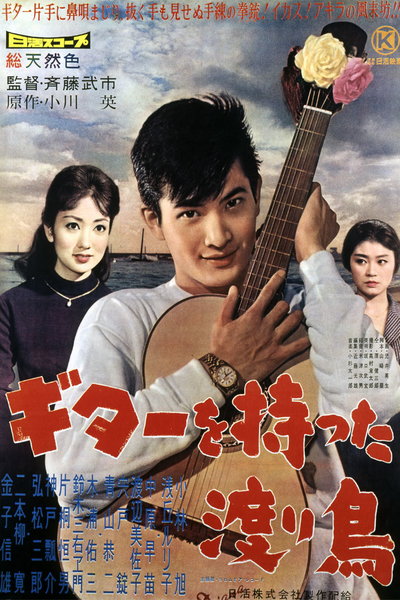
Sometimes, just like an aimless drifter wandering into town, you feel as if you’ve come in during the second reel and missed some vital piece of information leaving you feeling a little at odds with the current situation. So it is with Buichi Saito’s The Rambling Guitarist (ギターを持った渡り鳥, Guitar wo Motta Wataridori) which is, apparently, the first film in a series though feels a little more like the second.
The film begins with a scene straight out of a classic western as the titular guitar toting wanderer, Taki (played by rising Nikkatsu star of the time Akira Kobayashi looking very fresh faced indeed), is fast asleep on the back of a cart travelling through an arid landscape with a mountain looming in the background before being woken by the driver who points him towards the nearest town. Having left the dry expanses on foot, Taki hasn’t been in Hakodate for long before he’s wrecked a local drinking establishment in a two on one bar brawl with a couple of drunken foreign sailors who were hassling the other musicians. This brings him to the notice of the crime kingpin Akitsu who offers him a job but Taki doesn’t like to linger and this kind of work’s not his thing so he passes. That is until a chance encounter with Akitsu’s pretty young daughter leads to a change of heart…
Akira Kobayashi went on to become one of the studio’s biggest action stars but here he’s every inch the pretty boy in a Brando-esque leather jacket and with a cooler than cool devil may care approach to life. The very epitome of the kind of pin-up star these films were created to sell, Taki is a noble, broken hearted drifter mournfully strumming along on his ever present guitar whenever the opportunity presents itself. Appealing to the rebellious side of post-war youth but still possessing a moral centre which places him on the side of right, Taki is the kind of youth hero you can still take home to mama.
Post set-up, The Rambling Guitarist drops most of its western tropes pretty quickly and falls back into a standard youth crime drama mould as Taki ends up joining the Akitsu gang who have a plan to build an amusement park on the quiet edge of the island to pull in a bit more tourist money. The snag is, there’s a small house and fishing company based there that they need to take out – the owners have a loan and are already in debt so it shouldn’t be too hard but Akitsu has neglected to mention that the house belongs to his sister (and her husband whom he doesn’t like very much).
Just when you thought everything was about to settle down, an old “friend” emerges from underneath a raincoat in the form of “Killer George” played by fellow Nikkatsu rising star, Jo Shishido. It’s from here on that we start to piece together some of Taki’s previous life and the reason he’s on this seemingly endless path of wandering from to place to place with no clear aim in sight. Things start to take a more generic turn as Taki and George dance around each other a little bit with Akitsu fuelling the fire by plotting behind both of their backs from the shadows. It’s a conventional narrative but acquits itself well enough.
Like the other films of the period, The Rambling Guitarist is built of bright, colourful and above all youthful fun. Consequently it has an energetic, freewheeling atmosphere coupled with a mildly nihilistic bent designed to appeal to the youth of the time. Aside from having some of the least realistic fight choreography ever committed to celluloid (that first bar brawl scene has some real howlers), The Rambling Guitarist proves an enjoyable embodiment of its genre but ultimately fails to build up the kind of emotional investment that would earn it a higher place on the list. A little bit disposable, perhaps, but nevertheless fun The Rambling Guitarist does at least leave you wanting to wander off and find your way to The Rambling Guitarist 2.
The Rambling Guitarist is the third (and final 😦 ) film included in Arrow’s Nikkatsu Diamond Guys Vol. 1 collection.
Loosely inspired by Julian Duvivier’s 1937 gangster movie Pépé le Moko, Toshio Masuda’s Red Pier (赤い波止場, Akai Hatoba) was designed as a vehicle for Nikkatsu’s rising star of the time, Yujiro Ishihara – later to become the icon of the Sun Tribe generation. On paper it sounds like a fairly conventional plot – young turk of a gangster comes to town to off a guy, sees said guy killed in an “accident”, and shrugs it off as one of life’s little ironies only to accidentally become acquainted with and fall head over heals for the dead guy’s sister. So far, so film noir yet Masuda adds enough of his own characteristic touches to keep things interesting.
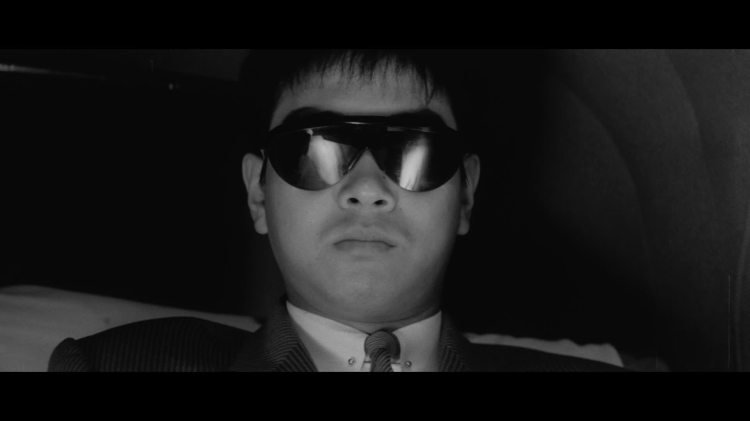
“Jiro the Lefty” (Yujiro Ishihara) is a sharp looking petty yakuza type in a bright white suit and sunglasses. Another of Japan’s post-war abandoned street kids, he found a home in a gang and has never known anything one could call a “normal” way of life. Other than his obvious talent with a gun, he has a cheerful and ironic personality that has him even almost respected by the police and is generally well liked in the area.
Early on Jiro rescues a little boy from almost being hit by a car and later when playing the harmonica for him gets hit by a thunderbolt of love when catching sight of the boy’s aunt, Keiko (Mie Kitahara). This causes him several problems at once: to begin with, she’s the sister of the guy he saw get hit by a crane and she doesn’t seem to know her brother was a gangster, two – Keiko is obviously of a much higher social class and a little out of his reach even if he managed to go straight, three – he can’t go straight, he doesn’t know how to do anything else, four – Mami, his current nightclub dancer “girlfriend” who’s invested a little more in the relationship than he has. Actually this is only the start of a long list of problems Jiro has to deal with, he just doesn’t know about them yet.
The story is set around the docks of Kobe where the living is hard and life is cheap. The local policeman is a fairly laid-back, ironic chap who’s made an odd sort of friendship with Jiro wherein he doesn’t really want to see anything too bad happen to him. He can see this thing with Keiko is not a very good idea and is constantly lurking in the shadows trying to control the situation as much as he can. Jiro, doesn’t know it yet but his own guys are out to get him too and after one of his sworn brothers ends up paying the price for Jiro’s rising profile in the yakuza world, he finds himself on the run from pretty much everyone.
This sounds like quite a complicated set up but Masuda manages to martial everything into a coherent order and even adds a hearty dose of realistic emotion too. As far as the aesthetic goes, Masuda takes his cues from American film noir with harsh lighting and canted angles all employed to show us the crookedness of this underground world but he also makes sure to add occasional touches of artistic flair such as the light bouncing off Jiro’s sunglasses during a night time cab ride or the sheer shock on Ishihara’s face as he first sees Keiko framed against the bright sunshine of Kobe’s harbour.
The too noble for his own good gangster who wants to go straight but knows he has a crooked heart – it’s an old story, but a good one. Red Pier pushes a lot of these ideas to the max but handles them well and adds a traditional “crime doesn’t pay” ending which is both endlessly sad and completely appropriate at the same time. You can’t help feel for Jiro and his small scale existential crisis in which the reluctant gangster wants to jump ship for more peaceful climes but can’t for both personal and societal reasons. Red Pier may not be the best Masuda/Ishihara collaboration but it is certainly an excellent example of everything its genre has to offer.
Red Pier is the Second film included in Arrow’s Nikkatsu Diamond Guys Vol. 1 collection.
Make friends with this Oni mask – you will be seeing a lot of him throughout the film.
Seijun Suzuki might be best remembered for his surrealist pop art masterpieces from the late sixties or his even less comprehensible art films which followed his return to directing after settling his dispute with Nikkatsu, but everyone’s got to start somewhere and it comes as something of a relief to know that Suzuki was perfectly capable of making a straightforward movie if he wanted to. Voice Without a Shadow (影なき声, Kagenaki Koe) is exactly what it sounds like – a fifties style, US inspired noir however, Suzuki adds his usual flourishes and manages to wrong foot us pretty much the whole way through so that we never end up where we thought it was that we were going.
To begin with, our story is fairly straightforward. Reporter Ishikawa (Hideaki Nitani) provides our film noir style voice over as switchboard operator Asako (Yoko Minamida) accidentally dials a wrong number only have it picked up by a strange man who tells her she’s rung a crematorium then laughs hysterically. It turns out that the number was actually for a pawn shop which was in the process of being knocked over and the owner killed – Asako heard the perpetrator’s voice and thanks to her switchboard experience isn’t going to forget it. Ishikawa grows closer to Asako as the case becomes a media sensation but backs off after learning she’s already engaged.
Three years later Asako hears the voice again – a friend of her husband’s who keeps co-opting their living room for mahjong games that go on for days and cost everyone but him a lot of money. Before long Hamazaki (Jo Shishido) is found dead and Asako’s husband is the prime suspect but did he really do it? And if he didn’t, does Ishikawa really want to find out who did?
As you can see it’s a story that wouldn’t be out of place in any B movie noir from the fifties and the telephone set up is even a little reminiscent of Sorry, Wrong Number (though that film has a very different conclusion indeed). Based on a short story by Seicho Matsumoto, Voice, Voice Without a Shadow is full of the classic play of light and shadow that characterises the best film noir and the mood is ably supported by a suitably jazzy score from Hikaru Hayashi. If there’s a criticism to be made in this area, it’s that Nitani’s Ishikawa is a little too nice and pure hearted in comparison to the broken hearted heroes from the detective serials. He seems content to try and help Asako whilst uncovering the truth even if it ends up costing him in the end.
Although Asako herself is technically the leading character she quickly gets relegated to a more conventional woman in peril role. She is the one who recognises Hamazaki’s voice and the only clue linking him to the pawn shop murder three years ago but, while he’s alive anyway, Hamazaki is more interested in having fun terrorising everyone rather than trying to rub her out. In fact, the sudden demise of Hamazaki, played by an extremely young Jo Shishido, is one of the most surprising things about the film in which you’d expect him to remain the central antagonist right up until the grand finale.
Voice Without a Shadow is then a fairly conventional, noir inflected B movie which wears its Hollywood influences on its sleeve. However, there are glimpses of Suzuki’s individual style leaking through such as in his occasional and surprising use of double exposure, innovative composition and other modernist techniques which all help to lift the rather workmanlike script onto another level. In someways, it’s all a little too nice – even Hamazaki’s nasty lowlife activities are neatly skirted around almost like a film noir that’s been through a car wash though its strange pleasantness also has a nicely refreshing quality.
A minor film from the master of the surreal then, but an interesting one none the less. The mystery element proves satisfying even if it could do with a little more dirt under its fingernails and the committed performances also do their bit to enhance the mood. A prime example of its genre, Voice Without a Shadow is a notably restrained entry in Suzuki’s back catalogue but its classical style mixed with an offbeat, absurdist undercurrent make it one worth seeking out.
Voice Without a Shadow is the first film included in Arrow’s Nikkatsu Diamond Guys Vol. 1 collection.
What are you supposed to do when you’ve lost a war? Your former enemies all around you, refusing to help no matter what they say and there are only black-marketers and gangsters where there used to be merchants and craftsmen. Everyone is looking out for themselves, everyone is in the gutter. How are you supposed to build anything out of this chaos? Perhaps you aren’t, but you have to go one living, somehow. The picture of the immediate post-war world which Suzuki paints in Gate of Flesh (肉体の門, Nikutai no Mon) is fairly hellish – crowded, smelly marketplaces thronging with desperate people. Based on a novel by Taijiro Tamura (who also provided the source material for Suzuki’s Story of a Prostitute), Gate of Flesh has its lens firmly pointed at the bottom of the heap and resolutely refuses to avert its gaze.
A nervous young woman, clearly tired, starving and alone wanders through a marketplace in desperation before a yakuza offers to buy her something to eat. She is wary but has little choice. Soon after she meets toughened prostitute Sen who is the de-facto head of a small group of streetwalkers committed to supporting and protecting each other. They have few rules but the biggest one is no giving it away for free. Maya joins their “merry” band and things are going OK for them until they make the fateful decision to take in a wounded ex-soldier on the run from the American military police. Shin puts a great big wedge between the members of the group, deepening the cracks which were present all along. Sure enough, Maya starts to fall for this damaged man threatening to fall foul of the gang’s single taboo. When you’ve lived like this, without hope, without a future, can you ever go back to being a “real human being” ever again?
Make no mistake, this is a ruined world. Almost post-apocalyptic, it’s populated by the starving and the desperate. The sweet potato seller is king here – the working girls are depicted like packs of rabid animals, descending on any passing male ready to extract any amount of loose change which they immediately run out to thrust into the hands of anyone who has food. The great horror is hunger.
The other great horror is, of course, violence and particularly male violence against women. Maya is assaulted early on and a truck carrying two army officers and a priest tries to make a quick escape after noticing her lying wounded by the roadside. The Americans aren’t going to help her, she’s just another raped Japanese woman after all, but the priest stops and offers another kind of salvation shining from his dangling crucifix. He repeatedly turns up later and tries to convince Maya to come back to church but you can’t live on a communion wafer alone and eventually Maya puts a definite end to the idea of any kind of religious solution to her predicament.
Sex is business for the woman under Sen’s command. They sell their bodies, hence the prohibition on giving them away. Breaking the rules will get you cruelly beaten and humiliated before being thrown out of the group and it’s near impossible to survive alone. The other women have all been injured by the war, they’re all among those left behind. One of them, Machiko, stands a little to the side as a middle class war widow rigidly sticking to her kimono and dreaming of becoming someone’s wife again. Needless to say, she and Sen do not always see eye to eye as Machiko’s desire to return to a more innocent age conflicts with Sen’s hard nosed pragmatism.
This is Japan in defeat. The girls live in a warren of ruined buildings haunted by visions of the past. Shin has returned from the war to a land devoid of hope. He’s a broken man and, as the woman have been “reduced” to prostitution, he has been “forced” into crime. There aren’t any real people here anymore, just animals willing to do whatever it takes just to stay alive.
When Suzuki was given this assignment, they wanted him to make a soft-core exploitation pic full of the sleazy lives of the red light district. Suzuki doesn’t give them that, he gives them another round of beautifully composed, surrealist social commentary in which the downtrodden citizens of Japan are defeated for a second time by the corrupting influences of the American occupation. The final shot of the ascendant Stars and Stripes flapping in the wind while the Japanese flag lies drowned in the muddy river speaks for itself and though Suzuki shows us those defiantly trying to live his prognosis for them is not particularly hopeful. He uses multiple exposure here more than in any other film as the past continues to haunt the traumatised populace in quite a literal way where one scene of degradation leads on to another. Extended metaphor, surrealist examination of the post-war world and also the low level exploitation feature Suzuki was hired to direct (albeit in more ways than one) Gate of Flesh proves one of his most complicated and accomplished features even given his long and varied career.
Gate of Flesh is available with English subtitles on R1 DVD from The Criterion Collection.
When considering their next holiday destination, many people like to peruse some brochures, have a read of trip advisor or head to a well known tourist spot that is likely to impress the guests at their next soirée but then there are always others who just simply show up somewhere and hope for the best. The central character of Megane, Taeko (Satomi Kobayashi), perhaps wishes she’d done a little research before heading out to a very strange inn on a very strange island but the longer she stays, the more the ways of the laid-back islanders seem to make sense to her.
The film begins as inn owner Yuji (Ken Mitsuishi) plays with his dog on the beach before suddenly realising “She’s here!” – referring to a favourite, annual guest who operates a shaved ice stand on that very same beach but for the spring only. Sakura (Masako Motai) has, indeed, arrived but unexpectedly there is also a second visitor, Taeko, all the way from the big city. Yuki seems impressed Taeko managed to find the out of the way hotel and points out their tiny sign (if they had a bigger one there would be too many customers).
Taeko might have been looking for an escape but this is a little more than she bargained for. First off, she gets a wake up call every morning in the form of Sakura kneeling next to her bed and commenting on the weather and she’s sort of expected to attend meals at the same time as everyone else, convenient or not. Sakura also leads a strange callisthenics session on the beach each morning which Taeko is encouraged to join as well as constantly being offered Sakura’s shaved ice which she always declines.
There isn’t much to do in this strange place, Yuji, Sakura and another woman who isn’t a guest but hangs round all the time anyway are convinced Taeko has come for the purpose of “twilighting” which Taeko doesn’t quite understand and they refuse to elaborate on but apparently this weird island is very good for it. Getting sick of these strange people and their odd habits Taeko decides to just check out and try another hotel. BIG MISTAKE. The other hotel on the island turns out to be an even more bizarre cult commune which makes Yuji and co seem much more appealing all of a sudden. Returning humbly to the extremely relaxed hotel and sacrificing her suitcase in the process, Taeko finally begins to embrace the odd ways of the island and open herself up to its benign indifference.
However, part way through she’s rudely interrupted by one of her students who’s managed to track her down despite her having chosen this place specifically for its remoteness and lack of cellphone signal. Yomogi (Ryo Kase) takes to the weird ways of the island like a fish to water, in fact his hipsterish adaptability is a little odd in itself, but against expectations his arrival only slightly irritates Taeko and creates no major drama of its own. The mystery of the overly jealous hanger on, Haruna (Mikako Ichikawa), is partially solved towards the end though her gentle possessiveness of the inn bound family and passive aggression to Taeko’s gradual acclimatisation is also more of the comic variety and eventually works itself out in a gentle way.
“Gentle” may well be the best way to describe Megane. Someone should probably market a “calm” mix which consists entirely of the relaxing island sounds of this film. These people take things slow and are all the happier for it. They know the pleasure of a sunset, shaved ice on the beach on a sunny day, drinking beer outside or enjoying a barbecue with friends. Mellow to the core, Megane is the ideal way to find your own spot of serenity at the end of a busy day and is sure to ease even the heaviest of hearts with its subtle, absurd humour.
The Japanese region A blu-ray release of Megane includes English subtitles!
Belated review from the 2015 London Film Festival – Yakuza Apocalypse is released in UK cinemas for one day only on 6th January 2016 courtesy of Manga who will also be releasing on home video at a later date.
Takashi Miike shuffles back towards the yakuza plains in the western inspired horror comedy Yakuza Apocalypse (極道大戦争, Gokudo Daisenso) trailing ever more zany humour behind him. Yakuza gungslingers, bloodsucking, high school girls running away from things and, finally, a guy with a magic belly button wearing a frog suit who just happens to be “The World’s Toughest Terrorist”.
We open in media res as vampire yakuza boss Kamiura (Lily Franky) cuts up a storm in settling some local disputes. There’s a handy voice over from our soon to be protagonist, Kageyama (Hayato Ichihara), lamenting the old yakuza world of tough guys and honour codes but things don’t really take off until a very geeky looking guy and a Van Helsing type in 17th century attire suddenly turn up hoping to re-recruit the boss to “The Syndicate”. When he refuses, they fight and the geek twists Kamiura’s head right off. Using his last ounce of strength and in a touch right out of Hausu, Kamiura clamps onto Kageyama’s neck turning him into a vampire. However, in his just turned state, the honourable Kageyama turns a few more vampires of his own – and not only vampires, the bite also transmits yakuzaism too. This increase in bloodsucking gangsters is a bit of a problem for the regular guys as it does mean their pool of victims is being steadily depleted…
Not making much sense is not generally much of a problem in a Miike film. In fact, it’s a pretty much a given at this stage of the prolific director’s career. However, in the case of Yakuza Apocalypse it’s even more pointless than usual to pay any attention at all to any kind of narrative. Looking over Kageyama’s shoulder, we move from set to piece to set piece as, first of all, the non-vampire yakuza guys struggle for power between themselves and then with the vampire variety before the giant frog turns up to ruin everything.
There are some rules, Miike takes a while explaining to us how this yakuza business works with Kamiura as the “good” kind of yakuza committed to protecting his townspeople above all else – essentially, he’s the sherriff around these parts. He’s a vampire, yes, but he only feeds on yakuza who he’s “reforming” by means of an underground knitting circle held prisoner in his basement. Apparently yakuza blood tastes bad and isn’t very good for you but eating civilians is dishonourable and anyway, limited in supply, because when you turn someone they also become a foul mouthed yakuza fighting machine.
The world building is shaky at best, none of this really hangs together making for a fairly disappointing series of one note jokes. There is an attempt at a bit of more sophisticated satire with the regular gangsters suddenly lamenting that there will be no one left for them to prey on if everyone turns yakuza vampire but otherwise it’s crazy piled on crazy. Not a bad thing in itself but somewhat lacking in substance.
Despite that, the film offers some quality performances notably from its lead, Kageyama, played by Hayato Ichihara, as the yakuza who’s so sensitive his delicate skin won’t allow him to get a proper yakuza tattoo. That is, until he becomes a brooding, conflicted vampire mourning the loss of his boss and of those long held tough guy ideals. Lily Franky also offers a high impact though short lived appearance as the honourable vampire boss with a hinted at backstory, though the much publicised cameo of The Raid’s Yayan Ruhian feels a little wasted as he’s just generally hanging around for a handful of fight scenes. That said, the action scenes themselves are extremely impressive, both exciting and often funny too.
Yakuza Apocalypse is not one of Miike’s most well thought out efforts. Its collection of crazy ideas feels thrown together and there’s disappointingly little depth to its world building. Even its media res conclusion looks more like running out of ideas than a deliberate decision. However, that’s not to say it isn’t heaps of fun, which it often is. A crazy frog riding a bicycle who somehow wakes up the giant king of the crazy frog people after some kind of emergency plaster is ripped off his belly button – really, what could be more fun than that? That really is all there is though and those who prefer their absurdist action thrills with a little more substance had best look elsewhere.
Yakuza Apocalypse is in released in UK cinemas for one night only on 6th January 2016. Luckily the film is playing across the UK even if it’s only the one night and you can see if it’s on anywhere near you by checking out this handy link! If it’s not, don’t despair! It’ll also be available in all the normal ways from Manga later in the year.
Arrow double whammy up at UK Anime Network as I review both of Arrow’s recent Yasuharu Hasebe releases – Massacre Gun and Retaliation!
Tatsuya Fuji tests his gun out in Massacre Gun (and looks cool in the process)
Arrow have been turning up some hidden gems and neglected classics as they trawl through the world of the populist cinema from the Japanese golden age of the 1960s and 70s – they’ve already brought us the iconic Lady Snow Blood, the lesser known Blind Woman’s Curse, the anarchic Stray Cat Rock series and now, following on from their release of Seijun Suzuki’s famously crazy Branded to Kill they’ve turned their attention back to Nikkatsu Noir with Massacre Gun. The first of two releases from director Yasuhiro Hasebe who also directed three films in the Stray Cat Rock series (Retaliation will follow next month), Massacre Gun has everything any genre fan could wish for – depressed hit men, warring gangs, jazz bars, boxing clubs, stylish monochrome photography and the melancholic ennui that permeates all the best noir movies. Perhaps not quite as impressive as the greatest hits of Nikkatsu Noir such as the afore mentioned Branded to Kill or Nikkatsu’s other offerings like A Colt is My Passport, Massacre Gun is nevertheless another impressive entry in the studio’s short lived action output.
As the film begins, thoroughly dejected Kuroda has just been asked to carry out a hit on a woman who is in love with him – feelings which he may have have reciprocated but, but like any good lackey, Kuroda chose his boss over his heart and sent the love sick girl into a lake with a bullet in her chest. When Kuroda’s two younger brothers find out they do not approve and hot headed youngest brother Saburo who trains at a yakuza run gym hoping to become a a pro-boxer, decides to have a word with Kuroda’s boss, Akazawa. As might be expected things don’t go Saburo’s way and he’s brutally beaten to the extent his hands are all but crushed leaving him unlikely to box again. At this point, Kuroda wants out of the game – but for a yakuza hit man there is no out. His only option is to take down Akazawa’s empire and build one of his own.
Like most of Nikkatsu’s late ‘60s action output which would later retroactively become known as Nikkatsu Noir, Massacre Gun is heavily indebted to the American B-movie and particularly to the film noir. Its settings are those of “low culture”, Western bars and cafes where people drink expensive whiskey and wear sharp suits and sunglasses. In fact, the Kuroda brothers’ side business involves running a jazz bar with a half Japanese-half African American jazz singer playing piano in the corner and a pair of Western dancers doing some sort of scantily clad, artistic ballroom dancing routine in the middle. Most importantly it’s full of the classic Film Noir feeling of spiritual emptiness and existential ennui with the very depressed contract killer Kuroda at its centre.
A very male affair (perhaps the key missing element from a Film Noir is a femme fatale), the bulk of the film is the opposition between Kuroda on the one side and his former boss on the other. Other than the closeness with his two younger brothers and to a lesser extent the other workers at the club, Kuroda’s other most notable relationship is with his old friend Shirasaka who coincidentally married another woman Kuroda may have had feelings for. Though the two have enjoyed a close friendship up until now, Kuroda’s decision to leave Akazawa’s employ has meant Shirasaka has had to make a choice and he’s chosen Akazawa. The two are are now mortal enemies on opposing sides of a war – a fact which causes them both pain but which, nevertheless, cannot be otherwise.
Hasebe is best known for his striking use of colour which makes Massacre Gun a notable entry in his filmography as it’s the only one he made in black and white. Other than the perverse habit of sticking colours into the names of his leading characters and locations (the “Kuro” in Kuroda means “black”, the “Shira” in Shirasaka means “white” and the “Aka” in “Akazawa” means red making this one very complicated game of checkers), Hasebe still manages to make an oddly “colourful” film even in monochrome. Taking a cue from Suzuki, Hasebe has come up with a fair few arty and unusual compositions of his own though not quite to Suzuki’s absurd extremities and neatly retained the classic Nikkatsu Noir aesthetic in his superbly crisp black and white colour palate.
Coming as a late addition to the genre, Massacre Gun also takes a fairly unusual approach to violence with a far more explicit representation than would be expected from this period. Simply put – lots of people die in this film, many of them in quite exciting ways. Blood is everywhere and there are so many bullets fired you start to wonder if some one in the yakuza equivalent of the administration department isn’t having some kind of heart attack behind the scenes. Massacre Gun might not be the best entry in the Nikkatsu Noir series, but it is perhaps one of the most typical. Edgy and arty, exquisitely framed and perfectly photographed it brings out the effortless cool that came to symbolise Nikkatsu’s late ‘60s output. Aside from all that – it’s just fun as most of these films are. Another welcome release from Arrow who continue to root out these lesser known genre movies, Massacre Gun is a must see for fans of classic ‘60s action movies.
Jo Shishido smokes a cigarette in Retaliation (and looks cool in the process)
Arrow are back with another neglected classic of Japanese action cinema produced by Nikkatsu – Retaliation, a slightly later film from Yasuharu Hasebe director of Massacre Gun and three out of five of the Stray Cat Rock series. Unlike Massacre Gun (but like every other film Hasebe ever made), Retaliation is shot in colour and features Hasebe’s trademark use of it. Retaliation is very typical of its genre in someways and very not in others. It stands on something of a borderline seemingly symptomatic of Nikkatsu’s eventual slide into a producer of soft core pornography as their Roman Porno line of sex and violence based movies took over as their main production style. Not as strong as some of the other entries from around this time, Retaliation nevertheless marks itself out as an interesting addition to the genre.
Not one of the most exciting plots in yakuza movie history, Retaliation’s main mcguffin centres around trying to persuade some farming families to sell their ancestral land to developers who want to build a factory there. Having just been released from prison after taking the fall for gang murder, Jiro is offered the chance to head up his own group, however his patch is between two rivals and his best bet is to play the two off against each other as they both vie for this disputed farmland. One group is super old school and the other is the more modern type of thug who’ll do pretty much anything to get what they want – including abducting one of the farmer’s daughters and molesting her in the back of a car as a way to threaten her father. Jiro is given his own mini team to help out on his mission including an out of work actor and card shark, and another top yakuza guy who just happens to be the brother of the man he went to prison for killing and who has already vowed to killed Jiro in revenge. Jiro sometimes dreams of going straight and leading a different kind of life but gang loyalty still means something to him and those outside of the life aren’t always so understanding. Retaliation is the only way to stay alive in this new, empty yakuza world.
Retaliation starred three of Nikkatsu’s famed “Diamond Line” stars – Akira Kobayashi is the film’s lead leaving Jo Shishido playing second fiddle (his star had fallen a little at Nikkatsu and they didn’t see him as an actor who could carry a colour film as the leading man), and Hideki Nitani coming in third. Tatsuya Fuji and Meiko Kaji round out the almost famous section of the cast and each would soon find fame (or notoriety) in the new landscape of ‘70s Japanese cinema. There’s undoubtedly an air of everybody just doing what they do – it is after all what they’ve been employed for but at the same time no one’s really pushing themselves to do anything very notable. That said, you do have five of the biggest (or soon to be biggest) names of the time in one movie which gives it a feeling of a prestige project. However, in another move that anticipates the direction in which Nikkatsu was headed, the sex and violence quotient has been significantly upped.
Nikkatsu action films could already be shockingly violent for the time period, but Retaliation unfortunately adds a layer of sexualised violence against women which is undoubtedly being offered up as something for the viewer to enjoy. The early scene in which Meiko Kaji’s farmgirl is molested by a gang of thugs before being dumped at her parents’ house is unsettling on one level, but is shot with such a voyeuristic camera style that it’s difficult to not feel complicit in this fairly horrific act. There’s even another such sequence later in the film when one yakuza is forced to give up a girl he’s with so all his yakuza mates can have a go first which is again shot with a lingering camera often cutting back to the salivating gangsters. Of their time in one sense, these sadly salacious scenes of sexual violence against women filmed with an encouraging eye give the film an unwelcome sleazy quality from which it is hard to bounce back.
The other notable theme of the film is that it positions itself between the glamorous, modern samurai, gangster movies of the past and the grittier tales of modern thugs that were about to become the mainstream narrative. Jiro has been away for a long time, the yakuza world has moved on and his old clan would have died out if weren’t for another gang’s generosity. Jiro is the last of the honourable men who place loyalty above personal gain and seek to protect women and the put upon rather than exploiting them. Unfortunately, modern yakuza think differently and it’s no small irony that it’s a group of farmers they’re falling over themselves to ruin given that farmers are the very people old school yakuza, as the receivers of samurai values, would be expected to protect. Jiro and some of his cohorts still believe in these “old fashioned” ideas and are thought brave and noble. The other gangs who rape and torture women whilst forcing farmers off the land they’ve worked for centuries are not.
Again, it’s a fairly manly affair with women becoming little more than props to be used and abused throughout the film but the relationship between the two central guys Jiro and Hino takes on an oddly homoerotic context even ending with Shishido’s character getting rid of his girlfriend because he apparently falls in love too easily before telling Jiro that this is the first time it’s been with a guy. Considering their relationship began with Hino determined to kill Jiro, to end it with a quasi declaration of love (even half in jest) is a pretty steep character arc but one of the better things about the film.
Retaliation isn’t a perfect film, and it might not have the most exciting basis for its plot machinations but it certainly has its moments. Entertaining enough, the film is marred by its unpleasant treatment of women and takes a few dramatic missteps towards the end. The action is good however, as are the performances and production values. Perhaps not an essential Nikkatsu action movie but nevertheless a very interesting one from several different perspectives, Retaliation deserves a view from the genre’s committed fans.
Both available now in the UK on DVD & blu-ray from Arrow Films!
 Sogo (now Gakyruu) Ishii was only 20 years old when Nikkatsu commissioned him to turn his smash hit 8mm short into a full scale studio picture. Perhaps that’s why they partnered him with one of their steadiest hands in Yukihiro Sawada as a co-director though the youthful punk attitude that would become Ishii’s signature is very much in evidence here despite the otherwise mainstream studio production. That said, Nikkatsu in this period was a far less sophisticated operation than it had been a decade before and, surprisingly, Panic High School (高校大パニック, Koukou Dai Panic) neatly avoids the kind of exploitative schlock that its title might suggest.
 “Being good”. What does that mean? Is it as simple as “not being bad” (whatever that means) or perhaps it’s just abiding by the moral conventions of your society though those may be, no – are, questionable ideas in themselves. Mipo O follows up her hard hitting modern romance The Light Shines Only There by attempting to answer this question through looking at the stories of three ordinary people whose lives are touched by human cruelty.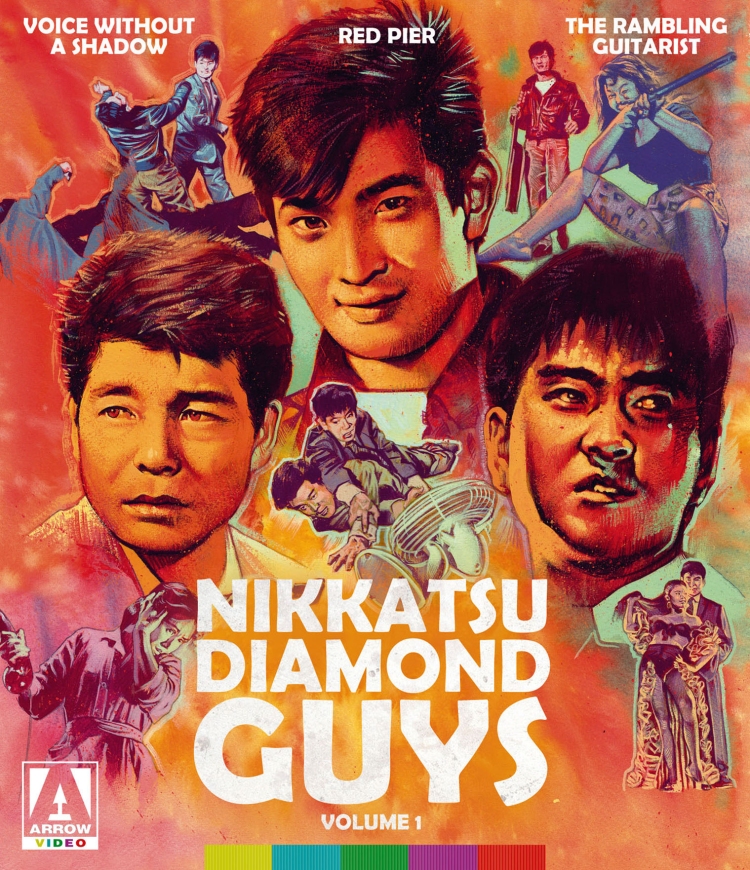
 Sometimes, just like an aimless drifter wandering into town, you feel as if you’ve come in during the second reel and missed some vital piece of information leaving you feeling a little at odds with the current situation. So it is with Buichi Saito’s The Rambling Guitarist (ギターを持った渡り鳥, Guitar wo Motta Wataridori) which is, apparently, the first film in a series though feels a little more like the second.
 Loosely inspired by Julian Duvivier’s 1937 gangster movie Pépé le Moko, Toshio Masuda’s Red Pier (赤い波止場, Akai Hatoba) was designed as a vehicle for Nikkatsu’s rising star of the time, Yujiro Ishihara – later to become the icon of the Sun Tribe generation. On paper it sounds like a fairly conventional plot – young turk of a gangster comes to town to off a guy, sees said guy killed in an “accident”, and shrugs it off as one of life’s little ironies only to accidentally become acquainted with and fall head over heals for the dead guy’s sister. So far, so film noir yet Masuda adds enough of his own characteristic touches to keep things interesting.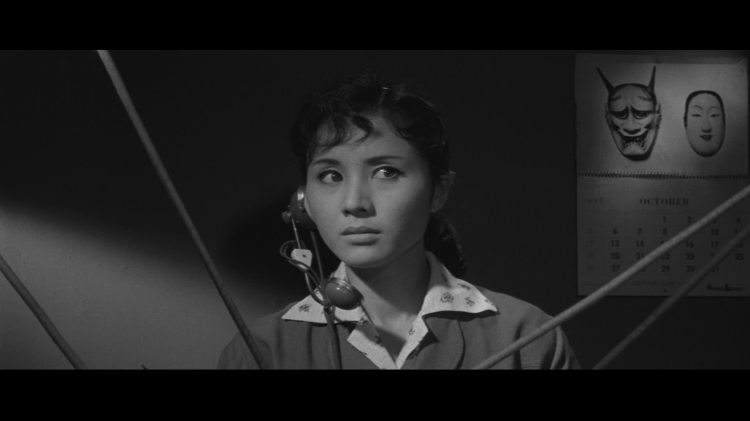
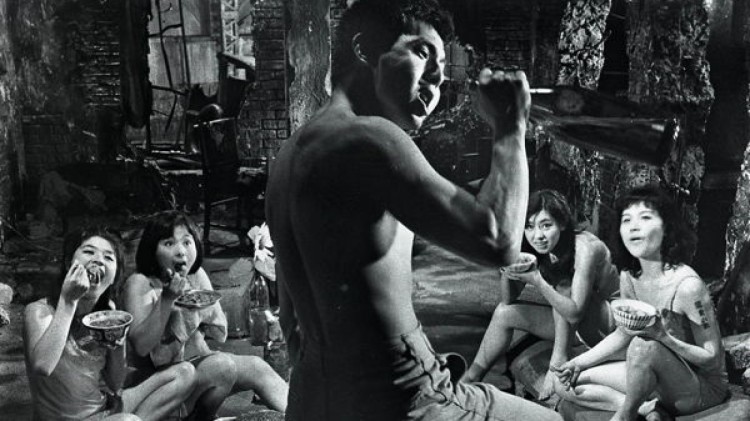 What are you supposed to do when you’ve lost a war? Your former enemies all around you, refusing to help no matter what they say and there are only black-marketers and gangsters where there used to be merchants and craftsmen. Everyone is looking out for themselves, everyone is in the gutter. How are you supposed to build anything out of this chaos? Perhaps you aren’t, but you have to go one living, somehow. The picture of the immediate post-war world which Suzuki paints in Gate of Flesh (肉体の門, Nikutai no Mon) is fairly hellish – crowded, smelly marketplaces thronging with desperate people. Based on a novel by Taijiro Tamura (who also provided the source material for Suzuki’s Story of a Prostitute), Gate of Flesh has its lens firmly pointed at the bottom of the heap and resolutely refuses to avert its gaze.
 When considering their next holiday destination, many people like to peruse some brochures, have a read of trip advisor or head to a well known tourist spot that is likely to impress the guests at their next soirée but then there are always others who just simply show up somewhere and hope for the best. The central character of Megane, Taeko (Satomi Kobayashi), perhaps wishes she’d done a little research before heading out to a very strange inn on a very strange island but the longer she stays, the more the ways of the laid-back islanders seem to make sense to her.
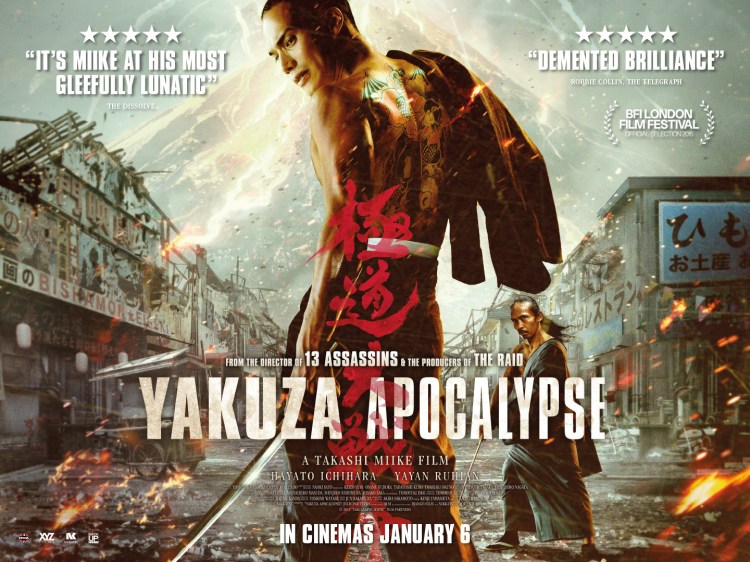 Belated review from the 2015 London Film Festival – Yakuza Apocalypse is released in UK cinemas for one day only on 6th January 2016 courtesy of Manga who will also be releasing on home video at a later date.
 Windows on Worlds