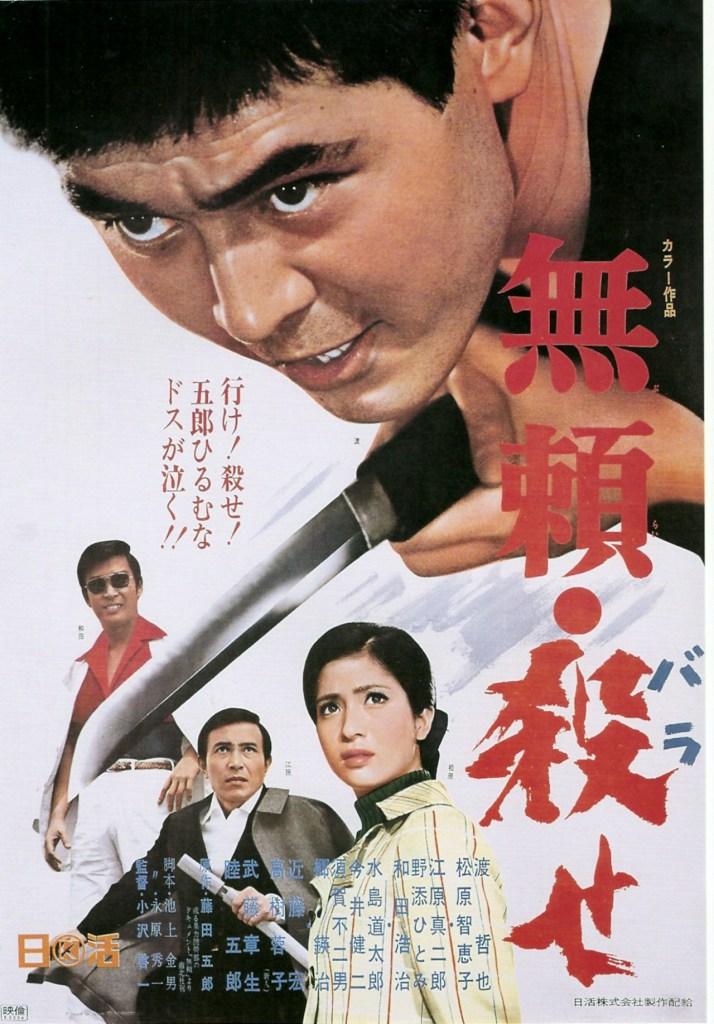
 Goro, Goro, Goro – will you never learn? Maybe he will because this is the last film in the series! Appropriately titled Outlaw: Kill! (無頼 殺せ, Burai Barase), this sixth and final film in the Outlaw series sees Goro once again moving to a new town and trying to lead a more honest life but unfortunately he’s wandered in at just the wrong time because a local gang boss has just been sent to prison after defeating a group of assassins leaving a dangerous vacuum and leading, therefore, to the outbreak of a turf war.
Goro’s first fight is with a gang of thugs who were hassling an elevator girl in a department store – the girl being Yumiko, played by Chieko Matsubara, becoming Goro’s love interest once again. Luckily or unluckily, Goro runs into an old friend from his prison days who is also one of the gang bosses involved in the turf war. After his friend promises him that he will incur no debt from him and he won’t get in the way of Goro finding a proper job, Goro agrees to move in with him and his wife – who only turns out to be the sister of elevator girl Yumiko which is not even the most predictable coincidence in this whole saga.
Despite his protestations about not getting involved in local gang politics, Goro’s attachment to his friend and his growing family means he can’t altogether avoid getting pulled back into the messy gangster world of violence and betrayal. Things end up going just about as well as they ever do and Goro is only able to clean up some of the chaos in this disputed area by creating even more counter chaos.
The format is becoming tired by the time we reach Outlaw: Kill! and it’s true that the film revisits exactly the same narrative beats as all of the other films, though it does so in a fairly exciting fashion. That said, there’s much less nuance here – we get that Goro sees himself as a lonely drifter who doesn’t deserve happiness, a self hating yakuza who is engaged on a long and hopeless walk to the grave. Perhaps it’s just because everyone’s getting older, but now it’s less about never having had a home or a proper place to belong than it is about the (im)possibility of building your own family. Goro’s friend, Moriyama, is married and going to be a father which Goro thinks is a nice thing, broadly, but also worries about what is means for a yakuza who may be killed at any second to have a wife and a child dependent upon him. Goro, being the noble sort of fellow he is, has decided that romance is irresponsible if you’ve already pledged your heart to the outlaw’s creed.
Once again directed by Keiichi Ozawa, Kill! sticks to the formula of his other offerings in the Outlaw series but opens with stylish series of colour filter stills rather than the action filled title sequences of the previous films. The fight scenes are exciting and actually quite bloody but perhaps not as innovative as some of those seen earlier in the series. In an interesting mix of old and new, Ozawa stages his final fight in a club but this time it’s a very contemporary night spot filled with guys and girls dressed in stylish, colourful outfits whilst a hippyish rock band play a cover of a famous pre-war ballad. Swooping around, notably shooting one sequence through a transparent floor/ceiling, Ozawa seems to be pushing forward more, breaking with the traditional ‘50s aesthetic for a new and crazy, youth counter-culture inspired moment which looks forward to the Stray Cat Rock series much more than back to the now ancient ninkyo eiga or sun tribe films.
Maybe Goro’s had his day too as Kill! ends in pretty much the same way as all but one of the previous films with Goro staggering away from the destruction he has wrought into a barren and snow filled landscape. Doomed to be a wanderer forevermore, Goro is a relic of the cruel post-war world which never gave him a break but his story’s now old hat. A man without a home is left forever alone, marching onward to the next confrontation or the final relief of a lonely grave.
Outlaw: Kill! is the six and final ( 😦 ) film included in Arrow Films’ Outlaw: Gangster VIP The Complete Collection box set (which is region free on DVD and blu-ray and available from both US and UK).
English subtitled original theatrical trailer:
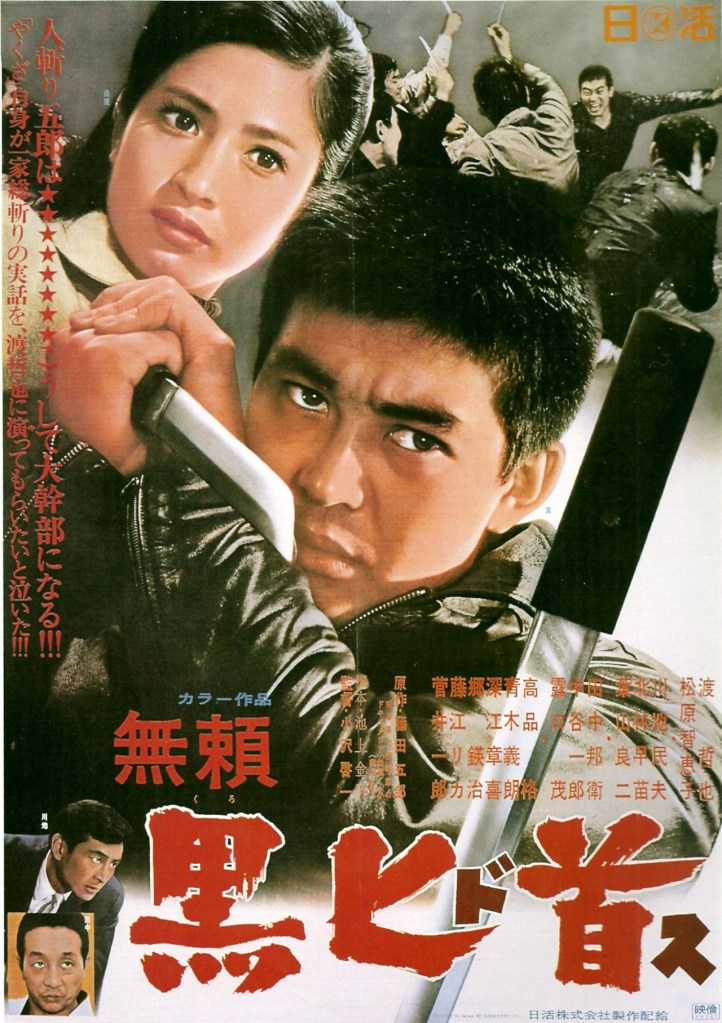 Goro (Tetsuya Watari) just can’t catch a break. He sends his one true love off on a train to safety only to see her dramatically return because she can’t bear to leave his side. Her devotion costs her her life as she places herself between Goro’s manly chest and an assassin’s knife. Heartbroken, Goro gets out of town only to run into another old flame who is now a mama-san and has apparently married another yakuza (despite the fact that Goro parted with her because of his chaotic yakuza lifestyle). As usual, the past won’t let him go – this time in a more literal sense as Goro encounters another woman who looks exactly like the girlfriend who died in his arms….
 So, once again Goro Goes Straight is sadly not the title of this fourth film in the tale of the noble hearted gangster “Goro the Assassin” (無頼 人斬り五郎, Burai Hitokiri Goro). After getting his friend out of a jam, the pair end up in prison. Goro is released three years later but his friend, Masa, is poor health and eventually dies a prisoner’s death with no one to collect his body meaning he’ll be buried in a lonely prison grave alongside the rest of society’s unwanted rubbish. On their final meeting, Masa asks Goro to find his sister for him and tell her that he’s doing alright. This message now well out of date, Goro decides to try finding Masa’s sister anyway if only to find out why she never came to see him even as he lay dying.
 So, as it turns out the end of
  By 1968 the fate of the gangster movie was somewhat in flux as the old ninkyo style was on its way out yet the jitsuroku approach, later to find its zenith in the
  Sogo (now Gakyruu) Ishii was only 20 years old when Nikkatsu commissioned him to turn his smash hit 8mm short into a full scale studio picture. Perhaps that’s why they partnered him with one of their steadiest hands in Yukihiro Sawada as a co-director though the youthful punk attitude that would become Ishii’s signature is very much in evidence here despite the otherwise mainstream studio production. That said, Nikkatsu in this period was a far less sophisticated operation than it had been a decade before and, surprisingly, Panic High School (高校大パニック, Koukou Dai Panic) neatly avoids the kind of exploitative schlock that its title might suggest.
 “Being good”. What does that mean? Is it as simple as “not being bad” (whatever that means) or perhaps it’s just abiding by the moral conventions of your society though those may be, no – are, questionable ideas in themselves. Mipo O follows up her hard hitting modern romance The Light Shines Only There by attempting to answer this question through looking at the stories of three ordinary people whose lives are touched by human cruelty.
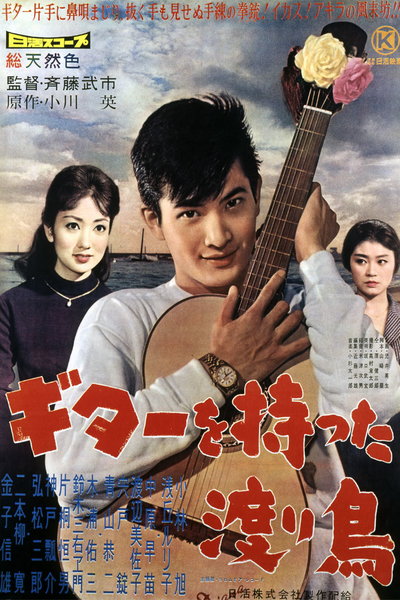 Sometimes, just like an aimless drifter wandering into town, you feel as if you’ve come in during the second reel and missed some vital piece of information leaving you feeling a little at odds with the current situation. So it is with Buichi Saito’s The Rambling Guitarist (ギターを持った渡り鳥, Guitar wo Motta Wataridori) which is, apparently, the first film in a series though feels a little more like the second.
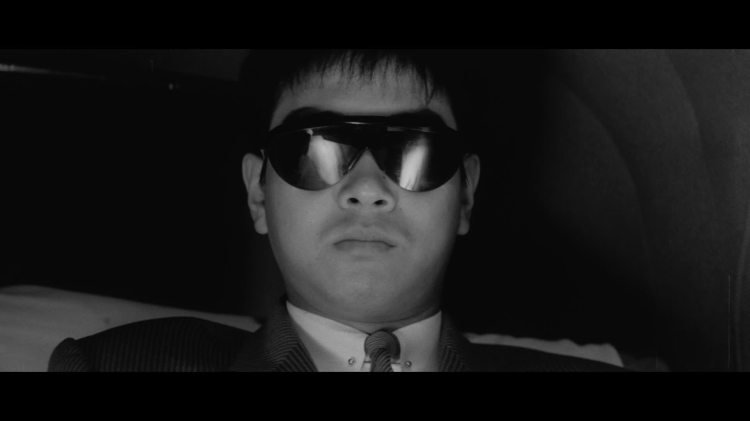 Loosely inspired by Julian Duvivier’s 1937 gangster movie Pépé le Moko, Toshio Masuda’s Red Pier (赤い波止場, Akai Hatoba) was designed as a vehicle for Nikkatsu’s rising star of the time, Yujiro Ishihara – later to become the icon of the Sun Tribe generation. On paper it sounds like a fairly conventional plot – young turk of a gangster comes to town to off a guy, sees said guy killed in an “accident”, and shrugs it off as one of life’s little ironies only to accidentally become acquainted with and fall head over heals for the dead guy’s sister. So far, so film noir yet Masuda adds enough of his own characteristic touches to keep things interesting.
