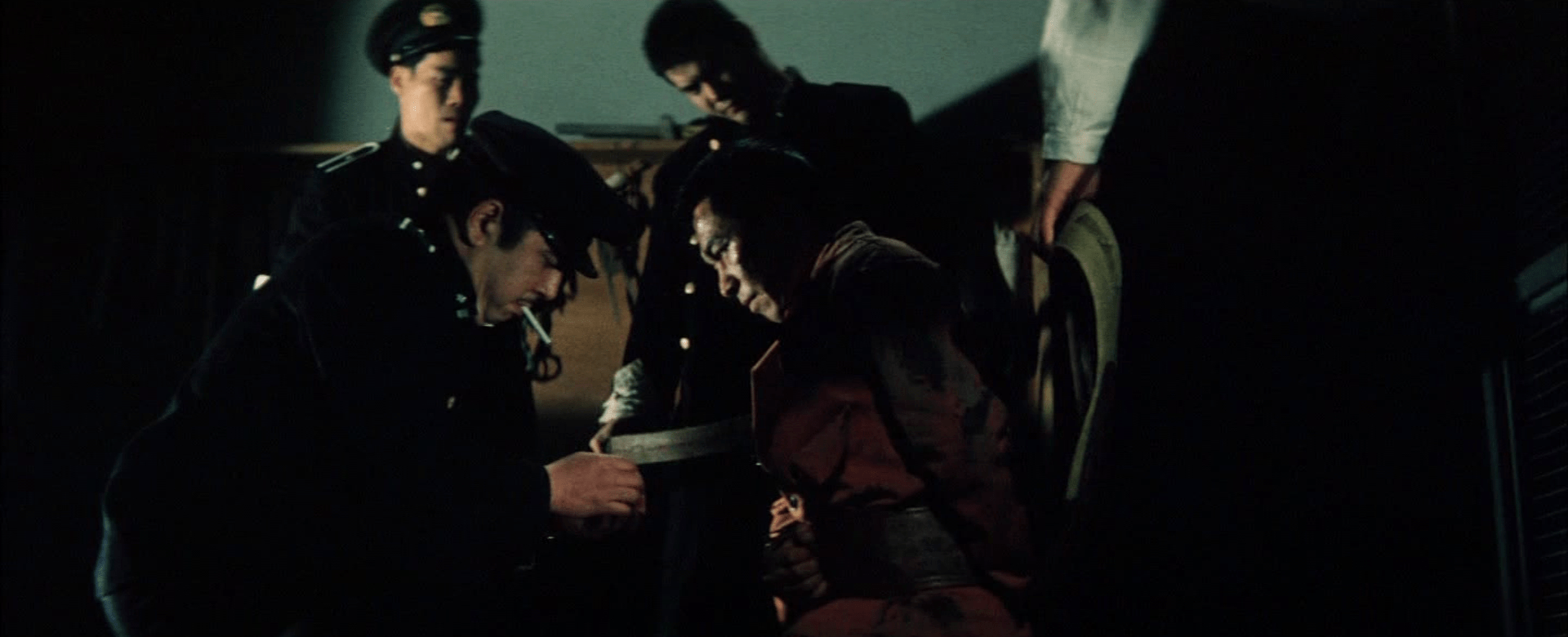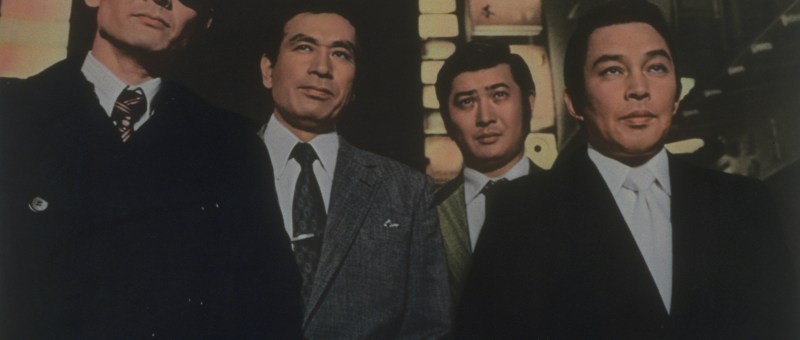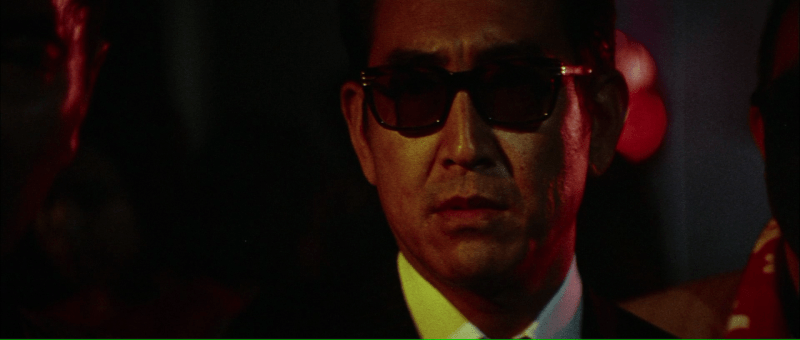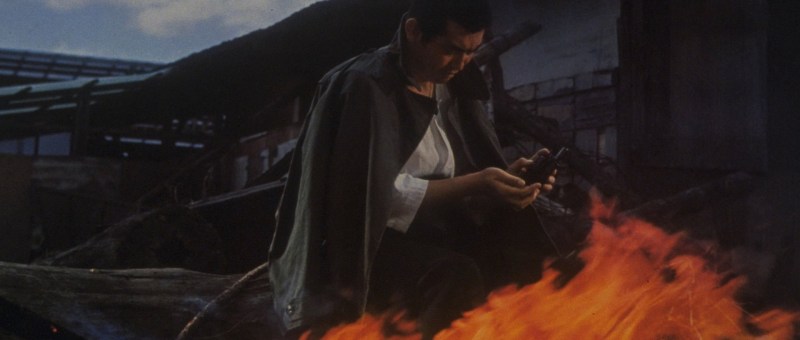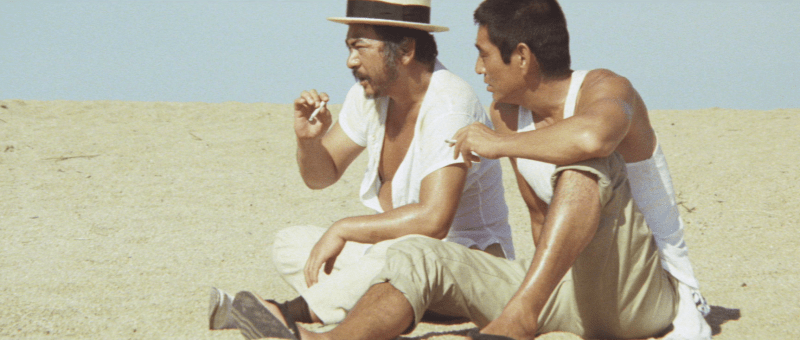
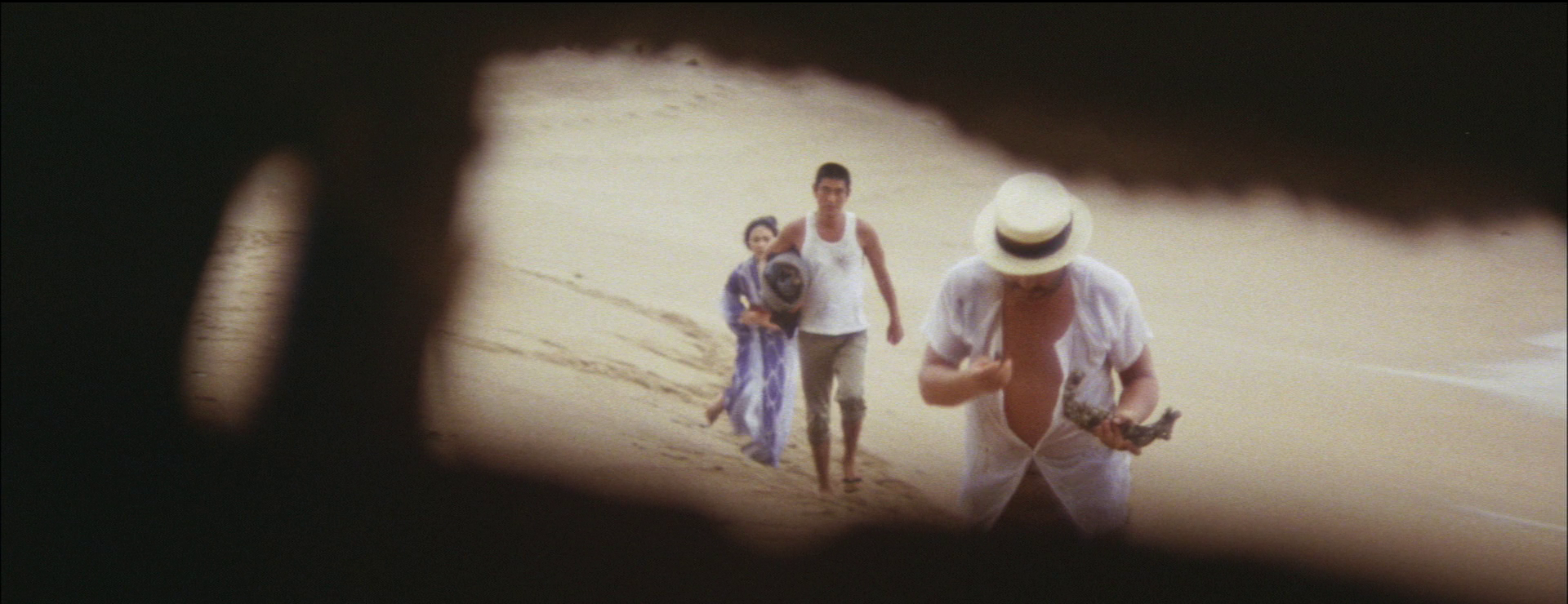
The Homeless (無宿 やどなし, Koichi Saito, 1974)

Two men are released from prison on the same day. One, dressed in a 1920s-style white suit and straw hat, tries to befriend the other, in black kimono and geta, but he ignores him. Soon, they arrive at a fork in the road. The man in the kimono walks down a well worn grass path cut between the fields while the man in white, looking back and a little disappointed, continues along the modern roadway making his way towards civilisation.

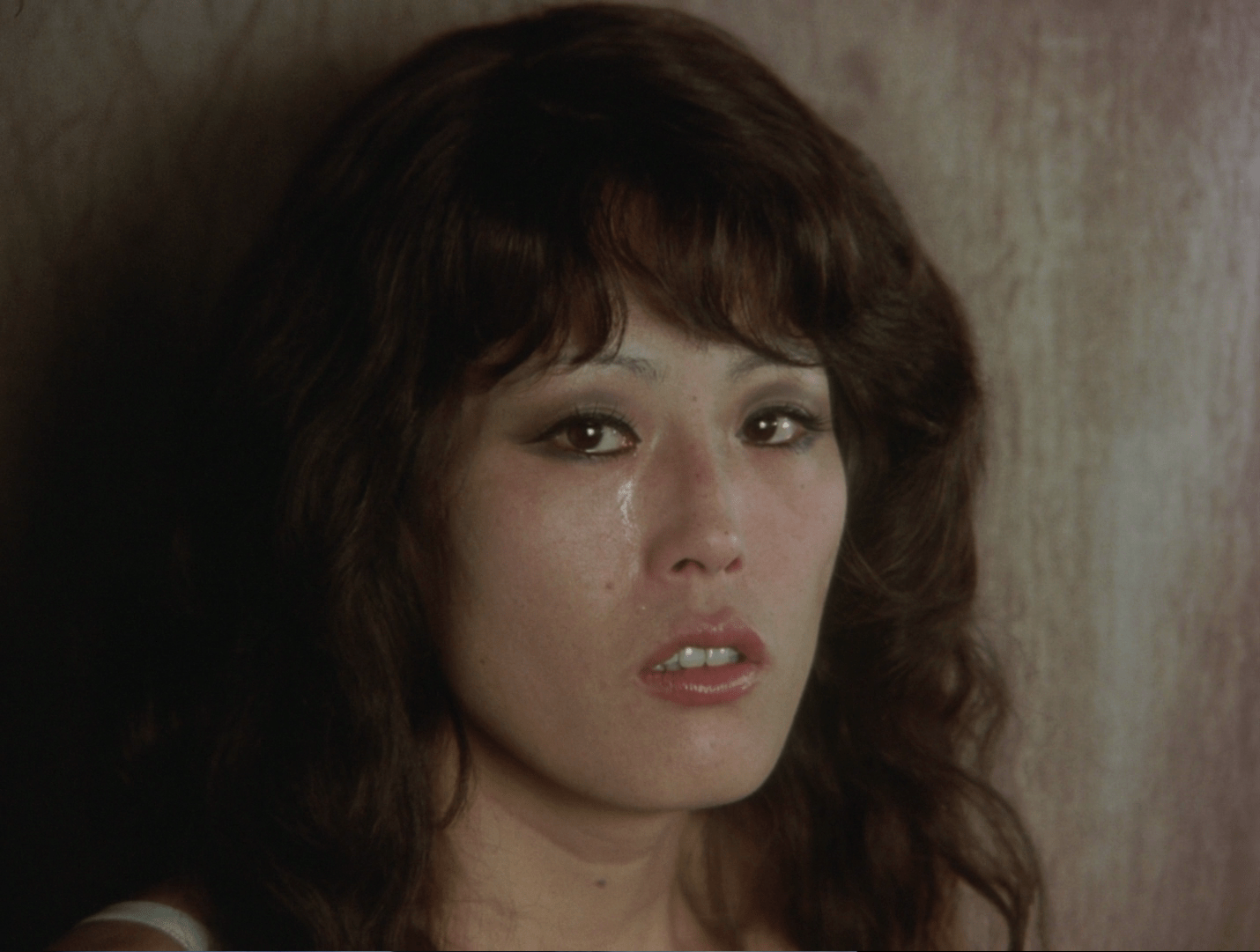
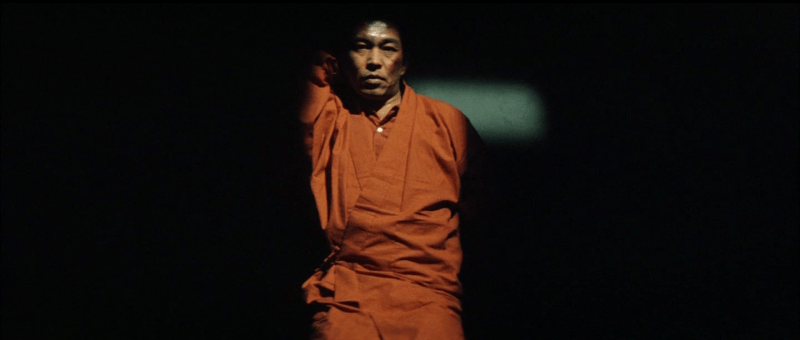
In some ways, the heroes of Koichi Saito’s The Homeless (無宿 やどなし, Yadonashi) are embodiments of past and future. Jokichi (Ken Takakura), the kimonoed man in black, chooses the path of vengeance. On his release from prison, he learns that his gang leader older brother has been killed while his sister was sold to a brothel. He goes there to find her, but is told that she is already dead. The madam says she died of a chronic illness and that she did for her what she could but treating such a cruel disease is only throwing good money after bad. Sakie (Meiko Kaji), a sex worker who appears to have a childlike quality and possibly impaired mental state, tells a different story claiming the madam had Jokichi’s sister killed for reasons she doesn’t explain but may have more to do with the drama going on with Jokichi’s gang than a desire to cut costs and her losses. 

Gen (Shintaro Katsu), meanwhile, seemingly chooses the path of prosperity. He returns to his wife, Ume (Murasaki Fujima), who is a member of a moribund theatrical troupe, and asks her to return to him what he believes is a treasure map marking the location where his father saw a ship sink during the Russo-Japanese war that may be filled with gold. On finding out Jokichi used to be a diver, Gen becomes determined to bring him onto his mission but Jokichi is set on revenge firstly on a man called Senzo (Noboru Ando) he thinks killed his sister and then on whoever ordered the hit on his brother. This bad news for Gen who realises that if he achieves his vengeance, Jokichi won’t be available to help retrieve the gold because he’ll be in prison so he starts by warning Senzo that his past’s about to catch up with him. 

But it’s also Gen that helps Jokichi escape from the rival gang by suggesting he help rescue Sakie from her indentured servitude as sex worker. Childlike and ethereal, Sakie claims not to remember where she was from and has a simple desire to see the sea which represents to her a kind of freedom while for each of the men it may in fact form a kind of border they will eventually be backed up against and unable to escape. Though Sakie develops a fondness for Jokichi, and then begins to love Gen after he ends up taking care of her along the road, the three form a relationship that seems more fraternal or perhaps even forged on the homoerotic tension between the two men who light their cigarettes one from the other and finally find a home on an idyllic beach where they devote themselves to the search for buried treasure.

Sakie may say that the real treasure is her new life of freedom and warmth, but the hint of riches the two men find is itself rooted in warfare and imperialism which are the same forces by which they were each displaced amid the rising militarism of the 1930s. The three of them remain homeless in this environment, unable to fit into the changing society and by degrees exiled from it. An early title of the film was apparently Jingi no Okite (仁義の掟) which means “the law of honour and humanity” and that is in a way what Jokichi is bound by in his desire for vengeance, while Gen is clearly an anarchistic force unable to submit himself to authority and lusting after a more prosperous modernity. Sakie meanwhile is powerless as a woman with few rights, sold into sex work and technically a fugitive from the gang-backed brothel that owned her contract.

As beautiful as the beach is, we have the feeling that in some senses the three of them are already dead and living in their temporary paradise. Indeed, the past eventually catches up with them as if these three homeless fugitives cannot be allowed to survive in resistance to an authoritarian culture. Their existence is elegised by the beautifully composed cinematography along with the childlike rapport between the two men and the sense of domesticity which arises between the trio before reality bites and even their beachside idyll is invaded by the forces of darkness.


Original trailer (no subtitles)
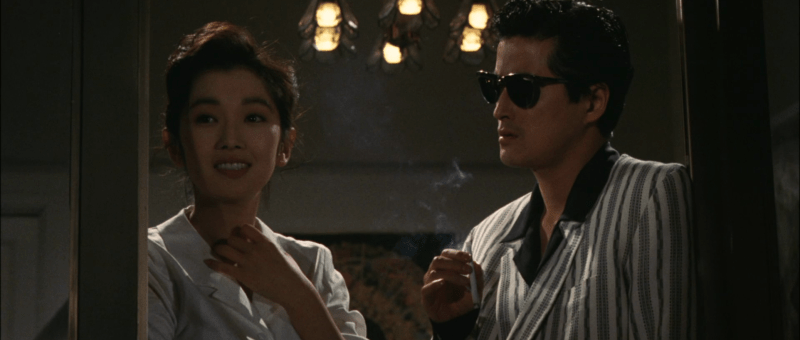
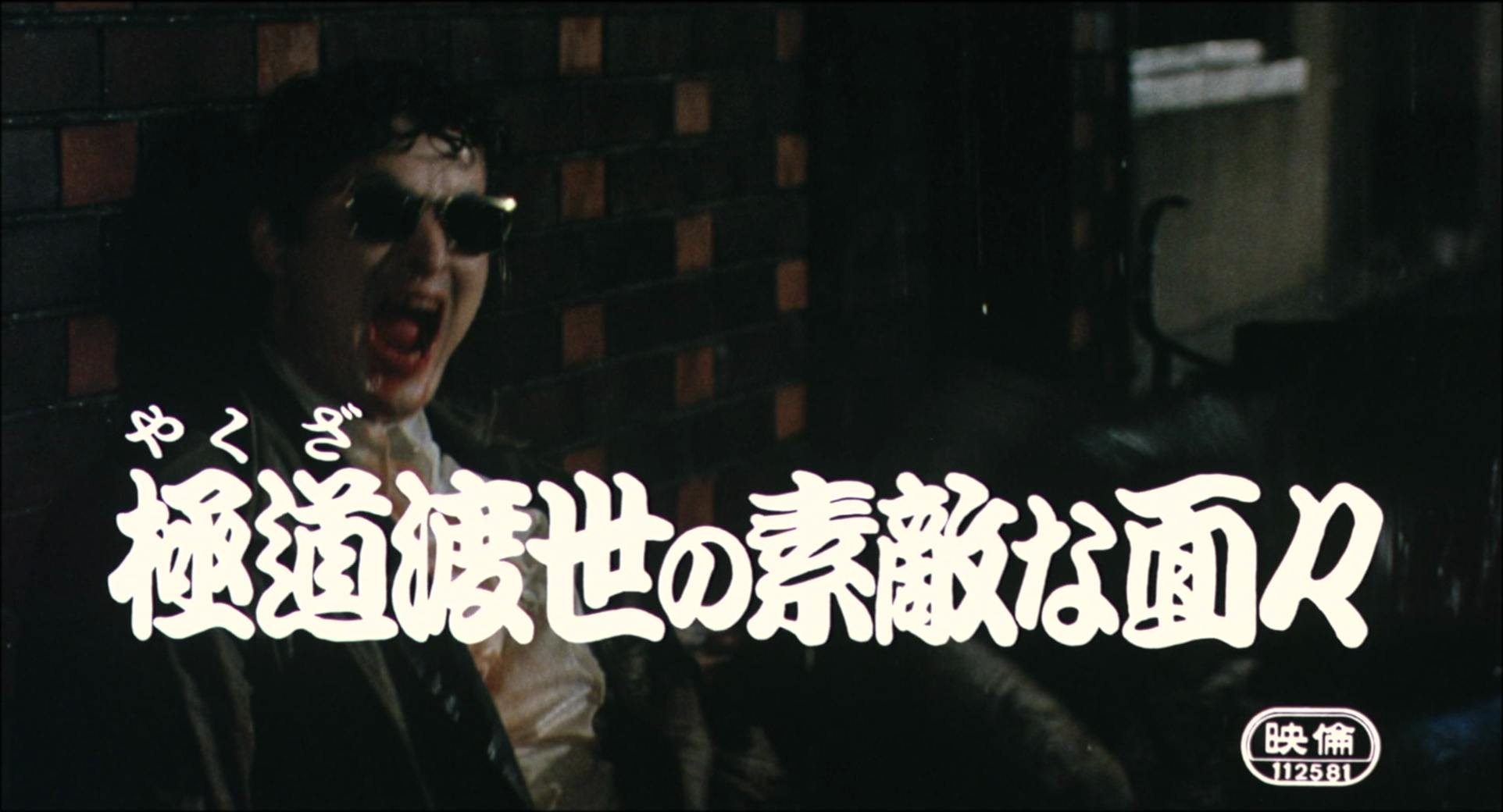
Those Swell Yakuza (極道渡世の素敵な面々, Seiji Izumi, 1988)

The yakuza movies of the post-war era had largely depicted the gangster world as being one of internecine desperation and even if the hero was a pure-hearted defender of a traditional honour code those around him were anything but honourable. By the late 1980s, however, the yakuza were increasingly seen as an outdated institution amid the high rise office blocks of a prosperous Bubble-era Japan in which the street thug had given way to more corporatised kinds of organised crime. 

This might help to explain the ironic title of Seiji Izumi’s 1988 comedy Those Swell Yakuza (極道渡世の素敵な面々, Yakuza Tosei no Sutekina Menmen) which simultaneously presents a nostalgic view of gangster cool and a way of life which is more rooted in the everyday existence of a contemporary petty outlaw. The hero, 24-year-old Ryo (Takanori Jinnai), is a former banker who evidently rejected the heavily corporatised nature of the Bubble-era society and left his stable job to open a record store which subsequently went bankrupt leaving him with huge debts to yakuza loansharks. It’s these debts he’s trying to escape by wandering into a mahjong parlour and getting carried away with his early success despite the advice of steady hand Nakagawa (Takeshi Kusaka) who eventually covers his losses when it turns out that Ryo started playing without any stake money. A ageing yakuza, Nakagawa takes him outside to teach him a lesson explaining that the parlour is run by Taiwanese gangsters and he’s lucky to be leaving with his life. Nevertheless, Nakagawa is impressed by his hutzpah and leaves his business card in case Ryo has the desire to get in touch. 

Ryo’s decision to become a yakuza reflects both a sense of emptiness in the Bubble-era society and a nostalgic longing for post-war gangsterism and the theoretical “freedom” is represents to a man like Ryo though of course there’s not so much autonomy to be had in the life of a petty footsoldier who is always beholden to the whims of his boss. Nakagawa becomes to him a kind of father figure, though he’s also someone who has largely lost out in having achieved little in the realms of gangsterdom while his friend and contemporary Kanzaki (Hideo Murota) has successfully climbed the ladder to become a high ranking officer. Kanzaki takes him to task for visiting the mahjong parlour in part because the Taiwanese gang has gained a reputation for dealing with drugs of which their organisation does not approve and it would present a problem if his connections to them were to come out during any potential anti-drug action by the police. By the film’s conclusion, Nakagawa has become something of a tragic figure more or less excluded from the yakuza world while his body is ravaged by alcoholism and his finances by gambling addiction. 

Ryo, meanwhile, seems to live the yakuza dream. He gets stabbed while defending a bar hostess from a yakuza from a different gang and then meets the love of his life, Keiko (Yumi Aso), who similarly rejects the constraints of the contemporary society by refusing the marriage arranged by her father for his own benefit to spend three years waiting for Ryo who goes to prison after shooting Kanzaki in the arm to avenge a slight against Nakagawa who also cuts off his finger to fulfil the codes of yakuza honour. Wandering around in sunshades and flashy suits, Ryo soon attracts a fiercely loyal band of followers of his own and despite the tragedy of losing one of his men to an assassin proves adept in navigating the yakuza world to present an idealised image of masculine cool perfectly tailored to the Bubble era.

Despite the shooting that landed him in prison and the mission of revenge he leaves his own wedding (after the ceremony) to complete in the film’s conclusion, Ryo’s yakuza existence is otherwise fairly non-violent and based in a kind of trickery that makes him seem clever rather than exploitative given that as Nakagawa had suggested the way forward for the modern yakuza is scams not drugs. As one of his prison buddies puts it, there are old school gangsters like Ryo ready to die for the clan, and then there are those like himself intent on filling their boots. Largely, most of these guys are old school yakuza who do obey the code and have some kind of scruples about how they make their money which adds to their aspirational allure as Ryo seems to lead a fairly charmed life of idealised masculinity with a pretty wife and fancy apartment seemingly free of the petty oppressions faced by workaday salarymen. Izumi makes frequent reference to classic Toei gangster pictures from a decade previously with appearance from from genre stalwarts such as Hideo Murota, Nobuo Ando, and Mikio Narita, but lends the action a contemporary spin in the ironic sense of cool even if the implications of ambiguous ending may be far less upbeat.


The Sea of Genkai (任侠外伝 玄海灘, Juro Kara, 1976)

Juro Kara was an avant-garde playwright and theatre practitioner whose work was a part of the Little Theatre Movement which rejected conventional naturalism and prioritised the physicality of the actor over text and dialogue. Though he performed as an actor in films by other avant-garde filmmakers such as Shuji Terayama and Nagisa Oshima, he directed only one film. By these standards, the The Sea of Genkai (任侠外伝 玄海灘, Ninkyo Gaiden: Genkai Nada), a co-production with the Art Theatre Guild, may seem surprisingly conventional, but is also highly unusual not only in ATG’s filmography but also in its subversions of the yakuza film. 

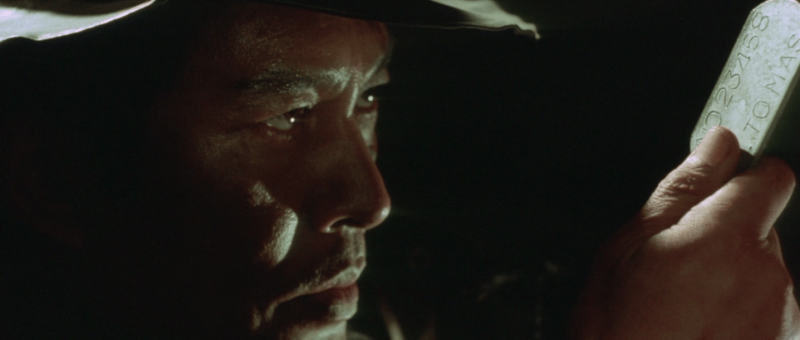
The Japanese title is prefaced by “ninkyo gaiden” which makes it sound like a spin-off to a ninkyo eiga or chivalrous gangster movie, which turns out to be incredibly ironic because there is no chivalry or honour here only cruelty and exploitation. Set in the port of Shimonoseki where boats leave for Korea, the film follows dejected petty yakuza Kondo (Noboru Ando) as fate finally catches up with him. He and his boss Sawaki (Jo Shishido) were once students together and took a job in Busan dealing with the corpses of American soldiers killed in the Korean War. Sent to deliver dog tags to widows, Sawaki spits in a distraught woman’s face and then attempts to rape her, only there is another couple in her home and the man soon wakes to challenge him. Kondo and Sawaki are then drawn into a brutal and ugly fight during which Kondo knocks out the man while Sawaki rapes the widow. The other woman then threatens them with a knife, taking back the dog tag only for Sawaki to pounce and strangle her. Sawaki then flees the scene confused by what he’s done, but Kondo stays behind and rapes the second woman’s corpse before leaving her for dead. 

Kondo later relates that he’s been unable to sleep with women ever since his experience of necrophilia in Korea in 1951. Kura often cuts back to the bundle of dog tags Kondo has been keeping all this time which hang by his window like a wind chime. He watches them sway and hears them jingle with the violent motion of Sawaki’s raping the woman, hanging that of, presumably, a random man around the second woman’s neck as he in turn rapes her body. He later finds a woman who reminds him of the one he raped while dead among a cohort of those he’s in the process of sex trafficking who has unwittingly put on one of the dog tags like an ironic necklace while taking a bath in his apartment on the invitation of his more sensitive associate Taguchi (Jinpachi Nezu). On catching sight of Kojun (Reisen Ri), he’s struck by a literal flashback that is a clear homage to Henri-Georges Clouzot’s Les Diaboliques as he watches a “dead” woman rise from a bath. Later he rapes her too, presumably the first (though not the last) “living” woman he’s had sexual contact with in 25 years. 

The dog tags take on a still more ironic relevance in the Korean song which plays over the opening titles and is sung frequently by the trafficked women. The song is sweet and innocent, narrated by a woman who is preparing a “flower garland” for someone that she loves, but its imagery is subverted in Kondo’s grim necklace of dog tags taken from fallen men. Even Sawaki describes him as someone who has been dead for 20 years while preparing to sacrifice him to curry favour with their creepy Tokyo boss Tahara (Taka Ohkubo) who permanently wears black gloves on both hands even while shirtless, while Kondo later sings a song characterising himself as a “black dog” who never stood a chance in this broken world of ruined dreams. Penned by Kura himself and performed by Ando, this song more clearly reflects his absurdist dialogue style in its deeply melancholy imagery as Kondo fully succumbs to his image of death. 

Kondo’s actions come to emblematise the continued violence inflicted on the bodies of Korean women by Japanese men from the colonial era onwards. The woman from the bath, Kojun, suffers continually throughout the film and is later forced to perform in strip shows by the Sawaki gang. She is clever, and fierce, but the world is all against her and the only answers that she ever gets as to why her “uncle” forced her to stowaway on a smuggling boat to Japan only further deepen the wounds inflicted by a deeply corrupted, imperialistic patriarchy. Kojun develops a fondess for Taguchi because he is the only man who doesn’t try to rape her and in fact saves her from being raped though later said to be impotent and rejected by the other gang members for his refusal to participate in their despoiling of the Korean women. Bloodstained underwear becomes a symbol of sexualised violence countered only by the plain white pairs Kojun later buys for Taguchi after replacing her own ruined clothing.  

She and Taguchi attempt to protect themselves by bringing the receipts, threatening to release the smuggling account books and expose a host of dodgy dealings if the Sawaki gang come for them, but in the end there is no escape. Taguchi finds himself wading through oil-soaked waters with his dreams in ruins before finally breaking the chain though it’s unclear if it will really free him. Bleak beyond measure in its deeply tragic denouement, Kara’s intense drama offers no respite from its nihilistic world of violence and exploitation and leaves us quite literally floundering in a dark sea of inevitable corruption. 


Trailer (no subtitles)

꽃목걸이 – 이영숙 (1972)

(꽃목걸이 = “flower necklace”. There doesn’t seem to be an official romanisation of singer 이영숙 (李英淑)’s name, but it does appear in a few places as “‘Iyeongsuk”, or “Lee Young Sook”. A contemporary romanisation would render it as “Lee Yeong-suk”)

Father of the Kamikaze (ゝ決戦航空隊, Kosaku Yamashita, 1974)

By the mid-1970s, Japanese cinema at least had become much more comfortable with critiquing the wartime past, considering it from a greater distance than the often raw depictions of war in the films from the previous two decades. 1974’s Father of the Kamikaze (ゝ決戦航空隊, A Kessen Kokutai), however, is among the few to skew towards the nationalist rather than the ambivalence or simple anti-war messages of other similarly themed films of its era. 

Starring ninkyo icon Koji Tsuruta who served in the air force himself, the film is a kind of biopic dedicated to Admiral Onishi who oversaw the kamikaze operations at the end of the war. As is pointed out, Onishi had been against the war in general terms even before its inception and is originally against the philosophy behind the kamikaze squadrons but as Japan’s fortunes continue to decline he becomes its biggest advocate citing a kind of sunk cost fallacy that it would be in someway unfair to the men that have already died to surrender while insisting that suicide missions are the only feasible way to turn the tide because one kamikaze could take out a hundred men by destroying battleships singlehandedly. 

The film in part attributes this extreme solution to the prevailing with your shield or on it philosophy of the contemporary society which placed extreme shame on the act of being taken prisoner. In the prologue that opens the film, a squadron of downed pilots whose heroic deaths have already been recorded is discovered alive in an American prisoner of war camp but as being a prisoner of war is so shameful and would reflect badly on the military, the decision is taken to fix the books by sending the men on a mission from which they are not intended to return. Onishi is opposed to the plan, he asks why they can’t find a way for the men to live, but the decision is already made. In any case, he describes the action of a suicide mission as a “beautiful ideal” even when insisting that a war cannot be fought in that way not least for purely practical reasons in that they do not have the resources to be wilfully sacrificing skilled pilots and their planes. 

Having come round to the idea, however, Onishi is a crazed zealot who cannot accept the idea of surrender and even goes so far as to barge into a cabinet meeting to urge ministers against a truce even though the war is clearly lost. To his mind, the only way to honour the sacrifices of those who’ve died is to fight to the last man. Kozono (Bunta Sugawara), another officer opposed to the kamikaze, eventually meets a similar fate in refusing to obey the order to lay down his arms and ending up in a psychiatric hospital. His objection had partly been that it’s wrong to turn men into ammunition, but also that the kamikaze project is itself defeatist and self-defeating when there are men such as himself who are committed to fighting on.  

In this the film leans into the image of militarism as a death cult in which dying for the emperor is the only noble goal of the whole imperial expansion. In its eventual lionising of Onishi’s image, his bloody suicide atop a white cloth resembling the flag of Japan while his parting words scroll across the screen in text, it does not shy away from his more problematic aspects in which he fails to object to a request from a junior officer that soldiers should be allowed to test their swords on American prisoners of war, roundly telling a subordinate who breaks protocol to insist that such a thing is not only morally wrong but will ruin their international reputation that he has no need to think of consequences because Japan will win this war. He claims to want to find a way of defeat that will satisfy the living and the dead, but in reality cannot accept it not least in that it would entail admitting that he sent 2600 young men to their deaths for nothing. 

Tsuruta brings the same level of pathos to his performance as he did in playing conflicted yakuza stoically committed to a destructive code, but there’s no getting away from the fact that the film focuses mainly on Onishi’s personal suffering as a man who sent other men to die for a mistaken ideal and then could not admit his mistake offering an apology only in his death in which he urged the young people of Japan to work to rebuild the nation in the name of peace. In switching to the present day and showing us Onishi’s dilapidated former residence and in fact the room in which he died with its tattered shoji and peeling paintwork, he veers towards the nationalistic in uncomfortably reinforcing the nobility of his death rather than the folly of war or absurdist tragedy of the kamikaze programme. Adopting a quasi-jitsuroku approach with frequent use of onscreen text, a narratorial voiceover, and stock footage of kamikaze in action Yamashita may portray war as madness in Onishi’s crazed devotion but cannot help depicting it as a “beautiful ideal” even in the undignified violence of Onishi’s ritual suicide. 


Eighteen Years in Prison (懲役十八年, Tai Kato, 1967)

Genre star Noburu Ando had a certain cachet in that he had been a yakuza prior to becoming an actor. He had in fact been the head of his own gang which at its high point had over 300 members and controlled much of the lucrative Shibuya nightlife scene. His first onscreen appearance was in a gangster movie in which he played himself. Rather than the jitsuroku epics he would later become associated with, Tai Kato’s Eighteen Years in Prison (懲役十八年, Choueki Juhachi Nen) essentially casts him in a ninkyo role as a noble if compromised former captain of the kamikaze squad who finds himself caught between the contradictions of post-war Japan and the American occupation. 

Indeed, in this as in many other yakuza movies set during the immediate post-war era, the Americans are really just the biggest gang. Suffering with survivor’s guilt, Captain Kawada (Noboru Ando) has set up an association together with former comrade Tsukada (Asao Koike) to look after he dependent relatives of men who fell in war. To do this, he has to resort to criminality raiding American boats for supplies such as sugar and rice which he redistributes to war widows and their families. His ultimate goal is amassing enough money to buy a patch of land in the town centre and do away with the black market which exploits the vulnerable replacing it with a legitimate market so the surviving family members can set up businesses to support themselves. 

Around this time, the association manages to track down the younger sister of one of their men who died as a kamikaze, Hisako (Hiroko Sakuramachi ), and discovers she is living in desperation having lost the family home to aerial bombing. As her mother is seriously ill and she needs money for food and medical treatment, Hisako contemplates turning to sex work and is almost assaulted by a gang of drunk and abusive American servicemen from whom she is rescued by a passing Kawada. This incident makes plain his resentment towards the occupation and sense that it is the American influence that is wilfully suppressing the efforts of the Japanese people to rebuild their society. It’s this resentment that lends a note of justification to Kawada’s decision to rob a nearby factory of valuable copper wire to get the money to save Hisako’s mother thereby saving her from falling into sex work and thereafter helping to achieve their ultimate goal of building the market. The raid, however, goes wrong. Kawada sends an injured Tsukada back to the association and is arrested.

In prison he discovers only more corrupt authority in which guards beat and torture prisoners, just another bigger gang. He finds out that block warden Hanya (Tomisaburo Wakayama) is actively accepting bribes and in cahoots with some of the inmates that attempt to terrorise newbies to the point that one attempts suicide by swallowing glass though Hanya refuses to call for help forcing Kawada and some of the other men to pull the alarm themselves. The sources of moral authority lie in the new college-educated deputy warden recently returned from five years as a POW in Manila, and a veteran yakuza with a grudge against Hanya who apparently had his girlfriend raped leading to her suicide. 

Though the film is titled eighteen years in prison, Kawada becomes eligible for parole in 1952 which is of course the year the occupation ends. By this point he discovers that Tsukada has abandoned their idealistic mission and turned full yakuza, building an immense red-light district on the land they bought for the market and making himself rich through the violent trafficking and exploitation of women. Eventually confronted, he tries to convince Kawada that the world has changed, that the post-war years of privation are over and that he sees only “the ghost of a nation that lost the war” rather than burgeoning new economy stimulated by the Korean War and an ironically a repositioned America now no longer occupiers but still somehow influential if leaving a vacuum a man like Tsukada may step into. It’s no coincidence that he threatens Hisako with deportation to a brothel in Okinawa he’s set up to service American servicemen in a place where the conditions of occupation are still largely in place. 

Tsukada clearly feels that he need have no more responsibility for his wartime conduct, roundly telling Kawada that the families of the fallen are not his responsibility and should “stop leeching off other people and start working for a living”. Hisako’s long lost younger brother Kenichi (Masaomi Kondo) who ended up alone on the streets after being conscripted as a student factory worker and returning to find his home in ashes, turns the blame back on the authorities reminding them that it’s their fault, they started the war the cost him his home and family and turned him into the half-crazed man of violence who immediately introduces himself as “King” on moving up from a juvie prison. Much of Kawada’s prison life is then given over to saving Kenichi, a representative of the next generation, from becoming mired in a life of nihilistic crime. 

In many ways, he remains a squad leader trying to atone for having sent so many young men to die by accepting the responsibility for their families while trying to protect those left behind from the vagaries of the post-war era including the amoral capitalism represented by the infinitely corrupt Tsukada. Dressed in a military uniform ironically pinched from an American soldier he goes on the rampage knowing that he has to deal with Tsukada himself in order to defend the post-war future from those like him who’ve apparently learned nothing much at all even from such recent history. Shooting from his characteristically low angles, Kato explores the seedy underbelly of the beginnings of the economic miracle while his noble hero does his best to offer a course correction to those who have already forgotten their responsibility not just to others but to those they left behind.


Japan Organized Crime Boss (日本暴力団 組長, Kinji Fukasaku, 1969)

A yakuza just out of jail emerges into a very different Japan in Kinji Fukasaku’s proto-jitsuroku gangster picture, Japan Organized Crime Boss (日本暴力団 組長, Nihon Boryoku-dan: Kumicho). A contemporary Oda Nobunaga is trying to unify the nation under his yakuza banner while fostering a nationalist agenda and colluding with corrupt politicians to prop up the 1970 renewal of the Anpo security treaty, but as it turns out some people aren’t very interested in revolutions of any kind save the opportunity to live a quiet life they once feared would elude them. 

As the film opens, a narratorial voice explains that the nation has now escaped from post-war chaos, but Japan’s increasing prosperity has led to a natural decline of the yakuza which has seen some try to ride the rising tides to find new ways to prosper. Exploiting its control of local harbours, the Danno group has quickly expanded though Osaka and on to the rest of the nation thanks largely to its strategist, Tsubaki (Ryohei Uchida), and his policy of convincing local outfits to ally with them and fight as proxies allowing Danno to escape all responsibility for public street violence. 

Perhaps strangely, the Danno group and others are acutely worried about optics and keen to present themselves as legitimate businessmen while using a prominent politician as a go-between to settle disputes between gangs. The yakuza already know they’re generally unpopular and fear that attracting too much attention will only bring them problems from the authorities. The politician needs Danno to look clean so that they can back them in opposing the protests against the Anpo treaty, while the yakuza organisation is later depicted as a militarised wing of the far right hoping to correct “misguided” post-war democracy while eradicating communism and instilling a sense of patriotic pride as they go. Of course, all of that will also likely be good for business while quite clearly marking these new conspiracy-minded yakuza as “bad”, hypocritical harbingers of a dangerous authoritarianism. 

Tsukamoto (Koji Tsuruta), the recently released lieutenant of the Hamanaka gang, is conversely the representative of the “good” yakuza who still care about the code and are genuinely standing up for the little guy against the oppressive forces now represented by bad yakuza. Hamanaka had allied with Danno while Tsukamoto was inside and was thereafter targeted by the local Sakurada group who have joined the Tokyo Alliance of yakuza clans opposed to Danno who continue to fight them by proxy. After his boss is killed and tells him that joining Danno was a mistake, Tsukamoto’s first thought is to rebuild the clan which he does by remaining neutral, refusing to engage in Danno’s proxy wars while protecting his men from their violence as mediated by the completely unhinged, drug-addled Miyahara (Tomisaburo Wakayama) and the anarchic Hokuryu gang. 

Miyahara comes round to Tsukamoto precisely because of his pacifist philosophy after he kidnaps one of his men and Tsukamoto stands up to him while making a point of not fighting back. As crazed as he is, Miyahara is a redeemable gangster who later also turns on Danno regretting having agreed to do their dirty work for relatively little reward. After a gentle romance with the sister of a fallen comrade, Tsukamoto, who lost his first wife to suicide while inside, begins to dream of leaving the life behind but as he and others discover there is no real out from the yakuza and the code must always be repaid. In failing to protect his clan he fails to save himself and becomes a kind of martyr for the ninkyo society taking on politicised yakuza and their lingering militarism. 

Fukasaku takes a typical ninkyo plot of a noble gangster standing up for what he believes is right against the forces of corruption and begins to undercut it with techniques such as voiceover narration and onscreen text that he’d later use in the jitsuroku films of the 1970s which firmly reject the idea of yakuza nobility seeing them instead as destructive forces born of post-war chaos and increasingly absurd in a Japan of rising economic prosperity. Men like Tsukamoto are it seems at odds with their times, unable to survive in the new society in which there is no longer any honour among thieves only hypocrisy and self-interest. 


Violent Streets (暴力街, Hideo Gosha, 1974)

“Nothing’s like it used to be anymore” sighs a woman who’s had to betray herself but has tried to make break for it only to discover there is no way back. Hideo Gosha’s Violent Streets (暴力街, Boryoku Gai) is like many films of its era about the changing nature of the yakuza in an age of corporatised gangsterdom. Now “legitimate businessmen” who claim to no longer deal in thuggery, their crimes are of a more organised kind though a turf war’s still a turf war even if you’re fighting from the boardroom rather than simply getting petty street punks to fight it for you in the streets. 

In a touch of irony, former yakuza Noboru Ando stars as a man who’s tried to leave the life behind but is pulled back into underworld intrigue when his former foot soldiers mount an ill-advised bid for revenge against the clan they feel betrayed them. After serving eight years in prison for participating in the last turf war, Egawa was given flamenco bar Madrid on the condition that he dissolve his family and attempt to go straight as a legitimate businessman. The Togiku gang has since gone legit and distanced itself from most of its old school yakuza like Egawa. But now a yakuza conglomerate from Osaka is moving in on their old turf and the Togiku want the Madrid back as a bulwark against incursion from the west which is why they’ve been sending the boys round to cause trouble in the bar. 

Egawa is the classic ex-gangster who wants to turn himself around but is largely unable to adapt to life in a changing society. He is technically in a relationship with a bar hostess who has a severe drinking problem in part exacerbated by his inability to get over his former girlfriend who left him and married the boss, Gohara, while he was in prison. His former foot soldiers attempt to convince him to get the gang back together and take revenge, resentful of having been used and discarded, but he tells them to let it go, that they’ve all got “honest jobs” and that they should try to live as best they can. Like him, the guys are ill-equipped to make new lives in the consumerist society and cannot move on from the post-war past. Hoping to engineer a turf war between the Osaka guys and Togiku, they kidnap a popular TV personality/pop singer (Minami Nakatsugawa) attached to a station which Togiku controls and frame a rival affiliated with the Osakans for taking her. 

This just goes to show the various ways in which newly corporatised yakuza have expanded their business portfolio, heavily participating in the entertainment industry moving beyond bars, clubs, and the sex trade into mainstream television and idol stars. Egawa’s old friend Yazaki (Akira Kobayashi) is his opposing number, just as caged but trapped within the confines of the new gangsterdom, reprimanded by his boss for raiding the rival studio’s offices and undoing the gang’s attempt to rebrand themselves as legitimate businessmen rather than violent street thugs. “I can’t stand being humiliated” he explains as Gohara points out he’s stepped right into their trap now giving the Osakans an excuse for retaliation. “The Togiku group is a defanged, domesticated dog” Yazaki barks, “I can’t pretend to be an obedient company employee forever and do nothing”. 

Neither man is able to progress into the new era of rising prosperity, both little more than caged animals thrashing around trying to break free but continually crashing into the bars. Just as Egawa’s old guys had tried to engineer a turf war hoping that the two gangs would take each other out and leave a vacuum they could fill, arch boss Shimamura (Tetsuro Tanba) flies above the city in a helicopter as the “worms fight among themselves” and observes the chaos below as he completes his silent conquest of the contemporary economy like some modern day Nobunaga of corporatised gangsterdom. 

Taking over the Togiku through a process of corporate infiltration and gradually ridding themselves of all the old school yakuza ill-suited to the shady salaryman life, the contrast between the world of cabaret bars and back street dives and Shimamura’s smart suits and helicopters couldn’t be more stark. A slightly sour note is struck by the use of a transgender assassin (Madame Joy) who performs a lesbian floorshow by day and kills by night while working with a bald sidekick who carries a parrot on his shoulder, her coldness bearing out the tendency of yakuza movies to associate queerness with sadistic savagery. Gosha rams his point home with the otherwise surreal scene of a pile of abandoned mannequins by a swamp that becomes a popular yakuza kill site homing in on the emptiness of their eyes and the uncanniness of dismembered bodies, mere empty shells just like the men who die in this literal wasteland. Egawa perhaps feels himself to be a man already dead long before being pushed towards his act of futile rebellion, somewhere between sitting duck and caged dog fighting for his life between the chicken coops of a moribund small-town Japan. Marching to a frenetic flamenco beat of rising passions and barely contained rage, Violent Streets leaves its former foot soldiers with nowhere to go but down while their duplicitous masters continue to prosper riding the consumerist wave into a new and prosperous future.


Violent Streets opens at New York’s Metrograph on Dec. 16 as part of Hideo Gosha x 3

Trailer (English subtitles)

Sympathy for the Underdog (博徒外人部隊, Kinji Fukasaku, 1971)

Toei’s stock in trade through the 1960s had been the ninkyo eiga, chivalrous tales of noble gangsters set before the war and implicitly in a less corrupt Japan in which jingi could still triumph over the giri/ninjo conflict if at great personal cost to the idealistic hero. By the end of the decade, however, audiences were growing tired of yakuza romanticism particularly in the wake of grittier youth dramas produced by Nikkatsu. Originally conceived as a kind of sequel to Japan Organised Crime Boss, Kinji Fukasaku’s Sympathy for the Underdog (博徒外人部隊,  Bakuto Gaijin Butai) marks a shift towards the jitsuroku or “true account” trend of the 1970s which would come to dominate the genre following the success of his Battles Without Honour and Humanity cycle two years later, employing many of the same techniques from onscreen text to shaky handheld photography but doing so within the confines of moody noir as the hero emerges from a 10-year prison sentence into a very different Japan. 

When Gunji (Koji Tsuruta) gets out, he steps into an empty, windswept street his incongruous zori sandals clashing with his smart suit and sunshades and marking him out as a relic of a bygone era. He’s met only two loyal underlings, his gang apparently now disbanded following the death of his boss who refused to take his advice as regards the big name gang from Tokyo attempting to muscle in to their Yokohama territory. Part of the missing post-war generation, Gunji has no illusions about going straight, wandering into their former HQ now a derelict building and calling the guys, who’ve since moved on to more legitimate occupations, back together. He knows he can’t take on Daitokai with his meagre forces and so settles for extracting from them some compensation money to get out of town, later teaming up with Kudo (Noboru Ando) a similarly orphaned former member of a rival Yokohama gang wiped out by Daitokai, and resolving to relocate to Okinawa where he is convinced the post-war gangster paradise is still very much in existence. 

Okinawa was only “returned” to Japanese sovereignty in 1972, having been governed by the Americans since the end of the war, and of course maintains a large American military presence up to the present day. As such to Gunji, and in a yakuza movie trope which persists right into Takeshi Kitano’s Boiling Point, it exists in a permanent post-war present in which the conditions of the occupation are still very much in play. Gunji knows that he and his guys are products of the post-war era, they cannot adapt to the “new” world of corporatising yakuza in which street brawls and petty thuggery have given way to more sophisticated kinds of organised crime, and so they retreat into an Okinawan time warp, determining to steal turf from under two rival gangs who control between them the ports and the red light district mediated by black market booze from the American military.  

Fukasaku was apparently inspired by Pontecorvo’s The Battle of Algiers, intending to make a comment on resistance to American imperialism on the mainland though it has to be said that this is extremely ironic given that Japan is itself a coloniser of the Okinawan islands where there has long been a demand for self-determination and recognition of a distinct identity which has often been subject to oppression in the face of conformist Japanese culture. Nevertheless, the film continues the persistent theme that the chaotic post-war era which has come to a close thanks to rising economic prosperity in the time Gunji was inside is inextricable from the American occupation, implying that Okinawa is in a sense the last frontier and the only viable territory for men like Gunji who, like the melancholy ronin of the Edo era, lack the skills to live in time of peace.  

Nevertheless, modernity is also on its way to Okinawa and where there’s money there are gangsters so as expected Daitokai eventually rear their heads on the island pushing Gunji towards the revenge he didn’t want to take. The Okinawa he inhabits is one of loss and nostalgia, taking up with a sex worker who reminds him of the Okinawan woman who left him when he went to prison and perhaps playing into the slightly complicated political dialogue which positions Gunji as an ironic “migrant worker” salmoning back to Okinawa as many Okinawan youngsters are forced to travel to the mainland for work while the islands themselves remain, it’s implied, mired in poverty and crime economically dependent on the American military. Indeed, the head of the dock gang brokers a deal with Daitokai predicated on the fact that there is plenty of cheap labour available at the harbour. “Good place for a long life” he ironically adds, shortly before all hell breaks loose. Shot with typical Fukasaku immediacy, Sympathy for the Underdog looks forward to jitsuroku nihilism but does so through the prism of film noir cool as its fatalistic hero submits himself to his inexorable destiny.


Original trailer (English subtitles)

Graveyard of Honor (仁義の墓場, Kinji Fukasaku, 1975)

“Like hell you’re free” the “hero” of Kinji Fukasaku’s Graveyard of Honor (仁義の墓場, Jingi no Hakaba) coolly snaps back in squaring off against a rival gang in a crowded marketplace. Perhaps a familiar scene in the jitsuroku eiga, a genre Fukasaku had helped usher into being and later solidified in the hugely influential Battles Without Honour and Humanity series. A reaction against the increasingly outdated ninkyo eiga and their tales of noble pre-war gangsterdom, the jitsuroku or “true account” movie claimed a higher level of authenticity, inspired by the real lives of notorious gangsters and depicting the chaotic post-war period as it really was, a Graveyard of Honor. 

Based on another true crime novel by Battles Without Honour and Humanity’s Goro Fujita, Graveyard of Honour charts the slow self-implosion of reckless gangster Rikio Ishikawa (Tetsuya Watari). In keeping with the jitsuroku mould, Fukasaku opens in documentary mode, onscreen text giving us Rikio’s pregnant birthdate of 6th August, 1924 before giving way to the voices of, we assume, real people who actually knew him when he was child. They describe him alternately as shy, an oversensitive crybaby, and an evil genius in waiting who was always different from the others and had a lifelong ambition to become a yakuza. They wonder if it was the chaos of the post-war world which turned him into a “rabid dog” but note that he was in fact just as crazy before the war and after.

A cellmate during his time in juvenile detention recalls that Rikio would often liken himself to a balloon, intending to rise and rise until he burst but his trajectory will be quite the opposite. A mess of contradictions, he repeatedly tells his remarkably understanding boss Kawada (Hajime Hana) that whatever it is he’s done this time it was all for the gang but all he ever does is cause trouble, picking fights with the rival area gangs in an obsessive need for masculine dominance over his surroundings. His trip to juvie was apparently down to getting into a fight defending Kawada’s honour, implying that he was “the sort of kid who genuinely respected his godfather”, yet it’s in transgressing this most important of unwritten yakuza rules that he damns himself. Beaten up as punishment for setting fire to the car of a gang boss he felt slighted him, Rikio is asked for his finger but gets so drunk psyching himself up that he eventually turns on his own side and is exiled from the capital for a decade. 

That gang boss, meanwhile, Nozu (Noboru Ando), is currently running for political office in Japan’s new push towards democracy. He eventually loses but only by a small margin, bearing out that in this extremely difficult post-war environment, the yakuza is still a respected, if perhaps also feared, force providing services which ordinary people are sometimes grateful for in that they provide a buffer against other kinds of threat. Meanwhile, the first of Rikio’s gang raids is undertaken against so called “third country nationals” a dogwhistle euphemism for Zainichi Koreans, Chinese, Taiwanese, and other citizens from nations colonised by Japan during in its imperialist expansion who entered the country as Japanese citizens but have now been “liberated” only to face further oppression while those like Rikio accuse them of looking down on and taking revenge against the Japanese for the abuse they suffered as imperial subjects. When both sides are arrested a racist policeman allows the yakuza to escape, thanking them for helping him round up all the Chinese businessmen who will now go to jail for illegal gambling allowing the local gangs to seize their turf. 

The greatest irony is, however, that the American occupation forces may be the biggest gang of all, willingly collaborating with Kawada in peddling blackmarket whiskey (amongst other things) from the local base. The yakuza is also in collaboration with the local sex workers who use their connections with American servicemen to facilitate yakuza business. When Rikio starts a fight with a rival gang in a local bar that threatens to spark a war, it’s the Americans who are called in as neutral third party mediator, Nozu being unable to fulfil that role in having an affiliation with Kawada. The Americans, however, merely issue a loudspeaker announcement for the gang members to disperse or face possible arrest, keeping the peace if somewhat hypocritically. 

Rikio, meanwhile, continues to flounder. Exiled from his gang, he becomes addicted to hard drugs and gets a problematic minion of his own, Ozaki (Kunie Tanaka), not to mention contracting tuberculosis. In a particularly morbid moment, he has his own gravestone carved, perhaps detecting that the end is near or at least that an ending is coming for him. In another somewhat inexplicable turn of his life, though a common trope in jitsuroku, he eventually marries the sex worker who fell in love with him after he raped her, presumably touched by his concern after he burned a hole in her tatami mat floor. Wearied by grief and already out of his mind, a final act of nihilistic craziness sees him approach his former boss for the turf and capital to form his own gang, crunching his late wife’s bones as hardened gang members look on in utter disbelief. 

Rikio’s desire for freedom, to be his own boss, is elusive as the red balloon we often see floating away away from him, free in a way he’ll never be. “Don’t these young people respect the code anymore?” Kawada exasperatedly asks on hearing that Rikio has broken the terms of his exile and returned only a year into his sentence. But Rikio’s tragedy may in a sense be that he understood the code too well. On the side of his tombstone he writes the word “jingi”, honour and humanity, full in the knowledge that such concepts in which he seems to have believed no longer exist in the cruel and chaotic post-war world which forces even true believers to betray themselves in a desperate bid for survival. “We all live by a code” his friend echoes, “there’s just no way around the rules”. 

A case of printing the legend, Fukasaku’s take on the life of Rikio Ishikawa may not quite be the “true account” it claims but is in its own strange way a tale of frustrated gangster nobility, a cry baby’s failure to become the man he wanted to be in the complicated post-war landscape. Capturing the confusion of the era through frantic, handheld camera Fukasaku nevertheless takes a turn for the melancholy and mediative in his shifts to sepia, the listless vacant look of a drugged up Rikio somehow standing in for the nihilistic emptiness of a life lived in honour’s graveyard. 


Original trailer (English subtitles)

A True Story of the Private Ginza Police (実録・私設銀座警察, Junya Sato, 1973)

By the early 1970s the ninkyo eiga (pre-war tales of noble yakuza) had begun to fall from favour. Modern audiences were perhaps unconvinced by the romanticism of the honourable gangster caught between personal loyalty and his inner humanity, real life thugs are rarely so high minded after all. The cinema industry may have been in decline, but the consumerist revolution was well underway, the economic miracle was nearing completion, and there was perhaps a readiness to reckon with the recent past from a position of relative safety. The jitsuroku eiga did just that, providing a more “realistic” depiction of the yakuza life based on the recollections of real life gangsters and incorporating the aesthetics of reportage with the use of stock footage, newspaper montage, narratorial voiceover, and high impact text recording the names of characters along with the times of their deaths. 

Released in the same year as Kinji Fukasaku’s Battles Without Honour and Humanity which has perhaps become the jitsuroku archetype, Junya Sato’s A True Story of The Private Ginza Police (実録・私設銀座警察, Jitsuroku: Shisetsu Ginza Keisatsu) paints an even bleaker picture of the immediate post-war era as one in which chaos and inhumanity rule. The pre-credits sequence follows demobbed soldier Watarai (Tsunehiko Watase) who finds himself in a bombed out warehouse where a woman is drinking around an open fire with a US serviceman. Standing motionless he stares at an upper balcony where another woman is having sex with a black GI. It seems this woman is known to him, perhaps his wife or in any case a woman he thought he was coming back to. She is not overjoyed to see him, breaking down in tears while he spots a baby girl crying in the corner who also happens to be black. Unthinkably he takes the child and throws her into a flooded area of the floor below, chasing the mother when she goes after the baby, strangling and then bludgeoning her to death with a rock. 

All of this has happened in the first five minutes. There will be no heroism here, no noble act of resistance only shame and desperation. These are men brutalised by war who’ve come home to a land in ruins where the enemy is now in charge, ruling their streets and sleeping with their women. They are humiliated and resentful, many of them still in uniform likely because they simply have no other clothes. Sato introduces us to the later gang members in turn beginning with a scene which echoes those of the Battles Without Honour series as Iketani (Noboru Ando) is chased and beaten by an angry mob in the chaos of the marketplace after being accused of stealing. Masaru (Tatsuo Umemiya) meanwhile is beaten by GIs who come to the rescue of a sex worker he tries to rape, offended when she tells him she doesn’t go with Japanese customers dismissing him as “just another defeated soldier”. Iwashita (Hideo Murota) uses his service revolver to commit an armed robbery to get money to gamble. Only the gang’s later leader, Usami (Ryoji Hayama), is introduced without a wartime record, named only as a pre-war gangster. The gang is forged when they meet by chance in a gambling den and bond over a grenade, mounting a military operation against the Korean street gang who hassled Iketani by bombing their HQ. 

A few months later they’ve become the “Private Ginza Police Force” of the title, now all in smart suits, loud shirts, and sunshades. They have their eyes set on ruling the area, taking down rival gangsters the Nakane brothers through cunning and trickery, turning an underling by threatening his family. But there is no honour among thieves and the gang is only a temporary arrangement intended to last only as long it’s useful. Iketani goes his own way, starting a small business running black market goods from China, bribing the police to turn a blind eye while Usami runs a conventional protection scam targeting the Chinese owner of a cabaret bar, Fukuyama (Asao Uchida), run as a front for black market smuggling. The problems start when Iketani learns that Fukuyama has been colluding with a government accountant to misappropriate money intended to be used for subsidies. 

This world is infinitely corrupt, from the easily bribed policemen to the civil servants out for all they can get and those who merely make use of them like Fukuyama and Iketani. While the guys get rich opening gambling clubs in Ginza, a wide scale famine creates a shantytown of starving poor at Ueno station where six die per day from hunger. Iketani is in someways the “noble” thug, he looks after his guys and pays attention to their lives, perhaps even claiming that his black market activities are a public service but it’s still every man for himself and if he’s assuming post-war chaos is on its way out he is sadly mistaken. Having got him hopped up on heroine and used him as a ghostly assassin, the gang jokingly refer to Watarai as a zombie, somehow surviving every bizarre death experience that comes his way including being buried alive, but they are walking dead too, soulless men who left their humanity on the battlefield. Fearing the game may be up, Masaru suggests one last hurrah blowing their ill-gotten gains on sake and women. “I’ll show you how rape is done,” Usami deliriously exclaims”, “how we used to do it on the continental front.” Meanwhile, Masaru throws notes all around the room screaming “Rejoice! There will be no tomorrow” sending all into a Bacchanalian frenzy as they cram as much cash as they can grab inside what little clothing they still have on.

All moody, anarchic jazz score and canted angles, Sato’s post-war Tokyo is a world of constant anxiety, a maddening no man’s land of fire and rubble inhabited by ghosts of men who died long ago for whom the war never ended. In true jitsuroku fashion, the picture ends on a note of fatalistic nihilism, the screen filled with red as the narrator cooly informs us what became of our heroes as they find themselves consumed by the futility of their lives of violence.


Original trailer (no subtitles)