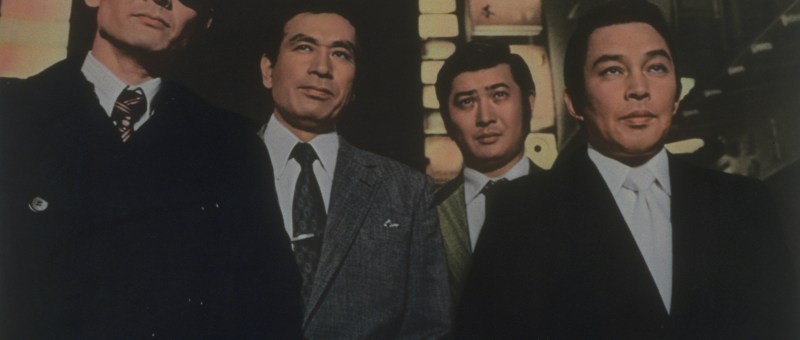
New Female Prisoner Scorpion (新・女囚さそり 701号, Yutaka Kohira, 1976)

After the fourth film in the Female Prisoner Scorpion series, star Meiko Kaji decided to move on but Toei had other ideas and opted for a reboot as signalled by the addition “shin” or “new” to the otherwise identical title to the very first film. New Female Prisoner Scorpion #701 (新・女囚さそり 701号, Shin Joshu Sasori: 701-go) moves in a slightly different direction spinning a tale of a less straightforward revenge coloured by conspiracy cinema and a series of real life high-profile corruption cases including the Lockheed Scandal, itself name checked in the film. Just a few months earlier, Roman Porno actor and fervent nationalist Mitsuyasu Maeno had lost his life in a suicide attack on the home of underworld figure and right-wing fixer Yoshio Kodama who had been instrumental in “convincing” Japanese airlines to buy Lockheed planes over McDonnell Douglas.

In any case, this Nami Matsushima (Yumi Takigawa) is an ordinary young woman who becomes concerned about her sister Taeko (Bunjaku Han) when she uncharacteristically drops out of contact after behaving strangely. Taeko is a political secretary to assemblyman Miura (Ichiro Nakatani) who is currently the vice-minister for justice and at the centre of a burgeoning corruption scandal. After Nami and her fiancée Toshihiko (Yusuke Natsu) manage to meet up with Taeko, she is suddenly kidnapped from the hotel car park while the man who was with her, Sugino (Nenji Kobayashi), is gunned down. Sugino is found to be carrying his passport and two airline tickets to Paris which, along with Taeko’s strange behaviour, imply they were planning to flee the country together. Looking more closely at the wedding presents her sister had given her, Nami realises she’s left her a cassette tape with the instruction to leak its contents to the press should anything untoward happen to her. 

Nami uses the tape as leverage with Miura to try and rescue her sister but ends up learning some unpleasant truths before being framed for Taeko’s murder and sentenced to 15 years in prison. Toshihiko, who had originally been supportive, betrays her, testifying at her trial that she may have been resentful that Taeko was against their marriage only to later marry Miura’s daughter and go into politics apparently siding with the bad guys. Toshihiko may have seemed like a nice guy, but it’s also true that he tried to pressure her into premarital sex that she didn’t want by insisting that he couldn’t wait for marriage, suggesting they blow off her sister and go to a hot springs in Hakone instead. Most of the men in the film are equally spineless and duplicitous not least the guards who with the exception of one are all corrupt and/or abusing the inmates. 

Not content with sending her to prison, Miura tries to have Nami offed with the assistance of the warden who puts her in a cell with the prison’s most notorious offender. Fusae (Mitsuyo Asaka) orders her minions to beat and torture Nami, at one point gang raping her while the only way she can think of to save her life is by claiming there’s another tape so if they kill her they’ll never know where it is and run the risk of the contents leaking. 

Meanwhile, she’s approached by a group of anarchists who tell her they need a leader which seems a little contradictory but nevertheless enables a jailbreak even as Nami develops a rivalry with the feisty prisoner number 804. Though she obviously didn’t commit the murder for which she was imprisoned, Nami is no pushover and in fact burns one of her tormentors alive not to mention stabbing another in the eye with a pencil and cunningly splitting a pair of scissors to gain twin knives. Rather than the classic scorpion look, she appears almost batlike, spreading her arms in her cape as she prepares to make her final act of revenge right outside the Diet building itself as if she were making a point about cleaning up politics aside from avenging her sister’s death and her own mistreatment. Director Kohira lends her a supernatural quality in her eerie silhouette as if she’s already become something else, a force of nature transformed by her righteous anger towards a corrupt society largely ruled by venal men willing to kill and use women for their own benefit or pleasure. Even Nami is forced to admit her complicity having learned her sister may have paid for her education through allowing herself to be traded by Miura as a political bargaining chip. She is not, however, willing to let it stand, resisting a controlling a patriarchal society with all of the resources available to her.
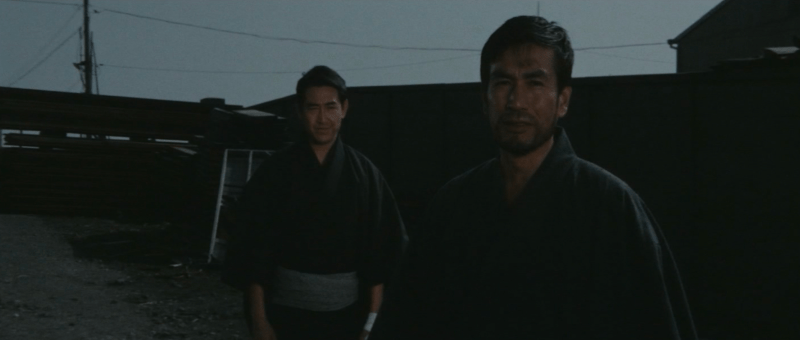

Dissolution Rites (解散式, Kinji Fukasaku, 1967)

“We’re all legitimate businessmen now” as a former yakuza explains to a recently released foot soldier stepping out into a very different Japan in Kinji Fukasaku’s Dissolution Rites (解散式, Kaisan Shiki, AKA Ceremony of Disbanding). The funereal opening scenes feature the first in a series of dissolution rites as a man dressed in black reads from a scroll and explains that all the local yakuza clans will be disbanding because despite “working day and night for the benefit of the world and humanity in the spirit of democracy” times have changed and they find themselves unnecessary.

There at the beginning of that change, Sawaki (Koji Tsuruta) served eight years in prison for the murder of a rival gang boss to ensure his gang got hold of a local landfill site where they later built an oil complex. While he was inside, his boss died and his clan disbanded leaving him with nowhere to go but thankfully looked out for by an old friend, Shimamura, who has since become a construction magnate. On his arrival at Shimamura’s office, however, he’s ambushed in a suspected case of mistaken identity while the man driving him is killed. 

Shimamura (Fumio Watanabe) tells him he’s gone straight, but it soon becomes clear that even as yakuza forsake the streets for more organised crime they still behave like thugs using the same old tactics to get what they want. Shimamura is in cahoots with a corrupt local politician, Kawashima (Asao Uchida), and is determined to get access to another stretch of bombed out wasteland owned by an egalitarian doctor, Omachi, who refuses to sell because he’s set up a community there of marginalised people, including Sawaki’s former girlfriend Mie (Misako Watanabe), who work on his chicken farm. Meanwhile, Shimamura is targeted by rival “legitimate businessman”, Sakurada (Hosei Komatsu), who pulls a few dirty tricks of his own in an effort to cut Shimamura out of the picture.

Once again Tsuruta plays a man who is out of step with his times, partly because he’s been in prison but also in his fierce commitment to a now outdated code of gangsterdom. “The chivalry that we were taught was just a way for bosses to use their soldiers” Shimumura insists, “you’ll look foolish if you don’t get rid of it”, disingenuously casting his transformation into a legitimate businessman as a way of freeing himself from yakuza oppression. Sawaki turns down his offer to join the business because it seems a bit dodgy while intensely disappointed to discover another former colleague, Kubo (Kyosuke Machida), running a trafficking ring masquerading as a management studio for cabaret singers and strippers by tricking women with the offer of good jobs then getting the hooked on drugs and shipping to them to Okinawa to do sex work near the US bases.  

On his return, Sawaki is also stalked by the man whose arm he severed in killing the rival boss who turn out to be, like him, an old school gangster which is why he insists on his revenge only to find an unexpected kindred spirit as the two men find themselves each adrift in a world in which no one really cares about humanity and honour. Sakai (Tetsuro Tanba) chooses to walk a different path, conducting his disbandment ceremony in protest of yakuza corruption. Like many Tsuruta heroes, Sawaki also has the possibility of walking away and living a conventional family life as a husband and father having been forgiven by Mei but inevitably is pulled in a darker direction by the necessities of his code. The oil complex he helped to create is only a symbol of the duplicities of the post-war society allowing men like Shimamura to get rich while literally choking the life out of those like Mei whom they now want to kick out of her home to add insult to injury. 

There’s no one more tragic than a yakuza Sawaki admits, knowing there is no longer any place for him in an amoral gangster society while unable to simply leave it and enjoy a quiet life with the woman he loves. An indictment both of corporatised yakuza and the equally duplicitous practices of “legitimate” businesses and corrupt authorities, the film ends in another righteous assault filmed handheld with Fukasaku’s characteristically canted angles amid the chaos and confusion of a rapidly changing society. 

Yakuza Graveyard (やくざの墓場 くちなしの花, Kinji Fukasaku, 1976)

“We don’t resort to violence. We observe the law.’ The hero of Kinji Fukasaku’s Yakuza Graveyard (やくざの墓場 くちなしの花, Yakuza no Hakaba: Kuchinashi no Hana) is berated by a superior officer for excessive use of force, but his criticism is in some senses ironic because it is the police force itself which becomes a symbol of the societal violence visited on those who can find no place to belong in the contemporary society. By this time the yakuza was already in decline and in the process of transforming itself into a corporatised entity while as a police chief explains increasing desperation has led to escalating gang tensions. 

Recently transferred maverick cop Kuroiwa (Tetsuya Watari) finds himself caught between two worlds in attempting to enforce the law through methods more familiar to yakuza. Soon after he’s had his gun taken away for exercising excessive force on a suspect he’d been independently tailing in the street on whom he’d found bullets designed to be used with a remodelled toy gun, Kuroiwa is pulled aside by another senior officer, Akama (Nobuo Kaneko) who takes him to a meeting with local yakuza boss Sugi (Takuya Fujioka). It seems obvious that Akama has cultivated a relationship with the Nishida gang which may not be strictly ethical for a law enforcement officer and hopes to bring Kuroiwa on board as a potential asset. They attempt to bribe him in return for information on the Yamashiro clan, the dominant organised crime association in the area, which has been hassling Nishida in an attempt to take over their territory. But Kuroiwa ironically tells them that they should “act like yakuza” and sort out their own problems rather than relying on the police before dramatically walking out much to to the consternation of everyone else present. 

Nevertheless, he eventually comes to sympathise with them as a symbol of the little guy increasingly crushed by corporate and authoritarian forces outside of their control. He finds out from a briefing that the police’s goal is the disbandment of the Nishida gang but when he asks why they aren’t going after the Yamashiro too he’s told to mind his own business and begins to realise that the police are in cahoots with organised crime. Whether they justify themselves that managing the Yamashiro to prevent a turf war is the best way to protect the public or are simply corrupt and in the pocket of big business, Kuroiwa can’t help but balk at the blatant hypocrisy of the law enforcement authorities. 

Later Kuroiwa reveals that he became a police officer after being bullied as a child in order to exert power over his life, or perhaps becoming an oppressor in order to avoid being oppressed. He was bullied because he had been born in Manchuria and even years later remains a displaced person at least on a psychological level. It’s this sense of displacement which allows him to bond with the Nishida gang’s accountant, Keiko (Meiko Kaji), whose father was Korean. Kuroiwa agrees to accompany Keiko to visit her husband (Kenji Imai) who is serving a lengthy prison term in order to tell him that the gang want to promote someone else to a position he viewed as his by right. The husband explodes in rage and uses a word some would regard as a slur to reference Keiko’s Korean heritage while she later attempts to walk into the sea feeling that there really is no place for her in the contemporary society. 

Just as she claims that she is neither Korean nor Japanese or much of anything at all, Kuroiwa is neither cop nor thug and similarly excluded from society at large. He ends up bonding with old school Nishida footsoldier Iwata (Tatsuo Umemiya), who is also ethnically Korean, for many of the same reasons and attempts to mount a doomed rebellion against their mutual oppression, but is hamstrung by his otherness which is only deepened when he’s taken prisoner by loan shark Teramitsu (Kei Sato) and given a mysterious truth drug developed by the nazis later becoming a user of heroin. Already marginalised, forced into crime by economic necessity and social prejudice, Iwata and Keiko like Kuroiwa himself struggle to escape their displacement while pushed still further out by systemic corruption and the amoral capitalism of an era of high prosperity. Shot with jitsuroku-esque realism and characteristically canted angles, Fukasaku injects a note of futility even within the hero’s tragic victory as he quite literally sticks two fingers up to the corrupted “brotherhood” that has already betrayed him.


Yakuza Graveyard is released on blu-ray on 16th May courtesy of Radiance Films. On disc extras include an in-depth appreciation of the film and the work of screenwriter Kazuo Kasahara from Blood of Wolves director Kazuya Shiraishi, and an informative video essay from Tom Mes on the collaborations of Meiko Kaji and Kinji Fukasaku. The limited edition also comes with a 32-page booklet featuring new writing by Miko Ko plus translations of a contemporary review and writing by Kasahara.

Original trailer (no subtitles)

Japan Organized Crime Boss (日本暴力団 組長, Kinji Fukasaku, 1969)

A yakuza just out of jail emerges into a very different Japan in Kinji Fukasaku’s proto-jitsuroku gangster picture, Japan Organized Crime Boss (日本暴力団 組長, Nihon Boryoku-dan: Kumicho). A contemporary Oda Nobunaga is trying to unify the nation under his yakuza banner while fostering a nationalist agenda and colluding with corrupt politicians to prop up the 1970 renewal of the Anpo security treaty, but as it turns out some people aren’t very interested in revolutions of any kind save the opportunity to live a quiet life they once feared would elude them. 

As the film opens, a narratorial voice explains that the nation has now escaped from post-war chaos, but Japan’s increasing prosperity has led to a natural decline of the yakuza which has seen some try to ride the rising tides to find new ways to prosper. Exploiting its control of local harbours, the Danno group has quickly expanded though Osaka and on to the rest of the nation thanks largely to its strategist, Tsubaki (Ryohei Uchida), and his policy of convincing local outfits to ally with them and fight as proxies allowing Danno to escape all responsibility for public street violence. 

Perhaps strangely, the Danno group and others are acutely worried about optics and keen to present themselves as legitimate businessmen while using a prominent politician as a go-between to settle disputes between gangs. The yakuza already know they’re generally unpopular and fear that attracting too much attention will only bring them problems from the authorities. The politician needs Danno to look clean so that they can back them in opposing the protests against the Anpo treaty, while the yakuza organisation is later depicted as a militarised wing of the far right hoping to correct “misguided” post-war democracy while eradicating communism and instilling a sense of patriotic pride as they go. Of course, all of that will also likely be good for business while quite clearly marking these new conspiracy-minded yakuza as “bad”, hypocritical harbingers of a dangerous authoritarianism. 

Tsukamoto (Koji Tsuruta), the recently released lieutenant of the Hamanaka gang, is conversely the representative of the “good” yakuza who still care about the code and are genuinely standing up for the little guy against the oppressive forces now represented by bad yakuza. Hamanaka had allied with Danno while Tsukamoto was inside and was thereafter targeted by the local Sakurada group who have joined the Tokyo Alliance of yakuza clans opposed to Danno who continue to fight them by proxy. After his boss is killed and tells him that joining Danno was a mistake, Tsukamoto’s first thought is to rebuild the clan which he does by remaining neutral, refusing to engage in Danno’s proxy wars while protecting his men from their violence as mediated by the completely unhinged, drug-addled Miyahara (Tomisaburo Wakayama) and the anarchic Hokuryu gang. 

Miyahara comes round to Tsukamoto precisely because of his pacifist philosophy after he kidnaps one of his men and Tsukamoto stands up to him while making a point of not fighting back. As crazed as he is, Miyahara is a redeemable gangster who later also turns on Danno regretting having agreed to do their dirty work for relatively little reward. After a gentle romance with the sister of a fallen comrade, Tsukamoto, who lost his first wife to suicide while inside, begins to dream of leaving the life behind but as he and others discover there is no real out from the yakuza and the code must always be repaid. In failing to protect his clan he fails to save himself and becomes a kind of martyr for the ninkyo society taking on politicised yakuza and their lingering militarism. 

Fukasaku takes a typical ninkyo plot of a noble gangster standing up for what he believes is right against the forces of corruption and begins to undercut it with techniques such as voiceover narration and onscreen text that he’d later use in the jitsuroku films of the 1970s which firmly reject the idea of yakuza nobility seeing them instead as destructive forces born of post-war chaos and increasingly absurd in a Japan of rising economic prosperity. Men like Tsukamoto are it seems at odds with their times, unable to survive in the new society in which there is no longer any honour among thieves only hypocrisy and self-interest. 


Violent Streets (暴力街, Hideo Gosha, 1974)

“Nothing’s like it used to be anymore” sighs a woman who’s had to betray herself but has tried to make break for it only to discover there is no way back. Hideo Gosha’s Violent Streets (暴力街, Boryoku Gai) is like many films of its era about the changing nature of the yakuza in an age of corporatised gangsterdom. Now “legitimate businessmen” who claim to no longer deal in thuggery, their crimes are of a more organised kind though a turf war’s still a turf war even if you’re fighting from the boardroom rather than simply getting petty street punks to fight it for you in the streets. 

In a touch of irony, former yakuza Noboru Ando stars as a man who’s tried to leave the life behind but is pulled back into underworld intrigue when his former foot soldiers mount an ill-advised bid for revenge against the clan they feel betrayed them. After serving eight years in prison for participating in the last turf war, Egawa was given flamenco bar Madrid on the condition that he dissolve his family and attempt to go straight as a legitimate businessman. The Togiku gang has since gone legit and distanced itself from most of its old school yakuza like Egawa. But now a yakuza conglomerate from Osaka is moving in on their old turf and the Togiku want the Madrid back as a bulwark against incursion from the west which is why they’ve been sending the boys round to cause trouble in the bar. 

Egawa is the classic ex-gangster who wants to turn himself around but is largely unable to adapt to life in a changing society. He is technically in a relationship with a bar hostess who has a severe drinking problem in part exacerbated by his inability to get over his former girlfriend who left him and married the boss, Gohara, while he was in prison. His former foot soldiers attempt to convince him to get the gang back together and take revenge, resentful of having been used and discarded, but he tells them to let it go, that they’ve all got “honest jobs” and that they should try to live as best they can. Like him, the guys are ill-equipped to make new lives in the consumerist society and cannot move on from the post-war past. Hoping to engineer a turf war between the Osaka guys and Togiku, they kidnap a popular TV personality/pop singer (Minami Nakatsugawa) attached to a station which Togiku controls and frame a rival affiliated with the Osakans for taking her. 

This just goes to show the various ways in which newly corporatised yakuza have expanded their business portfolio, heavily participating in the entertainment industry moving beyond bars, clubs, and the sex trade into mainstream television and idol stars. Egawa’s old friend Yazaki (Akira Kobayashi) is his opposing number, just as caged but trapped within the confines of the new gangsterdom, reprimanded by his boss for raiding the rival studio’s offices and undoing the gang’s attempt to rebrand themselves as legitimate businessmen rather than violent street thugs. “I can’t stand being humiliated” he explains as Gohara points out he’s stepped right into their trap now giving the Osakans an excuse for retaliation. “The Togiku group is a defanged, domesticated dog” Yazaki barks, “I can’t pretend to be an obedient company employee forever and do nothing”. 

Neither man is able to progress into the new era of rising prosperity, both little more than caged animals thrashing around trying to break free but continually crashing into the bars. Just as Egawa’s old guys had tried to engineer a turf war hoping that the two gangs would take each other out and leave a vacuum they could fill, arch boss Shimamura (Tetsuro Tanba) flies above the city in a helicopter as the “worms fight among themselves” and observes the chaos below as he completes his silent conquest of the contemporary economy like some modern day Nobunaga of corporatised gangsterdom. 

Taking over the Togiku through a process of corporate infiltration and gradually ridding themselves of all the old school yakuza ill-suited to the shady salaryman life, the contrast between the world of cabaret bars and back street dives and Shimamura’s smart suits and helicopters couldn’t be more stark. A slightly sour note is struck by the use of a transgender assassin (Madame Joy) who performs a lesbian floorshow by day and kills by night while working with a bald sidekick who carries a parrot on his shoulder, her coldness bearing out the tendency of yakuza movies to associate queerness with sadistic savagery. Gosha rams his point home with the otherwise surreal scene of a pile of abandoned mannequins by a swamp that becomes a popular yakuza kill site homing in on the emptiness of their eyes and the uncanniness of dismembered bodies, mere empty shells just like the men who die in this literal wasteland. Egawa perhaps feels himself to be a man already dead long before being pushed towards his act of futile rebellion, somewhere between sitting duck and caged dog fighting for his life between the chicken coops of a moribund small-town Japan. Marching to a frenetic flamenco beat of rising passions and barely contained rage, Violent Streets leaves its former foot soldiers with nowhere to go but down while their duplicitous masters continue to prosper riding the consumerist wave into a new and prosperous future.


Violent Streets opens at New York’s Metrograph on Dec. 16 as part of Hideo Gosha x 3

Trailer (English subtitles)

Devotion to Railway (大いなる驀進, Hideo Sekigawa, 1960)

In the early 1960s, Japan’s rail network might have felt a little uneasy with the Shinkansen already on the horizon. Hideo Sekigawa’s Devotion to Railway (大いなる驀進, Oinaru Bakushin) is in part a celebration of this essential service, the conductor and steward ever fond of reminding us that most passengers probably don’t realise that the Sakura sleeper service on which they are travelling from Tokyo all the way to Nagasaki is operated by only seven or eight people (though they don’t seem to be counting the staff from the dining car which hints at a minor source of division among the crew). While the Japanese title which means something more like “the great dash” might hint at a little more excitement, the film is less thriller than gentle ensemble drama in which the passengers and crew must come together to solve the improbable number of crises arising on this otherwise ordinary journey. 

Even so considering the film is directed by the left-leaning Sekigawa best known for his anti-war films such as Hiroshima and Listen to the Voices of the Sea, not to mention scripted by Kaneto Shindo, it is a little ironic that the central thrust of the drama revolves around junior steward Yajima’s (Katsuo Nakamura) rediscovery of his own devotion to the railway after at the beginning of the film declaring this will be his final journey. Mimicking the dilemma at the centre of Yoshitaro Nomura’s Stakeout, Yajima’s problem is that he has been engaged for two years and is sick of waiting to get married but his girlfriend Kimie (Yoshiko Sakuma) is the main breadwinner in her family and though his salary could support them as a couple it won’t stretch much further. Kimie, however, is dead against him taking the counter-productive decision to quit the railways even with the suggestion of going into business with a friend who owns a cafe, partly because it’s better to stick with a steady job than take a chance on something less certain, and partly because she knows he likes his work and all his experience will be wasted if he suddenly opts to switch careers. 

Despite its positive warmhearted message of people pulling together to overcome crisis, the film does skew a little conservative in essentially turning Kimie into a minor villain as if she were in a sense responsible for making Yajima doubt his devotion to the railway. After jumping aboard to make sure he doesn’t suddenly quit before the end of the line, she eventually has a heart to heart with the sympathetic conductor Matsuzaki (Rentaro Mikuni) that forces to her to admit that perhaps she’s just nervous about the nature of married life and has been making trouble where there needn’t be any, now certain that it’s better to just get married as soon as possible and let the rest figure itself out. 

Meanwhile, there’s additional tension seeing as a waitress from the diner car has an obvious crush on Yajima and is quite resentful on being presented with his fiancée, but even this is eventually solved with the two women becoming accidental friends during the climatic crisis, a landslide caused by a typhoon, that grants each of the passengers an epiphany about what it is they really want out of life. While waiting for the maintenance crew from the next station to arrive, Yajima, still in a bad mood, stands around doing not much of anything until coaxed into action by Kimie and Matsuzaki, Kimie too eventually jumping off the train to solve this literal roadblock in their relationship followed by the dining car girls and a young woman only on the train to transport blood to a hospital needed urgently by 2pm the next day. This sense of collective endeavour opening the way gives everyone on board a new sense of positivity, allowing Kimie and Yajima to repair their relationship and a man who tried to take his own life in the night to gain a new sense of hope for future. 

Several times Yajima is reminded that he has the lives of the passengers in his hands which is undoubtedly true given that there is always the chance of disaster yet also perhaps going a little far seeing as most of his job is checking tickets and providing travel information. Nevertheless, there is a lot going on on this train from eloping couples to yakuza assassins, not to mention the twin sights of a newly wed couple and a pompous politician momentarily disembarking at each stop to be feted either by workers at their factory or the local members of their political party. The snooty politician even gets a minor comeuppance from a famous pickpocket who steals his watch as a joke and then gives it back only to dismissively ignore his thank you message while eating a giant apple. 

Surprisingly handsome for a Toei programmer, Sekigawa’s deft direction lends a claustrophobic sense of dread to the interior of the train stalked by a vengeful assassin, while simultaneously making it an essentially safe space guarded by the ever solicitous crew keen to help an anxious young woman with a long journey ahead of her arrive on time to get home to her chronically ill mother. An effective piece of advertising for the Sakura sleeper service (which ran until 2005 albeit in slightly different forms), Devotion to Railway may surprise in its insistence that the hero rededicate himself to his employer but is nevertheless a charming ensemble drama which finds a new sense of positivity in the solidarity between friends and strangers coming together to overcome crisis through common endeavour. 


Original trailer (no subtitles)

Prison Boss (獄中の顔役, Yasuo Furuhata, 1968)

“Both you and I must do what a man must do and live this life to the very end” according to the melancholy theme song of Yasuo Furuhata’s fatalistic tale of gangster nobility, Prison Boss (獄中の顔役, Gokuchu no Kaoyaku). Another vehicle for tough guy star Ken Takakura, this post-war drama despite the name spends less time in a cell than one might imagine but casts its melancholy hero as a man imprisoned by the times in which he lives, too good to survive in an ignoble society and eventually brought down by his self-destructive need for retributive justice. 

As the film opens, Hayami (Ken Takakura) is goaded into a knife fight with a foot soldier from the evil Honma gang, Tetsu the Viper, and eventually kills him. Stumbling into a nearby bar, his only intention is to do the right thing and turn himself in filled with remorse as he is that he’s offed Tetsu in territory which belongs to “good” mob boss Tajima (Ichiro Ryuzaki). Tajima lives up to his name when some of his guys rescue Hayami and take him to their HQ where the old man insists that he rest and recover from his wounds. Whilst there, Hayami is cared for by Tajima’s teenage daughter Toshiko (Junko Fuji) who falls in love with him and vows to wait while he honours his word and spends seven years in jail for the killing of Tetsu. 

Meanwhile, awkward small-town politics is destabilising the precarious post-war environment as the Honma, embodiments of the new, venal and violent yakuza who care nothing for honour or humanity, are intent on squeezing Tajima’s influence mostly through muscling in on the running of the local bike races for which Tajima currently runs security. Though the Tajima gang is presented as an unambiguous good, the old style noble yakuza who live by a code and care about protecting the little guy, you can’t deny the levels of nepotistic corruption on display at the local council meetings given that the mayor and Tajima are apparently childhood friends while his rival shouts about allowing yakuza too much sway in politics while in the pay of Honma. 

Nevertheless, the central drama exists solely in the soul of Hayami who emerges from seven years in prison into this already destabilised environment owing a debt of honour to Tajima. Not quite a yakuza, he feels himself a perpetual other forever tainted by his crime having lost the right to live as other men live. Thus he struggles with discovering that Toshiko has also remained true to her word, having waited for him all this time running a small coffee bar rather than getting married. Even so, he finds himself dragged back into yakuza drama avenging the death of a Tajima man gunned down by Honma and thereby ending up back inside where he’s reunited with another childhood friend, Kurosaki (Ryo Ikebe), who’s been far less fortunate and is now affiliated with Honma.  

Kurosaki and veteran prisoner Pops (Shogo Shimada) are perhaps both mirrors of Hayami’s internal conflict, Kurosaki like him bound by a code but forced to act in ways which betray his own sense of honour and humanity and eventually paying a heavy price for doing so. Pops meanwhile as a man nearing the end of his life tries to talk him down from the road of destructive nobility, reminding him that he has a choice and ought to choose himself rather continuing to suffer for an outdated ideal. Hayami’s selflessness, his oft remarked tendency to disregard his own interest to protect others (the true mark of the noble gangster), is his weakness and fatal flaw. A yakuza’s daughter, Toshiko understands the code of manliness well enough and even she eventually tells him to run, to abandon his revenge and live free rather than becoming just another sacrifice on the altar of yakuza honour, but of course a man has to do what a man has to do. 

Though Hayami himself becomes a big man in prison, it’s Honma to whom the film’s title primarily refers hinting at the corruption involved in a society in which it is perfectly possible (and in some ways advantageous) to continue running a yakuza gang from behind bars, while the central crisis also turns on post-war desperation in betting all on controlling the lucrative bicycle races. In such a world as this, there’s precious little room for the noble gangster who must in the end damn himself if only to redeem it. 


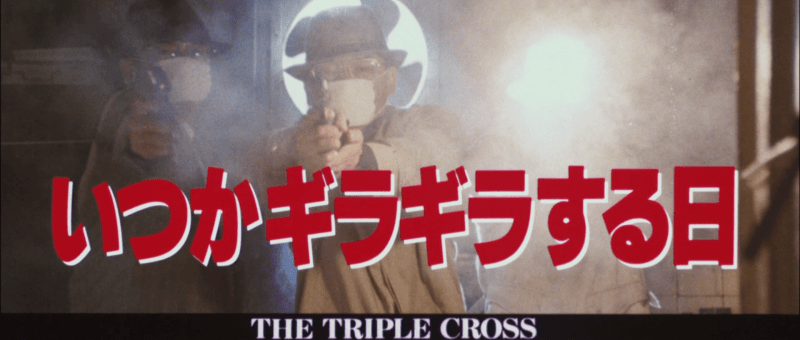
The Triple Cross (いつかギラギラする日, Kinji Fukasaku, 1992)

“It’s never over for men like me” laments the hero of Kinji Fukasaku’s infinitely zeitgeisty 1992 action thriller The Triple Cross (いつかギラギラする日,  Itsuka Giragira Suru Hi), though the director might as well be talking for himself. Fukasaku is most closely associated with the jitsuroku gangster genre which he helped to create at Toei in the mid-1970s with the hugely influential yakuza cycle Battles Without Honour and Humanity. Through the difficult ‘80s, he’d sustained his career with a series of commercial projects and critically acclaimed prestige pictures, which is perhaps why he felt secure enough to go all in with an absurdist take on the death spiral of the Bubble Era. 

As the film opens, a trio of veteran crooks commits a series of flawless armed robberies which makes them all very wealthy. In an age of excess, crime is perhaps for them more a way of life than a means of survival save for one, Imura (Renji Ishibashi), who has massive debts from loansharks and is living with a constant sense of anxiety that his failures as a man and as a father may result in his beloved wife (Kirin Kiki) and daughter leaving him (for which he wouldn’t blame them). Kanzaki (Kenichi Hagiwara), the veteran gangster, enlists his girlfriend Misato (Yumi Takigawa) along with Imura to scout a possible new job their “boss” Shiba (Sonny Chiba) is planning up in Hokkaido. When they get there it turns out that Shiba has taken up with an extraordinarily irritating much younger woman, Mai (Keiko Oginome), and through her has befriended a young guy, Kadomachi (Kazuya Kimura), who’s come up with a plan to rob the takings from a nearby resort which he has heard run to 200 million yen transported in cash by car via remote mountain road. 

Kadomachi, who later claims he was once a police officer, is an annoyingly entitled young punk with bleach blond hair who wants the money to open a live music venue in order to support real rock and roll. So manic he seems to be on something, it’s a surprise that the guys agree to work with him though after a quick hazing they apparently decide he’s OK only to bitterly regret their decision when it turns out he was mistaken about the amount being transported. As veteran pros, the trio know that it’s better to just be happy with what you can get and move on, but they had each hoped this job might be the last and the disappointment proves too much for Imura who flips out and points a gun at his friends intending to take the lot but is calmly talked down only for Kadomachi to grab a gun and start shooting, making off with the whole 50 million. 

Deliberately down with the kids with his pulsing club score, Fukasaku seems to be taking a swipe at the Bubble generation who want everything now and fully expect to get it. Shiba pays the price, essentially, for refusing to act his age, trying to be young and hip like Mai and Kadomachi, while Imura is perhaps the opposite unable to escape from the post-war era with its poverty and vicious loansharks while also facing discrimination as a zainichi Korean which further deepens his anxiety for his teenage daughter. Yet getting her hands on the money Mai confesses that she has absolutely no idea what to do with 50 million yen, spending 50,000 on a handkerchief just because while even Kadomachi is eventually struck by a sense of futility in realising the money has corrupted him though he knows that it will eventually slip through his fingers. “People, life, they pass us by” he muses sadly while Mai confesses all she wanted was for someone to “notice” her, which they eventually perhaps do only it’s in the context of a nationwide manhunt. 

The vacuous youngsters are finally slapped down by the calm and collected Kanzaki whose lack of ostentation serves him well in the ensuing war on two fronts as he goes up against not only Kadomachi but the loanshark he was in debt to in an attempt to get his hands on the money. Fukasaku takes the jitsuroku and turns it inside out for a tale of Bubble-era excess filled with increasingly elaborate action sequences culminating in a high octane car chase and a shoot out with the entire garrison of the Hokkaido police force, yet as before crime only yields futility, the money floating away in Hakodate harbour, while we end on a trademark note of irony that shows us banks on every street corner, money is literally everywhere. What does crime mean now, what is the point of such ceaseless acquisition in an age of plenty? For Kanzaki, perhaps it just spells opportunity and well you can’t argue with that. 


Original trailer (no subtitles)

A Fugitive from the Past (飢餓海峡, Tomu Uchida, 1965)

Fugitive from the past“There’s no way back” intones a spirit medium in the throws of a possession early on Tomu’s Uchida’s three-hour police procedural, A Fugitive from the Past (飢餓海峡, Kiga kaikyo, AKA Straits of Hunger). Her message will be repeated frequently throughout the journeys of our three protagonists – a guilty man seeking escape from himself, the hooker with a heart of gold who thinks of him as a “kind person”, and the obsessive policeman whose quest to find him threatens to destroy his own family and chance of ongoing happiness. Beginning in 1947, Uchida’s adaptation of the novel by Tsutomu Minakami is a cutting indictment of post-war inequalities but is also keen to remind us that the war was merely a symptom and intensifier of problems which existed long before and are likely to survive long after.

In 1947, three men in military uniforms attempt to escape from Hokkaido after committing a crime while the island is subject to a typhoon warning. Using a ferry disaster in which hundreds of people have been killed as cover, the men steal a boat and try their luck on the stormy seas. Only one of them makes it. Once all the bodies from the ferry are accounted for, two more are discovered and later identified as recent parolees from Abashiri prison. The dead convicts are then linked to a local robbery, murder, and arson case in which a large amount of money was stolen leaving the third man, described by witnesses as bearded, tall and imposing, the prime suspect in the deaths of the two prisoners as well as the original robbery.

Calling himself “Inugai” (Rentaro Mikuni), the “third man” takes off with all the money and ends up forging an unexpectedly genuine connection with a cheerful prostitute just on the way back from her mother’s funeral. Yae (Sachiko Hidari), claiming to have seen through to Inugai’s kindly soul, seems to reawaken something within him but the next morning he moves on leaving only a vast a mount of money and some nail clippings behind him. Meanwhile, Yumisaka (Junzaburo Ban), the dogged policeman who discovered the convicts’ bodies, tracks him at every turn.

The world of 1947 is a hellish one in which perpetual hunger is the norm and crushing impossibility all but a given. Inugai is starving. With rationing in place the black market is flourishing while the unscrupulous profiteer off the back of other people’s desperation. This is a land of defeat where to survive at all is both shame and victory, yet somehow you have to go on living. Inugai, like many a hero of golden age Japanese cinema, is engaged in an internal war to erase the dark past, drawing a veil over what it took to move from post-war privation to economic prosperity. He does however take his unseeing further than most in adopting a new, more respectable persona, remaking himself as self-made man and wealthy philanthropist keen to “pay back” the society which has been so supportive of his “success”.

Thus when Yae, whose attempt to remake herself in the capital has fared far less well, spots Inugai’s photo in the papers and decides she just must track him down, it’s not that Inugai fears blackmail or even really that she poses a threat but that she shatters the integrity of his carefully crafted post-war persona and reminds him who he really is. A climactic storm mirroring that which illuminated their first meeting also graces their last as “Inugai” finally resurfaces, committing an impulsive act of animal violence which tugs at the strings of his new life and sets the whole thing unravelling.

Yae used Inugai’s money to pay off her debts and get out of the brothel, but even if the Tokyo of 1947 was warmer than that of Hokkaido it was no more kind and her attempt to lead an “honest” life was quickly derailed by underworld crime and unforgiving law enforcement. Realising there’s nowhere left for her to go she resigns herself to life in the red light district but does at least manage to find a “nicer” establishment run by a kindly older couple where the girls are like one big family. Her meeting with Inugai has come to take on mythical proportions in her mind – she even worships a tiny relic of him in the form of one of his nail clippings. Hoping to repay his kindness she commits herself to hard work and barely spends any of her money on herself, dreaming of the day she will one day see him again.

Yumisaka, however, mirrors Yae’s devotion in his all encompassing “hate” for Inugai as his obsession consumes him, costs him his job, and threatens to ruin his family. Alerted by two more bodies washing up out of the sea, a young detective (Ken Takakura) puts two and two together and gives Yumisaka a chance to vindicate his long held convictions but what they discover through the shifting sands of invented truths and corrupted memories is a legacy of suffering and resentment which runs far further back than the recent wartime past. As Yumisaka later puts it, those who’ve never been poor or miserable cannot understand the desperation felt by those who have in the presence of money. Inugai, poor and trapped by circumstance, longed to escape the drudgery of Hokkaido life but couldn’t live with what he did to do it and so conjured up another history for himself.

Still, the truth will out and there really is “no way back”, not for Inugai or for his nation which seems determined to continue unseeing the darkness of the previous 30 years as it begins to find a degree of comfort once again. Incorporating strong spiritual overtones from the sutras Yumisaka is so strangely adept at reciting to the gloomy intoning of the spirit medium, Uchida imbues all with a heavy sense of dread as a man attempts to outrun his fate by running from himself only to be tripped up by sudden moment of panic born of a lack of faith in his only true believer. A chronicle of the post-war era, A Fugitive From the Past makes poverty its ultimate villain but attempts to paper over spiritual corruption with the pretty trappings of conventional success will only end in ruin as the unresolved past eats away at the foundations of a brave new world.


Original trailer (no subtitles)

https://www.youtube.com/watch?v=jHgeiDgxb6E

Brutal Tales of Chivalry (昭和残侠伝, Kiyoshi Saeki, 1965)

brutal tales of chivalry posterBrutal Tales of Chivalry (昭和残侠伝, Showa Zankyo-den) – a title which neatly sums up the “ninkyo eiga”. These old school gangsters still feel their traditional responsibilities deeply, acting as the protectors of ordinary people, obeying all of their arcane rules and abiding by the law of honour (if not the laws of the state the authority of which they refuse to fully recognise). Yet in the desperation of the post-war world, the old ways are losing ground to unscrupulous upstarts, prepared to jettison their long-held honour in favour of a dog eat dog mentality. This is the central battleground of Kiyoshi Saeki’s 1965 film which looks back at the immediate post-war period from a distance of only 15 years to ask the question where now? The city is in ruins, the people are starving, women are being forced into prostitution, but what is going to be done about it – should the good people of Asakusa accept the rule of violent punks in return for the possibility of investment in infrastructure, or continue to struggle through slowly with the old-fashioned patronage of “good yakuza” like the Kozu Family?

Here is where we find ourselves in the 21st year of the Showa Era (1947) – the small marketplace in Asakusa is rife with black marketeers and illegal goods, but it’s still the only mechanism by which people are able to survive. The market is overseen by the elderly patriarch of the Kozu Family, Gennosuke (Tomosaburo Ii), who does his best to ensure a kind of “fairness” in its operation, at least in as far as yakuza rules extend. His territory is currently under threat from a rival gang – the Shinsei (literally “new truth”) who obey no such rules and are growing ever more ruthless in their quest to control the local area. Their big idea is to build an entirely new marketplace with a roof to make it a permanent and pleasant place for traders to do business – they will finance this through a kind of crowdfunding paid for by the merchants themselves who will also be paying protection money and kickbacks to the Shinsei. Everyone approves of the covered market project, even the Kozu, but if it means letting the Shinsei assume control is it a price worth paying?

This is a question which faces prodigal son Seiji (Ken Takakura) who returns from the war to find his city in ruins, Gennosuke murdered by the Shinsei, that he is now the new head of the Kozu, and that the woman he loved has been given away in a dynastic marriage to man from another minor clan. Before he died, Gennosuke was able to dictate two important instructions – that Seiji was to take over, and that the gang should proceed on a note of peace, avoiding violence or aggression where possible, leading by example rather than attempting to crush their new rivals. Seiji, having just returned from one battlefield is intent on following Gennosuke’s orders but how far can he really survive on the moral high ground when his opponents are content to fight dirty from down below?

The “Showa” era spanned some 60 years of turbulent Japanese history but in 1965 it was just under 40 years old and already beginning to generate the complicated feelings of nostalgia which are still attached to it today. Showa is right there in the Japanese title as if it were an age already passed but it’s clear in 1965 that something has shifted, one age has or is beginning to give way to another. The desperation of the post-war world with its empty, rubble strewn vistas and population filled with hunger and despair has ebbed away now that Japan is back on the world stage following the 1964 Olympics and the economy has as last begun to pick up. The young no longer fixate on the rights and wrongs of empire building, war and surrender but have begun to turn their attention towards the American occupation, social justice, and foreign conflicts. The young of 1947 were middle-aged in 1965, no one would begrudge them romanticising their youth, and so even if the world of Brutal Tales of Chivalry is a bleak one it still contains a kind of nostalgia for the kind of honourable gangster inhabited by Takakura who embodies traditional values some may feel are under represented in modern society.

Yet, for all that, there’s something subtly subversive in the film’s eventual suggestion that pacifism will only go so far and that one side or another must be banished from the battlefield through violence if peace is ever to prosper. Still, the struggle is a noble one in which honour is defined by strength of character and the selfless desire to ensure the well-being of others as much as it is to a blind observation of arcane rules and obsolete, meaningless ritual. The first in a long running series, Brutal Tales of Chivalry helped established Takakura’s iconic presence which eventually became synonymous with the “ninkyo eiga” as a personification of idealised Japanese masculinity, tough but caring even if passion is often repressed or redirected into violence. Remnants may be all that’s left of “chivalry” in the new Showa era, but there’s a degree of beauty in this brutality that refuses to die even as its era passes.


Now available on Region A blu-ray from Twilight Time (limited to 3000 copies only)

Original trailer (no subtitles)