Madadayo (まあだだよ, Akira Kurosawa, 1993)

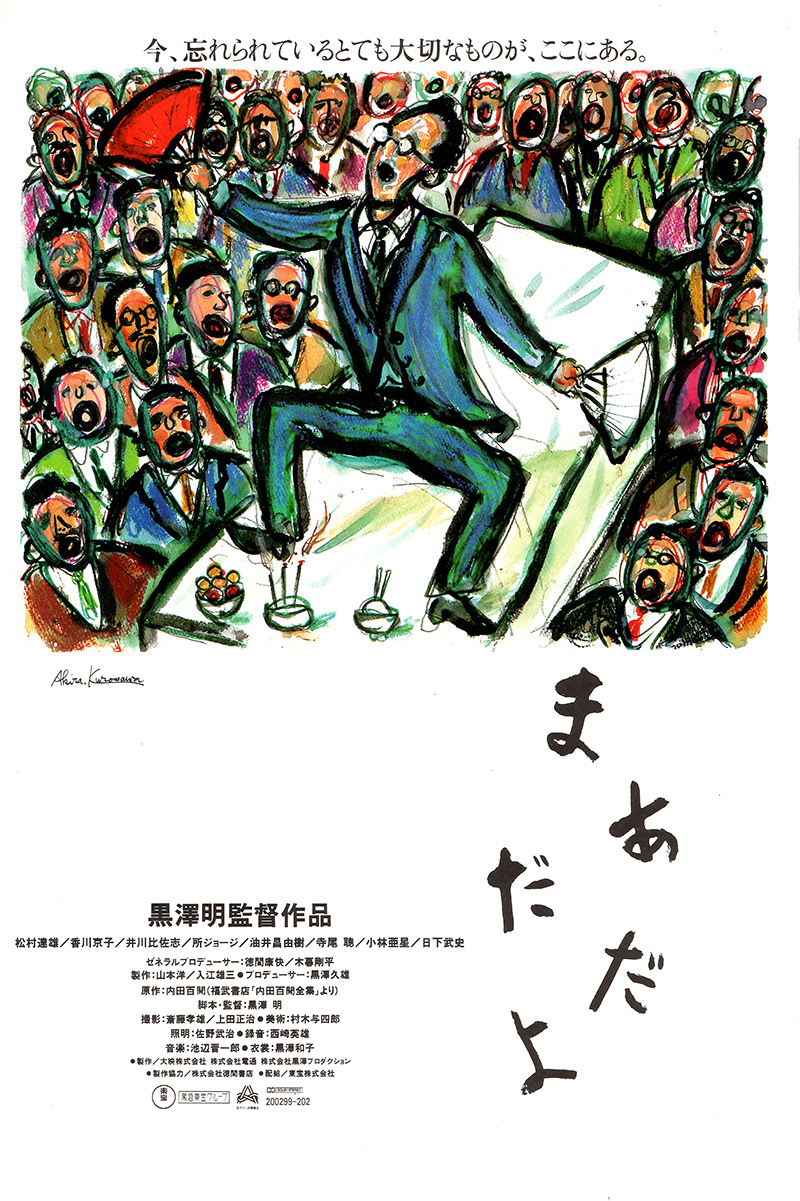
It’s tempting to read Akira Kurosawa’s final film Madadayo (まあだだよ) as a kind of valediction, though he may not have thought of it as a “final” film and if he had, it would have been ironically for film’s title means “not yet” and thematically hints at a desire on hold to a life that is admittedly fleeting. Much of the film is indeed bound up with transience and the difficulties of accepting it, but it’s also a humorous tale of a man who was “pure gold” and managed to maintain his childish heart even into his 77th year. 

Inspired by the life of the writer Hyakka Uchida (Tatsuo Matsumura), the film rather curiously opens with his retirement as he abandons his teaching position to pursue writing full-time much to the disappointment of his doting students. The relationship between Uchida and the boys he taught is at the heart of the film, for much like Mr Chips he had no children of his own and is cared for in his old age by a collection of old boys who almost venerate him as if he were something precious which cannot be allowed to slip from the world. Soon after his retirement, Uchida achieves his Kanreki, that is his 60th birthday or the completion of one cycle of the Chinese zodiac which is also the beginning of a second never to be completed round, which some consider as a second childhood or the beginning of old age.

Uchida is indeed childishly innocent and generally lighthearted forever making incredibly silly puns and approaching even potentially serious situations with good humour. When his wife remarks that the rent may be reasonable on their new home because it is unlucky and prone to being burgled, Uchida simply puts up a series of signs directing thieves to the “burglars entrance” through the “burglars corridor” to the “burglars lounge” and “burglars exit” reasoning any potential robber would find the situation so odd as to want to leave as soon as possible. The house does turn out to be unlucky in a sense as it is burned down during the fire bombing of Tokyo leaving the Uchida and his wife to move into a tiny shack on the grounds of a ruined mansion. 

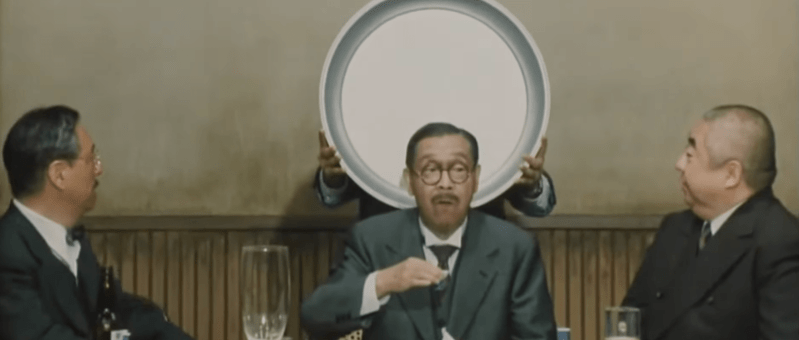
Signs of a sense of irony and an underlying darkness are, however, present in his improvised version of a march he would have taught the students during the years of militarism on which he comments on the disillusioning realities of new era of “democracy” under the Occupation ruled by bribery and corruption. The students decide to hold a birthday party for the professor they christen the “Not Yet Fest”, taking the lines from a child’s game of hide and seek to ironically ask if he’s ready to throw in the towel first, actually featuring a performance of his funeral which might seem insensitive but Uchida can be relied upon to see the funny side. During the party the former students give various speeches, one announcing he will recite the names of all the stations from one end of the country to the other, but no one really pays very much attention to them. The students even track on a large white dinner plate during a children’s song about the moon to hold behind Uchida’s head as if he were a buddha achieving enlightenment. 

Yet the crisis comes when, shortly after the students buy Uchida and his wife a new house to live in, their beloved cat Alley disappears, plunging the professor into a well of existential despair that leaves him unable to sleep or eat. The depths of his sorrow perhaps hint at his childish sincerity, though there is an undeniable poignancy in the attachment of the childless couple to this cat that chose them as its family. Despite the best efforts of the students along with the local community, Alley never returns though the professor and his wife learn to love a new cat who like Alley wandered into their garden and found a home. As in the poem that inspires Uchida in his “ascetic” life in the hut, life is an ever-flowing river. The waves of students that flowed through his classroom, the homes that were destroyed and rebuilt, the cats who stayed as long as they could and then made way for the new visitor all of them small circles of life that will continue long after he is gone. 

But as Uchida says, “Not Yet”. Like Kurosawa himself who feels the light dimming he asks for more time as if playing hide and seek with death whose presence he must eventually acknowledge even if he’s not quite ready to welcome him in. At the last Not Yet Fest that we see times have clearly changed. Uchida’s wife is now present along with the daughters and granddaughters of the students, one of whom points out they’ll soon be genuine old geezers themselves. For a moment we think we see the boy from 1943. Uchida tells the children to find their passion and give their lives to it, imparting one final not quite lesson while gifting them the cake they’ve just brought him in order of his 77th birthday. A 77th birthday is supposed to be lucky, though seven sevens are also 49 which is the length of a Buddhist mourning period and the time it takes to be reborn. The cycle begins again, as Uchida may know as he dreams of childhood hide and seek only to be distracted by a surrealist sky in its pinks and blues, a vista apparently painted by Kurosawa himself who lets the clouds roll into the credits an endless stream of dream and memory on which our lives are mere bubbles that disappear and form anew. But perhaps, not yet. 

A Quiet Life (静かな生活, Juzo Itami, 1995)

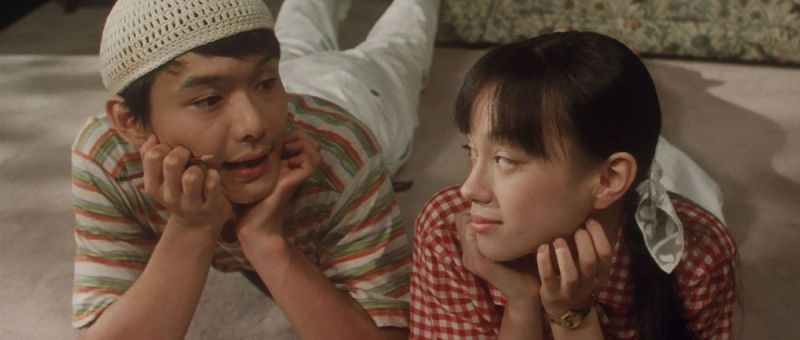
“One person is not a tool for another” the heroine of Juzo Itami’s 1995 melodrama A Quiet Life (静かな生活, Shizukana Seikatsu) eventually writes in her diary quoting her novelist father but also reflecting on herself and her life in which some have indeed attempted to use others for their own ends. Outside of international mega hit Tampopo, Itami is best known for a series of anarchic comedies each starring his wife Nobuko Miyamoto as forthright woman tackling the ills of contemporary Japan from tax evasion and increasingly amoral capitalism to the yakuza and shady cults. Based on a novel by his brother-in-law Kenzaburo Oe, A Quiet Life is therefore something of an outlier yet once again addresses a number of social issues from treatment of disability in the contemporary society to the relationships between parents and children and the dangers of a rapidly modernising society. 

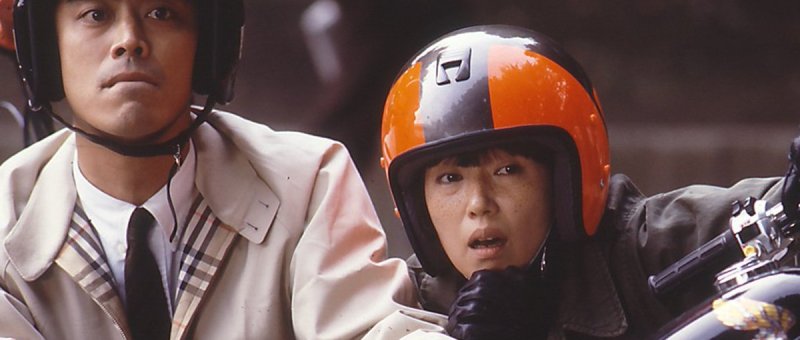
Middle daughter Ma (Hinako Saeki) lives in a large Western-style in the country with her father, internationally renowned author K (Tsutomu Yamazaki), mother and two brothers the oldest of which, Eeyore, has some learning difficulties but is largely independent. Nevertheless, when K, who is experiencing a moment of crisis that leads him to consider suicide when he is unable to fix a problem with the drains and has to resort to a plumber, is offered a job at a university in Australia Ma is left in charge at home and therefore responsible for her brother. Though the family fully accepts Eeyore, it’s clear the world around them is not always so kind. As they approach a centre for the disabled on a walk, others around them openly express disgust, suggesting they are a “bad influence” and wanting to leave the area entirely. 

Meanwhile as the film opens two children are locked together in a game of magnets, a collection of adults attempting to pull them apart by force. The shot is later repeated as Eeyore holds his sister in the rain following a traumatic and unexpected incident and demonstrating the close and affectionate bond between the siblings. Yet there is an uncomfortable suggestion from some that Ma is being asked to sacrifice her life to look after her brother who after all is unlikely to marry and will require additional care as long he lives, while she is perhaps slightly overprotective and wilfully self-sacrificing. “Don’t expect another human to sacrifice their life for you” goes another of her father’s lines, “to expect such a thing is the worst kind of depravity”, the family otherwise committed to the insistence that Eeyore has his own life and interiority which must neither be sacrificed, nor sacrificed for, for to do so would be to deny his personhood. Eeyore is not a tool for Ma’s charity nor is she a tool for the family’s duty towards him. 

Nevertheless even she is not immune to negative stereotyping becoming increasingly concerned that her now adult brother may pose a threat to the local community in his lack of understanding and inability to control his impulses. When a child molester is on the loose in the village, she is terrified Eeyore may be involved having read a newspaper report about a similar crime committed by someone with learning difficulties uncomfortably echoing the prejudice of the walkers by the disabled centre not to mention to middle-aged women who openly gossip about it in front of their house. Meanwhile, her own naivety becomes a threat when she allows a smarmy young man, Arai, to give her brother swimming lessons later learning that he has a grudge against her father who he feels “used” him to facilitate his art having bought and drawn inspiration from his experiences of being accused of a crime but leaving readers with the impression that he was a sex offender. 

Arai may indeed be trying to use her for revenge and at any rate is not all he seems even if the implication of her father’s story is that he wanted to sacrifice himself to save the young man. While K works through his artistic block offscreen aided by his wife (whom he soon forgets once he’s well), Ma has a series of epiphanies of her own over an eventful summer you couldn’t really call “quiet” even if there’s a strange tranquility in its anarchy. Going to some dark and unexpected places, Itami’s gentle dramedy veers away from the zany comedies of his earlier career but discovers a kind of serenity in the quiet of life of the siblings getting on with business of living in the sometimes hostile Japanese countryside. 


Original trailer (no subtitles)

Party 7 (Katsuhito Ishii, 2000)

“This shit’s for real.” according to the front desk guy at Hotel New Mexico, an out of the way spot just perfect for those looking to lay low for a little while. Like a lot of Katsuhito Ishii’s work, Party 7 is essentially a series of self-contained vignettes which eventually collide following a series of bizarre coincidences revolving around some money stolen from the mob, a two-way mirror in a regular hotel room, and the receptionist’s tendency to almost literally shoot the shit. 

Following a brief prologue, Ishii opens with striking animated sequence which introduces each of the main players with an arcade game aesthetic and explains that Miki (Masatoshi Nagase) has stolen money from the mob and is currently on the run which is why he’s turned up at the infinitely weird Hotel New Mexico. The running gag is that Miki thinks he’s holed up somewhere no one will find him, but sure enough a series of “friends” soon turn up in part thanks to a loose-lipped travel agent. The fact that people can find it so easily dampens the impression of the Hotel New Mexico as some kind of interstitial space. It’s not so much existing in a weird parallel world as a bit run down and staffed by a series of eccentrics. It does however have a “peep room” hidden behind a two-way mirror where “Captain Banana” (Yoshio Harada) is attempting to pass his knowledge on to the young Okita (Tadanobu Asano), the son of a recently deceased friend who has been repeatedly arrested for voyeurism. 

Captain Banana’s insistence on his surreal superhero suit is in a way ironic, if perhaps hinting at the super empowerment of accepting one’s authentic self. “It’s your soul,” he tells Okita, “it’s screaming ‘I want to peep’.’” Meanwhile, Miki gets into an argument with his ex-girlfriend Kana (Akemi Kobayashi) who has turned up in the hope of reclaiming money that he owes her. Kana too seems to be less than rigorous with the truth if perhaps emotionally authentic. She’s now now engaged to a nerdy guy having somewhat misrepresented herself as the innocent girl next-door type. Her refusal to let her fiancé into her apartment perhaps hints at a more literal barrier to intimacy or at least that she is intent on preventing him from seeing her true self. What she doesn’t know is that her fiancé hasn’t been completely honest either, in part because he thinks she’s out of his league and is insecure in their romance. 

Miki too maybe somewhat insecure, having run off with the gang’s money after hearing them bad mouth his associate Sonoda (Keisuke Horibe) who has now been charged with killing him and getting the money back. But Sonoda too has reasons to doubt the boss’ affection for him after Miki and the others point out that gifts he thought were so valuable are really just cheap knock offs that suggest the boss thinks very little of him at all. Okita’s psychiatrist tells him that there are “no rules in making friends”, and maybe in a strange way that’s what everyone is trying to do. Kana wanted the money to overcome her anxiety about having no friends or family to invite to the wedding, while all Sonoda wanted was the boss’ approval and though Miki had deliberately gone somewhere he thought no one would find him nevertheless attracts a series of followers. 

Even the receptionists seem to be desperate for human contact with their strange stories of poo falling from the sky and bizarre approach to hospitality. “The point is whether you believe it or not,” one tells the other after spinning what sounds like a yarn but then again might not be. Ishii’s zany world has its own surreal logic culminating in a piece of cosmic irony and defined by coincidence as the otherwise unrelated stories begin to come together and slowly find their way to Hotel New Mexico but seems to suggest the point is in the serendipity of the meeting and its concurrent authenticity even if a literal shot in the arm is a less than ideal way of brokering a friendship.


Party 7 is released in the UK on blu-ray on 17th July as part of Third Window Films’ Katsuhito Ishii Collection.

Original trailer (English subtitles)

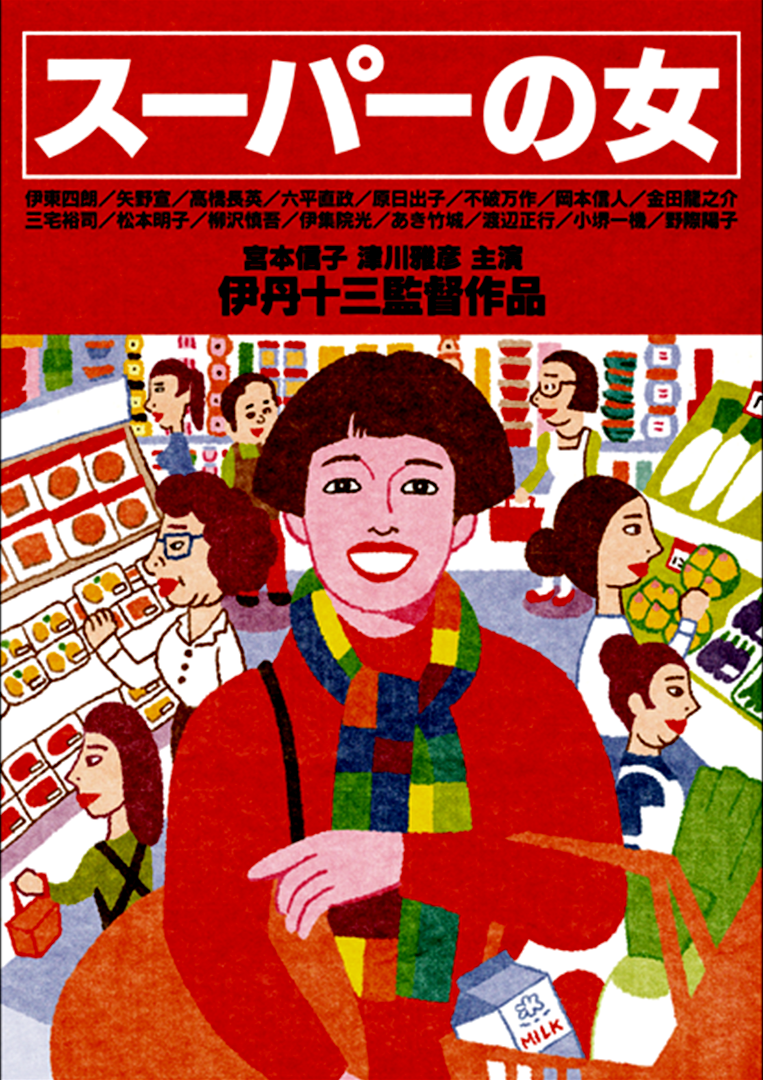
Supermarket Woman (スーパーの女, Juzo Itami, 1996)

By 1996 Japan had entered an extended period of economic stagnation which signalled the end of post-war aspiration but for many at least the false promises of the Bubble era proved hard to dispel. In what would be his penultimate film, Supermarket Woman (スーパーの女, Supa no Onna), Juzo Itami turns his attentions to the insular world of the nation’s family-held, independent supermarkets to ask a few questions about integrity in business which cut straight to the heart of what kind of society post-Bubble Japan intended to be given yet another opportunity to make itself anew. 

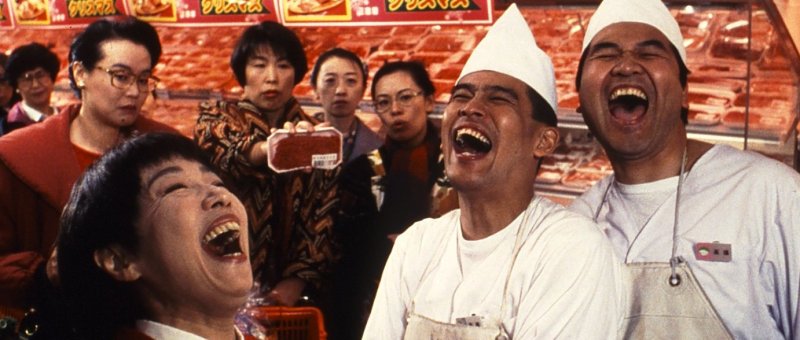
As the opening text crawl explains, this is a story not about giant supermarket chains but your friendly indie local. “Honest Mart” is a family-owned, mid-range supermarket in a declining industrial area nominally run by absentee CEO Goro (Masahiko Tsugawa) who was bequeathed the place by his father but is a melancholy drunkard delegating responsibility to his manager. The store has a huge problem in that a rival has recently re-opened under the new name “Discount Demon” and seems primed to steal all their business. On a stakeout of the new place, Goro runs into a childhood friend, Hanako (Nobuko Miyamoto), who is now a widow returning to the area. With her lifelong experience as a veteran housewife, Hanako knows a few things about supermarkets and she’s not very impressed with Discount Demon, doing a few quick calculations to realise the supposed discounts aren’t as enticing as they seem while common gimmicks like the all pervasive red glow that makes their meat look fresher than it really is only irritate her. Goro asks her for a “professional” opinion on Honest Mart without telling her who he is, only to discover she’s even less impressed with them, certain that his place is on the way out thanks to its dated decor, uninviting atmosphere, and low quality produce. 

The irony is Honest Mart is not much better than Discount Demon, both stores are subject to the same industry standards in which a certain degree of obfuscation is permissible. “In business honesty doesn’t pay” Hanako is told by the onsite butcher after she questions his tendency to mix meats to pass them off as more expensive cuts, while she later discovers that the store engages in the practice of repackaging unsold meat and fish with new expiration dates and is not very particular about its suppliers when it comes to buying in ready-made products. Brought on board to save the store, Hanako breezes in with a new mission to win the hearts and minds of her customers, and she can’t do that if she can’t have confidence in her stock. In any case, her the customer is always right policy quickly brings her into conflict with the store manager, an older more conservative man who actively resists innovation and resents having his authority undercut by an interloping woman. 

Meanwhile, we can also see that customer attitudes have changed. There’s a problem with availability of trolleys because, perhaps unusually for Japan, customers are just abandoning them willy-nilly in the carpark instead of retuning them to the trolley point like responsible shoppers. One man is even for some reason intent on stealing a large number of shopping baskets, caught by Hanako loading them into his car. Everybody wants cheap, which is understandable especially given the economic situation, and they might even be a little underhanded when it comes to getting it, but they also expect a reasonable level of quality and to be able to trust that the food they’re buying is safe to feed their families. Hanako is most alarmed that the ladies who work in the kitchen area, who are obviously wives and mothers themselves, do not shop at Honest Mart because they know what goes on at the store and they don’t trust it. 

“A housewife knows” Hanako is fond is saying. Her revolution is in essence a vindication of “the housewife”, perhaps the most maligned and dismissed figure of the mid-90s society, putting to good use all of her veteran experience both of running a home and of working a series of part-time jobs including those in supermarkets which she claims to love. Approaching the problem from the point of view of a consumer, she attempts to help Goro achieve his dream of making Honest Mart number one in Japan not through making it the most financially successful but the most loved by listening to women like her in the form of a focus group of local aunties some of whom had previously been serial complainers. 

Then again, some of her decisions are in a sense contradictory as she attempts to streamline the business along classically capitalistic lines in suggesting that the store doesn’t really need its overqualified butcher and fishmonger because the part-timers could be trained to do a “good enough” job. “Good enough” is in a sense her business philosophy, only not in the sense that somewhere like Discount Demon which falsely advertises regular steak as discount Wagyu means it, rather that her customers are after an everyday level of produce and so it’s not surprising that premium meats don’t sell. She wants to get rid of the butcher, who turns out to be on the fiddle, and the melancholy fishmonger disappointed no one wants his top quality seafood, because their “artistic temperament” is disruptive to the flow of the store and their presence is perhaps emblematic of the bloated, pretentious management style which is holding it back. 

Positioning the “housewife’s choice” as the ultimate seal of approval, Supermarket Woman advocates for a return to wholesome, small-town values, prioritising a sense of integrity as Honest Mart projects itself as a corporate force their customers can trust, perhaps anticipating a trend in dedicating itself to providing good quality fresh produce at fair prices in direct opposition to Discount Demon and its underhanded trickery. “Honest Mart keeps its word” Goro assures, pledging to honour a mistaken ad which promised eggs at prices so good it caused minor riot. In the end, it’s all about trust and integrity. If you don’t have that, you don’t have anything and the housewives of post-Bubble Japan will it seems vote with their feet. 


Currently available to stream in the US via Criterion Channel.

Original trailer (no subtitles)

The House of Hanging (病院坂の首縊りの家, Kon Ichikawa, 1979)

Unlike many directors of his generation who either shifted into television or saw their careers stall, Kon Ichikawa was able to continue working throughout the difficult 70s and 80s precisely because he was less averse to taking on commercial projects such as 1976’s The Inugami Family, an ensemble mystery adapted from the bestselling book by Seishi Yokomizo and starring his famed detective Kosuke Kindaichi. The film proved an unexpected hit, an early success for Haruki Kadokawa’s new multimedia marketing model which would allow him to dominate cinema screens throughout the bubble era, and spawned a series of Kindaichi adaptations produced for Toho boasting a host of A-list stars. By 1979, however, the age of the prestige country house mystery was perhaps coming to a close and The House of Hanging (病院坂の首縊りの家, Byoinzaka no Kubikukuri no Ie) would be the last in the cycle of movies starring Koji Ishizaka who would eventually return to the role in Ichikawa’s 2006 remake of the original Inugami Family. 

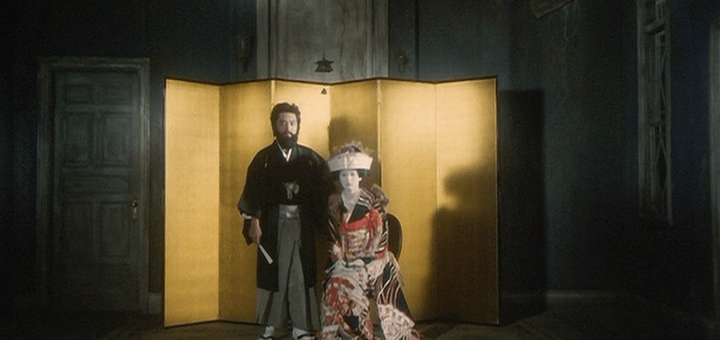
Set quite specifically in 1951 (Showa 26), House of Hanging is among the more complex of Kindaichi’s cases and rests not on war trauma, which is only a background presence in the present venality of the post-war society, but on the decline of a once noble house ruined, as we find out, through the legacy of sexual immorality and abuse. For the moment, however, Kindaichi gets roped into the mystery after visiting an author friend (played by Seishi Yokomizo himself in a cameo) who recommends a photo studio he could visit in order to get a picture taken for his passport as he plans to travel to America. The photographer, Naokichi (Koji Shimizu), takes on an odd job from a strange young woman who asks them to take wedding photos of her sister but abruptly leaves explaining she’ll send a car later to bring them to an undisclosed location. That turns out to be the bombed-out former home of the Hogen family who own the local hospital. Escorted by a creepy young man, Naokichi finds himself in front of a traditional gold screen backdrop but feels uncomfortable because the bride does not seem to be very present and he worries that perhaps she’s been drugged and something untoward may have been going on. He shows the photo to Kindaichi for advice and is later called back to the same location to discover the severed head of the groom hanging from a ceiling light.  

In slightly comedic fashion, the circumstances of the case are so confusing that they have even Kindaichi admitting that he doesn’t quite follow while his temporary sidekick, photographer’s apprentice Mokutaro (Masao Kusakari), proudly holds up a chart he’s made to help keep track. Though the why is in this case more important than it might usually be, it boils down to the same old problem of buried secrets and past shame. We learn that the Hogen family is descended from a line of prominent doctors, though the family tree is complicated because it appears many of the sons of previous generations had illegitimate children, some of whom were later adopted or married to other adopted children in a quasi-incestuous union. With no one quite sure whose children are whose, incest appears to be the original sin which condemns the family, though as we later realise it’s another kind of abuse which sets the present events in motion.

The murdered man, Toshio (Teruhiko Aoi), was apparently part of travelling jazz band earning their living playing on American bases (the photographer also has a sideline in blackmarket army surplus). Aside from the original sin that connects the murders with melancholy fatalism, the additional victims damn themselves through their amoral greed, foolishly engaging in blackmail in the hope of improving their circumstances. Nevertheless, the sin remains the same, the theory being that Toshio was murdered by missing sister Koyuki who killed him in order to escape his inappropriate romantic obsession with her. The additional complication is that Koyuki looks near identical to Yukari (Junko Sakurada), daughter of the Hogen family, connecting the crime with the traumatic events of some years’ previously which led to the cottage becoming known as the “house of hanging” when the body of a young woman was found there having taken her own life. 

As in many of the other Kindaichi mysteries, the detective has only sympathy for those caught up in this complicated murder plot, many of whom are also victims acting simply to protect themselves ironically enough from the past trauma that has in a sense led to this sorry turn of events. Justice, in the end, takes care of itself though Kindaichi will also do his bit to protect those in need acting from a place of moral compassion rather than judicial censure. This final instalment in the Kindaichi cycle has slightly lower production values and a much less starry ensemble but sees Ichikawa adding a few idiosyncratic touches such as his fast, multi-angle cuts to a single person’s speech and a brief theatrical reconstruction sequence, while making time for the return of bumbling inspector Todoroki (Takeshi Kato) and the ironic comedy the series is known for. “Old things pass, that’s when new things are born” Yokomizo sagely advises in his cameo, Kindaichi apparently taking his leave from a corrupted post-war Japan for the bright lights of San Francisco, perhaps never to return. 


Original trailers (no subtitles)

The Devil’s Ballad (悪魔の手毬唄, Kon Ichikawa, 1977)

Devil's Ballad posterA year after his box office smash The Inugami Family, Kon Ichikawa returns to the world of eccentric detective Kosuke Kindaichi with The Devil’s Ballad (悪魔の手毬唄, Akuma no Temari Uta). Like many a Kindaichi mystery, Devil’s Ballad finds him called upon to delve back into the past to satisfy an ageing detective’s anxiety about an old case, only to be faced with a series of new ones as a consequence. This time, however, the mystery leans less on buried secrets than deeply held grudges, betrayals, and lingering feudal feuds as the post-war society tries and fails to free itself from ancient oppressions.

The film opens with a tryst between two adolescent lovers in the ominously named “Devil’s Skull Village” in 1950. Yasu (Yoko Takahashi), the girl, is at pains to let her boyfriend, Kanao (Koji Kita), know that she is keen to take the relationship to the next level but he is old fashioned and wants to wait until their union is formalised. The pair are interrupted by some of their friends who are in the middle of planning a celebration for a visit from a girl who moved to the city, Chie (Akiko Nishina). Meanwhile, Kindaichi (Koji Ishizaka) has arrived at the inn owned by Kanao’s mother Rika (Keiko Kishi) on invitation from a retired policeman, Isokawa (Tomisaburo Wakayama), who wants Kindaichi to look into the murder of Rika’s husband twenty years ago. Isokawa, then a young rookie, is convinced that Rika’s husband was not the victim but the murderer and the corpse actually belonged to another man entirely – Onda, a drifter who defrauded half the village with a wreath making scam.

Rika and her children – 20-year-old Kanao and his younger sister Satoko (Eiko Nagashima) who has prominent facial birthmarks and rarely leaves the house, came to the village with her husband and are therefore slightly divorced from the longstanding social rivalries. The village has two noble families – the Yuras and the Nires. Feeling the need to modernise, the Nires bet everything on vineyards and it paid off. The Yuras, by contrast, were defrauded by Onda’s wreath scam and lost their fortune and social standing. Yasu, Kanao’s girlfriend, is a daughter of the Yuras, but the Nire’s have been petitioning Rika for quite some time to have her son marry their daughter, Fumiko (Yukiko Nagano), who also has a crush on him (though this is largely irrelevant to her father’s dynastic ambitions). When the younger generation start getting bumped off in ways eerily similar to a local folk song, Kindaichi and Isokawa are on the case, wondering if these new murders have anything to do with their old one.

Despite its 1950 setting, Devil’s Ballad is unusual in resolutely making an irrelevance of the war which only receives a brief mention as an explanation for why some of the case files have been destroyed and for why marriage is such a hot button issue given the lack of men and abundance of women. Nevertheless, the crimes span a turbulent 20 years of Japanese history with the original murder taking place in the early ‘30s during a period of economic instability following the Manchurian Incident. In the socially conservative pre-war era, it seems Onda also got around and may have fathered several illegitimate children with women in the village, some of them noble, some not. These buried secrets seem primed to bubble to the surface now that the children are coming of age and marriage again becomes an issue as worried parents try to think of acceptable ways to block potentially “inappropriate” matches without sending their children off into ruinous elopements or tipping off the wrong people that their kids may not be their kids.

The crimes themselves, old fashioned as they are, are partly reactions to a changing society. We discover that the reason Rika and her husband were forced to come back to the village was that their showbiz careers were stalling – she was a vaudeville performer specialising in shamisen, and he a “benshi” (narrator of silent films) who became convinced his job was obsolete after witnessing a subtitled print of Morocco. Likewise, the two rival families cannot let go of their petty provincial privileges, and as Kanao angrily snaps back at his mother, Japan is now a democratic country and he is free to choose his own wife at a time of his own choosing with or without parental blessing. This remote village is perhaps isolated from the privations of the post-war world but it’s also stuck in the past, hung up on past transgressions and unable to move forward into the new era. However, the primary motivations for murder are as old as time – guilt, humiliation, and self preservation.

Ichikawa keeps things simple but splices in a few strange, avant-garde sequences of kokeshi dolls menacingly bouncing balls coupled with shifts to black and white, fast-paced reaction shots, and stuttering still frame sequences all while Kindaichi showers innocent passersby with his famous dandruff, the idiot police officer continues to offer ridiculous theories while his sergeant dutifully follows him around, and the local bobby perfects a line in hilarious pratfalls. Overlong at two and a half hours and falling prey to the curse of the prestige crime drama in spoiling its mystery through casting, the Devil’s Ballad may not be the best of the Kindaichi mysteries but offers enough of a satisfying twist to prove worthy of the Kindaichi name.


Original trailer (no subtitles)

A Taxing Woman’s Return (マルサの女2, Juzo Itami, 1988)

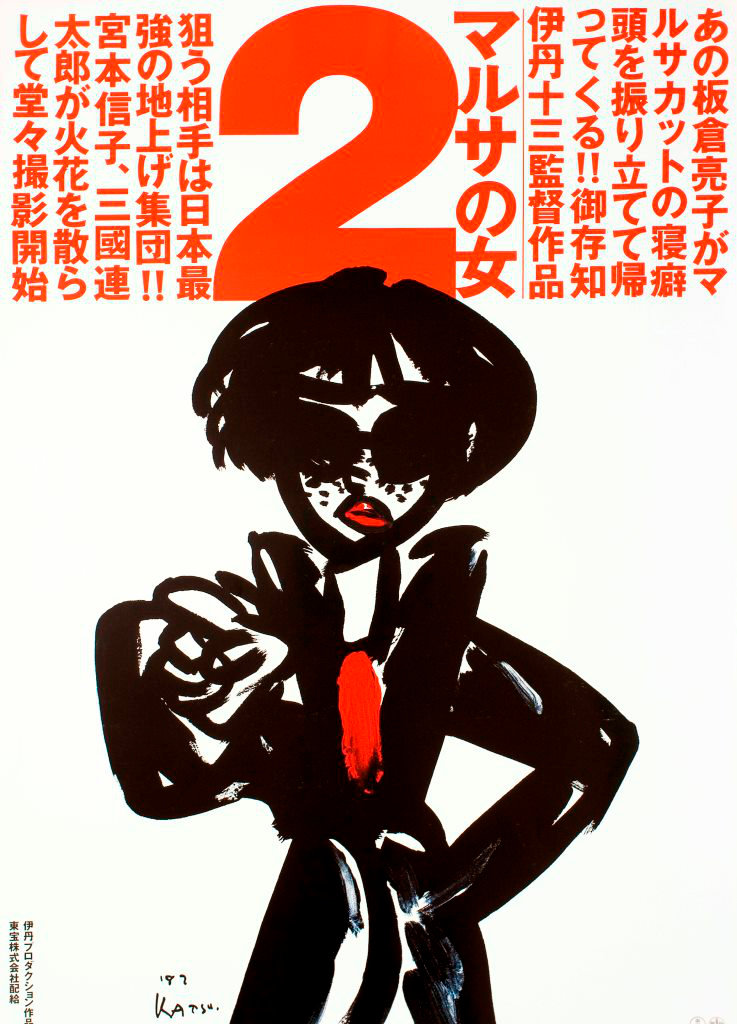
Taxing Woman 2 posterA Taxing Woman introduced us to Ryoko Itakura (Nobuko Miyamoto) – an oddball detective working as an insurance inspector who met her Irene Adler in a tax dodging corporate gangster with a limp. A year later she’s back, still the only woman working with the tax inspectorate and apparently still a dogged pursuer of those who would seek to defraud the Japanese government of its rightful earnings. Ryoko may have been a stickler for the rules who applied the same dog with a bone approach to a mom and pop store chowing down on its own supplies as to a dodgy yakuza led conspiracy, but she also believed in justice – something which stands her in good stead when she rubs up against a dodgy cult which, again, is a yakuza front but adds insult to injury by deliberately manipulating the vulnerable.

The action opens with some kids poking at the dead body of a “landshark” floating in a pond before flashing to a meeting of officials sucking crab meat from the shell and wondering what they’re going to do about this land they need cleared now their heavy is out of the picture. The corrupt politician from the first film, Urushibara (Takeya Nakamura), is apparently still involved in semi-legal land deals but palms the assignment off on a colleague. The big wigs need to empty a dated housing complex on some valuable land so they can build a vanity skyscraper – office space apparently being scarce in mid bubble Tokyo.

To do this they enlist the services of dodgy cult leader Onizawa (Rentaro Mikuni) and his troop of yakuza goons. Most of the tenants have already signed but they have three key holdouts – a diner owner clinging on to the family legacy, a stubborn paparazzo, and an intellectual professor who heads up the housing association. Unlike the yakuza of Taxing Woman, these guys have not reformed – they are the new/old style of lawless thugs who are perfectly prepared to threaten women and children to get their own way. Making it impossible for the tenants to stay through intimidation and noise torture, they stoop to blackmail to seal the deal.

Despite arriving only a year after A Taxing Woman, Taxing Woman’s Return (マルサの女2, Marusa no Onna 2) takes place in a much darker, though more obviously comedic, world. Whereas the earlier film adopted a noticeably ambivalent attitude to the tax inspectors and the enterprising gangsters, the villains of A Taxing Woman’s Return are so heinous and morally bankrupt as to be entirely indefensible even if the inspectorate takes a turn for the bumbling to compensate. The “cult” is, of course, merely a convenient money laundering front and tax dodge for the yakuza – religious organisations are exempt from taxation in the vast majority of cases which may be why the local tax office records hundreds of registered “religious bodies” in its jurisdiction alone. That doesn’t mean it doesn’t have its loyal followers, often vulnerable people looking for spiritual fulfilment but being bled dry by the money hungry cultists while the leader’s wife swans around in sables costing more than the average annual salary. A desperate devotee in need of a loan puts his own teenage daughter up as collateral only to see her raped by Onizawa, eventually becoming pregnant by him at only 16 years of age and thereafter becoming his devoted concubine in a bizarre instance of Stockholm Syndrome.

Yet for all the background darkness of weird cultists and nasty yakuza backed up by corrupt and venial politicians, Itami ups the cartoonish sense of the absurd with our hero Ryoko clambering over rooftops to listen in to the bad guys while her boss throws himself down flights of stairs and has to battle piercing sirens to get into the villains’ secret vault. It is however a dark humour as the opening makes plain with its troupe of little children staring at the strange shape floating in the water – a motif later repeated when a yakuza is gunned down in the street only for another group of children to pour over him as he expires, a single tear rolling down his cheek. The original spongy white body gives way to the businessmen sucking spongy white crab out its shell while insensitively discussing the late land shark, and the yakuza are unafraid to deploy a maggot infested severed hand (thankfully a fake picked up from a friend who makes horror movies) to convince the tenants they mean business.

At the end of A Taxing Woman, the gangster and the inspector reached something of a truce but one which came down, broadly, on the side of right. This time things aren’t quite so simple. The conspiracy is bigger and deeper, stretching all the way into the Diet and about more than just office space in still developing Tokyo. Onizawa, regarding himself as public servant, tries to say he did it all for his country, that if someone didn’t get their hands dirty Tokyo would be eclipsed by Hong Kong or Seoul. A post-war justification for a bubble era problem, but one that takes us straight back to the first film in Onizawa’s second proposition that only through money does he truly feel “immortal”. He may be a liar and a cheat, but he’s only a symptom of rapidly spreading infection, one which Ryoko and her team are powerless to cure, trapped on the wrong side of the fence while the bad guys build monuments to economic hubris, indulging in vanity in an era of bad faith which is about to be brought to a rather abrupt close.


Currently available to stream in the US/UK via FilmStruck.

Original trailer (no subtitles)