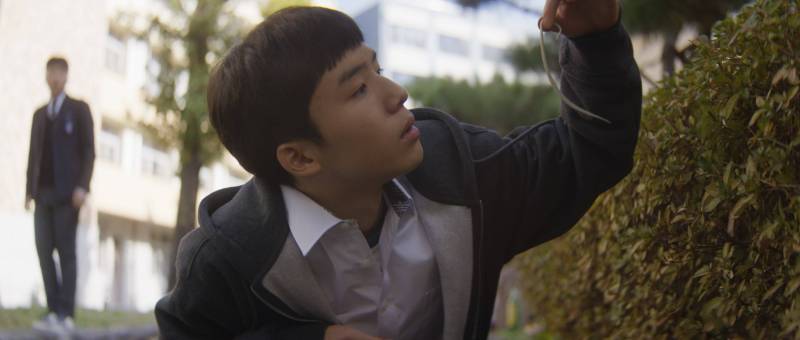
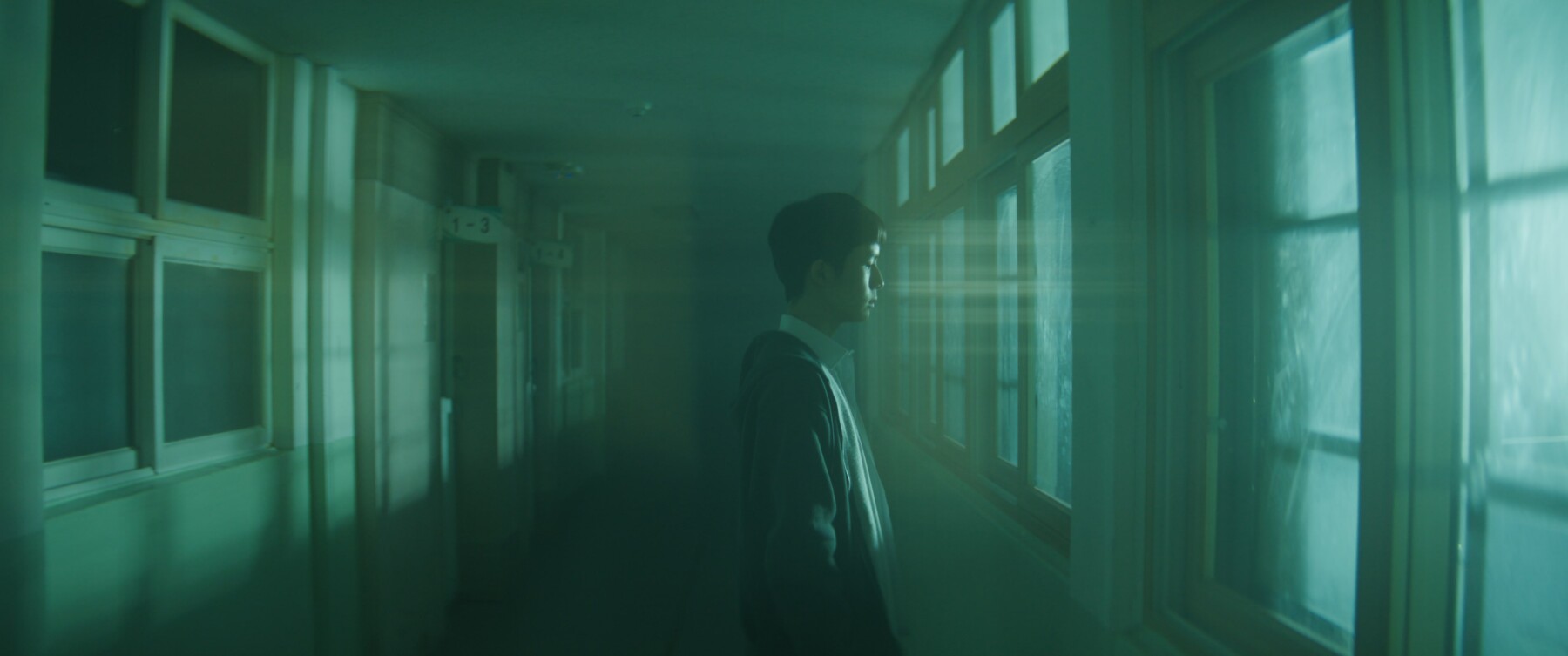
A young man with an apparently prodigious talent for writing comes to doubt himself when past trauma provokes what may either be a strange delusion or a very real exit of the muse in Son Kyeong-su’s supernaturally tinged exploration of the pressures of the contemporary Korean society, The Accordion Door (아코디언 도어). Constantly berated by his overly demanding mother as a small child for not being good at anything, Ji-soo (Moon Woo-jin) lives in fear of being labeled “a dummy” but has simultaneously become almost entirely detached from the world around him.
This is partly because he has no memories of himself before the age of nine when he went temporarily missing. In the opening sequences, the young Ji-soo is taken around an exhibition explaining the precipitation cycle by his parents who are each too busy sniping at each other to pay much attention to him. His mother blames his father’s lack of effort for Ji-soo’s apparent inability to fill in a worksheet demonstrating that he’s understood that water from the river becomes clouds and that clouds become rain. Crying on his own in the toilet, he poetically wonders if he too has become a cloud only for a cloud-like, or perhaps wormlike, being to enter his brain through his ears, turning him into an apparently different person who is addicted to chocolate and can perfectly articulate his thoughts in writing.
But as good a writer as Ji-soo might currently be, having recently won a national competition, he carries a strong sense of inferiority and worthlessness that’s largely caused by the seemingly conditional nature of his mother’s love which may be withdrawn if he were to become “a dummy”. His mother has separated from his father under the rationale that this will help make Ji-soo a better writer and is constantly pressuring him about winning more competitions. In a way, her determination is self-reflective in that she does not want her son’s mediocrity to make her look like a mediocre mother. When Ji-soo asks what he was like as a child, she tells him that he was “ordinary” and now he’s “brilliant”. When she replaces the expensive phone he had that got broken after he finally agreed to have one, she remarks that it’s just the kind that “ordinary” boys have, in case it gets broken again thereby presaging the fall from grace he undergoes believing that his talent has left him and migrated into Hyeon-joo (Lee Jae-in), the football-playing transfer student that Ji-soo has developed a crush on.
Hyeon-joo was the reason Ji-soo agreed to get a phone, but he’s equal parts attracted and threatened by her. He doesn’t know much about football, but it seems like she might not be all that good. When she starts to get better all of a sudden, his jealousy manifests in the paranoia that his talent left him for her, and he desperately wants it back so that he won’t be a “dummy” even if it ends up ruining his relationship with Hyeon-joo. Hyeon-joo, meanwhile, is much more laidback if just as alienated as he is. For her, it doesn’t matter if she’s any good at football as long as she enjoys it. She tries to encourage him that it’s the same with his writing. It shouldn’t really matter whether or not he wins any prizes, it only matters if he felt good while he was doing it. Her poet mother is the polar opposite of his own, encouraging Hyeon-joo to do what she likes doing and be happy even if there is nothing more to be gained of it than that. Becoming ever more insecure, Ji-soo tries to ask her for writing lessons, but all she tells him is that writing is an art that can’t really taught by one person to another. He must simply learn to teach himself. After all, he didn’t follow any rules when was writing something he was later proud of.
His science-obsessed friend Jong-yoon is similarly cheerful, rejoicing in his curiosity rather than thinking about what it might lead to or be worth to him in the future. Ji-soo’s mother had also been preoccupied with height, taking him to a doctor who seemed to be giving growth hormones, only for his growth spirt to begin as soon as he thinks his talent has left and bits of the past, or his imagination of it, start coming back to him. In a way this literal growth maybe a sign that he has begun to unpack some of his trauma and is experiencing a breakthrough that is destructive in the moment but also allows him to move forward. His mother lets up and finally divorces his father formally, while he no longer needs to be constrained by the idea that whatever talent he had was given by some mysterious parasite that took root inside him, but perhaps came from himself if only he could learn to embrace his love for it rather than be scared into silence by his fear of not being good enough. The implications of Ji-soo’s dreams maybe rather melancholy if lending an elliptical quality to his existence, but Son’s quietly empathetic, abstract film, does for a time at least allow him to find solace in his art in a sometimes unkind and judgemental society.
The Accordion Door screens as part of this year’s London Korean Film Festival.
Trailer (no subtitles)

