Last Night in Taipei (明日的過客, Kuo Cheng-chui, 2025)

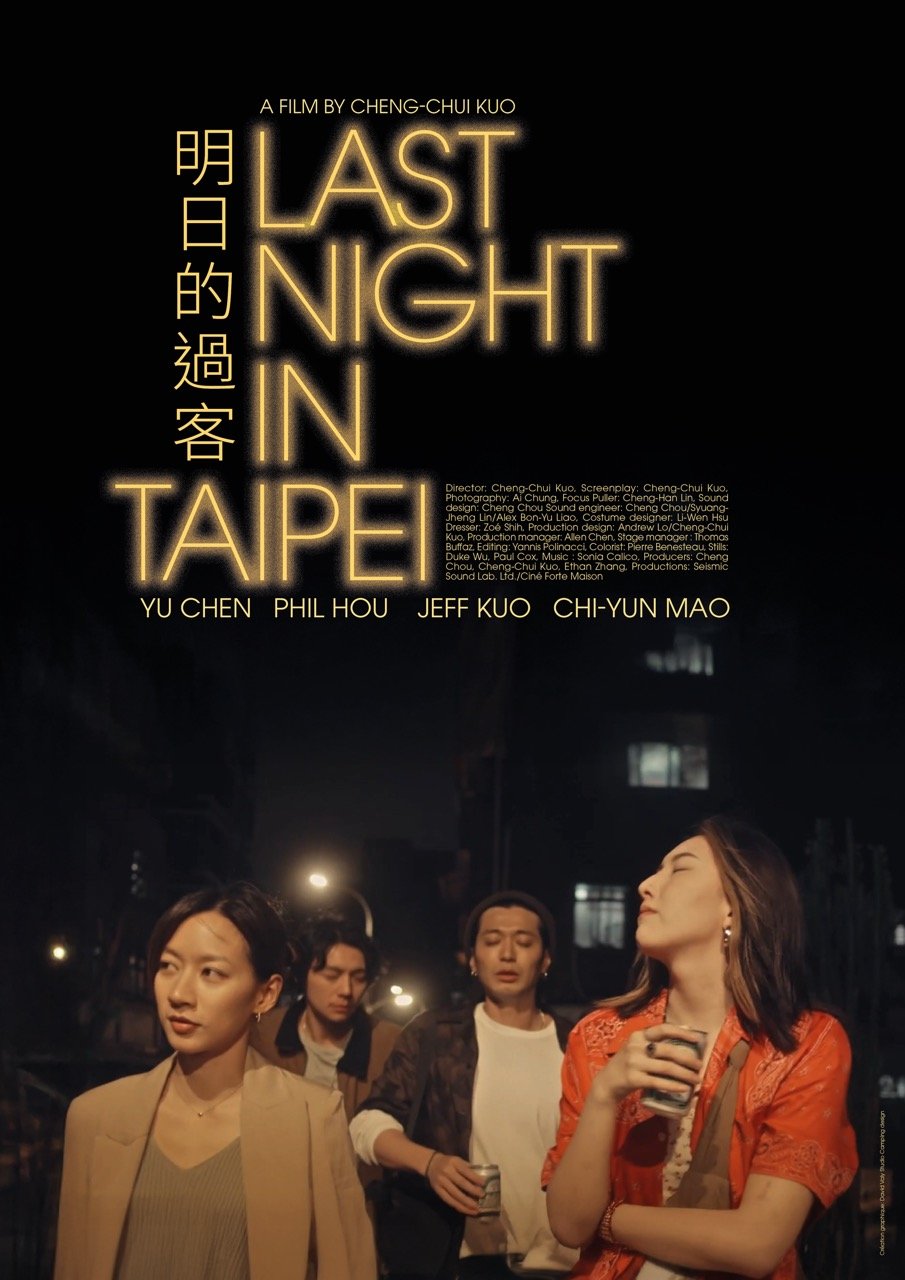
Three old friends who haven’t seen each other in years are forced to confront the reality of their lives after a chance encounter in Kuo Cheng-chui’s Last Night in Taipei (明日的過客, míngrì dì guòkè). Less an odyssey through the midnight city, the film is really more about finding accommodation with a sense of middle-aged regret and letting go of what might have been, though it does not necessarily seem that any of them are really happier after dealing with their unresolved feelings.

Blanche’s marriage has begun to turn cold owing to her husband’s deference to his mother who is upset that they have yet to conceive a child and continually dropping off Chinese medicine to help them along. After arguing with her husband Ben when a date night is abruptly cancelled she decides to stay in the city alone where she immediately runs into an ex, Jake, who is on a trip home from Paris where he as lived for the last few years. To begin with, it isn’t quite clear whether Blanche has actually met him at all or is just fantasising about what her life would be like if she’d stayed with him rather than ending up Ben whose chief advantage seems to be his wealth.

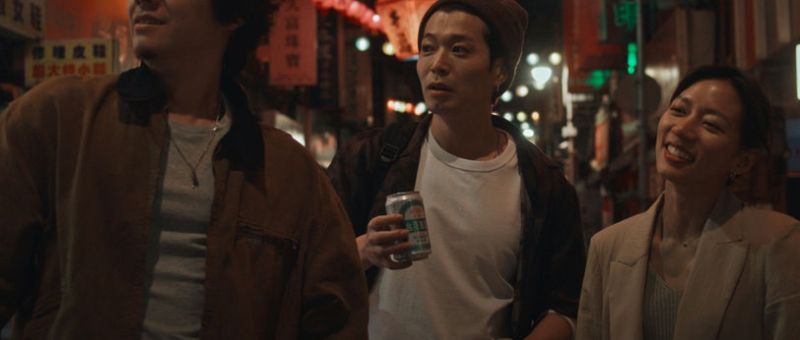
But Jake is similarly feeling lost in that he feels out of place in both Paris and Taipei and is perceived as a foreigner in both places. Meanwhile, he’s harbouring unresolved feelings about the end of his relationship with Blanche. While wandering though the city, the pair walk into a bar where their old friend Axin is currently working. His current girlfriend, Mao Mao, later joins them, but their relationship is not all it seems as Mao Mao essentially hired Axin to play the part of her boyfriend for 99 days to make an ex jealous and is now having difficulty dealing with the end of the arrangement.

The trio met when they were all aspiring actors, and they have to one extent or another each failed to fulfil their dreams. Only Axin is seriously persevering with performing, but he to is coming to the conclusion that he has failed as an actor and it’s time for him to leave Taipei. Blanche, too, regrets not having had the opportunity to play a proper role and is feeling unsatisfied with her married life. She wonders if this is all there really is and her entire life is already decided. Perhaps she only stays with Ben because it’s become convenient while the risks of leaving outweigh the benefits. Jake too always felt as if Taiwan was a liminal space, not somewhere he’d stay indefinitely, so he never put down roots. He reflects how much the city has changed, almost if it did so deliberately to give them memories as these spaces seem to retreat from them back into the past. 

The frequent references to missiles and intrusions into their airspace echo this sense of restless anxiety that this current existence might soon disappear or be taken from them. The sense of impending doom forces the three friends to reassess their bonds and missed connections providing an opportunity for at least partial emotional honesty even if these unresolved feelings are not fully addressed. Mao Mao too must reevaluate what she was looking for in her relationship with Axin in which he too was perhaps merely putting off the act of confronting himself and his life.

Though they may each discover a way of moving forward, no one seems all that happy about it. Blanche considers leaving her marriage, but ultimately stays perhaps because she lacks the courage to actually do it and resigns herself to an unfulfilling future. Jake still feels adrift and blames himself for the failure of his relationship with Blanche, realising that he let her down out of fear and immaturity. Axin too decides to move on, but is left with a sense of regret, while Mao Mao too can only resolve to start over again from day one. In some ways the friendship between them might have been repaired with the air cleared, but on the other hand as Axin says real friends don’t necessarily need to be in contact all the time and each seems to be left a little lonelier even than before in having closed a door to the past with seemingly none to open to the future.


Last Night in Taipei screened as part of this year’s New York Asian Film Festival.

Trailer (dialogue free)
Mama Boy (初戀慢半拍, Arvin Chen, 2022)

A diffident young man gets a few lessons in love after falling for a middle-aged madam in Arvin Chen’s charming romantic dramedy, Mama Boy (初戀慢半拍, chūliàn mànbànpāi). The English-language title at least is a kind of pun, the awkward hero both described as a mother’s boy and falling for the mama of a hotel providing sexual services, but also hints at the awkwardness involved in his attempt to assert his independence at the comparatively late age of 30 by choosing to spend time with a mother the polar opposite of his own. 

Xiao-hong’s (Kai Ko) mother Meiling (Yu Tzu-yu) describes him as “shy”, though the mother of one of the girls she attempts to set him up with less charitably brands him “not normal”. Not normal is closer to the way Xiao-hong thinks of himself, wishing his mother would stop with the blind dates knowing that in his awkwardness he ends up making women feel uncomfortable and has no idea how to talk to them. His sleazy cousin/boss at the tropical fish shop where he works, insists on taking him to an exclusive brothel where he is instantly captivated by the middle-aged madam, Sister Lele (Vivian Hsu). Too shy to say anything, he continues returning to the hotel and hiring a sex worker to sit blankly in the room solely for the opportunity of exchanging a few words with her. 

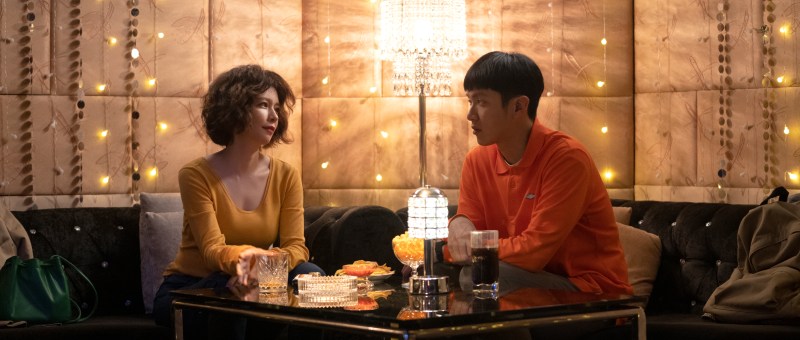
The two of them are in a sense in similar positions, a mother frustrated by a wayward son, and a son frustrated by his possessive mother. Some of Xiao-hong’s attraction at least is maternal in seeking a freer parental hand. Unlike his mother, Lele boosts his confidence by making him believe that he’s alright and girls are going to like him, while taking him to cosy nightspots and teaching him the basics of romance. She meanwhile admires him as an ideal son the polar opposite of her own. Weijie (Fandy Fan) only contacts her to ask for money (his father no longer answers his calls) and seems to be involved in several dodgy get rich quick schemes the latest of which is selling knock off wine while he’s also got himself in trouble with loansharks. 

There is something a little uncomfortable in the contrast presented between the two women, the prim and proper mum Meiling raising a sweet, polite child like Xiao-hong who nevertheless lacks several important life skills because of her overparenting, while the child raised by former sex worker Lele is a no good two bit wise guy. Lele certainly seems to see Xiao-hong as a symbol of her failed maternity believing that his mother must have raised him well while she blames herself for her son’s failings feeling as if she couldn’t give Weijie the attention he deserved because she was a single mother who had to work to support him. 

Meanwhile they are also each lonely, Xiao-hong shy and isolated and Lele spending her nights drinking alone in bars being chatted up by sleazy men. Spending time together they develop a tentative bond of love and affection only to find their connection interrupted by Weijie and Meiling each of whom obviously disapprove. Meiling has a suitor of her own in a retired police academy professor she rejects out of a sense of repressive properness but eventually warms to after feeling she needs police assistance to reclaim her son from Lele realising that he’s stopped picking her up from work in order to give Lele lifts instead. 

Despite the romantic themes, both women are essentially reduced to the maternal through their experiences with good son Xiao-hong, Lele trying to patch things up with the wayward Weijie while Meiling realises that she’s overstepped the mark and and will have to let go a little to let Xiao-hong live his life or risk turning him into a perpetual mother’s boy who’ll be all alone once she’s gone. Xiao-hong meanwhile begins to gain confidence, asserting himself as an individual free of his mother’s control now no longer so diffident in talking to women thanks to the patient ministrations of Lele. With its quirky production design and fairytale atmosphere Chen’s tale of first love delayed is also one of unexpected connection and mutual acceptance that perhaps missteps in effectively negating the relationship at its centre but nevertheless has only sympathy for its lovelorn hero. 


Mama Boy screened as part of this year’s New York Asian Film Festival.

Original trailer (English subtitles)

Images: © 2022 Filmagic Pictures Co.