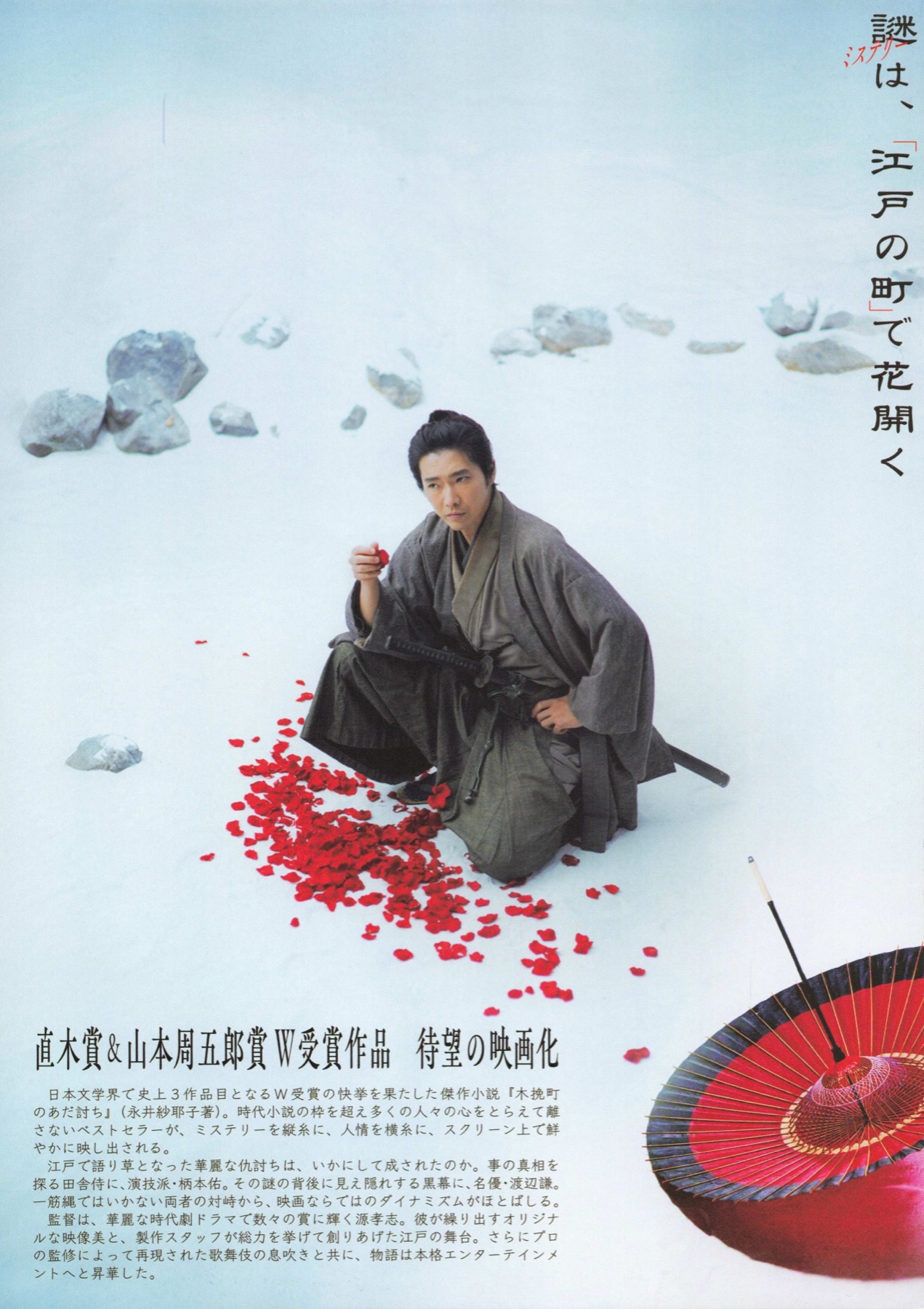
The life of a samurai is to some extent dependent on ritual. It’s as much a performance as anything else, yet, unlike a play, these actions often have very real and destructive consequences that result in bloodshed or exile. Though absurd and arbitrary, it’s adhering to this code of ethics that makes one a samurai, and once set in motion the consequences of a particular action proceed with inevitability. One cannot, in the end, escape one’s duty or destiny even by resigning samurai status.
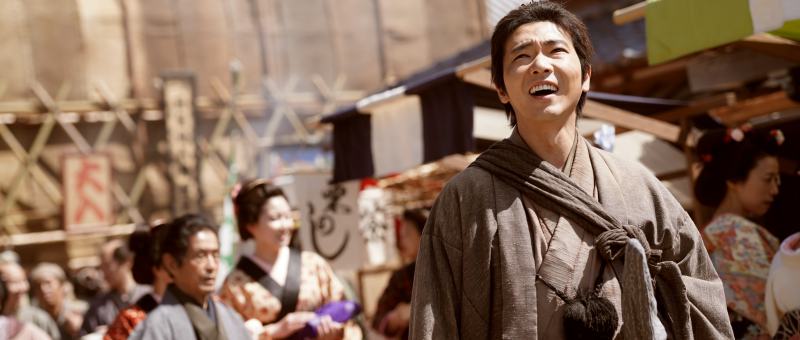
This is really the idea at the centre of Takashi Minamoto’s Samurai Vengeance (木挽町のあだ討ち, Kobikicho no Adauchi) in which a playwright conspires to take the blood out of revenge and finds largely that the conditions are met for the samurai world to continue on without incident. The fact that the act of vengeance is essentially theatre is clear from the opening sequence in which fallen samurai theatre director Kinji (Ken Watanabe) orders the spotlight-like lanterns to be turned on the scene of a young man who has raised his sword against an older one he holds responsible for the death of his father. The action takes place adjacent to a theatre where a performance of the 47 Ronin, one of the most famous tales of vengeance in Japanese history, has just concluded, and this is, in a way, a continuation of that. Attracted by the commotion, a crowd has started to gather around the two men that becomes both audience and witness to this act of performative justice.
But then the film wrong-foots us slightly, and we realise the central mystery is not to do with the staged performance itself, but the true identity of the man who has come around asking questions about it. Kase (Tasuku Emoto) too is playing a role, in this appearing as a bumbling, Kindaichi-like presence claiming to be a friend of the dead man, Sakubei (Kazuki Kitamura), who to some extent did not really exist having been giving an entirely new persona to suit the narrative of the staged revenge plot. Though Kase claims to have been kicked out of his clan and become a ronin himself, which explains why he has no money and is always hungry, he is later revealed to be a clan investigator who has fallen foul of the authorities after attempting to expose the corruption of a senior retainer.
Though the rules of samurai society may be strict, they can be gamed by those ruthless enough to subvert them for their own ends. This seems to be something that Lady Tae, the mother of the revenge-seeking Kikunosuke (Kento Nagao), knew all too well and understanding the performative nature of samurai justice, turned to her old friend Kinji to save her son from falling victim to the cruelty of their class. At only 17, Kikunosuke is a slender and effete young man of delicate features and sensibility. He does not appear to be suited to the harshness of samurai mores and being forced to take the head of a man who not only saved his life but is someone he’s been close to since the day he was born would likely destroy him.
His fragility is signalled in the fact he first appears dressed as a woman in a beautiful red kimono passed down from a retired onnagata to the current holder of his name. As they say, the world of the theatre is like another country and a place where those who do not otherwise fit into Edo society can be accepted. Kikuosuke’s vulnerability and the unfairness of his plight endear him to the members of the theatre company who all feel an instinctive need to protect him. Indeed, Kikuosuke himself says that he is sorry to have to leave the theatre behind and will never forget the six months that he has spent there. It may be that he is much more suited to living in this environment which is the antithesis of samurai rigidity. In the end, the symbolic need for “vengeance” is satisfied without actual bloodshed. Though those in power know this to be so, they accept it and decline to ask further questions, but still the samurai world continues as it is and others will not be so lucky as to avoid paying with their lives for offending its exceedingly arbitrary values.
Samurai Vengeance screens as part of this year’s Toronto Japanese Film Festival.
Trailer (no subtitles)

