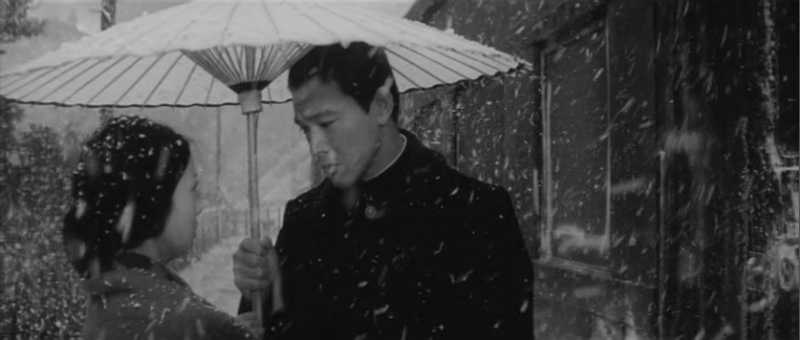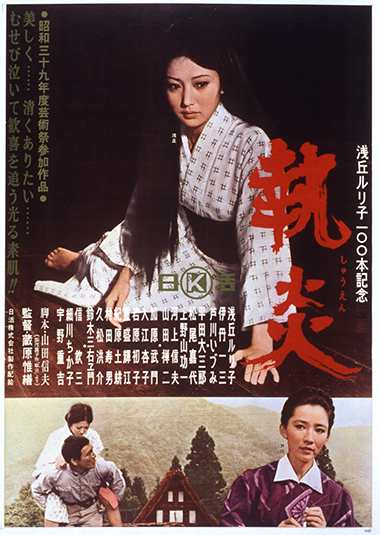
“What other way is there?” a young woman says to her mother, little understanding that what she so casually tells her quietly crushes her mother’s view of herself as if her long years of suffering had all been for nothing while exposing her justification that everything she had done was to save her daughter from her own fate as not strictly true. The opening scenes of Shohei Imamura’s The Insect Woman (にっぽん昆虫記, Nippon Konchuki) follow a bug stubbornly traversing rough terrain, slipping, pushing onward, overcoming obstacles, yet not really getting anywhere.
The bug’s journey is echoed in Tome’s (Sachiko Hidari) return to the village at the end of the film, now an ageing woman struggling with mountain roads after long years spent in the city and finally snapping her geta leaving her barefoot on rocky ground. Like that of the bug, Tome’s life seems to be a flat circle in which history repeats itself inexorably. The film opens in 1918 as Tome is born out of wedlock to a promiscuous woman who has entered a common law union with a man who appears to have learning difficulties. Chuji (Kazuo Kitamura) may or may not be her biological father, but has an attachment to Tome. As a child, she had asked him whether they are “married” seeing as they sleep together, and he had said that they were. There is definitely more than humouring a little girl’s silly question in his reply, while he flies into jealous rages when there is talk of marrying off the older Tome to the local landlord’s son.
Just as her mother had, Tome also has a child out of wedlock, though the father can only be Shuzo, the man her family intended her to marry in part in settlement of a longstanding debt. Tome’s early life is defined by the lingering feudalism of the rural society in which her family are serfs beholden to the whims of the landlord. The older women in the village call her away from her factory job which she says she is doing for the war effort to help on the landlord’s farm. Though she is assured she is only required to do farm work, she is raped by Shuzo who urges her to submit to him and serve her country in another way by letting him have his way with her as he will soon be going off to die for the emperor. Tome then becomes his woman, but not actually his legal wife while this justification wears a little thin when it is revealed that Shuzo has another woman and child already and thus will likely not marry her. When she becomes pregnant and Chuji beats Shuzo up, Tome is sent back to her family to have the baby. It turns out to be a girl and the older women have a brief conversation about whether to let it die as female babies are worthless and resources are scarce. This seems to run contrary to rural wisdom seen in other films such as Imamura’s later The Ballad of Narayama in which, grim as it is, male children are often exposed as girls at least can be sold, though possibly not any longer in the new democratic society.
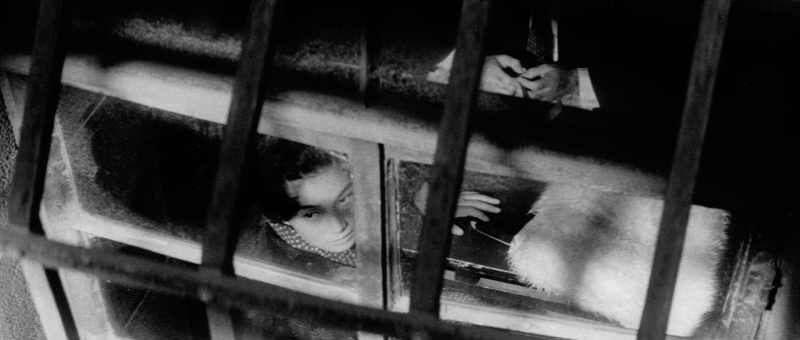
Nevertheless, Tome insists on keeping her baby though feels out of place among her family and returns to the factory where he she has an affair with the married foreman who gets her into trade unionism and then complains that she’s too militant about the labour movement when he gets promoted to assistant manager. Tome bristles at his hypocrisy, but later abandons her ideals herself and becomes an exploiter of women after moving to the city. After visiting a shady cult to overcome her sense of guilt after a child she was looking after who reminded her of her own faraway daughter died in accident, Tome meets a devotee who complains that all of the contemporary society’s ills are caused by a lack of religious rigour, yet is actually running a brothel staffed by “amateur” sex workers to which she forcibly recruits Tome by locking her in a room with a customer.
Just as Tome schemes by dobbing her new boss in to the police so she can start up her own business using the women as call girls posing as one half of a regular couple to avoid police detection, so she is later betrayed by her own prodigy. Tome’s travel from her rural hometown to Tokyo mimics the nation’s transition from an agrarian to an urban society mired in post-war corruption as seen in the cynical and exploitive conditions at the brothel in which the madam takes almost all the money for herself, deducting large amounts for things like kimonos and room and board, while the “amateur” sex workers prepare blood vials to convince the customers they are virgins. Tome always states that her goal is to earn enough money so that she, Chuji, and her daughter Nobuko who have been shunned by the family, could live together but though she becomes quite wealthy and sends large amounts of money home she makes no real attempt to bring them with her or to go back to the village.
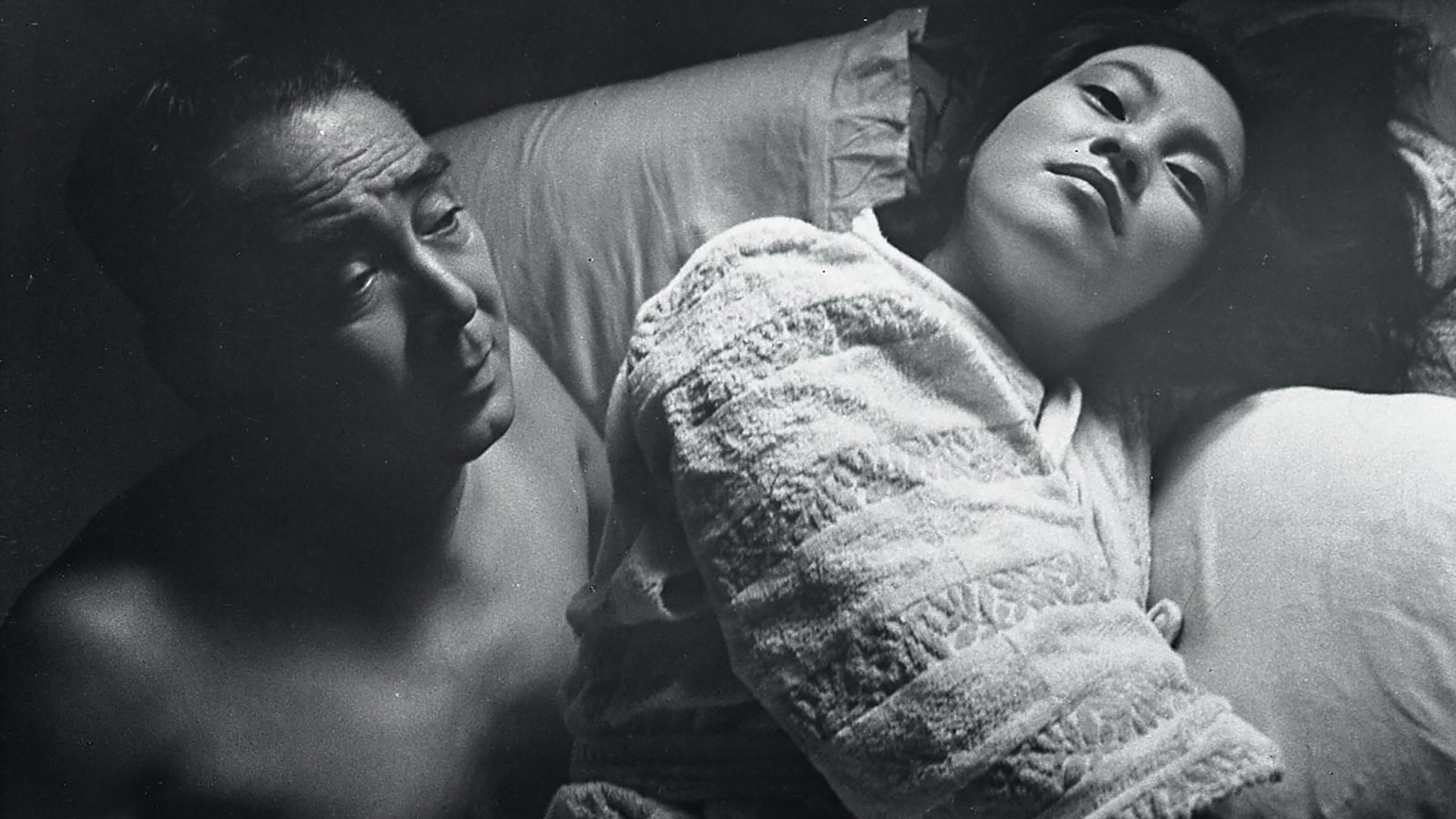
A grown-up Nobuko (Jitsuko Yoshimura) later comes to her and asks for money because some of the local youngsters are trying to start a collective farm in the wake of land reforms that redistributed landlords’ lands and ended serfdom. Tome is distressed to know that Nobuko has dropped out of school though Tome has been sending her money for the fees, realising that Nobuko will not escape the village through education nor through marrying a nice professional husband and moving to the city. In fact, Nobuko follows in the footsteps of her mother and grandmother by conceiving a child of uncertain lineage out of wedlock after being coaxed into a sexual relationship with her mother’s former lover, Karasawa (Seizaburo Kawazu), a once-prominent businessman who has fallen on hard times. He agrees to lend her the money for the farm on the condition that she make herself sexually available to him twice a week. He eventually asks her to stay and run a shop he owns instead. Nobuko agrees, but actually runs off with the money for the farm and returns to her boyfriend Yoshiji. Like Chuji, he also questions the paternity of her child, but seems to have accepted the fact it may not be his while agreeing to raise it. Tome, meanwhile, returns to the village on Karasawa’s behalf planning to tell Yoshiji about Nobuko’s life in the city in an attempt to force her to return to him.
In blowing Karasawa off and taking the money to invest in the farm, Nobuko may have broken the cycle in another way in shaking off male authority and rejecting the consumerism of the urban society, though her farm is also envisioned as a money-making business that will make them rich rather than purely self-sufficient. Another passenger on the train Tome is travelling on remarks that the rice tastes better because they have had good harvests, bearing out Nobuko’s optimism for the future. Yet in other ways, Tome is merely a passive everywoman largely oblivious to the history happening all around her. She misses the emperor’s speech announcing the end of the war while sick from malnutrition and canoodling with her lover. A former union organiser she ironically gets caught up in the Matsukawa train derailment that was blamed on the Communist Party and Japan National Railway Union which the authorities desperately wanted to crush. As an older woman, she runs into the 1960 Anpo protests, but is irritated because they disrupt her cab journey costing her time and money. She may have been corrupted by the urban, amoral capitalism of the post-war society, but is neither good nor bad, just herself and someone doing what they can to survive.
Imamura had said that he wanted to challenge the image of suffering womanhood seen in golden age cinema. Self-sacrificing heroines such as those in Naruse’s Floating Clouds or Mizoguchi’s Life of Oharu don’t really exist, he explained. His heroines were strong and outlived men, just like Tome who tries to carve out a kind of independence for herself, but eventually finds it taken from her by other women trying to do the same. Imamura had been prevented from making another film for three years after going over budget on Pigs and Battleships, but returns with a bold new stylistic experiment using freeze fames and ironic composition to depict the “messiness” of Tome’s life in all of its moral ambiguities, victories, and defeats.