The Military Policeman and the Dismembered Beauty (憲兵とバラバラ死美人, Kyotaro Namiki, 1957)

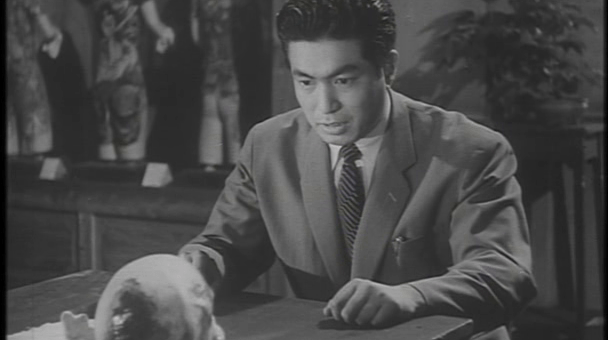
The Military Policeman and the Dismembered Beauty (憲兵とバラバラ死美人, Kenpei to Barabara Shibijin) was apparently a substantial hit on its release, though to modern eyes at least it doesn’t quite live up to the salaciousness of its title. In fact, it seems a little more interested in reassessing the militarist past while attempting to rehabilitate an authoritarian power and reframing it as good and compassionate unlike the corrupted killer who is selfish and ambitious to the extent that he’s literally poisoning the militarist wells. 

What we’re first introduced to, however, is a rather familiar tale of a soldier who’s gotten a girl pregnant but now won’t marry her mainly because he’s onto a good thing with a pretty girl from a prominent family so his girlfriend’s in the way. Though we see a prelude to the murder, we don’t get good a look at the soldier’s face (though we do hear his voice) which on one level hints at the generalised violent threat of the militarist machine but is also a neat plot device that allows us to into the crime but still maintains the mystery. When we do see the actual killing, it’s surprisingly frank for the time period and disturbing in its sexual charge though there is no gore involved save a grisly discovery in yet another well. 

The killing occurred shortly before the regiment left for Manchuria, which seems to be one way the killer sought to move on and leave his crime behind. The first hint of the corruption is discovered by a gang of new recruits as yet unused to the militarist machine. They notice that the water in the well in the barracks is bad, but are at first bullied and insulted by another soldier who’s been there longer and gives them a rather priggish speech about the sanctity of the regimental water. What they discover is that the water tastes bad because there’s a dismembered torso in there and has been for the last six months. One has to wonder why the culprit would think this a good place to hide a body given the risk of discovery and increasing suspicion but as it turns out no one is all that interested. The Military Police aren’t that keen on investigating themselves, and then we get the familiar conflict between the local cops and the specialists as a top investigator, Kosaka (Shoji Nakayama), is assigned to investigate the crime and insists on doing so thoroughly rather than just beating their favourite subject into a false confession. 

Kosaka is then posited as a nice Military Policeman, an emissary of legitimate authority rather than bumbling provincials who are ridiculous and self-serving not to mention incompetent and resentful. We’re told repeatedly that Kosaka is prepared to work with the civilian police unlike the other military policemen who insist on militarist primacy and refuse to allow the detectives onto the base to investigate. He’s a representative of a less authoritarian age that looks forward to the democratic future, but he is also a part of that organisation himself no matter how different he may seem to be and cannot escape the overarching structures of militarism. Nevertheless, his edges are further softened by a nascent romance with the middle-aged innkeeper at his lodging house while his assistant is after her sister, a childhood friend who can’t stop calling him by his old nickname. 

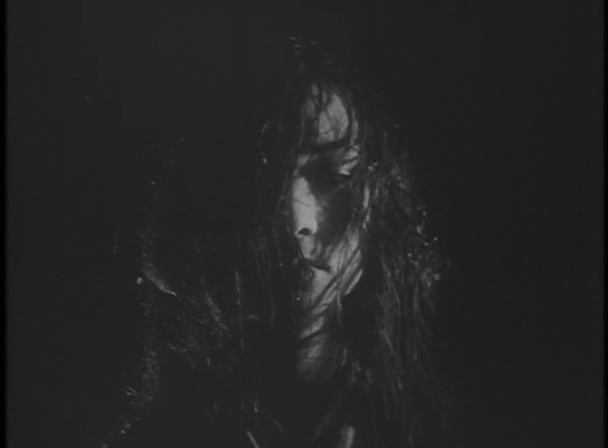
The two of them investigate scientifically, making frequent trips to the pathologist to discuss theories and evidence though Kosaka is eventually guided towards the solution after seeing the young woman’s ghost. The local military police meanwhile fixate on another soldier who has a reputation for using sex workers, one of whom has recently disappeared, though Kosaka thinks the man is a just a crook with what modern viewers make think of as a sex addition that sees him steal supplies from the kitchen to sell in order to finance his visits to the red light district. The military police whip him in an oddly sexually charged manner to try to get him to confess, but he maintains his innocence. One of the motives for the murder was seemingly that the victim planned to expose the affair, taking her concerns to the killer’s superior officer in an effort to force him to marry her which would have ruined his career prospects in what is supposed to be an organisation of honourable men. Unlike Kosaka who shares his name with the writer of the novel the film is based on which may have been inspired by true events, the other military police are largely like the killer, arrogant, selfish and unfeeling though all Kosaka himself represents is a supposedly more benevolent authority that for his niceness may not actually be all that much nicer.

No Regrets for Our Youth (わが青春に悔なし, Akira Kurosawa, 1946)

“Freedom is something you have to fight for” a young woman is ironically reminded by her progressively-minded father as she finds herself torn between the conservatism of her upbringing as an upper middle class daughter of an academic family and a bid for independence in the freedoms of the post-war society. In part a lament for a lost generation whose resistance towards rising militarism had been all but forgotten, No Regrets for Our Youth (わが青春に悔なし, Waga Seishun ni Kuinashi), is also the story of a post-war woman seeking new directions which in this case eventually send her back to the land.

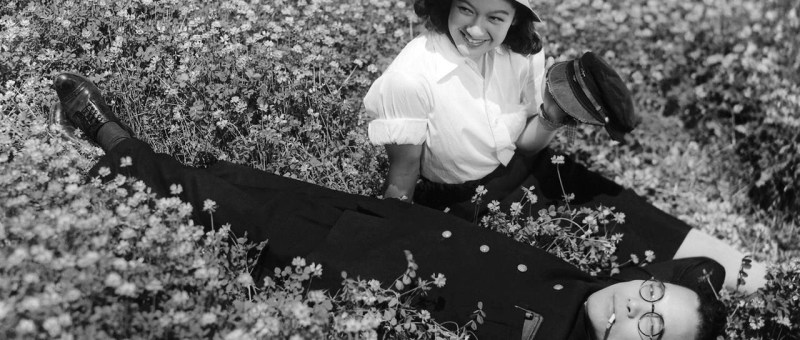
Then again, there’s no denying that Yukie’s (Setsuko Hara) dilemma is framed as romantic, torn between a dynamic communist and a spineless conservative while otherwise in her youth fairly vacuous. As the film opens, she frolics with some of her father’s students at a local mountain that overlooks Kyoto University. Caught on a stepping stone she awaits help from either the charismatic Noge (Susumu Fujita) or the diffident Itokawa (Akitake Kono) before Noge boldly dashes forward and carries her to the bank. Seeing Itokawa looking sheepish and embarrassed, she tugs on his student cap as if she hasn’t quite yet made up her mind which path she will take. “If I married you, my life would be calm and peaceful,” Yukie later reveals to Itokawa, “but it would also be a bit boring”, whereas if she married Noge “my life would burn so brightly that I might be blinded.” 

Even so, her outlook as the professor’s daughter leans towards the conservative. During the picnic on the mountain, the students suddenly hear the sound of cadets training with firearms Yukie exclaiming that it makes her heart race before ominously discovering the body of a wounded solider in the overgrowth. She declares that she hates “leftists” and that her father is a “liberal” not a “red” but will any case eventually be vindicated. Though attracted to Noge’s passionate nature, she seems to find him dull company, “boring” in his constant conversation about the rise of fascism while visibly bristling when he all but calls her a vacuous socialite and says she needs a “slap in the face to grow up” which is in a sense what he’s just given her. Her life had been that of a privileged upperclass girl cosseted from the world, engaging with refined pursuits such as playing the piano and learning traditional flower arrangement. Her epiphany seems to come when she realises she’s been doing as she’s told, reminded that flower arrangement is a means of self-expression suddenly tearing the heads off chrysanthemums and crafting something truly avant-garde that is in its own way quietly shocking. Notably her flower arrangements while living with Noge are much more harmonious. 

Still she wavers, wondering if she should give in to the quiet life she’d have with a man like Itokawa, a man with no ideology who sides with the militarists and becomes a prosecutor because it is expedient to do so, or continue to wait for Noge who by this point has been in prison and ostensibly renounced his socialist beliefs to join the army. What she chooses independence, breaking with the conventional life her mother wanted for her to support herself with a job at a trading company in Tokyo. Running into Itokawa in the city, he strongly hints to her that Noge is, from his point of view, up to no good running a kind of think tank as an expert on China. 

When Yukie chooses Noge she implies it’s because she wants “something I can throw myself into body and soul”, hoping to join him in his new cause prepared as her father had warned her to make sacrifices in the struggle for freedom. In the one sense, it’s Yukie making up her own mind to abandon her privileged background to live her life with no regrets, but it’s also impossible to ignore that the cause she dedicates herself to is that of her husband. Committed to making Noge’s parents, both peasant farmers, understand that he was not an “ungrateful” son but a man who did his best to oppose the war and fight for peace and prosperity in Japan, she commits herself to the land and wins them over with the strength of her resolve. The hands that once played piano are now rough with work and it is in this she has found her purpose. Yet it’s difficult to say if the austerity of her new life represents ultimate freedom or only further constraint in the imperative of her continued suffering. Perhaps it doesn’t really matter, if as she says she has no regrets for her youth as she joins hands with the peasant farmers leaving her privileged upbringing behind her even as her mother remarks that with her father reinstated at the university it’s as if nothing had changed. There is then something quite poignant as she sits by the stream and sees the students file past her singing their song of protest that in the end went unheeded while she prepares to reject modernity in its entirety and return to the simplicity of the land.


No Regrets for Our Youth screens at the BFI Southbank, London on 2nd & 10th January 2023 as part of the Kurosawa season.

The Ghosts of Kagami Pond (怪談鏡ケ淵, Masaki Mori, 1959)

“How could you do this to me?” asks a wandering ghost in Masaki Mori’s 1959 Shintoho kaidan Ghosts of Kagami Pond (怪談鏡ケ淵, Kaidan Kagami-ga-fuchi). Based on a story by Kozo Hayama, Mori’s supernatural morality tale is in many ways fairly typical for the genre save that the vengeance wreaked by the wronged spirit is extremely targeted rather than the sometimes indiscriminate curses aimed more at a corrupt society than the figures directly responsible for the death and mistreatment inflicted on the now wrathful ghost. 

The good-hearted hero, Yasujiro (Shozaburo Date), was forced to move to Edo after his father fell into disgrace with the Shogunate authorities and is grateful to have been taken in by the owner of kimono shop Ejimaya. However, his presence is intensely resented by veteran employee Kinbei (Joji Ohara) who had been expecting to inherit the business. Overhearing the boss, Jiemon (Hiroshi Hayashi), and his wife (Fumiko Miyata) discussing a possible marriage between Yasujiro and his childhood friend Kiku (Noriko Kitazawa) reunited by chance in the city, Kinbei realises that he intends to make Yasujiro his heir and hatches a plan to ensure that doesn’t happen beginning with selling Kiku’s sister Sato (Reiko Seto) a knock off wedding kimono that tears during the ceremony leading her intended’s family to cancel the marriage entirely leaving Sato a shamed woman in an impossible situation. Wandering the streets in despair intending to throw herself into Kagami Pond and thereafter become a vengeful ghost cursing the house of Ejimaya, Sato encounters Kinbei again and is killed in the ensuing struggle only to tumble into Kagami Pond sinking without trace. 

“No one ever floats up out of there” Kinbei later insists suggesting the pond as a possible dumping ground for additional bodies of which there are a fair few. As kaidan villains go, Kinbei is of the one note variety in simply being evil for no particular reason the only justifications offered for his ill conduct being his previous devotion to the kimono store and the fear that all his hard work will go to waste if Yasujiro is allowed to inherit. Even so, this seems disingenuous given an early scene in which an angry customer brings a kimono back complaining of shoddy work and suggesting she’s been fobbed off with a substandard product. Kinbei blames the whole thing on new employee Yasujiro though it later seems clear that he probably sold her a cheap kimono and pocketed the difference in price. 

He even goes so far as to mug Yasujiro in disguise, stealing 15 Ryo which he’d been transporting on behalf of the store attempting to sink his rival in debt. When Yasujiro’s disgraced father offers to sell a precious family sword to pay back Jiemon, Kinbei kills him too while 15 Ryo is also the amount for which he indentures Kiku to a brothel after framing her for adultery (illegal at the time) with the help of his sex worker co-conspirator Naka (Keiko Hamano) who bumps off Jiemon’s wife and quickly takes her place. Jiemon, who had previously been kind and fatherly insisting that Yasujiro and Kiku are like his own children to him, undergoes an unexplained and abrupt change of character becoming cruel and greedy, loaning money to another store holder in the assumption he won’t be able to pay it back in order to get his hands on his business and eventually party to all of Kinbei’s scheming little realising he most likely intends to bump him off too after he’s married Naka so that they will have full control of the business. 

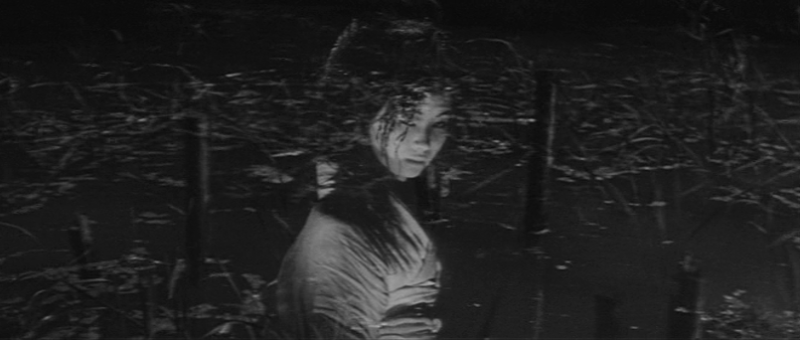
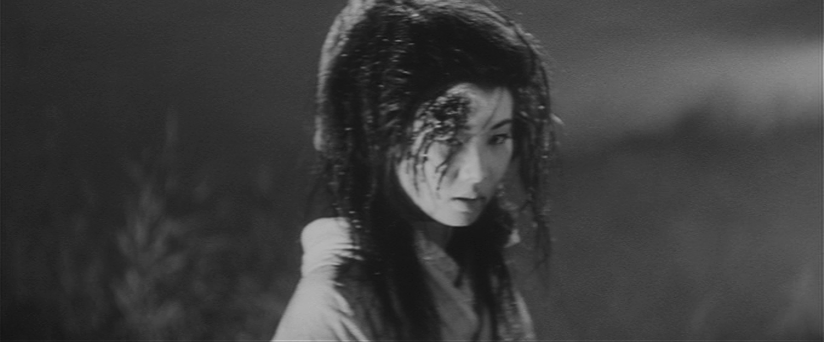
Kinbei is occasionally haunted by the rising ghost of Sato who chillingly repeats the phrase “How could you do this to me?” but carries on with his dastardly deeds anyway. As in most kaidan tales, she cannot hurt him directly but leads him to hurt himself by causing him to hallucinate, as do the ghosts of Yasujiro’s dad and the storeowner eventually calling him towards Kagami Pond and his watery fate. Some disjointed storytelling aside, the introduction of a potential ghost cat for example is never followed up, Ghosts of Kagami Pond is a fairly typical B-movie kaidan running a tight 60 minutes even if the effects and supernatural imagery are perhaps muted in comparison with Shintoho’s similarly themed ghostly morality tales. 


Clip (no subtitles)