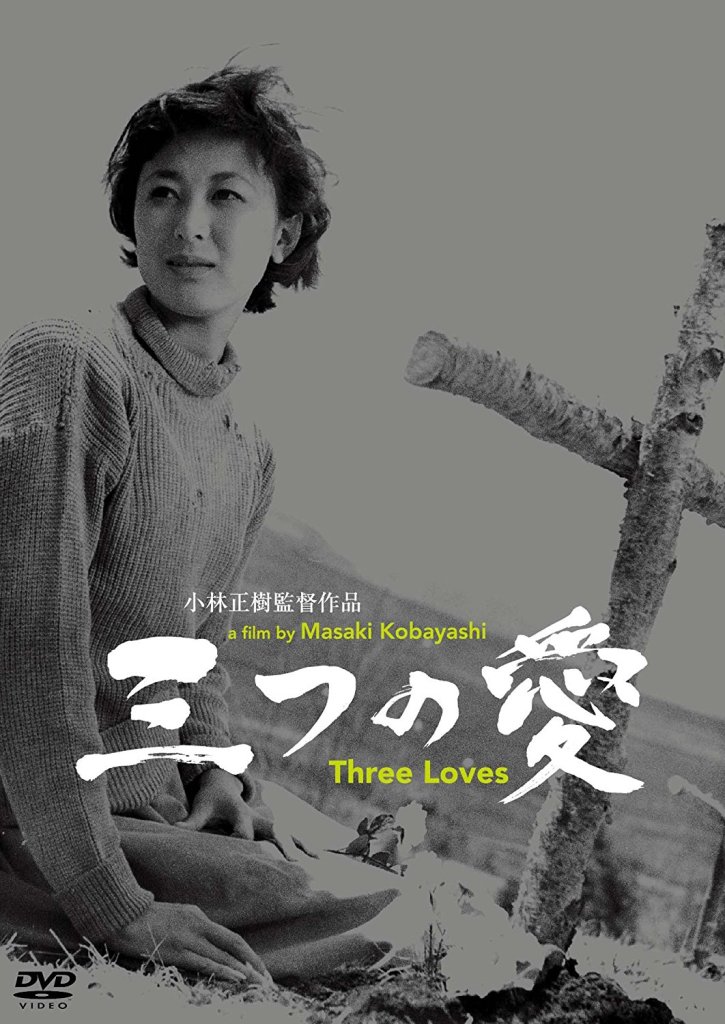
Three Loves (三つの愛, Masaki Kobayashi, 1954)

three-lovesMasaki Kobayashi had a relatively short career of only 22 films. Politically uncompromising and displaying an unflinching eye towards Japan’s recent history, his work was not always welcomed by studio bosses (or, at times, audiences). Beginning his post-war career as an assistant to Keisuke Kinoshita, Kobayashi’s first few films are perhaps closer to the veteran director’s trademark melodrama but in 1953 Kobayashi struck out with a more personal project in the form of The Thick-Walled Room which dealt with the fates of lower class war criminals. Based on a novel by Kobo Abe, the film was sympathetic to the men who had only been “following orders” but was careful not to let them off the hook. Still far too controversial, The Thick-Walled Room could not be released until 1957 and Kobayashi went back to more conventional fare such as this Christianity infused tale of three kinds of frustrated loves – romantic, spiritual, and familial, Three Loves (三つの愛, Mittsu no Ai).

Ikujiro is riding into town on a donkey cart, playing his flute which attracts the attention of a strange boy who exclaims that he is a butterfly. Following the death of his father, Ikujiro’s mother has apprenticed him to a man who owns a sake brewery but is also a member of the school board and has promised that he will get his education. Riding the same cart in is a down on his luck artist, Nobuyuki (Ko Mishima) – the lover of the town’s new music teacher, Michiko (Keiko Kishi), who has travelled to this remote country spot both for the benefit of her health and to help provide for her struggling artist boyfriend. This slightly unusual town is also home to a humble church whose Holy Father, Yasugi (Yunosuke Ito), came to the town as an evacuee alongside the now professor father of the little boy with a pigeon obsession, Heita.

Somewhat unusually, Three Loves opens with a choral rendition of a Christian hymn followed by a brief voice over and intertitle-style caption bearing the message that only those who live sincerely and seriously will be granted true joy but that this same joy is born from the bitterness and sadness of life. There are certainly an array of bitter circumstances on offer but Kobayashi choses to focus on them as filtered through three very different stories of love as children are separated from their parents, lovers are kept apart by cruel twists of fate and the love of God is both keenly and invisibly felt by those who take refuge at the underused church.

Ikujiro has been “sent away” by his mother who has been convinced to allow her oldest child to be raised by foster parents given that it will now be difficult for her to support all of the children in the absence of her husband. Feeling alone and unloved though missing his family, Ikujiro does not quite fit in at the local school but faces even more problems at his new home where it transpires that his foster father is not quite as altruistic as he originally claimed. Forming an odd friendship with Heita, Ikujiro begins to find some comfort in the place but nevertheless continues to suffer.

Heita, is, in many ways the heart of the film though his status as a kind of holy fool is perhaps uncomfortable from a modern standpoint. Yasugi, who has developed the closest relationship with the boy outside of his mother, describes him as beautifully sensitive and someone who requires especial care. Yet, his mother found it difficult to connect with him until he was allowed to return to nature, and his scholarly father mostly ignores him, describing his work as a kind of “atonement” for the way his son has turned out. Even given Heita’s unorthodox relationship to his environment in which he feels himself more bird or butterfly than human, he experiences only warmth and occasional exasperation from those around him rather than outright hostility.

These kinds of frustrated familial or social loves feed back into the intertwined romantic melodrama as tortured artist Nobuyuki has an attack of male pride in partially rejecting Michiko over her decision to become the major breadwinner despite her failing health. Professing love but remaining unwilling to marry because of his lack of financial security, he only wounds the woman he loves who wants nothing other than for him to go on painting and thinks of what he regards as a “sacrifice” of herself in working to support them both as part of their shared struggle. Becoming gloomy and depressed, Nobuyuki posits giving up on love, but eventually comes around, realising some things are more important than pride though old fashioned ideas about illness still pose a problem.

This in turn drives the central spiritual dilemma as Father Yasugi is forced to face his own emotional pain which he has long been trying to sublimate with service to something higher. Ten years previously, his wife left him for another man but his continuing love for her is the very reason he cannot bring himself to do what his own religion requires and forgive her for the pain and suffering which now cloud his heart. God is love, but love is pain and suffering without end. Thus he councils the romantically troubled couple against a marriage which may end suddenly creating even more heartbreak and everlasting sadness, which seems at odds with his own, and the film’s, insistence on the joy that life brings even whilst filled with sorrow and regret.

An early effort from Kobayashi, Three Loves is not as successful as his other work from the period offering none of the rawness or innovation of The Thick-walled Room, falling back on established melodrama techniques though making interesting use of montages and dissolves even if coupled with familiar horizontal wipes. The tone is more forgiving than Kobayashi’s later angry social tirades, but the muddled structure and strange use of religious themes make for a frustrating experience which ends in a traditionally melodramatic way offered abruptly and without further comment. A death of innocence may be Kobayashi’s concession to his own bleaker world view but feels like a standard Shochiku tearjerker ending, an afterthought tacked on as a concession to studio requirements. Still, an interesting meditation on the nature of love in all its different forms, Three Loves is an unusually contemplative piece even if frustrated by a slight clumsiness of execution.
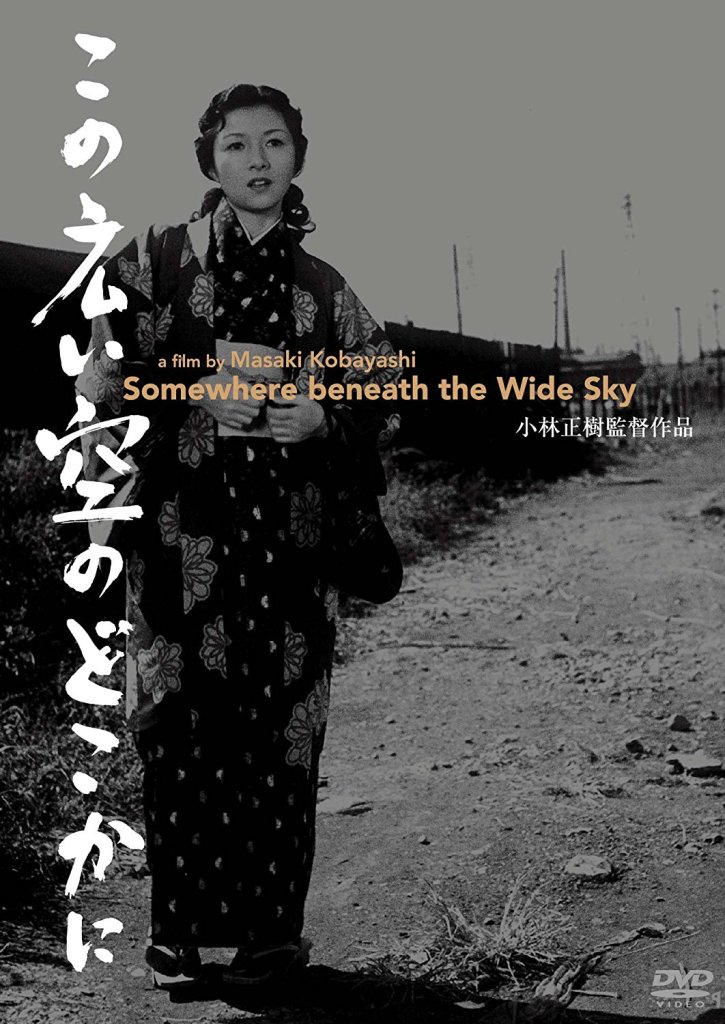


Somewhere Beneath the Wide Sky (この広い空のどこかに, Masaki Kobayashi, 1954)

somewhere-beneath-the-wide-skyOf the chroniclers of the history of post-war Japan, none was perhaps as unflinching as Masaki Kobayashi. However, everyone has to start somewhere and as a junior director at Shochiku where he began as an assistant to Keisuke Kinoshita, Kobayashi was obliged to make his share of regular studio pictures. This was even truer following his attempt at a more personal project – Thick Walled Room, which dealt with the controversial subject of class C war criminals and was deemed so problematic that it lingered on the shelves for quite some time. Made the same year as the somewhat similar Three Loves, Somewhere Beneath the Wide Sky (この広い空のどこかに, Kono Hiroi Sora no Dokoka ni) is a fairly typical contemporary drama of ordinary people attempting to live in the new and ever changing post-war world, yet it also subtly hints at Kobayashi’s ongoing humanist preoccupations in its conflict between the idealistic young student Noboru and his practically minded (yet kind hearted) older brother.

The Moritas own the liquor store in this tiny corner of Ginza, where oldest brother Ryoichi (Keiji Sada) has recently married country girl Hiroko (Yoshiko Kuga). The household consists of mother-in-law Shige (Kumeko Urabe), step-mother to Ryoichi, unmarried sister Yasuko (Hideko Takamine), and student younger brother Noboru (Akira Ishihama). Things are actually going pretty well for the family, they aren’t rich but the store is prospering and they’re mostly happy enough – except when they aren’t. Ryoichi married for love, but his step-mother and sister aren’t always as convinced by his choice as he is, despite Hiroko’s friendly nature and constant attempts to fit in.

As if to signal the dividing wall between the generations, Somewhere Beneath the Wide Sky opens with a discussion between two older women, each complaining about their daughters-in-law and the fact that their sons married for love rather than agreeing to an arranged marriage as was common in their day. These love matches, they claim, have unbalanced the family dynamic, giving the new wife undue powers against the matriarchal figure of the mother-in-law. While the other woman’s main complaint is that her son’s wife is absent minded and bossy, Shige seems to have little to complain about bar Hiroko’s slow progress with becoming used to the runnings of the shop.

Despite this, both women appear somewhat hostile towards Ryoichi’s new wife, often making her new home an uncomfortable place for her to be. Though Hiroko is keen to pitch in with the shop and the housework, Shige often refuses her help and is preoccupied with trying to get the depressed Yasuko to do her fair share instead. At 28 years old, Yasuko has resigned herself to a life of single suffering, believing it will now be impossible for her to make a good a match. Yasuko had been engaged to a man she loved before the war but when he returned and discovered that she now walks with a pronounced limp following an injury during an air raid, he left her flat with a broken heart. Embittered and having internalised intense shame over her physical disability, Yasuko finds the figure of her new sister-in-law a difficult reminder of the life she will never have.

A crisis approaches when an old friend (and perhaps former flame) arrives from Hiroko’s hometown and raises the prospect of abandoning her young marriage to return home instead. No matter how her new relatives make her feel, Hiroko is very much in love with Ryoichi and has no desire to leave him. Thankfully, Ryoichi is a kind and understanding man who can see how difficult the other women in the house are making things for his new wife and is willing to be patient and trust Hiroko to make what she feels is the right decision.

Ryoichi’s talent for tolerance is seemingly infinite in his desire to run a harmonious household. However, he, unlike younger brother Noboru, is of a slightly older generation with a practical mindset rather than an idealistic one. Ryoichi simply wants to prosper and ensure a happy and healthy life for himself and his family. This doesn’t mean he’s averse to helping others and is actually a very kind and decent person, but he is quick to point out that he needs to help himself first. Thus he comes into conflict with little brother Noburu from whom the film’s title comes.

Noburu is a dreamer, apt to look up at the wide sky as symbol of his boundless dreams. His fortunes are contrasted with the far less fortunate fellow student Mitsui (Masami Taura), who comes from a much less prosperous and harmonious family, finding himself working five different jobs just to eat twice a day and study when he can. Noburu wants to believe in a brighter world where things like his sister’s disability would be irrelevant and something could be done to help people like Mitsui who are struggling to get by when others have it so good. Ryoichi thinks this is all very well, but it’s pie in the sky thinking and when push comes to shove you have to respect “the natural order of things”. Ryoichi wants to work within the system and even prosper by it, where as Noburu, perhaps like Kobayashi himself, would prefer that the “natural order of things” became an obsolete way of thinking.

Nevertheless, it is the power of kindness which cures all. Gloomy Yasuko begins to live again after re-encountering an old school friend and being able to help her when she is most in of need of it. Being of use after all helps her put thoughts of her disability to the back of her mind and so, after hiding from a man who’d loved her in the past out of fearing his reaction to her current state (and overhearing his general indifference on hearing of it), she makes the bold decision to strike out for love and the chance of happiness in the beautiful, yet challenging, mountain environment.

Like many films of the era, Somewhere Beneath the Wide Sky is invested in demonstrating that life may be hard at times, but it will get better and the important thing is to find happiness wherever it presents itself. This is not quite the message Kobayashi was keen on delivering in his subsequent career which calls for a more circumspect examination of contemporary society along with a need for greater personal responsibility for creating a kinder, fairer and more honest one. A much more straightforward exercise, Somewhere Beneath the Wide Sky is Kobayashi channeling Kinoshita but minimising his sentimentality. Nevertheless, it does present a warm tale of a family finally coming together as its central couple prepares to pick up the reins and ride on into the sometimes difficult but also full of possibility post-war world.


Nobuko (信子, Hiroshi Shimizu, 1940)

vlcsnap-2016-12-09-01h11m57s027The well known Natsume Soseki novel, Botchan, tells the story of an arrogant, middle class Tokyoite who reluctantly accepts a teaching job at a rural school where he relentlessly mocks the locals’ funny accent and looks down on his oikish pupils all the while dreaming of his loyal family nanny. Hiroshi Shimizu’s Nobuko (信子) is almost an inverted picture of Soseki’s work as its titular heroine travels from the country to a posh girls’ boarding school bringing her country bumpkin accent and no nonsense attitude with her. Like Botchan, though for very different reasons, Nobuko also finds herself at odds with the school system but remains idealistic enough to recommend a positive change in the educational environment.

Travelling from the country to take up her teaching job, Nobuko (Mieko Takamine) moves in with her geisha aunt to save money. When she gets to the school she finds out that she’s been shifted from Japanese to P.E. (not ideal, but OK) and there are also a few deductions from her pay which no one had mentioned. The stern but kindly headmistress is quick to point out Nobuko’s strong country accent which is not compatible with the elegant schooling on offer. The most important thing she says is integrity. Women have to be womanly, poised and “proper”. Nobuko, apparently, has a lot to learn.

As many teachers will attest, the early days are hard and Nobuko finds it difficult to cope with her rowdy pupils who deliberately mock her accent and are intent on winding up their new instructor. One girl in particular, Eiko (Mitsuko Miura), has it in for Nobuko and constantly trolls her with pranks and tricks as well as inciting the other girls to join in with her. As it turns out, Eiko is something of a local trouble maker but no one does anything because her father is a wealthy man who has donated a large amount of money to the school and they don’t want to upset him. This attitude lights a fire in Nobuko, to her the pupils are all the same and should be treated equally no matter who their parents are. As Nobuko’s anger and confidence in her position grow, so does Eiko’s wilfull behaviour, but perhaps there’s more to it than a simple desire to misbehave.

Released in 1940, Nobuko avoids political comment other than perhaps advocating for the importance of discipline and education. It does however subtly echo Shimizu’s constant class concerns as “country bumpkin” Nobuko has to fight for her place in the “elegant” city by dropping her distinctive accent for the standard Tokyo dialect whilst making sure she behaves in an “appropriate” fashion for the teacher of upper class girls.

This mirrors her experience at her aunt’s geisha house which she is eventually forced to move out of when the headmistress finds out what sort of place she’s been living in and insists that she find somewhere more suitable for her position. The geisha world is also particular and regimented, but the paths the two sets of female pupils have open to them are very different. Nobuko quickly makes friends with a clever apprentice geisha, Chako (Sachiko Mitani), who would have liked to carry on at school but was sold owing to her family’s poverty. Though she never wanted to be a geisha, Chako exclaims that if she’s going to have to be one then she’s going to be the world’s best, all the while knowing that her path has been chosen for her and has a very definite end point as exemplified by Nobuko’s aunt – an ageing manageress who’s getting too old to be running the house for herself.

Eiko’s problems are fairly easy to work out, it’s just a shame that no one at the school has stopped to think about her as a person rather than as the daughter of a wealthy man. Treated as a “special case” by the teachers and placed at a distance with her peers, Eiko’s constant acting up is a thinly veiled plea for attention but one which is rarely answered. Only made lonely by a place she hoped would offer her a home, Eiko begins to build a bond with Nobuko even while she’s pushing her simply because she’s the only one to push back. After Nobuko goes too far and Eiko takes a drastic decision, the truth finally comes out, leading to regrets and recriminations all round. Despite agreeing with the headmistress that perhaps she should have turned a blind eye like the other teachers, Nobuko reinforces her philosophy that the girls are all the same and deserve to be treated as such, but also adds that they are each in need of affection and the teachers need to be aware of this often neglected part of their work.

Lessons have been learned and understandings reached, the school environment seems to function more fully with a renewed commitment to caring for each of the pupils as individuals with distinct needs and personalities. Even Chako seems as if she may get a much happier ending thanks to Nobuko’s intervention. An unusual effort for the time in that only two male characters appear (one a burglar Nobuko heroically ejects assuming him to be Eiko playing a prank, and the other Eiko’s father) this entirely female led drama neatly highlights the various problems faced by women of all social classes whilst also emphasising Shimizu’s core humanist philosophies where compassion and understanding are found to be essential components of a fully functioning society.


Four Seasons of Children (子どもの四季, Hiroshi Shimizu, 1939)

vlcsnap-2016-12-08-00h10m14s613Isn’t it sad that it’s always the kids that end up hurt when parents fight? Throughout Shimizu’s long career of child centric cinema, the one recurring motif is in the sheer pain of a child who suddenly finds the other kids won’t play with him anymore even though he doesn’t think he’s done anything wrong. Four Seasons of Children (子どもの四季, Kodomo no Shiki) is actually a kind of companion piece to Children in the Wind which also makes use of this motif, as they’re both based on works by the same author, Joji Tsubota, and feature the same cast playing characters with the same names. Four Seasons differs slightly in its form as it originally played as two films released at the same time with the piece split into four sections following the two central brothers across the course of a particularly traumatic year.
Beginning in spring, younger brother Sampei (Bakudan Kozo now known as Jun Yokoyama) is excitedly waiting for the arrival of an old man (Takeshi Sakamoto) who brings masks for the children and rides a fine horse. Unfortunately, Sampei takes a tumble and arrives last when only a noh style mask of a lady’s face remains which really doesn’t appeal to him (later he asks his older brother Zenta (Masao Hayama) to draw a moustache on it to make it look ”stronger”), so the old man offers to give him a ride on his horse to make up for it. Sampei and Zenta don’t think they have any grandparents, but Sampei thinks it would be nice if the old man were his grandpa for real.

After he does a typical Sampei thing and falls off a cow, Sampei’s mother (Mitsuko Yoshikawa) arrives and realises that, yes, mask man really is her estranged father who disowned her after she got married without his consent. Happy that perhaps her parents have finally forgiven her, Sampei’s mother is also a little bit worried as they’ve never explained to the children why they weren’t in contact with her parents and she’s afraid it might upset them. There’s also another problem. The boys’ father (Reikichi Kawamura) is currently very ill, and their dairy farm isn’t doing well either. The family have large debts secretly taken out with the father-in-law’s company behind his back, so all of this could quite easily backfire. More drama erupts when an ambitious underling, Rokai (Seiji Nishimura), realises there’s a possibility the old man will take his daughter’s family as his direct heirs rather than promote from within the company and starts on a series of fiendishly machiavellian plans to oust his rival.

The boys, however, know very little of this. They love their cows and life on the ranch, and the thing they’re most sad about is when they end up having to move in with grandpa for a while to avoid some of Rokai’s scheming. Having been very popular in their old town, the boys are slower to make friends and quickly run into a problem with the son of the man who’s causing their family so much bother. A typically melancholy episode sees little Sampei wandering off on his own to make friends with the carp in the local lake because there’s no one else for him to talk to. However, the boys later bond with their would be arch nemesis, Kintaro (Teruo Furuya), in defiance of the ongoing feud between their families, even going so far as to carry him on their back all the way home after he breaks his leg falling out of a tree when his father stupidly “repossesses” the backyard where the kids have been playing together safely.

Gradually, as time wears on, the allegiance of Kintaro and his mother starts shift away from Rokai and towards the boys and their family who have never been anything other than kind to them. In a nice piece of symmetry, it seems the two women were also close childhood friends who have been kept apart thanks to the ongoing pettiness instigated by the menfolk. The grandfather, having fully patched things up with his daughter, is doing his best to remain on the side of decency despite Rokai’s underhanded tactics but finds himself increasingly cornered by his finagling. The boys’ commitment to their friend and refusal to give in to Rokai’s attempts to use the children to perpetuate his feuding only serve to remind everyone how petty and self serving Rokai’s actions really are.

Rokai is several times described as “a real villain” by the disbelieving grandpa, constantly exasperated by the dishonourable conduct of someone he’d employed on his staff for several years. Yet aside from Rokai himself, it’s greed and pettiness that are the true villains of of the piece. The boys’ father gives them some very important advice for their future lives when he tells them not to strive to have more things than other people but to be generous in its place. Rokai, afraid and resentful, eventually gets his comeuppance, ending a long year of torment for the Ono family and restoring justice to an unjust world.

The boys themselves know little of the details of the feuds between their families, worrying about normal things like whether they’ll be able to go on to middle school and wondering how the cows are doing back at their old ranch. It’s these details at which Shimizu excels as usual, perfectly capturing the reality of childhood even whilst giving more space to adult concerns than he often did in many of his other, more purely child centred films. Once again making great use of location shooting, Shimizu captures the fast disappearing rural paradise the boys inhabit which is entirely divorced from the political tension of the day. Another warm and humorous tale of kids and the way they often become the accidental victims of a grown up dispute, Four Seasons of Children perfectly unifies all of Shimizu’s ongoing themes right up to its necessarily just, compassionate, ending.


Notes of an Itinerant Performer (歌女おぼえ書, Hiroshi Shimizu, 1941)

notes-on-an-itinerant-performerFilmed in 1941, Notes of an Itinerant Performer (歌女おぼえ書, Utajo Oboegaki ) is among the least politicised of Shimizu’s output though its odd, domestic violence fuelled, finally romantic resolution points to a hardening of his otherwise progressive social ideals. Neatly avoiding contemporary issues by setting his tale in 1901 at the mid-point of the Meiji era as Japanese society was caught in a transitionary phase, Shimizu similarly casts his heroine adrift as she decides to make a break with the hand fate dealt her and try her luck in a more “civilised” world.

At 25 years old, Uta (Yaeko Mizutani) jumps ships from one acting company to another having been promised better work by a roguish fellow performer. Tired of the strenuous life of travelling from village to village, putting on folk plays and street performances, Uta is thinking of quitting the business and looking for a job as a maid or something similar which is at least in the same place everyday. In a stroke of luck, she comes into contact with a kindly tea merchant who takes pity on her and suggests she come to live with him where she can teach his teenage daughter how to dance.

Uta becomes a member of the Hiramatsu household but not all of the inhabitants are as generous of spirit as Mr. Hiramatsu (Hideo Fujino) himself. The oldest son is away at college but the daughter, Nuiko (Kyoko Asagiri), has no interest in learning to dance and resents her father’s “adoption” of such a “common” woman. Youngest son Jiro (Haruhiko Tsuda) is similarly unimpressed with Uta’s presence, making her new home less than welcoming. To make matters worse, Mr. Hiramatsu abruptly dies leaving his business and household in disarray. Oldest son Shotaro (Ken Uehara) returns and feels as if he ought to abandon his studies and take over the company, but as a student he has no experience of running a business and lacks his father’s knowledge of the tea industry. Uta encourages him to return to university and finish his studies if only so that the prestige of a degree might help him later if he decides to restart the business. She also volunteers to act as a guardian for Jiro and Nuiko though Shotaro is wary seeing as they know each other so little. He then makes a surprising suggestion – that he and Uta marry, making it perfectly natural that she take care of everything at home while he’s away studying in the city.

Like many a Shimizu hero, Mr. Hiramatsu is a good hearted man but perhaps lacking in practical skills. Though he seemed to be prosperous and successful, the business was on the rocks and he dies leaving a number of debts behind him and total admin chaos for Shotaro as there is no clear successor to keep the business running in Mr. Hiramatsu’s absence. Luckily for Uta, Shotaro is also a kindhearted man like his father (in contrast to his siblings) and has no desire to suddenly throw her out when his father promised to look after her. He is, however, at a loss as of how to take care of everyone with no money coming in.

Even before Mr. Hiramatsu died, not everyone was happy about his decision to take in a travelling performer and an old friend begins to warn him about the danger of rumours. Friend of the family Kajikawa feels he has a stake in this as he intends his daughter Ayako to marry Shotaro and thinks it’s a done deal (though Mr. Hiramatsu does not seem particularly wedded to the idea). Ayako and Nuiko are also good friends and Ayako does seem like the ideal bride for Shotaro as a member of his own social class and a business connection for the family. Shotaro, however, proposes to Uta without really thinking things through. It is, in one sense, a purely practical decision but one that is likely to meet with a degree of social opposition.

Uta left her life as a travelling performer because she wanted something more conventional. Her mother died when she was six and she never knew her father. Her only happy memory of family is the time spent with her grandmother who died when she was twelve. Uta resents her lack of status as a member of a lowly order of entertainers and longs for something grander but has also internalised a deep seated sense of inferiority. Hence when Jiro and his school friends refer to her as a “monster” living in the house, she half accepts their prejudiced view of her. Nevertheless, she wants to honour the kindness that Mr. Hiramatsu offered her and also deeply respects his son, Shotaro, possibly even developing romantic feelings for him. Despite continuing to feel herself unworthy, Uta does the unthinkable by almost singlehandedly resurrecting the tea business when presented with an opportunity from a foreign company. Even after becoming a formidable business woman and winning the respect of Nuiko and affection of Jiro, Uta still feels herself out of place in the mercantile world and ultimately opts to leave in order to pave the way for the “proper” union of Ayako and Shotaro.

When Shotaro and Uta meet again she tells him that she left because she found his middle class world of “decency” too rigid and full of dull formality. Her “housewife” life was a hard one – getting up early, no smoking, no drinking. At least as a travelling performer she can sleep in and have her share of fun. This produces a quite shocking and strange scene in which Shotaro strikes Uta violently, knocking her to the floor. He repeats his earlier promise to marry her and invites her to come home as his wife, a “decent” woman, and full member of his social class whatever anyone else might have to say about it. Shotaro is apparently a man of his word but there is real feeling implied in his actions as opposed to duty or obligation. Nevertheless, this quite surprising scene of domestic violence used as a tool of coercion does not speak to Shotaro’s otherwise kindly personality and undercuts the “romantic”, if melodramatic, quality of the scene. This may be another instance of Shimizu’s aversion to romantic resolutions or romance as a solution to crisis, but one expects better from a director generally so keen to underline the hardships faced by women in his society.

Despite being filmed well into the era of the talkies and long after Shimizu himself had made the jump to sound, Notes of an Itinerant Performer makes use of frequent intertitles setting the scene or providing explanatory background material. Conversely, it also anticipates a more recent trend by allowing the discussions between the “American” (actually heavily accented European) and his interpreter to take place in English with Japanese sidetitles for parts not subsequently translated in the dialogue. In fact, this broadly positive foreign presence seems an odd inclusion for the fraught political world of 1941 (the film was released in March, just nine months before outright hostilities would commence with the USA which had been effecting a series of trade sanctions with the expansionist nation since 1938) even if the deal itself is taking place in the comparatively more open society of 1901.

In many ways about transitionary periods both in terms of society and of the self, Notes of an Itinerant Perfomer seems conflicted right up until its “Reader, I married him” inspired intertitle. Uta crosses a class border, transcending her lowly origins through selfless sacrifice, pure heartedness, and perseverance yet finally she is dragged across by violence and condescension rather than self acceptance or personal transformation. Filled with ambiguity, Notes of an Itinerant Performer reflects the uncertainties of its times and is noticeably less forgiving than Shimizu’s general outlook as its problematic finale demonstrates.


The Boss’ Son at College (大学の若旦那, Hiroshi Shimizu, 1933)

vlcsnap-2016-09-25-01h32m39s471It’s tough being young. The Boss’ Son At College (大学の若旦那, Daigaku no Wakadanna) is the first, and only surviving, film in a series which followed the adventures of the well to do son of a soy sauce manufacturer set in the contemporary era. Somewhat autobiographical, Shimizu’s film centres around the titular boss’ son as he struggles with conflicting influences – those of his father and the traditional past and those of his forward looking, hedonistic youth.

Fuji (Mitsugu Fujii) is the star of the university rugby team. In fact his prowess on the rugby field has made him something of a mini celebrity and a big man on campus which Fuji seems to enjoy very much. At home, he’s the son of a successful soy sauce brewer with distinctly conservative attitudes. Fuji’s father has just married off one of his daughters to an employee and is setting about sorting out the second one despite the reluctance of all parties involved. Everyone seems very intent on Fuji also hurrying up with finishing his studies so he can conform to the normal social rules by working hard and getting married.

Fuji, however, spends most of his off the pitch time drinking with geisha, one of whom has unwisely fallen in love with him. Like many teams, Fuji’s rugby buddies have a strict “orderly conduct” rule which Fuji has been breaking thanks to his loose ways. His top player status has kept him safe but also made him enemies and when an embarrassing incident proves too much to overlook he’s finally kicked off the team.

The times may have been changing, but Fuji’s soy sauce shop remains untouched. Gohei (Haruro Takeda), the patriarch, grumpily rules over all with a “father knows best” attitude, refusing to listen to his son’s complaints. In fact, he tries to bypass his son altogether by marrying off another employee to his younger daughter, Miyako. Though Miyako tries to come to the employee’s defence (as well as her own) by informing her father that “this way of treating employees is obsolete”, she is shrugged off by Gohei’s authoritarian attitude. He’s already tried this once by arranging a marriage for his older daughter but his son-in-law spends all his time in geisha houses, often accompanied by Fuji, and the match has produced neither a happy family nor a successful business arrangement.

Fuji is a young man and he wants to enjoy his youth, in part because he knows it will be short and that conformity is all that awaits him. His dalliance with a geisha which contributes to him being kicked off the rugby team is in no way serious on his part (caddish, if not usually so). However, when he befriends an injured teammate and meets his showgirl sister, Fuji falls in love for real. This presents a problem for the friend whose main commitment is to the rugby team who were thinking of reinstating Fuji because they have a big match coming up and need him to have any chance of not disgracing themselves. This poor woman who has apparently been forced onto the stage to pay her brother’s school fees is then physically beaten by him (if in a childishly brotherly way) until she agrees to break things off with Fuji for the good of the rugby team.

Fuji is finally allowed onto the pitch again, in part at the behest of his previously hostile father who thinks rugby training is probably better than spending all night drinking (and keeping his brother-in-law out all night with him). The loss of status Fuji experienced after leaving the team rocked him to the core though his central conflict goes back to his place as his father’s son. At one point, Fuji argues with a friend only for a woman to emerge and inform him that his friend had things he longed to tell him, but he could never say them to “the young master”. Fuji may have embraced his star label, but he doesn’t want this one of inherited burdens and artificial walls. Hard as he tries, he can never be anything other than “the boss’ son”, with all of the pressures and responsibilities that entails but with few of the benefits. Getting back on the team is, ironically, like getting his individual personality back but also requires sacrificing it for the common good.

In contrast with some of Shimizu’s post-war films which praise the importance of working together for a common good but imply that the duty of the individual is oppose the majority if it thinks it’s wrong, here Fuji is made to sacrifice everything in service of the team. At the end of his final match, Fuji remarks to his teammate that this is “the end of their beautiful youth”. After graduation, they’ll find jobs, get married, have children and lose all rights to any kind of individual expression. Fuji is still torn between his “selfish” hedonistic desires and the growing responsibilities of adulthood, but even such vacillation will soon be unavailable to him. Ending on a far less hopeful note than many a Shimizu film with Fuji silently crying whilst his teammates celebrate victory, The Boss’ Son Goes to College is a lament for the necessary death of the self as a young man contemplates his impending graduation into the adult world, but it’s one filled with a rosy kind of humour and an unwilling resignation to the natural order of things.


Mr. Shosuke Ohara (小原庄助さん, AKA Ohara Shosuke-san, Hiroshi Shimizu, 1949)

vlcsnap-2016-09-25-01h34m07s636Ohara Shousuke-san (小原庄助さん) is the name of a character from a popular folk song intended to teach children how not to live their lives. The Ohara Shosuke-san of Aizu Bandaisan has lost all his fortune but no one feels very sorry for him because it’s his own fault – he spent his days in idleness, drinking, sleeping in, and bathing in the morning. The central character of Hiroshi Shimizu’s 1937 film has earned this nickname for himself because he also enjoys a drink or too and doesn’t actually do very much else, but unlike the character in the song this a goodhearted man much loved by the community because he’s a soft touch and just can’t refuse when asked for a favour. An acknowledgement of the changing times, Shimizu’s Mr. Shousuke Ohara is a tribute to the soft hearted but also an argument for action over passivity.
If you turn up one day and ask for directions to the Sugimoto household, everyone will look at you with confusion but if you ask for Mr. Shousuke Ohara everyone will gladly walk you over and introduce you. Saheita Sugimoto (Denjiro Okochi) is the head of a once proud samurai household but his fortunes are far from those of his ancestors. Despite his pecuniary difficulties, Sugimoto is good hearted man who wants to help everyone that he can (out of a sense of altruism rather than duty or vanity). Consequently he is deeply in debt and nearing bankruptcy yet he can’t give up any of his three vices – drinking, gambling, and generosity.

The nature of the changing times is at the centre of this 1949 film. As Sugimoto is fond of telling people, his noble house used to stand for something but all of that historical influence is next to meaningless now. Though Western dress is not uncommon, the village is pretty much as it’s always been – children play in the fields and Sugimoto travels everywhere by donkey. Other than the tale of Sugimoto’s fall from grace, the central narrative concerns an election for a new village chief. Yoshida, a youngish man, wants Sugimoto’s support for his election campaign. His main campaign policy is modernisation – the introduction of electricity, modern transportation and communications, as well as greater cultural involvement starting with opening Western style ballroom dance classes for the children. Unfortunately his policies are not that firm and his motto seems to be “I’ll do that first!” to all aspects of his plan which is not very encouraging but still the desire is very much to move away from old fashioned village life towards a more sophisticated urbanism.

This of course also means an end to the inherited influence of idle nobleman such as Sugimoto. Though he’s a kind man who likes nothing other than helping other people, Sugimoto has been a passive steward, more consumed with his own idle pursuits than with making an active attempt at leading the village. This passivity has contributed to his downfall as he’s neglected the business of maintaining his own fortune. After taking out numerous loans which he only ever uses to help the villagers, Sugimoto has let the estate which ancestors founded, and which he was supposed to look after in the names of all that have gone before and all were to come after him, slip away. The ultimate failure and a disgrace to his ancestors, this loss of the ancestral home is an unforgivable betrayal yet there is something in Sugimoto which seems to regard it as right and proper that it should go.

Change is coming to the village, even if it isn’t coming with the speed that a young man like Yoshida may be hoping for. Change is also coming to Japan which is in the progress of rebuilding itself anew following long years of folly followed by confusion. There is no room for genial idleness anymore. “If you can work honestly with your hands you can make a living”, Sugimoto tells two would-be-burglars that he invites in for a drink as a apology for not having anything left for them to steal, but means the advice more for himself than anyone else. It’s time to say goodbye to Shousuke Ohara and the burden of inherited privilege and chart a new course as Seihata Sugimoto. Finishing on another of Shimizu’s much loved road shots, Sugimoto, like his nation, walks confidently along the road to an uncertain future yet he is not alone as he goes and may make something of himself yet.


Star Athlete (花形選手, Hiroshi Shimizu, 1937)

vlcsnap-2016-09-23-01h52m32s055Japan in 1937 – film is propaganda, yet Hiroshi Shimizu once again does what he needs to do in managing to pay mere lip service to his studio’s aims. Star Athlete (花形選手, Hanagata senshu) is, ostensibly, a college comedy in which a group of university students debate the merits of physical vs cerebral strength and the place of the individual within the group yet it resolutely refuses to give in to the prevailing narrative of the day that those who cannot or will not conform must be left behind.

Seki (Shuji Sano) is the star of the athletics club and shares a friendly rivalry with his best friend Tani (Chishu Ryu). Tani likes to train relentlessly but Seki thinks that winning is the most important thing and perhaps it’s better to be adequately rested to compete at full strength. While the two of them are arguing about the best way to be productive, their two friends prefer to settle the matter by sleeping. The bulk of the action takes place as the guys take part in a military training exercise which takes the form of a long country march requiring an overnight stay in a distant town. The interpersonal drama deepens as Seki develops an interest in a local girl who may or may not be a prostitute, casting him into disrepute with his teammates though he’s ultimately saved by Tani (in an unconventional way).

Far from the austere and didactic nature of many similarly themed films, Shimizu allows his work to remain playful and even a little slapsticky towards the end. These are boys playing at war, splashing through lakes and waving guns around but it’s all fun to them. Their NCO maybe taking things much more seriously but none of these men is actively anticipating that this is a real experience meant to prepare them for the battlefield, just a kind of fun camping trip that they’re obliged to go on as part of their studies. The second half of the trip in which the NCO comes up with a scenario that they’re attempting to rout a number of survivors from a previous battle can’t help but seem ridiculous when their “enemies” are just local townspeople trying to go about their regular business but now frightened thinking the students are out for revenge for ruining their fun the night before.

That said, the boys do pick up some female interest in the form of a gaggle of young women who are all very taken with their fine uniforms. The women continue to track them on their way with a little of their interest returned from the young men (who are forbidden to fraternise). Singing propaganda songs as they go, the troupe also inspires a group of young boys hanging about in the village who try to join in, taken in by Tani’s mocking chant of “winning is the best” and forming a mini column of their own. After this (retrospectively) worrying development which points out the easy spread of patriotic militarism, the most overtly pro-military segment comes right at the end with an odd kind of celebration for one of the men who has received his draft card and will presumably be heading out to Manchuria and a situation which will have little in common with the pleasant boy scout antics of the previous few days.

Physical prowess is the ultimate social marker and Seki leads the pack yet, when he gets himself into trouble, his NCO reminds him that “even stars must obey the rules” and threatens to expel him though relents after Tani takes the opportunity to offer a long overdue sock to the jaw which repairs the boys’ friendship and prevents Seki being thrown out of the group. Seki’s individuality is well and truly squashed in favour of group unity though Shimizu spares us a little of his time to also point out the sorrow of the young woman from the inn, left entirely alone, excluded from all groups as the students leave.

Employing the same ghostly, elliptical technique of forward marching dissolves to advance along the roadway that proved so effective during Mr. Thank you, Shimizu makes great use of location shooting to follow the young men on the march. Though the final scene is once again a humorous one as the two sleepyheaded lazybones attempt to keep pace with the front runners, the preceding scene is another of Shimizu’s favourite sequences of people walking along a road and disappearing below a hill, singing as they go. However, rather than the cheerful, hopeful atmosphere this conveyed in Shiinomi School there is a feeling of foreboding in watching these uniformed boys march away singing, never to reappear. Shimizu casts the “training exercise” as a silly adolescent game in which women and children are allowed to mockingly join in, but he also undercuts the irony with a subtle layer of discomfort that speaks of a disquiet about the road that these young men are marching on, headlong towards an uncertain future.


The Golden Demon (金色夜叉, Hiroshi Shimizu, 1937)

vlcsnap-2016-09-22-02h33m21s455Perhaps best known for his work with children, Hiroshi Shimizu changes tack for his 1937 adaptation of the oft filmed Ozaki Koyo short story The Golden Demon (金色夜叉, Konjiki Yasha) which is notable for featuring none at all – of the literal kind at least. A story of love and money, The Golden Demon has many questions to ask not least among them who is the most selfish when it comes to a frustrated romance.

Poor relation Kanichi (Daijiro Natsukawa) is a university student living with friends of his deceased father. He and the daughter of the family which took him in, Miya (Hiroko Kawasaki), have grown up together and formed an emotional attachment they each believed would naturally lead to marriage. However, Miya has received a proposal from a wealthy gentlemen which her cash strapped father is strongly advising her to accept. Though she loves Kanichi deeply, Miya is torn – both by a feeling of duty to marry well and keep her parents in comfort, and by a fear of leaving her middle-class lifestyle for a life of uncertain poverty with the still studying Kanichi.

When she ultimately agrees to the arranged marriage, Kanichi becomes angry and accuses Miya of placing monetary concerns over true feeling. Disappearing from Miya’s life entirely, Kanichi determines to destroy himself in a vicious quest for revenge. Abandoning his idealistic, progressive concerns, Kanichi becomes a heartless money lender with a plan to one day amass a great fortune only to throw it in the face of his former love. When Miya’s husband, Tomiyama (Toshiaki Konoe), appears at his door apparently fallen on hard times, Kanichi’s plan looks set for success.

In true Shimizu fashion, he remains non-judgemental of his characters save for that of the elderly money lender who, when questioned by his son, offers a series of flimsy justifications for his line of work which his son brands dirty and disgraceful. The money lender points out that he’s only operating a business – he never attempts to hide his terms so customers know they will pay a heavy price for the loans, and thereafter the decision is their own. When his son points out how selfish a point of view that is and that all he’s doing is exploiting the desperation of vulnerable people, he’s told that he reads to many books and should learn to live in the “real world”. If Shimizu wants to criticise anything at all (even obliquely, this is 1937), it’s this “real world” thinking which legitimises the selfishness of those who seek to profit from the misfortune of others.

The same money lender has a somewhat strained relationship with his equally cynical wife. After she complains about his complaint about how much makeup she’s putting on “to go to a temple”, he tells her that his jealously proves he loves her. She’s a precious object that he’s afraid of losing to another man. To him all is about possession. Kanichi, who once thought himself so different is more or less the same as he refuses to think about why exactly Miya has made the decision she has, or even allow her the right to make that decision. Obviously broken hearted, he decides to abandon emotion all together as “you can’t trust the human heart.” He even attempts to enact the final terms of the usurious loans on the contracts of some of his university friends who, just as he was with Miya, are unable to understand how he could be so cruel to those he was once so close to. Even Tomiyama, who had hitherto looked after Miya as a husband should finally exclaims “I can’t love you without money” as if in a tacit acceptance of the fact that he essentially bought her, obtaining her duty and service but not, perhaps, her heart.

In contrast some of Shimizu’s other work he focusses much more on Kanichi’s moral meandering than on Miya’s suffering but she herself pays a heavy price throughout. In sacrificing her love for Kanichi and a chance at a self directed future in agreeing to the arranged marriage, Miya ultimately chose to familial duty over romantic feeling. Having grown up in comfort, a degree of fear may have also influenced her decision but the choice has broken her own heart just as much as Kanichi’s. Guilt and a regret threaten to frustrate her new married life even though she does her best to become the ideal wife. Miya searches for Kanichi to obtain his forgiveness but Kanichi is nowhere to be found.

The eventual reunion is one of chilling coldness and repressed emotions which causes only more pain for everyone involved. Neatly avoiding melodrama, Shimizu opts for a more realistic solution in which everyone realises the error of their ways. Kanichi perseveres in his desire for vengeance yet leaves feeling like “the stupidest man in the world”, pausing only to offer a few words of parting encouragement to Miya if stopping short of forgiveness (or an apology which she is most likely owed if only for the previous ten minutes of cruelty). The past remains the past and must be accepted as such, yet there is at least a glimmer of hope for Kanichi whose abortive plan of revenge may have reawakened within him the very thing he’d been trying to bury even if the future for Miya seems nowhere near as certain.


Street Without End (限りなき舗道, Mikio Naruse, 1934)

Street Witout EndNaruse’s final silent movie coincided with his last film made at Shochiku where his down to earth artistry failed to earn him the kind of acclaim that the big hitters like Ozu found with studio head Shiro Kido. Street Without End (限りなき舗道, Kagirinaki Hodo) was a project no one wanted. Adapted from a popular newspaper serial about the life of a modern tea girl in contemporary Tokyo, it smacked a little of low rent melodrama but after being given the firm promise that after churning out this populist piece he could have free reign on his next project, Naruse accepted the compromise. Unfortunately, the agreement was not honoured and Naruse hightailed it to Photo Chemical Laboratories (later Toho) where he spent the next thirty years.

Although Street Without End is a conventional melodrama in many senses, it’s also quite a complex one playing with multilayered dualities and symbolic devices. After beginning with some brief pillow shots of the real city streets, we meet the stars of the show, Sugiko and Kesako, who are both waitresses in a local tea room. Whilst walking together, Sugiko is presented with an offer from a movie studio currently looking for new talent but isn’t really convinced, though the money would come in handy for her younger brother’s college tuition. A little while later she gets another offer from her boyfriend, Harada, who wants to get married as his parents are trying to pressure him into an arranged marriage at home. Sugiko agrees but is knocked over by a car on her way to meet him with the result that Harada thinks she’s changed her mind and goes home alone. Slowly she grows closer to the man who knocked her over, Yamanouchi, and eventually marries him instead but quickly finds herself out of place in his upperclass world.

Kesako, by contrast, ends up picking up on Sugiko’s job offer and joining the studio herself. She takes her unsuccessful artist boyfriend with her though their relationship suffers as she falls in with the studio crowd. Both women get what they thought they wanted, only to discover it to be not what they wanted at all.

Sugiko’s story is the main thrust of the narrative as she marries up through misfortune after Yamanouchi carelessly runs her over. He himself plays the part of the sensitive nobleman who’s bullied by his more conservative mother and sister who’ve picked out a girl exactly like them for him to marry. In a gesture that’s probably born out of rebellion rather than love, Yamanouchi brings Sugiko home as his wife but then leaves her to the mercy of the people he most feared himself. An ordinary working class woman, Sugiko quickly angers her mother in law by treating the servants like actual people and not having the poise expected of a Yamanouchi wife. Yamanouchi is too soft to defend himself, let alone his choice of wife, and so Sugiko’s life eventually becomes untenable sending Yamanouchi off the rails with it. Naruse includes a less than subtle intertitle here which states “EVEN TODAY, FEUDAL NOTIONS OF FAMILY CRUSH THE PURE LOVE OF YOUNG PEOPLE IN JAPAN”, which makes his position plain but seems a little strong for the anti-romantic nature of the relationship between the rebound Sugiko and the “getting back at mother” Yamanouchi.

Both Yamanouchi and Harada were interested in Sugiko as shield against an unwanted arranged marriage. Sugiko was unconvinced by both offers but her decision to marry Yamanouchi is one which ultimately went against her unconventional nature (as borne out by her unconventional decision to leave it). Sugiko and Kesako appear as mirrors of each other as Kesako nabs Sugiko’s job offer and starts to climb the studio ladder. Just as Sugiko finds the life of an upperclass housewife is not all she thought it would be, so Kesako begins to find the acting profession, which she’d previously dreamed of, equally unfulfilling. By the time we loop round the end, we arrive at the beginning again with both ladies in pretty much the same space they were in before though perhaps a little clearer about what it is they want from life. The final scene is one more of acceptance and self realisation than it is about moving forward, but then there’s a curious reappearance of a familiar face on a passing bus. It remains to be seen if this is hope leaving town or merely circling.


Street Without End is the fifth and final film included in Criterion’s Eclipse Series 26: Silent Naruse box set.